



Abstract
An old industrial region’s legacy can be a serious impediment to the development of tourism and other activities by generating negative externalities and disamenities. The aim of this article is to examine whether the cost of this industrial past as valued by tourists is reflected in hotel rates of the Nord-Pas de Calais region, a forerunner of the Industrial Revolution in France. An analysis based on the hedonic price method is undertaken using geolocalized data, to decompose hotel prices into the implicit prices of a set of attributes, both private and public, including the adverse public attributes inherited from the industrial past (brownfield sites, slag heaps, industrial seaports). By comparing the importance of each factor, our analysis provides useful information for public policy and hotel management strategies. In particular, our estimations reveal a significant negative effect of these adverse inherited public attributes on hotel rates for the Nord-Pas-de-Calais, but in the same order of magnitude as the effect of a tourist attraction, suggesting the potential power of public policy and local regeneration initiatives. Furthermore, our results show that hotel managers can obtain valuable information relative to the choice of a location for initial development, their investment strategy, and their communication strategy.
Introduction
Since the early 1970s, most industrial regions in Europe, which were the forerunners of the Industrial Revolution, have experienced a severe economic decline (Heim, 1997; Rodwin and Sazanami, 1991; Wabe, 1986). These old industrial regions specialized in “smokestack” industries such as coal, iron, steel, heavy engineering, and textiles have been hard hit by a process of deindustrialization, giving rise to the so-called Europe’s Rustbelt (Cooke, 1995; Tödtling and Trippl, 2005). The main priority of local and national authorities of course has been to find a way to rejuvenate these regions by implementing restructuring policies and promoting new activities (Birch et al., 2010; Campbell and Coenen, 2017; Hospers, 2004; Hudson and Sadler, 2004; Tödtling and Trippl, 2004). Culture and tourism have often been seen as having a role to play in fostering socioeconomic transition and in revitalization processes aimed at giving new opportunities to deindustrialized regions (Campbell and Coenen, 2017; European Parliament, 2013; Harrison, 2009; Heidenreich and Plaza, 2015; Hospers, 2002; Van der Borg and Russo, 2008).
However, industrial legacy can also be a serious impediment to the development of tourism and other activities by generating negative externalities and disamenities. First, the development of industrial activities, at least until quite recently, has been generally done without any concern for environmental issues and has led to serious environmental degradation and scenery spoiling (Clapp, 2014; Edwards and Llurdés i Coit, 1996; European Environmental Agency, 2015; Hanlon, 2020; Mosley, 2001; Thorsheim, 2006). The closing down of old industries has resulted in the emergence of numerous industrial wastelands and brownfield sites contaminated with hazardous substances, pollutants, or contaminants (Brasington and Hite, 2005; Payá Pérez and Rodríguez Eugenio, 2018). Second, industrial facilities, architecture, and scenery do not meet the dominant criteria of aesthetics and values of beauty (Goodall, 1994; Harris, 1989). As long as some kind of “aesthetics of deindustrialization” or “aesthetics of scenery in decline” (Llurdés, 1994: 97) has not widely developed, an industrial landscape will probably continue to be perceived as ugly rather than beautiful by most people (European Parliament, 2013). Third, former industrial areas are seriously handicapped by a poor image associated with hard work, tough living conditions, workers’ misery, and social struggles (European Parliament, 2013). These environmental, aesthetic, and psychological burdens inherited from the industrial past can act as a strong repellent factor for tourism and other activities (Conesaa et al., 2008; Edwards and Llurdés i Coit, 1996; European Parliament, 2013; Hospers, 2002).
The extent of the negative externalities generated by industrial legacy is therefore crucial information for policy makers, who ideally would need a quantitative estimation during both the design and the implementation of revitalization policies. However, by definition, externalities do not have observable market prices. The value attached to them must therefore be measured in an indirect way (van Duijn et al., 2016). As part of the revealed preference valuation techniques, hedonic analysis provides one method of assessing this value indirectly (Latinopoulos, 2018) and has extensively been used in the field of real estate to estimate, through their impact on the market value of residential property, the cost of many kind of negative externalities generated by industrial activities (Dai et al., 2020; Farber, 1998; Grislain-Letrémy and Katossky, 2014). According to Lancaster (1966), a product is viewed as a bundle of characteristics or attributes, each of which brings consumers some degree of satisfaction or dissatisfaction. The hedonic price model (Rosen, 1974) is a technique that allows us to separately evaluate the effect of each attribute on the product’s price. In the case of real estate, this technique disaggregates total property value into elementary values related to each attribute (size, proximity to schools, etc.), including industrial disamenities. The adverse price impact of these industrial disamenities and externalities on nearby property values is then used as a measure of welfare loss generated by industrial activities (Neupane and Gustavson, 2008). Such a welfare loss has been confirmed by numerous studies for hazardous waste sites (Deaton and Hoehn, 2004; Walsha and Muib, 2017), brownfield sites (Mihaescu and vom Hofe, 2012), environmental risks (Dai et al., 2020; Farber, 1998), and so on.
While providing useful information, these studies have limited relevance for policy makers and tourism managers who are concerned about incorporating tourism in the design of a revitalization policy for an old industrial region. The main reason is that, by using the market value of residential property, the evaluation of these negative externalities only takes local inhabitants into account. It is based on the estimation of the willingness-to-pay of people who live in the vicinity of present or past industrial activities. Tourists are de facto excluded from this evaluation. To be useful for tourism managers and policy makers who are interested in using tourism as a development tool, any evaluation of these externalities based on the same logic as for real estate should adopt the opposite approach by taking into consideration tourists and excluding residential inhabitants. The evaluation has to be done on the basis of lodging prices. This is the aim of this article. By using the hedonic method, we propose to examine whether the detrimental effects of a region’s industrial legacy are reflected in lodging rates, especially hotel rates, and if so, to provide an indirect assessment of the cost of the industrial past as valued by tourists. As underlined by Zhang et al. (2011: 1036), “lodging is one industry that is very appropriate for hedonic analysis.” The hedonic method allows us to estimate the implicit price of each hotel’s attribute, including the adverse public attributes associated with industrial legacy. This implicit price can be interpreted as the marginal value that tourists attach to this attribute, and therefore as their indirect evaluation of the negative externalities generated by the industrial legacy. By simultaneously evaluating other factors’ contribution to hotel rates, especially positive factors such as tourism attractions, we can get some indications regarding the possibility of compensating for these detrimental effects within the context of a region’s regeneration policy or a hotel management strategy. Such information should be of high interest to policy makers as well as to hotel managers, especially in a region belonging to Europe’s “Rustbelt,” for example, in the managers’ choice of a location for initial development or for the formulation of marketing strategies. Our case study is Nord-Pas-de-Calais (NPdC), an old industrial region in the North of France.
This article is expected to make several contributions to the literature. First, it is the only study investigating the determinants of hotel rates in an old industrial region, with the exception of Abrate et al. (2011) for the city of Turin, Italy (which does not devote any attention to the consequences of industrial legacy). Past pricing studies mostly focused on highly touristic regions or cities and on private attribute and beneficial public attributes (see the literature review for references). Second, to the best of our knowledge, it is the first to assess the cost of negative externalities for an old industrial region generated by its industrial legacy, as valued by tourists. For this purpose, it makes use of a hedonic pricing model incorporating explicitly unambiguous repellent public attributes inherited from the industrial past (i.e. brownfield sites, slag heaps, industrial seaports). Third, by also incorporating other factors that, according to the hedonic literature (see third section), usually influence hotel rates, this article allows us to compare the weight of each factor, and therefore to draw useful information for public policy and hotel management strategies. In particular, our estimations reveal for the NPdC a significant negative effect of these adverse inherited public attributes on hotel rates, but in the same order of magnitude as the effect of a tourist attraction. This could suggest the existence, at least for this region, of some room for public policy to offset the detrimental effects of industrial legacy on the region’s attractiveness and to break free from certain negative lock-in mechanisms (Hassink, 2010; Martin and Sunley, 2006). Furthermore, as some site attributes are shown to have more influence on hotel rates than the inherited negative externalities, we will see that hotel managers can obtain valuable information relative to the choice of a location for initial development, their investment strategy (which attribute is worth developing, especially when located in the vicinity of present or past industrial activities), and their communication strategy (which information on the hotel to communicate to potential customers).
Regarding the methodology, a geographical information system has been used to obtain the distance between the hotels and the amenities. Moreover, given the spatial nature of the data set, a specific econometric method has been used to prevent effects caused by heteroscedasticity and spatially autocorrelated disturbance terms.
This article is divided into five sections, in addition to this introduction. The second section presents a review of the literature on hedonic pricing in hotels, while the third section described the analytical setting underlying the hedonic method. The fourth section gives a brief description of the Nord-Pas-de-Calais region and presents the data and the model specifications. The fifth section gives the results and interpretations. The main conclusions are set out in a final section.
Literature review
Hedonic price models (Rosen, 1974) allow to estimate the implicit prices of a product’s characteristics and their contribution to the overall price of this product. As tourism products can be considered as a collection of objectively measured attributes, this method has been used to study the determinants of prices of different kinds of tourism product: a tour-operator package holiday (Alegre et al., 2013; Papatheodorou, 2002; Thrane, 2005), a hotel room (Abrate et al., 2011; Andersson, 2010; Espinet et al., 2003; Kim et al., 2020; Latinopoulos, 2018; Yang et al., 2016; Zhang et al., 2011), an overnight in a campsite (García-Pozo et al., 2011), a bed and breakfast (Monty and Skidmore, 2003), a rural lodging room (Hunt et al., 2005; Santana-Jiménez et al., 2011; Santana-Jiménez at al., 2015), a holiday apartment (Juaneda et al., 2011; Portolan, 2013), an Airbnb accommodation (Gibbs et al., 2018; Wang and Nicolau, 2017), a ski lift (Falk, 2008; Pawlowski and Pawlowski, 2010), and so on. Actually, the first application of this method to tourism and hospitality seems to date back to 1990 (Carvell and Herrin, 1990; Sinclair et al., 1990).
However, the hedonic analysis of lodging rates has been carried out mostly for highly touristic areas, like coastal (predominantly Mediterranean) areas with beach tourism (see among many others Alegre et al., 2013; Latinopoulos, 2018; Rigall-I-Torrent et al., 2011; Soler et al., 2019; Yang et al., 2016), the countryside with rural tourism (Hunt et al., 2005; Monty and Skidmore, 2003; Santana-Jiménez et al., 2011; Santana-Jiménez et al., 2015), and large cities with urban tourism (Andersson 2010; Chen and Rothschild 2010; Kim et al., 2020; Thrane 2007; Zhang et al., 2011). With the exception of Abrate et al. (2011), no analysis of the factors influencing hotel rates has yet been done for an old industrial region, which appears to be a significant lack in the literature given the potential role often given to tourism in the process of regional regeneration (see the aforementioned references).
Hotel room attributes are usually categorized into two main groups (Kim et al. 2020; Rigall-I-Torrent and Fluvià 2007; White and Mulligan 2002; Zhang et al. 2011). The first group consists of site (or private) attributes, like the hotel’s size, age, class, the availability of sport facilities, bar, room service, and so on. The second group is made up of situation (or public) attributes, like landscapes, quality of the environment, proximity to tourist attractions, downtown, highways, airports, and so on. Wang and Nicolau (2017) suggest a more precise categorization by distinguishing five groups of attributes: site-specific attributes, quality-signaling factors, hotel services and amenities, accommodation specification, and external market factors. The most important element of their first category, site-specific attributes, is the hotel location, in terms of distance to main focal points (beach, downtown, transportation hub, etc.). Most previous studies consistently showed that it is an important determinant of hotel room prices: a shorter distance from such a point is generally correlated with a higher price (Abrate et al. 2011; Bull 1994; Chen and Rothschild 2010; Kim et al. 2020; Lee and Jang, 2012; Schamel 2012; Thrane 2007; White and Mulligan 2002; Zhang et al. 2011).
The second category, quality-signaling factors, comprises star rating, online customer rating, and chain affiliation. They are defined by Yang et al. (2016: 42) as “various factors that reduce the information asymmetries in the market by offering buyers information on the quality of products they intend to purchase.” Star rating, or hotel class, is often considered in the empirical literature as the most important factor in hotel room pricing process. Hotels with high star rating display higher prices (Abrate et al., 2011; Becerra et al., 2013; Bull, 1994; Israeli, 2002; Kim et al., 2020; Latinopoulos, 2018; Schamel, 2012; Soler and Gémar, 2016; Zhang et al., 2011). In the field of e-commerce, Schamel (2012) and Yang et al. (2016) provide evidence of the positive influence of high customer rating scores on hotel price. Branded chain affiliation has been usually shown as associated with higher prices (Becerra et al., 2013; Chen and Rothschild, 2010; Lee and Jang, 2012; Thrane, 2007; White and Mulligan, 2002; Yang et al., 2016), despite an unclear effect in some regions, such as Israel (Israeli, 2002).
The third category of attributes in the classification of Wang and Nicolau (2017) is made up of hotel amenities and services. The presence of minibars, televisions, hair dryers, express checkout, breakfast, advance booking, a high ratio of housekeepers to guests, and so on, usually allows a hotel to charge higher prices (Chen and Rothschild, 2010; Espinet et al., 2003; Lee and Jang, 2012; Schamel, 2012; Thrane, 2007; Yang et al., 2016).
The fourth category, accommodation specification, consists of property characteristics, such as number of rooms, age of building, and presence of a business center, bar, car park, fitness center, swimming pool, and so on (Becerra et al., 2013; Chen and Rothschild, 2010; Espinet et al., 2003; Lee and Jang, 2012; Schamel, 2012; Thrane, 2007; Yang et al., 2016; Zhang et al., 2011). Hotel age seems to be associated with lower room rates (Bull, 1994; Kim et al., 2020; Zhang et al., 2011) and hotel size with higher room rates (Kim et al., 2020; Lee and Jang, 2012; Soler and Gémar, 2017; Zhang et al., 2011). However, for many of these property characteristics (presence of car parks, fitness centers, spa, etc.), the empirical results are mixed or not conclusive (Espinet et al., 2003; Lee and Jang, 2012; Schamel, 2012; Soler et al., 2019; Thrane, 2007).
The last category of attributes in Wang and Nicolau (2017) comprises market and industry characteristics, like the number and proximity of competitors (Balaguer and Pernías, 2013; Becerra et al., 2013), or the market accessibility (Yang et al., 2016).
It is worth noting that the analysis of hotel rates by the hedonic pricing model has already been explicitly used as an indirect way to evaluate externalities or services provided by some public goods for which there is no market. Fleischer (2012) and Latinopoulos (2018), for example, consider sea view as one of the room attributes to evaluate the aesthetic value of the coastal Mediterranean landscape for tourists. However, the focus in the literature has been placed so far on private attribute and beneficial public attributes. Only a few adverse public attributes, or “public bads,” have been considered, like crowdedness, congestion and public insecurity, and exclusively in touristic regions (Alegre et al., 2013; Rigall-I-Torrent and Fluvià, 2011). Policy makers and hotel managers in old industrial regions are thus missing a key element of information.
Lastly, spatial effects are increasingly being taken into account in hedonic price analyses through the use of spatial econometric methods (Latinopoulos, 2018; Lee and Jang, 2011; Santana-Jiménez et al., 2015; Soler and Gémar, 2017; Zhang et al., 2011) (for an informative presentation of the spatial effects in the context of hotel prices, see Kim et al. 2020). Since some hotel attributes are inherently related to location, the data set exhibits a spatial dimension, which may give rise to spatial dependence (i.e. spatial autocorrelation) and spatial heterogeneity (i.e. spatial non-stationarity). Spatial autocorrelation refers to the possibility for hotel prices to be spatially autocorrelated, as stated by Zhang et al. (2011), while spatial heterogeneity is the tendency for “the relationships among the independent and dependent variables [to] vary over space” (Mennis and Jordan, 2005: 249, cited in Kim et al. 2020).
Framework analysis
In this article, we adopt the terminology suggested by Rigall-I-Torrent and Fluvià (2007, 2011) distinguishing between private attributes and public attributes. Thus, a one-night stay in a hotel room is regarded in the present study as a vector (i.e. a collection) of both private attributes and public attributes.
To the best of our knowledge, the link between industrial legacy and hotel prices has not yet been analyzed in the literature. Therefore, in the first part of this section, we suggest five channels through which industrial legacy could influence hotel room rates, negatively for some, positively for others. These influence mechanisms are summarized in Figure 1.

Influence mechanism diagram of industrial legacy and hotel room rates. Note: “+” indicates a positive influence; “−” indicates a negative influence.
The first and most obvious channel is the negative externalities and amenities generated by past and current industrial activity. As stated in the introduction, industrial legacy brings about environmental, aesthetic, and psychological burdens: contaminated wastelands and brownfield sites, scenery spoiling, industrial design which fails to meet dominant criteria of aesthetics, negative stereotypes and a poor image of the region associated with hard living conditions, workers’ misery, and so on. These burdens can be serious barriers for the development of other activities, especially of tourism, even in regions endowed with rich tourist resources and a large range of tourist attractors. They depress tourism demand and, by spoiling hotels’ surrounding neighborhoods, they damage their public (or situation) attributes, that is, the hotel’s outdoor environmental characteristics. The dissatisfaction experienced by tourists leads them to attach negative marginal values to these damages, forcing hotels to set lower prices.
The second channel is due to mechanisms of path dependency and negative lock-ins (Arthur, 1989; Krugman, 1991; Martin and Sunley, 2006): past evolution and decisions create a legacy which shapes the current evolution. Assets, institutions, cultures, and practices inherited from the past lock the region in a rigid specialization trap and a kind of ossification, preventing it from a successful restructuring (Grabher, 1993; Hassink, 2010). An industrial legacy can be responsible for this type of situation by creating different kinds of negative lock-in, namely economic, institutional, and cognitive lock-ins, for example, a lack of entrepreneurial spirit, hierarchical interfirm relationships, the formation of self-sustaining coalitions and conservative lobbies, or a “preperestroika consensus culture” (Hospers, 2004). The old industrial region is not able to renew or to diversify its economy, and thus remains locked in economic decline. This is of particular importance for hotel prices, as the satisfaction tourists obtain from a hotel room also depends on the availability of complementary goods and services provided by nearby businesses, such as restaurants, pubs, or shopping centers (Rigall-I-Torrent and Fluvià, 2011). A declining old industrial region necessarily offers a more limited range of such complementary goods and services than a dynamic, new-economy-based region, where the nature of economic activities, the presence of high-income consumers, and a highly educated workforce create a demand for more diversified and trendy consumption goods and services. These amenities are thus also available to tourists and enable hotels to charge higher prices than in regions trapped by their industrial legacy. Note also that business tourism will be less active in these old industrial regions, depressing even more tourism demand for hotels.
The third channel of the industrial legacy on hotel prices works through the possibility for a region’s industrial past to serve as core resources and attractors (Crouch and Ritchie, 2015) for a special kind of tourism, namely industrial heritage tourism (Cole, 2004; Conlin and Jolliffe, 2010; Edwards and Llurdés i Coit, 1996; Jonsen-Verbeke, 1999; Jones and Munday, 2001; Xie, 2015). Industrial heritage tourism has been defined as “the development of touristic activities and industries on man-made sites, buildings and landscapes that originated with industrial processes of earlier periods” (Edwards and Llurdés i Coit, 1996: 342). As suggested by traditional visits to breweries and candy factories, subjects linked with industrial productive activities have proved to be also of interest to tourists. From the late 1960s (Jones and Flynn, 2011) and due probably to the growing deindustrialization of Western societies, physical remains from the industrial past like facilities (e.g. factories, mills, forges, etc.), machinery and related buildings, products and processes, architecture, housing, and industrial landscapes have sometimes become the key motivators for visitation to a destination (Campbell and Coenen, 2017; European Parliament, 2013). As they enrich the portfolio of tourism activities of the region based on its natural, cultural, and historic assets, and therefore the value consumers attach to neighboring hotels’ public attributes, these hotels can set higher prices.
In fact, the use of old factories and other abandoned industrial constructions is not restricted to tourism. Besides being inexpensive, old industrial buildings turn out to be appealing places to work because of their large open spaces (Hospers, 2002). They can thus be a valuable resource for an old industrial region to attract and develop new service activities, like in new technologies and IT services, in line with Jacob’s (1961) famous expression “New ideas must use old buildings” (p. 188). And as a matter of fact, several successful examples in Europe and North America (New York, Vancouver, Amsterdam, Hamburg, Essen, Sheffield, etc.) show how the real estate of industrial heritage sites can be effectively recycled to provide work spaces for designers, consultants, entrepreneurs, and researchers working in the field of new technologies (e.g. multimedia and software development) or have been converted into various offices, call centers, studios, conference rooms, and so on (Hospers, 2002; Kirkwood, 2001). More generally, according to Loures et al. (2008), the perception of postindustrial landscapes by practitioners and scholars in urban planning and local development has changed over time. Sandberg (2014) defines postindustrial landscapes as “associated with places in disuse, abandonment, and disrepair, such as old factories, harbors, train yards, tenements and barracks, mines, and sites at the edges of transportation routes.” These postindustrial landscapes have become less perceived as polluted and abandoned zones to being considered “complex resources” (Loures et al., 2008: 619) which can provide economic and other benefits to the local community (see also Small and Syssner, 2016). Loures (2014) indicates that they are often situated in attractive environments, “near city centres or along waterfronts and supported by existing infrastructure” (p. 72). Provided that lock-in mechanisms are not too strong or have been overcome, industrial relics can hence paradoxically constitute an opportunity for the regeneration and the attractiveness of old industrial regions. Industrial relics thus can indirectly lead to the widening of the range of goods and services available to tourists which are complementary to the accommodation service provided by hotels. With public attributes more valued by tourists, hotels in these revitalized regions can charge higher prices. That is the fourth channel operating from industrial legacy to hotel prices. This fourth channel also includes a mechanism acting through business tourism. The local economic development induced by these new activities stimulates business tourism, generating additional demand for hotels. To meet the higher requirements of business travelers, some hotels have to improve their private attributes (star rating, hotel amenities and services, etc.), which then enables them to fix higher rates.
The fifth channel works through industrial tradition as a component of industrial legacy. Old industrial regions necessarily have an industrial tradition and an industrial culture. Their workforce has manufacturing experience and an inherited human capital in the field of industry (production, management, project execution, etc.). These factors have been seen for a long time by economists and potential investors as a source of positive externalities that produce spillovers, supporting new network formation and reducing uncertainty in the implementation of new industrial projects (Amsden, 2001; Bellandi, 1989; Pallarès-Barbera, 2002; Piore and Sabel, 1986). The presence of this “Marshallian industrial atmosphere” (Pallarès-Barbera, 2002: 114) could attract investors and entrepreneurs from outside the region, inducing a process of “re-industrialization” or “neo-industrialization,” according to the terminology of Hospers (2004). This author suggests that the development of future-oriented branches in the German Ruhrgebiet (e.g. environmental technology, renewable resources, etc.) and thus its neo-industrialization “emerged from the region’s industrial tradition” (p. 152). The legacy of manufacturing experience has often been considered as a key factor in the economic success of European post-socialist countries (Hungary, Poland, Czech Republic, Slovakia), based on the massive foreign direct investment (FDI) by West-European firms, for example, in electronics and car production (Stephan, 2002; Van Tulder and Ruigrok, 1998). If they truly succeed in revitalizing the old industrial region, industrial tradition and culture could act on hotel rates in the same manner as the previous channel, that is, through the widening of the range of complementary goods and services available to tourists and the stimulation of business tourism.
It is quite difficult to precisely identify these five theoretical channels for the case of the Nord-Pas-de-Calais region. As will be clear from subsection “The Nord-Pas-de-Calais region,” there is significant evidence that the first channel (negative externalities and amenities created by industrial legacy) is active. However, the existence of a lock-in mechanism (second channel) and the role of industrial tradition (fifth channel) would require a specific analysis, which are beyond the scope of the present study. Moreover, there is no evidence of a significant recycling of industrial buildings (fourth channel) in this region, and therefore of the emergence of new activities specifically stimulated by the presence of old industrial real estate. (Some projects have recently been launched in the cities of Roubaix and Tourcoing, but it is still too early to assess their effects.) Finally, even if industrial heritage tourism has not really been developed in NPdC, we took into account the presence of coal mine museums by including them in the 20 most visited attractions in the region (see subsection “Public attributes”).
To investigate the presence of the first channel, we consider three unambiguous repellent factors, inherited from the industrial past and emblematic of the NPdC region: slag heaps (piles of accumulated waste rock removed during coal mining), brownfield sites (closed but still contaminated industrial sites), and finally a large industrial seaport (seaport of Dunkerque). Slag heaps are the most typical symbol of the mining past of NPdC (along with mining villages) and are associated with negative stereotypes about the region. As shown in the next section, brownfield sites are one of the most serious problems inherited from the region’s industrial past. Being the third largest industrial and commercial port in France, the seaport of Dunkerque is a significant source of negative externalities (noise, visual degradation, pollution, etc.).
As stated in the literature review, the focus in the literature has been placed so far on private attributes and on beneficial public attributes, with only a few adverse public attributes taken into consideration, like crowdedness, congestion and public insecurity, and only in touristic regions (Alegre et al., 2013; Rigall-I-Torrent and Fluvià, 2011). We complete this approach by adding these three repellent factors to the list of public attributes. Public attributes are thus composed here of three subcategories: attractive public attributes (e.g. proximity to the beach, scenery, availability of entertainment sites), repellent public attributes (the proximity to brownfield sites, slag heaps, industrial ports, or plants), and network externalities (e.g. job density, proximity to shopping malls, hotel partnerships). As explained above, the latter subcategory of public attributes is based on the idea that the satisfaction obtained from a hotel room by tourists also depends on the availability of complementary goods and services provided by nearby businesses, such as restaurants, pubs or shopping centers, or by partnerships concluded by the hotel (Rigall-I-Torrent and Fluvià, 2011).
A one-night stay in a hotel room can therefore be represented by the following vector:

where h is a one-night stay in a hotel room, cn is the measured value of the hotel’s private attribute n (n = 1…N);
Following Rosen (1974), the equilibrium price for a night in a hotel room can be expressed as a combination of the implicit prices for the private and public attributes included in the overnight and thus as a function of all these attributes:

The partial derivative of
Presentation of the region and the data
In this section, we present the region Nord-Pas-de-Calais and the data used for the empirical analysis.
The Nord-Pas-De-Calais region
NPdC has been chosen as a case study because of its rich industrial past and the extent of the legacy still present today. NPdC is the northernmost region in France, at the border with Belgium, and is located in Northern Europe’s former coal belt. As a forerunner of the Industrial Revolution, it has inherited many material vestiges in the form of mining plants, factories, housing, and scenery (industrial architecture, slag heaps, etc.). In addition, as it is usual for regions belonging to “Europe’s Rustbelt,” NPdC has inherited serious environmental issues and scenery degradation. For example, at present, 641 sites are officially registered as actually or potentially contaminated because of industrial activity, accounting for 14% of all polluted sites in France and ranking NPdC second among the most polluted regions in the country (BASOL database, 2014). Considering all former industrial sites leads to a total of 16,800 sites that may be contaminated throughout the 12,414 km2 of the region. Seventy-four industrial facilities are classified as Seveso (i.e. establishments displaying major technological and environmental hazards) representing 6.7% of total Seveso sites in France. Former mining activity has resulted in 874 identified mine shafts and is the source of specific hazards (firedamp, subsidence, landslide, slag heaps combustion and explosion risk, flood-risk areas, etc.) which still need surveillance and preventive action (Baudelle, 1996). The mining and industrial past is also responsible for a negative image of the region (the “Black Country”) and enduring stereotypes: generalized poverty, alcoholism, hard living conditions in foggy and dark mining villages, illiteracy, and so on. (Cegarra, 2003). All these burdens can act as negative lock-ins, especially of the cognitive kind (Hospers, 2004) by shaping a deleterious image of the region and hampering the development of many activities, including tourism. This could be one of the main factors explaining why this region, especially the areas which were heavily dependent on old industries (textile, coal, steel), still have so many difficulties recovering from deindustrialization (Degorre and Delattre, 2011).
Note that NPdC is endowed with many valuable tourism attractors related to its rich historical past, natural resources, and special geographical location. Called a “fatal avenue” by General de Gaulle (a Lille native) due to its strategic position in Europe, the region has always been one of the most fought-over regions in Europe and was a special theatre of military operations during the two World Wars. These factors have resulted in numerous historical sites (e.g. the battlefields of Bouvines and Azincourt, military cemeteries and memorials, the twelve Vauban citadels, etc.). Moreover, the sandy beaches of the “Côte d’Opale,” the numerous nature reserves, parks, marshlands, and forests make the region an attractive leisure destination. All these tourism assets are accentuated by a strategic geographical position as 100 million potential tourists are located within a radius of 300 km.
Tourism activity has thus become a significant activity for Nord-Pas-de-Calais region. For example, NPdC is ranked ninth among the 22 French metropolitan administrative regions for tourism employment, and tourism provides as many jobs in this region as the car industry or the insurance and financial industries (Direction générale des entreprises, 2016). However, despite these results, there is a general agreement that the region’s tourism potential is underdeveloped. As will be shown below, it represents an asset that the region could use as a tool to compensate for the damaging effect of industrial legacy as part of its regeneration or rejuvenation strategy.
Data collection and selected variables
Several sources were used to build a comprehensive database on the NPdC region hotels for the years 2014–2015: the NPdC regional tourism committee (Comité régional du tourisme, CRT thereafter) for information on hotels, a phone survey for hotel prices (note that verification showed no significant difference with the prices in 2019), Google Maps and NPdC geographic information and spatial analysis system (SIGALE) for location information, and the French national institute of statistics and economic studies (INSEE) for socioeconomic information. Only officially rated hotels were kept for the study, which gives an initial sample of 414 hotels. Nonrated hotels were discarded from the sample since, according to the NPdC CRT, they have an erratic activity, a rather short life, and display too poor quality for being influenced by usual attributes. These are the main reasons why the CRT gathers information on rated hotels only: name and address, star-rating (from one to five stars), participation to a hotel partnership (“club hotelier”), room equipment (TV, air conditioning, Wi-Fi, etc.), activities (golf, spa, etc.). After discarding rated hotels with missing data (often due to a nonresponse from the hotels), the final sample reduced to 337 hotels, which accounts for about 81% of the initial sample.
As the information gathered and provided by the CRT was incomplete, a few number of phone surveys were conducted to obtain the missing information, especially on hotel rates. The prices of a double room during peak season and off-peak season have been chosen as dependent variables. As the double room is the most common product on the hotel market, its rate appears to be the standard rate in the literature. For a same room, “peak season” refers to the maximum price (during a period of high demand, e.g. holidays), while “off-peak season” refers to the minimum price (period of low demand).
Notice that, as usual in the hedonic pricing literature on hotel rates, the prices used in our empirical study are not transaction prices, but prices displayed in hotel brochures. Effective transaction rates paid by tourists as resulting from yield management, last minute or age-based discounts, cannot materially (and for reason of confidentiality) be collected. However, the use of displayed prices is acceptable, as suggested by Rigall-I-Torrent and Fluvià (2011) and Latinopoulos (2018), since it can reasonably be assumed that they correctly reflect “expected” prices paid by tourists. Moreover, the market for hotel rooms in Nord-Pas-de-Calais is competitive and therefore, it is very unlikely that displayed prices systematically diverge from equilibrium market prices.
One problem with the hedonic pricing method is that it offers few theoretical guidelines for selecting independent variables (Andersson, 2000). In the present study, the selection of hotel attributes, both private and public, followed the two-steps procedure indicated by Espinet et al. (2003). First, the examination of the NPdC CRT database and interviews with professionals of the sector led to the identification of 40 private (hotel-related) attributes. The two same sources were completed by the NPdC geographic information and spatial analysis system (SIGALE) and by the INSEE database to define sixteen public (attractive, repellent, and network-related) attributes (see the lists of all these variables in the Online Appendices). Obviously, these lists are too large to be used in any manageable statistical model. Therefore, a second step is needed to select the more relevant and significant variables. This was done on the basis suggested by Espinet et al. (2003) (see also Rigall-I-Torrent et al., 2011), especially by taking into account the opinions expressed by professionals of the sector and experts of the NPdC CRT, the availability of reliable information for all hotels, statistical significance in exploratory analyses (based on stepwise procedure), and real variation of attributes across hotels (all results are available upon request). To avoid problems resulting from multicollinearity, a variance inflation factor (VIF) was also used. The VIF for variable h is given by VIF(j) = 1/(1 − R2(j)), where R(j) is the coefficient of multiple correlation between variable h and the other explanatory or independent variable. A higher value of VIF represents a higher degree of correlation. All the final estimations display VIF values less than ten, which is the traditional threshold advised.
Ultimately, this procedure left us with the following independent variables.
Private attributes
Hotel star rating. In France, there is an official star-rating classification for hotels at the national level. Hotel rating is carried out every 5 years by accredited inspection bodies using a five-star system defined by Atout France, the France tourism development agency. This system is based on a list of specified requirements (Atout France, 2009) which involve many important hotel’s private attributes (room surface, quality of room furniture, presence of flat screen TV, Wi-Fi access, private car parking, disability access, types of breakfast, etc.). Star rating can therefore be reasonably chosen as a synthetic index of the hotel’s overall intrinsic quality as based on private characteristics. This is in line with prior research (Aguiló et al., 2001; Papatheodorou, 2002) and empirical practice: for example, Balaguer and Pernías (2013) and Becerra et al. (2013) used star rating classification as a measure of vertical differentiation in the hotel industry in Spain. Moreover, using hotel star rating alone instead of using a list of private attributes including the star rating itself, as often done in the literature, allows to avoid two problems. First, considering simultaneously the effects of both private attributes and hotel star rating on hotel prices in a regression model would lead to a specification error because the hotel star rating variable would become an endogenous explanatory variable (Thrane, 2005). Second, using hotel star rating alone reduces the possibility of multicollinearity between explanatory variables, which is a common problem arising in hedonic price models. However, since this category of variables (star rating) is endogenous, we need to instrument it according to the available private characteristics, as will be explained in subsection “Model specification.” Hotel star rating was included in the regression as dummy variables: two stars, three stars, four stars or five stars. These dummy variables were coded 1 when the number of stars of the hotel reported by the NPdC CRT was, respectively, two, three, and four or five. The reference group is made up of one star hotels.
Bar, golf, and air conditioning. These private attributes were added to the list of independent variables as they are not, or only very partially, considered by the official hotel star rating. These dummy variables were coded 1 when the NPdC CRT indicated that a bar is available at the hotel, located near a golf course, or when air conditioning is available in the room.
Public attributes
Public attributes are composed of three subcategories: network externalities, attractive public attributes, and repellent public attributes.
(a) Network externalities
Recall that the satisfaction obtained from a hotel room by tourists is assumed to depend also on the availability of complementary goods and services provided by nearby businesses. Three variables were selected.
“Club hotelier” membership. This variable indicates a hotel partnership which allows to share clients, communication, services like booking, catering, and so on. This dummy variable was coded as 1 when the NPdC CRT reported that the hotel is part of such a “club hotelier.”
Distance to a shopping mall. Only shopping malls whose size was at least 10,000 m2 were retained.
Job density by town. This variable is defined as the number of jobs divided by the administrative surface of the town (number of jobs per square kilometer). Data come from the NPdC geographic information and spatial analysis system (SIGALE) and from the INSEE database. The job density by town captures the positive impact that economic vitality can have on the attractiveness of hotels through a better availability of public facilities and numerous shopping and entertainment opportunities it creates in the areas where hotels are located. All these goods and services are complementary to a hotel stay and thus can make a substantial difference when tourists choose a hotel (Balaguer and Pernías, 2013; Rigall-I-Torrent and Fluvià, 2011). Moreover, economic activity stimulates the demand for hotel accommodation through business tourism.
Three categories of job density were identified to capture the intensity of the effect of economic activity: “low job density,” when the jobs density by town is less or equal to 1000 per km2; “medium job density,” when the job density by town is between 1000 and 4000 per km2; “high job density” when the job density by town is more than or equal to 4000 per km2. The reference group is made up of the “high job density” group. In the estimation, we added the two others categories of job density with the inclusion of two dummies variables.
(a) Attractive public goods
Two variables were selected.
Distance to the beach. This control variable was included because location near beaches was shown to influence hotels’ strategy and pricing policies (Espinet et al., 2003; Rigall-I-Torrent et al., 2011).
Distance to tourist attractions. The 20 most visited attractions in the NPdC in 2013 were selected as the major region’s tourism endowments (Comité régional du tourisme, 2015a, 2015b).
(b) Repellent public goods
Three variables were selected.
Distance to slag heaps. There are about 340 slag heaps in NPdC. They are usually viewed, together with mining villages, as one of the most typical symbols of the mining and industrial past of France’s “Black Country” and are most often associated with the negative image of the region. Given the predominantly flat landscape of the region, the slagheaps are a prominent feature, visible from far away.
Distance to brownfield sites. As shown in subsection 4.1., brownfield sites are among the most problematic legacies to the region of its industrial past, giving rise to serious environmental risks.
Distance to the port of Dunkerque. The seaport of Dunkerque was chosen as potentially repellent public good for tourism, as it is the third largest industrial and commercial port in France, spreading over 7000 hectares and containing several industries (petrochemical, iron, and steel plants), and a lot of terminals and warehouses dedicated to a large variety of products (e.g. petrochemicals, grains, steel, coal). It is a source of many negative externalities (noise, visual degradation, pollution, etc.).
The influence of most public attributes on a hotel’s rates depends on their distance to the hotel. To determine the most significant distance, we first created a geographic information system. We manually input the physical addresses of hotels and all public attributes concerned by distance (attractive, repellent, and presence of shopping malls) in MapInfo Professional software and computed the geographical Euclidean distance based on GPS coordinates between each hotel and all these public attributes. We then tested different levels of distance for each public attribute and selected the most significant one. All the selected distances appear in the estimation. Eventually, we used a dummy variable coded as 1 when the distance to the public attribute was less than or equal to the selected distance. The decision to use a dummy variable is motivated by two reasons. First, not all relations have the same specification (some are quadratic, others are linear, etc.). Second, the threshold varies depending on the variable (e.g. the size and thus the visual impacts differ between slag heaps and brownfields). The use of a dummy variable helps to simplify and to compare the results.
Hotels are found all over the region, but they are concentrated on the coast and in the higher population density zone of Nord-Pas de Calais, namely, Lille (see Figure 2). Table A.1. in the Online Appendix 2 reports some descriptive statistics for all the variables considered in the study.
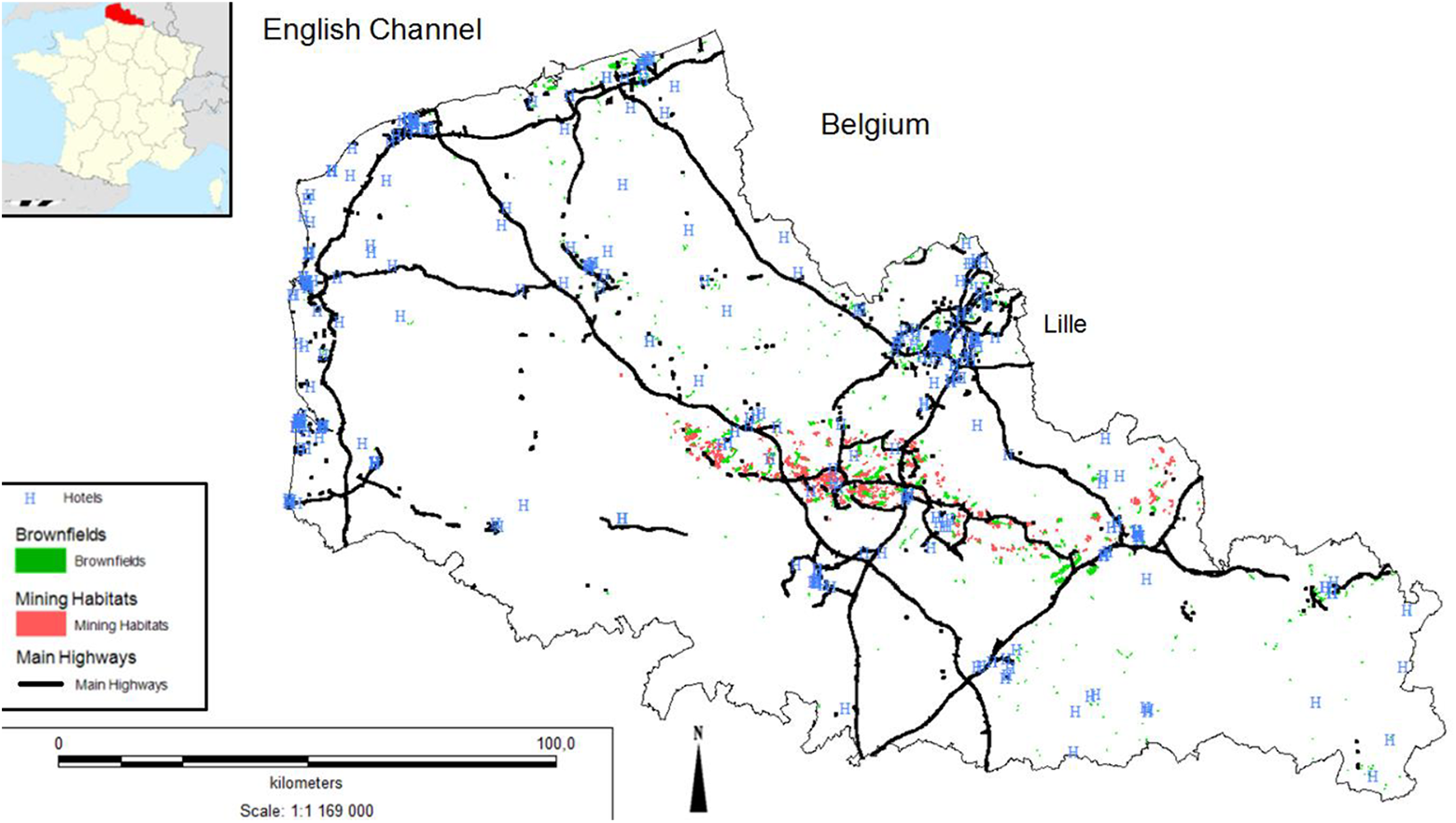
Geographical repartition of hotels in the Nord-Pas de Calais region. Source: Based on the authors’ survey.
Specification and estimation results
This section presents the empirical analysis. In the first subsection, we present the model and the specification. And the second subsection, we discuss the results obtained.
Model specification
The question of the relevant functional form for the regression model has been a matter of preoccupation for a long time in the hedonic pricing literature since there is no theoretical guidance on the best functional form (Andersson, 2000; Rasmussen and Zuehlke, 1990). We used a Box-Cox transformation to choose the specification, as usually recommended (Spitzer, 1984). This test showed that, with our data, the log-linear form is the best specification (see Table A.2. in the Online Appendix 3). Accordingly, the dependent variable is the natural logarithm of the price of a double room while the independent variables enter the regression additively.
Two regression models were estimated, one for the peak season and one for the off-peak season:

where
Equation (3) can be written in a matrix form:

However, the hotel star rating variables can suffer from endogeneity because this classification depends on a multi-criteria process established by Atout France. These variables can thus be correlated with the error term. To solve this potential problem, we used the instrumental variable method in the different regressions, based on the two-stage least square (2SLS) estimator. In other words, the three hotel classification variables were instrumented by all the private variables initially available in the database (see Online Appendix 1; except for the three private variables already included: bar, golf, and air conditioning). This method was preferred to the traditional simultaneous equation models, as it does not require any assumption about the distribution of the independent variables, and it is the most flexible.
Moreover, we know from the literature on spatial econometrics (Anselin, 1988; Gelfand et al., 2010) that equation (4) cannot be estimated consistently by using standard ordinary least squares (OLS), or even 2SLS, if there is spatial dependence. And spatial dependence is very likely to occur in tourism, especially in the case of hotels, given the importance of the spatial dimension in this activity (Kim et al., 2020; Latinopoulos, 2018; Lee and Jang, 2011; Soler et al., 2019; Zhang et al., 2011). Exogenous spatial factors can jointly influence the prices of closely located hotels and their pricing strategies (Balaguer and Pernías, 2013). Higher room prices in a particular area could lead to higher prices in a neighboring area. Hence, spatial autocorrelation phenomenon should be explicitly accounted for in the model. Moreover, spatial autocorrelation can also be caused by a misspecification of the model, omitted variables, or when there are unobservable common shocks affecting neighboring hotels (such as shocks on local costs, e.g., property tax, urban rents, etc.). As such, it can be considered as a useful diagnostic tool helping to detect some misspecification and to improve the quality of the model.
There are several methods in spatial econometrics (Bulteau et al., 2018; Latinopoulos, 2018), among which the spatial error model or the simultaneous autoregressive model (SEM or SAR) based on spatial dependence, the spatial Durbin model (or equivalent; for spatial nonstationarity) (LeSage and Pace, 2008), and the geographically weighted regression model (based on the spatial heterogeneity of the effects of independent variables) (Fotheringham et al., 2002). We decided to use the first category of model for the following reasons: (i) The spatial Durbin model cannot be used here as one of the main purposes of the analysis is to capture the effects of public and network attributes. (ii) The NPdC region is a relatively homogeneous region, with the exception of the city of Lille (homogeneous within the city) for reasons related to urban density (taken into account by the employment density variable); the use of geographically weighted regression is not adapted to our case study.
Econometrically, we have thus to test for the existence of spatial autocorrelation and to use the appropriate specification and estimation procedure. We selected a simultaneous autoregressive model (SAR) with the assumption that the error term

where W is the weighted matrix based on Euclidean distance decay such as
Estimation results
Our estimation strategy is as follows. First, we estimate the model by the 2SLS method without taking into account the possibility of spatial dependence (see equation (4)). The results of this estimation are shown in Table 2, columns 1 and 2. Second, we perform five appropriate non-robust and robust spatial tests based on the Lagrange Multiplier (LM) (see Table 1). The SARMA test allows us to test the general hypothesis of the presence of spatial autocorrelation. Following the Moran index, the comparison of the significance levels of LMlag (for autoregressive or lag endogenous variable), LMerr (for spatial autocorrelation errors), and their robust versions (RLMlag and RLMerr) shows some spatial autocorrelation due to residuals rather than to the lagged endogenous variable. Therefore, we select the SAR for the estimations with endogenous regressors, to get unbiased and consistent estimators of the parameters in equations (5) and (6). The estimation results of the SAR models are shown in Table 2, column 3 for peak season and column 4 for off-peak season. Note that, since the spatial autocorrelation term is significant and strong, the SAR model with independent endogenous variables has more explanatory power than the standard model and provides better estimates. Using these results, we also calculate the linear variations for the selected variables on hotel prices. The results are contained in Table 3.
Lagrange multiplier tests.

Note: PS: peak season; OS: off-peak season. p-value in brackets.
Estimation results based on the 2SLS method and on the SAR model with independent endogenous variables.
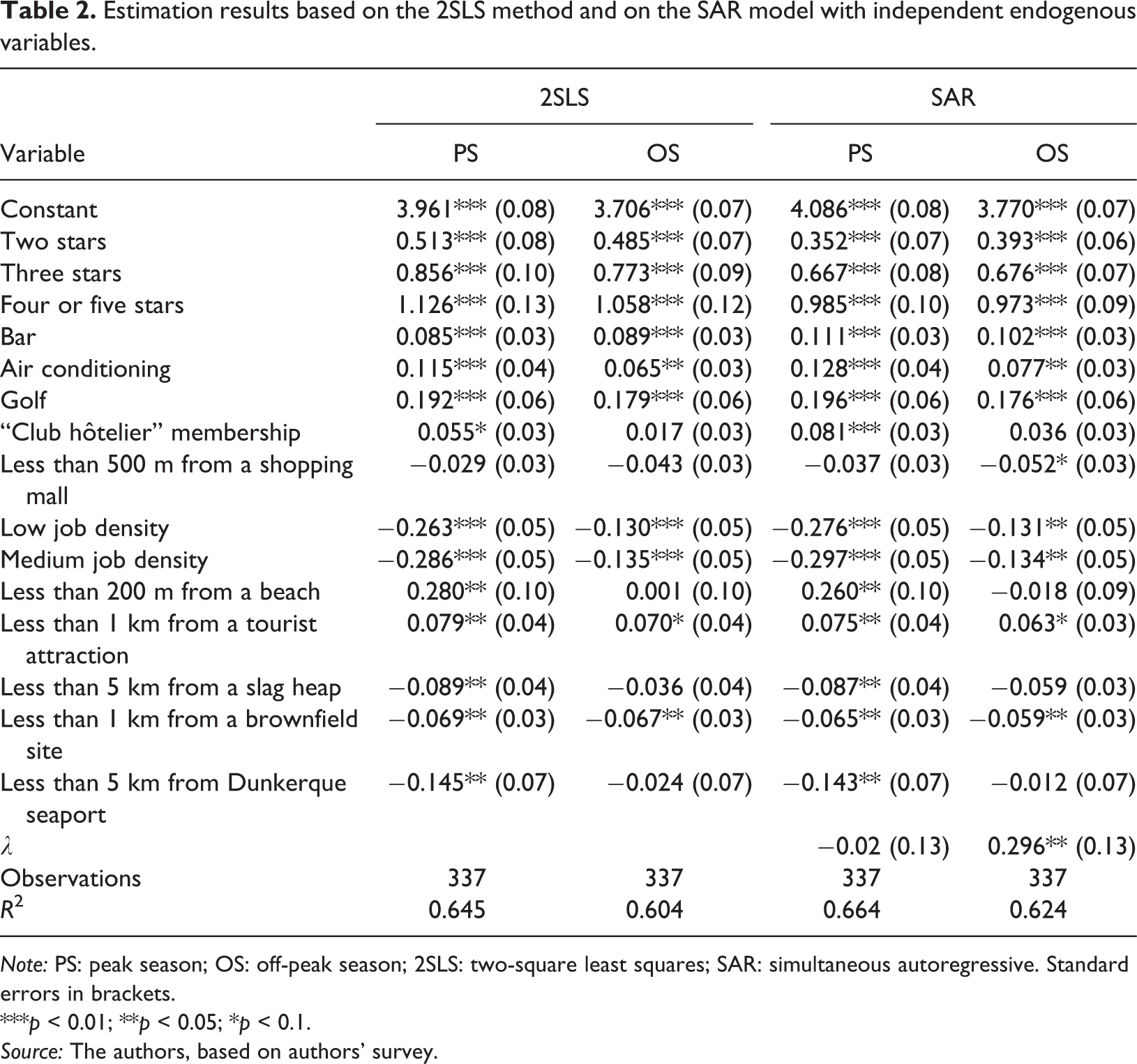
Note: PS: peak season; OS: off-peak season; 2SLS: two-square least squares; SAR: simultaneous autoregressive. Standard errors in brackets.
***p < 0.01; **p < 0.05; *p < 0.1.
Source: The authors, based on authors’ survey.
Estimation results on the linear variation of prices (in euros).

Note: PS: peak season; OS: off-peak season; 2SLS: two-square least squares; SAR: simultaneous autoregressive.
***p < 0.01; **p < 0.05; *p < 0.1.
Source: The authors, based on authors’ survey.
The results have to be interpreted with reference to the first line of Table 3. According to the SAR model with independent endogenous variables and given the selected reference group, the average price of a double room in a one-star hotel located in a high job density area with no other attribute is €59.50 in peak season and €43.38 in off-peak season.
As expected and in accordance with previous studies (Alegre et al., 2013; Andersson, 2010; Rigall-I-Torrent and Fluvià, 2011), the private attributes (hotel star rating, bar, golf, and air conditioning) have positive and highly significant effects on the hotel rates. In particular, the category of a hotel strongly influences its price. A two-star hotel can set a price €25.10 higher than a one-star hotel in peak season with otherwise identical characteristics, whereas a four- or five-star hotel can charge €99.83 more. All the effects are more important during the peak season, as the demand is higher and the occupancy rates rises.
Among public attributes, variables related to network externalities are in most cases significant at the standard levels. Being part of a “Club hotelier” partnership allows hotels to set higher prices, especially in peak season. This can be viewed as an implicit fee charged to customers for a particular service. According to the NPdC CRT, overbooked hotels redirect customers to hotels belonging to the same “Club hotelier,” saving them additional searching costs.
The proximity of a large shopping mall, extending over at least 10,000 m2, has a negative coefficient, even though statistically significant only in off-peak season. Although shopping tends to be part of any travel experience, big shopping facilities, provided in NPdC mainly in the form of hypermarkets, are clearly not valued by tourists when located in close proximity. This negative effect is probably aggravated by their usual location in the outskirts of the city.
Job density matters a great deal. Being located in a low or medium job density area drives the price of hotels down by a substantial amount relative to a high job density area, by almost 29% in peak season and 13% in off-peak season, ceteris paribus (see Table 2). This can be viewed as the result of differences in tourism demand intensity mainly attributable to two factors. First, as they are often located in cities, high job density areas concentrate public facilities, offer a wide range of entertainment activities and catering services, and provide a retail environment which is better adapted to the kind of shopping experience sought by tourists than hypermarkets (UNWTO, 2014). Second, business tourism, which can be a large contributor to the demand for hotel rooms, is often concentrated in these areas. According to the CRT, in 2015, business tourism was responsible for 57% of overnight stays in Lille, the economic and administrative capital of NPdC. Moreover, combined with higher occupancy rates, the traditional lower own-price elasticity of demand for business tourism (Peng et al., 2015) may contribute to explain the ability of hotels located in a high job density area to raise peak season prices much more than hotels located in a low or medium job density area.
Let us finally consider the results for the two groups of public attribute variables that are the most important for our purpose.
First, all variables aimed at capturing the adverse effects of the region’s industrial legacy on the hotel rates display the expected negative sign and are significant for the peak season. This result suggests that consumers unambiguously attach a negative valuation to industrial legacy. The hedonic analysis thus confirms that the industrial past acts as an adverse factor which is likely to contribute to a lock-in mechanism. This could be due to the difference of scale of these variables, since the actively operating Dunkerque seaport extends over 7000 hectares and thus acts as a larger source of nuisances. Note that the repulsive influence of the seaport seems to vanish in off-peak season, becoming statistically nonsignificant. As domestic tourists form the bulk of tourists at this time (La Voix du Nord, 2014), hotels are likely to be used mostly by tourists motivated either by some specific aspects of that city or by non-leisure purposes, such as business, hence by tourists with low own-price elasticity of demand. Actually, off-peak season turns out to be less sensitive to “public bads” as only brownfield sites exert a statistically significant negative effect on hotel rates.
However, and very meaningfully, our estimations also indicate that the proximity of attractive public goods generally enables hotels to charge higher prices. This is especially the case for tourist attractions during both peak and off-peak seasons. Having a beach close by example also exerts a positive, significant, and important influence on hotel rates, but only during the peak season. For the off-peak season, the coefficient has a negative sign, although not significant. This negative effect may be explained by the bad weather conditions usually prevailing in winter by the English Channel, which may lead travelers to prefer a hotel set back from the seaside.
Finally, even though the test on spatial autocorrelation between hotel prices has led us to select a SAR model, note that both specifications give rise to similar results. Moreover, the coefficient of lambda is significant only during the off peak season, which can be interpreted by the fact that, during this period, hotels in the same neighborhood tend to have a very similar pricing policy in order not to lose any part of a relatively low demand. While during peak season, higher occupancy rates allow them to deviate from competitors’ prices, ceteris paribus.
Discussion and conclusion
By creating negative externalities (pollution, spoiled scenery, a poor image, etc.), industrial legacy can be a serious impediment to tourism development and to the overall tourism attractiveness of an old industrial region. It could even block the successful restructuring of such a region by contributing to a mechanism of path dependency and negative lock-ins. The main purpose of this article is to provide an indirect assessment of the cost of this industrial past as valued by tourists. We decomposed hotel prices in Nord-Pas de Calais, a forerunner of the Industrial Revolution in France, into the implicit prices of a set of private and public attributes, including some repellent public attributes inherited from the region’s industrial past. We took into account the presence of potential spatial autocorrelation between hotel rates and used geolocalized data to better address the variability of threshold and distance effects.
This is the first article in the hedonic literature in tourism to evaluate the effect on hotel prices of these adverse public factors for an old industrial region. Most hedonic analyses of hotel prices have been conducted for highly touristic areas, mainly coastal, rural, and urban, and therefore we do not have a real basis of comparison for our results. Any comparison with previous empirical results has to be made cautiously. However, it is worth noting that many of our results are in line with prior findings regarding certain attributes. In particular, star rating has been found here to be a powerful and significant determinant of hotel prices in NPdC, confirming the empirical literature (Abrate et al., 2011; Becerra et al., 2013; Israeli, 2002; Kim et al., 2020; Latinopoulos, 2018; Schamel, 2012; Soler and Gémar, 2017; Zhang et al., 2011). The presence of a bar, a golf course, and air conditioning, three private attributes that we selected because they are not, or only very partially, considered by the French official hotel star rating, also exert a favorable influence on hotel rates. The result on bars is in line with Soler et al. (2019) for the Algarve region, Portugal, and Abrate et al. (2011) for Turin, Italy, who also found a positive effect on hotel prices. Note, however, that Thrane (2007) found no impact of bars on hotels in Oslo, Norway, while Schamel (2012) detected a negative effect for hotels in Bolzano, Italy. The premium associated with a golf course is in accordance with Soler et al. (2019) for the Algarve region, and consistent with Latinopoulos (2018) for Halkidiki, Greece, who considered outdoor sport facilities. On the other hand, the result on air conditioning is distinctive, as Soler et al. (2019) and Abrate et al. (2011) found a negative influence on hotel rates. This positive valuation of air conditioning by tourists in NPdC could be explained by the fact that this equipment is not widely used in this northern region and could be perceived as a luxury amenity.
The proximity to shopping malls is not valued by tourists in NPdC, which seems consistent with the finding by Schamel (2012) for Bolzano, Italy, while Thrane (2007) detected no impact in Oslo. Note, however, that both authors selected the distance to shopping areas, a variable that may be captured in our case by the high job density area variable. As in Abrate et al. (2011) for Turin, Italy, this variable is associated in NPdC with higher hotel prices, probably because, as stated above, it shows a concentration of shopping opportunities and a wide range of entertainment activities and catering services.
Concerning other location attributes, the positive influence of the proximity to a beach is consistent with previous literature (Alegre et al., 2013; Espinet et al., 2003; Latinopoulos, 2018; Rigall-i-Torrent and Fluvià, 2007, 2011; Soler et al., 2019), whereas the proximity to tourist attractions confirms the favorable impact shown by Monty and Skidmore (2003), but is inconsistent with the negative effect detected by Zhang et al. (2011) for Beijing, China. Note that Lee and Jang (2012) and Kim et al. (2020) also indirectly confirm this positive correlation in the case of Chicago, USA, if we assume that the main tourist attractions are located in a downtown area.
Considering the specific repellent public attributes of the NPdC region, inherited from its industrial past, our analysis shows that they all have a significant negative impact on hotel rates, particularly during the peak season. In other words, consumers attach negative marginal values to the visible evidence of industrial legacy, suggesting an adverse influence on the area’s attractiveness and a likely contribution to a lock-in mechanism.
However, our analysis also reveals that this negative impact can be offset by the presence of attractive public goods, particularly tourism attractions. According to our estimations, the implicit price of some of these adverse public attributes in NPdC is in the same order of magnitude, in absolute value, as the implicit price of a tourist attraction. The proximity of a brownfield site or a slag heap decreases hotel rates during the peak season by, respectively, 6.5% and 8.7%, whereas the presence of a tourism attraction increases them by 7.5% (see. Table 2). In other words, having an attractive public attribute close by could alleviate, or even wholly compensate for, the presence of an adverse public attribute inherited from the industrial past. The dissatisfaction caused to consumers by any of these inherited “public bads” could well be counterbalanced by the satisfaction provided by a new exploited tourism resource. This result leads to a conclusion of particular interest to hotel managers and public sector policy makers. It suggests that there is some room for public policy to compensate for the detrimental effects of industrial legacy on the region’s attractiveness and to break free from certain negative lock-ins. It provides a rationale to local regeneration initiatives such as the opening in Lens, a former coal-mining town, of a satellite branch of the Louvre Museum (the Louvre-Lens) in 2012 on an ancient mine yard surrounded by slag heaps and mining villages. This project was explicitly seen by the authorities as a tool for reviving the area and modernizing the region’s image (Borin and Paunović, 2015), in an attempt to create the so-called Bilbao effect (Lord, 2007) which resulted from the opening of the Guggenheim Museum in Bilbao in 1997. Other examples of a similar approach are the Tate in Liverpool, the Museum Folkwang in Essen, the Tate Modern in London, and the Pompidou-Metz Museum in Metz, the capital city of Lorraine, another region belonging to France’s rustbelt (Plaza and Haarich, 2009; Spoehr, 2014). Our results support the relevance of this type of policy, at least for NPdC, and more generally of any policy related to a strategy of counteracting inherited public bads through the creation of new attractive public attributes or the enhancement of existing ones. Our results can also be viewed as providing some support to the approach of culture-led regeneration (Benneworth and Hospers, 2009; Vickery, 2007) and tourism-led regeneration (Abrate et al., 2011; Nel and Binns, 2002; Ozden, 2008; Wise and Harris, 2017; Wise and Jimura, 2020). According to this literature, culture and tourism can play a crucial role in regenerating old industrial regions and cities (Harrison, 2009; Heidenreich and Plaza, 2015; Van der Borg and Russo, 2008), especially as “a booster of regional image” more than through direct job creation (Benneworth and Hospers, 2009: 2). They can be used as a development tool to reconstruct the negative image associated with deindustrialization by promoting a “post-industrial” image (Gomez, 1998).
Therefore, transforming the region’s numerous historical legacies and natural assets into valuable resources for many forms of tourism (legacy tourism, memorial tourism, historic tourism, warfare tourism) is confirmed to be an excellent option for the region and should be reinforced (see e.g. the museum La Piscine of Roubaix, the Remembrance Trails of the Great War, the twelve Vauban citadels, the V2 rocket launching site at Helfaut, nature reserves and national parks, etc.). As seen above, industrial legacy can be a potential tourism endowment for the region, giving rise to industrial heritage-based tourism (Conlin and Jolliffe, 2010; Edwards and Llurdés i Coit, 1996; Jones and Munday, 2001; Xie, 2015). NPdC has started to promote its many inherited material vestiges (see e.g. the mining site of Wallers-Arenberg and the mining historic center of Lewarde). This study confirms the merits of this policy and the need to design and implement appropriate marketing strategies, especially since industrial vestiges can give rise to new and original tourism market opportunities, like skiing on a slag heap (e.g. the ski resort of Noeux-les-Mines).
Site labelling and certification can be a powerful tool for such a strategy as they may provide a cultural attractiveness to scorned inherited sites, helping to erase the usual perception of their supposed or real unpleasant features. The inscription in 2012 of the mines of the Nord-Pas-de-Calais region to the list of UNESCO World Heritage Sites as ‘a living and changing landscape’ falls into this category. Site labelling and certification can also give more visibility to existing tourism resources, contributing in another way to counteract inherited “public bads.” For example, evidence shows that Dunkerque, whose industrial seaport was found to have such a negative effect on hotel rates, benefited in terms of tourist frequentation from having its belfry (Beffroi de Saint-Eloi) included in the 23 belfries from the Nord-Pas-de-Calais and Picardy regions added in 2005 by UNESCO to the list of the World Heritage Sites (La Voix du Nord, 2014).
Our analysis also provides useful information to hotel managers. For a manager, it is very important to determine how hotel features are valued by consumers (Chen and Rothschild, 2010), especially when the hotel location may be the source of serious disamenities. The findings show that the negative influence on hotel prices of the proximity to repellent public attributes inherited from the industrial past can be fully compensated for by promoting any of the three significant private attributes, that is, a bar, golf course, and air conditioning. According to Table 2, hotel rates during the peak season are reduced by 8.7%, 6.5%, and 14.3% due to the proximity to, respectively, a slag heap, a brownfield site, and the seaport of Dunkerque. However, at the same time, the presence of a bar, a golf course, or air conditioning in a hotel allows hotel managers to charge a premium of, respectively, 11.1%, 19.6%, and 12.8%. These results suggest that the negative valuation by tourists of the industrial legacy on hotel rates may be easily counterbalanced by the investment in some well-identified private attributes. In a similar way, the participation in a hotel partnership (club hôtelier) increases hotel rates by 8.1%, which is sufficient to cancel out the detrimental effect of a slag heap or a brownfield site. By shedding light on which attributes are worth developing, this analysis provides valuable information to hotel managers for their investment strategy. This information can also be used in a communications strategy: the manager should communicate about the attributes positively valued by tourists to offset any potential bad perception of the hotel due to the presence of the industrial past.
However, as pointed out by Soler et al. (2019), the findings from one region cannot always be extrapolated to others. The reason is that hedonic models need to concentrate on unique markets defined as geographic areas with a distinct image (Palmquist, 2005; Soler et al., 2019). The regions studied have to display some internal spatial homogeneity. Therefore, the findings of the present study, while valid for NPdC, should be interpreted with caution when considering other old industrial regions. Many other investigations are needed on this kind of region before general lessons could be drawn.
This study has some limitations which should be kept in mind. First, it addresses a specific point in time, not a period. Temporal data could reveal that the negative effects of industrial legacy might have been stronger 10 or 15 years ago, when the local strategy of creation or enhancement of attractive public attributes, especially based on historic and industrial legacy, was at an early stage. In addition, the study specifically focused on hotel rates, whereas other forms of accommodation, especially camping sites, are widely used in the NPdC region. However, data on the latter are dramatically lacking. Moreover, the effects on prices of yield management and, more importantly, of online reservation platforms have not been taken into account. And in fact, effective prices can seriously diverge from declared prices, which were chosen as the dependent variable in our study due to data availability. Nevertheless, our results can be interpreted as averages. And the market power of online reservation platforms has been recently restricted by the legislation to the benefit of the hotels which are now in a better position for negotiating rates.
In terms of research, the first task to complement this article would be to add a temporal dimension (in addition to the geographical dimension already considered). More specifically, it might be possible to measure the effect of cultural and/or sports events organized by local authorities on tourism attractiveness. Second, this analysis could be extended to housing market prices.
Supplemental material
Supplemental Material, Appendices. - Industrial legacy and hotel pricing: An application of spatial hedonic pricing analysis in Nord-Pas-de-Calais, France
Supplemental Material, Appendices. for Industrial legacy and hotel pricing: An application of spatial hedonic pricing analysis in Nord-Pas-de-Calais, France by Loïc Lévi, Jean Jacques Nowak, Sylvain Petit and Hakim Hammadou in Tourism Economics
Footnotes
Author's Note
Sylvain Petit is also affiliated with Unversity of Perpignan Via Domitia, France.
Declaration of conflicting interests
The author(s) declared no potential conflicts of interest with respect to the research, authorship, and/or publication of this article.
Funding
The author(s) disclosed receipt of the following financial support for the research, authorship, and/or publication of this article: This work was supported by the Conseil Régional Nord-Pas-de-Calais and the CETOP (Centre d’Etude sur le Tourisme en Océanie Pacifique). The authors want to thank the participants of the IATE 2015 conference (Hong-Kong), the LISA seminar, and the CAEPEM seminar for their comments and suggestions.

Supplemental material
Supplemental material for this article is available online.
References
Supplementary Material
Please find the following supplemental material available below.
For Open Access articles published under a Creative Commons License, all supplemental material carries the same license as the article it is associated with.
For non-Open Access articles published, all supplemental material carries a non-exclusive license, and permission requests for re-use of supplemental material or any part of supplemental material shall be sent directly to the copyright owner as specified in the copyright notice associated with the article.
