



Abstract
Does a country need good institutions to use tourism as an economic development activator? From a sample of non-organisation for economic co-operation and development countries, this article aims to assess the feasibility of tourism-led growth in different institutional settings. The results not only suggest that a tourism shock is good for gross domestic product growth but that inclusive institutions enhance the ability of a country to convert tourism into growth. It also emphasises that beyond tourism that remains a major transmission channel for growth, inclusive countries largely benefit from growth in their neighbouring countries. They are more able to import economic growth from abroad.
Introduction
It is commonly acknowledged that good institutions promote economic growth (Acemoglu et al. 2001; Acemoglu et al., 2019; Papaioannou and Siourounis 2008). The reason seems to be that good institutions allow innovation through creative destruction (Acemoglu and Robinson, 2012). But in an integrated world, where the industry remains quite concentrated within a small number of countries (Fujita et al., 2001; Krugman, 1991), are institutions also important for non-industrial countries? If a few countries fuel worldwide economic growth through innovative activities, others can import growth by specialising in traditional activities, such as tourism, relying on the terms of trade improvements to enhance their welfare in the long run (Baumol and Bowen, 1966; Nowak et al., 2007). With such a specialisation pattern, having good institutions would seem pointless for tourism countries. Indeed, some scholars have doubts about the effect of democracy on growth (Barro, 1996; Pozuelo et al., 2016).
Yet, institutions could impact growth in tourism countries through another channel than innovation. Take the example of centralised extractive institutions as defined by Acemoglu and Robinson (2012). With such institutions, the political rulers’ objective might be to maximise the wealth of an oligarchy that is in control of the main economic sectors. In terms of tourism policy, this would lead to a price-maker behaviour on the international tourism market, which is a good thing for domestic growth. But, on the other hand, maximising the oligarchy’s wealth implies acting as price-maker also on the local labour market to the detriment of domestic growth. In contrast, inclusive institutions would take the good side of this price-making behaviour (from the domestic point of view), namely, acting as a cartel on the international tourism market but would let competition fix the wages on the domestic market.
This article assesses the role of institutions as a mediating factor in the relationship between tourism and growth in non-industrial countries. A vast literature exists on tourism-led economic growth. It points out the positive effect of tourism demand on economic growth (Balaguer and Cantavella-Jorda, 2002; Brida et al., 2016; Paci and Marrocu, 2014; Schubert et al., 2011; Stauvermann and Kumar, 2016). However, only a few articles focus on institutions as a mediator variable (Sequeira and Nunes, 2008, Antonakakis et al., 2016). In this article, we estimate the impact of tourism on growth in a panel of non-organisation for economic co-operation and development (OECD) countries. Indicators of institutional quality are used to identify different groups of countries. 1 We show that the impact of tourism on growth is stronger in the group of countries that have inclusive institutions.
A common issue in the literature on the tourism–growth nexus is reverse causality. Indeed, it is fair to assume that economic growth is an attraction factor for tourists. Hereafter, we implement an original strategy to account for reverse causality problems. We construct instruments to measure tourism flows based on a gravity equation restricted to push factors (as by Jaumotte et al., 2016). Our results suggest that the positive impact of tourism on growth is magnified when we use those instruments. Moreover, the most inclusive institutions seem to improve the ability of a country to convert a positive tourism shock into economic growth. After a brief overview of the literature, the second section details our empirical strategy and data while the third section presents the results. The final section puts these findings in perspective.
Brief overview of the literature
This section intends to summarise the literature on the tourism–growth nexus and presents the research gap that we are trying to fill. Table 1 proposes a comparison of the empirical results for tourism development and economic growth. Since the early 2000s, a number of articles studied the tourism–growth nexus in a national context using cointegration techniques to deal with the reverse causality issue. Among others, the pioneering paper written by Balaguer and Cantavella-Jorda (2002) on the case of Spain has to be mentioned. They establish the positive effect of tourism development on economic growth performances in Spain over the period 1975–1997. Using a similar approach, other authors, such as Durbarry (2004), for the case of Mauritius, confirm the existence of this positive causal relationship between tourism development and economic growth. For some countries, a bidirectional causal relationship has been found meaning that not only tourism has a positive impact on growth but that economic growth tends to improve tourism performances. This is true for example for Taiwan (Kim et al. 2006). A key feature of these articles lies in the fact that they totally ignore the potential effect of institutions on the tourism–growth nexus.
Comparison of the empirical results for tourism development and economic growth.

Sequeira and Nunes (2008) are the first to address this question studying a sample of 94 countries over the period 1980–2002. Lagged variables are used as instruments in a panel GMM model to deal with reverse causality and two variables are alternatively used to proxy institutional quality, that is, Black Market Premium and International Country Risk Guide. They find that tourism has a positive impact on growth in different subsets of countries based on income and size. Lee and Chang (2008) using the heterogenous panel cointegration technique are of particular interest. They studied the tourism–growth nexus over the period 1990–2002 for two groups of countries: a group of OECD countries on the one hand and a group of non-OECD countries on the other. They found that the positive impact of tourism on growth is higher for non-OECD countries. More recently, using the panel VAR methodology on a sample of 98 countries over the period 1995–2011, Antonakakis et al. (2016) show that tourism fosters growth in democratic countries but that this is not the case in non-democratic ones.
The present article goes a step further in assessing the role, if any, of good institutions in the ability of non-OECD countries to use tourism to enhance economic growth. More advanced countries experience endogenous growth due to their ability to innovate. We focus on non-OECD countries since they are likely to be less innovative than OECD countries and need to import growth from abroad. A key question is to understand if inclusive institutions are required to import economic growth from abroad through a tourism boom. As shown above, to date, institutions are proxied without a clear theoretical background in the tourism literature. Our article is the first to use the concepts of inclusiveness and stability to characterise the institutional setting of each destination. Our approach makes it possible to understand if inclusiveness and stability are necessary features for non-industrial tourism destinations.
Empirical strategy
Econometric model
This section describes our empirical strategy. First, the estimated model is presented. Then, the method used to account for institutional differences is detailed. Finally, we discuss the construction of our original instrument to deal with the potential reverse causality issue in the tourism–growth nexus.
To assess the impact of tourism flows on gross domestic product (GDP), we use a two-way fixed-effect model:

with
We believe that the two-way fixed-effect model has the advantage of being clear and transparent and is a relevant way to account for changes in GDP within a panel data setting. Indeed, the main traditional factors of growth (investment, education, demography, etc.) are unlikely to have instantaneous impacts on GDP (Diffenbaugh and Burke, 2019; Mankiw et al., 1992). Rather, if a country experiences an improvement in educational achievements, for instance, its GDP per capita will tend to rise over the whole period. This effect will be captured by the country’s fixed effect. On the other hand, it seems reasonable to assume that the countries inside the panel share both a common trend and common fluctuations that will be captured by the years fixed effects. Idiosyncratic fluctuations in tourism flows, on the other hand, can be viewed as demand shocks with essentially instantaneous impacts on GDP. To be clear, this specification does not allow to assess the impact of tourism on the level of GDP, but rather the ability of tourism to enhance growth in GDP.
While the existing literature mostly uses econometric techniques such as VARs or various cointegration methods to deal with the reverse causality issue, we think the two-way fixed-effect model is better suited to the introduction of a proper instrument for the tourism flow (‘Empirical strategy’ section).
We use an unbalanced panel of 137 developing countries from 1995 to 2013. The data for GDP in purchasing power parity and population are from the WDI (The World Bank, 2018). Tourism data are from the Compendium of Tourism Statistics (UNWTO, 2015). The complete set of countries is presented in Online.
Institutions
The aim of this article is to assess the mediating role of institutions in the tourism-to-growth causal link. Our strategy consists in splitting the countries into three groups, defined by their institutional properties at the beginning of the period. 2 Having stable groups defined by their initial institutional properties allows avoidance of endogeneity problems. Indeed, reverse causality is one of the main concerns when it comes to assess the impact of institutions on growth. 3 Clearly, if the institutions alter the impact of tourism on growth, the coefficient for tourism (α in equation (1)) will differ between groups. On the other hand, if growth impacts institutions, then the institutional changes that will occur within the period 1995–2013 will not affect the estimated coefficient since groups are stable.
To create the three groups, we follow closely Acemoglu and Robinson (2012) who identify two criteria for a country to have inclusive institutions. The first is stability. The existence of a sufficiently strong central state to enforce a peaceful everyday life is a prerequisite to inclusiveness. Without stability, a country risks facing permanent violent conflicts between small groups seeking to seize political and economic power. This is what we call hereafter unstable extractive institutions. But stability is not a sufficient condition for inclusiveness. A stable country led by an oligarchy will not be inclusive either. Here, the political power will likely seek to maximise the oligarchs’ wealth.
Thus, the three groups we define and the expectations we form are as follows: The group of extractive unstable countries: such countries are very unlikely to take advantage of a tourism shock because stability is a feature we believe is valued by tourists (Detotto et al., 2021). This should result in a low value of α for this subgroup. Since we tried to make groups of equal size, we included in this group the third of the countries that had the lowest score in the stability index from Kaufmann et al. (2016). The group of extractive stable countries: such countries are sufficiently stable to attract tourists but will limit tourism supply to act as a two-sided cartel. To maximize the oligarchs’ wealth, the political leaders will extract a monopoly rent from the tourists and a monopsony rent from the local labour market. Thus, we expect an intermediate value for α in this group. We constructed the group by assuming that all the countries that are not included in the first group are sufficiently stable to attract tourists. Then, we focused on a second indicator to discriminate between stable extractive countries and inclusive countries, namely ‘voice and accountability’. This is a measure of citizen’s ability to participate in government selection along with freedom of expression, association and the media. Among the countries that are not included in the first group, we select the half with the lowest score on this indicator as the stable extractive countries. The group of inclusive countries are the remaining ones: in these countries, the political leaders are still likely to enforce a cartel behaviour on the tourism market to maximise the country’s GDP but will not try to extract a monopsony power from the local labour market. As a consequence, those countries should be the ones that take greater advantage of tourism flows. Thus, we expect a high value of α for this group.
Notice that world governance indicators are not available for all the
As indicated above, we intended to construct groups of equal size. Thus, this classification should be interpreted in relative terms. Being included in the group of inclusive countries does not mean that one country is fully inclusive (if it makes any sense at all) but that it is closer to being inclusive than the ones in the other groups.
Figure 1 shows the characteristics of the three different institutional settings, Figure 2 shows the allocation process of the countries to the three groups, which are depicted in Figure 3.
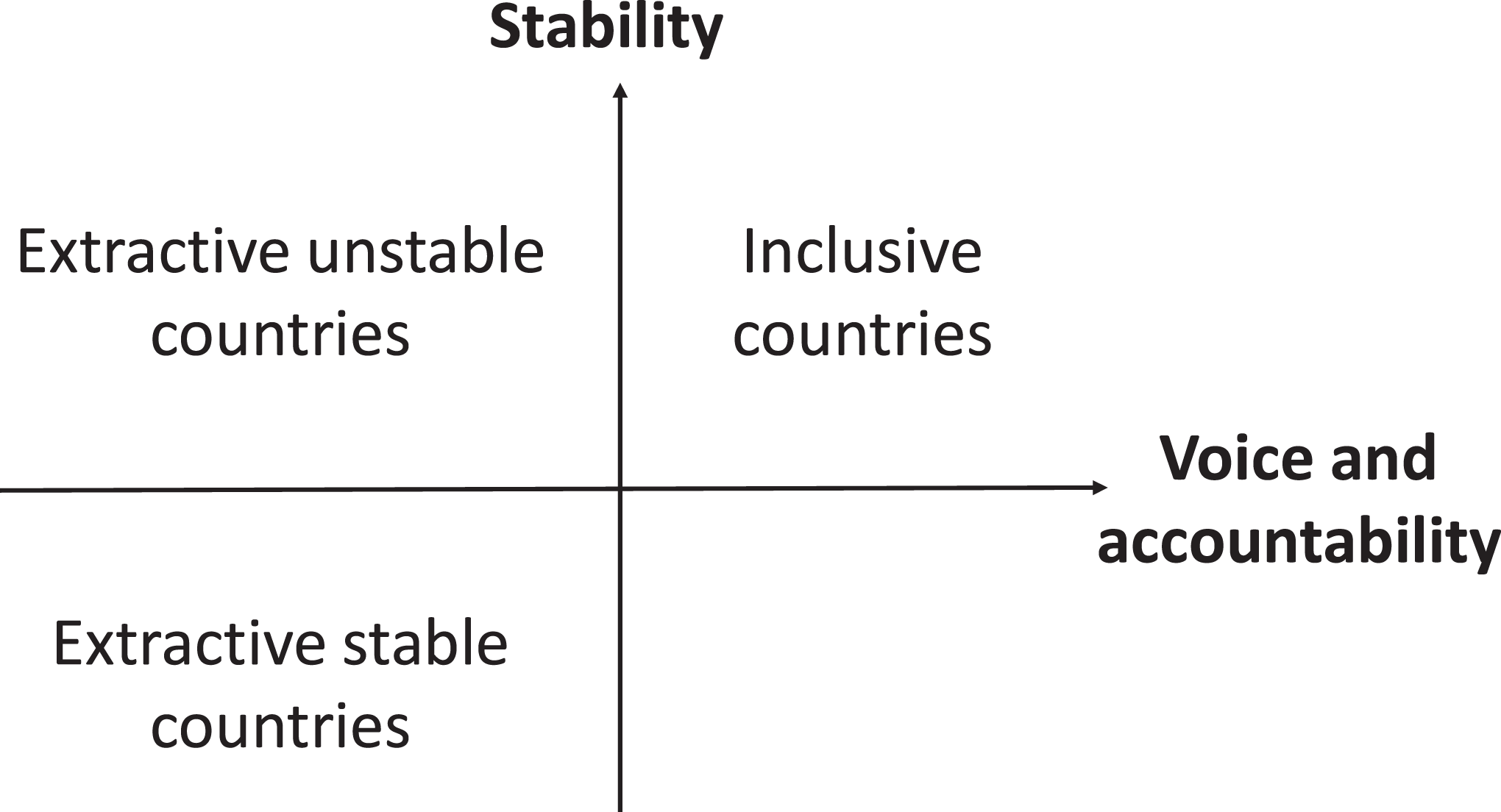
The dimensions of inclusiveness.
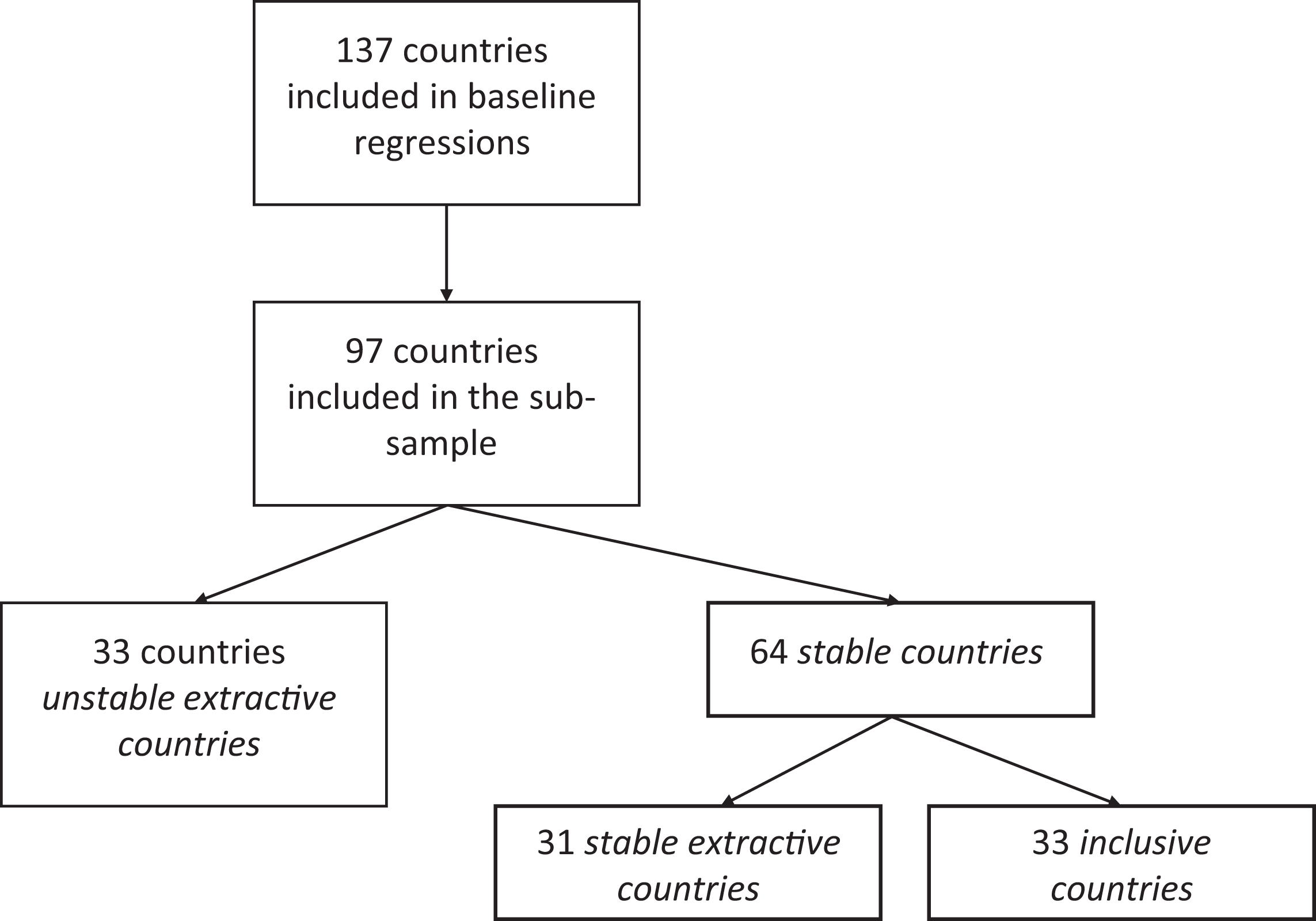
Construction of the different groups of countries.
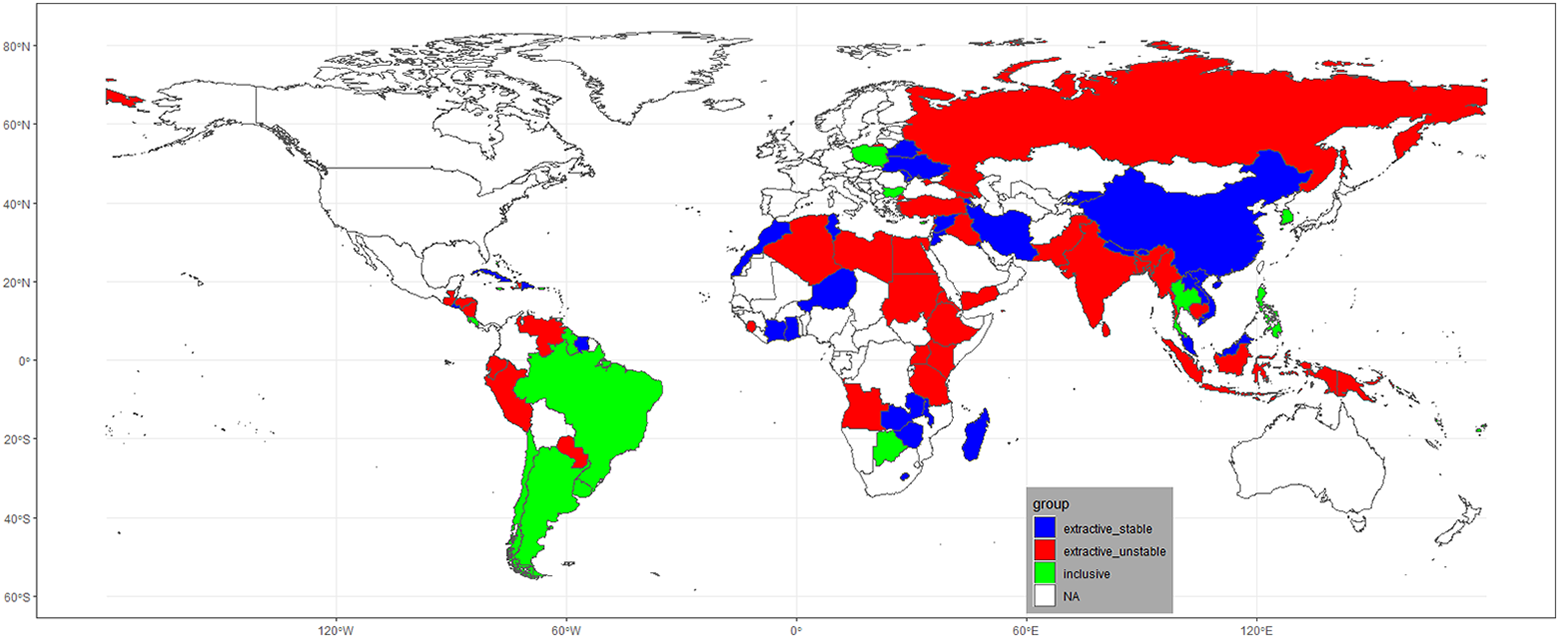
Map of countries groups.
Instrument variable for tourism
One of the main biases we can expect when estimating equation (1) is reverse causality. While tourism can enhance a country’s wealth, it is arguable that tourists are attracted by rich countries, ceteris paribus, that provide better sanitary conditions, safety, infrastructures, and so forth. Our strategy to build an instrument for tourist flow mimics the one used by Jaumotte et al. (2016) to create an instrument for migration, namely, we estimate the following gravity equation

where
This equation is quite unusual in the sense that it does not feature the GDP of the host country. While this specification is at odds with the classical theoretical foundations of gravity equation (Anderson and van Wincoop, 2003), it is a useful tool to create an instrument for tourism. Indeed, all the right-hand side variables of equation (2) are presumably orthogonal to the idiosyncratic shocks to the GDP of the host country. Bilateral regressors are taken from CEPII’s geodistance dataset (Mayer and Zignago, 2011).
After estimating equation (2) (cf Table 2), we computed the predicted values of the bilateral tourist flows. This involves both in-the-sample and out-of-sample calculations since some tourism data are missing in our database. We then simply calculate all the predicted tourist flows for a given host country in given year to get our instrument. The link between the instrument and the observed tourist flows is shown in Figure 4.
The gravity equation used to create the instrumental variable.*
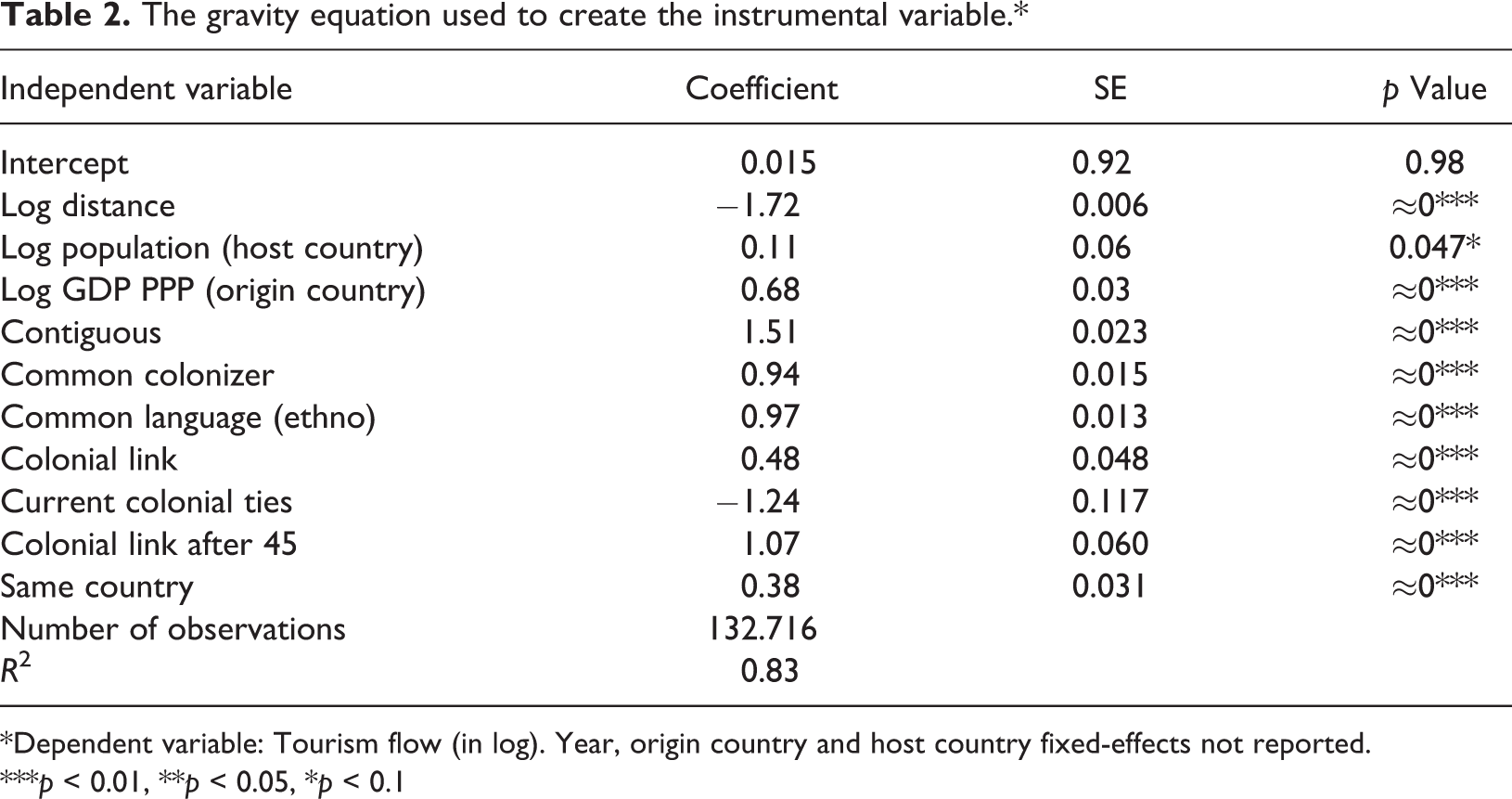
*Dependent variable: Tourism flow (in log). Year, origin country and host country fixed-effects not reported.
***p < 0.01, **p < 0.05, *p < 0.1
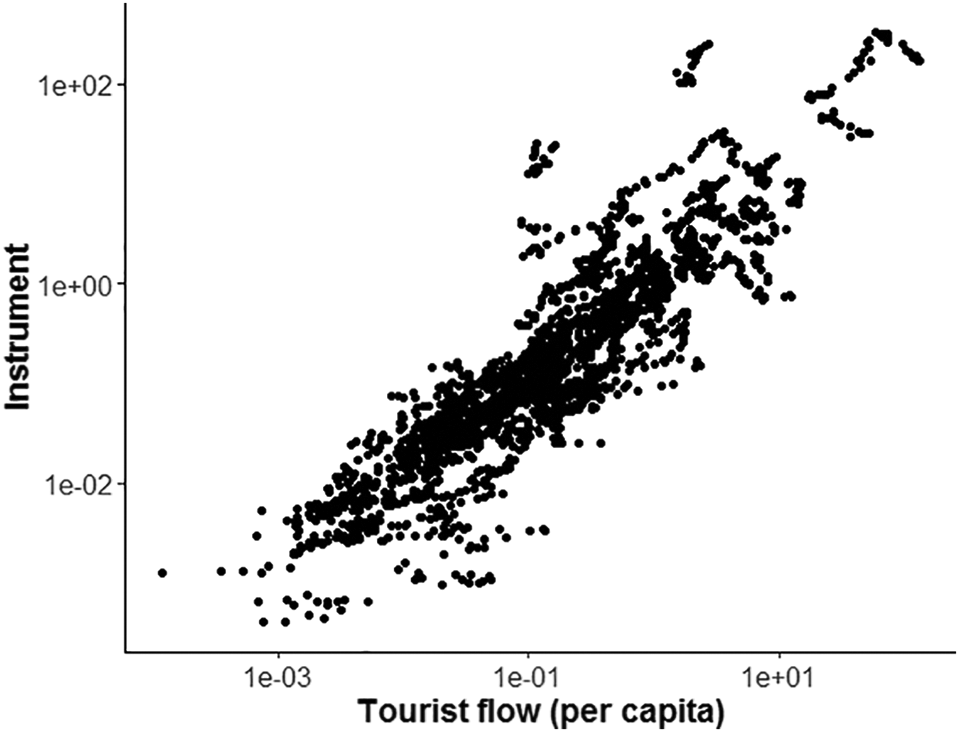
Relationship between the instrument and the tourism flows.
Results
This section details our results. We first estimate the basic two-way fixed-effect model as our baseline specification. Next, we show how the instrumentation of the tourism flows dramatically strengthens the role of institutions as a mediator variable in tourism-led growth.
Panel regression
Table 3 below summarises the estimation results of our benchmark specification on the whole sample and the three sub-samples. The log of GDP per capita is regressed on the observed log of the per capita tourism flow using the two-way fixed-effect estimator. The elasticity of per capita GDP to per capita tourism flow is positive and strongly significant in the four models.
Regression results using the two-way fixed-effect estimator.*
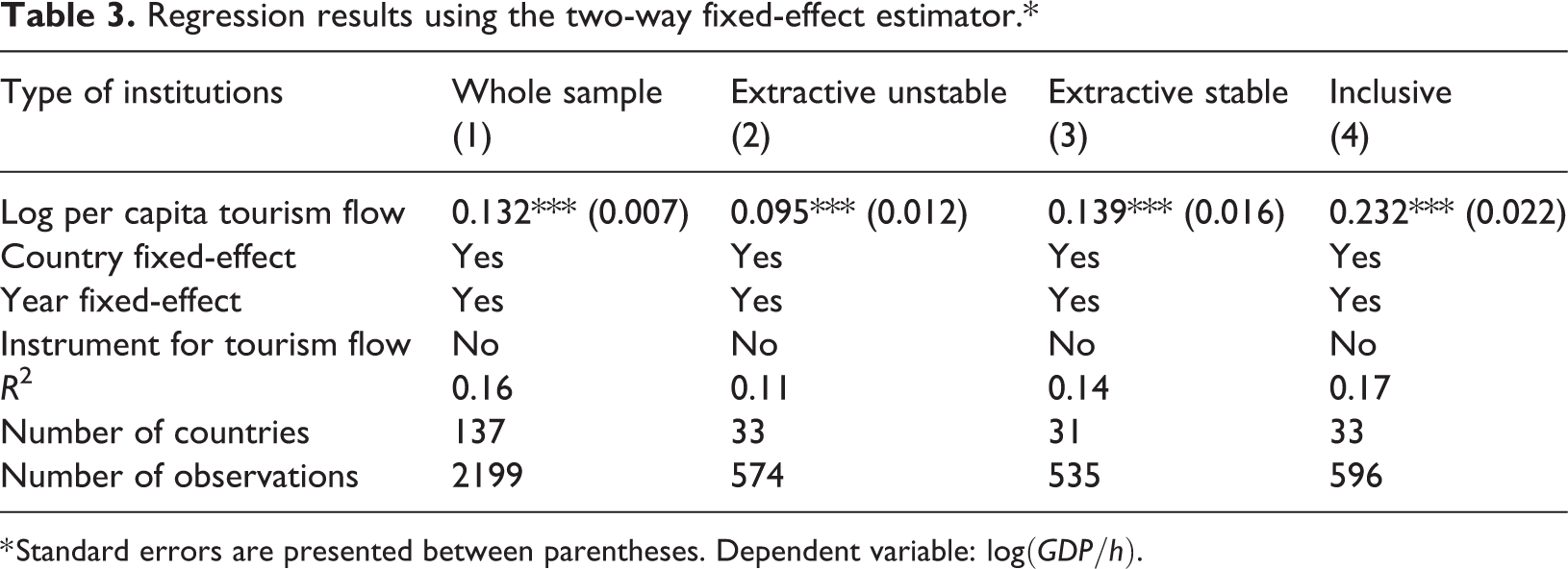
* Standard errors are presented between parentheses. Dependent variable:
Model (1) is estimated on the full sample of 137 countries and the elasticity is 0.132. This result is similar in magnitude to the results of Sequeira and Nunes. They find an elasticity of 0.106 in a sample of 92 countries over the period 1980–2002. Model (2) looks at the group of extractive unstable countries and it can be seen that the elasticity is only 0.095. That is to say that the positive effect of tourism on GDP per capita exists but is lower for extractive unstable countries.
Model (3), dealing with extractive stable countries, emphasises that in this group, the impact of tourism on GDP per capita, 0.139, is similar (slightly higher) to the one observed for the full sample of countries. The most interesting finding comes with model (4), dealing with inclusive countries. An elasticity of 0.232 is found. When the tourism flow in an inclusive country increases by 1%, GDP per capita is 0.232% higher, so that the positive economic effect of tourism on the country is 2.4 times larger in the inclusive group compared to the extractive unstable group.
These findings stress that the effect of tourism on GDP is always positive and that this is all the more true for the most inclusive countries. Furthermore, the effect of tourism is stronger for the group of extractive stable countries (oligarchy) than for extractive unstable ones.
Instrumented regression
Previous estimates are potentially biased due to the reverse causality issue. To cope with this problem, models have been re-estimated substituting the log of the observed tourism flow per capita by its predicted value, as explained in the third section. Results of these instrumented regressions are presented in Table 4. Models (1), (2), (3), and (4) have to be compared to models (5), (6), (7), and (8), respectively.
Instrumented regression results using the two-way fixed-effect estimator.*
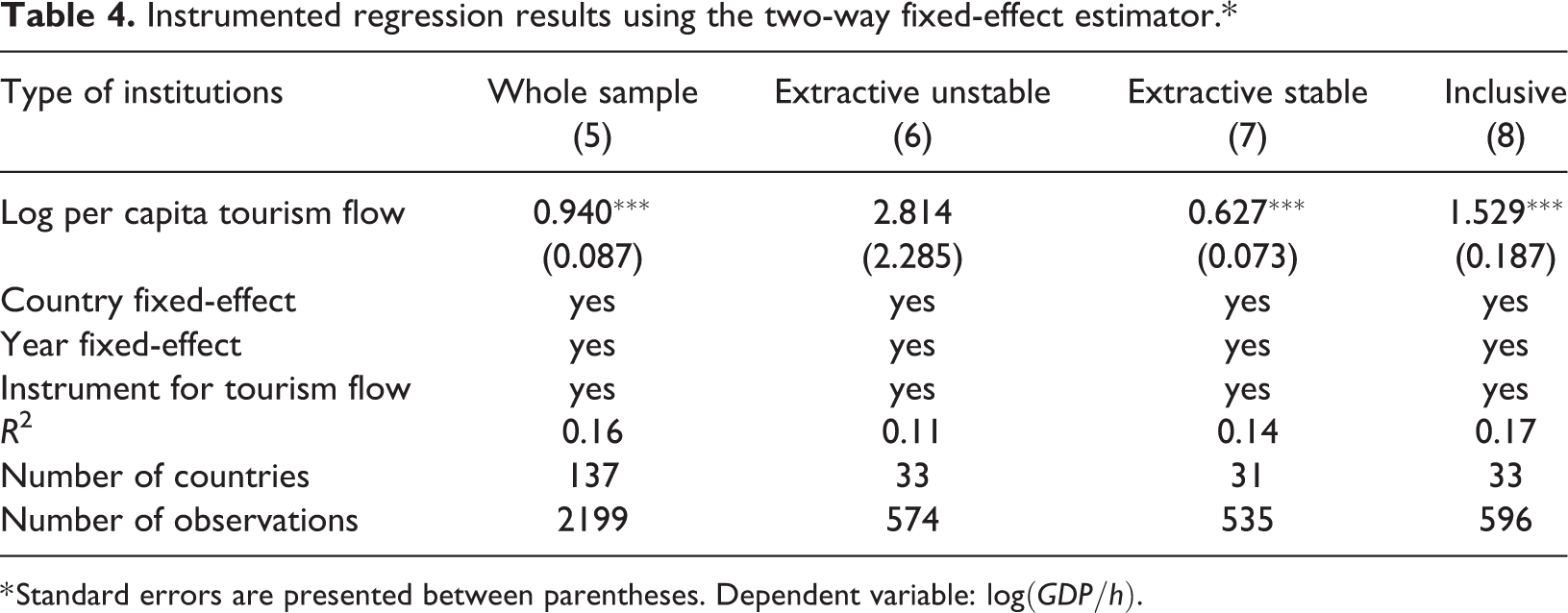
* Standard errors are presented between parentheses. Dependent variable:
Two major changes arise as a result of our instrumentation strategy. First, for every sub-sample, the value of the coefficients is much larger than suggested by naive non-instrumented regressions. Second, the effect of tourism flows on GDP is not significant under every institutional setting anymore.
More precisely, GDP elasticity to tourism is multiplied by a factor of 7 for the whole sample, a factor of 4.5 for the group of extractive stable countries and a factor of 6.5 for inclusive countries. For the whole sample, the elasticity reaches
Furthermore, while model (2) suggests a positive significant effect of tourism on GDP per capita for extractive unstable countries, model (6), its instrumented counterpart, does not support this conclusion. Despite the large value of the estimate, the standard error is so large that the coefficient is not significant. In other words, tourism has no significant effect on GDP per capita in extractive unstable countries.
To sum up, instrumentation reveals that (1) stability is required for countries to benefit from a positive tourism shock and (2) inclusive institutions make it possible to enhance the positive effect of tourism on growth.
Discussion and conclusion
The results presented in the fourth section confirm two well-established facts: 1—tourism is a growth-enhancing activity; 2—institutions matter for growth. In this section, we want to highlight the novelty of these results and discuss the important difference in magnitude between the instrumented and the non-instrumented regressions.
In the existing literature on the tourism–growth nexus, the mediating effect of institutions is often disregarded. This is partly due to the fact that accounting for such an effect is a challenging task. One has to deal with two potential reverse causality issues, one between tourism and economic growth and another one between economic growth and the quality of the institutions. In developing a proper instrument for tourism flows and differentiating institutional settings between three stable groups of countries, our methodology allows us to cope with both issues.
From a sample of non-OECD countries, our article aims to assess the feasibility of tourism-led growth under different institutional settings. Does a country need good institutions to use tourism as an economic development activator? The results not only suggest that a tourism shock is good for GDP growth but that inclusive institutions enhance the ability of a country to convert tourism into growth.
The introduction of an instrument for the tourism flows strengthens these results. The increase in GDP for inclusive countries is more than proportional to the increase in tourism. The high values of elasticities identified in this article tend to corroborate the fact that the positive effect of tourism on growth is higher for non-OECD countries (Lee and Chang, 2008). Indeed, such a significant impact of tourism on growth confirms that beyond the direct effects of tourism on GDP, tourism receipts contribute to economic expansion through multiple channels. As suggested by Brida and Risso (2010) and Pérez-Rogríguez et al. (2015), tourism is also a tool to promote capital accumulation in other sectors and favours competition. Also, it has been shown that tourism inflows improve the ability of countries to participate in international trade (Khan et al., 2005; Santana-Gallego et al., 2010; Santana-Gallego et al., 2016) and, in turn, this greater openness stimulates growth (López, 2005). Furthermore, with their study of a sample of 179 EU regions, Marrocu and Paci (2011) provide evidence that tourism can be an additional channel in the diffusion of knowledge between regions and firms resulting in an increase in regional productive efficiency. Our article contributes to tourism–growth literature by showing that good institutions have a strong positive impact on the tourism–growth relationship. Our results may appear too optimistic in that sense that part of the effect measured should probably not be attributed to tourism. One has to bear in mind that the push factors used to instrument the tourism flows are likely to have an impact on other economic variables. Our results capture the impact on the GDP of a country of an increase in the GDP of neighbouring countries. The interest of using this instrument is to show that, in general, non-OECD (less innovative) countries with inclusive institutions are more prone to import economic growth from abroad, as suggested by Nowak et al. (2007) for tourism destinations.
The results presented in this article support the opportunity of a tourism-led growth strategy for countries endowed with inclusive institutions. The policy implications of this result would be even stronger if it was possible to show that a positive tourism shock is associated to institutional evolutions towards inclusiveness in extractive countries. This question of the ability of tourism to induce positive institutional changes, leading to a virtuous circle of development opportunities, is a prominent avenue for future research.
Footnotes
Acknowledgement
We would like to thank participants to the internal seminar of our department UMR CNRS LISA (Corte).
Declaration of conflicting interests
The author(s) declared no potential conflicts of interest with respect to the research, authorship, and/or publication of this article.
Funding
The author(s) received no financial support for the research, authorship, and/or publication of this article.
