



Abstract
This paper investigates the effects of COVID-19 pandemic-related uncertainty focusing on the US tourism subsectors, including airlines, hotels, restaurants, and travel companies. Using daily stock price data, we compute connectedness indices that quantify the financial distress in the tourism and hospitality industry and link these indices with a measure of COVID-19-induced uncertainty. Our empirical results show that some subsectors of tourism are affected more than others. The connectedness of tourism companies has severely increased after March 2020. Restaurants are the most heavily influenced subsectors of tourism, while airline companies come the next. Besides, our quantile regression suggests that higher quantile COVID-19 uncertainty index has more effect on the connectedness of tourism companies. Our results guide the policymakers and investors to detect the stress accumulated in each subsectors of tourism and to take more informed and timely decisions.
Introduction
Although the US tourism sector has been suffering significant economic losses since the onset of the pandemic, the studies exploring the effect of the COVID-19 pandemic on the tourism and hospitality industry are very limited (Sharma and Nicolau, 2020). While the existing studies mainly explore the COVID-19-related policy measures established by regulators and governments, this paper focuses on the relatively less explored uncertainty channel supported by the observation that the pandemic has led to a decline in the revenues of the tourism companies through the uncertainty channel. In particular, using a newspaper-based COVID-19 uncertainty index of Baker et al. (2020), we examine how the COVID-19 uncertainty shocks propagate through the tourism and hospitality industry subsectors, including airlines, hotels, restaurants, and travel and tourism. We measure the financial stress in each tourism subsector by calculating the total connectedness of the tourism companies using the time-varying parameter vector autoregressive (TVP-VAR) model estimated with the companies’ daily stock returns (Antonakakis et al., 2018). Then, we link the total connectedness measures of each tourism subsector with the COVID-19 uncertainty through quantile regressions.
Our empirical results show that all subsectors of tourism are significantly affected by the COVID-19 uncertainty. The connectedness of tourism companies has severely increased after March 2020. However, some subsectors of tourism are affected more than others. Restaurants are the most heavily influenced subsectors of tourism, while airline companies come the next. Hotels and travel and tourism subsectors are relatively less affected. Besides, our quantile regression suggests that investors stay away from market risk at the higher quantiles of COVID-19-induced uncertainty.
Previous studies analyze the impact of the COVID-19 pandemic on the tourism sector. However, our unique empirical approach allows us to measure the stress accumulated in each tourism subsector separately. Then, we quantify the effects of COVID-19-related uncertainty, the daily measure of COVID-19 uncertainty (EMVID), on the stress of each tourism subsector. Our findings are also unique in showing the non-linear impact of the COVID-19-related uncertainty on the stress (risk) of each tourism subsector. In a sense, increasing COVID-19 uncertainty has an increasing effect on the tourism companies up to the fourth quantile except for the travel and tourism companies. The travel and tourism companies only experience this rising impact in the third quantile.
Overall, this paper contributes to the growing literature exploring the effects of different types of uncertainties on the tourism sector. While previous studies mainly focus on the effects of different types of uncertainties on the tourism sector, such as economic policy uncertainty (Demir and Gozgor, 2018), geopolitical risks (Tiwari et al., 2019), and presidential elections (Demiralay, 2020), this study investigates the effect of another type of uncertainty on the tourism subsectors. Our study also provides useful policy implications.
Our results first guide the policymakers to detect the stress accumulated in each subsector of tourism. It is often difficult to measure the severity of the risk incurred by the tourism companies in different subsectors of tourism. Even the policymakers intend to assess the damage caused by the COVID-19 pandemic, it may take time to collect information about the companies impacted. However, our empirical approach allows the policymakers to timely measure the stress accrued in the market. Consequently, policymakers have the chance to take well-timed precautions against the COVID-19 uncertainty shocks. Besides, policymakers can take these measures by targeting tourism subsectors considering that each sub-sector of tourism might be impacted differently at different episodes of the COVID-19 pandemic. Our findings also guide the investors to detect the most stressed subsectors of tourism. Instead of approaching the tourism sector as a whole, they can make more informed decisions on the intensity and timing of their investments into the different subsectors of tourism. Finally, our non-linear regression results help the investors be more alarmed after certain thresholds of COVID-19-related uncertainty shocks for each subsector of tourism.
Data
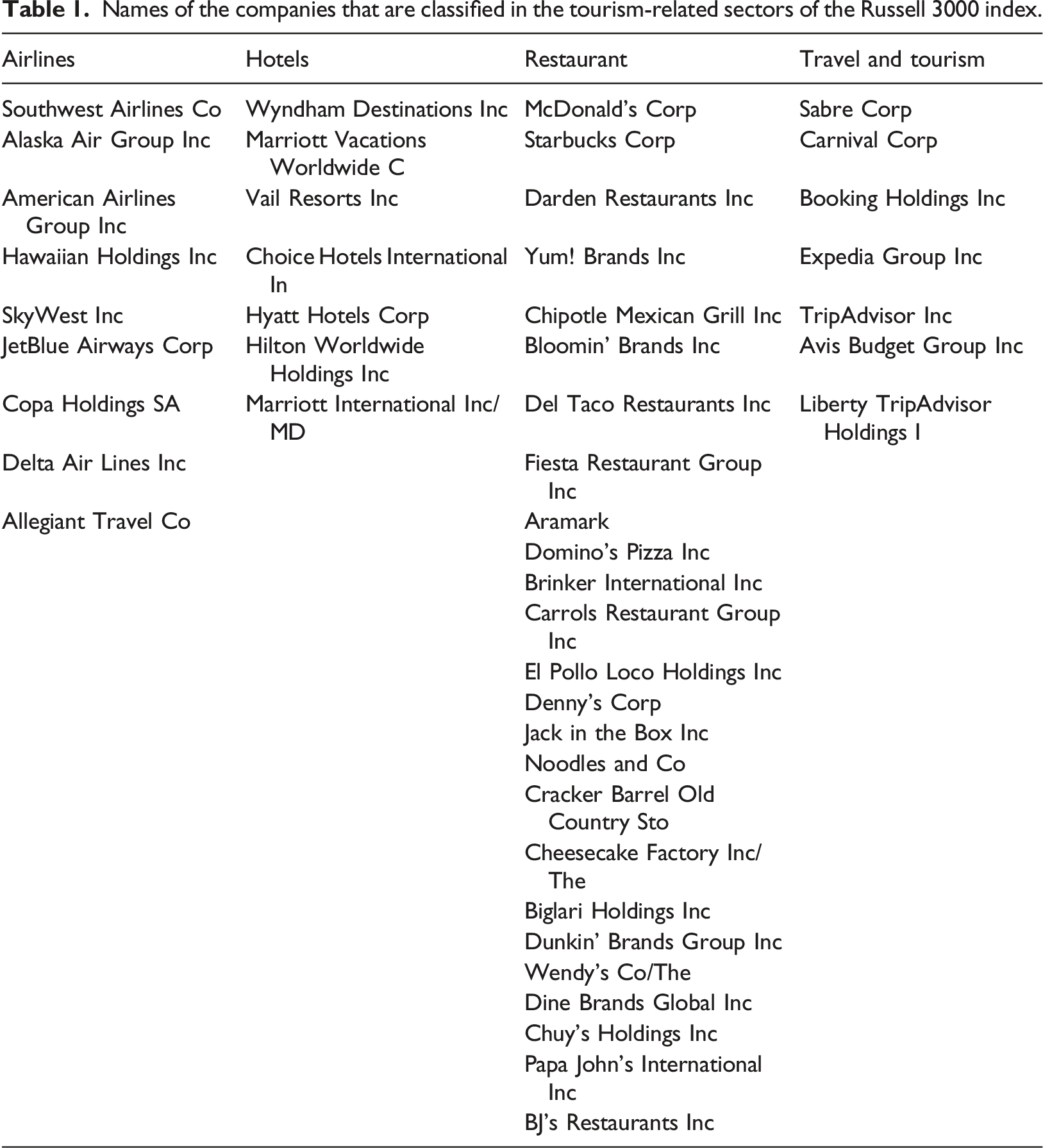
Names of the companies that are classified in the tourism-related sectors of the Russell 3000 index.
Methodology
Measuring the total connectedness of tourism’s subsectors
To assess the connectedness (spillover) in the tourism subsectors, we follow Antonakakis and Gabauer (2017) approach, who proposed a connectedness measure using a TVP-VAR model. The connectedness index is obtained using the variance decomposition estimated from the TVP-VAR model. To estimate the forecast error variances, we separately employ the TVP-VAR model for the set of companies for a given tourism subsector2

Subsequently, the H-step ahead (scaled) generalized forecast error variance decomposition (GFEVD) is computed using the approach of Pesaran and Shin (1998). Since this approach is based on the Wold representation theorem, we rewrite the TVP-VAR model as a TVP-VMA framework by using the equation: 

Quantile regression approach
The classical Ordinary Least Square (OLS) estimation does not capture the effect of the explanatory variable on the dependent variable across different quantiles. However, the quantile regression technique addresses this issue by providing a complete picture of the conditional distribution.
In particular, we use the following quantile regression model
For each quantile, the coefficients β(τ) are estimated by solving the following optimization problem
Results
Figure 1 presents the TCI results for tourism and hospitality industry subsectors separately. These total connectedness indices show the intensity of the co-movements of stock returns of companies belonging to given tourism sectors. Hence, a higher value of TCI indicates that the co-movement of the companies is high, implying that a shock in one tourism company will influence other tourism companies belonging to the same sector more powerfully. As shown in Figure 1, there is evidence of elevated connectedness in the company stock returns in all subsectors due to the proclamation of the COVID-19 as a “Public Health Emergency of International Concern” by the World Health Organization. Total connectedness of stock returns of the tourism and hospitality industry subsectors.
Figure 1 suggests that increased connectedness is noticeable around mid-March, coinciding with the outbreaks of COVID-19 all over the globe and provoking fears of the potential new waves of infection. Specifically, there is a sharp spike in the TCI of company stock returns belonging to the restaurants category reaching a level of 90%, which implies that, on average, 90% of the forecast error variance in one company’s stock return can be attributed to the innovations in all the others. This reflects the persistent vulnerability of the subsector, comprising mostly SMEs, as well as the lowest solvency ratio compared to the other subsectors.3 Moreover, the sharp increase in the connectedness of restaurant companies’ stock returns is probably related to the shift in market sentiment following the announcement of a new series of coronavirus restrictions, including the shutdown of restaurants and other hospitality venues in the US. This results in a sudden drop in their sales and puts high pressure on the companies’ stock price.
The airline subsector presents the second highest connectedness level (around 80%) but with a persistent ascending pattern in the following months, making it one of the most vulnerable sectors. The reason is that many countries and regions impose quarantines, entry bans, or other travel restrictions that have had a negative impact on the revenues of the airline companies and travel and tourism related companies since virus fears lead consumers and businesses to reduce spending on travel. Since this sector represents the largest in terms of the size of fixed assets, its failure will have a high reputational cost and potentially strong spillover to the market.4 Furthermore, the relatively lower value of the total connectedness index (around 75%) in the hotels sector is an expression that the “spillovers” in this sector are modest compared to the other three. The reason may be that hotel companies have adapted quickly to the new conditions, which leads to the reopening of national hotels quicker than expected and the increase in local tourism (i.e., staycations and cottages) when lockdown measures are eased.
Finally, Figure 2 shows the results of the quantile regression across tourism sectors. In particular, all slope coefficients are positive and higher at the upper tails, implying that the uncertainty in the economic policy stemming from to the highly infectious diseases leads to a higher level market risk as shown in the increased connectedness of tourism-related companies. The blue line shows the coefficient of the response, and the red lines display the 95% confidence intervals. In each quantile, the coefficient of COVID-19-induced uncertainty is statistically significant in all subsectors except for hotels since zero is located in the confidence intervals for the hotels sector. Although the coefficients are slightly different across sectors, our results confirm that the coronavirus shock has led to significant disruptions for tourism-related companies. All slope coefficients are positive and higher at the upper tails implying that the higher COVID-19 uncertainty leads to a higher level market risk due to the increased connectedness of tourism-related companies. The quantile regression of the impact of COVID-19-induced uncertainty highlights the stock market implications of managing the pandemic-related uncertainty. Quantile regression results. Notes: The blue line depicts the coefficients of the quantile regression. The red lines around the quantile regression coefficient represent the confidence interval at 95%. While the horizontal axis denotes the quantiles, the vertical axis shows the magnitude of the quantile parameter.
Conclusion
This study examines the rapid disruptive impacts of the COVID-19 outbreak, which matters in the formulation of policies to protect the financial system’s health and employment generation. Our results suggest that policymakers may implement sector-specific stimulus packages to the most affected subsectors of airlines and restaurants companies. The quantile regressions also conclude that in higher quantile, COVID-19 uncertainty index has more effect on the connectedness of tourism companies. Our findings also have implications for the financial investors. Airlines and restaurant companies are more connected while hotels and tourism and leisure companies are less connected with their individual narratives. Hence, depending on the different mandates and characteristics of investors, the paper provides insights into their portfolio choices.
Policymakers and investors can calculate the stress accumulated in each subsector of tourism in real-time using our empirical approach. This real-time market-driven information may also help the lobbyists of the tourism industry to convey their messages to the policymakers to make timely decisions. Considering that the decline in cash flows for the tourism companies has led them to borrow loans and restructure their debts during the COVID-19 period, our results even guide the banks and other lenders in extending credits into different companies of various subsectors of tourism.
Schaefers et al. (2021) show the significance of the sharing economy to address the limited availability of resources for alleviating poverty. Airbnb is an excellent example of a sharing economy that utilizes technology-enabled platforms yielding users temporary access to tourism services (Eckhardt et al., 2019). Due to the data unavailability, we could not delve into the implications of the COVID-19 uncertainty on the sharing economy in tourism. As a future study, one may analyze the effects of COVID-19 uncertainty on the shared economy products in the tourism sector. Even though a different data set is needed for such a study, it would be good to compare the impact of COVID-19 uncertainty on the conventional subsectors of tourism and various shared economy products of the tourism sector. The results of such a study also have the potential to shed light on how access-based services (Schaefers et al., 2021) can help overcome ownership risks.
Footnotes
Declaration of conflicting interests
The author(s) declared no potential conflicts of interest with respect to the research, authorship, and/or publication of this article.
Funding
The author(s) received no financial support for the research, authorship, and/or publication of this article.
