



Abstract
This paper investigates aspects of cruising of most concern to Australian consumers during the COVID-19 pandemic, following the shutdown of cruising globally. Using a mixed-method approach, the study asked cruisers and non-cruisers which of the risks associated with cruising were of most concern. The study found health was the most concerning risk for respondents, regardless of cruising history and, contrary to previous research, cruisers were more concerned about health risk than non-cruisers. Results indicated cruisers were also concerned about financial risk, while safety and psychological risk were the next most concerning aspects for non-cruisers. Implications for the cruise industry are discussed and areas for further research are identified. Findings suggest the industry cannot take for granted repeat cruisers’ return post-pandemic. As non-cruisers are much less positive and less willing to cruise than before COVID-19, the continued future growth of the cruise sector is also under threat.
Introduction
“Imagine the nightmare of being…stuck on that floating petri dish of infection.” Channel 9 reporter talking about the crew on the Ruby Princess (7 April 2020) after the news announcer had introduced a story on the “coronavirus-riddled ship”
The COVID-19 pandemic has grounded the decades-long ‘golden goose’ of cruising, which had enjoyed year on year growth and an unending narrative of cruising as the fastest growing tourism and travel sector segment (Papathanassis, 2019; Radic et al., 2020). The impact was particularly brutal in Australia, which had been enjoying a love affair with cruise ship travel. Despite its relatively small population (almost 25.5 million in September 2019 (Australian Bureau of Statistics, 2020)), cruising’s market penetration in Australia was the strongest globally, with the country the industry’s fifth largest source of passengers (Cruise Lines International Association [CLIA] Australasia 1 , 2019). The impact was compounded by timing, as the pandemic hit at the height of the cruising season in the Southern Hemisphere.
Like many other forms of non-essential activity, cruise ship travel ceased worldwide during the pandemic, but not before there were confirmed cases of COVID-19 on more than 50 cruise ships (Dolven et al., 2020). There were also widely-distributed images and stories of thousands of cruise ship passengers and crew being unable to disembark, sometimes for weeks beyond their initial cruise end date, as ships were denied entry to many countries.
While research into risk perceptions of cruising has been limited (Holland et al., 2021b; Radic et al., 2020), prior research suggests travel decision-making is complex and risk is an important aspect (Karl et al., 2015; Quintal et al., 2021). Quintal et al. (2010) used the Theory of Planned Behaviour (TPB) to provide a contextual framework for explaining the relationship between consumers’ risk perceptions and their intentions and attitudes to travel. For this reason, the TPB underpins the current study, which was undertaken to identify how COVID-19 had affected consumers’ perceptions of the risks of cruise travel and their willingness to cruise post-pandemic. Thus, this paper addresses the specific research question ‘What aspects of cruise travel risk most concern Australian consumers?’ with a view to developing a list of concerns that might inform a discussion within the cruise industry. Given the importance of repeat passengers to the cruising sector (Coster, 2020; Deloitte Development LLC, 2018; Mahadevan, 2016; McDonald, 2021; Petrick et al., 2006; Sun et al., 2018), respondents who had previously cruised were the primary focus of the current study, although data were also gathered from non-cruisers.
The research was exploratory in nature and commenced when it became apparent that COVID-19 was causing unparalleled disruption to cruise travel. At the time, while it was not clear how long the pandemic would last, it seemed likely the industry would be confronted with significant challenges on resumption (Holland et al., 2021a; Pan et al., 2021; Radic et al., 2020). The emergence of an overwhelming media and government narrative that cruising was a risk to personal health and the Australian community at large was also unprecedented (Holland et al., 2021a).
Background and context
COVID-19 and cruise ship travel in Australia and beyond
Cruise ships featured prominently in the early days of the pandemic after the Diamond Princess was quarantined in Japan for more than a month following a COVID-19 outbreak onboard. By 20 February 2020, the Diamond Princess officially accounted for more than half the cases of coronavirus outside China and at least 14 passengers would die, including the first Australian COVID-19 related fatality (Belam et al., 2020; Holland et al., 2021a). More ports closed and ships were quarantined as the outbreak spread.
In the Australian region, cruise ships became synonymous with COVID-19 infections and deaths. The initial increase in ships coming to Australia (considered a safe destination in the early days of the pandemic), brought with it increasing numbers of COVID infections and, ultimately, deaths, with cruise passengers and crew making up most pandemic fatalities in Australia throughout the first-half of 2020. The deaths were linked to at least eight ships with the highest profile being the Ruby Princess, which was the nucleus of Australia’s first super-spreader transmission event, spawning government and criminal investigations. Almost 2700 passengers disembarked from the ship in Sydney on 19 March 2020 without any requirement to quarantine or be tested, despite some showing coronavirus-type symptoms. These Ruby Princess passengers were allowed to travel on within Australia and overseas. By May 2020, at least 10% of Australia’s confirmed COVID-19 cases were related to the ship and 28 people had died (20 in Australia and eight in the USA) (Moriarty et al., 2020).
While the reported deaths of cruise passengers slowed in April 2020, coverage related to Ruby Princess was ongoing, initially as the ship and crew remained in Australia and then when hearings began in May. While this first enquiry cleared the ship from deliberately misleading authorities about the health of the returning passengers, the Commission identified contributing factors on the part of various Australian authorities and some things the cruise company could have done better (Walker, 2020).
Media coverage suggested cruise ships and passengers were somehow subversive or acting against Australian interests (e.g. “One of the Ruby Princess cruise ship passengers who snuck into Australia while infected with the coronavirus has today died from the sickness” and authorities telling foreign ships to “go home…there are thousands of people, potentially, in cruise ships off our coasts that are not members of our state, and … could well flood our system unnecessarily” (news.com.au, 2020; Trask, 2020).
Beyond the deaths, the travel plans of millions were disrupted and consumers’ financial losses were considerable, particularly for those holding bookings at what was the height of the local cruising season. The cruise sector lost an estimated $USD50 billion by September 2020 (CLIA, 2020).
Following the initial closure of Australian ports to cruise ships, the 2020/21 and 2021/22 Australian cruising seasons were cancelled, with indications as late as August 2021 that cruise ships might not return until 2023 at the earliest (Day, 2021; McGowan, 2021).
Literature review
The cruising industry in Australia and globally
For more than two decades, cruising had been the fastest growing sector in tourism (Papathanassis, 2019). Worth more than $USD150 billion annually, the pre-COVID-19 global cruise industry sustained almost 1.2 million full-time equivalent (FTE) employees and more than 32 million passengers were expected to ocean cruise in 2020 (CLIA, 2019a). The Australian cruise sector grew by 11% in the 2018–19 financial year (Smith, 2019), continuing the trend of double-digit growth experienced across the preceding decade. These strong performances had been expected to continue in 2020 and beyond, fuelled by new ships, increased capacity and increasing numbers of new and younger cruise travellers (CLIA, 2018a, 2018b).
While tourism was considered a ‘super growth industry’ by the Australian Government and had traditionally been seen as an important economic contributor (Tourism Australia, n.d.), Australia is a small player globally in terms of tourism, ranking anywhere between 12th and 33rd on six major measures, including contribution to GDP, employment, investment and visitor export (World Travel and Tourism Council, 2018). However, Australia had performed strongly in the cruise travel segment, being the fifth largest source country for passengers, behind the USA, China, Germany and the UK (CLIA, 2018a). Australia was the only market in which almost one in 17 people had cruised (5.8% in 2018), compared to 4% or less in all other regions (CLIA Australasia, 2019a, 2018a, 2018b). Industry reports measured the cruise sector’s contribution to the Australian economy at $5.2 billion in 2018-19, with ocean cruise ships stopping at more than 40 ports nationally and the sector directly and indirectly supporting more than 18,000 FTE jobs (CLIA Australasia, 2019a).
The sector’s strong global performance was being challenged by growing external and internal developments, including a consolidation of cruise operators and ship-builders, new technologies, ever-increasing management complexities, a spiralling cost base and a growing negative narrative (Cruise Lines International Association, 2019; Douglas et al., 2010; Dowling and Weeden, 2017; Papathanassis, 2012; Papathanassis and Beckmann, 2011; PR Newswire, 2014; Weaver, 2005; Wild and Dearing, 2000). Negative publicity around cruising had escalated sharply in 2019 following river and ocean cruise ship accidents and mishaps resulting in loss of life (Chua, 2019; Elfrink and Horton, 2019), damage to iconic sites and ships (BBC 2019; The Maritime Executive, 2019) and the critical reporting of cruise line behaviour, including breaches of environmental sanctions and dramatic rescues at sea (Anderson, 2019; Otte, 2019).
Against this backdrop, CLIA’s State of the Industry Report in late 2019 suggested the issues of most concern prior to the pandemic were associated with ‘responsible tourism’, with a twin focus on ‘environmental sustainability’ and ‘destination stewardship’. There was no mention of needing to pay attention to, or remedy, passenger health or safety issues or concerns (CLIA, 2019b).
As industry attention turned to post-pandemic resumption, various cruise operators highlighted the importance of repeat passengers to the sector’s recovery (Coster, 2020; McDonald, 2021). Past cruisers who make repeat cruising purchases, also known as ‘repeaters’, are an acknowledged strength of the sector and can comprise 50% or more of passengers (Deloitte Development LLC, 2018; Mahadevan, 2016; Petrick et al., 2006; Sun et al., 2018). While the numbers of first-time cruisers have increased in recent years, published research indicates repeaters are more involved in their cruising experience and more likely to demonstrate higher rates of brand loyalty and satisfaction, and lower levels of perceived risk (Chua et al., 2017; Petrick et al., 2006; Sun et al., 2018).
Recent cruising-related Australian research
Published research into Australian cruising is limited, and none address consumers’ perceptions of cruise travel risk. Recent works explore aspects related to sector performance (Dowling 2016), cruising intentions (Cooper et al., 2019; Mahadevan, 2016) and community response to cruise tourism development (McCaughey et al., 2018). The limited published research on cruising in an Australian context was seen as a gap in the literature, providing another compelling reason for this study.
Consumer decision-making
The Theory of Reasoned Action (TRA) and its extension, The Theory of Planned Behaviour (TPB), are among the most prominent frameworks for considering consumer decision-making (Perugini and Bagozzi, 2001; Quintal et al., 2010; Trafimow, 2009; Xie et al., 2013).
Developed by Fishbein and Ajzen in the 1970s, the TRA links beliefs, attitudes, intentions, norms and behaviours (Ajzen, 2006). The TPB adds a third factor (perceived behaviour control (PBC)) to the fundamental tenets of the TRA that behaviour is determined by a person’s intent to act, with intentions impacted by personal attitudes or beliefs and social or normative beliefs (Fishbein and Ajzen, 1976). The PBC refers to an individual’s view about how difficult it will be to carry out a behaviour (Ajzen, 2014; Wang et al., 2010). Various studies have tested the core TPB tenets that people are likely to behave in a certain way if they believe that behaviour will lead to a desired outcome, if they think others will endorse or approve the behaviour and if they believe they can perform the behaviour. Quintal et al. (2010) found the TPB explained people’s attitudes and willingness to travel and that perceived risk was negatively influenced by these attitudes. These researchers also called for further exploration into how perceived risk impacts consumers’ travel decisions.
More recently, researchers have begun to explore cruise consumers’ decision-making through the lens of TRA and TPB. Radic et al. (2021) applied TRA and Prospect Theory to better understand behavioural intentions of female cruise passengers during the pandemic, finding perceived health risk negatively affected onboard dining behaviours as a result of COVID-19.
Risk perceptions in cruising
Recent research suggests cruisers’ risk perceptions have changed as a result of COVID-19 (Holland et al., 2021a; Radic et al., 2020). Cruise passengers have been affected in myriad ways, with no certainty their holiday would occur, deposits and non-refundable fares lost, cruises cancelled, itineraries changed as promised ports denied them entry, onboard quarantines and an increased likelihood of illness and death.
Research on travel risk has increased in response to global crises (Pennington-Gray, 2018; Yang and Nair, 2014; Yang et al., 2017), with many scholars and tourists recognising risk as an inherent part of travel (Ritchie and Jiang, 2019; Williams and Baláž, 2013). Whether real or perceived, risk changes travel decisions (Bowen et al., 2014; Karl et al., 2015; Morakabati and Kapuscinski, 2016; Schroeder et al., 2013; Sönmez and Graefe, 1998). Indeed, perceived risk has long been recognised as a significant factor influencing destination choices, travel intentions, information search and pre-purchase behaviours (Floyd et al., 2004; Floyd and Pennington-Gray, 2004; Fuchs and Reichel, 2011; Karl, 2018; Kim et al., 2016; Kozak et al., 2007; Quintal et al., 2010; Reisinger and Mavondo, 2005; Sharifpour et al., 2014; Sönmez and Graefe, 1998; Yang and Nair, 2014).
Risk is particularly relevant when considering a cruise because of the complex decision-making involved (Petrick et al., 2007; Xie et al., 2016) and the multi-faceted nature of risk in the cruise context. A cruise is a complex tourist experience and deciding to take one is an involved and emotive process, with many aspects of the holiday needing to be considered (Petrick et al., 2007). For example, a would-be cruiser needs to select from many different brands offering different onboard experiences; choose where to go with varying destinations and itineraries, some of which have limited availability (e.g. Alaska and Antarctica have short cruising seasons) and select from an array of cabin types of different sizes, amenities and locations. Potential cruisers also need to consider fares, onboard spending, gratuities, shore excursions and transportation to the ship.
In addition to the negative COVID-19 narrative mentioned previously, events impacting on risk perceptions about cruising prior to the pandemic included incidents on the Costa Concordia in 2012 (Alexander, 2012) and the Sea Diamond in 2007 (Mileski et al., 2014). There have also been outbreaks of norovirus on cruise ships, resulting in cancellations and cruises with widespread illness and limited services onboard (Wikswo et al., 2011). An outbreak of norovirus on P&O Aurora in 2003 led to more than 600 passengers and crew falling ill and the ship being refused permission to dock in Greece (Elliot et al., 2005; Mileski et al., 2014), while coverage in Australia of sickness on the Sea Princess saw the ship repeatedly dubbed the ‘Sick Princess’ (9News, 2018; Ironside, 2014).
Examinations of consumers’ risk perceptions about ocean cruising have included studies investigating terrorism (Bowen et al., 2014; Brosnan, 2011; Greenberg et al., 2006), safety (Ahola et al., 2014; Baker and Stockton, 2013), polar cruising (Lück et al., 2010; Maher et al., 2011; Stewart et al., 2007; Stewart and Draper, 2008), food safety (Baker and Stockton, 2013) and illness outbreaks (Klein et al., 2017; Liu et al., 2016). While there are some notable explorations of tourists’ risk perceptions of cruising (Holland, 2020; Holland et al., 2021a; Le and Arcodia, 2018), these investigations are limited and further research is needed, particularly in response to the COVID-19 pandemic.
Much of the travel risk literature has drawn, at least in part, on Jacoby and Kaplan (1972) and Roselius (1971) seminal research on consumer risk. Jacoby and Kaplan (1972) identified five types of perceived risk (financial; performance; physical; psychological and social), while Roselius (1971) identified ‘time-loss’ as a risk, referring to the potential for a product to fail and the time and effort consumers incur in addressing that failure. Opportunity-loss was suggested much later by Lee et al. (2001) as a risk explaining potential regret when purchases failed to meet expectations. Equipment risk also has been mentioned in tourism (Roehl and Fesenmaier, 1992), and though not widely included, may be relevant to cruise holidays, given the importance of ships and facilities functioning correctly.
Some argue that the growth of cruising has been largely due to a perception it is ‘safe’ (Cordesmeyer and Papathanassis, 2011; Dowling, 2006; Holland, 2020), with cruise tourists being described as risk-averse (Tarlow, 2006). Research suggests most people felt cruising was safer than flying (GP Wild (International) Limited, 2017) and the industry has accentuated this concept, promoting cruises as the ‘safest way to travel’ (CLIA, 2017). Trust is particularly important when examining risk perceptions, as trust decreases perceived anxiety and concern and assists in decision-making (Forgas-Coll et al., 2014; Li and Petrick, 2008). Cruisers may view familiarity with a ship as a way to minimise uncertainty and feel at home and comfortable onboard. Indeed, Weaver (2005) argued cruise ships were standardised and controlled consumption environments that satisfied consumers' needs for predictability and safety. Clearly, perceived risk is a significant issue for the cruising industry, particularly in the uncertain times of a pandemic. This concern provided further impetus for the present study, which is discussed in subsequent sections.
The current study
The study sought to examine the impact COVID-19 has had on consumers’ travel intentions and perceptions of risk in ocean cruising. Specific research questions included: 1. What ocean cruising risks were of most concern to consumers during the COVID-19 pandemic? 2. Were there differences between non-cruisers and those who had previously cruised, in terms of the risks of most concern? 3. How had the pandemic influenced consumers’ future ocean cruising intentions?
The study was mixed method, with an online questionnaire that included items drawn from relevant scales, as well as questions that asked about socio-demographic backgrounds and cruise experiences. Qualitative data was also gathered through the inclusion of open-ended text questions. The data were obtained from members of a professional online consumer panel. Responses were obtained in the last week of June 2020 (during the COVID-19 pandemic and at a time when many cities were in lockdown and cruise operations were indefinitely suspended). This paper reports on data obtained from Australian respondents, including responses to: 1. A Best-Worst Scaling (BWS) question set that explored ocean cruising aspects that were of most and least concern to respondents. 2. Socio-demographic and cruising history/experience questions, as well as questions about attitudes towards cruising and willingness to cruise. 3. Open-ended free-text questions that were used to better understand responses to the quantitative aspects.
Unlike ratings scales, BWS forces respondents to make trade-offs between items, which mimics real life choice behaviour. Respondents are provided with an appropriate group of subsets of attributes of interest and are asked to indicate which of these attributes are ‘best’ and which are ‘worst’ within each subgroup, which results in respondents providing two answers for each of the presented subsets. In the current study, ‘best’ indicated of most concern and ‘worst’, of least concern 2 . The BWS approach does not suggest least concern is of no concern or inconsequential. Rather, respondents were asked to consider which of the aspects in each set (all of which might be concerning) was most important (and least important).
BWS overcomes some of the problems associated with ratings scales (e.g. bias, skewness, cross-cultural concerns and a lack of differentiation), enabling the importance of the items to be compared and differences better substantiated. Additionally, as BWS provides information about the lowest ranked items as well as the highest, the overall importance of items can be better approximated.
A best-worst score can be obtained from the data (often computed as the total times an item is chosen ‘best’ minus total times chosen ‘worst’) and more complex statistical applications can be applied to these scores. Louviere et al. (2013) suggested BWS was uncomplicated to use and, with a straightforward design and simple methods of analysis, could be used in many contexts. Not surprisingly, BWS is now widely used in various disciplines, including health, marketing, education, economics and tourism. Consequently, the BWS method was considered suitable to use in the present study.
BWS attributes and descriptions.
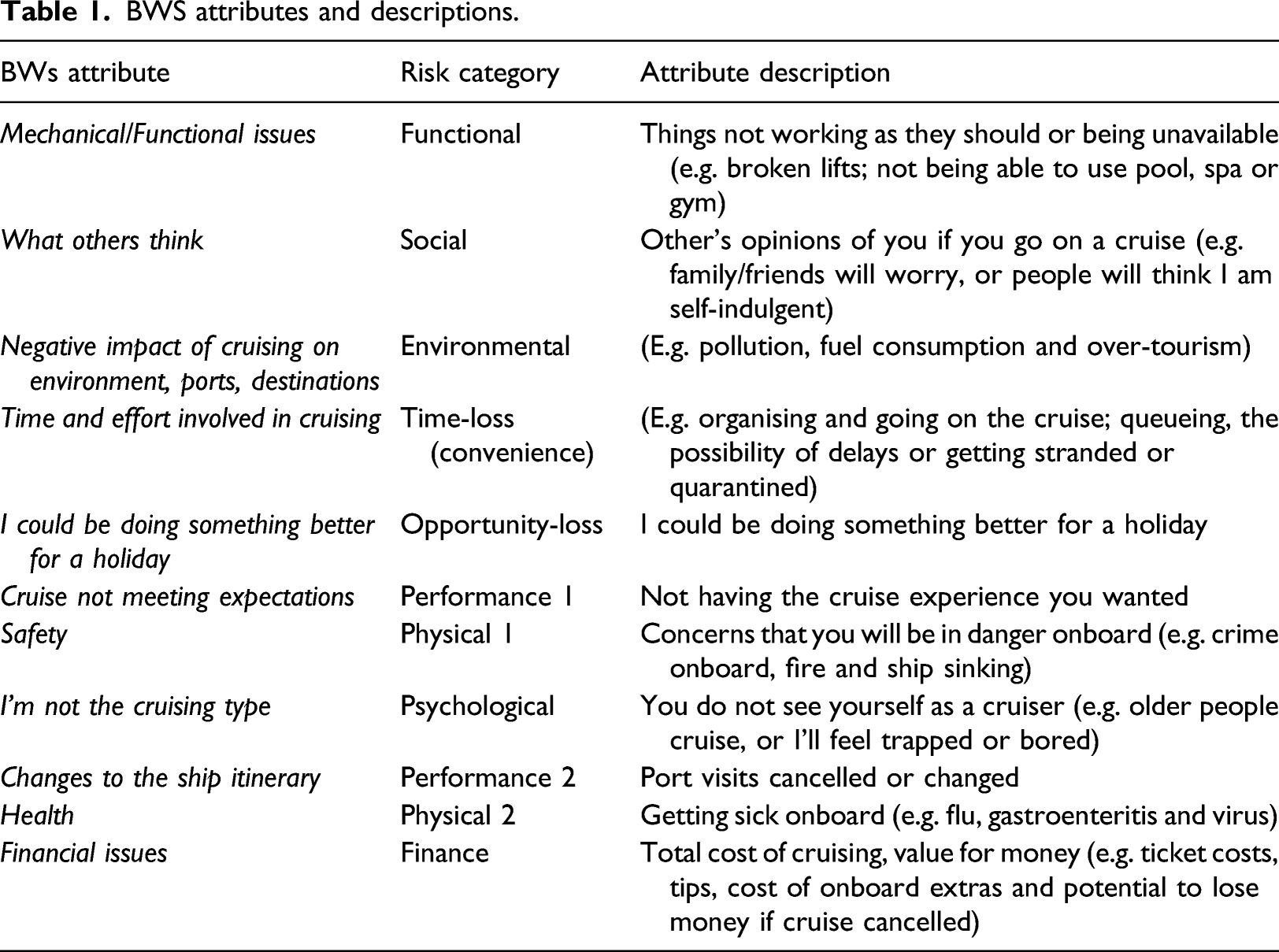
Following Louviere et al. (2015) suggestions, a balanced incomplete block design (BIBD) was used to create the required subsets. In this case, the BIBD design led to 11 subsets, each containing six items (see Figure 1 for an example of a BW choice block). Respondents saw each aspect six times and each combination of aspects, three times (Lee et al., 2008). The best-worst task (an example).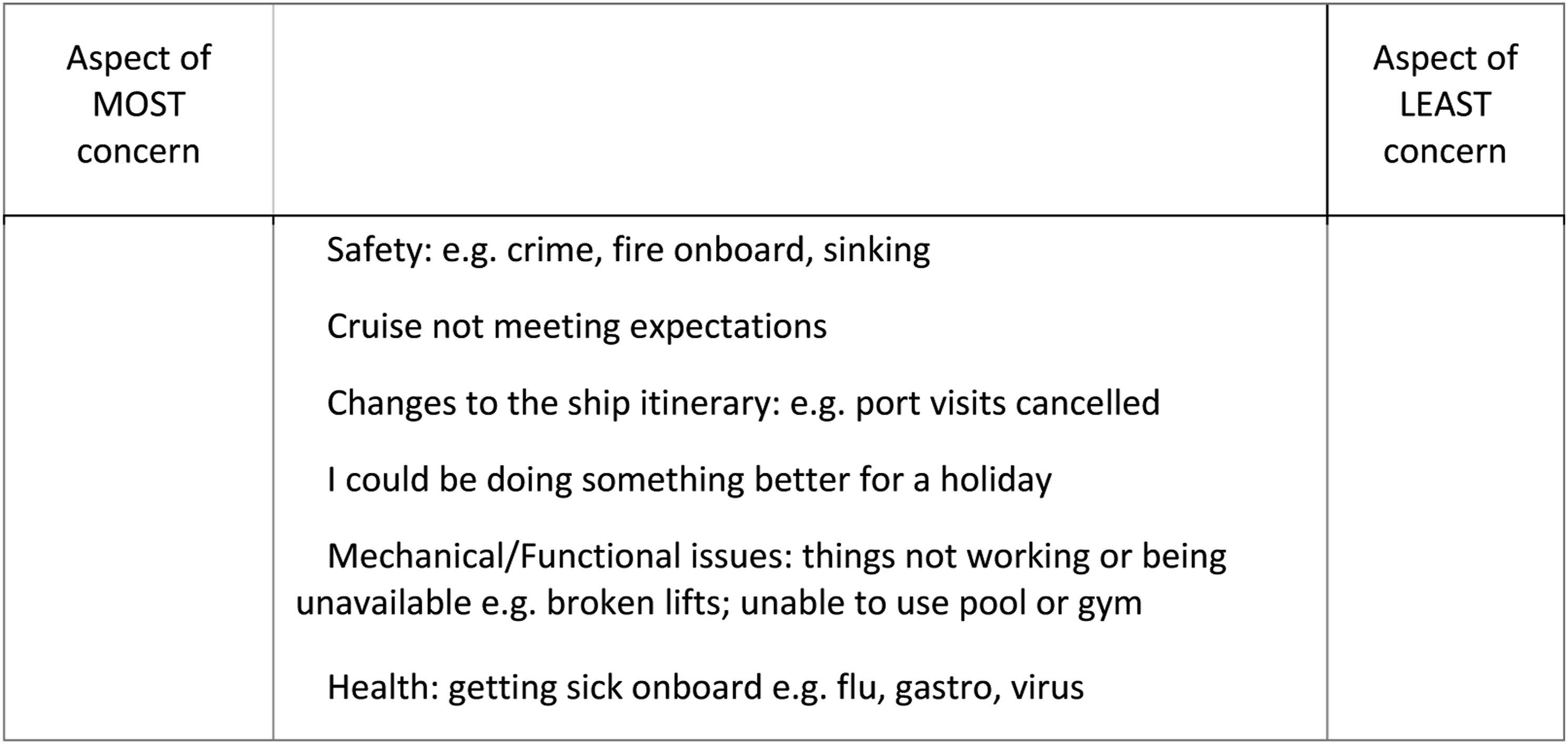
Data analysis
Each respondent’s individual BW scores for each attribute were initially calculated in Excel, by subtracting the number of times that factor was of Least concern from the number chosen as Most concerning, with higher scores implying greater concern (Lee et al., 2008). Standardised scores were obtained by dividing the individual BW means for each attribute by the number of times that attribute appeared in the BW question set and averaging the individual means, as suggested by Lee et al. (2008). A ratio-type score was also computed from the BWS data (Lee et al., 2008), termed ‘sqrt (B/W)’ here, and this score was used to calculate the relative importance of each attribute (Mueller and Rungie, 2009). Descriptive statistics were computed and the data were analysed in SPSS to understand sample characteristics (e.g. in terms of socio-demographic variables and cruising history). A thematic analysis was conducted of the respondents’ free-text responses where the iterative process identified patterns within the data based on themes (Braun and Clarke, 2006). Thematic analysis provides a logical process for organising and analysing qualitative data.
The sample
The questionnaire was administered online by an experienced global panel company, PureProfile, to a subset of its panel of more than one million consumers. Several stages of consultation, adjustment, pre-testing and refinement occurred, leading to a sample that included 464 Australian consumers. While the sample was not representative of the general population, some parameters were set. Reflecting the significance of repeat passengers to the sector, at least 50% of respondents had to have previously cruised and these respondents had to be at least 40 years old, to approximate the average age of Australian cruisers (CLIA, 2018b). The remainder of the sample was split evenly between those aged 18–39 years and those over 40 years. Some of this group had also cruised. Ultimately the sample included 75% of respondents aged over 40, with 60% having previously cruised.
Sample characteristics: highlights (selected results included).

Most respondents were in a relationship (67%), with 52% married and the rest in de-facto relationships or with a new partner after divorce or being widowed. Cruisers were more likely to be in a relationship (72%) than non-cruisers (59%). Almost three in 10 (28%) were single, widowed or divorced. Two-thirds did not have children or grandchildren at home (empty nesters (34%) or childless (33%)), with non-cruisers more likely to be childless (43%) than cruisers (27%).
Cruise history
Six out of 10 respondents had cruised previously (61%). Of the respondents who had cruised, more than half had cruised only once (31%) or twice (22%). A further 29% had cruised three or four times, with 11% having cruised between five and nine times and 7% completing 10 or more cruises. Less than half of the cruiser respondents indicated they would definitely cruise again (39% when it was safe to do so and 6% as soon as cruising resumed). More than one-third (36%) indicated they did not know when they would cruise again, and 20% stated they would never take another cruise.
Post-pandemic changes in attitudes to cruising and willingness to cruise
More than 70% of respondents indicated their attitude to cruising was less positive than it had been prior to the pandemic, with almost half the non-cruiser group (46%) saying they were much less positive, compared to 33% of the cruiser sample. Almost eight out of 10 non-cruisers indicated they were less willing to take a cruise than they had been pre-COVID-19, with 45% much less willing, compared to 30% of the cruiser group being much less willing.
Findings
Attribute importance
Total Sample: BWS Aspects of Most concern.

Financial risk was chosen as most concerning 567 times and least concerning 196 times while safety risk was selected of most concern 487 times and least concern 292 times. Rounding out the top four, and the only other attribute to be chosen more times as most rather than least concern, was ‘convenience risk’ (i.e. ‘Time and effort’), with scores of 415 (Most) and 254 (Least). Social risk (‘what other people will think of me for cruising’) was chosen of least concern more often than any other attribute (1343) and also had the smallest number of most concern scores (87). The top and bottom attributes were clearly distinguishable from the rest of the attributes, suggesting most respondents agreed about these aspects of risk.
The ratio-type score (the ‘sqrt [B/W]’ )and relative importance of each attribute are also shown in Table 3. As can be seen in the last column of Table 3, health was more than twice the concern of the next three highest ranked attributes (finance, safety and convenience risk) and three times as concerning as the next six risks, which were in a virtually indistinguishable clump (lost opportunity to do something better, mechanical risk, the cruise failing expectations, not being the cruising type, environmental risk and the likelihood that itineraries or destinations would change). Health was five times more concerning than worries about what others would think (social risk).
Cruisers: BWS Aspects of Most concern.

Non-cruisers: BWS Aspects of Most concern.
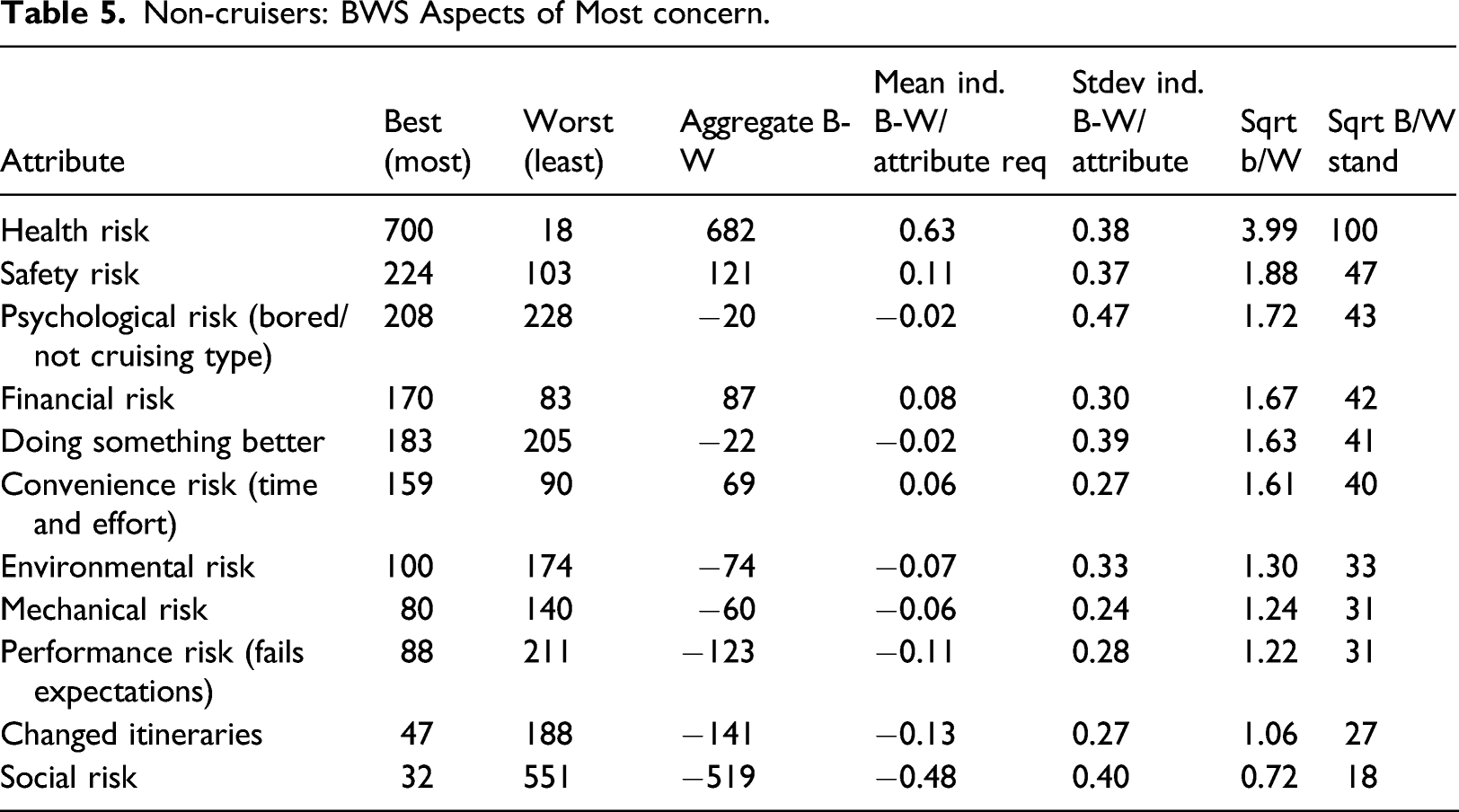
The thematic analysis of the free-text responses supported the quantitative outcomes, with concern about health risk predominant. For some respondents, the health risks were so concerning, they reported they would never cruise again post-COVID-19 (‘I didn’t like cruises before, but now after all the issues with COVID-19, this way of travelling is totally out of my thoughts’ [AU non-cruiser] and ‘I’ll never go on a cruise, they are petri dishes of infection’ [AU non-cruiser]).
A primary sentiment was that cruising was not an option, unless COVID-19 was eliminated, or an effective vaccine existed (‘I would only ever set foot on a cruise ship if they could prove and be certain of my health and safety onboard’ [AU cruiser] and ‘I would need to feel 100% secure that Coronavirus has been eliminated or a vaccine has been found for it before I would go on another ocean cruise’ [AU cruiser]). Even those positive about ship hygiene were waiting for a vaccine: I love cruising and…want to cruise again, but won’t until there is some form of control or vaccine. I actually trust the cruise ships’ cleaning more than my local shopping centre! It is the other idiots travelling with me I don’t trust. The infection risk is not much greater than when noro[virus] or a cold is circulating around a ship, which I have had mixed luck with avoiding/catching. [AU cruiser]
Common themes reflected in comments included:
1. Expectations cruise lines would substantially improve protective measures against sickness (‘I would need to ensure cruise ships go above and beyond for health and hygiene’ [AU cruiser] and ‘The hygiene issue on cruises has now been highlighted for me. If one person gets sick, I would be worried about everyone getting sick. I expect cruise advertising would now include reassuring me of cleaning practices’ [AU non-cruiser]). 2. Heightened concern about the risk of lockdowns or quarantine onboard (‘The fact that all those people got locked down on a cruise ship is very frightening and I would hate to be on a cruise that does that'. [AU cruiser]). 3. A loss of trust and belief in cruise companies (‘The record of cruise liner companies as exposed by the recent events of various cruise ships in relation to COVID-19 is extremely disturbing; especially the actions, honesty and attitudes of cruise line companies involved! This alone would give me pause to consider whether or not to go on a cruise’ [AU cruiser] and ‘I don’t trust cruise lines and the lies they have told regarding these issues’ [Au non-cruiser] 4. Negative connotations of cruising due to the deaths of COVID-19-affected cruisers (‘I don’t think I would cruise now that the pandemic has taken so many lives on cruise ships’ [AU cruiser] and ‘Many people died from COVID going on cruise ships. Seems like a petri dish where the virus grows and grows on the ship. Seems too risky now’ [AU non-cruiser]).
While the aspect of environmental risk did not rate as highly as some other concerns (sitting ninth in a cluster of risks), some respondents were vocal about the impact of this risk on their future cruising intentions: I had already cut back international travel almost entirely due to climate change. I would not consider large scale cruising under any circumstances due to the odious and environmentally catastrophic nature of the industry.
Discussion
These findings add to our understanding of the effects COVID-19 has had on risk perceptions of ocean cruising. Consistent with other recently published research into the impact the pandemic has had on cruising, negative perceptions of health risks have impacted consumers’ willingness to cruise (Radic et al., 2020, 2021). The finding that the cruiser sample was more concerned about health risk than the non-cruiser subgroup is notable, as it does not accord with earlier research suggesting that experience moderates risk perceptions. Prior studies suggested cruisers’ intentions were not significantly influenced by infectious illness outbreaks, as they felt able to manage the risk (e.g. by frequent hand-washing) or because they trusted ships’ hygiene and health-measures (Baker and Stockton, 2013; Holland 2020; Liu et al., 2016)). This would be consistent with the Theory of Planned Behaviour, which suggests consumers are more likely to carry out a particular behaviour where they believe they can perform that behaviour (Quintal et al., 2010).
The finding could not be explained by age, gender or income as there were no significant differences in the socio-demographic characteristics of the groups. In speculating about why cruisers may be more concerned about health risks than non-cruisers, a number of possibilities emerge, namely: 1. Previous experiences of health issues and sickness outbreaks on earlier cruises may mean that cruisers are more aware of the potential for illnesses to spread onboard (and COVID-19 has a significant mortality rate); 2. Cruisers may have fewer concerns about other cruising risks (e.g. psychological risk and convenience risk). Consequently, while health was just one of many aspects of concern for non-cruisers, it was critically important for cruisers; 3. The difference in the severity of the illnesses as most prior studies were associated with outbreaks of sicknesses such as norovirus, without COVID-19’s death rate.
Findings also suggest the perceived cost of cruising (both financial costs and time/effort) has increased, at least for cruisers. In the same way cruising was considered a ‘safe’ holiday in terms of physical risk, it had also been considered ‘safe’ in terms of knowing what to expect and was seen as a standardised consumption experience (Weaver, 2005). The many negative pandemic experiences (e.g. itineraries being changed and cancelled and passengers and crew quarantined onboard) appear to have changed this.
Negative experiences related to the financial costs associated with these aspects (e.g. concerns about refunds and insurance coverage) have also impacted cruisers who held bookings at the time of the initial COVID-19 outbreak. In considering the strong negative perceptions of health and finance risks expressed by respondents, it would appear the value equation has shifted, and that, consistent with the Theory of Planned Behaviour, cruisers no longer consider cruising as valuable as they once did.
Further, the decoupling of health and safety as aspects of physical risk, appears to be warranted. Here, safety related to risks such as onboard fires, sinking and other adverse incidents. This was a concern for respondents (more so for non-cruisers), but less than half as concerning as health risks. For cruisers, financial risk was more concerning than safety. Again, this may reflect cruisers’ prior ‘safe’ experiences, as well as the negative financial impacts of COVID-19, including losing deposits, the costs associated with cancelled cruises (fares, other transport fees and pre- and post-cruise holiday activities) and issues related to collecting refunds.
Additionally, the Australian experience of COVID-19 and cruising, as reflected earlier in the BWS analysis and in the free-text responses, suggests a worrying development of a ‘them and us’ mentality; with ‘them’ being the greedy, uncaring cruise line companies with unhygienic, potentially life-threatening ships and ‘us’ being Australian residents and governments.
Respondents’ lack of concern about ‘social risk’ (i.e. what others will think of [or about] me for taking a cruise) is notable. The researchers had wondered whether the health concerns associated with cruising and COVID-19 would increase consumers’ regard for how family and friends might view them for cruising or whether respondents could be concerned their friends and family would be worried about them cruising, as found by Floyd et al., (2004). Much ocean cruising research had identified status as an important (positive) consideration (e.g. Fan et al., 2015; Hung and Petrick, 2011; Loureiro et al., 2019). However, the study results did not seem to indicate this, suggesting it may be time to examine whether class and status are as intertwined with the cruising experience in Australia, as they appear to be in Asia and the USA.
Limitations and future research
Possible limitations to this research include the timing of the survey, as data were obtained in the early stages of the COVID-19 pandemic (June 2020). Subsequent experiences and discoveries may have changed perceptions. Issues of importance may vary with consumers’ personal characteristics, experience and expertise, as well as external factors, such as government rulings and statements, media coverage and word of mouth. Without any comprehension of how the crisis would unfold, the researchers believed it was important to begin building understanding of how consumer concerns might impact on post-COVID-19 travel intentions. Future studies should replicate this research to see whether the change in concern about health risk was temporary or lasting, and if there have been other changes in consumer’s views.
This paper used an Australian sample as Australian residents were exposed to a particularly negative cruising narrative, which may have affected people’s responses. It would be useful to broaden the research by comparing Australian consumer responses with responses from other countries.
A further limitation was the disaggregation of several traditional risk categories (e.g. dividing physical risk into health risk and safety risk). The disparity in the relative importance of health and safety concerns, particularly for cruisers, suggests this decoupling was useful. The findings also showed some smaller differences between aspects of performance risk (‘failing to meet expectations’ and ‘changes to itineraries and port’); the value of such disaggregations should be examined in future studies.
Conclusions, implications and recommendations
This research has significant implications for the cruising industry in a post–COVID-19 world. Cruise companies need to understand the issues that affect people’s willingness to cruise and their attitudes towards cruising and the cruising industry. These findings are notable given the clear negative shift in Australian respondents’ attitudes towards cruising. If these results are reflected more widely, this is of particular importance, as prior to the pandemic Australia was enjoying a love affair with cruising, reflected in reaching the highest market penetration globally (almost double the market penetration in the UK, for example).
While the cruising industry may be counting on repeaters to drive post-pandemic recovery (Coster, 2020; McDonald, 2021), these findings suggest they cannot take repeat cruisers for granted and assume they will return to the seas. These results do not align with earlier research suggesting cruise experience mitigated risk perceptions. Rather, cruise lines will need to work harder to instil confidence and bring repeat cruise passengers back onboard, focussing on health and financial safety through increased cleaning and hygiene measures, flexible and reliable refund and cancellation policies and the like.
This study suggests the trend in recent years of increasing numbers of first-time cruisers may also be under threat. While health risk was less concerning for non-cruisers (though still of most concern), it appears it may reinforce other concerns about cruising for these respondents, making it less likely non-cruisers will consider cruise holidays in future. Indeed, almost eight out of 10 non-cruiser respondents reported being less willing to go on a cruise, with more than half of these, much less willing. Continued growth in attracting new passengers was an important strategy pre-COVID-19, alongside building more and bigger ships to increase capacity. The industry will need clear strategies to encourage non-cruisers to come onboard.
The intertwining of cruising and COVID-19, and the associated development of a ‘them and us’ mentality presents a serious challenge to the industry as it seeks to return to Australian waters. Notwithstanding the acknowledged and significant value of cruising and tourism generally, in 2021 there remained thousands of Australians stranded overseas and stringent border controls prevented most travel into and out of the country. A successful negotiation of a return to cruising in Australia is likely to take considerable time and be a fraught experience for the cruise industry. Australian Government support for resumed cruising is essential to allow ships into local ports and necessary to give Australian consumers’ the confidence that it is safe to return.
COVID-19 has disrupted what had been an unending tale of growth and success for the cruising sector. Whether this disruption is permanent, or will eventually be considered a temporary blip in the industry’s performance will depend, at least in part, on the extent to which the sector can convince travellers and governments that cruising is safe – at least in terms of physical health. Considered through a TPB lens, the industry will need to persuade consumers, particularly repeat cruisers, that the value of cruise ship travel to them outweighs the perceived risks of cruising.
Footnotes
Declaration of conflicting interests
The author(s) declared no potential conflicts of interest with respect to the research, authorship and/or publication of this article.
Funding
The author(s) disclosed receipt of the following financial support for the research, authorship and/or publication of this article: This study was funded by the University of Western Australia.
Note
Author biographies
