



Abstract
This research advances the current knowledge of tourism expenditure by adapting a new analytical approach to understand expenditure differentials along their conditional distributions, based on multiple segmentation criteria. Using data from survey and secondary sources, we approximate tourists’ required utilities via prosperity at their countries of residence, a macro-level criterion, and individual-travel aspirations, a micro-level criterion. Subsequently, expenditure differentials between more and less prosperous/aspired tourists are decomposed into two components. First, group differences in expenditure covariates that represent tourists’ relative consumption behaviors and, second, differences in the estimated returns to those covariates, measuring potential third-degree price discrimination. Our results guide policy makers in the tourism industry to develop pricing strategies capable of generating mark-ups within all viable segmentations.
Introduction
Tourism expenditure is a complex and dynamic phenomenon. Socioeconomic attributes, trip-specific characteristics, and psychologic traits are fundamental covariates of tourism expenditures (Brida and Scuderi, 2013). Tourism expenditure boosts the economy as expenditure-based segmentation research recognizes higher-spending tourists as means for profit maximization (Mortazavi and Lundberg, 2020). Segmentation criteria to profile tourists are often confined to micro-level factors, such as nationality, tourists’ motivations, generational cohorts, transportation choice, and information search behavior, used as proxies for preference differentials (e.g., Laesser and Crouch, 2006; Park et al., 2020).
The paradigm of tourism expenditures shifts from advocacy to a sustainability platform which is indicative of its sophistication and complexity (Mehran and Olya, 2019). There is a need for methodological advances to decode the complexity of differentials in tourism expenditure patterns based on both macro- and micro-level criteria. This study fills this research gap in two ways. First, we approximate tourists’ required utilities via their countries’ prosperity levels and their individual travel aspirations. Second, we decompose tourists’ relative tourism expenditures into corresponding differences in their socioeconomic and behavioral expenditure covariates (aka their relative consumption behaviors), and differences in the estimated incremental returns at which such covariates transmute into monetary outlays via market exchange (aka potential third-degree price discrimination).
Methodology
A rational consumer minimizes expenditures subject to prices and a predetermined level of required utility (Mas-Colell et al., 1995). This yields consumers’ compensated demands,
Since utility,
Data
For method demonstration, a rich set of data from international leisure tourists to Oman is used. To collect data using survey, we approached respondents who waited to depart from Muscat International Airport in 2019. In total, 1042 individuals completed the survey, reported staying within budget a priority and rated questions about their travel aspirations. Details on the sampling approach are provided in Alfarhan et al.’s (2021a, 2021b) research. Aspiration
Prosperity The distribution of tourists by prosperity and aspiration.
Figure 2 illustrates the descriptive statistics of our two main groups. Means and standard deviations (between parentheses) of expenditures and expenditure covariates, based on relative prosperity and aspiration. *, **, and *** denote that the difference is statistically significant at 10%, 5%, or 1% probability levels.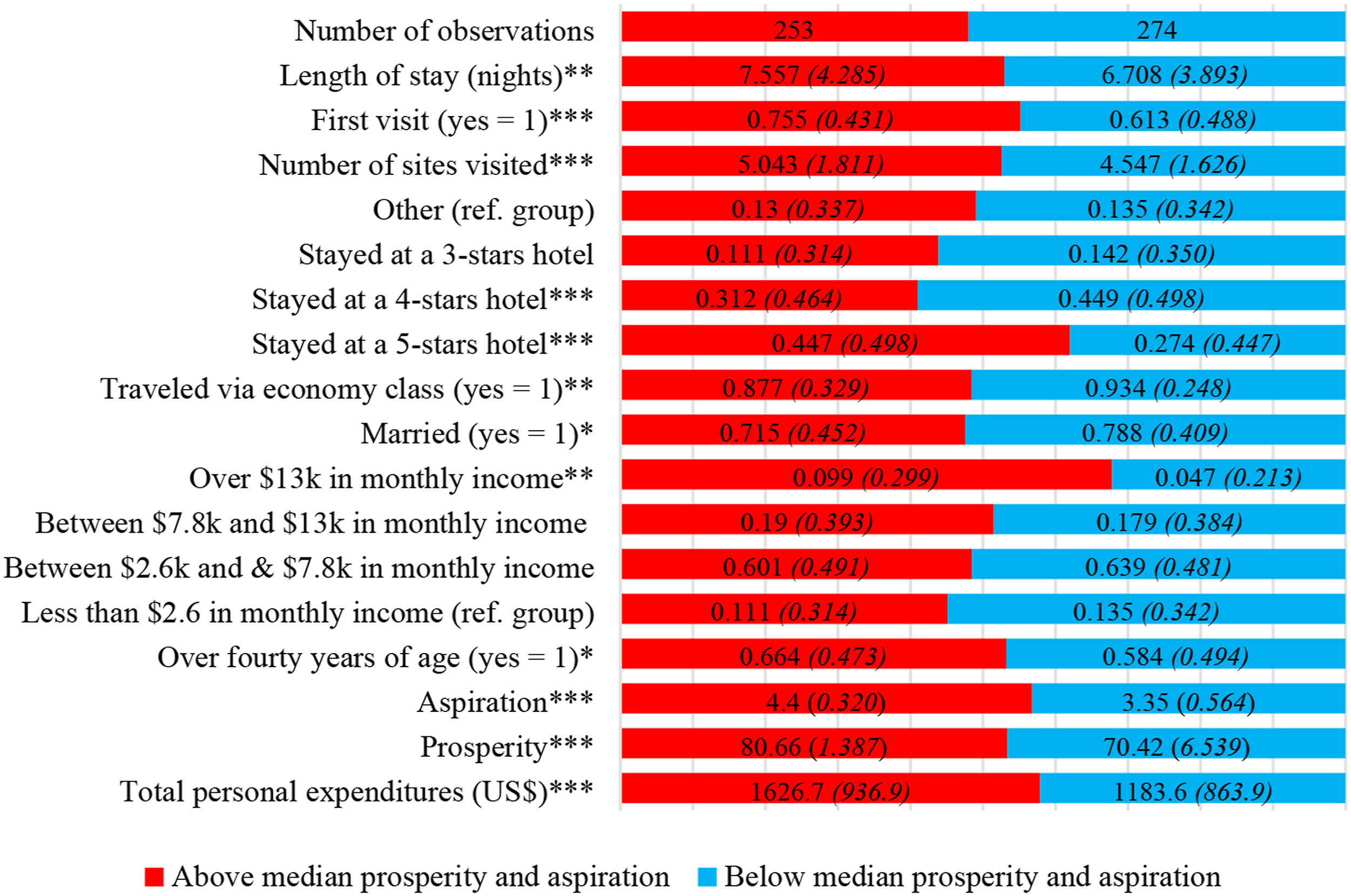
Analytical approach
This research proposes a novel approach to model relative expenditures by integrating the conditional counterfactual quantile decomposition structure of Chernozhukov et al. (2013) with the mean-level structure proposed by Shamsuddin (1998). The former allows for the decomposition of an estimated differential on the basis of a single segmentation criterion, whereas the latter enables conducting the decomposition using multiple criteria.
Define


The second and fourth terms, potential third-degree price discrimination, are the distributional differences in the estimated incremental returns at which constant expenditure covariates are transformed into monetary outlays via market exchange. The second term is based on relative prosperity and the fourth on relative aspiration.
Results
The conditional counterfactual quantile decomposition of expenditures by prosperity and aspiration, equation (2).
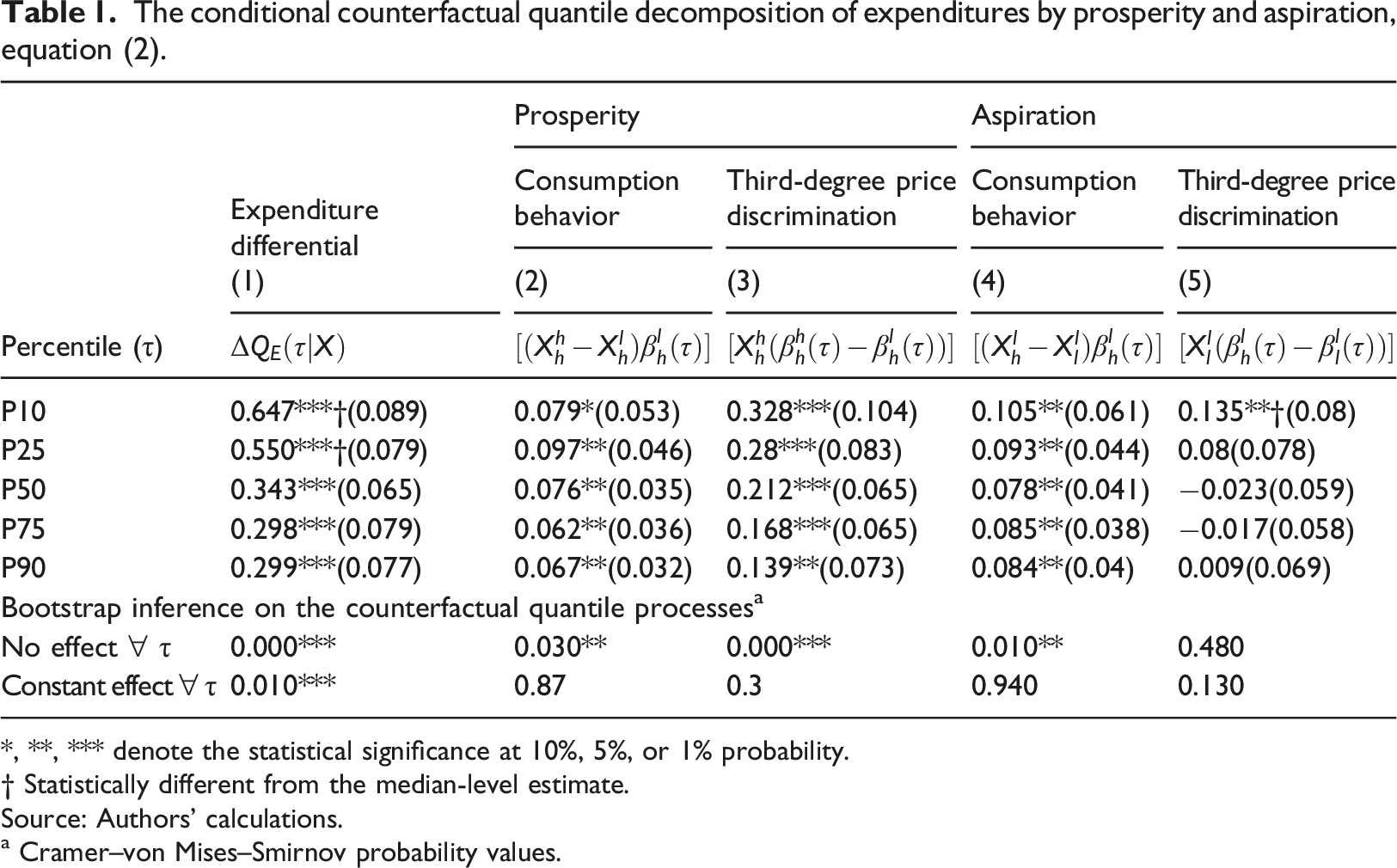
*, **, *** denote the statistical significance at 10%, 5%, or 1% probability.
† Statistically different from the median-level estimate.
Source: Authors’ calculations.
a Cramer–von Mises–Smirnov probability values.
Columns (2) and (4) show that tourists are heterogeneous in terms of their consumption behaviors as induced by both prosperity and aspiration. The monetary impacts of these two behavioral components account for median-level shares of 22% and 23%, respectively. These shares are generalizable along the distributions of expenditures, as per the corresponding bootstrap inference.
Third-degree price discrimination, on the other hand, is solely based on tourists’ prosperity levels. Column (3) indicates that estimated relative incremental returns to expenditure covariates within the prosperity criterion account for 62% of the median-level differential, whereas column (5) reveals no such effect within the criterion of aspiration. Intuitively, this signals that marketers at this destination are either unable to observe differentials in tourists’ travel aspirations or have no aspiration-based segmentation strategies in place.
Conclusion
This paper constitutes a methodological contribution by modeling the expenditure effects of tourists’ relative consumption behaviors and potential third-degree price discrimination within the double macro- and micro-level criteria of prosperity at the country of residence and individual travel aspiration. Prosperity and aspiration contribute to shaping tourists’ expenditure patterns.
We demonstrate that both criteria translate into observable heterogeneities in tourists’ consumption behaviors, both leading to corresponding differentials in their tourism expenditures (Supplementry Appendix Figures A3 and A4). Since third-degree price discrimination is a marketing strategy whose efficacy is contingent on, among other conditions, the ability to identify market segments who portray different consumption behaviors, the previously observed heterogeneities constitute ground for segmentation strategies based on both prosperity and aspiration together.
Evidence from the current destination, however, suggests that third-degree price discrimination is entirely based on observed relative prosperity levels. Relative aspirations, which may not be directly observable to destination marketers, induce no price mark-ups. These results imply room for revenue gains in the tourism industry, contingent on the ability of destination marketers to identify aspiration-induced differentials in behavioral covariates such as accommodation choice, sites visited, and visitation frequency (Supplementry Appendix Figure A4). Accordingly, marketing strategies may be introduced or redesigned, in order to generate price mark-ups within the aspiration criterion as well.
The results of this paper are based on post-travel data. Future research may capture data before and after travel to offer a comprehensive perspective on tourist’s behaviors including the travel decisions. Additionally, decomposing expenditure differentials via multiple segmentation criteria may turn data-demanding rather abruptly. That is because the sample must be subdivided into mutually exclusive and exhaustive subsamples, whilst each remaining sufficiently sizable for the quantile estimation processes. Furthermore, travel aspirations are a priori unobservable and may not be directly proposed as a segmentation criterion in practice. We recommend tourism marketers to find an observable instrument (e.g., information search behavior) to approximate for aspirations.
Supplemental Material
sj-pdf-1-teu-10.1177_13548166211064215 – Supplemental Material for How do prosperity and aspiration underlie leisure tourism expenditure patterns?
Supplemental Material, sj-pdf-1-teu-10.1177_13548166211064215 for How do prosperity and aspiration underlie leisure tourism expenditure patterns? by Usamah F. Alfarhan, Hossein Olya, and Khaldoon Nusair in Tourism Economics
Footnotes
Acknowledgments
We express our sincere gratitude to all public authorities and data collectors who contributed to the accessibility of respondents at Muscat International Airport.
Declaration of conflicting interests
The author(s) declared no potential conflicts of interest with respect to the research, authorship, and/or publication of this article.
Funding
The author(s) disclosed receipt of the following financial support for the research, authorship, and/or publication of this article: This study was supported by His Majesty’s Trust Fund for funding this research under agreement No. SR/EPS/MRKT/16/01.
Data availability statement
The data that support the findings of this study have been collected under the funding agreement No. SR/EPS/MRKT/16/01 and are not publicly accessible until conclusion of the agreement. Upon requests pertaining to the review process of this study, data are available from the corresponding author.
Ethics approval statement
This study is approved by His Majesty’s Trust Fund under agreement No. SR/EPS/MRKT/16/01.
Supplemental Material
Supplemental material for this article is available online.
Notes
Authors’ biographies
 .
.
.
References
Supplementary Material
Please find the following supplemental material available below.
For Open Access articles published under a Creative Commons License, all supplemental material carries the same license as the article it is associated with.
For non-Open Access articles published, all supplemental material carries a non-exclusive license, and permission requests for re-use of supplemental material or any part of supplemental material shall be sent directly to the copyright owner as specified in the copyright notice associated with the article.
