




Abstract
Number 8 is regarded as a lucky number in Chinese culture and is preferred over other numbers, especially in financial and retail market. To explore the impact of lucky numbers in room prices, we collect data from a room-sharing platform (Mayi) in China. The results indicate that a room with the lucky number in its price receives more bookings and higher customer ratings than other rooms without that price feature. Moreover, a host setting price with the lucky number 8 will receive more positive ratings. This study contributes to the existing literature and provides practical insights for room hosts and operators in room-sharing platforms.
Introduction
In Chinese culture, the pronunciation of number 8 sounds like ‘fa’, a term which means prosper and rich. Thus, 8 is regarded as a lucky number by Chinese and is preferred over other numbers (Simmons and Schindler, 2003). This preference for the lucky number 8 has been noted and utilised by several industries, such as the financial and retail markets. For example, Chinese firms are likely to set product prices that include number 8 and avoid number 4 (Simmons and Schindler, 2003). This study intends to focus on the importance of a lucky number in pricing online products when prices are shown to customers initially and may particularly influence customers’ subsequent actions (Jeong and Crompton, 2017).
Extant studies, especially those in the context of marketing, suggested that lucky numbers are perceived by Chinese customers as a signal of good product quality and a successful brand, thereby facilitating the decision-making process and even promoting product satisfaction (Block and Kramer, 2009; Kramer and Block, 2008). Scholars in tourism and hospitality have also recognised the determinant role of lucky numbers by indicating that the presentation of discounts containing ‘8’ can increase customers’ purchase intentions towards a gift and even the attitudes towards a destination (Hu et al., 2006; Wang et al., 2021). However, little research has been done on how the lucky number 8 in price affects customers’ room booking decisions and future rating behaviour. In room-sharing platforms in which hosts lack expertise and certification, customers face great uncertainty and are likely to use luck perception for decision references (Pratt and Kirillova, 2019). Exposure to a price with lucky numbers may evoke a feeling of luck in customers (Jiang et al., 2009). This positive emotion can increase customers’ expectations of room quality and thus encourage them to make booking decisions and form a satisfactory experience (Pratt and Kirillova, 2019). To this end, this study investigates whether the existence of lucky numbers in room prices can increase customers’ booking intentions and future ratings.
Data and methodology
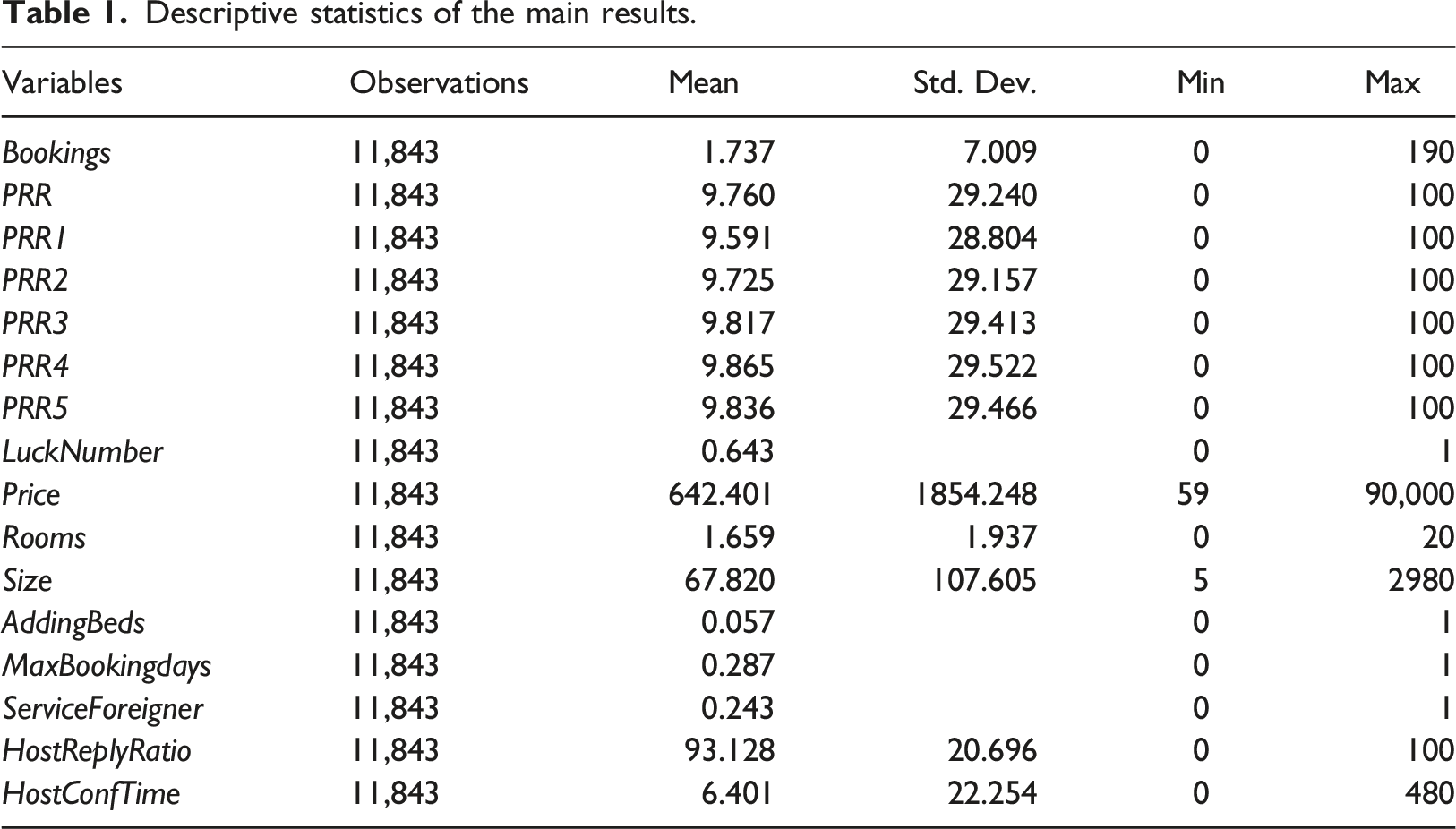
We chose one of the largest room-sharing platforms (Mayi) 1 in China as our data source. We primarily selected the Mayi platform because real booking numbers can be obtained from the platform. After consumers purchase and experience the service on the Mayi platform, they have three options for sharing their experiences: reviews with comments and numerical ratings, issuing numerical ratings only, and posting nothing. When consumers provide no comments on the platform, the website will set those instances as positive ratings by default and are also presented in the room review page. The research sample in this study involves rooms located in Shenzhen City, one of the largest and most popular cities in China. We collected information for 11,843 accommodations.
Our main independent variable involves whether the room price includes the lucky number (‘8’) and is represented as LuckNumber. As for the dependent variables, they include room bookings (Bookings) as represented by the total number of room reviews and the ratio of positive room reviews (PRR). We also adopt the five aspects of ratio of positive room reviews including room cleanness (PRR1), traffic (PRR2), facility (PRR3), host service (PRR4) and quality/cost (PRR5).
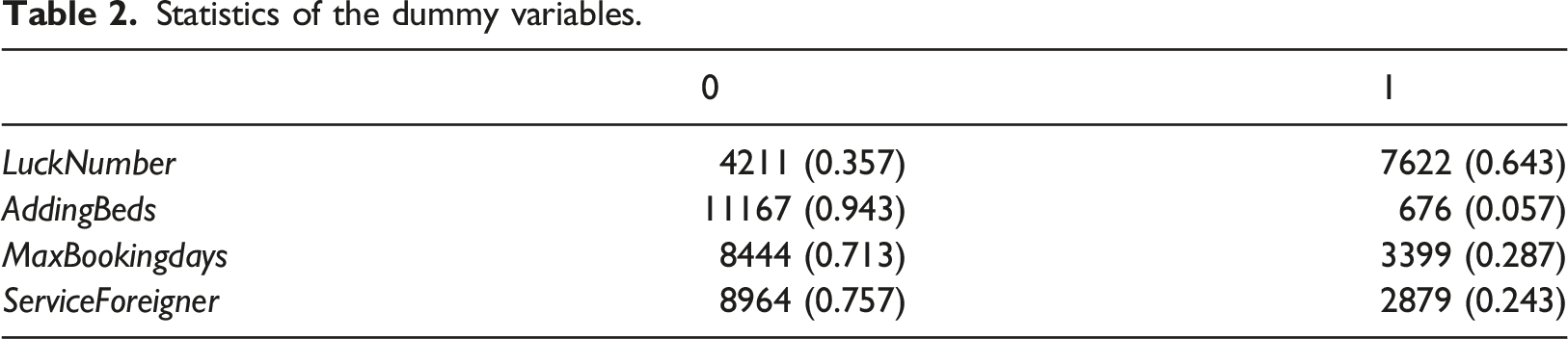
Lastly, we control some other factors including room price (Price), number of rooms (Rooms), size (Size), policy of adding beds (AddingBeds equals to 0 if beds may not be added and to 1 if otherwise), limit of maximum booking days (MaxBookingdays equals to 0 for the existence of a limit and to 1 if otherwise), service for foreigners (ServiceForeigner equals to 0 for no service for foreigners and to 1 if otherwise), ratio of host reply (HostReplyRatio) and confirmation time of host (HostConfTime). We adopt the following research models to estimate coefficients




Empirical results
Descriptive statistics of the main results.
Statistics of the dummy variables.
Estimation results.
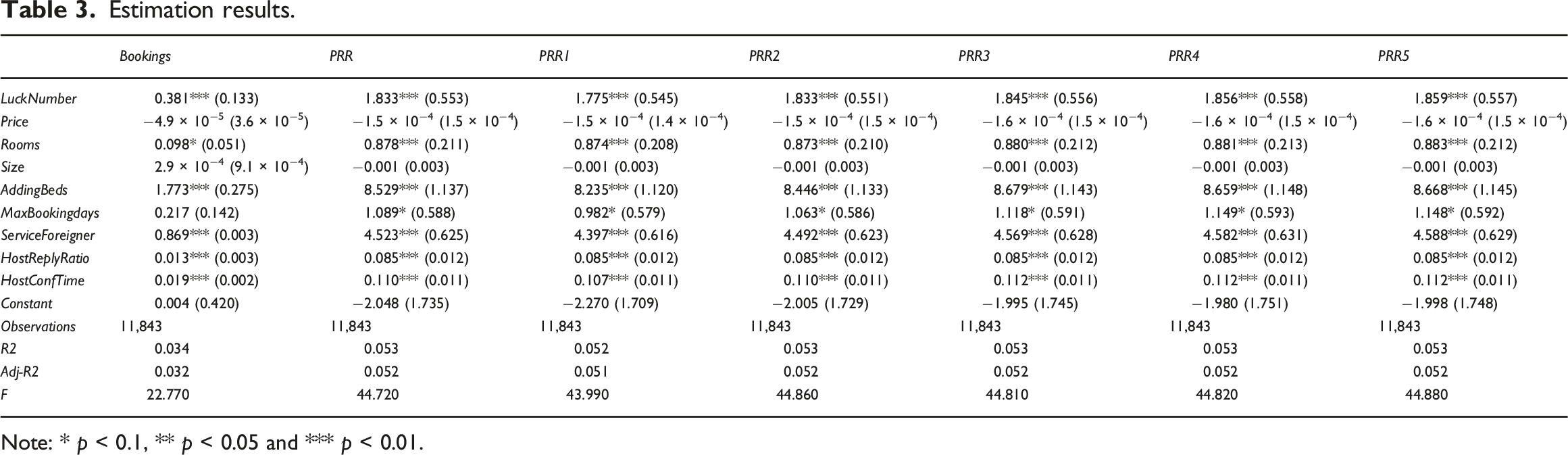
Note: * p < 0.1, ** p < 0.05 and *** p < 0.01.
Estimation results of the dependent variables with positive host review.
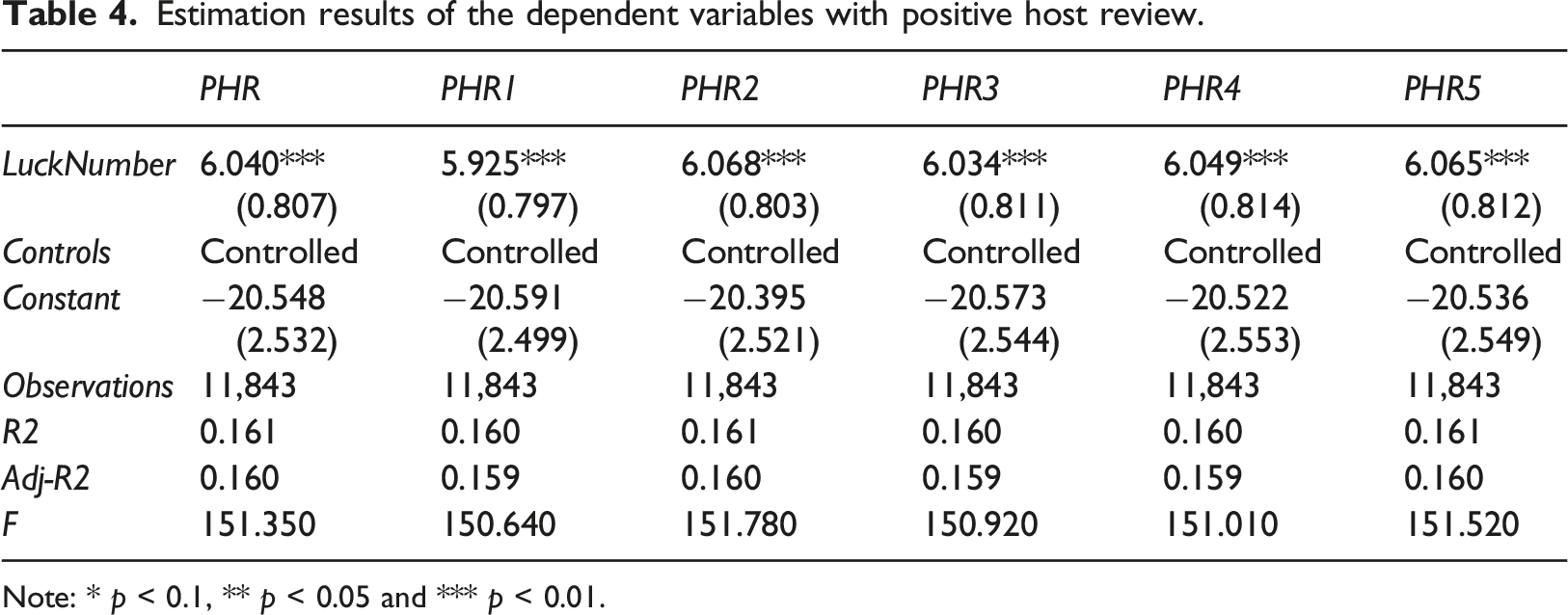
Note: * p < 0.1, ** p < 0.05 and *** p < 0.01.
Conclusions and implications
By collecting room and review observations from Mayi.com, this study establishes the following findings. Firstly, a room with the lucky number 8 in its price has a significantly higher booking number than other rooms without that price feature. Secondly, including the lucky number 8 in its price can increase a room’s customer rating. That is, such a room will have higher ratio of positive reviews as regards the entire room, the room cleanness, traffic, facility, service and quality/cost. A host setting price with the lucky number 8 will also receive more positive ratings. Prior studies have already identified the influence of lucky numbers on customer purchase and satisfaction for traditional products (Block and Kramer, 2009; Kramer and Block, 2008) with this study exploring the effect of a lucky number for room price for experience products in room-sharing platforms, thereby extending existing the literature on this topic. This positive effect of a lucky number might arise because such a number is favoured by Chinese customers and can trigger their positive emotions (Simmons and Schindler, 2003).
Our findings have practical implications for hosts and operators in room-sharing platforms. The identification of the positive effect of lucky numbers in prices can provide suggestions for hosts about their pricing strategy. That is, including the lucky number 8 in the price can help hosts increase their room bookings, booking ratings and even their own ratings. For platform operators, the lucky number 8 in the price is a double-edged sword. From a positive perspective, encouraging hosts to set a price with the lucky number 8 can increase room bookings and room evaluations, and these features are the preconditions of platform revenue and reputation. From a negative perspective, however, the usage of price with the lucky number 8 may evoke a perception of luck and positive attitudes to the customers, thus encouraging customers to make booking decisions with a quick process. With such quick process, customers may spend less time evaluating room quality and even neglect some flaws of the rooms, thus diminishing customer benefits from the room booking experience. Thus, we suggest that platform operators take reasonable responses to room price with lucky numbers. For example, platform operators can design a more objective ranking to take room price into consideration.
This study also has some limitations. Firstly, the data herein were collected from only one platform (Mayi.com) and one city (Shenzhen). Future studies could collect more data from other platforms and cities to achieve a more generalised result. Secondly, this work uses cross-sectional data with room price (which is a relatively stable variable) as the main focus. Future studies could identify the change of price and construct a more dynamic dataset to test the effect of room price with lucky numbers. Thirdly, lucky number 8 is a special case under the Chinese culture. Investigating the effect of other lucky numbers (i.e. 7 in the American culture) may yield interesting results. Lastly, future studies may consider exploring whether the number and the position of lucky number matters.
Footnotes
Declaration of conflicting interests
The author(s) declared no potential conflicts of interest with respect to the research, authorship, and/or publication of this article.
Funding
The author(s) disclosed receipt of the following financial support for the research, authorship, and/or publication of this article: This work was supported by the Philosophy and social science planning project in Sichuan Province (Xq21C04), MOE (Ministry of Education in China) Project of Humanities and Social Sciences (20XJC630003, 21YJC630148), Fundamental Research Funds for the Central Universities (YJ201950, YJ202074), and National Natural Science Foundation of China (71902148, 72101169, 72102157).
