



Abstract
This study scrutinised the influence of air pollution on the USA’s tourism industry along with macroeconomic variables from 1990 to 2020. The analyses were conducted using a novel quantile autoregressive distributed lagged (QARDL) technique to examine the nonlinear association in the long and short run. Additionally, the constancy of the parameters under the short- and long-run estimations was investigated using the Wald test. The QARDL results under different quantiles confirmed that air pollution in terms of carbon dioxide (CO2) emissions and particulate matter (PM2.5) had a negative association with the arrival of international tourists in the USA. However, the long-run estimation for the nonlinear association between gross domestic product (GDP) and tourists' arrival (TA) and between the real effective exchange rate (REER) and TA was positively significant under different quantiles. Alternatively, the estimation of the short run corroborated that the past and lagged values of TA showed a positive correlation with the current and lagged values of international TA. Moreover, the findings of the study confirmed, through Granger causality, the bidirectional causality between tourism, GDP, haze pollution such as PM2.5 and CO2 emissions and REER in the USA.
Introduction
A common notion regarding the global tourism industry is that it is not something that can be described through homogeneity but rather through heterogeneity. This is because a growing body of literature has attempted to explain tourism growth by examining both macroeconomic dynamics and the changing climate in emerging and developed economies. With reference to this, significant contributions were made by researchers (e.g. Ahmad et al., 2021; Nawaz et al., 2020; Omran and Kamran, 2018; Scott et al., 2012) while exploring trends in the natural environment, climate change and the tourism industry. Furthermore, the trends in the tourism industry were also investigated in terms of carbon dioxide (CO2) emissions (Jin et al., 2018), air pollution (Saenz-de-Miera and Rosselló, 2014) and macroeconomic dynamics (Boianovsky, 2020; Wang, 2009). It is also believed that tourists are deeply concerned about the environment, and this affects their decisions about vacations or visits (Lise and Tol, 2002). Environmental factors have a significant effect on the tourism industry from a range of perspectives (Baloch et al., 2021; Liu et al., 2021; Zhang and Zhang, 2021). However, their regional context is minimal in terms of specific geographic areas (Ahmad and Ma, 2021).
Air pollution affects the atmosphere, growth of natural resources and health of living beings (Chien et al., 2021a; Li et al., 2021a). The social and economic activities of humans are adversely affected by air pollution. The tourism industry, which is based on the atmosphere, the environment, natural resources and human services, is influenced by air pollution. Consequently, air pollution has a major impact on the tourism industry and its sustainable growth. The primary concern is that the natural boundaries of the regions are unknown. It is not only a threat to people’s health but also to society and the economy as well (Qiu et al., 2020).
Although the USA is among the top tourist destinations in the world, it has faced various issues in recent years (Mishra et al., 2020). In the last decade, it was observed that the tourism industry in the USA faced a contradictory scenario for various reasons. Additionally, Chien et al. (2021b) and Shair et al. (2021) argued that pressure from the recessionary environment has created an adverse environment in the tourism industry and caused a slump in tourist footfall. However, there is a changing trend in ecotourism which is reflected in lower ecological quality. Furthermore, Mishra et al. (2020) found that the carbon footprint in the USA’s economy was the highest compared to the rest of the world due to the higher dependence of tourism on transportation. Such conditions have raised serious concerns about sustainable tourism in the USA (Lenzen et al., 2018).
Besides the environmental factors such as a higher level of air pollution in the tourism industry, the linkage between tourism and economic dynamics such as growth factors, trade openness and exchange cannot be neglected. In this regard, Danish and Wang (2018) made a significant contribution, claiming that tourism and economic growth go side by side, promoting each other in the era of globalisation. Regarding the USA’s economy, it was found that in 2017, the travel and tourism industry generated an economic output of US$1.6 trillion while supporting more than 7.8 million jobs. Additionally, the travel and tourism industry of the USA accounts for 11% of exports, contributing 2.8% of the gross domestic product (GDP) (Select USA, 2017). These figures present some interesting facts to explore the dynamic relationship between the tourism industry and the economic outlook of the USA.
Considering the study constructs, it is worthwhile to share that the various effects of air pollution in the form of CO2 emissions, particulate matter (PM2.5) and economic factors such as GDP, trade openness and the real effective exchange rate (REER) on tourists’ arrival are different (Chien et al., 2020; Sun et al., 2020). Therefore, their relationship needs to be examined in the short and long run before suggesting practical policy measures. The quantile autoregressive distributed lagged (QARDL) technique, encouraged by Cho et al. (2015), has received much attention in the recent literature on energy economics and sustainable environments. This provided the core motivation to employ the QARDL method while investigating the short- and long-run estimated associations between the constructs, specifically in the USA context. Mensi et al. (2019) argued that there are various benefits to the QARDL methodology. For instance, it helps predict the correlation between the study constructs both in the long and short run simultaneously with a span of quantiles along with the conditional distribution of the explained variables. Additionally, various levels of quantiles for economic growth, trade openness, REER and air pollution, such as CO2 emissions and PM2.5, have impacted tourist arrivals (TA) in the USA due to significant variation in the travel and tourism industry in recent years. Therefore, the application of the QARDL process contributes to the existing literature on tourism, the environment and the economy.
Air pollution has long been a global issue. This problem has become serious and chronic since the Industrial Revolution, as the increase in industrial activities disturbed the balance of the atmosphere, increasing the amount of carbon emissions released into the air (Li et al., 2021b; Zhuang et al., 2021). Domestic and economic activities have been the major sources of carbon emissions, which cause air pollution (Chien et al., 2021c; Xiang et al., 2021). This adversely affects the atmosphere we breathe, natural resources and the health of living beings (Chien et al., 2021a). It proves to be a threat to sustainable tourism growth, where the atmosphere, natural resources, living creatures and human resources must be of good quality (Fotiadis et al., 2021). Interestingly, during the COVID-19 pandemic, the emission of one of the most toxic pollutants, CO2, was minimal because of the lower usage of fossil fuels, as many large industries, including tourism, were shut down to maintain social distancing (Higgins-Desbiolles, 2020). However, shutting down industries and tourism is obviously not a solution for maintaining air quality. Thus, this study suggests ways to improve air quality through the sustainable growth of the tourism industry. Moreover, this study not only analyzes the influence of air pollution on TA and tourism’s growth but also introduces factors such as GDP and REER to control the problems of air pollution in the tourism industry during COVID-19 (Chien et al., 2021c; Ehsanullah et al., 2021).
This paper is organised into different sections. A literature review is presented in section 2, and the research methodology is explained in section 3. The next section covers the study’s findings and presents a discussion, while the last section concludes the study and discusses its implications.
Literature review
Several researchers have added theoretical and empirical evidence to the literature while exploring trends in the tourism industry involving environmental and macroeconomic factors. For example, Churchill et al. (2020) considered G20 economies when exploring the trends in tourism through air pollution. For this purpose, the effects of two key measures of air pollution, emissions of CO2 and PM2.5, on the arrival of tourists in G20 member states, were explored. Through panel data models, it was confirmed that both CO2 emissions and PM2.5 adversely affected the arrival of international tourists in targeted economies. Furthermore, the study findings showed that the effect of CO2 emissions was more pronounced in developed economies, whereas PM2.5 played a stronger role in developing economies. Gulistan et al. (2020) observed a dynamic association between tourism, environmental degradation, economic growth, trade openness and energy in a global sample of 112 countries between 1995 and 2017. Their findings confirmed the presence of the environmental Kuznets curve and the determination of income as a turning point in improving environmental quality. Additionally, their study findings also highlighted that economic growth, energy consumption and tourism had adverse effects on the natural environment.
Mishra et al. (2020) attempted to provide fresh evidence while examining the dynamic association between the arrival of international tourists, transportation services, economic growth and carbon emissions in the economy of the USA. Their study applied partial multiple wavelet coherence techniques to a dataset from 2001 to 2017. A strong correlation among the constructs was observed, which was not equal across the time scales. Jermsittiparsert and Chankoson (2019) investigated the environmental trends in the tourism industry of Thailand using data collected from 2000 to 2014 with yearly observations. This study confirmed that carbon emissions from manufacturing industries and other sectors had a significant impact on Thailand’s tourism industry. Liu et al. (2011) analysed the energy requirements related to carbon emissions by the tourism industry in Western China in 1999–2004. Energy intensity, industry size and expenditure size are believed to play a substantial role in determining carbon emissions by the tourism industry. Deng et al. (2017) expressed their view that although there is growing concern regarding the effect of air pollution on the tourism industry, this topic still needs to be explored in different economies. Considering this gap in the literature, their study analysed the direct, indirect and total effects of air pollution due to the arrival of international tourists in China during 2001–2013. The study findings confirmed that air pollution has a significant and direct negative impact on international tourists visiting China. Other studies such as Dong et al. (2019), Tang et al. (2019), Zhang et al. (2020) and Zhou et al. (2019) also scrutinised the relationship between air pollution and the tourism industry in different economies.
In addition, tourism industry trends were investigated with the help of economic factors. For example, Belloumi (2010) examined the role of REER and GDP in defining international tourists' arrival in Tanzania by using annual data from 1970–2017. Their results confirmed a co-integrating association between tourism and economic growth, as well as a positive association between tourism and economic growth. De Vita (2014) examined the effect of the exchange rate regime on the flow of international tourism. The study applied the system generalised methods of moments estimation to investigate trends in tourism among 27 Organization for Economic Cooperation and Development (OECD) and non-OECD economies during the period 1980–2011. It is believed that multiple exchange rate regimes play a significant role in determining a stable exchange rate to attract more international tourists. Sigala (2020) investigated economic activity, air pollution and tourism. Business activities such as running of technologies, logistics use and manufacturing of products and services increase air pollution. In performing business processes and running technologies, energy resources such as fossil fuels, which spread SO2 and CO2 into the air, are used. The increase in air pollution affects the quality of the environment and natural resources, which in turn affects the health of human resources. Tourism, which is based on environmental and natural resources, is significantly affected by air pollution.
According to the literary investigation conducted by Ruan et al. (2020) on the factors affecting the growth of the tourism industry, air pollution has many adverse impacts on the growth of the tourism industry. Pollution affects the quality of the natural environment, which is a source of recreation and amusement for tourists and serves to expand the tourism industry. Transportation is necessary in the tourism industry, but in the case of a contagious disease like COVID-19, restrictions on transportation will be imposed. Thus, air pollution was more severe before the COVID-19 pandemic, resulting in better air quality during COVID-19. This was because many large industries were closed to maintain social distancing and curtail the spread of COVID-19. Thus, researchers have suggested that governments maintain air quality in the COVID-19 era by encouraging sustainable activities and tourism growth (Mostafanezhad, 2020).
Despite various studies confirming the dynamic relationship between air pollution and macroeconomic variables in the tourism industry, evidence from the perspective of the USA is still insufficient. Furthermore, the USA is the world’s second largest emissions producer in terms of CO2 emissions per capita. This was the primary motivation for selecting this sample. Furthermore, earlier studies mainly focused on traditional methods of investigating the association between the key determinants of the tourism industry. However, the key gap in the application of advanced techniques, such as QARDL, which provides three different levels of the lower, medium and upper quantiles, is yet to be covered. The benefits of applying the QARDL methodology lie in assimilating nonlinearity, asymmetric association and structural breaks, which are not possible when using traditional ordinary least squares (OLS) techniques or simple quantile regression estimation.
Methodology
This study investigated the nonlinear relationship between TA, GDP, air pollution (i.e. CO2 and PM2.5), trade openness and REER in the USA during 1990–2020, through an innovative QARDL technique. Data were collected from the World Bank Indicators from 1990 to 2020. TA was the dependent variable, measured as tourism receipts, while PM2.5 and carbon emissions were the independent variables. In addition to GDP, REER was the control variable. Although several econometric approaches have been provided in the literature for exploring the relationship between constructs, it was observed that the literature did not show a nonlinear association between the chosen variables. This gap was filled by Cho et al. (2015), who recommended QARDL. QARDL has received much attention in the recent literature on energy economics and sustainable environments. This provided the core motivation to employ the QARDL methodology while observing the short run as well as the long-estimated correlation among said constructs in the USA context. Multiple benefits emerged and were later noted when the QARDL methodology was applied. For instance, it helped predict the association between the study variables in the long and short run simultaneously with a span of quantiles and the conditional distribution of the explained variables. Since 2015, various researchers have utilised this approach and its econometric significance (Godil et al., 2020; Nawaz et al., 2021; Zhan et al., 2021). The traditional model for ARDL can be represented by the following equation

q and r = the order of the lags, as observed with the Schwarz-Info criterion.
The study variables (X1–X5) show titles such as GDP, trade openness, REER, CO2 emissions and PM2.5, measured through natural logs. The term Y indicates TA after determining the traditional level of the ARDL methodology. Equation (2) provides a more specific layout for the study variables considering the QARDL methodology

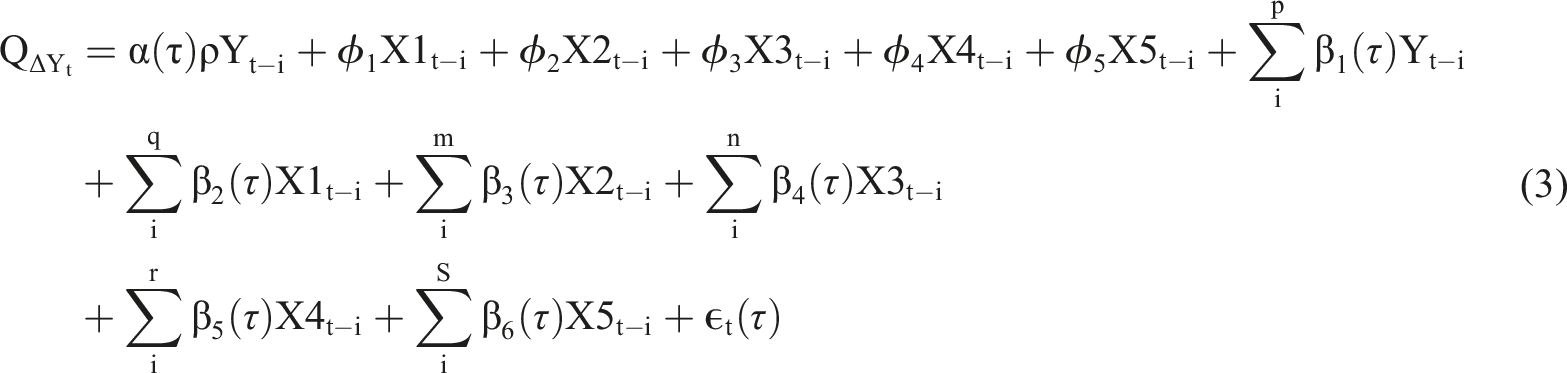
Additionally, equation (3) can be modified to derive the model provided for the QARDL framework, as below
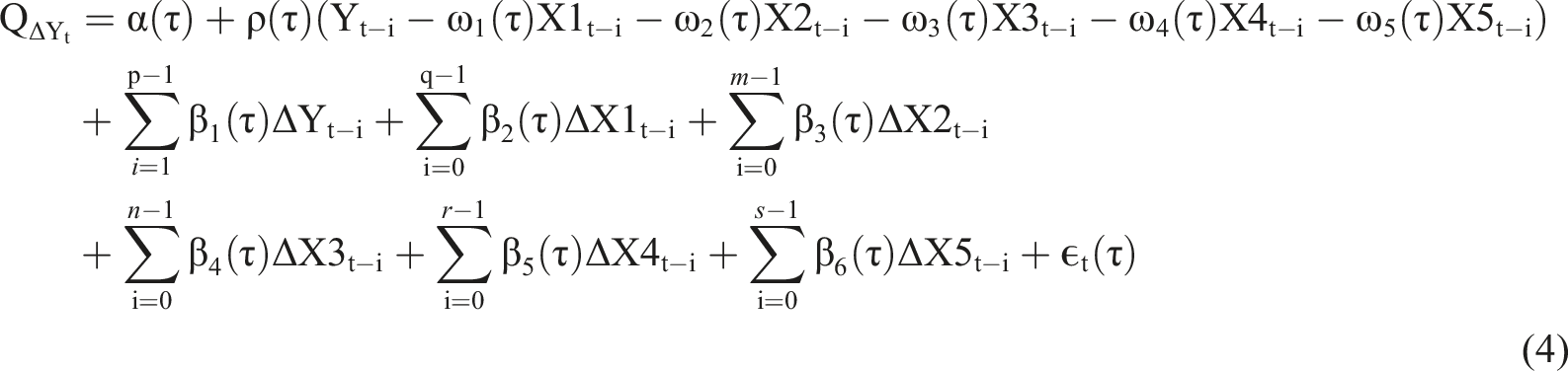
It was observed that
Discussion
Descriptive statistics.

Note: ***, ** and * represent a sig. level at 1%, 5% and 10%, respectively.
Source: Authors’ estimation.
Unit root test.
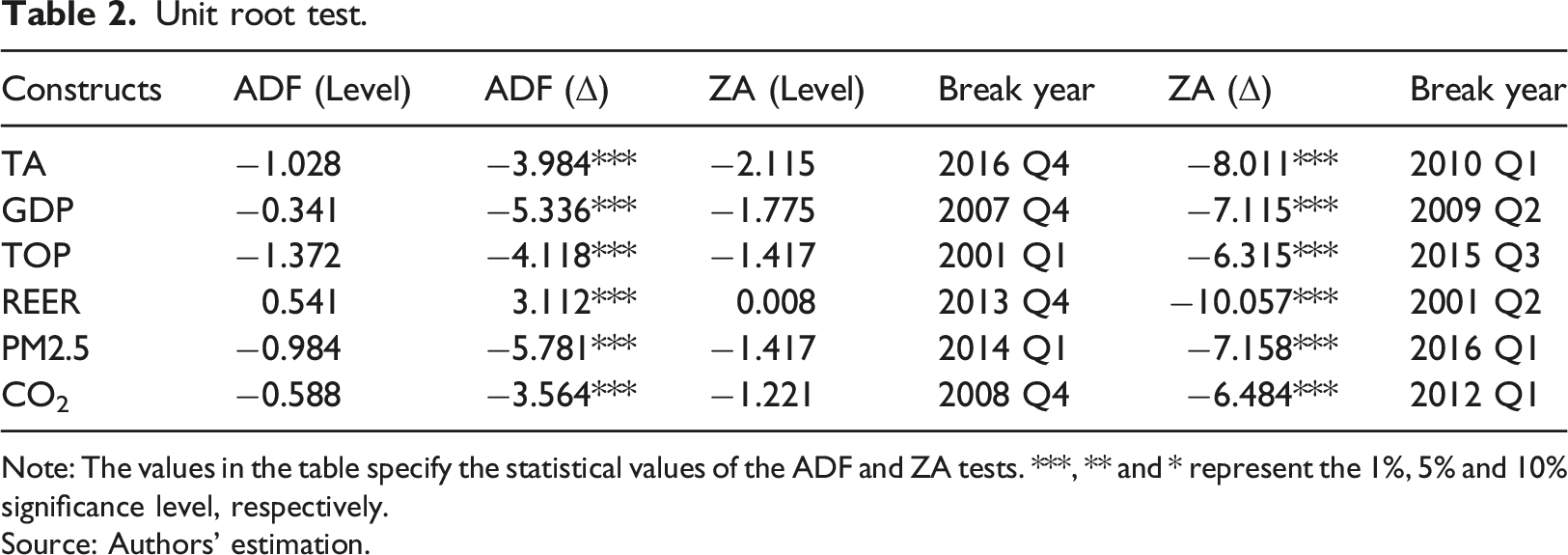
Note: The values in the table specify the statistical values of the ADF and ZA tests. ***, ** and * represent the 1%, 5% and 10% significance level, respectively.
Source: Authors’ estimation.
Quantile autoregressive distributed lag with TA.
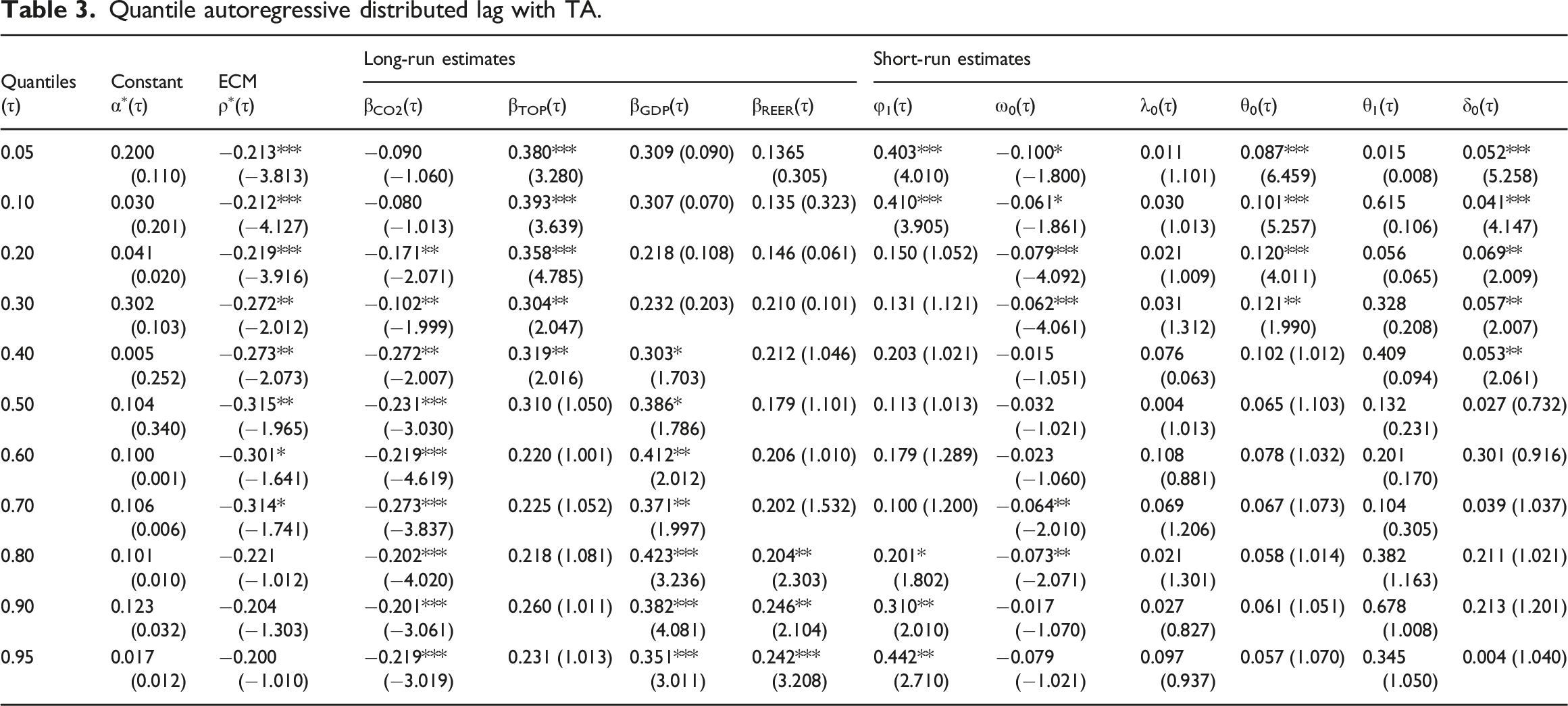
In addition, the long-run estimation in Table 3 confirms the association of economic growth with the USA tourism industry. However, this relationship was not significant for the lower quantiles, but it was statistically significant for the middle and upper quantiles. The highest impact was observed in the 80th quantile with a coefficient score of 0.423, followed by the 50th and 90th quantiles. These findings confirm that higher economic growth is a positive sign of good trends in the tourism industry in the USA. Tugcu (2014) observed causality between economic growth and the tourism industry. However, the study findings under long-run estimation for tourism arrival and its key determinants showed that REER is a positive and significant indicator. Under the lower and medium quantiles, the association between REER and TA was insignificant, but was highly significant for the 80th, 90th and 95th quantiles. Recently, Karimi et al. (2019) examined the relationship between the real exchange rate and TA in the Malaysian economy and observed a significant and positive linkage between them.
When examining the long-run coefficients, the findings under the short-run indicated that past TA values had a positive influence on the current values of TA in the USA. However, this relationship was only significant for the lower quantiles (0.05th and 0.10th) and upper quantiles (0.80th, 0.90th and 0.95th). The contemporaneous variation in the value of CO2 emissions showed a significant and negative influence on TA for the first four quantiles and 0.70th and 0.80th quantiles. This shows a short-run association between CO2 emissions and the arrival of tourists in the USA. Moreover, the study findings under the short-run estimation clearly showed that there was no significant linkage between TOP and TA. However, in terms of GDP, a positive and significant relationship was confirmed, but only for the lower quantiles. Additionally, the findings for the second lagged in REER showed a positive association with current changes in the TA of the USA. However, the relationship was only significant for the lower quantiles (0.05, 0.10, 0.20, 0.30 and 0.40).
Quantile autoregressive distributed lag with TA

Note: The t-statistics are in brackets. ***, ** and * represent a sig. level at 1%, 5% and 10%, respectively.
Source: Authors’ estimations.
Moreover, the results revealed that trade openness had a positive and significant impact on TA under the long-run estimation. This relationship was monitored only for the lower to medium quantiles, where the highest impact was observed for the 40th quantile, with a score of 0.217 at the 5% significance level. Gulistan et al. (2020) investigated the dynamic linkage between trade openness and economic growth in the tourism industry. They observed a positive association between trade openness and the tourism industry in the global market. From Table 4, the long-run estimation between economic growth and the tourism industry of the USA was also predicted, and a positive correlation between GDP and TA in the long run for all quantiles was confirmed. However, this relationship was significant for the higher and lower quantiles. In the previous literature, Gulistan et al. (2020) confirmed that higher economic growth was positively linked with the tourism industry. Meanwhile, the long-run estimation in Table 4 also shows a positive association of REER with the arrival of tourists in the local market of the USA, where this impact was only observed to be significant for the lower-order quantiles.
Results of the Wald test for the constancy of parameters.
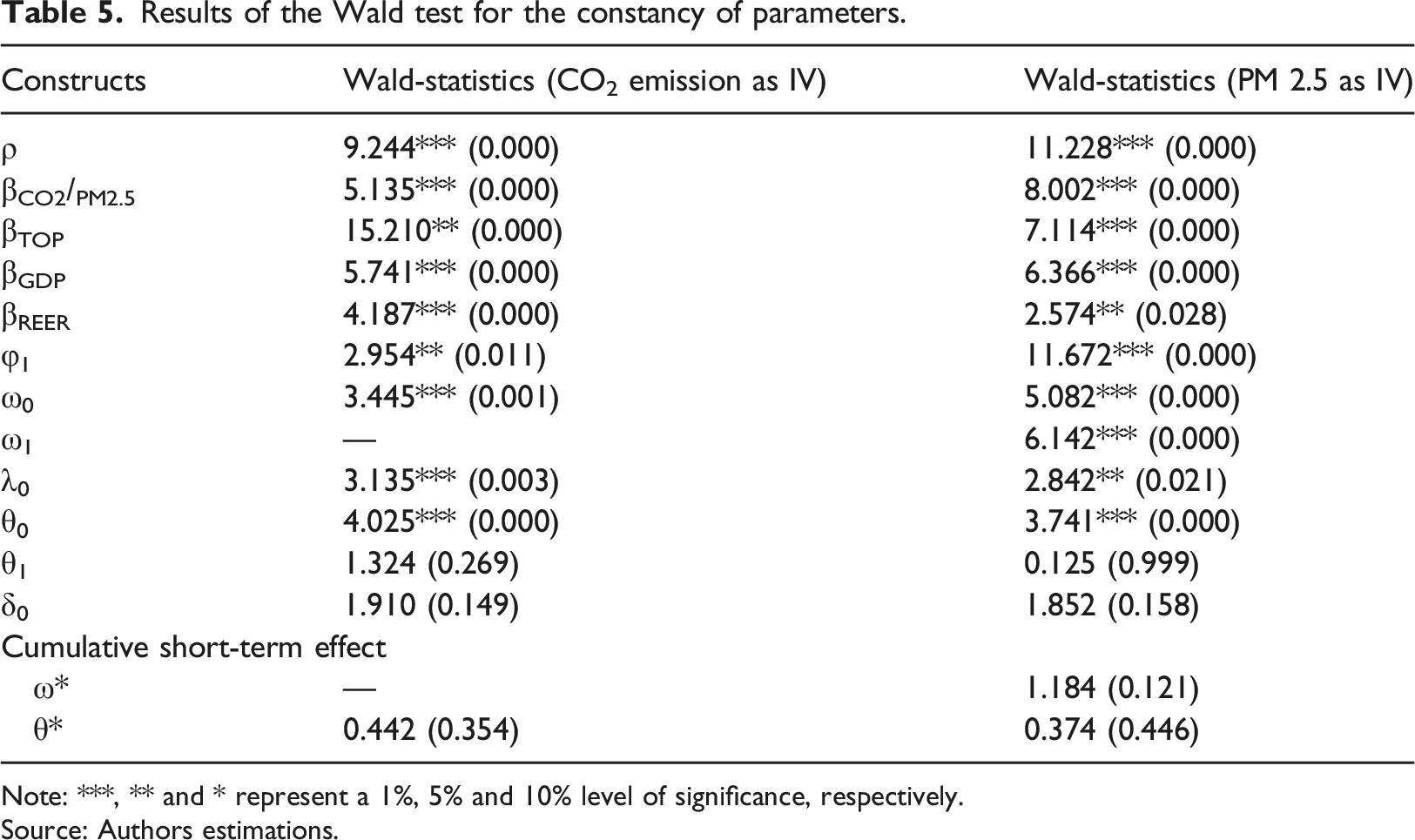
Note: ***, ** and * represent a 1%, 5% and 10% level of significance, respectively.
Source: Authors estimations.
Granger causality in the quantile test results.

Source: Author’s estimation.
Conclusion and policy implications
The current study’s core purpose was to investigate the impact of air pollution factors such as CO2 emissions, haze pollution (PM2.5) and other explanatory variables on the tourism industry in the USA through the QARDL methodology. The main reason for using this methodology was that it specifies how a variety of quantiles for the chosen constructs, such as trade openness, GDP, CO2 emissions, PM2.5 and REER, affect the arrival of international tourists in the USA; hence, it provided in-depth knowledge regarding the general dependence of the study variables in contrast with older approaches, such as simple quantile regression estimation or OLS. We further investigated the correlation between the study variables using the Granger causality test. The study findings indicated that the parameter of error correction for the lower order and medium quantiles was negative when CO2 emissions were added among other explanatory variables for the long-run estimation under the QARDL methodology. Similarly, the p* value for the second output of QARDL also showed significant and negative outputs, but not for the higher-order quantiles. This evidence proves the claim about the presence of a reversion to the long-run association between the constructs chosen for this study. Specifically, the results confirmed that CO2 emissions have an adverse impact on the arrival of international tourists, with a positive and significant impact from GDP, REER and TA in the long run. An in-depth investigation of the study quantiles further revealed that GDP and TA were positively correlated. However, this was only observed for the lower-order and medium quantiles. Additionally, a negative long-run estimation between CO2 emissions and TA was found for all quantiles except for the first two.
When the QARDL method was applied to explore the dynamic linkage between the constructs along with PM2.5 and TA, the results showed that CO2 emissions and PM2.5 were linked negatively with TA in the USA. Furthermore, the positive linkage between the past and lagged values of TA and the current and lagged values was also confirmed. The results in different quantiles via Granger causality also confirmed a bidirectional causality between tourist TA, CO2 emissions, PM2.5, trade openness, GDP and REER. Plausible policy implications can be drawn from this study’s findings. For example, the long-run estimation confirmed a positive association between economic growth and TA in the USA in a positive manner, and this was also proven by the Granger causality test.
The results showed that the government should focus on economic activities that may boost tourist visits in the region. Furthermore, the negative linkage between CO2 emissions and TA, and between PM2.5 and TA, also indicated a significant need to control air pollution, specifically from traditional energy sources. This may lower the environmental impact and provide more attraction to international tourists in the USA. Additionally, the government should consider the REER movement and its long-term linkage with the TA from the global market. This means that consistent and robust economic and financial policies are required to retain the long-run association between REER and TA over the coming years. Furthermore, it is recommended that strong policies be implemented to protect the natural environment from air pollution, such as CO2 emissions and PM2.5.
Footnotes
Declaration of conflicting interests
The author(s) declared no potential conflicts of interest with respect to the research, authorship, and/or publication of this article.
Funding
The author(s) disclosed receipt of the following financial support for the research, authorship, and/or publication of this article: This paper is partly funded by Van Lang University, Vietnam.
