




Abstract
This study examines whether international tourism flows are affected by differences in the environmental performance of origin and destination countries by conducting an empirical analysis with a gravity panel dataset of 169 origin countries and 157 destination countries from 2000 to 2015. Estimated results show that the difference between environmental performance of a country pair adversely affects international tourism flows. This implies that tourist behavior is particularly influenced by familiarity, behavior conformity, and the need for virtue-signaling. Results also suggest that better environmental performance of the destination relative to the origin, as captured by an overall environmental performance index or its sub-indices, lowers international tourism more than vice-versa. This effect potentially hinges on the tradeoff between functionality and the image of the international tourist destination. Policies that create an enabling milieu for sustainable tourism and environmental practices—such as ecolabeling and targeted advertising—would help attract more environmentally conscious tourists.
Introduction
Prior to the COVID-19 pandemic and subsequent restrictions on travel, international tourism made vital contributions to global, national, and even regional economies. The tourism and hospitality sector is often heavily influenced by environmental factors and natural resources—for example, scenic landscapes, nature, and wildlife (Knowles et al., 1999; Shafiullah et al., 2019). In the last couple of decades, the vulnerability of tourism to climate change, and the sector’s sustainability have been scrutinized (Gössling and Scott, 2008; Weaver, 2006; Scott et al., 2012). In response, consumers and service providers (firms) have modified their behavior to appear and/or become more environmentally friendly.
As social creatures, human beings often adapt their behavior based on their surroundings—motivated by belief, culture, fashion, peer pressure, and virtue-signaling, inter alia (Kong et al., 2016; Vollmer et al., 2018; Wallace et al., 2020). Behavior conformity is apparent for both tourism-sector consumers and service providers (producers) who aim at improving their social-responsibility image (Adriana, 2009; Blanco et al., 2009; Tan et al., 2017). Moreover, common human characteristics between countries—such as culture, diaspora/immigration, ethnicity, religion, and official and unofficial languages—have been observed to augment/influence bilateral tourism flows (Okafor et al., 2018; Okafor et al., 2021b; Shafiullah et al., 2019). Thus, apparently, the notion of birds of a feather flock together predominates in the realm of international tourism.
Since the 1990s, the environmental performance and sustainability of the tourism and hospitality sector have come under increasing scrutiny, and some have called for the sector to become more sustainable (Bojanic, 2011; Bojanic and Warnick, 2020; Goodall and Stabler, 1997; Middleton and Hawkins, 1993). Many of the sector’s firms have responded by voluntarily adopting measures—often ostensible ones such as ecolabeling—aimed at improving sustainability and/or environmental performance (Ayuso, 2006, 2007; Carter et al., 2004; Rivera, 2002). Green behavioral response by tourism and hospitality service providers aims at improving firms' survivability (Knowles et al., 1999) and consumer (brand) loyalty (Tan et al., 2017).
The phenomenon of visible green behavior (i.e., green to be seen) has frequently been observed in consumer behavior, mostly outside tourism (Thøgersen and Ölander 2003). Consumers engage in “conspicuous conservation”—for instance, driving hybrid vehicles and using green products and grocery bags, public transportation, and car-pooling—aimed at signaling altruism or status (Babutsidze and Chai, 2018; Brick et al., 2017; Griskevicius et al., 2010; Sexton and Sexton, 2014). For consumers in general, the spillover of green behavior might be motivated by altruism as well as by prestige, peer pressure or social norms, or the need for virtue-signaling, inter alia (Brick et al., 2017; Griskevicius et al., 2010; Mazar and Zhong, 2010). In particular, Sexton and Sexton (2014) find that U.S. consumers are willing to pay as much as an extra USD 430–4200 (depending on their location) to signal their green behavior by purchasing the Toyota Prius hybrid vehicle.
Tourist flows and environmental performance across regions.

Note: EPI, EH, and EV stand for Environmental Performance Index, Environmental Health, and Ecosystem Vitality, respectively. The difference of each variable measures the disparity between respective values from the destination and origin.
Accordingly, this study contributes to the extant literature and is unprecedented in assessing the extent to which the environmental performance of a destination and origin countries affect international tourist flows. This empirical analysis uncovers international tourists' consideration of the destination’s environmental performance vis-à-vis their origin. As noted above, international tourists and hospitality service providers alike are increasingly aware of the environmental sustainability of their business models. Both consumers and service providers in this sector have taken steps to be eco-friendly. To date, no extant study has attempted to analyze the relationship between differences in environmental performance between country pairs and tourist flows. This study fills that lacuna by assessing how bilateral tourist flows can be affected by differences in their respective environmental indicators. This is a novel approach to modeling environmental performance consideration in international tourist demand because the latter is often heavily influenced by familiarity, behavior conformity, prestige, and virtue-signaling. This study is also the first to implement a panel gravity dataset comprising 169 origin and 157 destination countries over a period from 2000 to 2015, with 12,812 country pairs. Gravity approach models both inbound and outbound tourist flows and is thus better able to model environmental performance’s impact on international tourism of country pairs. Furthermore, unlike past studies that often consider carbon dioxide (CO2) emissions as a measure of environmental performance, we avail the environmental performance index (EPI) by Wendling et al. (2020). EPI is a comprehensive, data-driven environmental performance metric comprising many sub-metrics including, but not limited to, Environmental Health (EH) and Ecosystem Vitality (EV). EPI, along with EH and EV, is better able to measure the overall state of a country’s environment than rudimentary CO2 emissions. This is expected to paint a lucid picture of international tourists' consideration of environmental performance in making visitation decisions.
This study’s empirical findings depict an interesting perspective, that is, a difference in environmental performance between country pairs worsens bilateral tourist flows. Such an inclination in international tourism demand is probably motivated by behavior conformity, familiarity, prestige, and virtue-signaling; in other words, birds of a feather flock together. Further, we find that tourists are more inclined to travel to destinations where environmental performance is slightly worse, compared to their origin, than to destinations that perform better than their origin. This observed phenomenon might be attributed to a tradeoff between the ideal image that the international tourist has of a destination and its utility/experience. Consequently, destinations have the incentive to become more environmentally friendly—perhaps via ecolabeling and targeted promotion campaigns—in contrast to origins, as well as to provide a unique experience to attract and retain a higher number of loyal international tourists. This has become particularly evident in the COVID-19 pandemic’s wake as tourists and travelers are more aware of the health and environmental risks, and are more willing to travel to destinations that are familiar, predictable, and trusted (World Travel and Tourism Council, 2020). The pandemic has also brought about “travel bubbles” between cities and country pairs (often based on similar health records)—almost approaching the literal interpretation of birds of a feather flock together.
The rest of this paper is structured as follows: the following section reviews the literature, the third section describes the model used for estimation and explains the data and methodologies used in this study, the fourth section presents empirical results and relevant discussions, and the final section provides concluding comments and policy implications.
Literature review
This section reviews previous studies related to environmental performance and financial performance of tourism firms, sales volume or price premium, use of ecolabels and environmental certification in the tourism industry, and organizational traits that define tourism firms' environmental performance. This includes tourism business practices in accommodation enterprises, and tourism accommodation’s environmental performance. The remaining issues include the propensity of consumers to emulate observable pro-environmental behavior, voluntary environmental sustainability practices, and review of environmental policies in the tourism industry.
In many advanced and developing countries, tourism depends on economic, social, and environmental conditions to thrive. As a result, countries tend to maintain high environmental standards, which in turn could help promote destination countries' international tourism competitiveness. The following review of related literature suggests that it is becoming common for the tourism industry and consumers to go green, and conserving the environment can lead to sustainable tourism development (Băndoi et al., 2020; Bojanic and Warnick, 2020; Mohammadi and Rasekhi, 2015; Tan et al., 2017).
According to Buckley (2001), ecolabels are common in the tourism industry; however, no coordination mechanism is in place. In general, several private, public, and nonprofit agencies have established ecolabels, which include awards, certifications, and accreditation, and range in scale from small villages to the entire world. However, their impact’s in influencing tourists to incorporate environmental performance in their purchasing decisions is largely unknown. Therefore, implementing ecolabels is difficult; a few have prospered by doing so, yet others have not. This is especially evident from elicited information from respondents as Björk (2004) found that Swedish eco-tourism label only captures to some extent a high-quality travel arrangement, protection of nature, a responsibility for nature and culture and environmentally friendly traveling. In addition, a significant share of the respondents maintained that it is not appropriate for Finnish ecotourism firms to make use of Swedish eco-tourism labels without necessary adjustments. A potential way to improve environmental performance is to augment the use of eco-labeling with benchmarking. This is consistent with the evidence that eco-labeling and quality systems has the potential to serve as facilitators of destination benchmarking, especially if the alternative benchmark information is not available (Kozak and Nield, 2004).
Similarly, Font’s (2002) review suggests that sustainable tourism and ecotourism are misunderstood as greenwash because of the paucity of methods to distinguish them as quality products. The upsurge in the number of labels, awards, and accolades for different products has confused consumers to the extent that they overlook green messages. To overcome this obstacle, an environmental certification in hospitality and tourism was developed in line with an international accreditation system that conforms to agreed standards and maintains linkage with sector-specific, national, or regional certification programs.
Knowles et al. (1999) have stated that natural resources and the physical environment are crucial assets for the tourism industry (including hotels) because they help promote the delivery of tourism services. As a result, hotels consider natural resources and the physical environment as essential assets for attracting a higher number of tourists. Considering the increasing importance of environmental initiatives, they used elicited responses from 150 hotels to explore initiatives introduced in the tourism industry with the objective of improving environmental performance. This included a case study that investigated environmental management practices. These researchers found that 94% of respondents were acting on environmental issues, thus suggesting that green values were, at least, being superficially incorporated into business values.
Usman et al. (2020b) have found that institutional quality enhanced environmental performance, using panel data from 28 European Union countries from 2002 to 2014. Additionally, Tan et al. (2017) have explored the effect of both individual and aggregate dimensions of environmental performance on financial performance using data from the travel and tourism industry from 2003 to 2014. They found that aggregated environmental performance had positive outcomes on the hotel industry’s financial performance, whereas resource reduction, an individual dimension of environmental performance, positively affected financial performance in hotels but negatively affected airlines.
Moore et al. (2003) have examined the applicability of visitor impact management approaches, resources and social indicators. These frameworks and/or indicators have been used in wilderness and backcountry management for environmental-performance reporting with respect to natural area tourism. Following these criteria, limits of acceptable change were rated top in the visitor impact management factor. The authors considered resource and social indicators to be potentially relevant in performance reporting insofar as politicians, senior management teams, and other relevant stakeholders viewed them as important.
Moreover, Font et al. (2012) have evaluated corporate social responsibility policies and practices of 10 international hotel groups significant to the European leisure market and found that corporate systems are not always in line with actual operations. For instance, environmental performance is primarily driven by eco-savings goals, labor policies are devised to adhere to domestic laws, customer engagement is not entirely considered, and socioeconomic policies are not broad-minded as little attention is given to their impacts on destinations. Furthermore, larger hotel industries adopt more detailed policies but also have larger gaps in policy implementation, whereas smaller hoteliers restrict their scope of coverage to environmental management and do, in fact, live up to expectation.
Mensah and Blankson (2013) have investigated determinants of environmental performance using Ghana as a case study. This included exploring managers' sociodemographic and organizational traits that explain hotels' environmental performance. The researchers identified the main factors that help explain hotels' environmental performance, such as environmental education and training for workers, support for conservation projects, initiatives to support the host community, adherence to environmental legislation, voluntary activities, and waste management practices.
Further, Rivera (2002) employed survey data from a cross-sectional sample of 164 Costa Rican hotels to reveal that participation in the certification for sustainable tourism (CST) alone was not strongly associated with higher sales volume or prices. Some evidence shows, however, that hotels with higher environmental performance, compared to those with lower performance, do not benefit from price premiums because of participation in a CST program. Moreover, Leslie (2007) used Bell and Morse's (1999) extensive set of environmental performance indicators to conduct a comprehensive investigation of tourism business practices in accommodation enterprises in the Lake National District Park, England. He found that most owners are committed to environmental management, but such commitment is overlooked because they attach greater weight to maximize financial gains through cost-saving measures.
Erdogan and Tosun (2009) examined whether tourist accommodations in the Goreme Historical National Park exhibit better environmental performance through survey data elicited from 73 accommodation managers. These researchers found that tourism accommodation providers perform poorly in energy efficiency, efficient waste management, water preservation, communication, environmental training of workers, awareness of the environment, possession of requisite knowledge, and interest in environmental protection and policy.
Increased tourist flows are associated with both positive and negative effects on the host economy. While countries are receptive to tourism’s positive effects, they fear negative effects. The COVID-19 pandemic has had a detrimental impact on the global tourism (Khalid et al., 2021c; Okafor et al., 2021a), as well as ignited academic and public discourse on potential negative effects of tourism in the destination country. For instance, Ascani et al. (2021) find economic core locations in geographically concentrated economic activities serve as a key channel for the transmission of COVID-19 infections.
Babutsidze and Chai (2018) have investigated consumers' propensity to emulate observable pro-environmental behavior in their regions, using the regional distribution of 15 varying greenhouse gas mitigation practices across Australia. They found that consumers adopted numerous mitigation practices similar to that of their neighbors. Furthermore, the researchers showed that while peer behavior affects the propensity to adopt visible mitigation practices, it does not influence the propensity to adopt nonvisible mitigation practices.
The Carter et al. (2004) review of environmental legislation in Australia suggests that individual and corporate ethics are key determinants for sustaining continuous improvement in tourism’s environmental objectives and performance. Moreover, Buckley and Araujo (1997) elicited information about environmental management practices via questionnaires and found that recycling programs and water and electricity conservation technologies are widely used, which suggests that tourism accommodation providers in the Gold Coast region are aware of conservation programs' importance.
Adriana (2009) elicited information from managers responsible for environmental activities from eight tour operators from the Netherlands, the United Kingdom, Germany, and Finland. Operators were selected for the study because of their leading role in environmental supply chain management (ESCM). Accordingly, the author found that excluding cost-saving benefits and regulatory constraints, pressures from the public prompt adoption of ESCM; however, its implementation is constrained by organizational factors and it focuses on short-term commitments in terms of organizational strategies.
Ayuso (2006) examined voluntary environmental sustainability practices adopted by Spanish hotel operators. He showed that managing directors of hotels in Spain have a muddled understanding of what sustainable tourism entails and limited understanding of their companies' contributions to environmental sustainability. Following a review of the interplay among policy, behavior, and norms, Kinzig et al. (2013) have stated that much debate on methods for addressing environmental problems focuses on short-term effectiveness or policy instruments' popularity. To improve the process, they recommended greater involvement of behavioral and social scientists in conducting environmental policy evaluations. This includes formation of teams of policymakers and scholars who can evaluate the efficacy of environmental policy interventions while considering both short- and long-term implications.
Similarly, De Burgos-Jiménez et al. (2002) reviewed the strand of studies that pertains to the assessment of hotels' environmental performance. They suggested that the high degree of interaction between hotel–environment, customer–environment, and customer–hotel helps promote the essence of environmental issues for the hotel industry. Hotels’ environmental performance in energy and water conservation could allow them to develop a sustainable competitive advantage.
A strand of the literature explores the environmental competitiveness of a destination country from the managerial framework. For instance, using the Calgary tourism competitiveness model, Mihalič (2000) found that improvement in destination environmental competitiveness can be achieved using suitable managerial tools such as environmental impact and environmental quality management. The author also showed that environmental marketing activities are instrumental in promoting destination environmental competitiveness.
The link between the environment and international tourism flows has been explored in the extant literature in the context of a gravity framework. Culiuc (2014) find that environmental conditions of a destination country affect bilateral tourism flows. For instance, tourists prefer to visit regions with similar climates as the origin country. Tourists, however, have a high preference to visit regions with warmer weather. Time difference is found to have a dampening effect on tourist flows even after controlling for distance. The results also show that cultural capital proxied by the number of UNESCO World Heritage sites is one of the key determinants of tourism flows. Additionally, Harb and Bassil (2020a) showed that it is important to control properly for “unobservables” in the context of a gravity framework in order to obtain reliable parameter estimates. For instance, some determinants of bilateral tourism flows, such as bilateral trade ties and the EU dummy variables either display a drop in size or level of statistical significance as the authors switched from first generation specifications to the second-generation framework. The same pattern is observed when they moved from second generation approach to the common correlated effects estimations. In general, the literature is replete with studies that investigate the determinants of tourism flows—migration rates, linguistic proximity, and natural disasters—using the gravity framework (Khalid et al., 2021d; Okafor et al., 2021a; Okafor et al., 2021b; Okafor and Khalid, 2021).
There is some evidence from a country’s environmental performance indicator showing that tourism flows are larger in countries with better environmental performance index compared to those with weak environmental state and low level of compliance with environmental legislation (Koval et al., 2019). Similarly, Usman et al. (2020a) have found that environmental performance interacts differently with democracy at varying quantiles of conditional distribution to promote tourism flows. Chaudhry et al. (2021) have demonstrated that environmental quality, institutional performance, trade openness, and real exchange rate have a positive impact on tourism revenue with reference to East-Asia and Pacific region. Overall, these studies suggest that countries with better environmental quality attract more tourism flows compared to those with poor environmental quality.
In view of the foregoing review, environmental issues are becoming increasingly important in the tourism industry. Studies in the extant literature have investigated the link between environmental performance and tourism flows as well as related issues as reviewed above. Previous studies, however, have not explored whether differences in environmental performances of destination and origin countries affect international tourist flows. This study aims to close this gap in the literature.
Model, data, and methodology
Model specification and methodology
To document how difference in environmental performance between destination and origin affects international tourist flows, we used the gravity model. Gravity models are widely applied in economic literature to model international trade flows, international migration flows, and foreign direct investment flows (Anderson and Van Wincoop, 2003; Bergstrand and Egger, 2007; Eichengreen and Tong, 2007; Frankel and Romer, 1999; Head et al., 2010; Gil-Pareja et al., 2007; Karemera et al., 2000; Khalid, 2017; McCallum, 1995; Rose, 2000). Similarly, gravity models are extensively used in tourism literature, specifically for exploring determinants of international tourist flows and studying tourism demand (Fourie and Santana-Gallego, 2013; Gopalan and Khalid, 2022; Khadaroo and Seetanah, 2008; Khalid et al., 2020; Khalid et al., 2021a; Khalid et al., 2021b; Okafor et al., 2021d; Okafor et al., 2021e; Santana-Gallego et al., 2016).
In line with the existing literature, we estimate a reduced-form baseline augmented panel gravity model as follows
1
:
While the specification in Equation (1) provides some insights into how environmental distance between origin and destination affects tourist flows, it masks the nuances in environmental performance differences between origin and destination countries. For instance, the effect of environmental quality being better in destination than origin on tourist flows might be very different compared to when environmental quality between destination and origin is similar. Therefore, to further tease out the impact of differences in environmental performance between origin and destination countries on tourist flows, we created two dummy variables that capture whether the origin’s environmental performance is better than that of the destination or the reverse. In this context, the relationship between environmental performance and tourist flows is defined as follows:
Although the choice of empirical model is driven by Hausman test, as highlighted by Anderson and Van Wincoop (2003), (2004) and Baldwin and Taglioni (2007) it is important to control for multilateral resistance terms (MRT) when studying bilateral trade and investment flows. Similarly, Harb and Bassil (2020a), (2020b), and (2021) discuss the importance of controlling for MRT when studying tourism flows. Therefore, we re-estimate Equations (1) and (2) by controlling for country-pair fixed effects and year fixed effects instead of country of origin and country of destination fixed effects, that is, we estimate the following two equations:

In addition to the above robustness check to control for MRT, following Harb and Bassil (2020a) we estimate our model using the common correlated effects (CCE) estimator. This is achieved by augmenting Equation (3) with the cross-sectional averages of the dependent variable and the main explanatory variable as follows
4
:

Data description
This study models the relationship between environmental performance and international tourist flows using an unbalanced panel dataset covering 169 origin countries, 157 destination countries, and 12,812 country pairs from 2000 to 2015. Specifically, we rely on the dataset by Wendling et al. (2020) to capture environmental performance. This dataset has been used frequently in the literature as a proxy for countries' environmental performance (Christensen, 2019; Huh et al., 2018; Le et al., 2019). Economic indicators such as GDP per capita at PPP and population size were obtained from World Bank Development Indicators (World Bank, 2017). Data on bilateral tourism flows came from the World Tourism Organization (UNWTO) database (UNWTO 2017). Finally, other gravity variables such as contiguity, colonial linkages, and common language were available from Head et al. (2010).
Table 1 displays the sample international tourist flow and environmental performance measures by region. Tourist flows in Europe, America and Latin America and the Caribbean, and in Asia, the Middle East, North Africa, and Oceania—where a quick computation and comparison of the absolute value of the differences in environmental performance indicators (EPIs, EH, and EV; see below for definitions) indicates that they are lower—exhibit relatively higher averages (mean) and lower volatility (standard deviation [SD]) than in Sub-Saharan Africa.
Dependent variable
Because our goal was to understand the arrival of international tourists as a function of the difference in environmental quality between origin and destination countries, we used tourist arrivals as our dependent variable. Data on tourist arrivals were sourced from the UNWTO database and contains information about tourist arrivals from the country of origin to the country of destination for 222 countries from 1995 to 2015 (UNWTO 2017). As highlighted in tourism literature, tourist arrivals are an accurate measure of international tourist flows due to their ease of collection and are widely used in extant literature (Gil-Pareja et al., 2007; Okafor et al., 2018).
Explanatory variables
Our primary explanatory variables were derived from EPI and its sub-indices, available from Wendling et al. (2020). EPI uses a data-driven approach to measure the sustainability status of 180 countries. Moreover, it uses 32 performance indicators across 11 issue categories to rank countries on their EH and EV. Thus, the EPI highlights leaders and laggards in environmental performance. Using EPI scores and EH and EV scores, we constructed measures to estimate Equations (1) and (2).
We also controlled for a battery of variables that influence international tourist flows, in line with the extant literature (Gil-Pareja et al., 2007; Khadaroo and Seetanah 2008). The definition and expected sign of each of these variables can be found in Table A5 in the Appendix.
Empirical estimation results
Effect of difference in environmental performance of destination and origin on international tourist flows.

Robust standard errors in parentheses. ***, **, and * represent statistical significance at the 1%, 5%, and 10% levels of significance, respectively. All specifications include a constant.
While we argue that tourists' green behavior might be primarily driven by virtue- and/or status-signaling, we acknowledge that behavior conformity and familiarity, along with relative price, perhaps, play pivotal roles. Price consideration is a factor in international tourism, and differing environmental performance between countries might coincide with relative price differences as cheaper destinations are often less environment friendly. The negative sign on coefficients of difference in environmental performance appears to indicate so (Columns (1)–(3), Table 2). The implication of this finding is profound, considering that international tourists prefer to visit destinations whose environmental performance is equivalent—or close—to that of their origin. Thus, for destinations to become more environmentally friendly compared to origins—perhaps by way of ecolabeling—might pay by attracting more and loyal foreign tourists. In Columns (4)–(6), we report the estimation result of Equation (3) using the three environmental performance indicators while controlling for country-pair fixed effects and time fixed effects. Overall, the results are qualitatively similar to the ones reported in Columns (1)–(3).
In terms of the remaining control variables' estimated effects, population and GDP per capita at origin and destination, relative price, common official and unofficial languages, common border, and colonial ties were all found to improve bilateral tourist flows. In contrast, islands' distance and isolation have a mitigating impact on international tourist flows. These findings show respective control variables' expected effects and generally agree with earlier literature, such as Okafor et al. (2018), Shafiullah et al. (2019), Khalid et al. (2020), inter alia. The impact of being landlocked in two-way tourist flows is negative but statistically insignificant at the usual levels of significance.
Effect of difference in environmental performance of destination and origin on international tourist flows, CCE estimates.

Robust standard errors in parentheses. ***, **, and * represent statistical significance at the 1%, 5%, and 10% levels of significance, respectively. All specifications include a constant. The estimates are for CCE estimator with the cross-sectional averages of the log of tourist flow variable and main explanatory variable (environmental performance indicator).
Effect of difference in environmental performance of destination and origin on international tourist flows, CCE estimates.

Robust standard errors in parentheses. ***, **, and * represent statistical significance at the 1%, 5%, and 10% levels of significance, respectively. All specifications include a constant. The estimates are for CCE estimator with the interaction of country of origin and country of destination dummy variable with the cross-sectional averages of all the variables.
Environmental performance of destinations and origins and international tourist flows.
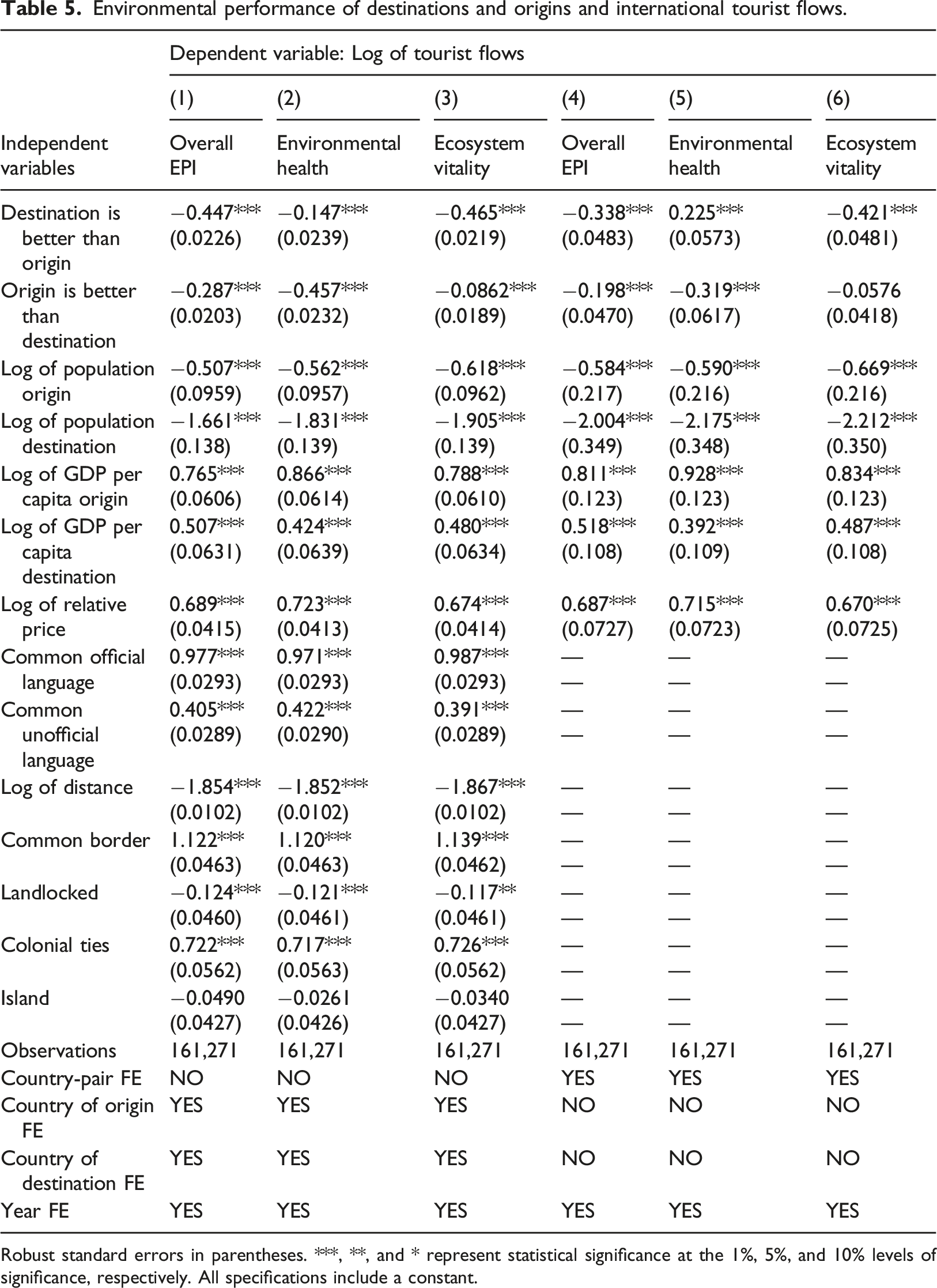
Robust standard errors in parentheses. ***, **, and * represent statistical significance at the 1%, 5%, and 10% levels of significance, respectively. All specifications include a constant.
Prior empirical literature appears to confirm a tradeoff between functional attributes and the ideal image of tourism destinations, albeit not necessarily relating to environmental performance (Stepchenkova and Mills, 2010; Murphy et al., 2007). Thus, Equation (2) estimation results in Table 5 provide further evidence that bilateral tourist flows depend on similar environmental performance and that tourists tend to strike a balance between the ideal image of the destination (including that required for virtue-signaling) and experience. Therefore, it pays for destinations to improve their images—perhaps by way of targeted advertising—as well as to provide a unique experience for international tourists.
Columns (4)–(6) provides the estimation results of Equation (4) where we control for county-pair fixed effects and time fixed effects. Once again, the results are similar to the ones reported in Columns (1)–(3) with the exception of the coefficient on destination is better than origin dummy for Environmental Health, which in this case is positive and significant. Estimated effects of Table 5’s remaining regressors are analogous to those of Tables 2, 3, and 4.
Robustness checks
To further verify the robustness of our empirical exercises in Tables 2, 3, 4, and 5, we re-estimated Equations (1)–(4) using the Poisson pseudo maximum likelihood (PPML) estimator. In international migration and trade literature, the PPML is frequently used to estimate gravity models. The PPML estimates are reported in Table A3 and Table A4 in the appendix. Environmental performance’s estimated effect on bilateral tourist flows is negative and statistically significant for all three indicators in Table A3, akin to that of Table 2. In Table A4, the impact of the destination’s relatively better environmental performance is also negative and significant in three versions of Equation (2) and (4). The estimated coefficient of better environmental performance in the origin vis-à-vis the destination is negative when the Overall EPI and EH are used as environmental indicators and positive when EV is used (see columns (1)–(3)). However, better environmental performance in the origin did not have a statistically significant effect on international tourist flows. Nevertheless, model Equations (1)–(4), estimated using the PPML, agree with that of estimate using fixed-effects estimator. In summary, the finding that international tourists prefer similar environmental performance and functional congruity of destinations is robust in the different estimation methods employed.
Economic discussion and comparison to the literature
The key findings of the above empirical results can be summarized as: (i) bilateral tourist flows worsen as the gap in environmental performance of the country pair increase and (ii) tourists prefer a destination where environmental performance is a little worse than their home country. The economic argument for finding (i) is that consumers view poor environmental performance as a bad. As with any bad, consumer (tourist) gains disutility from consuming it (non-green tourism). The literature observes the tendency of consumers to prefer environmental conservation and sustainable tourism—that is, going green (see e.g., Băndoi et al., 2020; Bojanic and Warnick, 2020; Mohammadi and Rasekhi, 2015; Tan et al., 2017). Consumers reveal their preference for ecolabels—for example, Björk (2004), Kozak and Nield (2004), inter alia—despite the latter’s varying levels of effectiveness. The greening of bilateral tourism flows—observed in our gravity analysis—also conforms to the cross-country study by Bojanic and Warnick (2020) who observe lower GHG emissions in economies more reliant on tourism. Tourists’ aversion towards worse environmental performance may also be likened to their aversion towards natural disasters (a bad), as observed by Okafor et al. (2021a). Thus, tourists consider environmental performance as an added economic variable when making leisure travel decisions. This is a novel finding of this study but remains intuitive and in line with related research in the literature.
Finding (ii) is also interesting as tourists appear to prefer destinations that are a little worse in environmental performance than their origin country. The dilemma (or cost-benefit analysis) between tourists’ environmental concerns and utility maximization motive manifests here. The tourist weighs travelling, for leisure, to an environmentally friendly destination versus its (financial) costs and functionality. In a destination of high environmental performance, especially relative to one’s origin, there may be more restrictions on tourism recreational activities (Beerli et al., 2007; Cohen et al., 2014). In such a scenario, the tourist will settle for the next best option—a destination that offers a better experience but sacrifices little when it comes to the environment. Tourists weigh the opportunity costs—the relative attractiveness of the destinations—when selecting leisure travel destinations. The gravity analysis of tourism flows by Harb and Bassil (2020a) dubs this the “multilateral resistance to tourism” or MRT. In addition, finding (ii) may also reveal tourists’ preference for warmer climates as evidenced by the gravity study of Culiuc (2014). As can be seen from Table 1, the EPI scores for the destinations are generally lower in the developing as well as tropical and/or warmer regions—Asia, Middle East, North Africa, and Oceania and Sub-Saharan Africa. In sum, the second key finding of tourists’ preference for lower environmental performance remains novel while conforming to similar tourism studies using the gravity approach.
Conclusion
Environmental sustainability has taken center stage in consumer-facing industries, especially in the tourism industry. Over the years, the sustainability of practices adopted in the tourism and hospitality sector has been scrutinized and criticized. As a result, the sector is rapidly adapting to shifts in public environmental consciousness and engagement, propelling faster government and corporate actions. However, improvements in environmental performance across countries are uneven, with some countries taking the lead and others lagging behind. This gives rise to the question of whether the difference in environmental performances of origin and destination countries determines tourist flows between them.
This study presents the first attempt at deciphering the nexus between differences in environmental performance and international tourism demand through a comprehensive gravity dataset. Our empirical findings reveal an interesting scenario, namely, bilateral tourist flows are adversely affected by differing environmental performances between country pairs. We argue that this kind of tourist behavior is motivated by familiarity, behavior conformity, and the need for virtue-signaling, that is, birds of a feather flock together. Additionally, tourists tend to prefer destinations whose environmental performance is a little worse than that of the origin, rather than the reverse. This effect can be argued as a tradeoff between the functionality and image of an international tourist destination.
Our results carry important implications for both policymakers and managers. From the policy makers’ perspective, the findings highlight the need for a more targeted tourism promotion based on current environmental performance. As our results show that country-pairs further apart in terms of environmental performance tend to attract lower tourist flows vis-à-vis country-pairs with similar environmental performance. Whereas tourists' flow to a destination will be substantially significant from countries having environmental performance similar to that of the destination country. Hence, policies should aim towards attracting tourists from countries having similar environmental quality and a similar level of consumer consciousness of environmental sustainability.
The results can be used to develop an attractive yet sustainable tourism sector. Therefore, policymakers looking to promote sustainable tourism by adopting sustainable practices in the hospitality and tourism industry will not face consumer backlash because these countries will attract more environmentally conscious tourists from countries geared toward supporting environmental sustainability. Thus, supporting and sustaining environmentally sustainable tourism practices is a virtuous cycle because improvement in environmental performance is likely to attract tourists that are more ecologically conscious, making it easier to benefit from the tourism industry without sacrificing the environment.
From a managerial perspective, our findings underscore the importance of signaling the adoption of more eco-friendly practices. Signaling may be achieved by ecolabeling and improving the image of businesses as environment friendly. Ecolabeling by tourism and hospitality managers dates back several decades. However, our finding of consumers’ preference for environmental sustainability underscores the viability of ecolabeling as a business decision. Ecolabeling and/or “eco-certification,” thus, is expected to provide a competitive edge to service providers. It may also allow managers to capture the more “premium” segment of international tourists—that is, the consumers that value environmental conservation, conspicuously or otherwise. As noted in Section 1, this idea is not far-fetched as consumers in many other industries are observed to pay a premium in a bid to go green to be seen. An added advantage of ecolabeling/signaling is that it may even instill a level of “brand loyalty” among such foreign tourists. This will not only help managers to further improve their businesses’ environmental performance but also bolster revenues through repeat tourism from loyal foreign tourists.
While initiatives like ecolabeling and/or “eco-certification” represent movement in the right direction, over-reliance on such environmental signs, certifications and programs can create confusion for the consumers and tourists, and lead to proliferation of environmental standards and lowers the value of all green brands (Mihalič, 2000). Therefore, destination managers and tourist establishments have to find a right balance between the adoption of green brands and the adoption of codes of conduct. Clear rules and regulations related to the environment helps improve environmental awareness amongst tourists and other stakeholders and can be an effective first step in moving towards a more environmentally friendly and sustainable tourism sector.
Furthermore, the findings of this study are especially relevant in the context of the ongoing COVID-19 pandemic. According to World Travel and Tourism Council (2020), the pandemic has shifted traveler preferences and behaviors toward the familiar, predictable, and trusted destinations. This includes an increase in environmental awareness amongst travelers and consumers, as they seek to minimize the toll on the environment due to travel (World Travel and Tourism Council, 2020). This suggests that travelers are more likely to visit destinations that they are familiar with and have at least the same level of environmental protection as the origin country during and post COVID-19 pandemic. This is consistent with the findings of our study that tourism flows are higher for countries with a similar level of environmental quality. Therefore, the results provide some guidance for the governments that are interested in revamping the tourism sector during and post COVID-19 pandemic while improving in their environmental performance. This is especially important for tourism-dependent or emerging tourism areas where there is a need to re-open travel while controlling the spread of the virus as well as utilizing the opportunities provided by the pandemic enhanced environmental performance. This essentially implies crowd moderation and enforcing social-distancing measures. To this end, countries can re-open their borders by allowing tourists from certain destinations that have a similar level of environmental quality as the origin and by extension have adopted similar health precautions.
A similar practice has already been implemented in relation to health—that is, the “travel bubbles” between cities/countries allowing quarantine-free travel—in the pandemic’s wake (Sharun et al., 2020). This may be useful in tourism relating to the environment (such as scenic landscapes, nature, and wildlife), where access can be rationed based on health and environmental attributes of the tourist’s origin. In particular, destinations may provide easy (quarantine-free) access to guests with similar health and environmental record (including that of performance), and limit access to others—perhaps by way of quarantine—to reduce the risk of disease (to florae and faunae) and other environmental harms.
The ongoing pandemic has provided the tourism sector an opportunity to reinvent itself in a sustainable and eco-friendly way. In a post–COVID-19 world, sustainable tourism is likely to become more prevalent, with destinations adopting eco-friendly practices. In this context, enhancing environmental performance will attract a steady inflow of environmentally conscious tourists. Thus, our results suggest that destinations that focus on highlighting their ecological commitments are more likely to attract environmentally conscious tourists. The COVID-19–induced lockdown has highlighted the significant impact of human activity on the environment. In light of our results, tourism operators and relevant stakeholders in the hospitality industry will likely face increased pressure from the public to adopt more sustainable and environmentally friendly practices. Moreover, the travelers’ health concerns as a result of the ongoing COVID-19 outbreak suggest that tourism businesses and destinations will have to invest in and adopt additional health and hygiene protocols if they expect to promote tourism and reassure travelers that they are safe. In light of our results, the adoption and implementation of the abovementioned protocols are likely to attract travelers who are not only environmentally responsible but adhere to the local restrictions.
The areas of further research stem directly from the limitations of our study. First, it could be argued that this study did not fully control for multilateral resistance in tourism (MRT). Second, it could also be argued that our variables of interest could be potentially cross-sectionally dependent. Given that our dataset comprises of a large number of panels (N) and it is highly unbalanced, we are unable to test for cross-section dependence and implement regression estimators which account for cross-section dependence such as the common correlated effects (CCE) (Harb and Bassil, 2020a). Implementing the above procedures in statistical software often requires a balanced finite panel dataset, and future research can take this approach into consideration.
Supplemental Material
Supplemental Material - Do birds of a feather flock together? Analyzing environmental performance and tourist behavior using a gravity approach
Supplemental Material for Do birds of a feather flock together? Analyzing environmental performance and tourist behavior using a gravity approach by Muhammad Shafiullah, Usman Khalid, and Luke Emeka Okafor in Tourism Economics
Footnotes
Declaration of conflicting interests
The author(s) declared no potential conflicts of interest with respect to the research, authorship, and/or publication of this article.
Funding
The author(s) disclosed receipt of the following financial support for the research, authorship, and/or publication of this article: This work was supported by the United Arab Emirates University (UPAR grant # 12B001).

Supplemental Material
Supplemental Material for this article is available online.
Notes
Author biographies
References
Supplementary Material
Please find the following supplemental material available below.
For Open Access articles published under a Creative Commons License, all supplemental material carries the same license as the article it is associated with.
For non-Open Access articles published, all supplemental material carries a non-exclusive license, and permission requests for re-use of supplemental material or any part of supplemental material shall be sent directly to the copyright owner as specified in the copyright notice associated with the article.
