



Abstract
This study aims to develop a benefit valuation model with household production under consumption suppressed by self-restraint, as observed during the coronavirus disease 2019 pandemic. This study proposes a model to measure the benefits of the value of time (VOT), value of environmental quality (VOQ), and value of self-restrained consumption (VOS). Numerical simulations show that 1) the benefits can be measured in a single modeling system, 2) the absolute VOS might be larger than the other benefits, 3) the VOS decreases exponentially with an increase in self-restrained consumption, and 4) the VOT may be sensitive to the degrees of the parameter values.
Introduction
Personal consumption suppressed owing to the outbreak of the new coronavirus disease 2019 (COVID-19) has caused significant economic losses in the global economic market. Restriction policies for human flows to prevent the spread of the disease have been particularly damaging to the tourism industry (Haryanto, 2020; Zhanga et al., 2021). In Japan, there was an approximately 11% reduction vis-à-vis tourism-related personal consumption in April 2020 (Yamaguchi and Kanda, 2020). The sustainability risks in the tourism industry have been alerted to international and domestic economic markets owing to the multitude of bankrupt tourism-related firms in many countries.
Project investments for tourism activities are an approach to reduce tourism sustainability risks. Cost–benefit analysis is employed to assist policymakers in deciding whether or not to invest in a project due to accountability for citizens (Hardy et al., 2002). The ratio of the benefit of the cost used by a project shows the efficiency of a project. Here, benefit values rely on the degree of consumption in a market, leading to an increase in the possibility of being valued as small benefit values for a project owing to self-restrained consumption during the COVID-19 pandemic. Namely, self-restraint undermines not only the possibility of project implementation but also the sustainability of tourism.
Two approaches for avoiding the issue of benefit valuation are examined in this study. The first is to show policymakers the benefit values based on consumption in the absence of self-restraint. The non-biased benefit values would help policymakers to consider tourism sustainability after the COVID-19 pandemic. The second approach is to show policymakers the negative benefit values caused by the existence of self-restraint. Consumers (tourists) could not travel because of the COVID-19 pandemic rather than their preferences. The negative benefits of self-restraint are interpreted as hidden needs for tourism. Preservation and improvement of tourism site statuses until the COVID-19 pandemic subsides would lead to significant benefits for the tourism economic market due to the expression of hidden needs.
The present study aims to 1) develop a benefit valuation model with and without a self-restraint consumption situation and 2) measure the negative benefits of the self-restraint. An object of the benefit analysis assumes tourism activities for heritage sites.
The structure of this article is as follows. The second section summarizes previous studies on benefit valuation studies. The model is examined, and numerical simulations are performed in the third and fourth sections, respectively. Finally, the conclusion is presented in the fifth section.
Literature review
Previous studies on tourism-related benefit valuation mainly use two types of data for benefit measurement. The first is the stated preference method (SPM), which entails direct data collection from tourists who answer a questionnaire about the benefits (Nuraeni et al., 2015; Suh and McAvoy, 2005). The advantage and disadvantage of the SPM are the ability to value various political targets (e.g., air and water quality) for benefit measurement and the possibility of obtaining biased measured benefit values (Mitchell and Carson, 1989), respectively. The advantage of SPM is that it allows researchers to measure both the benefit values of policy objects that are related and unrelated to economic activities, generally called the use and non-use value, respectively (Krutilla, 1967). Tourism-related benefit analyses employ SPMs to comprehensively measure the use and non-use value generated from tourists’ economic activities and their bequest motivations for the historical heritage of tourism sites (Kim et al., 2007; Maltese et al., 2017). Second, the revealed preference method (RPM) measures benefit values (use values) by using economic activity data such as the number of travels, travel costs, and household income observed in tourism activities (Caulkins et al., 1986; Torre and Scarborough, 2017). The advantage and disadvantage of the RPM are its consistency with the classical economic theory and its unusability without economic activity data. This study aims to develop an RPM based on tourists’ economic activities as a benefit measurement method because of its interest in consumption reduction due to the COVID-19 outbreak and the non-necessity of including non-use values.
Previous studies examined several RPMs (Kling and Herriges, 2008). This study examines the development of the travel cost model (TCM), which is frequently employed to evaluate the benefits of tourism activities (Poor and Smith, 2004; Voltaire et al., 2017). The TCM values benefit based on the concept of consumer surplus (CS) by estimating the relationship between the number of trips as a dependent variable and travel cost, household income, and sites’ environmental qualities (e.g., number of historical heritage sites and areas of protecting heritage sites) as independent variables (Bigirwa et al., 2021; Mazumde, 2012). Benefit measurements under the concepts of equivalent and compensating variations (EV and CV, respectively) also reveal project benefits without some biases generated in the CS value (Eberle and Hayden, 1991; Kealy and Bishop, 1986). Integrating back and household production function (HPF) approaches allow researchers to value the benefits of the EV and CV concepts (Ebert, 2007; Hausman, 1981; Hayashiyama and Nohara, 2008). This study employs the latter approach, which can measure benefits from tourist site quality and travel time perspectives.
The procedure of the HPF approach is as follows: first, the benefit of the value of time (VOT) generated from the utility of staying time at a tourist site is defined (De Serpa, 1971; Larson and Shaikh 2004). Second, the value of quality (VOQ) of a tourist site based on the VOT is derived. Third, the EV and CV values are formulated based on the VOQ. Here, the VOT and VOQ are defined as marginal benefits that represent a benefit value for an additional unit change of a good or service. Examinations of this study are based on the marginal benefit values because the marginal benefit value is frequently measured in recent valuation studies, such as a choice experiment method (Nuraeni et al., 2015; Suh and McAvoy, 2005). The examinations and empirical analyses of the EV and CV values are future tasks related to this study.
Model
Utility function with self-restraint
The tourist behavior formulation in this study is based on Ebert (2007) and Hayashiyama and Nohara (2008). First, the utility function of the HPF approach is examined. In previous studies, an individual is assumed to obtain a good (g) by inputting a visit number (tourism demand) for a site (x) when the COVID-19 outbreak did not occur and the site’s quality (Q) to a household production function
This study adjusts the previous utility function by inducing self-restraint. Let

The
The differential conditions of equation (1) are examined. Here, the first-order partial differentiation of a function

Budget and time constraints
Let 1, p, and Y be the prices of z, x, and the individual’s household income, respectively. The budget constraint is formulated as shown in equation (3). The

The time constraint is defined by equation (4) by using additional notations T and t, denoted as an individual’s total available time and average staying time at a tourist site per trip, respectively. Consumption-related self-restraint also reduces the staying time at a tourist site as

Utility maximization problem and definitions of marginal benefits
The utility maximization problem is defined by equation (5), according to equations (1), (3), and (4). Equation (5) yields the Lagrange equation in equation (6) using the Lagrange multiplier







The optimal consumption levels by solving the equations from equations (7) to (11) are expressed as

The marginal benefits from staying time, site quality, and self-restraint are defined based on equation (12). The first-order differentiations of equation (12) with respect to p, t,






De Serpa (1971) and Hayashiyama and Nohara (2008) define the VOT as the ratio of marginal changes in p and t, as shown in equation (19) from equation (12). The VOQ definition by Caulkins et al. (1986) and Hayashiyama and Nohara (2008) is expressed as equation (20) based on equation (8). The VOQ signs are positive or zero if
The features of the VOT, VOQ, and VOS formulations are as follows: first, the VOQ and VOS, including the VOT, increase with the VOT. Second, the VOQ might be undefined if
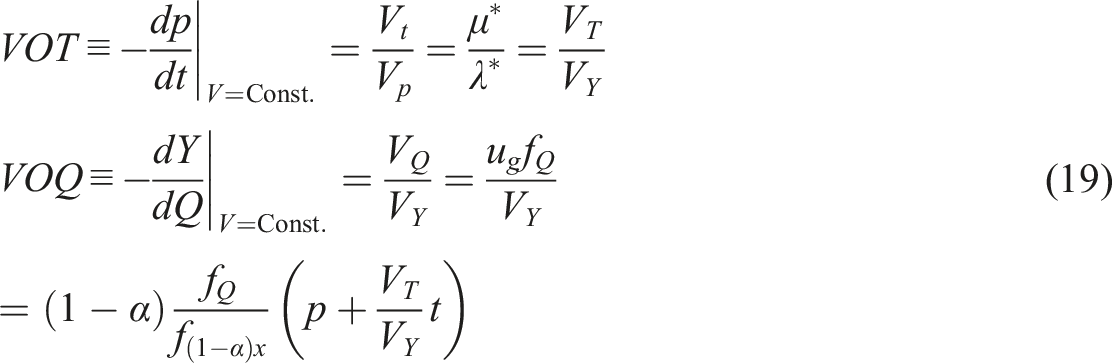


The VOT is calculated using equation (19) by solving equations (13) to (18). Supplementary Appendix 1 presents the procedure for deriving equation (19). Equation (19) indicates that the VOT can be calculated by using data on visit number (x), the first-order conditions of



Finally, a Cobb–Douglas type of household production function as
Simulations
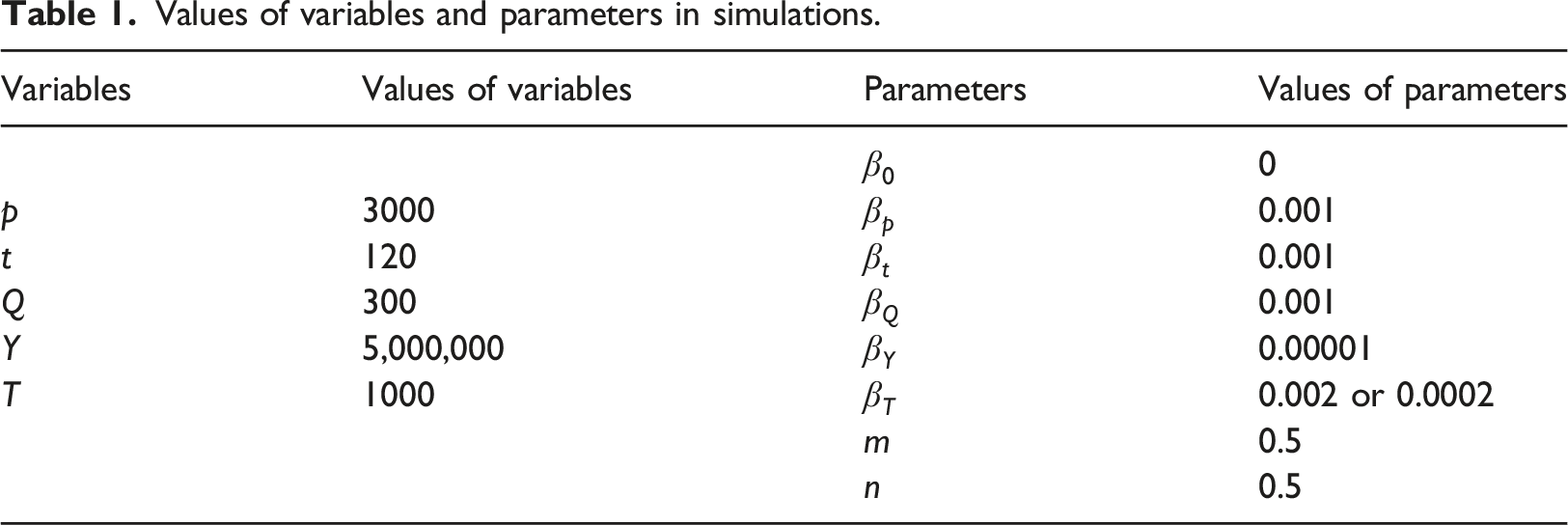
Details and values of simulations
This study confirms 1) the signs and degrees of the VOT, VOQ, and VOS; 2) the tendency of the benefit value changes according to different
The hypothetical tourism activity in the simulation is a trip to a historical site for observing (small and large) historical buildings and goods and taking pictures. For example, Voltaire et al. (2017) employed historical monuments as estimation variables.
Values of variables and parameters in simulations.
Results and discussion
Figures 1–3 show the numerical simulation results. The details of the values are shown in Supplementary Appendix 3. Equation (24) holds for all VOTs owing to Values of time. Values of quality. Values of self-restraint for consumption.
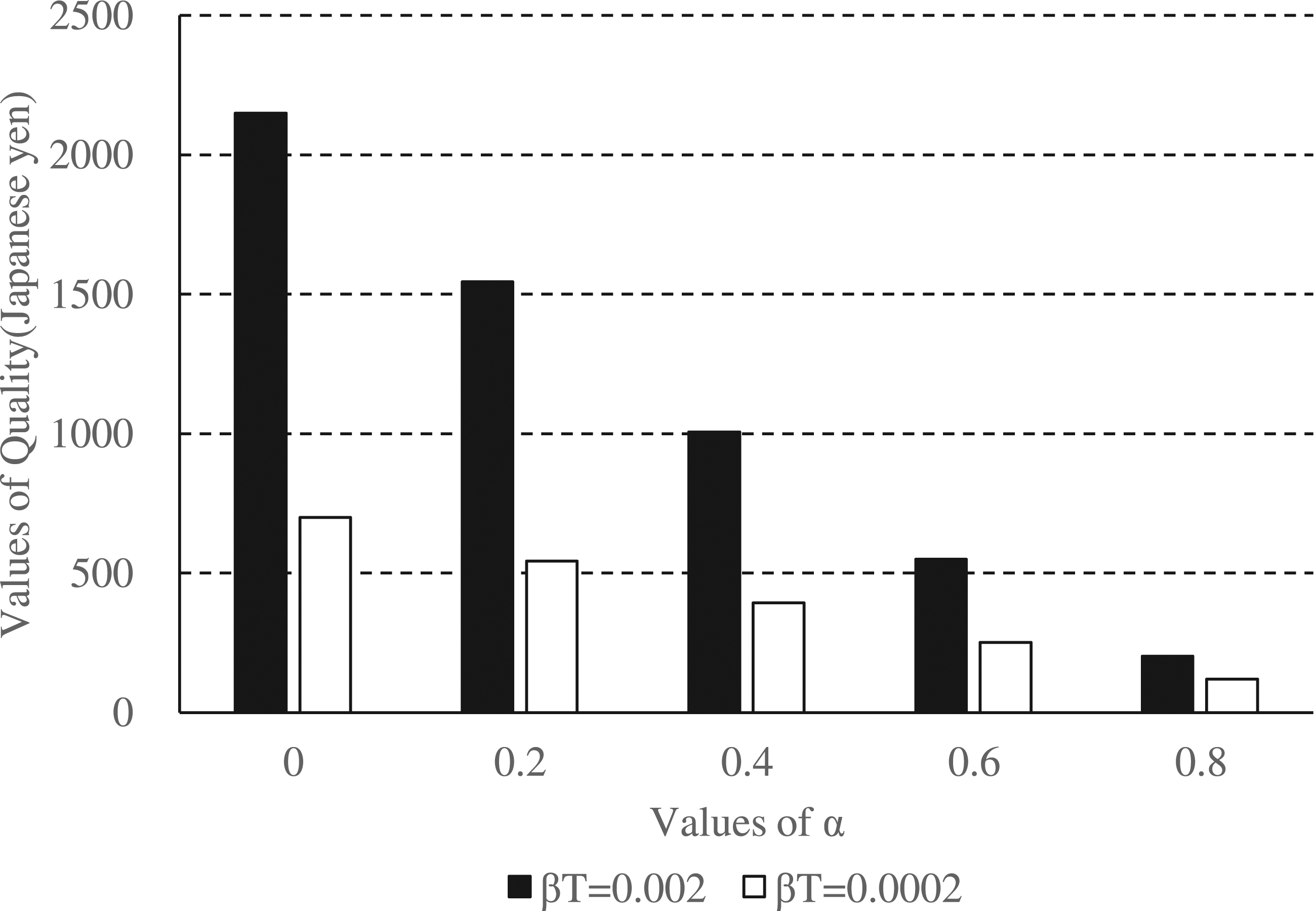
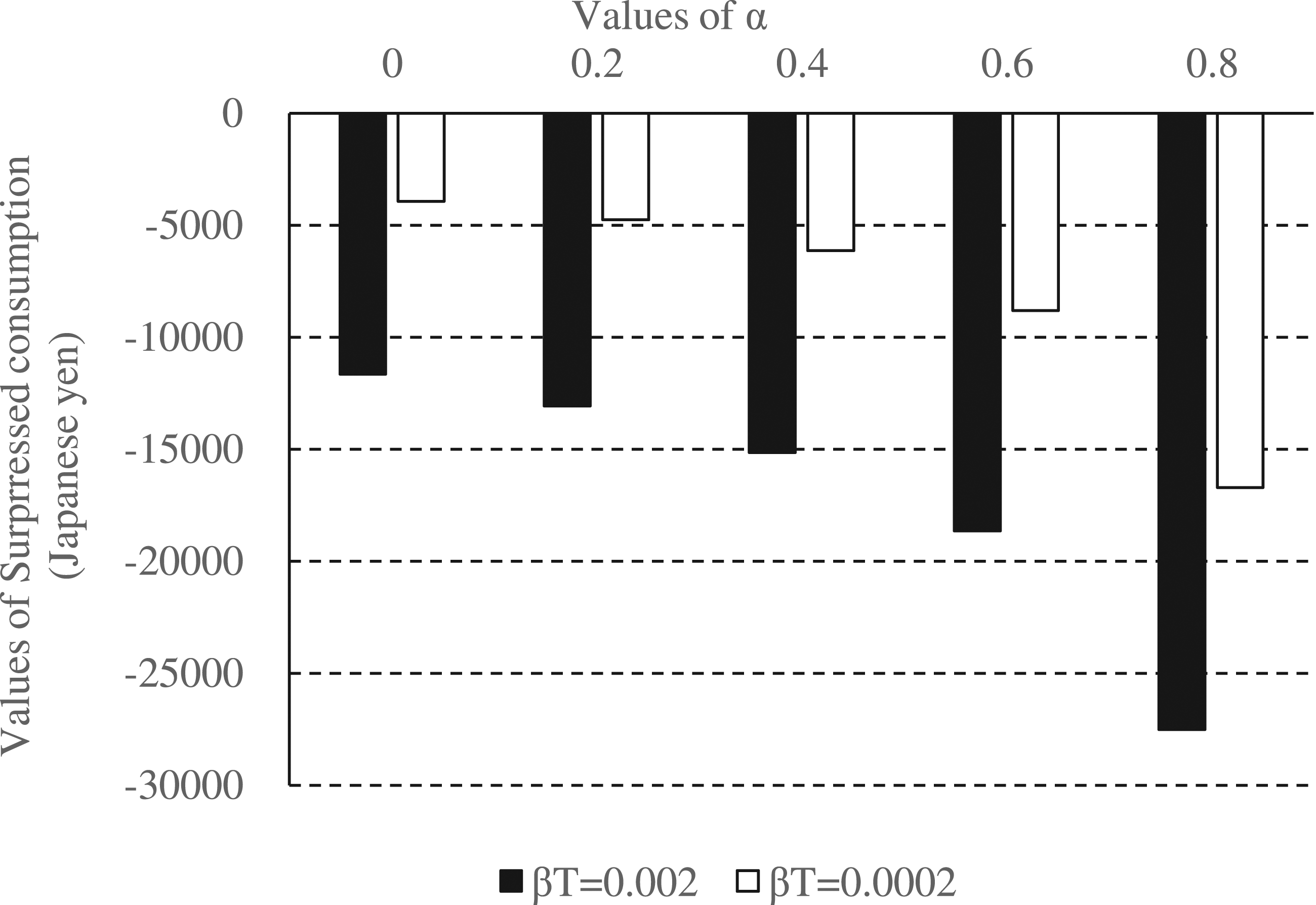
The first examination entails checking the signs of the marginal benefit values. The sign of each benefit value is the same as in the discussion in the Utility Maximization Problem and Definitions of Marginal Benefits section, with the VOT and VOQ being positive and the VOS being negative. Here, it is noteworthy that the absolute VOSs are larger than the other two benefit values at each
The second examination is to confirm the tendency of the benefit value changes. An increase in the α value leads to a decrease in the VOT, VOQ, and VOS, as discussed in the Utility Maximization Problem and Definitions of Marginal Benefits section. The acceleration of the decrease in the VOS seems to be the greatest among the marginal benefits; its tendency is observed as an almost exponential decrement. The larger VOSs compared to others might have caused this tendency.
The third examination involves checking the robustness of the values to the parameter
Policy implication
This section explains the significance of the benefit valuation model used in this study. For simplicity, the marginal benefit values in the numerical simulation are used directly for the project effects. The referenced numerical values below are in the
Imagine that a project has been planned to increase the number of heritages protected by one building in a heritage site due to the decrement in heritages by natural damage. Cost–benefit ratios with and without an infectious disease outbreak cases are examined. Without an outbreak, no self-restraint situation suppresses a person’s consumption. On the one hand, VOQ as a project benefit could be considered as JPY 2149 per person in the
The latter example suggests that tourism sites’ qualities may continuously decline with no project implementation decision by policymakers if an infectious disease outbreak continuously suppresses individuals’ consumption. A contribution of this model would help researchers and historical heritage managers present benefit values without self-restraint for consumption (e.g., a case of 2149/2000 > 1) to policymakers to improve the impossibility of implementing a project (e.g., a case of 1545/2000 < 1). Simultaneously, the model would contribute to show negative benefit values generated by visitors’ dissatisfaction for not being able to travel to policymakers. The project implementation of increasing the (type of) heritages will ensure the effectiveness of eliminating the negative benefits of an infectious disease outbreak. The cost–benefit ratio would be 1545 + 13,069 > 2000 if a policymaker is permitted to add the elimination effect of the negative benefit, for example, JPY 13,069 at
Examination of empirical estimations
There are some issues with the empirical estimations when applying the present model. The first issue is how to find a household production good g, as exemplified by the photos. The number of catching fish, plants, and seeing rare landscapes in sites might be another example of household production goods. The second issue is the selection of statistically significant functional formulations from several household production and demand functions. The number of estimations may be larger than those in previous studies. The simulated estimation model presented by Eom and Larson (2006) reduced the number of operations. The third issue is to (probably) create complex benefit value changes by changing the values of parameters and policy target variables owing to the complex functional forms in the demand and household production functions. The second and third issues (probably the first issue, too) would be solved by using the Kuhn–Tucker (KT) model that determines a utility functional form in estimations (Phaneuf and Siderelis, 2003). Example of the utility function of the KT model corresponding to equation (1) is as follows
Concluding remarks
COVID-19 has caused sustainability risks for tourism activities by reducing tourism demands due to governmental restrictions and individuals’ self-restraint. The tourism demand reductions by the COVID-19 pandemic would lead not to implement tourism management projects in tourism sites due to low project valuation results for policymakers. This study examined adjusting the bias of project valuation generated from the COVID-19 pandemic by modeling individuals’ self-restraint in the utility maximization problem.
This study 1) develops a benefit valuation model with and without a self-restraint consumption situation and 2) measures the negative benefits of self-restraint.
This study employs the household production function approach to define benefits and adjusts the previous utility function by inducing a self-restraint level denoted by
The features of marginal benefits were examined using numerical simulations. The first examination entailed checking the signs of the marginal benefit values, indicating that the VOTs and VOQs are positive and VOSs are negative, and that the negative benefits (VOSs) generated from self-restraint are relatively larger than the positive benefits. The second examination confirmed the tendency of benefit value changes. An increase in the α value leads to a decrease in VOT, VOQ, and VOS, and the acceleration of the decrease in VOS seems to be the greatest among the marginal benefits. The third examination involved checking the robustness of the values to the parameter of total available time,
This model would help researchers and tourism site managers to present benefit values without self-restraint for consumption infection to policymakers to improve the impossibility of implementing a project during the COVID-19 pandemic. Simultaneously, the model would help policymakers by showing negative benefit values generated by visitors’ dissatisfaction for not being able to travel due to the COVID-19 infection. Further, this model might help search for potential tourism demand for a tourism site by interrupting
The remaining issues are as follows. The first is to analyze the impacts for the benefit values by different household production functional forms and features of expected produced goods. The second is to examine empirical estimation models as operationally useful. The third is to examine a (similar) model without the household production function assumption (i.e., standard estimations using demand functions with
Footnotes
Acknowledgments
We thank the participants of the 28th symposium on the global environment and engineering for their advice toward improving this study.
Declaration of conflicting interests
The author(s) declared no potential conflicts of interest with respect to the research, authorship, and/or publication of this article.
Funding
The author(s) disclosed receipt of the following financial support for the research, authorship, and/or publication of this article: This work was supported by JSPS KAKENHI (Grant Number JP 21K01504).

Supplemental Material
Supplemental material for this article is available online.
Author biography
Dr Tadahiro Okuyama completed his PhD in Economics at Tohoku University and is a professor of economics at Shimonoseki City University, Shimonoseki, currently, studying the evaluation of the landscape project of the Kanmon Straits. Previously, he was employed in University of Nagasaki, Sasebo, where he researched and analyzed the promotion of tourism on remote islands. His research focuses on tourism and environmental and natural resource economics, especially on risk and benefit valuation to achieve sustainable society.
References
Supplementary Material
Please find the following supplemental material available below.
For Open Access articles published under a Creative Commons License, all supplemental material carries the same license as the article it is associated with.
For non-Open Access articles published, all supplemental material carries a non-exclusive license, and permission requests for re-use of supplemental material or any part of supplemental material shall be sent directly to the copyright owner as specified in the copyright notice associated with the article.
