



Abstract
Inter-firm coordination agreements through a destination card (DC) are a widespread profit-increasing strategy in tourism destinations. Literature on tourism economics argues that this type of coordination increases social efficiency. However, industrial organization studies consider heterogeneous consumers and warn that a DC-type agreement can be welfare impairing. Conflicting views have become an issue for tourism destinations, as collusion is in the crosshairs of antitrust regulators. This paper aims to clarify these contradictory results by developing a duopoly model with heterogeneous tourists. A sensible demand structure is assumed which, unlike previous literature, includes loyal demand segments. A policy prescription is obtained, namely, a DC alliance is welfare enhancing if DC price is equal to or lower than the cost of joint consumption under no coordination. However, a greater total surplus in markets may be accompanied by a reduction in consumer welfare, which differs from the conventional view in tourism economics.
Introduction
A tourism destination can be defined as a geographical area where a mix of firms supply attractions and services, such as accommodation, emblematic buildings, cultural heritage, museums, thematic parks, natural capital, and so on, the consumption of which shapes a visiting experience (Vanhove, 2011; Candela and Figini, 2012). According to Candela et al. (2008), this set of services presents an anti-common feature, since it makes up a resource whose property is fragmented between different producers (e.g., Michelman, 1982; Buchanan and Yoon, 2000). In tourism markets, this problem, which causes underproduction and social efficiency losses, is solved through inter-firm coordination agreements handled by tour operators, travel agencies, and/or destination management organizations (DMOs).
A widespread mechanism of coordination is the destination, city or tourist card or pass (DC), which was first introduced in Stockholm in the 1970s (Schmalz, 2000). Though DCs differ in their features, such as price, included services, territorial coverage, purchasing channel, and others (Angeloni, 2016), a DC can be generally defined as a bundle of tourism-related services offered at a lower total price than buying the services separately, with the aim of increasing their demand in the destination (Steinbach, 2018). Apart from increasing demand, this instrument raises tourism expenditure, attracts new demand segments, promotes a destination’s brand, enables the tracking of tourists’ preferences and hence better targeted marketing, and encourages the use of public transport (e.g., Zoltan and Masiero, 2012; Leung, 2021). This collaborative tourism product has been mainly implemented in cities and regions (Zoltan and Masiero, 2012; Angeloni, 2016), but there are also interregional and transnational DCs (Pechlaner and Abfalter, 2005).
Despite the important role of DCs in improving a destination’s profitability, this strategy has received scant attention from the literature on tourism economics. In this respect, Leung (2021) found only 16 studies on this topic published in tourism and hospitality journals. These works include literature reviews, case studies and empirical analyses (e.g., Egger, 2013; Zoltan and Masiero, 2012; Zoltan and McKercher, 2015; Angeloni, 2016; Scuderi and Dalle Nogare, 2018; Schnitzer et al., 2018). However, none of them have undertaken a theoretical analysis of social efficiency outcomes of inter-firm coordination agreements through a DC, which is the objective of the present paper.
Such theoretical analysis is certainly needed as the literature shows conflicting results on social efficiency outcomes of this strategy. Indeed, literature on tourism economics advocates for inter-firm coordination, as it is shown to lead to social efficiency gains (Wachsman, 2006; Candela et al., 2008; Candela and Figini, 2010; Álvarez-Albelo and Hernández-Martín, 2012; Andergassen et al., 2013; 2017). However, with more general demand structures involving heterogeneous consumers, studies on industrial organization show that a DC-type arrangement can be welfare-impairing, since it involves a reduction in competition (Gans and King, 2006; Armstrong, 2013; Jeitschko et al., 2017). Particularly, the effects of bundling arrangements on social welfare are a real concern, as shown by the literature on law and economics (Kobayashi, 2005; Muris and Smith, 2008; Economides and Lianos, 2009; Masson et al., 2014) and tourism economics (e.g., Evans, 1999; Nalebuff and Majerus, 2003; Ng, March 8, 2021; Torres, Ed., 2022).
A clarification of this issue is relevant to destinations, since a DC could actually entail a kind of collusion, whose objective would be to increase tourism profits at the expense of social efficiency. If this were the case, the anti-commons problem would be absent, and there could be a reason for antitrust regulators to be wary. Since conflicting results seem to be related to demand assumptions, such clarification requires considering a demand structure that sensibly represents the different types of consumers of tourism services included in a DC.
This paper aims to shed light on these contradictory results by considering a sensible demand structure. A duopoly model that builds on the theoretical frameworks of Jeitschko et al. (2017) and Wang et al. (2011) is developed for this purpose. In the model, each firm produces a different tourism service that is sold to single- and joint-service consumers. Two types of heterogeneous tourists are considered. One set of tourists is composed of potential groupers who, under particular price conditions, would be willing to buy either service or both services (Jeitschko et al., 2017). Unlike previous literature on bundling by separate sellers, the model includes two sets of loyal tourists who only derive utility from one of the services (Wang et al., 2011). This structure matches quite well with actual demand segments of tourism services included in a DC. Indeed, it is a fact that not all tourists purchase a DC (Leung, 2021). Some of them want to enjoy a comprehensive tourism experience when visiting a destination, so they buy a DC. Other tourists are not that interested in some services but could be willing to buy a DC if they are offered a good deal. Consequently, these tourists could buy either a single service or a DC. Lastly, there are tourists who are only interested in buying some services and, hence, would never become DC users. In the literature, the latter group of tourists is named loyal (e.g., Wang et al., 2011; Gangwar et al., 2021) or captive consumers (e.g., Morgan et al., 2006; Armstrong and Vickers, 2019). This simple model is enough to illustrate the main ideas in this paper.
To assess the social efficiency of a DC arrangement, two pricing schemes are analyzed, namely, uniform pricing (no coordination) and a DC agreement (coordination), and their welfare outcomes are compared. The first strategy implies that firms charge the same price to all tourists. By contrast, in a DC scheme, firms agree on different prices between single- and joint service consumers following a two-step pricing process (Gans and King, 2006). The DC price is established in the first stage through the joint maximization of profits, and then each firm sets its stand-alone price. Since a DC agreement entails a lower competition level, this scheme yields higher profits than uniform pricing.
It should be noted that a cooperative setting of the DC price would result in social efficiency gains if stand-alone demands and the demand for DCs were independent, that is, in the absence of cross-price effects. If this were the case, services would be perfect complements for a set of tourists, which would call for coordination in order to increase social welfare. However, this assumption seems rather unrealistic. This paper, instead, considers a sensible demand structure that includes cross-price effects and loyal tourists. Since loyal tourists only derive utility from one of the services, their demand only depends on the own price, which limits the role of cross-price effects. Consequently, it could be conjectured that the larger the loyal demand segments are, the more incentives for cooperative firms to restrain price rises, so as not lose consumers in these demand segments. These incentives reinforce price reductions owing to the single markup charged by cooperative firms, which could give rise to welfare increases.
The remainder of the paper is organized as follows. Section 2 reviews the literature. The model is presented in Section 3. Sections 4 and 5 compute the equilibrium under the two pricing strategies. An assessment of social efficiency outcomes is carried out in Section 6. Lastly, section 7 discusses the results and concludes.
Literature review
Leung’s (2021) empirical results reveal that the primary reason why tourists purchase a DC is cost savings, since the card is sold at a discount. From a supply side perspective, literature has emphasized the collaborative nature of a DC. Indeed, the implementation of this product requires the coordination of tourism service suppliers at the destination, usually carried out by a DMO (e.g., d’Angella and Go, 2009; Zoltan and Masiero, 2012; Angeloni, 2016; Schnitzer et al., 2018). In addition, survey analysis by Schnitzer et al. (2018) show that a firm’s main motive for participating in a DC alliance is to increase customer numbers. Behind this motive lies the objective of increasing profits, which is achieved through cooperation, that is, by reducing competition.
It is worth noting that a DC agreement is only legitimate if it is not detrimental to social efficiency. Otherwise, antitrust regulators would force price competition. Bundling strategies, such as a DC-type arrangement, may raise antitrust concerns that have been profusely studied by the literature on law and economics. For example, Kobayashi (2005) finds that literature on bundling does not provide clear guidance to antitrust regulators on when and how to act. This is because theoretical studies are based on a wide variety of assumptions that have not been empirically tested. Thus, the author stresses the need for generating testable hypotheses in order for these studies to be useful in practice. Following an experimental approach, Muris and Smith (2008) analyze whether or not bundled discounts can be viewed as an anticompetitive strategy that antitrust regulators should be wary of. Taking into account critical assumptions in theoretical models, these authors find that, to the contrary, bundled discounts increase both consumer and total surpluses. Moreover, Economides and Lianos (2009) analyze the disparities between American and European antitrust regulation, which can even result in different rulings in the same case. 1 These disparities show the difficulty in determining when a particular strategy is detrimental to social welfare. For example, Masson et al. (2014) show that a bundling agreement between oligopolists that produce complementary products does not always lead to an increase in consumer welfare, as it depends on assumed demand structure.
The tourism sector is subject to competition law, as extensively analyzed in the book “Competition Law in Tourism” (Torres, Ed., 2022). In fact, anticompetitive bundling strategies are quite common in the tourism industry. The British Monopolies and Mergers Commission highlighted a reduction in competition in the market of bundled travel packages because of the link between tour operators and travel agents (Evans, 1999). The well-known Aspen case began in 1979 with the suit filed by Highlands against Aspen Ski for using bundling as a way of decreasing competition. However, the verdict supported Aspen Ski, because it was considered an essential facility. Despite this, the ruling was controversial, since many economists disagreed with the court’s decision (Nalebuff and Majerus, 2003). A case in Hong Kong against a tour operator and six hotels for facilitating collusion between two travel service providers is another example of anticompetitive behavior. More specifically, in 2021 Hong Kong’s Competition Commission opened an investigation into collusive price fixing of tourism attractions and transportation (Ng, March 8, 2021).
Collusion in the tourism industry, as in other sectors, is not easily detectable, as it requires clear evidence to be presented before court as well as an in-depth investigation. Therefore, authorities are not always sure on whether these cooperation agreements lead to reductions in consumer and total surpluses in markets, since they require broad knowledge about demand structure. For this reason, theoretical results that clarify potential impacts of firm cooperation on social efficiency are of utmost importance for regulators to take the appropriate action to fix undesirable firm interactions (Rey and Tirole, 2013, 2019).
In the tourism literature, Candela et al. (2008) argued that inter-firm coordination in a local tourism system (LTS) is desirable to fix the so-called anti-commons problem. This problem arises from two main features, namely, firms have market power and tourists derive utility from the joint consumption of tourism services offered in a destination (Álvarez-Albelo and Hernández-Martín, 2012). Both features give rise to the well-known problem of double marginalization, which results in higher prices, underproduction, lower profits, and social efficiency losses (e.g., Kwoka and Slade, 2020; Brueckner and Flores-Fillol, 2020). 2 Switching from property rights fragmentation to inter-firm coordination is then required to reverse the situation. The welfare effects of coordination have been studied by a branch of literature on tourism economics. Wachsman (2006) shows that coordination between hotels and airlines is welfare enhancing when firms operate in the same destination. Candela and Figini (2010) also call for coordination of the LTS in order to increase tourism profits and social welfare, as well as advancing key ideas for a crucial result in tourism economics, namely, the Coordination Theorem. Likewise, Álvarez-Albelo and Hernández-Martín (2012) study welfare effects of coordination in the presence of congestion externalities, and design public policies to achieve a social optimum. Andergassen et al. (2013) establish the Coordination Theorem, which states that, owing to the presence of an anti-commons problem, coordination among firms in a destination increases tourism profits and social welfare. Andergassen et al. (2017) demonstrate that coordination raises tourism profits even if the goods and services that compose the tourism product are substitutes, and it leads to lower social welfare. Unlike the demand structure proposed in this paper, these studies assume tourism services as being complements, and none of them considers cross-price effects arising from consumer heterogeneity (groupers vs. loyals), and hence do not capture all possible relationships between tourism services included in a DC. By contrast, in the model developed herein, services are complementary for tourists who buy a DC, a single service and a DC are substitutes for some tourists who only buy a service, while for loyal tourists a service is an independent product. Under these assumptions, it is not possible to guarantee that the anti-commons problem is present, and hence if there is a need for coordination.
The need for coordination requires complementarity between tourism services. Theoretical literature on tourism economics considers accommodation and transport as being perfect complements. This seems a sound assumption, since tourists must necessarily buy both services to travel to a destination (Wachsman, 2006; Álvarez-Albelo and Hernández-Martín, 2012; Álvarez-Albelo et al., 2017). Although there is a high degree of complementarity between accommodation and transport, usually included in holiday packages (e.g., Haroutunian et al., 2005), this assumption may not apply for services included in a DC. Indeed, once at the destination, tourists may purchase all of a destination’s attractions or just a set of them, as follows from the fact not all tourists buy a DC (Leung, 2021). Thus, the demands considered herein entail a sound structure, since it reflects all possible relationships between services included in a DC mentioned above.
As previously argued, this is due to the heterogeneity of tourists in terms of preferences, which casts doubts on the presence of the anti-commons problem. The absence of this problem implies that a DC-type agreement would involve a kind of collusion, which increases a destination’s profits at the expense of social efficiency. Literature on industrial organization has pointed to this possibility.
In this literature, there are three works that are closely related to a DC-type arrangement. Gans and King (2006) construct a model in which each consumer buys two independent products. Even so, firms find it profitable to make an alliance to apply bundled discounts, the reason being the absence of stand-alone demand for the products. In addition, they find that cooperation brings about a substantial welfare reduction. Armstrong (2013) considers a more general demand structure that includes single-product consumers. He shows that, when products are partial substitutes, firms have incentives to offer independent discounts to joint-product consumers. He also analyzes a situation in which firms reach an agreement to apply a coordinated discount to these consumers. This arrangement reduces the competition inherent in offering substitutes, thus leading to welfare reduction. Lastly, Jeitschko et al. (2017) study joint marketing by rival firms and leave aside cooperative pricing, as they argue that the latter strategy raises antitrust concerns. Unlike the two previous works, Jeitschko et al. (2017) also analyze the case in which a bundle is sold at a price, instead of with a discount. This case is relevant to the present study, because a DC is usually marketed at a price that allows free access to services and attractions (Angeloni, 2016). 3 None of these studies consider loyal demand segments which, as argued in the previous section, could affect greatly social efficiency outcomes of a DC agreement.
The model
In the duopoly model, each firm is denoted by the tourism service it produces. Thus, firm
Tourist preferences entail horizontal differentiation à la Hotelling (1929). More specifically, tourists in set

Loyal tourists who belong to sets

Two pricing strategies will be studied: uniform pricing or non-price discrimination, and a DC agreement that involves firm coordination or joint setting of DC price. The value of parameter
The analysis is confined to the case in which set
The construction of tourist masses is based on the comparison of net utility between options, as illustrated in Figure 1. In Figure 1(a), a tourist indifferent to buying a unit of service Utility comparison and indifferent tourists. Demand structure in the model.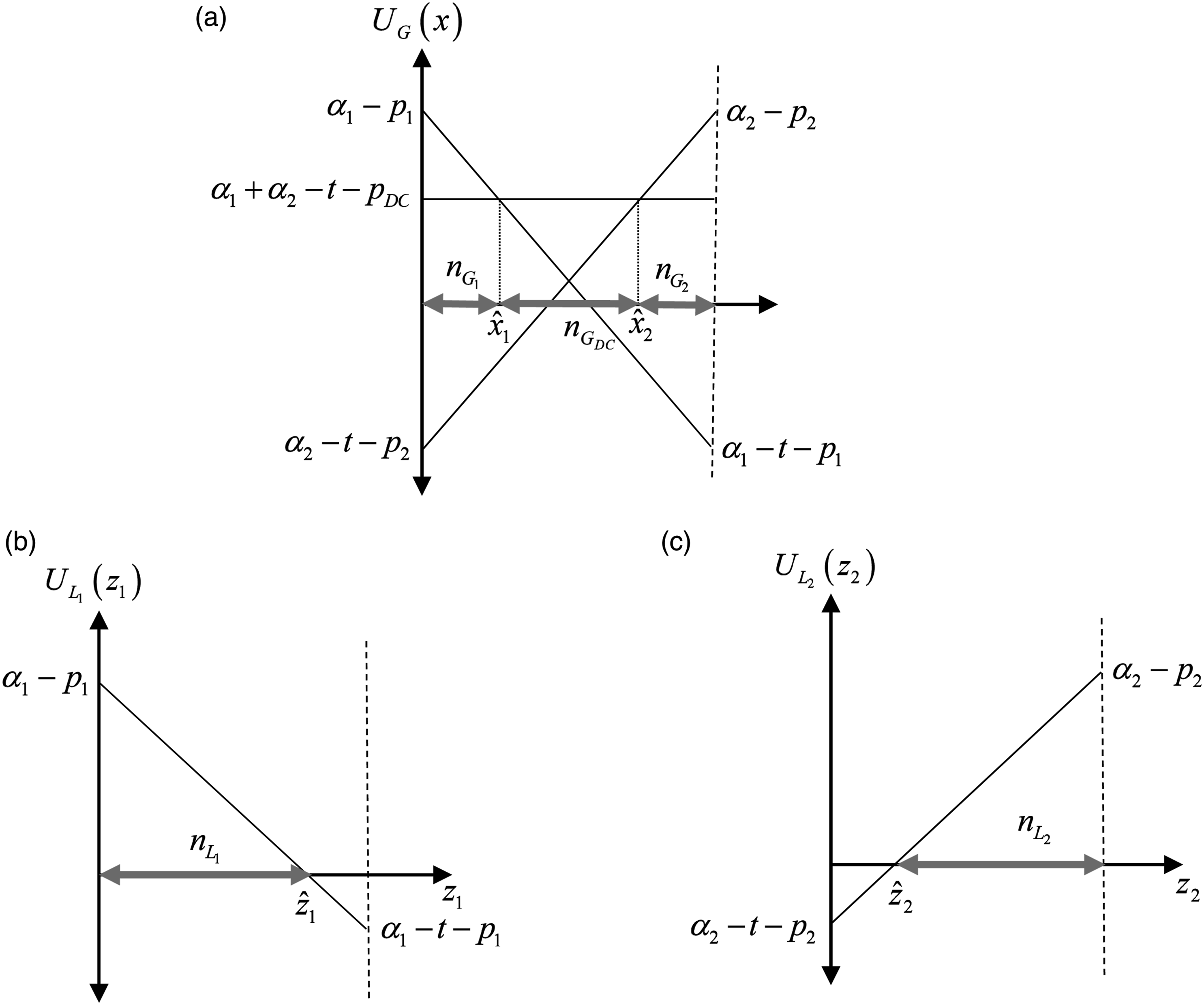
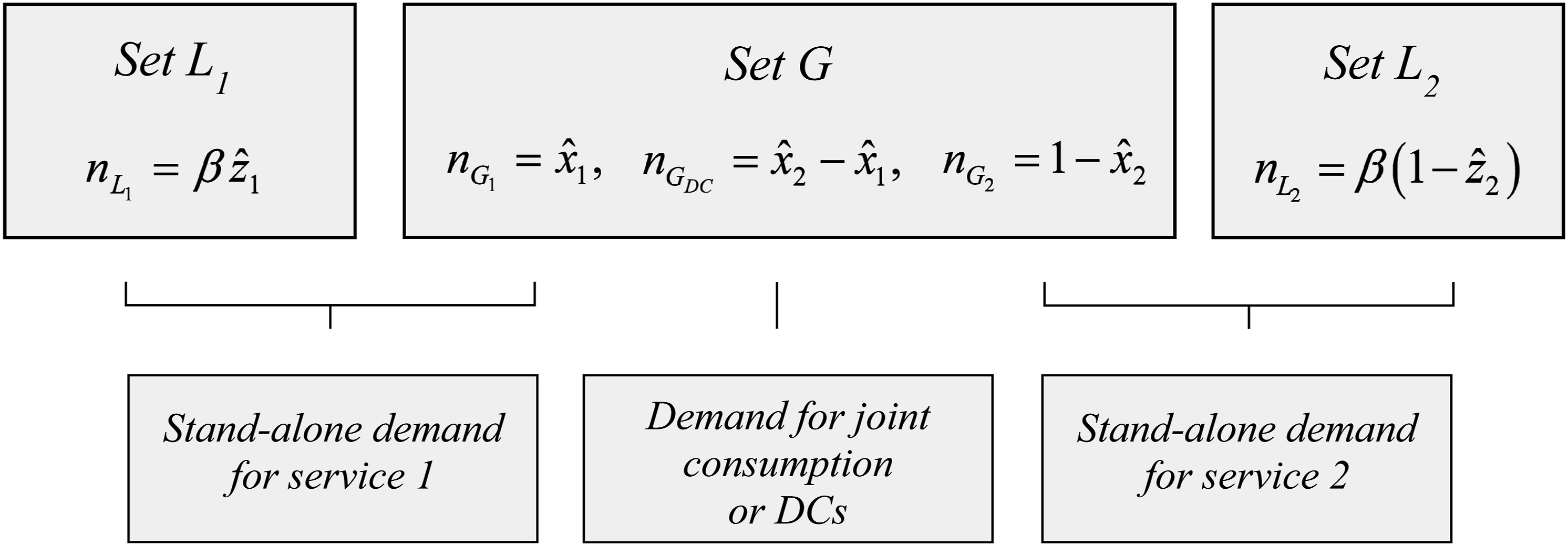
Uniform pricing implies that firms charge the same price to all tourists. Thus, the masses of single- and joint-service consumers are given by

where
By contrast, a DC agreement entail price discrimination between single-service consumers, that is,

where
Welfare of market participants is calculated by adding up net utility and profits for all tourists. For example, looking at Figure 1(a), a tourist located at

where the price discount

where
Uniform pricing
Each firm seeks



It is worth noting that the conditions
Destination card agreement
As demonstrated by Gans and King (2006), a bundling agreement involving a two-step pricing process increases firms’ profits, so the analysis herein adopts this approach. More specifically, the decision process is as follows: firms first set the DC price; stand-alone prices are established in a second stage; finally, tourists make their purchasing decisions. Similar to Armstrong (2013), it is assumed that firms agree on earning half of the DC price, so that
The model is solved by backward induction, that is, the second (first) stage of the pricing process involves the first (second) step of the solution procedure.
The strategy for setting the DC price cooperatively consists of choosing
The first stage of the solution procedure consists of choosing

The FOC of the problem is

The FOC yields stand-alone prices, price discount, sales, and joint profits as functions of DC price






The second step of the solution procedure involves seeking

where

The equilibrium variables are obtained substituting (19) in (12) through (17). The conditions for the existence of such a Nash equilibrium are established in the following proposition.
Proposition 1. Under a DC agreement, a Nash equilibrium exists in which (i) set
Proof. See Appendix.
From Proposition 1, it follows that the existence of a DC agreement requires loyal demand segments to be sufficiently large. The reduction in the DC price that makes possible a non-negative net utility of joint consumption is the reason for this result.
Evaluating equation (18) in equilibrium identifies two opposite effects that drive the behavior of the DC price

Equation (20) shows that cooperative firms charge a single markup, which causes the DC price to decline, as indicated by the sign of
Social efficiency assessment
This section answers the main question posed in this paper, which requires comparing the welfare of market participants under the two pricing strategies.
The aggregate producer surplus is equal to aggregate profits, as shown in (5). The aggregate consumer surplus is obtained calculating (6) under uniform pricing and a DC agreement


respectively. Lastly, the aggregate total surplus is the sum of aggregate producer and consumer surpluses under uniform pricing and a DC agreement

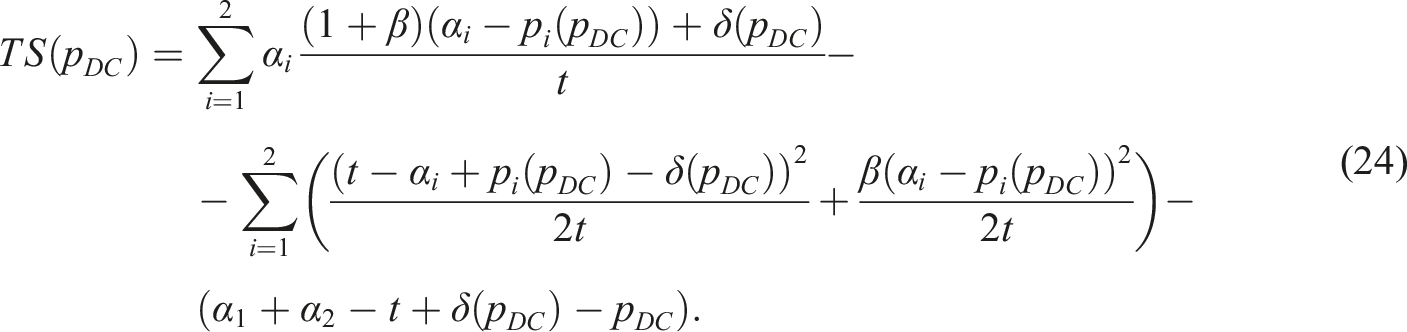
respectively. Equations (21) and (23) can be easily computed from the Nash equilibrium characterized by (7), (8), and (9). Consumer and total surpluses arising from a DC agreement are obtained introducing (19) into equations (22) and (24), respectively.
Moreover, total sales of service

and introducing the DC price in (19) in equation (25). A look at (12) through (16), (22), (24), and (25) reveals that stand-alone prices, price discount, and unbundled sales in set
Previous results provide a comparison of welfare outcomes from both pricing schemes. Since a DC agreement involves the lowest competition level, this strategy yields higher profits than uniform pricing. However, as shown in equation (20), cooperative firms have incentives to charge lower prices provided that the size of loyal demand segments is large enough. As shown in Proposition 2, this result affects greatly the relationship between aggregate surpluses delivered by a DC agreement and uniform pricing.
Proposition 2. Let a. There exists b. Three cases can be distinguished regarding aggregate consumer surplus: (i) if
Proof. See Appendix.
From Proposition 2, it follows that
A numerical computation of the Nash equilibrium under both pricing strategies is carried out to illustrate the results. Figure 3 shows equilibrium variables according to the values of parameter Equilibrium under a DC agreement and uniform pricing according to parameter 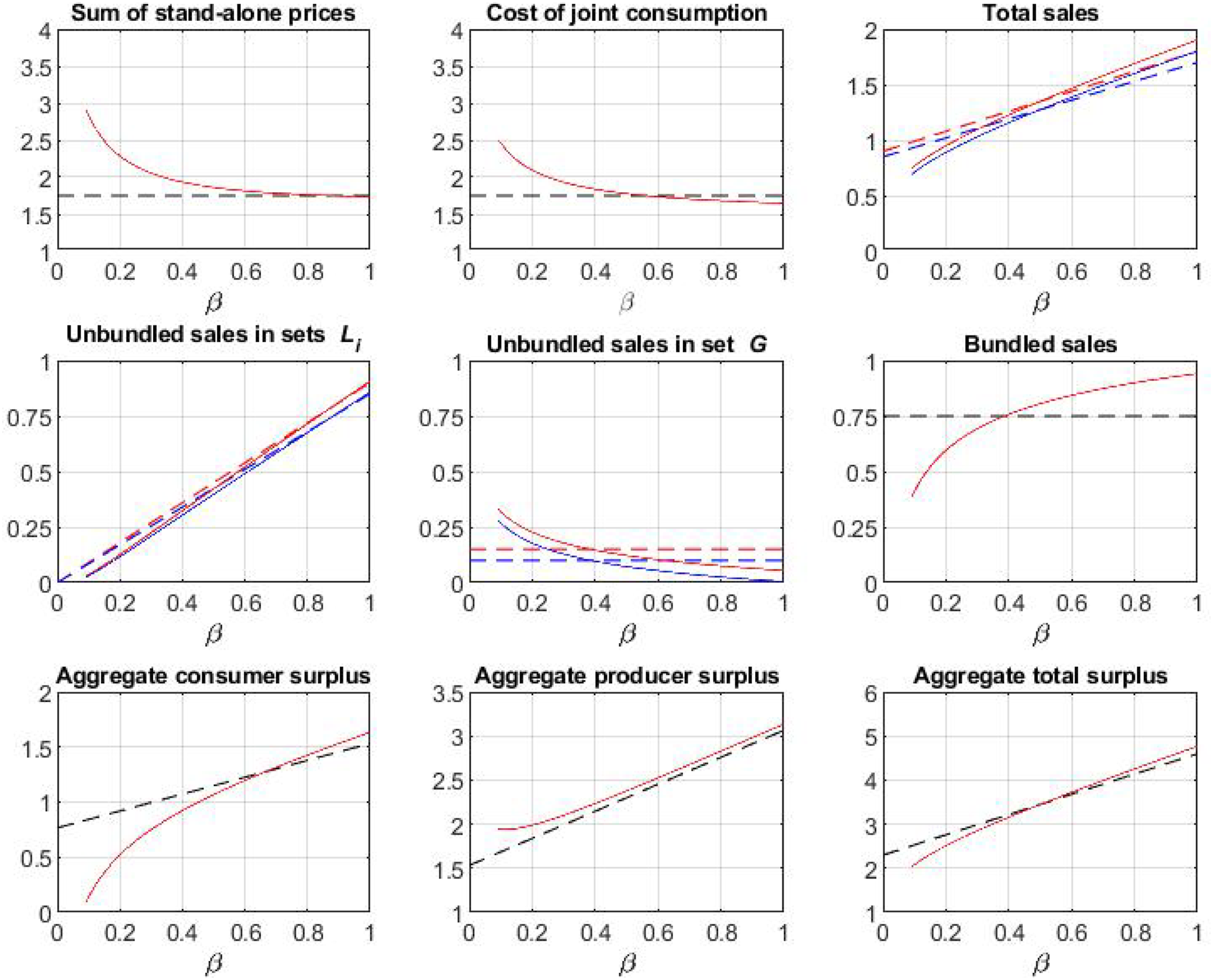
The case depicted in Figure 3 involves the condition
Discussion and conclusions
The conventional view in tourism economics is that, owing to the anti-commons feature of a LTS, which involves complementarity between services supplied in a destination, coordination is needed to increase market participants’ welfare (Wachsman, 2006; Candela et al., 2008; Candela and Figini, 2010; Álvarez-Albelo and Hernández-Martín, 2012; Andergassen et al., 2013, 2017). Such coordination adopts the form of bundling agreements, as is the case of the extensively used DCs. Destination cards are purchased by a variety of tourists with different preferences for tourism services. Though, only a certain proportion of tourists visiting a destination buy a DC, while others do not. These considerations cast doubt on the assumption of complementarity, generally present in tourism studies. This is no minor issue since, in the absence of the abovementioned anti-commons problem, a DC-type agreement would entail a kind of collusion that antitrust regulators should be wary of. The reason lies in the reduction in competition, which implies increasing tourism profits at the expense of social efficiency.
Therefore, an in-depth analysis of welfare outcomes of DC agreements with more general assumptions on the relationships between tourism services is much needed. Based on studies on industrial organization (Gans and King, 2006; Armstrong, 2013; Jeitschko et al., 2017), this paper has carried out such an analysis. More specifically, a duopoly model has been developed that includes a sensible demand structure with heterogeneous tourists and cross-price effects, the novelty being the introduction of loyal tourists who only buy one of the services (e.g., Wang et al., 2011). The demand structure is well-motivated and encompasses all possible relationships between services. Indeed, DC users consider services as complements; for some single-service consumers a service and a DC are substitutes; and for loyal consumers the only service they purchase is independent. The existence of cross-price effects implies that tourists can switch from being single-service to joint-service consumers and vice versa, except for loyal tourists who only purchase one of the services. In this environment, it has been studied if inter-firm coordination is still desirable from a social efficiency point of view.
Welfare outcomes and cost of joint consumption from a DC agreement and uniform pricing according to the size of loyal demand segments.
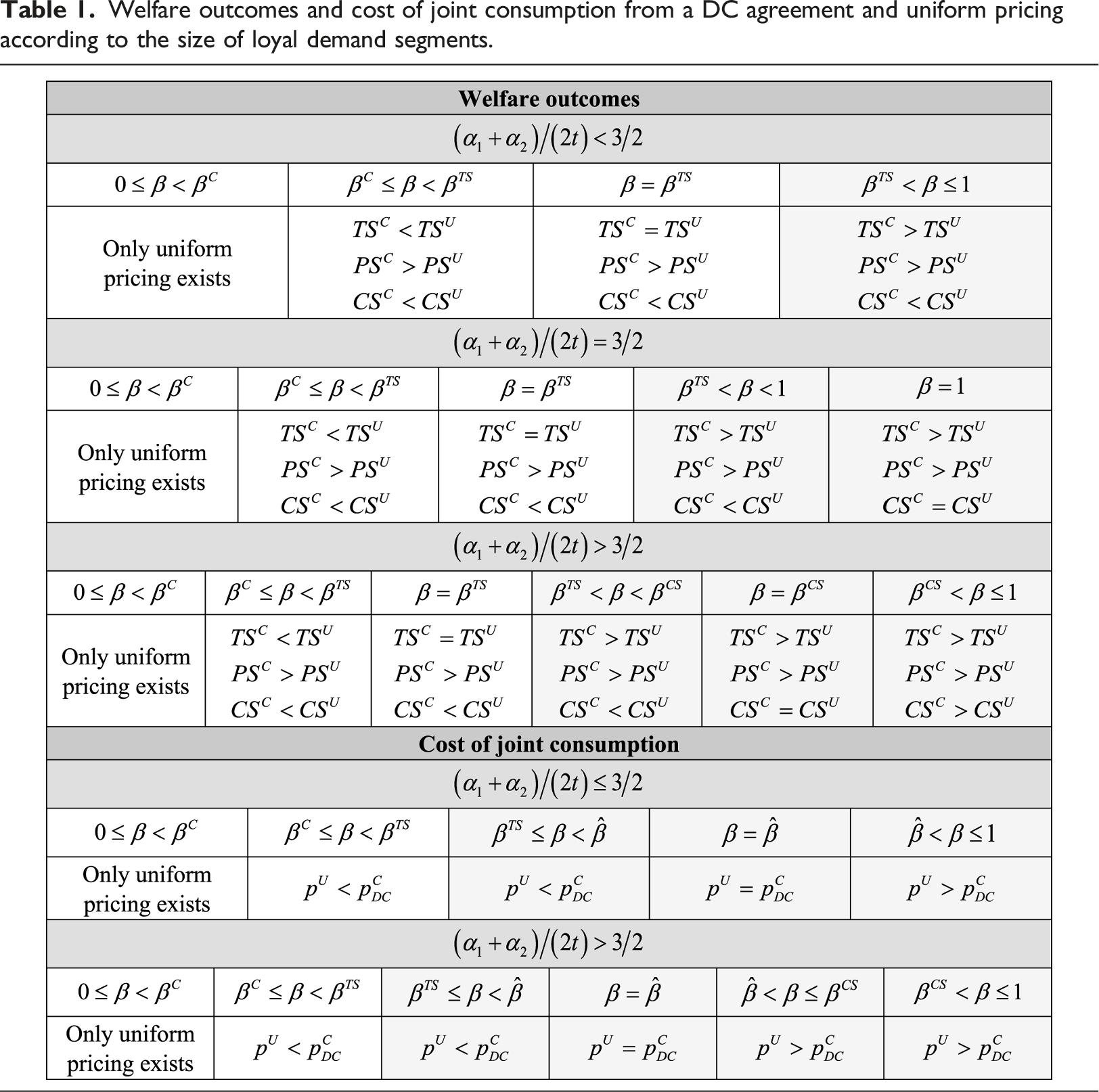
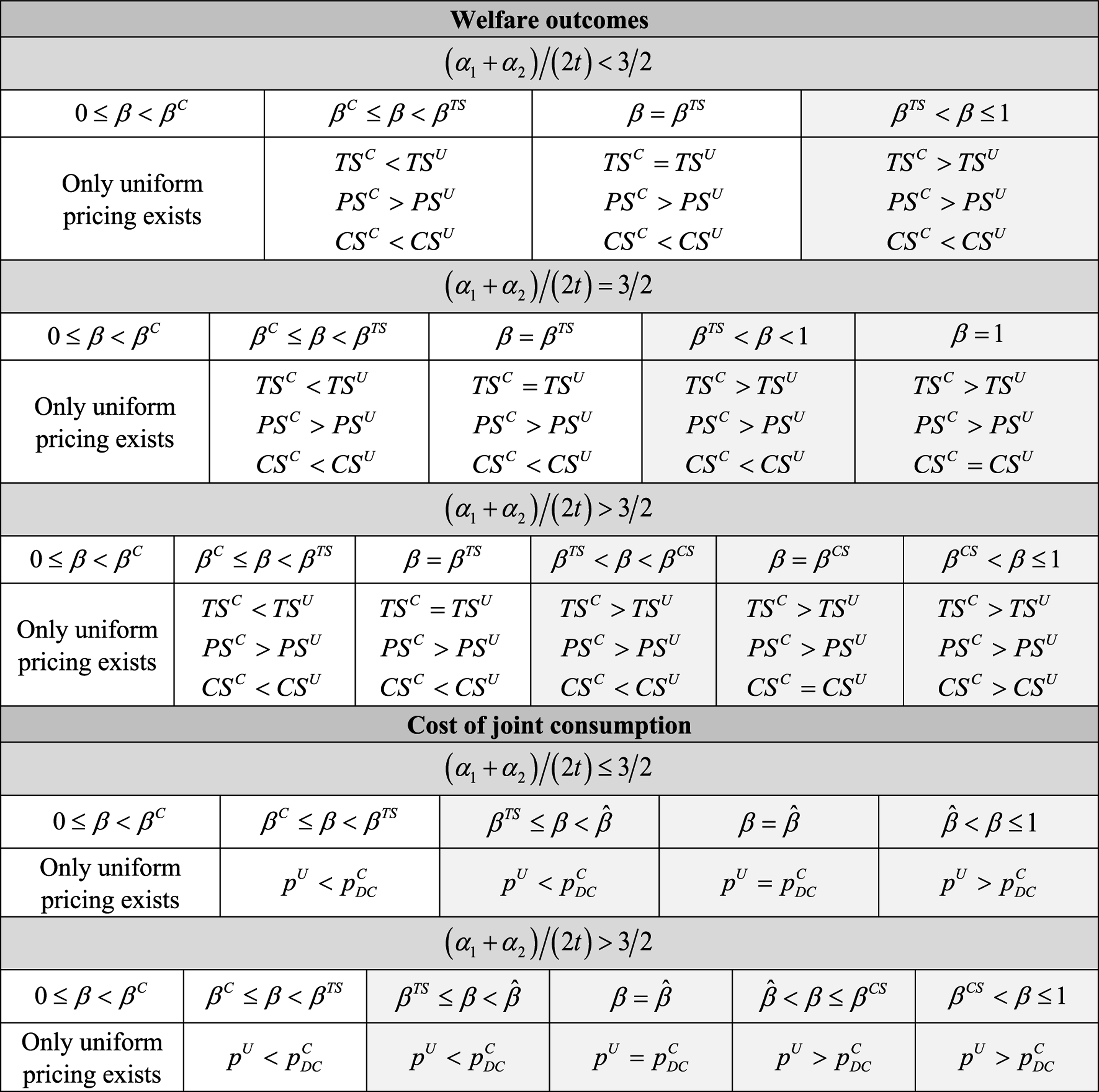
The findings differ strikingly from those obtained by other tourism studies. The Coordination Theorem established by Andergassen et al. (2013) is crucial in this literature, and it assumes complementarity between tourism services. Under the assumption of complementarity, coordination is desirable to fix the anti-commons problem, as it reduces the cost of joint consumption and increases production, which gives rise to higher tourism profits, greater consumer surplus and, hence, social efficiency gains.
By contrast, the demand structure herein not only involves complementarity but also substitutability and independence. Thus, the presence of an anti-commons problem is not guaranteed, as it depends on two opposite effects. As in the literature on tourism economics, the first effect comes from the fact that some tourists view tourism services as complementary. Thus, firms engaged in a DC alliance charge a single markup when setting the DC price, which causes a reduction in prices. However, there is also a second effect that comes from the reduction in competition, as cooperative firms maximize their profits jointly, which brings about a rise in prices. Consequently, whether or not a DC alliance increases the total surplus in markets will be determined by these countervailing effects. As shown in Table 1, whether the first effect outweighs the second one or vice versa depends on the size of loyal demand segments.
To better understand the role of parameter
Thus, the key issue is to provide antitrust authorities with a simple policy prescription to guide their actions. The results show that such a prescription is quite straightforward, namely, if the DC price is equal to or lower than the cost of joint consumption under uniform pricing, a DC alliance increases social welfare. A look at Table 1 reveals that this is a sufficient, but not a necessary condition for coordination to be desirable from a social efficiency point of view. Indeed, a DC agreement can be welfare enhancing even if the DC price is higher than the cost of joint consumption under uniform pricing. The reason lies in the cross-price effects. Under this price behavior, there can be an increase in bundled sales since a DC alliance offers a price discount to joint-service consumers. This increase can outweigh the reduction in unbundled sales, thus leading to a rise in total sales and social welfare.
Regarding the decomposition of total surplus, a DC agreement always increases tourism profits as it entails a reduction in competition. Nonetheless, this is not always the case for consumer surplus. Unlike the conventional view in tourism economics, an increase in total surplus can be accompanied by a lower consumer surplus, which implies a reduction in consumer welfare because of coordination. This result is not to be underestimated since, as pointed out in Torres (Ed., 2022), “Competition law, as it stands, focuses on maximizing consumer welfare” (p. 29). This finding is similar to that obtained by Armstrong (2013), who concludes that a bundling agreement could have mild effects on social efficiency, though it reduces consumer surplus. Nonetheless, Armstrong’s (2013) model does not include loyal consumers and involves firms that agree on a bundled discount instead of the bundle price. There could also be the case that a DC alliance leads to efficiency gains and a greater consumer surplus, but this result requires a substantial fall in prices. Consistently, a lower DC price than the cost of joint consumption under uniform pricing is a necessary, but not sufficient, condition for a DC agreement to increase consumer welfare.
This paper has relevant theoretical implications for the analysis of the relevance of coordination in tourism destinations. Indeed, owing to tourist heterogeneity, the existence of complementarity should not be taken for granted. A sensible demand structure must encompass all possible relationships between tourism services included in a DC. This implication is in line with theoretical studies on bundling by separate sellers, but this literature does not consider the existence of loyal consumers. By contrast, the demand structure for a DC must involve loyal tourists, since it is a fact that some tourists are only interested in buying some services. In this respect, the results from the model show that the size of loyal demand segments play a crucial role in determining welfare outcomes. Therefore, the paper has built a well-motivated demand structure that represents the diversity of tourists who visit a destination. This demand structure can serve as a basis for future research in tourism economics.
The present work also has significant practical implications for both antitrust authorities and tourism destinations. Indeed, the results provide antitrust regulators with a simple policy prescription, namely, a DC-type arrangement is welfare enhancing if the DC price turns out to be equal to or lower than the cost of joint consumption under no coordination. This condition is milder than that obtained in tourism studies, which found that coordination is needed provided the bundle price is strictly lower than the cost of joint consumption under no coordination. However, this result must be taken with caution, since a greater total surplus can be accompanied by a reduction in consumer welfare, which differs from results obtained in the literature on tourism economics. These results are also relevant for tourism destinations that have implemented a DC or are planning to do it. Coordination is certainly a strategy to increase tourism profits, as it reduces competition. However, the rationale for coordination alleged in tourism studies is the presence of an anti-commons problem. In the presence of this problem, coordination not only yields higher profits for a destination but results in social efficiency gains and greater consumer welfare. Thus, destinations must pay special attention to undertaking legitimate policies, and avoiding collusive strategies that may be targeted by antitrust authorities.
In view of the important role of DCs in enhancing a tourism destination’s profitability, further research is needed on their economic impacts. For instance, this strategy could play a significant role in destinations where a sizeable share of tourism rent goes abroad due to the presence of foreign intermediaries (Álvarez-Albelo, 2012; Andergassen et al., 2013). In this context, a DMO could coordinate suppliers through a DC, with the aim of increasing tourism rent that would be retained by the destination. This analysis constitutes a relevant matter for future research. The present study can also be extended by considering DCs including several services and, as in actual DC schemes, a card that allows free access to some services, while other services are offered at an ad-valorem discount relative to price.
Footnotes
Acknowledgements
The authors gratefully acknowledge insightful comments and suggestions of two anonymous referees. Suggestions by participants in the conference JEI 2022 are also recognized. Carmen D. Álvarez-Albelo thanks financial support from research project PID2019-107161GB-C33.
Declaration of conflicting interests
The author(s) declared no potential conflicts of interest with respect to the research, authorship, and/or publication of this article.
Funding
The author(s) received no financial support for the research, authorship, and/or publication of this article.

Notes
Author biographies
Carmen Dolores Álvarez-Albelo is an associate professor at the University of La Laguna. She has a degree in economics from University of La Laguna (1991), a master degree in economic analysis from Autonomous University of Barcelona (1995) and a PhD in economics from University of Barcelona (1998). She works in the fields of tourism economics and economic growth. He has participated in numerous reseach projects, and has published in Tourism Management, Journal of Sustainable Tourism, Journal of Air Transport Management, and Tourism Economics, among other journals. She is a member of the Business Institute (IUDE), the Institute for Social Research and Tourism (ISTUR) and the Chair of Tourism at the University of La Laguna. She is head of the research group Economic Analysis of Tourism at the University of La Laguna.
José Alberto Martínez-González is an associate professor at the University of La Laguna. He has a degree in economics (1985) and in psychopedagogy (2004), and a PhD in psychology (2008) and in tourism (2014) from the University of La Laguna. He works in the fields of behavioral economics in tourism and entrepreneurship, and has participated in numerous research projects on these topics. He has published in Journal of Destination Marketing and Management, Sustainability and European Journal of Management and Business Economics, among other journals. He is a member of the Business Institute (IUDE) and the Chair of Tourism, and has held prominent positions at the governing teams of the University of La Laguna. He is a member of the reseacrh group Economic Analysis of Tourism at the University of La Laguna.