




Abstract
Debates on whether tourism has pro-poor effects remain imperative and unsettled owing to the discrepancy of research perspectives, estimation techniques, data source, study regions, and variables designs, etc. With the eradication of absolute poverty in China, the focus of tourism-relative poverty nexus could get deeper insights into the poverty reduction efficacy of tourism development in developing countries. This study examines the impacts of rural households’ tourism participation on relative poverty using the survey data from 22 pro-poor tourism villages located in western China and the endogenous switching probit (ESP) model. The results show that participating in rural tourism reduces both objective and subjective relative poverty. However, it has no direct effect on subjective poverty, but exerts an indirect effect by decreasing objective poverty. Furthermore, heterogeneous effect analysis shows dual impacts. On the one hand, it brings reduction of relative poverty probability for tourism participants; on the other hand, it exacerbates the relative gap by individual endogenous capital endowments and narrows the gap by exogenous targeted poverty alleviation (TPA) policy interventions. Our findings extend theoretical significance of the pro-poor tourism arguments by clarifying the pro-poor effects and the pathways of rural tourism on both objective and subjective relative poverty at the household level. It also provides empirical evidence for improving the current anti-poverty policy related to rural tourism in China.
Keywords
Introduction
Poverty eradication is a universal global issue and the first vital goal of the United Nation’s Sustainable Development Goals (SDGs). As the world’s largest developing country, in 2012, China had 98.99 million people who were considered impoverished under the current poverty line of 2300 RMB (313.76 USD) per annum, and eliminated absolute poverty in 2020 through the Targeted Poverty Alleviation (TPA) policy implementation (Xia and Huang, 2021), accomplishing the SDGs ahead of schedule. Despite this remarkable achievement of eliminating absolute poverty, relative poverty is still prevalent and rising in China, which has led to a gradual shift, focusing on relative poverty reduction (Wan et al., 2021). Relative poverty is often understood as the relative gap that occurs when the resources owned by individuals or households are significantly lower than the average level of local residents under a certain context of regional economic and social development (Luo, 2020; Townsend, 1979). It has both objective and subjective attributes (Zhou Li, 2020). Compared with absolute poverty, objective relative poverty mainly refers to the inability to obtain material necessities available to the majority for a modest lifestyle and inequality in obtaining income and social resources (Liu and Xu, 2016; Sen, 1976). Subjective relative poverty is each individual’s subjective perception and evaluation of his/her living conditions, such as happiness, satisfaction with own life, sense of gains, and relative deprivation (Townsend, 1995; Wang et al., 2011; Zhou Li, 2020). Moreover, given the distinct natural, historical, and institutional contexts, relative poverty in China is an issue not only with unbalanced, inadequate, and uncertain developments among regions (Wang and Sun, 2021), but also with differentiation within rural areas and limited income growth within the rural low-income population (Luo, 2020), determining that rural areas, especially the western impoverished areas, are still the main battlefield for Chinese relative poverty reduction.
Tourism has been regarded as a powerful means to reduce poverty by creating job opportunities, broadening income sources, and improving the quality of life for poor residents, particularly in developing countries (Ashley et al., 2001; Blake et al., 2008; Rasoolimanesh et al., 2017; Zeng and Ryan, 2012). Since 2015, when China’s TPA policy was first implemented, rural tourism has had remarkable results in eliminating absolute poverty. According to monitoring data of the pro-poor tourism villages in rural China, rural tourism provided 30.6% of the employments of the poor population in 2019 (China Tourism News, 2021). Despite the rapid decrease of absolute poverty incidence with strong government interventions, the benefits from rural tourism were distributed in an unbalanced way, widening the yield gap within the communities. Moreover, an individual’s objective economic conditions are not inevitably associated with an improvement in subjective welfare (Mysikova et al., 2019; Wang et al., 2020b). Accompanied by income inequality, the existence of damage to households’ interests and rights (e.g. fewer opportunities to participate in tourism) in tourism leads to poorer farmers being marginalized and relatively deprived (Su et al., 2019), some households might feel that they are still living poor even worse than before. However, empirical research focusing on the effect of tourism on the subjective relative poverty remain limited when discussing the tourism-poverty nexus. Thus, studying the effects of rural tourism on both objective and subjective relative poverty could provide a comprehensive understanding of poverty reduction effects by tourism and a clear direction for future poverty alleviation programs in China.
Since the 1990’s when the Department for International Development (DFID) implemented the “pro-poor tourism (PPT) concept”, which consists of strengthening the relationship between tourism and poor people (Schilcher, 2007), extensive research has been conducted concerning the effects of tourism on absolute poverty alleviation (Croes, 2014; Truong and Hall, 2013), and several studies have examined the effect of tourism on relative poverty at the national/regional level (Ashley et al., 2001; Blake et al., 2008; Dossou et al., 2021; Folarin and Adeniyi, 2020; Zhao, 2021; Zhao and Xia, 2020). Most scholars believe that tourism offers higher income by virtue of its low employment requirements and high industrial relevance (Chok et al., 2007). In recent research, Zhao and Xia (2020) and Folarin and Adeniyi (2020) identified that the positive impact of tourism on economic development could affect poverty reduction through the trickle-down effect. However, it is argued that tourism could not be pro-poor at the household level because of its high dependence on external investment and a high rate of leakages (Walpole and Goodwin, 2000). From local households’ perspective, direct and absolute income effects have been widely recognized in poverty-stricken areas (Chok et al., 2007; Estifanos et al., 2020), but income increases do not always mean poverty reduction. As the economy and society develop, the average welfare level of the whole society improves when absolute poverty is decreased or eliminated. Moreover, the mechanism behind tourism’s demonstrated correlation with relative poverty reduction received insufficient attention and the related empirical studies remains limited (Zhao, 2021; Zhao and Xia, 2020), thereby resulting in a continuous debate over the effectiveness of tourism on poverty alleviation. Studies also show that tourism employment opportunities are more likely to fall into the hands of capable households or those with sufficient family capitals, the ones who lack of required resources and abilities were often excluded (Su et al., 2019). Despite that scholars noticed the importance of individual capital endowments in participating in tourism (Avila-Foucat and Rodriguez-Robayo, 2018; Liu et al., 2012; Ma et al., 2018) and that its diversities might initiate income differentiations (Su et al., 2019), few studies focus on the relationship between households’ tourism participation behavior and relative poverty and the role of livelihood capital in it.
In contrast to livelihood capital, China’s TPA policy that initiated in 2015 aimed at low-income households to eradicate absolute poverty across rural areas. At the beginning of policy implementation, a screening process identified poor households with income lower than the current poverty line. Each household identified as poor was provided with at least one of the targeted assistances, including industrial development, resettlement, ecological compensation, strengthened education and social security (Tang et al., 2021; Wang et al., 2016). Therein, TPA related to rural tourism involves industrial development (i.e., involving poor households in rural tourism poverty reduction projects, like providing tourism operation subsidies, micro-finance, tax exemptions) and education promotion (i.e., providing training, job information, etc.), the poor being involved in tourism can be targeted and receive assistance related to tourism operation or employment. By doing so, it helps to narrow the gap between capable households and low-income groups. Although the TPA policy has been given great attention in analyzing their participation mechanism of the poor (Cheng et al., 2021), and investigating its effects on various outcomes, such as economic and subjective well-being (Tang et al., 2021; Wang et al., 2020c), and household income and livelihood capital (Leng et al., 2021; Liao et al., 2021; Liu et al., 2021), it is necessary to examine whether the poor who received assistance benefit more from tourism participation than their non-received counterparts, from which we could peer its effect on relative poverty.
The objective of this study is to empirically examine whether and to what extent rural tourism could reduce both objective and subjective relative poverty. The contributions to previous literature are presented as follows. First, in contrast to most previous PPT research have dominated the issue at the national/regional level, and the micro-level research are still relatively underrepresented (Yu L et al., 2019), this study focuses on the impacts of rural tourism on relative poverty based on residents’ participation behavior. More importantly, unlike most current tourism-relative poverty research mainly discussed the objective aspects of poverty, we explore the influence of tourism participation on both objective and subjective relative poverty reduction using the primary micro survey data in western China. Second, we bring attention to the impacts of tourism participation on relative poverty by evaluating the effects differentiated with the heterogeneity of the rural household’s endogenous capital endowments and exogenous TPA policy assistance. It would deepen the understanding of the benefits gap among tourism-participants and also provide evidence for further policy adjustments. Third, given that subjective well-being poverty is often associated with economic status and income (Chan and Wong, 2020; Mysikova et al., 2019; Wang et al., 2020b), which could affect the objective relative poverty (Zhou Li, 2020), we further analyze the mediating role of objective relative poverty in tourism-subjective relative poverty nexus to reveal the complicated relationship between tourism participation and relative poverty.
Literature review
Causes and measurements of relative poverty
Many studies have focused on the causes of relative poverty and its measurement approach. In considering the causes of objective relative poverty, both individual and institutional factors were investigated. Individual factors examined include livelihood capital and strategies (Cheng et al., 2015; Xu and Xu, 2020). For instance, Gautam and Andersen (2016) argued that due to the lack of financial, social, and human capital, poor households were unable to overcome the entry barriers to work in high-paying sectors, leading to insufficient opportunities and income inequality. In addition, institutional factors, including the lack of public service provisions, inadequate social security, and detrimental income distribution tend to have impacts on poverty reduction based on individual assets or livelihood styles (Sekhampu, 2013; Wang et al., 2020a). As for subjective poverty, many studies discussed the association between objective economic conditions, income, deprivation, social exclusion, and subjective poverty (Chan and Wong, 2020; Mysikova et al., 2019; Wang et al., 2020b). Wang et al. (2020b) illustrated that the demographic and socioeconomic characteristics, such as per capita income, house value, and irregular expenditures have significant effects on subjective poverty.
The objective relative poverty measure is generally linked with income level. Internationally, three measurement methods of objective relative poverty are widely used: the Gini coefficient, Foster-Greer-Thorbecke (FGT) poverty index (Foster et al., 1984) and income ratio method. Therein, the former two methods mainly measure the internal inequality and poverty breadth and depth of a country or region as a whole. Income ratio method usually determines a poverty line based on certain ratios (e.g., 40%, 50%, or 60% ratio) of the mean/median family income (Madden, 2000; Sun and Xia, 2019; Van Vliet and Wang, 2015). The advantage of this method is that it reflects the scale of relative poverty population in a region under a certain relative poverty line. More importantly, it identifies whether a family or individual is in relative poverty conditions, which is favorable when evaluating poverty reduction effects at the household level. For China, given the practical experience of eliminating absolute poverty, several scholars have proposed that the combined standards of “income & multi-dimensions” should be adopted in the post-poverty era of China (Luo, 2020; Wang and Sun, 2021), while others argued that the income-based measurement standards are more reasonable, considering the cost and effectiveness of poverty reduction policies implemented in China (Sun and Xia, 2019). Based on the research purpose, the income ratio method is adopted to measure objective relative poverty in our study.
From the subjective dimension, relative poverty is usually measured by self-evaluation of individual welfare or satisfaction in various areas of life, which are often identified through questionnaire surveys. There are three main types of questionnaire settings. First, the respondents were required to examine whether they considered themselves to be poor (Alem et al., 2014). Second, setting the subjective poverty line using the respondents’ self-evaluation of their economic status, or income level. Income Evaluation Question (IEQ), Minimum Income Question (MIQ), and Centre for Social Policy Question (CSP) (Wang et al., 2020b; Želinský et al., 2022) are the cases. Third, the life Satisfaction Question (LSQ), that is, the poverty status of respondents were evaluated according to their self-assessed life satisfaction (Rojas, 2008; Wang et al., 2011). This approach relates the poverty measure to individual’s subjective welfare and happiness, captures subjective poverty in the different life domains, reflecting a multidimensional attribute (Ravallion and Lokshin, 2002; Rojas, 2008). Rojas (2008) used the given life satisfaction categorical answering scale to define a subjective poverty line, which referred to a person’s various life domains assessment but not limited to income. To distinguish objective poverty measure (related to income) from subjective poverty measure and get a broader meaning of households’ tourism participation on subjective well-being, we use the LSQ measure to define subjective relative poverty.
Tourism and poverty alleviation
The relationship between tourism and poverty alleviation has been extensively discussed in previous literature. Existing research showed a bilateral and complicated linkage between these two constructs. For instance, Ridderstaat et al.(2022) proposed a framework to describe a direct interaction and indirect relationship between tourism and poverty, in which the indirect relationship was mediated by economic growth and human development. As far as unilateral relations are concerned, “whether tourism could reduce poverty” is still an imperative and debatable topic. A large number of studies that investigating the effect of tourism on absolute poverty recognized that tourism-led economic growth could reduce absolute headcount of poverty through trickle-down effects and income distribution (Briedenhann and Wickens, 2004; Croes and Vanegas, 2008; Mitchell and Ashley, 2010), but this is only partially justified because economic growth does not always generate pro-poor effects (Varis, 2008). Others have concluded that tourism had positive impacts by providing employment and increasing income based on regional survey data in a specified area (Croes, 2014; Truong and Hall, 2013). From the individuals’ perspective, the income effects of tourism on the poor were investigated, among which the results varied. Gartner and Cukier (2012) analyzed individuals’ tourism employment in the Nkhata Bay area of northern Malawi and found that tourism improved local households’ monetary conditions, but did not improve the poverty conditions at the intra-household level. Conversely, Wang and Ge (2019) surveyed villages in the Shandong Province of China, showing that by the end of 2018, 17,886 households were directly lifted out of poverty, and 90% of households in the poor villages benefited from tourism.
As for the relationship between tourism and objective relative poverty, some researchers (Ashley et al., 2001; Blake et al., 2008; Mahadevan et al., 2017; Wattanakuljarus and Coxhead, 2008) found that the benefits from tourism are imbalanced among different household income quintiles, and the quick eradication of absolute poverty might be accompanied by the relative poverty expansion. Among the representative studies of this strand of literature, Blake et al. (2008) and Mahadevan et al. (2017) applied a computable general equilibrium (CGE) model to the Brazilian and Indonesia economy, respectively, to examine the distributional impacts of tourism and revealed that the benefits of the lowest-income households are much lower than that of higher-income groups, thereby generating income inequality and relative benefit gaps within groups. Kweka et al. (2003) had a similar conclusion based on the case of Tanzanian tourism development. Accordingly, Incera and Fernández (2015) argued that the significance of tourism development on relative poverty reduction depends on how low-income individuals are involved in tourism activities. Chi (2021) documented that tourism contributes to exacerbating income inequality in developing countries, while it does not affect income inequality in developed countries.
Another strand of research examined the impacts of tourism based on the poverty gap and poverty severity by using the FGT poverty indicators measure, namely, poverty headcount, poverty gap, and severity of poverty (Foster et al., 1984). A case in Kenya found that tourism could push the poorest population closer to the poverty line, but the effects on the poverty gap and severity in rural areas were lower than in the cities (Njoya and Seetaram, 2018). According to a recent study based on a panel of 13 tourism-intensive economies between 1995 and 2012, Mahadevan and Suardi (2019) found that tourism growth has failed to reduce the incidence of poverty, but it can alleviate the relative poverty gap. In other words, the contribution of tourism to poverty is the reduction of the poverty gap near the poverty line, showing a reduction in the depth of poverty. In China’s case, scholars used the FGT measure and confirmed that tourism could decrease the poverty headcount ratio, narrow the poverty gap and severity, revealing that tourism contributes to relative poverty reduction (Zhao, 2021; Zhao and Xia, 2020). Zhao and Xia (2020) and Zhao (2021) further indicated that although tourism in the undeveloped regions of western China demonstrates substantial capabilities to reduce the absolute number of the poor, the potential risks of income inequality existed among the poor in the western regions. Moreover, based on the panel data for Latin American countries and the FGT indicators, Dossou et al. (2021) found that tourism development exacerbated poverty, while the influencing mechanism analysis unveiled that tourism and the macroeconomic factor, i.e., governance quality, had complementary impacts in alleviating relative poverty.
The aforementioned research suggests the mixed and inconclusive result of the relationship between tourism and objective relative poverty. The findings above mainly focused on the tourism poverty alleviation issues at the national or regional level, which attempts to examine the effects of tourism industry development on the number of absolutely poor people and poverty disparities within regions. Accordingly, the macro-level analysis usually utilized tourism development indicators, such as international tourism receipts, domestic tourism receipts, domestic tourism spending, and international tourist arrivals, to explore the effect of tourism on poverty reduction (Dossou et al., 2021; Zhao, 2021; Zhao and Xia, 2020). However, these studies have ignored the inherent individual-specific characteristics and their possible impacts on poverty. Although residents of tourists destination have experienced better working conditions and incomes through participating in tourism activities, the poverty status may not be necessarily improved, which makes it more valuable to assess the impact of tourism on poverty conditions at the household level (Gartner and Cukier, 2012).
There are no direct studies on tourism and subjective poverty, though some poor farmers truly suffered from deprivation due to tourism development (Peng et al., 2016). In practice, the impact of tourism on subjective relative poverty is ambiguous. On the one hand, participating in tourism could bring job opportunities so as to improve the economic status of households (Estifanos et al., 2020; Su et al., 2019). Also, Chi, et al. (2017) identified that households’ economic status, social relations, and sense of community are positively associated with subjective well-being in the tourism development context. In other words, both the income and non-income factors are proved to take effect in tourism to improve locals’ subjective well-being (Rivera et al., 2016) and decrease the sense of relative poverty. On the other hand, the income level increase may not be enough to reduce their subjective poverty as they are also concerned with their relative income position (Eszter Siposne, 2011). Residents may have higher expectations with the notable income effect of tourism, and change the reference for comparison, generating the additional deprivation and dissatisfaction for their lives. This study mainly explores the effect of households’ rural tourism participation on the objective and subjective relative poverty status and the heterogeneity based on livelihood capital and the TPA policy assistance, expecting to provide new empirical evidence regarding the controversial effects of tourism.
Methodology
Survey data
The survey area of this study is located in the national Qinba Mountains’ poverty stricken areas in western China. The main area of interest is located in the southern region of Shaanxi Province, which has abundant, diverse, natural, and ecological resources. Rural tourism in Shaanxi Province started early and has become an effective tool for local employment, poverty alleviation, conservation and development (Ren et al., 2021).
The survey data used in this study were obtained from the results of questionnaires of our research group in 2017. Four cities, Baoji, Ankang, Hanzhong, and Shangluo, were selected, given that these cities had great achievements in tourism development and took the lead in implementing the TPA policy poverty alleviation through tourism industry in Shaanxi Province. The sampling process was as follows. First, we took the first series of pro-poor tourism villages in Shaanxi Province as the sampling frame and used stratified random sampling to select 22 villages in four cities. The selected villages were all close to the rural tourism scenic spots, which are all designated as typical demonstration sites for poverty alleviation by rural tourism administrations at the national or provincial level in China. Therefore, they are good representatives of exploring the inherent relationship between rural tourism and relative poverty in impoverished areas. Second, a convenience sampling method and structured questionnaires were used to interview each household, we mainly interviewed the household heads aged 18–65 or their spouses who stayed at home at the time of the investigation and chose them randomly.
Moreover, several measures were taken to ensure data quality and reliability. First, before the former survey, three prior surveys were conducted in 2017 from June 12 to 14 in Ankang, on June 15 and 16 in Shangluo, and from June 15 to 29 in Baoji and Hanzhong, to determine the suitability of the surveyed villages and to correct any inappropriate items on the questionnaire. Second, in-depth interviews were conducted for some key respondents, such as leaders of tourism bureaus, agricultural bureaus, poverty alleviation bureaus, and village directors and cadres, to acquire details about the tourism development status of the villages. Finally, pre-training for investigators, a face-to-face interview, on-site guidance, and post-investigation reviews for the former survey were also adopted to maximize the response quality and reduce deviation. In total, 875 household questionnaires were distributed to the sample villages, after data cleaning that removed samples with missing information, 835 valid samples for the empirical analysis.
Variables
The dependent variable is relative poverty. As previously mentioned, we adopted the income ratio method to measure objective relative poverty. At present, China has not yet issued an official relative poverty line. Most scholars suggest that given China’s long-term urban-rural dual economic structure and great differences in regional development, it is suitable to adopt income-based and urban-rural separation standards for objective relative poverty. Generally, the total household income consists of four types of income sources in rural China, i.e., operation income, wage income, wealth income and transfer income. Participating in tourism could generate significant effect through increasing the four types of income. More specifically, households can engage in tourism business operation to earn operation income, be employed by tourism enterprises and nearby hotels to earn wage income, rent own family house or farmland to tourism enterprises or cooperatives to earn wealth income, and receive financial subsidies from the governments to earn transfer income. Furthermore, the 40% of median per capita income (Med) is appropriate to describe current relative poverty conditions in rural China (Sun and Xia, 2019; Wang and Sun, 2021), so we take 40% of the median per capita income (Med) in rural China as objective relative poverty line. The dependent variable is a dichotomous value, which represents whether a household is poor, with 1 used to indicate poverty and 0 otherwise when a household is above the poverty line.
Based on the Rojas (2008) comments, we use the LSQ approach to define a subjective poverty line in terms of a given satisfaction level. Specifically, the respondents were called upon a question in our survey: “all things considered together, such as livelihood environment, family income, the community’s infrastructure and public service, etc., how satisfied are you with your life?” The answer was ranked on a five-point scale from 1 (very unsatisfied) to 5 (very satisfied). Households who respond with “very unsatisfied, unsatisfied, neither unsatisfied nor satisfied” with their lives are considered as being in subjective relative poverty, and “satisfied, very satisfied” are defined as not being in subjective relative poverty. Additionally, we also used Income Satisfaction Question (ISQ) to measure subjective poverty, as a sort of robustness test so as to further clarify the effects and influencing mechanism of rural tourism on relative poverty.
The household’s tourism participation is the independent variable. In general, the patterns of local households participating in rural tourism involves the community tourism planning, operation and benefit distribution (Tosun, 2000).This study mainly concentrates on participation in tourism operation activities and benefits from them. The participation forms refer to engaging in tourism operations such as an agritainment, rural inn or a small tourism commodity retail shop near the core tourism attractions, being employed by tourism enterprises, renting a family house to foreign operators, or transferring farmland to tourism enterprises or cooperatives. Here, when rural households participated in any form of the above activities and obtained income from doing so, it was regarded as rural tourism participation, and it was given a value of 1; otherwise, the value was 0. According to our survey data, 311 households, 36.98% of the total sample participated in rural tourism. The main forms of participation are tourism operation and tourism employment in survey areas.
Key variable definition and descriptive statistics.

Note: * Taking 40% of the median per capita income of rural China in 2016 (11,149 yuan) as the objective relative poverty line, which was calculated to be 4428 yuan, after the consumer price index (CPI) was adjusted.
Before the empirical analysis, we used the two-stage least squares with the instrumental variables (IV-2SLS) method to verify the effectiveness of the above instrumental variables (Ullah et al., 2021).The first stage of the model shows that the F value is 12.883 (p = 0.0000), which higher than the threshold value of 10, so the null hypothesis that “there is a weak instrumental variable” can be rejected. Furthermore, the test of overidentifying restrictions is not significant (p = 0.8652), meaning that the null hypothesis “all instrumental variables are exogenous” is accepted. Therefore, two instrumental variables were verified. Since the IV-2SLS estimation is a linear model estimation and requires dependent variables to be continuous, the estimated coefficients will be biased if this fact is ignored. Here, we only used it to test the validity of the instrumental variables but not the econometric model to evaluate the effect of tourism poverty reduction.
Considering the determinants of relative poverty and the empirical methods of this study, the control variables should first include factors that relate to both the independent variable and outcome variable, and then the factors only related to the outcome variable (Brookhart et al., 2006). Thus, we controlled three types of variables: (1) Livelihood capital. Livelihood capital usually includes five types of capital: human, social, physical, financial, and natural (DFID, 2000). Human capital reflects the quantity and quality of a family’s human resources, including the number of laborers, household head education, and skills that each family member has mastered. Social capital includes social experience and social networking for households. Physical capital refers to the fixed assets of a family, represented by housing quality, products, and tools that rural households possess. Financial capital includes the cash resources used for production and consumption, as well as the loan resources available to households, measured by cash income and the loan availability of a family. Natural capital usually includes resources that exist in nature, like land, water, etc., reflected by farmland and forests, which are the most important property characteristics, particularly in China’s rural poor areas. (2) Rural household demographic characteristics including the age of the household head, the household size and dependent ratio (Wang et al., 2020a), and livelihood styles including whether family members engage in migrant working and agroforestry labor time (Su et al., 2016, 2019), and: (3) Village characteristics, including the star rating of scenic spots near the village (listed as “scenic star rating”) which reflects tourism resource scales and attractiveness near rural communities. The city variable in survey areas is also controlled. All the definition and descriptive statistics of control variables are shown in Supplement Table A (Appendix I).
Mean difference of the main variables between tourism participants and non-participants.

Note:“Scenic star rating” and “City” are not included because that they are village characteristic variables; the average standardized scores of livelihood capital are calculated and presented, for example, 0.388 is the average standardized score of human capital for tourism participants; ***p < 0.01, **p < 0.05, *p < 0.1.
The econometric model
Usually, deciding to participate or not in rural tourism is a rational choice for families, so the selection is not randomly distributed. Households’ tourism participation decisions are likely to be influenced by both observed factors (e.g., livelihood capital and households demographic characteristics) and unobserved factors (e.g., individual perceptions, motivation, and psychological dependence on poverty alleviation projects) that may be correlated to the effect of poverty reduction. These factors result in a concern for a sample selection bias and endogeneity issue, neglecting which would obtain a biased and inconsistent estimation. The most popular technique that deals with endogeneity is the propensity score method (PSM), which relies on past experience (observed factors) to estimate the effect on the outcome variable (Austin, 2011). In contrast, the endogenous switching probit (ESP) model has an advantage in controlling the selection bias caused by both observable and unobservable factors (Lokshin and Sajaia, 2011). Moreover, it is suitable for the situation where the endogenous independent variable and dependent variable are both binary variables. Therefore, we use the ESP model to examine the effect of tourism participation on relative poverty.
Specifically, we consider the following two-stage models:
The first stage is the selection equation:
The second stage is the outcome equation:When 

Then, the ESP model can be used to calculate the poverty alleviation effect of tourism participation on relative poverty by constructing a counterfactual framework, that is, the average treatment effect of the treated groups (ATT) and untreated groups (ATU) and the average treatment effect of the total samples (ATE). Comparatively, ATT has greater significance for the effect evaluation of this study. Therefore, we only estimated ATT to show the relative poverty reduction effect on tourism participants. The calculation formula is given as:
Empirical results
Determinants of relative poverty
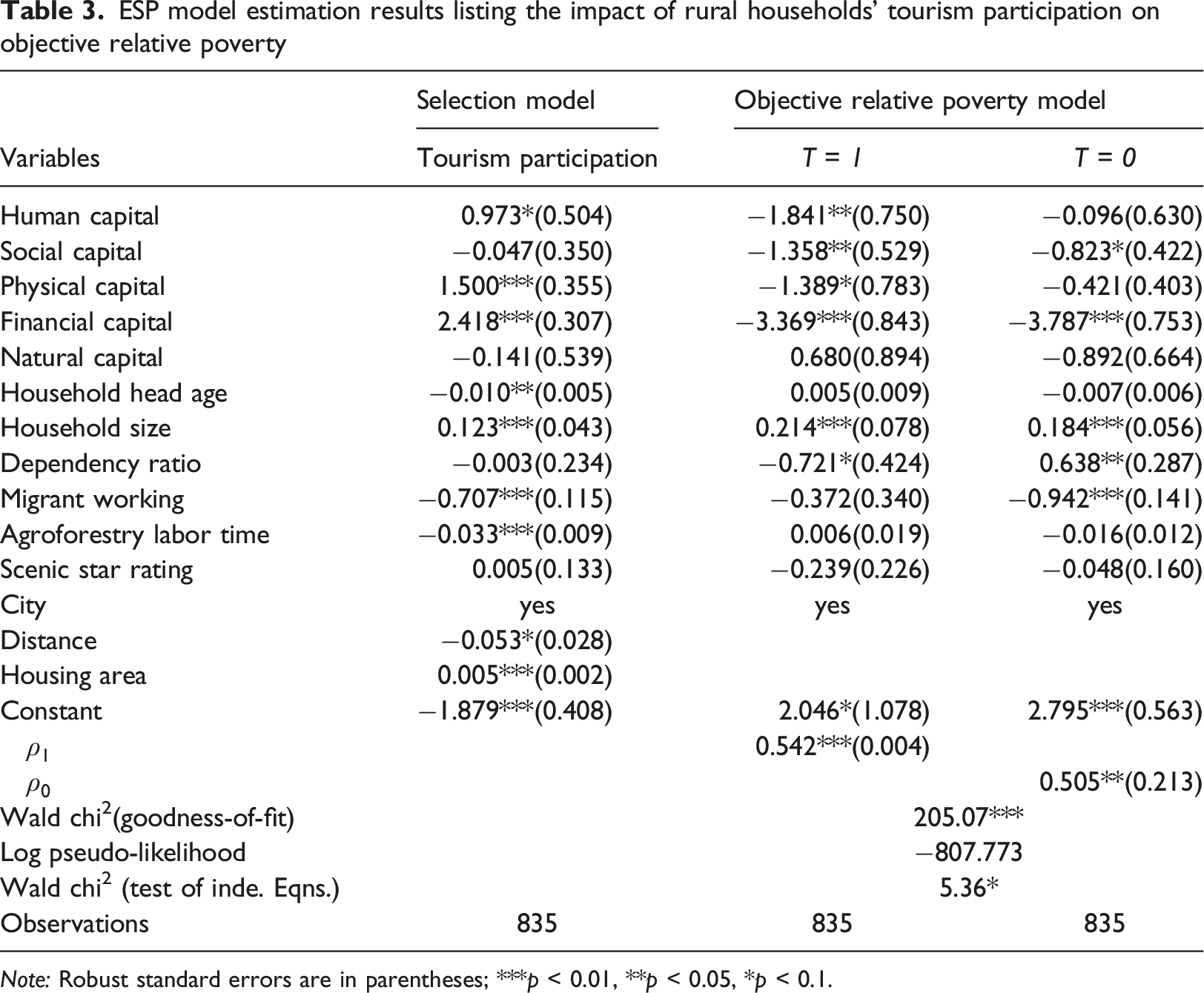
ESP model estimation results listing the impact of rural households’ tourism participation on objective relative poverty
Note: Robust standard errors are in parentheses; ***p < 0.01, **p < 0.05, *p < 0.1.
The results from first-stage estimates of the ESP model, which show the determinants of households’ tourism participation, are presented in column (2) of Table 3. The results show that human capital, physical capital, and financial capital increase the possibility of tourism participation, while social capital and natural capital did not show significant impacts. The other coefficient estimates reveal that the age of the household head and the household size have positive impacts. In particular, the coefficient of migrant working and agroforestry labor time have significant negative impacts, indicating that they have a substitute effect on the tourism participation selection. The coefficients of the distance and housing area variables further confirmed the validity of the instrumental variables.
The estimated results of objective relative poverty model (in columns (3) and (4) of Table 3) show that, first, human, social, physical, and financial capital have a significant negative impact for tourism participants, while only social capital and financial capital are significant for non-participants. Natural capital has no significant effect on the two groups. Second, objective relative poverty also tends to be influenced by other factors. A higher dependency ratio often aggravates poverty, which is verified in non-participating households, but the result is opposite for tourism participants. This may be the reason that tourism participation in western China is dominated by family business operations, it increases the possibility for inter-generational divisions of labor and mutual cooperation within the family to maximize their tourism income. The coefficient of migrant working shows that it is an indispensable livelihood style for non-participants to reduce objective relative poverty. Moreover, the head of household age and agroforestry labor time failed to have significant impacts on the two groups, possibly due to the aging and low efficiency of the rural labor force in western China. In terms of village characteristics, compared with the scenic spots below 4A level, 4A level and above scenic spots have not alleviated the objective relative poverty, possibly because that there is little difference in alleviating objective poverty between the two types of scenic spots.
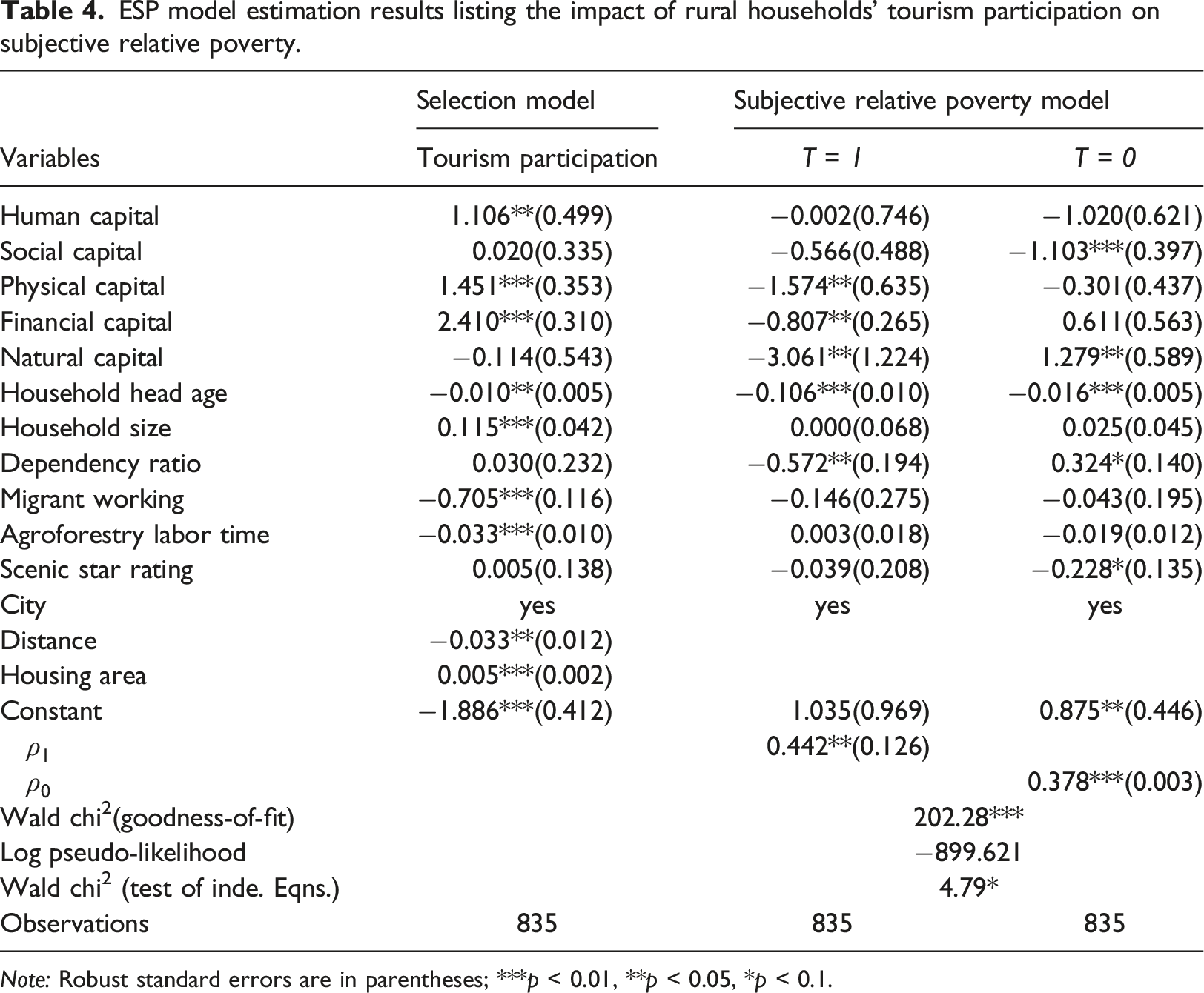
ESP model estimation results listing the impact of rural households’ tourism participation on subjective relative poverty.
Note: Robust standard errors are in parentheses; ***p < 0.01, **p < 0.05, *p < 0.1.
Treatment effects of rural tourism participation and their heterogeneity on relative poverty
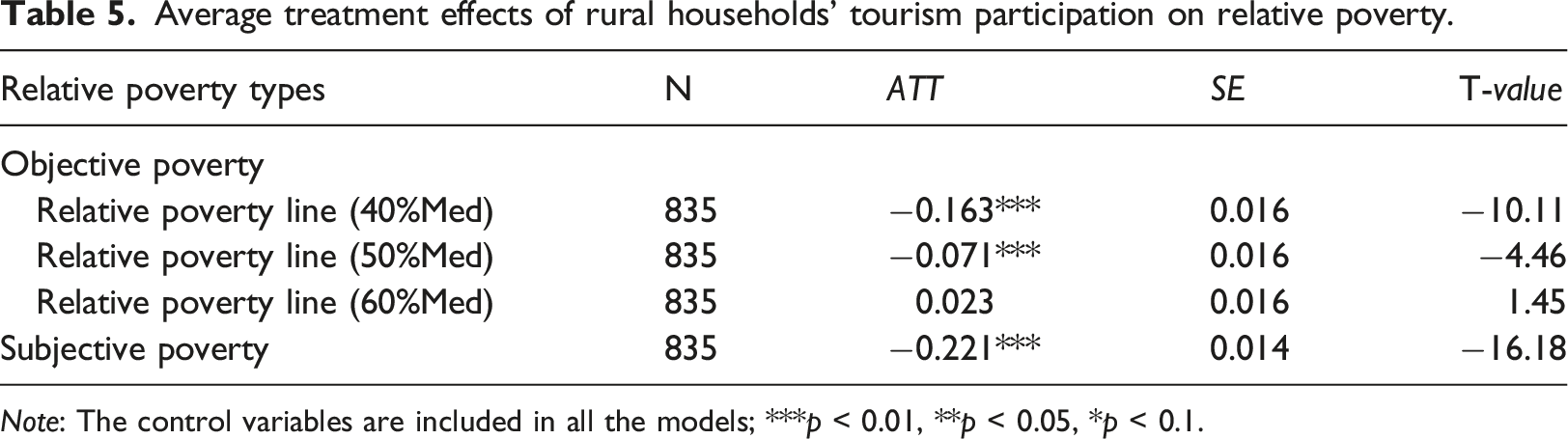
Average treatment effects of rural households’ tourism participation on relative poverty.
Note: The control variables are included in all the models; ***p < 0.01, **p < 0.05, *p < 0.1.
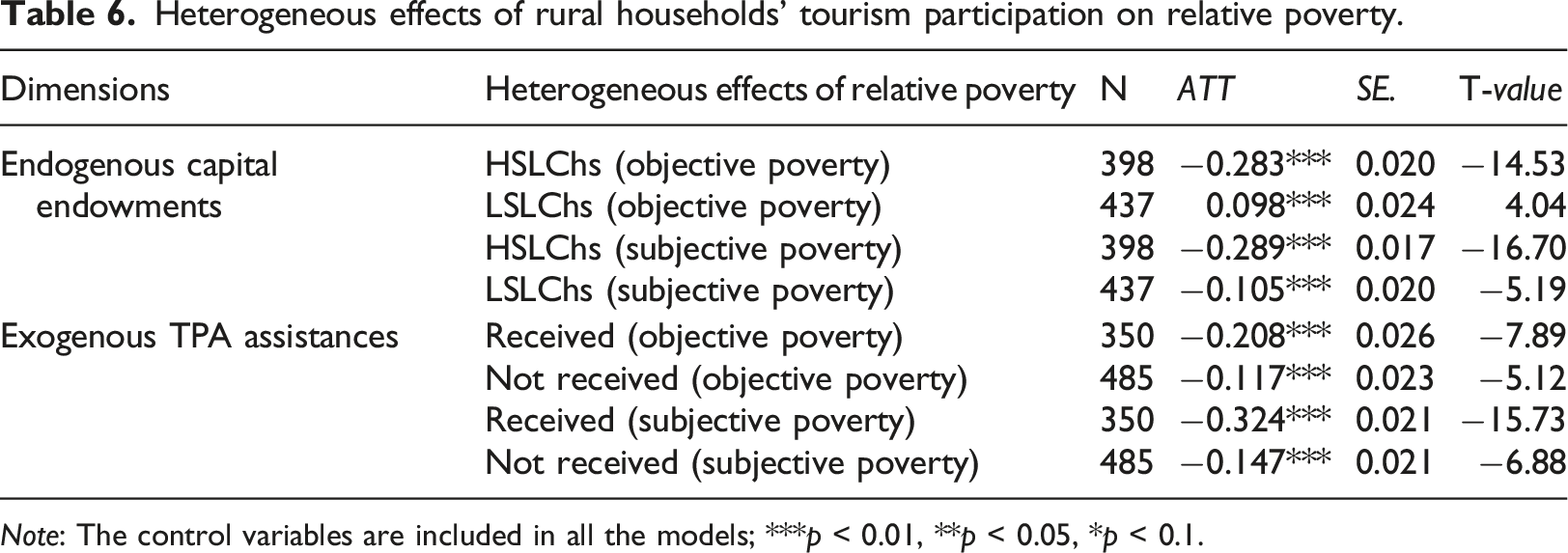
Heterogeneous effects of rural households’ tourism participation on relative poverty.
Note: The control variables are included in all the models; ***p < 0.01, **p < 0.05, *p < 0.1.
In Table 6, the results show that tourism participation decreases the probabilities of objective relative poverty for HSLChs by 28.3%, conversely, for LSLChs the effect increases by 9.8%. The findings suggest that, even though tourism participation can reduce the probability of objective relative poverty in general, the positive effect is mainly reflected in HSLChs, the poverty condition even exacerbates if LSLChs participate. The effect of objective poverty reduction based on the 50% and 60% Med poverty line showed similar effects between HSLChs and LSLChs (seen the Supplement Table A2, in Appendix II). As for subjective poverty alleviation effects, tourism participation had negative and significant effects on both the HSLChs and LSLChs. More importantly, the effect was greater in HSLChs than in LSLChs. These empirical results indicate that households with better endogenous resource endowments tend to benefit more from tourism development. Focusing on heterogeneous effects of exogenous TPA assistance, households who received the TPA policy assistance had a greater poverty alleviation effect than those who have not received the assistance if they are engaged in tourism, which is true either for objective or for subjective poverty. These results support the positive influence of packages of TPA policies and assistance on poverty targeting in tourism communities.
Furthermore, the effects and its heterogeneity of tourism participation on subjective poverty based on the ISQ measure are shown in Supplement Table A3 (Appendix II). Apparently, whether LSQ or ISQ method is adopted to measure subjective relative poverty, participating in tourism decreases the probability of subjective relative poverty, and the heterogeneous effects observed are similar with the results of Table 6. These findings validate the robustness of the pro-poor effect of tourism on subjective poverty, and to some extent reflect the importance of economic benefits in improving subjective welfare by rural tourism.
Further analysis
Considering the correlation between objective and subjective relative poverty, we further discussed the influencing mechanism of tourism participation on different types of relative poverty. Specifically, employing the mediation effect model, we examined the direct and indirect paths to the impact of households’ participation in tourism on relative poverty.
As shown in Figure 1, the total effect, i.e., the impact of tourism participation on subjective relative poverty is statistically significant at 1% level (the coefficient c is −0.085), the impact of tourism participation on the objective relative poverty (mediating variable) is statistically significant at 1% level (the coefficient a is −0.270). When both tourism participation and the mediating variable are included in the model, the results show that the impact of mediating variable on subjective relative poverty is significantly positive (the coefficient b is 0.105), the direct effect (c’) is −0.057, but not significant, meaning that households’ participation in rural tourism only has an indirect effect on subjective relative poverty through objective relative poverty. According the model, the value of indirect effect (ab) is −0.028, significant at 5% level. Moreover, as exhibited in Supplement Figure A1 (Appendix II), the results of ISQ measure for subjective relative poverty are consistent with our findings based on the LSQ measure (the coefficient c, ab is −0.053, −0.029, respectively, both significant at 5% level; the coefficient c’ is not significant). From what we have found, participating in rural tourism brought an income effect and decreased households’ objective poverty, then the subjective well-being improved, but the participation behavior had no direct effect on the alleviation of subjective relative poverty. Influencing path test for rural households’ tourism participation on different types of relative poverty. Note: The control variables are included in all the models; ***p < 0.01, **p < 0.05, *p < 0.1.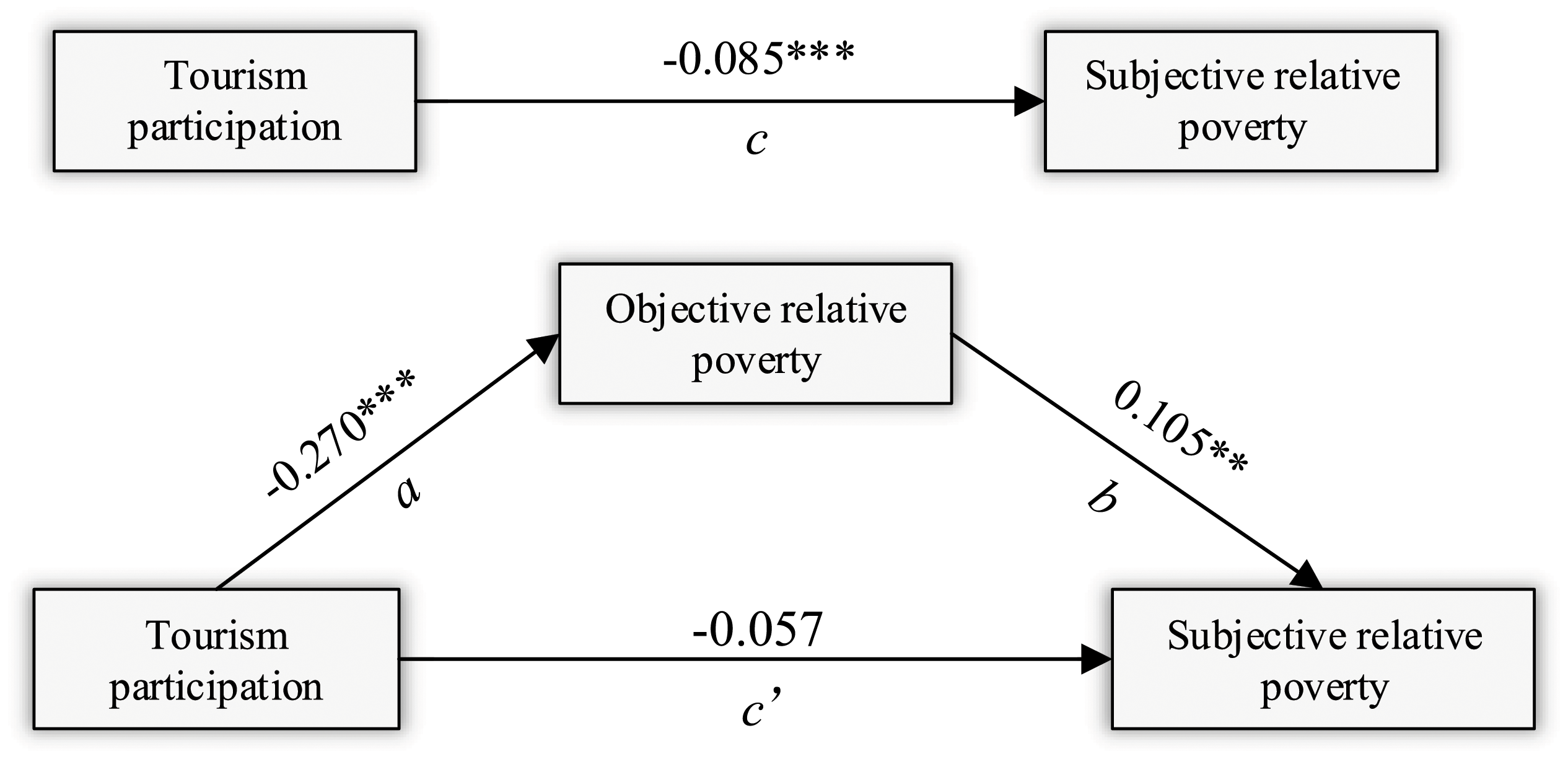
Discussion
The effect of rural tourism on objective and subjective relative poverty
This study estimated the effects of rural tourism on relative poverty reduction at a household level based on the survey data from pro-poor tourism villages in western China. Our empirical findings indicated that rural tourism reduced objective relative poverty, specifically, participating in tourism generated a substantial pro-poor effect, promoting upward mobility of the poor and thereby getting rid of relative poverty at the 40% and 50% Med poverty line. However, this effect failed when a higher 60% Med relative poverty line was adopted. Generally, the objective poverty reduction of rural tourism for the poor depends not only on individual’s monetary benefits, but also on the existing competitiveness of tourism development with the limited endowed tourism resource base (Feng et al., 2018; Gartner and Cukier, 2012). In survey areas, rural residents could get job opportunities for tourism business operations or periodic or temporary tourism-related work. However, these operation projects or employments were mostly small-scale, and low-yield endeavors. In some tourism communities, a ticket monopoly bounds tourists’ consumption to external operators, which make it difficult for local residents to get higher benefits. Not only that, rural tourism industry of the Qinba area has been presently characterized by a low-level development and operated in a simple industrial mode, it becomes more difficult for tourism participants to break through current income levels. Thus, as the poverty line rises, more poor population are identified, and the poverty reduction effect fails.
Moving our focus to the effect on subjective poverty, we found that when residents engaged in tourism, their life satisfaction was greatly improved and subjective relative poverty declined. Studies have shown that tourism could bring benefits to residents in the form of income, higher living standards, job opportunities, and a sense of community (Chi et al., 2017; Estifanos et al., 2020; Su et al., 2019), which helps to achieve the goal of improving their life quality and subjective well-being (Chi et al., 2017; Estifanos et al., 2020; Su et al., 2019). However, further analysis implied that tourism participation affected subjective relative poverty indirectly through objective poverty, it had no direct influence. This finding is inconsistent with Rojas (2008) and Rivera et al. (2016) who argued that raising the family income did not ensure greater subjective well-being, the non-income factors also played an important role in it. Ravallion and Lokshin (2002) indicated that a person’s perception of poverty were affected by health, education and employment status, etc. There is practical evidence to support our finding that in western China where rural tourism is still considered a means to make a living, tourism participants tend to pay more attention for the economic benefits from tourism (Ying and Zhou, 2007), rather than directly pursuit the experienced subjective sense of gains. Furthermore, the current insufficient public health care in western China as well as household’s high expectation for intergenerational education make family expenditure on education and health largely dependent on income. Moderate economic benefits from tourism facilitate a better living by accumulating family’s physical assets, maintaining health expenses and investing in children’s education, which is conducive to fostering positive life satisfaction and reversing the adverse subjective poverty status.
Moreover, the robustness test of subjective poverty using ISQ measure suggests that households’ relative income level is closely associated with income satisfaction. From what we found, on the one hand, although it was argued that raising the income received by persons does not automatically translate into greater subjective well-being (Rojas, 2008), our findings reveal that increases in the relative income promote households’ income satisfaction and the comprehensive improvement of their subjective well-being in western China, further suggesting the importance of the economic aspects for subjective poverty at the household level. On the other hand, however, compared with the ISQ measure, the findings based on the LSQ measure provide more information about how participating in rural tourism impacts subjective poverty; and to a large extent, provide evidence for existing studies that used LSQ instead of ISQ as a measure of subjective poverty given its multidimensional attribute. Anyway, the findings validate that economic benefit is an indispensable source of subjective poverty reduction. Therefore, it is necessary to innovate tourism development mode to broaden diverse income source to enhance households’ subjective sense of gains from rural tourism in impoverished areas of China.
To widen or narrow the relative gap of poverty? The heterogeneous effect analysis
Due to the differences in households’ characteristics and poverty alleviation targeted, the effects of rural tourism on relative poverty may vary. Our empirical results demonstrated a heterogeneous effect of rural tourism on relative poverty probability based on the differentiation of endogenous livelihood capital and exogenous TPA assistance. First, Livelihood capital is the prerequisite and foundation of livelihood strategies in a adverse environment. Generally, the essence poverty reduction by tourism is to help the poor better adapt to the market mechanism, which not only creates job opportunities and income, but also requires higher threshold for participation. In most cases, locals with more assets have the advantage of engaging in tourism (Su et al., 2019), particularly with human capital, initial investments, and the physical assets that a tourism operation needs (Liu et al., 2012; Su et al., 2016), while those with low livelihood capital have less funds and capitals to resist the risks of the fluctuating tourism market demand (Feng et al., 2018). Thus, participation in tourism widens the gap between HSLChs and LSLChs, thereby aggravating the relative objective poverty conditions. Related to this, the effect of tourism participation on subjective relative poverty for HSLCHs was lower than LSLCHs.
Second, compared with those who were not targeted by TPA projects, the targeted households participating in tourism have a higher significant effects on relative poverty reduction. This finding may be explained by the fact that, unlike the straightforward monetary transfer programmes implemented in other countries (Fisher et al., 2017), in the implementation of China's TPA especially the poverty alleviation by industrial development, local governments mainly take households’ ability as the foundation and their living demands as the guidance (Liu et al., 2021; Tang et al., 2021), and provide targeted assistant measures such as industrial subsidies, skill training, to remedy low-income households’ short board of tourism engagement. In addition, participants who have received TPA assistance had a higher subjective poverty effect than whom not received, which is similar to Cheng and Xu (2021) who revealed that low-income residents had a higher level of subjective well-being in the moderate benefit-sharing context.
As mentioned earlier, relative poverty is comparative poverty and cannot be isolated from its connection to the average state of society. For the objective attribute of relative poverty, an individual’s poverty condition depends on own income to cross a certain level, as well as on its income distribution status compared to others (Luo, 2020; Townsend, 1979). Following this thinking, the effects of relative poverty reduction not only signify the decrease of poverty incidence, it also contains the relative income status changes of households. As our findings indicate, on the one hand, it reduces the relative poverty probability for tourism participants; on the other hand, it exacerbates the income gap among participants with the livelihood capital endowments differentiation. Conversely, heterogeneous effects of exogenous TPA policy support the view that the TPA is pro-poor and could be an effective measure to narrow the gap between the low-income households and others. For the subjective attribute, it showed a similar meaning. Generally speaking, people often evaluate their life conditions by taking adjacent or homogeneous groups as a reference, such as the similar hukou type, livelihood styles, or environment. In our survey areas, tourism-participants who got many benefits by virtue of advantaged asset endowments are more likely to hold a positive perception evaluation of own life compared with their neighbors, friends and relatives, and they often ranked in a moderate-high income level within communities. Low-income households are inevitably disadvantaged in the tourism development. However, as we indicate, the TPA assistance could decrease this relative disadvantage and deprivation, and remedy the gap with the average groups.
In conclusion, our empirical analysis shows that alleviating relative poverty through rural tourism is complicated from the household perspective. It brings the reduction of relative poverty probability, more importantly, the widening gap caused by individual endowments and the narrowing gap by the government’s TPA interventions are the profound meaning in it. Capturing the relative gap affected by heterogeneous effects of tourism participation provides empirical evidence for further relative poverty reduction.
Conclusions and implications
The existing research on tourism-poverty nexus mainly conducted at the national or regional level, lack of full consideration of the role of rural households. Moreover, few previous literature paid attention to the effect of tourism on the subjective aspects of relative poverty even though the experienced poverty could reflect an individual’s comprehensive feeling of well-being. This study explored whether and to what extent rural households’ tourism participation affect relative poverty in impoverished areas of China. The empirical findings indicated that tourism participation reduced both objective and subjective relative poverty, reflecting a significant and positive effect on poverty reduction. It revealed the great value of implementing the pro-poor tourism policy at the household level. Furthermore, participating in tourism had no direct effect on subjective poverty but exerted an indirect effect through decreasing objective poverty. As for the objective relative poverty, tourism participation had significant effects at 40% and 50% Med poverty line, but it failed to bring the participants a higher income to cross the 60% poverty line. Heterogeneous effect analysis showed a dual impact of tourism participation on relative poverty. On the one hand, it could reduce the objective and subjective relative poverty probability for tourism participants; on the other hand, it exacerbated the relative gap by individual endogenous capital endowments and narrowed the gap by exogenous TPA policy interventions, which is the same for both objective and subjective relative poverty.
There is a long-standing debate over whether tourism is pro-poor owing to the discrepancy in research perspectives, estimation techniques, data source, study regions, and variables design, etc. Through empirically exploring the effect of tourism participation on relative poverty, both objective and subjective poverty reduction effects are clarified by tourism for rural households in poor areas. We also identified that the alleviation of objective poverty was beneficial to their subjective well-being. These findings could remedy a lack of micro-level research and overlook for the effect of subjective poverty in the current PPT literature. Moreover, our findings revealed a complicated effect of tourism on relative poverty reduction based on the households’ internal endowments and external policy interventions. Therefore, these findings provide a theoretical implication by enriching the understanding of PPT arguments in the current tourism literature, and obtaining a broadly cognitive picture of the tourism-poverty nexus.
Based on the findings, some policy implications are put forward as follows. First, relative poverty reduction requires active roles of both tourism development and government intervention. Because rural tourism is a labor-intensive industry, a sustainable growth of income from tourism is needed, which is the key to governing beneficial to alleviate relative poverty (both objective and subjective attributes) in the long run. So it is necessary to actively attract foreign enterprises, as well as foster native tourism cooperatives or other industry organizations to upgrade the scale and quality of rural tourism. Second, governments have a responsibility to strengthen investments and financial supports for tourism development, to balance inappropriate income distribution caused by individual endowments, abilities, or opportunities in tourism participation, and to explore a reasonable tourism benefit distribution mechanism inclined to low-income households. Third, the TPA policy should be enhanced to provide more appropriate and regular assistance to the poor after China’s 2020 eradication of absolute poverty.
A few limitations should be noted. First, by using the cross-sectional survey data, we could only examine the effect of tourism on the poverty rate. It is difficult to capture the possible dynamic impacts of tourism on relative poverty. Second, the measure of subjective relative poverty is a flexible method to reflect the experienced poverty, different measures may generate different conclusions. Besides, LSQ/ISQ measure may vary with respondents’ characteristics, such as age, health, education and other personal expectations, and be influenced by the way of researcher’s interview process. Third, except for households’ characteristics, some meso-level factors, such as community tourism development modes, elite governance of villages also influence relative poverty at the household level. Further exploration is needed to ascertain how these factors and their interaction with micro-level factors affect tourism participation and poverty reduction.
Supplemental Material
Supplemental Material - Does rural tourism reduce relative poverty? Evidence from household surveys in western China
Supplemental Material for Does rural tourism reduce relative poverty? Evidence from household surveys in western China by Peiying Dang, Linjing Ren, Jie Li in Tourism Economics
Footnotes
Acknowledgements

Authorship contribution
All authors contributed to the study conception and design. Conceptualization, methodology, data collection were performed by Peiying Dang, Linjing Ren and Jie Li. Material preparation and data analysis was performed by Peiying Dang. The first draft of the manuscript was written by Peiying Dang and all authors revised it critically for important intellectual content. Funding acquisition and data curation was performed by Jie Li. All authors read and approved the final manuscript.
Declaration of Conflicting Interests
The author(s) declared no potential conflicts of interest with respect to the research, authorship, and/or publication of this article.
Funding
The author(s) disclosed receipt of the following financial support for the research, authorship, and/or publication of this article: This study was supported by the National Natural Science Foundation of China (Grant Number 71573205).
Supplemental Material
Supplemental material for this article is available online.
Author biographies
References
Supplementary Material
Please find the following supplemental material available below.
For Open Access articles published under a Creative Commons License, all supplemental material carries the same license as the article it is associated with.
For non-Open Access articles published, all supplemental material carries a non-exclusive license, and permission requests for re-use of supplemental material or any part of supplemental material shall be sent directly to the copyright owner as specified in the copyright notice associated with the article.
