



Abstract
This research aims to quantify the effect of air transport capacity on tourism demand by examining their long-term (cointegrating) relationship, accounting for cross-sectional dependence and endogeneity. Panel time series data from 2008Q1 to 2019Q4 for international tourist arrivals from 16 main origins to six Australian states are investigated. The study finds 1% increase in Available-Seat-Kilometers, seat capacity, or flight frequency can result in 0.4%–0.7% increase in tourist arrivals to Australia, adding to the body of evidence that shows a non-negligible aviation-led generative effect on tourism demand. The study finds ignoring cross-sectional dependence can result in significantly different, and potentially incorrect, coefficient estimates. Although using pre-COVID data, the results are useful in highlighting the likely aviation supply—tourism demand relations under reasonably well-performing market conditions. For greater tourism demand, findings call for more liberal international air services agreements, and direct/indirect air route development subsidies with minimum commitment of several years.
Keywords
Introduction
Australia is a geographically remote tourism destination with a liberalized aviation market and a highly developed aviation – tourism ecosystem (Spasojevic and Lohmann, 2022). In 2019, the total nonstop air transport capacity (hereafter air transport capacity) to Australia increased by more than 60% compared to 10 years before (from 16.5 to 26.8 million seats) (Cirium, 2021). Within the same period, the total number of international tourist arrivals (TA) to Australia almost doubled (from 5.56 to 9.47 million) (Australian Bureau of Statistics, 2021). These two observations do not happen in coincidence but stem from intertwined interdependences between the air transport and tourism industries in the long term (Ivanova, 2017). For air transport-reliant destinations like Australia, guiding aviation policy and marketing designed for promoting tourism development relies on accurate yet robust estimates of the causal effect of air transport capacity (ATC) on tourism demand; for instance, destination marketing organizations such as Destination New South Wales in Australia use return-on-investment ratios for assessing air route development funds.
The causal effect of air transport capacity on tourism demand has a theoretical basis. Many tourism demand studies tend to be based on neoclassical consumer theory (Lim, 1997b, 1999). From their perspective, air transport capacity is a surrogate of the generalized cost of air transport borne by tourists. Air transport is one of the top three determinants in tourism demand modeling, in addition to tourists’ income and (destination) tourism prices (Lim, 1997b, 1999). Another theoretical motivation for considering the effect of air transport on tourism demand is based on gravity theory, which has a distance parameter. In this regard, air transport capacity is associated with the “distance” between the origin and destination, which in tourism parlance is defined as a measure of accessibility or connectivity for the destination. Empirical evidence from meta-analyses has demonstrated that the omission of the transport factor results in larger size coefficient estimates of tourism price elasticity (Peng et al., 2015) and income elasticity (Gallet and Doucouliagos, 2014).
However, modeling the causal effect of air transport capacity on tourism demand needs to resolve at least two challenges. First, the commonly recognized bidirectional causality (aka the classic “chicken or egg” dilemma by Koo et al. (2017)) must be appropriately disentangled. In the econometric context, this bidirectional causality results in a correlation between the explanatory variable and residuals (aka the endogeneity problem); thus, the estimates will be inconsistent. The endogeneity problem can be mitigated by introducing instrumental variables (hereafter instruments) in the empirical models (e.g., Alderighi and Gaggero, 2019; Koo et al., 2017; Tsui, 2017). Second, the scale of data used should not be too limited and the model specifications (i.e., explanatory variables included, econometric techniques used) must adequately deal with the structure of the data (Fuleky et al., 2014). Several empirical studies on the air transport capacity – tourism demand nexus have been undertaken in the last decade, particularly in the Asia Pacific region (e.g., Koo et al., 2013; Koo et al., 2017; Koo et al., 2018; Tsui, 2017; Tsui et al., 2019; Salesi et al., 2021). However, these studies have been dominated by either small
Against this background, the aim of the study is to quantify the causal effect of air transport capacity on Australian inbound tourism demand using large-scale panel data with 48 origin-destination (O-D) pairs during 2008Q1-2019Q4 (
Literature review
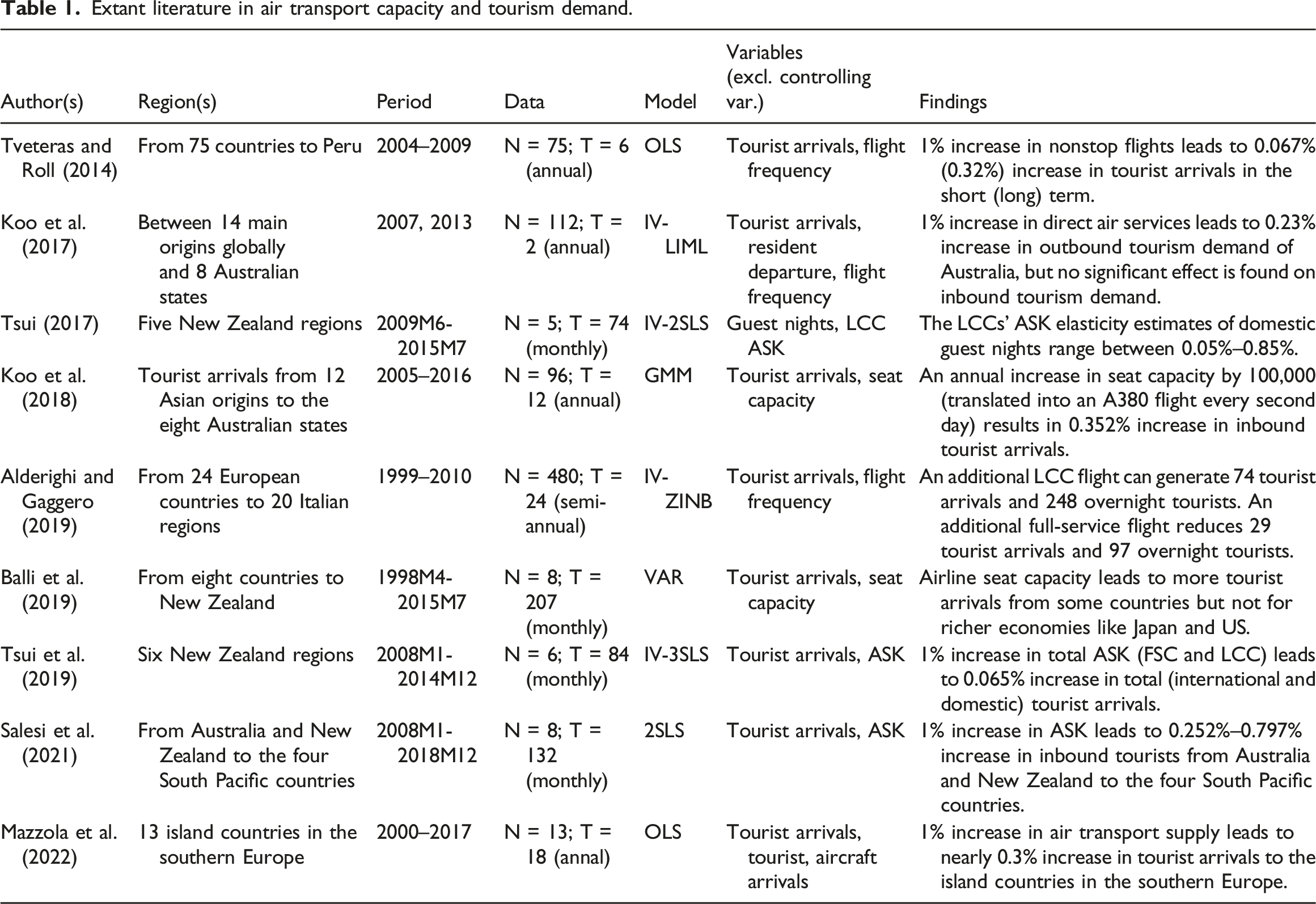
Extant literature in air transport capacity and tourism demand.
In other studies, quantitative measures of air transport capacity are used, such as flight frequency (e.g., Alderighi and Gaggero, 2019; Koo et al., 2017; Tveteras and Roll, 2014), total number of seats available (aka seat capacity) (e.g., Koo et al., 2013; Koo et al., 2018), and Available-Seat-Kilometers (ASK, a standardized unit of measure of capacity in airline management) (e.g., Tsui, 2017; Tsui et al., 2019; Salesi et al., 2021). From the perspective of tourists, the level of air transport capacity determines how convenient the tourists can choose a flight with a departure time as close to their most desired departure time, and this is referred to as schedule delay (Douglas and Miller, 1974). Furthermore, increased air transport capacity is also associated with lower airfare. According to Cattaneo et al. (2018), the negative relationship between air transport capacity and airfare can be explained in two ways. First, airline industry structures are usually oligopolistic; in the presence of more frequent services, competing airlines may have to reduce airfare to attract more travelers. Second, the economies of density, credited to lower average cost per passenger, also result in lower airfare.
As shown in Table 1, studies vary significantly in their samples and panel data characteristics. For example, Tsui (2017) investigates five New Zealand regions and finds that 1% increase in LCCs’ ASK results in 0.05%–0.85% increase in domestic guest nights. Tsui et al. (2019) focus on six main airports in New Zealand and find that 1% increase in total ASK (FSC and LCC) leads to 0.065% increase in total (international and domestic) tourist arrivals. However, the abovementioned studies do not differentiate between tourism origins. In other words, they implicitly assume the consumer utility functions are identical across all the origin countries, although segmentation by origins is desirable on theoretical grounds (Morley et al., 2014). Also, empirically, meta-analyses have given evidence that tourism demand elasticities differ across the origins of a common destination (e.g., Crouch, 1995; Lim, 1999; Peng et al., 2014; Peng et al., 2015).
Some studies differentiate the tourism-generating markets of a destination. For example, Koo et al. (2013) independently examine the Japan-Australia pair and China-Australia pair, and find that air passengers from Japan to Australia make quicker adjustments to changes in seat capacity than those from China to Australia. However, the authors focus on a small number of origin-destination pairs/routes, which limits the generalizability of the study. Other attempts examine the tourist flows for many O-D pairs/routes through a panel dataset. For example, Koo et al. (2017) use 112 O-D pairs, and they find a significant positive relationship between direct air services and the outbound tourism demand of Australia. Koo et al. (2018) reexamine Australia with a different panel dataset comprising O-D pairs between 12 Asian origins and the eight Australian states. The authors find a significant, albeit small effect of direct air services on tourist arrivals to Australia, which is equivalent to 0.352% increase in tourist arrivals for an annual rise of seat capacity by 100,000 (translated into an A380 flight every second day). However, the temporal observations of the panel data in these studies tend to be relatively limited, probably due to the increasing data requirement for a large sample of O-D pairs/routes. As seen above, previous studies have been limited to either small
Methodology
With improvement in data collection technology, large
Panel cointegration
Invariably, time series of many economic variables are nonstationary, leading to spurious static OLS regression (Kao, 1999). However, simply differencing the nonstationary variables (to obtain stationary variables) eliminates some relevant information on the long-term properties of the underlying variables. Thus, the regression model on the relationship between different variables and the estimated coefficients may not be supported by rigorous theoretical reasoning. Engle and Granger (1987) argue that a linear combination of the studied variables may form a stationary process. Hence, such a linear combination indicates the long-term relationship (aka cointegrating relationship) between the studied variables.
Cointegration analysis is a suitable starting point when examining panel time series and it enables us to explore the long-term properties between air transport capacity and tourism demand. According to Granger (1986), economic theory is often based on the belief that certain pairs of economic variables do not significantly diverge from one another in the long term. Such variables may drift apart in the short term (e.g., one-off shock), but if they continue to deviate from the long-term steady relationship, some economic forces (e.g., market mechanism) will drive them back together. In the aviation industry, capacity decisions which involve fleet acquisition and flight crew training, must be planned on a long-term basis, at least several years ahead. Therefore, knowing the cointegrating relationship between air transport capacity and tourism demand is useful for developing aviation policy and marketing. The long-term steady relationship between air transport capacity and tourism demand can be modeled with the aid of an error correction specification, through which the long-term (cointegrating) relationship, short-term divergences, as well as the speed of convergence to the long-term relationship are separated. Cointegration analysis has received particular attention from economists and has been considered in policymaking related to major economic variables (i.e., consumption, employment, government expenditure, interest rate, investment, tax) (Granger, 2004). In addition, the superiority of imposing cointegrating restrictions in a forecasting system to improve the forecasting performance is a known practice by economists (e.g., Christoffersen and Diebold, 1997; Clements and Hendry, 1995) and tourism researchers (e.g., Kulendran and Witt, 2001; Li et al., 2006).
One commonly used cointegration technique is the Autoregressive Distributed Lag (ARDL) model. This model enables researchers to determine the cointegrating relationship between the studied variables through an error correction specification. The ARDL model is particularly suitable for cointegration analysis on panel time series for several reasons. First, the ARDL model allows for slope heterogeneity across sections. A widely used technique in examining short panel is to pool the data by imposing a common slope (e.g., fixed/random effects). However, such a technique generates inconsistent estimates in a dynamic model specification for panel time series because ignoring slope heterogeneity induces serial correlation in residuals (Pesaran and Smith, 1995). Unlike the conventional panel data technique, the ARDL model is estimated by (i) the mean group (MG) estimator (Pesaran and Smith, 1995) or (ii) the pooled mean group (PMG) estimator (Pesaran et al., 1999). In essence, the MG and PMG estimators estimate the section-specific equations independently; thus, the slope coefficients can be heterogenous. Second, the estimates generated by the ARDL model are valid regardless of whether the regressors are
Cross-sectional dependence
Another important econometric issue to be considered is cross-sectional dependence arising from the fact that the cross-sectional units are influenced by some omitted unobserved common factors (Frees, 1995). Unless the analysis of air transport capacity and tourism demand interaction is confined to a single origin-destination pair case study, it is likely cross-sectional dependence will be present in the data because the sample of interests will involve tourist flows from various origins to a destination. For panel data with small
The commonly correlated effects (CCE) estimator, proposed by Pesaran (2006), can mitigate the effect of cross-sectional dependence. The CCE estimator is a vector of cross-sectional averages of the studied variables incorporated as regressors and used to capture the unobserved common factors. It is robust to different types of cross-sectional dependence, potential unit roots in factors, and slope heterogeneity (Chudik and Pesaran, 2015). Based on Fuleky et al. (2014), the CCE estimator (i) is simple to implement; (ii) has good finite sample properties; (iii) does not require ex-ante information about the unobserved common factors; and (iv) offers good finite sample properties. The authors further show that when the empirical model is estimated by the FMOLS estimator, the price elasticity has the wrong (or positive) sign. However, the obtained price elasticity estimate is significant negative under the CCE estimator. Other tourism studies also report that the underlying coefficient estimates generated by the CCE estimator differ from those that do not correct for the cross-sectional dependence (e.g., Demir et al., 2020; Ghosh, 2022; Lee et al., 2021). To verify whether the residuals of the regression are cross-sectionally independent. The Pesaran (2021) test (aka the CD test) is conducted, which is based on the average pair-wise correlation coefficients of the individual regressions’ residuals.
CS-ARDL model
In this study, we employ the CS-ARDL model developed by Chudik and Pesaran (2015), which takes into account slope heterogeneity and cross-sectional dependence, to conduct a panel cointegration analysis on the air transport capacity – tourism demand nexus. Based on Chudik and Pesaran (2015), the CS-ARDL model is derived as follows. We assume the 

We further decompose the residuals 

Acting as proxies for the unobserved common factors, the cross-sectional averages of the dependent and explanatory variables, 

Then, we plug equation (6) into equation (1) and obtain equation (7) as:
Likewise, the 
The
Variables and data
Subject to the availability of nonstop flights, we focus on quarterly O-D pair data (2008Q1-2019Q4) from 16 oversea markets worldwide to the six Australian states (New South Wales (NSW), Northern Territory (NT), Queensland (QLD), South Australia (SA), Victoria (VIC), and Western Australia (WA)). Our panel time series dataset comprises 48 time periods and 48 O-D pairs (or sections). The 16 origin markets are Canada, China, Fiji, Hong Kong, Indonesia, Japan, Malaysia, New Zealand, Papua New Guinea, Philippines, Singapore, South Korea, Taiwan, Thailand, USA, and Vietnam. The tourist flows of these 48 O-D pairs are likely to follow some common patterns because they belong to a single country (Shafiullah et al., 2019). The cointegrating relationship between the studied variables is given as
Numbers of short-term (less than one year) tourist arrivals are retrieved from the Department of Home Affairs (Australian Government). We also independently examine tourists for business, holiday, and visiting-friends-and-relatives (VFR). Data for air transport capacity, measured by Available-Seat-Kilometers (ASK), seat capacity, and flight frequency, are retrieved from the Cirium database. These three measures are used separately to enhance the robustness of our empirical results. Since the data are specified by airline and airport-airport pair, we need to make summations to generate the series for the O-D (origin market-Australian state) pairs to fit with the data for tourist arrivals to Australia as follows:
To correct for the endogeneity problem in our empirical model, we utilize the Herfindahl-Hirschman Index (HHI) as an instrument. A valid instrument must have causal effect on the endogenous explanatory variable but cannot directly affect the dependent variable (Greene, 2003). The HHI is a measure of market structure and is used as an instrument in the estimation of empirical models for the air transport capacity – tourism demand relations (e.g., Alsumairi and Tsui, 2017; Tsui, 2017; Salesi et al., 2021). This is because airlines’ decisions on capacity are heavily influenced by market structure (Mohammadian et al., 2019; Pitfield et al., 2010), whereas the market structure per se is believed to have no direct effect on demand for tourism.
The HHI is calculated by summing the squares of the percentage market share of each of the airlines competing in the same O-D pairs. In our study, the HHI is calculated as follows:
Empirical results
Panel unit root tests
Although the ARDL model accommodates variables of
IPS and CIPS panel unit root tests.
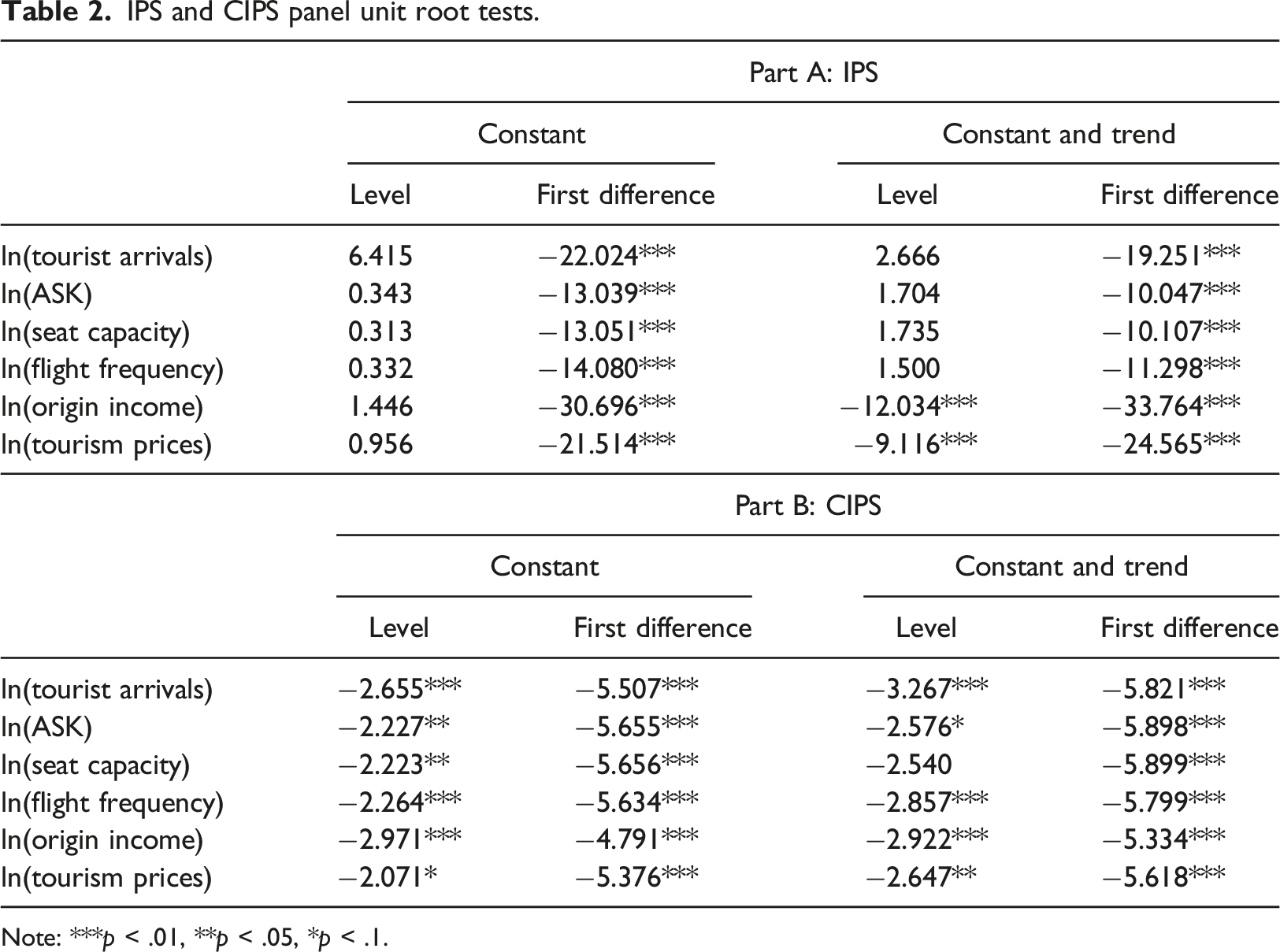
Note: ***p < .01, **p < .05, *p < .1.
Panel cointegration tests
Before estimating the CS-ARDL model, two types of panel cointegration tests are implemented to verify whether a cointegrating relationship exists between the studied variables, namely the Pedroni (1999) test and the Westerlund (2008) test. The residual-based Pedroni (1999) test verifies the stationarity of the OLS residuals for the studied variables. The null hypothesis of no cointegration is against the alternative hypothesis that the studied variables are cointegrated in all sections. However, this residual-based panel cointegration test suffers from loss of power if the imposed common factor restriction1 is not satisfied (Westerlund, 2008). In contrast, the error correction model-based Westerlund (2008) test removes the common factor restriction and allows for different long-term and short-term adjustment processes. Essentially, the Westerlund (2008) test rejects the null hypothesis of no cointegration in case the error correction coefficient is significantly different from zero2. It provides two types of test statistics, namely the group mean statistics (
Pedroni (1999) and Westerlund (2008) panel cointegration tests.

Granger causality tests
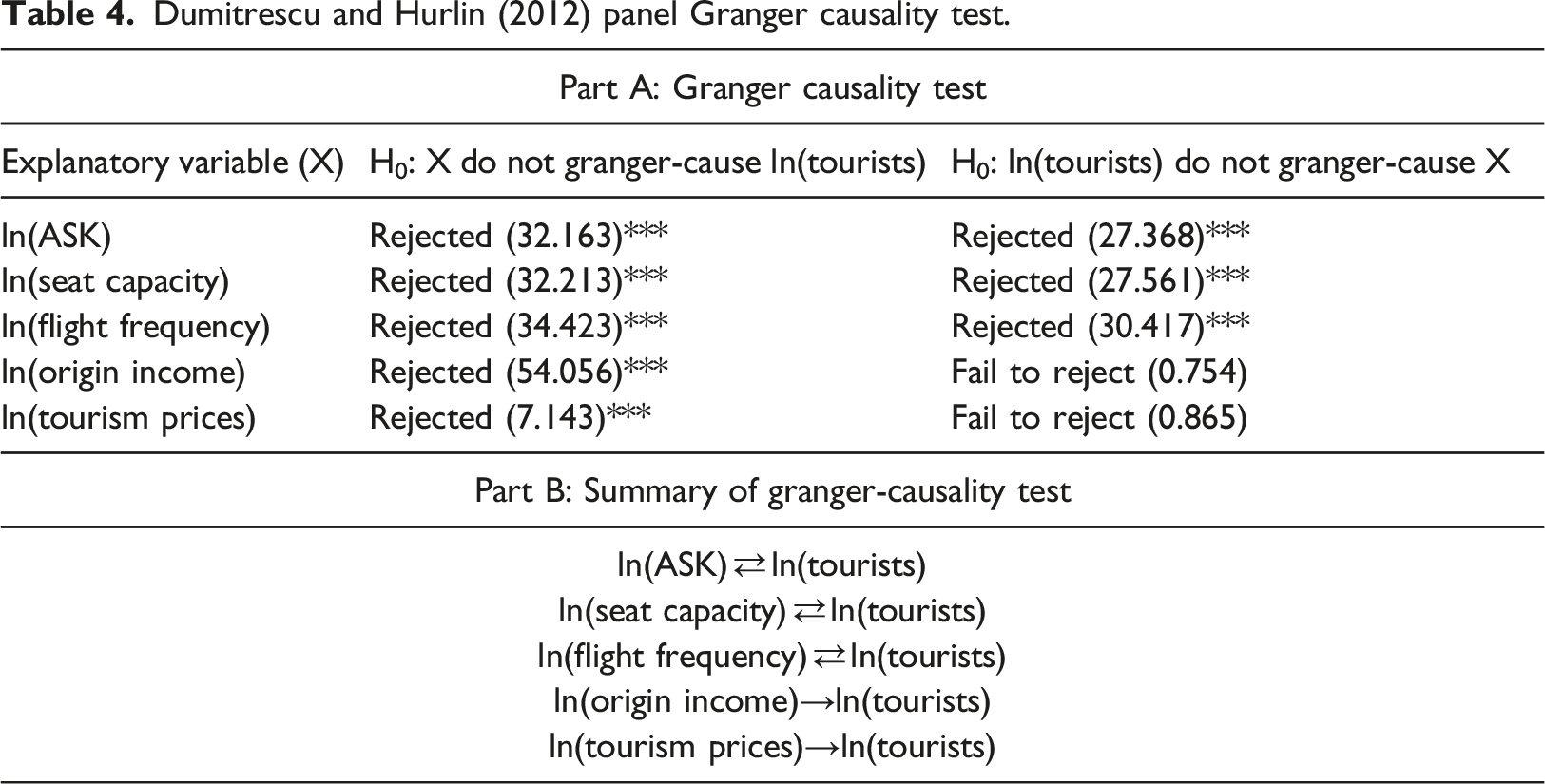
The existence of cointegration indicates causality, at least in one direction (Tano, 1993). To determine the direction(s) of the causality between the studied variables, we employ the Dumitrescu and Hurlin (2012) test of Granger causality for panel data. The Dumitrescu and Hurlin (2012) test is an extension of the Granger (1969) causality test for time series. In essence, the Granger (1969) causality test relies on the idea that if past information about
Dumitrescu and Hurlin (2012) panel Granger causality test.
Full sample analyses
Auxiliary regressions for the CS-ARDL model specifications with instrument.
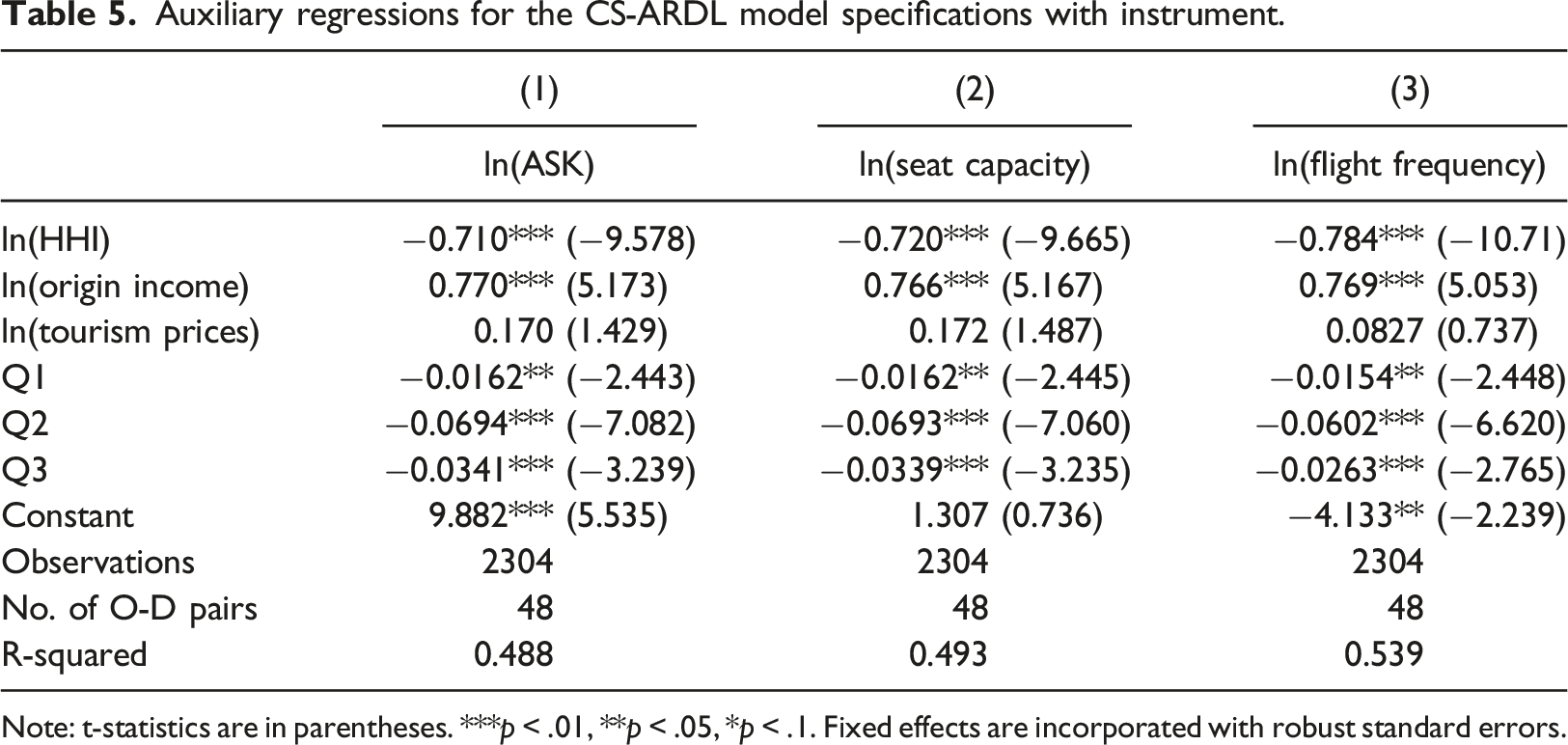
Note: t-statistics are in parentheses. ***p < .01, **p < .05, *p < .1. Fixed effects are incorporated with robust standard errors.
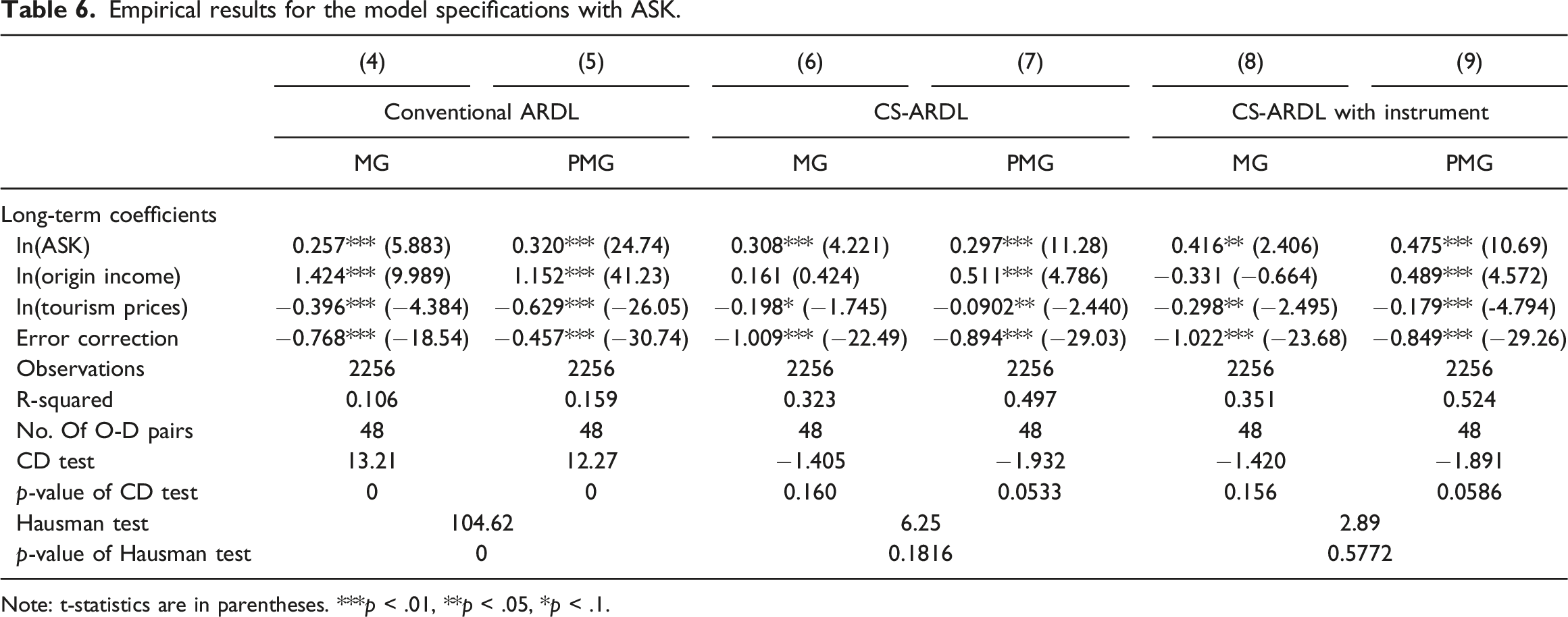
Empirical results for the model specifications with ASK.
Note: t-statistics are in parentheses. ***p < .01, **p < .05, *p < .1.
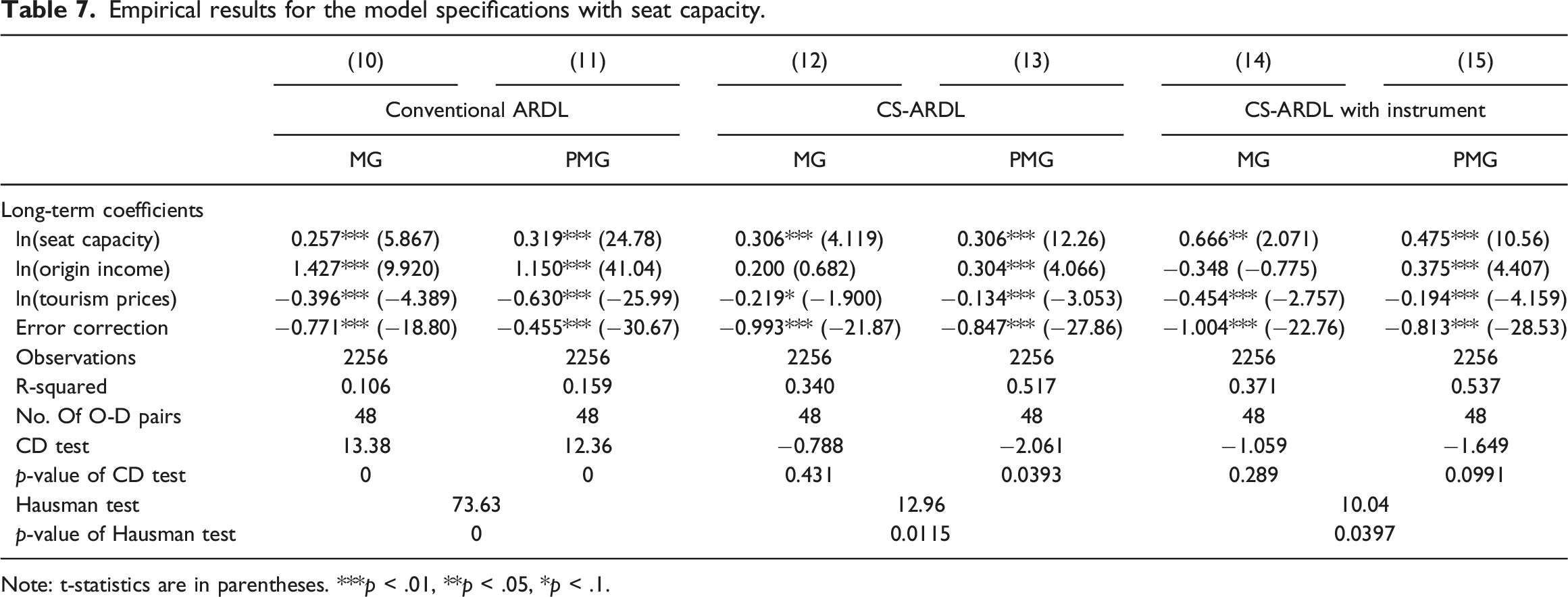
Empirical results for the model specifications with seat capacity.
Note: t-statistics are in parentheses. ***p < .01, **p < .05, *p < .1.
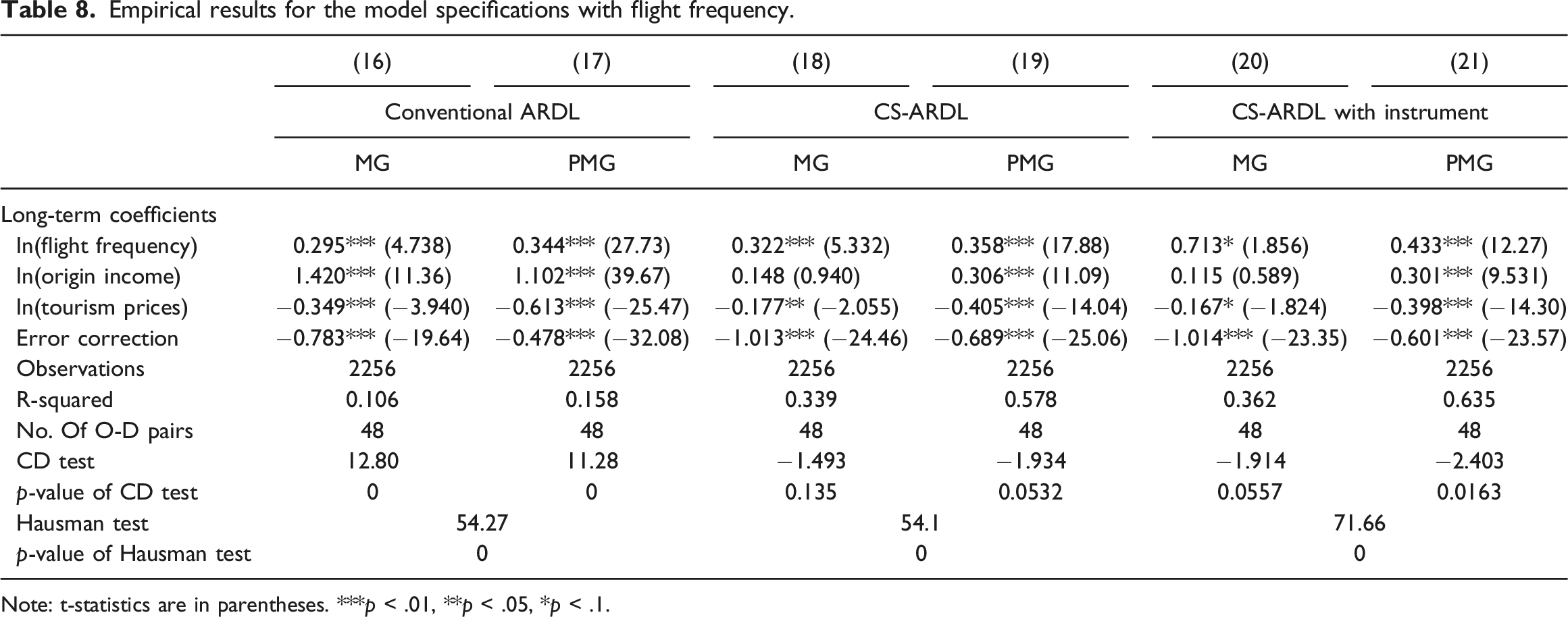
Empirical results for the model specifications with flight frequency.
Note: t-statistics are in parentheses. ***p < .01, **p < .05, *p < .1.
Table 6 demonstrates the long-term coefficient estimates of ASK on tourism demand. ASK is given by the number of available seats multiplied by the total travel distance in kilometer. Thus, a seat on a long-haul flight produces greater ASK than a seat on a short-haul flight. Across Columns (4)–(9), we observe that ASK has significant positive effect on tourism demand. Under the conventional ARDL model specifications, the long-term coefficient estimates of ASK are 0.257 and 0.320 using the MG and PMG estimators, respectively, whereas these two numbers are 0.308 and 0.297 under the CS-ARDL model specifications. However, the conventional ARDL model specifications suffer from cross-sectional dependence since the Pesaran (2021) CD test statistics show overwhelming evidence of rejecting the null hypothesis of no cross-sectional dependence in all cases. In contrast, under the CS-ARDL model specifications, cross-sectional dependence is effectively mitigated, as indicated by the corresponding CD test statistics. The F-statistics of the Hausman (1978) test suggest that, under the CS-ARDL model specifications, the MG and PMG estimators generate systematically similar estimates and there is long-term slope homogeneity across the O-D pairs. Thus, the PMG estimates are consistent and more efficient. Notably, after mitigating the endogeneity problem using the instrument, we obtain a slightly larger effect of ASK (0.416–0.475), as shown in Columns (8)–(9). This suggests that, without considering the endogeneity problem, a downward bias may exist on the coefficient estimate of air transport capacity. Biased estimations are also observed in some passenger demand studies focusing on the effect of airfare if the endogeneity problem is not considered (e.g., Lurkin et al., 2017; Morlotti et al., 2017; Mumbower et al., 2014; Perera and Tan, 2019).
Regarding the long-term effect of origin income, we observe that the corresponding long-term coefficient estimates are larger than 1 under the conventional ARDL model specifications. In other words, 1% increase in origin income leads to more than 1% increase in tourist arrivals to Australia, implying that traveling to Australia is income elastic. This contrasts sharply with the results generated under the CS-ARDL model specifications, which indicate that tourism demand is insensitive to changes in origin income in the long term (0.489–0.511, as indicated in Columns (7) and (9)). Additionally, the long-term coefficient estimates of tourism prices under the conventional ARDL model specifications (−0.692∼−0.396) are larger in size than under the CS-ARDL model specifications (−0.298∼−0.0902). We postulate that the conventional ARDL model overestimates the effect of income and tourism prices due to the cross-sectional dependence problem. Under the CS-ARDL model specifications, the estimated long-term income and tourism price elasticities concerning the international tourism demand of Australia are similar to the ones found by Seetaram (2010) and Ghosh (2022), who also adopt the dynamic panel cointegration approach to examine the inbound tourism demand of Australia during 1991–2007 and 2007–2020, respectively. In contrast, the papers published between 1961 and 2011 in the meta-analysis by Peng et al. (2015) show that international tourists to Oceania (where Australia is the dominant destination) exhibit income elasticity value of 2.067 and tourism price elasticity −0.844. As can be seen, the estimates of income and tourism price elasticities for inbound tourism demand of Australia tend to be smaller in size in more recent studies.
Furthermore, the estimated error correction coefficients are significant negative. This strongly suggests that tourist arrivals, air transport capacity, origin income, and tourism prices are cointegrated, which align with the results of the panel cointegration tests reported in Table 3. The error correction coefficient (aka the speed of adjustment) measures how fast the dependent variable returns from its short-term deviation to the long-term equilibrium with the other variables. The value of −1 indicates that tourist arrivals return to the long-term equilibrium by one period, equivalent to a quarter in our study. This is the situation when the empirical model is estimated by MG under the CS-ARDL model specifications (as shown in Columns (6) and (8)). In contrast, when the empirical model is estimated by PMG under the CS-ARDL model specifications, the estimated error correction coefficients range between −0.894 and −0.849, suggesting that it takes more than a quarter for tourist arrivals to return to the long-term equilibrium.
For comparative purposes and as a robustness check, we also utilize seat capacity and flight frequency as alternative measures of air transport capacity (as shown in Table 7 and Table 8).
Unlike ASK, seat capacity does not account for flight distance, whereas flight frequency does not account for aircraft size and flight distance. Generally speaking, the estimated long-term coefficients of air transport capacity, origin income, and tourism prices reported in Table 7 and Table 8 are similar to Table 6 in terms of the parameter estimates’ significance level, sign, and size. This provides further support that the ARDL model specifications used in our study can generate robust coefficient estimates depicting the cointegrating relationship between the variables of interest.
Subsample analyses (tourist arrivals by trip purpose)
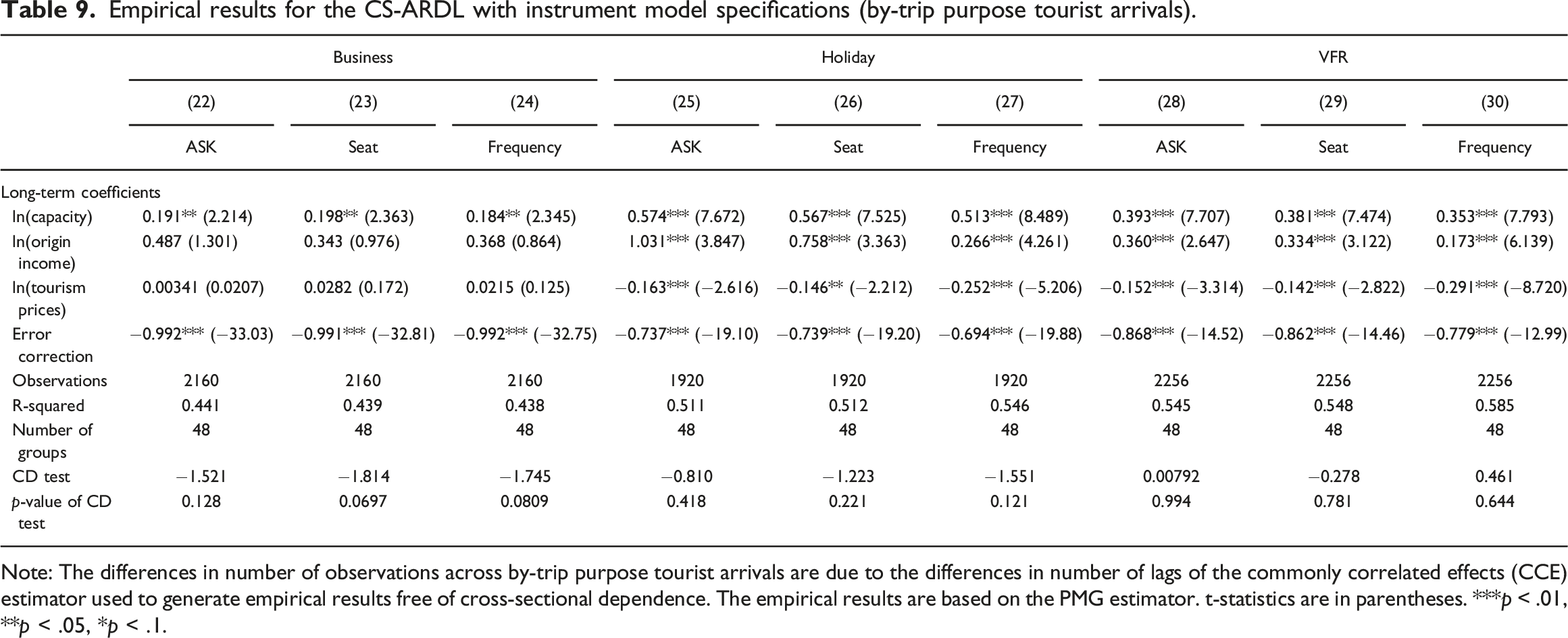
Empirical results for the CS-ARDL with instrument model specifications (by-trip purpose tourist arrivals).
Note: The differences in number of observations across by-trip purpose tourist arrivals are due to the differences in number of lags of the commonly correlated effects (CCE) estimator used to generate empirical results free of cross-sectional dependence. The empirical results are based on the PMG estimator. t-statistics are in parentheses. ***p < .01, **p < .05, *p < .1.
As shown in Table 9, three observations can be highlighted. First, the estimated long-term coefficients of air transport capacity are significant at least at the 5% significance level for all the three measures and for all trip purposes. Specifically, the corresponding coefficient estimates for holiday tourists range between 0.513 and 0.574, the largest amongst all the trip purposes. While VFR tourists are also significantly influenced by air transport capacity to the destination, the size of the effect is smaller than that of holiday tourists, ranging between 0.353 and 0.393. This might be attributed to the fact that destination choices for VFR tourism are influenced by where their friends/relatives reside overseas; thus, increase in air transport capacity to Australia may have small influence on some VFR tourists if their friends/relatives do not live at that destination. Concerning business tourists, the long-term coefficient estimates of air transport capacity are the smallest among the three trip purposes. This makes sense if one accepts that business tourists will not necessarily travel to a destination because it is easy to get to, or simply because air transport is cheaper or available. And they are usually determined by the firm or the need to attend business activities. Unlike holiday or VFR travels which are usually planned several months in advance, business travel decisions may be made within a short time period before the departure date. As a result, the long-term effect of air transport on business tourism demand is also smaller than leisure tourism demand.
Second, as shown in Column (25), the significant long-term coefficient estimates of origin income for holiday tourists is 1.031, implying that holiday travel to Australia is income elastic. In contrast, we do not find a significant positive long-term effect of origin income on business tourists. This observation is consistent with the meta-analysis by Peng et al. (2015), which finds that holiday tourists are usually more influenced by origin income than business tourists. Third, we do not observe any significant effect of tourism prices on business tourists. The unresponsiveness to tourism prices by business tourists might be attributed to the possible situation that the employers fully or partially cover tourism expenditure for business travel. As such, demand for business travel might not be deterred by high tourism prices in the destination.
Discussion and implications
For a geographically remote destination such as Australia, the air transport and tourism industries are usually interdependent and require commonly coordinated and planned integration in the long term (Ivanova, 2017); thus, the long-term cointegrating relationship between them is of interest for facilitating aviation policymaking and understanding whether economic agents of travel sectors optimize behaviors with one another. The finding that there is a non-negligible generative effect of air capacity on demand has implications for competition policy and international air services agreements.
First, policymakers and regulators (e.g., Dept. Transport, the Australian Competition and Consumer Commission or ACCC) should aim to maintain competition in the Australian airline industry through a highly liberalized market, which can ensure a high level of international air transport capacity. It is important to note that there exists an innate misalignment in interest between the tourism destination and airlines. While the former focuses on economic benefits brought by tourist arrivals, the latter pays particular attention to revenue generated from passengers (not necessarily tourist arrivals) and operating costs. Therefore, airlines may restrict capacity and adopt price discrimination (aka yield management) to create as much revenue as possible with maximized load factor (Bergantino and Capozza, 2015; Hsu and Wen, 2003). However, destination policymakers can indirectly influence air transport capacity via the implementation of a relatively open international aviation policy through liberal bilateral air services agreements (Duval, 2008).
Second, air route development activities may involve direct or indirect subsidies to further boost direct air transport capacity for the purpose of developing longer-term tourism. According to Morrison and de Wit (2019), government subsidies have the same effect of lower operating costs, which, in game theoretic terms assuming a Cournot model, lead to a Nash equilibrium with a higher capacity level. However, it is important to note the empirical results of this study are for long-term cointegrating relationship; therefore, air route development activities must ensure consistent service levels for at least several years to observe the effect found in this analysis.
Conclusion
This study is the first attempt to conduct a panel cointegration analysis on the air transport capacity – tourism demand nexus. Cointegration analysis avoids the problem of spurious regression and multicollinearity, which can impact the accuracy and reliability of the empirical results. A panel time series dataset based on large cross-sections and long time horizon enables us to adopt a parsimonious model specification to generate robust coefficient estimates of air transport capacity. We employ the CS-ARDL model, developed by Chudik and Pesaran (2015), to examine the cointegrating relationship between tourist arrivals, air transport capacity, origin income, and tourism prices. We utilize the HHI as an instrument to mitigate the endogeneity problem arising from the commonly recognized bidirectional causality between air transport capacity and tourism demand.
Compared with other commonly used panel econometric techniques, the CS-ARDL model has a number of advantages in examining large-scale panel time series data. First, utilizing the MG/PMG estimator allows for slope heterogeneity across the O-D pairs. Second, by incorporating cross-sectional averages of the studied variables in the regression, the CS-ARDL model can effectively mitigate cross-sectional dependence in residuals. This is particularly important when examining data for tourist flows from a sample of origins to a common destination/country (Dogru et al., 2021). The results highlight that accounting for cross-sectional dependence changes income elasticity from elastic to inelastic. Thus, accounting for cross-sectional dependence when examining panel time series is necessary; otherwise, the practical implications generated from the empirical results might be misleading. Third, utilizing HHI as an instrument under the CS-ARDL model enables us to mitigate the endogeneity problem arising from the bidirectional causality between air transport capacity and tourism demand. As discussed earlier, coefficients of air transport capacity tend to be underestimated when the endogeneity problem is not adequately corrected for.
In general, the empirical results from the auxiliary regressions show that 10% increase in airline market competition measured by HHI leads to around 7% increase in air transport capacity. Then, using the predicted values of the air transport capacity obtained from the auxiliary regressions, we estimate the cointegrating relationship between tourism demand, air transport capacity, origin income, and tourism prices. Our study empirically demonstrates that 1% increase in ASK, seat capacity, or flight frequency results in 0.416%–0.713% increase in tourist arrivals to Australia in the long term. This estimate is more robust to potential biases that may be present in earlier studies. Furthermore, through analyses of tourist arrivals by trip purpose, we find that air transport capacity has greater influences on holiday and VFR tourists than business tourists.
This study can be extended in several ways in the future. First, restricted by the data for tourist arrivals, the cross-sections in our panel time series data refer to the pairs of origin country/market-Australian state, rather than the individual routes serviced by nonstop flights. The aggregation of individual routes assumes the utility functions of tourists are identical across all the routes for a specific O-D pair. Based on Morley et al. (2014), in examining data for tourism demand, high level of segmentation is preferred because it allows for heterogeneity of utility functions across a sample of routes investigated. Second, only pre-COVID observations are included in our panel time series data. Our cointegration analysis of air transport capacity and tourism demand is based on a long period of historical data. The econometric techniques may not capture the large structural change due to the recent unanticipated COVID shocks (Zhang et al., 2021). Future research may reexamine the air transport capacity–tourism demand relations for a sample of routes and integrate the Delphi adjustment method in conjunction with the CS-ARDL model to account for the COVID factor. The current study results, however, are still useful in highlighting the likely relations in the international travel sector under reasonably well-performing market conditions, which is often the type of environment promoted by many governments and destination marketing organizations (certainly in Australia) in regard to international aviation.
Footnotes
Acknowledgements
The authors are grateful to the editor and two anonymous reviewers for helpful comments and suggestions. The authors would like to acknowledge the aviation data provided by Cirium - RELX group. The 1st and 3rd authors wish to acknowledge the funding support of the University of Macau Research Grants (File no. SP2022-00005-DRTM and MYRG2020-00235-FBA).
Declaration of conflicting interests
The author(s) declared no potential conflicts of interest with respect to the research, authorship, and/or publication of this article.
Funding
The author(s) disclosed receipt of the following financial support for the research, authorship, and/or publication of this article: This work was supported by the University of Macau (MYRG2020-00235-FBA and SP2022-00005-DRTM).
