



Abstract
The nexus between tourism and income inequality has received much attention but no consensus emerged. It is of interest to explore how this nexus is affected by the important external condition of the Internet. This study examines the spatial threshold effect of the Internet on the nexus between tourism and urban-rural income inequality by developing a spatial threshold model. Using panel data for 280 Chinese cities from 2003 to 2019, the results show that the impact of the Internet is characterised by clear spatial thresholds, and the local and spatial spillover effects of tourism on urban-rural income inequality vary under different regimes of Internet development. Further, by differentiating the Internet’s functions, the inequality-reducing effect of tourism in local and surrounding cities has strengthened significantly as cities’ Internet penetration improves; meanwhile, this effect has increased first and then decreased as cities’ online market penetration deepens, with a relative optimal interval.
Introduction
Income inequality has always been a major concern worldwide, and studies have identified excessive urban-rural income inequality as a critical driver of overall income inequality, especially in developing countries (Bauer, 2018; Kim and Kang, 2020; Zhang, 2021). The widening of urban-rural income inequality not only hinders economic growth and challenges economic equity, but may also lead to a series of serious consequences, such as sharpening social conflicts and threatening political stability, which should be given high priority (Lv, 2019; Shi et al., 2020; Zhang et al., 2021). In response to this concern, the development of tourism offers a possible solution to reducing urban-rural income inequality, based on its remarkable contribution to creating rural employment, alleviating the urban-rural dichotomy and stimulating rural economic growth (Kim and Kang, 2020; Li et al., 2016; Zhang, 2023a).
Nevertheless, existing studies provide mixed evidence on whether tourism reduces urban-rural income inequality and no consensus has emerged. Some scholars find that tourism generates more income for rural residents and thus can significantly reduce urban-rural income inequality (Kim and Kang, 2020; Zeng and Wang, 2021a). Conversely, some scholars claim that the main beneficiaries of tourism are urban residents rather than rural residents, which leads to a widening of urban-rural income inequality (Croes and Rivera, 2017; Klytchnikova and Dorosh, 2013). Others even hold that the effect of tourism on urban-rural income inequality is not always positive or negative, revealing an ‘N-shaped’ or ‘U-shaped’ curve characteristic of the relationship (Zhang, 2023b; Zhang et al., 2021). One possible reason for these inconsistent findings is that the spatial and temporal heterogeneity of the economic effects of tourism is not fully considered. Regarding the spatial dimension, after controlling the spatial spillover effect of tourism, the findings of existing studies begin to converge and are more likely to support the inequality-reducing effect of tourism (Li, 2016; Liu et al., 2017; Shi et al., 2020; Zeng and Wang, 2021b). Regarding the temporal dimension, researchers find the effect of tourism on urban-rural income inequality varies according to changes in external conditions (e.g. FDI, economic development, and openness; Kim and Kang, 2020; Zhang et al., 2021; Zhang, 2023b). Thus, it is necessary to consider both spatial factors and important external conditions in understanding the relationship between tourism and urban-rural income inequality.
Notably, many scholars have observed that the development of information and communication technologies (ICTs), represented by the Internet, has been closely related to the changes in income inequality in recent decades (Bauer, 2018; Shaw, 2002); meanwhile the widespread use of the Internet also inevitably has a profound impact on the tourism industry (Kumar and Kumar, 2020; Law et al., 2020). As studies have pointed out, the impact of the Internet on income inequality is complex and works not alone but in conjunction with other factors (Bauer, 2018; Gao et al., 2018; Yan et al., 2022). These make Internet development an important external condition affecting the relationship between tourism and urban-rural income inequality, which has been overlooked in the literature. In this vein, to explain how the Internet works, two important characteristics of the Internet deserve further consideration. As a general purpose technology, the adoption and benefits of the Internet vary by industry and area, making the effect of the Internet on tourism economic activities potentially nonlinear and exhibiting threshold characteristics (Ivus and Boland, 2015; Wang et al., 2023). And, the ‘spatial-temporal compression’ effect of the Internet strengthens the spatial linkages between areas, making it possible for the Internet to amplify the spatial spillover effect of tourism economic activities (Fang et al., 2022; Wang et al., 2022). Consequently, the key to proper recognition of the Internet’s role lies in the simultaneous consideration of its possible threshold and spatial spillover effects, which are rarely addressed by existing research.
To this end, this study aims to examine the spatial threshold effect of the Internet on the nexus between tourism and urban-rural income inequality, based on panel data of 280 cities in China from 2003 to 2019. The main contribution of this study is twofold. Theoretically, this study analyses the spatial threshold effect of the Internet using a spatial-temporal consistency framework that can portray spatial nonlinear characteristics. This contributes to clarifying how tourism nonlinearly affects urban-rural income inequality in local and surrounding areas under the Internet’s influence. In addition, this study opens the ‘black box’ of the Internet’s role. According to two core functions of the Internet (i.e. information exchange and commodity trading), different outcomes of roles performed by the Internet are identified and distinguished from Internet penetration and online market penetration dimensions. Methodologically, by combining a panel threshold model with a spatial econometric model, a spatial threshold model proposed in this study allows for a precise estimation of the spatial threshold effect of the Internet. This method effectively overcomes the problem of biased estimation caused by using conventional methods when both spatial spillover and threshold effects are present.
Literature review and hypothesis development
Literature review
The effect of tourism on urban-rural income inequality is complex and depends on how the economic benefits created by tourism are distributed between urban and rural residents. If the relative income gains from tourism are greater for rural residents, then urban-rural income inequality decreases, and vice versa. Existing studies on this provide mixed evidence. Some scholars find that tourism can significantly reduce urban-rural income inequality. The results of Blake (2008) using the Social Accounting Matrix (SAM) suggest that tourism in Tanzania generates more income for rural residents, thus reducing urban-rural income inequality. This finding is supported by the results of Kim and Kang (2020), and Zeng and Wang (2021a) using panel fixed effect models and province-level data in China. Nevertheless, other scholars are doubtful of such views, stating that the effect of tourism on urban-rural income inequality is not always negative. The results of Klytchnikova and Dorosh (2013) and Croes and Rivera (2017) using the SAM with the cases of Panama and Ecuador, respectively, reveal that rural residents are not the main beneficiaries of tourism, but rather urban residents share more benefits from it, thus widening urban-rural income inequality. Based on province-level data in China, Zhang (2023b) adopts a dynamic panel model and finds that tourism increases urban-rural income inequality, and such the effect is overall characterised by an ‘N-shaped’ curve. Instead, using city-level data, the results of Zhang et al. (2021) indicate that tourism reduces urban-rural income inequality in China with the effect exhibiting a ‘U-shaped’ curve by applying a panel fixed effect model.
However, it is noteworthy that the findings have broadly converged when spatial spillover effects are further considered. Li (2016), Liu et al. (2017), and Zeng and Wang (2021b) confirm that tourism can reduce urban-rural income inequality in both local and surrounding areas through spatial econometric models. These studies reveal that different analytical frameworks (i.e. whether spatial factors are included) can significantly affect the results, and emphasise the importance of considering spatial factors in understanding the relationship between them.
Furthermore, researchers reveal that the effect of tourism on urban-rural income inequality can be affected by economic-related factors such as FDI, economic development, and openness (Kim and Kang, 2020; Zhang, 2023b; Zhang et al., 2021). Nonetheless, they have largely ignored the impacts caused by non-economic factors, especially revolutions in ICT represented by the Internet. Obviously, the Internet’s impact on economic and social development is profound and widespread. Studies demonstrate that the Internet, on the one hand, changes the behavioural patterns of tourists and enhances the real-time interaction between tourists and destinations; on the other hand, it alters the production and operation modes of the industry (Law et al., 2020). The Internet is recognised as playing an important role in stimulating tourism demand, optimising the tourism supply structure, and facilitating the high-quality development of tourism (Kumar and Kumar, 2020; Standing et al., 2014; Yang, 2020). In addition, some studies argue that Internet development has a significant impact on the urban-rural income distribution through channels such as reducing urban-rural information asymmetry and promoting equal opportunities for development between areas (e.g. employment opportunities; Bauer, 2018; Gao et al., 2018). Therefore, it is apparent that Internet development can shape both tourism and urban-rural income distribution patterns, and thus Internet-induced changes cannot be ignored in understanding the relationship between tourism and urban-rural income inequality. However, scarce research has reported on the Internet’s impact on this relationship, and the mechanisms by which they interact remain unclear. To this end, this study draws on the useful insights of existing research that the Internet has spatial externalities and its impact on economic activities can be nonlinear (Ivus and Boland, 2015; Wang et al., 2023), and attempts to explore how it affects the nexus between tourism and urban-rural income inequality by examining the spatial threshold effect of the Internet.
Hypothesis development
Researchers have identified the outstanding contribution of tourism to job creation and stimulating economic growth in rural areas in the process of rural tourism development (Li et al., 2016; Zhang et al., 2021). Thus, tourism can reduce urban-rural income inequality through the following two channels. First, rural tourism development can help solve the employment problems of surplus rural labour through the employment effect, thus enabling rural residents to improve their relative incomes from tourism employment (Croes and Rivera, 2017; Uzar and Eyuboglu, 2019). Second, rural tourism development also allows production factors to move back from urban to rural areas along with tourist flows (Marrocu and Paci, 2011). This indicates that tourism can address the problem of insufficient impetus to rural development through the resource allocation effect, thereby enabling rural residents to improve their relative incomes from rural economic growth and the accompanying ‘trickle-down’ effect (Kim and Kang, 2020; Mahadevan and Suardi, 2019). Moreover, studies find that there are general spatial correlations regarding tourism production and consumption activities due to the apparent cross-regional mobility of tourism flows (including tourists and tourism production factors; Yang and Wong, 2012). This reveals that tourism can contribute to the reduction of urban-rural income inequality in surrounding areas through the spatial spillover effect (Li, 2016; Liu et al., 2017; Zeng and Wang, 2021b). Specifically, through the spatial diffusion of tourism flows and knowledge spillovers from cross-regional tourism cooperation, competition and demonstration (Yang and Wong, 2012), it promotes tourism development in surrounding areas and expands the scope of the employment and resource allocation effects mentioned above.
Then, we focus on two core functions of the Internet (i.e. information exchange and commodity trading) to explain how it works in the proposed relationship (see Figure 1 for a brief demonstration of the mechanism). The mechanism of how the Internet affects the relationship between tourism and urban-rural income inequality.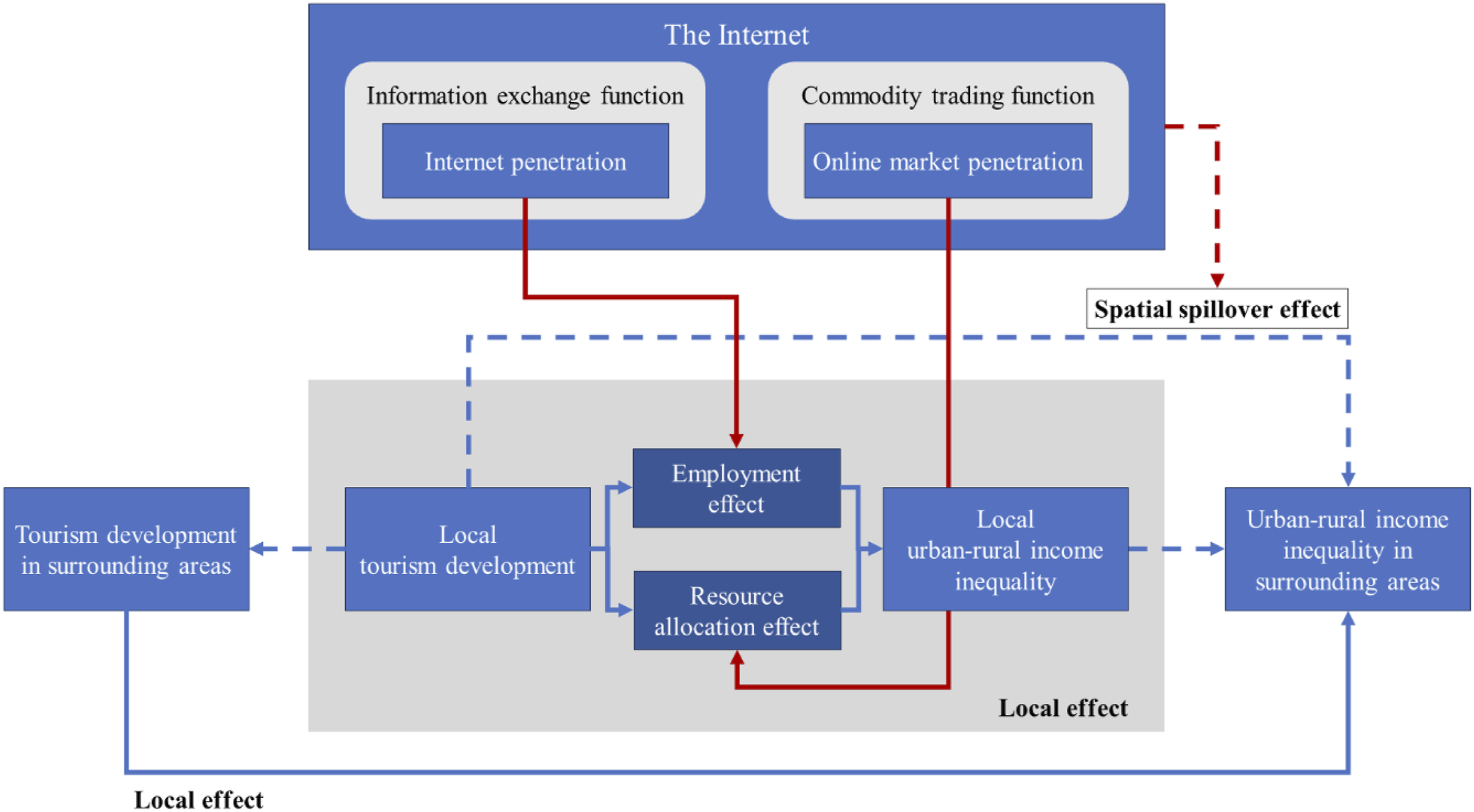
Based on its function of information exchange, the Internet has greatly facilitated users’ access to information and enhanced interactions among users, helping to bridge the information gap among individuals (Brousseau and Curien, 2007). With the application of Internet technology, increased Internet penetration can strengthen the reducing effect of tourism on urban-rural income inequality by enhancing the employment effect of tourism. On the demand side, Internet development has effectively reduced information asymmetry in the tourism market, enabling tourists to access a wider range of information on tourism products and destinations through the Internet, which is conducive to attracting tourists to rural areas for better tourism development and increasing tourism employment opportunities (Kumar and Kumar, 2020; Xiang et al., 2015). On the supply side, the Internet facilitates cross-regional interaction among tourism suppliers and promotes cross-regional tourism knowledge spillovers (Law et al., 2020). This strengthens the demonstration effect of urban areas that are advanced in tourism development on lagging rural areas, driving the specialisation of tourism as well as the innovation of products and operation patterns in rural areas (Karanasios and Burgess, 2008; Xue et al., 2023), thus enriching tourism employment options.
It is worth noting that since the Internet is a general purpose technology, all areas can benefit from using it; nevertheless, in the process of Internet penetration, urban and rural areas are unable to enjoy the dividends of the Internet simultaneously due to differences in Internet access and use by area (Ivus and Boland, 2015; Prieger, 2013; Wang et al., 2023). Only when the Internet penetration in rural areas reaches a certain level, it is possible for them to obtain relatively higher marginal gains from Internet use (including employment opportunities and income; Gao et al., 2018; Braesemann et al., 2022; Qiu et al., 2021). As existing studies have documented the nonlinear effect of Internet penetration (Wang et al., 2022, 2023), we also argue that when Internet penetration reaches a certain level, rural residents can derive greater benefits from tourism employment to further reduce the urban-rural income inequality. That is, Internet penetration has a significant threshold effect on the relationship between tourism and urban-rural income inequality.
Then, based on its commodity trading function, the Internet has outstanding advantages in reducing transaction costs, broadening distribution channels and facilitating the integration of resources (Brynjolfsson and Hitt, 2000). With the development of Internet commerce, the online market is gradually penetrating the traditional market (later called online market penetration), which will inevitably trigger market revolutions and of course involve the tourism market (Cardona et al., 2013; Standing et al., 2014). Accordingly, such increased online market penetration may strengthen the reducing effect of tourism on urban-rural income inequality by enhancing the resource allocation effect of tourism. Online market development can effectively improve the matching efficiency of tourism supply and demand, enabling rural areas to attract more tourists at lower costs and rural tourism suppliers to obtain more development opportunities, which is beneficial for rural areas to increase tourism income (Karanasios and Burgess, 2008; Peña et al., 2013). Additionally, the Internet allows rural tourism suppliers to achieve more efficient and economical cross-regional and cross-industrial collaboration, contributing to facilitating the inflow and optimal allocation of production factors to rural areas, thereby stimulating rural economic growth (Peña and Jamilena, 2010).
As mentioned earlier, Internet availability and adoption are not diffusing in rural and urban areas at the same rates, and likewise, the development of Internet commerce in rural areas is also lagging behind urban areas (Yin et al., 2022). According to the global village theory, the reduction in transaction costs brought about by the development of Internet commerce is particularly important for rural areas, as it helps to overcome the barriers to doing business associated with remote geographic distance and small economic scale (Forman et al., 2005). Similarly, some studies have found that bringing e-commerce to rural areas makes greater sense because it contributes to stimulating rural economic growth and mitigating the outflow of production factors, which significantly increases the area’s marginal returns from Internet use (Fan et al., 2018; Li et al., 2021). Certainly, the development of Internet commerce does not happen overnight, and its impact on economic activities still exhibits nonlinear characteristics (Li et al., 2021; Yin et al., 2022). Therefore, we argue that when online market penetration reaches a certain level, rural residents can obtain greater benefits from the significantly enhanced tourism’s resource allocation effect to further reduce urban-rural income inequality. That is, online market penetration has a significant threshold effect on the relationship between tourism and urban-rural income inequality.
Furthermore, the Internet’s ‘spatial-temporal compression’ effect also determines that it can also strengthen the inequality-reducing effect of tourism in surrounding areas by enhancing the spatial spillover effect of tourism. This is mainly because the virtual space created by the Internet breaks through the limitations of traditional geographic space which intensifies economic linkages between regions (Wu et al., 2021a). Specifically, the Internet helps tourism supply and demand to be better matched on a larger spatial scope to further facilitate the spatial diffusion of tourist flows, which makes a better development of local tourism not only attract more tourist inflows, but also draw tourist flows to its surrounding areas (Xiang et al., 2015). The Internet also enables inter-regional tourism economic linkages to be strengthened and further promotes cross-regional mobility and optimal allocation of tourism-related production factors, as well as the diffusion of tourism knowledge, which is beneficial to driving tourism development in backward surrounding areas through cross-regional tourism cooperation and demonstration (Ruan and Zhang, 2021).
In summary, we hold that the impact of the Internet on the relationship between tourism and urban-rural income inequality is characterised by spatial thresholds. Accordingly, hypotheses one and two are proposed.
Internet penetration has a spatial threshold effect on the nexus between tourism and urban-rural income inequality.
Online market penetration has a spatial threshold effect on the nexus between tourism and urban-rural income inequality.
Methodology and data
Research area
According to the latest pre-epidemic data provided by the National Bureau of Statistics, China’s total tourism revenue in 2019 was 6.63 trillion yuan, accounting for about 6.72% of GDP; meanwhile, the disposable income per capita of urban and rural residents was 42,359 yuan and 16,021 yuan, respectively, with a difference of up to 2.64 times. From an efficiency perspective, the contribution of tourism to China’s economic growth is undoubted, however, from an equity perspective, whether tourism development can help to alleviate China’s current prominent urban-rural income disparity problem deserves further exploration. These make China a valuable case for investigating the relationship between tourism and urban-rural income inequality. Besides, the 47th Statistical Report on China’s Internet Development released officially shows that China’s Internet users reached 989 million in 2020, and online retail sales reached 11.76 trillion yuan, both of which ranked first in the world. It can be seen that China also provides an excellent scenario to identify possible changes in the relationship between tourism and urban-rural income inequality in the context of rapid Internet development.
Moreover, based on the sample of this study, we also provide some stylised facts on China and its regional differences from 2003 to 2019, as shown in Figure 2. The overall trend in all sample cities is generally consistent with the above descriptions, that is, at the city level, urban-rural income inequality has not been effectively mitigated, while both tourism and the Internet have undergone rapid growth. Further, particularly noteworthy are the marked regional differences among sample cities. For example, urban-rural income inequality is especially acute in the western cities, but tourism and the Internet are much better developed in the eastern cities. And, the established literature supports the fact that there are significant differences among Chinese cities in terms of both tourism development and Internet development (Wang et al., 2022; Zhang et al., 2021). In this vein, it makes sense to accurately assess the threshold effect of the Internet to identify the external conditions that cause tourism to have different impacts on urban-rural income inequality. Some stylised facts on China and its regional differences (2003-2019).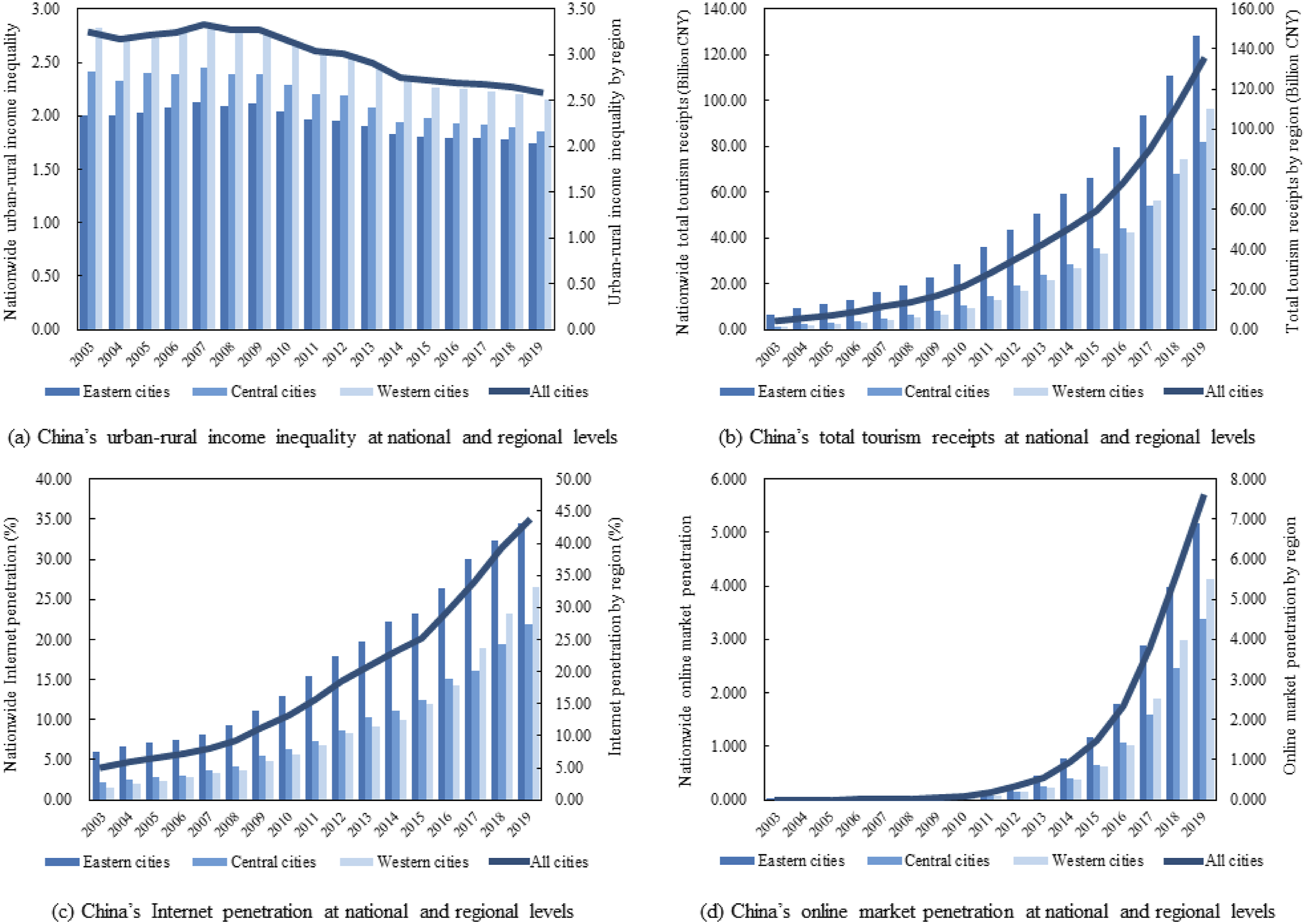
Model specification
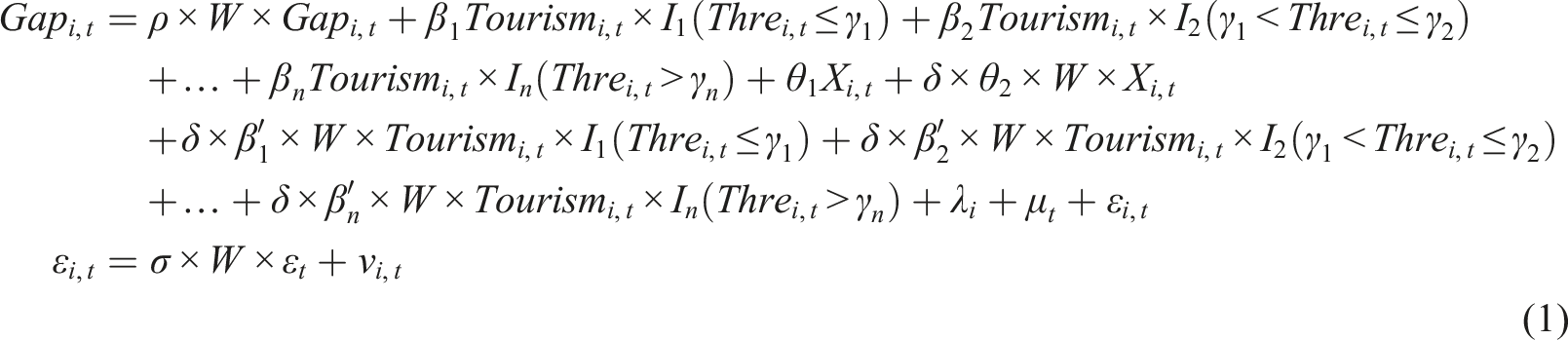
Based on the aforementioned theoretical analyses, it is known that the Internet may strengthen the spatial spillover effect of tourism development and make tourism present a threshold effect on urban-rural income inequality. Although spatial econometric models and threshold regression models have been widely used to evaluate spatial spillover effects and threshold effects separately, when both spatial spillover and threshold effects are present, ignoring either of them can lead to lower estimation accuracy, biased parameter estimates, or even misleading results, as they are interdependent in time and space (Li et al., 2022; Pang et al., 2024). Therefore, this study follows Yuan et al. (2020) and Feng et al. (2022) to develop a spatial threshold model by combining a panel threshold model with a spatial econometric model, which considers both threshold and spatial spillover effects. This spatial threshold model can not only correct the biased estimation caused by the use of a single model (spatial econometric or conventional threshold models), but also better explain the spatial nonlinear impact of tourism on urban-rural income inequality under the influence of the Internet.
The spatial threshold model in its generalised form is constructed as follows:
Variable selection
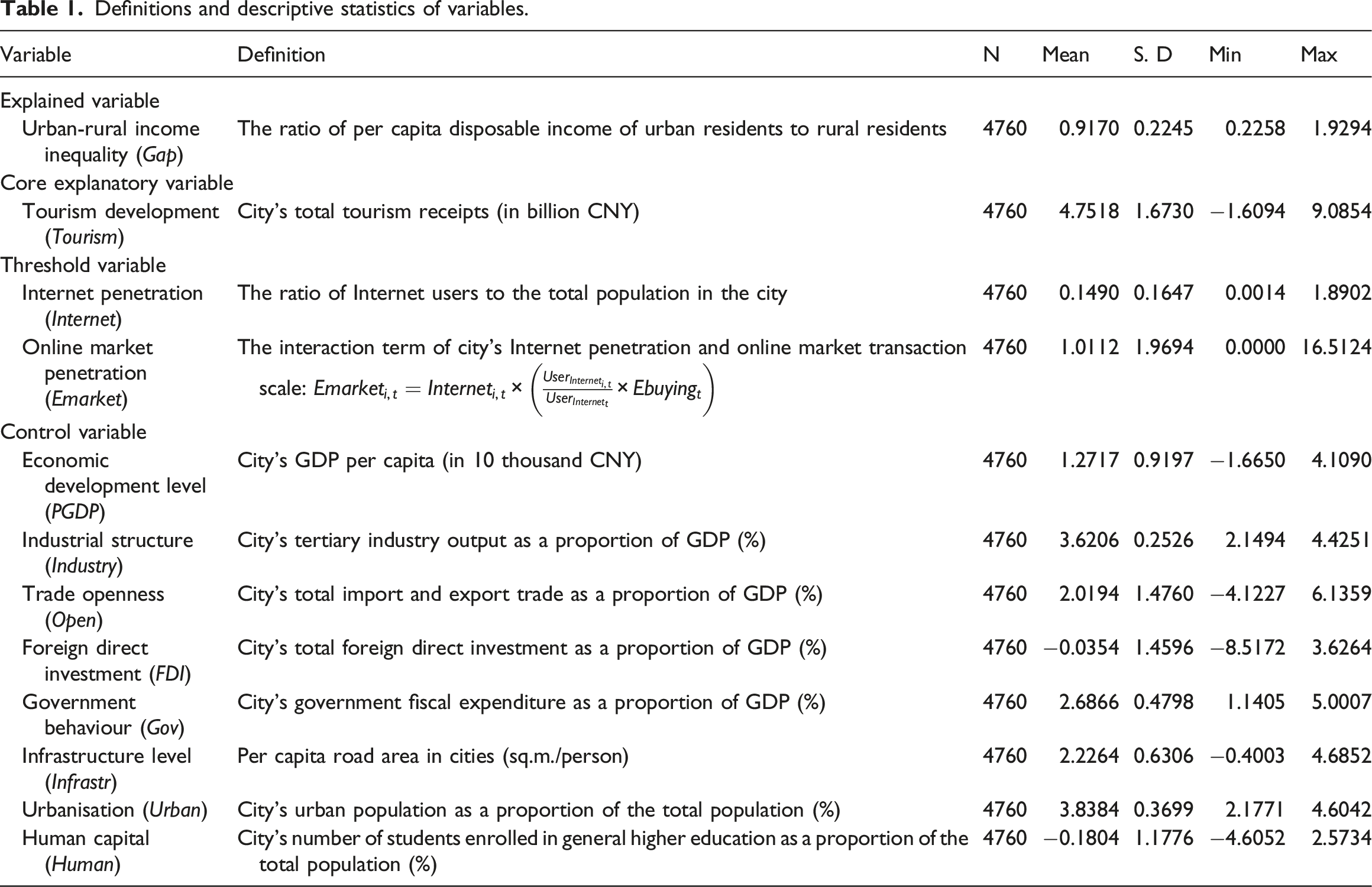
(1) Explained variable. Following the mainstream literature (Kim and Kang, 2020; Shi et al., 2020), the ratio of per capita disposable income of urban residents to rural residents is used to measure the urban-rural income inequality (denoted as Gap), with a larger ratio indicating greater urban-rural income inequality. Additionally, given that the Gini coefficient and the Theil index are also one of the most commonly used indicators for measuring income inequality, this study uses these two indices to calculate urban-rural income inequality for robustness testing with reference to Chen et al. (2019) and Tang et al. (2022). Likewise, the larger these two indices, the more severe the urban-rural income inequality. (2) Core explanatory variable. In previous tourism research, scholars have often used tourism receipts or tourist arrivals as the proxy variable for tourism development, of which the tourism receipts indicator is more reflective of the level of urban tourism development from an economic perspective (Zhang, 2023b). Thus, this study uses total tourism receipts as a measure of a city’s tourism development level (denoted as Tourism). Furthermore, given that the existing literature has also used tourism receipts as a share of GDP to measure tourism development to better capture the importance of tourism in the national economy relative to other industries (Alam and Paramati, 2016), this study utilises total tourism receipts as a share of GDP (denoted as Tourism2) for robustness testing. (3) Threshold variable. This study examines how the Internet exerts threshold effects from Internet penetration and online market penetration dimensions. Specifically, referring to Wu et al. (2021a) and Wang et al. (2022), we use measures the ratio of Internet users to the total population of a city to measure Internet penetration (denoted as Internet). This indicator reflects the impact of Internet technological development on the daily life of the residents. Additionally, following Wu et al. (2021b), we introduce online market transaction scales to measure the development of Internet commerce. Indeed, considering the differences in the Internet user base among cities, the interaction term of cities’ online market transaction scales and Internet penetration is constructed to accurately measure the degree of online market penetration (denoted as Emarket) by reference to Li and Huang (2021). This indicator reflects the impact of Internet commerce development on the consumer market. (4) Control variables. To avoid biased estimates due to omitted variables, this study draws on the established literature (Kim and Kang, 2020; Liu et al., 2017; Zhang, 2023b; Zhang et al., 2021) to incorporate following control variables in the model: the level of economic development (PGDP), measured by GDP per capita; the industrial structure (Industry), measured by the share of tertiary industry output in GDP; the degree of trade openness (Open), measured by the proportion of the total amount of import and export trade in GDP; foreign direct investment (FDI), measured by the proportion of the total amount of FDI in GDP; government behaviour (Gov), measured by local government fiscal expenditure as a proportion of GDP; infrastructure level (Infrastr), measured by city’s per capita road area; urbanisation (Urban), measured by the share of urban population in the total population; human capital (Human), measured by the proportion of the number of students enrolled in general higher education to the total population.

Data sources
Definitions and descriptive statistics of variables.
Results and discussion
Baseline results
The spatial spillover effect of tourism on urban-rural income inequality
Results of the conventional spatial econometric model.
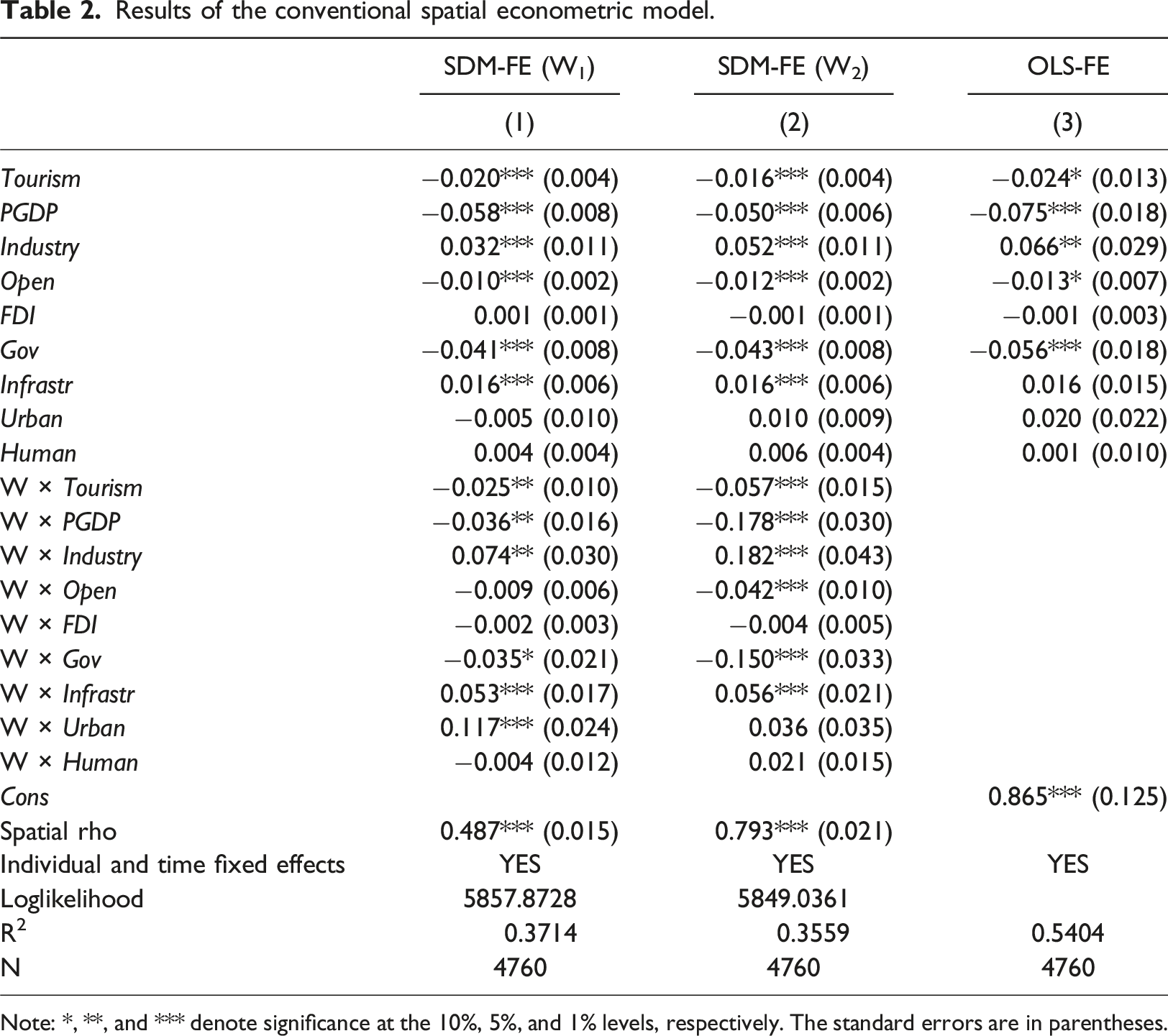
Note: *, **, and *** denote significance at the 10%, 5%, and 1% levels, respectively. The standard errors are in parentheses.
The threshold effect of the Internet on the relationship between tourism and urban-rural income inequality
Results of the conventional panel threshold model.

Note: *, **, and *** denote significance at the 10%, 5%, and 1% levels, respectively. The standard errors are in parentheses.
The spatial threshold effect of the Internet on the relationship between tourism and urban-rural income inequality
Through the preceding analyses, we have confirmed that tourism has a significant spatial spillover effect on urban-rural income inequality, and the Internet can generate a threshold effect in the relationship between these two. To avoid the biased estimation caused by using conventional methods when both threshold and spatial spillover effects are present, we will use the spatial threshold model proposed in the Methodology and Data section to accurately evaluate the spatial nonlinear impact of tourism on urban-rural income inequality under the influence of the Internet.
Results of spatial threshold models (Threshold variable: Internet).
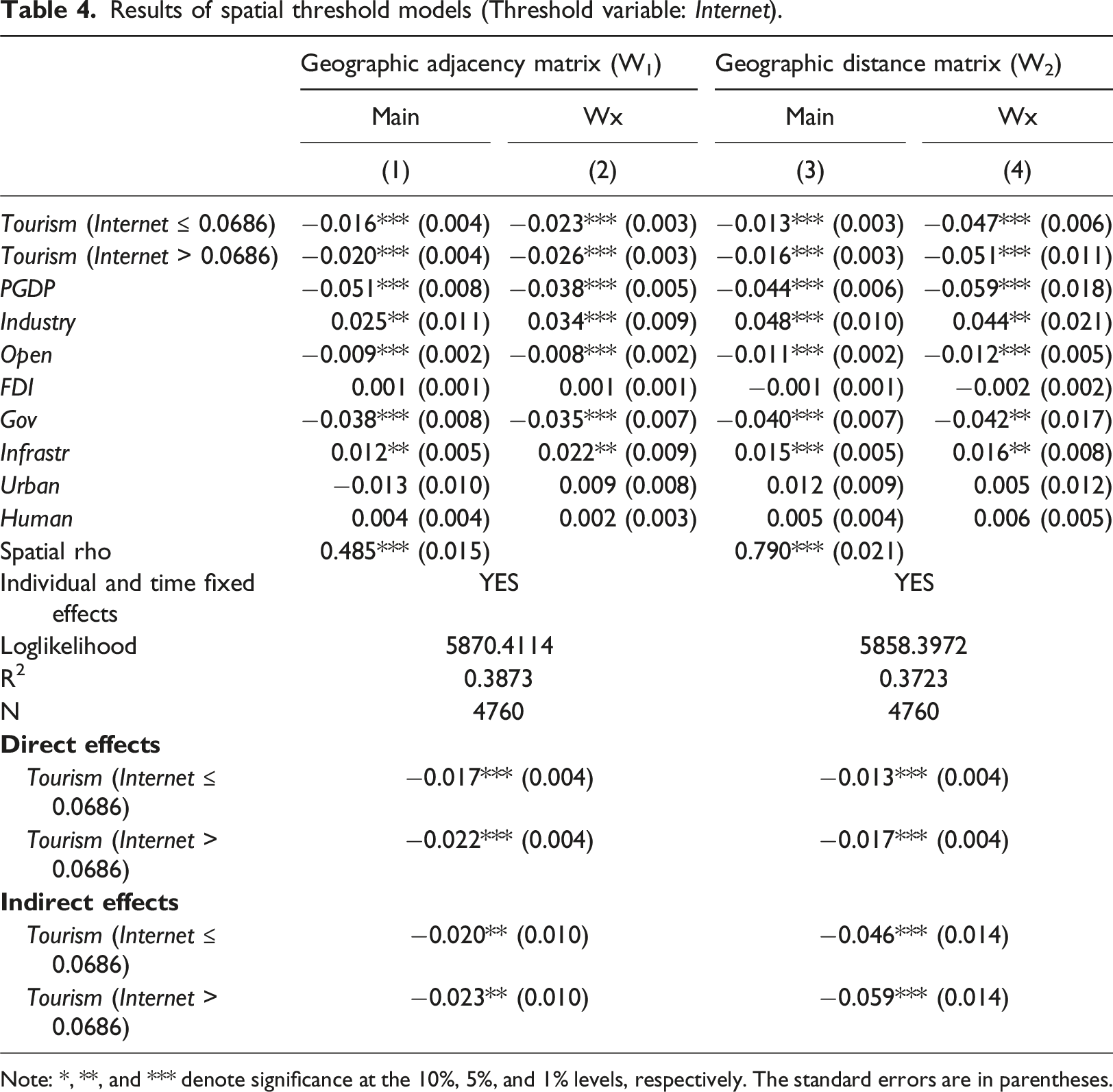
Note: *, **, and *** denote significance at the 10%, 5%, and 1% levels, respectively. The standard errors are in parentheses.
Results of spatial threshold models (Threshold variable: Emarket).

Note: *, **, and *** denote significance at the 10%, 5%, and 1% levels, respectively. The standard errors are in parentheses.
Specifically, regarding the direct effect, the results of the model with the Internet as the threshold variable show that (see Table 4), in the case of using the geographic adjacency matrix (W1), as Internet penetration crosses the threshold of 0.0686, for every 1% increase in the level of tourism development, its reducing effect on local urban-rural income inequality improves from −0.017% to −0.022%; while in the case of using the geographic distance matrix (W2), such reducing effect rises from −0.013% to −0.017%. In addition, the results of the model with Emarket as the threshold variable (see Table 5) indicate that as online market penetration crosses the thresholds of 0.0283 and 4.5485 in turn, the reducing effect of each 1% increase in tourism development level on local urban-rural income inequality will first rise from −0.018% (W2: −0.014%) to −0.024% (W2: −0.020%) and then drop to −0.021% (W2: −0.016%).
Regarding the indirect effect, the results of the model with Internet as the threshold variable (see Table 4) show that the spatial spillover effect of tourism on urban-rural income inequality in surrounding cities increases from −0.020 to −0.023 as Internet penetration exceeds the threshold of 0.0686 using the geographic adjacency matrix (W1), while such spatial spillover effect of tourism increases from −0.046 to −0.059 using the geographic distance matrix (W2). Furthermore, the estimation results of the model with Emarket as the threshold variable (see Table 5) suggest that the spatial spillover effect of tourism development on urban-rural income inequality in surrounding cities rises first from −0.029 (W2: −0.049) to −0.039 (W2: −0.070) and then declines to −0.031 (W2: −0.055) as online market penetration exceeds the thresholds of 0.0283 and 4.5485 sequentially.
Overall, regardless of the spatial weight matrix used, the reducing effect of tourism on urban-rural income inequality tends to increase with Internet penetration and online market penetration increased, basically supporting hypotheses one and 2. Moreover, two interesting findings further emerge by comparison. First, the coefficients of the indirect effect of Tourism are generally greater than that of the direct effect. With the significant spatial threshold effect exerted by the Internet, tourism has a stronger reducing effect on urban-rural income inequality in surrounding cities than locally. The possible reason for this is that with the development of the Internet, information flows have to a greater extent broken down the barriers limiting the mobility of production factors between regions. The Internet enables the effective matching of tourism supply and demand over a wider spatial scope, helping to facilitate the spatial diffusion of tourist flows (Kumar and Kumar, 2020; Xiang et al., 2015). This results in an increased level of local tourism development not only attracting more tourist inflows, but also drawing tourist flows to its surrounding cities. And, the Internet also promotes tourism knowledge spillovers, making it easier to diffuse ‘successful experiences’ (e.g. innovative behaviours and managerial modes) generated by the increased local tourism development to its surrounding cities through the demonstration effect, thus improving their tourism development situation (Fang et al., 2022; Paunov and Rollo, 2016).
Second, the coefficients of the indirect effect of Tourism are generally larger in the case of using the geographic distance matrix than those using the geographic adjacency matrix. The results further reveal that with the Internet, the spatial scope of the diffusion of tourism flows and tourism knowledge is significantly expanded, which reinforces the spatial spillover effects of tourism (Wu et al., 2021a). This leads to the reducing effect of local tourism development on the urban-rural income inequality in surrounding cities no longer being limited to spatial location adjacency, but also extending to a wider spatial range of cities where there is a certain geographic distance association.
Robustness checks
Considering the possible reverse causality between tourism and urban-rural income inequality, as well as the unavoidable omission of variables, these can lead to endogeneity problems and thus biased estimation of the model. To this end, this study draws on existing literature and uses two methods, the instrumental variable (IV) method and dynamic spatial modelling, to mitigate the endogeneity problem described above (Han and Phillips, 2010; Guo et al., 2023; Wang et al., 2022; see Appendix for details). The corresponding results show that after controlling for the endogeneity problem, neither the sign nor the significance level of the coefficients of Tourism and its spatial lag term change radically compared to the results in Tables 4 and 5 under the influence of the Internet (see Appendix Table S6 for details). This suggests that the spatial threshold effects of Internet penetration (Internet) and online market penetration (Emarket) are still significantly present, confirming the robustness of the previously obtained findings.
Apart from dealing with potential endogeneity problems, with reference to established research (Wang et al., 2022; Wu et al., 2021b), this study also uses the following four methods for robustness testing: (1) an economic distance matrix (W3) and an economic-geographic nested matrix (W4) are used to replace the spatial weight matrices that take only geographic factors into account; (2) the Gini coefficient and Theil index are used to calculate urban-rural income inequality (denoted as Gini and Theil) as the proxy measure for the explained variable (Gap), respectively; (3) total tourism receipts as a proportion of GDP (denoted as Tourism2) is used as the proxy measure for the core explanatory variable (Tourism); (4) the sample is re-estimated after a 1% tail reduction in order to exclude the interference of extreme values on the estimation results. The corresponding robustness test results do not present substantial changes from the estimates in Tables 4 and 5, except for some minor differences in the estimation of thresholds (see Appendix Table S7 and S8 for details), which validates the strong robustness of the findings drawn in this study again.
Discussion
Many scholars agree that the widespread use of ICTs, represented by the Internet, is closely related to the changes in income inequality in recent decades (Bauer, 2018). Nonetheless, some scholars have insightfully observed that Internet development is usually not a sufficient or necessary cause of income inequality changes; rather, its impact on inequality stems from its interaction with economic, social or other factors (Bauer, 2018; Shaw, 2002). In this sense, although existing studies have explored the impact of Internet development on tourism and urban-rural income inequality, respectively (Braesemann et al., 2022; Kumar and Kumar, 2020; Law et al., 2020; Peng and Dan, 2023), the inquiry into the relationship between tourism and income inequality has ignored the Internet as a critical external condition. This is the major concern to be addressed in this study.
Notably, two important features of the Internet need to be considered to better explain its role: first, as a general purpose technology, the adoption and benefits of the Internet vary by industry and area, which makes the effect of the Internet on economic activities present threshold characteristics (Ivus and Boland, 2015; Wang et al., 2023); second, the Internet can break down the spatial and temporal barriers of information transmission and enhance economic linkages between areas, which makes the Internet capable of reinforcing spatial spillover effects of economic activities (Fang et al., 2022; Wang et al., 2022). As such, it is necessary to take into account both the potential threshold and spatial spillover effects of the Internet on the relationship between tourism and urban-rural income inequality.
Bearing this in mind, this study develops a spatial threshold model by combining a panel threshold model with a spatial econometric model to accurately assess the spatial threshold effect of the Internet. By comparing the results of Table 3 with those of Tables 4 and 5, it can be observed that the threshold effect of the Internet on the relationship between tourism and urban-rural income inequality is significantly present, with or without considering spatial spillovers. This finding is consistent with the view of existing research that the economic effects of the Internet are usually nonlinear because the access, usage and benefits of the Internet tend to differ across areas (Ivus and Boland, 2015; Wang et al., 2023). In addition, it is worth noting that the absolute value of Tourism’s direct effect coefficients estimated by spatial threshold models (see Tables 4 and 5) is smaller than those estimated by the conventional threshold model (see Table 3), while the absolute value of Tourism’s total effect coefficients is relatively larger. This indicates that the conventional threshold model will overestimate the local effect of tourism under the influence of the Internet but underestimate its total effect by ignoring spatial spillovers. These results also support existing research that the spatial threshold model can correct the estimation bias of conventional approaches and provide more accurate estimates when both spatial spillover effects and threshold effects are present (Feng et al., 2022; Li et al., 2022; Pang et al., 2024; Yuan et al., 2020).
Conclusion and implications
Based on panel data of 280 cities in China from 2003 to 2019, this study examines the spatial threshold effect of the Internet on the nexus between tourism and urban-rural income inequality by utilising a spatial threshold model. The results reveal that the impact of the Internet is characterised by significant spatial thresholds, with the direct effect (i.e. the local effect) and the indirect effect (i.e. the spatial spillover effect) of tourism on urban-rural income inequality varying across different Internet development regimes. Specifically, regarding the direct effect, the Internet exacerbates the temporal asymmetry in the relationship between tourism and urban-rural income inequality. As a city’s Internet penetration increases, the reducing effect of tourism on local urban-rural income inequality enhances significantly. Meanwhile, along with the deepening of a city’s online market penetration, such local inequality reduction effect exerted by tourism increases first and then decreases, with a relatively optimal interval. Regarding the indirect effect, the Internet also strengthens the spatial dependence between tourism and urban-rural income inequality. The spatial spillover effect of tourism on reducing urban-rural income inequality in surrounding cities is reinforced by the process of Internet penetration and online market penetration. The above findings still hold after dealing with potential endogeneity issues and performing other robustness tests.
Theoretical implications
This study provides the following two important theoretical implications. Primarily, this study identifies that Internet development generates spatial threshold effects in the relationship between tourism and urban-rural income inequality. Different from the existing studies that often examine the direct impact of the Internet on tourism and urban-rural income inequality, respectively, we focus on the heterogeneous characteristics of the relationship between these two under the influence of the Internet. On the one hand, we confirm that the Internet can be one of the key external conditions that enable tourism development to better perform its inequality-reducing effects, which contributes to the current understanding of the relationship between tourism and income inequality. On the other hand, our findings support the argument of the global village theory that rural areas can derive relatively high marginal returns from using the Internet (Forman et al., 2005), and further reveal that the Internet helps to empower tourism in rural areas and release the potential of tourism to alleviate inequality in a larger spatial scope, thus enriching the research on the Internet’s economic effects.
In addition, this study opens the ‘black box’ of the Internet’s role by distinguishing its two core functions (i.e. information exchange and commodity trading) to gain a deeper understanding of how it works. Given that the spatial threshold effect generated by online market penetration is numerically greater than that generated by Internet penetration, we should recognise that the promotion of Internet commerce is more important to rural tourism empowerment than Internet technology applications. Similar conclusions have been drawn from studies that rural areas and rural residents benefit more from e-commerce than Internet access (Li et al., 2021). In this respect, this study offers insights into clarifying the mechanism of the Internet through identifying and comparing the different effects generated by it.
Practical implications
This study also provides practical implications for seizing the opportunities of Internet development and better exerting its joint efforts with tourism to reduce urban-rural income inequality. First, we have found that the reducing effect of tourism on urban-rural income inequality increases significantly as the city’s Internet penetration rises. For cities with low Internet penetration rates, promoting Internet penetration through measures such as improving Internet infrastructure and lowering the cost of Internet users will help to unleash the inequality-reducing effects of tourism development. In this process, preventing or governing the accompanying Internet development divide is a key point that requires attention. In China, for example, existing studies have uncovered that the rapid development of the Internet has been accompanied by a clear development divide between areas, which weakens the dividend effect of the Internet on economic activities (Peng and Dan, 2023). To this end, areas with poor Internet penetration deserve priority support, especially rural areas. Efforts can be made to bridge the urban-rural divide in Internet access and use through measures such as infrastructure investment and skills training.
Second, our findings also reveal that the inequality-reducing effect of tourism declines when the degree of online market penetration exceeds the optimal interval. This implies that with the further development of the online market, the tourism market is becoming saturated and competitive, and thus the Matthew effect gradually appears. Rural areas that are relatively backward in tourism development, will confront the outflow of production factors and the unsustainability of tourism suppliers dominated by small and micro enterprises, which hinders their further tourism growth and economic benefit creation. In this regard, policymakers can start by strengthening the supervision of the online market, and help rural small and micro enterprises share more Internet dividends through maintaining fair competition in the tourism market.
Third, this study supports existing research and confirms that Internet development has positive spatial externalities (Wang et al., 2023). The results show that the Internet can enhance the spatial spillover effect of tourism development to reduce urban-rural income inequality in surrounding and a wider range of cities. The crucial insight of these for tourism authorities is to promote the deep integration of the Internet with the tourism industry. This will not only benefit the industry itself, such as increasing productivity, stimulating innovation and optimising the division of labour, but will also help to further enlarge tourism’s contribution to inequality mitigation. Specifically, tourism authorities can exploit the important role of Internet technology in precision marketing and joint marketing to facilitate the sharing of regional tourism source markets and eliminate barriers to the intra-regional movement of tourist flows, thereby enhancing the overall tourism attractions of the region. As well, tourism authorities can make use of the Internet platform’s outstanding advantages in integrating resources and reducing transaction costs to optimise the regional tourism specialisation division system, thus fostering a synergistic development of regional tourism and achieving win-win cooperation.
Supplemental Material
Supplemental Material - Chance or challenge? Understanding how the internet affects the nexus between tourism and urban-rural income inequality
Supplemental Material for Chance or challenge? Understanding how the internet affects the nexus between tourism and urban-rural income inequality by Haoyu Shu, Jianping Zha, Rong Ma, and Minqing Yan in Tourism Economics
Footnotes
Declaration of conflicting interests
The author(s) declared no potential conflicts of interest with respect to the research, authorship, and/or publication of this article.
Funding
The author(s) disclosed receipt of the following financial support for the research, authorship, and/or publication of this article: This work was supported by the National Natural Science Foundation of China [grant number 72302169 and 72102158], the Humanities and Social Science Fund of Ministry of Education of China [grant number 23YJA790003], the Fundamental Research Funds for the Central Universities of China [grant number 2021skzx-pt97], and the Natural Science Foundation of Sichuan Province [grant number 23NSFSC3447].

Supplemental Material
Supplemental material for this article is available online.
Author biographicals
References
Supplementary Material
Please find the following supplemental material available below.
For Open Access articles published under a Creative Commons License, all supplemental material carries the same license as the article it is associated with.
For non-Open Access articles published, all supplemental material carries a non-exclusive license, and permission requests for re-use of supplemental material or any part of supplemental material shall be sent directly to the copyright owner as specified in the copyright notice associated with the article.
