




Abstract
Smart mobile devices like the iPhone, Android, Kindle Fire, and iPad have energized educators’ interest in using mobile media for education. Applications from clickers to games to augmented reality game creation software are thriving in research settings, and in some cases schools, but relatively little is known about how youth use such devices for learning outside of school. This research study seeks to add to the research literature detailing the technological affordances of such devices by using a Social Construction of Technology (or SCOT) approach, to see how one user group – adolescents – construct the technology particularly in regards to learning. It employs a design intervention approach in which we gave fully operational iPhones with unlimited data plans to three cohorts of youth to use throughout the day. Participants included homeschooled students, students enrolled in alternative schools, and students at a conventional American high school. Participants strongly valued these devices for learning, and constructed them as personalized devices for amplifying learning, specifically through amplifying access to information, social networks, and ability to participate in the world. Access to mobile devices was deeply tied to personal power for these youth, as they were able to function more effectively to meet their goals with employers, teachers, and peers. Although they destabilized relationships, they caused almost no friction, and instead, parents, teachers, and peers reported valuing how youth could participate more fully in the world. The article concludes with implications for how educators and software designers might best capitalize on these social affordances when designing for mobile-enabled classrooms.
Keywords
Introduction
My phone doesn’t have internet so I can’t do anything with it. I can’t read books on it. I can’t check the weather on it. I can’t look up things on Google. I can’t check my Facebook. I can’t check my Myspace. Or my email … I haven’t been on the computer, since I’ve had this [smart phone] … it was just always with me. (Study participant, age 17)
In the USA, there was an explosion of cell phone adoption between 1995 and 2005 (Comer and Wikle, 2008; Rideout et al., 2010). As of 2008, 66 per cent of all youth own cell phones and 76 per cent own media devices of some sort (Rideout et al., 2010). Looking to older students, ‘Virtually all higher education students carry some form of mobile device’ (Johnson et al., 2010). In 2008, youth in America owned substantially more cell phones (+27%), more MP3 players (+58%), and laptops (+17%) when compared to 2003. Most dramatically, youth use these devices to consume an average of 7.5 hours daily, including an average of 3.5 hours per day in which they are multi-tasking using more than once device (Rideout et al., 2010). Youth are spending substantial time consuming and participating in media through music, video, games, social networks, websites, instant messaging, twittering, and increasingly using applications that span across them. Jenkins (2006) uses the term Cultural Convergence to describe new emerging forms of cultural participation, such as Last.fm, a music application that gathers data from iPods, publishes them to a social networking site, which is integrated into other social sites such as Facebook.
Educators’ responses to mobile media technologies is typically to ban them (Clark, 2006), evaluate them in terms of their ability to work within contemporary schooling structures (Hu, 2007), or occasionally to design new applications that test their efficacy. Arguments for banning mobile devices revolve around distraction, theft, and the potential for engaging in nefarious behaviors. More recently, educators have investigated their potential to facilitate communicating among students and teachers within traditional contexts (Solochek, 2009). Initial studies of mobile media investigated their potential for classroom use (Soloway, et al., 1999), compared them to desktops in terms of where they were used (Bannasch, 1999; Reiger, 1997), ways they can leverage instruction (Roschelle, 2002), and more recently how they empower place-based learning (Squire and Jan, 2007; Squire and Klopfer, 2007).
This study seeks to add to this body of knowledge by studying what practices youth engaged in with mobile media devices on their own, irrespective of educational designs. It seeks to understand how they use mobile media devices for learning both inside and outside of school by presenting students with the devices and observing what practices they engage in.
Background: Mobile media learning
Market categories for mobile media devices are currently in flux. Each generation of mobile devices integrates and adds features, for example, personal digital assistants, (or handheld computers), in which early research was conducted, merged with portable music players (e.g. iPod touches) and mobile phones. These devices feature a parade of new features (such as the integrated front facing video camera on the Apple iPhone4 to support video calling), creating new classes of applications few educators imagined in the early 2000s. Klopfer and Squire (2008) describe these affordances as the following.
Portability – can take the computer to different sites and move around within a location.
Social interactivity – can exchange data and collaborate with other people face to face.
Context sensitivity – can gather data unique to the current location, environment, and time, including both real and simulated data.
Connectivity – can connect handhelds to data collection devices, other handhelds, and to a common network that creates a true shared environment.
Individuality – can provide unique scaffolding that is customized to the individual’s path of investigation (Klopfer and Squire, 2008).
Together, these technological affordances enable a deeply personal relationship with media, as people use a customized media device with personalized access to their media library and their social networks. Examining contemporary media practices, Squire (2009) maintains that such media create a multiplicity of place. With mobile devices, people inhabit multiple places, both physically and temporally as such devices enable participating in virtual communities or networks across places and throughout the day, as well as deepening the experience of particular places as people can access content created earlier in time related to that place, ranging from historical documents to restaurant reviews.
These approaches theorize the affordances of mobile media from a designer, or technological perspective, but do not investigate how users (particularly youth) construct technology, adapting it to their needs and social context (for a notable exception, see Ito et al., 2008). Research on how users construct digital media complements technology-driven design oriented research by illuminating what meanings users make of these technologies and media. For educators, such a socio-cultural approach is especially important as mobile media devices (much like video games, see Squire, 2006), have been culturally constructed as entertainment, in opposition to learning and schooling. If we are to harness the robust power of mobile media for learning, we must understand their cultural construction by various interest groups and identify the features they value.
Research questions
This study seeks to contribute to the growing body of literature on youth media practices outside of formal schooling (see Gee and Hayes, 2010; Ito et al., 2008; Steinkuehler, 2006) by examining how youth use mobile media in their daily lives, inside and outside of school.
When given full access to mobile media devices, how do youth cohort groups use them for learning in and out of school?
How do these youth construct the technology?
Theoretical framework: Social construction of technology (SCOT)
Research on the history of technology adoption emphasizes the role that users play in shaping technological artifacts (Pinch and Bijker, 1984). Developed in response to technologically determinist approaches to studying technology, SCOT theory suggests that technological artifacts cannot be understood through features and affordances alone. Technology creators and users iteratively produce and select media and particular media features (Bijker et al., 1987). SCOT is both a theory and a method for understanding how technologies evolve in response to users’ needs.
Pinch and Bijker use SCOT to illuminate how the bicycle began as a male, hobbyist pursuit extending out of racing as a practice, resulting in the Penny Farthing. As different user groups (particularly women) wanted safer riding features, bicycle designers responded by designing the chain-driven safety bicycle. Pinch and Bijker developed the term interpretive flexibility to describe the early stages in which different user constituencies each construct technological artifacts differently (i.e. is a bicycle a thrill-seeking device or a form of transport?). As groups vie for their interpretations of technological artifacts, rapid changes occur as designers struggle with design priorities (i.e. what’s the optimal trade-off between safety, convenience, price, and aesthetics?). Closure was reached as constellations of manufacturers, user groups, and legislative and social forces coalesced around the chain-driven safety bicycle.
As new user groups, particularly environmental activists seek to use the bicycle as a form of everyday, all weather, zero emission transport, this closure has been disrupted and the bicycle may be re-entering a period of interpretive flexibility. Using SCOT terminology, user groups who experiment with add-ons (windshields, trailers, new tires) are reinterpreting the artifact as a tool for transportation. Much like the early history of the bicycle (and more appropriately, perhaps, the automobile), many modifications are introduced by users themselves, and then are either integrated into bicycle manufacturers’ designs, or become features in new products started by users themselves.
Thus, a lesson from SCOT is that we cannot understand technological artifacts as lists of technological features alone. We need to understand the practices that users engage in, their goals and intentions, and how different user groups construct technologies. This is particularly important with mobile media devices, technological artifacts that have undergone several rounds of reinterpretation between 1990 and 2010. The Apple Newton platform (1993), for example, was described as a personal digital assistant, and a wave of devices followed in this category (e.g. Palm Pilot, Pocket PC). Much of the early educational research on mobile media was done with Newtons, Palm Pilots, and Pocket PCs, and was framed as personal digital assistants or handheld computers. Perhaps because of the business connotations behind the term personal digital assistants, many educators gravitated toward the term handheld computers to describe the class of artifacts they were studying.
Simultaneously, personal media devices (e.g. iPods, personal DVD players, televisions, radios, or mp3 players) developed from the relatively stable concepts of transistor radio and walkman and into devices such as the iPod, which is a personalized media device described at the moment by Wikipedia as a ‘portable media player, personal digital assistant, and Wi-Fi mobile platform,’ suggesting that it too, is in a period of interpretive flexibility along with further iterations like the iPhone, iPad, and competitor products. Although there is relatively little research on their use in classrooms, many educators are intrigued by the potential of a personalized, WIFI-enabled media device capable of storing hours of video, accessing broadband content, touch-screen interface, and rendering 3D graphics in real time in retinal displays, making it computationally more powerful than desktop computers of the early 2000s. Indeed, with telephony software, such devices can behave as phones, further collapsing market categories.
Finally, mobile phone devices have evolved from being portable ‘car phones’ into ‘smart phones,’ which are currently generally understood to be a mobile phone with integrated handheld computing capable of running custom applications. IBM’s Simon, released in 1993 is generally considered the first smart phone (Schneidawind, 1992), other iterations continued to expand the market; Nokia’s Commnicator, Ericsson’s Symbian, Palm OS TREO, Windows CE Pocket PC (soon to be called Mobile), and RIM’s Blackberry, followed later by Apple’s iPhone and Google’s Android, among others.
Personal media devices and smart phones are intriguing devices for educators. They are being introduced into schools primarily by students, rather than teachers, designers, or educational researchers (Roschelle and Pea, 2002; Soloway et al., 1999). Thus, many questions that have defined educational technology from 1980 onward (e.g. ‘How do we get computers into schools?’ or ‘How do we achieve a 1:1 computer to student ratio?’), may soon be obsolete (see Cuban, 1986a, 1986b, 2000). If every student brings a personalized media device to school with them, the question becomes how are youth using mobile media devices, how might they be shaping how we think, learn, and interact, and how do we adapt schools to take advantage of their affordances? Adapting schools to meet the needs of a mobile generation may seem odd, and certainly the social configurations of schools (themselves socio-technical artifacts) arise at the constellation of forces, and technologies such as textbooks and mobile phones play only a part in shaping them, thus educational technology has also been disrupted and may be re-entering a period of interpretive flexibility. In short, if every student is coming to school with personal media players with communication capacities, and is experienced using them for home, personal, and work life, then schools may experience pressures to integrate them into daily practices.
This research study seeks to understand how youth are using mobile devices, what if any changes they bring into participants’ lives, and theorize their importance for the design of learning environments.
Methodology: Design intervention
This study employs a modified SCOT methodology to study mobile media use within three cohort groups. We conducted a design intervention study and purchased 4 iPhone3s, with unlimited phone and data plans, administered to three cohort groups (see Table 1). Each cohort kept their smart phones for three weeks, and we tracked their use through observations, log files, interviews with students and their parents, and analyses of data trails left on the devices. The expense of the phones limited the number of subjects observed at one time.
Participants
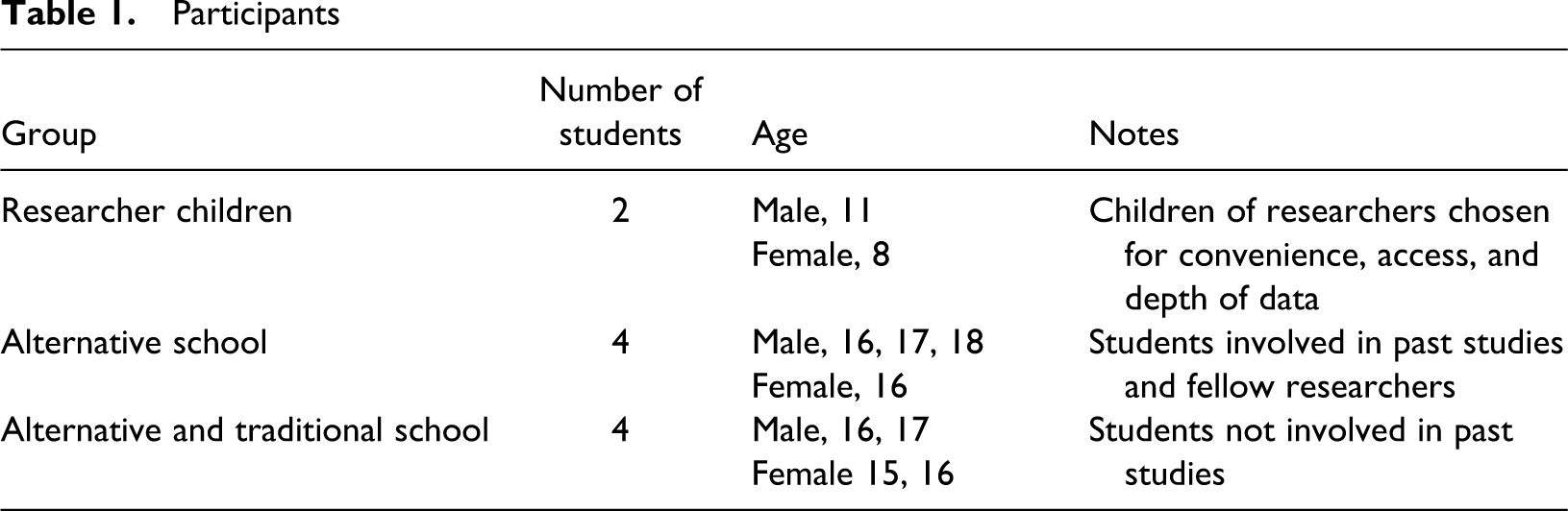
We were particularly concerned that giving students unfettered access to these devices (negotiated within family structures) would be disruptive at home, school, and work, so we began with students enrolled in non-traditional settings in which we believed such media use would be less disruptive, gradually evolving toward students enrolled in more traditional settings.
Participants
This study employed a purposeful sampling technique to illuminate issues of theoretical interest and of convenience (to meet practical concerns, particularly around privacy), rather than to represent a broader population (Patton, 1990; see Table 1). Because of the potentially sensitive nature of this study (giving youth media devices with broadband, personalized internet access), we began with youth with whom we had familiarity and access and then recruited youth whom we had less contact with. Further, we began with participants with whom we were the most acquainted so that we could have extensive access (Lofland and Lofland, 1984), observe any potential changes in behavior (such as engaging in new practices), as well as build on existing trusting relationships, and themes identified in this phase could be pursued further with subsequent cohorts. Each stage built on the previous one.
Researcher children cohort
Both children were homeschooled meaning that parent-teachers could observe uses. Further, we had constant access to their uses, enabling us to capture a wide range of practices and ferret out any behavioral issues.
Alternative high school cohort
The second wave included four older children (16–18) at a local school (see Table 1). Participants had school permission to use their smart phones at all times during this three-week unit, as long as it was not distracting.
Traditional student cohort
Four students that were recommended as motivated and successful in school were selected for the third cohort.
Data collection
Following the recommendations of Lincoln and Guba (1985), we collected observations, interviews, and documents to triangulate data sources.
Observations
The researcher children cohort was observed several hours each day across contexts. Alternative school students were observed in and out of school, on average six times, for 90 minutes each. The final student cohort was not observed outside of interview demonstrations.
Interviews
Each participant was interviewed three times. The interview protocol was designed to elicit themes that, consistent with the SCOT approach, revealed how participants constructed mobile media devices. We also interviewed six parents and two of the students’ teachers about their perceptions of students’ mobile media use.
Document analysis
Seven students completed daily use journals. Parents often used notes to remind themselves of incidental observations. During each interview, we asked participants to show us their device, and we recorded how many applications they downloaded, of what sort, collected any photographs taken, and recorded phone logs.
Data analysis
Researchers met three times during the study to compare notes and identify emergent themes. Analysis started with sharing field notes, reviewing informal findings, and then dividing all data into manageable emergent themes in order to structure ongoing inquiry (Strauss and Corbin, 1990). After completion of data collection, researchers transcribed all interviews. Researchers individually sorted data pertinent to research questions, generating categories of use and meaning. As researchers identified these findings, they shared findings with participants for additional triangulation and member checking for refinement.
As an example of the interplay among data sources in analysis, researchers observed an average of 23 applications added and 67 photos taken during the first two cohort groups. However, ‘taking pictures’ was rarely observed or discussed in interviews. Triangulation across sources enabled us to capture a broader range of activities than we otherwise might, however for privacy and ethical concerns we did not log keystrokes, record websites visited, intercept text messages, or record phone calls.
Because we were interested in the stories participants told about their devices, researchers conducted simplified narrative analysis (Gomez and Tabachnick, 1992) on their stories to identify how they positioned themselves as actors, what conflicts drove them, and how mobile media devices were tools for overcoming the obstacles they faced. These stories are reported in the findings and discussion. During this phase, the metaphor of amplification of learning emerged as particularly descriptive of student experience. We shared this analysis with students, teachers, and parents, each of which agreed that it captured the essence of students’ experience, as detailed in the following section.
Limitations
Each sample involved trade-offs among accessibility, trust, privacy, and negotiating pre-existing power relationships (such as parent–child or researcher–participant). As a result, we treat these data points as the stories that participants tell about their lives, and look for the meanings that participants find in them, rather than treating them as raw, unprocessed data. Further, we are capturing users when they first encounter a device, meaning that it has a high novelty factor, may not yet be integrated into their lives, and could change over time. We chose a three-week window to study them, hoping that their novelty would have worn out in this time and more routine practices would emerge. Finally, participants reported that they did not often purchase applications for the phone because of the short time period they would have it. Given the nature of the research questions, findings, and claims, we do not see any inherent reasons to discredit the findings.
Results: Mobile devices as information retrieval sources, media players, ‘Swiss army knives’, and communication devices
The primary activity reported by participants was information seeking and entertainment (especially games and music), yet participants also used mobile devices for participating in social networks, as a ‘tool’ and as a platform for learning through applications (see Figures 1 and 2). The tools downloaded, which included a carpentry level, a stethoscope, a bevy of musician’s tools, and a note-taking tool, were striking in their capacity to turn an already multi-faceted device into a highly customized performance enhancement tool. Given that downloading and installing applications to mobile devices is a relatively new practice, we were impressed by how rapidly these participants learned to download applications and how many applications they downloaded. The number and breadth of these tools that participants found within days of owning the devices surprised us.
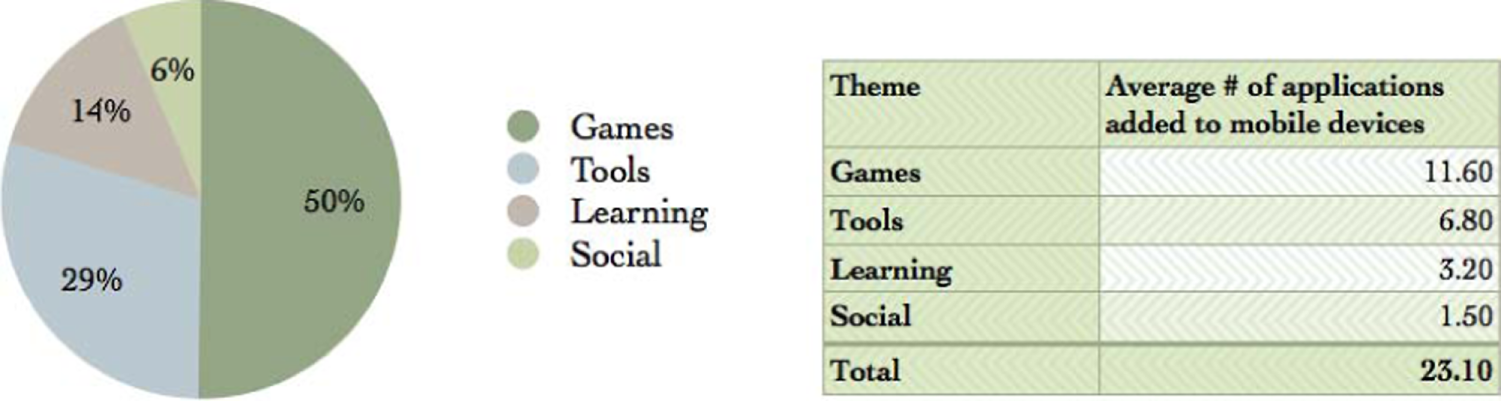
Applications downloaded to mobile media devices

Sample of use pattern from participant journal record
The diversity of applications downloaded was also striking. On average, participants downloaded 23 applications in three weeks, or about 1 application per day, about 50 per cent of which were entertainment applications (primarily games, or music software such as Pandora). Every participant downloaded applications designed to be tools, (i.e. flashlight, compass, or level) and applications for learning, and for social networking (Figure 1). Learning applications varied based on the interest of the participant and our small sample included travel, music, astronomy, geography, art, trivia, language acquisition, community reading groups, poetry, and digital book applications. About once per day, participants shared applications such as Neighborhood Fruit, an application that displays where public fruit trees are located. In the post-interviews, students reported enthusiasm for these applications ‘for fun’ and distinct from school activity.
Students universally valued the ability to quickly look up information on their devices to fulfill curiosities, settle arguments and debates, help others, or fill unused time. In this respect, the mobile device functioned somewhat like a ‘lifeline,’ in which they could always be connected to Google, and the device was framed as a personalized broadband computer/information retrieval source. Participants equally described their devices as gaming machines (like a SONY PSP or Nintendo DS), and nearly 50 per cent of their applications downloaded were games (on average 12 games in three weeks). In interviews, participants reported participating in social networks (particularly Facebook) less frequently, although it accounted for roughly 33 per cent of their time, according to their journals.
Examining data from one student reveals how the number of applications downloaded does not correlate perfectly with how they reported using the device (see Figure 2). This participant downloaded more games (for free) than any other type of application, yet the daily use journals showed that overall usage was not heavily game-focused. In follow-up interviews, this participant confirmed these observations and shared that they enjoyed downloading and trying out free games, but used the device most regularly for retrieving information.
Findings and discussion: Mobile media learning as amplification
Focusing on the devices themselves, they look like media players, web browsers, toolkits, telephones and interfaces for Facebook. However, the stories that participants told about using the devices (even from parents) were quite different. One parent reported, ‘I was really surprised at how many times the kids used the iPhone as a teachable moment for other people and for themselves.’ The theme of amplification cut across these stories, which we describe here in four ways: Amplification of Interest, Self, Social Networks, and Learning. All four amplifications are interrelated, and mobile devices thoroughly mediated participants’ experience of these four areas.
Amplification of self
Unlike a portable media machine in which consumption practices might be compared to games, television shows, or films, these devices were often employed to do things that made their users (and others) feel useful. Possessing mobile devices elicited a feeling of empowerment and perceived feeing of ‘being useful,’ both on the part of youth and on those observing them. One teacher explained, ‘[She] was much more apt to figure things out on her own.’ The girl explained, ‘This has everything like right there in your hand … I wasn’t expecting to use it that much but I ended up finding uses for it all the time.’ Others agreed: ‘So its just fun over all to like to know that you have that power almost.’ ‘Overall it was just powerful feeling.’ Our parents made similar observations, ‘They felt useful, and they felt like they could look things up and figure it out for themselves, and that gave them a lot of confidence.’ Or more succinctly from our youngest subject, ‘I just feel more useful with it.’
This heightened sense of empowerment was deeply tied to increased access to information.
You have any question and you can pretty much get it instantly because it’s your phone and you’re always going to have it on you. Can you think of anything you might want to know that you can’t learn in that format or even that learning in that format might hinder it as well? Umm, I don’t think so. I think you can learn anything on the Internet.
In one case, a student’s mother became lost. New in town, she continued to drive, and commented that she hoped to get lucky and find it. The student realized he had a phone in his pocket and enthusiastically perked up, ‘Oh, I can look it up!’ He used the GPS function, located the car on a map and ‘zoomed out’ to see their relative position to the airport. He was able to draw out the needed directions by physically turning the device to orient himself to the streets he saw and gave his mother turn-by-turn directions successfully. In the post-interview he explained that he is ‘more useful’ when he has the phone because he can solve ‘real’ problems like this one. The connection of thought, to tool, to applied use, to solution, fuels a very personal amplification of self.
A second participant worked as a nanny, and used the device to improve her services; quite literally becoming more valuable by using her device to amplify her professional self. She explained: I’m a nanny, so I was able to take pictures of the kids I watch. I was able to just email them right to their parents. They liked that a lot. It was just that with a camera you can take pictures, but you have to upload it to a computer and that takes more time. So all I had to do was take a picture, and then push email.
This participant explained that she was a better nanny and able to charge more per hour because parents were much happier having increased communication, access, and knowledge of their children’s activities in real time. Indeed, we examined her device after the study, and most of her applications related to friends, family, and working with children, suggesting how mobile media amplify access to social networks and interest.
Amplification of social networks
Based on previous research (Ito et al., 2008) we expected that devices with phone, internet, and IM capability will be used primarily as social devices. This social use of the phone was expected to cause trouble at school, yet in only one case did we have a subject get ‘caught’ using the phone inappropriately. The student was kicked out of class because the teacher thought he was texting. In the follow-up interview, the student reported that he was checking his grades online because the teacher was telling the class the previous test was poorly done; personal information to inform his attention to class. Inappropriate use was expected to happen by nearly all parents, students, and teachers. In fact, the students themselves introduced the concern of ‘disruption’ to school in all of the pre-interviews.
It was much more common that our subjects reported using mobile devices in socially productive ways, which parents and teachers confirmed. One younger student worked with her mother to build a ‘contact’ book. Each of the high school students reported being ‘more connected’ and reported a feeling of being part of the social conversations going on around them. We wondered how the devices mediated this, and at times feared that constant access to social networks could be overwhelming.
The complex interaction among technology, social networks and personal relationships was illustrated through one student, who reported little interest in socializing. He explained, ‘You know, I don’t care. I’ll be antisocial for technology any day. Technology is fun and entertaining.’ Yet, this resistance seemed to be more the result of social awkwardness, as after the study, he reported that Facebook enabled him to talk with girls whom he could not in day-to-day life. ‘… before we had the iPhones,’ he explained, ‘I never really talked to her. We just never had the place to have conversation, I guess you could say. But like, she’ll go on Facebook and I’ll be on Facebook and then I’ll see her on, and I’ll be like, ‘hey, blah, blah, blah,’ – so that’s pretty cool.’
Prior to the study, we feared that access to Facebook might create problems with social pressures, but these youth, described the quasi-public, low stakes interactions that Facebook make possible as positive. It created a safe space for casual friendships that transcended cliques to emerge, reminding us that approaching someone virtually can be lower stakes than talking to them in a crowded school hallway or lunchroom.
Expertise with mobile media devices was social and cultural capital for these youth, and they were eager to share its capacities with others. Applications quickly flowed among participants in each cohort. Like the Cliff Clavin character in Cheers, participants would search out and share trivia information. As one participant described, ‘I would be in the car and if someone asked me a question, I could look it up on my iPhone on Google.’ One subject explained that ‘Because one of my really good friends here has an iPhone … I pretty much knew how to do everything.’ Another student felt her use of the device was particularly important and, though new to the device, wanted to teach her more experienced cousin, ‘She didn’t know about the Pandora app, and she doesn’t really know about a lot of the things that I found so I was able to show her.’ Regularly, the students became teachers. ‘I was really surprised at how many times the kids used the iPhone as a teachable moment for other people …’ shared a parent that saw the positive social impact of the devices.
Participants reported using downtimes and interstitial times to plan their social calendars. One subject summarized, ‘I could figure out stuff I wanted to do later on instead of like having to wait around. That’s a problem because your friends end up scheduling something with someone else and you’re just sitting there. So I could get a hold of them a lot faster and schedule something with them before anyone else did.’
Also, participants were eager to discuss emerging social norms about mobile media use and explore the social consequences of their use. These negotiations were trickier in situations such as classrooms in which there had been no previous opportunity to use them. Participants thought that it should be the student’s choice as whether to multi-task, but that they should be responsible for any information they missed. One explained, ‘I can kind of understand it [teachers prohibiting texting]. I mean you’re trying to teach or lecture, and students are ignoring you. But they make it a bigger deal than what it really should be. If they see someone texting, just keep right on teaching, and if they miss that part, then you’ll be able to tell on the test.’ This view was common among students.
Students negotiated use boundaries within their own lives throughout the study and generally concluded on balanced use. For example, in just the second day of the study, two students discussed whether to bring their devices on a hiking trip. After much deliberation, they decided that the devices would distract them from their friends, and they left them at home. A high school subject reported a similar social dilemma during his science class hike. ‘I thought, ‘I’m playing with a phone when I should be enjoying nature a little more.’ The same student confessed that his device, ‘pulled him out of my surroundings sometimes,’ and he limited his ‘mess around on the phone’ time, so as to more deeply engage in the world around him.
Amplification of interest
Access to the mobile device amplified participants’ interests, both in current passions and fleeting notions. After a few days of experimenting with their devices, each participant used it to explore areas of interest, ranging from music to science. For example, one participant began taking pictures of movies she was watching, and then ported the pictures to slideshows – an odd collusion of multiple modalities around an emerging interest in film. For this participant, the device meant the ability to capture and journal lived experiences – even when the experience was another form of media.
Older participants very frequently used their device to look up information, even to settle a mere curiosity. As one described, ‘We were having a discussion in class about lightning and where it came from and if it came from the ground or if it came from the sky. I was pretty sure that I had heard somewhere that it came from the ground so I looked it up.’ For one subject, his ‘interest’ in trivia was worth downloading a separate application. There is so much information right at your fingertips, it’s not even funny … Me and my mom were watching TV and I downloaded an application, like random facts, and we had multiple conversations about random facts because they are just like the craziest facts that pop up. Like, uh, the giant squid has the largest eyeball out of any creature in the world. What else?
This trivial pursuit style engagement was somewhat surprising, but also reminiscent of many people’s first experiences of having unfettered internet access for ‘surfing’ (Herz, 1995).
Users found uses that amplified lasting interests and activities. Two examples stood out. One young man had a previous passion for music, especially songwriting, and used his device for researching songwriting and as a tool to assist his writing process. He described his process to us: I have a little basement room where I play music. I have a couple keyboards and a guitar and all this different stuff. There was an ambient feature, which plays, like, tunes that people can fall asleep to, and I used those because they had a couple different kinds. And I play that in the background almost as a background starting music and then I play my guitar along with it. Then I have a guitar pedal that records my guitar and I record that and then I go sit over at my keyboard and then start playing that so I have a one-man band going. Then I come back to the IP and turn it down slightly and then I change the tune a little bit on the guitar and the keyboard and then come back and turn a different ambient sound up on it. And then there was one on the ambient sounds that is a fuzz almost – like a computer fuzz – and it sounds almost electronic.
The mobile device here functions somewhat like a computer in the many ways that it empowers his interests, yet its portability supports his songwriting as a tool, builder of new interests, and rehearsal partner. As he used his device, his interest in music, particularly forms of electronic music grew.
The diversity of interests that even this small group supported through their devices included fine art, literature, philosophy, cooking, and wood working. In addition to simple trivia, these uses took on the form of more instructional, tool-based, or applied instruments to build the user’s capacity within the area of interest. These applications were shared with others as a form of water-cooler talk (or social amplification) for those with common interests, but often kept as personal as the interest itself. Although applications are certainly not new, having access to a personalized device was transformative.
What was striking was how these features, integrated in one device, enabled new practices. A researcher observed a student working quietly with headphones, but every few minutes he would take out his phone and type. When asked what he was doing, he explained that he was listening to Pandora, noting new bands and songs that he liked. Later he would use his lyrics application, guitar chord application, and learn the song itself. He then took his device to his guitar studio and experimented with new sounds (another application). He did this whenever he could. When asked how aware parents were of children’s media practices, most reported that their children were sophisticated. ‘Kids teach themselves, kids just really, naturally figure it out.’
We wondered however, when and why do kids figure ‘it’ out? If all the information is already on the internet, what was different about mobile media devices, over other forms of digitally mediated instruments? Participants frequently reported using ‘filler’ time extensively with the devices. Upon reflection, it is worth noting how much of such filler time youth have – whether it be waiting on or for a bus to school, waiting for parents, waiting in line, or sitting bored during required activities. Activity with the phone fits into the ‘gaps’ of the day, for example our nanny built her idea for building the business with continual use of the applications in these interstitial times: I wake up and I have Pandora so while I’m getting ready for school. I check my email and my Facebook and myspace. I go to school and while I’m waiting for class to start, I listen to Pandora. When I don’t have a class, I’m on myspace or Facebook or checking my email or emailing people. That’s for an hour. At lunch, I’m a lot of Facebook and Pandora. When I get home, I listen to music, but I can’t do Pandora at the same time as I do Facebook and myspace so I have my iPod and I play that sometimes. Then, the rest of the evening after school, I’ll be on social networking.
Waiting for the bus, when alone, or any time when the users wanted stimulation, they used their devices to fill voids. Eventually, they filled the void with things that interested them most and saw the time as more ‘useful’ to their personal curriculums for growth – perhaps adding to an amplification of self.
Participants reported surprise with just how useful their devices were, and universally valued them immensely. As one described, ‘I knew it was like helpful and you could do a lot of stuff with it, but I just didn’t realize how useful it would be, because I don’t use a phone much and I wasn’t expecting to use it that much but I ended up finding uses for it all the time.’ They could build and pursue interests throughout their day, regardless of schedules. In short, the devices didn’t alter schedules, but their constant availability made better use of their schedules.
Amplification of learning
Together, amplifications of interest, self, and social networks constituted amplifications in learning. Just as pencils and paper effectively changed both the medium and the means of learning centuries ago, in this admittedly abbreviated study we saw signs of how mobile media devices could change learning practices, particularly in informal contexts through interest-driven learning. The key to these transformations, we believe will be in the fact that most students will soon own similar devices, carry them with them, and use them in their personal pursuits, regardless of schools.
To illustrate, one student was working at a fast food chain and was debating with his colleagues what ingredients constituted the ‘special’ sauce that they served. He reported with pride that he could ‘pull out his phone and look it up, thus winning the argument.’ He found that special sauce ‘wasn’t all that special.’ Participants reported stories like this repeatedly. Learning was quick and easy.
Accessing information, even in areas that they had little previous understandings (such as the lightning example) was not a barrier for these learners to engage in information searching and feel empowered to participate in social interactions based on their information retrieval and consumption. Each participant described his or her device as enabling access to an ‘endless amount of information’ and valued that as a key part of its value. Even when they did not understand how to access information, the device enabled getting help from experts that did. As one described, Its just a tool that you can use to learn whatever even if its just like pulling up a screen and learning a fact about something you can use it to help further your knowledge. You can take a picture of something and go to the library and say you want a book about this guy and ask the librarian if they know who this is.
Going to the library to ask questions was less reported and observed less commonly than simply asking follow up questions to teachers and parents. We were surprised, however, that students, even in the alternative school, oriented so positively toward independent, intuitive, interest-driven learning.
Many participants used their devices to read entire books. In the alternative school cohort, three of the four students downloaded a reading application despite showing resistance to traditional reading in school. We asked why and they listed: ease of access, a way to use filler time, convenience (not having to lug heavier books), that scrolling was enjoyable, and the enjoyment of delivery. This interview excerpt illustrates this:
I think it was because the words were closer together and just the scrolling. I’d put it on a slow scroll so it went along. I just stayed up at the top and it did all the work for me.
So it paced the movement of the words for you? So this isn’t like a book – this is reshaping what a book looks like.
Yeah. It was also not like looking at a computer screen because then you still have that whole page and it was different from reading a book and like reading a computer screen altogether. It was something that was unique.
Although many adults may resist reading books on phones, these participants reported being very comfortable, and preferred, reading novels or books on them. Because of the nature of this study, we cannot say if this was simply a novelty effect, or a lasting one, however, it lends support to the claim that this generation of students might embrace digital readers much more readily than their parents, as there was little reported resistance to the idea of reading a book on the smaller devices.
Conclusions
This study sought to examine youth use of mobile media devices, specifically iPhones, so as to understand how they constructed the devices and understand these implications for learning. We anticipated that students would use them for many functions, but primarily socializing, perhaps putting them in conflict with learning practices, constituted formally or informally. In fact, we saw no friction between students’ mobile media use and learning, but rather an embracing of their use for learning. Participants used them for amplifying their access to social networks, interests, and access to information, which taken together constituted a form of learning. As such, the devices were truly being constructed partly as a media device, partly a communication device, partly an information accessing resource, partly a tool (like the Swiss-army knife) that empowered them in the world to do ‘anything’.
The readiness with which all of these students successfully integrated these mobile media devices into their lives was striking and suggested a dramatic departure from how life was experienced without them, especially in formerly unused times. Participants described many situations in which they were not in control of their attention or even bodies to the extent where they could ‘cocoon’ with headphones, such as riding in the car with parents, shopping with parents, sitting in class, or experiencing a slow day at work. These youth made remarkable use of such devices as a tool to retake control over these times. Participants pursued interests and curiosities, interacted with social networks, and stretched activities such as songwriting across these spaces. A participant stuck at work could partially transform the space into a music studio or comfortable reading spot.
The previous examples suggest moments in which participants used mobile media devices to transport them away from spaces, but the most remarkable moments were when they used such devices to deepen their participation in practices, whether it was arguing with friends, practicing in the recording studio, babysitting, or doing carpentry. In such moments, mobile media devices were tools that extended their participation in activities and were described by participants as powerful tools. The adults we interviewed remarked on this as well, noting how the devices served as a scaffolding of sorts, enabling youth to participate in adult practices. The girl who used her device to enhance her babysitting services is perhaps the most dramatic example, as it describes a positive feedback loop in which the participant uses the device to participate in existing social practices with greater competence, which then positively reinforced that emerging interest and skill, and led to more material gain.
This discussion has thus far focused on learning outside formal learning contexts, and indeed, it is difficult to imagine right away how it can be integrated with the predominant structure of schooling. Most curriculum theories that dominate formalized schooling, even those that purport to use emerging technologies do not feature learning emanating from participants’ interests, but rather from government institutionally mandated curricular objectives see Leander and Lovvorn, 2006). Despite these contradictions (e.g. Engestrom, 1996), these contradictions did not manifest themselves as frictions for these youth. As mobile media devices become more widespread, and the cultural practices associated with such tools become more accepted, it is possible that such frictions could occur, but for now, we find it curious that they did not.
Implications
Educational technologists developing curricula for mobile media devices have typically created applications designed to work within these inherited educational systems rather than transform them. Although many scholars, most notably Roschelle and Pea (2002) have predicted tensions between traditional learning models, which are highly centralized, and emerging pedagogies with mobile media, which are deeply distributed. An implication of this study is that educational technologists might benefit by designing curricular experiences involving mobile media that leverage this distributed nature. How to implement curricula based on cultural values at odds with the predominant patterns of schooling is a common concern.
Although this is but one study with a limited sampling, findings from this study would suggest that environments that include learners with mobile media tools might operate by the following assumptions. Mobile learners might begin to expect:
Studying topics of personal interest or curiosity. Observing these participants use their mobile media device allayed concerns that students would resist using them for learning. Instead, we have argued throughout that they were conceptualized, by students, as tools for amplification – including amplifications of learning. Indeed, many of their uses were deeply connected to learning, albeit through personal interests, whether it was art, music, carpentry, the causes of lightning, or winning a debate with friends. Curricular efforts integrating mobile media devices might leverage such capacities. For example, participants might be encouraged to use their devices to write social histories of their neighborhoods, using places, people, or conflicts of personal interest as a springboard into deeper investigations (see Mathews, 2010; Squire et al., 2007).
Access to personalized and customized tools that seek out, identify, select, and maintain learning. To contextualize, educators once debated whether students should have calculators or not; soon, schools could be the only place in students’ lives that they do not have calculators, encyclopedias, and so on. Curricular models predicated on trivial pursuit-style presenting and representation of facts make little sense in this context, any more than extensive memorization texts makes sense in a print age (see Perkins, 1992). Design studios, inquiry-based learning, and game-based learning approaches are potentially fruitful approaches as they reposition information as tools used for doing complex, authentic tasks. Regardless, as designers we can assume that each student has Google in their pockets and can and will use the devices everywhere.
Instant connection to peers or other social networks. Mobile media devices function like ‘lifelines’ for contestants on the game show Who Wants to Be a Millionaire, enabling them to query friends and contacts for information. New social networking tools including Facebook, Twitter, Text Messaging, Yelp, FourSquare, and Aardvark are transforming these practices in real time. They enable people to broadcast requests to friends, and can be tailored according to interest, topic, or physical location. The mobile youth we studied embraced and shared these practices quite readily.
Having persistent access to mentors and teachers. Owning mobile media devices enabled participants to build and extend access. Most routinely they provided context-sensitive information, irrespective of time or location. Currently, most student–teacher interactions are limited to classroom time (or perhaps office hours). Learning models that assume some sort of constant persistent access (such as students text messaging at 9pm with a project question) seem more appropriate. However, how to reduce burden on overworked teachers and ensure healthy life boundaries remains an issue. Paradoxically, mobile media enables school life to spill over into home life too. Currently, there seems to be much concern about ‘life’ invading school (e.g. students texting during class), but relatively less concern with investigating how to extend learning throughout students’ lifeworlds in an equally compelling manner. Educational interventions leveraging mobile media might not only take advantage, but actively promote learners collaborating throughout the day. For example, students might create photo essays of life in their neighborhood, leveraging the fact that they have cameras with them. Models for such curricula exist, but they might be expanded to leverage constant online access, so that students might also gain quick feedback on their work.
Responsiveness to emergent, grassroots interests spread via word-of-mouth. Introducing mobile media devices, particularly of a personal, portable, social, and connected nature means opening the walls of the classroom (for better and for worse) to the outside world. Ideas are no longer filtered through teachers, but from podcasts, message boards, or applications. As applications such as Twitter or Neighborhood Fruit came online and spread, there was a natural tendency to exploit or build off them (see Mathews, 2010). Predominant curricular models that emphasize federal, pre-planned control largely preclude capitalizing on such emergent interests and developments. Other pedagogies, such as place-based, inquiry, project-based, or studio learning include such capacities (Tiffin and Rajasingham, 2003).
Demonstrable relevance and personal edification. Learning with mobile media devices took on an organic quality, as participants followed their interests, learned, and became more powerful participants in the world. If schools do not respond, one can imagine a growing disconnect for students who learn this way (which may be much more natural than the industrial model of schooling). For enterprising learners, time invested in such communities could become more life enhancing and productive than schools anyway (particularly in particular domains in art, design, engineering, or technology, which may not be taught in schools anyway). Much as middle-class parents have begun in places pulling students out of school for enrichment activities, enterprising students may increasingly opt out of school for better learning experiences.
Producing work and publishing it for feedback or consumption. Providing participants with mobile devices with integrated telecommunications reduces barriers to sharing media to near zero. Although none of our participants seemed compelled to write a book on the phone (as has occurred on occasion in much-publicized instances in Japan, see Ito et al., 2010), many were inclined to read them. With new media tools, such as the video editing tools, integrated into iPhone 4 and iPad2, we should expect coming productions. Indeed, such devices will in all likelihood remediate the cultural form of the symbolic text, video, and games as they are recrafted for production and consumption on mobile media devices.
These data suggest that learning, as we understand it socially, is about to change whether or not schools find uses for or integrate mobile media tools. These students demonstrate a refined understanding of the challenges and growing gap spanning their own interests, pursuits, skills, and lifetime learning to the world that is school. Most notably, mobile media technologies are contributing to a greater personal efficacy for these users, which may be contributing to a variety of social trends because use is so widespread. These students recognize this gap between teachers that were trying new technologies in the classroom, and ‘others’; alongside a similar recognition of connected students and those that were not. The implication is that the traditional divisions of classification are fading and being replaced with ‘connected’ or ‘unconnected’.
This study takes place as mobile media technology is only at the beginnings of being adopted in schools. These students were new to the technology and the speed with which they picked up, found mentors, personalized, and changed engagement with the world was startling. The entry barriers to use were minimal, opening the door to everyone, and the short observations here implied that designers were right about adoption and innovative use. Students were able not only to use the devices in expected and advertised ways, but innovative and creative ways not expected ahead of time. The native user is building something new even as you read this.
Footnotes
Funding
Funding for the project was from the MacArthur Foundation.