




Abstract
The authors systematically investigate the evolution of the modern information and communication technologies (ICTs) and the associated changes in protest – related tactics employed by two main stakeholders in the contemporary contentious political processes – dissenters and incumbent political authorities. Through in-depth investigation of the cyberprotest cases in the former Soviet states of Belarus, Moldova, Russia, and Ukraine, which occurred during the last decade, a coherent outline is developed of the co-evolution of the ICT-enabled protest tactics of the main counterparts in the contemporary political struggle in these countries. Particularly, it was found that there were at least three highly distinguishable levels of development of modern ICTs and the associated types of protest-related tactics employed by the main stakeholders in these events. It was established that as soon as the authorities were able to effectively counteract the previous ICT-enabled tactics by the dissenters, new developments in modern ICTs always empowered the latter to devise new effective strategies to overcome previously successful counterrevolutionary measures of the political authorities.
Keywords
Introduction
Recent events in different parts of the world have drawn attention to the use of Internet-based information and communication technologies (ICTs) within the contentious (Tilly and Tarrow, 2006) political processes. For example, these technologies were widely used in 2010 and 2011 during the people’s uprisings in the Northern Africa – for example, in Tunisia and Egypt. During some of these uprisings, in addition to their usual practice of heavy censoring of the Internet (see e.g. McLaughlin, 2003), the authorities even resorted to the complete blackout of Internet and phone communications (Hopkins, 2011; Ragan, 2011a). But these attempts at the restriction of information and communication access were often in vain. Resourceful dissenters used various techniques to circumvent those limitations and were still able to obtain access to both the Internet and phone networks (The Economist, 2011).
There are several features of the Internet-based ICTs, which promote the synergy of the offline and online protests: (1) improved organizational robustness and accelerated mobilization speed, (2) reduced transaction costs and a facilitated possibility to alter information transparency, (3) improved fundraising, and (4) the physical security of the dissenters (Howard, 2010; McLaughlin, 2003). At the same time, there are also some potential risks associated with these tools. These include (1) threats to the anonymity of the dissenters and confidentiality of the information they communicate and (2) the possibility of powerful cyberattacks on their resources (Morozov, 2011). Therefore, there is a constant race in the use of the rival Internet-based tools between the dissenters and the authorities.
From the most recent examples of political cyberprotest in Tunisia and Egypt, we see that the tech-savvy cyberprotesters were able to find ways to overcome restrictions on the use of ICTs imposed by the authoritarian/semiauthoritarian regimes. Research into how similar restrictions were imposed and overcome in other cases of the contentious political cyberprotest may also prove fruitful. Particularly, valuable would be an investigation of the possible evolution of ICTs use in the response of one side in the contention to the activity of their opponents, and vice versa, over prolonged periods of time. It is likely we would be able to recognize some regularities and patterns in those processes, which, in turn, would be applicable to other cases as well. Investigation of these issues would help us to clarify the role of ICTs in the modern contentious political processes and possibly to establish some particular dynamics of their co-evolution.
Former USSR is a fertile ground for studying cyberprotest. During the past decade, we observed numerous attempts at color revolutions and other more or less peaceful people’s revolts against the nondemocratic regimes – for example, in Belarus in 2001, 2006, and 2010; in Georgia in 2003; in Ukraine in 2004; in Kyrgyzstan in 2005 and 2010; in Azerbaijan in 2005; in Armenia in 2008; in Moldova in 2009; and so on. During many of these events, the ICTs played an important role. In particular, it was established in the course of our in-depth case studies research of such events in Belarus, Moldova, Russia, and Ukraine (see Lysenko and Desouza, 2010a, 2010b, 2012a, 2012b). It is also established that the leaders of the color revolutions and other contemporary people’s uprisings in the nondemocratic countries successfully learned from previous examples (see, e.g. Beissinger, 2007). The same can be said about the authorities opposing them (Silitski, 2010).
We can combine and compare results of our cases and thus trace the continuous co-development/development of ICT-facilitated contentious tactics of the main stakeholders in these confrontations (nondemocratic authorities and pro-democratic opposition) during the last 10–15 years. Since the main ICTs used and the authoritarian/semiauthoritarian political regimes involved are widespread globally, our results should also be applicable to similar states. Thus, in other countries with comparable technical, sociopolitical, and economic conditions, the Internet could potentially be an important tool during major political protest activities. Indeed, there are more than 2 billion people living in the currently not free countries (Puddington, 2011: 3).
The rest of the article is arranged as follows. First, we provide a short review of the literature dealing with the political cyberprotest – particularly, in the former USSR – in order to establish what is already known in this area and what results can be applicable for our present study. Subsequently, we discuss our research methodology. This is followed by the findings from our in-depth case studies (Lysenko and Desouza, 2010a, 2010b, 2012a, 2012b) relevant to the topic of this article. Based on all these, we propose and discuss the co-evolution of the ICT-enabled contentious tactics and tools employed by the protesters and the authorities in the former USSR countries during the last 15 years. We conclude our paper with the short summary of our findings and suggestions for the future research in the area.
Internet and the protest potential in the former Soviet countries
In general, it is established that the use of the Internet-based ICTs is often associated with access to the alternative sources of politically and socially important information (Horrigan et al., 2004). As such, it facilitates more open discussions (Boulianne, 2009). These tools are especially appealing to the youth and can promote their stronger involvement with the political and social life of their society (Palfrey and Gasser, 2008). ICTs also simplify the process of providing the meaningful critical feedback to the actions of the authorities (Curran, 2005). This, in turn, can potentially contribute significantly to the stable development of societies. At the same time, in the age of the Internet, for dictatorial and authoritarian regimes it becomes more and more difficult to keep their societies closed to the alternative information flows coming from outside their borders (Howard, 2010).
Particularly, according to the Freedom House, ‘[i]n 2010, only 1 in 6 people lived in countries with a Free press’ (Karlekar, 2011). Specifically, the almost complete control over the traditional mass media is characteristic for all the authoritarian/semiauthoritarian countries of the former USSR, including Russia (Becker, 2004; Oates, 2007). Under this condition, the Internet-based ICTs become especially important for the opposition to conduct its activities and to mobilize people’s support.
The first political use of the World Wide Web in Russia can be dated to mid-1990s, when one liberal political party first uploaded its Web site (March, 2006). But merely 6 years later, Krasnoboka (2002) found that Russian oppositional online media already became structurally flexible and were often run by both professional journalists and politically inspired enthusiasts. This author (Krasnoboka, 2002: 496) also analyzed media’s popularity and discovered that ‘monthly ratings of many original online outlets compete with … many (particularly local) newspapers and journals.’ Likewise, Semetko and Krasnoboka (2003) found that the online-only mass media in Russia and Ukraine are often much more popular among the local Internet community than those countries’ traditional mass media presented in an online format. For example, the Ukrainian online-only newspaper Ukrainska Pravda played an exemplary important role during both active phases (2000–2001 and 2004) of the Orange Revolution in Ukraine (Aslund and McFaul, 2006).
One of the Internet tools that are skillfully used by the successful cyberdissenters is blogs. Kulikova and Perlmutter (2007: 29–32) argue that
…samizdat blogs can serve to incite or sustain democratization in Third World countries, even those undergoing uneven economic development. … Blogs are for people with something to say to the world and the means to say it through a new medium. … We argue that Third World blogs can be a significant producer, collector, sifter, distributor and exhibitor of information. … Even in nations where they are actively politically repressed, blogs can constitute a political factor.
Later in their article, these authors provide documented facts that dissenter Web sites and blogs did play an important role in the Kyrgyz Tulip Revolution.
Etling et al (2010a) studied the potential of the Russian blogosphere. Particularly, they note (p. 3) that ‘Russian bloggers prefer platforms that combine features typical of blogs with features of social network services (SNSs) like Facebook. Russian blogging is dominated by a handful of these “SNS hybrids”. … We find evidence of political and social mobilization, particularly in those clusters affiliated with offline political and social movements.’
Overall, based on this short literature review, we can conclude that the Internet-based ICTs can play an important role in political cyberprotest activities under the authoritarian/semiauthoritarian regimes. Moreover, we see that many different ICTs were used differently in these countries, depending on a particular cyberprotest situation or timing that enabled existence of other ICTs with which the former ones can be more effectively used in combination. We also noted changes in the protest-related tactics depending on the availability of new ICTs. However, we found that there is no systematic research on the evolution of both the new ICTs and the related tactics employed by both the dissenters and the authorities who oppose them. At the same time, our own research on the political cyberprotest in the former USSR countries (Lysenko and Desouza, 2010a, 2010b, 2012a, 2012b) contains numerous data that can be used to investigate this evolution. Therefore this article, based on this data, is devoted to determining and researching the potential regularities in the possible co-evolution of modern ICTs development and various tactics used by the two main opposing forces – dissenters and authorities – in contemporary contentious political processes.
Research methodology
Employing the case study methodology, we studied cyberprotest events in former Soviet states (Lysenko and Desouza, 2010a, 2010b, 2012a, 2012b). Specifically, we studied two major cases in Russia, Ukraine's Orange Revolution and the ‘Twitter Revolution’ in Moldova. We also studied several attempts at a color revolution in Belarus during the past decade. According to the recent edited volume The Colour Revolutions in the Former Soviet Republics: Successes and Failures (Beachain and Polese, 2010), all 12 of the non-Baltic states of the former USSR potentially are highly susceptible to the major contentious political events. Due in part because of the authoritarian/semiauthoritarian regimes there, with all their typical negative features: high corruption, low standards of living for a large part of the population, suppression of many basic rights and freedoms, and so on. Moreover, in the majority of these countries, such events have already occurred – either as full-blown color revolutions (successful or failed) or as major local political protests. Accordingly, the cases that we have chosen for our study represent all the typical politically contentious events for the former USSR.
To assure theoretical meaningfulness of our conclusions, we chose our cases in such a way as to ensure comprehensiveness of the resulted findings based on the patterns derived from these cases. In particular, we aimed at selecting cases demonstrating the maximal variability of both the ICTs employed and the tactics facilitated by these ICTs. For example, we chose the case of the Orange Revolution because this case is one of the best described in the literature, and it was also one of the longest, lasting for 4 years (2000–2004).
This gave it additional advantages in terms of this research point of view, since we could observe various cyberprotest-related patterns in its development. This case has two distinct peaks, namely in 2000 and in 2004 (for more details, see Table 1). And while in 2000, cell phones were not widespread in Ukraine, in 2004 they were, adding a new and important possibilities for protesters’ tactics. Researching this long case allowed us to establish the co-evolution of the dissenters’ and the authorities’ ICT-related tactics during the highly contentious political events.
Characteristics of the cases.
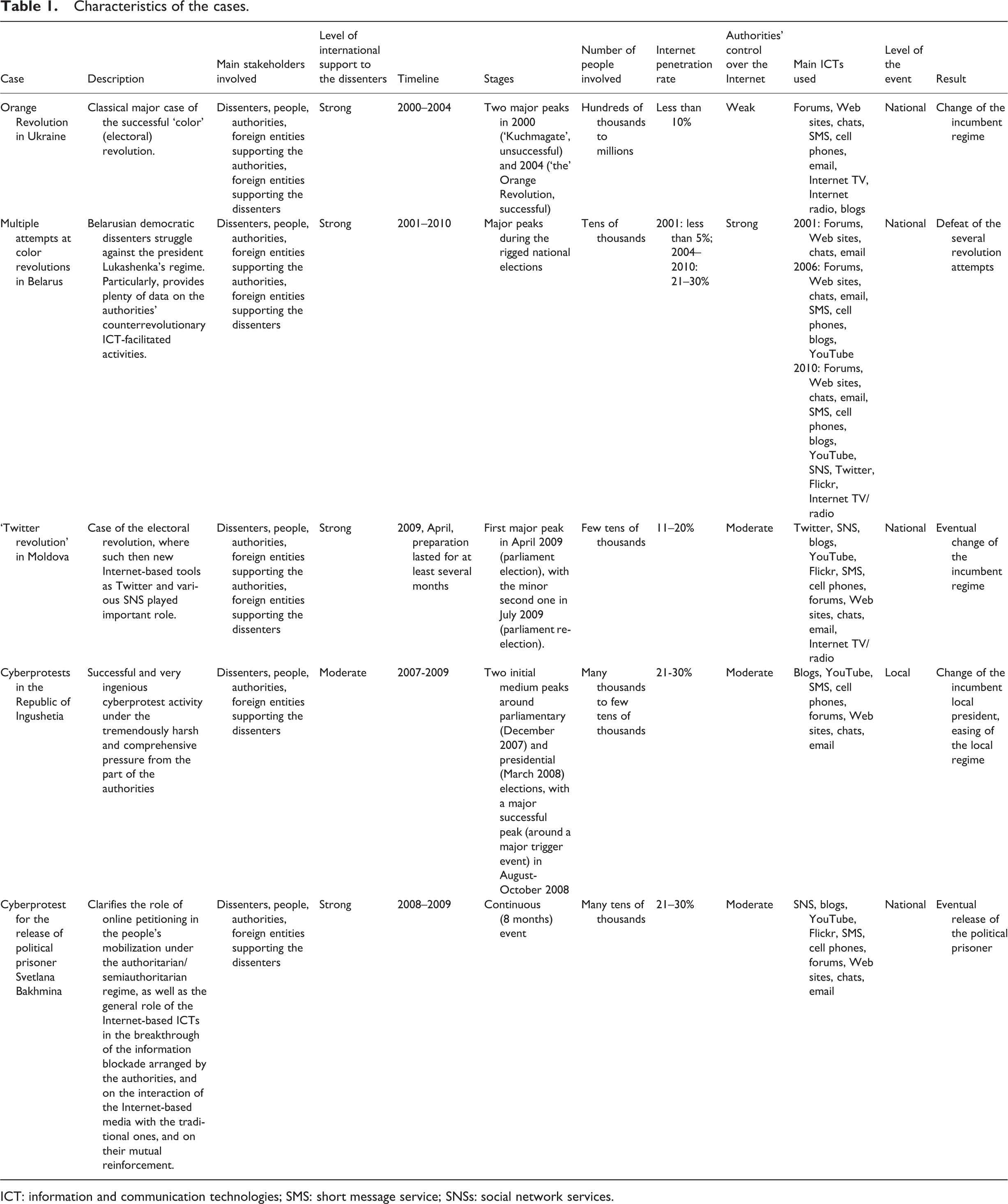
ICT: information and communication technologies; SMS: short message service; SNSs: social network services.
We wanted to take into account the maximum variations possible in the conditions of the political cyberprotests to ensure comprehensive conclusions. In order to accomplish this, we chose several additional cases for our research. For example, we studied the Belarusian democratic dissenters’ struggle against President Lukashenka’s regime. (This was an ongoing case in which the first active phase of this cyberprotest happened in 2001, and the last in 2010.) We also analyzed the ‘Twitter Revolution’ of 2009 in Moldova which, on one hand, allowed us to supplement our conclusions with details related to the use of the modern Internet-based ICTs which were not actively used in the course of the Orange Revolution (such as Twitter, Facebook, YouTube, etc.). On the other hand, this case of cyberprotest helped us to better clarify the role of the sociopolitical (including legal) context in the course of political cyberprotests in authoritarian/semiauthoritarian states.
Other cases involved the study of cyberprotest in the Republic of Ingushetia (one of the ‘national,’ semiautonomous parts of the Russian Federation) in 2007–2009. This case added important data on successful and innovative cyberprotest activity, employing a wide variety of ICT-enabled tactics to break through the attempted information blockade arranged by the authorities and under the tremendously harsh and comprehensive pressure from their part (including even fatal casualties among the leaders of the cyberdissenters).
We also studied the case of the cyberprotest for the release of political prisoner Svetlana Bakhmina in Russia (2008-2009). This case bolstered the generalization of our conclusion’s data on the role of such ICT-enabled tactics as online petitioning in the people’s mobilization under the authoritarian/semiauthoritarian regime, as well as on the general role of the Internet-based ICTs in the breakthrough of the information blockade arranged by the authorities. It also revealed clear patterns of the interaction of the Internet-based media with the traditional ones, and on their mutual reinforcement.
Table 1 compares the various cases we used in this research. These cases varied both in their scope (national major electoral revolutions and uprisings versus local, more narrowly focused cyberprotests directed at achievement of the particular sociopolitical goals) and in the contexts under which they occurred. This included different levels of the Internet penetration, various ICTs used, number of the main stakeholders involved, levels of the international support, and the authorities’ control over the national segment of the Internet (time lengths, availability of several activity peaks, numbers of people involved, etc.).
For each of these cases, we took great care to trace the roles of the main stakeholders in cyberprotest (dissenters, authorities, the people, and the foreign entities supporting either side), their use of technology to further their agenda, and understand critical success (failure) factors for these revolutions. As a result, we were able to identify 59 different ICT-facilitated protest tactics used by the dissenters and their allies, and 50 different ICT-enabled counterrevolutionary tactics used by the authorities and their helpers.
As gathering primary data on these cases is difficult, we drew on a vast collection of secondary data including scholarly papers, descriptive case studies, news items in various forms, memoirs and books by authoritative scientists, journalists, writers, and direct participants of the events. We analyzed the materials in five languages (Russian, Ukrainian, Belarusian, Romanian, and English). In total, we thoroughly sifted through many hundreds of related documents. In addition, we observed the development of the contemporary cyberprotests [e.g., in the real time through the Web-based TV and radio, and on the main actors’ various online tools (Web sites, blogs, forums, SNS, Twitter, etc.)] as they occurred.
Accordingly, we built case narratives, extensively employing the historical approach (George and Bennett, 2005). Using triangulation where possible, we carefully integrated data obtained from different sources. In particular, we conducted extensive research and extraction of the data available in a number of the above mentioned sources and classified these data into related categories. These processes are similar to the processes of coding typically used under the grounded-theory approach (see, e.g. Glaser and Strauss, 1967). Accordingly, from these categories, we were able to determine the main stakeholders of the political cyberprotest (dissenters, authorities, foreign entities, etc.), main Internet-based tools used, and, finally, the main tactics and strategies those stakeholders undertook using those tools.
As a result, we were able to build the generic theoretical framework describing contentious political cyberprotest in the system of electoral (‘color’) revolution. There are five main generic stakeholders in this system: the people (the neutral stakeholder) for the votes of whom the two main generic opposing stakeholders of the system (the incumbent authorities and their opposition, the active dissenters) fight. The two other main generic stakeholders of the system are various foreign entities supporting the authorities and various foreign entities supporting the dissenters.
Use of the multiple cases also allowed us to observe differences in outcomes of the cyberprotest cases in response to different conditions of their occurrence. This increased both the internal validity and the generalizability of our findings (Miles and Huberman, 1994; Yin, 2009). A multiple case approach thus provided us an opportunity to elaborate a more robust theory, since we were able to derive more compelling generalizations.
The cases
Ukraine
The revolution in Ukraine had two phases: the first one was ‘Ukraine Without Kuchma’ protest campaign triggered by the ‘Kuchmagate’ 1 events. It occurred in Autumn 2000–Spring 2001 and ended with the temporary retreat of the opposition. The second one, which happened in 2004, culminated with ‘the’ Orange Revolution. In 2000–2001, Ukrainian opposition used the Internet for two main purposes – informing and mobilizing. Both were done through online newspapers like Ukrainska Pravda, online forums like Maidan, and email lists. And, while in the early Autumn of 2000, the political Internet in Ukraine was not very popular; by the end of that year it became so.
For example, in early September 2000, the Web site of Ukrainska Pravda had only about 3,000 visitors per day, but in December 2000 it already had about 80,000 visitors daily (Vasyl, 2000). Then this newspaper, established just in April 2000, already registered its first million visitors. And that happened at a time when less than 1% (or only about 400,000 people) of the population of Ukraine had the Internet access (Krasnoboka and Semetko, 2006: 190).
Despite the eventual failure of the ‘Ukraine without Kuchma’ protest campaign in March 2001, when several of its leaders were repressed, it was objectively progressive for Ukrainian Internet use. Next January, Kuzio (2002) wrote:
Internet use in Ukraine has increased five-fold since 1999. From 2000 to 2001, it jumped by 30 per cent to 40 per cent. … In 2001, 400,000 personal computers were sold (an annual increase of 22 per cent–25 per cent) plus 10,000 computer notebooks (an annual increase of 60 per cent). Due to increased competition among Ukraine’s 260 Internet service providers … the cost of Internet connection has dropped dramatically.
Accordingly, by 2004 the situation with the Internet access in Ukraine improved substantially and, according to various estimates, approximately10% of Ukrainians already had it. Therefore, it is no surprise that McFaul (2006: 178) was able to compare the then media situation in Ukraine with previous cases of successful electoral revolutions in Serbia (2000) and Georgia (2003) in these terms:
In contrast to Serbia and especially Georgia, Ukraine’s democratic opposition had access to fewer traditional sources of independent media. By 2004, in Ukraine all the major TV channels were owned or controlled by oligarchs loyal to Kuchma and Yanukovych. Some important print newspapers provided independent sources of news, but all had limited circulations. Compared with Serbia and Georgia, however, Ukraine’s opposition had one advantage: the Internet. Coming just a little bit later than the other two revolutions and in a country a little bit richer and therefore with a little more connectivity, the Orange Revolution benefited tremendously from the Web. In fact, the Orange Revolution may have been the first in world history organized in large measure on the Web.
What was equally important, the mobile phones (with their SMS 2 capability) penetration rates in Ukraine also grew dramatically during 2000–2004: from less than 2% to more than 29%. 3 Accordingly, these improvements in the ICTs access in Ukraine allowed the opposition to effectively switch its organization from the more vulnerable hierarchical (when arresting the key leaders can lead to the serious confusion within the movement) to the more robust network structure (when the semiautonomous local small groups effectively coordinated their activities in the real time through cell phones, SMS, Web sites and email lists, and when disabling of such a group would not undermine the whole movement).
Therefore, when, for example, about 300 local leaders and activists of the prominent youth oppositional organization Pora were arrested in Autumn 2004, it did not have a negative impact on its overall revolutionary capacity. Some other new ICTs, for example blogs and webcams, also played a role: the former served as the alternative platforms for the oppositional online activities when its main Web sites were under cyberattacks, while the latter were widely used to live broadcast online the mass demonstrations occurring in the Ukrainian cities. Detailed dynamics of the co-evolution of the various ICT-related tools and parameters, and of the relevant tactics employed by the main stakeholders during the Orange Revolution in Ukraine, is provided in Table 2 (adapted from Lysenko and Desouza, 2010b).
Detailed dynamics of the coevolution of the various information and communication technology-related tools and parameters, and of the relevant tactics employed by the main stakeholders during the Orange Revolution in Ukraine.
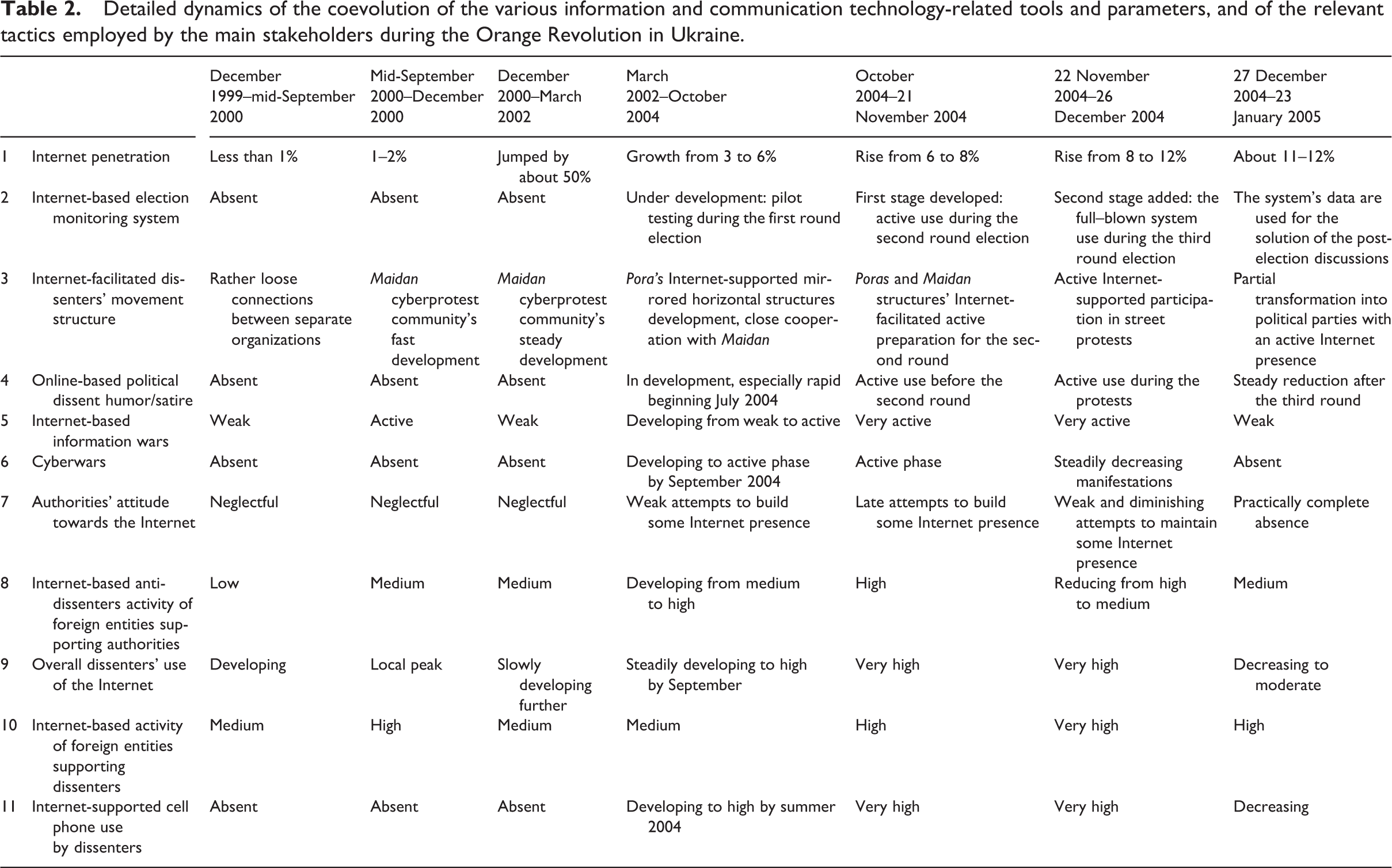
Overall, based on the Ukrainian case, we see that the ICTs played important role in the success of the Orange Revolution. Particularly, the rise of the Internet and mobile phone penetration rates, as well as wider use of the new types of the ICTs, facilitated the opposition’s ability to mobilize and to coordinate its activities effectively and in the real time, to survive repressions imposed by the authorities.
At the same time, the authorities did not pay enough attention to the new ICTs, and concentrated their efforts mostly on the traditional mass media, while their slow-reacting organizational structures could not adequately respond to the quickly developing revolutionary situation. Accordingly, they ‘overslept’ the moment when the protesters reached the critical mass, completely lost control of the situation (including the previously loyal mass media), and eventually lost power.
Russia
For Russia we have chosen two cases that occurred mostly within the 2007–2009 time frame – the case of a struggle for liberation of political prisoner, Svetlana Bakhmina, and the case of mass protests in the semiautonomous territory (‘republic’) of Ingushetia. Mrs. Bakhmina worked for Mikhail Khodorkovskiy – former oligarch known for his support of the oppositional parties in Russia – who was sentenced to 14 years in prison. 4 Svetlana was sentenced to 7 years in prison, despite having two little children. After serving half of her sentence, she applied for conditional release but was declined although pregnant with her third child.
People organized mass protest campaign for her release, both online and offline, and the online petition for her release collected more than 96,000 signatures. After months of protests, she was eventually released, and the campaign for her freedom became an evidence of how initially purely online protest invoked the offline one, and together they eventually led to the successful outcome, even under the current Russian regime.
The case of Ingushetia investigates the struggle of its people against the Republic’s then president Zyazikov who was strongly backed by the Kremlin. The only independent republican news agency – purely online Ingushetiya.ru – played an important role in this struggle. The authorities tried to shut it down using a range of methods – from the purely legal ones to cyberattacks and spoiling Web sites – but in vain.
The site always managed a rebirth and survival and continued disclosing numerous misdeeds of the Ingush authorities. Eventually, the Web site’s owner was killed by the police, immediately invoking a strong wave of offline protests of the Ingush people. The Web site played an important role in the ignition, mobilization, and coverage of the protests. And again, after several months of protests, the Kremlin wavered and was forced to change the Republic’s president – to more acceptable for the opposition.
The main types of ICTs used in our Russian cases, and the counterparts’ ICT-facilitated tactics, were the same as in the above Ukrainian case, plus we observed some use of the popular Russian SNS, particularly Odnoklassniki.ru (established in 2006, some analog to the American Classmates.com), and massive use of photo- and video-hosting services. That difference occurred because all these services became popular after 2004 when the Orange Revolution happened, plus in 2007–2009, the broadband Internet was already widespread in Russia which, in general, had much higher Internet penetration rates – from 24% to 29%.
Particularly, SNS and blogs played important role in networking people around the Bakhmina’s case, and even the first post about her destiny, which triggered the whole campaign, was posted by her former classmate. In their turn, video- and photo-hosting services played an important role in spreading documentary information about the Bakhmina and Ingushetia cases, and about their offline actions, to both Russian and foreign audiences. The result was an increase in the number of people and organizations actively interested in these issues. When the number of people actively involved in the cases reached critical masses, the Kremlin was forced to account for their demands.
Moldova
By mid-2005, the authorities of the nondemocratic countries of the former USSR already had developed successful tactics to counteract oppositional massive youth, mostly offline organizations. As a result, several attempts at electoral revolutions failed, particularly in November 2005 in Azerbaijan and in March 2006 in Belarus. One of the reasons was that the authorities were closely monitoring such organizations and, as soon as the beginning of any serious protest activity was observed, crushed it in the bud. As a result, the protesters needed new tactics to deceive and lull the authorities’ vigilance. The solution was the creation of a virtual, predominately online organization, that would seem harmless for the authorities but could be instantly and covertly mobilized for the offline contentious political activity. SNSs, which became popular in the former USSR beginning the second half of 2006, were able to ensure the success of these new tactics of the protesters.
Its first successful test run was in April 2009 in Moldova, when, after the parliamentary elections, the ruling Communist Party claimed to get the necessary majority to elect the President. But independent observers proclaimed the elections rigged and oppositional youth set about starting the protests. Offline oppositional parties still remained silent (so the authorities, who closely monitored them, probably relaxed), while mostly online youth oppositional groups, using all available to them Internet-based and mobile ICTs (SMS, IM, email lists, forums, etc. as well as already existing and seemingly harmless to the authorities mass groups in various SNS), organized the protest flashmob that within a couple hours turned into a powerful evening protest rally. The authorities were absolutely unprepared. The next day, when oppositional political parties actively joined the protests, the number of protesters approximately doubled and they were able to occupy the Parliament and the Presidential Administration.
Before the elections, only few dozen Twitter users existed in Moldova, so it had only limited application during the protest mobilization. But Twitter was actively used to inform the outside world about the revolutionary events, thus attracting international mass media attention to them. Moldova’s protests even became one of the leading topics in Twitter. YouTube, Flickr, cell phones, live Internet-based TV/radio, and other modern Internet-based ICTs were also actively used to spread the information worldwide. Therefore, Western public became aware of the events and these states probably also applied some diplomatic pressure on the incumbent regime.
During the protests’ peak, the Moldovan authorities even temporarily turned off the Internet and cellular communications in the country and apparently were able to shut down some online protest groups based on the Russian-based SNS. But all that was too late – the protests already passed the threshold and became self-sustained even without modern ICTs. Thus, the oppositional leaders were able to negotiate with the authorities about the results of the elections, having strong mass protests at the background. As a result, to pacify the protesters, new results (where the Communists already did not have enough votes to elect the President) of the elections were announced. Consequently, this Parliament was dissolved and new elections occurred in summer when the united opposition eventually won.
Belarus
Belarus opposition has waged an active ICT-facilitated struggle against the country’s dictatorial regime of President Lukashenka since the 2001 presidential elections. The struggle had major peaks also around the 2004 national referendum and the 2006 and 2010 presidential elections. All revolutionary attempts were unsuccessful, due to the various harsh and effective offline preemptive tactics employed by the regime. Nevertheless, as our article (Lysenko and Desouza, 2012b) shows, use of ICTs was usually at the protesters’ advantage, though the state also applied the ICT-facilitated counterrevolutionary means rather skillfully.
During these 10 years of ICT-facilitated contentious political struggle, both the opposition and the authorities developed their related skills and tactics, which co-evolved: As soon as the authorities were able to apply a new way of Internet censorship, the opposition was able to devise related ICT-enabled countertactics and vice versa. Specifically, as new ICTs appeared, they soon were used by the Belarusian opposition, and often these new tools allowed for the application of new protest tactics.
As we established in our study (Lysenko and Desouza, 2012b), in 2001 the opposition, for communication and informational purposes, used mostly email, IM, forums, and news Web sites. Cell phones were then rare in Belarus (only 1.38% of the population used them, see Table 3), and the protestors typically used landlines to call. Accordingly, with these ICTs, the opposition was unable to effectively deploy the semiautonomous, mobile, network-type organizational structures and relied mostly on the hierarchical, leader-centric ones. Consequently, when some of the main leaders abandoned the active struggle, all of the revolution attempt of 2001 was doomed to failure.
Dynamics of the Belarus’ Internet and cell-phones penetration rates.

Source: International Telecommunication Union (http://www.itu.int/ITU-D/ICTEYE/Reports.aspx).
By the March 2006 elections, the SMS-enabled cell phone penetration rate in Belarus reached 61% of the population (see Table 3), so deployment of youth network-type oppositional structures was reasonable.
Information about the protests was also spread through informational Web sites, blogs (which also often served as alternative informational channels when the main ones were under cyberattacks), video-hosting services, etc. Nevertheless, major discrepancies between various factions of the opposition and harsh suppression by the authorities (hundreds of the activists were arrested, while many leaders were sentenced to long terms in prison) prevented the success of this revolutionary attempt.
Finally, by 2010 new types of ICTs such as SNS and Twitter became very popular in Belarus. As a result, before the elections, the opposition established various SNS support groups of tens of thousands of participants; on the day of the protests the opposition managed to gather several tens of thousands of the protesters in the streets of Minsk – more than ever before during this decade. In its turn, Twitter, as well as the Internet radio and TV, was used as a source of the live updates about the course of events for the both local and worldwide audience. On the streets, the protesters possibly were going to use the offline tactics that were successful in Moldova – occupation of the main governmental buildings.
But the authorities had learned the Moldovan lessons: They covertly deployed their well-trained special police forces en masse both within and outside the buildings. This riot police force was able to dissolve the protesters, absolutely unprepared for the street fights, within minutes, 5 while, again, hundreds of the activists were arrested and several oppositional presidential candidates were sentenced to long terms in prison. Hereagain we see that, while the skillful use of the ICTs helped Belarusian opposition to bring the record numbers of the protesters to the streets, major errors in the offline tactics were the main cause of its failure.
Evolution of cyberprotest tactics
Ten Eyck (2001: 158) suggested that if there is a relation between the development of ICTs and political protests, then the protests should happen in clusters – each cluster corresponding to the new generation of ICTs:
If communication and information technologies are a part of political protests, then we must get more detailed information of the timing of the protests to see if they occur in clusters, which we would expect to happen.
Our findings seem to prove his prediction. Looking at the cases studied, at least three periods of the co-development of the ICTs and protest-related tactics and activities can be (roughly) distinguished for the former USSR countries: 6
1997–2002 - Level 0
2003–2007 - Level 1
2008–2011 - Level 2
These levels have qualitative differences. And even recognizing the same tactics, for example, online info-war, its quality (e.g., speed, intensity, and ability to target particular audiences) changed radically with introduction of the new tools (Twitter, SNS). Compare, for example, the information wars during the Orange Revolution of 2004 and those during the Moldova’s Revolution of 2009. The former was waged mostly using the online news agencies and forums, while the latter mostly on Twitter. The same can be said about other ICT-facilitated protest-related activities as well. We even can suggest that the Orange Revolution-type protests can be identified as ‘Cyberprotest 1.0,’ while the Moldova-type protests certainly qualify as ‘Cyberprotest 2.0.’ A detailed consideration of each of the above three levels follows.
Level 0 (1997–2002)
This is the beginning of the active use of the ICTs in political processes in the former USSR countries. In the end of 1990s (1997–1999), the authoritarian/semiauthoritarian regimes in those countries, apparently became alarmed by the role played by the ICTs in Mexico during the Zapatista uprising, in Indonesia during the toppling of the Suharto regime, as well as by the incipient ICT-facilitated dissent voices in their own countries. As a result, they approved legislation, allowing for the interception and close monitoring of the ICT-enabled communications by Secret Service.
Local oppositional organizations were mostly hierarchical, party-based, and apparently considered ICTs as secondary in the political struggle. Online oppositional communities (like Maidan in Ukraine) were mostly rather loose and amorphous. The most common online oppositional open communication channels were forums. Synchronous communication between the dissenters was also popular through IM (like ICQ). At the same time, email (including the lists) also played important role.
Dissenters had good reasons to suspect that the authorities could try to intercept their communications, and many of them used encrypted email and IRC (Internet Relay Chat). Cell phones were not affordable yet for the majority of the population, so the phones that were used were mainly landline, and only some leaders used cell phones to communicate. Oppositional online newspapers only appeared and quickly showed their importance as the main channels of supplying alternative information (e.g., during Kuchmagate in Ukraine). At the same time, topical oppositional listservs were popular since they were able to target particular audiences. Many of such email lists were in foreign languages to engage potentially influential foreigners.
During the acute political events (like the 2001 Presidential election in Belarus), the authorities tried to react according to the ICTs used by the dissenters. For example, they could cutoff or intercept those landline and mobile phones that belonged to the oppositional activists and their official organizations. Where authorities can physically access oppositional Web servers, they simply turned them off. Therefore dissenters, when at all possible, tried to host their Web servers abroad, beyond the reach of the authorities. If the authorities could not physically get to the dissenters’ Web sites, they applied the basic and the simplest restrictive means – either tampering with the DNS (Domain Name System) registries (for the locally registered Web sites) or trying to block (filter by IP (Internet Protocol) addresses) the sites registered abroad. Dissenters usually were able to bypass those blocking activities with ease using online proxies and anonymizers.
Thus overall, the Level 0 cyberprotest-related activities and tactics can be considered as only the beginning, often ‘testing’ tactics.
Level 1 (2003–2007)
This stage of the cyberprotests tactics evolution can be considered as the first ‘developed’ phase. During this period, the major exemplar ICT-facilitated success was achieved by the dissenters (Orange Revolution). At the same time, the authorities also demonstrated that they do not just mark time.
The dissenters moved from only the basic hierarchical organization (still typical for the political parties) to the networked one (especially typical for the youth oppositional organizations). The widespread expansion of the cell phone networks seriously helped with that organizational change, ensuring constant communication between the dissenters and their small semiautonomous groups.
At the same time, SMS, especially their mass sending software, along with the email listservs, ensured successful massive initial mobilization of the protesters. The authorities, as an answer (often late), sometimes employed simply turning off mobile coverage around the protest spots. Broadband Internet also became more affordable, thus oppositional online TV and radio played a role in spreading alternative information about the street protests as well as webcams broadcasting 24/7 live from the protest spots.
Combining the power of cell phones, the Internet, and computer databases, the dissenters were also able to organize the comprehensive election monitoring system in which data subsequently played a role in court during the Orange Revolution. Some photo evidence of the election violations were operatively uploaded to the photo-sharing services, like Flickr, which then became popular. Skype, with its built-in strong encryption, contributed to ensuring higher security of the dissenters’ communications.
Blogs, especially on the LiveJournal platform, had become very popular then in the former USSR countries. Because of their comment feedback feature, blogs also served (along with the forums), as important open communication/discussion channels for the dissenters. By that time the authorities instituted the very close ICT-related counterrevolutionary cooperation with other authoritarian/semiauthoritarian states and, apparently, got access to the malicious hackers. As a result, DDoSing oppositional online resources became a new authorities’ counterrevolutionary tactics. In turn, multiple Web sites mirroring, as well as using the alternative platforms and technologies (including blogs and RSS feeds), became the dissenters’ answer.
Overall, during the Level 1 cyberprotest period, it is clear how the nondemocratic authorities, alarmed by the success of the ICT-facilitated color revolutions, began paying more and more attention to the new ICTs. Specifically, they started legally prosecuting and arresting people for purely online speech, cleaned out their online posts, organized troll brigades to spoil oppositional open communication channels, and tried to acquire or get control over the critical online services, like blog platforms, IMs, SNS, and search engines. More recently (near the end of 2005–2007 period), they also succeeded in counteracting several major attempts of the color revolutions in various former Soviet countries. Thus, the authorities probably became accustomed to the then current ICT-enabled tactics of the dissenters and found relevant and effective countertactics. Apparently, some new ICT-enabled tactics were needed for the dissenters. The dissenters likely needed a breakthrough in the ICTs in order to be able to use them to devise and employ new winning revolutionary tactics.
Level 2 (2008–2011)
That breakthrough was achieved with the advent and widespread availability of ICTs allowing for easy and convenient online group communication (one-to-many and many-to-many) – SNS and Twitter. In particular, SNS allowed for the covert preparation of a major successful cyberprotest in Moldova – without prior existence of any noticeable offline massive oppositional youth organization. As a result, the authorities simply missed the beginning of the revolt and subsequently were unable to stop it without strategic political losses. In its turn, Twitter in Moldova played an important role in the instant spread of information about the full-blown street protests worldwide. This ensured the world’s attention to the situation in Moldova and probably also influenced the outcome of the protest-related negotiations.
Simultaneously, during the Level 2 cyberprotests period, it became obvious that the nondemocratic authorities were willing to completely blackout Internet, mobile, and landline phone communications within their territories. But the dissenters proved that they would always find ways to bypass those tactics – either using satellite-based Internet and phone communications or using other alternative communication channels. To successfully achieve that resistance, the big role was played by the online instant/emergency ICT-related advice/help Web sites. For example, when Belarusian authorities blocked the regular secure Internet communications on such Web sites, the dissenters were promptly advised to use VPNs (virtual private networks), preferably in combination with other anonymizing services, for example Tor (i.e. VPN over Tor), to overcome that restricting activity.
Since the nondemocratic authorities started paying close attention to the potential oppositional SNS groups, they reportedly used connections with the friendly authoritarian/semiauthoritarian states hosting respective SNS platforms to shut down those groups. In their turn, to avoid such a crackdown, the dissenters began using SNS platforms independent from the nondemocratic authorities.
Other new tactics, relevant to the appearance of new ICTs, appeared as authorities became active users of Twitter and SNS to conduct information wars or to spread propagandistic information. In their turn, the dissenters could use such new technologies as crowd-sourced or HITS-based filtering to get rid of the progovernment online trolls. Other crowd-sourcing methods, like cooperative work on the documents, crowd-mapping of the critical areas, or even ‘crowd-DDoSing’ of the governmental Web sites, were also done by the dissenters using various new online tools.
There is also evidence that during the Level 2 period, the nondemocratic authorities acquired (or were able to buy) technologies capable of rather precisely locating and persecuting individual dissenters through their IP Internet addresses or cell phone locations. In their turn, the dissenters usually took the known ICT-enabled precautions (like using anonymous proxies or new cell phones) to avoid detection. A new trick/tampering widely used by the authorities was tuning up or blocking, depending on the topic, of the particular searches through the local search engines. The dissenters answered using techniques similar to Google-bombing to mock the authorities.
Another important protest-related technological improvement that occurred around the Level 2 period was the simultaneous development of the affordable video camera-equipped and Internet-enabled cell phones and online video-hosting services (like YouTube), plus widespread affordable broadband Wi-Fi Internet. As a result, the protesters became citizen journalists who record the development of the important protest-related events, and instantly upload them to the online video services. Using the Bambuser service, they can also broadcast live video from their video camera-equipped cell phones directly to their Web pages (accounts) on such services as Facebook, Twitter, and so on. Consequently, the event effectively becomes ‘visible’ worldwide.
During the development of the critical protest events, information (news) updates very quick. As a result, such new tools as online aggregators capable of combining on a single Web page constantly updated news in various formats and from various sources also became important. At the same time, since this news may emerge from a country with a not widely known language, such new online tools as the automatic/semiautomatic translators became essential.
Overall, we can conclude that during the Level 2 cyberprotests period, the dissenters continued combining all the suitable ICTs in a synergistic manner, thus ensuring their best possible employment. Concurrently, such critical new tools as SNS and Twitter brought completely qualitatively new possibilities and tactics to the cyberprotests. At the same time, the nondemocratic authorities, combining their efforts internationally, devised new and new ICT-enabled tactics trying to withstand the new generation of the color revolutions.
As an example illustrating the above mentioned interdependence and co-evolution between the successful/unsuccessful use of the ICTs, cyberprotest tactics employed, and the authorities’ countermeasures, we can provide Table 4 (adapted from Lysenko and Desouza, 2012a).
Oppositional youth structures, information and communication technologies and tactics.
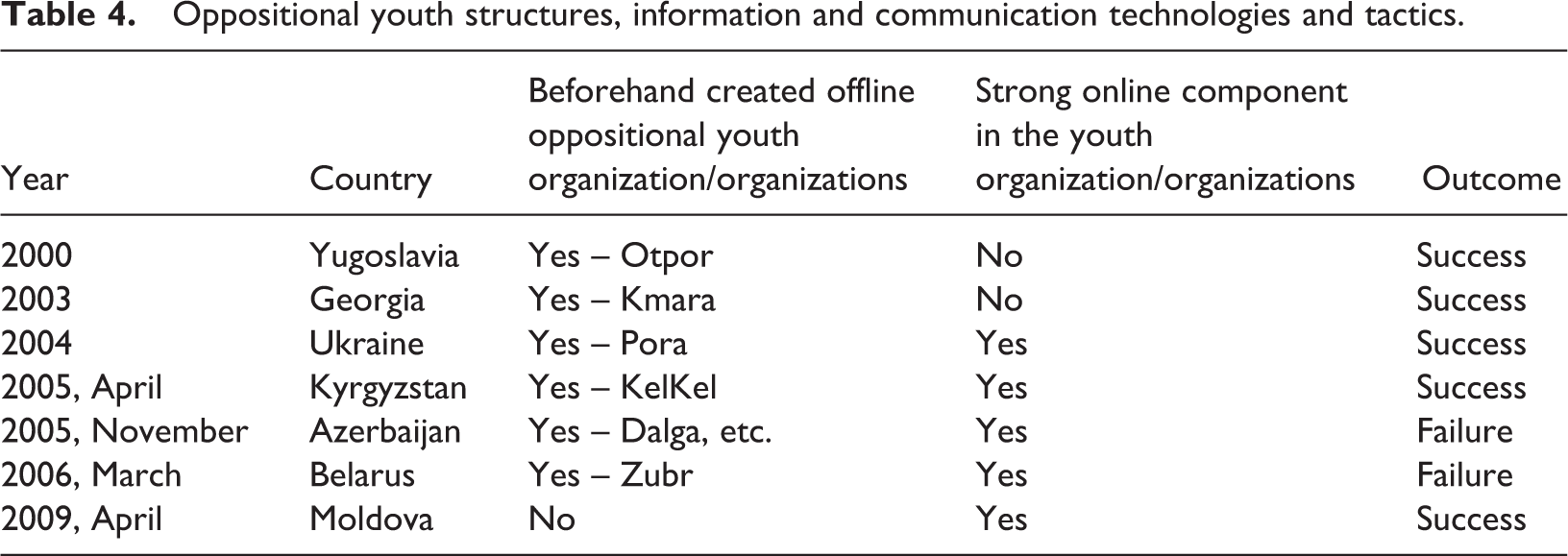
From Table 4 we, particularly, see that when beginning the second half of 2005 the nondemocratic authorities in the former Soviet states found effective ways to withstand the mostly offline oppositional youth organizations (so after successful color revolutions in the former Yugoslavia, Georgia, Ukraine and Kyrgyzstan there were failures in Azerbaijan and Belarus), the dissenters, using then new ICTs (namely, SNS), were able to radically modify their mobilization tactics and to defeat the authorities in Moldova.
In general, from all of the above we can see that there is a developing process of the co-evolution of the ICT-enabled tactics employed by the two main opposing forces – dissenters and authorities – clashing during the political cyberprotests. Current revolutionary events observed in the MENA (Middle East and North Africa) 7 countries seem to confirm our conclusions based on the data obtained in the former USSR republics.
Discussion
Thus, from our study we see that there is a constant race of the ICT-enabled revolution-related tactics – the prorevolutionary tactics of the dissenters and the counterrevolutionary tactics of the authorities. In the Belarusian example, we established that sometimes the authorities are a step ahead in their Internet filtering techniques – and then the dissenters brainstorm ways to bypass them. Or vice versa – the protesters devise new tactics to use ICTs in their revolutionary struggle – and then the authorities design or acquire from the colleagues in the ‘Authoritarian International’ (Silitski, 2010) new technologies capable of effectively reducing revolutionary impact of those ICT-enabled tactics of the protesters.
Inductively generalizing from our findings, we can theoretically postulate that there is a constant competitive co-evolution of the ICT-enabled cyberprotest approaches by the dissenters and respective counterapproaches by the authorities, and vice versa. Graphically that can be represented by a vertical double helix (our reader can imaging the classical DNA visual representation as an example), where the two spiraling strands represent the evolution/co-evolution of the two above mentioned ICT-enabled competing approaches. In this case, the grooves correspond to the above determined by us respective periods (levels) of the ICT-enabled contentious tactics’ co-development, while the outstanding acute cyberprotest events (like attempts at the ICT-facilitated revolts), or respective major ICT-enabled counteractivities by the authorities, represent centers (which can be paired if the action and respective counteraction happen around the approximately same time) of the horizontal bases including information flows going between these centers and the competing strands. These flows represent information related to the execution and effects of those outstanding ICT-facilitated events. Processing of this information makes the strands grow further (which represent the development of the new, improved tactics by the opposing entities, based on this relevant information).
If we add the third spiraling strand, representing general development of the ICTs, we will obtain the more complete system of the co-development of the ICT-facilitated protest-related activities, this time in the form of a triple helix model. Accordingly we will get additional horizontal bases representing information flows between the ICT-strand and the two mutually opposing tactical strands described above. The latter flows represent knowledge transfers – this time related to the new ICTs developed and their possible employment for the development of the new contentious protest-related activities and tactics.
Since the ICTs develop constantly, and their new generations appear regularly, we can predict further development (grow) of our triple helix system, with addition of the further levels of the ICT-enabled protest related tactics – beyond our above described three initial Levels 0, 1, and 2. So in the forthcoming years we will probably see appearance of the respective Levels 3, 4, 5, etc. In this connection, how do we see the outcome of this constant ‘cat and mouse game’ of the arms race between the protesters and repressive authorities? There is a conventional debate within the scholarly community about this topic. For example, Howard (2010) believes that the dissenters, under certain conditions, could eventually win, while Morozov (2011) is more skeptical about this issue. For the other most current instances of these debates to date, see, for example, Drezner (2010), Etling et al. (2010b), Deibert and Rohozinski (2011).
Based on our research, in this debate we rather hold to the moderately optimistic point of view. Particularly, we found out that the course of a cyberprotest usually can be effectively and very quickly corrected ‘on-the-fly’ with the necessary positive adjustments corresponding to the level of preparedness and counteractivity of the authorities. For example, in the case of the Ukrainian Orange Revolution of 2004, initially the authorities did not pay much attention to the mobilization power of the ICTs and that allowed the dissenters to have initial advantage in those events. Later, the authorities realized the mistake and, probably with some foreign aid, started active cyberwarfare against the dissenters’ online resources. Then, within hours, the Ukrainian dissenters were able to obtain help and advice from other, more experienced and knowledgeable in these issues, Internet activists, and thus ensured restoration and further effective functioning and defense of their online assets.
Similar events were observed over the last decade in Belarus. Likewise, the eventual success of the Tunisian dissenters in the winter of 2010/2011, despite the sophisticated system of online censorship deployed by the Tunisian authorities, was to a great extent determined by the ICT-related help from the globally dispersed groups of the technically advanced cyberactivists (Ragan, 2011a, 2011b). Thus, overall, our moderate optimism is based on the fact that in the modern world the repressive governments, because of various factors ranging from the voluntary self-isolation of their science and economics to the rules banning export of some technologies to the nondemocratic regimes, generally cannot get timely access to the most cutting-edge ICTs, and thus they should eventually lose in this cyberarms race against their world’s most ICT-competent adversaries.
Indeed, in the modern Internet-working world, the intracountry co-evolution of the revolution-related technologies naturally becomes international. Both the dissenters and the authorities actively use international cooperation to pursue their goals related to the modern ICT-enabled revolutionary activities.
For example, in January 2011 the Egyptian protesters actively consulted with their Tunisian colleagues who had already successfully accomplished revolution in their country (Kirkpatrick & Sanger, 2011). In their turn, the authoritarian/semiauthoritarian regimes are actively engaged in their own ‘Authoritarian International’ to devise ways to counteract the ICT-facilitated spreading of the color revolutions. The last example – the August 2011 summit of the CSTO, 8 after which Belarusian president Lukashenka announced that the alliance’s members will unite their mutual efforts, first of all in the informational- and cyberspaces, to prevent events similar to the ‘Arab Spring’ of 2011 (Smirnov, 2011).
Thus, taking into account our conclusions about the interdependence of the development of the ICTs and relevant tactics related to the modern contentious political struggle, there are implications for all the main stakeholders involved in the process – dissenters, authorities, and foreign entities supporting any of them. Principally, based on our findings, we can reliably predict that in the future, development of the novel ICTs possessing innovative features potentially applicable for the protest-related activities, will inevitably spur the appearance of new effective protest-related tactics capable of radically changing the realm of modern contentious political struggle worldwide.
The dissenters will learn about new ICTs developed worldwide and, using them, try to devise new cyberprotest tactics, taking into account the local cyber landscape. They will become capable of overcoming the imposed counterrevolutionary technologies and techniques imposed by the authorities. In turn, the nondemocratic authorities will inevitably try to devise or acquire new technologies capable of neutralizing the ICT-enabled protest activities of their people. Finally, foreign entities, interested in some outcomes of these struggles, may devise new techniques and technologies capable of helping the supported side.
For example, one of the prospective technologies that can help the dissenters bypass the authorities’ censoring of the Internet, is autonomous mesh networks. These networks can unite the dissenters’ computers and cell phones into autonomous networks independent from the in-country censored and monitored Internet but capable of connecting across the borders to the free foreign Internet channels. 9 Deployment of such technologies in the nondemocratic countries, whose authorities restrict their peoples’ natural rights to the freedom of assembly and information, could be of significant help in these peoples’ struggles toward freedom and democracy.
This conclusion about the dependence of the levels of the ICTs development and types of the insurgency tactics in the former USSR was made inductively, based on the data developed by our case studies of Ukraine, Russia, Moldova, and Belarus. Its further confirmation can be seen, for example, in Kyrgyzstan. Indeed, there were the two seemingly different tactics used by the insurgents during the revolts in March 2005 and in April 2010. The former essentially followed the Level 1 (‘Ukraine-type’) revolutionary scenario (see, e.g. Lewis, 2010), while the latter was apparently more similar to the Level 2 (‘Moldova-type’) uprising development (see, e.g. Morozov, 2010).
At the same time, not much changed in Kyrgyzstan in terms of the possibilities available to conduct the revolt during these 5 years (2005–2010). However, the new generation of the ICTs definitely became more popular. Thus, in the case of Kyrgyzstan, future researchers perhaps can claim a ‘control’ over much of the parameters (variables) related to the revolutionary potential there but not for the ICTs development. Hence, development of the ICTs in the case of Kyrgyzstan contributed to the development of the insurgents’ tactics.
However, in order to prove this potential interdependence, a more detailed investigation (systematic and comprehensive within-case comparative analysis) of the Kyrgyzstan case is required; one which is beyond the scope of this article.
To date, the most recent comprehensive, comparative, and multidimensional study of the progress toward democracy of the post-communist countries, including all the former USSR states – ‘Nations in Transit 2011’ by the Freedom House 10 – reveals that all the non-Baltic republics of the former Soviet Union still cannot be considered as real democracies. At best, some of them (Georgia, Moldova, and Ukraine) can be considered as hybrid regimes. The overwhelming majority are either consolidated authoritarian regimes (Uzbekistan, Turkmenistan, Belarus, Azerbaijan, Kazakhstan, Tajikistan, Russia, and Kyrgyzstan) or semiconsolidated authoritarian regime (Armenia).
Moreover, in his overview essay of the report, ‘Nations in Transit 2011: The authoritarian dead end: The Arab Spring’s implications for the former Soviet Union,’ the Freedom House’s leading researcher Christopher Walker (2011: 28) stresses that ‘…[t]he authoritarian former Soviet states suffer from many of the institutional weaknesses found in the Middle East, including shoddy governance and the corrupt concentration of economic power in the hands of presidential families and their associates.’ 11 Thus, based on our above considerations, these authoritarian countries are the primary candidates for the future color revolutions or other events similar to the 2011 ‘Arab Spring’. As we discussed previously, in all such events, modern ICTs and their evolution played important role. Accordingly, our findings about the interdependence and co-evolution of the development of the modern ICTs and development of the ICT-facilitated protest-related tactics probably will have some additional practical implications in the foreseeable future.
Conclusion
In this article, for the first time, we established that there is an evident co-evolution of the generation of the tactics used by the main stakeholders in the system of the political cyberprotest under the authoritarian/semiauthoritarian regimes and the generation of the ICTs employed. We identified at least three distinct levels. We also forecast that as technology advances, one can expect development of new generations of the ICTs, enabling totally new cyberprotest-related tactics. It is also likely that the ICTs will play a more and more sophisticated role in impacting the sociopolitical development of the currently nondemocratic countries toward more freedom and democracy.
Future research in this area can be concentrated in studying other cases of cyberprotests, like the proposed above case of Kyrgyzstan. The goal could be to find further evidences helping to improve our understanding of the co-evolution of the development of the modern ICTs and modern contentious political tactics worldwide. Taking into account the many similarities between the authoritarian situations in the Arab Spring’s countries and the overwhelming majority of the former Soviet states, in the foreseeable future we are likely to have many more additional cases to test this article’s conclusions.