



Abstract
We are surrounded by archives, archives personal and national; our externalized memories and their material placeholders line our shelves and attics, just as they crowd the vaults of our national repositories. But how do we relate to archives as material memories? What do we gain in their preservation, and what, paradoxically, might we lose? For good reason, archival materials are conserved and preserved in order to ward off dissolution, of both the things themselves and their memory function. But what does archival preservation prevent us from feeling, seeing and doing? What creative possibilities might be released when the archive is dissolved? In this article, we discuss our art–science collaboration, after | image. This project is about personal and material memory and about archival preservation and dissolution; it features time-lapse macrophotography of photographic negatives being chemically and physically destroyed. The negatives come from Grayson Cooke’s studies in photography at high school – this archive has been stored in his parents’ attic for 20 years, nominally ‘preserved’ for posterity but degrading nevertheless, as all material objects do. The submission of a personal archive to chemical destruction not conservation, and to a digital recording of this destruction, highlights the crux of the project’s enquiry and introduces its affective charge. Why destroy the archive, why commit archival treason? Because in doing so, you can make it live again.
But in the domain of photography the amount of ‘horse-power running to waste’ is appalling – and all for a lack of a little system and co-ordination. Shall this be allowed to continue? Shall the product of countless cameras be in the future, as in the past (and in large measure today), a mass of comparative lumber, losing its interest even for its owners, and of no public usefulness whatever? This is a question of urgency. Every year of inaction means an increase of this wastage. (‘The Camera as Historian’ [1916] in Elizabeth Edwards, Photography and the Material Performance of the Past)
We are surrounded by archives, archives personal and national, archives physical and digital; the material placeholders of our memories line our shelves and attics, just as they crowd the vaults of our national repositories. As material degradation inexorably wends our archives towards digital storage, and as digital imaging technologies become imbricated in everyday practices, we multiply archives, almost without thinking. Let us save everything, we say, it costs so little and is so easy to do. Let nothing slip from our grasp.
But what does it mean, this will to preserve? How do we relate to archives as material memories? What is gained in their preservation, and what, paradoxically, might be lost? For good reason, archival materials are conserved and preserved in order to ward off dissolution, of both the things themselves and their memory function; as Derrida proposes in Archive Fever, this is done in the name of the future, of future uses of the archive (Derrida, 1995: 17). But what does archival preservation prevent us from feeling, seeing and doing? Nietzsche suggests that ‘there could be no happiness, no cheerfulness, no hope, no pride, no present, without forgetfulness’ (Nietzsche, 1989: 58). Might archival forgetting be worth considering? Surely in some fashion we archive in order that we can forget because we have stored and preserved it and are ready to move on – Plato’s critique of writing as a pharmakon for memory, a poison and a cure, is one of the earliest acknowledgements of this notion (Derrida, 1981). What creative possibilities might be released, were the archive to be actively dissolved?
In this article, we wish to address this line of questioning through discussion of our collaborative art–science project after | image. This project is about personal and material memory and about archival preservation and dissolution; it features time-lapse macrophotography of photographic negatives being chemically and physically destroyed. We are working with a series of strong acids, ionic solutions and oxidizing agents – sulphuric acid (H2SO4), acetic acid (C2H4O2), nitric acid, sodium hypochlorite, copper sulphate, copper chloride, silver nitrate, hydrogen peroxide (H2O2) and sodium hydroxide. After being placed in a Petri dish, each negative is submerged in a given substance and digitally photographed 1000–2000 times over differing periods, anywhere from 2 hours to 2 days. These photos are then collated into time-lapse sequences and edited as digital video.
The negatives used in the project were produced when Grayson Cooke studied photography at high school – this ‘archive’ has been stored in a ring binder in his parents’ attic for 20 years, nominally ‘preserved’ for posterity but degrading nevertheless, as all material objects do. It is this use of a personal archive that underpins the conceptual thrust of the project. Each substance affects the negative differently, with different temporal envelopes of attack, sustain and decay. Some substances destroy the negative completely, whilst others lift the emulsion from the substrate or dissolve the emulsion entirely. Each of these processes has its own specificity and marks a different regime in an interrogation of the archived photographic image; its materiality, its durability, its capacity to call the past into the present.
The project takes its impetus, however, from one of Grayson’s earlier projects, Outback and Beyond, which involved working with early film footage from the National Film and Sound Archive in Australia – notably two films by Franklyn Barrett. Much of this footage was considerably degraded, having been shot on volatile nitrate film stock; at some point, a film preserver had struck a print from this degrading print, and it is now this preserved but degraded version of the film that constitutes the ‘record’ in the archive that is available for public viewing and use (Figure 1).
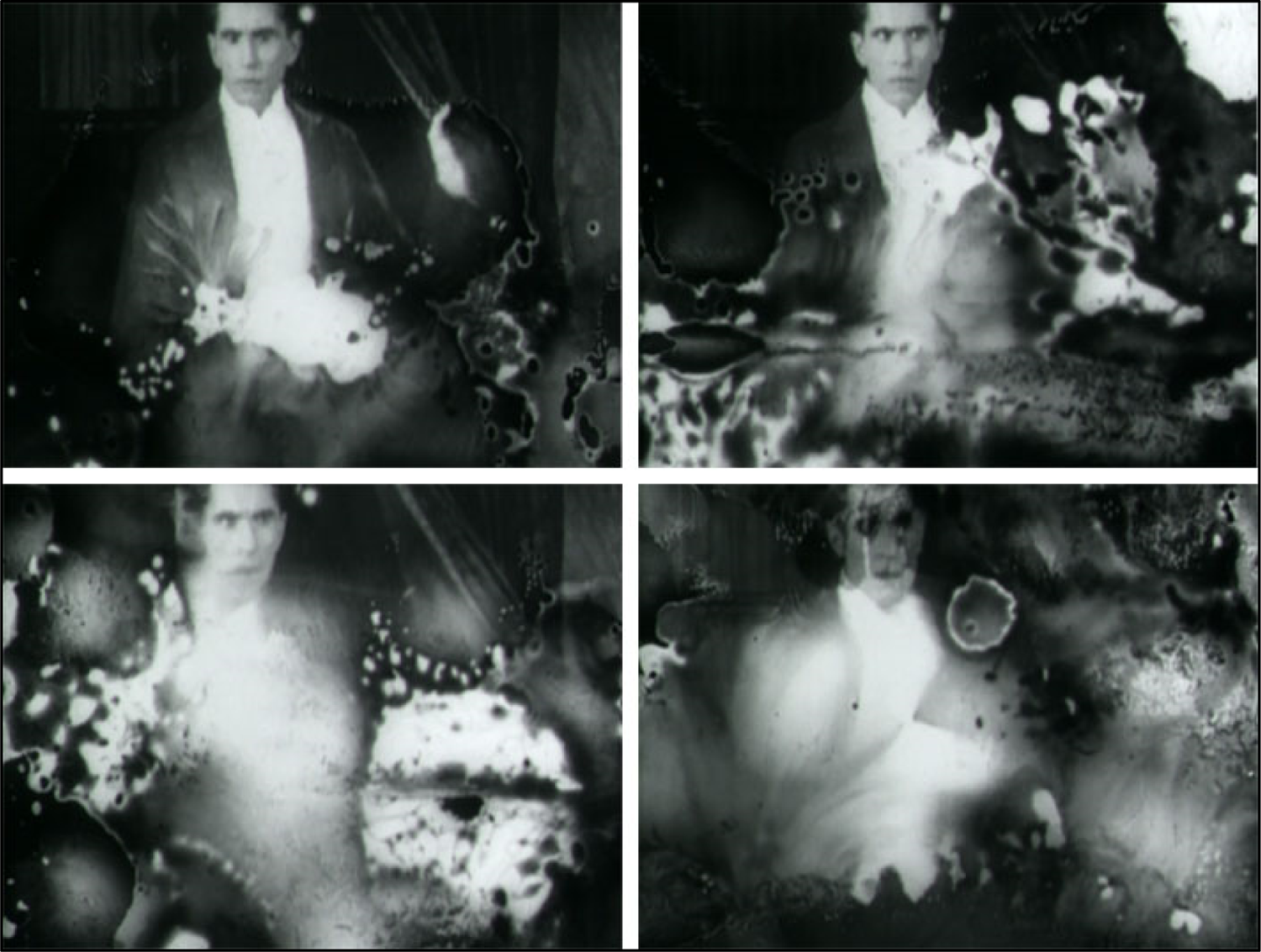
Emulsion degradation in Girl of the Bush. Source: Franklyn Barrett, 1921. Copyright National Film and Sound Archive.
Obviously this happens all the time in archives and national repositories that some natural process of degradation in a record or work is halted and the new version of the record now comes to stand in for the older version, which was materially susceptible to the depredations of humidity, heat, mould, ultraviolet light and oxidation. So in some ways it is simply a quotidian aspect of archival management that archives might store ‘copies’ of degraded records or works. Yet in other ways this is immensely significant because it calls into question the ontological status of the record itself and highlights the issue of archival dissolution and its relation to archival preservation.
In giving some kind of access to ‘the past’ – to documents and objects ‘from’ the past as well as to the ‘sense of a past’ that documents and objects refer to – archives are frequently understood as a kind of memory (Brothman, 2001: 50). Archives are not memory as such, just as photographic and film media ‘cannot be equated with, or reduced to, a supply of memories' (Kember, 2008: 177). Rather, for both individuals and collectives, they serve as a memory function because they re-mind us; by virtue of their material existence they bring the past to mind, in the same way that for thousands of years writing has been considered a form of external memory, a mnemotechnology, a prosthesis or supplement – even a dangerous one – to a psychic function (Derrida, 1981; Stiegler, 1998). If archives function as a kind of external and material memory – as both ‘personal’ memory for personal archives and ‘social’ or ‘collective’ memory for national repositories – then any degradation or dissolution in the archives must be understood as a kind of forgetting. This is particularly evident in image media, as André Habib notes, ‘fragments of rediscovered films, damaged prints, and anonymous bits of reel are memory traces of forgetting’ (Habib, 2006: 127). The images above, which are from Franklyn Barrett’s (1921) film Girl of the Bush (one of only two surviving films from Barrett’s entire oeuvre), illustrate clearly such a forgetting – the emulsion has melted away and whole parts of the image have been lost. In having this loss process arrested, however, by striking a new print from the degraded one, and having this new print substitute for the degraded print in its place and as the record it can no longer be, forgetting is inscribed into both the image content and the material form of the archival object. The archive has recorded its own dissolution.
The aim of this article, and the after | image project, is to ask what this could mean. What does it mean that an archive might record its own dissolution? How might such an event and practice allow us to reflect on the role and function of archives both in our personal lives and in the life of the nation? The emulsion–degradations in Girl of the Bush add multiple dimensions to the record that resonate materially, metaphorically and affectively, namely, a sense of the frailty, the contingency of both psychic and material memory; a sense of what is at stake in history making and in our very access to ‘the past’; a sense of the difficulty and danger of loss but also of the joy or freedom of loss, the way loss can open unexpected paths to the future; and thus an aesthetic sense and affective experience of the ‘awful beauty’ to be found in material degradation. These resonances were certainly not present in the work when originally created, and most likely did not form part of the record as originally archived, and yet they accrete as a function of time and archival practice, hence they are now intricately tied up with the record’s record-ness, by which we mean its status as a tangible but mutable record of the past in the present.
After | image focuses on archival dissolution in order to rethink archival preservation as part of a dialectical process where the past can be brought meaningfully into the present. Moreover, it forces archival dissolution in order to re-feel the archive, to probe the affective dimension of historical imagery, to seek new ways for the past to change the present and to produce images that operate as ‘a force with transformative potential’ (McGettigan, 2009: 31). The after | image project thus proposes a chemical pathway into the transformative potential of images, for example, dowsing photographic negatives in sulphuric acid (Figure 2).
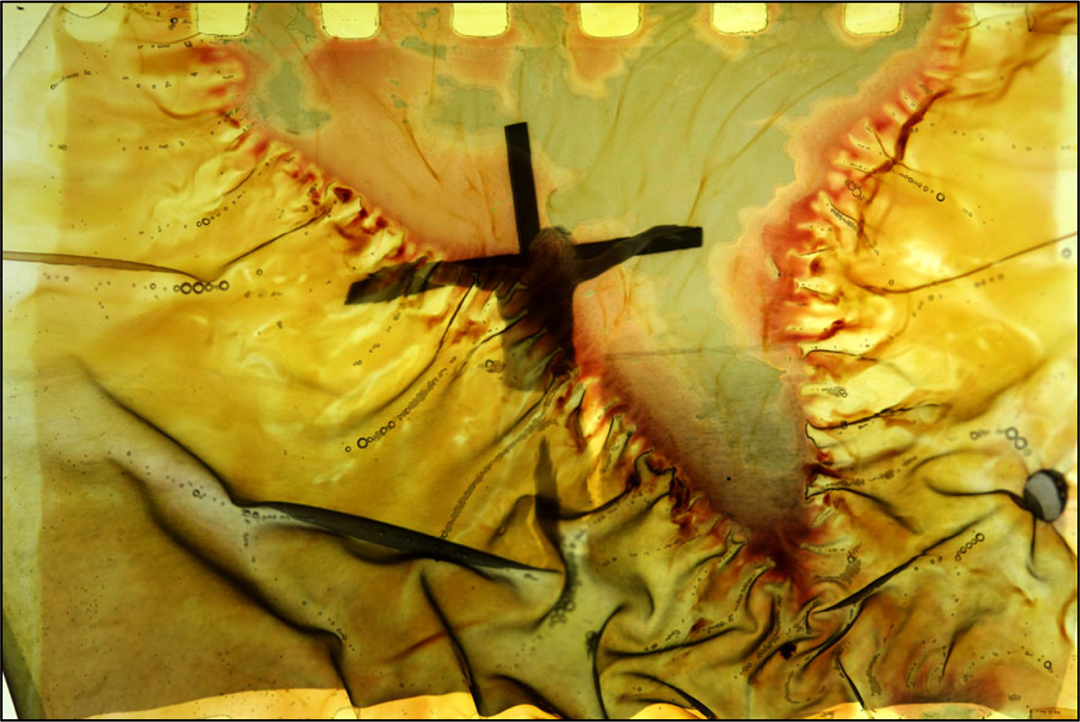
Photographic negative in sulphuric acid.
Archive, memory and medium
The after | image project stitches together a number of concepts or phenomena, and in this section of the article, we will outline these key concepts in order to set the ground for the following discussion of the project itself.
The founding concept for this project is the notion of the archive. Over the past 30 or 40 years, ideas about the role and constitution of archives have shifted as a function of broader enquiry into how history is ‘made’ rather than ‘discovered’. Sir Hilary Jenkinson, Deputy Keeper of the UK Public Record Office, argued in 1948 that: Archives are the Documents accumulated by a natural process in the course of the conduct of Affairs of any kind, Public or Private, at any date; and preserved thereafter for reference, in their own Custody, by persons responsible for the affairs in question or their successors.
It is now more commonplace, however, to understand archives as both this quite concrete collection of documents relevant to this or that organization or state department and the system of rules, regulations and technologies that determine such collection. It is the nature of Jenkinson’s ‘natural process’ which is queried here. Thus Michael Foucault’s observation, in The Archaeology of Knowledge, that the archive is better understood as ‘the law of what can be said, the system that governs the appearance of statements as unique events’ (Foucault, 2000: 129), was followed by Jacques Derrida’s now well-known argument that the structure and technologies of the archive determine not just the manner of archivization but what can be archived in the first place: ‘The technical structure of the archiving archive also determines the structure of the archivable content even in its very coming into existence and in its relationship to the future’ (Derrida, 1995: 17).
Ann Laura Stoler refers to this shift as the move from ‘archive-as-source’ to ‘archive-as-subject’, noting that the ‘archival turn’ that has been most volubly attributed to Derrida had already begun well before the publication of Archive Fever in the 1990s (Stoler, 2002: 93). Indeed, we can clearly see how the more broadly postmodernist concerns with situated knowledge, with provisional narrative, with partial perspectives, and the postcolonial and queer languages of difference and alterity, might underpin such a ‘different reflection on the politics of knowledge’ (Stoler, 2002: 88). These postmodernist concerns tease out the power and politics inherent in the notion of the archive and the act of archiving, focusing frequently on the relation of inclusion to exclusion. Sarah Tyacke observes that: state archives in particular reflect the histories of those governments and countries and give evidence of how power has been used, sometimes by the absence of records owing to deliberate destruction in sensitive areas or the almost obsessive total recording of activities in others.
The task that confronts analysts and users of archives today is to track the traces of these politics through the archives (tracking traces in traces, recursively) in both what is present in the archive and what is present only by its absence.
This question of inclusion and exclusion leads us to the second key concept for the project, namely, memory. Commentators on archival practice – particularly those commentators who explore the development of postmodernist perspectives on traditional archival practices – frequently define archives as a form of memory. As Brian Brothman notes, ‘the term “memory” is common discursive currency in the archival realm. Archivists variously use it to convey to others that their work has something to do with the past’ (Brothman, 2001: 50). Such a use accords with the traditional understanding of archives as an accumulation of what passes before the collector; memory as a personal psychic phenomenon can clearly operate as a metaphor for this practice. But of course memory is also infinitely more complex than this, being subjective, selective, subject to the vicissitudes of time and the vagaries of attention – the growth in studies in memory across philosophy, psychology and neuroscience throughout the 20th century is due testament to this complexity. Brothman proposes, then, that ‘archivists are urged to reconsider their working concept of memory’ (Brothman, 2001: 50), and it is this reconsideration that opens the way for postmodern perspectives on archives and archival practice to emerge.
Numerous subtly different formulations are used to tease out what this reconsideration might involve. For example, Joan M Schwartz and Terry Cook use the term ‘societal memory’ to define the scope, scale and stakes of this notion of memory – that is, that this is a distributed memory held by institutions in the name of both individual citizens and societies as a whole (Schwartz and Cook, 2002: 3). They also use the term ‘collective memory’, noting that archives ‘wield power over the shape and direction of historical scholarship, collective memory, and national identity’ (Schwartz and Cook, 2002: 2). They go on to further define this power, ‘the power of the present to control what is, and will be, known about the past … the power of remembering over forgetting’ (Schwartz and Cook, 2002: 3). If each of us, individually, forms an ‘identity’ in part as a function of what we remember about our past and our experiences, then societies form ‘national identities’ as a function of what is collectively remembered, stored and archived. The key point postmodern theorists make here is that this collective memory, like personal memory, is selective, it excludes whilst it includes, it forgets whilst it remembers, and it does this as a function of the political persuasion of the keepers of the archive, the inheritors of archontic power (Derrida, 1995: 3). As Terry Cook notes, ‘the archive is now perceived as a mere trace of missing universes’ (Cook, 2001: 27).
Cook’s phrasing is interesting, and we need to highlight the complexity of the use of the term ‘trace’ here, as it adds vital nuance to this notion of archival exclusion and forgetting. Trace is a deconstructive term, a key figure by which Derrida advances his theory of differance, the idea that signifiers – nominally elements of ‘meaning’ – signify recursively, by their difference from and deferral to other signifiers. The use of the word trace signals not simply that something has been elided and that it is up to the postmodern scholar to give voice to what has been silenced. Cook’s use of the word ‘missing’ seems counterproductive because it implies that the trace points to that which should or could be there but isn’t, it suggests that the postmodern scholar might seek to ‘put back’ what is missing. Sarah Tyacke says as much above when she talks about the ‘deliberate destruction’ of records; that which has been deliberately destroyed in the exertion of power is clearly missing. Cook and Schwartz suggest the same noting that archival power consists in controlling what is remembered and what is forgotten.
We do not wish to quibble with these observations but rather to suggest that the trace can also allow us to think archival records differently. The figure of the trace signals not that something in particular is absent but rather that what is there is only there by virtue of what is not. If one were to seek to put what is not there there, then one would discover that once again, what is there is only there by virtue of what is not. By this logic, archival records hold absence within them, as in Derrida’s later formulation of the mal d’archive which all ‘archive desire’ is premised on (Derrida, 1995: 19). Peter Fritzsche says as much in a plainer fashion when he states that ‘remembering and forgetting are two sides of the same coin’ (Fritzsche, 2001: 100). The idea that archival records are traces allows us to rethink the idea that archives are structured by inclusions and exclusions, remembering and forgetting, proposing that the ‘knowledge’ or ‘information’ or memory function encapsulated by the archival record might be fulfilled as much by absence as by presence, by loss as by gain and by dissolution as by preservation.
Two brief case studies of archival analysis can be used to bear this observation out and to highlight the remaining key concepts for the project, namely, the notions of the medium and materiality. In her article ‘The Archival Object: A Memoir of Disintegration’, Lisa Darms discusses the decisions made by archivists at the New York University Fales Library’s Downtown collection, regarding the storage of an item of David Wojnarowicz’s personal effects. Wojnarowicz was an artist and activist working in New York in the 1970s and 1980s. One of the items the Fales Library holds is Wojnarowicz’s ‘Magic Box’, a pine box containing miscellaneous items of personal significance Wojnarowicz kept under his bed – stones, feathers, seeds, plastic toys and so on (Darms, 2009: 146). As Darms explains, the key dilemma facing the Fales archivists was how to store the Magic Box whilst adhering to the Library’s mandate to preserve and conserve works in their collection: The box and its contents presented considerable preservation challenges; the wooden box and the plastic or painted objects within it off-gassed into the enclosed space, speeding the deterioration of all the objects. Other objects, like a chunk of concrete, were rough and chafed the objects around them. Some items were falling apart, and the shared weight of the objects surrounding them was only speeding this process.
In other words, here was an archival object structurally destined to destroy itself. Darms notes that to ensure maximum preservation of all the items in the box, each item would have had to be removed and stored separately, but this would have been to radically alter the specificity of the Magic Box itself – its provenance as a specific collection of personal effects (Darms, 2009: 146). Hence the Fales archivists decided to house the Magic Box ‘in the form and configuration it was when it arrived at the repository, and no preservation or conservation measures [would] be undertaken’ (Darms, 2009: 148).
The Magic Box, then, is a very complex object; an archival object that holds its archival value even as it deteriorates; an archival object that remains the same ‘thing’ and maintains its provenance at the same time as it changes physical form. Moreover, the more it deteriorates, the better it comes to represent the work of Wojnarowicz more broadly and act as a commemoration or memorial to his legacy: Because Fales archivists have made the decision not to physically preserve the Magic Box, it is in the process of its disappearance that another kind of evidence arises. This is evidence of loss, which is often the content of Wojnarowicz’s work, and now also becomes its form. It is also evidence of the impossibility of the attempt to preserve, which reveals the true pathos of the archives: disappearance.
The Fales archivists’ adherence to and maintenance of the contingency of the archival object foregrounds the material basis of archival memory, providing a tangible, affective dimension to the notion of archival forgetting. The same attention to the materiality and medium of the record can be found in Liam Buckley’s account in ‘Objects of Love and Decay: Colonial Photographs in a Postcolonial Archive’. Buckley gives an account of his research with the photography collection of the National Archives of The Gambia in West Africa. The photographs were produced during the space of a decade in the mid-1940s and 1950s, as The Gambia prepared for independence from the United Kingdom. As the title of Buckley’s article suggests, the photographs now operate as colonial remnants within a postcolonial nation, and it is this awkward status, this equivocation between regimes and therefore value systems, that presides over the material form of the collection.
By Buckley’s description, the photographs are in an advanced state of decay. He describes working in an archival space where the power is intermittent, the ceiling fans inoperable, the dust and dirt pervasive. ‘Dirt, dust, mold, torn paper, water damage, rodent droppings, empty folders, missing items – this is the stuff of the narratives of decay that accompany the presence of colonial artifacts in postcolonial archives’ (Buckley, 2005: 250). Rather than see this state of the archive as a sign of ‘postcolonial inefficiency and carelessness’, though, Buckley argues that ‘decay – as well as the right to allow for decay – is central to the cultural practice of archiving’ (p. 250). He positions the photographs within a matrix of interests and social dynamics that may question the right of the state to collect artefacts, the capacity of the state to store these artefacts in ways seen as appropriate by the original owners of the artefacts and the value of storage over destruction in the context of, for example, a widow who destroys her dead husband’s belongings as part of a grieving process (Buckley, 2005: 264).
In these broader contexts, the issue of archival decay can begin to look a little different. Buckley poses the possibility that archival decay may be an appropriate method by which postcoloniality supersedes coloniality and by which an act of mourning can be undertaken. Whilst ‘colonial photographs would play a key role in the postcolonial exercise of dismantling colonial ways of knowing the world’, in some instances, the very dissolution of such photographs may speak more loudly, and be felt more keenly, than their preservation (Buckley, 2005: 257). Recalling Roland Barthes, he argues that this discourse of archival decay is a lover’s discourse: But what about the encounter with the photograph that is itself about to expire? What is the structure of that experience? The figure of the widow who destroys her dead husband’s belongings reminds us that it is necessary to learn how to grieve and let go of the loved object and acknowledge the reality of its departure.
This question of the encounter with the decaying photograph recalls our mention of the resonance produced by the emulsion degradation in the Franklyn Barrett’s films, a resonance André Habib calls the ‘aesthetics of ruin’ (Habib, 2006: 132). Importantly, it is the materiality of the archival record, the fact of the photographic object’s chemical and physical susceptibility to time and environment, which facilitates this act of mourning, this conscious and intentional letting go. This material decay allows the archival object to operate not as a signifier of ‘fact-history’, but of ‘time-history’, which can be ‘understood as a natural process that affects matter and gives it its historical depth’ (Habib, 2006: 124). Allowing that archival objects are temporal things and not simply objective records, allows that their material or media form constitutes a vital aspect of their record-ness, and holds the potential to release individually affective as well as culturally significant knowledge that equals or in some cases exceeds the significance of their informational or image content. This is also to inflect the observations of Foucault and Derrida regarding the law of enunciability and technologies of archivization, with a medium specificity wherein the ‘law of what can be said’ is written not only by the archontic power but also by the medium of record itself.
Taken together, these case studies provide a range of pathways to understanding what might be useful, productive or significant about archival dissolution. Whilst in no way are we intending these perspectives to be taken as a critique of the personal and cultural value of archives or archiving, or to advocate any kind of large-scale archive destruction, we think they offer important limit cases by which to reappraise archival practice. They suggest that some archival records are most properly preserved by not preserving them. They suggest that allowing some archival objects to degrade enables a coming to terms with the past that complete preservation would not – and hence they further suggest that archival objects resonate with a complex kind of past-ness. The material mutability of the archival object stands as both a concrete index and rich allegory for the passing of time and the changing of minds, the attitudinal shifts that make memory such a vital living thing. If we are to have such a thing as external and material memory, both personal and collective, and if we are to bequeath this role of memory to archives of various sorts, then allowing archives to change like memories seems only appropriate.
Archive, image and ruin
The case studies in the previous discussion explore archival dissolution that comes about via a ‘natural’ process – that is, by an inevitable process that is not consciously accelerated by human or technical means in any particular way. Buckley even makes this point explicitly in his discussion of the rules governing the handling of items in the Gambian archives, ‘These regulations do not rule out the fact that things decay but rather prohibit readers from exercising their capacity to aid in that decay (Buckley, 2005: 251). The after | image project takes a rather more hands-on and accelerated approach to archival decay, but its processes are no less natural than what normally occurs in archives, especially in archives containing photographic and film media. The materials we use – strong acids, ionic solutions and oxidizing agents – are commonly occurring substances, a number of which (acetic acid, silver nitrate, sodium hypochlorite) already play a part in photographic media and processes; ironically, some of these materials have previously been investigated for their potential use in restoring discoloured and faded silver gelatin film negative (Johnsen, 1991). Nevertheless, there is an obvious difference between photographs mouldering in an archive and photographic negatives dissolving in a Petri dish; after | image operates via a series of analogies and allegories, whereby the artwork stands in for or points to a broader context and set of issues. In the realm of the archive, it enacts on a small and personal scale what happens on a large and national scale; it works with our memories and not the nation’s; it both accelerates and expands the temporal and material effects that archival objects are subject to; and it takes photographic media as a paradigmatic instance of the archival object more generally.
Photographic images and film media are rich in associations, and much has been written about their role as external memory as well as their relation to forgetting, loss and death. By their content photographic media operate as exemplary figures of memory, they hold images that recall our visual sense of a given spatiotemporal relation, a moment in time; and by their material form they embody the contingency of memory, the possibility of forgetting and the vicissitudes of time. Whilst Siegfried Kracauer suggests that photographs are unlike memory because they cannot crystallize that sense of significance that memory holds (Kracauer, 1993: 425), we argue that this only increases their function as aides-memoires; rather than substituting for it they point to psychic memory and form a kind of dialectic with it.
This function of pointing to psychic memory underlines the poignancy of the photograph and especially the archived and historical photograph; its structural absence of both the subject of the photograph and the perception memory of the creator. Roland Barthes’ identification, in Camera Lucida, of the essence of photography as a sense of the ‘that-has-been’ is exemplary in pointing to the gap between then and now, between that which ‘was’ and that which ‘is’ (Barthes, 1981: 77). In a perhaps histrionic but certainly evocative analysis, Eduardo Cadava sees this gap as a kind of death: In photographing someone, we know that the photograph will survive him – it begins, even during his life, to circulate without him, figuring and anticipating his death each time it is looked at. The photograph is a farewell. It belongs to the afterlife of the photographed. It is permanently inflamed by the instantaneous flash of death.
Whether read as a harbinger of death or simply as a reminder of time’s passing, the historicity or past-ness of the photographic or filmic image is paramount. The presence of decay in the photographic or filmic image serves to highlight this sense of the that-has-been. The work of film-makers, like Bill Morrison and Peter Delpeut, who work with degraded film stock found in archives or private collections, and the work of expanded cinema artist Jürgen Reble, who actively degrades film stock by chemical means in live performances, explicitly activate this sense of temporality and loss for their audiences. These artists – whose works form important intertexts for the after | image project – all produce works that unite image and medium, form and content, via the visible evidence of time’s passing and the loss that this implies. ‘The ruin breaks the spatial depth of the image (everything suddenly appears on the same plane—image and ruin), while inscribing on the surface of the film a temporal depth’ (Habib, 2006: 135).
Building on the preceding discussion of archival memory and forgetting, media and materiality, we would now like to turn to a more in-depth discussion of the after | image project. The photographic negatives used in after | image constitute a personal archive and are therefore an instance of personal material memory, standing in, within the project, for the national archive and collective memory (given our plans to douse negatives in acid, we felt we were unlikely to be given access to photographic materials in the national archives and thought it best to use an archive of our own). The negatives were not ‘collected’ under the same kinds of rules or strictures – laws of enunciability – that a national repository might operate under and so cannot be understood as an archive of the same order as a national archive, yet they were collected and preserved under a logic befitting their status; photographs produced by a high school student who later moved out of his parents’ home. Stored in negative file sheets in a ring binder in an attic for 20 years, they operate according to the logic Peter Fritzsche identifies, which turns ‘attics into archives’ (Fritzsche, 2001: 111). Fritzsche quotes John Gillis who argues that since the late 19th century – coincident with the development of photography – ‘each family is now the creator and custodian of its own myths, rituals and images’ (Gillis in Fritzsche, 2001: 111). These negatives were stored as aides-memoires, kept around for their capacity to, at some unspecified time in the future, point back to a specific time and set of circumstances and concerns in the life of their creator. The images – a fairly arbitrary collection of photos of friends along with naive experiments with multiple exposures and images arising from the Gothic subculture of the 1980s – are not of any real artistic worth, yet it is precisely in this that their real significance lies. Devoid of value in any broader realm, they can only really signify as a collection of personal image objects, the bare material evidence that a life has been lived.
Being stored in an attic and so particularly subject to the inevitable material degradation all photographic or film media face, some of the photos had already begun to degrade – in some negatives ‘vinegar syndrome’ had begun to set in (Figure 3), and others, poorly fixed and washed, had developed stains or had in places adhered to the backing of the file-sheets (Figure 4). Preserved by not being preserved, redolent of the past but not engaged with or in the present in a meaningful way, this collection of photos seemed the perfect object with which to conduct an interrogation of the archive, its memory function and its materiality.
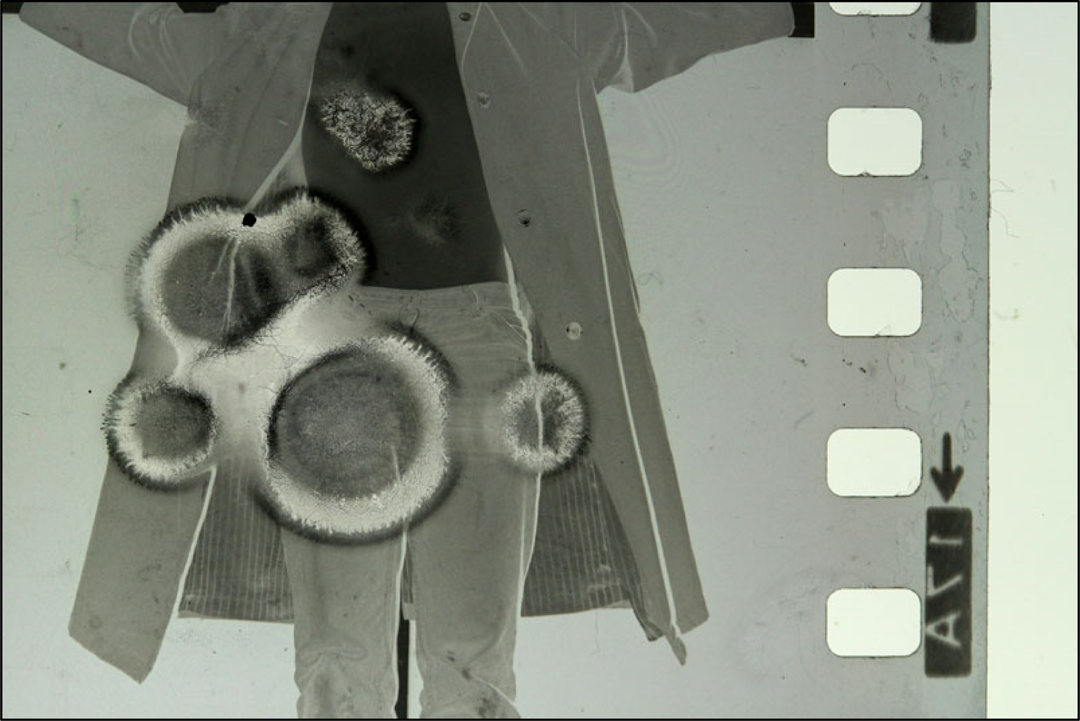
‘Vinegar syndrome’ emulsion degradation.

Poorly fixed negatives can develop yellow staining.
The after | image project uses a laboratory context and the scientific method to produce a heightened sense of the fragility of memory and the stakes of archival preservation. It evaporates photographic images of their imageness, collapsing the image into the medium and reducing the medium to a kind of bare chemical reality, a question of ion exchange and electron transfer. In testing each new substance for its effects, we track the temporality of its effects on cellulose acetate film, using the scientific method to test not for the truth of a hypothesis but for aesthetic fitness. Each chemical process has its own temporal dynamics; it contains multiple ‘events’, speeds and slownesses, and our intention was to track the aesthetic envelope of these events, seeking the points where the material degradation best coincided, for us as ‘observers’, with the feeling of the evaporation of memory where the affective charge would align most strongly with the dynamic of the chemical process.
Hydrogen peroxide, for example, is a highly corrosive oxidizing agent with a relatively linear onset and image dissolution envelope; for a brief period a few minutes after application, we see a kind of ‘flowering’ of a golden colour in the emulsion, probably a result of the oxidation of impurities, such as sulphuric acid, remaining from the production of the cellulose acetate film (it is somewhat reflective of the ‘fading’ browning effect that can be observed in old film). Once all the oxidation of this material has taken place, the emulsion is then attacked and the oxidation mobilizes the silver metal to silver ions, which literally reverses what happens during film processing where the reducing agent reacts to convert the silver ions to silver metal (Figure 5).

Hydrogen peroxide after (clockwise from top left) 0 min, 2.5 min, 50 min and 210 min.
Acetic acid is a weak acid that produces a very different image dissolution envelope. The reactions of the film with C2H4O2 begin by stretching the emulsion layer and buckling the image, then the film base expands and the buckling reduces and finally both emulsion and base contract and dry as evaporation occurs (Figure 6). These behaviours may be due to the dissociation of the hydrogen ion from the acetic acid molecule (CH3COO−°+°H+), enabling interactions to be made between the cellulose acetate film and the negative charges associated with acetate ions (CH3COO−), particularly if only partial acetylation of the cellulose acetate was originally achieved during film manufacture (Taubman, 1935). Whilst vinegar is essentially dilute (approximately 5%) acetic acid and the film degradation known as ‘vinegar syndrome’ is the result of acetic acid being released from degrading acetate, the observations we made were quite different than those seen after extensive vinegar syndrome, due partly to the fact that the film was wetted with the acetic acid solution in our experiments.
Acetic acid after (clockwise from top left) 0 min, 8 min, 23 min and 198 min.
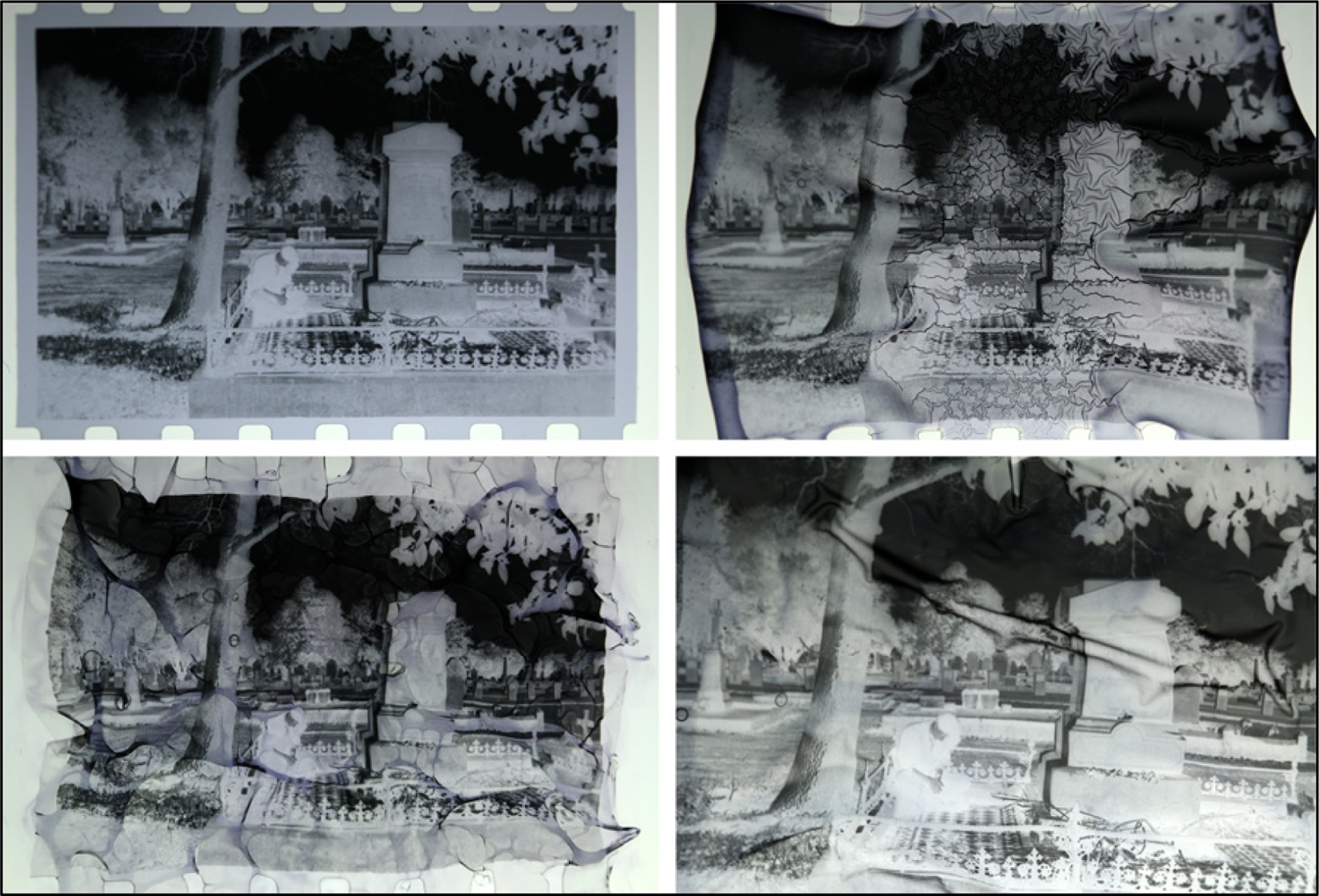
Sulphuric acid is a highly corrosive acid that is used as a catalyst in the production of the cellulose acetate support layer in photographic film. Of all the processes we explored, it had perhaps the most dramatic, complex and conceptually resonant dissolution envelope. It begins by stretching, buckling and lifting the emulsion layer from the film base, so the image floats free of its material support; our observations suggest that this is due to the sulphuric acid reacting with the gelatin emulsion layer in the film rather than the silver that constitutes the image. The gelatine layer expands and the image expands with it (when we intentionally restricted this expansion the pattern resulting from the crumpling effect was reminiscent of a Mandelbrot set, showing some apparent order in the evolving process). The film base then begins to burn away in striking orange and brown waves, until finally the emulsion curls up and dissolves over the space of 2–3 hours (Figure 7).
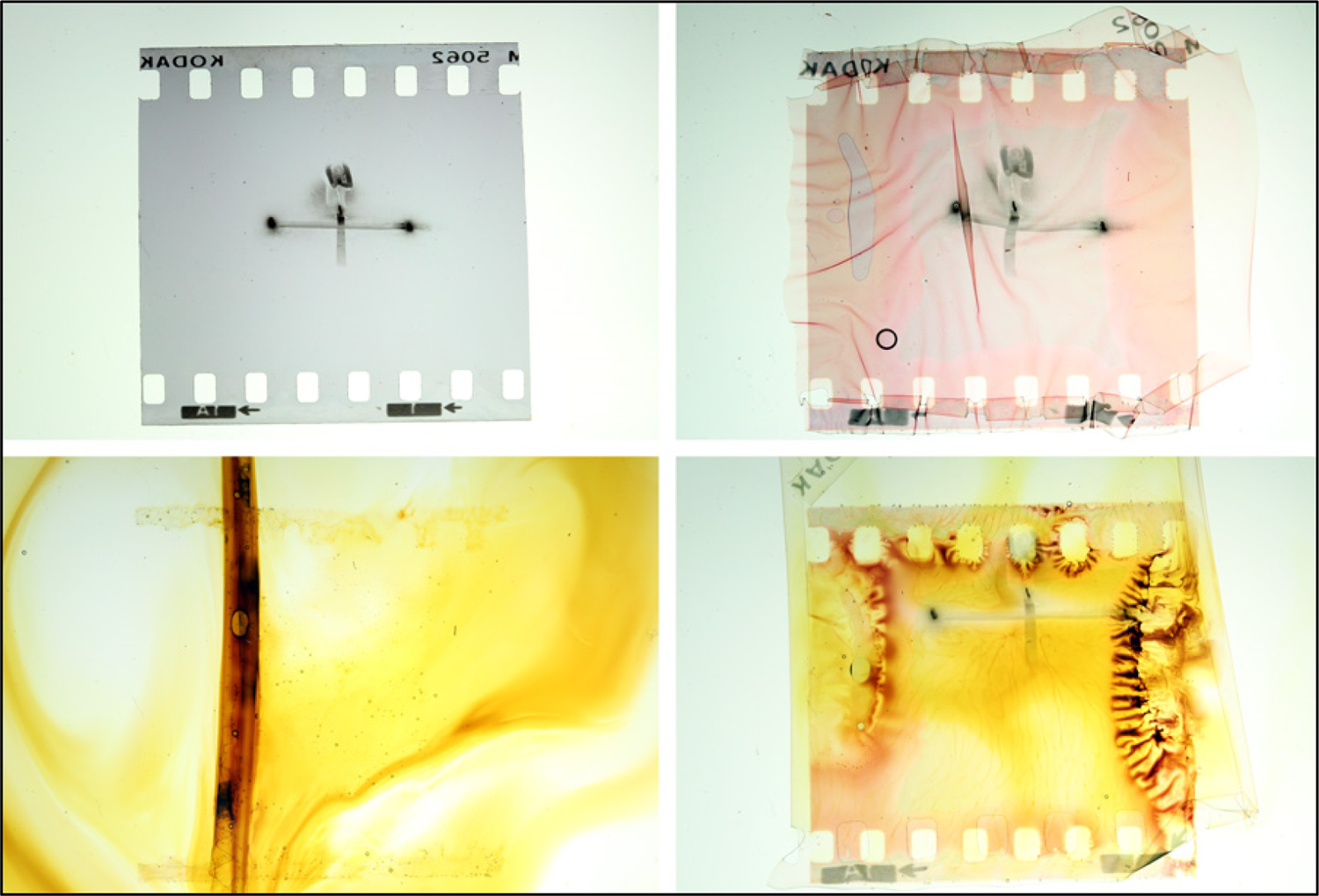
Sulphuric acid after (clockwise from top left) 0 min, 2.5 min, 11 min and 30 min.
Via the project’s structural allegory, each of these processes literalizes, in different ways, the malleability and fragility of memory – personal and collective, psychic and material. The project necessarily also comprises a compendium of forgetting, a collation of event sequences that explore the different dynamics of a kind of active or conscious forgetting, a forgetting that in its release of the image from its material support does justice to memory and to what emanates from the past, at the same time as it shifts from one medium to another, from analogue film to digital file. Thus, each process also demonstrates a different interaction between the image and the medium, entwining this notion of memory with the affordances of the media we place our faith in to preserve what we externalize. Through the time-lapse process, where a single photographic negative is now made to spit out thousands of unique images in the space of a few hours, the time of the archive is hyperbolized and spatialized, collapsing a decay that might normally take years to occur into the work of a moment, chemically expanding the range of effects that could occur during this time and intricately documenting this process.
But to record the archive’s dissolution, and hence with an artwork to require that an audience bear witness to the archive’s disappearance, is very different from discovering its disappearance after the fact. The time of the archive is not simply a question of the passing of time and evidence of its material effects, it is also about the gap between the moment of a record’s creation and the present moment of its apprehension. This is the record-ness or past-ness that constitutes one of the key experiential values of archives, and it is here that after | image seeks to make a contribution, concatenating the past in the present in a particularly urgent and, indeed, violent way.
Walter Benjamin’s historical materialism is similarly concerned with this sudden and potentially violent irruption of the past into the present. In both the ‘Theses on the Philosophy of History’ (2007) and The Arcades Project (1999), where Konvolut N contains much that is later reworked for the ‘Theses’, Benjamin outlines the method and political expediency of reorienting traditional historical linearity, of ‘brush[ing] history against the grain’ (Benjamin, 2007: 257). In an influential prefiguring of the postmodernist ‘historical turn’, Benjamin’s critique of historicism involves a refusal to see historical time as progressive, as a series of linear moments which can be accessed historiographically in order to present history ‘the way it really was’ (Benjamin, 2007: 255). Images of the past must be seized from this progression, given the danger that they become ‘a tool of the ruling classes’ (Benjamin, 2007: 255). The material manifestation of such a view of history is likewise tainted with this logic, ‘There is no document of civilization which is not at the same time a document of barbarism’ (Benjamin, 2007: 256). The task of the historical materialist is thus to wrest the significant moment from the historicist perspective, it must ‘renounce the epic element in history’ and ‘explode […] the homogeneity of the epoch, interspersing it with ruins – that is, with the present’ (Benjamin, 1999: 474). Underlining the urgency Benjamin feels in confronting this task, the language he uses to describe this task is forceful and invokes the violence of war; the historical object must be ‘blasted out of the continuum of historical succession’ (Benjamin, 1999: 475); the angel of history regards history not as a neutral ‘chain of events’ but as ‘one single catastrophe which keeps piling wreckage upon wreckage and hurls it in front of his feet’ (Benjamin, 2007: 258).
It is the figure of ‘image’ or the ‘dialectical image’, which stands as the manifest potentiality of this historical rupturing, the sudden revelation of the ruin in/of the present. Whilst this figure is elliptical, and this ellipticality is often noted – Rolf Tiedemann notes that it ‘never achieved any terminological consistency’ (Tiedemann, 1999: 942); Andrew McGettigan says it lacks ‘clear, systematic presentation’ (McGettigan, 2009: 25) – it provides us with illuminating avenues for thinking after | image as an interrogation of the potential archives hold for injecting the past into the present in unexpected ways. In an often-cited formulation, Benjamin writes that ‘image is that wherein what has been comes together in a flash with the now to form a constellation’ (Benjamin, 1999: 463). Later he expands on this sudden ‘flash’ of the image, ‘The dialectical image is an image that emerges suddenly, in a flash. What has been is to be held fast – as an image flashing up in the now of its recognizability’ (Benjamin, 1999: 473). At this moment, the now of its recognizability, what has been – some element from and of the past – combines with the present to form a constellation that momentarily illuminates both the present and the past differently, ‘The rescue that is carried out by these means – and only by these – can operate solely for the sake of what in the next moment is already irretrievably lost’ (Benjamin, 1999: 473). This notion is later rephrased somewhat in the ‘Theses on the Philosophy of History’, ‘The true picture of the past flits by. The past can be seized only as an image which flashes up at the instant it can be recognized and is never seen again’ (Benjamin, 2007: 255).
What do these figures mean and what use can be made of them? Benjamin is writing during a time of immense social upheaval and personal danger. As many commentators note, the personal and political urgency with which he writes can be read into his language in different and even contradictory ways, and in invoking this language now, at the start of the 21st century, we are cognizant of the enormous gap between Benjamin’s ‘now’ and the now of this writing (Bullock, 1988: 1102). Nevertheless, Benjamin’s concern with ‘rescuing’ a notion of history from chronological progression and the narratives of the victors, and saving images of the past from ‘enshrinement as heritage’ (Benjamin, 1999: 473), echoes well beyond its sounding in 1930s Europe, as evidenced by the role played by such a revisioning of historiography and archival practice in postmodern and postcolonial theory. Benjamin’s writings are filled with the tremendous energy contained in the notion of history, a sense not of any order that historicism brings to events in and documents from the past but rather a sense of what the appearance of this order must contain and repress in order to function. That the richness of all that historicism elides – a ‘true picture of the past’ – might burst forth and momentarily flood the present is the power that charges these writings.
We are interested less in explicating Benjamin’s writings within a specific historical and revolutionary context and more in investigating the possibilities his writings can open up for conceiving and understanding works of art concerned with how archives activate images of the past – images both as actual, visible, legible and material things and as conceptual clusters or ‘constellations’. What does it mean that the true picture of the past ‘flits by’ and that the past’s relation to the present exists as image only in the space of a flash, to be then ‘irretrievably lost’? Cadava suggests that: if ‘the true picture of the past flits by’, it is not so much that we are unable to grasp the truth of the past, but rather that the true picture of the past is the one that is always in a state of passing away.
Disappearance is a formal requirement of this image of and from the past, it must risk itself and risk itself constitutively, in its conceptual and material articulation, if it is to mean anything to and in the present, if it is to matter.
The question the after | image project revolves around is whether such an image can be produced – in other words, what would happen if we were to take Benjamin literally? To produce an image of the past one must produce an image that itself passes away – a memory subject to forgetting, a picture made of past-ness. Like the archival trace, this must be an image object that holds its own absence within it in both a conceptual and material sense. Hence passing away must be produced as well; that is, passing away must be constitutive, a law of enunciability.
We would argue, then, that the archive that records its own dissolution, and that substitutes dissolution recording for preservation, fulfils the requirements of this formulation. The after | image project is designed around this double move – it produces the passing away of the past and records it, requiring that what it records is made available for further passing away, recursively. If ‘history can be grasped only in its disappearance’ (Cadava, 1992: 109), then after | image gives us an image of both this disappearing history and its grasping, and being an artistic work, it provides for an audience an experience of this, an affective and intellectual mapping of what is at stake in both archival preservation and dissolution. The project thus provides a new way to think about the memory function of the archival object; where Lisa Darms asks ‘can the archival object be described as moving forward into the future, rather than exclusively in terms of its origins?’ (Darms, 2009: 153), we answer in the affirmative that after | image produces the archival object as active memory not as static memorial and includes active forgetting, a forgetting that takes stock of the past as it passes away, constitutively within this active memory.
Moreover, in asking what it means for archives to record their own dissolution, after | image keeps the medium of record at the forefront of this process because it involves a format shift from analogue to digital; what started as around 200 celluloid negatives ended up as some 200,000 digital images and a terabyte of data plus a motley collection of Petri dishes and dessicated remains (Figure 8).
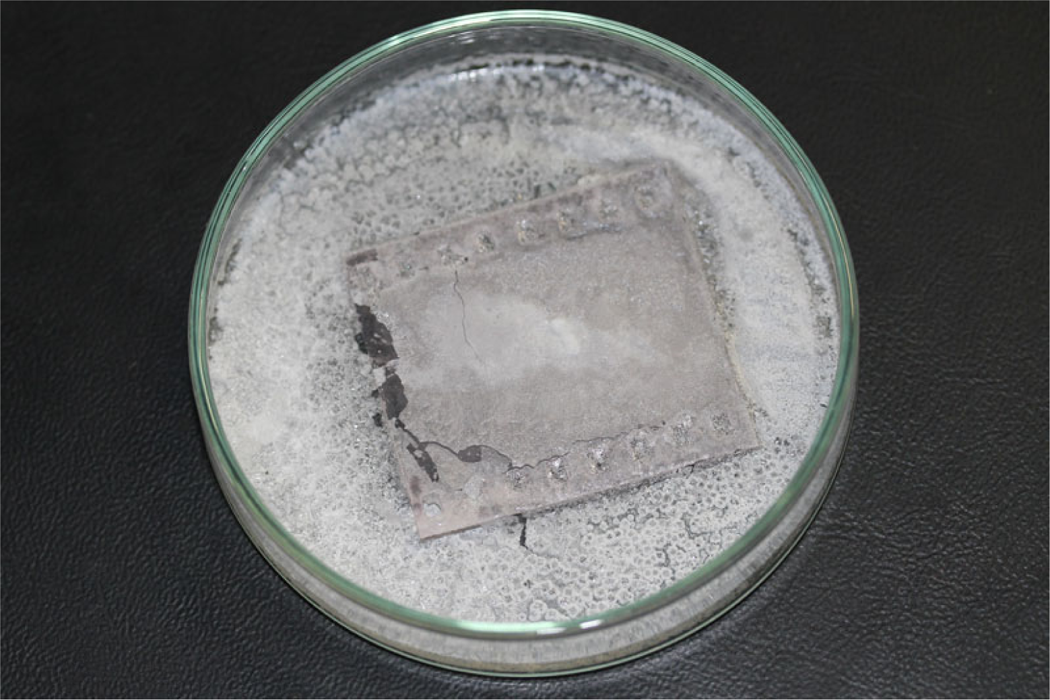
Cellulose acetate and sodium hypochlorite after approximately 24 hours.
The massive disparity in number between the analogue and digital materials, as well as the qualitative difference in kind, is one of the central ironies of the project, and it operates as an important touchstone in thinking the project’s relation to the role of digital media in personal lives and increasingly in archival practice – it is in its use of digital media that after | image invokes the question of the future, the question ability of the future and thus also the future of archives and archiving. There is no question that digital media have come to substitute for the memory function that, for the past 120 years, has been performed by photographic and film media. If, as Peter Fritzsche suggests, the 19th century’s ‘memory crisis’ found in photography both its salve and clearest expression, then the 21st century’s memory crises will be intimately tied up with the affordances of digital media (Fritzsche, 2001: 110). The format shifting of personal and collective memory has been accompanied by a massification of digital imaging technologies and their imbrication into social systems, where social relations are increasingly performed via digital media, in peer-to-peer technologies, fan fiction, media-sharing websites and other Internet technologies. Archives, museums and libraries are all dealing with the aftershocks of this shift, whether it is a question of how to archive new born-digital works, or preserving decaying material works by digitally copying them (Santone and Straw, 2009: 259–260). In many ways, digitality embodies the question of the image of the past for the future; it rescues the archival object from the dangers of material degradation, of oxidation, of chemical decay, and at the same time introduces a panoply of other issues to do with choice of storage format, programmed obsolescence and the upgrade cycle. The question of the medium and its modes of dissolution, the different ways it will perform a memory/forgetting function, are maintained even whilst material problems appear to be evaporated by the promise of digital immateriality.
Archival dissolution is not for the faint-hearted. We do not advise it for everyone! But maybe it can be our Nietzschean ‘robust health’ if we let it (Nietzsche, 1989: 58). Maybe some things we can preserve in order that they dissolve, that we might gain something from this expiration, this awful beauty, that we might rescue them from the archive in order to save the archive itself, ‘To the process of rescue belongs the firm, seemingly brutal grasp’ (Benjamin, 1999: 473). Why destroy the archive and record its dissolution, why commit archival treason? Because in doing so, you can make it live again.