




Abstract
The rise in self-publishing, digital folk culture and social media participation, have revolutionized reading and writing practices. Readers can directly contact their favourite authors, and publishers, through social media and become authors, and publishers, themselves. One of the outcomes of digital reading and writing is that writing is now becoming more democratic: traditional publishers are no longer the sole gatekeepers of culture. The popularity of social writing platform Wattpad is a recent example of how a new generation of influential and innovative writers is entering the publishing arena. This also demonstrates that there is a demand for authorship without the intervention from publishers. Despite this, traditional notions of authorship, ownership and control are prevalent in contemporary publishing hindering the true potential of creativity. The disharmony between the rise of the amateur author and the control of the traditional publisher is confronted in the digital public sphere. Consequently, issues such as authority and influence are mediated during the activities and interactions that take place on social media and other online platforms. Established authority figures, such as famous authors or well-known publishers, that exert authority and influence in the traditional sphere, can shift this authority and influence to the digital world; however, this sphere is also occupied by emerging networks of influencers, such as emerging authors or micro-celebrities, who gain popularity as a result of specific trends, in specific domains, at specific times. This article will examine how new and established authors are using social platforms, and social media, to publish their writing, build communities and extend their dialogue with readers and other writers. A netnographic study of Wattpad will identify which authors are the influencers and innovators in social publishing. Consequently, this article will underscore the increasing importance of social networks and social relationships in 21st century publishing.
Keywords
Introduction
Social computing has created a shift from consumer culture to a culture of participation: what Benkler (2006: 10) describes as ‘from the mass-mediated public sphere to a networked public sphere’. This allows consumers to contribute to social collaboration and production instead of, simply, passively consuming products. Cultures of participation, such as online reading and writing platform Wattpad, help to open up the creative process by shifting power towards a network of prosumers (Jenkins, 2006; Rifkin, 2014). Despite many doomsayers predicting the demise of the book trade, as a result of developments in new mediums, for at least a century: people are still reading books for entertainment. Instead, the development of the media has created many new opportunities for, existing and emerging, authors and consumers of content.
The publishing industry has come a long way since Darnton’s ‘Life Cycle of the Book’ (Darnton, 1982). Ray Murray and Squires’ (2013) ‘Digital Publishing Communications circuit’ shows how readers, enabled by social media, have more of a proactive and interactive function, which has shifted the author–reader dynamic. Boyd (2008) describes this as a context collapse because it allows the various parties to coexist in a social context where they were once separate. Publishers and authors can now directly communicate with readers and potential readers, through social media, and build author and book-related communities. This not only can lead to direct sales but it also allows publishers and authors to gain a better insight into reader needs and wants. Jenkins (2006: 135–136) asserted, 10 years ago, that the Internet provided ‘a powerful and new distribution channel for amateur cultural production’: digital folk culture has grown exponentially since then. The rise in self-publishing, and the popularity of social writing platforms like Wattpad, show that there is a demand for authorship without the intervention from publishers. Readers can directly contact their favourite authors, and publishers, through social media and become authors, and publishers, themselves. Despite this, traditional notions of authorship, ownership and control are prevalent in contemporary publishing hindering the potential of creativity. Some traditional publishers are beginning to embrace self-publishing by developing their own self-publishing imprints and scouting for talent among other self-publishing platforms (Phillips, 2014). However, these publisher-led initiatives have not always been popular or successful: the demise of HarperCollins’ writing platform Authonomy, the failing of Penguin Random House’s Author Solutions, the Twitter controversy surrounding HarperCollins’ decision to sell teen writing platform Inkpop to a rival company and concerns around the commercialization of fan fiction suggest that participatory cultures of creation do not work under corporate publishing structures (de Kosnik, 2009, Mance, 2015, Page, 2015).
The disharmony between the rise of the prosumer and the control of the traditional publisher is confronted in the digital public sphere. Consequently, issues such as authority and influence are mediated during the activities and interactions that take place on social media and other online platforms. Established authority figures, such as famous authors or well-known publishers, that exert authority and influence in the traditional sphere, can shift this authority and influence to the digital world; however, this sphere is also occupied by emerging networks of influencers, such as emerging authors or micro-celebrities, who gain popularity as a result of specific trends, in specific domains, at specific times. It is essential to understand these emerging influencers, and how popularity and authority are negotiated in the digital sphere, to further elucidate the practices of gatekeeping and networked gatekeeping and to understand authorship and publishing in the 21st century.
Evolution of authorship
Authorship remains a fascinating topic for academic discussion and deconstruction. The idea of the author as the original creator of a works is a modern concept; a product of the Romanticism of the late 18th and early 19th century, which introduced the concept of proprietary authorship, and placed a greater emphasis on the individual, while often neglecting the wider social context (Feather, 2007; Rose, 1994). Foucault, and several other scholars, proposed, over 30 years ago, that the concept of the author was a modern one, and was outdated because it did not reflect a contemporary, and more collaborative society (Foucault, 1977; Jaszi, 1994; Woodmansee, 1984, 1994).
This historical elevation of authorship has lead to the author having cultural capital and, thus, influence and authority over matters of opinion: cultivating a trust through their occupation (Bourdieu, 1986; Emminson and Frow, 1998). This has been perpetuated through the rise of the celebrity and brand-name author, which started with authors such as Walter Scott and Robert Louis Stevenson. 1 These celebrity authors were able to secure a larger income as a result of their fame; however, this was not the case for middle and low ranking authors. Additionally, the gulf between readers and writers increased in the 19th century as media ownership and authorship became more concentrated (Feather, 2006). The author-centric ideology, centred on the idea of a solitary genius, is still very much in existence in 21st century literary culture. Publishing in the 21st century has become increasingly celebrity/brand-name author driven as a result of the conglomeration of the publishing industry. Conglomeration has transformed authorship and publishing into a more competitive, cross-media discipline (Moran, 2000). Many publishers are now persistently looking for potential bestsellers, and authors who can be used as marketable commodities. Clark and Phillips (2014) observe that as the book market became more polarized, with the focus shifting towards bestsellers, publishers began to cut their lists and concentrate on their most marketable authors. Midlist and first-time authors have suffered as a consequence. Contemporary authorship is characterized by the polarity in authors earnings; expressly, that a small percentage of, brand name or celebrity, authors command large advances for their forthcoming works while many of the remaining authors live below the minimum income standard. According to a survey commissioned by the United Kingdom’s Authors’ Licensing and Collection Society, the typical annual income of a professional author was £11,000 in 2013, with only 11.5% of professional writers making enough to earn their living solely from writing, compared to 40% in 2005 (Gibson et al., 2015). In the United States, a survey by the Authors Guild found that more than half of the respondents earned below poverty level, for their writing, and that the median income for an American author in 2014 was US$8000 : a 24% decrease from 2008 (Deahl, 2015). Despite this, the romance and opportunity associated with authorship is still very much in existence; and the evolution of digital technology enables aspiring authors to contribute to the exponential growth of digital literary content. 2 One of the outcomes of the digital shift is that writing is slowly becoming more open and democratic and that traditional publishers are no longer the sole gatekeepers of written culture. While Phillips (2014) suggests that self-publishing mirrors traditional publishing in that a small percentage of authors dominate the market, a new generation of authors are building audiences, on social platforms, through direct engagement with readers even before publishing through platforms such as Amazon/Kindle Direct.
The popularity of Wattpad and booktubing (book culture on YouTube) are recent examples of how a new generation of, social media-savvy, influential and innovative writers are entering the publishing arena. Wattpad, created in 2006 by Allen Lau and Ivan Yuen, is a network of user-generated content, which has also been described as the YouTube for stories (without the videos). Wattpad is an experimental platform for aspiring and experienced authors allowing them to publish their work, get feedback, and connect with other writers and readers. For readers, it is a platform – available on laptops, computers, mobile phones and tablets – with a diverse array, across a range of genres (mainstream and niche), of content available for free. For publishers and literary agents, it is a hotbed of literary talent, where gatekeepers, such as publishers or agents, can scout the next Anna Todd or Beth Reekles (two authors that have been published by traditional publishers as a result of their popularity on Wattpad).
Social media and social authorship
Social media researchers have found that participation in social networks is a good way of accruing social capital (Bourdieu, 1986, Ellison et al., 2011). In the case of, existing and emerging, authors, it is a good way to build an audience and raise awareness of themselves and their body of work. Additionally, Hampton et al. (2011) found that users of social networking sites have a more diverse network than non-users, which means that authors can further extend their visibility with online social engagement.
Social media has changed the way that users interact with, and relate to, celebrities: in the case of this research, well-known authors (Marwick and boyd, 2011). It has also, due to the increased ease of creating and distributing content, bolstered the micro-celebrity or citizen influencers, that is, non-famous people who use social media to build an audience and status online (Senft, 2008, Shaefer, 2012). Zoe Suggs/Zoella, the YouTube star with over eight million subscribers, is a good example of this. Suggs’ debut novel, Girl Online, sold 78,109 copies in its first week: more than J. K. Rowling, Dan Brown or E. L. James sold in their first weeks, breaking the sales records as recorded by Nielsen (Singh, 2014). Social platforms, such as Wattpad, empower writers to become networked micro-celebrities: Wattpad writer, Anna Todd is a very good example of this. Such users attract attention and visibility in an overcrowded social environment. This high visibility allows these micro-celebrities/users to become influential and spread a particular message; or in the case of Wattpad, story. Experts, such as well-known authors, with large fanbases, have, traditionally, held this sort of influence (Katz and Lazarfeld, 1955). Established influencers transfer their popularity and power to online platforms such as Wattpad; however, they work alongside inexperienced, emerging authors. Marwick and boyd’s (2011) study shows how social media, namely, Twitter, can be used to maintain and enhance popularity and celebrity status: allowing celebrity authors to extend their reach, and their brand, into new and emerging markets. Shaefer (2012) concludes that while citizen influencers are on the rise and are becoming as influential as celebrities: Celebrity culture is stronger than ever.
Social authorship, however, is not a new phenomenon: Ezell (2003) argues that manuscript authorship was inherently social since the authors did not write with a commercial readership in mind. The reader was involved in both the production and the consumption of the text because the text was not fixed (printed). Ezell asserts that print technology created the modern author and shifted social authorship to commercial authorship. Social, manuscript, authors often wrote at their own expense and for reasons other than profit. Therefore, print authorship was often at the detriment to these authors because print technologies do not always consider the different types of authors: authorship was, and still is to a certain extent, intrinsically linked to a printed book. Barriers such as class and gender prevented authors from fully participating in the new printing technologies during the 17th and 18th century: Such barriers are still in existence today (Ezell, 2003). The ‘dynamic network of writer and reader’, that Ezell (2003: 40) discusses, endures on social reading and writing platforms such as Wattpad. Just like manuscript publishing, readers on Wattpad are involved in both the production and the consumption of the text because it is not fixed, is it fluid. Readers can be editors (beta readers) and can increase the circulation of the text through their own networks: accentuating the role of the reader in social authorship (Ezell, 2003, Karpovich, 2006). This reinforces the idea of the book as a cultural concept, which is not tied to print (Carriere and Eco, 2011).
Methodology
This article will examine how new and established authors are using social platforms to publish their writing, build communities and extend their dialogue with readers and other writers. Focusing on the ‘most popular authors’ on Wattpad, this netnographic study – employed to understand online practices and behaviours – will identify which authors are the influencers and innovators in social publishing. This article helps us understand why online author communities and publishing platforms are being established and becoming increasingly popular, and what this means for contemporary authorship and publishing. Consequently, this article will underscore the increasing importance of social networks in 21st century publishing. The netnographic approach was essential for capturing Wattpad as a social environment, and thus the dynamics and relationships within this environment.
According to Mary Meeker’s annual report on Internet trends, Wattpad has over 40 million people using the site each month: up to 48% year-on-year. Ninety percent of Wattpad users are readers (commenting, sharing, reading and voting) though the majority of the 10% of users writing are also reading. Additionally, 100 million stories have been uploaded and shared on the social reading and writing platform, with at least 250,000 shared every day: approximately 24 h worth of reading materials posted every minute (Meeker, 2015). Popular stories, with a large number of votes, coexist with an abundance of niche and specialist stories: a good example of what Anderson (2006) describes as the long tail. While this virtual bookshelf of user-generated content could seem intimidating to new users, because of the lack of traditional markers such as recognizable authors and publishers, Wattpad is an effective discovery mechanism. The ‘Discover’ tab on the website allows users to browse genres, featured stories, ‘Watty’ award winners, ‘undiscovered’ stories, ‘what’s hot’ and ‘what’s new’. In particular, the what’s hot and what’s new items are daily-changing lists, generated by algorithms based on user interactions: the reads/votes/comments in the last 24 h. The ‘featured’ list is a compilation of staff picks based on a combination of personal favourites, data on top stories and stories with a broad appeal. Writers can also submit their stories to be on the featured list. Additionally, virtual communities can help their members navigate through the deluge of information: Wattpad has a number of genre specific and speciality clubs for users to join (Rheingold, 2000).
The focus of this article will be the ‘popular author’ list: an algorithm generated list of 200 Wattpad users (visible under the Discover tab). The statistics are based on the Wattpad users with the most followers, the most reads or votes for their story/stories or users who have recently acquired a large number of new followers. Although it will not be explored in this article, it is important to note, at this juncture, that this emergent type of gatekeeping, based on human-created algorithms, still contains ‘both human and technical biases’ (Bozdag, 2013: 209). 3 This ‘popular’ author list changes on a regular basis; however, the majority of users featured on this list remain the same. Fifty of the users on the list had not written any stories, so this analysis will focus on the remaining 150 writers. Data – such as number of followers, traditional publishing experience, genre/s, popular stories, comments on profile page, interaction with readers and so on – was collected to generate a comprehensive picture of the most popular authors on Wattpad. 4 This article will not try to understand why these authors write but will explore what makes them popular in a saturated platform.
Popular authors on Wattpad
Like Twitter, verification allows Wattpad to establish the authenticity of well-known authors: there are a number of less well-known authors, who are traditionally published, that have not been verified. To give an overview of the most popular 150 authors, 17 were verified authors and include traditional, authors such as Margaret Atwood, Paulo Coehlo, Dan Brown, R.L. Stine and Marian Keyes. However, the verified authors also include hybrid authors such as Amanda Hocking and Hugh Howey and Anna Todd: an author who has been published due to her popularity on Wattpad. The rest were mostly unpublished authors and a mix of self-published and traditionally published authors. The rise of self-publishing over the last few years has shown that authors no longer rely on traditional publishers to circulate their work: 16% of the authors were self-published, forging relationships directly with self-publishing platforms such as Amazon/Kindle Direct. However, the allure of traditional publishing is still very apparent. There are numerous threads, in the different Wattpad clubs, dedicated to advice and tips on securing a traditional publisher. Additionally, just under a quarter (37%) of the authors, including the verified authors, have been or are in the process of being traditionally published and nearly half of these have been or will be published as a result of being on Wattpad. Nearly half (47%) of the writers who have or will be published as a result of being on Wattpad wrote in Filipino or a Filipino–English hybrid. 5 According to Wattpad, while around 63% of their users are based in North America, and 77% of their published stories are in English, the site is available in over 50 languages. There has also been a rise in amateur translations of stories (Wattpad, 2014b). In contrast, only 53% of the popular authors wrote in English, followed by 28% in Portuguese, 12% in Filipino, 9% in Spanish and 8% in Turkish, highlighting important non–English speaking markets. All of the verified authors write in English.
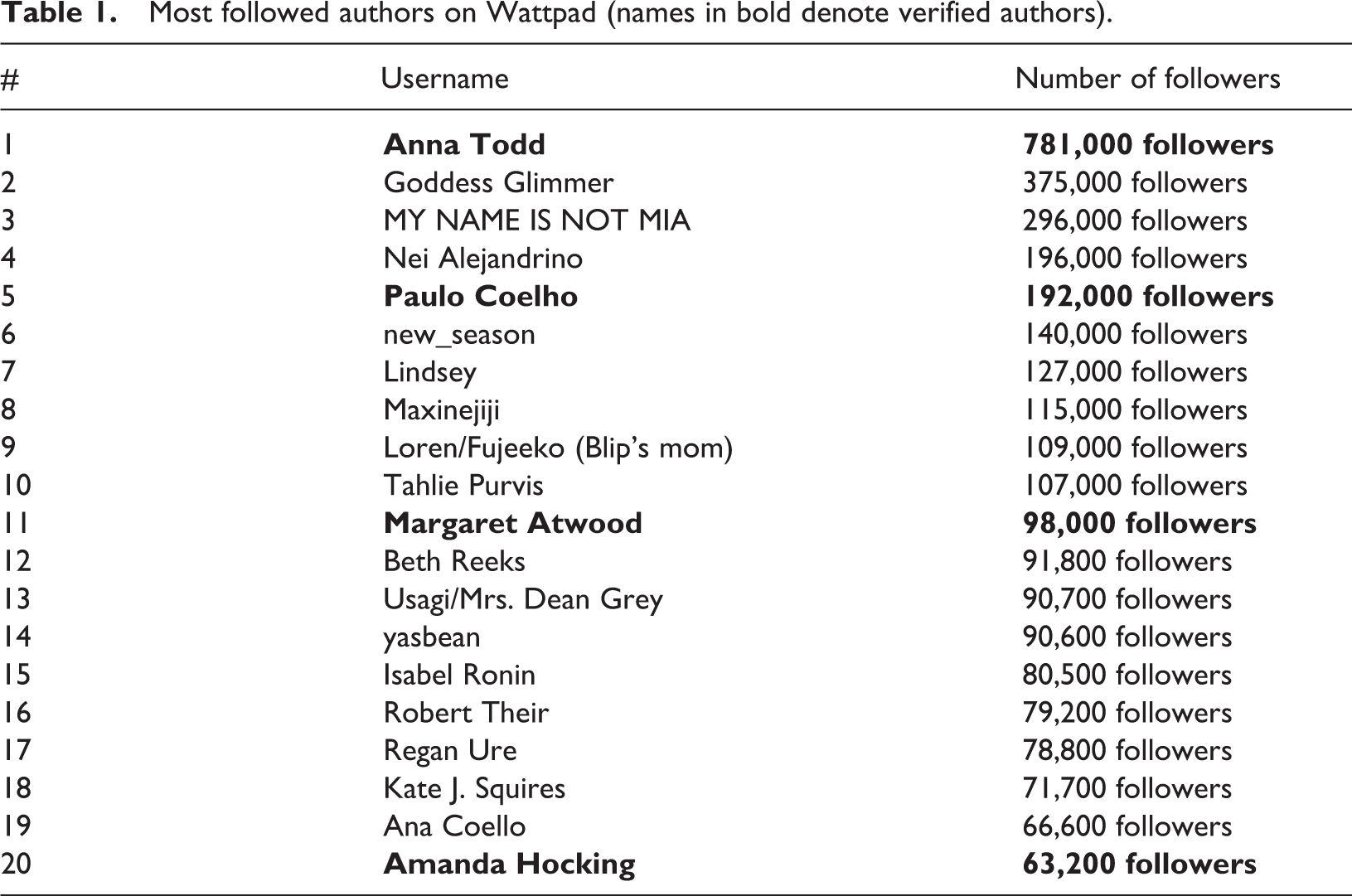
Writing anonymously or under a pseudonym was prominent in the 18th century but this practice decreased as authors grew in eminence and authority (Griffin, 1999). Pseudonyms, and the anonymity that comes with them, are popular on Wattpad: just over two-fifths (41%) of the top 150 writers did not display their full name, or other demographic details, on their profiles. 6 It was, therefore, impossible to employ demographic segmentation for this sample. When looking at the lists of 20 most followed authors and 20 most voted for stories (see Table 1): 60% of the most followed authors used their full names in comparison to 40% of the authors with the most voted for stories. This shows that brand identification can result in more followers; however, it does not guarantee reads or votes. All of the validated authors, in the top 150 list, displayed their real names and the majority also had their real names as usernames, except Anna Todd whose username is @imaginator1D. 7 This highlights the author’s name as an authority and allows users to navigate Wattpad through familiar signposts such as author brand. Anna Todd uses two markers of authority: her name and her association with One Direction.
Most followed authors on Wattpad (names in bold denote verified authors).
Building an audience
When discussing the rise of the networked society, namely, online communities, Castells (2000: 368) describes the ethos of the network as ‘decentralization, diversification, and customization’: this ethos is evident in the Wattpad community where users from around the world upload and read a wealth of heterogeneous stories. One of the factors of Wattpad’s success is their app, which sends stories directly to, and allowing authors to write on, their smartphones: According to Ashleigh Gardner, Head of Content, Publishing at Wattpad, 85% of users read via their mobile devices. 8 Gardner estimates that 45% of Wattpad users are aged between 13 and 18 and 40% are 18 and 30. Despite perceptions to the contrary, Gardner insists that Wattpad is ‘much broader than just teens’. This is reflected in the genres favoured by the popular authors: only 17% wrote teen fiction, while the most popular genre, with 38%, was romance: a genre that appeals to all ages. Other popular genres include fan fiction (8%), chick lit (7%) and urban fiction (4%). 9 The use of genre classification in Wattpad is interesting because it is the author who chooses the appropriate genre/s for their work and tags the stories accordingly. While the traditional use of a genre, as an identifier, is apparent on Wattpad: it is not a closed system (Devitt, 2004). Genres, on Wattpad, are, therefore, more fluid: authors tag their work with a number of genres and keywords, which provide the underlying basis for potential readers. However, there is a risk that self-tagging can be inaccurate as authors identify themselves with genres than are popular and/or are not representative of the work they are creating.
The popularity of new trends and genres, such as fan fiction and urban fiction, and subgenres, such as LGBT teen fiction, is emerging as a result of the lack of traditional gatekeepers on Wattpad. The urban fiction genre is largely ignored by the large publishers despite increasing in popularity in the United States (Munshi, 2015; Sweeney, 2012). Additionally, many of the urban fiction authors, on Wattpad, were based outside of the main market (United States). While traditional genres thrive on Wattpad – the romance (92,628 members) and teen fiction (77,896 members) clubs have the most members – the fan fiction community (70,950 members) is becoming increasingly more influential. Wattpad does not distinguish between fan fiction and fiction, or aspiring authors and established authors: in fact the two stories – with the most votes – on the popular author list are One Direction fan fiction. It comes as no surprise that One Direction fan fiction is popular on Wattpad, given the young demographic of the users; however, the fan fiction featured list showcases a wider range of fan fiction, which includes stories about: Dr Who (TV programme), Captain Hook (Peter Pan), Spooks (TV programme), The Hobbit, Sherlock (TV programme) and Pride and Prejudice, to name a few. While it has only recently become the focus of, mainstream, public attention, fan fiction is a long-standing practice and one that has a vast reach (Hellekson and Busse, 2014). However, reverse-engineered fan fiction is a recent concept and is becoming increasingly popular in traditional publishing (Jones, 2014). It consists of removing all of the identifiers (e.g. character names) of the original work that it was based on, in an attempt to make the fan fiction unidentifiable from the original work, and subsequently republished under a different title as an original piece of work. This shows that fan fiction is becoming a commercially viable path for writers and publishers. Famous examples of this include Fifty Shades of Grey, originally published as Master of the Universe (based on the Twilight series), and Anna Todd’s After series (One Direction fan fiction).
The rise of these emerging genres is interesting given the recent discussions about the dominance of male writers and the lack of diversity in books. A recent report confirmed that while traditional publishing was still dominated by male authors, self-publishing is dominated by female authors (Flood, 2015). Gender, race and location are immaterial in self-publishing publishing on websites like Wattpad. As, Wattpad user and champion, Margaret Atwood summarized, ‘No one need know how old you are, what your social background is, or where you live. Your readers can be anywhere’ (Atwood, 2012). Free from the constraints of traditional publishing, self-publishing can be a liberated activity where writers are not obliged to conform to convention and are therefore permitted to search out or share versions that are personally satisfying. In fact, topics such as gender identity, pansexuality and BME feminism were explored by some of the popular authors, which means that Wattpad, and self-publishing in general, can be a vehicle for expressing otherness and offering a response to the under-represented in traditional publishing.
Law (2000: 34) asserts that serial fiction in the 18th and 19th century ‘represents an important but overlooked transitional phrase between the “Gentlemanly Publishing” of the mid-century, with its cloth-covered volumes and literary monthlies, and the mass-market magazines and paperbacks of the turn of the century’. At this point, serialization disrupted the existing model of the expensive, three-volume, novel by offering an affordable alternative. Serialization also helped to build suspense: Charles Dickens, an author who is well-known for writing serialized novels, and one of the first fiction authors to recognize the value being aware of his audience and of reader engagement, realised he could entrance readers by making sure the ending of each segment left them curious for more (Hayward, 1997). Like Dickens and his Pickwick Papers, Wattpad makes the creation of the book – the writing process – a collaboration between the author and the reader and is, in the word of Allen Lau, ‘disrupting the publishing industry’ and also ‘disrupting the entertainment industry’ (Business News Network, 2015). Writers can submit their book in a piecemeal way and receive feedback on each chapter or part: this not only allows the writer to understand what their reader wants but it helps to build up a readership and loyalty. The average number of instalments, for the popular authors, is 45. However, when you look at the five stories with the most number of votes, the average instalment is 61. This suggests that more instalments, and thus creating anticipation, lead to a larger number of readers and votes. 10
Author brands
As outlined earlier, social media removes the barriers that mass media systems have put in place and allows anyone the opportunity to become a celebrity and increase popularity and visibility. Foucault argues that an author’s name has a classificatory function because it describes the author’s body of work. Having a recognizable author name is essential to defining the author function: Foucault asserts that there are differences in discourses that contain an author function and those that do not. Consequently, the author function is linked to status and privilege (Foucault, 1977). The role of the author, in particular the author brand name, operates in a specific framework within the contemporary publishing industry, especially for promotional purposes. The brand of an author’s name is developed from the author’s reputation, and the quality of their work, therefore any work published by the author is usually associated with their previous work. This helps to create a relationship, and loyalty, between the author and their readers (Ginsberg, 2005). This is confirmed by a recent study, which found that consumers were willing to pay 66% more for a book, particularly in genre fiction, by a brand name author over an unknown author. Additionally, 43% of genre fiction buyers bought their last book because of the author name (Codex, 2015). A recent example of this is The Cuckoo’s Calling by unknown author Robert Galbraith. When Sphere, an imprint of Little, Brown, first published the book, in the United Kingdom, in April 2013, it only sold 492 print copies in the first 4 months. When it was revealed, in July 2013, that the author was actually J.K. Rowling, the books sales multiplied: selling sold 68,009 print copies within a month. 11 English and Frow (2006: 52) argue that the author brand is ‘a matter of the careful management of a persona which continues to be seen as the source of value’. While English and Frow (2006: 51–52) identify the importance of ‘personal presence’ (i.e. the desire, of readers, to be in the same physical space as their favoured authors: to hear them read or have their book/s signed) for the development of author brand, this ‘careful management of a persona’ also extends to their online presence.
Wernick (1993: 92) asserts that, ‘[author] reputation is a composite of identity and standing; and the latter involves a competition for status which is both invidious and conducive to hierarchy’. While certain author brand names exert great authority, Goldhill (1993) argues that the author no longer holds such towering authority. This democratization of authorship is particularly visible on Wattpad. Although numerous traditional authors use Wattpad, only 17 verified authors are on the list of 150 popular authors. Additionally, if we look at the 20 most followed authors in this ‘most followed’ author list (Table 1), only 4 verified authors feature on this: (1) Anna Todd, who was published as a result of Wattpad; (6) Paulo Coelho, a bestselling author; (12) Margaret Atwood, a bestselling author and champion of Wattpad and (20) Amanda Hocking, a self-publishing phenomenon and now traditionally published author. However, this list changes slightly when we look at the stories with the most votes: only one verified author – Anna Todd – remains on this list, the Wattpad micro-celebrity.
An analysis of both these lists shows that both the most followed authors and the authors with the most popular stories are more likely to write fan fiction than the top 150 (Figures 1 and 2). In particular, a quarter of the authors, with the most popular stories, write One Direction fan fiction – including Anna Todd – in comparison to 8% of the 150 popular authors; so the brand association to One Direction is clearly influential here. However, Wattpad users are more likely to follow authors who write teen fiction but vote for stories in the romance genre (Figure 2). It must be added at this juncture that Anna Todd has begun to expand into the romance and teen fiction genres, having already accrued a following from the fan fiction community. Additionally, publishing experience/history is not important, for the authors with the most popular stories, but ranking in the relevant genre charts – so discovery based on what other people are reading and voting for – is. While only 10% of authors on this list had been published, 65% of had been ranked in the relevant genre list in comparison to 53% of the top 150. When compared to the ‘Most followed authors: Top 20’ list (Figure 1), we can see that traditional publishing experience is more important: 45% had been traditionally published and less than half (45%) were ranked in the relevant genre lists. While having a recognizable name may help to amass followers, building a readership and fan base – people who are willing to read, vote on and promote stories – requires engagement.
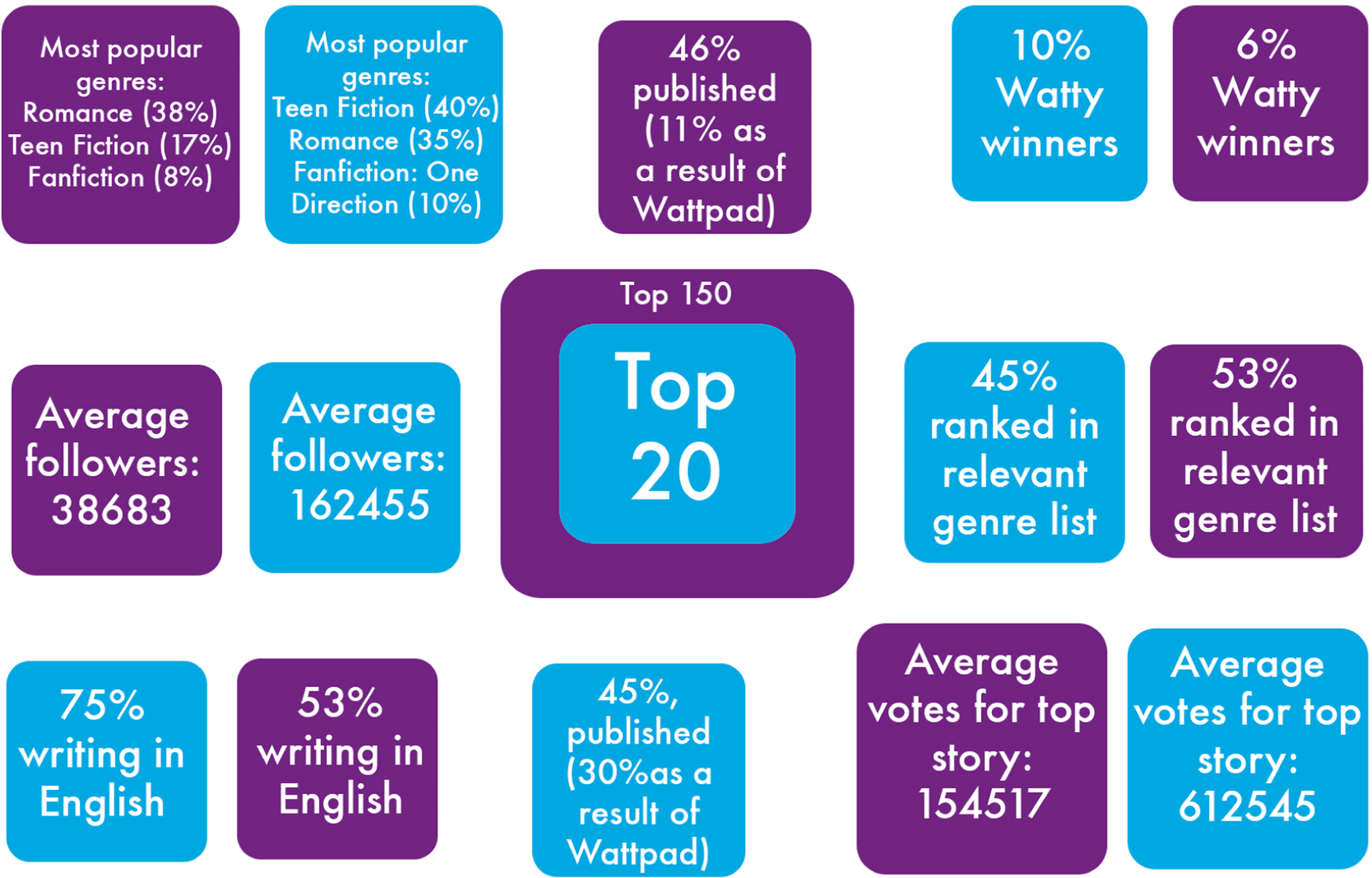
Most followed authors: Top 20.

Most voted story: Top 20.
Hierarchies and the role of the reader
Readers, especially the most dedicated kind, are most affected by the confines of traditional publishing. Territorial boundaries and/or digital developments can delay access to content, time between publications in a series and the distance between themselves and the author. Some readers want to immerse themselves even more in a story or world and do this by writing fan fiction and participating in fandoms. Scholars, such as Jenkins (2006) and Lessig (2002), have explored how participatory culture has allowed users to create and produce their own content from remixing available media content. Such reader practices challenge the traditional notions of authorship and ownership, especially the notion of originality, and draws attention to outdated business models. Lang (2012: 8) argues that the Internet provides a space for readers to convene and ‘construct evaluative taxonomies’ eschewing or, at least, not being defined by prescriptive canon constructions from cultural elites. Readers are now more empowered than ever and are engaging in literary conversations, debates and shaping of the literary field, where the boundaries between mass market bestseller and experimental products are less consecrated and increasingly blurred (Bourdieu, 1993, 1996). While one could argue that amateur curation lacks the skill and insight of the publishing industry, cultural selection by the mass media industries does not guarantee merit since creative fields have a low degree of qualification (Bourdieu, 1984). If we take the publishing industry as our example, one only needs to look at some of the bestselling books of the last decade.
Platforms such as Wattpad allow readers to comment directly on chapters, making suggestions for story and/or character development. Writers are also able to collect data on what is working and what is not working by looking at user comments, demographics and length of time they are reading the chapters: Writing can, therefore, become a more fluid, social process when undertaken in dialogue with readers (Fitzpatrick, 2011). Thus, the familiar post-structural axiom, ‘The birth of the Reader must be at the cost of the death of the Author’, is particularly relevant in contemporary, digital authorship (Barthes, 1977: 148). Barthes argued that it is the work that matters, not the author, and that content works independently of authors. This is reflected in some of the most read and voted for stories, where stories can accumulate millions of reads and votes and yet the author does not have such a high number of followers or a recognizable brand name.
Marwick and boyd (2011) argue that instead of bringing consumers and celebrities together, and closing the power gap, social media actually illuminates the hierarchical divisions. This is true for Wattpad where the most famous authors – such as Dan Brown – do not follow or interact with others in the Wattpad community. Six of the verified authors did not follow anyone while authors such as Margaret Atwood, Naomi Alderman and Amanda Hocking only followed other published authors: Atwood and Alderman only follow each other. Status by association also exists in contemporary publishing – Wernick (1993: 89) describes Rushdie’s review of Thomas Pynchon’s Vineland in the New York Times: a gesture that puts Rushdie in ‘the company of Great Contemporary Writers’ – and this can also be seen on Wattpad. For example, Atwood co-authored a story with the less well-known Alderman. Atwood’s association with Alderman – one author endorsing another – reinforces and elevates Naomi Alderman’s status. This study found that there were five main types of author on Wattpad (see Figure 3): (1) verified; (2) fan fiction authors; (3) micro-celebrities; (4) (Wattpad) award winners and/or charted authors and (5) invisible authors. Despite the clear hierarchies in social authorship, this study has found that it is possible to bridge the gap between the different categories and enhance authority, influence and visibility on Wattpad.

Authorship on Wattpad.
Case study: Publishing experience and Wattpad popularity
An analysis of three different types of Wattpad authors – (1) published as a result of being on Wattpad, (2) published before joining Wattpad and (3) unpublished – will identify what makes an author influential and popular on such a social platform.
Anna Todd: Published as a result of being on Wattpad
The most popular Wattpad author: in terms of followers, numbers of reads, and number of votes, Anna Todd epitomises micro-celebrity through social media. While Todd has – by far – the most followers (718,000), she also follows more users than any of the others on the list: 1000 (the maximum amount you can follow). Todd has written 11 stories since she joined Wattpad in 2013: mostly One Direction fan fiction so there was already a large readership for her stories; however, she has recently expanded into the Romance and Teen Fiction genres. Her story After and its sequels were picked up by Simon and Schuster and are being made into a film: making Todd the most successful Wattpad author, in terms of bridging the traditional media divide (Reid, 2014). Overall, Todd’s stories attract a very high number of reads and likes with an average of 930,000 votes per story (approximately 1.3 × the amount of her followers): After 3 has 618 million reads and 5.4 million votes, which means approximately 7.5 × the number of Todd’s followers voted for this story. 12 This demonstrates that Todd’s stories reach much further than her follower list.
Marwick and boyd (2011) assert that micro-celebrities view their followers as a fan base, rather than friends, so it creates a relationship of power. This unequal relationship is recognized by both micro-celebrity and follower, with the fans behaving deferentially. This is evident when we look at the 369 comments/messages posted on Todd’s wall in the last 7 days: they are mostly declarations of love for Todd (64) – including one marriage proposal – or her stories (90), alongside requests for Anna to follow them (34) or read their work/s (20) and numerous story dedications (15) (a good way for writers to increase visibility of their own writing); however, other writers also use it as a space to promote their own stories and gain followers, cementing Todd’s authoritative and influential profile:
13
ranamazing_ posted a message to imaginator1D: hey guys, please read my fan fiction of one direction called (not) simply luck. I was inspired by Anna. thx. dipshltluke posted a message to imaginator1D: if anyone wants to do votes for votes or reads for reads private message me. i follow back:) Rita1268 posted a message to imaginator1D: hey everyone im writing a new story please go to my profile and read it I hope you like it its called I can’t do it any more, its about one direction please read it TAFTCOCACOLA posted a message to imaginator1D: After 1,2,3 are amazing ! I love you Anna. After is the best book I’ve ever read! Really it was amazing! I started reading it a 3weeks ago and now i already completed it! i love you Anna. You are amazing imaginator1D: @TAFTCOCACOLA you’re so sweet! thank you! lctrish18 posted a message to imaginator1D: i super duper love your books∼!!!!!!! imaginator1D: @ lctrish18 thank you babe! CrazyStalker posted a message to imaginator1D: OMG I literally just had the biggest fangirl moment in my life cause I just found the After series translated to German in a Bookstore here in Austria and I absolutely loved the books when I read them here on WP <3 so guess what I’m gonna do during my summer holidays:-) imaginator1D: @ CrazyStalker thats so cool! I still fangirl every time I see them! Especially in other countries, it’s just so cool! Enjoy your summer holidays <3
Paulo Coelho: Published before joining Wattpad
Paulo Coelho is the most followed, traditionally published author on Wattpad, with 155,000 followers. Oddly, Coelho is only following one Wattpad user: a user who does not write any stories, follows no-one and has 66 followers. Coelho has published 30 books with traditional publishers: these have been translated into 80 languages and sold in 170 countries worldwide (Gamerman, 2014). On Wattpad, Coelho has written seven stories across a range of genres (non-fiction, fiction and spiritual) since he joined in 2012. Coelho has an average of 5201 votes per book (approximately 3% of his followers): this is significantly less than Anna Todd. His most popular book is a collection of short stories with 27,300 votes (approximately 6% of his followers): this is not one of the popular genres on Wattpad, so this high readership is, most likely, connected to his recognizable name. Like Todd, Coelho engages directly with messages on his wall: replying, in Spanish, English and Portuguese, to 6 of the 21 messages (a 29% response rate) he received in the last 7 days: Niall_is_a_crow posted a message to PauloCoelho: You changed my perspective about the world. The Winner Stands Alone is perfection. All the adoration, N. PauloCoelho: @ Niall_is_a_crow great to read that. As a matter of fact, the book did not sell well, probably because people expected another thing. That said, I also love The Winner LuzCVasquez posted a message to PauloCoelho: Hola paulo. Tal vez no vallas a ver este mensaje pero yo confió en qué sí, dejo esto por aquí para qué sepas qué tus libros han cambiado mi vida y qué sin duda eres uno de mis escritores favoritos. Luego de Leer uno de tus libros me di cuenta qué la única qué no creía en mi era yo misma y pues sé qué como ellos dicen llegaré lejos, no porqué ellos lo digan -realmente solo algunas personas-sino porqué confió en mi y la capacidad qué dios me a dado para cumplir mi sueños. Mis más gratos saludos desde República Dominicana. Luz celeste Vásquez, una lectora más. PauloCoelho: @LuzCVasquez gracias, que Dios bendiga tu camino bi_britto posted a message to PauloCoelho: Tem que ser em inglês os livros?? PauloCoelho: @bi_britto vou postar no meu blog semana que vem
Coelho is very active on other social platforms, which he manages himself and engages enthusiastically with his readers. 14 His blog and Facebook page are advertised on his Wattpad profile. This ‘personal presence’, as discussed by English and Frow (2006: 51), has enabled Coelho to develop a large social media following across different platforms. Coelho’s direct engagement with his followers, visibility on other social networking sites, language skills and international reputation could be why he is the most popular traditional author on the list.
Nei Alejandrino: Unpublished
Nei Alejandrino is an unpublished author that appears in the top four of both the most followed list and the list of stories with the most votes. Alejandrino has 223,000 followers, more than Coelho, and is only following four users. Although Alejandrino writes in English, she is based in the Philippines, where Wattpad has revolutionized the publishing industry. Alejandrino has written six stories in the Romance genre since she joined Wattpad in 2013; so already has a large readership to tap into. From reading the synopses of Alejandrino’s stories, they follow a similar theme: a handsome, but aloof, billionaire falls in love with sweet, normal girl: a plot that has proved popular in mainstream publishing (i.e. Fifty Shades of Grey). Alejandrino’s most popular story – The Girl He Never Noticed – has a very large number of reads (53.5 million) and votes (1.2 million, approximately 5.38 × the amount of her followers), probably due to it being ranked number one in the Romance charts. Overall, Alejandrino has an average of 370,331 votes per story (approximately 1.7 × her follower amount), which shows her reach beyond her followers. Alejandrino has already amassed an avid fan base, with 90 messages/comments posted on her profile in the last 7 days: mostly compliments her writing/stories (60), pleas to update her stories (13) and feedback/suggestions (8): iamcybergirl posted a message to sweetdreamer33: love all your book! I already read The Girl He Never Noticed, My Possessive Billionare, Lucas’s Revenge. All of ‘em was totally ammazing! Keep it up! May God Bless You SinlakuValdez posted a message to sweetdreamer33: plz update the nxt chapter of the girl he nve notice Cass99 posted a message to sweetdreamer33: how about a book for rafael and natalie!! maymay749: @Cass99 I SECOND THAT PLZZZZZZZZZZZZZZZZZZZZZZZZ!:)
Conclusion
Social writing and reading platforms, such as Wattpad, are changing the way that writers and readers interact and the way publishers and literary agents discover writers and produce content. The concentration of the publishing industry, homogenization of products, focus on bestselling authors, and declining shelf-space in physical bookshops has made it increasingly difficult for midlist and debut authors. Therefore, Wattpad and other social writing platforms offer possibilities to the long tail of authors who are not, initially, attractive to large publishing houses. Wattpad replaces professional editing, design and marketing with crowd-sourced feedback and word-of-mouth social and viral marketing and allows its users to sort through the virtual slush pile to find the latest hit, while traditional authors, publishers and literary agents are still anticipating what will be popular with readers. As the traditional publishing industry becomes more concentrated, the role of the editor becomes less nurturing and they have less time to spend developing authors, especially new ones. While writing content on Wattpad, and building audiences online, presents new opportunities for aspiring and emerging authors, it is not a guaranteed direct route into traditional publishing stardom: Anna Todd is an anomaly in some respect. It could, however, be an indirect route to traditional publishing because it is a valuable way for a new writer to develop their writing skills, get to know their readers, raise their visibility, build authority and influence online and be a part of a writing community: In the absence of being nurtured by an editor, this collaborative process could bring the text to the point where it can be recognized by the professional publisher.
Some traditional publishers have seen other writing outlets as threats to their markets or have failed with their attempts to replicate participatory publishing approaches; however, O’Leary (2014: 31) asserts that publishers must develop ‘an architecture of collaboration’ with new platforms and business models. This engagement with communities and different companies could help publishers fully explore the possibilities of their content. As Thompson (2011: 398) notes, ‘turbulence gives rise to renewed questioning of the rules of the game and to new ventures that could…change the rules’. The pressure on the traditional publishing model should be viewed as a call for evolutionary practices which preserve the cornerstone of the publishing industry – content curated and developed through a strong partnership between author and editor – while considering existing threats as opportunities and catering to the demands of the modern reader.
The focus on the reader is increasingly important: Wattpad is a platform that exposes its writers to a very large reader base and it is that reader base that is influential in the digital sphere. Readers are increasingly involved in the writing process, harking back to the days of manuscript authorship, which makes it easier to create loyalties between authors and readers and help to build audiences in a saturated marketplace. Readers are now curating the content, sifting through the morass of stories to pick the hits from the misses and choosing what authors they want to back and endorse. As this research has shown, without the constraints of publishing gatekeepers, new trends, authors and markets begin to emerge based on readers’ tastes, participation within these reading communities and personal relationships with the author and the texts. This shows that Wattpad is broadly inclusive and can introduce writing from the periphery. Unsurprisingly, authors who write within the popular genres – romance and teen fiction – amass the most followers and votes; however, some of the emerging genres, especially fan fiction, are attracting large readerships. Additionally, while English is still the dominant language, there is a clear demand for works in a variety of languages and works in translation. However, this is not a completely democratic system: Wattpad’s algorithms are a kind of gatekeeping and the difficulties that come with algorithms and gatekeeping need to be explored further.
What is most interesting about Wattpad is the feedback system: Writing on Wattpad can be a collaborative process with readers proving feedback on instalments and the author developing the story according. Writers can crowd source feedback, engage directly with readers who also act, as editors and, through Wattpad, writers are also able to collect data on what is working and what is not working: this means writers can, thus, structure and develop their work accordingly and become influencers and/or authority figures online. Consequently, in this digital realm, authorship, and cultural production, is becoming a lot more transparent, collaborative, malleable and targeted, so challenges the notions of status and privilege. Writing content on Wattpad is a canny marketing move for established authors, and a sensible first step for aspiring authors, particularly for books targeted at the key demographics (e.g. teen/young adult/people in their twenties). These consumers use social media frequently not only for communication with friends but recommendations from influences and discovery. It is clear, from the issues presented throughout this study, that authors – brand name, established, emerging and debut – have to acquire new skills, and mindsets, to take advantage of the new opportunities afforded to them: they cannot simply rely on their brand name or the content they create to extend or develop authority and influence in the digital sphere.
Footnotes
Declaration of conflicting interests
The author(s) declared no potential conflicts of interest with respect to the research, authorship, and/or publication of this article.
Funding
The author(s) received no financial support for the research, authorship, and/or publication of this article.