



Abstract
Literary festivals throughout the English-speaking world have been enthusiastic adopters of digital technology: uploading podcasts of author talks, posting videos of panel sessions to video-sharing sites such as YouTube, inviting guest bloggers to comment on proceedings and encouraging live-tweeting as a means of reinforcing audience members’ participatory agency. Such innovations serve to expand festivals’ reach to encompass dispersed audiences and, moreover, increase the longevity of previously transient events. They hence provide evidence to justify writers’ festivals’ claims on public funding as well as to delineate vibrant online and offline bookish communities of interest. However, wholesale uptake of digital technology destabilizes some previous givens of the literary festival as they have coalesced since the phenomenon’s 1980s efflorescence. The concept of authorship undergoes profound changes in a climate of online performativity, constant availability to readerships and digitally diminished ‘aura’. Equally, previously passive audiences are reconceptualized as amateur critics, co-publicists and even co-publishers in the case of crowdsourced subscription publishing. Festival programming may be sampled live or archived, and audiences are only partially tethered to a particular geographical location – a disarticulation taken to another level by emerging online-only writers’ festivals such as the #TwitterFiction Festival and the Digital Writers’ Festival. What are the implications of these shifts for our conceptualization of 21st-century literary community? This article seeks to address this question by proposing a theoretical framework for examining the digital/literary festival interface, analyzing a wide range of terrestrial and online-only festivals and underpinning this analysis with empirical audience interviewing conducted at multiple Australian and UK writers’ festivals and book towns. In bringing together these strands, the article presents a detailed picture of an important and currently underexplored dimension of the public encounter with literature at a moment of profound digital change.
Keywords
We have scarcely begun to talk about literature as a form of public-commercial-aesthetic institution comparable to cinema, television or popular music.
The nature of contemporary authorship has clearly been in significant flux since at least the turn of the millennium. In November 2004, for example, Indian novelist and political activist Arundhati Roy delivered a lecture at the University of Sydney on the occasion of her being awarded that year’s Sydney Peace Prize. As the campus’s Seymour Centre quickly sold out its 700+-seat York Theatre, tickets were subsequently offered for a ‘spillover’ audience in the same venue’s 600+-seat Everest Theatre, which received a live-feed broadcast. This ambiguously appended second venue was also graced with a post-talk ‘visit’ from the frankly astounded-looking celebrity lecturer. What prompted so many to purchase a A$12.00 ticket to a broadcast? Was live transmission being proffered as partial compensation for lack of physical co-presence? What new spins were electronic media, even at the dawn of the Web 2.0 era, putting on the already complex phenomenon of authorial performance?
Writers’ festivals have massively proliferated since the 1980s, with most major international cities and state capitals hosting them, and regional towns, local councils and even specific suburbs frequently sponsoring their own, location-badged events (Bidisha, 2014: 49; Driscoll, 2014: 152; English, 2011: 64; Giorgi et al., 2011: 2; Llewellyn, 2005; Stewart, 2009).
1
As James English points out, writers’ festivals exist in a state of fierce competition, for visibility, star-power and funding: Festivals…play a critical role in shaping [the] geography of the symbolic: determining not just a world public but a world space of hierarchically situated publics, not just a global cultural public sphere but a global field of cultural prestige and power. (2011: 64)
This enthusiastic embrace of digital networks dramatically recasts inherited understandings of writers’ festivals. Sydney Writers’ Festival (SWF) Artistic Director, Jemma Birrell, in her opening address to the 2015 festival summed up the received view of such events: At the heart of the Festival is our love of books – and reading is a solitary pursuit but at the same time, in a sort of blissful contradiction, festivals bring all of us together in one time and place, as a community.
4
This article uses semi-structured interviews conducted with 62 audience members across five writers’ festivals in Australia and the United Kingdom to interrogate the influence of digital media along each of these axes. The five case-study festivals are the Edinburgh International Book Festival (EIBF), the Melbourne Writers Festival (MWF), the Emerging Writers’ Festival (EWF, Australia), the Clunes Booktown Festival (CBF, Australia) and the Port Eliot Festival (PEF, United Kingdom). These case studies were selected to offer diversity of rural and urban; local and international; immersive and dispersed; and cultural, professional and commercial points of comparison. This forms a necessarily selective sample, with the growth of literary festivals in Asia, Africa and South America meriting additional critical attention beyond the scope of this article. Notable festivals outside of the Anglosphere include Word Alliance member festivals such as the Bookworm International Literary Festival, held across Beijing, Suzhou and Chengdu, 5 the Francophone Étonnants-Voyageurs festival which rotates between Saint-Malo (France), Bamako (Mali) and Port-au-Prince (Haiti), 6 and India’s Jaipur Literature Festival which dubs itself ‘the world’s largest free literature festival’ and now attracts audiences in the hundreds of thousands. 7
Perspectives such as Birrell’s speak clearly to the experiences that writers’ festivals have long been perceived to offer audience members: the shared ‘love of books’; the gathered ‘community’; the act of simultaneous engagement and participation. Through undertaking a comparative and qualitative study of audience members’ actual experiences at – and outside – writers’ festivals, this article evaluates the extent to which this perspective remains valid, or is problematized, in digitally mediated festival spaces. The majority of audience members interviewed indicated high levels of engagement with literature and literary communities in online spaces. Their experiences at literary festivals and other live events are extended into these digital spaces, generating creative and social practices while, conversely, digital networks or communities serve to initiate engagement with live literary culture. Extrapolating from empirical fieldwork, this article theorizes an emerging reciprocity in the relationship between individuals’ digital and live engagement with reading and writing culture. It argues for further interdisciplinary and multimodal research into both live and digital cultural practices as a means to comprehend the medium symbiosis characterizing literary culture by the second decade of the 21st century.
Place: Civic branding, festival site and community identity
Two varying conceptions of place are at play in literary festivals, and they pull in opposite directions. At one level, there is a cosmopolitan conception of community as defying geographical boundaries and celebrating a Habermasian public based on shared cultural interest in writing, akin to Pascale Casanova’s ‘world republic of letters’ (2004 [1999]; English, 2011: 63; Giorgi, 2011: 35–36, 39; Johanson and Freeman, 2012: 304, 311). The trajectory of such conceptions is centrifugal, reaching outwards from the geographical site of the festival to embrace international writers of diverse stripes and languages and debates of transcontinental import, consequently cementing the festival a place in the A-list of literary festivals. This, by extension, consecrates the host city as a significant node on an international cultural festival circuit. It is in this light that we should read the MWF’s claim that it ‘connects writers and stories to celebrate a world of literature, explore universal ideas and inspire a global community of readers’ (italics added). 8 Second-tier international capitals appear particularly given to this kind of insistence on world-class status, such as through flagging their anointing by UNESCO’s Creative Cities programme (Hamilton and Seale, 2014: 146). The other conception of place at play is economic. The principal funders of literary festivals internationally are typically the cultural policy divisions of national, state/provincial and local governments. Given that a sizeable proportion of festival funding is derived from taxpayers of a particular locale, they have a legitimate desire to see their interests reflected in the resultant event. The dynamic here is centripetal, with global interests illuminating and reflecting on the cultural specificity of a particular locale. To some extent, flagging localism may also help in attracting inbound tourism, catering to the desire of interstate and international visitors to access an authentic (albeit curated) slice of cultural life in the host city.
Where international community is emphasized over local embedding, festival organizers leave themselves open to criticisms of elitism and resultant funding cuts. Conversely, focussing on localism invites criticism of the festival’s provincialism, a failure to attract ‘big names’ suggesting it is not/no longer an A-list festival, and a decline in attendance figures which (somewhat ironically) also threatens continued public subsidy (Dempster, 2013). Thus, literary festival organizers engage in complex strategies to ensure these two, frequently competing, senses of community can – however unstably – be mapped onto each other. For example, Toronto’s International Festival of Authors has a long-running offshoot ‘Lit on Tour’ programme which tours festival guests around libraries, bookstores and universities across the province of Ontario. 9 Building on this idea, the SWF in 2015 inaugurated its ‘Live and Local’ programme offering live streaming to libraries and writers’ centres in other New South Wales (NSW) cities and regions, and even the western suburbs of Sydney itself – a vast metropolitan district battling stereotyping as Harbour-obsessed Sydney’s unloved backyard. Remote participants could ask authors questions via Twitter or text message and receive answers in real time. 10 Building on this success, the following year the SWF rolled the ‘Live and Local’ programme out nationally, adding a live feed to bolster the sense of co-presence during question and answer sessions. 11 Such innovative programmes are constructive attempts to counter regional and outer suburban taxpayers’ common grievances that flagship cultural festivals are unduly concentrated in the metropolis. But in their interweaving of digital media into the fabric of the literary festival, they disrupt the geographical specificity which is traditionally central to writers festivals’ self-conception.
Encountering the festival space: Site and venue
Questions of place come into play at writers’ festivals not only at the level of the host city but also at the crucial level of the festival site, as well as at the most microcosmic level, in choice of venue for individual events. Festivalgoers interviewed for the current project repeatedly emphasized the importance of the physical site in scaffolding their festival experiences. Different festivals evidently offer different kinds of spaces, each of which constructs individuals’ experiences of the festival in subtle though pervasive ways. Cornwall’s Port Eliot Festival and regional Victoria’s Clunes Booktown Festival, by requiring a paid ticket to access the space but offering numerous ‘free’ events and activities within its confines, offered immersive experiences, with individuals attending the festival for large periods of time and often attending events on a more serendipitous, ad hoc basis. In marked contrast, Australia’s annual EWF occupies a number of different spaces over its 10-day duration, visiting different suburbs and venues across Melbourne, and even taking specific events to other state capitals. Attendance at the different EWF events could therefore be considered to create an overarching festival space, but the piecemeal and transient nature of this space – and the consequent complexity of the festival’s character – is clearly reflected in a degree of disparity between individuals’ descriptions. Participant EWF9 articulates the curious experience of this dramatically dispersed and peripatetic festival: So the Sydney one…like, the Melbourne National Conference is in the Town Hall, there, so it’s a big sort of space, and quite formal. When they come to Sydney, and I’ve been to a couple of the Sydney ones, they go to [inner-city, harbour-side suburb] Rozelle, the writers’ centre, the NSW Writers’ Festival. And it’s this old building, it used to be a hospital, and the grounds, they’re like old hospital grounds. So the place, it’s like a mansion, in the country. So you’re surrounded by rolling hills, and it’s a different kind of…so it’s this space you go through, to get there, and when you’re there, you resolve things differently, because the environment is different, it’s less formal, and more ‘I’m on a writers’ retreat, learning things about writing’, rather than ‘This is a conference! You’re going to learn very formal things!’ So, I don’t know whether…I couldn’t tell you what the difference was in terms of what comes out of that, what the results are, but the effect is decidedly different. So far as the Atrium is concerned I think it’s fantastic, I think it’s a fantastic spot. And you know, Deakin Edge and so on…being in such close proximity and having all these various events, you know, at the moment there’s one, two, probably three events going on inside this space, and probably four and more going on in the Deakin Edge, and then the Gallery just next door…And you know just outside in the, what’s it called, in the Square itself, there’s always something happening. So it was an app, that you just downloaded for free on your phone, and as you walked around a certain specific area in Melbourne – so just around the town hall – it would pick up your location, and direct you kind of where to go, and as you were moving, audio stories would be played, that would kind of change as you were moving. So that’s fascinating, it’s combining that physical element of being in the space, with online content that’s really accessible. (Participant MWF13)
Staging writerly authenticity
One of the primary reasons that many audience members volunteer for attending live events is the opportunity they offer for direct, human connection with writers, which subsequently enhances their (re-)engagement with their works. Audience members described literary festival events as humanizing, but also augmenting, their experience of literary culture, emphasizing the invaluable quality of the direct, face-to-face contact with a writer – long writers’ festivals’ key selling point: I’d like to find out what other literary festivals there are, that are within relatively easy reach from me, and go and visit them. And I do, I have discovered in the last year or two that it’s great fun, and very enlightening, to sit and listen to an author about a book you’ve either read, or are interested to read. […] I was listening to Brian Selznick this morning, about his book Hugo, and Wonderstruck that followed it, and he’s got another one coming out. And although I think they’re predominantly aimed at children, they’re fascinating books, because he draws the whole thing, and I’m very interested to see that. And he…just makes the whole thing, he made the whole thing come alive. And I think that’s what the authors do, they make the whole thing just come alive. (Participant PEF1) It makes it very accessible I think. Particularly with the ‘dovegreyreader’ tent, it makes…it humanises what goes on behind the scenes, really. Because we can put authors on pedestals, you know, they’re these literature kind of giants, that are kind of studious, in a way, or you have this idea of what they’re like, and then coming to this environment where they’ve got an opportunity to talk about themselves, and their personality, and their motivations for why they write, it’s really interesting. Because they are labours of love, every book is a labour of love, isn’t it? (Participant PEF2)
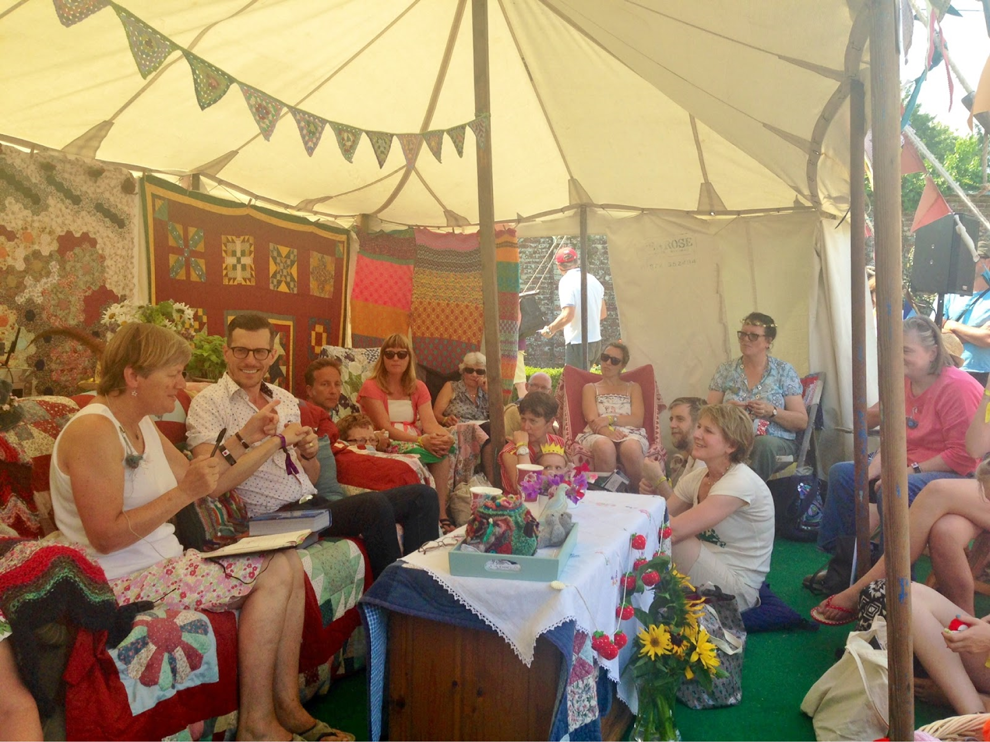
Brian Selznick speaks at the dovegreyreader tent, Port Eliot Festival, 2014.
In an inversion of the usual dynamic whereby virtual spaces mimic extant physical locales, in this instance the dovegreyreader tent is an attempt to recreate physically the domestic, rural, explicitly feminine atmosphere infusing Hatwell’s pre-existing blog. Both are deliberate acts of curating an evocative environment of enthused, non-professional reading. As Hatwell writes in her blog profile: Sharing a love of good books is the plan, and I only write about books I’ve loved, books that have touched me, engaged me emotionally and captured my imagination. I harbour no pretensions about being a book reviewer, let alone a literary critic, this is about sharing a subjective passion for reading with like-minded people.
12
While literary festivals frequently serve to propagate the celebrity status of authors, encountering writers within the intimacy and domesticity of this particular physical space created what participants judged to be an authentic depiction of writers’ personalities and individuality. These live encounters work to humanize the writers and consequently add that interpersonal dimension to readers’ experiences of their books. Although without the inflections of domestic intimacy, even larger and less personalized festival spaces perform a similar function: I think you get more meaning when you actually meet them, or see them, and you know – they’re talking personally, well, not personally to you, but they’re talking about their adventures, and what they’ve done, and how they’ve done it, and things like that. And I think that’s good, personally to do it, rather than listening to a recording of a message. To see that person in reality. (Participant EIBF11)
Authorial performativity and aura
A key draw for writers’ festival audiences is the opportunity to see big name international and local writers ‘in the flesh’ to see how they measure up to the implied author detectable in their works. This ‘ritual of authentification’ takes literature back to a pre-industrial era where the writer might be a comfortingly familiar, physical presence whose oral performance of the work certified it as their own creation (Johanson and Freeman, 2012; Meehan, 2005; 13 Young, 2015). Other motivations for many attendees are the opportunity for a quasi-papal literary audience through asking a question of the star author in a public forum or the benediction of the signed book copy. It is hard to get away from such sacral language with writers’ festivals the major sites for perpetuating the literary star system (Driscoll, 2014: 165–167; Meehan, 2005; Ommundsen, 2009: 22, 31).
There has been long-running criticism of writers’ festivals in academic debate and cultural-sector commentary as forcing often introvert authors to become public performers, and consequently assessing writers on theatrical criteria rather than the allegedly ‘purer’ achievement of their writing (Barnes, 2010: 11; Driscoll, 2014: 166–167; Johanson and Freeman, 2012: 308; Literary Festivals: Who are they for? 2010; Llewellyn, 2005; Lodge, 2015; Montenegro, 2013; Nowra, 2010: 7; Ommundsen, 1999: 174; 2007: 246–47; 2009: 29–30; Starke, 2006: 158–59; Young, 2015). Writers might not be particularly well adapted to public speaking compared with politicians, actors, and others schooled for more obviously performative careers, but they are by definition professional communicators. That many writers are uncomfortable in a festival context is amply documented in the periodical publications of author societies, but that writers generally ‘perform’ to audience expectations is evidenced by these events’ popularity, audience members’ repeat attendance and reported high levels of satisfaction.
Distaste for the figure of the performing author is part of a broader critique that writers’ festivals contribute to a debasing and vulgarizing of literary culture (Driscoll, 2014: 158; Giorgi, 2011: 42; Lurie, 2004; Ommundsen, 2009: 21–22). For some commentators, this shoehorning of writing into performing arts-style engagement is central to what is problematic about writers’ festivals. Wenche Ommundsen writes: ‘The festival somehow aspires to make the moment of creation and the moment of consumption coincide in time and space, thus changing the fundamental dynamics of the experience’ (2009: 21). 14 Here, distortion of the typically asynchronous print culture encounter through importation of ‘live’, quasi-theatrical modes such as author readings introduces awkwardness and falsity.
The online expansion of writers’ festivals and shifts in the nature of authorial performativity via social media challenge this perception of festival performance as diametrically opposed to writers’ everyday business. Now the writer may have a long-running programme of promotional online engagement prior to their main festival appearance, peaking there perhaps, but often providing ongoing commentary about the writers’ festival through their blog, tweets, Facebook posts or Instagram pictures both during and after the event. The governing dynamic is less an off/on, private/public authorial toggle than an increase in the frequency and intensity of the writers’ consistent public communication. Further, these interactive online applications refocus attention on the writer as (pithy) written communicator, as opposed to the mediagenic chat-show persona foregrounded by ‘in conversation with…’-style events. So, while communicating effectively in the chatty, off-hand form of a blog or the haiku-like laconicism demanded by Twitter may be a far cry from literary prose, such mediums’ reinvigoration of the written word – as opposed to broadcast media’s foregrounding of authorial voice and appearance – may actually counteract many cultural pessimist criticisms of writers’ festivals.
From ‘audience’ to community
The concept of the audience for writers’ festivals has come a long way since 1960, when organizers of the first Adelaide Writers’ Week (its target audience clearly flagged in its name) made efforts to exclude the public from what was essentially a writers’ workshop on the grounds they were literary rubberneckers (Driscoll, 2014: 158; Ommundsen, 1999: 175; Starke, 2006: 157; Stewart, 2009: 26). For contemporary audiences, the exclusionary sting originally implied by the term ‘writers’ festival’ has entirely disappeared, with contemporary festival taglines – such as the MWF’s ‘For Everyone Who Reads’
15
– positively broadcasting a determined orientation toward accessibility and inclusion. Possession of the requisite cultural capital is still clearly a de facto hurdle to participation, but the festivals themselves seem at pains in their marketing to downplay any exclusionary perception. Audiences value not only the interactive potential of encounters with live writers but also the unique affordances of live audience membership. Writing in the pre-participatory digital media epoch, Kristin Langellier (1983) argued that the value of attending a literary reading encompasses both the experience of the event’s content and the sharing of the physical experience with others. Listening and responding to the same cues as a group of other people, in the same physical space and within the same set of social and cultural norms offers a unique sense of interconnection. The respect that those norms dictate – remain quiet, do not stand up, do not obstruct another’s view – serves to ensure each individual’s ability to watch and listen uninterrupted. The function of the audience collects and connects people, but still acknowledges their individual experience. But it is only when all of the individuals in that group are collected in that precise space and time, and behaving in this manner, that the conceptual idea of ‘audience’ is realized and corresponds with the literal grouping of individuals gathered to attend. As Langellier comments: The word ‘audience’ as a collective noun emphasizes that, far from alienated, as an audience member I am with others. Indeed the audience is precisely a group that is not simply an aggregate of its individual members, but a whole unit that takes on a life of its own greater than the sum of its parts. The presence of others watching and listening with me releases a power and a magic. Infectious laughter and hushed suspense are just two examples of the unity of audience and its shared experience. (1983: 35)
A recurrent theme in participants’ descriptions of their experiences as part of contemporary literary festival audiences was the value of collectively participating in a grouping that was large, physically immersive and ideologically relatively cohesive: One of the sessions I went to at the Melbourne Writers Festival last year was a session about women’s writing, why women’s writing isn’t, you know, encountered as much as the men’s writing sometimes? Well, naturally of course, that sparked like a feminist debate and all the rest of it, and before you know it you’ve got all the women in the audience standing up, and shouting – ‘Go women!’…. It was very liberating! And that was at Deakin Edge, and that session was full. So, yeah, that sort of thing was really good to be part of. It was great to see, there’s some passionate people out there…it was quite emotional. (Participant EWF11)
Although literary communities and interpersonal relationships frequently do develop in online spaces, a sense of physical isolation and medium-induced disconnect lingers. Hence the opportunity for literary communities to meet in a physical space can be particularly valuable, not as replacement for but rather accompaniment to online engagement. This was consistently expressed by audience members, and particularly strongly by those individuals who identified as writers – their more intensive participation in solitary or online reading and writing activities, as well as their strong identification as members of literary communities, contributing to the importance they placed on in-person engagement: I think there will always be a physical space for [the] writers festival, just because it’s a meeting point, and you feel connected to this big community, and it’s really – it’s, for a lot of writers who are starting out, they just feel incredibly enthusiastic, and it’s kind of confirming that they’re doing work, and they’re not alone, and it’s not an isolated thing. (Participant MWF13)
Searching for the next read and finding one’s tribe
In addition to the shared experience, attending a literary festival offered participants access to a social space, somewhere they could meet friends and colleagues, and make new connections, as well as a cultural space in which they could discover new books and authors to read. Participant MWF9 expresses this in her description of the festival as offering her access to new reading material, as well as describing the value of the festival as a source of relatively low-cost literary education: ‘I’m a reader. And so you learn things about…it teaches you about how to read, and what to look for, and what to…what you can get out of a book, you know’. The idea of discovering new authors through attending the festival, and using that attendance as a means of deciding whether to read their books, was very common; participant MWF7 described how the festival ‘expand[ed] my understanding’ and offered her the opportunity to ‘hear people whose names I have never heard’, while participant MWF12 explained that attending the festival meant ‘I can get an idea of what their work’s like, to see if it’s worth reading or not’.
As well as discovering new writers to read and follow in online spaces, individuals expressed the value of ‘finding their tribe’ – having access to a group of strangers with interests compatible with their own: I don’t know, it’s funny, because reading and writing are basically completely solitary activities, so the idea of having a festival about it is kind of a good idea. Because you can talk to people who…you know, in a session, like you go to see your favourite writer at a writers’ festival, and then you talk to somebody else, and you’re like ‘oh what about that writer’. So you’ve made a connection that you wouldn’t otherwise have made. Even in a book club, like people choose the books, not necessarily the writers, or the…and they don’t necessarily bond over them either, they just discuss over whether or not they liked it…so yeah, you’ve just found, you’ve found an audience who has the same mentality as you, or at least finds the same things engaging. (Participant EWF9)
Social media-enabled audiences
These days, festival audiences – once excluded or at best tolerated as largely seen but not heard – have been reconceptualized as active participants, co-publicists, invited commentators or reviewers and a pool of future programming suggestions (Dempster, 2012: 124). For example, the widespread uptake of live-tweeting during festival sessions creates a Twitter ‘back channel’ to a standard festival keynote address or panel session, whereby audience members tweet both in response to what is being said on stage as well as responding to others’ tweets (Driscoll, 2014: 185; 2015). This lends participation in an event a multilayered density; it now comprises not only those physically present plus the conversations occurring in the Twitterverse (among those both physically present and those geographically elsewhere), but also the potential for the virtual to feedback into the ‘real’, as where a Chair may make reference to audience Twitter feedback during the session itself, or read out an audience member’s tweeted question. Noticeably, live and mediated experiences here overlap and enhance one another without any sense of the two existing in opposition. This complementarity might be given a further twist by reliving the combined physical/virtual event at a different time-point. Participant MWF6 articulates how having seen an event live boosted her enjoyment in listening to a radio broadcast of the same event: I think that it’s the atmosphere. And, you know, the activity of being there, you know, live, and hearing it live. And then I’ve heard it, re-heard it on the radio, and I’ve pricked up my ears, and I’ve revelled, I’ve loved hearing it again!
Online-only writers’ festivals
Enthusiasts of digital media regard emerging online-only writers’ festivals as more radically dissolving the restrictive binary of star-author-versus-anonymous-audience-members through their emphasis on community engagement and the technological ease of readers documenting their responses to programmed events. Online writers’ festivals increasingly engage in digitally-hosted programming where ‘audience’ participation in real time is crucial for a festival’s success. Lisa Dempster, Director of the MWF and former Director of the EWF, distinguishes between three levels of literary organizations’ use of digital technologies: using digital media as a supplement to publicize a fairly traditionally conceived programme (e.g. star keynotes, ‘in conversation with’-style interviews, panel sessions, readings followed by Q&As, etc.) (akin to Web 1.0); community-building through inviting audience interaction and responses (e.g. comments on blogs, official Twitter hashtags, video content) (akin to Web 2.0) and online programming where creativity occurs in the digital sphere and the digital is the assumed (and often only) platform for the event. Audience participation in the event is crucial and typically occurs in real time (2012: 117–18).
Examining two recently launched online-only writers’ festivals allows us to tease out what benefits and drawbacks Dempster’s third ‘level[] of sophistication’ (117) might involve in practice. The #TwitterFiction Festival (TFF), established in late 2012, runs over five consecutive days and bills itself as ‘about embracing, exploring, and developing the art of storytelling on Twitter’. 16 It boasts heavyweight sponsors in the form of Twitter itself, Penguin Random House, the Association of American Publishers and media partner USA Today. The Festival particularly encourages literary uses of Twitter beyond just sequential, linear tweets à la the currently best-known example of ‘Twitterature’, Jennifer Egan’s futuristic thriller ‘Black Box’ (2012) (which was tweeted from the New Yorker’s fiction account and subsequently published in full in that magazine). For example, Festival organizers invite writers to experiment with parody accounts, crowdsourced content, tweets incorporating images and video and those narrated by multiple characters using various Twitter handles. Such formats exemplify what Bronwen Thomas, in a rare academic analysis of Twitterature, terms ‘distributed narrative’ (2014: 101). 17 Programmed authors were, in 2015, either ‘featured’ (e.g. Margaret Atwood, Lemony Snicket, Alexander McCall Smith and Jackie Collins) or among 25 contest winners. Members of the public were invited to tweet their contributions to #TwitterFiction. The Festival’s website also catalyzes public engagement via a randomized tweet generator which users can customize to some extent – Instant #TwitterFiction – with results akin to found poetry. Hence, despite the pervasive, quintessentially Web 2.0 communitarian rhetoric, festival organizers to an extent perpetuate the traditional professional/amateur demarcation.
The other notable online-only writers’ festival, the Digital Writers’ Festival (DWF), first emerged in 2010 as a strand of the EWF, but since 2014 has branched out as its own event, running annually over 12 days. It self-describes as ‘an online carnival dedicated to what happens when technology and the written word collide’. 18 As befits the brainchild of Lisa Dempster, the DWF prides itself on being ‘playful and participatory, transmedia and transcontinental’. 19 Launched as a stand-alone event through Director Connor Tomas O’Brien being interviewed via Twitter (a format he christened with the neologism a ‘twitterview’), the DWF comprises an innovative programme of hybrid print-digital formats with livestreamed webchats via Google Hangouts predominating (O’Brien, 2013). Participation and accessibility (whether geographical, chronological, economic or social) are key selling-points for the festival, which promotes itself (potentially controversially) as the world’s first online writers’ festival. In the words of O’Brien, ‘the panels might end, but the tweets keep flowing’ (2015). The DWF’s first iteration involved much live streaming of author panel sessions and discussions, with audience participation mostly confined to tweeting, texting, Facebooking and other text-based discussion modes. In its second iteration, the DWF aimed to expand opportunities for audiences to engage more actively and directly via face-to-face computer-mediated technologies (though technical limitations upon these mean that, in practice, the festival still presupposes a high degree of spectatorship on the part of the majority of its audience). Even Web 2.0 egalitarianism and inclusiveness appear to have their limits however: the live link-up between festival organizers to launch the inaugural event had the convenors discussing on camera blocking certain trolls Twitter bombing them with their poetry. 20
It is legitimate to question, in light of theorizations of the live event from theatre and performance scholars, whether the TFF and DWF can, in fact, be considered writers’ festivals. Clearly, the answer is ‘no’ in the sense that they lack the geographical and metropolitan specificity of the more familiar terrestrial writers’ festival. But ‘yes’ in that both festivals perceive the element of temporal simultaneity – ‘liveness’ – to be key. For example, TFF stories are tweeted during a pre-programmed period from authors’ Twitter accounts. This reduces confusion caused by tweets from other accounts in an individual reader’s Twitterfeed interrupting a digital work’s narrative flow or panel session’s potential for audience immersion. Andrew Fitzgerald of Twitter emphasizes that this liveness was a crucial aspect of the organizers’ strategy: ‘Our thinking was that: If we bring it all together, all the people experimenting into [the] same chronological space, we can also bring some attention to it’ (Popescu, 2014). Insistence on the unique simultaneity of these events is what distinguishes the offerings of such self-described ‘festivals’ from a content aggregator site or mere event archive.
Liveness versus archival discoverability
What attraction does liveness hold for the writers’ festival audience member – whether onsite or online? Lisa Dempster, herself a pioneer in digital festival programming, is adamant that the ‘live connection’ is ‘the point of what a writers’ festival is all about’ (Dempster, 2013). For digital writers’ festivals, the fact that the majority of sessions occur online in real time (or with only a one-minute delay) allows organizers to make legitimate claims about the democratizing effect of digital media: online festivals facilitate involvement regardless of geography and their mostly free programming removes economic barriers to entry such as ticketed sessions. Admittedly, hurdles to participation still exist: participants must be across the requisite Twitter etiquette, have a good internet connection, and global time zones can relegate participation to antisocial timeslots. Nevertheless, digital writers’ festivals greatly expand potential audiences for literary encounters. This then begs the question: is liveness merely an adjunct, an added bonus, to the central attraction – the content of the talk – or, in a hyper-connected world, are the event’s uniqueness, its physicality, and the specificity of both the individual event and the festival setting intrinsic to the value of the experience?
Much critical work exploring the nature of liveness derives from theatre and performance studies: ‘[t]hat theatre is performed live is central to its definition’ (Reason, 2004). Matthew Reason explains that three features of the live theatrical event recur in audience members’ discussions of their experiences: the importance of shared memory and event talk in affirming an individual’s recollection of the event; an awareness of the humanness of the performer; and a sense of co-presence with other members of the audience. In the writers’ festival context, audience members interviewed repeatedly praised the uniqueness of a live event in addition to the benefits of physicality and shared experience. But wholesale importation of liveness theory from performance studies occludes the quite different experiential frameworks that audiences of readers bring to live literary events. For such audience members, the live literary event takes on meaning in contrast to typically codex-based or digitally-mediated literary encounters. Book historian David Reinking argues that digital technology offers a space for the dissemination of literary culture which is highly fluid but lacking fixity, while the printed book, by contrast, has been a widely successful medium for communication precisely because it occupies a middle ground between both fixity and fluidity (2009: 490). Concepts of malleability, portability and accessibility define this continuum, and Reinking suggests that the situation of the codex towards the middle of this spectrum implies that it will remain popular even as digital technologies continue to proliferate. Based on audience members’ descriptions, the present article contends that writers’ festival events are widely successful precisely because they do not conform to the model of protean malleability, portability and accessibility that characterizes digital engagement: these events are precise, located, unique and comparatively exclusive: There is something in feeling like you’re there, in a particular moment, and there might be – oh, you know, the audience might ask a particular question, or something that you’re just not going to get in a pre-recorded, pre-edited set-up, you know. […] You have to want to go and get a ticket, and bother to get here, and all the rest of it. They’re not going to – it isn’t happening again next week, or whatever. So in that respect, I think it is quite special…. (Participant EIBF3)
Leading writers festivals’ extensive online archiving of past events, either on their own websites as podcasts or videos, or through content aggregator sites such as YouTube, Vimeo, SlowTV or iTunes, greatly expands the audience for such literary events. It also, of course, reinforces the prestige of a given writers’ festival through demonstrating its star-pulling power (hence, the festival-identifying banners and podium signage strategically positioned in frame). Such audiovisual records constitute digital paratexts which may significantly affect reader interpretation of a literary work – consecrating particular interpretations with authorial approval. But the more famous and virally circulated a certain authorial festival appearance becomes, the more literary bragging rights attach to having actually been there – having witnessed it live (Robertson and Yeoman, 2014: 332). Hence, the online circulation of writers’ festival content both significantly democratizes literary culture, and simultaneously reinforces the existing coteries of literary insiderness: those who live within a range of major literary metropoles, who can afford tickets to see big-name speakers, and who have sufficient leisure time.
Conclusion
Audience members’ experiences at writers’ festivals demonstrate self-aware and sophisticated negotiation of live and digital spaces. Rather than positioning different forms of physically present or mediated engagement in opposition to one another, our empirical data demonstrates how audience members construe their experiences with live and digital engagement as both complementary and mutually constitutive. Contrary to fears pervasive in the early-to-mid 1990s that digital technologies threatened to decimate all aspects of literary culture, digital media uptake does not diminish the relevance of literary festivals’ physicality; rather, digital technology increases readers’ awareness of the affordances of both environments and facilitates more deliberate and considered involvement.
Extant work on the interface between live and digital spaces in contemporary literary culture scopes the manner and extent to which digital technology has been integrated into festival programming (Dempster, 2012), and trials innovative methodologies utilizing audiences members’ own online discussion to better understand the nature of literary festival audiences’ experiences (Driscoll, 2014, 2015; Weber, 2015). But such single-issue-oriented research has, to date, lacked broader contextualization within theoretical debates about the shifting ratio of mediums comprising contemporary literary culture, the significance of authorial and audience embodiment and the blurring of formerly distinct producer and consumer media roles in relation to the literary encounter. Offering an overarching conceptual framework, supported by empirical data, this article contributes to the small but burgeoning body of academic research into writers’ festivals to explore the relationship between live and digital engagement along four key axes: place, authorship, audience and liveness. In so doing, it demonstrates that the tired notion of print/digital and live manifestations of literary culture being mutually exclusive is not only dead and buried in the minds of most 21st-century academics but clearly also in the beliefs and practices of festival audiences.
Footnotes
Notes
Funding
The research underpinning this article was made possible by an Australian Research Council Discovery Project grant (#DP120100815). The project, on which the co-authors were Chief Investigator and PhD scholarship-holder respectively, is titled ‘Performing Authorship in the Digital Literary Sphere’.