



Abstract
There is a wide range of interest in gamification – with game design elements being used in an increasing number of non-game contexts. Yet, despite these developments, there has been little interest from the academic community in the potential opportunities that gamification presents in the research context. Law in Children’s Lives is an innovative project that has explored the use of a specially designed tablet-based game, Adventures with Lex, as a data collection tool. The game, developed using participatory design techniques, has been used as a means to investigate children’s perceptions of the law in their everyday lives. This article presents a case study of the processes and challenges involved in the development of the game which leads to a discussion of the implications of this study for the wider use of game-based research.
Introduction
Law in Children’s Lives, 1 funded as part of the Economic and Social Research Council’s (ESRC) transformative research call, is an innovative study exploring the possibilities for the gamification of research. The primary aim of the project has been to investigate how far children consider law as an empowering force in their everyday lives. However, rather than adopting a conventional interview design, the project has developed a tablet-based game, Adventures with Lex, as an alternative means for data collection. Aware that traditional research methods can sometimes be ‘alienating’ to children (France et al. in Lewis and Lindsay, 2000), this study was interested in exploring whether children’s familiarity with digital games presented a new opportunity for conducting research.
Digital games have become one of the most culturally and economically significant media. In 2014, they outsold video and music, and the global digital games industry was estimated to be worth £75.2 billion, with the UK industry alone worth £3.9 billion (Newzoo in UKIE, 2015). There are now around 34.7 million people regularly playing games in the United Kingdom – this represents 55% of the population; they play on average 14 h/week (Newzoo in UKIE, 2015). These statistics are even higher in relation to children with 99% of 8- to 15-year olds (5.9 million) regularly playing games, playing on average 20 h/week (UKIE, 2015).
Despite a decline in console sales, mobile gaming is still a particularly strong area of growth. In 2014, over half of the £500 million spent on apps in the United Kingdom was specifically on games (UKIE, 2015). This growth can be directly linked to an increase in tablet and smartphone sales. In fact, the take-up of tablets has more than doubled over the past 2 years, from 24% of households in 2013 to 54% in 2015 (Ofcom, 2014 and 2015). Further statistics from Ofcom suggest that one in three children now have their own tablet computer and 60% of children aged 6–11 use them each week (Ofcom, 2014).
Alongside these developments in gaming, ‘gamification’ or ‘the use of game design elements in non-game contexts’ (Deterding et al., 2011: 9) is becoming more widespread. In a recent literature review, Hamari et al. (2014: 3025) described gamification as a ‘trending topic and a subject of much hype’ and there is certainly evidence that it is seen in many sectors as a useful means to motivate and engage customers, staff and the public. Yet, despite this range of interest in gamification, the research community has been slower to realize its potential. Are there similar opportunities for the academic community to motivate and engage participants with research through gamification? Social research has not yet taken advantage of the motivational aspects of gaming.
This article will discuss the gamification of research in the project, Law in Children’s Lives, from the original concept to the eventual design and implementation of the research tool. This will include consideration of the processes and challenges involved in the development of the game, Adventures with Lex, and will lead to a discussion of the wider implications of the project to the future of the gamification of research. Games are clearly a popular pastime for children and tablets are a familiar technology. Could these factors lead to the development of a more comfortable environment for conducting research with children?
Games in non-game contexts
Gamification has been defined as ‘the use of game design elements in non-game contexts’ (Deterding et al., 2011: 1); or, as Werbach suggests, ‘the process of making activities more game-like’ (Werbach, 2014: 272). In order to understand these definitions, it is useful to unpack what it actually means to make something more ‘game like’. It is clear that not all activities which are called ‘games’ are alike: Tetris (Ubisoft), Monopoly (Hasbro) and Hopscotch – all activities recognized as games – are very different. Therefore, in order to recognize the commonalities between the objects and activities that are referred to by this term, it is useful to have a frame of reference. In the article, The Structural elements of games, Avedon identifies nine structural elements as the basis of commonality between games: (1) purpose, (2) procedures, (3) rules, (4) number of players, (5) roles, (6) interaction patterns, (7) results, (8) abilities required and (9) physical setting (Avedon in Avedon and Sutton-Smith, 1971: 420). In other words, games involve an aim or objective; there are certain parameters within which a player or players must operate and rules which must be adhered to. Finally, games have an ‘outcome’ which is usually a win or lose resolution. In his ‘classic game model’, Juul offers the following definition of a game: A game is a rule-based system with a variable and quantifiable outcome, where different outcomes are assigned different values, the player exerts effort in order to influence the outcome, the player feels emotionally attached to the outcome and the consequences of the activity are negotiable. (Juul, 2005: 36)
Gamification is not necessarily the use of games but involves exporting features associated with games into processes and transactions typically considered mundane or demotivating in order to increase engagement with these activities. It has become increasingly common in a wide range of commercial and non-commercial contexts, from marketing and customer engagement to public services and health communication (Primack et al., 2012; Papastergiou, 2009). In fact, in 2011, Gartner claimed that by 2015, more than 50% of organizations who manage innovation processes will ‘gamify’ those processes (Gartner in Hamari et al., 2014: 3025) and Burke predicts that ‘by 2016, gamification will be an essential element for brands and retailers to drive customer marketing and loyalty’ (Burke, 2012). There is already clear evidence that companies are increasingly using gamification to improve customer engagement and encourage brand loyalty. The types of game elements used can be as simple as leader boards (who is the top contributor on a review site) and rewards (customer loyalty points such as Air Miles or Nectar points). These activities are clearly not games in their own right but are influenced by elements taken from games, with a tendency to focus on the competitive elements of gaming. Businesses and industry are realizing that there are lessons to be learnt from the motivational affordances present in games and that gamification can be beneficial, and profitable, to the organizations that implement it.
Alongside the gamification of processes, there is also the development of ‘serious games’. ‘Serious’ games can be defined as ‘any piece of software that merges a non-entertaining purpose (serious) with a video game structure (game)’ (Djaouti et al. in Felicia, 2011: 120). Unlike gamification, serious games are usually in the form of a complete game with procedures, rules, interaction patterns and ‘quantifiable outcomes’ (Juul, 2005). The serious games movement has grown considerably in the last 10 years, and these types of game are now commonly used in corporate environments, with numerous articles on their use published in Forbes and Financial Times, as well as in surgical and military training (Graafland et al., 2012; Smith, 2010). In companies, serious games are being used ‘to recruit staff, improve communication between managers and their far-flung staff, and train employees at all levels’ (Derryberry, 2007). Serious games are used in these settings, because games are seen as inherently motivating and engaging – they can hold the attention of their ‘players’ as well as incentivize employees. In addition, games are cost-efficient; there is an awareness that many employees ‘understand the concept of games’ and they also provide an element of ‘realism’, ‘since using games can involve authentic content and authentic practice’ (Ulicsak, 2010).
The reasons for their use in military and medical settings are similar. Serious games are being used for military training because, as Ulicsak (2010) states, games allow important training to ‘take place in an engaging method, but without the cost, inconvenience and time of running the training sessions in the real world’. In medical settings, serious games are being used as ‘simulated settings’ for training in procedures such as laparoscopic surgery ‘to reduce cost and patient morbidity’ (Graafland et al., 2012: 1322). The reason games can be used in this way is highlighted by Stone (2008). It is because ‘the high level of fidelity, that is, their close resemblance to actual events, enables transference’ (Stone in Ulicsak, 2010: 5). In other words, these simulations are ‘carefully designed to develop specific competencies that can be directly transferred into the real world’ (Ulicsak, 2010: 17). It is this ability for games to reflect real situations, with ‘authentic content’, that makes them potentially useful research environments as well.
Another area in which games are beginning to be taken more seriously is in education. These developments were observed by Hamari et al. (2014) in their literature review of gamification. In fact, they discovered that the ‘gamification of education or learning was the most common context’ (Hamari et al., 2014). Game-based learning, particularly digital educational games for children, is an extremely significant field of interest. Its growth and development can be linked to digital games being extremely familiar and comfortable environments for today’s children – this relationship between children and games is highlighted in work by many researchers including Gee (2003); Prensky (2007) and Miller and Robertson (2011). Their work relates closely to earlier work by play theorists who have recognized the valuable role of play in child development and learning (Maxwell, 1982; Piaget, 1951; Sutton-Smith, 1997; Vygotsky, 1976). This is because of play being ‘a natural setting for observing children’s behaviour’ (Matorin and McNamara, 1996).
Certainly, there are intrinsic qualities in games that make them excellent learning environments and/or tools.
2
One particularly interesting argument about the suitability of games as learning environments is presented by Bogost, one of the key figures of the serious games movement. Bogost suggests that games are useful educational tools because of ‘their ability to demonstrate the complexity and interconnectedness of issues…they can help us shape and explore our values’ (Bogost in Ulicsak, 2010). This reflects Caillois’ much earlier observation that the games we play are a reflection of societal values. Games necessarily reflect [society’s] culture patterns and provide useful indications to the preferences, weaknesses and strength of a society at a particular stage of its evolution. (Caillois, 1962: 83)
Games in research contexts
Despite the growth of interest in gamification and serious games, there are still very few examples of the use of digital games in academic research. Certainly, there has been a wide range of use of traditional games, such as board games, in research – especially with children (Matorin and McNamara, 1996; Oren, 2008; Siegler and Ramani, 2008). But the development of digital games, or using game environments, specifically as a research tool is still an innovative concept. Some research has been carried out into the gamification of surveys by Downes-Le Guin et al. (2012), Cechanowicz et al. (2013) and Harms et al. (2015). This research has shown that gamification is ‘a promising way of improving user experience and increasing engagement in online surveys’ (Harms et al., 2015). Certainly, in theory, gamification presents great opportunities for researchers to present ‘complex and interconnected issues’ (Bogost in Ulicsak, 2010) to participants. In addition, faced with potential ‘survey overload’ and ‘bureaucratic burden’ (Bera, 2011), there is noticeably a need for an approach that will motivate and engage participants more than traditional methods, especially for those researching with children.
Law in Children’s Lives was funded as part of the ESRC’s second transformative research call. This research stream aims to ‘provide a stimulus for genuinely transformative research ideas at the frontiers of the social sciences…enabling research which challenges current thinking’ (ESRC, 2014). Law in Children’s Lives aims to investigate how far, if at all, children in Key Stage 2 in English schools (children aged 7–11) are aware of the various legal provisions that apply to them and to assess in particular how far children perceive themselves to be empowered by these laws in their day-to-day lives. The project is informed by the capabilities approach, developed by the economist Amartya Sen (1985) and further developed by Martha Nussbaum (1988). It is a theory that focuses on ‘what people are effectively able to do and be’ (Robeyns, 2005: 94) and acknowledges that ‘individuals can differ greatly in their abilities to convert the same resources into valuable functionings’ (Wells, 2015). It is useful as a means for considering the ‘gap between children’s formal liberties (rights) and their real freedom (capability)’ (Stoecklin and Bonvin, 2014: 1). Children are surrounded by many international instruments, European and domestic laws that technically empower and protect them in their day-to-day lives, most obviously the United Nation’s Convention on the Rights of the Child (UNCRC); but to what extent do children understand these rights and have the capability to enact legally relevant decisions?
The original project proposal’s title, Where do I stand? Assessing children’s understanding of law as an empowering force in their lives through games based-research, highlights the fundamental transformative features of this project. First, rather than taking a ‘law-first’ approach, the research is focussed on children and their everyday lives – with children also being an active part of the research process rather than passive research subjects (Montserrat et al., 2010). The second significant feature of the project is the innovative use of gaming as a research tool. Assessing children’s understanding of the law is a difficult aim in light of previous research which has shown that children have a very limited understanding of legal systems, processes, institutions and terminology. For example, in Saywitz et al.’s studies, children defined the term ‘court’ as ‘a place to play basketball’ and ‘jury’ ‘as the stuff ladies wear on their fingers and ears and around their neck’ (Saywitz et al., 1990). This lack of understanding – or clear evidence of misunderstandings – meant that any research in this area would have to take an alternative approach. In Law in Children’s Lives, this has been achieved by turning the research upside down – making the child and their perspectives the focus rather than the abstract legal concepts.
Children, without necessarily being conscious of it, interact with the law in many ways in their day-to-day lives: by going to school, through their interactions with other people and when they go into a shop to buy a drink or a toy (Watkins, 2016). Presenting children with familiar scenarios, and observing their choices and reactions within these settings, is an appropriate way to understand how they make sense of the laws that surround and protect them. In this way, the focus of this research was children’s behaviour and their decision-making processes in relation to specific law-based scenarios. This presented two key methodological challenges. First, there was the question of how best to conduct research with children; and second, the issue of gathering data about behaviour and decision-making.
Previous research has shown that children are not necessarily familiar with traditional research tools. In fact, France et al. suggest that questionnaires and interviews can be alienating to children (France et al. in Lewis and Lindsay, 2000). They also acknowledge that there are ‘inherent tensions between adults and youth’ (France et al. in Lewis and Lindsay, 2000). With traditional methods, the power relationships between researchers and participants can lead to social desirability bias whereby ‘respondents…frequently answer questions in terms that they perceive as having the greatest degree of social desirability’ (Denzin, 1989: 108); or more commonly in children, acquiescence bias – ‘the tendency for survey respondents to agree with statements regardless of their content’ (Holbrook in Lavrakas, 2008) which ‘may be greater due to the power imbalance’ (Kellett and Ding in Fraser et al., 2004: 166). Certainly, survey research is always potentially affected by the tension of ‘the gap between stated and actual behaviour’ (Bryman, 2012: 271). While surveys allow data to be collected from a large number of respondents, traditional surveys are neither the most effective research tools for working with children nor the ideal method for gathering data on behaviour.
A traditional method to carry out effective research on behaviours is direct observation through an ethnographic study. Ethnography involves participant observation with the researcher immersing themselves in the world of the group being studied for an extended period of time (Bryman, 2012: 432). It has been frequently, and effectively, used in childhood studies (Jenks in Christensen and James, 2000: 71). However, in this project, this approach would not have been ideal. Ethnographic research generally only allows for a relatively small number of research participants, whereas this project was interested in gaining insight into a wide range of children’s views. Furthermore, the researchers were interested in how children respond to very particular events/situations and their decision-making processes. To be able to observe, these responses in everyday life would present considerable practical challenges (waiting for children to encounter one of the topics of interest) as well as potential ethical and safeguarding issues (one of the scenarios children are asked to comment on is physical chastisement). Ethnographic studies are not effective research tools for working with large groups of society or for investigating very specific phenomenon.
Unobtrusive methods offer the researcher a means to remove themselves from direct contact with participants and to gather data without intruding into the lives of the people being studied (Payne and Payne, 2004). Traditional methods used include physical traces (as in archaeological studies), covert observation and the use of secondary data, such as official records – with a recent increasing focus on the use of social media content. ‘Contrived observation’ is a type of unobtrusive method defined by Webb as a setting ‘where the specific situation being studied is created by the observer’ (Webb et al., 1966). Examples of studies where this approach has been used include field simulations in which ‘the researcher directly intervenes in and/or manipulates a natural setting in order to observe what happens as a consequence of that intervention’ (Bryman, 2012: 282). In this way, contrived observation presents a ‘half-real’ scenario or ‘simulation’ which becomes a controlled environment for the study of a particular phenomenon or behaviour. Digital games offer researchers a new way to use contrived observation.
Games are a controlled environment, because they are bound by rules. These rules create what Huizinga termed the ‘magic circle’ (Huizinga, 1938) which separates the player from the ‘real’ world as they are ‘surrendering to a system that has no effect on anything which lies beyond the circle’ (Egenfeldt-Nielsen et al., 2008). For example, match wins in FiFA 15 (Electronic Arts) have no impact on the actual ‘real-life’ Premiership League table. The term, magic circle, was Huizinga’s way of emphasizing that games are outside ordinary life; it is a ‘short-hand for the idea of a special place in time and space created by a game’ (Salen and Zimmerman, 2004: 95). This reflects the principles behind contrived observation. The ‘specific situation’ being studied can be recreated in a game and controlled by the researcher. As a controlled environment, the magic circle becomes a ‘protective frame’ which exists between a player and the real world, a frame within which ‘you are confident that no harm can come [to you]’ (Apter, 1991: 15). Similarly, Crawford observes: ‘the results of a game are always less harsh than the situations the game models’ (Crawford, 1982) – a player is never really shot in Grand Theft Auto (Rockstar Games) nor are they hurt when they crash their Mario Kart (Nintendo). In this way, games offer researchers the opportunity to explore, and observe, children’s responses to highly sensitive issues in a safe environment.
Some criticism has been directed at the idea of games as a magic circle (Calleja, 2012; Copier, 2005; Malaby, 2007; Taylor, 2007). These critics have argued that the magic circle implies a closed system which is in no way influenced by the external real world. However, as Juul suggests, the term ‘does not imply that a game is completely distinguished from the context in which it is played’ (Juul, 2008). It is acknowledged that games do not exist in a vacuum. Games are played by players who are influenced by their own personal situation and bring their own lived experiences into their playing of the game; as Calleja states, ‘it is hardly possible for the game-space to block out the complexity of social and personal relations’ (Calleja, 2012). Similarly, Salen and Zimmerman observe that ‘it is impossible to ignore the fact that games are…a reflection of the players who play them’ (Salen and Zimmerman, 2004: 96). This is a key concept in relation to using games in research.
The reflective nature of games is an intrinsic factor in their role as data collection tools. As researchers, it is vital that the controlled environment reflects the reality of the player’s experience. This is the only way the contrived observation – the game – can become like a ‘two-way mirror to observe children at play’ (Burns, 2000: 405). In order to enable this, the context of play must be based on everyday life and real scenarios. This enables transference due to the game’s ‘close resemblance to actual events’. In this study, this has been achieved by working closely with children and using participatory design techniques to create a game environment that reflects the reality of their everyday lives.
Developing the game, Adventures with Lex
The success of any research study is intrinsically linked to the efficacy of the research methods. From the outset of this project, it was clear that the success of this research was dependant on the efficacy of the game. For children to engage with the research, this project needed to go beyond the ‘gamification of surveys’, or in other words, merely presenting a list of questions to children on a tablet with a few game design elements added on. Children are extremely sophisticated consumers of media, in particular digital games; producing a transparently gamified survey could have been met with disinterest and derision. It was, therefore, important to move beyond gamification towards ‘game-based research’ – that is, the development of a ‘proper’ game – with rules, procedures, a clear aim and objective as well as a ‘recognizable outcome’ which triggered an ‘emotional attachment’ (Juul, 2005) – as a research tool. Indeed, if this research was to truly engage its participants, who better to advise on the design of the research tool than the children themselves. This is one of the reasons that all of the main features in the game – the game narrative, the fictional world and the reward systems – were developed using participatory design techniques.
Participatory design, or co-design, is based on the concept that designers work together with all the stakeholders; its focus is user participation (Johnson, 1998; Kensing and Blomberg, 1998). Participatory design acknowledges that ‘all people have something to offer and that they, when given the means to express themselves, can be both articulate and creative’ (Sanders in Frascara, 2002: 6). This participation was a fundamental aspect of this project in which it was vital that the child’s voice was heard. This was another reason why children have been involved from the outset: not only as research subjects but working collaboratively with the project team to develop the game.
Six focus groups of children, aged 7–11, from three different primary schools in Leicestershire, worked with the project team from the early stages of the research. In these focus groups of around 6–8 children, the children explored their experiences of using technology, their familiarity with different games and platforms and key questions relating to what they felt makes a good game. They also talked about their daily lives; the activities that they take part in and the levels of independence that they have at their age. In this way, these focus groups were an opportunity to develop the key game design elements, including the game’s characters and the reward systems, as well as appropriate settings for the game narrative. Further into the design process, the children were invited to comment and give feedback on initial designs and images from the game; they were part of early pilots to test and rework the game questions and were involved in the beta testing of the game – giving invaluable feedback on an early version before the game was finalized. Through these focus groups, children, who were representative of the intended research participants, have informed all of the decision processes involved in the development of the final game.
The game, Adventures with Lex, is a specially designed tablet-based game – built on behalf of the project team by the digital development agency, Enigma Interactive. In the game, children navigate through different scenarios based on four different ‘worlds’: the park, school, a friend’s house and a shop (see Figure 1). All of these locations were identified in the focus groups as places that children in this age group might sometimes go to on their own without a parent/carer. In order to progress through the game, the children spin a wheel to choose which ‘world’ to visit (this ‘choice’ is randomized by the game).

Adventures with Lex: in-game spinning wheel.
In each world, the children are presented with different situations and asked questions relating to that specific incident. For example, in the shop, the children observe an animation of a boy stealing a purse from someone’s handbag. The children are asked: ‘What happens to a child who is caught stealing?’ This is followed by questions relating to the age of criminal responsibility – do the children know at what age they become responsible for breaking the law? What age do they think it should be? The final question in this, as in many of the scenarios is: ‘Why do you say that?’ (see Figure 2). Through these different types of question, the game is gathering both quantitative and qualitative data. For the questions on age, the children use number sliders to select an answer on the screen; for the open-ended qualitative questions, the game needed another way to capture their answers. One option would have been to let the children type-in their answers but it was felt, especially with this age group, that literacy levels could be a potential barrier to children responding fully. The alternative solution was to record the children’s verbal answers.

Adventures with Lex: gathering quantitative and qualitative data.
In the original proposal, it was envisaged that children would play the game in pairs and their reasoning would be tracked through the conversations they had with their partner. These discussions could then be recorded using a digital voice recorder. However, this presented two distinct problems. First, playing in pairs could potentially lead to a dominant child taking control and the loss of the other child’s voice. This would not have given a representative view of the understanding and capabilities of every child. Furthermore, it would have been extremely difficult to capture the recordings if a whole class of children were noisily playing, and discussing, the game at the same time. The solution to both of these problems was to have children play the game individually in the classroom. In order to eliminate the surrounding noise of other children playing the game, the children wear a headset. The headsets also helped to immerse the children in the game and proved to be a popular part of the play experience. The headsets have a microphone which allows the children to speak directly into the game; it is the tablet itself that records their voice which meant no need for additional recording equipment. Although this was an ideal methodological solution, it did present a practical problem: finding appropriate equipment.
Selecting an appropriate tablet was one of the first critical challenges. The project had chosen to develop a tablet-based game because of their growing popularity with children and young people. Sixty percentage of children aged 6–11 use tablets each week (Ofcom, 2014) and they are increasingly used in the classroom. In two of the three focus group schools, the children regularly use iPads (Apple) in the classroom; the third school was planning to purchase similar equipment in the near future. Furthermore, tablets are easy to use and portable: a vital consideration for this research which would involve travelling to a number of schools across the city and county. It was clear that a tablet which could record audio was needed which was not a problem: The majority of tablets have speakers and in-built microphones. However, as the children would be wearing headsets with microphones, the tablet also needed to have a 2-in-1 audio/mic combo port. This caused problems as, despite the wide range of tablets on the market, very few have this feature. In fact, it was difficult to ascertain which tablets do have a combo port; even conversations with suppliers and manufacturers often lead to conflicting advice. iPads would have been an obvious choice but they were outside the project’s budget. The pressure to make a decision was increased as the game developers needed to know the screen resolution and operating system that the tablet used before they could start work on the game. After thorough online investigations, visits to national computer retailers, and circular discussions with University IT support staff, one tablet was found which met the project’s requirements: the Asus MeMO Pad 7. Finally, the equipment – tablets, headsets with microphones, audio splitters (needed to connect the double cable to a single audio jack on the tablet) and green tablet cases – could be purchased and work on the game could begin (see Figure 3).

Equipment for this project included tablets, headsets with microphones, audio splitters and protective green tablet cases.
Game design elements in Adventures with Lex
Having decided that the children would speak directly into the game, there needed to be a motivation for them to do this: who was asking all these questions in the game? Answering this question leads to the development of the game’s narrative and the creation of the ‘fictional world’ – the story’s settings and the actors within it (Egenfeldt-Nielsen et al., 2008: 175). Within Adventures with Lex, the key character or ‘actor’ is Lex – a naïve alien who has travelled to Earth to find out more about children’s lives. The original idea of using the naïve alien character came through discussions with the Young Research Advisors (YRAs) at the National Children’s Bureau. The YRAs are a trained group of young people who act as consultants for various research projects and were part of the Law in Children’s Lives advisory group. In early discussions about the project, one of the YRAs asked whether the game would be ‘like a real game…with aliens and stuff’. This pointed question led to the development of the Lex character. Guided through the different worlds by the children, it is Lex’s voice which asks: ‘Why did you say that? Why do you think that?’
The use of a ‘naïve alien’ is by no means new. It is commonly used by educators and researchers as a way to gain an understanding of people’s knowledge of different ideas and concepts. In 1986, Schwanenflugel et al. asked children to explain the concepts ‘to a spaceman who knew nothing about our world’ and to assess how important specific attributes would be to helping the space man understand them (Schwanenflugel et al., 1986: 423). A similar technique has also been used in legal research with children – in Saywitz et al.’s studies in 1990, children were ‘instructed to pretend to tell everything they knew about each word [about court] to a spaceman from another planet who had never heard the words before’ (Saywitz et al., 1990: 526). More recently, in a paper by Nichols et al. (2012), the researchers discuss using the ‘imaginary scenario method’ as a means to evaluate the success of a dog safety education programme. In this research, the children were told a story involving an alien called Gimbo, and the story was stopped ‘at the point when Gimbo needs advice about “what to do next”‘. The researchers observed that this approach was a successful way to elicit children’s ‘risk assessment and decision-making processes in a non-threatening manner’ (Nichols et al., 2012: 115). Incorporating an alien into the game, Adventures with Lex, was a digital expansion of this imaginary scenario method and it has proved an invaluable means to gain insight into children’s decision-making processes.
As the key character in the game, it was important that Lex appealed to children. The idea of using an alien in the game was discussed in the focus groups. The children were enthusiastic about the narrative and were all used to playing games in which characters talk directly to the player. They suggested that the alien needed to be a ‘child alien’ as children would then feel more comfortable talking to a child. One child commented: ‘if you are a child alien that doesn’t know anything, then people will want to talk to you about the law because it will help you’. The focus groups were shown some initial designs for the character (Figure 4) and were asked for their feedback. The children reacted strongly to Alien 1. They felt he looked ‘a bit evil’ and ‘suspicious’ like ‘a spy who is going to watch you forever and take notes on what you are saying’. There was mixed opinion on Alien 2. He was seen as ‘a bit freaky’, ‘weird’ and a number of the children commented that he ‘looks like a human in a swimming costume’. Another added: ‘you need to make it look a bit more like an alien’. Alien 3 was the most popular. Most of the children laughed when they were shown the picture, with one boy shouting, ‘that looks like an alien’.

Initial concept designs for the alien character in Adventures with Lex.
Although one girl suggested that ‘he looks perfect’, they all had clear ideas on how the design could be improved. They were very adamant that aliens should be green but they thought the ‘equipment’ should be removed from his head, as they associated this with being spied on; they also felt that he should be wearing different clothes – one child commented: ‘he isn’t wearing any trousers!’ All of the feedback from the focus groups was reported back to the game developers who used this information to finalize the alien character for the game (Figure 5).

Lex and Rex: the final design for the alien character in Adventures with Lex.
In Figure 5, Lex is pictured with his alien pet dog, Rex. The appearance of Rex is directly linked to the development of the reward system in Adventures with Lex. An important part of playing any game is the reward a player receives for their efforts, and Salen and Zimmerman (2004) observe that ‘there are as many kinds of rewards as there are forms of play’. In order for Adventures with Lex to develop beyond being merely a digital survey, the reward system was an important game design element. The complication was that traditional game rewards, such as points and leader boards, are related to the concept of ‘winning’. These types of reward were not appropriate to Adventures with Lex as children could not be directly awarded points for their answers and there was no way of measuring a ‘win’. One possible solution was to integrate ‘mini-games’ with puzzles and timed challenges into the four worlds: this was something that was popular with the children in the focus groups. The concern with this was that the children would be distracted from the main purpose of the game – answering the questions. The eventual solution came from Schell’s ‘completion’ category of award (Schell, 2008) or Hallford and Hallford’s ‘rewards of glory’ (Hallford and Hallford, 2001). As the children were expected to complete four different levels – visiting all of the four different worlds discussed above – they could be rewarded for answering all of the questions and completing each stage of the game.
The completion award was developed with children in the focus groups. In discussions about the types of games they enjoy playing, one of the most talked about games was Minecraft (Mojang). All of the children had played it and it was by far their favourite game. They liked the creative elements of it and the fact that ‘there is no limit to your imagination and you can just keep on building whatever you want’. Certainly, when asked what makes a good game, the influence of Minecraft was apparent and creativity was a common theme, with children explaining: ‘if you can create your own stuff, this makes it a better game’. The idea of incorporating a creative element, and allowing the children to build something in the game Adventures with Lex, was a direct result of these discussions. Consistent with the game’s narrative, the ‘Alien Pet Lab’ was developed (Figure 6).

Alien Pet Lab: reward systems in Adventures with Lex.
At the beginning of the game, Lex introduces the children to Rex, his alien pet dog, and promises to allow the children to build their own pet if they help him. As each child completes a world in the game, they have the opportunity to visit the ‘Alien Pet Lab’ and select body parts to build their own pet: one body part is ‘unlocked’ for each level they complete. This part of the game proved to be extremely popular in both the pilot and the empirical phase of the project. As a result of this popularity, the alien pets are being used as a means to engage children with the results of the project in a second game – gamifying the research findings.
Developing the fictional world of the game and the game’s narrative were key game design elements. Within the game’s settings – the park, school, friend’s house and the shop – the key research elements were the development of the specific scenarios and questions. These were also developed through participatory design methods. Working alongside consultants from Law for Life, a charity organization which focuses on public legal education, the project team produced a long list of potential legal scenarios which could be included in each setting within the game. These were discussed with the children in the focus groups to assess whether they were realistic representations of things that might happen to them. It was through these discussions that a final decision was reached on the particular scenarios to include in the game. The final scenarios include legal issues relating to the age of criminal responsibility (as discussed above), duty of care, gender discrimination and children’s rights issues based on the UNCRC, such as children’s rights to express their views freely in all matters affecting them and to be taken seriously (Article 12; the full text of the UNCRC is accessible via: Unicef).
With the scenarios finalized, it was necessary to formalize the related questions. Although the project sought advice and guidance from child psychologists at this stage, this process was another example of where the project worked closely with the focus group children. Participatory design techniques are a useful way to test the usability of systems and all of the phrasing of the questions, and the answer formats, in the game, were thoroughly tested with children. The final questions were developed through an iterative process. They were tested for understanding with one group, reworked and then tested again in another. These tests were repeated in all three schools. All of the multiple-choice answers in the game were taken from open responses to the same questions in the focus groups. The in-game answer formats were also tested using paper prototypes. As Snyder (2003) observes, ‘paper prototyping is a method to brainstorm, design, create, test and communicate user interfaces’. In the focus groups, it was used as a means to introduce the children to different types of Likert scales and to test the idea of ‘dragging and dropping’ answers into different areas. For example, in the game, children are asked a question about whether certain groups of people are allowed to hit children and they have to move the different people into the corresponding ‘answer test tube’ (see Figure 7). In the focus groups, this question/answer format was tested using Post-it notes with the names of the different people on and predefined areas on a desk.

Example of question/answer format in Adventures with Lex.
These low-tech, cost-efficient tests helped to ensure that children would understand the language in the game, as well as the game mechanisms, before the expensive work of actually developing the real game started.
Playing the game
In March 2015, a beta version of the game, Adventures with Lex, was piloted in school (see Figure 8). One year 4 class (35 children aged 8–9) and one year 5 class (31 children aged 9–10) played the game in their classrooms. The game was also played by most of the focus group children. The pilots were used as a means to test the equipment and the project’s methodology but also as a way to identify any issues with the game and gather feedback from the children in order to make any necessary changes. After the children had played the game, they were asked to complete an evaluation postcard, explaining what they liked and did not like about the game. In-depth feedback sessions were also held with the focus group children.
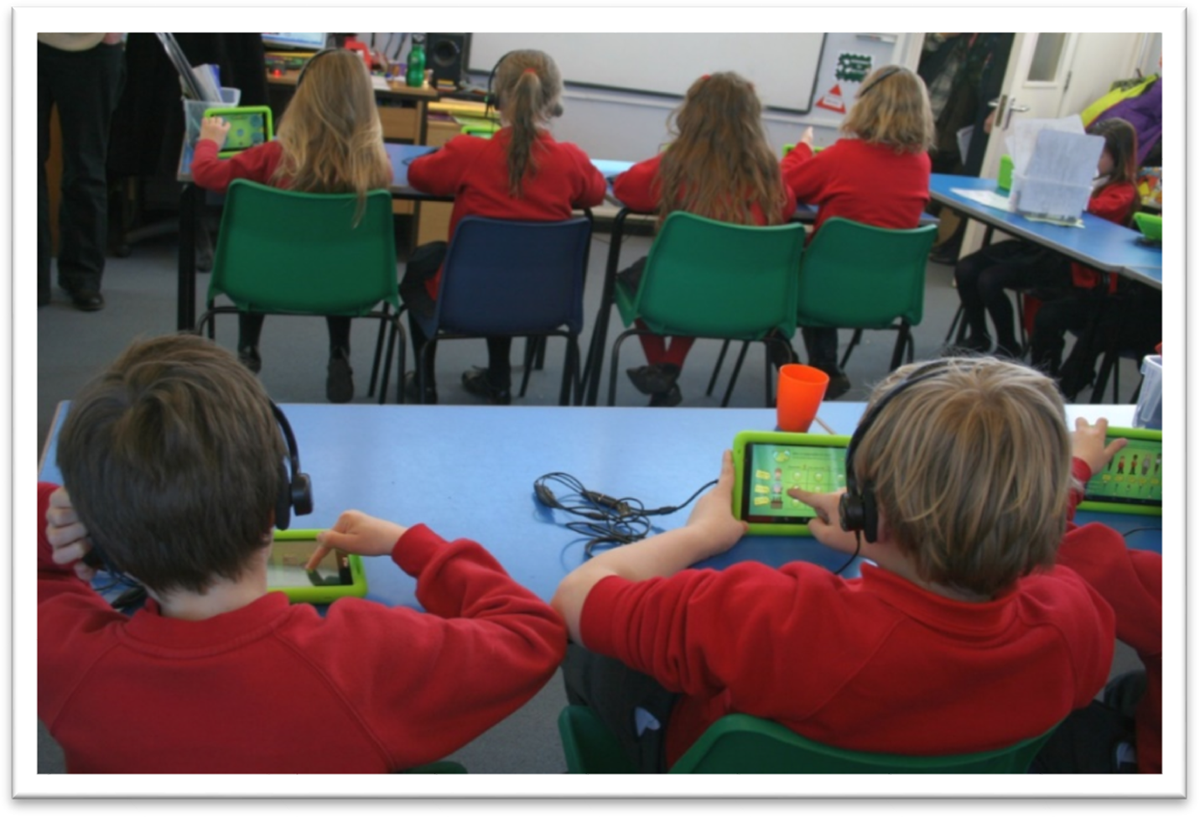
Pilot study: children play the game, Adventures with Lex, in their classroom.
The pilots were very successful. The game was well received by the children and they all engaged with the activity. The equipment worked well. The headsets effectively eliminated the noise of other children playing the game and the microphones recorded good quality audio from the children speaking into the tablet. In the evaluation, 44% of children specifically mentioned speaking into the tablet as the best feature in the game; 72% of children rated building their alien pet as their favourite part. The game was clearly popular. In fact, when asked how the game could be improved, 35% of children stated that they would have liked it to be longer. However, despite the amount of positive feedback, there were some issues with the beta version of the game. The most commonly cited problem was that there was no opportunity for the children to change their answers. Once they had selected an answer on the screen, the game automatically moved on to the next question. Thus, if they made a mistake or changed their mind about an answer, they could not go back to change this. The facility to do this was clearly something that needed to be incorporated into the final version of the game.
One interesting issue with the beta version was identified at this stage of the project: this related to the game visuals. In the school setting, there is one specific scenario which is based on a real legal case. In Mullin v. Richards and another [1998], two school girls were sword fighting with plastic rulers in their classroom. One of them was injured as a piece of the plastic snapped off into her eye. The idea was that this incident would be recreated in the game, with the children shown an animation of the ‘sword fight’ and then asked to judge who they think is responsible. However, due to miscommunication between the project team and the game developers, in the game, it appears that one girl is behaving more aggressively than the other; rather than them both being involved in ‘horseplay’ – the term used by the judge in this case when describing what happened (Figure 9).

Game image from Adventures with Lex – children fighting with rulers.
There was insufficient money to change the animation at this stage of development but it was a useful lesson in the importance of the game visuals to the overall effectiveness of games as research tools. It also emphasized the importance of good communication between researchers and developers. The eventual representation of this scenario in the game potentially changes how children respond to it and their subsequent answers about responsibility. This was something that needed to be taken into consideration in the data analysis phase.
Another issue that arose from the pilots was a practical but significant one for the overall success of the research: this was the format of the extracted data. The quantitative data from the game is stored as Comma-separated value (csv) files and the audio files as individual Waveform Audio File Format (wav) files. Upon downloading the children’s answers from the beta version of the game, it became clear that the format of the data would make it extremely difficult to process. Each child’s answers were in columns rather than rows, making it difficult to collate the children’s answers in Excel or SPSS, and the files also included a lot of unnecessary data. Discussing the format of the extracted data was an aspect that had been overlooked in the game design phase. It was not straightforward to change – every question and answer that had been programmed in the game had to change the way that it saves data from appending to a file to saving it within the memory (within the code; Enigma). It was, therefore, an expensive oversight – it cost one and half extra days of the developers’ time. The pilot study proved to be an invaluable part of the research process as it provided the opportunity to identify these problems and correct them before the empirical phase of the project.
For the empirical phase of the project, various primary schools from across the city and county were identified as potential partners in the study. These schools were chosen as a representative sample of all the schools in the area. Of the 18 schools invited to participate, eight schools agreed, and were able, to take part. The parents/carers and children at each school were sent leaflets informing them about the project and clearly explaining the purpose of the game. They were also sent informed consent forms which, in line with BERA’s ethical guidelines for educational research (2011), also explained their right to withdraw from the research at any time. Both the parents and the children themselves were asked to complete these consent forms. Only children with completed consent forms took part in the study. Engagement with the project varied from school to school, ranging from 95% of children in one school to around 50% in another. Data collection took place in April to June 2015 with the project team travelling to schools with heavy cases full of green tablets.
In the game sessions, tablets and headsets were distributed to the children. There was a brief introduction to the project and the project team and an overview of how the equipment worked. Each child had to enter a ‘Cosmic Code’ into the tablet before they started the game. The Cosmic Code was a unique identifier distributed to each child which anonymized the data – linking it to this code rather than the child’s name. Children played the game individually at their own pace. Each question in the game appears as text on the screen but can also be read out loud to the child by pressing a small speaker button next to the words: this was incorporated to overcome any problems with children’s literacy levels. As the children finished the game, the tablets were collected, and the data extracted and uploaded to a laptop. The data was also backed up on an encrypted hard drive. At the end of each session, the children were invited to comment and give feedback to the project team. In line with good ethical practice, the children were also given feedback on the legal scenarios and issues they encountered in the game. This was an important part of ‘debriefing’ the children as the game includes potentially upsetting and sensitive issues. In addition to this formal discussion of the issues, the game includes a short message which advises the children to discuss any concerns about the issues raised the game with an adult they trust and providing them with the contact details for ChildLine, the confidential listening service for children.
The game was eventually played, and data collected, from 634 children, aged 8–11. Working with this number of children in such a short time period – around 8 weeks – would have been enormously challenging without the game. The game was well received and proved to be a successful and popular way of conducting research with children. Feedback has been positive from head teachers, teachers, parents and children. One head teacher commented: This project has provided a superb opportunity for pupils at our academy to reflect upon their legal rights and responsibilities via a game that is both innovative and fun…the game takes abstract legal concepts and makes them clear and relevant to young learners in our digital age.
The implications of this study
The use of game design elements in non-game contexts is clearly being recognized as beneficial in a wide range of areas. Commercial organizations have seized the opportunities that gamification offers to engage their staff and customers. The health sector and the military have realized the potential that games have to recreate authentic content and practice in a convenient and cost-efficient context. In education, game-based learning is seen as a means to present complex and interconnected issues and share and explore values. All of these developments are influenced by the motivating and engaging qualities of games and are supported by their growing popularity in wider society.
Gamification presents similar opportunities to the research community. Researchers need to find effective and convenient ways of engaging with the public. This is relevant to both conducting research as well as increasing public engagement with the outcomes of research. For conducting research with children, game-based research presents an innovative way to motivate and engage young participants. For research into behaviour and decision-making, games provide a new environment for contrived observation. As controlled environments, they offer a safe space to explore sensitive issues. Most importantly, through their ability to recreate situations with close resemblance to actual events, games can reflect a player’s experiences thus enabling transference of behavioural patterns between the game and the real world. In this way, games can be seen as a theoretically invaluable research tool.
This study has shown that games can also be invaluable research tools in practice. The game, Adventures with Lex, allowed the project to fulfil its aims and objectives. It enabled abstract legal concepts to be presented to children in a way that made sense to them. The key game design elements, the fictional world, the narrative and the reward system, complemented this: these were all developed through participatory design methods which ensured that the game was relevant and appealed to the participants. The fictional world reflected the reality of children’s lives. The key actor, Lex, and the imaginary scenario method of guiding the naïve alien through the worlds informed the game narrative and was a useful way to gain insight into children’s behaviour and reasoning. The game narrative also meant that particular areas of interest could be incorporated into specific scenarios and the children’s responses observed. This would not have been possible with more traditional forms of participant observation. Furthermore, the game’s controlled environment provided a safe, protective frame to address potentially sensitive issues such as bullying and physical chastisement. Finally, the reward system – the Alien Pet Lab – proved to be a key factor in engaging the children with the game and the research. Developing the game was not without its challenges. These included choosing appropriate equipment, ensuring the game’s visuals represent appropriate meaning and communicating with external stakeholders. However, children’s familiarity with games, and the inherent motivating and engaging qualities of gaming, lead the children to be strongly engaged with, rather than alienated by, this research. That is certainly a ‘reward of glory’ (Hallford and Hallford, 2001) for the project.
Game-based research is clearly an innovative concept but this project has demonstrated that it is a successful way to engage children with research. By providing them with a familiar and comfortable setting, games overcome the problem of ‘alienation’ which can be caused by more traditional methods. Children are in their comfort zone – an environment where they are the experts; this presents clear advantages to researchers working with them. The use of game-based research also provides new opportunities for researchers who need to explore sensitive topics with children and young people as the magic circle provides a safe space to do this. A game-based approach to research has proved to be particularly effective for gathering large scale responses to closed questions. Its value as a qualitative approach was more limited due to the lack of opportunity to prompt and probe children’s responses but it should not be dismissed; there is potential for development in this area too. Game-based research will not necessarily provide rich data but it is a useful tool for gaining insight into people’s views and could be used as a building block as part of a mixed method approach.
The impact of using game-based research with adults needs further exploration. It is possible that the exact approach taken in this project – using a game as a data collection tool – is less important when working with adult participants. However, game-based learning with adults – professionals as well as HE students (Jisc, 2016) – is proving to be increasingly popular. Certainly, at a time of survey overload, there is also an opportunity for game design elements to improve the engagement of adult participants with research. Current projects such as EnerGAware – a project developing a serious game to explore household energy efficiency – will provide useful evidence of the effectiveness of using serious games with different groups (EnerGAware Consortium, 2015). This will help inform the future of game-based research with adults.
Adventures with Lex has been an invaluable aspect of the Law in Children’s Lives project which is part of a broader theory of change which aims to explore children’s current understanding of the law and ultimately develop an educational game to reinforce children’s awareness that the law protects and empowers them in their everyday lives. Following on from the successful conclusion of this phase of the project, there is further research to be done and it is anticipated that Adventures with Lex will be a useful building block as the project moves forward. For now, this project has confirmed that game-based research is a transformative idea which can improve how researchers approach future research with children.
Footnotes
Funding
The author(s) disclosed receipt of the following financial support for the research, authorship, and/or publication of this article: This work was supported by the Economic and Social Research Council (Grant number: ES/M000443/1).