



Abstract
Based on online observation of communication in a web-based weight loss forum, this article identifies the relevance of confession and absolution as characteristics of online interactions. Our close study of forum messages, arranged as web diaries open to comments from participants, shows that self-blaming posts elicited absolutional replies. With a primary interest in those personal posts which had a confessional character, we identified three aspects of absolution in replies: collective, prospective and supportive. Of special sociological interest is how online interaction in the forum challenges the concept of ‘civil inattention’ (Goffman, 1971) as a basic social norm for interaction in public spaces. Rather, absolutional attention defines the interactional order within the forum, in which diary authors receive feedback on their accounts of challenges, problems and failures. Studying online communication in detail may contribute to an important theoretical refinement of interactionist sociology, which currently strongly rests on studies from pre-Internet times.
Introduction
With the growth of the Internet in the early 1990s, web-based communities have expanded rapidly (Stommel, 2009) to include mailing lists, newsgroups, forums, Internet Relay Chat channels and multi-user domains. Within the health domain, a vast number of online support groups have been established, often related to one specific group of patients or a single disease. These serve a wide range of functions: exchanging patient experiences, searching for and exchanging information, posting diaries and seeking and providing emotional support. The Internet is now to be thought of as a low-threshold medium (Stommel and Koole, 2010), characterized by 24-h availability, anonymity and geographic independence. Connection has also, at least in Western countries, become cheap with, for instance, free ‘Wi-Fi zones’ in a number of (semi-)public spaces. A quantitative study by Berger et al. (2005) shows that the Internet is a valuable communication and education tool for stigmatized groups. People with stigmatizing illnesses are more likely to use the Internet for information, communication with physicians and healthcare information discovery online compared to individuals with non-stigmatized conditions. Communication without visual cues (age, gender, race and appearance) as a potential source of empowerment among individuals with severe physical or mental disabilities is also an important factor (Finn, 1999: 229). While the fit body signals healthy living and self-control, stigma and low status are connected to the overweight body (Lupton, 1996). The anonymity provided online allows members to easily and safely explore sensitive themes or stigmatizing experiences.
The Internet is widely used for health-related purposes, with implications for patients, clinicians and the structure and practices of healthcare delivery (see, e.g. Henwood et al., 2003). It offers lay liberation, pluralism, democratization and empowerment in relation to a dominant medical profession (Fox et al., 2005; Hardey, 1999; Radin, 2006) but also poor-quality medical information, promotion of potentially harmful therapies (Crocco et al., 2002; Kiley, 2002) and lay acceptance of unhealthy attitudes (Gavin et al., 2008; Hirji, 2004; Whitlock et al., 2006). Social research on use of the Internet for health-related purposes tends to reduce the polarization between these accounts by researching the complexity of Internet use and non-use in relation to everyday health practices and offline contexts (Andreassen, 2011; Broom and Tovey, 2008; Henwood et al., 2003; Kivits, 2009; Sandaunet, 2008a, 2008c; Trondsen and Tjora, 2014). Accordingly, Nettleton et al. (2005) have suggested that the different responses to the proliferation of Internet-based health information can be classified as (1) ‘celebratory’, (2) ‘concerned’ and (3) ‘contingent’. Similar to much of the sociology within this area, our approach conforms to the contingent approach, in which we study the use of an obesity forum as part of the everyday practices and experiences of handling obesity and accompanying lifestyle changes. Combining interviews and net-based observation (similar to, e.g. Sandaunet, 2008b; Trondsen and Tjora, 2014) supports the ambition of a nuanced analysis of how using the Internet for health purposes is contingent upon participants’ everyday lives and situations.
This article draws on analysis of online interaction between obese people enrolled in a weight loss programme, in which strong experiences of shame and blame (stigma) serve as an important background (Grønning et al., 2013). On the basis of close inspection of interactions on the programme’s web-based forum, we ask the following questions: What characterizes interaction in an online weight loss forum for people during radical lifestyle changes made in effort to lose weight? How may we conceptualize this phenomenon within interactionist sociology?
This article is based on observation of one diary posted in a weight loss forum over an 11-month period, responses to this diary, and an interview with the writer of the diary. We identify the forum as an arena for sharing confessions, that is, accounting for negative behaviour and experiences from which different forms of communal normalization strategies emerge. Communal normalization has been identified by Trondsen and Tjora (2014: 1410) as a process in which online forum participants interactively provide and obtain support to handle everyday life situations through increased recognizability, openness and agency. While Trondsen and Tjora’s study of adolescents with mentally ill parents is of great relevance, we have identified a slightly different interactive pattern in this weight loss forum, and we ask whether the concepts of confession and absolution are relevant as descriptors of much of the interaction we have observed.
Online support for stigmatized groups
The reasons for using online support groups are many, and research indicates that men and women use the Internet differently (Seale et al., 2006). While more men than women use the Internet to find information about treatment, side effects and diagnostic procedures, women tend to seek social support online. Also, Internet use of individuals with stigmatized illnesses differs from that of individuals with non-stigmatized illnesses (Berger et al., 2005). People who recognize themselves as characterized by stigma are likely to isolate themselves from the community (Smith, 2007). Obese and overweight children are met with prejudice from an early age (Øen, 2012). A study of people’s evaluations of endomorphic (soft, round body), mesomorphic (strong, athletic body) and ectomorphic (slim body with lean muscles) silhouettes showed that even children as young as 6-years old evaluated the endomorphic body as unfavourable, using adjectives such as lazy, filthy and ugly, while the mesomorphic body was assigned positive descriptions (Staffieri, 1967).
In order to avoid social stigma, many overweight people choose to withdraw from social activities (Grønning et al., 2013; Smith, 2007). As an alternative, some overweight people find social support in anonymous communication online. In a study of a public Internet weight loss community, Hwang et al. (2010) found that the forum provided participants with encouragement, motivation, information and shared experiences and was characterized as convenient, anonymous (if desired) and non-judgemental. Online social support can also help members to cope with being overweight and inspire them to lose weight. Self-monitoring is promoted and sustained by positive personal feelings, aptitudes favouring organization and computation, and by commitment, determination and support from significant others (Burke et al., 2009). This indicates that self-monitoring in an online forum is beneficial, as participants receive social support and feedback while posting diaries.
People seem to have little trouble expressing negative feelings online, as online support groups serve as arenas for emotional support (Coulson et al., 2007; Coulson and Knibb, 2007). A meta-analysis of 28 studies of health-related outcomes associated with participating in computer-mediated support group interventions found that participants experienced a significant increase in social support, a decrease in depression and an increased quality of life and self-efficacy to manage their health condition (Rains and Young, 2009). Cancer patients differ from this group of participants as their diagnosis is characterized as a high-status illness (Album and Westin, 2008), while at the same time having a higher death rate. In studies of online support groups for women with metastatic breast cancer, Vilhauer (2009) found that these groups offer continuous support from other women with the same diagnosis, providing great help for those who are either too ill to participate in group meetings or reluctant to participate due to changes in physical appearance (Vilhauer, 2009). Sandaunet (2008a) found that some women with metastatic breast cancer chose to withdraw from social support groups online in order to avoid reading painful details about cancer, which indicates a possible difference between stigmatizing illnesses in comparison to diagnoses where death and dying are more central themes.
Online spaces as the new sites of normalization
This article aims to discuss the interaction that takes place in an online weight loss forum. We see that self-blaming posts receive normalizing replies. Within sociology, Erving Goffman in particular has provided concepts attempting to make sense of the different processes that maintain the interaction order. We see these concepts as different processes related to normalization, which are also relevant for online communication. Through ‘saving face’ (Goffman, 1955) and maintaining civil inattention (Goffman, 1971), the interaction order is developed and maintained. With reference to Goffman’s interaction order, Smith (2011: 364) suggests that ‘normalization rituals’ are established in the encounters between urban welfare workers and their clients to reduce problematic aspects related to stigma. While civil inattention is used as a term for distancing oneself from interest in others (avoiding staring obtrusively in public), an even stronger ‘wilful disattention’ is displayed by welfare workers to repress stigma, risk and the knowledge of ‘abnormal’ or threatening behaviour in the outreach encounter (Smith, 2011: 371). These processes of saving face maintain actors’ dignity by avoiding focus on interactional failures or negative attributes. Saving face is maintained by a person effectively presenting a self-image that is internally consistent, supported by judgements and evidence conveyed by other participants and confirmed by evidence conveyed through impersonal agencies in the situation.
Another concept that is relevant to communication online is that of ‘accounts’; a way of bridging actions and expectations, defined as ‘a linguistic device employed whenever an action is subjected to valuative inquiry’ (Scott and Lyman, 1968: 46). Richard Buttny (1993) defines an account as ‘talk that is designed to recast the pejorative significance of action, or one’s responsibility for it, and thereby transform other’s negative evaluations’. Scott and Lyman (1968) distinguish between Austin’s (1961) formulation of accounts as excuses and justifications. When an individual accepts responsibility for an act but denies the negative quality associated with it, it is classified as a justification. When an individual admits to having done something wrong but denies full responsibility, it is described as an excuse. Excuses come in different forms: for example, constructing the backstory to an event in terms of an accident or appealing to defeasibility. All actions contain a mental element such as knowledge or will. Excuses can therefore be presented against a background of lacking information and can be linked to biological traits or to scapegoating (blaming others). Justifications can also be used to neutralize an act. Using justifications recognizes a general sense in which the act in question is impermissible but claims that the particular occasion permits or requires the act.
While saving face (Goffman, 1955), ‘excusing’ and ‘justifying’ (Scott and Lyman, 1968) point towards different interactional processes, they all support encounters by which embarrassment is reduced or avoided through subtle variations of language and gesture. Such processes have been identified in language studies: In doctor–patient consultations, lowering or changing tone of voice can be used to avoid threats to ‘face’ or to indicate delicate issues. Non-deliberate pauses are a way of presenting information more smoothly, as a means of expressing caution when dealing with sensitive topics (Linell and Bredmar, 1996). Nevertheless, social normalization processes have received surprisingly little attention within the social sciences given the prolonged popularity of Goffman and the relevance of his concepts to such processes. In particular, while challenging Goffman’s relevance for mediated communication, for instance, his frontstage/backstage concepts (cf. Rettie, 2009; Tjora, 2011), we find online-based processes of ‘communal normalization’ (Trondsen and Tjora, 2014) very relevant for our analysis in this article. Such processes, and how they are mediated through various applications of communication technology, are not only relevant for studies of social aspects of such technologies but also relevant for the further development of sociological studies of interaction.
Research methods
This article is based on observation of a Norwegian online weight loss forum over an 11-month period in 2011 and one interview with one of the forum participants. At the time of observation, the forum statistics showed in excess of 3000 members, 8000 subject threads and 16,000 individual posts. The forum includes subforums related to weight loss and also contains a section for diaries. The forum is open to anyone who registers a user profile, although the most active participants have undergone – or plan to undergo – weight loss surgery (gastric bypass, gastric banding or sleeve resection; see, e.g. Grønning et al., 2013). In our observation of interactions in the weight loss forum, we identified ‘Astrid’ as an especially active user with over 1000 posts at the time of observation. Due to the huge amount of data in the forum, we decided to focus on this user because she used the forum daily both for writing posts and for reading and commenting on other people’s posts. She seemed to use the forum to its full potential, which made her an interesting case. In addition to writing a daily diary on the forum describing her diet, she also kept a diary with weekly weight updates and personal remarks related to workouts and private issues. She also posted comments on others’ posts and received many response comments on her own posts, of which many seemed to provide support and encouragement. Based on our interest in social interaction, we started out questioning whether there were specific qualities in those posts by Astrid which triggered that response type. However, we were also interested in the experience of using the forum, which required interviewing her. The epistemological basis for this article is therefore twofold, analysing interaction in the forum and analysing the manner in which Astrid accounted for her use of the forum.
Astrid was contacted through the forum and she agreed to let us analyse her diary and participate in an interview. Ingeborg Grønning conducted the interview with her in her home in September 2011, lasting 2 h. Before the interview, Ingeborg Grønning read through her online diary and designed an interview guide containing questions about why she joined the forum, how she uses it and how she valued lay knowledge in contrast to professional advice. The interview guide also contained questions about specific posts from the diary and about comments from other users. Text from both interview and diary posts was analysed through inductive coding using HyperRESEARCH qualitative analysis software (ResearchWare, Inc., Randolph, Massachusetts, USA). The interview was analysed first and all the components of the interview were given empirically close codes. We gave these specific code names such as ‘they are all so similar to me’ and ‘I spent all my time reading the forum’, that reflected what was actually being said in the interview, and not only the topic that was being talked about (Tjora, 2012: 184). The analysis of the interview was later used to support our analysis of the online observation data.
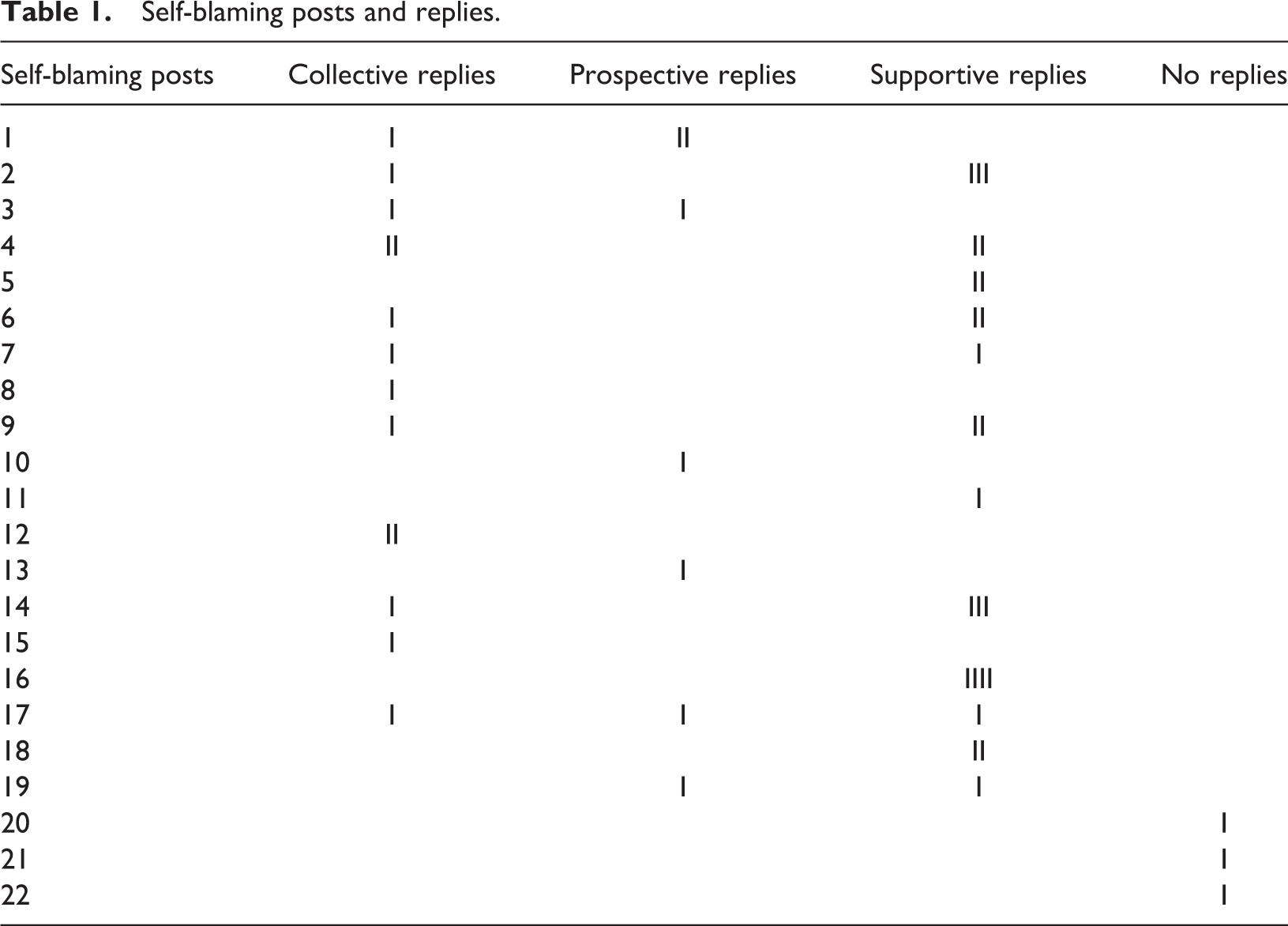
Astrid’s diary postings and responses over the period of 11 months consisted of 393 messages (posts and replies). Her posts and comments were analysed applying HyperRESEARCH in a somewhat different and novel way: Each post was marked with a new code and related replies were given the same code, resulting in a total of 106 codes (one code for each of Astrid’s posts). Some new posts were replies to earlier posts. These were merged with the original post, resulting in 97 posts/codes. The code names indicated the theme of the post, such as ‘I regret eating candy’ and ‘I am disappointed’. The code-structured report generated through HyperRESEARCH following this coding conveniently showed which posts had the most replies, as well as showing the specific posts and replies. We wanted to look further into what characterizes this type of communication. In the first close review of our coding report, we found that 75 of the posts had a positive character, while 22 were self-blaming/negative posts. Of the positive posts, 52 attracted replies. These posts were often about weight reduction, holidays, excursions and parties, and the replies contained remarks such as ‘well done’, ‘have a nice trip’ or ‘have a good weekend’. Of the 22 self-blaming posts, 19 received encouraging feedback (see Table 1). Within these 19 replies, we identified three types of normalizing responses from other forum participants. The three types of response define the core of our analysis in this article. The small sample of one interview and 19 posts and replies is not intended to be statistically representative but rather serves as an empirical resource for a detailed inductive analysis of online interaction. Similar communicative phenomena are likely identifiable in other online support forums, as giving advice and support to community members in need or despair is part of the very nature of such forums.
Self-blaming posts and replies.
There are a range of methodological challenges in web-based observation studies, such as limited background information about participants (Goldfarb and Prince, 2008) and difficulties in evaluating participants’ honesty (Wisznievski and Coyne, 2002). One major concern is the blurring between the private and the public: While the Internet may broadly be considered a public space, online support forums are often experienced more as private spaces by their users, who may reveal ‘the most intimate details of private life relating to sexual desire and suicide’ (Seale et al., 2010: 601). King (1996: 126) warns that online participants have reason to feel harmed and exploited in situations where they are unaware of their messages being analysed (for research purposes), particularly where they unexpectedly learn of a published study based on their own utterances in ‘high perceived privacy groups’ on the Internet. The forum that we observed is publicly available, but users have to register a profile to obtain access. As some participants use the forum as a private arena, as demonstrated by personal communications such as planning coffee dates and meetings, we consider it a semi-private space. Accordingly, in our project, we contacted (using a message function in the forum) all users who were actively involved in the analysed communications with Astrid and requested consent to use their posts in our analysis. There were no negative replies, but some of the users we asked did not respond to the request. We left these specific quotes out of the analysis. Although not represented by a quote, they still support our analysis and are counted towards the total number of post types. Researchers should maintain collective responsibility for online social research, to protect the participants’ anonymity and avoid situations that would threaten the legitimacy of such research. Considering whether informed consent is necessary should be evaluated separately in every case.
Analysis: Online interaction
Being obese is not only characterized as unhealthy, but also as being lazy and weak (Gilman, 2008) and indicating a lack of self-discipline (Grønning et al., 2013), all of which are stigmatizing characteristics (Goffman, 1990). Underweight people have a higher status than overweight people, as control and dignity are perceived in slenderness (Gilman, 2008). Users share these stigmas in the online forum; for some, this may be why they find it natural to share information with each other. Sharing information about personal failure is not only found in online forums, but also on Facebook and in other online social media. Astrid, whose posts we analyse in this article, is a middle-aged woman who underwent bariatric surgery 1 year before she was interviewed for our study. Since her surgery, she has maintained an online diary, which she finds helpful. She uses the diary to share personal stories, experiences and problems. We observed a total of 97 posts in Astrid’s diary. We had special interest in negative posts that triggered feedback from other forum participants, and we chose to leave out those posts that had a positive character. These posts usually reported on family situations such as birthdays and excursions. Replies to these posts involved questions about ingredients, travel tips and cheerful comments about weight loss. A total of 22 posts had a negative, self-blaming character, reporting on a personal defeat such as trouble eating correctly, not working out sufficiently, static weight or even weight gain. Of these, 19 posts received replies that offered practical solutions, explanations or emotional support, or a combination thereof.
During the interview, Astrid mentioned that the forum was a place where she received comfort and encouragement when her weight reduction was slow and when she felt that nothing was helping her to lose weight. It was also a place where she could inspire others and find her own inspiration. Astrid expressed that it took her a while before she understood the unwritten rules of the forum, but she eventually realized that she had to create a dialogue with other forum members in order to elicit replies. She needed ‘to thank the readers for the comments’ in order to maintain the dialogue with other users. For Astrid, it was important that others could read what she wrote because she felt more obliged to continue her diary. As she told us: I wanted to get feedback on my writing and I wanted others to see what I wrote. I felt more obligated to write if others could read it. I wanted to be able to go back and see what I had written.
Self-blaming posts
Astrid exclaims that she is ‘struggling with hunger’ and has lost only 300 g in body weight during the last week. She hopes she does ‘not gain weight next week’.
Astrid writes that she has lost another 300 g and is very disappointed. She was expecting to lose more weight by now. She is very dedicated to her strict diet and feels like she is ‘doing a very good job’.
Astrid is ‘disappointed, sad and angry’ because she feels like everybody loses much more weight than she does. She was expecting to lose more than 1 kg/week. The food focus is starting to affect her psyche and she is becoming tired of thinking about food ‘24/7’.
Astrid is regretting that she has eaten candy every day during Easter and is ‘dreading getting on the scale’ the next day. She has enjoyed herself a lot this Easter, ‘not only with candy but wine almost every day’. The candy has now been cleared away and her husband has hidden it: ‘It’s over!’
Astrid has gained 1.1 kg. She was hoping to not gain weight during the holidays and realizes that she has to ‘get a grip!’
Astrid’s weight has not decreased – which is frustrating, and she is ‘really beginning to get impatient’.
She has gained 500 g and is disappointed. She admits that there was ‘more wine than usual last week’, but justifies this by having had very active days. She is frustrated and feels like she does not ‘have anything left to give’.
Astrid admits that she has gained 200 g following a week without weight change. She feels like it is ‘really dreary’.
In analysing replies to these posts, we found that exposing one’s weaknesses attracts positive responses. On close inspection of the responses, we find that they are either collective, prospective or supportive, or combinations of these aspects. We observed that different categories of reply are distributed between postings, but that supportive replies dominate. In the following section, we explore in more detail the three aspects of the replies. The numbered replies refer to the posts numbered above, while ‘a’, ‘b’ and ‘c’ refer to the order of the replies.
Three aspects of responses
Various strategies can be used to normalize statements or actions (Clarke, 2002; Linell and Bredmar, 1996). Upon analysing the self-blaming posts and replies, we found that 19 of these posts attracted replies that normalized Astrid’s actions. These had a collective, supportive or prospective character. The collective replies focused on how the writer could relate to Astrid’s post and that she was not alone with her problem. The prospective replies included nutritional advice with the hope of faster weight loss in the future. The supportive replies were mainly comforting. They assured Astrid that she was doing a good job and that her total weight loss was great. In this section, we illustrate the different types of replies.
The collective replies recognize the problems that Astrid struggles with in her post. By sharing similar experiences, a collective basis emerges for struggling and not succeeding. The three examples below demonstrate how problems are shared.
Reply 4a: It’s tough when the usual trot starts again. I have the same experience when eating a lot of sugar. I get a real craving! But that’s when the will and the brain are supposed to take over. Had a hard dumping
1
yesterday and I hope it’s enough to convince my brain that it’s about time to get back to the usual routines again. (Jenny) You and I, Astrid. (Betty) I understand that you’re disappointed, but you’re doing everything really well, so just keep up the good work; you’ll get your reward. Remember that everyone in here has had crappy weeks and good weeks. It’s just as important what happens in our heads. I really think you’ve done well. Stick to the positive thoughts and go on! (Fay)
The second aspect of replies is prospective, providing Astrid with practical advice for future action (on diet, in particular). We consider three extracts in detail:
Reply 3a: I understand that you’re disappointed, but have you tried varying the calorie intake by trying 1200–1300 for a few days then rising to 1500? You try chicken/fish one day, then some protein shakes the next day as a snack. I ate at 07:00, 09:00, 11:00, and 13:15 and ate half of a diet bar, a meatball, then a shake, a salad, fish etc…One day with crisp bread, the next day fish. Just some thoughts that may trigger your metabolism. Just some thoughts from me…(Fay) Hi Astrid, I really understand your disappointment, as I gained 300 grams this week and know disappointments. I think that what’s being said here is really reasonable, even if I have a hard time getting enough calories. I’m only four weeks post-surgery and have to admit that I don’t know how many calories I should eat, but I eat around 500–600 calories a day. After reading your food diary, I assume you eat relatively little. So maybe they’re right and you should eat some more. You’re a bit ahead of me anyhow, so it might be about time you increase your calorie intake? If you don’t want to do it with sweets you should do it with other foods. Eat bread instead of soup, for example. You shouldn’t force yourself into eating fat foods if that makes you nauseous. If you do, then the whole eating thing will get even worse. Good luck. From someone that hit the wall and gained weight last week, I’ll say that all weight loss is good. (Hanna) Ugh. I’m sure it’ll pass by next week. (Betty)
The third aspect we identified is supportive replies, which support Astrid without either invoking the collective attitude of the forum or encouraging hopes and actions. Participants assure Astrid that she is doing a good job despite her own disbelief. Supportive replies are especially well represented in the forum, with a majority of replies reflecting this characteristic.
Reply 1b: You’re doing really well, Astrid. I sincerely hope that your weight keeps going down, ‘because you really work hard. It’s so unfair – some lose weight no matter what they do, while others have to work very hard. (Deborah) Congratulations on the decrease in weight and the new BMI point. You know, I really understand that you want to lose weight the fastest possible way, but I think both your head and your skin prefer that it goes slower. I’ve lost weight fast and it shows on my skin. I’m wrinkled all over and it’s not a pretty sight. I look a lot older than I am. It’s really easy to say, but I honestly think it’s for the best. And you’re not gonna stop yet. It’s only been a year since surgery. Even if it goes slow, you’re probably in much better shape than ever, given how much you work out! You’re doing really well, Astrid! (Betty) Hi there, you’ve had great weight loss – and not even once have the scales gone up. If the scale takes a rest from time to time it’s not that bad. But I understand that you’d like to be skinny yesterday, of course…(Deborah)
Three of the 22 self-blaming posts did not attract any responses. The character of these posts did not differ from the ones that attracted replies, which makes the lack of replies unlikely to be significant.
While this section has explored this interaction on an empirically close level, the following section explores the phenomenon from a more theoretical perspective.
Discussion: From civil inattention to absolutional attention
In an online forum, people may participate on the basis of visible interaction (usually text) or invisibly, by ‘lurking’; however, they are all physically absent. It has been suggested, therefore, that the time and space availability provided by online support groups can be regarded as ‘absent presence’, in which people become absorbed in a ‘mediated world of elsewhere’ (Gergen, 2002: 23, 227). The lack of visibility involved in virtual and electronic interaction can potentially redefine situational interactive options (Tjora, 2011), in our case, allowing people to escape physical stigma.
The participants in the weight loss forum have (or have had) a weight problem and have certain experiences and challenges in common. Struggling with obesity and the desire to lose weight affords collectivity on the basis of accepting a commonly recognized problem. Self-monitoring of weight loss and food intake (diets), as well as receiving feedback on such lifestyle changes, has positive effects on weight loss (Burke et al., 2011). From a sociological point of view, online forums seem to produce specific communities, such as the one we examined, so that regular users of such forums leave their status as random strangers as they explore the virtual chat room, to potentially become familiar supporters.
Goffman’s interactional concepts were developed from a primary interest in personal interaction and behaviour in public places but have survived the transition to online communities reasonably well. As noted earlier (i.e. Rettie, 2009; Tjora, 2011), it is time to revise the application of Goffman’s various concepts to mediated communication, such as on the Internet. On the one hand, Goffman’s concept of facework has the potential to increase the understanding of interpersonal dynamics, including that of computer-mediated communication (Radford et al., 2011). On the other hand, concepts such as frontstage and backstage become blurred, as a mediated backstage may exist within a physical frontstage setting (Tjora, 2011: 205) and as interaction that is the ‘frontstage’ of one performance may be the backstage of another (Rettie, 2009: 427). The critique of Goffman’s theatre metaphor from the point of view of the linguistic turn in the social sciences is also of relevance. Butler suggests, for instance, that the ‘self is not only irretrievably outside, constituted in social discourse, but that the ascription of interiority is itself a publically regulated and sanctioned form of essence fabrication’ (Butler, 1988: 528). In our case at hand, the weight loss forum is populated by users who struggle with seriously stigmatizing experiences within the public sphere of their everyday lives. But according to Butler’s position, ‘being obese’ is also performed by interaction within the forum, as well as within the potentially humiliating social face-to-face encounters of the everyday. Communication within the forum addresses issues that are left unspoken (politely in-attended to, or perhaps hinted at) in public. As demonstrated in the last section, extended dialogue (and not just ‘solitary posts’) is supported by what we have termed confessional interaction. Performing a supportive social role as a forum participant includes responding regularly to other participants’ challenges. When an active forum participant (exemplified by Astrid) accounts for her problems (not losing weight, not being able to stick to her diet, etc.), other forum participants are invited to ‘save Astrid’s face’ through responses that contain one or more of the different aspects of responses: collective, prospective and/or supportive.
Confessions are found both offline and online and are relevant to the study of interaction in online forums. The original model of confession is one of the seven sacraments of the Catholic Church. It was originally anonymous, as a screen separated confessor and priest. According to Catholic theology, all sins should be atoned for by an appropriate punishment, to be determined by a priest. After punishment, the apology is mediated through absolution, and the priest forgives the sin on behalf of God. Confessions are still practised in the traditional manner, but they also exist in more modern formats, outside Catholicism. Talk-show host Oprah Winfrey’s confessions about her personal weight struggle have been important to her huge success. By telling her own story or the stories of others, ‘she has made the act of witnessing into her life’s work’ (Klassen and Lofont, 2013: 58). Catholic confessions are forgiven through absolutions, while Oprah’s ‘absolution’ comes with a makeover including new clothes and self-knowledge. Confessions attract public attention, which is found by Ogan and Cagiltay (2006) in their study of the Turkish website www.itiraf.com (‘itiraf’ translates as ‘confessions’). In a survey of 4531 users of this forum, Ogan and Cagiltay found that amusement was the main reason for reading the forum, but that social interaction through writing confessions, commenting on others’ confessions and meeting people offline was also important for the participants.
In our case, we draw a parallel with how online confessions are responded to by absolutional replies that help Astrid cope with her challenges and failures in relation to body weight reduction. Forgiveness in this context is accompanied by advice on prospective changes of attitude, behaviour and lifestyle. Collective and supportive replies are not concerned with a change in behaviour, but rather with assuring Astrid that what she has done is not that bad or that there are lots of people struggling with the same issue, to normalize the experiences that are the basis of her confession.
There are several examples of places and spaces where people gather (offline or online) to confess and be absolved. For example, Alcoholics Anonymous (AA) organize meetings for people with mutual problems. The format provides an arena for sharing experiences, strengths and hopes, in which the goal is to remain sober and help others recover from alcoholism (Alcoholics Anonymous, 2013). Arminen’s (2004) research on AA meetings in Helsinki demonstrates how stories told serve as a format for giving advice. By replying to stories told with another story, support is provided to the first speaker, new perspectives are offered, the identity of the group is supported and symbolic interpretations of the prior stories are established. These social processes are creating a sense of ‘being in the same boat’ (Arminen, 2004: 340). Second, stories are also used as advice in online forums. Veen et al. (2010) found that by showing support through responsive stories in a forum for people with coeliac disease, dietary compliance was encouraged.
Feelings of guilt, loneliness and hopelessness are experienced by overweight and obese people. Individuals with addictions and other ‘weaknesses’ are met with social pressure to regret their actions. By collaborating with people with similar problems, arenas for confessions and absolution are created. In order to comply with the social pressure to regret, ‘hell and damnation’ are avoided and personal absolution is received. While ways of saving face are needed when ‘face-to-face interaction becomes disrupted’ (Buttny, 1993: 22), our analysis shows that saving face is at the very core of prolonged interaction within the online support forum. According to Goffman (1955), saving face is an account whereby a person’s dignity is repaired by avoiding focus on interactional failures or negative attributes. In the case of the weight loss forum, we find that Astrid’s confessional accounts invite saving face for her by means of absolutional replies. Hence, online interaction, as demonstrated in the weight loss support forum, adds to the necessary nuancing of Goffman’s concepts of interaction order for mediated communication (see, e.g. Rettie, 2009; Tjora, 2011; Trondsen and Tjora, 2014).
In our analysis in this article, Goffman’s observations about saving face by means of civil inattention are of special interest. While Goffman (1971) was concerned with inattention as a public response of politely distancing oneself from interest in others, especially when they carried visible stigma, online interaction in a support forum is quite different. First, lurking is invisible – one does not need to distance oneself, and curiosity cannot therefore be negatively sanctioned. The social norm of civil inattention becomes irrelevant. Second, as demonstrated in our analysis, rather than contra-interactive civil inattention to others’ stigma (or failures), pro-interactive absolutional attention is developed and maintained to demonstrate interest in other participants’ problems. While our analysis is qualitative, it is the number of responses (19 out of 22) to confessional postings that triggered the analysis of such postings in particular (compared to 53 responses to 75 positive postings). By responding to Astrid’s confessions, forum participants maintain absolutional attention as part of an online interaction order. On the basis of confessional postings, forum participants are able to reassure each other that they are not alone with their problems, that things will soon improve if small adjustments are made and that they have generally been doing well, after all. The absolutional attention that we have identified as a response to confessional postings demonstrates another interaction order of online discussion forums, in which personal problems and what users experience as individual weaknesses are placed up front. An online frontstage, by which these processes are maintained within (and limited by) the forum, provides a resource for coping with bad days in the struggle to lose weight.
The way in which an interaction order is developed through interaction itself is one of the main propositions of ethnomethodology (Garfinkel, 1967); in this case, how communication within the weight loss forum defines the forum qua interaction order (Goffman, 1983) or as the content of a communication community (Delanty, 2003). Accordingly, we have limited our analysis to the negative postings, with special emphasis on these responses. In a study of a discussion forum about depression, Marrow (2006) classified messages as problem messages, advice messages and thank you messages. In the online weight loss forum, positive posts reporting on weight loss success were more common than confessional posts. We concentrated, however, on the (negative) confessional posts and identified a similar interaction sequence as described by Marrow (2006), but we have put stronger conceptual emphasis on the specificity of the identified interaction as confessional: A user (Astrid in our case) submits a message in which she demonstrates her vulnerability; one or more members of the weight loss community provide a collective, supportive or prospective response; and the original poster responds with gratitude. As mentioned by Astrid in the interview (discussed previously), she had to demonstrate gratitude in order to receive any responses to her postings at all. In seven of the eight confessions that we used in our analysis, Astrid thanks the respondents for their comfort and kind words. In several replies, she admits that she needs comfort to keep up the struggle. The interaction order of the weight loss forum then basically consists of (1) a vulnerability-demonstrating post (confession), (2) empathetic responses (1–3 aspects of absolution) and (3) a thanking response from the original poster to the respondents.
Our analysis is mainly generalizable in a conceptual way (i.e. Tjora, 2012), through the potential application of terms such as confessional interaction and absolutional response. We expect that varied aspects of this interaction order, confessional interaction, may be identified in various forums.
This study has provided a first insight into how online spaces provide interaction characterized by confession and absolution. Our particular case forum is populated by people struggling with obesity, where the definition of a successful outcome – losing weight – is quite obvious to all participants. Such a common goal shared among users will supposedly strengthen the collective aspect of communication, and our case may therefore represent a ‘paradigmatic case’ (Flyvbjerg, 2004) for social support communicated through an online forum. Even if not all support forums resemble the present scenario, similar communal processes may in their generic sense be identified in analyses of online communication, not least for health purposes. Confessional interaction may be one of many communicative practices that evolve through continued engagement in Internet forums, for instance, those in which participants struggle to achieve lifestyle changes. Moreover, for a more updated microsociology, detailed studies of web-based communication may provide the necessary challenge to classic studies of social encounters, both in physical and virtual space.