




Abstract
Accounts of our digital future, both optimistic and dystopian, are often founded on three myths: users are in charge, big data is neutral and people will opt to live in enclaves. This article describes and challenges those myths. As an alternative, it posits a dynamic model of the digital media marketplace in which users, media and metrics constantly interact. It concludes by arguing that the structural features of the marketplace play an important role in shaping crossmedia encounters and inviting readers to consider the power of media to reshape preferences.
The social impact of digital media has been the subject of widespread speculation, but there is little consensus. Some believe that we are at the dawn of a new participatory culture. Others are convinced that digital media will tear society apart. Most of these arguments, optimistic or dreary, are built on erroneous assumptions about digital media and how people use them. In this article, I critique three of the most prevalent myths. As a corrective, I describe a theoretical framework I call ‘the marketplace of attention’. It better reflects the dynamic nature of the digital media environment by invoking a structurational model where the use of crossmedia both shapes and is shaped by the environment.
The three myths
Popular and scholarly commentaries about our digital futures make a number of compelling, if unfounded, assumptions about digital media: first, that users are now in charge; second, that big data is neutral; and third, that given a chance, people will opt to live in media enclaves. Sometimes, these assumptions reflect the theoretical commitments of the author(s). Often, they are buttressed by anecdotes or other questionable evidence, and they typically lead to compelling stories of hope or despair. To be sure, not everyone subscribes to these myths, but they are prevalent enough to identify and challenge.
Users are in charge
Digital media allow people to choose from an endless supply of offerings. Users can also make their own media and share what they like with everyone else. All this can be done ‘anywhere anytime’. The widespread availability of these media resources has led to a growing chorus of user empowerment. In business, we hear that the ‘consumer is king’ (Gottlieb, 2010; Markillie, 2005). In the blogosphere, the public has morphed into the ‘people formerly known as the audience’ (Rosen, 2006). In academe, media users are now ‘prosumers’, who ‘are demanding the right to participate within the culture’ (Jenkins, 2006: 24). Whether these newfound freedoms are being used for good or ill varies depending on whom you read, but all such narratives assume users have unfettered agency.
In a digital media environment, agency – or the power to act – appears in different ways. Three expressions of agency are particularly relevant here: the freedom to choose, the freedom to create and the freedom to share.
The sheer number of media choices has grown steadily over the years, as has scholarly interest in choice-making (Hartmann, 2009). Long gone are the days when a few newspapers or networks controlled the public sphere (Katz, 1996; Williams and Delli Carpini, 2011). The convenience and super abundance of digital media affords unprecedented freedom of choice. The only questions seem to be how people will use this power and whether we’ll like the result.
Anderson’s popular book, The Long Tail, revels in the death of ‘hit-driven culture’ and the ability of users to find niche media suited to their tastes (Anderson, 2006). This, we’re told, will nourish a robust popular culture. Others fear people will make poor choices. For example, they could avoid news that they find ideologically objectionable (Levendusky, 2013; Stroud, 2011; Sunstein, 2007) or ignore news altogether (Aalberg et al., 2013; Prior, 2007). Neither would bode well for participatory democracies. All of these scenarios suggest the emergence of media enclaves – another myth I address below.
Digital technologies have also been a boon to people who want to create media. Their contributions run the gamut from using social media for self-promotion (Marwick, 2013), to propagating memes (Shifman, 2014), to collaborating on more elaborate productions (Benkler, 2006). Perhaps, no form of user-generated content has received more attention than grass-roots, citizen journalism (Gillmor, 2006; Schmidt and Cohen, 2013). The tone of most writers documenting the freedom to create is optimistic. Ordinary people can now make their own contributions to the marketplace of ideas. Whether they have anything really new to say or whether anyone else is listening is less certain (Webster, 2014). Indeed, the freedom to create seems empty without a corresponding freedom to share the result, and it is the nature and extent of sharing that is pivotal when judging social impact.
Several writers have argued that digital media give new life to ‘sharing economies’, in which exchanges aren’t motivated by financial gain (e.g. Benkler, 2006; Jenkins et al., 2013; Lessig, 2008). People can and do share their own creations. More often, they pass along an existing piece of content by sharing a link or ‘retweeting’. Almost always, social media platforms are the vehicles that people use to share. Here again, the tone of most people who write about sharing is upbeat. Whether the actions of ordinary users do much to alter the mix of voices being heard is doubtful. Aside from user-generated content that unpredictably goes viral, powerful institutions and celebrities still seem to dominate the public sphere (e.g. Hindman, 2009; Wu et al., 2011).
Social sciences often focus on ‘the purposeful, reasoning actor’ to explain social behaviour (Giddens, 1987: 59). Now that digital technology seems to have freed agents from whatever limited their media use, it’s not surprising that theorists and popular commentators alike look to human agency to tell us what the future holds. It’s as if to say, ‘the users are in charge, so we just have to figure out what they are going to do’. But this agent-centric way of thinking encourages a one-sided and seriously flawed understanding of the digital media marketplace.
First, it’s wrong to assume that people operate in a media environment where they are the only active agents. Media act on users, sometimes in ways people cannot detect. Those in the business draw a distinction between pull media and push media. In the former, people find the media they want; in the latter, media find the people. Those who assume agents are in charge often turn a blind eye to push media. This is a serious oversight. Advertising and public service messages have long found audiences, no matter what people have chosen to see, but digital media make those old push media techniques seem quaint. Today, websites instantly recognize a person’s presence, auction their attention to an advertiser and serve them a targeted advertisement – all in a fraction of a second. This can happen anywhere, anytime. In fact, the media environment is full of ways to push media; from programming linear television and radio, to deciding what is put on the covers and home pages of publications, to engineering the ‘stickiness’ of websites.
Second, an agent-centric approach typically assumes that people will make well-informed, or even ‘rational’, choices about what media to use, but that isn’t necessarily so. People often don’t know all their options. They suffer from what economists call ‘bounded rationality’ (Simon, 1991). In a digital environment, user choices cannot be fully informed because there are too many things to consider. Moreover, most media are ‘experience goods’ whose attributes cannot be fully known prior to consumption (Caves, 2000). Users do their best to cope with this abundance by narrowing their choices to small ‘repertoires’ (Hasebrink and Domeyer, 2012), using heuristics (Marewski et al., 2009) and relying on recommender systems – a topic I discuss below. None of these methods is fool proof, and they all affect the extent to which users act rationally.
Third, many of the most consequential forms of social behaviour emerge without users even knowing what they’re a party to. The choices of individual television viewers create predictable patterns of audience flow without any coordinated effort (Webster, 2006). Programmers attempt to exploit these patterns when scheduling programmes. Digital networks are particularly susceptible to mass behaviours that emerge from individual actions in unintended ways; these include herding behaviours, information cascades, social contagions and power law distributions. These are powerful forces that shape cultural consumption, but they are not well explained by focusing on purposeful, reasoning actors. As Watts noted, ‘you could know everything about individuals in a given population – their likes, dislikes, experiences, attitudes, beliefs, hopes, and dreams – and still not be able to predict much about their collective behaviour’ (2011: 79). So while users are in a position to do far more than ever before, they’re hardly in charge.
Big data is neutral
In recent years, we’ve become sensitized to the darker side of big data. Stories about governments monitoring our private communication, hackers stealing our personal information and commercial interests gathering our ‘digital exhaust’ are hard to miss. They all involve instances where our data can be turned against us, and the public seems alert to these dangers, but that’s hardly the end of how big data affect our digital lives. Ordinary citizens and many knowledgeable commentators seem far less concerned with the applications of big data that appear to make the world a more predictable, manageable place. Here, if it’s even given a thought, people are more likely to view big data as a neutral tool that enhances their lives.
Indeed, the buzz around these apparently benign applications suggests big data will revolutionize everything from forecasting the weather to predicting the media we’ll like. Many of these claims make a common, if unspoken, assumption that big data is so vast and unadulterated that it provides users with a powerful, distortion-free lens with which to see the world. The most exuberant proponents, such as Anderson (2008), have argued that scientists no longer need to trouble themselves with theory because with enough data, we’ll simply know – a claim that has been widely challenged. A steady stream of government papers, consultant reports and trade books echo the same refrain, however, that big data has a wealth of valuable, unproblematic applications (e.g. Mayer-Schonberger and Cukier, 2013; McKinsey, 2011; Podesta, 2014).
One challenge in sorting through these claims is the tendency of authors to gloss over differences between modelling and prediction in the physical and social worlds. They are very different. Big data can certainly help predict the weather, and while the algorithms that crunch the data don’t always agree, their forecasts don’t change the weather. Hurricanes are oblivious to our predictions, but the algorithms that predict what movies we’ll like or what books we should read are different. Social recommendations enter back into the world they observe and change it. They are wonderful examples of what the great sociologist Robert Merton called ‘self-fulfilling prophesies’ (1948). Once you realize that the operation of big data can alter digital media systems, the notion that they are neutral tools goes out of the window, and it becomes important to assess their effects on the system.
The term ‘big data’ involves two interrelated sets of issues that are worth disentangling. The first is about understanding the data itself. What does it really measure or represent? The second is about how we handle the data to create rankings and recommendations.
Big datasets are, by definition, enormous. The sheer volume of the data and the velocity with which it comes at us is awe inspiring. Big data can solve a number of analytical problems, especially in a rapidly changing, highly fragmented media environment (Webster et al., 2014), but it can also be riddled with problems (Boyd and Crawford, 2012). Among other things, data often fails to adequately represent all relevant populations (Hargittai, 2015). Recent work on crowd-sourced data has found that it under-represents rural areas and so provides a poor picture of those areas (Johnson et al., 2016a; Johnson et al., 2016b). Additionally, much of the data collected by digital media platforms captures behaviours (e.g. page views, downloads, time spent viewing, purchases, etc.). These may or may not reveal other things, such as liking or engagement, but they are routinely taken as evidence of people’s preferences (Webster, 2014). If the data that falls into our laps doesn’t really measure what we need to measure, it’s difficult for any analytical technique to compensate for its shortcomings. This can do more than introduce random error into the process. It can introduce systematic biases, even before the data is massaged with algorithms.
The ways in which big data is reduced and turned into actionable recommendations are another potential source of systematic bias. Two biases are widespread. First, most recommender systems try to personalize their results. The algorithmic techniques vary, but personalization is the hallmark of search engines, social media, online retailers and content providers. In fact, the prevalence of these unseen filters caused Eli Pariser to warn against the rise of ‘filter bubbles’ (Pariser, 2011). Second, recommender systems typically rank order results by popularity. This can encourage the emergence of winner-take-all markets in which media offerings build a cumulative advantage over competitors that has little to do with their quality (Salganik et al., 2006). Personalization and popularity are the yin and yang of recommender systems. They can either divide or concentrate public attention. The balance between these tendencies can vary. They are not in and of themselves good or evil, but it’s naive to think that these applications of big data are somehow neutral in digital media systems.
Users will opt to live in enclaves
One of the most widely anticipated consequences of digital media is that users will opt into enclaves – indulging in preferred genres and avoiding whatever they find distasteful. Several theories, including ‘selective exposure’, predict that users will deliberately choose a steady diet of what they like. As we’ve seen, sometimes this expectation buttresses an argument that digital media will encourage the growth of a more robust cultural democracy. At other times, it is the opening salvo for claims that media use will devolve into ‘echo chambers’ of ideologically agreeable news and entertainment, but neither scenario squares with the best evidence on media use.
Anderson’s treatise on the long tail is illustrative of optimistic interpretations of enclaves. He approvingly envisions of the growth of a ‘massively parallel’ culture composed of ‘millions of microcultures’ and ‘tribal eddies’ (2006: 183). Others imagine vibrant communities of interest in niches on the long tail (e.g. Benkler, 2006; Jenkins, 2006). Readers might easily imagine a world in which fans and genre loyalists spend much of their time in these niches, but that expectation is not well supported by analyses of audience behaviour. As a rule, the few people who consume unpopular media or visit niche websites spend very little time with them (Elberse, 2008; Gentzkow and Shapiro, 2011; Webster and Ksiazek, 2012). They, like most people, devote more attention to popular offerings.
The pessimistic accounts are more abundant and varied. A great many commentators, especially in the United States, warn of a growing ‘red media/blue media’ divide, in which partisans consume a steady diet of likeminded media (e.g. Iyengar and Hahn, 2009; Jamieson and Cappella, 2009; Levendusky, 2013; Stroud, 2011). Here again, analyses based on metered data indicate that partisans are exposed to ideologically crosscutting outlets (Gentzkow and Shapiro, 2011; Prior, 2013; Webster, 2014). Other writers worry less about ideology but fear that an abundance of entertainment may allow people with no interest in news to avoid it altogether (Aalberg et al., 2013; Ksiazek et al., 2010; Prior, 2007). Sadly, there is credible evidence that large minorities of the population do a pretty good job of avoiding hard news. The consolation for myself and others is that people are likely to encounter political ideas even if they don’t see ‘the news’ (Webster, 2014; Williams and Delli Carpini, 2011).
All of the above casts doubt on the existence of what might be called ‘opt-in’ enclaves – that people will knowingly self-select into narrowly circumscribed media environments and stay there. A more sinister prospect is the problem of ‘opt-out’ enclaves. Thanks in large part to the operation of unobtrusive, data-driven systems, digital media are quite likely to be filtering our encounters with media in ways that are invisible to us. Most of the major web platforms we use, such as Google and Facebook, employ algorithms to show us things we’re predisposed to like. This drive toward personalization has raised concerns about the pernicious effects of filter bubbles and ‘reputation silos’ (Pariser, 2011; Turow, 2012). These may create enclaves that are hard to avoid, but the evidence so far is mixed (e.g. Bakshy et al., 2015), and I remain hopeful that we can avoid being captured within totally closed systems (Webster, 2014).
The marketplace of attention
These three myths have inadvertently promoted over-simplified models of media use and, by extension, audience formation. They do this by privileging user-centric theories that assume a passive media environment and turn a blind eye to the operation of data-driven systems. A more complete framework for understanding digital media use needs to reckon with the interaction of three key components: the users, the media, and the metrics on which both increasingly depend. These are featured in a model of digital media use that I call ‘the marketplace of attention’ (Webster, 2014). It is depicted in Figure 1 and described briefly below.
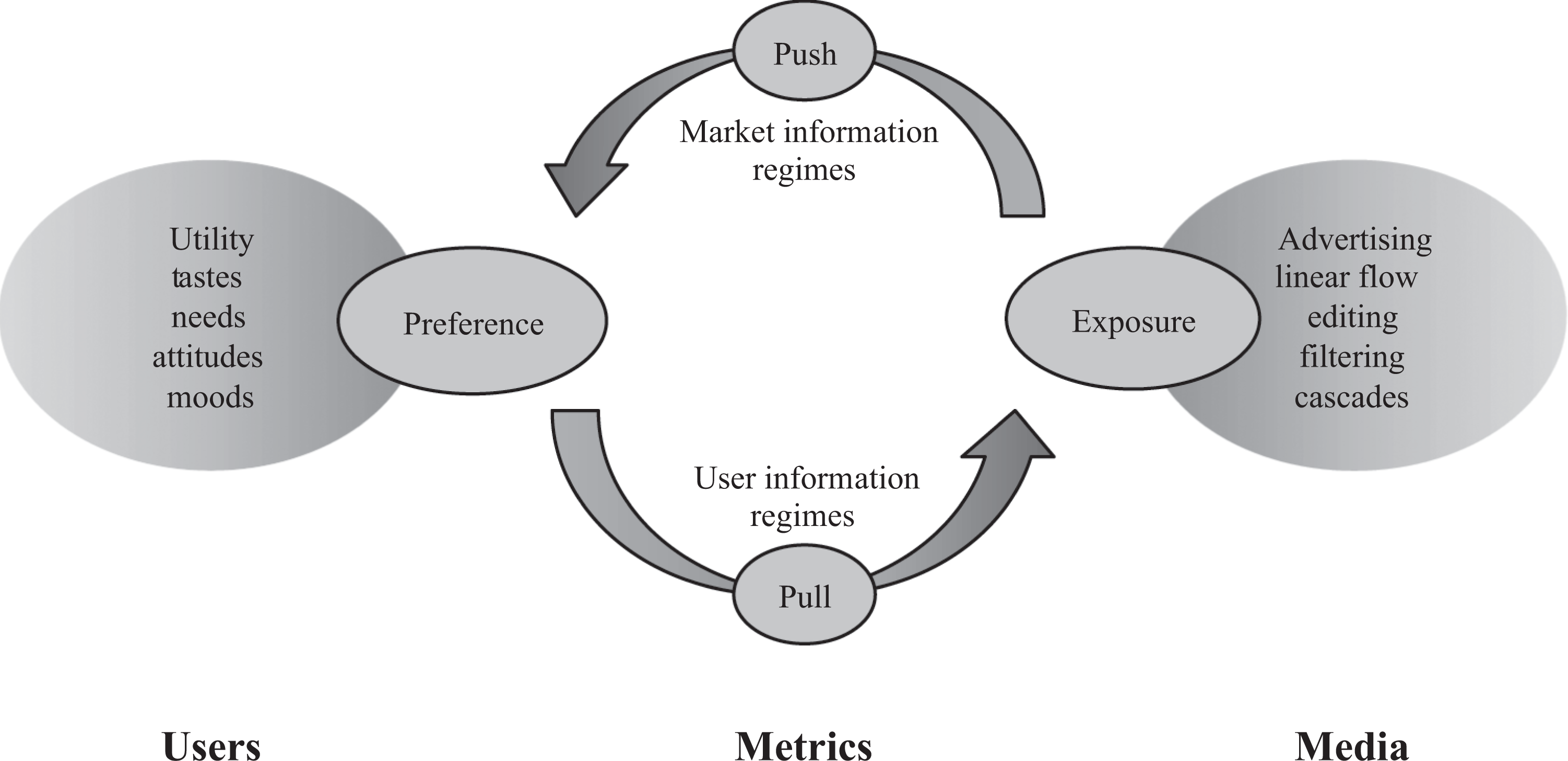
The marketplace of attention. Adapted from Webster (2014).
The model is the result of my work as an audience researcher over the last 40 years. Time and again, I have seen good evidence of macro-level audience behaviour that was not well explained by micro-level theories of individual media preferences. My first foray into reworking the relevant theory addressed television programme choice (Webster and Wakshlag, 1983). The figure you see is my latest effort. It has the virtue, I hope, of spanning all the media a user might encounter, and so offers a way to think about crossmedia use.
Despite its title, the marketplace of attention is grounded less in economics than in sociology. Specifically, I found that Giddens’ theory of structuration provided a useful framework for understanding how people engage with media across platforms and how those behaviours might scale up to form audiences (Giddens, 1984; Webster, 2011). Media users are seen as agents who recursively draw upon structured media resources. As they do, they both reproduce and change the media environment. They are also the authors of a good many unintended consequences.
Like most social scientists, I assume that users are reasoning, purposeful actors. Researchers in various disciplines have identified a great many individual predispositions that can motivate media use: utility, tastes, needs, attitudes and moods to name a few. These motives translate into preferences that guide media choices, but in a digital environment, some sort of recommender system often mediates choice (e.g. Google, Netflix, Facebook, etc.). These systems constitute a relatively new class of metrics that I call ‘user information regimes’ (Webster, 2010). The choices people make in this way result in exposure to offerings in the media environment.
Exposure also results from many things that have little or nothing to do with the exercise of individual preference, however. Most notably, advertising shapes what we see and hear with considerable precision. Programmers and editors also exploit audience flows, page placements steer our encounters with media and information regimes affect exposure by filtering what we see and provide the means for information to cascade across the population. The phenomenon of ‘going viral’ generally emerges as an unintended consequence of social networks in operation.
To efficiently push things at users and monitor their success at doing so, the media rely on ‘market information regimes’ (Anand and Peterson, 2000). These provide the lens through which media see the competitive environment, but that lens has systematic distortions, which affect the actions of the media and thus shape the environment. Traditionally, independent third parties, such as Nielsen or GfK, have provided these metrics. Today, they are joined by data from user information regimes to provide an unprecedented level of surveillance.
In a similar vein, Thorson and Wells (2016) recently suggested that in a digital age, media exposure results from a confluence of different ‘curated flows’. Those flows might reflect personal preferences, but they can also be determined by journalists, advertisers, social networks and algorithms.
Conceiving of the digital media environment in this way helps identify the forces that shape our use of digital media and invites a number of questions about the interaction of these components. To understand crossmedia use, we need to begin by ridding ourselves of the notion that users are solely responsible for their encounters. This is surprisingly hard for social scientists to do, so great is our faith in the purposeful, reasoning actor, but digital media use is always embedded in dynamic systems that enhance certain outcomes and hinder others.
In making sense of these encounters, my own inclination is to think about the role of structures – both social and media structures – that can span large numbers of people. These have the potential to scale-up and produce socially consequential patterns of audience behaviour. If those structures have systematic biases, benign or otherwise, they could reshape the culture.
This leads me to one of the most far-reaching questions begged by the marketplace of attention model. It is captured in the arrow that points back to user preferences. Where do our media preferences come from?
The user-centric approach adopted by most social scientists assumes that people’s preferences for media are ‘exogenous’. That is, their appetites and predispositions arise from factors outside the media environment. Economists begin with the assumption that programme type preferences exist – without further explanation (e.g. Owen and Wildman, 1992). Sociologists argue that tastes are wedded to our place in society (e.g. Bourdieu, 1984). Gratificationists look to the ‘social and psychological origins’ of needs (Katz et al., 1974: 20). The possibility that media preferences are ‘endogenous’ – that they arise from within the system – is often unconsidered.
Of course, this oversight is less troublesome if you believe that users are in charge. If anything, our choices would simply reinforce our predispositions. To the extent that media push things at us, however, they have the potential to cultivate new preferences. This surely happens all the time. We develop new interests or a fondness for new artists as a result of media encounters we haven’t planned in advance.
These encounters almost never cause a sea change in our tastes or deeply held convictions, but our tastes and convictions can and do change. Students of media would do well understand how media preferences evolve over time. Which of the various curated flows that we encounter across media serve as agents of change or agents of reinforcement? To what extent do the expert judgments of editors and critics inform our interests and appetites? Do social networks lock us in place or open our eyes to new and different things? Under what circumstances can any of these mechanisms promote change? Even incremental changes over the long haul could add up, nudging us down a path we might not otherwise have taken. Unravelling these dynamic relationships is one of the central questions before us. It goes to the heart of the media’s ability to reshape the social world.
If preferences are truly exogenous, then the media will ultimately give us what we want. For good or ill, it will be a reflection of who we are and what we desire. If preferences are endogenous, then the media will give us what they want – and we’ll become creatures of the media environment upon which we depend, but to understand these processes and their implications for the public sphere and popular culture, we need to dispense with the myths of digital media.