Abstract
The Stanley Parable (Galactic Cafe, 2013) is a game that self-reflexively meditates on the relationship between the structure in which choices are presented to the player in first-person exploration games and contemporary concerns over freedom. It takes, as its subject matter, its own ‘variable expressiveness’, yet must also delimit that expressiveness in order to direct the player towards a self-reflexive mindset. The article proposes, by analysing three of the endings in the game, that this endeavour necessitates the game to compromise its ‘gameness’ and to move towards being a Lukácsian novel caught in an endless interiority; it must maintain a tension between giving the player freedom and room for expression, on the one hand, and being tightly focused on reflections concerning freedom and meaning, on the other. This reveals something about what computer games must sacrifice in order to grasp at meaning and also what would be required for a work to indicate that in which freedom consists. It will be argued that neither of the two kinds of subjectivity that are detailed by Lukács ((1971) The Theory of the Novel. Cambridge, Massachusetts: MIT Press) – the Homeric subject without interiority and the alienated modern subject on a Sisyphean quest for meaning – are compatible with freedom. Instead, the carefully conceived tensions to which The Stanley Parable gives rise initiates a ‘dance’ that gestures towards freedom inhering in a subjectivity which avoids these possibilities. This could only be accomplished by being more than both a game and a novel. The implications bear upon the form of a medium that can most suitably function as a homology for the aforementioned subjectivity that transcends the two Lukácsian poles.
Introduction
The Stanley Parable (Galactic Cafe, 2013) is a first-person exploration game in which you play as Stanley, also known as Employee 427, who works in the kind of drab, grey room that evokes popular depictions of the early 90s style of office, replete with colour-coded sorting trays and steel filing cabinets.
1
The epitome of the faceless worker in a bureaucratic machine, Stanley is described by the narrator as doing the following kind of work: Orders came to him through a monitor on his desk, telling him what buttons to push, how long to push them, and in what order. This is what Employee 427 did every day of the month of every year, and although others might have considered it soul rending, Stanley relished every moment that the orders came in, as though he had been exactly for this job. And Stanley was happy (Galactic Cafe, 2013).
Wandering through Stanley’s deserted office, it becomes clear that this is a game that tries to do more than offer a fictive game-world boasting challenges to overcome. It is self-reflexive on the manner in which choices are presented to the player in first-person exploration games. The player is prompted to ask themselves whether they have anything in common with their in-game character Stanley, who had hitherto been brainwashed, living day to day in a totally administered life. The Stanley Parable (hereafter TSP) is the story of Stanley’s, and perhaps also the player’s, journey towards exploring the very possibility of freedom. It is not, however, a simple case of player identification with an office worker on a journey. The way in which freedom is explored by the game is through its questioning of whether the possibilities available to the player in the game are genuinely significant or meaningful, and the extent to which we may feel alienated from even acts of our own volition (within and without computer games); this accomplishes a to-and-fro transposition of the general philosophical questions about choices and alternatives into the realm of computer games, into the structure by which choices are presented in first-person exploration games, and back out from the games again. As such, TSP reflects upon its own status as a computer game and also utilizes the medium of the computer game to address broader issues. Through this, we may discern a comment about the connection between computer games, their conventions and capabilities and the perennial anxieties over authenticity, freedom and alienation. If computer games are particularly symptomatic of the forces that have shaped the world in the past few decades and of contemporary subjectivity, then it might not be unreasonable to posit that this makes them particularly suited to the task of considering what it would now mean to be free. Lucien Goldmann, a disciple of Georg Lukács, believed that [t]here is a rigorous homology between the literary form of the novel as we have just defined it following Lukács and Girard, and the everyday relationship of men with goods in general – and, by extension, of men with other men – in a society producing for the market (1975: 7).
TSP draws heavily upon triggered narration to delve into the themes of freedom and choice in games, the nature of game constraints and conventions, putative player transgression from authorial intention through glitch exploitation and console cheats, player subversion of narrative direction, psychological manipulation of in-game decisions, and the limits of player expression, amongst other things. On the official site, it is described as ‘an exploration of story, games, and choice. Except the story doesn’t matter, it might not even be a game, and if you ever actually do have a choice, well let me know how you did it’ (Galactic Cafe, 2008). The explicit stance of the in-game narrative is also that there is no real freedom or choice in computer games – or at least not in TSP. Yet there are carefully conceived tensions at stake here. Its narrative decrial of the possibility of freedom is at times serious, but is more often tongue-in-cheek. Meanwhile, the official site paradoxically suggests that ‘as you explore, slowly, meaning begins to arise, the paradoxes might start to make sense, perhaps you are powerful after all. The game is not here to fight you; it is inviting you to dance’. This article will consider that claim. It will analyse TSP’s commentary about the possibility of freedom and meaning, and using Georg Lukács’s Theory of the Novel (1971b), argue that it moves towards the novel form in order to foment antinomic semantic ambiguities and give rise to the production of an elusive meaningfulness via the alienated reflexiveness of the player who is made to reflect upon the apparent meaninglessness of their choices. It is the contemplation of the lack of freedom that produces a most ephemeral sense of freedom, which, it turns out, is a line of thought that also yields a critique of Lukács’s Theory. The contemporary concern with freedom is caught in the following antinomy: on the one hand, it is implausible to subscribe to a view of freedom in which we would appear to lack all conflicted interiority, belonging to a unity in which what is to be done is absolutely evident; on the other, the capacity for reflection appears bound up with alienation and doubt that can lead nowhere other than an endless folding back on itself. As such, a remaining possibility lies in somehow finding freedom through the very contemplation of the lack of freedom, via a movement beyond both alienation and unity. The significance of TSP lies in what it gives up, as a game, in order to be able to reflect on this issue. In doing so, it reveals the limitations of, as they have been conceived, the game form and the novel form.
Two types of subjectivity
The examination of freedom in this article will be traced via the distinction between two types of subjectivity as set out by Georg Lukács in Theory of the Novel. The argument will be that freedom cannot lie in either of those two kinds of subjectivity. There will be no attempt to offer a focused theoretical critique of the philosophical assumptions made in Theory. 2 Instead, my intention is to use the poles of the two types of subjectivity as conceptual tools with which to offer a meta-commentary on TSP’s examination of some of our existing and various intuitions about freedom and meaning in computer games (and perhaps beyond them).
The first type of subjectivity pertains to the kind that inhered in Georg Lukács’s mythic Homeric subjectivity, in which the Greek subject of Homer’s time inhabited a telic world of ‘ready-made, ever-present meaning’, where ‘life and meaning were present with perfect immanence in every manifestation of life’ (1971b: 32, 80). This subject cannot be at odds with themselves or feel alienated from the world, and the meaning of what has been done and what needs to be done is never in question. It is an existence without any conflicted interiority (interior reflection or doubt) since ‘there is not yet any exterior’ (Lukács, 1971b: 30); and it is also without any need for interpretation or quest for meaning.
3
Perhaps one of the most memorable lines in Theory is this one: Happy are those ages when the starry sky is the map of all possible paths – ages whose paths are illuminated by the light of the stars (Lukács, 1971b: 29).
In this age, Lukács claims that it was the medium of the Greek epic that ‘gives form to the extensive totality of life’ (1971b: 46). The epic does not give a privileged position to the author or the hero’s subjectivity since there was no individuality, in a world of such original unity, as we would know it: ‘[t]he subject’s form-giving, structuring, delimiting act, his sovereign dominance over the created object, is the lyricism of those epic forms which are without totality’ (Lukács, 1971b: 51). The Homeric epic hero was ‘never an individual’ and the theme of the epic was ‘not a personal destiny but the destiny of a community’ (Lukács, 1971b: 66). Novalis and Hölderlin’s influence in Theory with regard to world in which the Gods have vanished is indubitable. Theory differs from the works of these Romantic poets in not bemoaning the absence of a divine presence, but of past human activity and the interiorities that created man-made works, the epic in particular (Moretti, 2015: 40). As such, it is suited to thinking how a medium, like the novel, evidences the interiorities that detract from or cohere with the celebrated ideal of the Homeric age.
Homeric subjectivity is radically different to self-reflexive, self-conscious modern subjectivity, in which arises the doubt as to whether we are authentically who we are, and has been the concern of thinkers from Rousseau to Hegel, Nietzsche, Heidegger and Sartre (Pippin, 2005: 307). For Lukács (1971b: 60), this has arisen due to the loss of ‘distancelessness’; sources of meaning have now become increasingly more transcendent to immediate life. This state of social existence has been the case except for the Homeric age and a period of the Middle Ages in which the idea of God had provided the locus of all meaning. The modern novel embodies the state of having been sundered from the immanence of meaning and its claim to value depends upon the capacity of its author to reflect upon his or her own individual interiority. The depth and articulation of their desire, frustration, self-loathing, joy or grief, folded back upon itself, examined, and for that examination to be examined in turn, is demonstrative of the complex interiority that forms the object and sine qua non of the novel as biographical form. It is the novelist’s subjectivity, treated as an object, which is the putative carrier of meaning. The novel accomplishes ‘the problematic individual’s journeying towards himself’ (Lukács, 1971b: 80), towards self-recognition. 5 Thus, although the scope of the world is limited by the hero’s experience of it, the heterogeneous mass of isolated persons and meaningless events ‘receives a unified articulation by the relating of each separate element to the central character and the problem symbolized by the story of his life’ (Lukács, 1971b: 81). TSP clearly takes such a biographical focus, with the opening narrated line to the game being: ‘This is the story of a man named Stanley’. Through this, it gets at a ‘hybrid-identity’ (Bourdreau, 2012: 13) between player and game character, as explained later.
However, whilst the novel form is an expression of ‘transcendental homelessness’ (Lukács, 1971b: 41), meaning in this age is so utterly elusive that even meaning that originates from reflection is ultimately illusory. The authenticity of the novelist’s reflection can always be called into question by a further folding back, an even deeper reflection. Lukács himself bemoaned this state of affairs; he calls interiority ‘the via dolorosa’ (1971b: 92). 6 The subject’s role becomes that of ‘a mere instrument’ which functions to articulate the fact of the problematic insubstantiality of the world (Lukács, 1971b: 83), one that is unendowed by divine grace.
For the Homeric subject, on the other hand, the question of freedom simply does not arise as there is no (conflicted) interiority as such. Given that the world is replete with meaning, there can be no dis-identification or alienation from one’s position within it if one is not radically distinct from it and if to do so calls for a reflexiveness that does not exist. With the advent of interiority, self-reflexiveness became possible, particularly those forms that could be described as estrangement from not only one’s roles and duties, but perhaps also from one’s own feelings and desires – the sense that they are not authentically one’s own. For Lukács, such alienated reflexiveness was a pervasive and unavoidable aspect of modern subjectivity. As such, we might question whether freedom subsists if the subject is always doomed to a Sisyphean quest, a futile search for elusive meaning, to the feeling that they cannot identify with anything that they do as genuinely meaningful, that there is no possible choice that can be made that gives them relief from ennui. 7 If it is only with meaning that we can find identification, escape alienation and Lukács’s analysis of the impossibility of doing so in a condition of transcendental homelessness is correct, then an endlessly reflexive alienation is the only possible state of affairs. In this analysis, can it be true that the subject with no interiority actually enjoys a greater ‘freedom’ than the subject who sees only the problematic insubstantiality of the world? What militates against this question being dismissed as a comparison between historically incommensurate entities is the aim of Theory itself, which is concerned with stimulating revolutionary change through elucidating the conditions of the present as against, and in comparison with, a lost ideal (see Lukács, 1971: 53). Playing TSP explores this issue, as the player is led to reflect upon whether their own struggles through the ‘via dolorosa’ of the game evince the actions of a Stanley that is any freer than the Stanley, one without interiority, that had been happily brainwashed to relish the meaningfulness of every moment of his button-pressing.
Players of computer games have been accused of being enmeshed in a deeper embroilment with their entertainment medium that had been the case with recipients of older, non-ergodic media forms, existing in what could be called a ‘self-administered reality’ (Retort, 2005: 187) where subjects already immersed in a commodified and militarized regime are provided the means to animate, elaborate, refine and extend their own commodification as ‘self-spectacularizing cocreators’ (Wark, 2007: 111). In a planetary regime or system of power ‘with no outside’ (Hardt and Negri, 2000: xii), subjects perform the roles required to reproduce the system of their own volition. Such a view has been espoused in the literature that discusses the shift away from ‘discipline’ to ‘biopower’ and to ‘governmentality’ (Foucault, 1991 [1978]: 102 [655]), as the decisive means by which power now operates. Power has come to be almost indistinguishable from a subject’s own desire, functioning not in terms of proscription, but as an enticement through making some actions more rewarding in the eyes of a rational calculative subject (Baerg, 2009). As such, the alienation of Borgesian forking paths that effect separation is perhaps overridden by the illumination of a new constellation of stars. Choices do not lead to interior conflicts if the subject is driven by an interiority that sees one possibility alone as the only viable choice. Indeed, the contemporary neoliberal subject has been argued to identify with a new kind of unity: the logic of the enterprise and, over and above that, with the ‘cosmos’ of the world market and market valorization as self-valorization (Dardot and Laval, 2013: 284). Such a mode of being can often be associated with an instrumentally optimizing approach to gameplay subject to qualifying considerations (Zhu, 2016).
Alienation and distancing from one’s own volitions is therefore apposite as a retreat from a go-getting entrepreneurial neoliberal subjectivity. Yet, it threatens to become a retroactive return to the modernist search for an elusive and mythical meaning, which has itself been arguably subsumed under late capitalism – neoliberalism has economized artistic self-creation into a subjectivity that is its primary engine and product line (Nealon, 2008: 13). Instead, it must amount to something more than an individualization linked to the state (Foucault, 1982: 216). A search for freedom through alienated reflexivity cannot be one where the end goal is instrumentally defined in advance as a form of maximization, but nor can it be one that is resigned to failure. It may, however, be one that, through some convoluted process, the player discovers themselves to be ‘powerful after all’.
The bounded labyrinth of The Stanley Parable
TSP does not feature the complex causal mechanisms and interrelations between quantifiable units that characterize many mainstream ‘flow’-inducing computer games. There is no panoply of non-diegetic gamic icons on a toolbar that gives the player the challenge of deciding which gamic actions to chain together given the exigencies of a situation. The game world itself is a graphically bland and causally unresponsive one: the player cannot topple any office furniture or break any windows, for example; he or she feels the inability to interact, or even jump, rather keenly in comparison to the affordances of most contemporary first-person games. There are no weapons or tools at Stanley’s disposal. The way in which the story or intrigue advances is through the player’s ability to move through space: entering into the next designated zone, having gone left rather than right, unlocks the appropriate narration or cutscene. The particular sequence of narrative that is unlocked constitutes the trajectory towards a determinate ending. Some objects, buttons, in particular, can be interacted with via the mouse cursor, but the interactive possibilities are themselves limited and the consequences do not generally matter. In effect, the challenges and possibilities offered by conventional gameplay have been sidelined in order to foreground the meaningfulness of choices that impact upon the ending, upon the development of the story. The game is succinctly pared down to plot-consequential decision-making that serves to guard against the player’s reflections and deliberations about their predicament, about what it all means, from being interrupted by any gameplay that would require concentration and skill-acquisition, which would shift the player’s mental focus elsewhere. TSP could, therefore, be understood to stand as a work that deals with branching narrative paths requiring input from the player or user, as a hypertext, cybertext or non-linear text. However, as it will be later argued, the fact that it presents itself as a fully fledged computer game is certainly not irrelevant. Nevertheless, TSP is not a game that relies on ‘gameplay’ as such, understood broadly as the element of engaging in a feedback loop with the game’s procedures, with the particular challenges of skilfully entering sequences of inputs with precision timing, order, accuracy or in accordance with strategic aims. Instead, TSP is about ‘playing’ and navigating a non-linear story-driven first-person game that reflects upon the conventions that pertain to first-person exploration games. Nonetheless, some trajectories are by no means obvious to uncover; the game is not simply a linear interactive narrative in which the possible routes forward are clearly marked; it takes nous to uncover all 18 endings. In this respect, then, it differs from story-driven games such as Dear Esther (2012) and Everybody’s Gone to the Rapture (2016).
Self-reflexivity is not itself a novel development in computer games. The adventure game genre, for example, has been notable for its reflexivity (Giappone, 2015). In addition to the countless indie titles that might be referenced as evidence, some notable mainstream titles that have directly addressed the player-game relationship have included Metal Gear Solid (1998), Spec-Ops: The Line (2012) and Bioshock (2007). TSP stands out as an effort that takes gamic self-reflexivity as its central driving force. Causally responsive gameplay is perhaps antithetical to reflexivity, at least in the moment of play, given that it contributes to a total atmosphere in which players can lose themselves in the flow of tasks to be accomplished, as opposed to considering the significance of the tasks themselves or the very conditions of possibility set by the game. In this way, self-reflexivity has arguably not been a ‘natural’ accompaniment to computer games, once they have characterized themselves by good ‘gameplay’ (Kirkpatrick, 2012). 8
In many story-driven games, there are choices that are presented to the player outside of the challenges of gameplay in which the player must elect for some course of action that they know will impact upon the remainder of the game. This would be a fork in a multicursal labyrinth insofar as the game’s story is concerned. The lack of such forks has often been a source of complaint from players, which has in turn fed into a glorification of player autonomy and a rhetoric of meaningful choice that has been repeatedly sold by the games industry, something along the lines of: ‘in this game, your choices really do matter’. The marketing blurb, for example, for one of the most iconic single-player RPGs made, The Elder Scrolls IV: Skyrim, tells players of ‘a complete virtual world open for you to explore any way you choose…The legendary freedom of choice, storytelling, and adventure of The Elder Scrolls is realized like never before…The new character system allows you to play any way you want’ (Bethesda Softworks LLC, 2014).
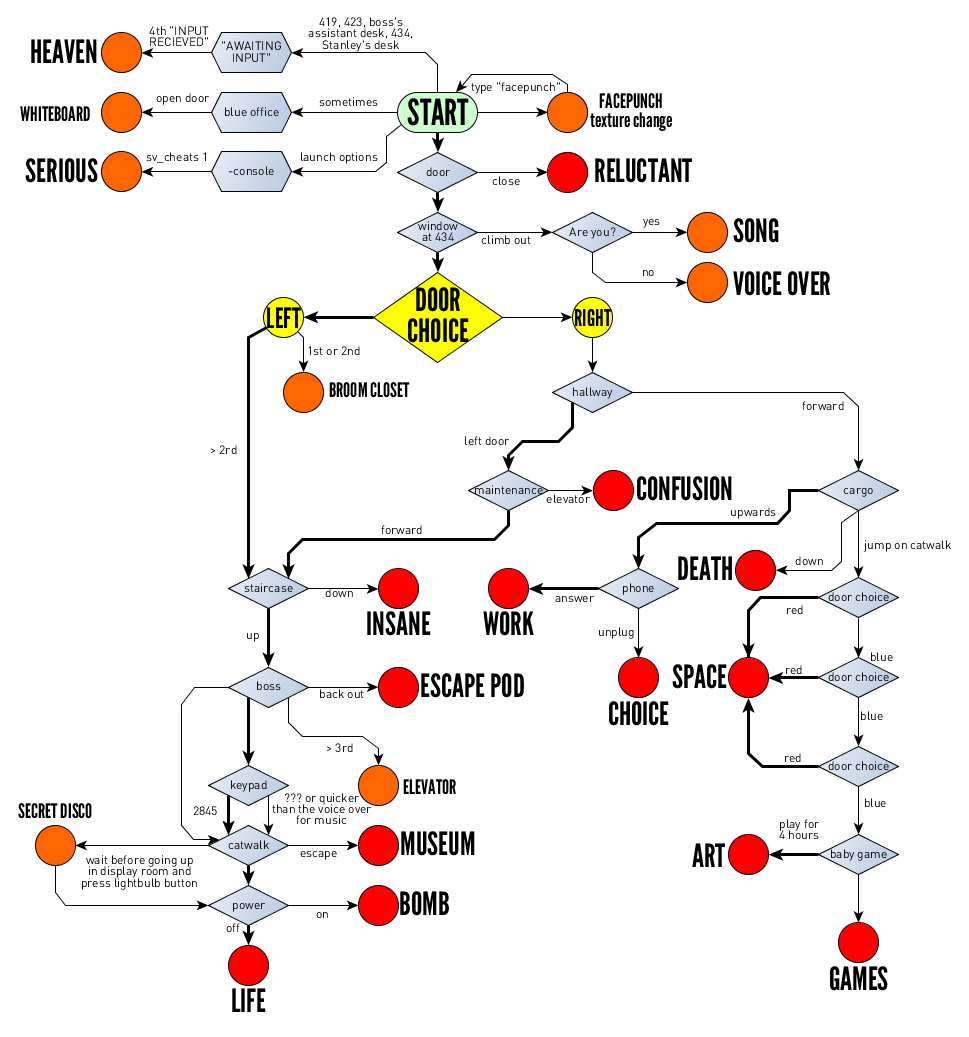
TSP conspicuously boasts no less than 18 different endings that follow from different in-game player choices (Figure 1), which places it well over the standard 3 or 4 endings in triple-A first-person games. 9 But whilst it is unusual for a game to have to cater for so many branching outcomes that respond to players’ decisions, there is also an implicit encouragement of the player to exhaustively seek out multiple endings by laboriously combing through the game. In fact, the game is arguably not completed until all the endings have been explored. Some players will register that there are similarities here with the role that ‘Easter eggs’ have traditionally played in games in their fostering of a ‘completionist’ mentality amongst dedicated gamers; the game is not ‘completed’ after one play through to an ending, but only once its most obscure secrets have been uncovered. So on the one hand, the comparatively high number of endings seems to indicate a celebration of responsiveness to player choice; but on the other, there is an implied expectation for the player to explore all of the endings, which seriously mitigates the significance of choosing one ending over another. The counterfactual state of as yet unchosen decisions within a bounded labyrinthine, as opposed to truly emergent, branching structure very shortly becomes factual: you did not go for the ‘art ending’ this time, but it will be the one you uncover three endings later. In this sense, the order in which the endings are experienced is arguably unimportant and the player still exists within a game that, like the novel, represents the interiority or subjectivity of its creator.
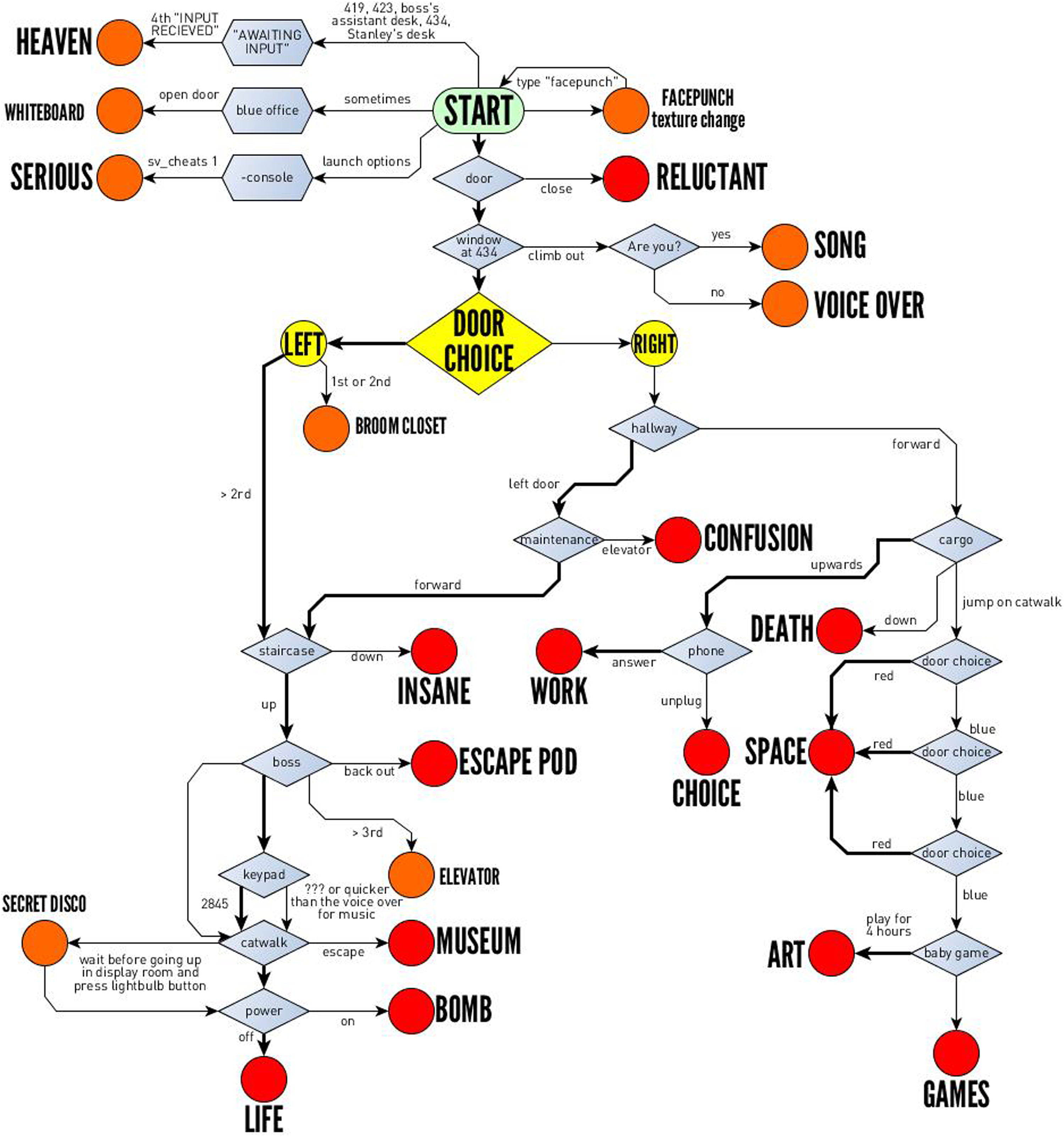
Eighteen endings. Source: Fenner (2013)
TSP features voice actor Kevan Brighting as the ever-present, paternalistic, martinet of a narrator, who takes the role of steering the narrative of the game along the lines envisaged by its creators. The subjectivity of the narrator is abstruse, often commenting world-wearily on the player’s last decision to go through one door over another, which imparts a gamic passivity to the player, who must listen if they are to understand the significance of the plot development as well as what is claimed to be Stanley’s own (narrated) interior monologue. More than merely fleshing out the details of the fictional game world, the narrator’s commentary is very often deliberately ambiguous as to whether it addresses the player as Stanley or the player qua player and thus whether he refers to the game world or the ‘real’ world. 10 The player is aware that references to ‘Stanley’ in the game are made to them, with the narrator often slipping into the second-person personal pronoun ‘you’, particularly when the player is directed to perform some action. In the ‘work’ ending, Stanley appears to go home to his wife, before things take a strange turn and his reality comes apart. To progress, the player must follow the instructions that appear on screen, the first of which is: ‘GOOD MORNING EMPLOYEE 427. PRESS “G” ON YOUR KEYBOARD’. The player, not only addressed as Employee 427, must also perform the Stanley’s role on their own computer keyboard. 11
If we distinguish, between the ‘avatar’ as ‘a playable character (or persona)’ and as ‘a vehicle through which the player is given some kind of embodied agency and presence within the gameworld’ (Klevjer, 2012: 17), then it becomes clear that Stanley is better understood as a vehicle. Shown only for a few seconds from behind in the first cutscene and wearing a lab coat, we only know that he is a Caucasian-looking man with short dark hair. But these are facts that are quickly forgotten. As such, Stanley is a far cry from characters that have personalities, identities or backgrounds that their designers took pains to craft. Consequently, it would be impossible for the player to play TSP with a role-playing approach; his personality had been that of an automaton, and the very act of stepping out of his office, of playing the game, represented a rupture from the realm of meaningful/meaningless bliss in which he existed. This is one of the techniques employed by the game to have us feel that I, as the player, am the one caught in the strange world. Nevertheless, we do know that Stanley the character has a history, and so there is still a ‘hybrid-identity’ at stake in our playing as Stanley, which is to say, an identity that ‘does not belong solely to the player, nor to the playable character’, but which is ‘a fluid, sometimes fleeting form of being that exists somewhere between the player and the avatar (or player character) during the process of videogame play’ (Bourdreau, 2012: 13, 86). Perhaps, the more that we identify ourselves with what we know about Stanley: that he has a boring office job, is very unremarkable and follows instructions, the more we might be inclined to perceive a hybrid-identity that gravitates towards us as the player. The oscillation between Stanley-as-game-character and Stanley-as-player-vehicle is done in a way that exacerbates the feeling of an unresolved confusion, and which imbues the playing of the game with a keen self-consciousness, a paralysing criticality that is hostile to uninterrupted ‘flow’ (Csikszentmihalyi, 1990) like game states.
The different endings in TSP that we uncover invoke different conceptions of freedom so that when taken together as a whole, they can be understood to constitute a meta-commentary that prima facie, through a process of elimination, denies the possibility of any kind of player freedom and meaningfulness of in-game choices. This thereby has the effect of promulgating an alienated reflexiveness in the player. The present article will have scope to examine 3 of the 18 endings. The ‘bomb ending’ puts the player in a position of helplessness, and so refers to a sense of freedom as the capacity to make meaningful differences to one’s own fate, which is denied to the player. By extension, this calls into question our capacity to be able to make meaningful differences in other, less charged situations. The ‘art ending’ challenges the player’s willingness to play or work repetitively for the mere promise of instrumental reward, asking whether freedom can inhere in the willingness to accept such inducements or arrangements. Thus, the sacrifice of the present for the future through work/play that is not intrinsically enjoyable is problematized. The ‘life ending’ scrutinizes the player’s compliance with the narrated story, asking whether willing compliance with instruction can be compatible with freedom and happiness. Once these possibilities have been progressively eliminated, we might reach a realization from which it becomes possible to step beyond both alienation and unity.
Follow instructions to break free of mind control
The ‘life ending’ is the one obtained by following the narrator’s pre-emptive account of events. The first significant decision available to the player, after deciding to play at all and leave Stanley’s office, is a choice between two doors (Figure 2). It is, in popular culture, the most archetypal representation of a decision between alternatives. The narrator emphatically declares that Stanley goes through the door on the left. Should the player follow this ‘script’, and continue to oblige with subsequent narrator instructions, Stanley ends up discovering a cavern of screens that evidence the secret surveillance to which he and his co-workers had been subjected. They had all been under the sway of a piece of mind control machinery that had hitherto robbed them of their volition. The obedient player, as Stanley, proceeds to turn it off for good and exits the facility into a promising green, sunlit world. But when the ending cut-scene unfolds, any exaltation that the player might feel is threatened by an ominous part of the ending’s narration: ‘[t]his was exactly the way, right now, that things were meant to happen. And Stanley was happy’ (Galactic Cafe, 2013). Yet, we can, of course, recall that Stanley had also been explicitly described as ‘happy’ when he was Employee 427, pushing buttons upon instruction and prior to discovering that all of his actions had been controlled. This ending was indeed the way that things were ‘meant’ to happen according to the narrated story – it is obtained by not deviating from the narrator’s pre-emptive descriptions of Stanley’s actions. So, when the narrator had stated that Stanley took the door on his left, the player had dutifully complied. If the brainwashed Stanley had existed in a state of perpetual compliance and had previously lacked all interiority, then the question is posed as to whether the player, in taking over his destiny, had demonstrated any newfound interiority.
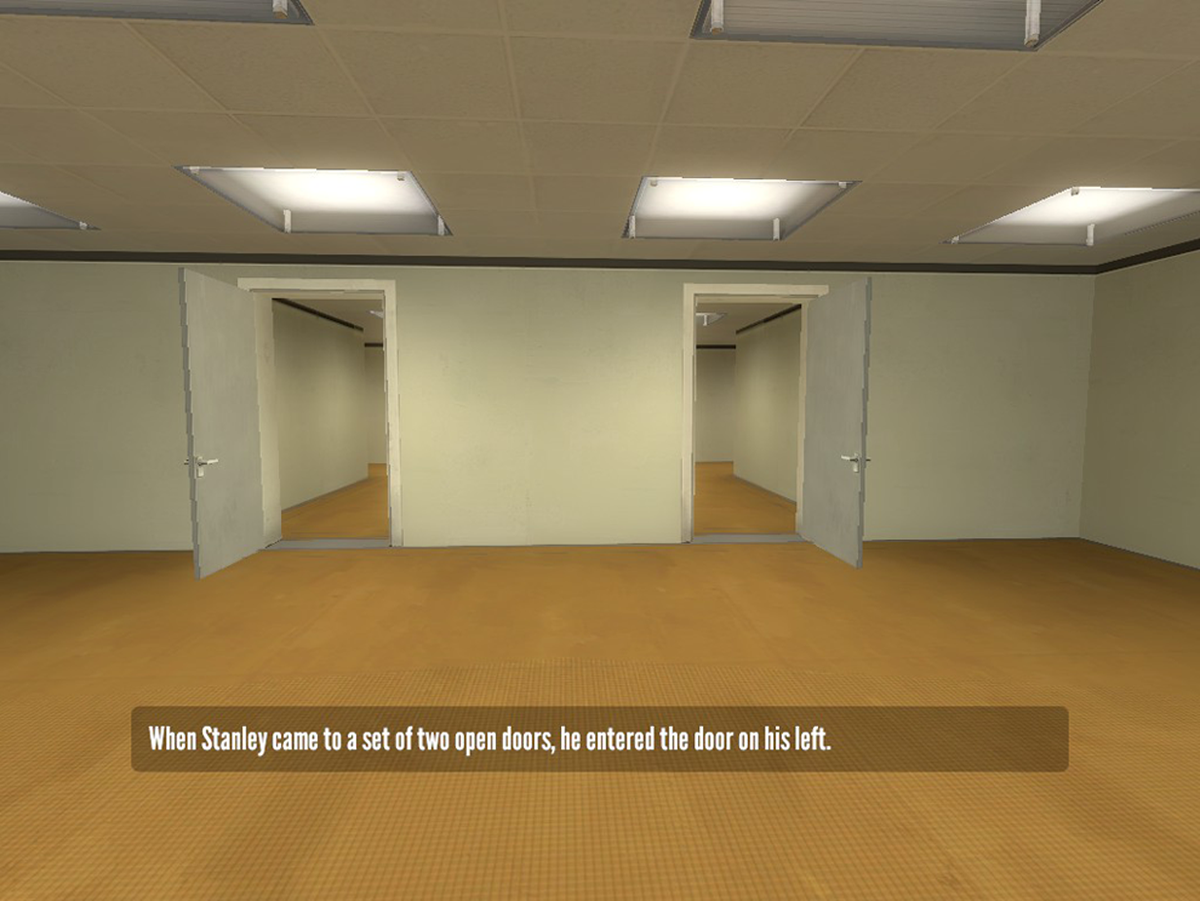
The first forking path. Source: In-game screenshot taken by the author.
This ending of the TSP can be seen to comment upon those instances, when we play computer games, where we go along with, as it were, the designer’s expectations. This is often quite unavoidable in the early stages, as we follow the more obvious plays due to not knowing other possibilities. Or, we might temporarily acquiesce to the game’s instructions, rather than attempt to become a so-called subversive player, in order to see what it has to offer, which does not amount to a promise to follow all future in-game instructions. It is, in fact, arguable that the ethical or open-minded approach is to submit, to give the game its chance, as it were, to reveal the vision of its developers (Sicart, 2011). Further, we arguably cannot avoid having to learn the steps of the ‘dance’ from the game in order to hope to dance to our own tune at some later point. Nevertheless, in some games, the learning and execution, rather than the subsequent creative development, may be all that there is, whilst in others, the gameplay might be so compelling that we forget to do anything other than repeat the dance that we have been taught.
Compared to many of the other endings, Stanley’s fate here is arguably a remarkably good one (death or madness is avoided, at least); the chain of decisions leading to it is perhaps comparatively more sensible than those leading to other endings, but it is the freedom of the will underlying them – the player’s will – that is impugned. TSP provokes the player to doubt their own intentions. Have I been happily duped into complying with the designer/narrator’s vision of the story, blindly following it, or had that trajectory actually coincided with my own desires and good judgement? This line of thought leads to an indefinitely extendable retrospective dissection of our own intentions, to that self-reflexive alienation. If the ‘authenticity’ of any satisfaction with the status quo, or given state of affairs, is always haunted by the concern of manipulation or false consciousness, then the further question is whether it is ever possible for an action of compliance to be free.
The lack of capacity to effect any difference
In the ‘bomb ending’, Stanley sets off the countdown to a nuclear detonation by not turning off the mind control machinery as the narrator had advised. The narrator, displeased at this disobedience, suddenly seems to be able to arbitrarily affect the plot at his whim. He nonchalantly adds into the story the existence of a fail-safe device (nuclear detonation) in the event of activation without proper DNA authorization, proclaiming that he wanted to see Stanley made humble for his actions. As the player rushes around the facility, they cannot fail to notice the sheer number of brightly coloured control buttons (Figure 3). The fact that pressing them is not completely inconsequential (they do cause things to happen, but cannot forfend the catastrophe), prompts the player to hope that a correct sequence of button-pressing can avert the detonation. Meanwhile, the narrator is persistent in his mockery: [D]id you just assume when you saw that timer that something in this room was capable of turning it off?…Everything! Anything! Something here will save me!…Why would you think that Stanley? That this video game can be beaten, won, solved? Do you have any idea what your purpose in this place is?
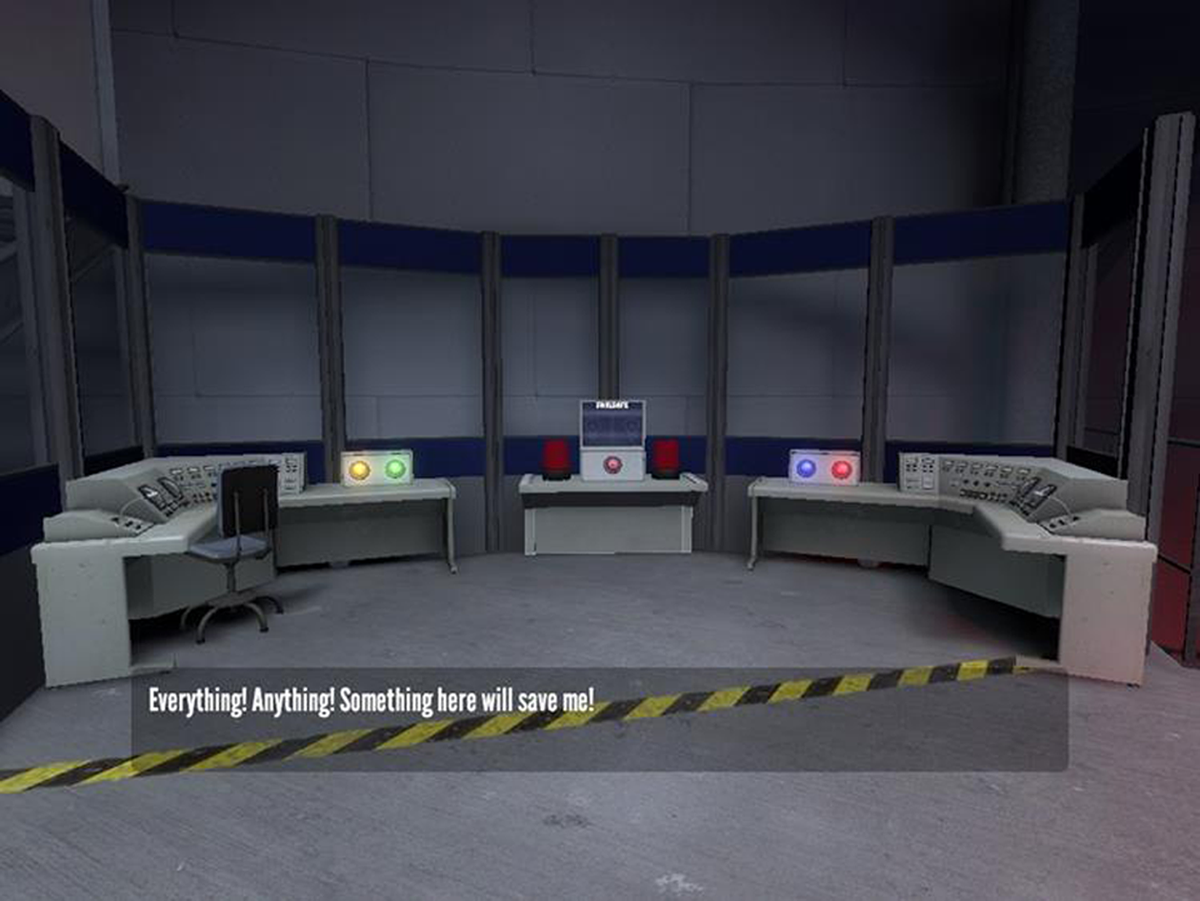
Buttons everywhere but none that can save Stanley. Source: In-game screenshot taken by the author.
The lack of capacity to effect any real difference is suppressed by the hope that some untried button combination or series of actions can avert the countdown. It is, in gamic terms, an aporia without a concomitant epiphany (Aarseth, 1999). This scenario effectively makes a mockery of the player’s delusions of their own causal power, which no doubt is an aspect of gaming literacy that has resulted from having always been given the chance to make the crucial difference when there is a hint of a choreographed in-game opportunity to do so. Such is the weight of the acquired literacy and the strength of convention that especially curious or stubborn players might feel challenged to play that ending multiple times in order to exhaustively rule out whether there was something or other that might have made all the difference. Players expect games to impart them with a ‘contract’ in which the terms of good and poor performance are spelled out, along with the possibility of attaining the former.
This can be contextualized against a rather pervasive rhetoric that has accompanied many genres of games, but particularly in first-person story-driven games, which assures the player that their decisions exert tremendous impact upon the game world, and are profoundly meaningful insofar as they shape the destinies of so many. But more so than just industry rhetoric or marketing hype, as we have seen, it is manifest in the games themselves, where NPCs dote upon the play protagonist’s every deed and affirm their status as the sole agent of change. TSP’s ‘bomb ending’ serves up a dose of brute unresponsiveness that decentres the player from the throne of causal agent primus inter pares. It is as though a solipsistic idealism, where the very existence of the game world itself and its possibilities being built around the capacities of the protagonist by an intelligent, benevolent designer, has been dispelled. Yet, there can be no denying that the player is evidently still the focus of the narrator’s ire and the motor for action, albeit incapable, after a point, to exert any action that will make a difference.
The freedom of self-exploitation
The ‘art ending’ sets up a challenge that is immensely trying if only due to the banality of its repetitiveness. The player is told that they must press a single red button continuously, for four hours, in order to prevent the cut-out of a crawling baby from reaching a fire, which would result in failure. This is done to the accompaniment of the auditory torment of the baby’s wailing, the jarring buzzer noise following every press, and the narrator’s periodic exclamations that the whole exercise is a ‘work of art’. About two hours later, a puppy is added; it is being lowered towards a piranha-filled aquarium, and the player must now also press a teal button to foil this, dashing back and forth frantically between red and teal buttons. The alternative is to forfeit the previous two hours of effort. Only if this is maintained for an additional two hours is the ‘art ending’ given as a reward.
Springing a new demand, a new ‘degradation’ in the form of the teal button, on the player after they have already committed themselves to the terms of a task that they believed themselves to have understood tests the continued resolve of the player to the pursuit of the desired instrumental reward – unlocking the ending. The player might ask themselves: What are the lengths to which I will go? And could I have possibly have made a genuinely free choice to do so? Within the purview of computer games, finding that the terms of the game have suddenly changed as one plays is certainly a familiar experience since we are still, as players, uncovering mechanics that we may like or dislike even after we have sunk many hours into play. The terms of the ‘contract’ in full, as it were, are withheld from us. Whilst this explorative aspect can be the sine qua non of game playing for some – the discovery of the rules and the testing of tentative hypotheses one has for how the game operates can be more interesting than the other elements of the game – the dark obverse of this ought not be ignored. Do we have the resolve to throw it all in if developments are not to our liking or has the game already exerted a hold on our more compulsive instincts? In this regard, the monotony here evokes, but also differs from, the ‘Desert Bus’ minigame in Penn & Teller’s Smoke and Mirrors, in which players must complete a gruelling eight-hour drive between Las Vegas and Phoenix, Arizona without pausing. There, the terms of the game were clear from the outset; new demands did not suddenly materialize.
The repetitiveness and reward obviously references grinding and farming, and perhaps the regret that gamers feel at having realized that they have expended so much time in a game. The paltry reward that is obtained here for one’s labours is nothing less than ‘transcendence and oneness with the beauty and essence of all beings’ (Galactic Cafe, 2013), which entails a clichéd numinous moment: encountering ‘The Essence of Divine Art’ – a simply rendered black monolith. The absurdity of using only a small part of one’s full faculty, of performing actions that could easily be substituted by a macro, as the means by which to realize something so transcendently artistic is the means by which this performance can be seen to embody a commentary about play/labour in certain computer games and the concomitant reward. That is to say, players are often subjected to hysterical praise for achievements that amounted to little more than following a clear set of instructions, and this is one of the inducements by which they are supposed to continue playing. If we have voluntarily unlocked this ending through rote action, it could well be asked, firstly, whether we were enticed by the inducement of reward for rote action. The quality of the process is sacrificed or overlooked in favour of the perceived outcome, which, in this case, is one that mocks this very order of priorities. And even as the player feels that they are clued into this particular point, they had no resort but to submit to the logic in order to unlock the ending. We could also ask if the keenness for such banal rote action is due to the unpalatability of all the other options that I, the player, had for spending that slice of time (alternatives, both inside and outside the game), which thereby again raises the question about one’s freedom – how can one be free if this is what one ‘chooses’ to do voluntarily?
The self-exploitation here references the changing boundaries between repetitive, mechanical ‘play’ and work that masquerades as enjoyable. The historical turning point in question has been elucidated by writers such as Klossowski (1970), whose examination of the way we find perverse pleasure in labour dates to the moment of transition between an industrialized model of labour, organized by management, in which the worker feels exploited and unrealized, to a connexionist, project-based model, structured by networks, in which the worker is arguably even more exploited but feels greater fulfilment and autonomy (Bishop, 2012: 236). The exploitation of Uber drivers, for example, is repressed by an advertising campaign that emphasizes the promise of autonomy with statements like ‘587 miles closer to opening a new restaurant’, and ‘481 miles closer to becoming a homeowner’ (Gwynn, 2016). Desert bus drivers, falling more into the industrialized model, arguably have a comparatively better deal. In any case, the gameplay contract in the ‘Desert Bus’ game was more transparent and not shot through with overblown promises of one’s achievement as a form of inducement.
Conclusion
The three endings examined have progressively eliminated the sense of a gamic freedom insofar as freedom is defined as not doubting one’s own reasons for complying with instructions; being able to effect a difference; and not being compelled to self-exploit. Together with the other endings, which lie beyond the scope of this article, the player is led to reflect upon what the conditions of possibility for freedom might be. If these conditions of possibility are consequently decided to be unachievable, either under present social conditions, or in an even more pervasive sense, then a realization may be catalysed in the player that leads them to redraw or reassess their intuitions and ideas about what it means to be free, to pragmatically reassess the conditions of possibility in light of what is achievable. This is perhaps what was alluded to on the official site as the game’s invitation to the player to ‘dance’, one that reveals the player to be ‘powerful after all’. That is to say after a particular process has occurred or journey undertaken.
On the one hand, such a move can be regarded as a woeful abandonment, however pragmatic, of a crucial utopian impulse, due to pervasively alienating social conditions. 12 Yet, on the other hand, it opens up a critique of the philosophical and political suitability of Lukács’s notion of a telic world of ready-made meaning. The assumption that there has been a profound sundering from a time of meaningful bliss into a wretched state of alienation can foment a profound criticality of the present that does not subscribe to a vision of how things could be better that is limited by existing imaginaries, but it is also doubtless potentially problematic for various reasons. Firstly, it is disputable whether this kind of mentality actually inhered for the Homeric Greeks. Lukács had based this assessment more on the image of the Greeks in German culture, including the writings of Hegel and Friedrich Theodor Fischer, than on any sustained historical analysis (Jay, 1984: 93). 13 Secondly, the possibility of a return to the original unity, as well as the implications of any attempt to do so ought to be considered. Adorno, for example, judged these intentions as harmful, writing that it would be a regression to a pernicious state, to a ‘blind subjugation to nature’ and a ‘real barbarism’ (1978: 499). Instead, the task is to ‘use the force of the subject to break through the deception of constitutive subjectivity’ (Adorno, 1973: xx). And thirdly, if this holism sits at the boundaries of comprehension; in what respect, then, is the requisite mental state different to the lack of interiority that we ordinarily associate with brainwashed individuals or religious fanatics for whom there is only one righteous way against all other sinful deviations?
As such, in discussions concerning freedom, the dogmatic pining for an original unity might be replaced by an alternative that utilizes the possibilities within the vitiated subjectivities available to us to effect a break from them, which is to acknowledge that freedom inheres. 14 It is to use the force of our alienated subjectivities to break from alienation. In the process of foregrounding the player’s alienated reflexive subjectivity in TSP, there is an implication, contrary to Lukács, that the conditions of possibility for freedom reside in doubt and in the conflicts that come with interiority, and that these may actually be preferable to a state of so-called meaningful bliss. These can be dimensions that are elegantly explored by the ergodic work that does not aspire towards a harmonious sensation of play, a feeling of immersive ‘flow’, or non-contradictory experience in which indecisiveness or doubt are expunged. The interactive, ergodic work is typically defined as generating multiple sequences of events so that what the interactor experiences is ‘one actualization amongst many potential routes within what we may call the event space of semio-logical possibility’ (Aarseth, 1999: 32). This ‘experience’ of ‘one actualization’ is of a different order to the process of interpretation that takes place on the basis of and as a result of the sensory data, as Aarseth (1997: 3) distinguished between ‘variable expressiveness’ and ‘semantic ambiguity’. When a computer game takes, as its subject matter, rather than as its structure, that variable expressiveness, so that it is part of and integral to the semantic ambiguity, then there may be a tension between a reflection upon itself, and enabling free play.
TSP has kept a tight rein on the array of possible player actions so that significance is not unwittingly diverted to any virtuoso player achievements, absurd coincidences or feats of skill. It eschews many conventional gamic foci – complex causal connections, proliferating emergent structures, the aporias and epiphanies of solving puzzles or vanquishing opponents. In this respect, the game’s invitation to the player to dance is not a dance with its causal, processual dynamics, with the way in which its algorithms come alive on screen and enter into a feedback loop with the player’s sensorium, but with the expression of its ideas. This aligns it with the form of the novel. The emergent possibilities and forking paths that might supplant the intended authorial expression must be delimited, as they would risk plunging it into the ephemerality of the mere game. 15 Yet, although it has eschewed gameplay challenges, it has retained an evocative labyrinthine structure that at least initially gives the sense of an impressive array of unexplored possibilities; the player is made to feel that there is still some crucial essence of gameness present that enables it to effect a succinct commentary about the structure of all games. It could be said to be, like the novel that aims to reflexively comprehend the conditions in which novels exist, a game that understands its own ‘gameness’, which thereby makes this reflexiveness the subject matter, but which has also had to disavow that very gameness in order to demonstrate its self-reflexive awareness.
Its own ambiguous status brings out the dissonance between two objectives: to give the player freedom and room for expression (to be a ‘good’ game), and to be a tight and cogent work that provokes reflection about freedom and the possibility of meaning (to be a ‘good’ Lukácsian novel/work of art). 16 The significance of achieving this ambiguous status lies in TSP’s gesturing to a mode of subjectivity that lies beyond the two modes that have been explored in this article. The details of such a subjectivity have not yet crystallized, but it appears that neither the novel form, nor the game form simpliciter, as they have been outlined, are suitable homologies for it. What can be said, however, is that a work that explores one’s having the interiority to choose one path from amongst many, together with the comprehension of this fact, can be said to be an indicator of alienation whilst also effecting a movement towards freedom insofar as it instigates a ‘dance’ that moves the subject towards the aforementioned subjectivity.
Footnotes
Acknowledgements
The author would like to thank Graeme Kirkpatrick, Veli-Matti Karhulahti and the two anonymous reviewers for their comments on earlier versions of this article, as well as attendees of the Eighth International Conference on Philosophy of Computer Games, where the first draft of this article was presented, for their suggestions.