



Abstract
Typically understood in relation to innovations in new media and modes of peer-production, the ‘media lab’ has emerged as a contemporary phenomenon encompassing a variety of ‘maker-spaces’, ‘fablabs’ and ‘hackathons’. This article seeks to resituate the ‘media lab’ in the context of media research and education, drawing inspiration from the recent ‘nonrepresentational’ and ‘nonhuman’ turns in media and cultural theory that examine our entanglement with media on a social, cultural and biological level (Grusin, 2015b; Thrift, 2007; Vannini, 2015; Zylinska, 2012). This article contributes to such debates by presenting the lab as entangled media praxis as a set of 10 principles for teaching media as mediation: a reflexive form of ‘doing’ contemporary media studies that is primarily concerned with developing an embodied ‘attunement’ to the entangled relations of media lab participants. This framework calls for transdisciplinary modes of practice research and ‘critical making’, whereby students, artists, creative technologists and academics work collaboratively to address the affective and subjective conditions of contemporary digital culture. This article will explore these methods in relation to the concept of media entanglement, drawing out the underlying principles of the ‘entangled media praxis’ framework by examining two pilot media labs facilitated by the Arts Council England-funded project, 1215.today.
Keywords
Can we think of a way of “doing media studies” that is not just a form of “media analysis” and that is simultaneously critical and creative? Could it allow us to challenge the opposition between “media theory” and “media practice” that many university media departments have adopted somewhat too comfortably over the years, at worst privileging one over the other, at best aiming at some kind of dialectical resolution that in the end only reaffirms the division?
Indeed, media scholarship has begun to re-examine the everyday experiences of mediation, with researchers increasingly turning their attention to the ways in which pervasive media technologies and practices have become embedded within the daily rhythms and spaces of contemporary society (Deuze, 2012; Fuller and Goffey, 2012; Grusin, 2015a; Hansen, 2015; Moores, 2017). Such work addresses the shifting boundaries between production, consumption, social interaction and lived experience, whereby material relations and subjectivities are co-produced through a ‘networked ecology’ of media platforms, people, texts and technologies (Fuller, 2005; Parikka, 2011). Rather than viewing media ecologies as determining technological environments, this line of enquiry instead examines the dynamic relationality of media systems by attending to the material sociability and affective capacities of contemporary media. In Media Life, for example, Mark Deuze (2012) argues that media can no longer be conceived of as separate to us, but instead should be considered an integral component of lived experience. Our life, he suggests, is lived in, rather than with, media. Sean Moores (2017), meanwhile, has argued for a non-representational, non-media-centric approach for the study of media in everyday life, one that focuses on embodied, sensuous and practical knowing and on matters of orientation and habitation. This shift from thinking about media solely as objects of use and interpretation recognizes our entanglement with media on a social, cultural and biological level.
This article responds directly to these developments by repurposing the notion of the ‘media lab’ in the context of scholarly research and education, presenting practical methods for engaging in a form of entangled media praxis. To that end, we begin by addressing the prominent characteristics of emerging maker cultures, considering how media labs have been utilized within academia to encourage collaborative learning, peer-production and social enterprise. By exploring the relationship between the makerspaces and the wider creative economy, we draw attention to various contradictions often associated with media labs.
The second section surveys recent intellectual trends that problematize traditional representational approaches to media scholarship, calling into question the effectiveness of epistemological methods that position media as distinct objects of study. Drawing inspiration from the ‘nonrepresentational’ and ‘nonhuman’ turns in cultural theory, we turn our focus to a multiplicity of agencies that operate beyond direct human perception within sociocultural assemblages (Barad, 2007; Delanda, 2006; Grusin, 2015a, 2015b; Thrift, 2007; Vannini, 2015; Zylinska, 2012). We pay particular attention to the notion of ‘affect’, highlighting how this concept has been integrated into the examination of entangled agencies operating in the ‘background’ of digital culture (Hansen, 2015; Thrift, 2004). The aim, then, is to develop a critical account of contemporary mediation which is less focused on meaning and representation per se, but rather on what materialities, operations and bodily sensations emerge through our relationships with ubiquitous media. We suggest that engaging with such approaches can reveal how the subjective and political conditions of contemporary life are routinely shaped by processes of mediation.
In the third section, we propose the media lab be mobilized as a form of embodied praxis for interrogating the experience of living in (and with) media. This is a reflexive framework that blends critical theory and media arts practice in a variety of situated contexts to examine the ontological dimensions of mediation. In doing so, we argue the media lab be positioned as a speculative form of ‘critical making’ and ‘relational aesthetics’ in the context of media scholarship. We outline a number of ‘lab principles’ for facilitating the production of affective and embodied forms of knowledge. These principles are (1) respond to an event, (2) collaborate across borders, (3) experiment with hybrid pedagogies, (4) foster communities of practice, (5) attend to affective backgrounds, (6) engage the senses, (7) harness intensities, (8) support the production of collective subjectivities, (9) situate research in practice, and (10) speculate, ideate and co-create. We conclude by exploring these principles in relation to a series of ‘Innovation Labs’ run by the Arts Council funded project, 1215.today, 2 where the ‘lab as entangled media praxis’ framework was trialled.
On the politics of media labs and maker cultures
Typically understood in relation to innovations in new media and modes of peer-production, the media lab has emerged as a contemporary phenomenon encompassing a variety of makerspaces, fablabs and hackathons. Media labs, in their various guises, range from physical locations where people gather to share resources and knowledge, work on projects, network, and co-create (Slatter and Howard, 2013; Wong and Partridge, 2016), to fast-paced environments for creative minds to convene and ideate around a specific challenge over an intensive period (Artiles and Wallace, 2013; Nandi and Mandernach, 2016). The structure and objectives of media labs vary broadly, with some labs adopting a rigid format and specific set of stated goals, while others embrace the open-ended and exploratory nature of interactions between participants. What unites these various approaches is the principle of making and experimentation within a community environment; and while the focus is often on technology, media labs more generally concentrate on collaboration and creativity (Thayne and Cooper, 2014; Wong and Partridge, 2016).
Following recent research that contextualizes media labs as ‘situated practices’ (Emerson, 2017; Emerson et al., forthcoming), we suggest the media lab occupies an important role in the renegotiation of disciplinary borders, practical and conceptual methods, forms of labour and the relationship between higher education, media convergence and technological innovation. As Lori Emerson (2017) notes, media labs have a long and varied history – from the avant-gardes of the 20th century where the new materials and aesthetics of technical modernity were developed to the burgeoning interest of universities to establish makerspaces in a variety of academic contexts. 3 Such labs experiment with multidisciplinary research and teaching methods using a variety of platforms, devices, software and tools – from ‘leading edge’ digital technology, to the repurposing of obsolete and historically significant media formats. This exposure to media arts practice in a community environment has been shown to support the production of knowledge through forms of co-production, co-design and creative problem-solving (Artiles and Wallace, 2013; Nandi and Mandernach, 2016; Thayne and Cooper, 2014). Media labs should therefore be considered ‘communities of practice’ (Wenger, 1998) since they promote peer-learning, personal development and community building through collaboration around a shared topic, in a shared environment, with shared objectives.
Similar to aspects of hacker cultures and ‘arts and crafts’ communities, media labs encourage participants to view themselves as ‘makers of things, not just consumers of things’ (Sheridan et al., 2014: 506). Indeed, it has been suggested a hallmark of the maker movement is a do-it-yourself (or do-it-with-others) mindset that brings together individuals around a range of activities (Peppler and Bender, 2013: 23). This has prompted some to champion the democratizing potential of the maker movement, with several studies that emphasize the transformative role of commons-based peer-production in a variety of ‘online’ and ‘offline’ contexts (Anderson, 2012; Benkler, 2006). Chris Anderson (2012), for example, explores a number of innovations in the manufacturing of physical goods, particularly emerging forms of 3D printing, low-cost robotics, mobile and desktop computing and open-source, Internet of Things-based software, suggesting that such practices might initiate a ‘new industrial revolution’. He highlights the affordances of open and distributive systems of production as having a profound impact on business, the economy, manufacturing and society in general. Maker cultures, then, represent a new modality of social production, organized around decentralized, non-hierarchical and collaborative forms of agile production, which Anderson argues has the potential to upend traditional markets and proprietary systems (see Anderson, 2012).
While peer-production is certainly a significant aspect of contemporary media culture, the notion that makerspaces can be considered entirely non-proprietary, inclusive and egalitarian is rather problematic. As Xin Gu and Shea (2018: 1–3) explain, ‘makers’ are often implicated in the exploitative practices of neo-liberalism and globalization, particularly in terms of labour relations and intensified consumption. Such work draws attention to the ‘institutional shaping’ of makerspaces by examining the historical links between military funding, corporate sponsorship, state policy and entrenched cultural attitudes towards making (Gu and Shea, 2018). This has resulted in a general lack of diversity, with media labs tending to be viewed as exclusive, middle-class and male-dominated spaces (see Hunsinger and Schrock, 2016; Voigt et al., 2017). These disparities are reflective of wider trends in the STEM subjects (science, technology, engineering and mathematics), whereby the focus on traditionally masculinized disciplines and technologies often reinforces (and reproduces) existing social relations. Media labs, particularly those initiated in an educational context, should therefore aim to make a difference in how today’s society operates by encouraging more open and diverse forms of self-expression, peer-production and collective empowerment (Voigt et al., 2017: 53).
Furthering these contradictions, media labs are increasingly employed as a means of promoting social entrepreneurship. By co-locating researchers, innovators, policymakers and investors, media labs can provide a catalyst for technological transfer and social enterprise in response to social, cultural or environmental challenges (Wong and Partridge, 2016: 145). Here, the media lab is positioned in the context of scientific and technological discovery, with maker practices being set to work to address real-world issues through experimentation with digital media. So, while there is often a tendency to foreground entrepreneurial practices, media labs are also frequently leveraged to address issues of community enrichment, civic engagement, sustainability and urban development. 4 This highlights the complicated relationship between makerspaces, the economy and the wider community, with media labs providing a platform for technical prototyping and innovation that can have a meaningful impact on society. As such, media labs can be considered dynamic environments where the production and conceptualization of media is positioned as a form of speculative problem-solving in response to challenges or concerns in digital culture.
Despite this emphasis on peer-production and technological innovation, media labs can also foster experiences that have value beyond what is actually ‘made’ or produced within the lab itself. In addition to facilitating practical and engaging forms of learning involving ‘hands-on’ experimentation, maker practices have also been shown to supplement and extend critical reflection (Lukens and DiSalvo, 2012; Ratto and Hockema, 2009). Matt Ratto and Hockema (2009) propose a mode of critical making that leverages maker practices as an embodied method of social and conceptual critique: Critical making is an elision of two typically disconnected modes of engagement in the world – ‘critical thinking’, often considered as abstract, explicit, linguistically based, internal and cognitively individualistic; and ‘making’, typically understood as tacit, embodied, external, and community-oriented. (Ratto and Hockema, 2009: 58)
Attending to the ‘more-than-human’, ‘more-than-representational’ entanglement of contemporary media
Over the past two decades, non-human and non-representational perspectives across a range of disciplines have resulted in a variety of conceptual frameworks that ascribe increased agency to objects, technical processes, matter and things. Richard Grusin (2015b) suggests this marks a distinct ‘non-human turn’, one that decentres the human subject in favour of relational encounters, processes of subjectification, organic and geographical systems, affectivity, bodies and technologies. Such work emerges from the intersections between ‘actor-network theory’ (Latour, 2005), ‘assemblage theory’ (Delanda, 2006; Deleuze and Guattari, 1987), ‘affect theory’ (Clough and Halley, 2007), ‘process-philosophy’ (Hansen, 2015; Whitehead, 1978), ‘posthumanism’ (Braidotti, 2013; Hayles, 1999), ‘new materialism’ (Bennett, 2010; Parikka, 2012), ‘agential realism’ (Barad, 2007; Shotter, 2014), ‘speculative realism’ and ‘object-oriented ontology’ (Bryant, 2011; Harman, 2011; Morton, 2013). Whilst these approaches differ vigorously in their application and philosophical position, they each seek to account for the complex relations of humans and non-humans in sociocultural formations. What these frameworks demonstrate is an urgency to bring technical and ecological processes back into consideration, with media objects and non-human agencies increasingly addressed on a similar ontological plane to human subjects. By shifting focus from human cognition and modes of representation towards the various technical processes, operations and affective atmospheres that co-constitute human culture, there is the potential to arrive at more practical methods for doing contemporary media studies. For John Shotter, this involves: […] re-situating ourselves – as spontaneously responsive, moving, embodied living beings – within a reality of continuously intermingling, flowing lines or strands of unfolding, agential activity, in which nothing (no thing) exists in separation from anything else, a reality within which we are immersed both as participant agencies and to which we also owe significant aspects of our own natures. (2014: 306) Even our bodies are not simply situated in, or located in, particular environments. Rather ‘environments’ and ‘bodies’ are intra-actively co-constituted. Bodies (‘human’, ‘environmental’, or otherwise) are integral ‘parts’ of, or dynamic reconfigurations of, what is. (Barad, 2007: 170)
In Non-Representational Methodologies, Phillip Vannini (2015) suggests the recent turn towards non-representational thinking has propagated some of the most influential theoretical perspectives for addressing our contemporary epoch. Traversing a number of fields of inquiry – including philosophy, sociology, feminism, anthropology, post-structuralism, media and cultural studies and, in particular, human geography – non-representational thinking does not refute representation per se, but rather calls into question the ‘value of empirical research, the nature of data, the political value of data and evidence, the methods of research, the very notion of method, and the styles, genres, and media of research’ (Vannini, 2015: i). Non-representational theory, or rather, ‘more-than-representational theories’ (Lorimer, 2005), instead describes a plurality of approaches, methodologies and styles of thinking that value practice, experimentation, performativity, bodily experience and issues of affect. For Nigel Thrift (2007), this means attending to the ‘on-flow’ of everyday life, calling for a movement away from the prioritization of the cognitive, the symbolic and the interpretation of meaning, toward a consideration of what ‘actually happens’ in the unfolding of the social world (Thrift, 2007: 2–6).
Following the influential work of Thrift (1996, 1999, 2004, 2007), non-representational theory seeks to engage with the complex entanglement of practices within our ‘more-than-human, more-than-textual, multisensual worlds’ (Lorimer, 2005: 83). Rather than obsess over representation and meaning, Thrift contends that a non-representational approach is concerned with the performative ‘presentations’, ‘showings’ and ‘manifestations’ that bring into relief the embodied, intangible aspects of everyday life (1997: 142). The aim of non-representational theory, then, is to account for the ways in which, […] life takes shape and gains expression in shared experiences, everyday routines, fleeting encounters, embodied movements, precognitive triggers, practical skills, affective intensities, enduring urges, unexceptional interactions and sensuous dispositions. (Lorimer, 2005: 84)
We therefore contend that a 21st-century media studies should draw inspiration from emerging ‘more-than-representational’ perspectives in order to address how mediation functions ontologically among assemblages of humans and non-humans. Richard Grusin (2015a), for example, proposes that while digital media continue to operate as modes of communication, dissemination and knowledge production, they also increasingly ‘function technically, bodily, and materially to generate and modulate individual and collective affective moods or structures of feeling’ (2015a: 125). Grusin’s notion of radical mediation seeks to ‘make sense’ of technical and embodied experiences of contemporary digital culture, attending to the entanglement of material and discursive processes that shape and modulate affective subjectivities (Grusin, 2015a: 125–126). Joanna Zylinska (2012) similarly claims that given the intimate dispersal of media in our biological and social lives, mediation must be seen as an all-encompassing, vital process that frames our ‘being in’ and ‘becoming with’ the technological world. Elsewhere, David Beer (2009) describes a form of power through the algorithm to examine the ways in which the material infrastructures of Web 2.0 and ubiquitous media operate in the lives of individual users. He considers the implications of software ‘sinking into’ and ‘sorting’ aspects of our environment, how the software constrains and enables, formulates hierarchies and shapes the things people encounter. Media should subsequently be understood in the context of their potential to shape a multiplicity of entangled relations, bringing into relief emerging expressions of power and agency enacted through human and non-human ‘bodily doings’ (Grusin, 2015a: 125; Shotter, 2014: 307). We must therefore respond reflexively to where we find ourselves at the beginning of the 21st century: immediately in the middle, in mediation itself, implicated in the transformations of both human and non-human actors, affective states and conditions. To that end, we suggest that maker practices be situated within an embodied framework for engaging with these issues, demonstrating how the collaborative forms of production that occur within media labs can foster a form of entangled media praxis.
The media lab as entangled media praxis
The lab as entangled media praxis framework is influenced by ‘arts-based’, ‘arts-informed’ and ‘arts-oriented’ approaches that utilize artistic processes and expressions across a range of media as a means of producing affective knowledge (Eisner, 2008; Knowles and Cole, 2008; McNiff, 1998; Mills et al., 2013; Zarzycka and Olivieri, 2017). Here, creative inquiry, performance and arts practice are taken seriously as methods of research, recognizing that the production of knowledge occurs not only in the mind but also involves the ‘sensoriality, embodiment, co-presence, and movement of bodies’ (Mills et al., 2013: 11). As such, we contend the media lab be positioned as an embodied, performative and non-representational mode of aesthetic inquiry, which we argue can bring into relief the affective and subjective conditions of mediation.
In recent years, there has been a radical rethinking of aesthetics as a means of addressing the complex entanglement of art, culture, society and politics (Bennett, 2012, 2014; Kuepers, 2013; O’Sullivan, 2001; Rancière, 2004, 2009). Drawing inspiration from the aesthetic paradigms of Maurice Merleau-Ponty (1962), Henri Bergson (1964) and Gilles Deleuze and Felix Guattari (1987; Deleuze, 1994), such work reconsiders the relationship between practicing art and thinking about art, whereby art is examined as a practice of doing in its relationship with the social field. Of particular relevance here is the work of Jill Bennett (2012, 2014), who argues for a practical and transdisciplinary aesthetics. Bennett resituates art as a means of apprehending the world through sensory perception and affective processes – ‘processes that touch bodies intimately and directly but that also underpin the emotions, sentiments and passions of public life’ (2012: 3). In other words, Bennett approaches art in the context of its ontological aesthetic operation, rather than as a fixed object of analysis. Practical aesthetics should therefore be considered a mode of embodied praxis, whereby a heightened awareness of one’s own socio-technical condition becomes embedded with, and emerges through, practice.
This turn towards a relational, practice-based aesthetics deviates from the predominant focus on the ‘judgement of art’ and ‘categorisation of beauty’, in favour of the political and creative functions of sensory experience, media dynamics, affect and perception. As John Shotter contends, this requires a reflexive engagement of the sensory faculties: Re-situating ourselves as spontaneously responsive, embodied beings, immersed within a somewhat ‘fluid’ reality, is the turn to a study of our felt experiences. (2014: 308)
Respond to an event
The lab as entangled media praxis corresponds to contemporary ‘cases’ or ‘events’ as a starting point for aesthetic practice. Inspired by approaches in non-representational research, we contend that engaging with the affective conditions of mediation requires a reflexive approach that acknowledges events as cultural symptoms, revealing particular subjectivities, experiences and manifestations of media entanglements. Events are examined as they bring forth drama, conflict, uncertainties and diffractive ways of thinking, which Vannini (2015: 7) suggests can highlight the possibility of alternative futures, contingencies and practical interventions. Using events as a starting point, practical aesthetics similarly encourages the development of experiential and adaptive research methods orientated around a ‘contemporaneous phenomenon’ (Bennett, 2014: 13–15). Rather than commencing with theories or disciplines themselves, a focus on events recognizes that social phenomena cut across multiple empirical contexts. Beginning with the event, then, is to acknowledge the relational complexity, temporality and agency of media entanglements – relations that exceed the capacity to be rendered epistemologically ‘knowable’. We contend that media labs should therefore respond to a specific event, with participants focusing their practice around a shared theme, case or provocation. The aim is not to merely report, represent or critique, but rather to leverage aesthetic practices as a method of engagement with the affective dimensions of digital culture. This can be considered a form of aisthesis – a perception via the senses – which might be used to trace aesthetic operations and their effects in the world at large (Bennett, 2014: 175). This real-world orientation therefore acknowledges that contemporary events can shape ways of seeing, ways of thinking and ways of being, emphasizing the relationality and affective capacity of aesthetic practice.
Collaborate across borders
The lab as entangled media praxis adopts a transdisciplinary ethos that brings together artists, creative technologists, academics and students from a broad spectrum of disciplines. As Bennett (2014: 174–176) has argued, a trans-disciplinary approach should not to be confused with multi- or inter-disciplinarity, which tend to reinforce disciplinary distinctions by proliferating or importing approaches. While a transdisciplinary approach can derive methods from a range of disciplines, it does so without prioritizing the interests of disciplines themselves. Transdisciplinarity instead emphasizes the ways in which embodied knowledge can unfold across dynamic contexts and fields of potentiality, whereby aesthetics becomes an interface to address sensory relations, experiences and subjective processes. Thus, the study of aisthesis cannot occur ‘inside’ any particular discipline, but instead becomes situated through aesthetic practice. This requires a diffractive approach that transcends disciplinary borders by negotiating the collision of diverse perspectives, experiences, temporalities, methods and empirical contexts. Following Barad (2007: 30), a diffractive method brings into relief the effects and manifestations of such differences, which are dialogically contextualized ‘through one another’ to engender creative and unexpected outcomes. Adopting a diffractive, transdisciplinary approach, we therefore suggest, is vital for attuning to the complexities of media entanglements.
Experiment with hybrid pedagogies
Media labs can provide alternative learning situations outside the traditional classroom, where making is considered a form of informal, ‘hands-on’ learning, with participants encouraged to take ownership of their own learning experiences. Simon O’Sullivan (2008: 238) contends that teaching practices which involve student participation, creative workshops and ‘laboratories’ can ‘contribute to the active and practical involvement of individuals in determining their own intellectual and creative projects, and indeed their wider lives’. Media labs, then, tend to draw influence from constructivist pedagogies, with the direction of research and creative practice emerging primarily from peer-feedback and forms of student-driven, discovery-based learning (Nandi and Mandernach, 2016; Thayne and Cooper, 2014). In keeping with these developments, we suggest media labs should implement a flexible structure that provides opportunities for participants to take their research and practice in unexpected directions. The lab as entangled media praxis should therefore be considered a liminal space to experiment with open-ended, playful and rhizomatic pedagogies. 5
Foster communities of practice
Recent perspectives on embodiment have drawn attention to the ways in which cultural, social, artistic and media practices are embedded in the distribution of affects and feelings. Such practices have tended to be situated in the context of participatory and collaborative modes of community building, resulting in a variety of studies that examine how practices of drawing, painting, photography and film-making can transform the production of meaning within a community (Drummond et al., 2012; McNiff, 1998; Mills et al., 2013). The aim here is to render sensory and embodied insights into the social, cultural and political aspects of community formation. The lab as entangled media praxis draws influence from such approaches by cultivating diverse communities of practice around a particular event. United by a common objective, participants learn from each other through their regular interaction and collaboration (see Wenger, 1998). The aim here is to identify how the ideas and social relations of participants come to be embodied in their practices, making it possible to transform them. The lab as entangled media praxis should therefore maintain a non-hierarchical and inclusive environment that supports social interaction, co-creation and peer-feedback. This approach, we suggest, might also contribute to the democratization of maker practices by encouraging participation from individuals with diverse interests, skill sets and cultural experiences. Since the emphasis here is not on any particular discipline or technological focus, but rather on the collaborative practices and shared experiences of lab participants, the lab as entangled media praxis seeks to overcome the types of disparities that have traditionally been associated with media labs and makerspaces.
Attend to ‘Affective Backgrounds’
As we have alluded to, a central development of non-representational theory has been the turn towards affect, leading to an increased focus on affective moods, resonances and backgrounds (Anderson, 2009; Anderson and Ash, 2015; Clough and Halley, 2007; Vannini, 2015). Such affective backgrounds can be considered the sites that ‘fall outside of common awareness, the atmospheres we take for granted, the places in which habitual dispositions regularly unfold’ (Vannini, 2015: 9). Affects, then, are processes that emerge from intra-actions between bodies and environments, encompassing a variety of ‘modalities, energies, attunements, arrangements and intensities of differing texture, temporality, velocity and spatiality’ (Lorimer, 2005: 552). The focus on ‘bodies’ here transcends the human in favour of affective relations amid inanimate objects, living, non-human matter, place, ephemeral phenomena, events and technologies (Vannini, 2015: 5–6). Unlike emotions and personal feelings, affects are non-conscious, transpersonal experiences of such intensities that are not limited to a particular ‘body’ and cannot be fully realized in language (Shouse, 2005).
Thrift (2004) suggests this requires a closer examination of the complex processual background of life, which he labels the technological unconscious. 6 For Thrift, this technical background originated with the first wave of artificial components embedded into the earth (roads, lighting, pipes, screws, etc.); additional layers further materialized through a second wave of cables, formulae, wireless signals, screens, software, artificial fibres and so on. Understood within the context of the digital (often described as the third wave/nature), scholars have argued in various ways that these components now constitute an accelerated and intensive geo-material infrastructure that mediates, frames and structures ‘affective’ relations (Amin and Thrift, 2017; Hansen, 2015; Hayles, 2014). In the advent of ‘pervasive’, ‘ubiquitous’ and ‘everywhere’ computing, Thrift argues the technological unconscious embodies a prepersonal substrate of correlations, encounters and modulations that operate beyond the realm of the cognitive (Thrift, 2004: 177). The technological unconscious should therefore be understood as a mode of preemptive power, 7 arranging and organizing the possibilities of human and non-human existence. To this end, the lab as entangled media praxis seeks to address the affective and technological infrastructures that govern and modulate daily routines, actions and subjective experiences.
Engage the senses
Mimi Sheller (2015) notes the turn towards affect, sensory perception and embodiment has resulted in a number of methodological crossovers at the intersection of social research and creative practice. She suggests that non-representational theory has begun to intersect and interact with practices in contemporary art, calling for an ‘experimentalist orientation’ in research methods in which embodied practices and experiences become the site for enacting a ‘critical consciousness of a politics of the everyday’ (Sheller, 2015: 130–145). This requires an engagement of the senses that moves beyond appearances to what Wendelin Kuepers describes as a ‘comprehensive integration of sense-making’ (2013: 25), which they suggest is enacted through contextual encounters: […] the sensing perceiver, knower and actor are being grounded in everyday experience and integrally connected to herself and her environment in an ongoing sensual interrelation. (Kuepers, 2013: 19)
Harness intensities
Intensive and accelerated forms of teaching have been shown to provide an effective method for stimulating high levels of attention over a short period of time (Thayne and Cooper, 2014). We suggest there is also something to be said for the intensive nature of working in a media lab and the capacity of lab participants to engage with issues which are scaled beyond individual attention. To that end, the lab as entangled media praxis seeks to harness the affective resonances and intensities of collaborative practice by emphasizing the relational aspects of sensory experience. As we have addressed, affective resonances refer to intensities of feeling, sensation, atmospheres, moods or urges that modulate pre-individual bodily capacities to act, engage and connect. Social interaction and emotional experiences, then, are dynamic, interpersonal processes that are shaped in an entanglement of affecting and being affected (Mühlhoff, 2014). Media labs should therefore cultivate a sense of excitement, enthusiasm and togetherness among participants, thus representing a generative force that co-constitutes social interaction, shared attention and collaborative practice. In other words, intensities are understood here as having a transformative potential.
Support the production of collective subjectivities
As Emerson (2017) has noted, specific combinations of discourses, practices, techniques and forms come together in media labs to produce and study specific kinds of technological objects. In the process, she suggests, they also produce new kinds of subjects (hackers, makers, entrepreneurs, collaborators, artists, designers, etc.). The subject here, as we’ve discussed, is not seen as fixed or distinct, but rather emerges from an interplay of collective subjectivities which are enacted through what Alfred North Whitehead (1978) would call occasions of experience. This decentring of the subject acknowledges the various material, social and symbolic dimensions that shape the production of collective subjectivities. By bringing into relief the entanglement of these processes, and by fostering an intensification of attention, empathy, critical thinking, artistic expression and political engagement, such an approach underscores the potential of media labs to open up new possibilities for thought and action in the present. This calls for creative strategies and collective practices that enable participants to produce, transform, and perhaps even go beyond, their habitual selves (O’Sullivan, 2008). As such, the lab as entangled media praxis addresses the subjective conditions of digital culture by attending to the systems of relationality that are brought to bear in the collaborative practices and experiences of media lab participants.
Situate research in practice
The lab as entangled media praxis encourages participants to recognize that their critical and creative practices can speak to social issues beyond academia. Rather than seeing themselves as some way ‘separate from’ or ‘outside of’ the issues they are addressing, participants can identify how their artistic and knowledge-making practices are situated across a variety of contexts and lived experiences. The lab as entangled media praxis, therefore, seeks to emphasize the real-world implications of research by attending to the relational processes embedded within the production of knowledge. Such an approach acknowledges the production of knowledge as situated in specific historical power relations and sociopolitical contexts. It also recognizes that digital literacy, creativity, critical thinking, communication and collaboration are fundamental skills and competences for the 21st century, with the media lab providing an opportunity to situate these skills in practice.
Speculate, ideate and co-create
As suggested above, working in a media lab can constitute a form of situated learning, where embodied knowledge emerges from the collaborative practices of lab participants. Of particular relevance is the notion of technological fluency, which Jonathan Lukens and Carl DiSalvo (2012) describe as the ability to be creative with technology; a vital component, they suggest, of a participatory media culture in which the design, use and evaluation of technologies is an open and dynamic process. They propose that engaging in forms of speculative design can add a critical perspective to technological fluency, given the potential of these approaches to bring social and political content to the fore (Lukens and DiSalvo, 2012: 24).
We wish to go one step further by positioning speculative design and critical making as fundamental principles for entangled media praxis. Most commonly associated with the work of Anthony Dunne and Fiona Raby, speculative design can be considered a means of provoking complex and meaningful reflection, where design practices are leveraged to stimulate discussion and debate about the social, cultural and ethical implications of existing and emerging technologies. 8 In other words, speculative design takes a critical and conceptual approach to design, as opposed to the user-centred, affirmative design of functional consumerist objects. Such an approach is not limited purely to the concerns of designers or design courses, however. On the contrary, speculative design can be considered a transdisciplinary approach that encompasses practices from art, design, architecture, photography, computing, futurology, political theory, the philosophy of technology and literary fiction. While traditional design processes are still employed (research, ideation, iteration, prototyping, etc.), speculative design applies these practices to develop hypothetical and provocative design proposals – or what Bruce Sterling has called ‘design fictions’ (Wired, 2013) – that challenge assumptions, preconceptions and expectations about the role of technical objects in everyday life. We suggest that speculative methods of creative practice might also be leveraged to address the concerns of 21st-century media studies, providing a framework for situating novel forms of storytelling, critical thinking, methods of research and a range of creative practices to address the complex entanglement of media in our daily lives.
Crucially, the lab as entangled media praxis is not limited to representational concerns (i.e. in producing knowledge about a particular subject), but rather approaches collaborative practice in the context of embodied actions, relational processes, affective resonances and sensory experiences (i.e. in recognizing the experiential dimensions of practice which are enacted through ideation and co-creation). The aim here is to raise important questions about the possible future(s) for society by re-imagining and critiquing techno-cultural developments through experimentation with digital tools. The lab as entangled media praxis therefore represents a speculative mode of practice-research that re-orientates the role of the artist/researcher towards the performative examination of digital culture. This approach embraces speculative design, critical making and provocative modes of storytelling, 9 resulting in the production of transmedia art projects that embody the shared experiences and affective knowledge of lab participants.
‘Lab principles’ in practice
Following the outline of the ‘lab as entangled media praxis’ framework, we will now present a reflective commentary of two media labs that ran as part of 1215.today, thus providing an opportunity to think-through these lab principles in practice. 1215.today is a virtual house of culture featuring commissioned artworks and creative opportunities for young people. It is an Arts Council England funded project coordinated by the University of Lincoln which explores the themes of rights, justice and equality and is inspired by the 800th anniversary of the sealing of the Magna Carta. 10 A series of intensive, one-day ‘Innovation Labs’ were organized by 1215.today to involve the public in the development of commissioned artworks in response to this event, providing a shared space for artistic expression and reflexive practice. Facilitated by digital identity specialist, Abhay Adhikari, 11 the labs were designed to engage participants in a creative and critical debate about key concerns of the 21st century. The labs invited young people (aged between 14 and 24) from local communities around the United Kingdom to collaborate with other students, artists and creative technologists in response to contemporary themes of civic participation, democracy and political engagement. The outcome of the labs was a series of working prototypes and speculative design proposals, which were later developed into two digital artworks in further consultation with lab participants. 12 Innovation Lab 1 was hosted by artist Kathrin Böhm 13 in January 2016 at Leeds Open Data Institute, and Innovation Lab 2 was hosted by artists Ben Peppiatt and Stephanie Bickford-Smith 14 at Lincoln University Technical College in June 2016.
The labs shared a similar flexible structure, although the direction of creative projects and discussion evolved through interactions between participants and their responses to the lab themes (rather than being limited to any particular disciplinary focus or specific media technology). In relation to the wider aims of 1215.today, participants explored how the ideals of Magna Carta could be repurposed and reimagined for the digital age. This resulted in a number of self-directed themes that emerged in response to this event: themes of openness, inclusivity, participation and questions of power, agency and citizenship. Innovation Lab 1 began with a number of thematic provocations: What is your ideal future space? What do we pay to be part of a shared space? What does your daily interaction in a digital world look like? These questions were situated in relation to the realities and localities of spaces that the participants already occupy and are familiar with – from bedrooms, classrooms and libraries, through to shopping centres, public transport and social networks. As such, these provocations invited discussion and aesthetic practice relating to public and private, governed and self-managed, online and offline spaces, as well as addressing these themes in relation to future ‘smart’ cities. Themes that emerged from Innovation Lab 2 were concerned with the power of thought and contemplation, particularly with regard to digital interventions that might enhance contemplation or reveal the ways in which online media affect the ability to process thoughts in the information age. Both labs, then, involved responding to the contemporary sociopolitical contexts of Magna Carta from a transdisciplinary perspective, with the aim of producing affective and embodied knowledge of digital culture.
Each lab began by establishing initial provocations, themes and objectives for the day, with the artists addressing existing media art projects and topical cultural issues to inspire debate and creativity among the participants. This was followed by short introductory exercises that provided an opportunity to ‘break the ice’ through social interaction and open discussion of these examples. The aim here was to support the social dimensions of collaborative practice, which was further reinforced by encouraging participants to share their experiences on social media. Smaller subgroups were formed by participants navigating towards one of the creative technologists, although they were able to move freely between groups throughout the day to contribute new perspectives and provide iterative peer-feedback. The subgroups discussed their initial thoughts, feelings and ideas in relation to the artists’ provocations, with a series of collaborative ‘mind-mapping’ exercises to identify shared areas of concern that resonated within the groups. Participants reflected on their subjective experiences of contemporary culture by mapping daily routines and media habits, which helped to focus collective attention towards the social, political and affective dimensions of such experiences (Figures 1 and 2). This presented an opportunity to identify the implications of their day-to-day activities and media practices by addressing the complexities of living in a highly networked culture; a culture in which personal data and social interactions are routinely monitored, monetized and exploited across a myriad of contexts. 15
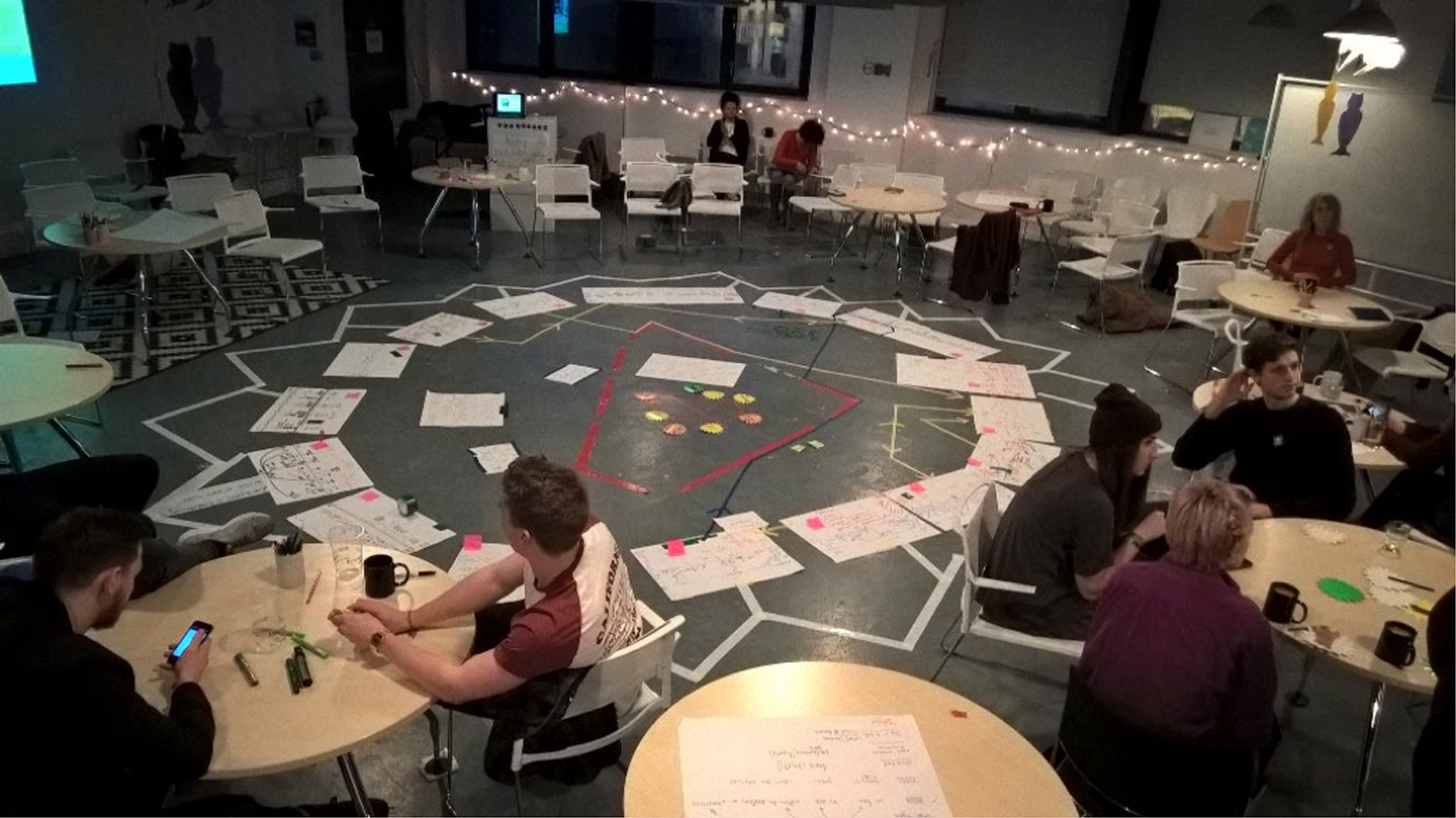
Mapping subjective experiences, 1215.today Innovation Lab 1 (2017).
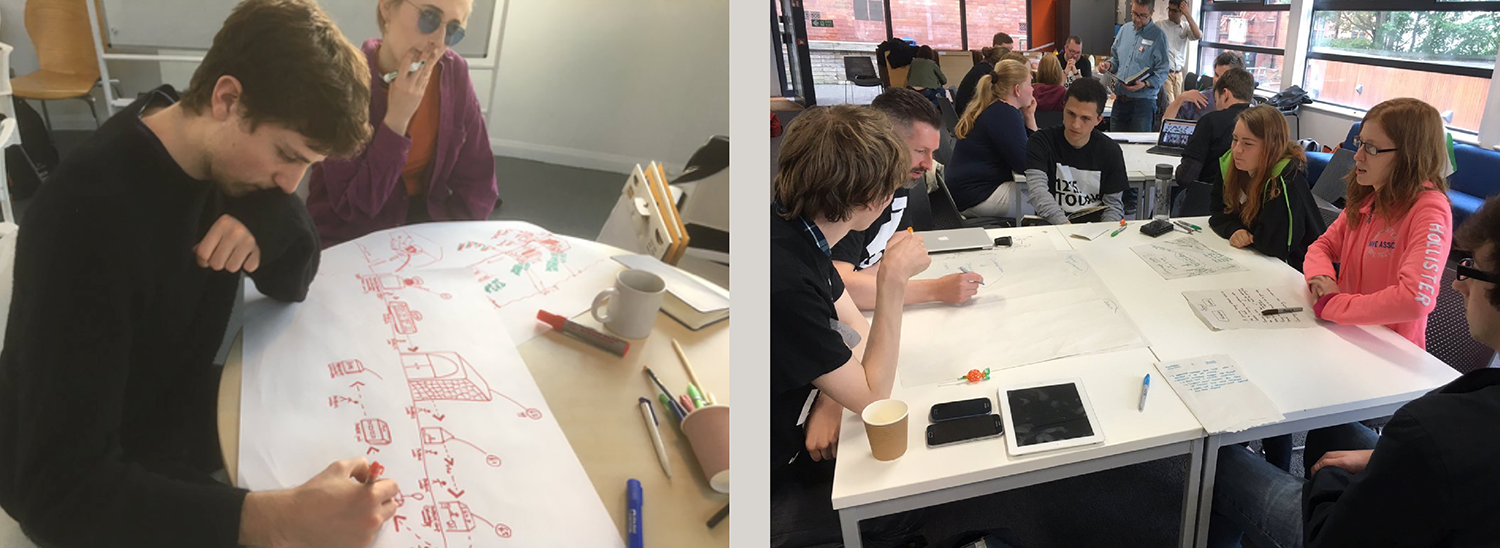
Reflecting on daily routines and media habits, 1215.today Innovation Labs 1 and 2 (2017).
A key observation during the labs was the level of critical engagement compared to subject-based university teaching, with the co-creation of a diverse range of outputs in a limited time frame highlighting the potential benefits of discovery-based, transdisciplinary learning. Participants were situated within intensive working environments with a clear objective to formulate, design and present proof-of-concepts by the end of the lab (which helped cultivate a sense of urgency and comradery between participants). The subgroups responded creatively to the lab themes by experimenting with narrative processes, user-experience design, ideation and prototyping, as well as exploring potential applications of mobile media, virtual and augmented reality and multi-sensory computer technology. In addition to producing paper-based scenarios and concept visualizations, participants engaged in more ‘hands-on’ making, using recycled materials to create rapid prototypes for contemplative and communal ‘future spaces’. These activities fostered a playful and informal atmosphere, distinguishing the labs from a traditional ‘classroom’ setting by stimulating lively debate, social interaction and self-reflection through collaborative arts practice (Figure 3). Participants were encouraged to move around the lab and explore the external environment, undertaking guided walks, group meditation and various mindfulness techniques to engage the senses and help attune participants to the affective resonances of mediation.
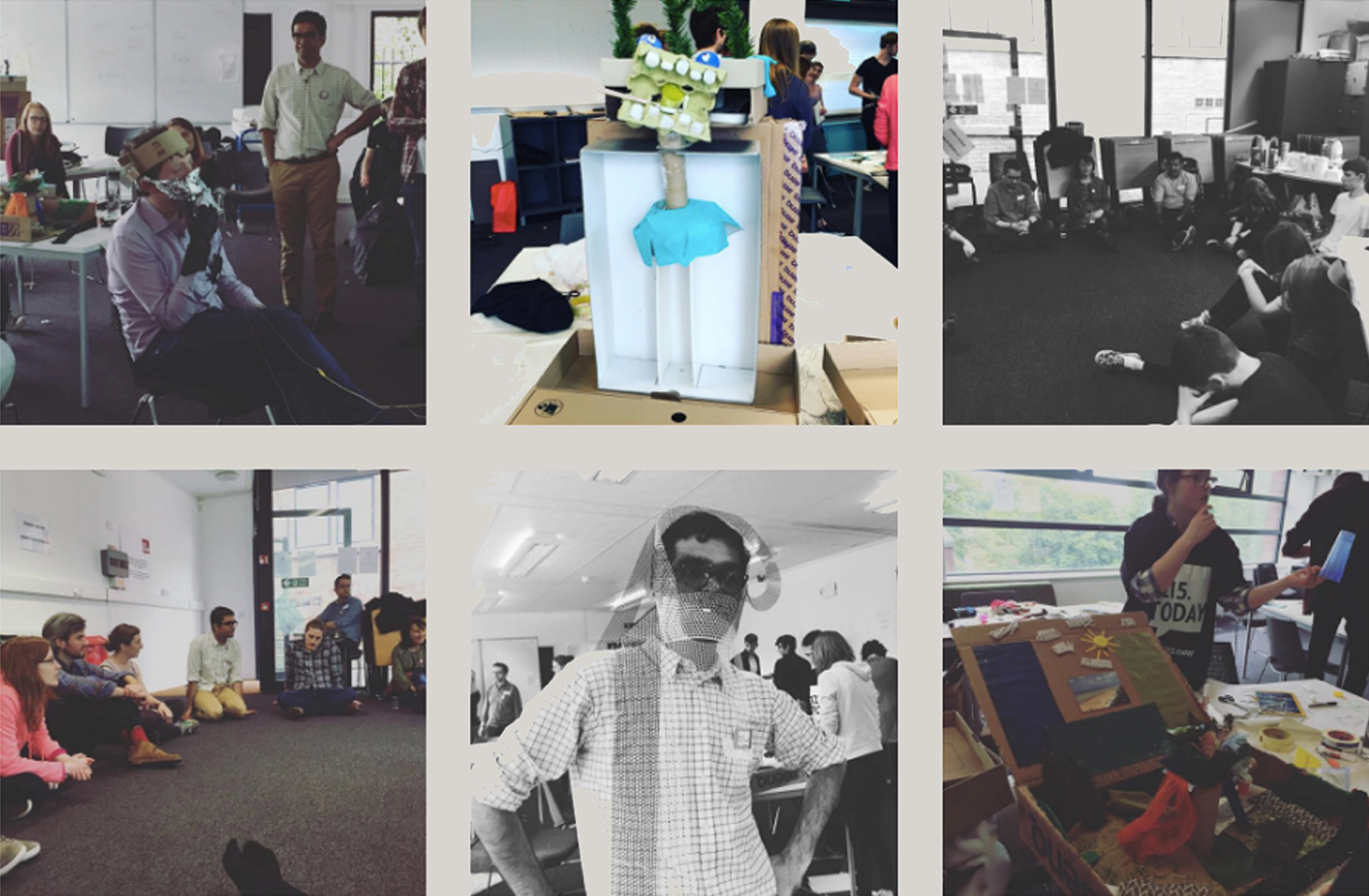
Playful and embodied practice, 1215.today Innovation Lab 2 (2017).
These activities were therefore designed to inform the speculative design of media artworks that in some way embodied the collective experiences of the lab participants. This culminated in the development of several proof-of-concepts for digital interventions that embraced the affective potential of interactive media (Figure 4). For example, one of the concepts imagined an augmented-reality application for creating bespoke contemplative environments using eye-tracking technology and gesture controls. There were a number of location-based designs that incorporated geotagging, crowdsourcing and mixed-media content to enable users to record their thoughts and feelings about a particular location or to share sensory experiences of a city by contributing audio, images, emojis, colours and subjective sentiments. One project responded provocatively to the actions we take when deep in thought by creating a working prototype for a wearable interface that controlled online browsing by touching or stroking the face. Other groups addressed the implications of living in a participatory digital culture by designing contemplative experiences of social media content, raising a debate around its impact upon our ability to think clearly. Issues of surveillance were also explored, which culminated in a prototype browser plug-in for tracking the ‘location’ of personal data at any given time, which a user could hypothetically use to take back control of their data by filtering who has access, mapping data connections and visualizing where data are stored. The aim here was not to produce an exact representation of their experiences, or to seek to ‘solve problems’ identified during the lab, but rather the labs became a site for participants to respond reflexively to the lab provocations by re-examining their own experiences of digital culture through different perspectives, contexts and artistic expressions.
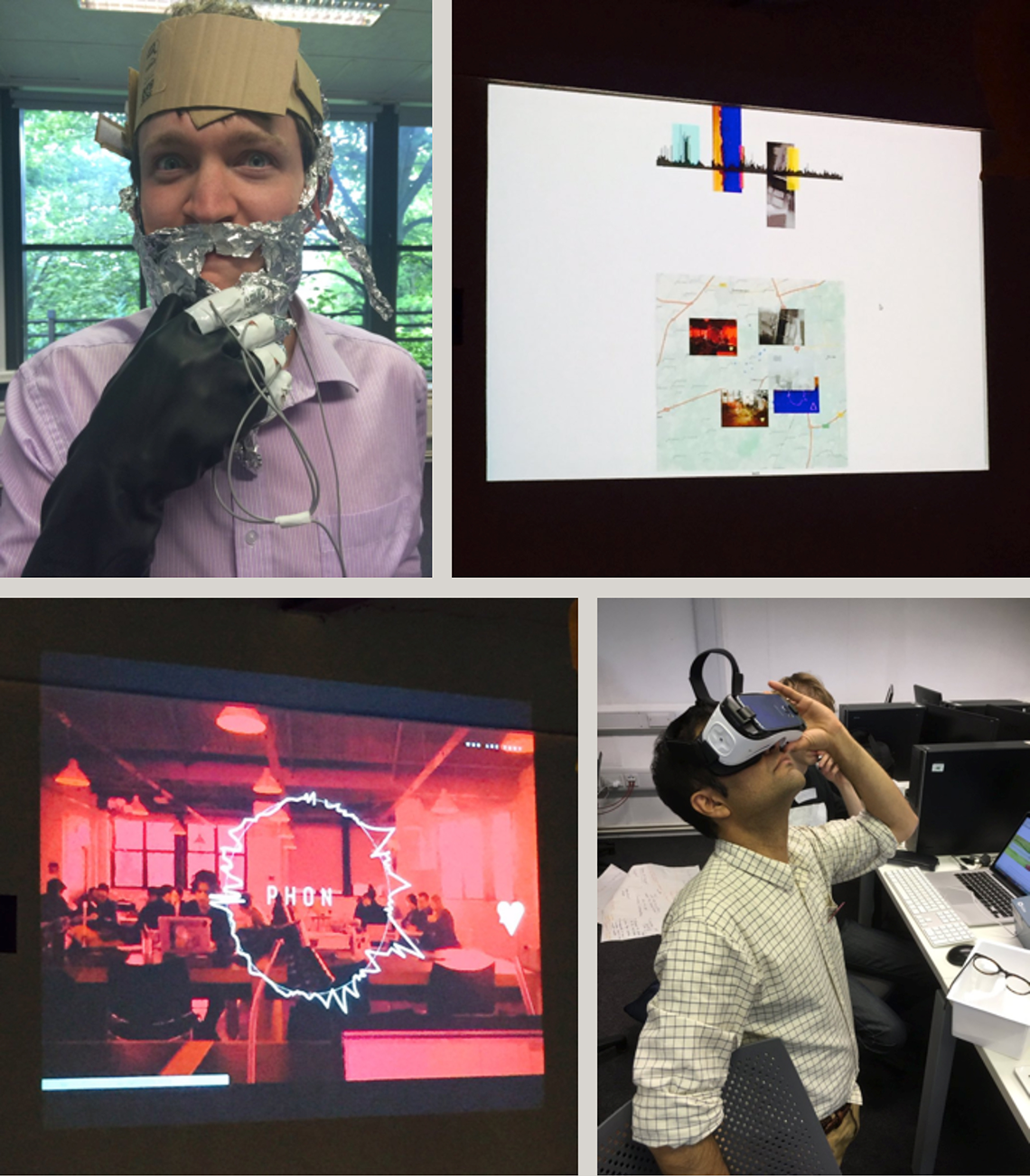
Prototypes and proof-of-concept examples, 1215.today Innovation Labs 1 and 2 (2017).
Conclusion
Throughout this article, we have addressed the recent intellectual turn towards examining the ‘more-than-human’, ‘more-than-representational’ dimensions of contemporary media culture, with issues of ‘affect’, ‘embodiment’ and ‘relational aesthetics’ being increasingly foregrounded by contemporary researchers. This line of inquiry draws attention to the dynamic relationality of media systems by bringing into relief our intra-actions with media on a social, cultural and biological level. For us, and as many of the scholars above have highlighted, questions of power, agency and subjectivity must therefore be re-situated within an entanglement of relations, operations and affects in the 21st century. It is this entanglement – the ontological status of mediation – that points towards the emerging challenges of traditional research methodologies and approaches to media pedagogy. It calls of us cultivate a critical sensibility: the process by which academic research both encounters and produces an affective form of knowledge. In other words, a non-representational approach recognizes that the production of knowledge is an entangled process that cuts across a multitude of contexts.
This article contributes to such debates by presenting the ‘lab as entangled media praxis’ as a set of principles for teaching media as mediation: a form of ‘doing’ contemporary media studies which is primarily concerned with developing an affective attunement to the entangled relations of digital culture. We contend that attunement here be understood as an ethics that acknowledges felt experiences as symptoms of the processual registers of mediation working upon the body. As such, this framework repurposes the notion of the media lab as a transdisciplinary and performative mode of practice-research, wherein the production of knowledge is contextualized through the embodied practices of lab participants. The lab as entangled media praxis can therefore be considered a non-media-centric approach for studying media, in which participants are encouraged to respond reflexively to the affective and subjective conditions of mediation through collaborative practice, experimentation and tangible interaction. In order to demonstrate these ‘lab principles’ in action, we provided a reflective commentary of two media labs where this framework was trialled. While this cannot be considered a comprehensive analysis of the two case studies, we have attempted to illustrate how these lab principles may be employed in practice by other media educators and researchers. 16 It is not our intention to claim this model as conclusive ‘answer’ to the problems identified within non-representational theory; nonetheless, we contend the lab as entangled media praxis may provide an effective method for engaging with the relational and operational logics of mediation.
Footnotes
Acknowledgements
The authors would like to thank our friends and colleagues, Prof Sarah Barrow, Dr Dave Boothroyd, Dr Rob Coley and Dr Dean Lockwood, for their support and valuable feedback. The authors would also like to thank participants and organizers of 1215.today for their contributions to this project.
Funding
The author(s) disclosed receipt of the following financial support for the research, authorship, and/or publication of this article: While 1215.today is an Arts Council England-funded project, the authors received no financial support for the research, authorship, and/or publication of this article.