



Abstract
The purpose of this article is to explore how unboxing videos on YouTube contribute to the domestication of privacy-invasive technology. Further, the objective is to show how consumer influencers on YouTube adapt to the flexible persona of the online warm expert (OWE) which expands the concept of the ‘warm expert’ from the domestication literature (Bakardjieva, 2005, Internet Society: The Internet in Everyday Life. London: Sage Publications). I argue that the OWE and unboxing discourse advance corporate interests of surveillance capitalism in home environments by promoting the circulation of emergent consumer technologies and eschewing meaningful discussion of privacy and surveillance issues. A case study of the Amazon Echo smart speaker and Alexa, its voice-activated personal assistant, is presented. The research consists of a qualitative thematic analysis of unboxing videos (N = 73) and viewer comments on YouTube. Unboxing discourse reflects normative consumer culture values that are detached from critical discussions of surveillance or the informational privacy framework of end-user agreements. As a practical implication, the study helps look beyond the household and traditional social relationships in the domestic sphere to understand how technological domestication is being shaped in a paradigm of consumer culture that is fused with the infrastructural and cultural logics of the Internet and social media.
Introduction
The YouTube genre of unboxing videos features individuals unpackaging and informally reviewing consumer items, as epitomized by the unboxing of new electronic devices. Although a great deal of unboxing content is produced by obscure YouTubers, the more popular content is created by influencers who are no strangers to their base of followers (see Herrero, 2016). The genre dates to 2006 and began with the unpackaging of a new mobile phone (Mowlabocus, 2018) but later expanded to shopping ‘haul’ videos (Silcoff, 2014), and most notoriously, kids’ content centered on toys. Unboxing videos have been criticized in news media accounts for promoting hyper-consumerism and addictive pathologies, especially among children (Chettle, 2015; Kollmeyer, 2015; Sloane, 2015). Moreover, researchers have elaborated on the moral panic around toy unboxing by assessing child viewing habits and aspects of digital literacy (Marsh, 2016; Nicoll and Nansen, 2018; Thompson, 2016). Following an important intervention by Craig and Cunningham (2017) who interpret the genre as a form of social media entertainment (SME), Sharif Mowlabocus (2018) identifies a common narrative articulated by technology unboxing videos – ‘a journey of discovery’ (emphasis in original) that communicates the aura of new technologies. This article contributes to the limited body of scholarship on the topic by focusing on a problem concealed by the unboxing of privacy-invasive technology.
The article presents an unboxing case study of the Amazon Echo smart speaker and Alexa, its voice-activated personal assistant (VAPA), which were released together in November 2014. Although Alexa’s ‘wake word’ functionality reproduces the design of mobile VAPAs like Apple’s Siri, its embeddedness in a smart home device was novel and has since made inroads in the domestication of ‘eavesmining platforms’ which subject home environments to ubiquitous eavesdropping and data mining processes (Neville, 2020). Like other smart products, the Amazon Echo actuates ‘dataveillance’ (Clarke, 1988) mechanisms that reproduce the logic of ‘surveillance capitalism’ (Zuboff, 2015, 2019) by striving to extract, commodify, and control consumers’ social behavior. Yet despite the myriad privacy and surveillance risks articulated by the Amazon Echo, its always-listening microphone array enables hands-free digital interaction that poses benefits of convenience and potential empowerment for users and households – purported benefits that engender an impetus for the domestication of a potentially privacy-invasive technology.
This article situates a case study of the Amazon Echo in relation to literature on the domestication of technology. Central to this is the assertion that YouTubers of unboxing videos are best understood as online ‘warm experts’ (Bakardjieva, 2005) who engage in processes of technological domestication. The key goal of the article is to show how the online warm expert (OWE) persona and unboxing videos on the YouTube platform contribute to the domestication of privacy-invasive technologies. I argue that the OWE and unboxing discourse advances corporate interests of surveillance capitalism in home environments by promoting the circulation of emergent consumer technologies and eschewing meaningful discussion of privacy and surveillance issues.
After a concise literature review, the article draws from a qualitative thematic analysis (Braun and Clarke, 2006) of unboxing videos (N = 73) and viewer comments on YouTube concerning the Amazon Echo. Thematic findings highlight how unboxers function as OWEs and how the privacy invasiveness of the technology is evaluated by consumers in the context of home environments.
Literature and theoretical framework
Domestication of technology
The social process of purchasing and integrating a smart speaker like the Amazon Echo in a home environment is summarized by the term domestication of technology (Moores, 1993, 1996; Spigel, 1992). Turo-Kimmo Lehtonen (2003) outlines domestication according to a set of Latourian ‘trials’ (Latour, 1999: 311) to stress the openness of the process and its association with dynamic relationships in particular households: in various stages, participants involved may asses the compatibility of a technical object within their household but may also evaluate any ‘emergent attachments’ (Lehtonen, 2003: 381) that are affected by perceptions of the gadget’s design, its usefulness, and the user’s appreciation for it in the conduct of everyday life. In the context of consumer electronics, the domestication process typically begins for a household before a decision to purchase the device. For instance, technology advertisements and marketing efforts strive to seduce consumers as participants in the domestication process. Concurrently, consumers may also actively explore and educate themselves about a new technology to inform their purchasing decisions: as demonstrated by practices of window-shopping, ‘cyberflânerie’ (Marsh, 2016), online research, and informal discussion among peers. Moreover, having purchased and introduced a device in the home, the domestication of technology remains subject to ‘recurrent renegotiation’ (Lehtonen, 2003) – meaning that its status as a household fixture cannot be determined in the short term. For instance, many consumers require ongoing technical trouble-shooting assistance with certain technologies to help ensure ‘successful’ domestication: clarifying this process, Silverstone et al. (1992) have developed a robust model to explain the domestication of commodities that challenges the ‘adoption curve’ model posited by Rogers (2003) and its conception of consumers as predominantly passive agents.
A domestication framework reveals how an individual or particular family tends to actively evaluate new technology over a period of change and how this occurs in relation to a ‘moral economy of the household’: an individuated set of social values and interests (Silverstone et al., 1992: 16–17). In Maria Bakardjieva’s (2005) study of the domestication of the Internet, she highlights how this new medium incited anxieties and household negotiations about the roles and rules of using it. Through what Bakardjieva (2005: 138) calls the ‘micro-regulation of the medium’, the moral economy of the household is articulated as a regulatory force that ‘involves making decisions about issues of placement, access, preferred, discouraged and forbidden activities on and through the Internet, and the allocation of resources, including time, space, money and attention’. What is notable though is how this micro-regulation can occur in the context of greater social change and disruption in the mores of the domestic sphere. For instance, in a contemporary context – with increased public awareness about the logic of surveillance capitalism (Zuboff, 2019) and the scope of dataveillance (Clarke, 1988) mechanisms – it is clear that privacy concerns are often prominent in the domestication of emergent technology, such as devices belonging to the smart home apparatus and Internet of Things (IoT). Thus, privacy values and interests may shape a moral economy of the household that ostensibly serves to regulate the domestication process. For instance, perhaps an individual will reject a potentially privacy-invasive device based on moral principle, whereas another household might purchase and use it while seeking to manage and renegotiate privacy relations at home.
A crucial element in moving forward in the domestication process is the mobilization of ‘warm expert’ figures (Bakardjieva, 2005). Without exploring the ‘diffusion of innovations’ perspective (Rogers, 2003), it is clear that a warm expert can be instrumental in helping steer the course and tempi at which households purchase and domesticate emergent technologies. Indeed, many consumers reportedly seek the advice and assistance of trusted friends and relatives who are more knowledgeable about technology, especially before an expensive purchase and during the initial stages of domestication such as during setup, and to resolve any technical problems. Bakardjieva (2005: 99) characterizes the role of the warm expert according to two elements: ‘he or she possesses knowledge and skills gained in the System world of technology and can operate in this world but, at the same time, is immediately accessible in the user’s lifeworld as a fellowman/woman’. Bakardjieva found that a warm expert acts as an intermediary between the consumer as layperson, and the producer as specialist, by helping an individual ‘learn’ how to use the technology. Further, a warm expert typically provides their service in the context of a ‘gift economy’ (Mauss, 1966) and as a guest in one’s home. Bakardjieva’s concept of the warm expert helps to understand who can influence the domestication process and potentially affect the moral economy of the household: due to their status as a friend or family relative, a warm expert is welcomed into a home environment and utilized as a congenial resource of technical knowledge and service. It follows then that they are uniquely positioned to affect the micro-regulation of the medium since they are perceived as trustworthy and morally objective in their opinions about technology, in contrast to industry specialists and salespersons.
The platformization of the warm expert
In this article, I adapt Bakardjieva’s (2005) concept of the warm expert to the social media platform of YouTube to clarify the role fulfilled by unboxing reviewers of technical products: I posit these figures as OWEs. Researchers have elaborated on the interpersonal role fulfilled by friends and relatives as warm experts (Lehtonen, 2003; Olsson and Viscovi, 2018), yet have not interpreted online influencers as such. Unlike traditional warm experts (i.e. friends and relatives), the OWE is a producer of SME (Cunningham and Craig, 2017) which characterizes native-to-online content genres such as personality vlogging. Unlike established screen entertainment, SME is ‘constituted from intrinsically interactive audience-centricity and appeals to authenticity and community in a commercialising space’ (Cunningham and Craig, 2017: 72). Within the proto-industry of SME, unboxers exemplify a type of content creator who operates quite distinctly from a traditional media producer because they often exhibit greater agency in content creation and brand management, diverse forms of entrepreneurship, and innovative strategies of viewer engagement (Craig and Cunningham, 2017). The intervention posed by SME problematizes understandings of unboxing videos as simply another form of advertisement, product placement, or celebrity endorsement. Extending this analysis, Sharif Mowlabocus (2018: 16–17) has explored the affective intensities and tactile pleasures engendered by unboxing videos which ‘offer the viewer an opportunity to occupy a specific orientation towards both that which is unboxed, and the act of unboxing itself’ (emphasis in original). Thinking with Sara Ahmed (2010, 2014), Mowlabocus (2018: 19) notes that these videos transform the act of unboxing into a happy event in which a shared investment of feeling is directed to the object itself and the ‘conditions of its arrival’; specified as its narrative conventions, the history of the genre, the history of the object, and the practice of unboxing itself. However, Mowlabocus does not address how the unboxer persona contributes to the happy event of unboxing.
The concept of the OWE addresses this gap in relation to the unboxing of new technology. This warm persona on YouTube represents a subset of influencer or ‘micro-celebrity’ (Marwick, 2015) that fosters an impression of intimacy by adhering to a model of communication, termed ‘perceived interconnectedness’ (Abidin, 2015). This is contrasted with ‘para-social interaction’ (Horton and Wohl, 1956) which theorizes how the casual and responsive conversational style of radio and TV personalities can form an illusion of intimacy with audiences despite the one-sidedness of the interpersonal relation. Crystal Abidin explains that perceived interconnectedness emerges from the affordances of social media platforms as influencers are in direct control of their self-representation, use of personal voice (Boyd, 2006), and interactions with followers. Like influencers, the OWE typically invites viewers to interact with them: ‘Leave a comment to let me know what other features or products you’d like me to test out in another video’. The OWE is perceived as highly approachable yet distinct from the persona of a friendly salesperson due to his or her use of social media platforms for strategic displays of intimacy. For instance, unboxing videos are typically conducted in a home environment and may feature appearances by the OWE’s family members, friends, or candid disclosures about the YouTuber’s personal life – characteristics that are highly common in the approach of lifestyle influencers (Abidin, 2015). Moreover, the self-presentation style of the OWE adheres to the norms of SME which places great currency on authenticity and community (Cunningham and Craig, 2017: 72).
Despite the fraught relationship between authenticity and commercialism (Banet-Weiser, 2012), the ‘realness’ of influencers emerges from their relatability to an imagined audience (Duffy, 2018: 111). The ‘realness’ of the OWE is constructed visually and textually to denote various aspects of accessibility to a community: geographical, linguistic, stylistic, technical, and financial. This accounts for the diversity of subject positions that intersect with the OWE persona and the tendency of unboxers to walkthrough technical aspects of new technology, respond to comments, and address basic pricing and value concerns. In this way, unboxers can act as user and consumer allies that communities of viewers perceive as informal experts. Crucially, this relationship extends onto YouTube’s comment section as viewers interact with the OWE in a manner that might feel like a personal dialogue concerning the product or related devices. As a result, despite the commercial affordances of YouTube which includes automated partnership agreements and programmatic online advertising (Craig and Cunningham, 2017: 83) and potential revenue streams from the unboxing genre – that is, endorsements, free products, and online sales commissions – perceived interconnectedness between the OWE and viewers helps frame the expertise displayed in unboxing videos within an intimate gift economy. In this context, the ‘relational labour’ (Baym, 2015) of the OWE is given in hopeful exchange for viewer subscriptions, likes, and ongoing engagement. This reciprocity positions unboxers of new technology in a role that shapes the process of domestication as they introduce devices, offer tips, and interact with individual viewers during their personal trials with the technology.
The theoretical contribution of the OWE concept is threefold. First, it reveals that a shared interest in new technology can lead to diverse relations of perceived interconnectedness. For example, some viewers follow specific unboxing channels, whereas others may turn to YouTube as an ad hoc resource of unboxing videos. Bakardjieva’s warm expert figure is familiar to users beyond their role as a technology adviser and tailors his or her assistance to the individual needs of a household. In contrast, the OWE may or may not be familiar to a viewer in any personal capacity because this depends on both the engagement of the viewer and the YouTuber’s personal performance style. 1 As a flexible persona, the OWE may or may not fulfill individual expectations of warm expertise, because YouTubers showcase various levels of sociability and technical familiarity. Moreover, although OWEs commonly express a willingness to provide assistance, there is no consistent practice of communication evident in the comment section. However, what establishes the OWE as an identifiable persona is the way in which content creators seduce viewers as potential users of technology and contribute to the living resource of technical assistance on YouTube. Put simply, the OWE frames emergent technology as always already domesticated.
Second, the concept of the OWE reveals that users who have basic experience with a new technology can be positioned as authorities. Bakardjieva’s warm expert figure possesses knowledge and skills acquired from the ‘system world of technology’, whereas typically, the only implicit or explicit claim to authority made by an OWE is their familiarity with a product as a consumer. However, familiarity with a product’s design acquired from using it over a period is not equivalent to product knowledge (Hoch, 2002), and thus, the consumer generally does not understand how technology works, as intended by its black box design. As a result, it should come as no surprise that surveillance processes are not meaningfully outlined by the OWE when dealing with privacy-invasive technology because digital platforms cultivate a logic of opacity (Roberts, 2018) that discourages users from attempting to understand these systems (Draper and Turow, 2019). Nonetheless, viewers turn to the OWE seeking to learn from his or her experience because this is a highly seductive form of learning (see Hoch, 2002; Troullinou, 2017) about technology. This creates a significant problem because it means that the ‘authentic’ experience shared by the OWE is evaluated by potential users as a valuable form of technological authority.
Finally, the OWE identifies a persona that not only adheres to the norms of YouTube’s promotional culture but also participates in a culture of ‘seductive surveillance’ (Troullinou, 2017), whereby both parties, the OWE and viewer, are seduced by the promise of interactivity (Abe, 2009). While product design and marketing processes seek to seduce individuals, unboxing performances disseminate seductive user experiences. This is arguably more powerful than espousals of ‘digital resignation’ (Draper and Turow, 2019), ‘privacy cynicism’ (Hoffman et al., 2016), and ‘surveillance realism’ (Dencik and Cable, 2017), because seductive surveillance not only displaces social concerns but actively promotes the desirability of privacy-invasive technology. As a result, when the OWE engages in conversations about the moral economy of the household, they exhibit a bias of conformity to a culture of seductive surveillance. Moreover, a ‘dark pattern’ (Gray et al., 2018; Mathur et al., 2019) is embedded in the conventions of the unboxing genre which typically features a walkthrough of the initial setup of a technical device; surreptitiously, having completed this process, the OWE and viewer as user have effectively accepted the terms and conditions of the privacy agreements governing the use of the technology. Crucially, in my case study of the Amazon Echo smart speaker, the OWE consistently does not advocate reading Amazon’s End User Agreements (EUAs). Thus, as a mechanism in the domestication of new technology, unboxing videos help to advance the process by dislocating the technical object from its corporate legal framework of informational privacy.
Methodology
The study interprets the perceived interconnectedness of unboxing discourse as a dialogue between the OWE and viewers and as a discussion between viewers as potential users of the product under review. Research has focused on visual and auditory aspects of unboxing videos (Mowlabocus, 2018) and such an approach would certainly reveal variations in the OWE persona. Instead, the study focuses exclusively on a textual analysis to trace how the common narrative of unboxing videos initiates dialogue and discussion about the domestication of technology. There is a deluge of unboxing videos in numerous languages on a variety of Amazon Echo and third-party products featuring Alexa. The study is limited to videos in English or with English subtitles created by the YouTuber that cover the original Amazon Echo (first and second generation) and Amazon Echo Plus. Further, videos with fewer than 1000 views are excluded from the data sample to focus on influential OWEs in unboxing discourse.
YouTube data were collected on 13 January 2019 using the search terms: ‘Unboxing Amazon Echo’. Videos were selected by ranking the order of search results based on ‘view count’ and manually examining each video based on the aforementioned criteria (see Figure 1). Additional videos that correspond to the criteria list were then selected by re-ranking the order of search results based on ‘relevance’. This procedure yielded 73 videos which each have corresponding Content IDs. All 73 Content IDs were then individually input to the ‘Video Info and Comments’ module provided by the Netvizz YouTube Data Tools (Rieder, 2015) to create a tabular file containing all retrievable comments and replies for each video (see Figure 2).
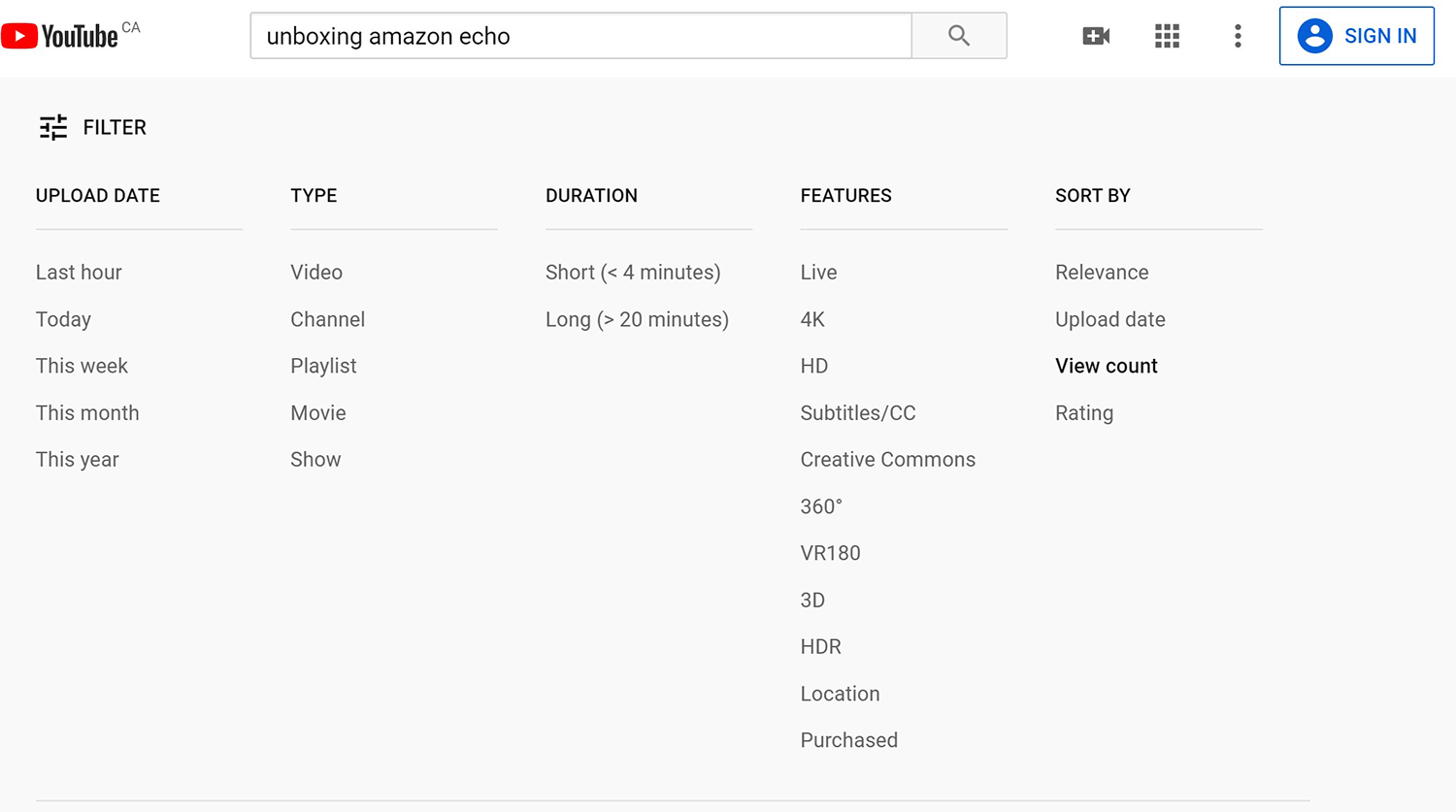
YouTube screenshot of filters to rank order of search results.
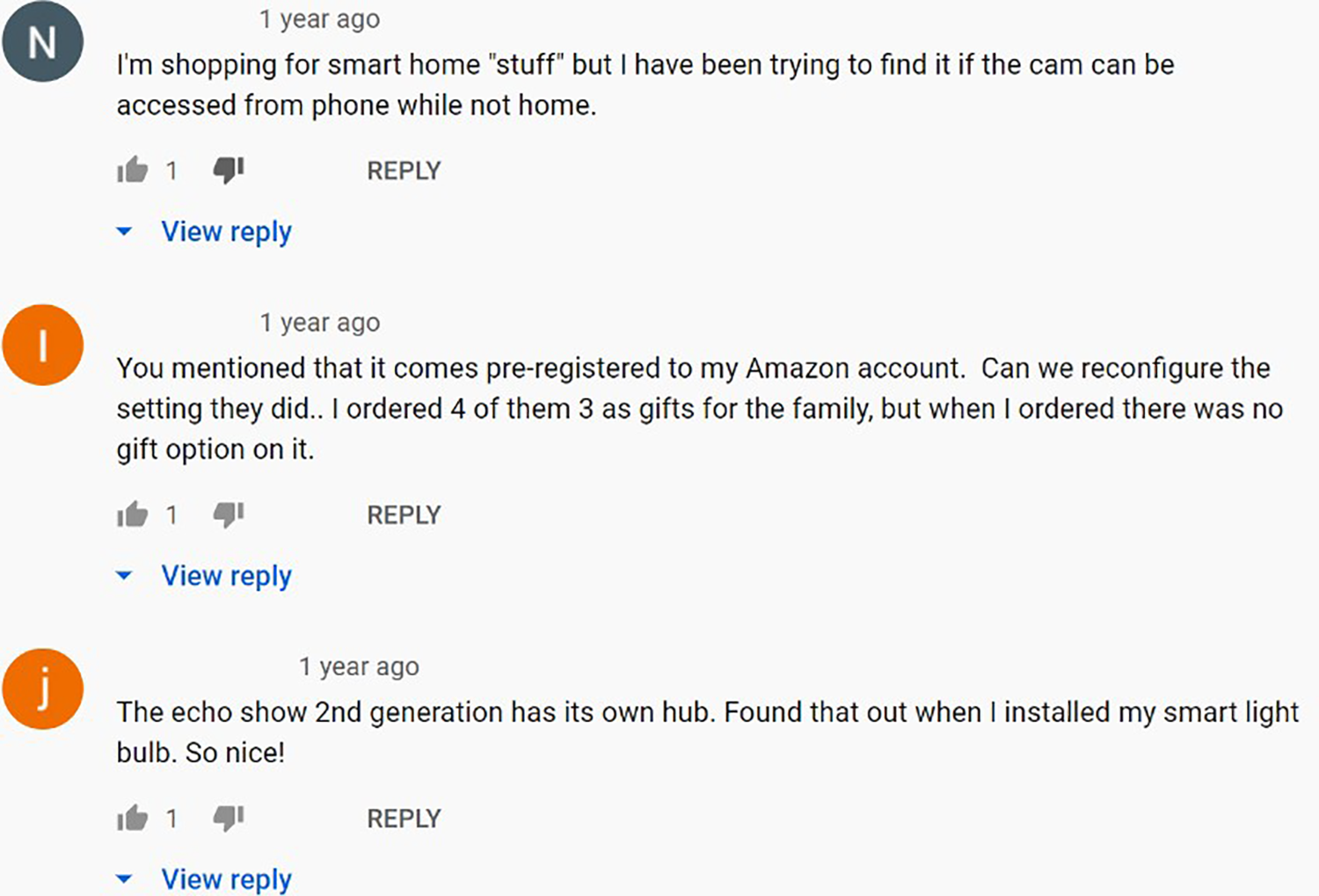
Screenshot of viewer comments on YouTube.
The YouTube platform lends itself readily to quantitative analysis of ‘natively digital objects’ (Rogers, 2013: 19) because of its embedded metrics of influence, including view count, like/dislike count, comment count, and channel subscription count. These metrics can be used to determine which OWEs are particularly influential but do not explain how unboxing discourse engages in the domestication process and articulates privacy and surveillance concerns about the Amazon Echo. Further, a quantitative approach would be necessary to indicate broader trends and patterns in the data. In contrast, this qualitative study is not designed for generalizability but rather contributes to the domestication literature by highlighting key passages that reveal how the Amazon Echo is evaluated in unboxing discourse on YouTube by OWEs and users alike.
The study asks: How does the OWE on YouTube serve to initiate a dialogue in the domestication of the Amazon Echo as a privacy-invasive technology? And how does unboxing discourse articulate oppositional evaluations of privacy and surveillance issues while advancing the societal domestication process? The study approaches three discursive elements for analysis: video transcripts of OWEs, viewer comments in dialogue with OWEs, and viewer comments in discussion with other viewers. Research findings are presented in this order for the sake of clarity. The coding process involved a deductive and inductive thematic analysis (Braun and Clarke, 2006) oriented around my specific theoretical and analytic interests which center on the domestication of privacy-invasive technology initiated by the OWE. A coding of video transcripts produced four themes covered in unboxing videos of the Amazon Echo. Subsequently, a purposeful sampling procedure was used to produce three themes from user comments in dialogue with OWEs and two separate themes from user comments in dialogue with other viewers. The thematic findings from each of the three discursive elements highlight key passages that reveal the function of the unboxing genre and the role of the OWE in the domestication of the Amazon Echo.
Research findings from video transcripts
An easy and straightforward setup
Setup for the Amazon Echo is very simple: after plugging the device into a power outlet, Alexa activates and informs the user to follow some instructions in the mobile companion app. During the walkthrough of the setup process for the Amazon Echo, OWEs typically do not include a great deal of added commentary. Instead, Alexa clearly instructs the user to download the app and follow a sequence of instructions on one’s smart phone and then plays a short tutorial video that outlines the basic functions of the device: this is important in revealing to users just how easy the setup process is. Notably, in the recent past, home automation technology often involved a significant learning curve that likely would have dissuaded potential users.
OWEs promote the Amazon Echo as an accessible technology, describing the setup as ‘super easy’, ‘straightforward’, and ‘pretty simple’. One OWE elaborates: ‘they like babysit you through the whole process, just ask it to connect to your phone and boom, it will guide you’. Many users are familiar with the frustrating experience of reading technical instructions for a new device or system which for non-savvy users can represent a barrier in the domestication process. In contrast, the intuitive affordances of a voice interface streamline the Amazon Echo’s setup, enabling users to ‘sit back and relax’. One OWE explains: ‘I don’t usually read instructions and fortunately this came with none so I’m assuming this cylinder [the Amazon Echo] is going to talk me through the process of setting it up’. The setup is not only easy and straightforward, but due to the novelty of the device, it is even described as ‘exciting’, ‘fun to figure out’, and ‘an epic little experience’. OWEs demystify the setup process and sometimes even express that it can be enjoyable and rewarding in itself.
Is it worth the money?
Some early adopters of new technology are content purchasing a device as a fun gadget or novel toy yet OWEs clearly recognize that some users watching an unboxing video are more interested in evaluating the quality and usefulness of the Amazon Echo in relation to its price. ‘We’re here to look at the Amazon Echo…and to find out if this is worth your hard-earned money’. This theme prominently recurs in the data set, as OWEs conduct straightforward reviews of the device, justify its value to users, and sometimes provide rudimentary cost-benefit analyses that consider alternative models, brands, or smart home solutions.
OWEs regularly conclude that the Amazon Echo is ‘really affordable’ and offers the ‘best value’ on the market. In many cases, OWEs make overt endorsements of the product by characterizing it as ‘the must-have gadget for your home’ or stating that ‘it’ll improve my life by quite a lot, so I would definitely recommend getting one of these’. After their evaluation of the device, a few OWEs conclude that it is not yet worth the price. ‘To be honest, the thing is still a bit expensive’. As a result, some OWEs recommend waiting for the price to drop or for the product to go on sale. ‘It’s kind of hard to recommend to go out and get one at that price…I’m pretty much going to tell you to wait and get the second generation of this product’. Indeed, others agree that the value of the product will increase over time as its price lowers and its functionality improves and expands with added features. ‘It’s constantly getting updates from Amazon, improving it much more and adding more features to it. I love when companies update their products via software updates’. Thus, evaluations of the quality and usefulness of the Amazon Echo are directly related to its price, so some OWEs justify its value simply because ‘it’s always getting smarter’.
Addressing privacy concerns
In the entire data set of unboxing videos, not a single OWE advocates reading Amazon’s EUAs. Although this is by no means a startling revelation, it does articulate a deceptive function of the unboxing genre which characteristically features the setup process of the Amazon Echo and companion Alexa app. Following the lead of OWEs and having completed this process, the user has effectively consented to the terms and conditions stipulated in Amazon’s EUAs. During an unboxing video, an OWE picks up the quick start manual which features a link to Amazon’s EUAs and states bluntly: ‘Who am I kidding, I don’t need to read that’. OWEs consistently do not recommend reading Amazon’s EUAs to uncover information about the device’s privacy and surveillance implications; however, several OWEs express mild concern by describing the technology as a ‘little bit scary’, ‘kinda weird’, and in a word, ‘creepy’.
An OWE expands upon the notion of the creepiness of new technology by characterizing the Amazon Echo as an ‘Orwellian nightmare’. He elaborates: ‘It’s kind of like it came straight out of a dystopian future where a giant corporation is just going to put this in the middle of your house and listen to every word you say’. Nonetheless, the OWE’s complacency is revealed by his gleeful smirk and indication that he plans to further test out the device at home for himself. This relates to commentary from other OWEs who realize the privacy and surveillance implications of the technology but minimize and joke about any potential risks: The thing totally spies on you. And delivers all the data to the NSA. No, no, I have no clue, to be honest. Doesn’t matter anyway. If Amazon memorizes my music wished, then that’s okay with me. My music wishes aren’t that exotic. If you say now something like:…. “Alexa, what do I have on my grocery list?” These aren’t like my big secrets.
Online warm experts
Unboxers initiate a dialogue in the domestication of technology and seek to establish themselves as a virtual friend or ally of the consumer: ‘This is your friend, OWE #1’; ‘It’s your boy, OWE #2’. This friendly relationship is also reflected by the fact that unboxing videos are typically performed from the OWE’s home and may include depictions of their domestic life. Further, some OWEs interpolate the viewer as a friend of the family, so to speak, by conducting the unboxing alongside their family members or by discussing their family’s plans to use it. I will try to keep you guys updated…maybe [I’ll] have my wife talk about it because like I said, she’s probably gonna be the one to use it a little bit more than I will. Maybe our little one will use it as he gets a little older because he can use it for things like schoolwork.
In the final moments of the videos, OWEs sign off in a generic fashion, graciously requesting viewer support: ‘Thanks a lot for watching my video, give me a thumbs up, subscribe to my channel, and peace’; ‘As a friendly reminder, click this button to subscribe’. OWEs operate in an intimate gift economy that extends informally as they ask users to share the video or channel with their family or friends: ‘If you found this video helpful please share it, it might help someone else out as well’; ‘Give it a quick share with your friends and family’.
Within the data sample, OWEs communicate a willingness to assist users. ‘Hopefully this was helpful and it helps you make an informed buying decision if you were in the market for one of these’. Notably, the dissemination of online warm expertise continues well beyond the unboxing process onto the comment section. This is likely in an effort to acquire more channel subscriptions and to develop and retain a loyal fanbase. ‘If you guys have any questions, concerns, [or] if you want me to test anything specifically, let me know down below in a comment and I will try and get back to you’. Additionally, some OWEs are willing to create new content to satisfy user requests related to the technology. ‘If you guys want an in-depth comparison between Alexa and these different Alexa devices, do let me know. I can make a different video’.
This concludes the research findings from video transcripts in preparation for the next element of unboxing discourse, viewer comments in dialogue with OWEs. In the following sections, comments and replies are presented without any corrections of typos, misspellings, or online colloquialisms, reflecting an effort to preserve the integrity of the participatory discourse under analysis.
Research findings of viewer comments in dialogue with OWEs
Trusting the OWE
OWEs regularly invite viewers to submit comments on the video. Positive affective relationships are articulated by viewers who express their gratitude about the reliability of OWEs. ‘Down to earth, brutally honest, yet positive and helpful review. Thank you so much. Feeling confident about purchasing some Echos now’. OWEs can play a decisive role in the domestication of technology by influencing viewers’ decisions to purchase the device. ‘A thorough, practical and very useful review. Essential viewing for anyone considering buying an Echo, and that includes myself!:-)’. Viewers are in many cases only responsive to ‘authentic’ warm experts who produce seemingly unbiased and honest content without advancing an apparent sales pitch of the product. Viewer #39: Good work. Keep it up…Your work is genuine and trustworthy. Don’t let it be like other top rated youtube channels (paid fake reviews), wish u good luck. OWE #3 [reply]: Thank you so much. Your words mean alot to me. Will always try to do my best. No biased reviews ever. Will say only what i feel. Thank u
Some viewers who do not perceive any emergent attachments with the Amazon Echo and choose not to purchase it will nonetheless express gratitude toward OWEs. The best echo review out there – hands down. No marketing BS [bullshit]. Real life scenario – with objective and well explained pros and cons. And although the Echo is a technology wonder – I am failing to see currently any real life application for it….
Help and technical assistance
OWEs are generally well-respected and appreciated for showcasing a degree of technological competence and familiarity. Yet it is not only their technical knowledge but their willingness to outline the setup process, answer questions, and troubleshoot technical problems that establish them as OWEs. Viewers submit a broad range of queries to OWEs including accessibility questions: ‘I am legally blind and was thinking of getting an Alexa to help me run my house. But was wondering about the accessibility functions’. Other viewers ask for help with the basic operations of the device. ‘I’m having issues trying to connect with other family members that have an Alexa device. Specifically the calling feature…Please help!!! Before I give up on it all together’. In addition to technical and accessibility questions, viewers will sometimes appeal to the authority of OWEs when evaluating the social applications of the Amazon Echo.
Some comments reveal what can be described as the mediation of warm expertise. ‘Thanks for the extremely good review. Since you have experience with the device perhaps you could tell me whether or not this might be useful to my 80 year old mother with no computer skills? Thanks’. Viewers often turn to YouTube as an information resource when evaluating or setting up the device up for an elderly user. Thus, traditional warm experts can utilize the information disseminated by OWEs. The mediation of warm expertise from participatory social media platforms through interpersonal contacts illustrates that OWEs have not altogether replaced traditional warm experts. Rather, OWEs can function as resources for individuals that support potential users with direct technical assistance.
Faith in technology
Numerous OWEs recognize the privacy risks of the technology being introduced into the household but nonetheless encourage viewers to have faith in the privacy affordances of the technical device, such as the microphone mute button. Some viewers are reluctant to domesticate the technology but still appeal to the purported authority of OWEs. Viewer #139: Is it true that it spies and records you? OWE #5 [reply]: One would hope that it is not tracking every word. But, only analyzing sound waves for the right waves that equal the word Alexa. I am going to keep my fingers crossed and Alexa under a pillow in the closet when I have private stuff to talk about. Viewer #121:…My daughter and her husband moved in with me. He’s an IT Tech working security and setting up the network for a company…Since moving here, he now works remotely for his company and is here ALL the time. Zero privacy LOL;-) He’s very sneaky and capable of setting this stuff up. I need to make sure my privacy is protected. [emphasis mine] OWE #6 [reply]:…The next layer of privacy and the step I would take is to setup your own profile and voice profile. I did make a video on how to set that up…Only you can access information that is saved by your voice. for example, your contacts, calendars and messaging…Unless he [the ‘sneaky’ son-in-law] were to look at your phone, he would not be able to ask to her your Alexa messages if voice profiles are setup…Your voice profile can keep that stuff private…[emphasis mine]
One viewer provokes a pithy response from an OWE after harshly criticizing his evaluation of the privacy and surveillance concerns posed by the technology. Viewer #138: Alexa – do you know how dumb i am bugging my/our house for amazon. Yes, you are a mindless twat who’s given up your privacy just to be part of the latest trend. Alexa – I’m too busy to turn off my own lights. Turn them off. Ok, turning off lights and sending todays recording to the NSA/CIA and amazon database. How on earth did a mega corp manage to convince the stupid masses to legally bug themselves on behalf of amazon? OWE #7 [reply]: ha man, no proof that amazon is doing this [emphasis mine].
Research findings of viewer comments in discussion with other viewers
Fear and distrust of technology
Viewers frequently express privacy and surveillance concerns in relation to a fear and distrust of technology. A group of comments characterizes this in relation to government surveillance by American signals intelligence agencies. ‘NSA, CIA and FBI would like to personally thank Amazon for installing spy mics in every home’. Critiques of the technology relate the Amazon Echo to an espionage device by describing it as a ‘listening bug’, ‘spy tool’, ‘spy machine’, and the ‘NSA’s new toy’. There is a common conflation of corporate and state surveillance in viewer commentary, reflecting post-Snowden consumer attitudes toward technology corporations in response to their complicity with dragnet dataveillance operations by the National Security Agency (NSA).
Other commentators express their fear of technology by relating it to science fiction horror and dystopian literature. References to ‘Skynet’ from the Terminator franchise and ‘Hal 9000’ from 2001: A Space Odyssey reveal that Alexa’s artificial intelligence and synthesized voice conjures up fears of autonomous machines growing more powerful than its human users can manage. Further, allusions to George Orwell’s ‘Big Brother’ resonate with post-Snowden consumer attitudes by conflating corporate and state power. Two viewers refer to 1984 while debating the distinction between governmental control and corporate advertising, marketing, and surveillance. Viewer #112:…This has nothing to do with totalitarianism, government, or controlling the masses. It has more to do with marketing, selling, and wrapping people up in a particular company’s products. You can calm down. We’re not at war with Eastasia or Eurasia quite yet… Viewer #113 [reply]: ‘controlling the masses’ ‘marketing, selling, and wrapping people up in a particular company’s products’ I don’t see the difference.
Conspiracy theorists versus the fools
Viewers can be polarized in a heated debate about privacy and surveillance risks posed by the technology. Those who feel they have nothing to hide or that privacy is dead perceive critics as ‘conspiracy theorists’. In contrast, privacy advocates describe early adopters of the technology as ‘idiots’ and ‘fools’. Some viewers reject the technology on principle and characterize proponents of the technology with pithy statements about its invasiveness. ‘Only moronic ignorant idiots would purchase a device that listens to everything you say in home’. This contrasts with those who believe they have ‘nothing to hide’ and express the belief that they are not surveillance targets. ‘You’re not as interesting as you think you are, and the NSA doesn’t give a shit about what you had for breakfast or what time you have to go to yoga class’.
Numerous viewer comments dismiss surveillance critics as fools for fighting to protect their freedom because ‘privacy is dead’. They support their claims by explaining how microphone technology is already embedded in a variety of domesticated technologies that can be compromised for surveillance purposes. Viewer #114: I hate these comments. They literally make no sense…If the NSA did spy on us, they would use EVERY FREAKING device in your home. If you have a phone: RIP [rest in peace] new tv: RIP PC: RIP Laptop: RIP Skype (or any other calling software): RIP Amazon Echo: Why would they even bother bribing Amazon to spy for them? It would plane out, be a waist [sic] of money for them… I can’t wait for the conspiracy theory crowd to run with this one…I’m sure it was created by the CIA to collect your thoughts and invade your dreams so that they can power their Loch Ness Monster finder or something like that. Oh, and Obama!
The final section discusses these findings and returns to the research questions.
Discussion
In the unboxing genre, OWEs promote the Amazon Echo’s easy and straightforward setup and conduct a walkthrough that demystifies the technical procedure. In the data sample, OWEs do not read the EUAs and sometimes discourage viewers from doing so for themselves: in the context of the domestication process, OWEs further condition users to skip-over and ignore the consensual contract with Amazon (see Obar and Oeldorf-Hirsch, 2018). As a result, the dialogue initiated by these OWEs helps advance the domestication of the Amazon Echo by focusing on its packaging and setup while ignoring how this process implicates user consent to Amazon’s EUAs and surveillance affordances. More generally, I suggest that this deceptive function of the unboxing genre can perpetuate the contemporary proclivity to domesticate privacy-invasive technologies.
OWEs discuss the quality, price, and value of the Amazon Echo at great length and often conclude unboxing videos with overt recommendations to purchase or wait for the price to drop. Notably, the privacy and surveillance risks of the technology are not factored into the cost-benefit analyses led by OWEs. Instead, privacy concerns are often addressed by OWEs with complacent remarks, jokes, and dubious ‘tests’ for interest-based advertising protocols. Unboxers establish themselves as virtual friends and user allies, positioning themselves as impartial intermediaries between the consumer and Amazon. As a whole, OWEs engage in the domestication process by reproducing and transforming the traditional role of the warm expert. I suggest that this enables them to initiate a dialogue about the moral economy of the household in relation to consumer privacy values and interests – nudging viewers to conform to a culture of seductive surveillance (Troullinou, 2017).
In the context of an intimate gift economy, unboxers consistently invite viewers to leave comments and questions, revealing how an OWE’s performance continues well beyond the unboxing performance. Many viewer comments in dialogue with OWEs reveal how unboxing videos can influence purchasing decisions. Further, the trustworthiness and congeniality of OWEs leads many viewers to approach them as resources for help and technical assistance. A range of queries are directed to OWEs that show that unboxing discourse helps mediate warm expertise to traditional warm experts who assist elderly users in the domestication process of the Amazon Echo. Thus, OWEs on YouTube initiate a dialogue that diffuses technical knowledge both directly and indirectly through traditional warm experts.
OWEs encourage viewers to have faith in technology by assuming that the technical device will function as designed and officially promoted. For instance, the privacy affordances of the Amazon Echo, including the microphone mute button and voice profile service, are typically cited in response to user privacy concerns. Unquestioning faith in Amazon is clearly misplaced in light of a recent privacy scandal that revealed how Amazon employees manually audit voice recordings collected from Amazon Echo devices (Valinsky, 2019). The study’s data sample reveals that OWEs initiate a dialogue in the domestication process that fosters faith in the device and the Amazon brand, despite the technology’s apparent privacy invasiveness.
In some cases, OWEs lose the respect and trust of users for not taking their privacy concerns more seriously. Thus, privacy and surveillance concerns can affect the perceived interconnectedness between viewers and OWEs as this impacts their evaluation of unboxers’ likeability, trustworthiness, and moral reliability. In general, unboxing discourse articulates oppositional evaluations of privacy and surveillance issues but nonetheless advances the domestication process by characterizing the technology as innocuous.
Viewer comments in discussion with other viewers can communicate their fear and distrust of technology about the Amazon Echo. Corporate and state surveillance are commonly conflated in these accounts, reflecting post-Snowden consumer attitudes. In 2015, Amazon stated that it was never involved in the NSA’s PRISM program (Sayer, 2015): yet despite Amazon’s earlier attempt to distance itself from the surreptitious data practices of other technology corporations, such as Google, consumers are rightly suspicious of their personal data being shared with and analyzed by American signals intelligence agencies and other clandestine state actors. The technology is also regularly critiqued by users with frequent allusion to dystopian literature of state control or the vague creepiness of new technology. As a whole, oppositional evaluations of the Amazon Echo which are critical of its privacy and surveillance issues tend to assume secretive cooperation between corporate and state surveillance networks.
In the comment section, proponents of the technology and privacy advocates wage a polemical debate: a battle between conspiracy theorists and the fools. Technology enthusiasts often argue that they have nothing to hide or that privacy is dead, while privacy advocates characterize the technology according to general sociotechnical processes of ‘eavesmining platforms’ (Neville, 2020). These adversarial groups on the discussion board share a common unfamiliarity with Amazon’s EUAs. Thus, unboxing discourse can articulate negative evaluations of privacy and surveillance concerns while advancing the societal domestication process of the Amazon Echo through its ostensible dislocation from the underlying informational privacy framework imposed on users.
Conclusion
The study implicates an important empirical limitation because unboxing videos tend to primarily communicate the YouTuber’s initial perceptions of the device and not the user’s gradual conditioning to the interactive affordances and monitoring presence of the technology. As a result, the study elaborates on the early stages of the domestication process but does not thoroughly investigate the potential in developing enduring bonds of attachment over the lifecycle of the technology. Relatedly, research has explored individual decisions to adopt VAPAs using social contract theory (Liao et al., 2019). Future research should address this limitation by attending to longer term relationships formed with the technology in determining whether subtle transitions occur over time for individual users and households in the normalization of its surveillance presence and affordances.
This article set out to adapt the concept of the warm expert (Bakardjieva, 2005) onto the social media platform of YouTube. The unboxing genre reveals how particular YouTubers adopt the flexible persona of the OWE, steering the course and tempi of the domestication of commodities. Increasingly, unboxing discourse is fueled by the perennial release of novel technical devices that are part of the smart home apparatus and IoT. The role of the OWE helps refine our understanding of particular influencers or ‘micro-celebrities’ (Marwick, 2015) who promote the products and services of a digital economy. Notably, the figure of the OWE should not be constrained to the unboxing genre, because similar performances of warm expertise are routinely displayed in other content forms. Further, the OWE is not restricted to YouTube, since he or she often exerts their influence across multiple platforms, including blogs, websites, and social media pages.
The lack of transparency in the economic relations between OWE and corporate brand is not the sole issue when the products or services they promote are embedded in a logic of seductive surveillance: this is exemplified by unboxing videos of privacy-invasive technology but also includes the promotion of platform services that shape household relations and behaviors while subjecting users and home environments to invasive forms of dataveillance. For example, online shopping and food delivery platform services articulate the ‘structuration’ (Mosco, 2009) of home environments into intense spaces of consumer activity and surveillance. In light of this, there are many cases where the process of domestication involves new services that effectively piggyback upon the prior successful domestication of technical objects (e.g. computers and smartphones). Thus, influencers who promote or endorse services and applications that seek to target domestic life and home environments can also be interpreted through the lens of the OWE.
The strength of the conceptual framework developed in this article lies in addressing who can influence the domestication process and how the relationship between the OWE and potential users is of significance. I have argued that the OWE helps advance corporate interests of surveillance capitalism in home environments by promoting the circulation of emergent consumer technologies and eschewing meaningful discussion of privacy and surveillance issues. Whereas Bakardjieva’s (2005) notion of the warm expert addresses the role of friends and family members in the domestication of the Internet, it is apparent how the ‘platformization of the household’ (Pridmore et al., 2019) thesis is accompanied by the platformization of the warm expert. Thus, it is necessary to look beyond the household and traditional social relationships in the domestic sphere to understand how technological domestication is being shaped in a paradigm of consumer culture that is fused with the infrastructural and cultural logics of the Internet and social media.
