



Abstract
This article examines the construction of a digital collection. Using a theoretical framework adapted from digital history and historiography, it will investigate the implications of archival digitization. Through an empirical study of the National Library of Israel’s digital depository of ephemera entitled ‘Time Travel’, the article demonstrates how the selection of archival records for digital preservation, the design of the search interface, and the crowdsourcing of metadata collection are all directing archive users toward certain narratives about Israeli history and away from others. Drawing on interviews with professionals, analysis of reports, and investigations of user experience, I will unearth the political, religious, and cultural tensions that lie beneath the surface of ‘Time Travel’. This research demonstrates that digitization of archival documents is not just a technical process but a cultural, social, and political one as well.
Introduction: On digitization, digital humanities, history, and historiography
Over the last two decades, libraries, museums, and archives have gradually begun converting their materials into digital objects. Many institutions that maintain historical archives are seeking to expand and enrich their relationships with the public by providing digital access to content that was previously limited only to individuals who could visit the physical depository, and by asking the public to participate and share their knowledge about the scanned items (Popple, 2015). These trends raise questions as to the degree and kind of inclusivity which are desirable in archival digitization projects, the nature of the relationship between the material object and its digital copy, and the role of the online interface in shaping access and interpretation.
The transition from analog to digital archives represents more than a simple migration of information from one place to another. Rather, it creates new and different practices for storing and accessing information, thereby creating specific challenges that are being studied by scholars of digital humanities (DH), digital history, and digital curation (Burton, 2005; Cohen and Rosenzweig, 2006; Little, 2011; Poole, 2017; Svensson, 2013). This shift raises questions about new types of digital data, tools, and methods and affects how the past is preserved in the present and how it may be framed and understood in the future (Brügger, 2012). Recent studies have raised critical questions regarding the construction of web archives and the practices involved in preserving digital-born sources (Brügger, 2011; Brügger and Schroeder, 2017; Dougherty, 2010; Dougherty and Meyer, 2014).
However, these studies focus on the preservation of digital-born content while the conversion of analog materials into digital objects remains understudied. This current study focuses on this conversion and how archival digital objects become accessible to the public through an online interface. While digital scholars are celebrating the democratization of knowledge and the unprecedented possibilities for sharing historical sources with audiences all over the globe (Cohen et al., 2008), I seek to examine this phenomenon through a critical lens. By employing the insights of critical DH in my analysis of a digitization project at the National Library of Israel (NLI), I demonstrate how the construction of a digital collection that aspires to multiculturalism and inclusivity can nevertheless risk reinforcing sociopolitical tensions.
Fiormonte (2012) asks if there are DH that fall outside the Anglo-dominated tradition, and if so, what are their characteristics? With this provocative question, Fiormonte reminds us that all human knowledge – even computational knowledge – is influenced by the environment, culture, and social landscape of the individuals and groups that produce and consume it. A geopolitical analysis of the DH reveals that their research focus is largely restricted to English-speaking countries, and therefore the knowledge generated in this framework is largely shaped by Anglo-dominated culture (Fiormonte, 2012). According to Liu (2012), the critical dimension – which is so prominent and essential in humanities – is absent from the new field of DH research. Social and cultural issues involving humanities and social sciences (such as the digital divide, surveillance, privacy, and copyright) are mostly absent from the study of DH and are not reflected in the field’s journals or conferences (Liu, 2012).
In this context, Sternfeld (2011) called for a new theory of ‘Digital Historiography’ which is defined as the ‘interdisciplinary study of the interaction of digital technology with historical practices’ (Sternfeld, 2011: 544). In other words, Digital Historiography is a combination of archival theory, traditional historiography, and the application of technical and computational standards. This new theoretical approach offers a shared vocabulary for the examination of the ‘production, use and evaluation of digital historical representations’ (Sternfeld, 2011: 544). According to digital historiography theory, any digital database, collection, application, or visualization is a digital historical representation (p. 547). Three archival processes – selection, search, and description – are essential for the contextualization of raw data and the construction of digital collections.
Sternfeld’s (2011) three phases shape my analysis of the ‘Time Travel’ digital collection at the NLI. First, I examine the collection’s selection processes, presenting conclusions from the interviews I conducted in order to learn how decisions are made about what to include and what to leave out. Second, I provide a heuristic examination of the search interface. Finally, I turn to metadata. In this section, I analyze a crowdsourcing subproject of ‘Time Travel’ entitled ‘Osei he-Chayil’, a potent Hebrew phrase from the Old Testament which refers to people who are successful, virtuous, and thriving (for lack of a perfect English equivalent, I will translate this term as ‘The Good Doers’). Walking through each of these phases allows for a careful exploration of the cultural, religious, and political forces that shaped the ‘Time Travel’ digital collection.
‘Time travel’ digital collection of the NLI
In June 2011, the NLI launched ‘Time Travel’, a digital project aiming ‘to collect and scan Israeli ephemera and make them accessible to the general public’. 1 The project’s stated goals are the ‘mapping of ephemera collections that exist in the Library and elsewhere; cataloging of items; scanning of items; design and development of a system to facilitate public contribution to information about items; digital preservation of items and provision of accessibility’. Between June 2011 and June 2014, the library staff collected and scanned approximately 150,000 documents. The Time Travel project, whose estimated cost is US$2 million, 2 was undertaken in partnership with UCLA as part of a larger project to collect and preserve ephemera around the world. It was funded by the British foundation Arcadia, which supports organizations and projects designed for preserving and providing free access to spiritual and cultural treasures worldwide. According to the foundation’s reports, since 2002 it has awarded over US$363 million to academic institutions around the world for projects aimed at preserving culture and heritage through digitization and free access to information (Arcadia, 2015: 2).
‘Time Travel’ is similar in its objectives to other growing digital collections like ‘Women’s Worlds in Qajar Iran’ at Harvard University 3 , which provides access to scanned photographs, wedding contracts, settlements, powers of attorney, wills, and other documents that reflect the social and cultural history of women in Qajar Iran (1786–1925). Another example of a digital ephemeral collection in a national library is a project at the National Library of New Zealand 4 which houses over 20,000 digital items that cover subjects like entertainment, politics, horticulture, war, Māori culture, and more. Both examples are similar in their objectives, with each aiming to make documentation of marginalized cultures available to people all over the globe. This raises again the thorny issue of Anglo-dominated institutions aspiring to inclusivity and multiculturalism, even as the curators, funders, and hosts are all rooted in English-speaking cultures (Fiormonte, 2012).
The ‘Time Travel’ website provides access to 45 distinct digital collections. These include posters, brochures, and academic calendars from the Archive of Jewish Education in Israel and the Diaspora; poster collection from the Dance Archive; placards from the Holocaust museum Yad Vashem; and ephemera from municipalities. The collection dedicated to the transportation cooperative the Egged contains scanned photographs, posters, bus tickets, and timetables, and Israel’s national airline El Al collection contains advertisements.
Methodology
This study employs several methods. First, I conducted 12 semi-structured interviews, each one lasting approximately 90 min. To locate the people involved in the Time Travel project, I first approached the NLI curators. When I began interviewing, the position of ‘curator’ was new at the NLI and they were only starting to define the responsibilities of this position. The NLI has four curators for its four major collections: Israel, Judaica, Islam & the Middle East, and the Humanities. For this study, I interviewed the Israel and the Islam & the Middle East collection curators and then asked them to connect me with others working on the ‘Time Travel’ project. Through these connections, I interviewed 10 more individuals involved in the project at different levels, from the managers at the NLI responsible for coordinating the project to the staff members in charge of the scanning process. Most of the interviewees were, at the time, employed by the NLI, but some were contractors hired for this specific project. The informants’ backgrounds were varied and dependent on their position; some were photographers in charge of scanning, and others were community organizers and social media managers focused on the project’s crowdsourcing dimension. The interviews were transcribed and coded to find the relevant themes, and they helped to illuminate the selection and decision-making processes that shaped the collection.
Second, I analyzed official reports referring to the ‘Time Travel’ project, such as the annual report of Arcadia Foundation (Arcadia, 2012), which funded this project, and official reports from the NLI like the collection development policy (NLI, 2013). Furthermore, I examined how the NLI presents the project on official websites and how it describes the collections chosen for the project.
Third, I employed a user experience heuristic model to understand the politics embedded in the hierarchizing of online materials (Nielsen, 1992). Heuristic evaluation entails the review of each page or screen of an interface, with the reviewer assessing different attributes (Blandford et al., 2004). Studies analyzing library and archive interfaces commonly apply user experience models to detect technical errors or to propose ways to increase the comfort and efficiency of the user–interface interaction (Aitta et al., 2008; Chowdhury et al., 2006). In contrast with these studies, in this analysis, I apply the heuristic model to critically examine how the interaction between user and interface affects the narration of the past and historical interpretation. In other words, I analyze how the central components of Time Travel’s search interface – the default modes of retrieval and the dialog boxes – serve as a mediator in the translation of scanned materials into a historical narrative.
Selecting ephemera for ‘Time Travel’
The selection of proper historical sources concerns all those entrusted with the preservation of heritage materials, including archivists, librarians, curators, and collectors. Archivists are responsible for deciding which sources will be kept in the archive while considering various challenges, such as the ability to provide for the long-term preservation of these materials. During the adoption of microfilm, for example, archivists had to decide which sources from their collections would be preserved using this medium. Thus, the question of selection, which stands at the core of every digitization project, is not alien to the archival community (Brancolini, 2000; Hazen et al., 1998). However, digitization entails a special set of selection considerations that other forms do not. For instance, materials that will be made freely available on the Internet require legal review, and the extent to which the sources are subject to copyright restrictions may affect their prioritization for digitization (Lopatin, 2006). The process of selecting materials thus involves a series of complex decisions influenced by many considerations, including organizational needs and social and cultural conditions (Hedstrom, 2002).
The selection of ephemeral sources for digital preservation raises questions, since the term ‘ephemera’, as defined on the ‘Time Travel’ project website, refers to ‘things that last only a day’. Examples of such items include posters, advertising flyers, and bookmarks. Therefore, the project is particularly interested in materials that originally were not meant to be preserved. The NLI’s official website describes the significance of these items: A glance at our surroundings, from bulletin boards, to mailboxes, storefront signs and more, illustrates the degree to which ephemera reflect public life on every level […]. Along this spectrum, different perspectives on various aspects of our lives are on display. This remains true, even today when so much of our public existence is mediated by the Internet, and it was most certainly the case in generations past.
5
Since the selection criteria for ‘Time Travel’ are not published, I draw on interviews and documentation to understand how the people involved in this project collected the ephemeral items. In other words, what are the guidelines for selecting items for digitization, and what workflows make these items accessible through the website? Two themes stand out in this analysis: the funding partners and the project partners.
The funding partners
As mentioned, the ‘Time Travel’ project was funded by the Arcadia Foundation, which aims to digitally preserve and provide access to ephemeral items from the Middle East. Arcadia’s 2011 annual review describes the role of the NLI in the project. The report, titled ‘Digitising Ephemera Programme, joint project: UCLA $3,414,000 – National Library of Israel $2,300,300 (2011–2016)’, explains that the NLI will contribute to both the digitization of items and the development of a digital project model that can be used by other institutions as they develop similar collaborative international preservation and access initiatives. It states: The pace of events and change in Israel’s relatively short history, coupled with the plethora of cultures, religions and nationalities that comprise Israel’s heterogeneous population, make the collecting, digitizing and preserving of material particularly crucial as a research tool and a bridge to cross-cultural understanding. (Arcadia, 2012: 15)
The collaboration with a British foundation, which provides the funding, and an American university, which manages the project, buttresses the arguments of scholars who point to digitization’s relationship to cultural colonialism (Fiormonte, 2012; Nell Smith, 2014; Povinelli, 2011). According to these scholars, digital technology enables the reproduction of cultural power relations through the establishment of digital archives funded primarily by Anglo-dominated money. From this perspective, digitization is an extension of Western hegemony, in that Western institutions ultimately decide which heritage to preserve and which to discard, and how the preserved heritage is to be accessed (Risam, 2015).
For the ‘Time Travel’ project, Arcadia required the NLI to collect ephemera that reflect the multicultural nature of Israeli society. This stands in contrast to another digital project ‘The Israel archives Network Project’, which one interviewee described as a ‘more Zionist oriented project’ that was largely funded by the Heritage Program of the Office of the Prime Minister. The selection of archival records for the Israel archives Network Project included mostly items that reflect Israel’s Jewish heritage. One of the informants explained thusly: Where does the money for the “Time Travel” project come from? From the Arcadia Foundation, and they added their own requirements of Arabic-language material. As for the Prime Minister’s Office, it’s different, because that’s exactly the opposite. In fact, it’s not what they are interested in. It is not what they are looking for. So, in the [other] project, of the Prime Minister’s Office, we had to leave Arabic materials aside. Politics is very influential here. So, there is the theory of who the National Library is actually supposed to serve, and then there are populations that it serves more than others, and the Arabs are far away in this sense […] The government’s budgets are dedicated to Zionist projects. (July, 2014)
The project partners
In an interview with ‘Time Travel’ project managers, they explain how finding Arab partners was one of their biggest challenges. Collaboration with Palestinian archivists is often fraught. As one informant described: I would also say that because the Arab society in Israel is alienated from national institutions, it also influences priorities. There is the traditional community of the National Library and there are not many Arabs there. There are a few individual Arab researchers and they have friends through which we make connections, but that’s it. The NLI has no connections with the Arab sector. Before the first Intifada, there were Arabs who came to the NLI, but after the first Intifada, they stopped coming. But also because of the security they have to put up on the campus, and after they put all kinds of obstacles for the Arabs from East Jerusalem to come here, they no longer arrive […] They hardly arrive […] because of the political situation that is alienating Arab society from the NLI. For them, the library was identified as strictly Jewish. (July, 2014) We saw that we cannot reach the Arab sector ourselves. There is the issue of Judaism, nationalism, etc. […] We conducted a day of interviews in Haifa, interviewing people, and finally, we chose a Druze community member because it’s all about connections. […] From my experience working on this project, I realized that the Arab sector in Israel does not share the same preservation of culture as the Jewish community. It was very difficult to locate materials since they are not preserving enough things […] and so we slowly gathered here 100, here another 200. (March, 2016)
Upon examination, however, the ephemeral objects from the Arab sector do not all appear to meet the NLI definition of ephemera (i.e. posters, advertising flyers, bookmarks). They include official letters written by the managers of large and small institutions within the Arab community, including a letter sent by the Muslim and Druze office of the Religious Department concerning the appointment of the court director. 6 It would be difficult to define this letter as a document that was not meant to be preserved or as a thing that lasts only a day. The fact that it is included in a project it poorly fits is a testament to the challenges NLI faces as it collects ephemeral records that reflect the Arabic society in Israel.
To conclude, my analysis of the selection process for the ‘Time Travel’ project reveals that economic and political considerations had a direct impact on the content selected for preservation in the digital depository. The chosen items will be accessible to the public, but both the selection criteria and challenges faced by the curators will remain largely invisible for the archive’s users. The case of the ‘Time Travel’ project demonstrates how the myriad considerations involved in the construction of a digital collection can have unintended consequences. While the funders intended for the project to reflect the multicultural nature of Israeli society, the resulting archive serves to reinforce a national-hegemonic narrative.
Searching in ‘Time Travel’
Researchers from various fields have investigated computer mediation of information. Software code is the basis of every digital search interface, and scholars who examine the access for digital knowledge have noted that the technical skills required to interpret it render these interfaces a sort of ‘black box’ for most researchers (Berry, 2011). Furthermore, code is generally perceived as neutral or essentially technical, unrelated to content (Halavais, 2009). The emerging field of software studies goes deeper, analyzing the processes behind the screens to evaluate how code structures and is structured by political, social, and cultural forces (Fuller, 2008; Kitchin and Dodge, 2011; Manovich, 2013).
Studies examining the use of search engines in digital libraries and archives have analyzed patterns of use, developed models for the optimal retrieval of desired results, and described the intricacies of user experience (Buttenfield, 1999; Huvila, 2008; Tsakonas et al., 2004). Users’ ability to formulate a query that will enable the retrieval of pertinent information is, of course, important. However, many digital archives fail to instruct users on how to use search engines to retrieve optimal results and do not maintain contextual integrity (Sternfeld, 2011: 557). In other words, while search engines, bibliographic databases, and digital libraries may function well for experienced users, they are not as well-suited to users unfamiliar with techniques to accurately retrieve the required information (White et al., 2006). The user interface and in particular search engine results may invite different historical interpretations and narrations of the past. Just like the selection of archival materials for digitization, the digital archive interface may also prioritize the national-hegemonic narrative.
In examining the ‘Time Travel’ website’s interface and search options, I applied a heuristic model of user experience that included several specific criteria for identifying possible errors in user–interface interaction (Nielsen, 1992). My main assumption is that heuristic evaluation can point to where technical failure translates into an integrity failure, to how the interface is oriented toward a particular historical interpretation through contextualization. In the analysis that follows, I apply two key attributes – navigation and terminology – to examine the communication between the system and the user.
Navigation
‘‘Navigation’ refers to the ease with which users can traverse an interface using the navigation tools available to them, and how aware they are of their current location at any point in time' (Buchanan and Salako, 2009: 640). The mechanics of the navigation interface predisposes users to understand the archive – and Israeli history – in specific ways.
When users click the ‘The Full Collection’ link on the ‘Time Travel’ home page, they are transferred to the search page within the collection. The search page displays some featured documents, and before the user can start to narrow the search options or type a keyword, the word ‘posters’ already appears in the search query. An initial look at the site’s main search page may imply that the site prioritizes ‘Posters in Arabic’, since these appear as icons upon entering the ‘The Full Collection’ search page (see Figure 1). However, as I noted above, out of the 150,000 ephemeral items in the collection, only 3500 items were scanned from collections of the Arab sector. Moreover, a user who does not notice that the word ‘Posters’ (in Hebrew) is already planted in the search query box may think that the site’s holdings are mainly posters, instead of a wide variety of ephemera.
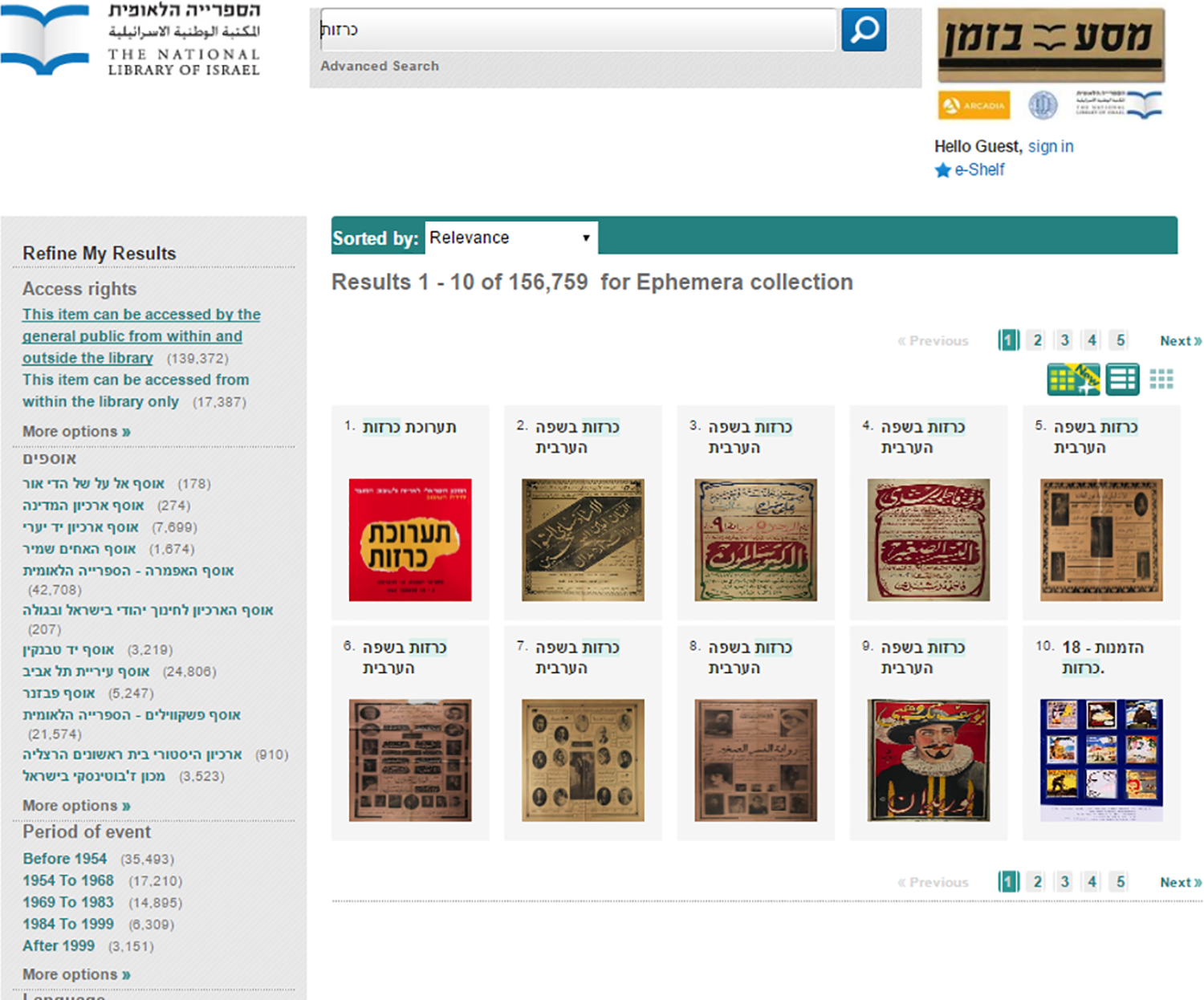
NLI, ‘Time Travel’, The Full Collection search page (accessed July 13, 2017).
At the left side of the ‘Search the Full Collection’ page, there is the option to ‘Refine My Results’ (Figure 1) by browsing the following categories: Access rights, Collections, Period of Event, Language, Designer, Publisher, Location, Tags, and Physical Attributes. The multiplicity of options appears to allow the users to narrow down the search options to get the desired results. However, clicking on ‘Collections’ and then on ‘More Options’ opens a box that includes only 12 of the 54 collections – those classified as ‘Partners’ of the ‘Time Travel’ project – and none of these are Arab. Thus, even though Arabic posters appear on the very first page of the search interface, it is at the same time challenging for the user to find these archival records using the search tools offered.
Terminology
In the context of this article, I use ‘terminology’ in reference to ‘how well the user can comprehend the terms and phrases used to describe functions or content within the interface, and the consistency of terms used and how logically they have been placed’ (Buchanan and Salako, 2009: 640). The ‘Time Travel’ website contains various pages. At the top of its home page, several tabs allow the user to transfer to pages such as ‘Our Partners’, ‘Collection Highlights’, ‘About the Project’, and ‘Contact Us’. Clicking on the ‘Collection Highlight’ tab transfers the user to an internal page that duplicates the list of categories of ephemeral items as they appear in the left sidebar: Army, Sports, Excursions, Holidays, Book Publishers, Culture, Economy, Election Propaganda, Made in Israel, and Authorities and Organizations. These same categories of the ‘Collection Highlight’ appear at the center of the page, organized alphabetically. The category ‘Arab society during the British Mandate’ is presented only on the Hebrew version of the page (see Figure 2).
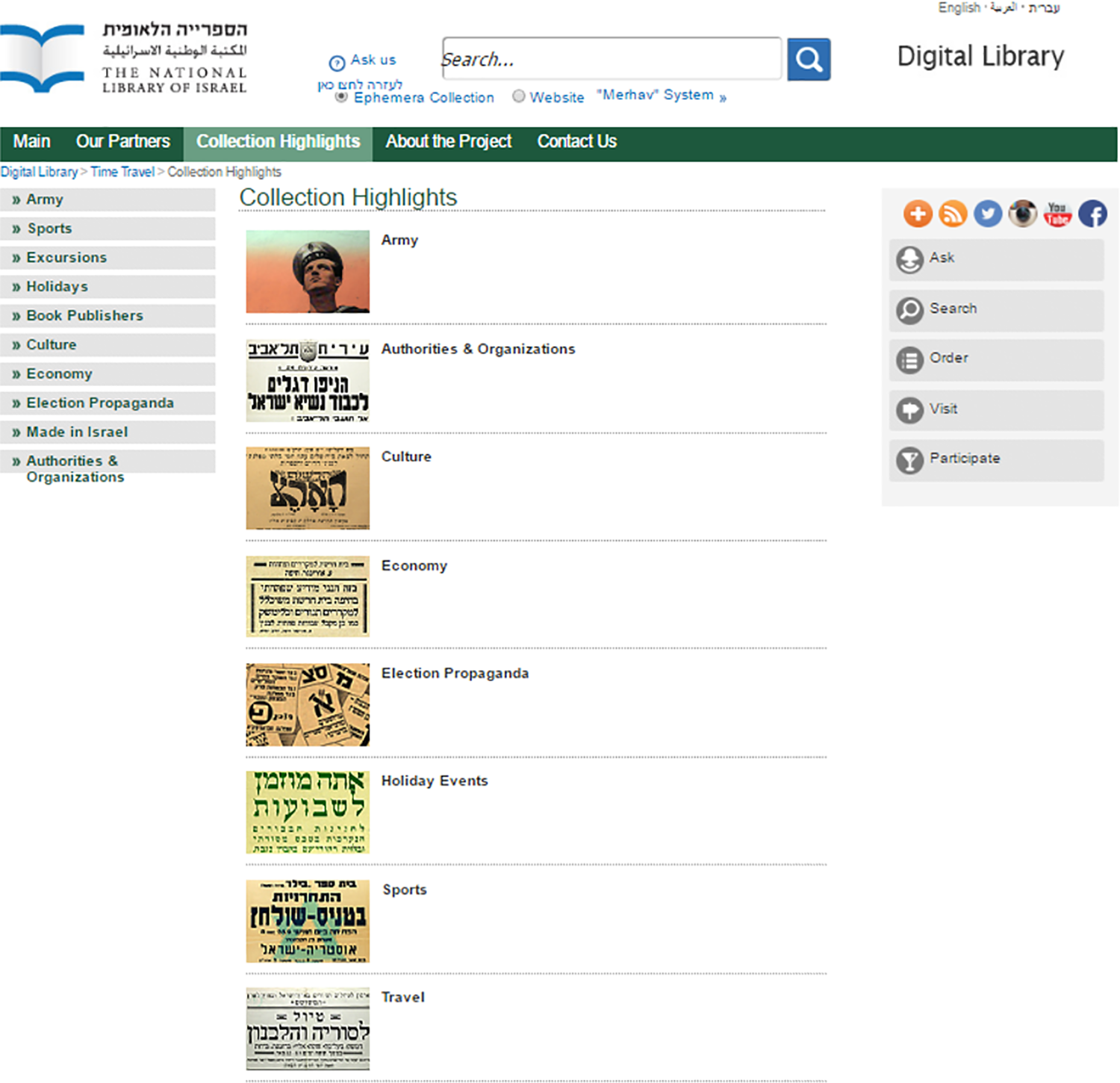
NLI, ‘Time Travel’, Collection Highlight (accessed July 13, 2017).
The first category both in Hebrew and English is ‘Army’. The centrality of the army in Israeli society and history is well known, and it is reinforced here by the category description, which begins with the following: ‘Military service features prominently in the Israeli experience. The IDF is a citizens’ army and serving in it is regarded as a rite of passage into mainstream Israeli society’. This both taps into and affirms the notion that military service is a common thread that unites Israeli society. Additionally, its position at the top of the page – even if earned only for alphabetical reasons – suggests its importance within Israel and excludes from Israeli identity the segments of the populace who do not participate.
Further heuristic analysis of the search interface for ‘The Full Collection’ revealed multiple technical errors that may impact the construction of historical narrative. The structure of the interface prioritizes the national-hegemonic culture at the expense of Arab-Israeli culture. While advanced searching options are available for the Hebrew language materials, prior knowledge is required to locate documents within the Arab collections. The small, difficult-to-search collection of Arabic holdings stands in contrast to the prominently displayed Arabic items on the initial search page, suggesting a gap between the reality of the archive’s contents and how the archivists would like their project to be perceived.
Metadata and ‘The Good Doers’
A simple definition of metadata is ‘information about information’ (Greenberg, 2005). Metadata plays an important role in maintaining the reliability and authenticity of records by documenting the contexts of their storage and use. ‘Recordkeeping and archival processes involve the continual capture and persistent linkage of these layers of metadata with the record object, and therefore have the potential in the electronic environment to be automated and integrated into business processes’ (Evans et al., 2005: 32).
There are different categories of metadata, including dates, locations, owners and keywords, labels, and ratings. The emergence of electronic records raised challenges for record-keeping practices, since the massive digitization of archival sources created a ‘databank of orphans’, having no documentation of their history and context (Sassoon, 2007). The NLI’s subproject ‘Osei he-chayil’ (‘The Good Doers’) was created to resolve this challenge.
‘The Good Doers’ subproject, which was developed under the larger ‘Time Travel’ umbrella, relies on new technology and wisdom of the crowd to produce the metadata for the digital ephemera collections. ‘The Good Doers’ website, launched in 2014, allows anyone interested to participate in ‘tasks’ and assist in identifying, describing, tagging, and classifying the ephemeral items. The NLI describes the effort: In this project, we are activating a crowdsourcing system for the first time, based on the assumption that there is such a large quantity of material that cataloging each item exceeds the processing capacity of our librarians and archivists. Large numbers of people who have specific knowledge about events, individuals, and places that appear in publications of project participants, can thus contribute information that is one-of-a-kind.
7
‘The Good Doers’ subproject was created in response to the Arcadia Foundation’s request that the NLI share the items with the public. This is how a member of the project team described its evolution: Originally, the entire project was based on crowdsourcing. It was the commitment to the fund, that it would be a project of mass crowdsourcing. We were committed to a very high share of the crowd. And it created a lot of problems, also because such a project requires prior-knowledge, and basically when we started to share the items we still did not have minimal cataloging of them. […] And, for crowdsourcing this task you need to create a community. It is not something that happens at one day; it is something that happens over time. We also had copyright problems: There are items that cannot be opened to the general public. We started thinking about solutions. […] So we looked for platforms, divided into teams, and found an open-source platform and started developing it with an external provider. Although there was a demand by the fund for mass participation, they did not tell us exactly how to do it; it was part of the agreement, but because they did not define how, it gave us an opportunity to do it as we believe it should be. (March, 2016)
The library staff controls the crowdsourced information in order to ensure that the platform is not misused, but this does not mean that all the work performed by volunteers is sound. One of the project team members noted that ‘anyone can enter and say that any old man is Ben-Gurion, so there may be tagging out there that is not Ben-Gurion and we have no idea about it’. The inaccurate tagging of sources in the databases may have dramatic implications, as it can affect the search engines retrieval of sources and mislead, confuse, or stymie researchers.
The crowdsourcing of metadata shifts responsibility from the library to the public. This transfer not only has implications for the quality of the information and its availability in the search engine but can also create gaps in the construction of the database. For example, as of July 2016, the Pashkevil Collection (wall posters hung in orthodox neighborhoods) had the highest percentage of tasks completed (approximately 97%) which means it will be more easily navigated than other collections.
‘The Good Doers’ subproject demonstrates how crowdsourcing can productively involve the public in the construction of a digital corpus. However, public participation may have implications for the reliability of the information collected, and for the way information is prioritized in searches. This trade-off – more productivity for potentially less accuracy – means that the choice to use public participation will affect the archive’s final form and thereby shape interpretations of the past.
Concluding comments
This study focused on the selection, search, and metadata of the NLI’s ‘Time Travel’ project, a partnership with UCLA funded by the Arcadia Foundation. The main objective of the project is to collect, scan, and facilitate general public access to Israeli ephemera while encouraging the audience to contribute information about the scanned items. The analysis shows how the collection of the project materials, their accessibility through the online search platform, and the crowdsourcing of their metadata each have the potential to shape historical interpretations, even before these archival records are ever seen by scholars or other memory agents.
Further, my research demonstrates how the wishes of the project’s funders directly impact the quantity, quality, and specific contents of the records included in it. The Arcadia Foundation’s desire to include Arab-Israeli resources differentiated the ‘Time Travel’ project from other projects at the NLI, and it also required the archivists to negotiate specific political challenges. These economic and political factors are not transparent to the archive users, although they play a significant role in framing future memory. My analysis demonstrates how the ‘Time Travel’ project reaffirms a national-hegemonic narrative even as it aims for inclusivity and multiculturalism.
By applying heuristic evaluations of usability, I examined how the interface of the digital repository prioritizes some archival materials at the expense of others. The choice to highlight some collections and search options rather than others directs users toward certain results and therefore toward certain understandings of the past. The search interface, then, serves as another mediator in the translation of the scanned materials into historical narratives.
Time Travel’s interface invites users to familiarize themselves with the archives through ‘Collection Highlights’ or through changing virtual exhibitions. These performances illustrate how the digital archive is becoming museum-like. Digital collections do not simply mirror analog ones but rather function as active cultural intermediaries in their own right. This conclusion aligns with studies that show how digital environments are blurring the definitions of archives, libraries, and museums. Although these institutions have followed distinct historical trajectories, they now appear to be converging (Marcum, 2014; Marty, 2009). While such studies have examined the growing physical convergence of organizations that preserve and present cultural heritage (Warren and Matthews, 2018), my analysis is specific to the digital, demonstrating how the online archive functions similarly to the museum. Projects like ‘Time Travel’ are aimed to reach the general public rather than the scholars who were the main users of the traditional archive. By curating materials and ephemera for digitization, soliciting public participation in the description and classification of materials, and creating a hierarchy in the way the different digital objects are presented, these projects actively shape interpretations of the past rather than simply facilitate access to it.
The final part of my analysis focused on ‘The Good Doers’ subproject’s use of public participation. This use of crowdsourcing comes with both risks (inaccurate records) and rewards (increased productivity). While the NLI conceptualizes such efforts as a way to engage the ‘general public’, it reached out to specific populations with the necessary knowledge, skills, and time to enrich the information about the collections. This raises the question regarding the imagined audience of the digital depository: Who is included in the definition of the ‘general public’? What are their professional, cultural, social, and class identities, and how might these identities shape the archive’s portrayal of history?
Ultimately, this analysis of the NLI’s ‘Time Travel’ collection sheds light on the political, cultural, and religious tensions that simmer beneath the surface of the database. By investigating the selection of materials, the search interface, the default modes of retrieval, and ‘The Good Doers’ crowdsourcing platform, my research suggests that the NLI assembled a largely Jewish narrative for a largely Jewish audience while excluding other possible approaches.
The case of preserving, digitizing, and making ephemera accessible reveals the political aspects of any archival collection. While ephemera such as bus tickets, brochure, and others were collected in order to represent everyday life, the question remains as to who actively preserved these kinds of materials (systematically), if they were not meant to be preserved. In other words, it might be that marginalized cultures are not making the effort of preserving documentations, and as a result, it is impossible to digitize what was not preserved in the first place.
Though the foundation sponsoring the project required that the materials reflect all the cultures of Israel, there is a significant imbalance in the collection’s portrayal of the country’s culture and history. The ‘Time Travel’ project serves as an example of how a digital collection can begin with the best of intentions but ends with reinforcing sociopolitical tensions. The archive’s distinct components of the project combined to contribute to the cultural marginalization of groups outside of the Jewish majority.
Footnotes
Acknowledgements
This article draws on my Ph.D. thesis, supervised by Dr, Rivka Ribak and Prof. Na'ama Sheffi. I would like to thank them for their dedicated mentorship, insightful comments, and assistance in this research project. I would also like to thank the anonymous reviewers, who critically read the manuscript and suggested substantial improvements.
