



Abstract
Digital Voice Assistants (DVAs) like Google Home provide automated news, media and other content directly into the home. In this article, we outline how Google Home’s content delivery can support the wellbeing and independence of older people. We argue that automated media provided by DVAs enrols older people in a dialectic relationship with the automated content and feminised conversation they deliver, uniquely performed within people’s own everyday life circumstances. We demonstrate this by drawing on ethnographic insights generated during a trial of smart home technologies with older Australian households who are ‘ageing in place’ in regional New South Wales. For most participants, the trial was their first encounter with DVAs and the modes of media and content delivery including for music, news, weather, trivia, jokes, facts and images. While DVAs bring new experiences via content, communication and companionship, they are also subverted, ignored or transformed as people improvise to make them ‘fit’ within their homes and lives. These dynamics underpin how DVAs, automated content delivery and user’s interactions can support people’s sense of wellness and their independent daily practices at home.
Keywords
Introduction
In this article, we discuss how older people (75+) learn to live with Digital Voice Assistants (DVAs) like Google Home, the automated content delivery and feminised personalities delivered directly into their homes by these devices. We argue that engaging with these technologies can generate new everyday modes of wellbeing and independence beyond traditional health outcomes. We emphasise that these benefits are neither the outcomes of technological solutions and people’s straightforward adoption and acceptance of them, nor are they driven purely by people’s individual choices and needs. Rather they emerge from the small shifts in the media ecologies and routines of the home that come about through the culturally specific, socially, materially and sensorially situated engagements of people (and other species) with these agents and their automated decision-making capabilities. Our research demonstrates the importance of attending to the continuous processes through which voice assistants and other smart home technologies become generative and often playful elements in older people’s lives, and of accounting for these in technology and policy design. We also advance an interdisciplinary approach to media studies to create a dialogue between existing engagements with media phenomenology, digital anthropology and digital sociology on the one hand. And on the other, design anthropological attention to the detail of the emergent relations between people, technologies and everyday environments, in which design is seen as an everyday practice.
DVAs and their algorithms have been extensively researched to understand how they affect interactions between their users (Sciuto et al., 2018), perpetuate gendered and racial stereotypes (Noble, 2018; Phan, 2019; Strengers and Kennedy, 2020) or facilitate new socio-technical experiences or relationships (Cho et al., 2019). Building on this work, we ask how Google’s algorithms and automated decisions impact longer term processes involving people’s experience, interactions and relationships with these devices. We found several distinctive DVA features of particular interest. First, unlike other automated content delivery services, such as social media feeds, smartphone push notifications, or on-demand television subscriptions, DVAs must typically be asked to initiate content delivery. If the request is vague, the assistant is unlikely to suitably respond. Therefore, people’s requests play a significant role in determining what automated content they receive. Second, DVAs automated responses simulate conversation with a human-like ‘agent’ providing specific answers to questions. This experience is distinct from simply engaging with a text-based search engine to receive a list of automated links. Third, and most uniquely, DVAs engage users through linguistically and conversationally performed personality traits that mimic and reproduce human qualities and mannerisms. These include gender (typically feminine), a Western cultural orientation, regional and country-specific accents and language options, humour, and certain turns of phrase that cannot be easily changed.
In this article, we explore these forms of automation as central to voice assistant design and operation. We draw on a trial of smart home technologies with older Australians in New England, a regional area of New South Wales with sometimes limited access to basic services. Internet access has improved since the rollout of the National Broadband Network (NBN), but reliability disparities still remain. Specifically, our analysis focuses on three types of automation facilitated by the DVAs trialed: conversational responses; content delivery; and personality and gender traits. In discussing these, we reflect on how these devices shaped the conversation and modes of interaction between participants and DVAs; how participants improvised to shape their interactions with and uses of these devices in relation to their automated characteristics; and how automation repositioned participants’ relationships with the DVAs by being presented as a human-like agent.
As an understudied and undervalued group of people in relation to technology, older people’s relationships with the automated characteristics of the trialed DVAs reveal new insights concerning the improvisatory modes through which these technologies become part of the home. More broadly, they demonstrate the complexities of the relationship between the dominant and opposing narratives of automated manipulation and personal choice. Concurrently, our research provides new understandings of wellbeing in relation to assisted living in the smart home, demonstrating how older people learn new ways to both garner support from, and have fun with, the automated features of such smart home devices. We conclude that wellbeing with DVAs is contingent on this interplay between automation and personal engagements, which provides new opportunities for experimentation, exploration and experiences that enhance seniors’ lives.
Approaching older people and smart home devices
To date, little research exists into the broader wellbeing or lifestyle impacts of smart technologies, or knowledge about older adults’ experiences with DVAs (Sayago et al., 2019; Sunyoung, 2021). Older people are generally less likely to self-select for smart technology trials or have them in their homes, especially older people living in rural and regional areas.
Much of the research relating to older people and smart home technologies has been undertaken within technologically determinist and solutionist frameworks. For instance, in applied work in non-academic settings by independent organisations (e.g. Local Government Association, 2018), older people’s use of smart home technologies is considered within a narrative of innovation, which sees smart technology as supporting older people while cutting costs for service providers. The majority of systematic reviews about older people and smart technologies focus on categories such as levels of technology acceptance, barriers to adoption and user attitudes towards different technological interventions (for example, see Liu et al., 2016; Demiris and Hensel, 2008; Pal, 2017). Such approaches have been criticised in sociological work on ageing, for not adequately considering how technologies are (or are not) variously adapted and integrated into everyday life (Gibson et al., 2019); overlooking potentially negative impacts of technologies which may alter or displace existing, beneficial practices (Bailey et al., 2011); and for presenting overly optimistic views of technological interventions, as a panacea to diverse health and care challenges (López Gómez, 2015). Instead researchers have argued that older people’s technology acceptance largely depends on the specificity of their ‘personal, social, and physical context’, rather than the technology itself (Peek et al., 2016: 235), and is related to practical, personal and ethical issues (Doyle et al., 2014; Mort et al., 2013; Rosenberg et al., 2012; Neves and Vetere, 2019).
From a positive psychology and Human Computer Interaction (HCI) perspective, Wiese et al. (2019) argue that technology design and ‘[p]roducts’ contribute to wellbeing via their potential to support well-being enhancing activities rather than in their material value’ (2019: 85) and in ‘supporting or enabling positive and meaningful activities’ (2019: 86). Indeed, HCI researchers have begun to call for a reconfiguration of ‘the older technology user as an active agent, belonging to a diverse cohort rich in experience’ rather than presenting ‘ageing as a “problem” that can be managed by technologies’ (Vines et al., 2015: 3). More specifically, Vines et al. (2015: 2) call for a departure from the situation they uncovered in a 2015 review of three decades of research, which revealed that ‘older users’ were characterised as experiencing ‘health concerns’, ‘physical and cognitive decline’, ‘social isolation and a loss of independence’ and being ‘slow at performing with technology’ (Vines et al., 2015: 2). Pradhan et al. (2020: 3) concur that ‘much of the literature still associates older adults with being slower, more anxious and less competent with technology than younger populations’. The implication is that older people are typically approached from a deficit perspective, where the aim is to help them ‘catch up’ with more competent technology users, or adopt new technology to address specific health and cognitive problems, whilst overlooking the broader engagements that are possible with emerging smart technologies.
More recently, Sunyoung has stressed that ‘little is known about how older adults perceive and respond to the idea of talking to a device that does not have a graphical user interface’ (2021: 2). Sunyoung and other researchers have also noted that shifts towards spoken interactions require adjustments in ‘conversational’ styles (Sunyoung, 2021), and learning new media languages (Gershon, 2017; Pradhan et al., 2019; Terzopoulos and Satratzemi 2020). Despite this progress in understanding how older people relate to, and learn with, conversational devices, other everyday life questions with this cohort have been overlooked. In particular, there is little knowledge concerning how older people might engage with smart devices and automated media content without utilitarian objectives for directed (commonly health related) outcomes; or how they might engage with automated media content for fun, new experiences, or to explore technology serendipitously.
By engaging and extending a design anthropological framework, we take a process-focused approach to account the embeddedness of DVAs in the everyday lives and routines of seniors. We focus on first impressions, processes of learning and continual experimentation, as incrementally constituting ‘smart’ mediated routines which can generate and support forms of wellbeing and diversify care services for older people living independently. Research informed by design anthropology demonstrates that people of all ages tend to improvise with media devices and content in ways that constitute environments or atmospheres of home that ‘feel right’ for them (Pink and Leder Mackley, 2013; Pink et al., 2015). Non-media-centric media phenomenology (e.g. Couldry and Markham, 2008; Couldry, 2012; Moores, 2012) has also advanced towards a focus on the experiential and improvisatory dimensions of how people engage with the digital in everyday life (Markham, 2020).
Attention to how people engage new devices within their own lives and environments also resonates in healthcare technology research, which emphasises how the successful integration of healthcare technologies into everyday life depends on diverse forms of social and material practices, accommodations and changes, which have been called ‘little arrangements’ (Langstrup, 2013; López Gómez, 2015: 91). Healthcare technologies configure moreover with and within existing infrastructures such as electricity, internet networks and mundane technologies including telephones, cupboards and televisions (Langstrup, 2013; Astell et al., 2014). Gibson and colleagues have used the concept of bricolage to account for the ways in which people use non-conventional tools or methods to adapt old and new technologies to their own everyday health needs and preferences (Gibson et al., 2013). Beyond healthcare, studies of smart home technologies originating from the social sciences and HCI emphasise how people seek ‘small conveniences’ (Strengers et al., 2019), ‘aesthetic pleasures’ (Strengers and Nicholls, 2018), greater control over their routines and lives (Hargreaves and Wilson, 2017), a more modern lifestyle (Mennicken and Huang, 2012), experimentation, tinkering and ‘hacking’ opportunities (Mennicken and Huang, 2012; Rode and Poole, 2018; Strengers and Nicholls, 2018) or ‘protection, productivity and pleasure’ (Strengers et al., 2019).
Recent ethnographic research into how digital and emerging technologies become part of everyday life emphasises the value of attention to both how people live, learn and know with new devices, and the importance of attending to how these devices become meaningful in their everyday life contexts. For example, Fors et al. (2020) combined a learning and knowing approach with design anthropology theory to analyse how participants engaged with self-tracking technologies through everyday innovation. They found people who continued using these devices longer term did so because the devices had meaning within the detail and structuring of everyday routines, and also offered them ways of knowing and learning about themselves within the specificities of their social, material and digital environments. In such research, knowing and learning are understood as ongoing incremental processes, drawing on phenomenological anthropology (e.g. Ingold, 2000). This perspective recognises that older people’s homes and lives are not simple landing sites into which technologies are accepted, but rather sites for learning and knowing with smart devices. They entail dynamic ecologies of home where people, technologies, other species and the diverse materialities of life come together and where older people come to learn and know with and through their own collaborations and innovations with technologies, as the remainder of this article shows.
Methodology and participants
Our ethnographic research was undertaken as part of a smart home technology trial, developed as a partnership between an aged care provider McLean Care and two universities (Monash and Deakin), and funded through a grant provided by the Australian Government’s Department of Health. The project was approved by both universities’ human ethics committees. McLean Care recruited client households in Inverell, Tamworth and Gunnedah, located at the Jukumbal, Kamilaroi/Gomeroi Indigenous Nations. To better observe older participants’ experiences with trial technologies, only participants not living full time with anyone under the age of 65 were included.
A total of 19 women and 14 men aged 75–93 years across 23 households participated in the research (real names and pseudonyms are used throughout this article according to participants’ preferences). Most households were homeowners, living on the age pension. Nine participants were sole occupants (seven women, two men); eleven lived with their partner, two lived occasionally with children/grandchildren. Pets were important companions and often interacted with the technologies installed. In terms of technology use, most used phone calls to connect with children and grandchildren, including those not living locally. A few used basic functions of smartphones given by family members, and generally kept updated on local news with radios and TVs, used too for entertainment and music.
The project team selected off-the-shelf, commercially available devices (mixed brands), easily retrofittable to, and removable from, participants’ homes. Google Home was selected as the digital voice assistant for the study because it was the market leading voice assistant in Australia at the time of the research. To ensure consistency, availability of stock also influenced the final selection, and mobile internet modems were provided to each participant household. Device selection was tailored for each household, with ongoing personalised technical support (provided by McLean Care), collection of device usage data (conducted by the Deakin team) and ethnographic research (conducted by the authors) to understand participants’ experiences, hopes and anxieties with the technologies. All costs were covered by project funding (no cost to participants) and the research was not sponsored by, or designed to promote, any technology companies. Each household received two $50 gift vouchers to thank them for their involvement in each stage of ethnographic research.
As part of the broader suite of smart home technologies trialled (including robotic vacuum cleaners; and smart lights, fans, kettles and motion sensors), 70 Google DVAs were installed (each household had one large Google Home speaker and 2-3 Google Mini speakers). Three months into the trial, 12 Google Nest Hub Max tablets were added at 12 homes to diversify participants’ media choices, and to support them to ‘stay at home’ during the COVID-19 pandemic.
One to 2 weeks after the initial installation, the first, in-home research visit was conducted alongside researcher Michael Mortimer undertaking a technical review of the trial devices. First visits lasted 90 minutes to 3 hours (dependent on technical work required) and were followed by a team debrief to generate initial ethnographic hunches (Pink, 2021) and ground-up analytical themes to further structure the research. Eight weeks later, we spoke with participants on the phone (10–20 minutes) to see how they were going with the technologies. Four months after first visits, final 30–60 minute interviews were conducted remotely (due to COVID-19), mostly using iPhone’s Facetime app or the Google Nest Hub Max tablet/Duo app, but also by telephone for a few households (see Figures 2, 5, 6). Eight households withdrew from the wider study, including due to internet and power outages (common in these regional locations), which compromised trial device functionality and technical support capability. Participants also withdrew due to financial, health and/or privacy concerns, or dissatisfaction with the home space taken up by the devices.
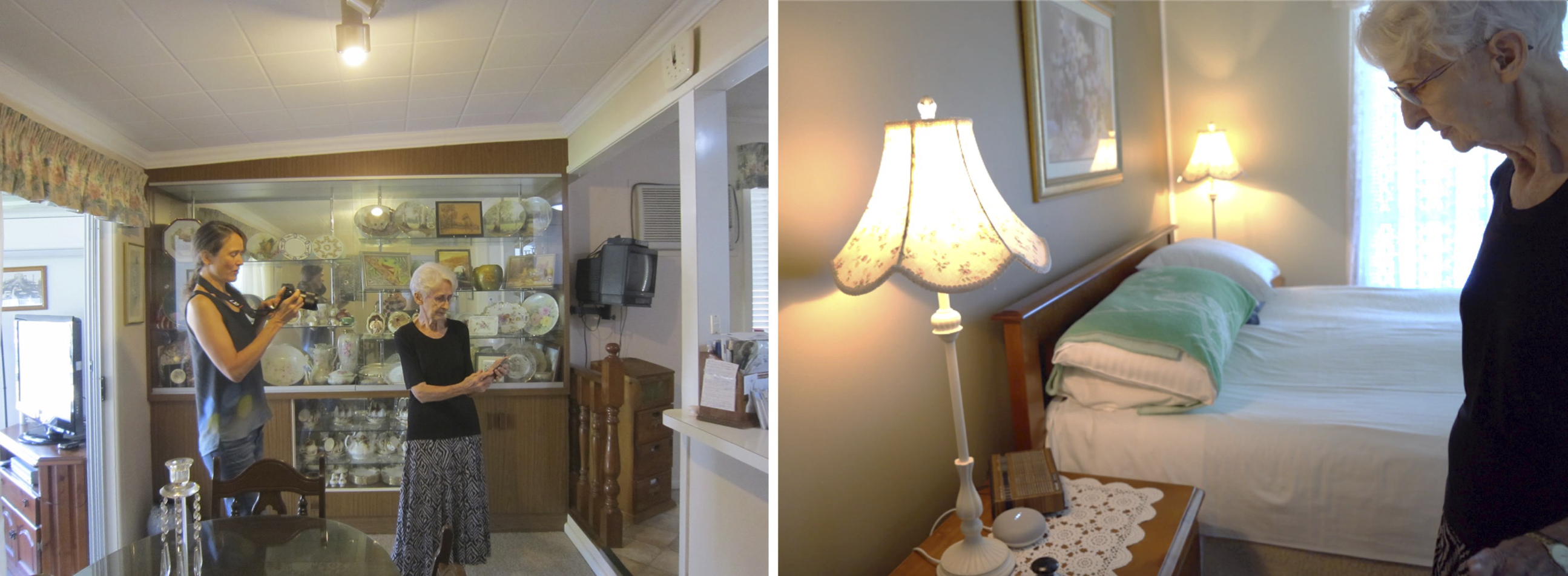
Sarah and Melisa (behind camera) home touring and experimenting with technologies with Beryl.
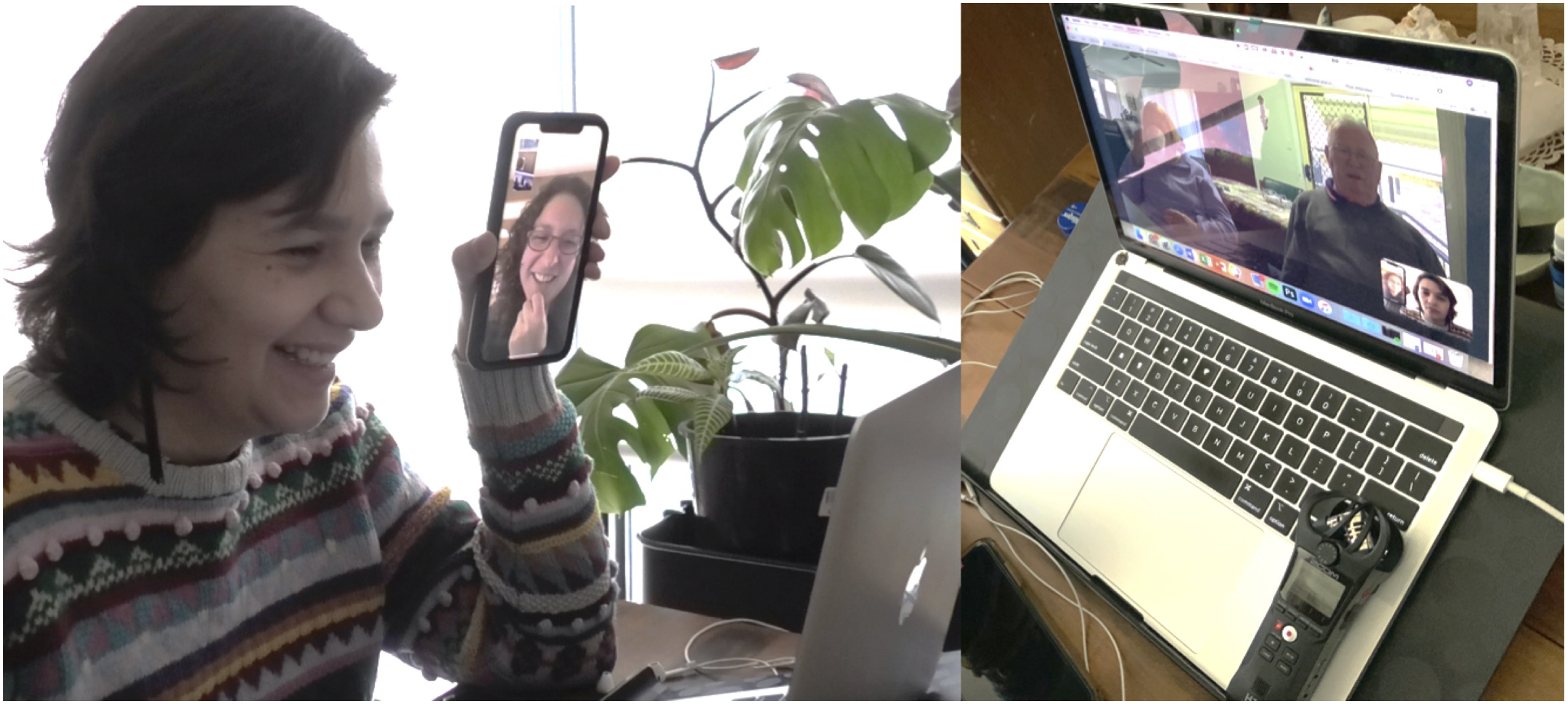
Yolande (on smartphone) and Melisa improvising approaches for the video group calls to make up for Google Duo’s limitations of that function at the time, with Helen and Ken.
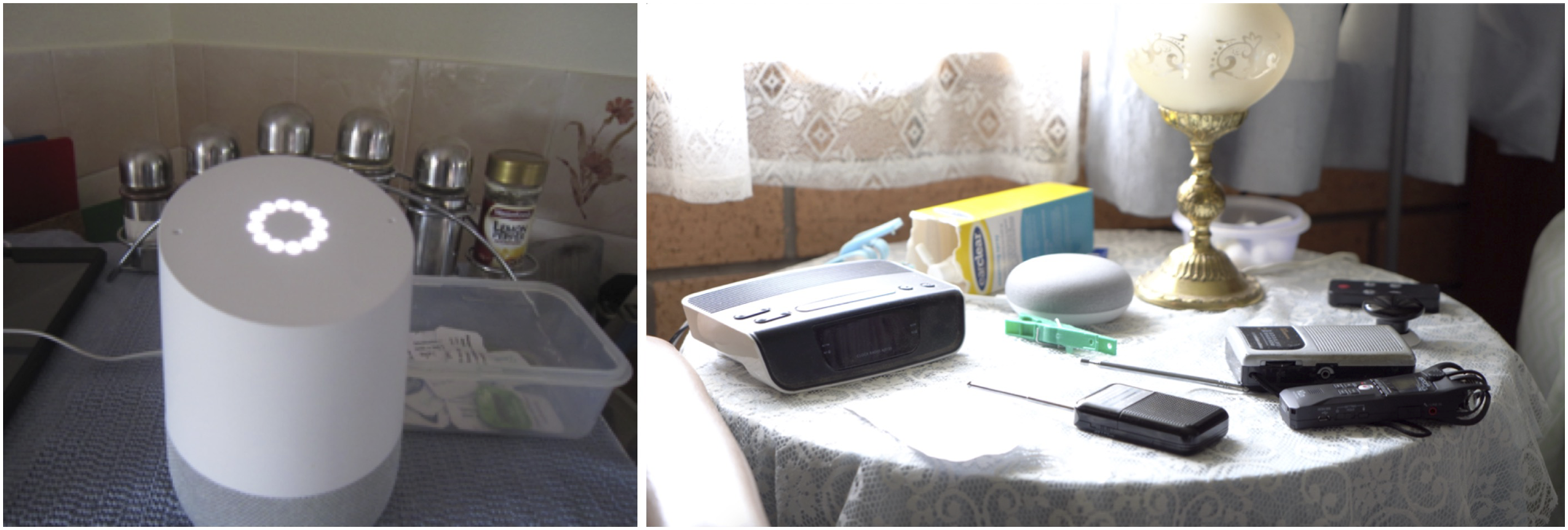
DVAs joining home materialities and media ecologies. Google Home (left) seen here sitting at the top of the microwave with cooking spices and the tea bags container. Google Mini (right) sharing bedside table with three radios, medications and lamp.
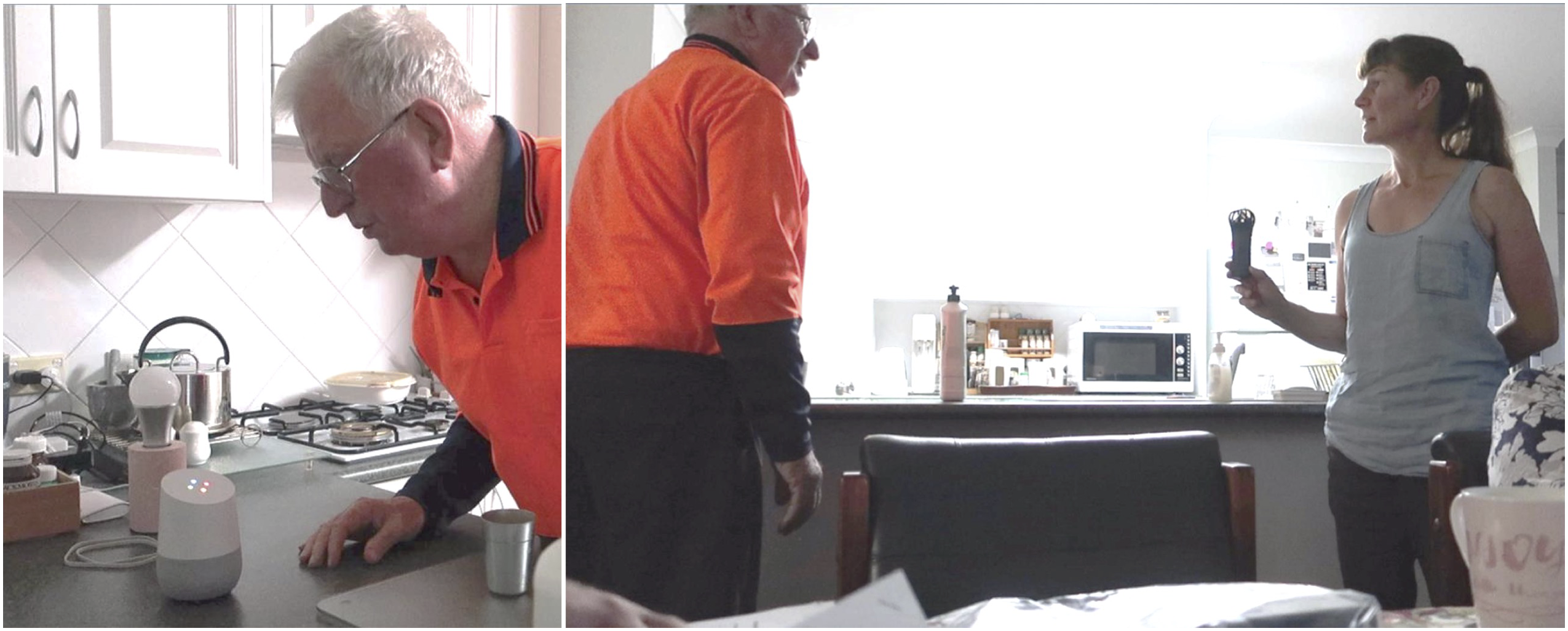
Ken demonstrating to Larissa and Melisa (behind camera) how he and Helen had explored what the automated responses of the DVAs were when asked, ‘Hey Google, do you listen to our conversations?’
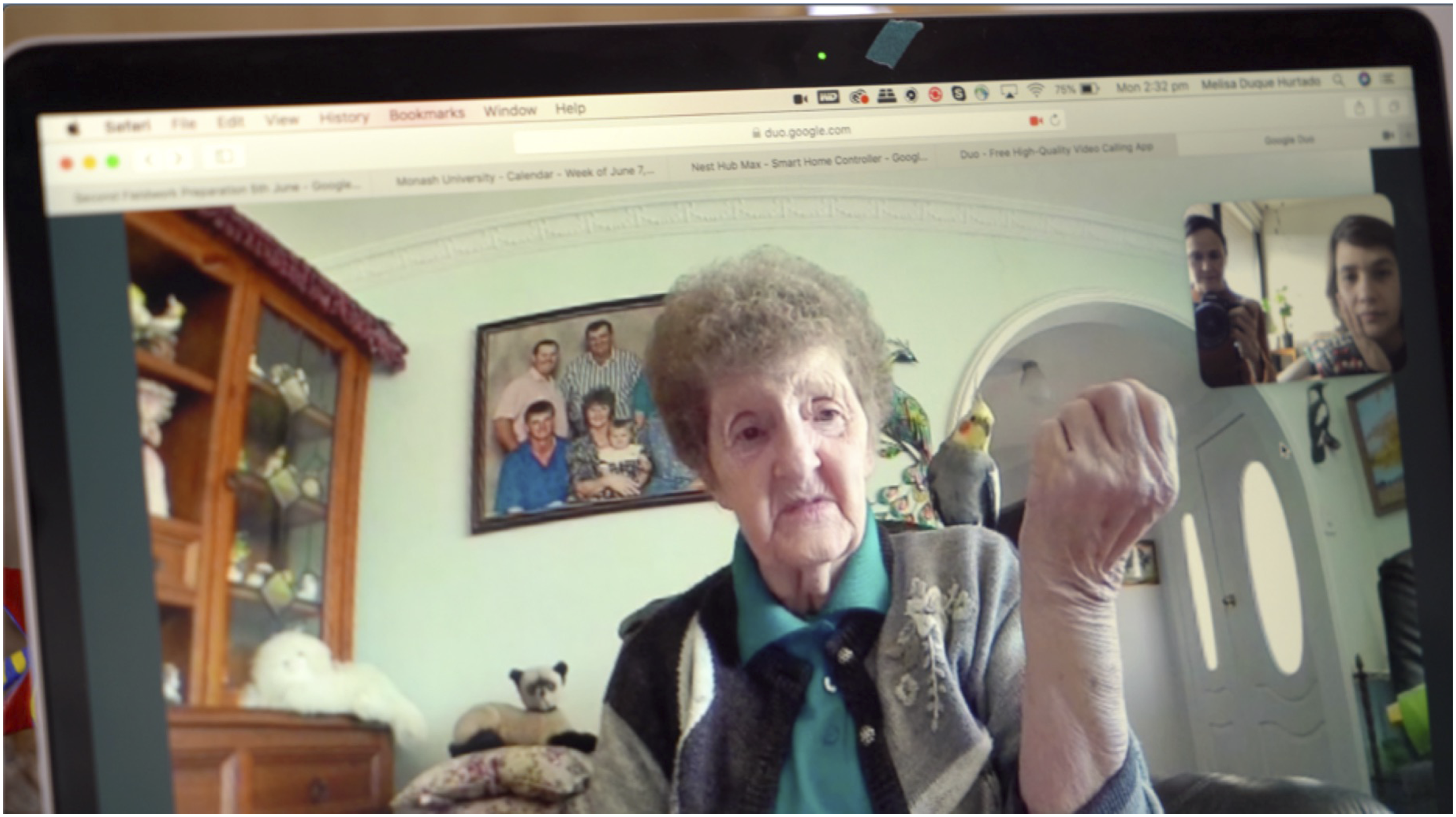
Edna and Cheeky (the bird on her shoulder) on video call with the research team, explaining that after the trial she would miss the tablet-derived access to music and ‘facetimes’ with her family (all participants were subsequently offered continuing free access to the technologies post-trial).
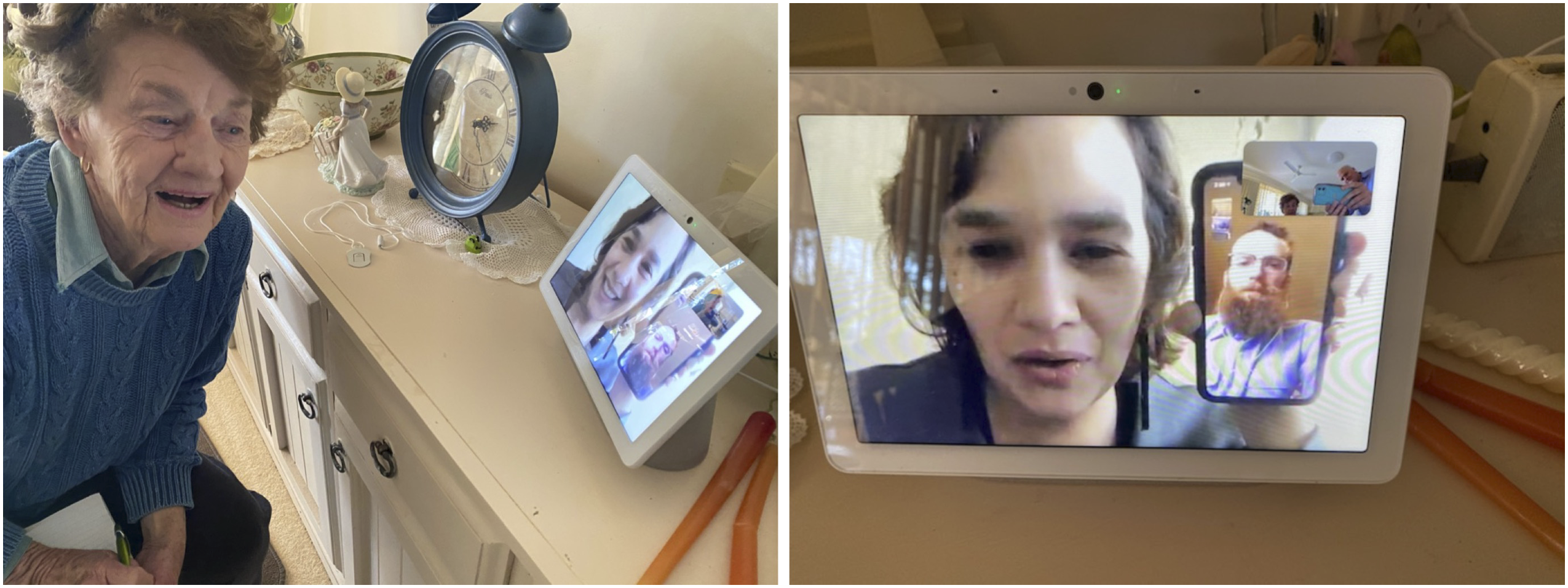
Ann (on the left), during video call via the DVA tablet located on the dining drawer. Both photos were taken by Ross, the project technician, who helped to set up this first video call with Ann. Here the functions of video calling offered by the device (and the lack of group call at the time), had to be supported by social, technical and improvised measures (e.g. including Rex via Melisa’s smartphone).
The face-to-face fieldwork followed a team ethnography approach (Pink, 2021) shared by four ethnographers working in pairs. This involved an established ‘short term ethnography’ approach whereby the researchers’ immersion in the everyday lives, environments and experiences of the participants is intensive and collaborative (Pink & Morgan, 2013). Rather than waiting to observe life unfold over time, short term ethnography involves the ethnographer intentionally exploring and sharing aspects of participants’ lives and experiences with them, verbally and performatively. This collaborative and participatory mode of doing ethnography is necessarily short term since the intensity of the engagement and learning that the ethnographer develops could not be sustained over time, and the modes of ethnographic knowing it generates are deep and rich. Collaboration with participants underpins the ethics of the approach and involves ongoing dialogue and approval of the outputs of the research. Ongoing ties were maintained with some households who were interested in the video materials we produced with them, or who agreed to feature in our documentary Smart Homes for Seniors.
If participants consented, we video and audio recorded interviews and home tours (Pink and Leder Mackley, 2014) (see Figure 1). The video materials provided an audio-visual account of the performative research encounters and with reference to our interest in this article, the devices participants used, their spatial distribution, participants modes of accessing content with them, and the affective and sensory dimensions of these everyday activities. In partnership with the project team, we also developed responsive everyday design interventions (Duque et al., 2019) with participants as they demonstrated and experimented with smart technologies. For example, we explored how to use the commands to access participants’ favourite music genres and groups, trivia, jokes, local news, or ask questions about topics ranging from the gender of Google to what the weather was like that day. In doing so we shared first impressions in the communication and content accessibility, which led to instances of ‘incorporating mistakes’ (Sunyoung, 2021: 8) into the ethnographic encounters. These interactions enabled the researchers to experience first-hand the surprise, confusion, joy and frustration that participants expressed, and engage empathetically with their journeys of learning with the smart devices.
Locating DVAs in the home
Existing research shows that devices that deliver media content – from analogue to digital to smart devices – become part of the spatiality, sociality and routines of everyday life in the home as they are performed at different moments of the day and in particular rooms (Couldry and Markham, 2008; Moores, 2012; Pink and Leder Mackley, 2013). Likewise, research has shown that voice assistants are aligned with the spatial and activity-based ways people live in their homes. For instance, Sciuto et al. (2018) found the Alexa voice assistant tended to be used for specific goal-based activities in kitchens and bedrooms, while it was used in more open-ended ways in living and other shared areas. The location of DVA devices in participants’ homes was based on recommendations and suggestions from the technical team, in collaboration with participant choices. Resonating with the research cited above, most participants used the devices to access media content and information within specific everyday routines, and in relation to other spatially oriented functionalities of the devices, as follows.
The DVA devices were mainly located in common areas of the house: kitchen, living and dining rooms. Participants used them mostly during the day to access music, news or recipes as well as experimentally in social contexts to access jokes, trivia, or factual information. These devices were also used to activate other smart home devices including smart lights, fans, the kettle and vacuum as part of the broader trial. Google Mini was usually kept in bedrooms where it became part of morning routines involving, for instance, asking for the time, weather and national news, as well as to turn on bedroom and bathroom lights at night (see Figure 3).
The Google Nest Hub Max tablet tended to be kept on kitchen benches, or dining and living room tables, where participants spent much of their time during the day. They enabled participants to access media content in audio-visual formats, including video world news, video entertainment and music, screen-saving photographs, and in some cases, they also enabled video calls to family during COVID-19 restrictions. Two participants had previous experience with Siri and said they applied ‘the same method’ when using Google. Nevertheless, this was the first time that all participants had used DVAs to access media content or activate other smart devices in their homes. These first encounters simultaneously involved participants in new sensorial experiences of and in the intimate spaces, routines and relationships of home with themselves, with their families, the research team and with others during the COVID-19 pandemic.
In the following sections we outline how participants experienced DVAs, accessed automated audio and audio-visual content, and how these became part of the affective and social relations of home.
Conversational responses: Getting to know (with) voice assistants
Our ethnographic analysis focuses on how participants experienced their encounters with DVAs; therefore, our interest in their conversations is phenomenological rather than semiotic. Participants’ first encounters with the DVAs involved a series of learning steps. First, they discovered that their interactions would be spoken rather than the visual, textual or tactile experiences that most tended to associate with any existing Google functions on their computers, phones and/or tablets. The initial move from the written to spoken (Soffer, 2020) involved conceptual and practical shifts in participants’ understanding of the technology, including learning to speak ‘a different language’ (as they sometimes put it), and the novelty of the device speaking in response to their requests. Learning that the Google agent speaking with them was the same as the one that responded to a typed ‘Google’ request was simultaneously baffling and fascinating. Google’s spoken presence often raised participant concern about being listened to and potential loss of privacy (as attentioned in Godwin, 2012; Peek et al., 2014; Pal et al., 2017). These concerns were often expressed as discomfort with Google’s ‘ears’ listening to their conversations like ‘Big Brother’ and sparked some exploratory questions, such as asking Google whether it was listening (see Figure 4).
Early learning steps also involved memorising correct phrasing for commands including ‘Hey Google’ to activate the assistant, and the names of other connected devices (e.g. ‘Hey Google, turn on Light 1’). Participants had to learn ‘disciplined’ (Soffer, 2020: 928), ‘command based’ (Noble, 2018) speech (Pradhan et al., 2020; Sunyoung, 2021), including when to pause; for example, saying ‘Hey Google’, then pausing before articulating their command. Without this fraction of silence, Google either failed to activate, or informed the participant that it could not understand, which required them to try again. Testing of commands, phrases and timings gave participants opportunities to practice, but generated some frustrations. Experiencing the barriers and limitations of these spoken dynamics grounded their initial wonder.
This process of getting to know what was (or was not) possible, and how to interact with an automated device, was facilitated by the frequent disruptions that ‘broke’ the continuity of the ‘conversation’. Following the findings of Pradhan et al. (2019: 10), after seeing the device as ‘providing social interaction when it was responsive and engaging in small talk, it reverted to an object when it did not provide these forms of interaction’. These moments of ‘brokenness’ became problematic when participants took the blame for intrinsic technological inadequacies, with statements such as ‘I’m not a technology person’. Despite attributing difficulties with Google to their own limitations, participants often persisted when they were ready and on their own terms. Substantial time at home, and having the DVA devices located in many rooms, facilitated this ongoing learning. Participants often explained their persistence as a desire to learn, a commitment to the trial, or a time filler leading to getting the interactions ‘right’. With time, successful interactions boosted their self-confidence, and made the range of possibilities with the DVAs explicit. This led participants to experiment further, as illustrated by Beryl: Of a morning, when we wake up I quite often say ‘Good morning Google’ and she says good morning, and what time it is, and the weather, the news, yes, yes. I don't every morning, because if David’s asleep ... [I] don't disturb [him]... I did get reprimanded earlier in the piece, the first morning. Ross [project technician] ... said ‘ask G [Google] for... the time and the weather and all that’. So, I asked individually the first morning, and she said, ‘you know, you would save us a lot of time if you just said ‘good morning’, and she said ‘I'll tell you all of it, it’s a spiel’... It was funny. Oh, yes, make light of things.
Beryl’s account of accessing media content within her morning routines, illustrates her process of learning how ‘words are not intended to form a narrative. In fact, in the case of voice queries, narrative can lessen the effectiveness of the search’ (Soffer, 2020: 938). Beryl’s account also shows how the DVA’s sensitivity to responding to ‘Google’ as a wake command led participants to creatively invent and use new code words (e.g. ‘G’) to refer to the device without unintentionally inviting it into the conversation. Besides the voice manners and the interactivity protocols with the device, this example demonstrates how Google needs to adapt to the household’s sleeping etiquette and routines.
Being able to ask the DVAs for media content at any time was a significant shift from seniors’ previous technology interactions, with, for instance, the computer (Sayago et al., 2019). It presented new possibilities for comfort, entertainment and day planning. As Soffer also notes: ‘In the television and radio era, a user’s exposure to content relied on the sender, making knowledge acquirement coincidental. Voice queries, however, allow a much more targeted exposure, one that depends on an active search’ (2020: 932). For instance, when depending on the weather forecast given in the ‘good morning’ sequence of information, some participants would reschedule their plans to wash clothes, garden or go out. Although their plans were often previously informed by other media devices (TV or radio), DVAs offered immediate access to specific information rather than waiting for a scheduled news or weather segment. The sense of agency in asking for rather than waiting for information supported wellbeing by allowing participants to filter unwanted media stimuli and receive desired information more efficiently.
Content delivery: Locating automated content retrieval in the routines and spatiality of the home
The introduction of the DVA tablet provided visual alternatives to spoken and sonic media via Home and Mini DVA speakers. The COVID-19 pandemic limited outdoor and social activities, particularly for older people ‘self-isolating’. Although most participants were used to long periods at home, the DVA tablet became both a source of news and entertainment, and an important tool for social and family connection (e.g. enabling video chats instead of relying on phone calls only). Helen and Ken used the tablet to enjoy music and images of nature as ‘background’ to other activities. Easy access to music also helped Helen manage chronic pain, ‘The music sort of helps relieve [the pain] to some extent. It’s better than painkillers sometimes. It makes you sleepy’. Helen and Ken described how they selected different music, soundscapes and visuals depending on their experimental mood. In addition to pain relief, the couple experienced subtler ‘aesthetic pleasures’ (Strengers and Nicholls, 2018) that manifested as a sense of contentment and new sensory pleasures, for example, when the automated media generated a series of memorable bird singalongs between the tablet and birds at their window, as the following exchange between this couple illustrates. Ken: Sometimes, just switch it [the DVA tablet] on and ask for a video of bird calls… it just leaves the birds fluttering about and twittering there [on the screen] for ages, you know, and they’re not caged. They’re just in the open, you know, on the planes or mountains or whatever. And then they go to the waterfalls and on certain bridges. Beautiful scenery… we do that while Helen’s working. If she’s cleaning the lounges, she puts on some classical music or the birds or jazz. She loves jazz too. And so it makes the day go quick. Helen: We don’t know whether it was a coincidence but we had that [DVA tablet] with the birds playing and there was a willy wagtail came in underneath our awning out the back there and he twittered away like anything... They’ve got some birds [next door], and when the house is open in the summertime and you play that sort of thing, you can hear them singing. Ken: They start to sing along with [the birds from the DVA].
Living alone, Ann explored the content available on the DVA tablet to pass time and entertain herself, ‘Especially when I was in lockdown all the time. I was mucking around with it… it was good to have something to do and keep me busy’. She found an enjoyable selection of funny videos, providing much-needed humour while the printed collection of jokes normally on display at her gym’s wellness centre were unavailable due to COVID-19 infection risk. Unexpectedly finding funny dog videos on the tablet provided Ann with a sense of wellbeing in a few ways. It was a chance to gain confidence with this kind of automated technology and diversify beyond her other media technologies and their content. Besides the television and radios she used to access local stations, she now scrolled through the tablet for content. Without a clear plan or expectation of what to look for, Ann experienced a novelty ‘event’ (Soffer, 2020) that she shared and enjoyed with her pet bird, Buddy. Moreover, associating the humourous dog videos with her gym routines prompted her to experiment with the tablet to find other health-oriented media to maintain fitness routines at home while the gym was closed. When Rex asked Ann specifically about the way in which this automated interaction and content delivery happened (for example, if she explicitly requested it, if it was presented as a choice, or given at random) she explained it as a contingent combination: I just found this thing and it said ‘comic pictures’ or something… there’s different ones and we got the dogs on and Buddy was sitting on my shoulder and in the end he and I were both laughing at these dogs and cats sometimes, but I’m a dog person.
When the tablet was not being actively used to stream requested videos or deliver other specific functions, it displayed an automated and randomised selection of screensaver photographs, a highlight for participants who admired the quality and wide range of images, and the way the images allowed them to ‘travel’ from within the comfort of their own homes.
Brenda and Ron used the tablet to avoid too much COVID-19 news that although ‘important’ was ‘too repetitive’ and ‘boring’. Brenda said, ‘The things on television aren’t all that entertaining anymore, not as far as we’re concerned. Whereas this [DVA tablet], it’s got a lot of variation’. They particularly enjoyed the screensaver photos and commented that watching these brought novelty, especially appreciated by Brenda, who spent considerable time in a reclining chair with a hot water bottle to manage her back pain. She said she could ‘sit here and just watch that [tablet] and really enjoy it… I must say that I love all the photos that show on the screen. They’re lovely... A lot of them are scenes, autumn scenes and all that, very good’. Ron also commented that the automated screensaver photos could be ‘educational’ for people who haven’t ‘travelled anywhere and haven’t seen the Grand Canyon or what’s built in Egypt or what’s built in London’.
The sense of ‘travelling’ extended to the easy access to video chat via the DVA tablet used to ‘see’ their families (and the research team) during the COVID-19 self-isolation, which provided enhanced social interaction compared with phone conversations (see Figures 2, 5, 6). As Ken explained:
Especially with coronavirus because [our son] used to come up about every 3 months to see us. And I said to him, even a few weeks ago, ‘when are you coming up?’ And he said, ‘it will probably be a long time now’. And in the meantime, it’s good because it’s sort of more personal rather than just talking to a voice, to talk to somebody on the phone. It’s much better, I think, and you can see the person.
Overall, the tablet further supported the social and affective atmosphere of the home already provided by the DVA speakers (Home and Mini devices), by offering participants a range of visual content including entertainment videos, photo displays and news videos. This opportunity to blend spoken interactions with both sonic and graphic media delivery bridges a gap recently identified by HCI scholars who have identified the potential that screens add in mitigating feedback barriers for older peoples’ engagement with voice assistant devices and media (see Kowalski et al., 2019 work from Warsaw, Poland; and Sunyoung, 2021 located in New York, USA). Incorporating these devices into participants’ home spaces and routines had often spontaneous wellbeing implications that provided for participants’ ‘exploration of the heterogeneous materiality of the intimate and, in particular, of its more-than-human constituencies’ (Latimer and López Gómez, 2019: 247). Participants thus built on their existing media ecosystem, by augmenting the information, the devices and the home spaces from where they could access different kinds of media, not from one, but with all options combined (including television, radios, phones and now the smart tablet/agents); for their personal, as well as their social use (with family, research team and with their pets).
Personality and gender traits: DVAs, sociality and affect
Research has begun to explore how DVAs play a role in the social life of households, becoming part of the ‘intimate entanglements’ (Latimer and López Gómez, 2019) of affective family relations and the dynamics of domestic sociality and wellbeing. As already discussed, past research has revealed concerns about the possibility that the DVAs were ‘listening’ to conversations (e.g. Sciuto et al., 2018: 863), and the ‘“Google Effect”, in which the facility with which search engines access external knowledge can affect memorisation, as well as the role of human expertise’ (Atkinson and Barker 2020: 2). While both these issues resonate with our findings, as we show through the examples outlined in this section, they exist alongside participant wellbeing benefits derived from using the devices’ automated content and information functions. This is not to say these issues are not pressing, but that they should be situated in response to the call to ‘further investigate how such voice assistants fit into older adults’ social ecosystem and in-home dynamics’ (Pradhan et al., 2020: 22).
Existing research on DVAs has found households ‘proudly showing off Alexa to visitors’ (Sciuto et al., 2018) and this device being implicated in memory work in the sense that people both retrieved and verified information, treating ‘human semantic memory ... [as] fallible in a way that a database is not, irrespective of other doubts about the veracity of online knowledge’ (Atkinson and Barker 2020: 5). The novelty nonetheless of the DVAs’ ability to access digital media and to deliver automated content in the form of conversational responses with the familiar female voice, was ‘a talking point’ with visitors, as Mary put it. At Beryl and David’s home, the DVAs sometimes joined family gatherings, where the devices’ ability to access media content was brought in to settle disputes, or provide ‘a source of truth’, as Beryl explained.
Look, Google’s been great, because she's great to settle arguments. My husband has two brothers and, oh, they can't get together unless they'll have different opinions on things. So I say now, ‘Go on, talk to Google’ and off they go. She settles it, so no, that’s very good.
Thus, as participants like Beryl learned how to use the DVAs, the physical device, its functionality and the media content and information it delivered became entangled in everyday domestic socialities. Some participants experienced this as a form of companionship, which kept their minds ‘active’ through the information and content the devices delivered. These dynamics were moreover gendered with personal pronouns and polite manners (Pradhan et al., 2019). The automated default feminine voice of Google’s DVA was experienced within the specificity of the gendered relations and socialites of the older study participants, as Beryl expressed: I call her ‘her’. They tell me that some of them call her ‘he’ so I don’t know. It’s ‘her’ for me… after she does something I thank her. And Ross said, ‘Oh, you’re very polite to her’. I said, ‘Well, now and again I get a polite answer back’. ‘You’re welcome’ or something like that. So they must take it in, so there you are.
Robin, like most other participants, told us why she liked the feminine, ‘perhaps a young adult’ voice ‘probably’ cause I’m used to females ‘round me all the time. I’ve got four daughters, one son. ... I think she’s got a lovely voice’. Other participants, like Robert, had not reflected on the gendered voice: ‘I never woke up to the fact that it was a female voice all the time. Just never occurred to me to even think about it. She's got a lovely voice whoever it is’. The familiarity experienced by many participants when interacting with Google’s default female voice was appreciated. It eased the learning and interacting process, contributing also to ‘her’ incorporation within the home, quickly moving from being a relative ‘stranger’ to a friendly companion.
However, as other researchers have warned (e.g. Bergen, 2016; Pradhan et al., 2019; Strengers et al., 2020; Strengers and Kennedy, 2020), the automated feminisation of DVAs like Google Home can also increase vulnerabilities in the home by desensitising householders to the presence of algorithms that are constantly collecting, synthesising and collating data in order to serve other corporate (and sometimes third party or hackers’ nefarious) interests. The likable feminine form can prematurely alleviate people’s legitimate concerns about ongoing data collection and surveillance facilitated by DVAs (Strengers and Kennedy 2020; Zuboff 2019). In addition, the friendly feminine and deracialised personalities of DVAs can perpetuate negative stereotypes about women when these devices do not work as expected, or are less ‘intelligent’ than their users might hope for or anticipate. While most participants engaged politely and respectfully with their DVAs, some took their frustrations out on ‘her’ in the form of gendered insults or insinuations. For example, one participant referred to his DVAs devices as a ‘dumb blond’ and another joked that ‘she was a twit’, suggesting that Google’s limited functionality or responsiveness was the fault of ‘her’ femininity rather than the companies designing and creating the device. In such examples, the automation of a particular type of demure and servile ‘white’ femininity provides comfort and familiarity, as well as an opportunity to reproduce familiar gendered tropes whilst avoiding ‘uncomfortable’ issues of race (Phan 2019).
Despite these concerns, not everyone referred to their DVAs with a female pronoun; others didn’t associate the device with a person despite the human voice. This likewise resonates with research that found that ‘instead of straightforwardly categorising the voice assistant as “human-like” or “object-like”, participants fluidly move between the two categories’ (Pradhan et al., 2019: p17). For instance, in our study, Shirley used both pronouns when referring to her DVA devices: ‘Oh, no, I don’t mind talking to her. I get cranky with him at times. I call him he’. Betty rejected a human characterisation of her DVAs, saying, ‘No. it’s an inanimate object’.
For participants living alone, their conversational encounters with the DVAs and its information delivery supported their sense of wellbeing through instances of mental and social stimulus. ‘It keeps your mind active’, Claire and Hilda explained, ‘Your brain has sort of got to think hasn’t it? … to make sure you’ve got it right… You’re still using your brain no matter what with a different item. That’s what I like about it’. Wellbeing was also experienced in terms of companionship, as Ron explained, ‘It's a companion for somebody, that’s how I see it, particularly if you’re stuck on your own and your family lives miles away and you don’t see too many visitors. People are lonely’. Jack agreed with this sentiment, ‘Yes, well it’s nice sometimes to hear a voice, cause sometimes I don’t see someone for a while’. These findings resonate with recent research that examines the role that technologies can offer for enriching older peoples’ social connectedness (Waycott et al., 2019), and in particular how DVAs have the potential to alleviate ‘moments of loneliness’ at home, ‘rather than a global feeling of loneliness’ (Pradhan et al., 2019: 17). The performativity of ongoing daily moments of interaction and of life with the DVAs, becomes what Soffer sees as ‘a live occurrence: an event’ rooted in the ‘orality’ and ‘spoken word’ of DVAs (2020: 936). Interactions with the DVAs stimulated participants’ thinking and diversified their media engagements, or as Jake expressed it, ‘Well it gives you something to think about’, contrasting the content derived from his DVAs to the repeated content aired on free-to-air television and the need to keep up with reading the news. Thus, for many of our participants, the suite of Google DVAs became part of the social and affective atmosphere of home. ‘She’, and her capacity to deliver particular types of content, led to her inclusion in conversations, provided company and inspired participants to engage with new modes of content retrieval and interaction. From actively looking for and browsing through, to willingly letting themselves be surprised and amused by unknown spiels of automated content, our participants’ encounters with DVAs revealed a relationship between choice and automation that was continually negotiated and contingent on their particular circumstances.
Conclusion
In the study discussed in this article , participants’ trial experiences with DVAs illustrate how automated forms of content delivery and interaction intersect with everyday wellbeing for people living independently in rural and remote areas. These interactions ranged from participants augmenting the domestic technological ecosystems that supported their personal routines, through to diversifying forms of social engagement with others or between themselves and the DVAs from both within and outside their homes. These sensory, social and affective experiences contributed to participants’ sense of wellbeing as they continued to live independently in their own homes. Together, participants’ everyday experiments configured small daily shifts in their routines in the form of cognitive, social, inter-species (e.g. with birds) and technological learnings. These learnings were two-directional from both devices and participants, and unfolded during the trial through first impression days, novelty curves, new modes of speaking and interacting, including experimental, fun and subversive adaptations, to share spaces and routines on participants’ terms. None of these technological experiences, including mediated and automated content, were seen or desired as a full replacement for their other media technologies and social interactions. Rather, the DVAs’ automated delivery of content, conversational responses and personality traits were seen and mostly welcomed as supplements to their existing home technologies, spaces, media routines and care services. As we stressed at the beginning of this article, automated DVAs and their associated services do not in themselves provide technological solutions to wellbeing and independence issues for older people. Instead, as we have shown, people learn to live with these devices and the automated content and information possibilities and improvise to generate benefits by bringing voice assistants into their everyday worlds.
Footnotes
Acknowledgements
This project acknowledges the people of the Jukumbal, Kamilaroi/Gomeroi and Kulin Nations on whose unceded lands this research was undertaken. We pay our respects to all our ancestors and Elders, past, present and emerging. We appreciate the time and contribution of all the householders who participated in this research, who welcomed us into their homes and shared their valuable insights and data. This project was funded by the Australian Government Department of Health through a Commonwealth Home Support Program Innovation grant. In partnership with: McLean Care, Monash University Emerging Technologies Research Lab, and Deakin University CADET Virtual Reality Training and Simulation Research Lab.
Declaration of conflicting interests
The author(s) declared no potential conflicts of interest with respect to the research, authorship, and/or publication of this article.
Funding
The authors disclosed receipt of the following financial support for the research, authorship, and/or publication of this article: Australian Government through a Department of Health Commonwealth Home Support Programme Innovation Grant.
