




Abstract
This study examined the various ways in which Danish news media represented digital media as a problem over a period of three years. We present data from a content analysis of 263 newspaper articles and chi-squared analyses identifying associations between worries, voices, culprits, and those responsible for solving problems. We find professionals significantly responsible for framing problems with screen time in terms of mental health issues and addiction, while the broader discourse is one of, for example, time theft, video game addiction, and issues in schools. Technologies are often diffused using “screens” to describe a broad palette of devices/applications, are represented as responsible for distractions while the technology industry is held culpable for effects on social relations and addictive behaviors. We discuss how patterns in media coverage and expert use affects public understandings, and the overall findings that while technologies are represented as responsible for particular problems, the “screen” discourse is a space in which arguments shift between technologies, problems, and authorities.
Keywords
Introduction
“Screen time,” a term historically deriving from heightened concern around children’s television viewing during the 1970s (Alper, 2015), has become a contested topic in contemporary public discourses ranging from online conversations to mainstream news media. Most citizens in developed countries have access to the internet through personal devices (Mascheroni and Ólafsson, 2016; Pew Research Center, 2016). By 2019, 90% of households in the EU had access to the internet (Eurostat, 2020). The many opportunities this mediatization (Hepp and Hasebrink, 2018; Hjarvard, 2008) of everyday life entails for information seeking, networking, browsing, distraction, and entertainment have led to a wide-ranging conversation about potential negative effects. Although, for example, social media platforms act as arenas for human activities already seen in schoolyards, cafés, photo albums, opinion writing, and phone conversation, the sheer time spent interacting via computers and mobile devices marks a decidedly new mode of cognitive, social, and cultural engagement. This leaves a host of questions for researchers, practitioners, and all owners of digital devices alike.
As within any public conversation, media outlets play a prominent role in setting the agenda (George and Odgers, 2015; Luo et al., 2019; McCombs, 2006) by allowing certain problem representations and voices to become main points of focus, whilst other perspectives and facts remain less articulated. The present study maps the public discourse surrounding problems associated with digital media use, especially as leveraged through “screens” or “screen time” (see Blum-Ross and Livingstone, 2018; UNICEF, 2017: 110). Theoretically inspired by Bacchi’s (2009) What’s the Problem Represented to be? (WPR) approach, we aim to investigate what the problems with digital media are represented to be in mainstream print media over a period of 3 years, and how these problems were associated with specific technologies as well as debate voices. We further ask who is represented to be responsible, and employ cross-tabulation methods to find patterns in how these codes intersect.
Major shifts in societal and interpersonal participation due to new technologies historically raise questions, especially among parents and caregivers (Downes, 1999; Drotner, 1999; Leick, 2019; Vuorre et al., 2021; Willett, 2015) because “the notion of the ‘child’ acts both as a nostalgic and futuristic device through which societal changes are portrayed and discussed in popular and political arenas” (Selwyn, 2003: 351). Societal worries about emergent technologies (e.g., the radio, TV, and video games) are represented throughout history and tend to follow what Orben (2020b) calls the “Sisyphean cycle of technology panics” due to a lack of knowledge regarding the consequences for children and youth.
Especially due to the ubiquity of mobile technologies, debates about new technological developments in our everyday lives intensified throughout the 2010s. This included the debate about “screens” in mainstream media in a mediated world where news media became increasingly competitive due to new economic models, meaning that clickbait headlines became more common (Tandoc Jr, 2017), the rhetoric more sensationalized (Ponte et al., 2009; Schäfer, 2011), risk- and fear-focused (Altheide and Michalowski, 1999; Beck, 1992), and audience-oriented (Valkenburg et al., 2016). These developments ushered in heightened reflexivity about hazards to “healthy” and “good” living, penetrating both public and private consciousness in a sometimes opaque combination of practical, medical, and moral imperatives (Harrison, 2019). While critical discussions of any technologies that radically change our everyday lives and socioeconomic realities are clearly warranted (e.g., Zuboff, 2015), critical scholars have also identified contours of moral panic (Cohen, 2011) in the rise of societal worry about screen time and online spaces (Facer, 2012; Gale and Bolzan, 2016; Lemish, 2009; Marwick, 2008; Rao and Lingam, 2020). At the same time, regulatory initiatives, policies, and legislation have been suggested in several countries to curtail the influence of digital media on child and adolescent health, safety, and wellbeing (e.g., Facer, 2012; Hawley, 2019; Hürriyet Daily News, 2015). Such initiatives interact with the sentiments amplified by news media and opinion writing, and with which experts are called on and allowed to supply their perspectives (Albæk, 2011; Boswell, 2009; Wien, 2014).
The present study provides an overview of the “screen debate” as it unfolded in Denmark during the years 2016–2019 using a content analysis approach (Krippendorff, 2013). In addition to the content analysis of news media, we conduct chi-squared cross-tabulation analyses in order to examine how mentions of various problems and contexts co-occur, thus permitting an extensive exploration of subtle discursive associations across various voices and platforms within the media sphere. Rather than aiming to endorse an a priori suggestion of the screen debate as a moral or media panic (Buckingham and Strandgaard Jensen, 2012; Drotner, 1999), we see this debate as a legitimate conversation on societal issues such as children’s encounters with inappropriate content (Martellozzo et al., 2020; Smahel et al., 2020), cyber-bullying (Kofoed, 2014), or dubious business practices related to personal data (“surveillance capitalism”, Zuboff, 2015). We therefore aim to develop a deep and representative systematic understanding of what the problems with digital media are represented to be (Bacchi, 2009) in society as expressed in the daily news media.
Inspired by Bacchi’s (2009) WPR approach, a poststructuralist and Foucauldian method originally developed for critical analysis of policy texts (Bacchi, 2012), we acknowledge news media outlets as governing actants of meaning. With digital media integration being a reality within practically every societal, institutional, and personal sphere (Hepp and Hasebrink, 2018; Hjarvard, 2016), we find it relevant to address how problems related to digital media are represented in public discourse in order to advance critical discussions while uncovering assumptions that underlie problem representations in news media discourse.
Previous research
A large proportion of previous research on media discourses about digital media and screen time focuses on children and families. A quantitative content analysis by Haddon and Stald (2009) studied the contours of 1035 European newspaper articles during October–November 2007. Overall, their findings showed that news media at the time focused on the risks related to children’s internet use (64% of articles), such as cyber-bullying, grooming and sexual content, rather than the opportunities of the internet (18%), for example, creative activities, sociality, and learning. Using the same dataset, Ponte et al. found that children were represented as “vulnerable, ignorant and innocent receivers” (2009: 166) or wrongdoers, rather than actors, especially when addressing risks related to the internet.
Facer (2012) suggested that the discourse on vulnerable children has resulted in a moral panic about children’s use of the internet in the UK. The concerns addressed the content viewed on the internet, and especially the risk of being contacted by malicious adults. Governmental reactions to this did not include children as actors, but rather kept them positioned as vulnerable and dependent (Facer, 2012).
These same patterns were found by Stern and Burke Odland (2017) who examined 339 American news articles about teenagers and social media published in 2013–2014. The relationship between teenagers and social media was represented as dysfunctional and dangerous, and depicted “technology as acting on teens rather than the other way around” (Stern and Burke Odland, 2017: 518). Parents were represented as responsible for this, intersecting with a discourse of parent blaming.
In a report investigating the online risks and opportunities of European children, Hasebrink et al. (2008: 92) formed the hypothesis that ”Parents in countries with a general high level of risk reporting in the media (…) will have a higher perception of risks than the average of all countries.” A study of Australian media found the majority of information and advice provided for parents related to children's use of digital media to be focused on risk, restriction, and criticism, for example, claiming that parents use screens as “digital child-minders” which was argued to cause “techno-guilt” among parents (Jaunzems et al., 2019: 23). Mascheroni et al. (2014) found that fearful stories about the internet circulating in news media often become adopted by children somewhat mediated by peers and parents. Studying American teens’ use of social media networks, boyd (2014) found that the sensationalist public discourse on teens and social media, for example, representing teens as pathologically addicted to devices, resulted in conflict between parents and their children.
As noted by Grundmann (2017) and Jensen et al. (2012), the tendency of societies becoming more knowledge dependent, as well as the emergence of an extended diversity of information channels, has created favorable conditions for experts—both lay and professional—to become central actors in the news sphere. Hence, news media outlets have taken on the role of disseminating scientific knowledge to the public but also act as forums for debates on public issues through which both lay and specialized experts share views on various subjects, thus becoming “a minor device of government,” that is, “a mode of ruling through showing how we should think and act under certain norms of civility” (Chouliaraki, 2005: 49, original emphasis). Therefore , to understand public concerns and issues of governance, it is important both to assess news texts and op-eds, columns, and debate pieces, as well as the problematizations and voices that appear within these differing genres.
Methods
This study consists of a data driven content analysis (Krippendorff, 2013) of texts from Danish news media comprehensively mapping discursive trends surrounding digital media between 2016 and 2019.
In this paper, we understand discourse through the theoretical lenses of Bacchi (2009) and Fairclough (1992); that is, we see discourse as the practical uses of language that—in dialectical interaction with social practice—actively come to constitute how people perceive and understand the world they take part in, as well as how they understand themselves and those around them.
We present the analysis on two levels for each research question. First, exploratory descriptions including frequencies of main codes identify the various discourses representing problems and their nodal points (Bacchi, 2009; Fairclough, 1995; Laclau, 1990), followed by an interpretative analysis of the media discourse surrounding digital media, including χ2 tests of associations between discursive formations and distinctive source categories.
Data corpus
In order to map out the mainstream national debate, we set the scope of analysis to Danish newspaper articles published in 9 nationwide popular and broadsheet newspapers in Denmark (Supplemental Appendix 1) ranging from 193,000 to 1,638,000 weekly readers. These newspapers broadly cover the Danish political spectrum as well as demographics including urban/rural and long/short education, and all exist both online and in print.
In general, citizens of Denmark are avid news readers, and while TV remains the preferred source, national newspapers and media outlets (physical or digital) are the second choice for news consumption (Slots- og Kulturstyrelsen, 2019). Concurrently, the use of digital media is widespread: 95% of Danish families have internet access at home, and the social media use of Danish citizens is high relative to other European nations (Statistics Denmark, 2020). Thus, Denmark represents an interesting case in regards of examining the “screen time debate” since it—in one way or another—reaches and possibly affects virtually all citizens.
Digitized news articles were collected and read via the digital archive Infomedia (see Supplemental Appendix 1 for search strategy and string). Data was collected in two turns. In the first round, we collected articles published between January 1, 2016, and June 19, 2018, and in the second round, we collected articles published between June 20, 2018, and June 30, 2019. This resulted in 263 articles fit for analysis. Included articles addressed the problems and/or effects related to digital media and/or the problems/effects related to the debate around digital media.
Articles cited in this paper are listed separately in Supplemental Appendix 4, and referenced with uppercase letters and year of publication (e.g., “POL, 2018c” or “KD, 2018b”).
As illustrated in Figure 1, coverage intensified during the second half of 2016, peaked during the second half of 2018, and then declined slightly into 2019. On average, 6.3 articles discussing issues related to digital media appeared in national newspapers per month during the whole 3.5-year sampling period. Publication trend in the digital media debate, semi-annual. January 2016 to June 2019.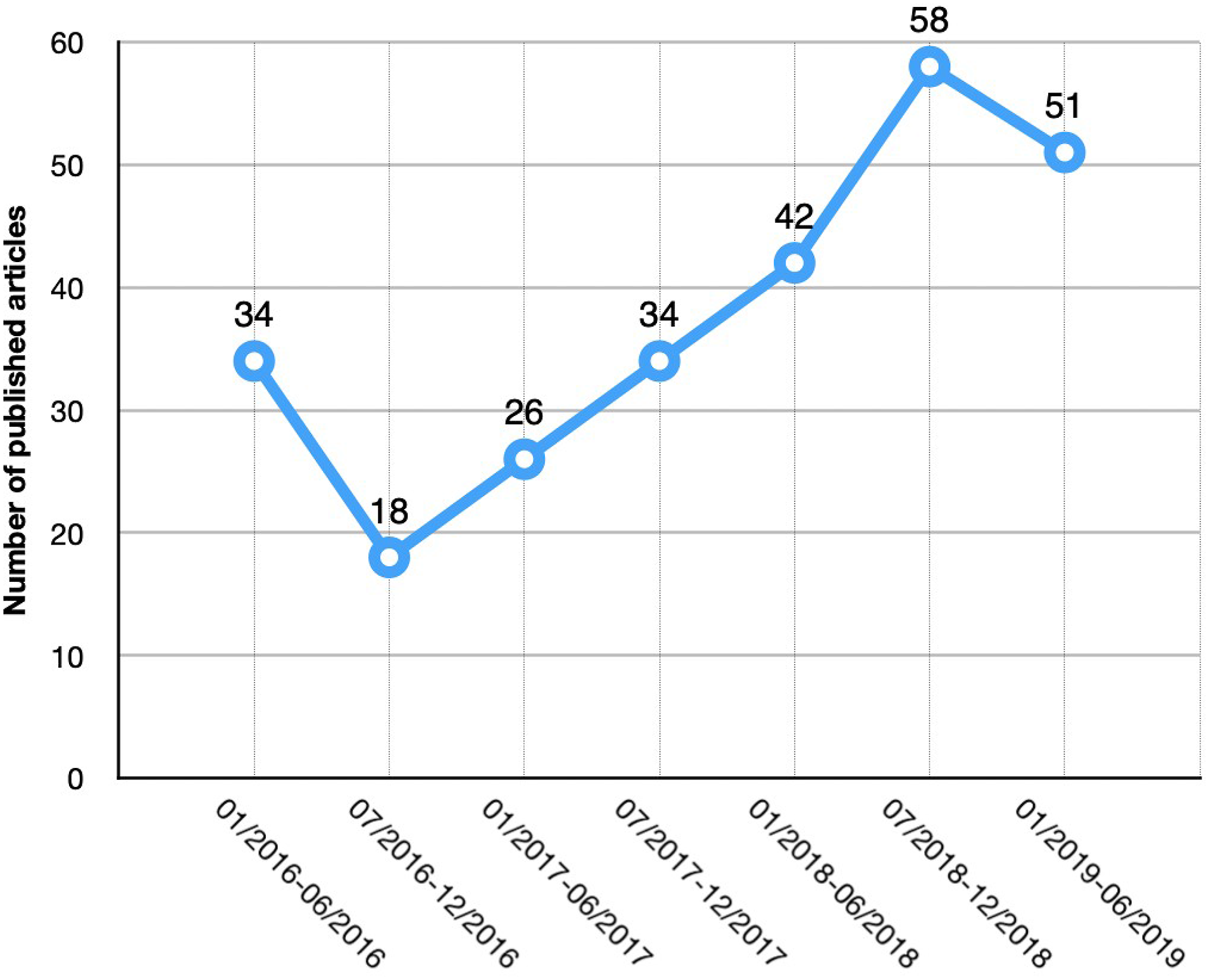
Analytical procedure
A priori organizing units and code examples.
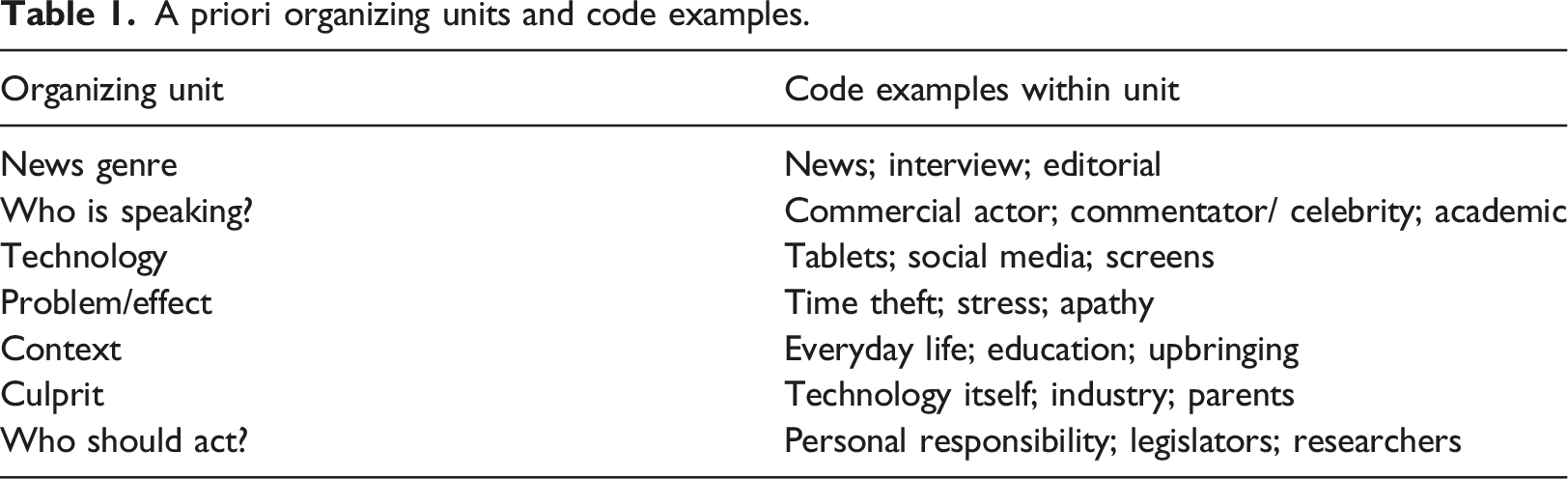
The coding of news articles was performed as a cyclical act (Saldaña, 2016: 9). The data corpus was first-cycle coded departing from the a priori organizing units, while iteratively adding new units as these emerged. Then, having composed the initial codebook (see Supplemental Appendix 2 for complete codebook), codes were critically re-examined and reorganized in interplay between the authors departing from a “test-test replicability” approach (Krippendorff, 2013: 271) to ensure the reliability of applied coding schemes.
In order to examine the relationship between the most commonly represented problems, their perceived causes, the solutions suggested by debaters, and the voices and media sources discussing them, this paper supplements the content analysis with a cross-tabulation of what emerged as central codes. χ2 (Chi-squared) analyses were carried out using the JASP R-environment for overlaps between recurring codes, defined as content that occurs in more than 5% of the corpus (rounded up).
As problem representations were not mutually exclusive, and multiple messages and voices often co-occurred within articles, conceptual units could not be entered together as single categorical variables. Instead, a series of 2x2 cross-tabulations were conducted for codes recurring within each conceptual unit (e.g., kind of problem mentioned X * kind of culprit mentioned Y) and organized in larger tables in order to visibly identify where two codes intersected significantly more or less often than statistically expected.
χ2 results are summarized below, and listed as full statistical tables in Supplemental Appendix 5 in order to preserve readability in the current article. Since series of multiple comparisons may give rise to false positives, we ran false discovery rate (FDR) corrections (Benjamini and Hochberg, 1995) within the columns of the first two cross-tabulation tables, finding that p-values equal to or below < 0.01 were typically still significant after FDR-correction. Based on this, we summarize only systematic overlaps between two codes (e.g., problems frequently represented along with a certain context; source types frequently discussing a certain problem) that are less than p < 0.01 likely to have occurred by chance, while raw χ2 tests of independence with effect sizes and p-values are available in the tables of Supplemental Appendix 5.
Results
To examine the general attitude towards digital media in the debate, we assessed whether individual articles addressed digital media using (1) positive or defensive wordings (e.g., “productive” and “social”), (2) negative or criticizing wording (e.g., “addictive” and “anti-social”), or (3) elements of both perspectives. Articles were then categorized as “Positive,” “Negative,” or “Both.”
62.7% of articles unambiguously expressed negative views toward digital media, 24% unambiguously positive, and 13.3% were categorized as “Both.” “Both”-articles were likely to use contrasting expert sources, or contain cautious comments and reflections (Figure 2). Almost two thirds of articles express negative views toward digital media. Figure illustrates the overall attitudes toward digital media within overall sample (n=263) divided into three categories: “Negative,” “Positive,” and “Both.”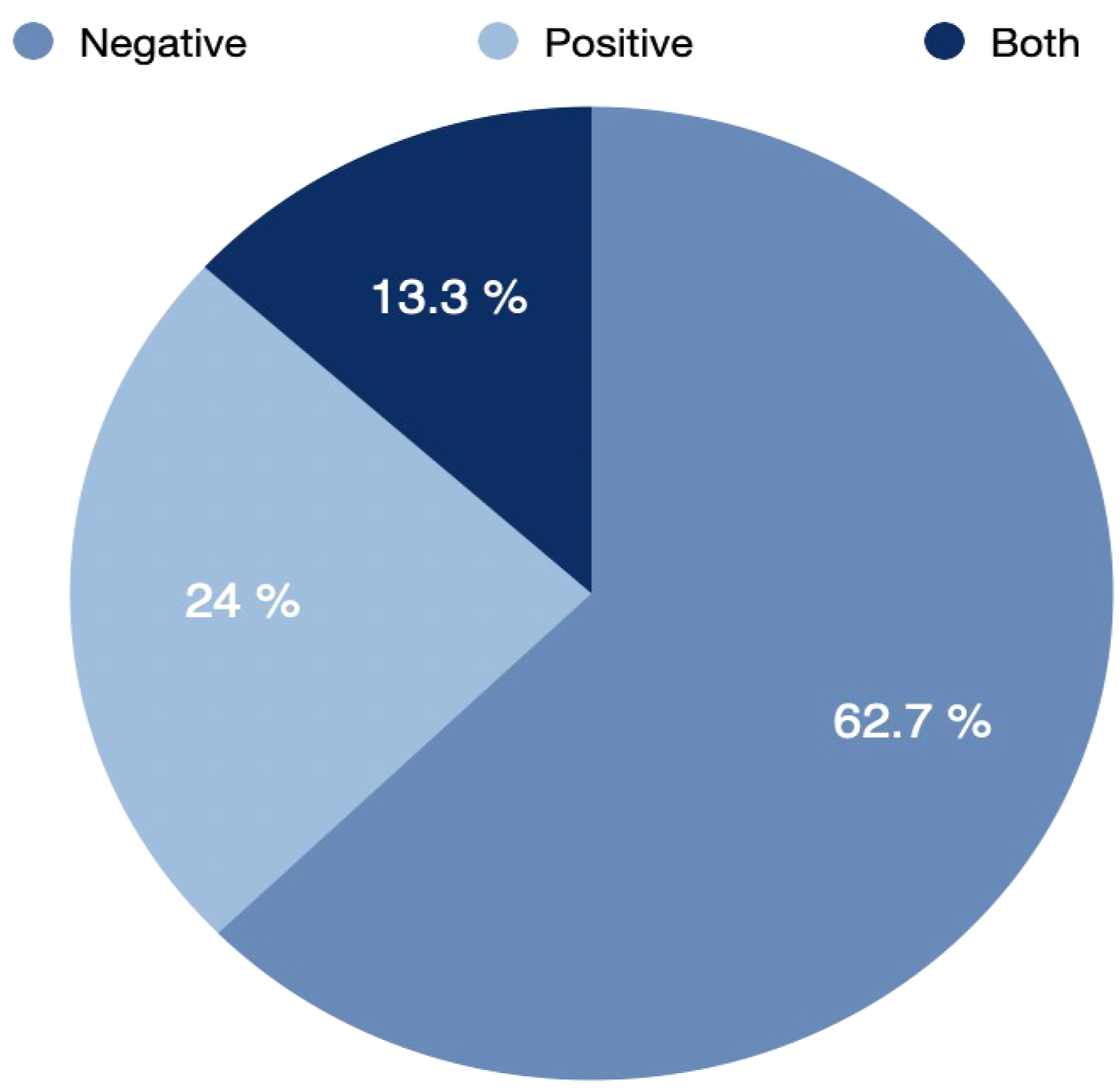
What’s the problem with digital media represented to be?
We found 19 unique Problem/Effect codes (Figure 3) with a series of sub-codes (marked with *). These varied in frequency across the media corpus, from occurring in one or two articles (e.g., Economic implications; Worries about data) to recurring in more than 50 articles (e.g., Time theft; Social relations) (Figure 3). The most frequent codes represented Mental health issues (addressed in 67 articles, or 25.5% of the total corpus), Socio-emotional implications such as loneliness (63 articles, 24%), Time theft (58 articles, 22%), Social relations (54 articles, 20.5%), and Attention theft (52 articles, 19.8%). Many of these were conceptually related. For instance, a large number of articles discuss the threat of scarce time and attention resources being supplanted by digital media. Mental health addressed as problem/effect in one fourth of all articles. Figure illustrates the distribution of Problem/Effect codes within overall sample (n=263) divided into 19 categories. *Contains sub-codes (see Supplemental Appendix 3, Table 1).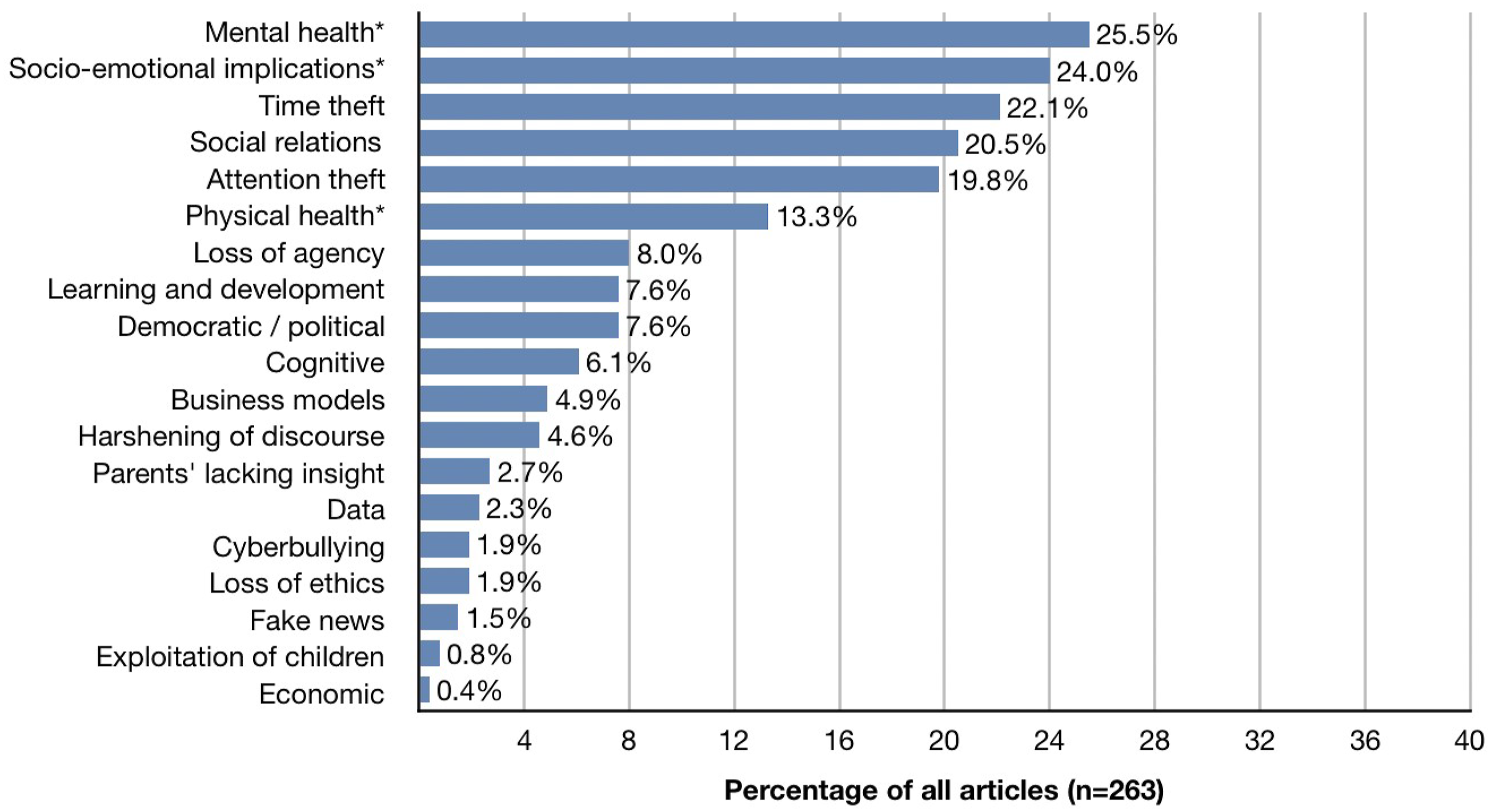
Based on the overall themes they occur within, the palette of Problem/Effect codes (Figure 3) can be further condensed into five overarching discursive themes (see also Supplemental Appendix 3, Table 1):
The
The
The
These five overarching discourses frequently overlap within articles. For example, an article (POL, 2018c) addressed the “time theft” of smartphones (Displacement) whilst also representing smartphone-induced stress (Health and Wellbeing) and its consequences for social relations (Social impact).
The way themes overlap within articles provides insight into the overall narrative found in the “screen debate”: Time is a topic especially integrated into most articles representing concern over digital media (e.g., POL, 2018e: “Social media for hours”). Children and people in general are represented as spending too much time on digital activities, and thus their attention is seen as being displaced (e.g., POL, 2018c: “Facebook and YouTube over-exploit our attention”) from activities of greater importance or appropriateness (e.g., INF, 2018: “Danish adolescents are spending less leisure time with other adolescents”). As a consequence, digital screens are framed as the culprit behind loneliness (e.g., KD, 2018b), depression (e.g., BER, 2018), and addiction (e.g., KD, 2018a) within a time-focused discourse surrounding family life and everyday psychological functioning.
However, problems are not just represented in terms of unwanted outcomes. Various media uses are represented at the levels of device, application, or brand (as distinguished by Meier and Reinecke, 2020) (Figure 4). Sometimes texts single out devices like “smartphones” or brands like “iPads.” Video games and Social media also occur frequently enough to warrant their own code. “Screens” as a general denominator, however, occurs in almost 25% of all news articles reviewed (Figure 4), either as a synonym for particular technologies (often tablets, judging by context) or as a more discursively “fluid” (Habermas, 1988) or “empty” (Laclau, 1990) signifier. We thus find that “screens” and “time” are both core concepts in public representations of problems with digital media. “Screens” are addressed in one fourth of all articles. Figure illustrates frequency of media use codes within overall sample (n=263) divided into six categories.
Social media (33.1%) was the most commonly debated media use followed by Smartphones (27%) and Video games (17.9%) (Figure 4). Beyond codes capturing specific technological hardware or its applications, the rhetorical use of different denominators makes digital practices hard to “pin down” in the discursive circumstances (as per Jones et al., 2015). Especially the use of “Screens” as a blanket term seems to sustain a fluid discourse which on the one hand encompasses “them all,” and on the other hand never becomes very specific, hence allowing ongoing shifts to new targets or problems both in the general discourse and by specific debaters.
Which technologies are represented as responsible for which problems?
To systematically assess discursive links between the problems and technologies being represented within the debate, we examined how often various types of digital media overlapped with Problem/effect codes (Supplemental Appendix 5, Table 1) using Chi-squared cross-tabulation. Smartphones were more than statistically expected associated with texts discussing distraction and attention issues, as well as learning.
Looking closer, the focus on learning, at least partially, derives from several news stories discussing whether or not schools should ban mobile phones, following the decision to enforce national rules in France in August 2018 (education.gouv.fr, 2019).
Video games appeared significantly more frequently in conjunction with texts debating Mental health issues, most notably “addiction,” but less frequently with Attention/distraction than would be statistically expected in the general corpus. Here, addiction is deployed in a clinical sense, sometimes leveraging the authority of voices that are presented as health professionals, but nonetheless the term “addiction” is typically used to describe everyday behaviors—not clinical conditions. We see this as an example of what Haslam (2016) has described as “concept creep” from clinical to colloquial usage of mental health terminology. We found several instances of clinical language used to describe common experiences rather than pathological cases as illustrated by, for example, the idea that “By removing the addictive applications you become able to show empathy and presence” (KD, 2018a: “Quit social media and save your soul,” p. 16).
The broad Screens code was significantly associated with texts debating Time theft and Physical health. In articles, “screen time” is often represented to be antithetical to physical activity (JP, 2018; POL, 2018a), illustrating the displacement discourse.
Social media were mentioned in relation to most issues, but only seen more systematically represented in the debate about democratic/political consequences, where no other media technologies were represented to be the problem. Articles with this Problem/Effect code mostly address how social media disrupt democratic processes, for example, Facebook as a “battleground” for political disputes with societal consequences of its own, including the rise of “echo chambers” and “fake news” (e.g., INF, 2016: “Social media might drive us into a post-factual democracy”).
Finally, Smartphones were represented as Distracting, and as having negative effects on Learning and development. The “always-on/always-on-you” (Turkle, 2008) nature of mobile phones leads smartphones to be represented as disruptive or attention consuming. Reading closer, the prevalence in relation to Learning and development in part reflects debates on how schools should handle students’ phones; that is, should they be banned, collected by the teacher, or put to educational use?
Who is the culprit represented to be?
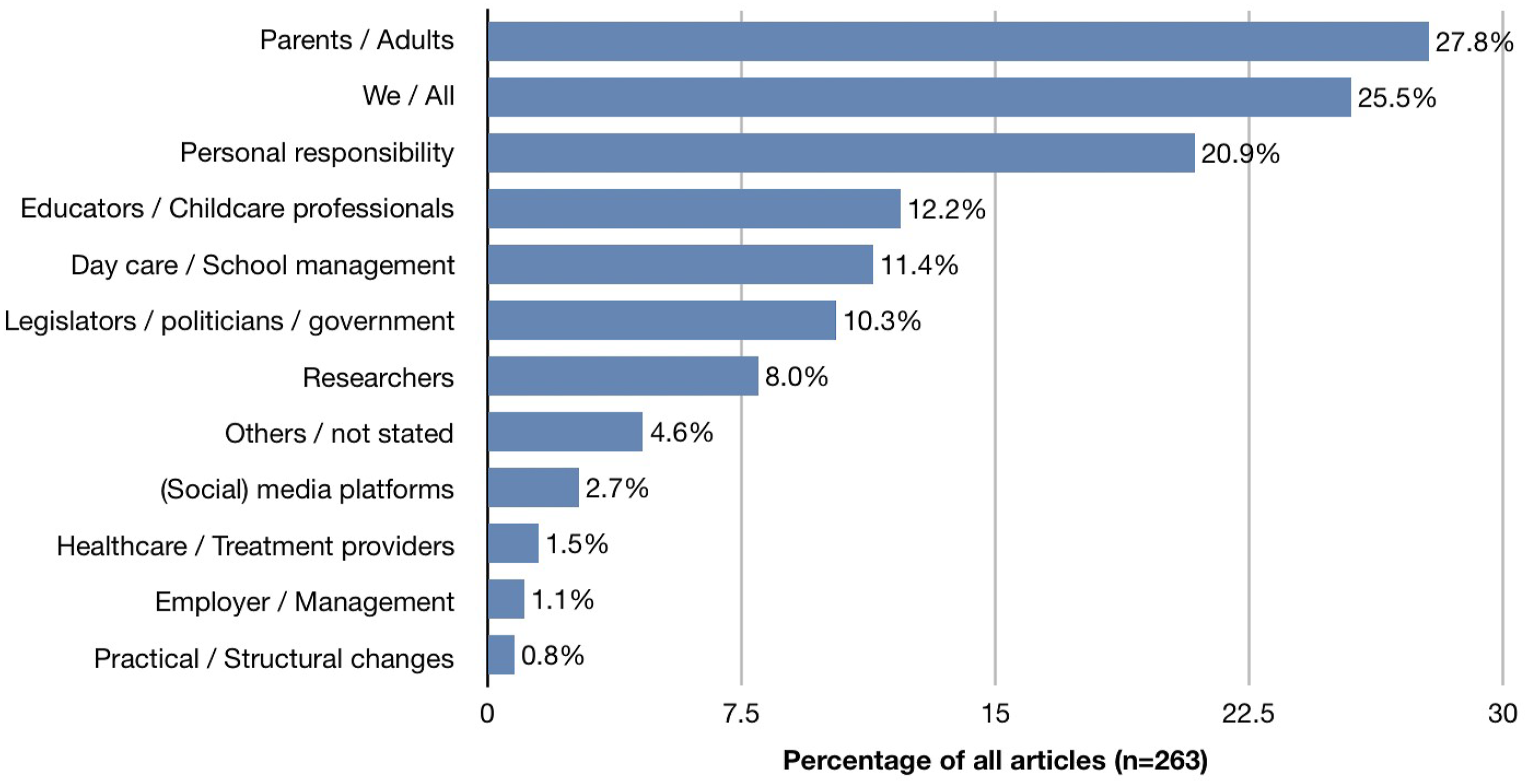
Most articles point out certain culprits (Figure 5), that is, reasons that a problem has emerged, whilst also framing others as responsible to act upon these problems (Figure 6). We treat these two aspects in turn. “Technology itself” represented as culprit in more than half of all articles. The figure illustrates groups and bodies represented as culprits behind problems related to digital media within overall sample (n=263) divided into five categories. Parents and adults most often called to act upon problems related to digital media. The figure illustrates groups and bodies framed as responsible to act on addressed problems related to digital media within overall sample (n=263) divided into 12 categories.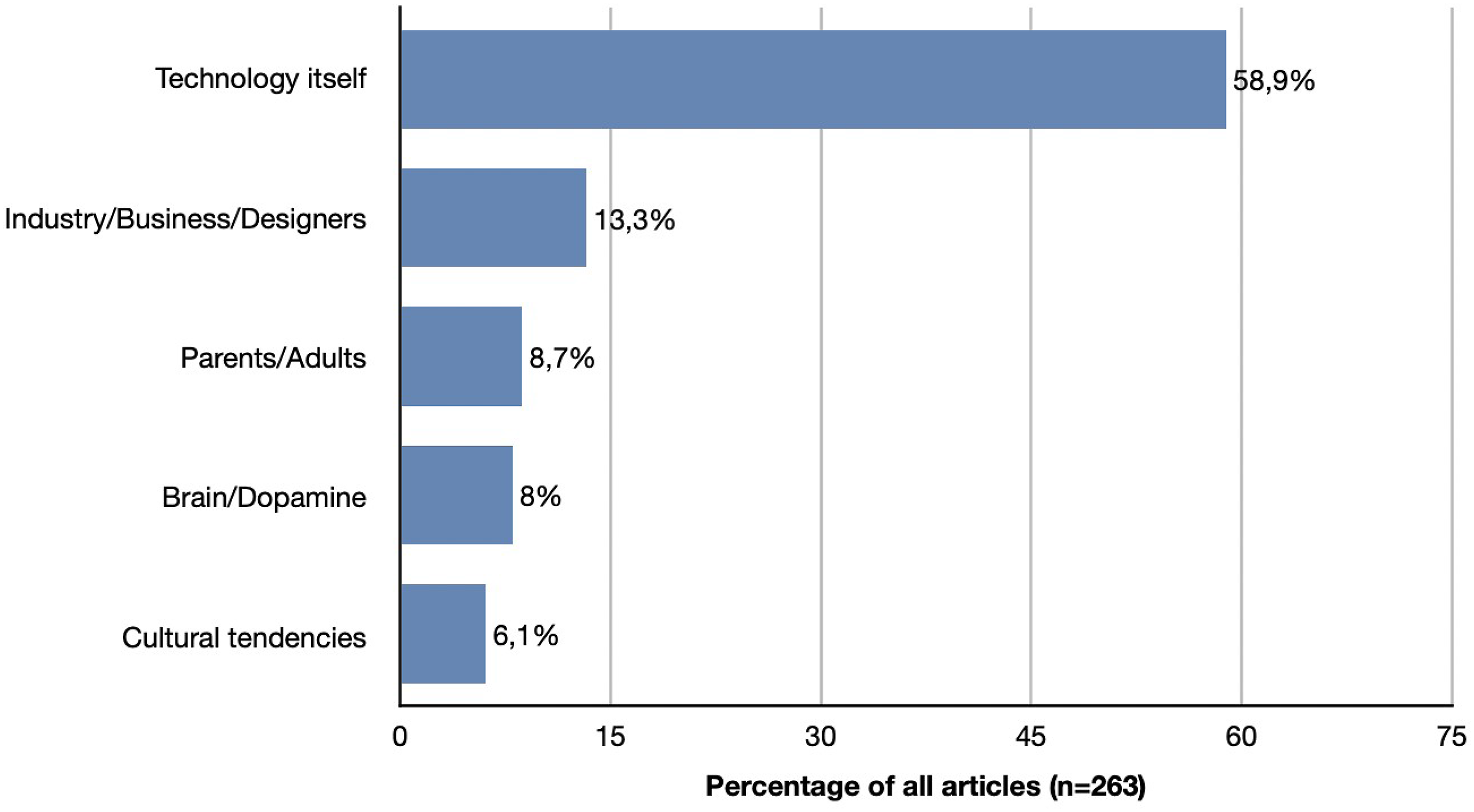
As outlined in Figure 5, the vast majority of articles framed Technology itself (58.9%) as culprit. Such articles represented addiction (INF, 2019), sleep problems (e.g., BT, 2019), and loneliness (e.g., KD, 2019a) as more or less directly emerging from the inherent nature or design of digital media technologies. For example, in the article titled Screens eat lives, and therefore we must limit them (KD, 2019b), a priest posits increasing “screen time” as the cause of a decline in wellbeing and gross motor skills among children. 13.3% of articles specifically represented the designers of digital technologies or the social media industry as a whole as culprits, for example, Facebook is an immature product—and you are one of the guinea pigs (POL, 2018b). Parents/adults were also addressed as culpable (8.7%), for example, for being too protective, causing children to “hide behind the screen” (BT, 2017). 8% of articles specifically represented neurochemistry and the brain’s reward system, that is, Brain and dopamine to be the problem, for example, in the article titled We have all become screen junkies (JP, 2018). Lastly, social or Cultural tendencies were sometimes (6.1%) represented as the underlying problem, for example, political polarization already underway before the advent of social media (WA, 2019).
Cross-tabulation (Supplemental Appendix 5, Table 5) shows that both Mental health, Cognitive functions, Social relations, and Democratic/political implications are significantly tied to representing the Industry as a culprit. Technology itself is, however, significantly associated with Attention theft.
Further, a systematic Brain/dopamine discourse co-occurs with discussions of Time theft, Mental health, and Social relations. Hence, the mobilization of neurobiological rhetoric appears across issues relating to everyday experience and addiction. Paradoxically, Brain/dopamine arguments are not linked to their proper scientific domain of cognitive function in the debate.
Who is represented as responsible for acting on techology problems?
Turning from culprits (Figure 5) to who is represented as responsible for acting against digital harms (Figure 6), the group most commonly called to action was Parents/Adults (27.8%). For example, in an article titled It is neglectful not to limit children’s screen time (POL, 2019), the author argues that parents, but also professionals, researchers, and politicians, hold the responsibility to limit the time used on screens by children and adolescents, as screens are the main cause of children and adolescents' declining wellbeing. In another article, a school teacher argues that parents should take responsibility for children’s wellbeing in school by limiting children’s use of “crippling” digital media (POL, 2016a: “Should screens really be children’s best friends?”). The second most common occurrence was We/All, a code comprising perspectives suggesting that we all need to change our behaviors as well as the culture around digital media, for example, an article titled Say no to social media (KD, 2017). Third, 20.9% of articles represented the imperative to act as a Personal responsibility (Figure 6) to be fulfilled by either altering one’s own habits or by “taking a stand” against technologization.
A relatively large number of articles addressed Personal responsibility, hence discursively placing the individual in a difficult and ambiguous position; The media discourse both deprives the individual of agency as an effect of the presumed attention theft and addictive nature of digital media, whilst simultaneously requesting the individual person to take personal responsibility of her/his digital media habits. For example, the article titled Do you want to live with your head buried in a screen? (POL, 2016b) argues that smartphones and social media control every aspect of our lives and that we have become slaves of technology. Yet, the article also represents the position that we should reconsider our choice of living with our “heads buried in a screen” rather than with our friends and family in “the real world.”
The agency of children themselves is not strongly represented in the media. Instead, cross-tabulation shows that responsibilities to act against negative effects on Attention/distraction are significantly placed with Teachers/educators and School management (Supplemental Appendix 5, Table 6). Further, and more surprisingly, Teachers/childcare personnel and Schools are not held responsible for alleviating proposed problems with social relationships, socio-emotional development, or physical health, thus suggesting a puzzlingly limited and instrumental view of the role of education in the technology discourse: In the technology debate, schools are presented narrowly as seats of learning and cognitive training, rather than as spaces for social/personal wellbeing in or out of school, or as having a broader societal role.
Parents, on the other hand, are represented as responsible for acting on Mental health issues, in addition to the displacement of Time and Attention. Parents are significantly less likely to be suggested as part of the solution to Democratic/political issues. Instead, the responsibility to act on these problems is shared between a Personal responsibility and We/all as a collective cultural burden.
Surprisingly, science is not called on to solve any particular problem. Similarly, legislators and governmental bodies are not called to act upon specific problems.
Who speaks about which worries?
The sheer variety in backgrounds of people included as sources or authoring opinions in the dataset illustrates how the debate about digital media is one that reaches the attention of an extended gallery of actors.
As illustrated in Figure 7, we found 11 different ways in which texts represented the authority or perspective of its voices. The most frequent group of voices in the debate is the Professional occurring in 85 articles (32.3%) of which predominantly come from Health/medical (35.3%) and Psychological/therapeutic (45.5%) backgrounds. The second and third largest groups are the General academic and Active researchers. A distinction between these is necessary, as many General academics (25.5%) offer opinions even if they do not actually study the space of media and technology effects. In contrast to these, slightly fewer Active researchers (20.5%), who are represented as specifically engaged in generating knowledge in the area, are approached by journalists or, even more rarely, afforded column space. As with all codes in this study, this can create overlaps, as one article may represent an Active researcher talking about a recent study (JP, 2019), but the same person can appear with just “associate professor” added as a marker of expertise in another article (POL, 2017). The codes are based on how various texts represent academic authority, for example through an academic degree or a researchers’ empirical work on digital media. We also find voices representing NGOs/interest groups, as well as commentators including authors, celebrities, and self-styled influencers. Even though we have seen that they are at the core of the discourse, Parents/caregivers and Children/adolescents are given a voice comparatively less frequently (Figure 7). Professionals are voiced often while parents and children remain rather silent. The figure illustrates the distribution of sources within overall sample (n=263) divided into 11 categories. *Contains sub-codes (see Supplemental Appendix 3, Table 2).
To understand if particular groups of writers, sources, or debaters amplify specific representations of media problems, we examined associations between voices and Problem/Effect codes (Supplemental Appendix 5, Table 3).
Professionals are significantly tied to representations of problems related to Physical and Mental health, many addressing the addictive nature of digital media, often using a clinical/medical language to describe everyday experiences and media uses.
To understand the prominence of Professionals in the representation of problems related to Physical and Mental health, and especially the addiction discourse, it is worth noting that during the time window of investigation, some individuals appeared very frequently as both expert sources and authors of opinion pieces. These included a psychologist running a gaming addiction consultancy, and a former general medicine practitioner prospering as a writer and public speaker. These two were the most frequently used voices in the sample overall, together appearing in a full 11.4% of all texts, each time framing the debate toward mental and physical health issues, and alternating between authoring the debate directly and being used as sources by journalists writing for the newspapers. The media activities of relatively few individuals can thus have a significant impact on framing a national debate.
Representatives of NGOs and interest groups significantly more often discuss Physical health. This in part reflects several articles discussing physical activity during school recess, represented by bodies such as the national parent-teacher association.
We found only one significant pattern for Active researchers, who were called to speak on Attention/distractions significantly more rarely than would be statistically expected. This theme is dominated by no other group of voices, so it does not appear that any particular voices are crowding the researchers out. However, the systematic underrepresentation of researchers as sources also suggests that the discourse surrounding cognition and attention has been less informed by science than the other themes identified in this analysis.
Other academics were, however, significantly given voice in debates about Learning/development and Social relations/interactions. This could suggest that journalists tend to include expert sources with academic credentials within, for example, the field of education, rather than media experts or practitioners such as teachers or pedagogues. It may also be that “generalist experts” are easier to find than researchers who happen to study a particular problem.
Parents were significantly represented in articles addressing issues of Time Theft and Mental health. Here, parental voices generally express concern when children’s use of digital media is represented as an obsessive unduly time-consuming behavior. For example, a parent reflects on balancing her son’s time spent on the screen, trying to avoid it becoming a “nanny” (POL, 2018d: “I think I have become addicted”). Again, we see a tendency of a language of addiction dominating the discourse, drawing the field of mental health into that of childhood. In another article, a mother denies her son playing Fortnite because she believes that the game makes him “react as an addict” (BT, 2018: 16).
Finally, the relatively scarce voices of Children/adolescents appear to be scattered evenly across the various issues. Children were, in other words, not the main voices anywhere.
Discussion
In a time when internet connections and smartphones have become ubiquitous, we found that 74% of news articles analysed addressed digital media wholly or partially negatively. This is in line with previous research (Facer, 2012; Haddon and Stald, 2009; Stern and Burke Odland, 2017). Our goal, i.e.,to understand exactly what the problem is represented to be, when, by who, and who is held responsible, thus had ample material to work with.
While the most common single code for representations of problems related to digital media was mental health, the most common overall discourse was one of attention and time, followed by social interaction and health, the latter often expressed through the use of a mix of colloquial and clinical terminology such as neurochemistry, addiction, or attention disorders. All of these codes intersected within individual articles, centering around issues of (self) control and time. Looking to the contexts and responsible parties, we also found that children constituted a central battleground in the discourse surrounding digital media which fits the host of previous work (e.g., Downes, 1999; Drotner, 1999; Facer, 2012; Jaunzems et al., 2019; Selwyn, 2003). However, also in line with previous analyses (e.g., Milosevic et al., 2019; Ponte et al., 2009), the voices of children themselves were rarely heard. Instead, the debate puts children in a position in which they are pushed to defend their use of digital media, without being afforded the same voice in news media as their critics (boyd, 2014; Stern and Burke Odland, 2017).
Further, we find it important to highlight the rather surprising finding that schools were not called to act upon issues regarding children’s social wellbeing. Instead, the technology debate narrowly discussed schools in relation to problems of cognition and learning. This is at odds, especially in a Danish educational tradition, with the general understanding of schools as pivotal societal institutions, bearing a responsibility for facilitating children’s broad development and formation (Bildung), and thereby preparing new generations to participate in a democratic society.
Using cross-tabulation of main themes within the organizing units used for analysis, we found that certain media technologies are more strongly represented to cause certain problems with phones especially stealing attention, games especially being addictive, and social media especially influencing the democratic sphere.
With the exception of social media, this does not mean that each technology/application is only represented to result in specific issues. The cross-tabulation shows that the diffuse notion of “screens” is especially associated with worries related to physical health as well as the notion of “time theft.” As seen in Table 1 (Supplemental Appendix 5), all technologies are sometimes represented to result in most problems. For instance, both phones, social media, and screens are commonly associated with addiction, showing a fairly even distribution of the addiction discourse across all conversations. The code addiction, however, for example, occurs in an especially large portion of news pieces about gaming, compared to what would be expected from a statistically random spread. It is noteworthy that the relatively frequent coverage of issues related to “addiction” in Danish news media found in the data presented here was not found (at all) in a previous analysis of European news media (Ponte et al., 2009: 164), suggesting an increased mobilization of this concept over the last decade. This is in line with Haslam’s (2016: 9) analysis of how the clinical concept of addiction traditionally isolated to psychological and medical diagnostics currently “creeps downward”, undergoing semantic inflation, and hence becomes a very common colloquialism in public discourses. In the data we analyzed, the term no longer describes an illness, even though voices often attempt to draw on a clinical source space; Instead, addiction has gradually come to describe the culturally pervasive feelings of annoyance or powerlessness with the technologies at our disposal.
The broad idea of “screens” saturate the dataset, sometimes representing a particular technology, but more often as a more discursively fluid rhetorical mechanism, on the one hand able to encompass everything and on the other hand leaving a “blank space” open for the reader’s interpretation. From a discourse theoretical perspective, such constructs can be understood as floating signifiers (Laclau, 1990: 28), that is, terms that are essentially ambiguous so their inherent meanings depend on the contexts in which they are articulated and interpreted. Perhaps a more precise notion in relation to “screens” can be derived from Laclau’s concept of the empty signifier acting as “a surface of affective inscription” (Kraniauskas, 2014: 31), that is, a construct of multiple interpretations enabling individuals to project their own subjective meanings upon it.
Hence, when words such as “screens,” “screen time,” or even “social media” are repeatedly represented in news media discourse, they essentially mobilize a great variety of meanings at once. This is problematic as more and more research now demonstrates the need to be sensitive toward specific uses and behaviors in order to understand psychological and behavioral technology effects in any meaningful way (e.g., Kaye et al., 2020; Orben, 2020a; Schemer et al., 2020). As Flyverbom (2019: 27) notes in relation to the concept of the Internet, in public discourse we tend to “conflate a wide range of technologies, practices and transformations into a singular thing. Also, we focus our attention on technology rather than its uses or societal roles.” Hence, moving forward, we argue, that it would be worthwhile for journalists, laypeople, and researchers alike to develop a more nuanced, qualitative, and context-specific vocabulary when addressing the promises and perils of digital technologies rather than applying one-size-fits-all umbrella terms such as screens or social media that in reality encompass a wide variety of technologies, uses, and behaviors (Bromley, 1997; Dienlin and Johannes, 2020; Stern and Burke Odland, 2017).
We find it paradoxical that while the tech industry and brain/dopamine imaginary are held culpable for creating problematic and addictive technologies, driving humans to the point of powerlessness, individuals alone or as part of a “we/all” discourse are also held responsible for failing to abstain from using named technologies. Aagaard (2020: 4) views this inconsistent argument as a fallacy of what he terms the “neurobehaviorist” view of human agency: “On one hand, it portrays humans as helpless victims of addictive technology, but on the other hand, it constantly offers advice on how to shape our technology use.” This creates an odd balance between positioning people as both hapless victims and morally responsible actors.
In this respect, the screen discourse and its entrepreneurs bear a more than passing resemblance to diet culture and its actors. Except when focused on schools, even when the proposed problem is construed in terms of codes like We/all or Society, the supposed solutions are still “all about individual responsibility” (Harrison, 2019), a trend also observed in the “digital detox” movement (Syvertsen and Enli, 2020). In line with this tendency, we found that parents were often held rhetorically responsible for acting on their children’s (problematic) uses of digital media.
Moreover, in 8.7% of the articles we analysed, parents were framed as culprits to problems related to children’s uses of digital technologies. This might cause feelings of guilt among parents for not adhering to normative values of what “good parenting” and a “good childhood” should look like (Jaunzems et al., 2019; Jeffery, 2020; Livingstone and Blum-Ross, 2020; Mavoa et al., 2017; O’Connor and Fotakopoulou, 2016; Willett, 2015). Furthermore, this brand of parental determinism provokes caregivers into enforcing restrictive rules for their children’s digital activities to protect them from proposed harms (Nikken and Schols, 2015; Van Petegem et al., 2019). Simplistic restrictions, however, may come at the cost of children’s privacy, development of digital literacy, and opportunities to participate in the communal activities of their generation (see also Frith, 2017; Haddon, 2015; Livingstone et al., 2017; Smahelova et al., 2017).
Several factors other than news media narratives themselves, however, influence consumers’ beliefs, perceptions, and behaviors (Wåhlberg and Sjöberg, 2000), for example, education level and social status (Jensen, 2012a, 2012b; Valkenburg et al., 2016; Vu et al., 2019). The influences of news media might be better understood as “reinforcements” of audiences’ already existing ideas, beliefs, and attitudes (Klapper, 1960), that is, as actants capable of augmenting worries and beliefs already present in people’s everyday lives. This relationship may also be amplified by the increasing competition for clicks and attention that makes even mainstream media vie for names and headline subject matter, which reflects pervasive concerns in large numbers of readers. Moreover, media coverage may influence individuals’ perception of digital media related issues by playing on cognitive pitfalls and biases such as the “availability heuristic” (Kahneman and Tversky, 1972; Science Communication Unit, 2014; Wåhlberg and Sjöberg, 2000). As Altheide notes on the usage of fearful rhetoric in news media: “(…) with repeated usage, nuances blend (…) and we have a different perspective on the world” (2002: 233). Thus, if worried parents are continuously exposed to reports stating that their children are becoming “addicted screen junkies” (BER, 2016: 33) only thinking about getting their next fix of dopamine (INF, 2017), such narratives might be adopted by parents as meaningful and accessible explanations of lived experiences, that is, the perceived problematic behaviors of their children (boyd, 2014; Guo and Vu, 2018; Leick, 2019; Sarathchandra and Mccright, 2017; Wåhlberg and Sjöberg, 2000) who, in turn, might adopt the same views (Mascheroni et al., 2014). Furthermore, by addressing parents as responsible to act on said problems (see also Jaunzems et al., 2019; Stern and Burke Odland, 2017), they are placed in the midst of personal “screen guilt,” discourses on “the good childhood,” and conflicts resulting from attempting to restrict their children’s media uses, while at the same time being expected to raise digitally savvy citizens (Chimirri, 2017; Livingstone and Byrne, 2018).
It does not appear that news outlets are systematically and intentionally spreading disinformation or “fake news” about supposed harms of digital media, but rather that reports are mostly covered from a point of view reflecting popular worry discourses by letting negative perspectives dominate in both texts and headlines, and these perspectives are not always in line with scientific consensus (see also Bell et al., 2015; Holmes, 2009; Kardefelt-Winther, 2017). More than two decades ago, Altheide and Michalowski (1999: 499) coined this phenomenon the “discourse of fear” in news reporting, i.e., “a way of focusing on the fear-related features of most events.” Following the ideas of sociologist Ulrich Beck, this is not a trivial tendency: “Because risks are risks in knowledge, perceptions of risks and risks are not different things, but one and the same” (Beck, 1992: 55). In other words, we should be attentive to how risk related to digital media use is represented in news media, albeit the direct effects of media coverage on personal risk perception are disputed (Kitzinger, 1999; Science Communication Unit, 2014; Wåhlberg and Sjöberg, 2000; Wilson et al., 2004). Although not to be unfolded in depth in this article, the tendency to promote spectacular and negatively framed stories might in part be due to the disruption of the traditional journalistic news landscape (Mihailidis, 2012; San Martín, 2012) as well as the high-paced “attention economy” in which an increasingly competitive hunt for readers is the norm for media outlets (e.g., Nielsen, 2019).
The academics consulted by journalists were most often not experts in the exact problems being represented, perhaps reflecting how journalistic googling unavoidably leads to existing texts, and thus resulting in the use of well-known and well-spoken sources in articles rather than tracking down obscure specialists. A good example is journalists calling on neuroscientists to speak generally on how the brain’s reward systems work. As noted by Mascheroni et al. (2014: 2): “(…) in representing reality, the media embody social discourses and turn them into publicly accessible, popular symbolic resources: media representations mirror lay discourses, while at the same time informing and shaping common-sense knowledge.” Hence, while we should be critical of digital media technologies and especially the business models behind them (West, 2019; Zuboff, 2019), we ought also to remain constructively critical of their critics—and how their arguments are curated in news media.
In sum, rather than studying actual effects of the partially empty signifier that is “screen time,” we have here attempted to count and analyze what the problems are represented to be in news media. Not neglecting the actual and lived problematic experiences of young people, parents, educators, etc., we acknowledge that the use of digital media in school, at work, and at home do indeed give rise to questions, problems, and conflicts in need of being addressed and discussed.
However, looking at the results presented here, we find it equally important to maintain a critical and reflective stance toward the way in which digital media harms are represented in news media. Without wanting to promote an equally naïve deterministic view of news media coverage inexorably shaping human behavior, we believe that the debate would benefit from being wary of empty signifiers and concept creep when describing everyday behaviors and their supposed harms. The technology debate is a powerful discourse in our society, and should be able to progress toward well informed decisions without unintendedly and unnecessarily cultivating unresolvable feelings of shame, inadequacy, and guilt among readers, parents, and children.
Limitations and future directions
The content analysis approach inevitably draws on qualitative and interpretive descriptions and judgments of the researcher (Krippendorff, 2013) who gradually becomes part of the analytical apparatus (Barad, 2007). For example, whether a certain article is representing positive or negative views toward digital media might be perceived differently by different readers. To allow for transparent analysis and re-analysis, the data corpus and codebook are available for scrutiny (Supplemental Appendix 2) in accordance with the impetus for open data in the social and psychological sciences (Kardefelt-Winther, 2017).
Further, despite a methodical search strategy, data as included in this study will usually miss some news articles unintentionally. For instance, some writers may have used brand names instead of more generic categories of devices or applications. Hence, although phrases like “iPhone” or “Facebook” saturates the dataset, articles with these words in the headline may have been missed.
Our study departs from a Danish sample. National analyses on this topic contribute to a mosaic of “screen discourses” in global news media. As exemplified by the work of multiple scholars studying children, digital media, and/or news coverage (e.g., Bean et al., 2017; Blum-Ross and Livingstone, 2018; Mascheroni, 2018; Rao and Lingam, 2020) controversy surrounding digital media in the lives of children and young people is indeed an international media phenomenon, and, as mentioned above, several results in the present study mirror previous findings from other cultural settings. In a globalized and connected world, news stories and discourses are not confined to the geographical borders of individual countries (Lück et al., 2018; PwC, 2016). Therefore, future cross-national comparisons (e.g., Haddon and Stald, 2009) are needed to comprehensively understand how and why the debate on digital media and screen time unfolds as it does.
As traffic on news media sites increasingly derives from social media (Gabielkov et al., 2016), future analyses might benefit from examining the discursive connections between, for example, news media, blogs, and social media (e.g., the sharing of and commenting on news articles) in order to sufficiently understand the development of, for example, discursive movements against digital media use in school. More generally, from the perspective of audience reception studies (Jensen, 1986; Livingstone, 2007), research should include the views of parents, children, and perhaps journalists or other media actors to examine how media reports are understood by the recipients, as well as how the messages of writers are sought to be decoded. This is especially crucial to understand the role of influencers and self-made experts in manufacturing and representing problems in the collective arenas of 21st century public discourse.
In order to develop a critical yet balanced conversation on the influences of novel technologies in the lives of children and people in general, we need to validate and include the voices, interpretations, and situatedness of actors central to the discussion (see also Aagaard et al., 2021; Mavoa et al., 2017; Monteiro and Osório, 2016). The perspectives of children and young people regarding these issues are rarely heard in public, and most often the fearful perspectives overrule the optimistic stories (boyd, 2014; Holmes, 2009). Hence, there is a need for researchers, media practitioners, and lay people to collaborate in painting a more well-balanced and representative picture of the complexities related to everyday life with digital media in the 21st century.
Supplemental Material
sj-pdf-1-con-10.1177_13548565211065299 – Supplemental Material for What’s the problem with “screen time”? A content analysis of dominant voices and worries in 3 years of national print media
Supplemental Material, sj-pdf-1-con-10.1177_13548565211065299 for What’s the problem with “screen time”? A content analysis of dominant voices and worries in 3 years of national print media by Jan Ole Størup and Andreas Lieberoth in Convergence: The International Journal of Research into New Media Technologies
Supplemental Material
sj-pdf-2-con-10.1177_13548565211065299 – Supplemental Material for What’s the problem with “screen time”? A content analysis of dominant voices and worries in 3 years of national print media
Supplemental Material, sj-pdf-2-con-10.1177_13548565211065299 for What’s the problem with “screen time”? A content analysis of dominant voices and worries in 3 years of national print media by Jan Ole Størup and Andreas Lieberoth in Convergence: The International Journal of Research into New Media Technologies
Supplemental Material
sj-pdf-3-con-10.1177_13548565211065299 – Supplemental Material for What’s the problem with “screen time”? A content analysis of dominant voices and worries in 3 years of national print media
Supplemental Material, sj-pdf-3-con-10.1177_13548565211065299 for What’s the problem with “screen time”? A content analysis of dominant voices and worries in 3 years of national print media by Jan Ole Størup and Andreas Lieberoth in Convergence: The International Journal of Research into New Media Technologies
Supplemental Material
sj-pdf-4-con-10.1177_13548565211065299 – Supplemental Material for What’s the problem with “screen time”? A content analysis of dominant voices and worries in 3 years of national print media
Supplemental Material, sj-pdf-4-con-10.1177_13548565211065299 for What’s the problem with “screen time”? A content analysis of dominant voices and worries in 3 years of national print media by Jan Ole Størup and Andreas Lieberoth in Convergence: The International Journal of Research into New Media Technologies
Supplemental Material
sj-pdf-5-con-10.1177_13548565211065299 – Supplemental Material for What’s the problem with “screen time”? A content analysis of dominant voices and worries in 3 years of national print media
Supplemental Material, sj-pdf-5-con-10.1177_13548565211065299 for What’s the problem with “screen time”? A content analysis of dominant voices and worries in 3 years of national print media by Jan Ole Størup and Andreas Lieberoth in Convergence: The International Journal of Research into New Media Technologies
Supplemental Material
sj-xlsx-6-con-10.1177_13548565211065299 – Supplemental Material for What’s the problem with “screen time”? A content analysis of dominant voices and worries in 3 years of national print media
Supplemental Material, sj-xlsx-6-con-10.1177_13548565211065299 for What’s the problem with “screen time”? A content analysis of dominant voices and worries in 3 years of national print media by Jan Ole Størup and Andreas Lieberoth in Convergence: The International Journal of Research into New Media Technologies
Footnotes

References
Supplementary Material
Please find the following supplemental material available below.
For Open Access articles published under a Creative Commons License, all supplemental material carries the same license as the article it is associated with.
For non-Open Access articles published, all supplemental material carries a non-exclusive license, and permission requests for re-use of supplemental material or any part of supplemental material shall be sent directly to the copyright owner as specified in the copyright notice associated with the article.
