




Abstract
Digital patronage is an emergent revenue model in which fans provide recurring financial support to a content creator, as exemplified through platforms like Twitch and Patreon. Whereas previous research has investigated creator-supporter relationships, the current study investigates creators’ multi-platform practices through in-depth interviews. We build on trends in creative labor studies and communication to examine how creators perceive Patreon and integrate it into their existing workflow. This study’s findings contribute to a better understanding of the role of digital patronage within the broader ecosystem of creative labor platforms.
Introduction
Digital patronage refers to a revenue model in which fans provide recurring financial support to content creators through social systems that facilitate financial transactions (Wohn et al., 2019). Major digital patronage platforms include Patreon, Twitch and OnlyFans (Bonifacio and Wohn, 2020), and aspects of digital patronage – especially tipping and subscriptions – have been adopted by the likes of Twitter, Facebook and Clubhouse (Fischer and King, 2021; Yurieff, 2021). Digital patronage platforms allow supporters to ‘subscribe’ to an individual creator, sometimes in exchange for perks like behind-the-scenes content, subscriber-only badges or access to private forums.
Previous work on digital patronage has primarily focused on creators’ efforts to foster long-term relationships between themselves and their fans and the blended social-financial nature of such interactions (Hair, 2021; Leith, 2021; Wohn et al., 2019; Wohn and Freeman, 2020). The current study takes a step back to consider the role of digital patronage within the broader creative ecosystem. Digital patronage is a relatively new opportunity for creators, in comparison to the commission- and advertisement-based models that have characterized creative work until now. Research is needed to understand how digital patronage can replace, complement or fail to live up to alternative financial models, and how creators integrate this new revenue model into their existing workflow.
To understand this, we draw on recent literature in the field of creative labor studies concerning the importance of multi-platform practices among creators (Cunningham and Craig, 2019; Scolere, 2019). As new platforms – and associated revenue models – arise, creators learn to identify each platform’s place in their personal media ecology and to establish a web of interconnected creative platforms (Scolere, 2019). By adopting multi-platform practices, creators guard against the precarity of a single platform having total control over their income (Cunningham and Craig, 2019; Hesmondhalgh, 2020; Nieborg and Poell, 2018; Scolere, 2019). However, multi-platform practices also increase creators’ workload, both in terms of time spent on each platform and knowledge needed to effectively utilize them.
Given the infancy of digital patronage studies, it is not yet clear how creators conceptualize the business-related benefits of digital patronage platforms or how these platforms intersect with others, such as social media and freelancing platforms. This study takes Patreon as an exemplar of digital patronage and seeks to answer two primary questions: how does Patreon facilitate and constrain creative work? and how does it contribute to creators’ multi-platform practices?
Through in-depth interviews with 21 creators on Patreon, this study contributes to the fields of digital creative work and platform studies. First, our results highlight that any one platform is unavoidably embedded within the large digital ecosystem. Both creators and their audiences extend across multiple digital spaces, complicating scholarly inquiries into topics like audience management and self-branding. Our results also contribute to a deeper understanding of the invisible labor performed by creators. Whereas creators’ emotional and relational labor is well documented (e.g. Baym, 2018; Cunningham and Craig, 2019; Duffy, 2017), and this study adds to the growing literature on platform labor and the multi-platform practices that support creators’ financial autonomy.
Literature review
Digital patronage stems from a long line of revenue models developed for digital creative work. Digital creative work encompasses both traditional fields turned digital (e.g. music) and digitally-native fields (e.g. livestreaming). We follow Cunningham and Craig (2019: 70) in adopting the term ‘creator to refer to ‘commercializing and professionalizing native social media users who generate and circulate original content [in order to develop] their own media brand’.
The next two sections document the digital transformation of creative work and the revenue models that preceded digital patronage. The final section discusses digital patronage and Patreon itself.
Digital creative work and multi-platform practices
Digital platforms have facilitated a shift away from creative work and toward creative entrepreneurship (Glatt and Banet-Weiser, 2021; Hesmondhalgh, 2020; Larson, 2020; Lingo and Tepper, 2013; Neff et al., 2005). Creators are responsible for far more than content creation; they are expected to function as entrepreneurs who possess ‘meta-competencies [including] broad creative skills, commercial acumen, and the ability to work across multiple media platforms’ (Lingo and Tepper, 2013: 341). Some studies frame this new entrepreneurism optimistically and highlight creative autonomy and independence from traditional intermediaries (Larson, 2020; Lingo and Tepper, 2013). But most research stresses the lack of benefits and the financial risks that creators face without secure employment, as well as the long hours and erosion of work/life balance (Alacovska, 2018; Baym, 2018; Brzozowska and Galuszka, 2021; Eurofound, 2015; Guarriello, 2019; Hunter, 2016; Neff et al., 2005; Scolere, 2019).
This entrepreneurial transition has occurred because digital platforms have significantly lowered the threshold for the distribution and promotion of creative content. Uploading and hosting content is generally free, as is basic promotional activity on social media. Creators can opt to bypass traditional intermediaries – production studios, publishing houses and so forth – and release their content directly to consumers. In doing so, creators become entrepreneurs who take on the non-creative tasks previously delegated to intermediaries, such as financial management, audience management and self-branding and promotion (Baym, 2018; Cunningham and Craig, 2019; Hesmondhalgh, 2020; Netherton, 2021).
Another key aspect of creators’ entrepreneurial labor is the mastery of and engagement with multiple digital platforms – referred to in this paper as platform labor (Abidin, 2015; Cunningham and Craig, 2019; McDonald et al., 2020; Netherton, 2021; Nieborg and Poell, 2018; Scolere, 2019; Sutherland et al., 2020). Platform labor includes knowledge of technical, legal and algorithmic aspects of a platform (Klawitter and Hargittai, 2018; Nieborg and Poell, 2018; O’Meara, 2019), awareness of the platform’s esthetic and cultural norms (Luka, 2012; Scolere, 2019) and the ability to integrate new platforms into one’s personal media ecology (Scolere, 2019). It also involves the continuous negotiation of autonomy vis-à-vis powerful digital platforms. Platforms benefit creators because they provide an in-house audience, often along with analytics about the audience and/or the creator (Cunningham and Craig, 2019; Nieborg and Poell, 2018; Scolere, 2019; Sutherland et al., 2020). But platforms also threaten creators’ autonomy because they make unilateral decisions about monetization, algorithmic mechanisms and management of creators’ data (McDonald et al., 2020; Nieborg and Poell, 2018; Sutherland et al., 2020; Zoledziowski, 2020).
Creators can resist platform control through a strategy known as multi-platform practices: that is, spreading one’s content, business and audience across multiple platforms (Cunningham and Craig, 2019; McDonald et al., 2020; Scolere, 2019; Sutherland et al., 2020). For example, a professional gamer might engage in multi-platform practices by posting gameplay highlights on YouTube, streaming live matches on Twitch, tweeting their participation in an upcoming tournament and chatting with fans in a Discord community.
By incorporating multiple platforms into their work, creators guard against the precarity of relying on a single platform (Cunningham and Craig, 2019; Nieborg and Poell, 2018; Scolere, 2019). Multi-platform practices also offer creators the benefit of audiences and features unique to each platform. However, multi-platform practices disadvantage creators by intensifying their workload. Creators not only have to learn the particulars of each platform, but they also have to spend hours engaging with and tailoring content to each platform (Rouse and Salter, 2021; Scolere, 2019). A platform needs to offer exclusive and profitable features in order to earn a position within a creator’s personal media ecology.
Digital creative revenue models
Creators must evaluate not only the platforms, but also their associated revenue models. Based on current literature in digital creative labor studies, we identify four types of models that provide the most common options in the digital creative economy: commission-based, store-based, advertisement-based and fan-based.
In the commissioned-based model, creators share portfolios, network with clients and seek freelance opportunities to produce commissioned work; they also purposefully foster long-term relationships with clients in order to secure future work and reduce the time spent searching for new projects (Alacovska, 2018; Eurofound, 2015; Neff et al., 2005; Scolere, 2019). This model offers a variety of work and – for successful freelancers – autonomy in selecting projects (Neff et al., 2005). However, commission-based revenue is extremely precarious and unreliable, as creators are only ever employed temporarily and do not receive any long-term benefits (Eurofound, 2015; Neff et al., 2005). Creators are forced to spend a large amount of uncompensated time searching for work and negotiating with clients, and they have little power to respond to unreasonable demands from the client and/or platform (e.g. abusive rating systems) (Nieborg and Poell, 2018; Sutherland et al., 2020).
In the second model, store-based revenue, creators erect a digital storefront, either on their own website or through a digital platform, and sell products – both physical and virtual – to consumers. As none of our creators referenced this model, we do not go into detail about it here (see Larson, 2020, for an introduction to the self-publishing market).
The advertisement-based model reflects the attention economy that has dominated the Internet since the mid-1990s (Evans, 2009). This model features ‘free’ content supported by periodic ads, the inclusion of affiliate links and paid sponsorships (Cunningham and Craig, 2019; Dekavalla, 2020). Independent content creators did not have access to advertisements until recently, when digital platforms created ‘partner’ programs in which successful creators earn a cut of the ad revenue on their creations. Ads are easy to implement and require little to no maintenance from the creator, but advertising has never provided consistent income to creators (Baron, 2013), and the commercial nature of ads threatens creators’ sense of authenticity (Cunningham and Craig, 2019; Dekavalla, 2020). Additionally, advertisers have become wary of digital partner platforms: many companies withdrew their ads from YouTube due to concerns about their brand being associated with non-family friendly content during the YouTube ‘Adpocalypse’ (Cunningham and Craig, 2019; Kumar, 2019). This pushed YouTube to change its censorship policies and demonetize videos that might offend an advertiser, which in turn devastated small creators’ income and pushed creators away from the platform (Kumar, 2019).
The final and most recently developed revenue model draws on fans to supply income directly to a creator, sometimes with tangible benefits but sometimes with no expectation of receiving anything in return. The fan-based model can be seen as a response to the disadvantages and precarity of advertisements and commissions (Caplan and Gillespie, 2020). The next section discusses this in detail.
Digital patronage and patreon
In the fan-based model, fans directly finance creators’ works through one-time or recurring support. Typically, a large crowd of fans make small individual donations, providing the name crowdfunding. Musicians with devout online followings made use of crowdfunding as early as 1997 (Baym, 2018), but the practice became popular around 2010 with the founding of Kickstarter and IndieGoGo. On crowdfunding platforms, creators organize campaigns to raise a specified amount of money for a particular goal (e.g., the recording of an album) within a discrete period of time, usually one month (Belleflamme et al., 2014; Etter et al., 2013). Of course, creators’ labor extends well beyond that month: beforehand, they are tasked with raising a community and promoting the project, and afterward, they continue to foster their community by updating fans and soliciting feedback (Hunter, 2016; Smith, 2015).
Community management and relational labor define the fan-based model. Creators are encouraged to develop long-term, intimate relationships with their audience in order to reward fans for their direct support, which often incorporates both financial and socioemotional elements (Baym, 2018; Bonifacio et al., 2021; Brzozowska and Galuszka, 2021; Cunningham and Craig, 2019; Davidson and Poor, 2015; Smith, 2015). Unlike advertisements, funding in this model is a conscious and active decision on the part of fans; thus it falls upon creators to persuade their fans that they are worth the money, which can be achieved through the aforementioned intimacy. This type of crowdfunding relies on a pre-existing fanbase; doing so without one is often unsuccessful (Brzozowska and Galuszka, 2021).
Digital patronage is a subtype of crowdfunding in which the creator themselves is the target of ongoing financial support (Bonifacio and Wohn, 2020; Netherton, 2021; Regner, 2021; Wohn et al., 2019). Rather than a one-time payment, fans purchase recurring subscriptions that act as a stipend to support whatever a creator chooses to work on. In return, fans receive perks like behind-the-scenes content, subscriber-only badges and access to private forums. Prominent digital patronage platforms include the livestreaming platform Twitch, the adult content platform OnlyFans and Patreon (Bonifacio and Wohn, 2020). Aspects of digital patronage have permeated the Internet more broadly, with major platforms like Twitter and Facebook rolling out tipping and subscription features (Fischer and King, 2021; Kastrenakes, 2021; Yurieff, 2021).
Patreon is one of the most popular digital patronage platforms and representative of the model as a whole (Manjoo, 2017). As of March 2021, Patreon has nearly 200,000 creators and 11 million patrons; the estimated monthly payout across all creators is $23.3 million (Graphtreon, 2021). Most creators do not make a liveable income from Patreon alone, but adopt it as one of many revenue streams (Knepper, 2017; Regner, 2021). Patreon creators offer different levels of monthly subscription options, or ‘tiers’, for which patrons receive increasingly exclusive perks (Hair, 2021; Regner, 2021). 1 Patreon is seen as more accessible to new creators because it does not require a ‘minimum audience’ for monetization, unlike partnership platforms like Twitch and YouTube (Bonifacio and Wohn, 2020; Manjoo, 2017).
It should be noted that, as a company, Patreon rejects the crowdfunding label and promotes itself as a membership platform: ‘Though some folks have pegged Patreon as “crowdfunding,” we don’t think of ourselves that way. We’re membership and community management powered by consumer payments and hierarchical pricing’ (Conte, 2017). As such, Patreon offers data analytics, business consultation, physical reward fulfillment and other support services to creators who sign up for its Pro or Premium account plans; these plans also increase Patreon’s cut of the creator’s profit (Robertson, 2019). We identify Patreon as a digital patronage platform based on its recurrent, social, crowd-based funding model, consistent with the definition of digital patronage (Wohn et al., 2019).
The majority of studies on digital patronage have focused on its relational aspects, such as creator-fan relationships and fans’ motivations to provide support (Bonifacio et al., 2021; Hair, 2021; Leith, 2021; Wohn et al., 2019; Wohn and Freeman, 2020). Although these topics are crucial to study, the current study seeks to step back and contextualize digital patronage as a platform-based revenue model. This study aims to understand the advantages and disadvantages of digital patronage for creators and to locate its position within the broader creative ecosystem.
Specifically, this study takes Patreon as an exemplar of digital patronage and asks the following research questions. As a digital patronage platform, (1) how does Patreon facilitate and constrain digital creative work? and (2) how does Patreon contribute to creators’ multi-platform practices?
Methods
The interview protocol and recruitment procedures were reviewed and approved by the IRB.
Interview Participants
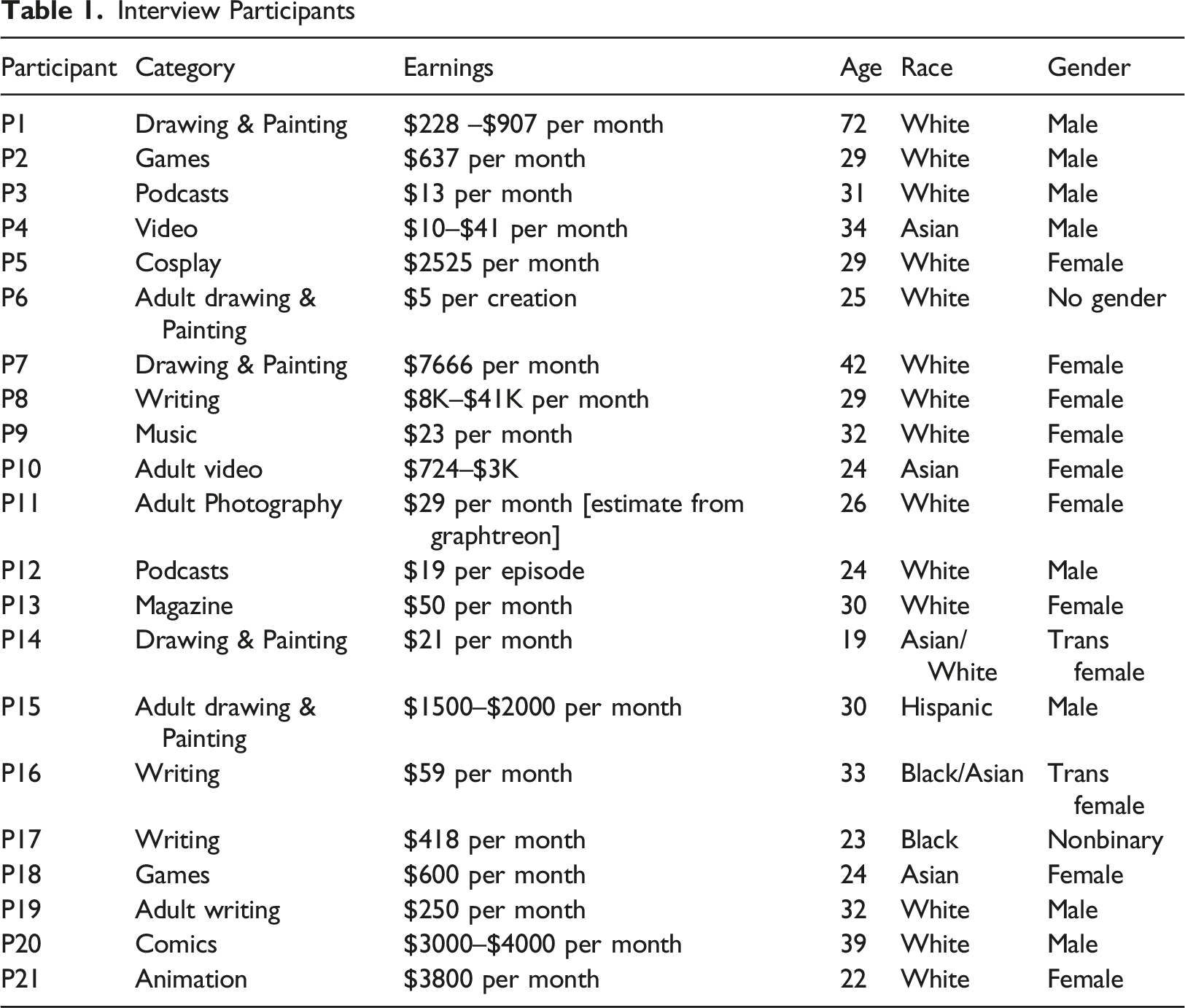
The second author, third author and four research assistants conducted semi-structured interviews remotely by phone and video conferencing software. The interviews were part of data collection in a larger project investigating multiple aspects of Patreon. After each hour-long interview, the participant was given a $50 Amazon gift card. The interviews were transcribed by the automatic transcription service Temi and then corrected by the authors, which resulted in roughly 400 pages and 175,000 words of data.
We organized the data using structural coding, a method in which interview questions are clustered into ‘conceptual domain[s] of inquiry’ (Namey et al., 2008). We used spreadsheets to categorize participants’ responses into nine domains, including ‘creators’ views on Patreon’, ‘tier/reward structure of Patreon page’, ‘creators’ revenue streams’ and ‘competitors to Patreon’.
We independently compared participants’ responses within each domain in order to identify points of consensus and dissent across all participants. After writing independent summaries of the patterns in each domain, we met to jointly discuss these patterns and identify the most prevalent. We then contextualized these patterns within the literature on creator labor and multi-platform practices.
Results
RQ1: Facilitation and constraint
Our first research question asked how Patreon facilitates and constrains digital creative work. Creators cited the subscription model as the major benefit of Patreon, in that it facilitates financial stability, creative autonomy and patron investment. Conversely, creators felt constrained by Patreon’s lack of promotional tools, the difficulty of balancing paywalled and free content and the power asymmetry between Patreon and its users.
Financial stability
Patreon’s central feature is the subscription model, in which patrons provide creators with direct and recurring financial support. Although creators have the option to charge patrons per creative work, the majority charge on a monthly basis. Their subscription income operates like a salary, in that, it is not dependent on the number of hours worked, creative works produced or viewers gained in a month. Because income is guaranteed independent of the creator’s work, creators feel less pressure to churn out content on a continual basis. In addition, Patreon’s monthly subscriptions enable creators to calculate a relatively consistent income each month.
This consistency stands in stark contrast to other revenue models, namely advertising- and commission-based revenue. Participants explained that advertising has become increasingly unreliable for several reasons, including the ubiquity of ad blockers in browsers, the inability to anticipate which videos will be algorithmically successful and the lack of transparency from coordinating platforms (especially YouTube) concerning copyright claims, demonetization and account suspension.
In contrast, creators can anticipate roughly the same amount of money from their patrons each month, ideally with gradual membership growth. Patreon pages tend to grow at a regular rate (or not at all), which avoids the fluctuation of income inherent to advertising and the unpaid gaps between commissions. This long-term financial stability significantly reduces creators’ stress and enables them to budget for larger expenses, such as providing for a family: “Due to the nature of what I did, there was no guarantee [of a monthly income]. Like it could go up, it could go down. … Once I had kids, Patreon represented for me income that I could count on to a degree… Based on the number of patrons I had, it was like, okay, I know I’m going to make at least this amount from this month. It provided some security, some peace of mind, that sort of thing. So that was a big appeal to me.” (P20, comic artist)
Due to its stability, creators mention using their Patreon income to pay for fixed costs like rent and food. As one artist quipped, ‘let’s just say, I no longer had to scramble to draw commissions every other hour just to keep food on the table’ (P15). Even after starting a Patreon, creators typically maintain multiple sources of revenue, such as a YouTube channel, merchandise website and Patreon campaign. Among these, Patreon was singled out as the most reliable and stress-reducing form of income.
Creative autonomy
As mentioned above, Patreon creators earn money regardless of the number of works produced that month. As a result, creators feel greater autonomy over their release schedules. Prior to Patreon, creators often produced and released content that adhered to the algorithmic demands of a platform, such as releasing one small daily video on YouTube, rather than intermittent long videos, in order to keep their channel among the most-promoted. With Patreon, so long as patrons are generally satisfied by a creator’s pace, the creator can experiment with the length and release schedule of their work. It is worth noting that none of our participants mentioned patrons complaining about too little or too infrequent releases of content. Although community pressure could plausibly be as much of an issue as algorithmic pressure, we did not find evidence of it in our interviews.
A sense of greater autonomy extends to the content of the creative work as well. Again, creators tend to release content geared toward algorithmic success, such as fanart that can be easily tagged and marketed to a pre-established community. But participants felt that fans who had become patrons were interested in a creator’s work beyond their greatest hits. P19, a magazine publisher, explained that their patrons have ‘faith [that] whatever I choose to do, they’re going to find it interesting’, whether that be poetry, pornography, architecture or ‘a Christian sermon’. This kind of unconditional support from patrons enables creators to venture into new topics or to revisit niche topics that they find enjoyable but unprofitable. P21, an animator with a large YouTube following, summarized the tension between well-performing and self-fulfilling content on YouTube: ‘The content that performs the best on my channel isn’t what I enjoy doing the most, and the stuff that I enjoy doing the most pays the least. [Patreon] gives me the ability to focus a little bit more on those things that I normally couldn’t focus on’.
Patreon also facilitates autonomy by allowing creators to avoid the ideological strain of endorsing advertisements and corporate sponsors. Even if advertising were a reliable source of income, some creators feel uncomfortable with the idea of associating themselves with advertisements that they cannot personally approve. P8, a member of a team of independent journalists, abandoned advertisements because of the underlying associations with clickbait content and for-profit journalism. Advertising was an ideologically incompatible revenue model for the journalists because ‘we weren’t really basing [our content] on how much money can we make from certain headlines, how many clicks can we get’. After fans reached out with the desire to directly support the team, the journalists ‘saw the opportunity to kind of get some freedom out of [Patreon]’ and earn money without worrying about how to write stories to attract attention and satisfy advertisers.
Investment in the creative process
Finally, Patreon facilitates a particular type of creator-patron engagement: long-term investment in the creative process. On crowdfunding platforms like Kickstarter, a supporter gives a one-time payment to a campaign in the early stages of development, followed by periodic updates and the delivery of the finished product. But on Patreon, not only do patrons receive regular updates but they also continuously pay into the development of the creative work. When patrons fund the ongoing production of a work, they become financially and emotionally invested: “Patreon as a platform makes people feel involved with what you’re creating. It makes them feel like they’re a part of the process and like they’re important to the process. And some people really find that to be attractive. … I think for some people it makes them care more about my finished product to know that they were involved in its production.” (P5, cosplayer)
This is particularly salient for creators with long-term projects, such as journalists or magazine publishers. Participants of this type explained that, prior to Patreon, they often worked ‘invisibly’ for long periods of time and occasionally released unidirectional updates to fans via newsletter or social media. Patreon updates differ, in that, they represent a transaction: patrons are paying a fee to gain exclusive access to information, behind-the-scenes content and sneak peeks. Patrons are no longer framed as passive fans glancing at generic updates, but instead as VIP supporters with financial and emotional investment in the project.
Our participants reported that invested patrons are more likely to engage with a creator’s work. P13, a magazine publisher, feels that her patrons ‘have a stake’ in the magazine and that her patrons are more likely than non-paying fans to engage by providing feedback, writing recommendations and sharing on social media. Because patrons are invested in the development process, they are invested in the project’s eventual success and are willing to advocate for it.
Overall, the blended financial-emotional investment of the subscription model benefits both patrons and creators. Patrons perceive their subscriptions to be more valuable when they are invested in and proud of the work they funded. Creators receive more feedback and public engagement from invested patrons, which not only promotes their work but also emotionally supports and motivates them. In some cases, overzealous patrons convert investment to entitlement and demand new or revised content from creators; as this is an audience management issue, and not a platform issue, it falls outside the scope of this study.
Lack of promotional tools
The first constraint concerns the fact that, currently, Patreon is limited to financial and community management tools. It does not offer promotional tools, although a 2021 announcement indicated that the platform intends to change this due to ongoing complaints from creators and patrons (Patreon, 2021). In our interviews, creators compared Patreon unfavorably to Kickstarter and YouTube – platforms with strong search systems, tags for discovery and within-platform promotion. P18, a Dungeons and Dragons game-runner, pointed out that Patreon lacks basic search functionality, such as being able to search for campaigns related to DandD. She stated that, ‘Patreon has advocated that they are only there to serve your existing fan base’. This aligns with many creators’ perception that Patreon is a viable tool only for creators with a strong existing fanbase who wish to transition away from another revenue model. As explored in RQ2, creators who succeed on Patreon typically do so by actively driving fans to their campaign from social media, rather than relying on Patreon to promote the campaign or for fans to independently discover it.
Patreon does provide basic analytics to its creators, but few participants viewed these as helpful sources of information. One of the only insights gained from Patreon’s analytics was that other platforms are necessary for success. P2, a video/podcast creator, explained that ‘if you look at traffic for a Patreon site… that traffic emerges from external sources and never from internal sources. There’s very little intra-platform usage’, especially in comparison to familiar platforms like YouTube, where users commonly hop from channel to channel and discover new channels through algorithmic suggestion. P2 felt that Patreon exists only ‘as a funnel for other people’s bank accounts into our media universe’.
Without support from the platform, creators who want to grow their campaign are expected to shoulder the burden of self-promotional labor themselves. Many creators are one-person entrepreneurs or small teams unable to afford outside assistance: “I was doing all the research, the writing, the recording, the editing, and I tried to put video editing in there and gave up. And there was also the PR and the marketing and the advertising and the social media work. I was doing everything. I wish I’d been able to find somebody to help, but without making any money on it, I wasn’t going to be able to pay anybody.” (P12, podcaster)
Taking on self-promotional labor cuts into the time that could be spent producing creative work, and it requires creators to learn the entirely new skillset of self-branding, marketing and social media promotion. Consequently, participants identified the lack of promotional support – and the overwhelming burden of self-promotion – as a major constraint of using Patreon.
Balance of free and paywalled content
A second constraint involves Patreon’s paywall. For creators with a large non-paying community and a small group of paying patrons, planning content for a paywall involves a ‘balancing act’ between audiences (P6, adult artist). Creators aim to sufficiently reward paying patrons while avoiding burnout from additional work. The obvious solution would be to assign a portion of their normal work to paywalled content. However, participants explained that this reduces the amount of free content for their non-paying community, who could retaliate by unfollowing the creator and threatening the creator’s popularity. For example, P7, an artist, insists that her art streams be open to both paying and non-paying fans so as not to alienate non-paying YouTube subscribers. Her YouTube and Instagram communities provide the foundation of her art business, with only a small percentage of her followers converted into patrons.
Paywalling content also hampers the promotional value of a creative work. Publicly and freely shared work has the potential to recruit fans and clients, and even to go viral and prompt unexpected income and networking. Paywalled content, on the other hand, is not circulated beyond a small community of already established fans: ‘I’m very wary of creating Patreon exclusive content because it feels like handicapping myself to create something that could end up being really good and then promise that I will only ever show it to patrons’ (P5, cosplayer). Thus, creators are tasked with identifying the most time/cost-effective rewards for patrons without overwhelming themselves, angering their non-paying fans or diminishing the promotional value of their work.
Platform-user power asymmetry
The final constraint concerns Patreon users’ limited ability to suggest or resist platform-level policies that affect their livelihood. As is the case with nearly all large platforms, Patreon does not provide users any way to systematically participate in platform decisions, although it encourages informal feedback through its community forums. In the past, creators have resisted unpopular policies through public outcry on social media, such as when Patreon abruptly announced a new fee policy that de-incentivized donations under $10, the backbone of many creators’ campaigns (Krishna, 2017). The announcement prompted such a wave of backlash that Patreon apologized and reversed the policy (Conte, 2017).
Creators have been less successful in contesting changes concerning censorship of adult content. Although a previous section described Patreon’s facilitation of creative autonomy, this autonomy was not experienced uniformly: adult content creators in particular expressed frustration with Patreon’s controlling policies. P15, an adult content illustrator, stated that several of his fellow adult content creators had their content abruptly flagged or accounts banned on Patreon because their content ‘do[es] not align’ with the policies of MasterCard and PayPal. Out of fear the same may happen to him, he removed potentially offensive content from his Patreon and created an account on SubscribeStar, another digital patronage platform. Most of his income continues to be made through Patreon, but he retains SubscribeStar as an ‘emergency’ platform. P15 explains that he is not alone, as ‘a lot of content creators made emergency profiles [on SubscribeStar] ... ready to go just in case Patreon folds’.
Thus, in a clear example of negotiating autonomy through multi-platform practices, adult content creators safeguard their future finances by creating back-up profiles on other platforms.
RQ2: Patreon within multi-platform practices
“YouTube is such an important factor in growing Patreon. And too many people don’t understand that. They think that they start a Patreon account, and people will just flood in and throw money at them. And it just doesn’t work that way. If you don’t already have a large following on another platform to bring people over, it doesn’t work.” (P7, artist)
Our second question asked how Patreon contributes to creators’ multi-platform practices. As P7’s explanation highlights, Patreon exists within a synergistic network of digital platforms, and a campaign’s success relies on a creator’s fruitful activity outside of Patreon. Our interviews revealed that creators’ multi-platform practices involve three overlapping categories of platforms: communication, content and income-generating platforms.
Communication platforms include social media (Twitter, Facebook, Instagram), personally owned spaces (digital portfolio, email newsletter) and community spaces (Discord, forums). Communication platforms tend to be used for promotional purposes. Promotion extends beyond self-advertisement and includes passive forms such as networking and community management. Examples range from posting promotional content on YouTube, to joining art memes on Twitter in order to gain followers, to casually mentioning Patreon while chatting with (non-paying) fans on Discord.
Although communication platforms require significant labor in terms of time and emotional regulation, they do not generate any income on their own: ‘they’re just designed to push out the product’ (P12, podcaster). Many creators begrudged the amount of promotional work they had to undertake: “I literally can spend two hours a week just hitting all of these social media sites, making appropriate posts. I really understand why that is a job now. It’s mentally exhausting. … If I could, I would just hit the Patreon and have everything else handled separately. But this is basically my advertising, so I can’t.” (P16, writer) “It’s quite difficult to really count [how much time is spent on promotion] because everything I do on social media contributes somehow to it because I’m building social media presence, and basically it’s 24/7 work on my social media unless I’m sleeping. So it’s every day, even every second. Whenever I’m awake.” (P10, adult content creator)
Despite the amount of labor, our interviewees generally preferred to continue communicating with fans on platforms like Twitter and Discord, rather than move their interaction to Patreon. Creators may have spent years establishing communities on these platforms prior to starting a Patreon campaign, and a shift in location would risk the loss of many fans unwilling to learn a new platform. For example, P14, a social media influencer and artist, expects her many Twitter followers to continue engaging on Twitter even after they become patrons. She does not attempt to use Patreon for communication and avoids posting polls, asking questions or utilizing feedback features. Given the entrenchment of communities on communication platforms, and the many promotional opportunities they provide, these platforms constitute a cornerstone of digital creative work.
The second category – content-hosting platforms – is medium-specific, such as YouTube for videos, deviantArt for art and personal websites for long-form writing. In addition to hosting content, these platforms often assist creators in generating and cultivating an audience through analytics, community feedback via comment sections and ratings and tag and search systems for discovery. As mentioned above, if the content platform offers monetization at all, the income is likely to be advertisement-based and inconsistent.
In situations where community membership is the content, communication platforms and content-hosting platforms begin to merge. P18, for example, runs a long-term Dungeons and Dragons role-playing game on Discord. She posts no content on Patreon, using it simply as a tool to receive money from players who are rewarded with in-game benefits. She delivers rewards exclusively through Discord, where she also chats with patrons outside of the game and mentions the Patreon campaign and its perks. Thus, Discord serves as the nexus of her content, community and promotion – but she relies on Patreon to monetize her efforts.
Livestreaming also exemplifies the melding of content and communication. Many of the visual artists in our sample livestreamed themselves creating art while interacting with their fans. For example, P2, a painter who creates art tutorials, hosts monthly ‘paint-along’ patron-exclusive livestreams, and P15 hosts ‘slave streams’ for his highest-paying patrons, in which patrons can request him to draw anything, ‘no questions asked’. Joining a livestream is technically content that a patron pays to receive, but this content is rooted in community and creator-patron communication.
As with Discord, livestreams are not directly monetized. They are supported through an income-generating platform, a platform which specializes in converting fans to paying supporters. Patreon falls into this category, as do other crowdfunding platforms (Kickstarter, IndieGoGo), subscription platforms (Twitch, OnlyFans) and tipping/payment platforms (KoFi, Paypal). Income-generating platforms tend to have limited promotion, discovery and archive tools (if they allow content hosting at all). Thus, creators must use the two previous categories of platforms to cultivate an audience and drive it toward a revenue source.
Among income-generating platforms, creators described Patreon as a middle ground in terms of return-on-effort. Creators report that Patreon requires more effort than a plug-in payment platform like KoFi, which functions as a digital tip jar, but this effort is compensated by Patreon’s provision of information about patrons and the opportunity for sustained interaction with them. Compared to other crowdfunding and subscription platforms, Patreon requires less effort and, notably, induces less stress. For example, one creator turned to Patreon rather than Kickstarter due to fears of mismanaging large amounts of money in a high-stakes, time-bounded crowdfunding campaign. Another creator prefers Patreon to Twitch because he dislikes that Twitch requires streamers to constantly expand their viewership: “With Patreon, I think that you can have a passive experience. … Patreon doesn’t have any kind of [requirement] where it would be like, well, you need to get 300 subscribers or 300 patrons in order to get X, Y, Z on the platform. It is decidedly non-gamified, whereas Twitch is wholly gamified up and down. And that means that Twitch is just A) less useful for me and B) I don’t have any interest in learning to play Twitch better, in order to monetize it better.” (P2, video/podcast creator)
The relatively ‘passive experience’ of Patreon appeals to creators already juggling multiple platforms, many of which exert algorithmic pressure to constantly produce content. As one creator summarized, ‘the psychology of using Patreon versus these other sites [Twitter and Mastodon] is that I feel less pressure about – am I posting enough, am I posting good enough content, etc. … I need there to not be that kind of pressure or I just go crazy’ (P6, adult artist).
Discussion
This study employed in-depth interviews with 21 creators on Patreon to investigate the benefits and drawbacks of digital patronage and its role within the broader digital creative landscape. The data revealed that Patreon is deeply embedded within multi-platform practices: creators often use multiple income-generating, content-hosting and communication platforms simultaneously and synergistically. In digital patronage, as in earlier revenue models, the onus of entrepreneurial labor (and especially self-promotion) is placed on creators’ shoulders. But digital patronage departs from previous revenue models in that it offers creators the possibility of a consistent, long-term income, as well as greater control over their content, schedule and creative identity.
Our first research question explored the benefits and drawbacks of digital patronage. Our participants indicated financial stability to be the primary benefit of digital patronage. Recurrent subscriptions address the financial precarity associated with creative careers (Abbing, 2002; Alacovska, 2018; Lingo and Tepper, 2013). The digital patronage model, as its name indicates, hearkens back to the long-term stipends provided by elite patrons in the Renaissance. Both arrangements, in theory, enable creators to live comfortably and pursue their work without the distraction of chasing after commissions or taking up non-creative ‘workaday’ jobs for the sake of stable income (Throsby and Hollister, 2003; Warnke, 1993). Although few creators currently make a living through Patreon alone (Knepper, 2017), digital patronage represents the possibility for a significant departure from previous digital revenue models – namely, commissions and advertising – that generate income in brief, unpredictable bursts.
Financial stability trickles down to several other benefits. Because creative content is no longer predetermined by clients or by algorithmic popularity, our respondents reported greater flexibility and autonomy in regards to the topic, format and release schedule of their work. Creators trusted their patrons to support not only experimentation with different types of content but also even complete shifts in creative identity. P19, for example, felt confident that his patrons would support his magazine issues regardless of content: ‘If I suddenly developed a really serious interest in architecture, an issue for it could be about architecture, or I could, you know, turn it into a Christian sermon if I wanted’. This flies in the face of literature on digital self-branding, which emphasizes consistency of both content and self in order to establish an ‘authentic’ identity (Scolere, 2019; Whitmer, 2019). In contrast, Patreon creators seem to derive authenticity from their willingness to be intimate and flawed with their inner circle of supporters and to share content that might not align with their public brand: “When I’m talking about my process or about what’s going on in my life, that’s exclusive for patrons. [Patreon content is] what I don’t want public and also things that would be something that I wouldn’t want a future client to see. That [content] then becomes a more intimate connection between me and my patrons to build that community.” (P9, musician)
Creators bolster this sense of intimacy when they reframe a transactional subscription as a patron’s personal support and passion for a creator’s work (Hair, 2021). In comparison to project-based crowdfunding, the rewards on digital patronage platforms are often deemphasized. Patrons subscribe to support the creator first and to receive a reward second, as evidenced by creators’ stories about patrons who continue their subscriptions during content hiatuses (Bonifacio et al., 2021). Patrons come to feel less like consumers and more like investors in the creative process, as the platform ‘makes them feel like they’re a part of the process and like they’re important to the process’ (P5, cosplayer). This adds value for patrons, but also for creators, who benefit from patrons’ willingness to promote the work.
Of course, the current landscape is relatively early in terms of the proliferation of digital patronage as a feasible working model, so the same concerns that plague creators in general – such as increased competition, copying of content and marketing – will most likely appear as more creators start to use platforms like Patreon. It will be interesting to see how engagement with their patrons shapes their creative practices and if having such close relationships with patrons results in creator-patron relationships give creators more or less freedom in terms of how they express themselves through their work and which content they decide will be free.
Patreon’s innovations are counterbalanced by the fact that it perpetuates the problem of forced entrepreneurial labor, especially in regards to self-promotion. Digital patronage platforms like Patreon claim that they can be used to monetize a creator’s existing content without additional work on the creator’s part. But in reality, Patreon functions more like ‘a funnel for other people’s bank accounts’, a monetization tool that must be operated in tandem with other platforms (P2, game developer). Patreon’s lack of promotional tools or discovery features means that creators are forced to use multiple social media platforms to make their Patreon campaign successful. The self-promotional aspect of entrepreneurial labor has been a continual burden on creators for a number of reasons: most creators are not trained in marketing; around-the-clock social media interaction makes it difficult to maintain a work/life balance; such interaction is emotionally draining, especially for introverted creators and promotion of the self also means commercialization (and sometimes dehumanization) of the self (Baym, 2018; Cunningham and Craig, 2019; Davidson and Poor, 2015; Neff et al., 2005). Although creators might choose to make use of social media to communicate with their fans, Patreon’s lack of promotional tools removes the voluntary nature of that choice and forces creators to seek patron communication management elsewhere.
Assigning promotional duties to the creator, rather than to the platform or some form of management, intensifies the neoliberal risk-taking that characterizes entrepreneurship (Brzozowska and Galuszka, 2021; Guarriello, 2019; Neff et al., 2005; Scolere, 2019). Creators assume all risk for their creative endeavors because they run every part of their business, they are single-handedly responsible for their own success – and for their failure. This perspective ignores the major role that platforms play in creator success (Nieborg and Poell, 2018). Our respondents drew explicit comparisons between how platforms like Patreon, Twitch and YouTube shape creators’ careers. The latter two demand a certain level of audience growth from partnered users, but they also support that growth through algorithmic recommendations to viewers and data analytics for creators. In comparison, Patreon neither requires nor facilitates growth. Some respondents praised this ‘passive experience’ (P2, game developer), but others characterized the platform as unsupportive.
Our second research question asked how digital patronage fits into creators’ multi-platform practices. As mentioned above, Patreon exists as one gear within a multi-platform machine. Creators commonly used distinct platforms to host content, to communicate with and advertise to fans and to monetize their efforts. Creators adopt multiple platforms because they complement each other’s weaknesses, such as Patreon’s lack of promotional tools and poor archiving of content. A creator has to judge the unique strengths of each platform against the time and effort needed to learn its norms and tailor content to it (Scolere, 2019). P2, for example, judged Twitch’s normative expectations of constant growth to be too stressful and not worth the time spent learning how to ‘game’ the system.
Our findings corroborated the idea that creators take up multi-platform practices to preserve their autonomy and enhance their economic viability (Cunningham and Craig, 2019; Nieborg and Poell, 2018; Rouse and Salter, 2021; Scolere, 2019). In the case of Patreon, creators’ autonomy was threatened by a series of policy changes and crackdowns on adult content (Cole, 2018). Many of the adult content creators who remained on Patreon created back-up accounts on other platforms, as they felt that Patreon could remove their account at any time and without any recourse on the creator’s side. Sudden policy changes about inappropriate content and unappealable bans have driven creators to migrate platforms elsewhere, such as Tumblr to Twitter (Captain, 2018). The same migration could occur on Patreon if new policies infringe too greatly on creators’ income.
Ultimately, Patreon’s content policies are not decided in a vacuum. Patreon answers to its payment partners, including Paypal, a company that explicitly bans payment for sexually explicit content (Dellinger, 2018), and to the federal government (Romano, 2018). Even in light of these broader forces, our participants advocated for greater transparency and communication from Patreon. Like nearly all major platforms, Patreon is characterized by a severe user-platform power asymmetry in which users have little to no say in decisions that can affect or even destroy their livelihoods (Digital Future Society, 2019; Nieborg and Poell, 2018).
Our study is limited by its participants. Most were located in North America, and the majority had relatively small audiences. It is not clear how success affects perceptions of Patreon’s value nor did we talk to creators who chose other revenue models over digital patronage. Our work would benefit from quantitative follow-up, especially surveys of creators to determine the generalizability of our findings.
Conclusion
We found that Patreon facilitates creative work by supporting creators’ financial stability, enhancing their creative autonomy and independence from financial intermediaries, and fostering fans’ investment in the creative process. Patreon constrains creative work due to its lack of promotional tools and the subsequent burden of self-promotion placed on creators, creators’ struggle to strike a balance between free and paywalled content and the power asymmetry between Patreon and its users. Creators perceived Patreon to be deeply embedded within multi-platform practices: without promotional efforts on other platforms, a creator is extremely unlikely to succeed on Patreon. Previous literature has observed a similar phenomenon on Patreon and other crowdfunding platforms, which further corroborates our observation of the labor intensity of self-promotion (Brzozowska and Galuszka, 2021; Dalla Chiesa, 2021; Hunter, 2016). Rather than a standalone tool, Patreon was described as an additional opportunity to generate stable income and foster a small, intimate community of fans more dedicated than a creator’s general audience.
Patreon exists as an income-generating tool, dependent on content-hosting and promotional platforms to supply monetizable content and fans. This system is made possible by creators’ willingness to take on entrepreneurial labor and to adopt multi-platform practices. The digital patronage model offers creators greater engagement from committed patrons and a stable monthly income, independent of specific work produced and less fettered by algorithmic and attention-based constraints on content and scheduling.
Digital patronage is no longer confined to creative platforms. As Twitter and Facebook incorporate tipping and subscription features (Fischer and King, 2021; Yurieff, 2021), this model becomes a viable source of income for journalists, activists, educators, experts and everyday users. Future research is needed to continue to clarify the benefits and drawbacks associated with digital patronage and how it operates relative to its predecessors.
Footnotes
Funding
The author(s) disclosed receipt of the following financial support for the research, authorship and/or publication of this article: This study was supported by National Science Foundation; 1928627.
Note
Author biographies
 ). His current focus is on digital patronage platforms like Patreon and the intersection between technological advances and independent creator empowerment.
). Her research is in the area of Human Computer Interaction (HCI) where she studies the characteristics and consequences of social interactions in online environments such as livestreaming, esports, gaming and social media.