



Abstract
Gaming livestreams have seen unprecedented growth on platforms such as Twitch.tv and YouTube Live, especially since the start of the COVID-19 pandemic. This study examined fans’ motivations for watching and supporting their favorite streamers. The results of an online survey showed that the time spent watching livestreams was positively associated with the degree of parasocial affinity they feel toward that streamer. Parasocial affinity strength was, in turn, a significant predictor of the likelihood of sending virtual gifts or donations to streamers. Some gender differences in motivations also emerged. Women reported being more likely to watch a particular gaming stream because of the streamer’s characteristics rather than the game being played, while men were equally likely to watch because of the streamer or because of the game being played.
Introduction
In the era of Web 2.0, watching live streams has become a common pastime. Reflecting the effect of quarantines intended to mitigate the impact of the COVID-19 pandemic, monthly streamers on Twitch.tv rose from 3.64 million in 2019 to 6.9 million in 2020 (TwitchTracker, 2021). Even though quarantines have been mostly lifted, the growth has continued unabated.
What could be the reasons for such a consistent growth? One possible answer is that online audiences are increasingly starved for authenticity. In the early days of social media influencers, audiences were drawn to what appeared to be real people giving honest reviews (Chronis and Hampton, 2008). The keywords were ‘real’ and ‘honest’ until money started to commodify the relationship between social media influencers and the audience. As some social media influencers started reviewing products for pay without disclosing posts as advertisements, their authenticity and credibility were eroded (Audrezet et al., 2020). Enter streamers, who tend to be seen as ‘people like us’ (Lee, 2020: 17) and who, by definition, operate in real time. Gaming streamers cannot edit a stream if they make a mistake. In that way, they have replaced some of the authenticity lost as other social media influencers sold fans’ attention to advertisers.
Livestreaming happens on synchronous social media platforms, of which Twitch.tv is one example. Most popular Twitch.tv streams focus on digital gameplay – an unsurprising fact, considering the video game industry grossed more revenue in the past decade than the film and sports industries combined (Witkowski, 2020). Streamers can simultaneously broadcast video/audio and interact with fans in a text-based format (chat), allowing many to create a faux-reciprocal relationship with their followers. In the context of such interactions, audiences often reward streamers with virtual currency, points or badges (Bründl et al., 2017; Zimmer et al., 2018). All gifts on Twitch are purchased with in-app currency, which is bought with real-world money (Hilvert-Bruce et al., 2018), commodifying the relationships between the streamers and many fans.
What explains the global explosion of interest in watching others play video games online and voluntarily donating to streamers despite the (mostly) free access to livestreams? Gandolfi (2016) identified three main fan motivations for seeking out gaming livestreams: the challenge (how well the streamer performs in-game), the exhibition (the spectacle offered by the streamer) and the exchange (the streamer–game and the streamer–viewer bonds). This study aims to build on Gandolfi’s and similar work by other scholars (e.g. Chen and Lin, 2018; Heo et al., 2020; Hu et al., 2017; Wohn et al., 2018; Wohn et al., 2019) by employing the conceptual lens of parasocial relationships (Horton and Wohl, 1956) to determine why fans choose to watch gaming streams and to (sometimes) financially support specific streamers. Fan gender is considered an additional variable because of its strong potential for explanatory power, as indicated by, for instance, research on sports fans’ motivations (e.g. Wann, 1995).
Literature review
A growing body of literature has explored the emerging practice of live streaming (Taylor, 2018), including through the lens of power, oppression and intersectionality (e.g. Chan and Gray, 2020; Gray, 2017; Ruberg et al., 2019), labor (Catá, 2020; Johnson, 2021; Woodcock and Johnson, 2019) and cultural performance/performativity (e.g. Johnson, 2022; Li et al., 2019; Zhang and Hjorth, 2019). Much of this important literature has focused on streamers’ live streaming practices and experiences. Less – and less prominent – research has explored what is happening on the other side of the screen, in live streaming fans’ cognitive and emotional worlds. This study’s focus, therefore, is on the live streaming fanship communities that have emerged with the growth of live streaming platforms.
In the academic literature, fandom has long been seen in a negative light, from the stereotyping of ‘screaming fangirls’ (Duffett, 2017:144) to the sometimes-taboo nature of collecting fannish objects (Heljakka, 2017). While the first wave of fandom studies addressed power and representation within fandom, defending fan communities as legitimate social groups, and the second wave explored how fan practices contribute to interpretive communities, the current (third wave) is squarely focused on fan wants, needs and motivations (Sandvoss, 2017). The present study is representative of the third wave of fandom studies and, as such, focuses only on fans’ motivations without critical-cultural or interpretive frameworks.
Fan motivations
Gaming livestreams include Let’s Plays (a streamer plays a single-player game and comments on each action), multiplayer gaming (a streamer plays with other players online) and co-op (multiplayer gaming with friends in real life or with other players online). Fans often enjoy watching Twitch.tv streams in genres different from those they play (Gandolfi, 2016). Some are ‘just watchers’, meaning they do not play or are even actively averse to playing but find that ‘games spectatorship offers them narrative engagement that is distinct from traditional media’ (Orme, 2021: 1).
Research on what motivates live streaming fans has accelerated in recent years but remains in many ways limited and inconclusive. In the cultural context of China, Hu et al. (2017) found that fans watch live streams because they identify with the streamers – including both ‘actual and ideal self-congruity’ – as well as because of ‘cognitive communion and resonant contagion’ resulting from co-experiencing a live stream with other fans (594). A South Korean study indicated that streamers’ expertise (e.g. gaming skills) positively affected their social capital, and perceived physical attractiveness had a negative impact (Heo et al., 2020). In the context of sports live streaming, also in China, Liu et al. (2022) determined viewers’ degree of customer satisfaction, defined as ‘consumption-related fulfillment’ (604) with the services provided by streamers, is the strongest determinant of gifting behavior.
These findings, however, do not fully align with other recently published research indicating less lofty factors at play. These differences reflect, in part, researchers’ use of a wide range of theoretical concepts and frameworks. Wohn et al. (2019) found that U.S. streamer fans watch and subscribe because they like the ‘feeling of being appreciated’ (108); indeed, the results showed that fans tend to pay more for subscriptions if streamers offer perks and incentives. Furthermore, U.S. fans reported watching and donating to streamers because they like them, find them physically attractive and/or desire social interaction (Wohn et al., 2018). Hou et al. (2020) found similar motivations in a Chinese context. They showed that live streaming fans are motivated by liking streamers who are funny and attractive, as well as by the ability to interact in real time and feel a sense of control over the interaction; and (c) ‘social status display’ (141). Drawing on responses from live streaming fans in Taiwan, Chen and Lin (2018) showed that users watch livestreams to relieve stress but also because they ‘were attracted by the charm of streamers’ (293). In the context of the U.S. and Turkey, research has also indicated that when the streamers are women, they attract larger audiences when they dress more revealingly, even though they have faced gendered dress codes (Cullen and Ruberg, 2019; Zorlu and Özkan, 2020). Given this slew of mostly complementary but also sometimes contradictory findings about the motivations of streamer fans, this study seeks to clarify and contribute to the existing scholarly knowledge by posing the following broad question:
Parasocial relationships
The primary body of literature that serves as the foundation for the current research pertains to so-called parasocial relationships, which refer to fans’ one-sided perceived intimate relationships with media figures and celebrities, including those formed through social media (Chung and Cho, 2017; Sokolova and Kefi, 2020). Horton and Wohl defined parasocial relationships in 1956 as a ‘simulacrum of conversational give and take’ (1956: 215), in which audience members feel as though they ‘know’ or are friends with certain performers or fictional characters. Parasocial relationships tend to develop and are reinforced by fans’ repeated exposure to a media figure (Rubin and McHugh, 1987). Generally, the audience member ‘know(s) such a persona in somewhat the same way they know their chosen friends’ (Horton and Wohl, 1956: 216). Horton and Wohl (1956) added that parasocial relationships elicit in fans a more profound sense of intimacy over time, as the mediated appearance of the admired media figure is a ‘regular and dependable event, to be counted on, planned for, and integrated into the routines of daily life’ (216).
While Horton and Wohl (1956) saw parasocial relationships as a complement to audience members’ social lives, Schickel (1985) suggested that fans use celebrities as a vessel of social capital they lack in real life and form parasocial relationships to share such celebrities’ fame and power vicariously. Jensen (1992) similarly argued that parasocial relationships indicate unfulfilled social needs. Collisson et al. (2018) found that people who fear rejection in real life are especially likely to form parasocial relationships because they generally are less intense, less threatening and easier to maintain. A recent meta-analysis, however, refuted the so-called ‘substitution hypothesis’ by showing no significant association between ‘social deficiencies’ and parasocial relationships (Tukachinsky et al., 2020).
The participatory nature of the internet has taken parasocial relationships to a new level, giving fans and media figures a platform to interact or stage imitations of personal interactions. The literature shows that online communities can function as valuable social groups for people who may lack real-life social relationships (e.g. Bargh and McKenna, 2004; Hilvert-Bruce et al., 2018). Socially anxious adolescents are more likely to experience meaningful connections online, as these relationships are less risky and allow for more control over the interaction (Valkenburg and Peter, 2009).
Streamer fanship as a parasocial relationship
Streamer fanship is one illustration of parasocial affinity in the contemporary media environment – perhaps, even more so than other forms of fandom centered around social media or various channels of audiovisual entertainment (e.g. T.V. and movies). The relationship between a streamer and a fan is strengthened through multiple mechanisms streamers use to recognize and interact with their fans (Hargittai and Litt, 2011). McLaughlin and Wohn (2021) found live streamers’ interpersonal attractiveness (the degree to which s/he is perceived as likable and friendly) is the strongest predictor of the fans’ development of parasocial relationships. As the internet’s anonymity encourages self-disclosure (Rubin, 1975), that selective self-disclosure facilitates, in turn, a sense of intimacy and the development of social relationships (Bargh and McKenna, 2004). As a result, fans often view streamers as ‘intimate friends’ (Hu et al., 2017: 2.3). Furthermore, the streamers’ self-disclosure and interactions with fans facilitate parasocial relationships that are not entirely one-sided but rather ‘one-and-a-half-way’ (Kowert and Daniel, 2021).
What also contributes to the sense of intimacy is live streamers’ facilitation of participatory communities, which welcome newcomers and encourage members to participate in group activities (Hamilton et al., 2014). The result is an experience of social association or the pleasure of being together, which in livestreams is illustrated by banter in the chat or lighthearted joking alongside gameplay. Sjöblom and Hamari (2017) found feeling a sense of community is the strongest predictor of fans’ following specific streamers on Twitch and subscribing to their streams, and Lin (2021) determined that social presence, or the awareness of togetherness with others, moderated the associations between parasocial affinity and enjoyment, satisfaction and loyalty in live streaming contexts.
Socialization is one of the primary motivations of users of Twitch.tv (Gros et al., 2017), which is supported by observations that fan-to-fan interactions sometimes focus on intimate matters, such as mental health, and often continue outside their favorite live streamer’s chat, on messaging platforms such as Discord (Kowert and Daniel, 2021). De Wit et al. (2020) found that Twitch online communities can facilitate coping among individuals going through difficult life periods. Livestreams, therefore, act as incubators where social communities grow over time (Hilvert-Bruce et al., 2018), even though fans’ social connections may remain fragmented and weak compared to the strength of their affinity toward their favorite streamers (Gandolfi, 2016).
Given all these characteristics, livestreams illustrate Auslander’s (2008) argument about the ontologically blurred line between traditional ‘liveness’ (real time, unrecorded and face-to-face performances, such as theater) and mediatized experiences. Although livestreams occur in real time, unlike theater, they (a) are by definition mediated by digital platforms such as Twitch.tv, (b) focus on digital gameplay, a pre-recorded experience, despite its many possible outcomes and (c) can be archived for later viewing by fans. On the other hand, livestreams have an explicit element of ‘sociality’ or knowledge that many others are watching, which Van Es (2017) argued is central to ‘liveness’. Both livestreams and live performances allow fans to interact with fellow audience members and performers. However, these interactions are more common, expansive and simultaneous in live streaming due to the use of a text-based chat. Regardless of where livestreams fit in the typology of ‘live’ performances, what is essential to the formation of parasocial affinity is that fans’ interactions with streamers have some unpredictability and perceived authenticity, a precursor to live performances’ ‘putative ability to create community (if not communion) among its participants, including performers and spectators’ (Auslander, 2008: 4).
Given the importance of time in the formation of parasocial affinity (Horton and Wohl, 1956) and the findings of a recent meta-analysis showing that the length of exposure to a media figure is positively associated with parasocial relationship strength (Tukachinsky et al., 2020), we expect that time spent watching and the strength of a fan’s parasocial relationship will be positively associated. Such an association does not necessarily mean more viewing time causes more parasocial affinity. The association between continued viewing of livestreams and parasocial relationship strength has been supported, though only in the context of South Korea, by Lim et al.’s (2020) finding that ‘a viewer’s likeliness to continue viewing a live-streaming game increases as the viewer develops stronger PSR’ (1). Therefore, we propose the following:
However, viewership alone is not the only factor in forming parasocial affinity. Research has shown that the more a streamer interacts with fans, the stronger the fans’ parasocial affinity becomes (Brown, 2015; Frederick et al., 2012). For example, to boost their fans’ engagement, streamers often ask them for direct feedback and interact in real time (Hou et al., 2020). Some streamers use dual monitors to play the game on one and manage the chat on the other, allowing viewers to make suggestions in real time. Streamers also take the time to answer specific questions or thank fans for their advice (Anderson, 2017).
The most significant interaction between streamers and fans occurs when the streamer mentions specific viewers by username. Wulf et al. (2021) experimentally determined that parasocial interactions result from streamers’ addressing fans individually and responding to messages in the chat. Addressing someone by name establishes individuation (for a review, see Goodwin and Frame, 1989), which is likely amplified by the uniqueness of usernames in digital environments. Furthermore, extrapolating from research about classroom interactions, it is likely that being recognized by name makes participants feel valued by their favorite streamer and contributes to relationship and community building (Cooper et al., 2017; Murdoch et al., 2018). The participatory format allows for a ‘more effective interactivity’ (Lim et al., 2020, section 2.4) and facilitates the development of fans’ parasocial affinity.
The importance of such engagement is especially salient in fans’ donations of money or in-app gifts to streamers. Streamers routinely reward their supporters by, for example, putting the usernames of donors on screen or by featuring a ‘top donor’ and/or ‘recent donor’ section on the screen (Anderson, 2017; Sjöblom et al., 2019). Fans seeking to interact with the streamer donate to receive some form of reciprocity (e.g. a verbal acknowledgment) or to get a message on a public channel for other fans to view. Fans reported that such interactions positively affected their mood and helped them avoid feelings of ‘loneness’ (Wohn et al., 2018: 8). Wohn et al. (2018) also found that some fans donate as compensation for the streamer’s time and energy, while others contribute to show the streamer emotional and material support. Given the extant literature, we hypothesize the following:
The importance of relational motivations in donating or sending virtual gifts to streamers is also highlighted by Li et al. (2021); however, in addition to this factor, they point to gifting behavior as an expression of class identity. Similarly, Hou et al. (2020) showed that some streamer fans use gifting behavior to flaunt their social status, as sending expensive virtual gifts demonstrates one’s wealth conspicuously. Although Li et al. (2021) and Hou et al. (2020) base their findings on Chinese participants, both draw on what was once a Western concept of ‘conspicuous consumption’ (Veblen, 1899/2005) – making it reasonable to expect that the findings would be replicable in a Western country such as the U.S. Therefore, we propose the following:
Gender and parasocial relationships
Only one study, by McLaughlin and Wohn (2021), has explored fan gender as a potential predictor of parasocial phenomena in live streaming, concluding that gender has no statistically significant effect. This finding contradicts research showing that – whether because of nature, nurture or a combination of both – women are, on average, more sociable and other-oriented, while men tend to be more self- and object-oriented (e.g. Levant, 1996). Men’s awareness during interpersonal communication also focuses primarily on ‘self-oriented achievement’, while women self-monitor ‘for the benefit of a relationship and dyadic or communal interest’ (Bubas, 2001, 573).
In the context of parasocial relationships, women tend to form more intense attachments than men (Cohen, 2003; Tukachinsky et al., 2020). They are also more likely than men to develop parasocial relationships with media figures of the opposite sex (Eyal and Cohen, 2006). These findings are most easily contextualized within the empathizing-systemizing (E-S) theory of sex differences, which suggests that, by comparison to women, men have a stronger drive to ‘to analyse and explore a system, to extract underlying rules that govern the behaviour of a system; and the drive to construct systems’ (Baron-Cohen, 2005: 23). A recent study with almost 700,000 participants offered support to the E-S theory by showing that women scored significantly higher on measures of empathy, while men scored significantly higher on measures of systemizing (Greenberg et al., 2018). Therefore, we propose the following:
Recent research has indicated men spend more time than women watching gaming livestreams (Cabeza-Ramirez et al., 2021), although in overall live streaming across genres viewing time and gift-giving, no gender differences appear to exist (Long and Tefertiller, 2020). However, there remains a gap in the literature regarding the potential role of gender in fans’ motivations to watch and donate to their favorite streamers (activities likely linked to the strength of fans’ parasocial phenomena, as hypothesized earlier). Therefore, we asked the following:
Methodology
The method was a survey administered online to undergraduate students at a major research university in the U.S. Southwest and participants in Reddit gaming forums. The undergraduate students participated in exchange for extra credit, while the Reddit users were encouraged to enter their emails into a drawing for two Amazon gift cards worth $20 each. The questionnaire was designed and administered via Qualtrics.
Participants
There were 567 participants in the original sample. We cleaned the data to remove 363 participants who (a) did not fit the study criteria (e.g. they did not watch livestreams or did not list a specific streamer); (b) gave identical answers (e.g. only ‘neutral’ or only ‘strongly agree’) across the measures in the survey or (c) claimed to know in real life streamers with more than 500,000 followers. Participants who claimed to know in real life streamers with fewer than 500,000 followers were left in the sample because there was a greater chance that they could have met the streamer at a convention or a meet-and-greet event. The final sample included 204 participants, of whom 53% identified as women, 44% as men and 2.5% as non-binary or other. More than three-quarters of the final sample participants were undergraduate students recruited in exchange for extra credit; only 46 were Reddit users.
The median age was 21 years. More than half of the participants identified as White/Caucasian (61.1%), 23.6% identified as Hispanic/Latinx, 6.9% identified as Black/African American, 4.9% were Asian American/Pacific Islander and 2% were Native American/American Indian. More than half of the participants (80.9%) reported having some college experience, 16.2% held a high school diploma or GED, 17.2% held a bachelor’s degree, 2% had a graduate or professional degree and 0.5% had not completed high school. Finally, in regard to annual income, the category that was most frequently selected was under $20,000 (28.9% of participants), followed by more than $100,000 (20.9%), $40,000–$60,000 (15.4%), $60,000–$80,000 (13.9%), $20,000–$40,000 (13.4%) and $80,000–$100,000 (7.5%).
Measures
The participants were asked to name their favorite streamer and keep their favorite streamer in mind when answering subsequent questions.
Time
Time was measured as an ordinal variable with four levels. Participants were asked to estimate how much time per week they usually spend watching livestreams (0–3 h; 4–7 h; 7–10 h; more than 10 h). The most frequently selected option, by 45% (92) of the participants in the sample, was 4–7 h a week.
Motivations
Participants in the survey were given the following options in response to the questions about why they watch a particular streamer and why they give gifts/donate to that streamer: (a) streamer uses interaction with chat; (b) streamer uses facecam; (c) streamer uses incentives (e.g. a shoutout on screen); (d) streamer is attractive; (e) streamer dresses provocatively; (f) streamer dresses modestly and (g) other (please specify). The gift-giving motivations question included an additional option: ‘regardless of the circumstances, I would not donate’. The list of potential motivations reflected previous research on live streaming fans’ motivations (Gandolfi, 2016; Wohn et al., 208; Wohn et al., 2019). In addition, to test H3b, participants were also asked to report their level of agreement with the following statements: ‘The main reason I watch livestreams is that I like the streamer(s)’ and ‘The main reason I watch livestreams is that I like the game(s) being played’ (1 = strongly disagree, 5 = strongly agree).
Strength of parasocial relationships
The Celebrity-Persona Parasocial Interaction (CPPI) Scale from Bocarnea and Brown (2006) was used to measure the strength of fans’ parasocial relationship with streamers. The CPPI scale was used because it measures identification with and liking of a media figure over time and across different platforms – an essential element because most streamers on Twitch.tv have a presence and are followed by fans across social media platforms, such as Twitter and Instagram. Furthermore, we used the CPPI scale to measure the strength of parasocial relationships (not interaction during a single exposure) because it explicitly focuses on what Dibble et al. (2016) have referred to as ‘long-term social involvement’ (23). It is partially derived from the Rubin et al. (1985) parasocial interaction scale, which has been shown to correlate more strongly with the dimensions of parasocial relationships than parasocial interactions (Dibble et al., 2016). We used 10 of the 20 items from the CPPI with minor modifications to adapt them to the study context (α = 0.84). Example items included ‘I look forward to [streamer] posting new content and/or going live’, ‘[Streamer] makes me feel as if I am with someone I know well’, and ‘I feel like I have very little understanding of [streamer] as a person’ (reverse) (1 = strongly disagree, 5 = strongly agree).
Likelihood to donate
Fans’ likelihood to donate to their favorite streamers was measured through an eight-item scale employed by Wohn et al. (2018), adapted from Cutrona and Russell (1987), with slight changes to only two questions to reflect their use for live streaming (α = 0.89). Example items included ‘I would give money to them to help with their livelihood’, ‘I would give them money to support their efforts’ and ‘I would give them a gift to show my appreciation’ (1 = strongly disagree, 5 = strongly agree).
Results
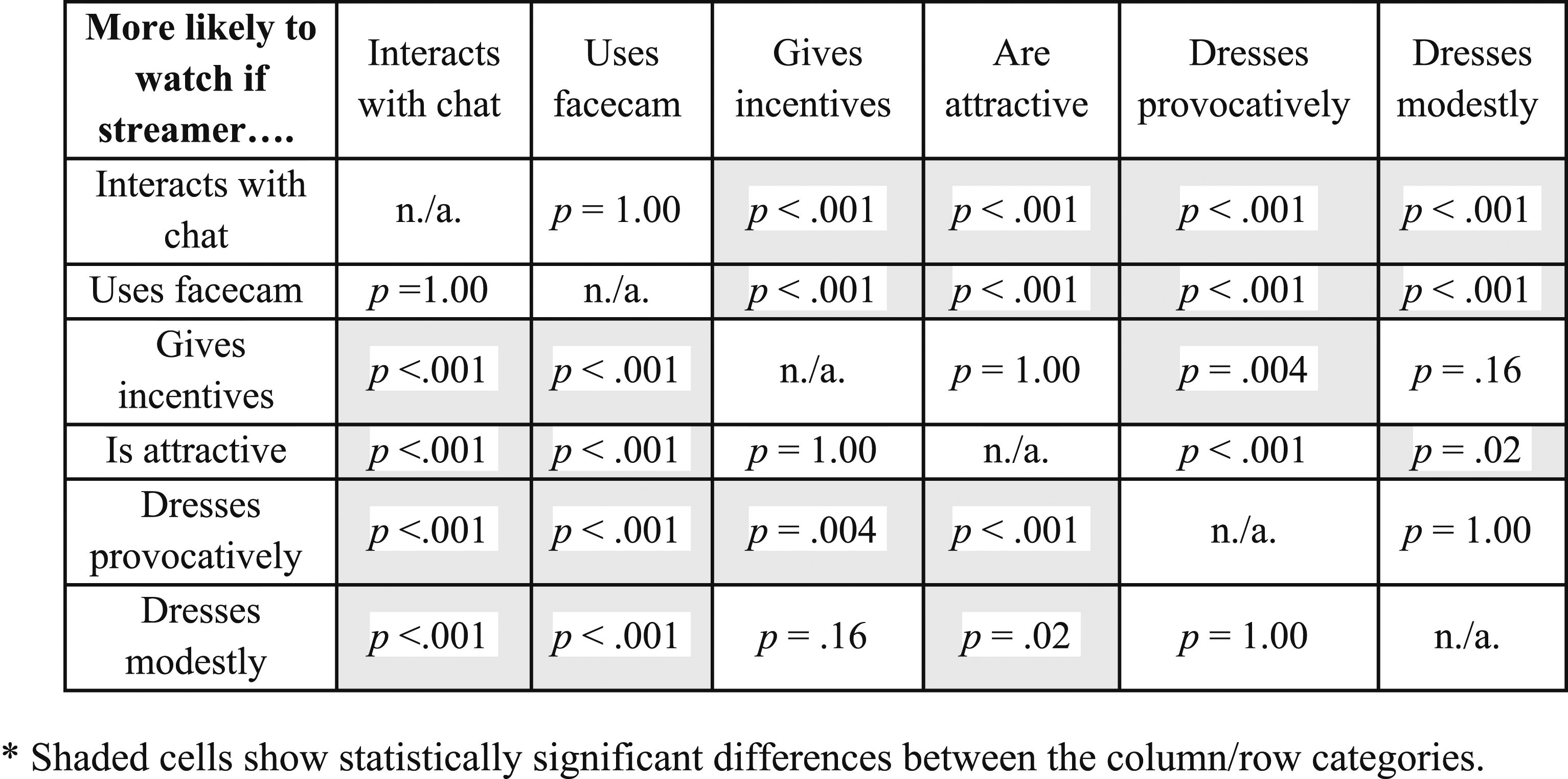
RQ1a asked about fans’ primary motivations for viewing game-related livestreams. We submitted the data to a Cochran’s Q test, which tests for equality of proportions within subjects. The test indicated the presence of significant differences in the frequency of viewership motivations reported by the fans, χ2(6) = 291.14, p < 0.001. The most popular viewing motivation, reported by 64% of fans, was the streamer’s interaction through the chat during gameplay. The second most popular reason for watching was the streamer’s use of a facecam (58%). Participants reported these motivations more frequently than watching because of the streamer’s perceived attractiveness (28%, p < 0.001), the streamer’s dressing modestly (12.5%, p < 0.001) and the streamer’s dressing provocatively (7.5%, p < 0.004). For the percent of respondents reporting each motivation, see Figure 1; for statistically significant pairwise comparisons, see Table 1. Proportions of respondents reporting each motivation for viewing game-related livestreams. Pairwise comparisons between proportions of respondents reporting each motivation for gift-giving to livestreamers.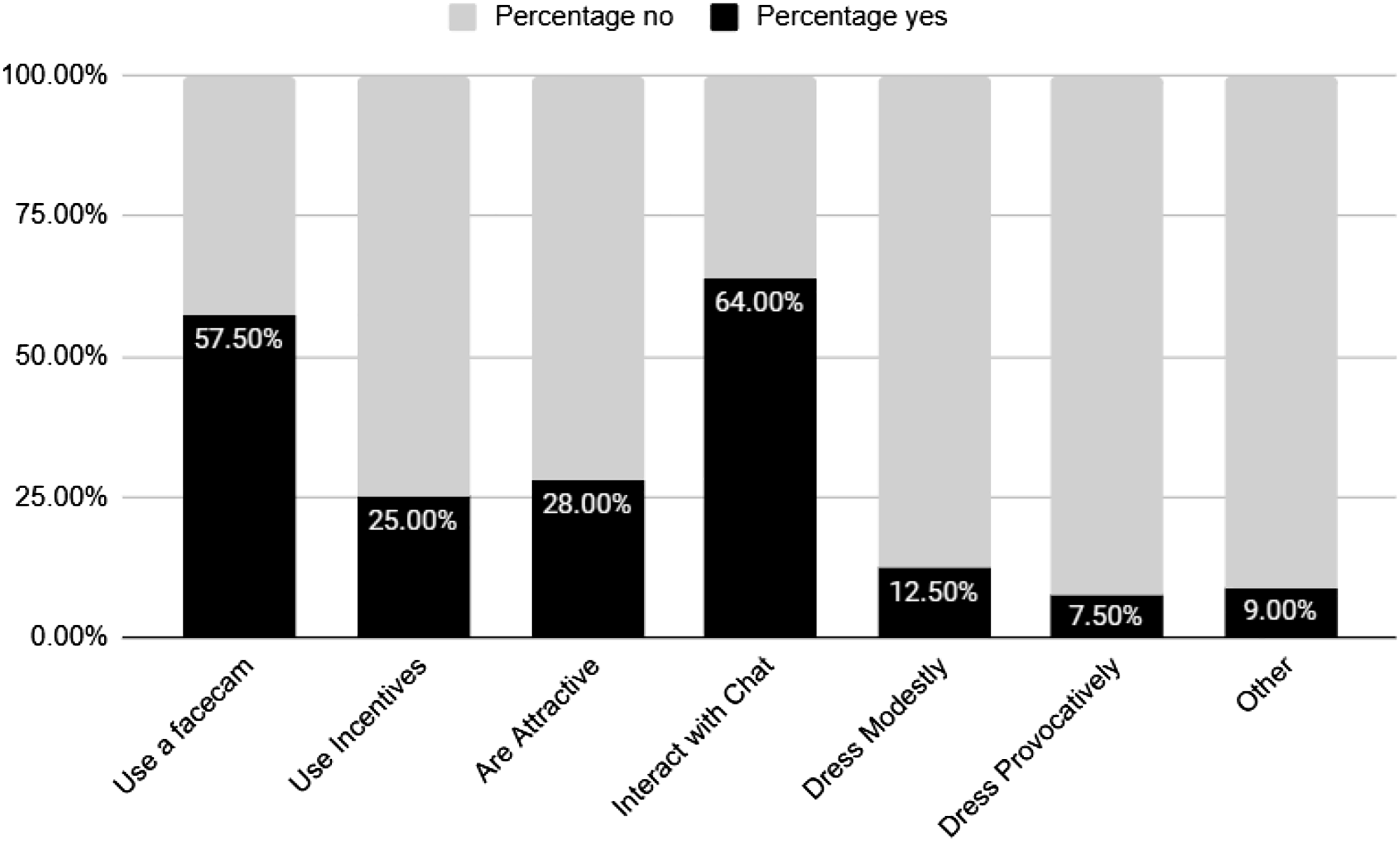
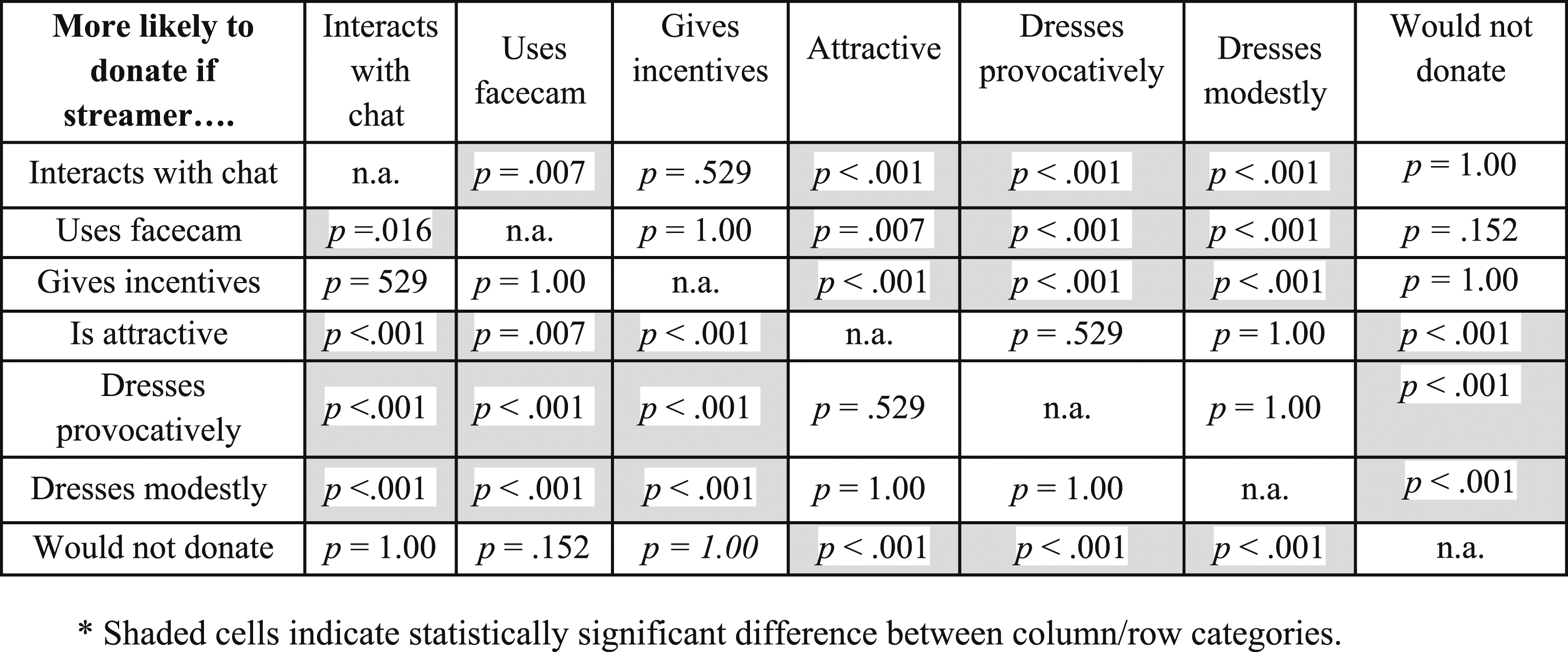
In respect to the second part of the research question, which asked about fans’ main motivations for gift-giving, the data were, again, submitted to a Cochran’s Q test. The test indicated significant differences among the frequencies of the gift-giving motivations reported by the fans, χ2(6) = 161.72, p < 0.001. The streamer’s interaction with the chat during gameplay was the most popular gift-giving motivation, reported by 44% of fans. This motivation was significantly more frequently expressed than motivations linked to the streamer’s use of facecam (29%, p = 0.01), the streamer’s attractiveness (13%, p < 0.001), the streamer’s dressing modestly (9%, p < 0.001) and the streamer’s dressing provocatively (4%, p < 0.001). For the percent of respondents who reported each motivation, see Figure 2; for statistically significant pairwise comparisons, see Table 2. Proportions of respondents reporting each motivation for gift-giving to livestreamers. Pairwise comparisons between proportions of respondents reporting each motivation for gift-giving to livestreamers.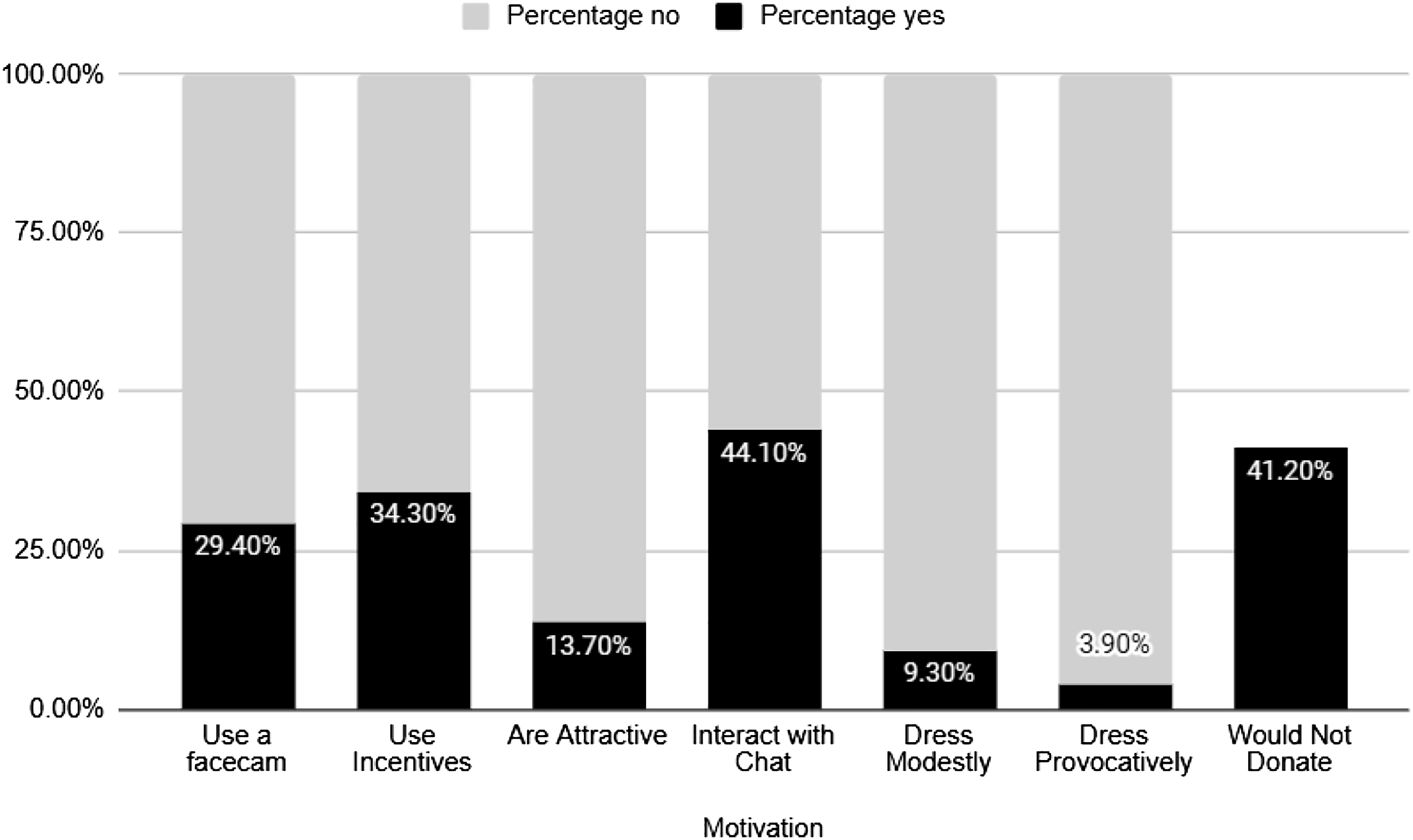
H1 proposed that the amount of time spent watching a particular streamer will be positively associated with likelihood to donate, and H2 proposed that there will be a positive association between fans’ levels of PSR and their likelihood to donate. Regression analysis showed that the strength of the parasocial relationship with a streamer mediates the effect of the amount of time spent watching the streamer on likelihood to donate. Results indicated that time spent watching a streamer was a significant predictor of the strength of the parasocial relationship, B = 0.17, SE = 0.04, 95% CI [0.08, 0.26], β = 0.26, p < 0.01 and that the strength of the parasocial relationship was a significant predictor of likelihood to donate, B = 0.75, SE = 0.07, 95% CI [0.61.89], β = 0.60, p < 0.01. The predictors accounted for approximately 43% of the variance in likelihood to donate (R2 = 0.43). Consistent with partial mediation, time alone was still a statistically significant predictor of likelihood to donate, B = 13, SE = 0.04, 95% CI [0.5.22], β = 0.17, p < 0.01. The indirect effect was tested using a PROCESS macro Version 3.5 (Hayes, 2020) percentile bootstrap estimation approach with 5000 samples. These results indicated the indirect coefficient was significant, B = 0.14, SE = 0.04, 95% CI [0.6.21], β = 0.16. Therefore, both H1 and H2 were supported (Figure 3). ** p < 0.01.
H3 proposed that fans’ self-reported income will be positively associated with their likelihood to donate to their favorite streamers. A linear regression analysis showed no statistically significant relationship between self-reported income and the likelihood to donate to a streamer, R 2 < 0.001, F(1,199) = 0.04, p = 0.85. Exploratory regression analyses showed that income was, however, a statistically significant predictor of one specific motivation to donate: ‘I would donate if the streamer uses a facecam’, R 2 = 0.03, F(1,199) = 6.02, B = 0.16, p = 0.02.
H4 proposed that gender will interact with live streaming viewership motivations, such that (H4a) women’s parasocial relationships with streamers will be stronger than men’s parasocial relationships with streamers, and (H4b) women will be more likely to report watching gaming livestreams because of the streamer, while men will be more likely to report watching gaming livestreams because of the game being played. To test H3a, we submitted the data to an independent-samples t-test, t(197) = 2.02, p = 0.044, which excluded the five participants who self-identified as non-binary or other. The results showed that men reported a significantly stronger parasocial relationship with their favorite streamer (M = 3.25, SD = 0.65) than did women (M = 3.07, SD = 0.62). Although the difference was significant, it was in the direction opposite to the one predicted. Therefore, H4a was not supported.
To test H4b, we submitted the data to a repeated-measures ANOVA with one within-subject factor – main motivation to watch livestreams with two levels (1) watching mainly because of streamer characteristics and (2) watching mainly because of game type. Gender was the between-subject factor with two levels (male and female; the five individuals who self-identified as non-binary or other were excluded from this analysis). The results showed a statistically significant interaction between gender and motivation to watch, F(1, 197) = 4.60, p = 0.03, ηp2 =0.023, with women reporting a significantly stronger motivation to watch because of steamer characteristics (M = 3.81, SD = 0.96) than because of game type (M = 3.45, SD = 1.05). There was no significant difference between women’s motivation to watch mostly because of the streamer and men’s motivation to watch because of the streamer (M = 3.81, SD = 1.09) and between men’s motivation to watch because of the streamer versus their motivation to watch because of the game (M = 3.81, SD = 1.01). Thus, the results partially supported H4b because the predicted difference was present only among women (Figure 4). Gender by motivation interaction.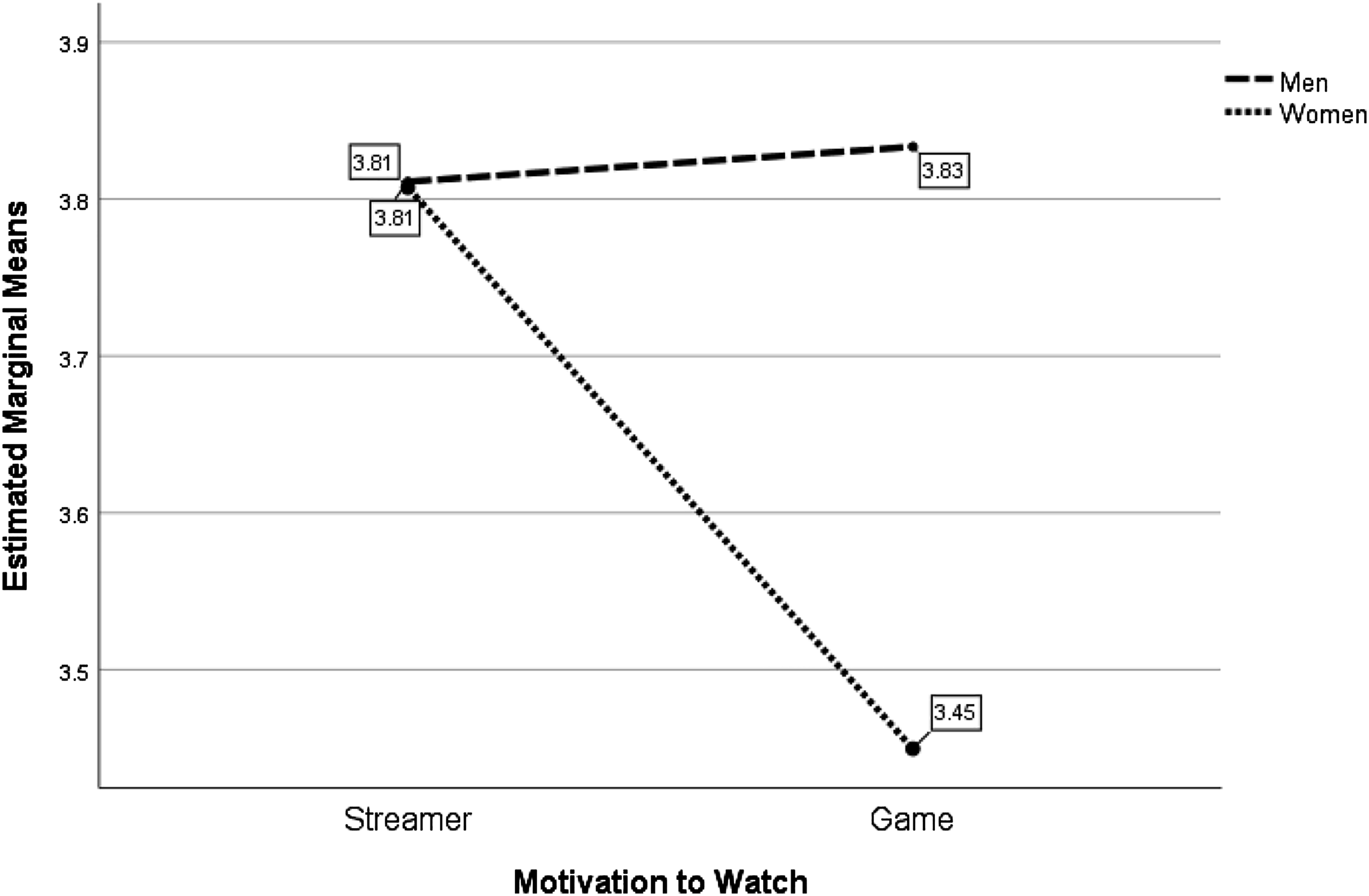
To answer the exploratory RQ2, we employed chi-square tests for equality of proportions. One statistically significant gender difference emerged in watching motivations: more men (12.2%) than women (3.67%) indicated they are more likely to watch if the streamer dresses provocatively, χ2(1) = 5.17, p = 0.02. There was also one statistically significant difference regarding potential motivations to donate: more men (32.22%) than women (20.18%) chose identification with the streamer as having a role in gift-giving decisions, χ2(1) = 3.75, p = 0.05.
Discussion
This study investigated fans’ motivations for viewing game-related livestreams and gift-giving in the context of forming and maintaining parasocial relationships with their favorite streamers. Our results mostly align with Kowert and Daniel’s (2021) theorizing that parasocial relationships in live streaming contexts represent ‘a unique mix of wishful identification, emotional engagement, community affiliation, and fandom’ (6).
Participants’ most popular viewing motivations were streamer interaction within the chat and streamer’s use of a facecam. These findings align with a study by Gandolfi (2016), who identified the bond between streamer and fan as one of the three main motivations among fans to seek out gaming livestreams. Similarly, the primary gift-giving motivation among fans was also streamer interaction with the chat during gameplay, which aligns with Wohn et al.’s (2018) finding that desire for interaction was an essential motivation for fans of live streamers. Such interactions are generally achieved by reading and replying to commenters in the chat box and taking fan suggestions seriously. Some streamers allow fans to dictate their next moves in role-playing games, choose weapons/character features or give feedback based on game progression. Such an approach is likely to boost viewership and gift-giving. Additionally, the use of a facecam was one of the top motivations for viewership, which, in turn, strengthened PSR. A facecam tends to increase the level of closeness or familiarity with the streamer, who is no longer perceived as an ambiguous, faceless being.
Another important finding was that the time spent watching a particular streamer was a predictor of the strength of the fan-streamer parasocial relationship. That relationship, in turn, predicted the likelihood that a fan would donate/send virtual gifts to the streamer. It is important to note that the word ‘predictor’, often employed in regression analyses of data resulting from non-experimental studies, is a statistical term that ‘does not imply that the predictor necessarily causes the change in the predicted variable, although it may’ (Flannely et al., 2014, 164). Therefore, this study’s findings do not suggest that the amount of time one spends watching livestreams causes parasocial relationships. The opposite may be (also) true – that existing parasocial relationships with live streamers cause fans to spend more time watching livestreams.
Our results align with existing research (e.g. Lim et al., 2020; Tukachinsky et al., 2020; Wohn et al., 2018) and extend it by showing that PSR strength mediates the relationship between viewership time/length and the likelihood of donating to a streamer. A somewhat surprising finding was that income was not a significant predictor of the likelihood of donating to streamers. This finding could mean that, at least among the participants in this study, publicly visible gift-giving to streamers did not serve to demonstrate social status conspicuously. Some fans may donate to their favorite streamers despite having limited discretionary spending, highlighting the importance of a fan’s parasocial relationship with a streamer.
Regarding gender, the results indicated that men’s parasocial relationships with their favorite streamers were more robust than women’s – a finding opposite to what was hypothesized. It also did not align with McLaughlin and Wohn’s finding that gender was not a significant predictor of parasocial phenomena. However, the results supported the second hypothesis about the effects of gender: women reported a significantly stronger motivation than men to watch because of a specific streamer rather than because of the game being played. These results elaborate on Gandolfi’s (2016) earlier finding that 45.8% of Twitch.tv fans watch because of a specific streamer, while the rest watch for game-related entertainment or evaluation for future purchase. Gandolfi interpreted the motivation to watch because of a particular streamer as characteristic of so-called ‘diffused audiences’, a concept coined by sociologists Abercrombie and Longhurst (1998, 69). Streamers’ fans are indeed a perfect illustration of diffused audiences, which simultaneously act as consumers and producers, are ‘both local and global’ and ‘erode the difference between’ public and private (76). However, our results suggest that not all streamer fans – even though they fit the definition of diffused audiences – are more interested in the streamer than in the game being played. Gender appears to explain some of the variance in fans’ motivations and, therefore, should be considered a relevant variable in future research.
The RQ2 results support the potential significance of gender, as men were significantly more likely to watch streamers who dress provocatively (presuming most such streamers are women, given the platform’’s mostly heterosexist logic). Men were also significantly more likely to donate because they identified with the (usually male) streamers. The most obvious way to interpret these findings is through the lens of gamers and gaming streamers’ demographic and psychographic characteristics: mostly male, and some prone to objectifying women. About 65% of Twitch.tv users worldwide are male (Clement, 2021), and only one of the top 20 Twitch streamers is a woman (Patterson, 2022). Furthermore, the objectification of women on Twitch has been extensively documented (e.g. Alexander, 2022; Nakandala et al., 2017; Ruberg et al., 2019; Uszkoreit, 2018). Our results align with the existing evidence that gaming and the corresponding live streaming communities are still not entirely welcoming of women.
Theoretical and practical implications
Conceptually, this study contributes to the literature on parasocial affinity – which is extensive but includes few studies that analyze parasocial interactions and relationships in the context of live streaming (e.g. Kowert and Daniel, 2021; McLaughlin and Wohn, 2021; Wulf et al., 2021). This work also contributes to integrating some of the vastly expanding research about live streaming fans’ motivations by employing a theoretical framework that can accommodate many concepts sometimes used in an isolated fashion, including but not limited to liking, attraction and social interaction. However, our study cannot fully resolve or explain all contradictory findings we described before proposing RQ1, as these are attributable not only to the use of many (sometimes) overlapping concepts and variables but also to differences in cultural contexts and the fast-evolving nature of live streaming. Finally, accounting for fan gender effects in live streaming indirectly continues the broad line of research focusing on women’s experiences in gaming contests and communities.
The link between the strength of a fan’s parasocial affinity toward a streamer and the likelihood of donating to that streamer suggests that parasocial affinity can be indirectly operationalized in monetary terms. This aspect of parasocial relationships was already evident (though infrequently studied) outside the context of live streaming, when actors and other celebrities would successfully solicit fan donations for various humanitarian causes (e.g. Jeffreys and Xu, 2017; Mitchell, 2016). As gifts are effortless to make through multiple online platforms nowadays, celebrity fans have even spontaneously started unsolicited, parasocial affinity–driven fundraising campaigns to express ‘gratitude and appreciation’ (e.g. Romano, 2020). These examples, along with our findings, suggest that existing parasocial affinity scales could be improved by including measures of fans’ drive to send money and other gifts to their favorite media figures.
As the findings of this study provide insight into fans’ motivations, such as the importance of streamer fan interactions, they also have practical implications for streamers who want to grow their fanbase and for companies that rely on streamers’ endorsements to promote their products. Actively chatting with fans during a live stream is the number one activity that helps live streamers grow their audiences and donations. In other words, the days when a gamer could find success with Let’s Play videos that included only commentary and no interaction with the audience appear to be gone (Park, 2019).
Limitations and directions for future research
Several limitations temper the findings. In addition to the limitation of potential social desirability biases in the respondents’ answers, which is common in survey research, the sample size was relatively small due to many of the participants’ exhibiting so-called extreme and acquiescence biases. These biases refer to ‘the tendency to give a positive or extreme answer regardless of the “true” answer’ (Baron-Epel et al., 2010: 543). For example, in response to whether they knew their favorite streamer in real life (a question included to control for relationships with friends who stream, as such relationships are not, in fact, parasocial), an overwhelming number of respondents chose ‘yes’. These responses were common even for fans of streamers such as Markiplier, who has more than 23 million subscribers. As a result, many respondents had to be removed from the dataset because the credibility of their responses was questionable. Future studies should control for real-life relationships with streamers by rephrasing the question – for example, ‘Do you and your favorite streamer know each other through school, work, or other real-life situations?’ Such phrasing could elicit more careful consideration and, therefore, more accurate responses.
Another limitation was the inclusion of an outdated item in the parasocial scale, which in hindsight probably did not resonate with streamer fans: ‘I feel like calling or writing [streamer]’. In the context of online gaming culture, future studies may elicit more accurate responses if this item reads ‘I feel like DMing [streamer]’, where D.M. refers to a commonly used acronym for direct messaging on social platforms. The item ‘If I saw a newspaper or magazine article about [streamer], I would read it’ may also need to be revised to reflect contemporary fans’ overall preference for social media posts over fact-checked articles from legacy news sources. Yet another item that could benefit from a revision reflecting contemporary culture and slang is ‘I see [steamer] as a natural, down-to-earth person’. Contemporary fans’ responses may be more accurate if this statement reads, ‘I see [streamer] as someone who keeps it real’.
Another limitation was the omission of potential variables of importance. For example, although we asked the participants why they would donate to their favorite streamer, we did not ask about the specific reasons they would not donate. We also did not ask why a particular streamer was their favorite. Furthermore, in the question about time, we did not specify that it referred to watching only each participant’s favorite live streamer. Although the introduction to the survey stated that it was about ‘your interests in a specific video game steamer’ and ‘the goal is to understand how you relate to your favorite streamer, participants may have answered the question about time spent watching livestreams generally rather than concerning their favorite streamer. Overall time spent watching livestreams, however, can still be considered an indirect measure of the time spent watching one’s favorite streamer by extrapolating from the sports literature, as overall sports media consumption is primarily reflective of the amount of time watching favorite-team-specific games (Dwyer and Drayer, 2010) and strongly predicted by team identity (Devlin and Brown-Devlin, 2017).
Finally, the analysis was also limited by the lack of control for the size of each participant’s favorite streamer’s fanbase. Fan motivations may differ based on the fanbase size of their favorite streamer, a question that has been studied only by Hilvert-Bruce et al. (2018). Similarly, there is room for more research on fan-fan interaction within streaming communities, as some literature suggests that fans within these communities have different motivations than more casual fans (Chui et al., 2006). As parasocial phenomena in live streaming have been studied chiefly through surveys and, in one case, an experiment (Wulf et al., 2021), future research should also aim to collect more nuanced data through qualitative approaches, such as in-depth interviews and digital ethnographies.
Footnotes
Funding
The author(s) disclosed receipt of the following financial support for the research, authorship, and/or publication of this article: The Clint Formby and Wendell Mayes, Jr. Student Research Endowment in the College of Media & Communication, Texas Tech University.
