



Abstract
This article examines how people have constructed touchscreen smudges, those oily marks left behind by users’ fingers on shiny glass, as a form of ‘mess’. It offers an historical account of smudges between 2007 and 2010, when users, corporations, journalists, third-party accessory manufacturers and others began to first frame smudges as a problem for mobile media due to users’ constant touching and the evidence of their finger trails which functioned as a kind of ‘visible tactility’. Solutions took the form of engineering special screen coatings or cultivating responsible users who would maintain their devices through cleaning and caretaking practices. In both these cases, smudges were denigrated not for degrading media content or breaking the device’s functionality, but rather for violating high-tech aesthetics and drawing attention to porous, tactile and germ-riddled bodies. The piece, bringing together this case with the present, encourages scholars to attend to the ways that users are entreated to tame and groom both their bodies and their media devices in particular socio-historical contexts.
Introduction: An Indeterminate Mark
At one of the peak moments of the COVID-19 pandemic in March 2020, Wall Street Journal writer Joanna Stern published an article that inquired, ‘Should you clean your phone to combat coronavirus? Definitely…Maybe’. Stern noted confusion over whether surfaces could transmit the virus and how much cleaning a user should bother to undertake. She worried, despite some experts’ advice not to worry: ‘[W]hat if you’re one of those people where your smartphone is basically an extension of your hand? What if I touch a dirty subway pole, then touch my phone, then my phone touches my face? What if someone sneezes directly onto my iPhone screen?’ (Stern, 2020) The author described her phone as a vector for germs – one as intimately connected to her as a hand – and her fears fit into a broader discussion about electronic hygiene related to touch. News articles around this period warned users that ‘your phone is grosser than you think’ in order to produce a responsible caretaker who ‘should clean your phone at least once a day’ (Teague, 2021). They even quantified touching, by offering a study which posited that an average user touched their phone 2,617 times a day, with that number rising to 5,427 for ‘heavy’ users (Verizon, n.d.). In response to such concerns, Apple, after years of discouraging it, updated its cleaning recommendations to ‘allow’ users to clean their phones with isopropyl alcohol wipes (Clover, 2020). Even the U.S. Federal Communications Commission (FCC) (2020) got involved in public health measures for phones, observing that ‘our mobile phones connect us to the outside world and are possibly the items we touch the most throughout the day’ (n.p.). From the subway pole to the toilet seat to the ordinary sneeze, phone contact came to represent a potential hazard. Users were urged to remediate this mess of touches, whether they could see them or not.
Though tempting to solely locate mobile hygiene and cleanliness as a pandemic matter, instead this dialog fits as but one thread in a larger and ongoing discourse about media aesthetics, care, safety and sensory experience. In 2019, for instance, writer Victoria Song asked in a piece for Gizmodo, ‘Is It Actually Okay to Touch Your Computer Screen?’ Song detailed how smartphones and tablets ‘normalized the idea of putting our greasy sausage mitts on our expensive, beautiful gadgets’ – but that screen touching practices could still get contentious and contested (Song, 2019). Similar concerns dated back to the early 2000s, when technology commentators argued against the computer screen as a site of touching, which would violate its pristine glossiness and its status as a visual interface (Atwood, 2008; Roncadin, 2011).
This disjuncture between screen-as-viewing device and screen-as-tactile-input device has raised questions about the interface between porous bodies, touch and machines. The capacitive touchscreen, which uses the finger’s electrical properties to function, requires touching (unlike the traditional monitor or television screen). Indeed, Verhoeff (2012) writes that ‘The aspect that most clearly distinguishes the touchscreen from other screen devices such as the cinematic screen, or the television screen for that matter, is the fact that spatial proximity of the screen not only can involve the user’s body, the screen must be touched in order to navigate within the screen interface’ (24). To carry a handheld device and also constantly touch its screen means that many people have had to re-negotiate social norms around touching the screen itself and to develop strategies for managing media ‘mess’ at different historical moments.
This article marks such a sociotechnical shift to the touched screen by considering how fingers and touchscreens have interfaced around the problem of smudges. The ‘smudge’ itself is an indeterminate mark, caught between practice, error, vulnerability and mess: sometimes interpreted as an artistic technique, or the fragment of a written word, or a muddied piece of evidence or a dirty spot (Clark, 2019; Neumann, 2012; Plotnick, 2015). People thus construct and imbue smudges with meaning in particular contexts. Thinking about smudges also means engaging seriously with the notion of ‘surface’. Bruno (2015) writes that surfaces, from skin and fabric to canvas and screens, ‘hold in their structure substantial forms of haptic, material experience; their ‘superficial’ texture is touchable and therefore touching, and it can even convey material relations, creating forms of encounter’ (n.p.). The author importantly references the haptic and material qualities of surfaces, bound up as they are in touching. In this regard, mobile phones with their touchscreens enter into intimate interactions with users’ bodies – and especially their hands – as people hold, carry and wear them (Cooley, 2004, 2014; Richardson, 2007; Robertson, 2007) and explore their haptic, tactile and playful qualities (Anderson, 2018; Nansen and Wilken, 2018; Richardson and Hjorth, 2018). Less is known, however, about how people manage and interpret these interactions as mess that requires cleaning. How do people ‘rub off’ on their devices and what happens in these moments of transfer?
While many kinds of physical media can and have historically incurred smudges (from newspapers to photographs, CDs and vinyl records), one could choose to handle these media with the intent and purpose to avoid smudging by handling around the edges, abstaining from touching or wearing gloves; touchscreens, conversely, necessitate a direct touch. As such, these screens bring into focus consumer ‘grooming rituals’ (McCracken, 1986: 79) and a growing industry that has commodified their care with cleaning accessories. I argue that smudges unsettle societal ideas about smartphones as new, high-tech and aesthetically pleasing; they draw attention to humans’ frustratingly porous bodies (Alaimo, 2010) by persistently stitching together finger digits with digital devices (Moores, 2014; Peters, 1996; Parisi and Farman, 2019; Puskar, 2019); and they resist technological interventions aimed at making them disappear. If porous bodies cannot be silenced, then they must be managed – primarily through users’ labor, time and expense.
The case of smudges on touchscreens directs scholars’ attention to embodied practices associated with digital media use by thinking about cleaning, hygiene and ‘care as an everyday labour of maintenance’ (De la Bellacasa, 2011: 90) (also see Plotnick, 2022). Smudges bring maintenance labor to the forefront of digital interactions, allowing us to ask questions about how and why people care for their devices to sustain them in a particular form. At the same time, they invite us to consider how a smudge (indeed, any form of dirt) functions as both ‘utilitarian’ mess (i.e. matter that requires cleaning) and as a marker of ‘moral and symbolic significance’ (a violator of purity or beauty) (Shove, 2003: 84). The following pages suggest how smudges became both material and symbolic through early interactions with smartphone touchscreens between 2007 and 2010. This period of social negotiation, which marks the advent of the iPhone through the development and use of the first phone oleophobic coatings to repel finger oils, demonstrates how smudges first came to represent anxiety over digitality (finger digit + digital device) because screens made finger marks apprehensible through sight. If the old adage states ‘look, but don’t touch’, then I propose that touchscreens have disrupted this sensory settlement by prompting users to touch and to look at their touches; I call this visible tactility – touch made seeable on the screen. In the following pages, I chart a history of the recent past in order to demonstrate how touchscreen usage brought visible tactility to the fore of discussions about using digital devices, living in a digital society and acting as a digital subject.
A smudge is a blemish: Violating digital aesthetics
While far from the first use of a touchscreen 1 , Apple’s iPhone, released on 29 June 2007, triggered a wave of demand for smartphones and for touchscreens more generally. When Steve Jobs announced the iPhone in his signature keynote presentation, he articulated the need for a device with no physical buttons or keys. Yet Jobs denigrated the idea of a stylus: ‘Yucch’, he said, at the thought of it. ‘Nobody wants a stylus, so let’s not use a stylus. We’re going to use a pointing device that’s the best pointing device in the world. We’re gonna use a pointing device that we’re all born with, we’re born with 10 of ‘em; we’re gonna use our fingers’ (Mipodstuff, 2011). Jobs’ language worked to naturalize touchscreens by coding the input method as biological. With no need for a mouse, a stylus or a click wheel, the phone interface seemed somehow more organic by getting back to the basics of fingers as nature’s sensible input mechanism (Norman, 2010). The announcement challenged long-held feelings about not touching screens, but lots of smudges were to come. Indeed, Apple anticipated oily fingers from the get-go – interpreting them as a visual nuisance or blemish – and included a black chamois cloth in its packaging to accompany the phone (Snell, 2007).
Some users expressed skepticism prior to the iPhone’s release about whether the device could live up to the hype and promise that surrounded it and whether its visible fingerprint marks would constitute a deal-breaker. One commenter on a blog, about 4 months before the iPhone hit the market, wrote that they could not imagine choosing to purchase the phone: ‘…I’d hate to have to touch the screen, unless they got a fancy technology that prevents smudges, which I haven’t heard about. Maybe I don’t have the right kind of touch screens, but my DS, PDA, Phone and Monitor all smudge stupid easy and are a pain to clean and build up fast’ (Zheng, 2007). Similarly, another prospective user wrote that ‘[W]ith a large touchscreen, there are two enemies that needs [sic] to be addressed. Smudges and scratches. Wonder what Apple is doing about that’ (Maharshstra, 2007). By drawing on prior experiences with photographs, records, gaming devices and computer monitors, potential users knew what to expect from shiny or glossy media surfaces that required handling 2 – though that shininess could take on different connotations depending on one’s context and positionality (Maffei and Fisher, 2013). For some, this accumulated wisdom made the idea of a touchscreen device that would put touching on display unappealing. Of note, these early commentators all referred to finger marks as smudges, thereby connoting them as a kind of blemish that left an unsightly appearance and put the burden on the user to clean them up.
The ‘smudge problem’ certainly garnered broad attention. In an early Engadget review for the iPhone in the summer of 2007, a writer acknowledged that ‘the rumors about the glass face being an absolute fingerprint magnet are totally true: this thing picks up more smudges than almost any touchscreen device we’ve ever used’, and added that, without a stylus, ‘you must touch it with your bare finger to do almost anything’ (emphasis in original) (Block, 2007; see also Strietelmeier, 2007; Gruber, 2007). Around this same time, designer Joseph Van Geffen created a video entitled ‘Smudge Spoof’, which visualized how finger marks endured on the phone’s screen. Van Geffen took an Apple commercial and tweaked it so that each touch of the model’s finger generated a lasting print. The (faux) commercial’s final shot offered an accumulation of smudges and prints against a black screen, which demonstrated visible tactility at work by making the information cloudy and smeared (see Figure 1). A spoof of an iPhone commercial played humorously upon the smudge problem by visualizing lasting prints upon the screen. Source: Van Geffen, Joseph. ‘Apple IPhone – Smudge Spoof.’ Uploaded June 18, 2007, video, https://www.youtube.com/watch?v=uYb0DYliDAU&list=FL2TiFdGSq9G6AVZe-ncHziQ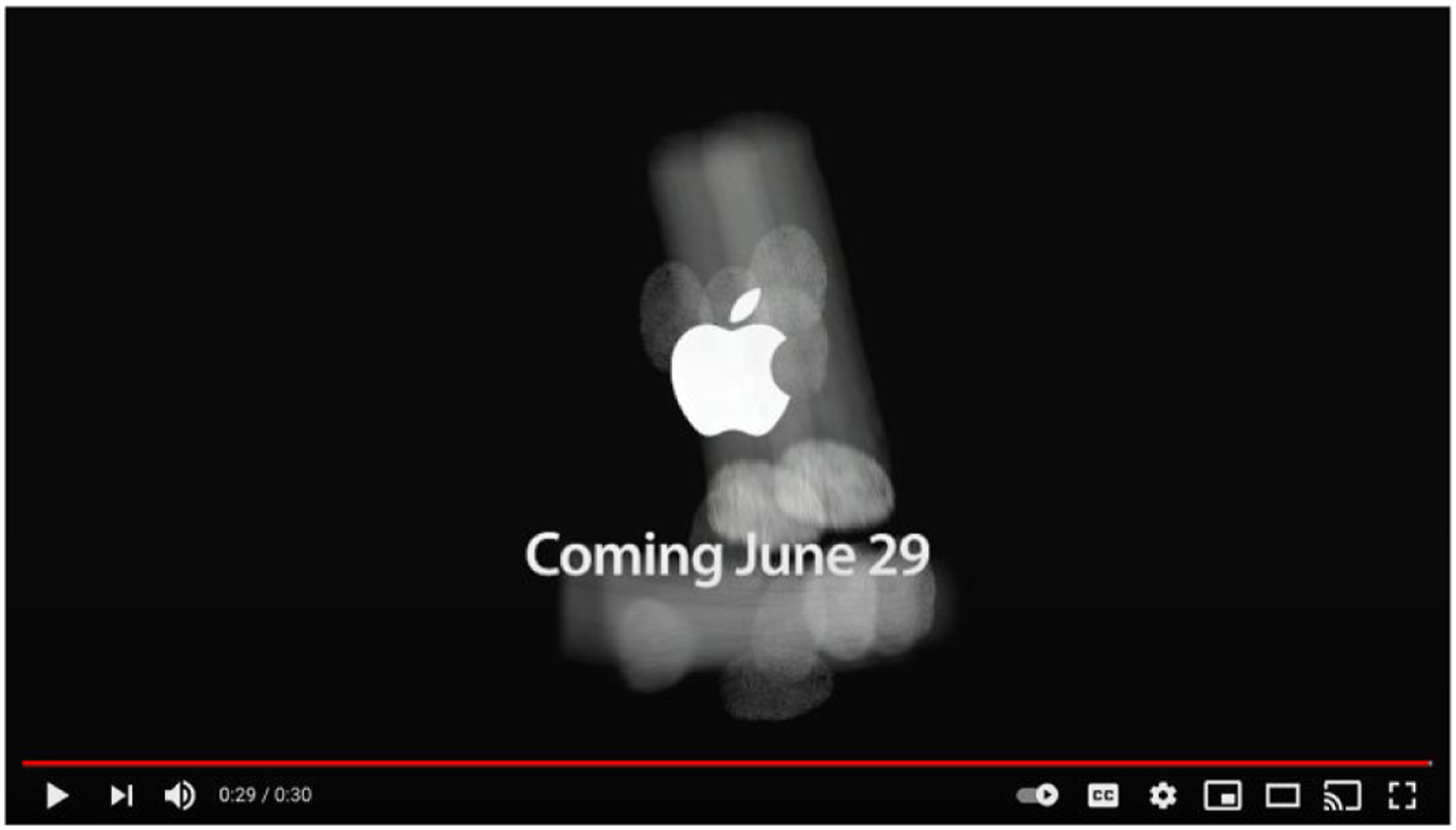
That same month, a Flash app called iSmudginator let users cathartically ‘wreak minor havoc upon an iPhone’ (Thompson, 2007). In a review of the app, Karson Thompson surmised that ‘Smudging [on the iPhone] doesn’t seem to be as bad as this time-killer suggests’, yet the product’s very creation offers a window into the percolating cultural dialog about smudges that occurred and how users should negotiate them. Playful parodies and apps paved the way for conversation about moving to touchscreen modalities in relation to the mess that hands made, suggesting an unease about seeing one’s finger trails made visible. Most conversations at this time revolved around the screen’s weakness as a smudge magnet – putting the onus on Apple to solve the smudge problem – rather than impugning users for their ‘leaky’ bodies or greasy fingers.
Smudges were not so onerous that they deterred most iPhone early adopters. However, a majority of technology bloggers and journalists in the summer of 2007 made mention of smudges as a component of their reviews – with writer Julian Gude going as far as to call the device the ‘iSmudge’ in his summary of the phone’s unveiling at Macworld. Reviewers Troy Wolverton and Kevin Hall each described the screen’s propensity to smudge as ‘inevitable’, given use of finger input (Hall, 2007; Wolverton, 2007). Still, despite acknowledging an obvious accumulation of fingerprints, many commentators dismissed concerns over smudges because of the screen’s brightness, which erased any signs of finger marks unless the screen was dark or ‘sleeping’ (Snell, 2007). The degree of smudge noticeability thus depended on context, time of day and line of sight. Reviewer nickspohn explained that ‘Although with a touch screen, you expect smudges on the screen, and yes, Apple still hasn’t figured out to make a smudge less [sic] phone (maybe in the next decade…?) but in the mean time [sic], it does smudge, and it isn’t noticeable as much if you are looking at it directly, but if you are in a bright environment, or looking at it from the sides, it’s there’ (Nickspohn, 2007).
Touchscreens reinforced users’ desire for a new, shiny aesthetic – a wish for the device to remain unblemished and fresh, as though recently unboxed. Various aesthetic analyses of touchscreen devices determined that ‘a messy screen is still quite readable, -- if not as pretty’ (Kiplinger, 2007). Thus, touchscreen devices stirred conflict between their need for touch input and the way that oily touching as ‘smudge’ degraded their status as high-tech, fetishized interfaces. Discussion about how much one could see smudges on the screen in different lighting indicates that concerns existed more about seeing the visible finger marks than about their harmfulness to the phone or to the user.
Clean up that smudge: Making hygienic digital subjects
Given that people identified smudges as visual blemishes early on, the goal quickly became to do something about them in terms of care, maintenance and routinizing user behavior. Shove (2003) has suggested – beyond phones or any specific device – that ‘The recent history of cleanliness is, among other things, a history of the successful commercialization of an idea and the skillful development and positioning of products deemed essential for its achievement and so for moral welfare and normal life’ (89). This assessment meshes with the way that a large accessories industry, from screen protectors to screen wipes, accompanied the diffusion of touchscreen devices. That industry aimed not only to remediate phones’ physical vulnerabilities (smudges, scratches, cracks), but also to engage consumers in normalized care practices by defining smudges as a form of dirt that required cleaning. Protective accessories became regular adjuncts to most mobile devices, sometimes serving as fashion accessories and markers of identity expression (Katz and Sugiyama, 2005). At the same time, screen protectors also garnered criticism for being ‘ugly’ or destroying the ‘naked’ beauty and form factor of an uncovered device, though they remained quite popular (Gude, 2007; Alvarez, 2019).
Most ads and descriptions for commercial products articulated their usefulness in terms of improving aesthetics to make the touchscreen device look new. Unlike a pair of jeans that could acquire meaning and desirability from its aging process and wear – or the painting that might accumulate value for its historical patina – the touchscreen device inspired love by looking virginal, as though it had never been touched (Boradkar, 2010; Kilker, 2009). Indeed, whereas signs of age, dirt and/or decay may meaningfully mark time’s passage or even trigger nostalgia, the smudged mobile device disrupted a notion of the ‘ideal pristine artifact’ (Kilker, 2009: 52). Descriptions of screen cleaning products such as the iKlear cleaning spray promised to ‘help you get your device looking like it just came out of the box’ (iKlear iPod, 2009). Cleaning products thus worked to create the illusion of newness by eliding evidence of use. Such cleaning practices indicate that despite the pressure to upgrade to a new device frequently, and the disposability often associated with mobile devices, ‘good’ users were also conversely pressured to preserve and clean their devices to maintain a state of newness by making their tactility invisible. In this regard, digital subjects had to perceive their physical digitality as undesirable and as dirt.
Cleaning accessories aimed to repel smudges differently. Products like Smudger, iKlear, iKlenz, eScreen and Monster CleanTouch wetted the glass with a chemical solution to permit easier wiping. These liquids each featured different formulations, with many companies promising an alcohol and ammonia-free solution that would not damage the screen (Gadgetmac, 2010). Littering the checkout aisles of popular retail stores as ‘impulse buy’ products, available through online retailers, and also sold aggressively by salespeople in tech-specific stores, such products (at a cost typically between $10 and $30) were typically interpreted by consumers as either necessary tools or as a waste of money (Morrison, 2010). In perhaps one of the most comical approaches to smudges, the Austrian product Phone Fingers (literally finger sleeves made of black, unsightly rubber) – widely mocked as ‘finger condoms’ (Jayfrankwilson, 2010) – generated a lot of humor and disbelief at their impracticality. Time magazine even dubbed them one of ‘The 50 worst inventions’ in 2010 (Gentilviso, 2010).
Phone Fingers’ ridicule in the popular press and among consumers sheds light on the question of whether users required a commercial solution for smudges in the first place. Indeed, many users recommended mundane and inexpensive cleaning approaches to one another, which included the simple use of t-shirts, sleeves and pants to wipe the phone throughout the day (Android Central, 2009) or the choice of microfiber cloths and gentle, homemade sprays. Cleaning ‘hacks’, folk wisdom, product reviews and recommendations popped up frequently in web device forums over time – with ideas ranging from car wax and silicone-based lubricant to Windex (Teryzx, 2010). These communities of users often discussed the best method to remediate smudges, thereby propagating advice about proper use and ‘grooming rituals’ (McCracken, 1986). A discussion in an Apple forum on Stack Exchange (Moshe, 2010) about cleaning iPad screens offers a good representative example: […]
The two interlocuters debated the merits of dry shirt-wiping as strategy – with @Dan Ray noting that his practice was ‘not exactly high class’ – and @Moshe wondering whether a cloth solution did more harm or good in actually removing oil from the screen. Other commenters subsequently joined the discussion. One person countered with a story about the user’s delight with a purchased cleaning solution as opposed to @Dan Ray’s convenient clothing option:
Ciaccio’s approach involved a researching process and a test under heightened accidental liquid circumstances (spilled tea) that differed from the everyday finger smudge and demanded, in the commenter’s estimation, a commercial solution; of note, the user deemed that solution necessary when a visual test (looking at the screen in the light and seeing streaks) demonstrated the failure of simple wetting and wiping. These variations in method also reflect uncertainty about classifying screen smudges as ‘special’ or ‘ordinary’ kinds of dirt. Such classifications required thinking about the interface between oily fingers and digital device and about the domestication of the touchscreen itself. As Holbrook (2016) suggests, ‘wiping is the most basic of cleaning activities’ and a humble form of maintenance that keeps sociotechnical systems functional (1). Thus, as users wiped and talked about how to wipe, they were bringing touchscreens into the fold of everyday cleaning practice. These activities could make visible digitality more ordinary and less threatening if one could polish her phone screen the same way that she polished a window.
Within this discourse around cleaning practices, corporations like Apple also entered the fray by dispensing their own recommendations. Since the advent of the iPhone, Apple had warned against using cleaning sprays and astringents to wipe the phone, instead advocating for gentle methods and thoughtful care. The problem of oils increasingly surfaced in its instructions as the company grappled with user expectations and changing handset specifications. When Apple first released the iPhone in 2007, for example, the user manual made mention of the included cleaning cloth to wipe the screen, but the text did not include any discussion of oils specifically (Apple Corporation, 2007). Two years later, the company updated its recommendations to account for a new oleophobic coating (described in subsequent paragraphs) that could protect against finger marks. The manual also referenced ‘oil left by your hands and face’. Apple’s cleaning instructions did not remain fixed or immutable; rather, they evolved in dialog with user feedback, changing materials (plastic, glass, coatings, etc.) and social/historical context. These instructions also worked to shift responsibility for the phone’s survival to users and away from the corporation. Improper care could serve as a good excuse for a voided warranty or allegations of ‘misuse’, while good care and proper digital behavior meant carefully cleaning and eliminating smudges without damaging the device.
Given the inevitability of smudging shiny, constantly touched glass and the inconveniences of having to clean touchscreens frequently, solutions also took the form of engineering a smudge-proof (or at least smudge-resistant) screen. In contrast to getting users to behave better – or differently – with screens, these efforts placed the burden on the device itself to repel bodily mess and erase evidence of touching. Scientific experiments began with oil-proofing in labs such as one at Massachusetts Institute of Technology (MIT) as early as 2006, with intended applications for aerospace and hazardous waste cleaning and not specifically for mobile phones. At that time, chemical engineers acknowledged the challenge of creating an oil-proof product as opposed to a waterproof one, citing the example of a duck’s feathers that could repel water but required soap to remove oil due to differences in surface tension (MIT Creates New Oil-Repelling Material, 2007). Oil thus constituted a more pernicious and tricky liquid as compared to water.
After experiments of its own, Apple released its first oleophobic coating, as mentioned above, for the iPhone 3GS in 2009. Oleophobic, meaning literally ‘oil’ and ‘fear’ from Latin, referred to a carbon-based polymer applied to glass that resists oil – similar to Teflon, a coating commonly found on pots and pans (Rothman, 2009). Importantly, this coating did not eliminate fingerprints, but rather made them easier to clean; a typical touchscreen surface, when wiped, would mostly spread the oil around (Peterson, 2017). Thus, oleophobic coating (when and if it worked) improved cleanability but made cleaning continually necessary. The very introduction of such a coating, however, indicates that smudge aversion became baked into the phone’s design and marked visible tactility as a problem.
Once again, consumer reactions were mixed to the announcement of such a feature, with some lauding the invention and others wondering about its utility. To give but one example, an individual with the username ‘rugox’ wrote in a 2009 Mac Forums post – before Apple released the iPhone 3GS: What’s the point of making an ‘oleophobic’ coating if you still have to wipe off the oil. […] If the coating didn’t allow the oil to get on the screen in the first place, that would be a good thing. If the coating makes the wiping of the oil off the screen more easy [sic], that is not much of an improvement… (Redrox 5, 2009).
By contrast, reviewer David Pogue (2009) for the New York Times lauded the innovation that would enable the user to ‘wipe away fingerprints with a single rub on your clothes’ (1). These conflicting viewpoints reflected uncertainty about the oleophobic coating’s purpose, whether it should act as a liquid repellent or merely make for an easier cleaning experience. These negotiations between different elements in relation to the coating suggested once again that users’ definitions of cleanliness/dirtiness created friction with technological solutions and raised the issue of user labor. They converged, however, in their recognition that smudges interfered with the ‘ideal’ smooth and invisible digital interaction between finger and screen.
A Smudge is a Hazard: Digitality as Danger
If the smudge signified an unsightly blemish (an offender to one’s aesthetic sensibilities) and a material form of dirt (that required cleaning), then it also could represent a hazardous condition leading to one’s illness. When perceived as a hazard, smudges were wed to a fear of germs and user revulsion. Referring to the iPhone, writer Anand Lal Shimpi observed that ‘The only time you really notice how disgusting the screen has gotten is when the device is asleep’, and the reviewer included a picture of the smudged screen with the caption ‘Uh, ew?’ (Shimpi, 2007) (see Figure 2). Dormant phones thus visually revealed grimy secrets in ways that actively used ones did not. Shimpi’s phrasing – ‘disgusting’ and ‘ew’ – offer important indicators about the problem of smudges for touchscreens. As previously discussed, though enough finger marks could obscure one’s view of the screen, smudges didn’t particularly cripple a phone’s functionality; rather, the breakdown occurred at the unsanitary interface between body and phone. The constantly touched screen generated disgust because it had been touched so much – it represented digitality left floating on the device’s darkened surface. Smartphone users noticed that screens more likely showed smudges when the screen went dark and in certain lighting. These smudges provoked feelings of revulsion at the sight of one’s oiliness. Source: Shimpi, Anand Lal. ‘Apple’s iPhone: The Future is Here.’ AnandTech, July 2, 2007, https://www.anandtech.com/show/2265/2
In the few years that followed the first iPhone’s release, a wide swath of articles and reviews demonstrated that these complaints persisted with many new generations of smartphones and similar devices such as tablets and laptops – especially in terms of touching and sharing these devices in public contexts. On an Apple message board in 2008, user Basilisk shared that, ‘In all the shops I have seen, the black iPhone has been touched by countless sweaty fingers, and has too many sweaty, greasy finger marks all over the back as a result' (Basilisk, 2008). Similarly, disk jockey Rana Sobhany complained in an article for the Wall Street Journal (2010) that everyone wanted to touch her iPad during a music session: ‘“They pass it around, and it becomes really disgusting after 2 hours”’ (Kane, 2010). The article also referenced software developer Stephen Hood, who tweeted of his visit to an Apple store, ‘“demoed an iPad […] Loved it but from the amount of finger grease covering it I expect I’ve just contracted H1N1”’ (Kane, 2010).
Basilisk, Sobhany and Hood, like Shimpi, equated smudges with germs and unsanitary touching. As these public devices accumulated touches from multiple users, they left behind evidence of shared tactile surfaces. Though these same touches occurred in all public spaces – on door handles, kiosks, drinking fountains, etc., the phone’s visual memory (through its glossiness) and display of such traces made it unappealing. A phone sample used in a store, or a tablet passed around in a communal space, introduced a new element of liquid mess: the comingling and aggregation of users’ finger marks made visible during use. Questions about germs and disinfecting also cropped up in conversations and in articles, with tips about preventing illness and linking device filthiness to disease (Gordon, 2010). In this regard, touchscreens activated conversations about how one should police the boundaries and touches of her device, especially within shared/communal modes of media engagement (Gansky, 2014). These questions would resurface, as noted at the outset of this article, in the wake of the COVID-19 pandemic and anxieties over tactile contamination.
Touchscreen discussions in the context of hygiene fit into broader discourses about glass as a material. Glass has long represented the pinnacle of modernness and looks ‘high tech’; its invisibility allows one to see through, to let light pass and to provide a window onto the world. It is considered first and foremost a medium for sight: eyeglasses, telescopes, mirrors, windows, microscopes, camera lenses, screens each make a certain kind of vision possible. As a result, clean glass and transparency have long been held up as an ideal. Baudrillard (2005) wrote that ‘glass’s cardinal virtue […] is of a moral order: its purity, reliability, and objectivity, along with all those connotations of hygiene and prophylaxis…’ (42). Mumford (1934), too, after studying the evolution of technology, concluded of glass that: Transparent glass lets in the light: it brings out, with merciless sincerity, moats dancing in the sunbeams and dirt lurking in the corner: for its fullest use, again, the glass itself must be clean, and no surface can be subject to a greater degree of verifiable cleanliness than the slick hard surface of glass. So, both by what it is and by what it does, glass is favorable to hygiene: the clean window, the scoured floor, the shiny utensils, are characteristic of the eotechnic household… (128).
Mumford’s description of glass as ‘merciless’ in the way that it could verify cleanliness at-a-glance points to an important visuality associated with the material. Schnapp (2013) likewise acknowledges that people have long lauded glass for its ‘cleanliness, health, moral probity, resoluteness, magical powers, and strength’ (n.p.). More recently, Mattern (2020) has demonstrated how COVID-19 pandemic ‘security theater’ has led to a dramatic increase in the use of plexiglass partitions, which offer people ‘visual access with physical distance’ to make contamination seem less likely – interlocuters look through the (faux) glass without touching one another. These appraisals of glass as a virtuous and hygienic surface help to frame users’ concerns about smudges and digitality in the 2000s. Dirty touchscreens violated an assumed form of glass purity. Like windows of buildings, touchscreens functioned both as aesthetic objects and as objects in everyday use (Hirsch and Smith, 2018). They easily gave evidence of their dirtiness without any special scrutiny. If the user could easily make designations of ‘clean’ or ‘dirty’ glass, then a presumed-dirty screen seemed to beg for housekeeping.
Conclusion: What’s in a Smudge?
Smudges have long existed within an ecosystem of mess that may befall many kinds of media, from photographs and computer monitors to mobile gaming devices and grocery kiosks. As this article has detailed, they played a small but widely discussed part in deliberations about touchscreens as a new interface modality and as a critical surface where bodies, materials and practices met. Importantly, touchscreens did not create oily fingers, nor glossy interfaces, but the need to touch these surfaces and the always-on behaviors of mobile culture spotlighted their pervasiveness. In the early 21st century, cleaning and removing smudges became a way to ‘freeze the physical life’ of a mobile device ‘at the point of acquisition and to mask the trace of consumption in the object’ (Gregson et al., 2009: 252). Smartphone and tablet culture hinged on a shiny, new aesthetic as these devices grew caught between constant touching and the desire for a smooth, unblemished interaction.
While scholars have amassed a large body of literature about handheld mobile devices and the intimate attachments that users form with them, these texts tend to overlook mess as an inevitable component of media use. Through this oversight, they erase important aspects of embodied experience and practices of cleaning and maintenance that connect inevitably with use. If the last decade or so represents a ‘haptic moment,’ in which digital touch technologies have ‘undergone a quiet domestication’ and normalization (Parisi et al., 2017: 1515), then smudges have functioned as a symptom of that domestication – of digitality becoming everyday dirt that requires housekeeping. Yet the everydayness of these touches is complex: oily fingers are in one sense ‘normal’ as human bodily secretions; in another sense, they become problematic and unwanted when the screen renders them seeable, in what I have called visible tactility. Designers and manufacturers have worked hard to establish the touchscreen as a desirable media modality by emphasizing that ‘touching is good’ and not taboo (Parisi, 2018: 273). Such visible tactility threatens the pleasure of touch because it is meant to be felt but not seen in the uneasy tension between fingers and screens.
As the introduction to this article has explained, we can make important connections between smudges on early touchscreens and those of the present. What is perhaps most stark is that, despite many years of innovation in screen and phone design, smudges remain a topic of conversation. This persistence stems from several factors: 1) as scholars have demonstrated, the digital is also always material and embodied (Blanchette, 2011; Hayles, 1999); 2) digitality and constant screen use remain areas of concern and 3) because wherever there is society or culture, there are concepts of clean and dirty (Douglas, 1966; Lagerspetz, 2018). Given these variables, it makes sense that deliberations about the meaning of a touchscreen smudge have continued to evolve.
Artists, for instance, see smudges as evidence of an increasingly digital existence, but they view this digitality as a site of inquiry rather than a mess that requires cleaning. In 2012, artist Evan Roth took a simple approach to the subject by cataloging common touch gestures like the ‘swipe’ to unlock a phone in his series, ‘Multi-Touch Paintings’ (Roth, 2012). Photographer Meggan Gould took another avenue (2014), highlighting the pathways of her husband’s touches on his iPad screen (see Figure 3) (Schiller, 2014). And, artist Tabitha Soren, in a series called ‘Surface Tension’ (2017), argued of her work to Wired magazine that ‘‘The grime is more than residue. It’s a map of where we’ve been and what we’ve done’ (Mallonee, 2017). In these instances, artists use glass’ visible traces and ‘maps’ to revel in the visibility of finger oils – where digitality is captured on the screen’s surface and represents part of the human condition.
3
Artwork by photographer Meggan Gould catalogs how smudges can offer evidence of humans’ digital existence in their beauty and mundanity. Source: Gould, Meggan. ‘Bob’s iPad 9-21-2012’.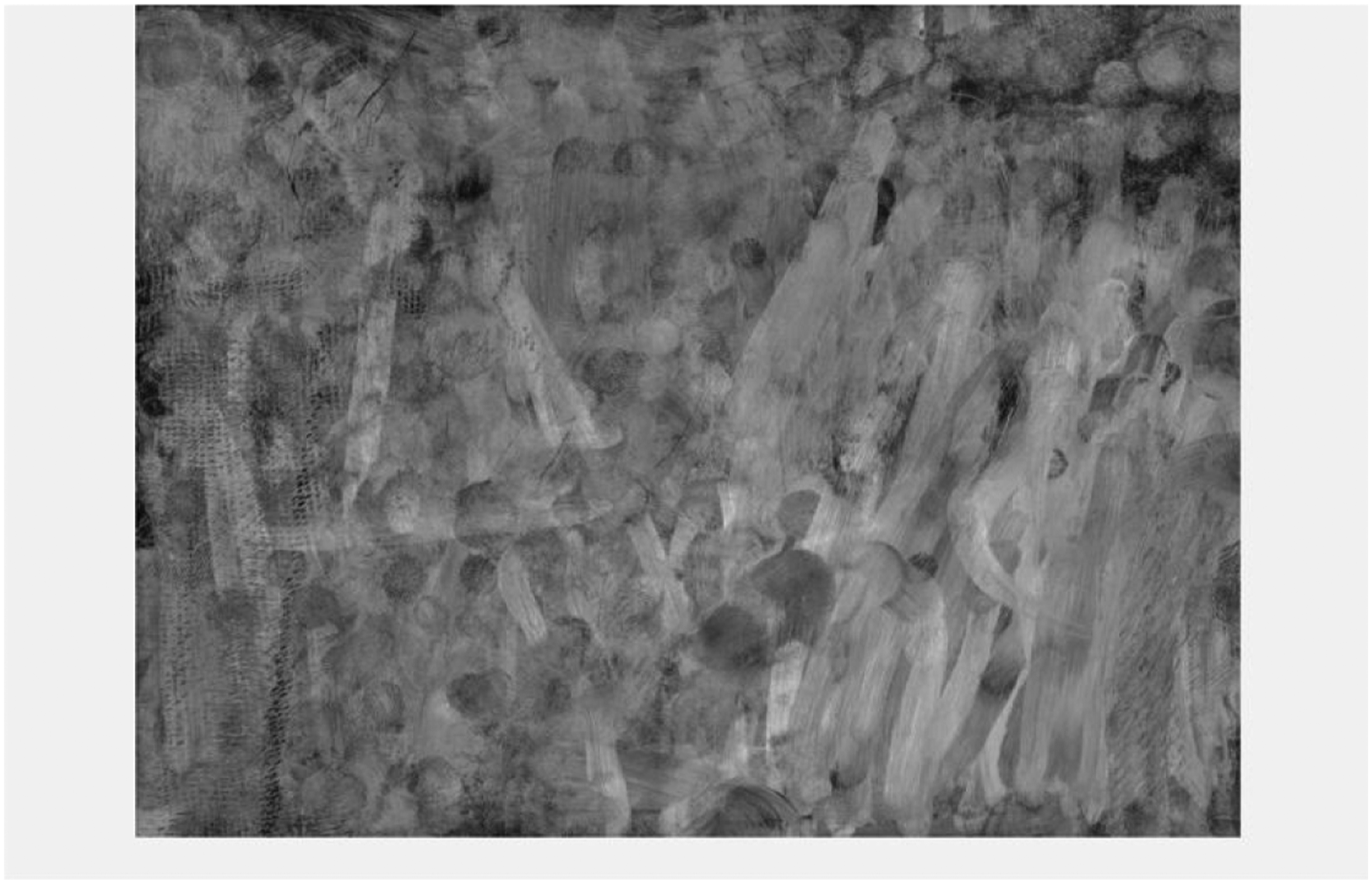
Yet, if smudges leave behind these artful digital trails, suggesting how humans and machines touch each other, then these oily fragments also gain notoriety as obvious security vulnerabilities. In 2010, worries over ‘smudge attacks’ began circulating when a team of researchers at the University of Pennsylvania investigated the issue (Aviv et al., 2010). The authors interrogated to what extent a hacker or schemer could discern one’s password patterns from finger oil traces left on the screen to access sensitive information. The researchers concluded that smudges constituted a credible threat, noting that smudges lingered, resisted cleaning and someone with malicious intent could easily catalog them. Thus, though fingers oils seemed ephemeral and nothing more than a nuisance, they left evidence behind like other biological traces such as hair, skin cells or footprints. Once again, the easily apprehensible nature of finger marks made them the target of concern, sharing a tale of where and what fingers had touched. More recently, smudge attack research has helped to make the case for other kinds of biometric data, like Face ID (which came with its own significant privacy concerns) (Leong, 2019), as a method for eliminating the liability of touching.
Glass keeps no secrets and readily betrays one’s digital traces. This visible tactility is central to understanding why smudges have (and continue) to generate concern. Ball (2015) details how invisible and microscopic agencies surround human beings, from particles of dust and dirt to atoms and bacteria, that seduce as unseeable (and yet often dangerous or powerful) forces. Unseeable dirt has provoked all kinds of interventions to eradicate such forces, which include sophisticated clean rooms, microscopes and special tools, and everyday cleaning sprays. Yet, the smudged glass provokes differently because it is so easily seen. Greasy fingers come to serve as a persistent reminder of bodies in interaction with mobile media as those bodies and media became ever more intimately tied together: device in hand; device held; device carried; device wiped and device touched. Nevertheless, the smudge is indeterminate. It does not tell what it holds (is it merely a greasy mark or germ-carrying vessel?) and remains open to interpretation. Smudges are fragments, showing that touch has occurred without the precise interpretability and uniqueness of a fingerprint.
Thus, the touched-screen’s risk might take numerous forms, from violating the purity of a phone’s aesthetic, to threatening illness from COVID-19, to making use (or perceived over-use) visible, to threatening digital security. Like the computer hygiene required to address moral panics over viruses (Parikka, 2007), touchscreen cleanliness, care and engineering has functioned as an antidote to one’s risky digitality. Users are encouraged to wipe, spray and cover their devices – and keep their hands clean – in the name of ‘good’ digital behavior. Yet, smudges’ persistence, whether due to deteriorating coatings or the sheer sliminess of hands, mean that the user’s job is never quite done. As Jasper (2009) puts it in his meditation on oiliness, ‘grease curses us with a variation of the Midas touch. Everything we grasp becomes greasy.’ In this manner, media devices inevitably and literally become extensions of the human hand. Certainly, then, the complexity of smudges in context encourages us to think more deeply about the points and moments where porous, greasy bodies and media devices intermix, and scholars might begin to investigate more thoroughly how this ‘mess’ operates in a variety of historical and contemporary interactions. For now, it seems, we are only beginning to scrape the surface.
Footnotes
Declaration of conflicting interests
The author(s) declared no potential conflicts of interest with respect to the research, authorship, and/or publication of this article.
Funding
The author(s) received no financial support for the research, authorship, and/or publication of this article.
