



Abstract
Within visual culture, postcyberpunk films are best approached as places of Otherness whereby human identity and agency are downplayed and posthumans are magnified in highly technopolic societies marked with scientific determinism. Postcyberpunk treats the posthuman enclave as a heterotopic site, oscillating between utopian and dystopian spaces, potentially and optimistically, creating a space for humanity to be reassessed and renegotiated. Against this backdrop, the current research endeavor proposes a Spatio-Cognitive Model of Posthuman Representation focusing attention on heterotopic ‘spaces’ and ‘bodies’ in hyperconnected environments. While the model owes a substantial debt to Foucault’s writings on heterotopia and the utopian body, in tilting the focus of enquiry, this paper is informed by the tenets of polyrhythmia, hypermimesis, spatial repertoires, semiotic assemblages and cognitive embodiment as insightful interventions. Blade Runner 2049 is taken as a fertile case study grounded in paradoxes and ambiguities around the contradiction between humans and replicants, artificial intelligence and super-large enterprises. The hybridity pertinent to the postcyberpunk film genre and the inner and outer topographies of posthuman representation proved to be insightful investigative vantage points of multimodal inquiry for the socio-political and technocratic implications they underlie. With technology seamlessly integrated into social spaces and posthuman bodies, Blade Runner 2049 is arguably structured as an emotional journey composed of multiple heterotopias (spatial layers, ruptures and bifurcations expressed through socio-political capitalist projections). The article adamantly argues for new philosophical perspectives and praxis in redefinition of the social relationship between human and posthuman.
Keywords
Introduction
The present epoch would perhaps rather be the epoch of space. We are in the epoch of simultaneity; we are in the epoch of juxtaposition, the epoch of the near and the far, of the side-by-side, of the dispersed.
Since its inception in the 1980s as a sub-genre of Science Fiction (SF) films, dystopian cyberpunk signaled a break from previous traditions and witnessed a substantial growth as the literary expression of postmodernism (Diggle and Ball, 2014; Lovén, 2010). Cyberpunk narratives, as cultural practices, tap into the transformation into colossal megacities and the anxieties surrounding the nature of humanity and posthuman imaginaries amidst the deluge of advanced technology (Zaidi and Sahibzada, 2020). In these narratives, control is no longer envisioned from a cybernetic impartial lens; rather, it is the inherent suppressive structures and institutions that take full accountability of the status quo in Western societies (McFarlane et al., 2019). Power is exercised not only through preeminent android technologies but also through the very cyborgs who have become mere objects of control in surveillant capitalist and technocratic communities. Cyberpunk literary works have profoundly influenced the narrative framework and esthetic style of dystopian films, namely Blade Runner (1982), Ridley Scott’s feature film based on ‘Do Androids Dream of Electric Sheep?’ (1968) by Philip. K. Dick (which is considered a precursor literary work to cyberpunk). As Bruno (1987) puts it, ‘The postmodern aesthetic of Blade Runner is the result of recycling, fusion of levels, discontinuous signifiers, explosion of boundaries, and erosion’ (p. 6). Indeed, the film popularized cinematic cyberpunk whereby global incorporations replace nations and their brutal capitalism dominates, casting the marginalized to a life of hustle and chaos on the fringe of cities.
In the 1990s, a new wave matured within the cyberpunk genre to aptly articulate the apprehensions of postmodernist contemporary life, coined by Person (1999) as postcyberpunk. Whereas the essence of cyberpunk is chaos and disorder, in the world of postcyberpunk chaos is eliminated and order is re-established by a massive system of central power and dominion perpetuated through novel cyber and virtual reality technologies (Murphy and Vint, 2010), on the one hand, and through taxonomic identifications of ‘self’ and ‘other’, on the other hand. Since the 1990s, postcyberpunk narratives have heavily invested on multi-dimensional socio-cultural and technological themes pertinent to the predominance of international corporate conglomerates and the creation of hyper-real places and simulacra with an acute sense of postmodern global malaise. Within visual culture, postcyberpunk has become a well-established sub-genre, with cinematic works at the forefront such as Artificial Intelligence (2001), Her (2013), Transcendence (2014), Blade Runner 2049 (2017) and Alita: Battle Angel (2019), among many others. A three-fold configuration defines these works, namely, fully commercialized dystopian cityscapes in distant futures void of life; multimodal esthetic grandeur symptomatic of the extrapolation of late capitalism and postmodernity; and the display of all-powerful humanoids developing self-sentience. Such films are best approached as ‘places of Otherness’ whereby human identity and agency are downplayed and posthumans are magnified in highly ‘technopolic societies’ (Postman, 1993) – societies that are marked with pessimism, skepticism and scientific determinism (Murphy and Schmeink, 2018).
Peculiarly, postcyberpunk power extends from the dystopian cityscape space to the posthuman Artificial Intelligence (AI) bodily space as the new transcendent ‘self.’ The posthuman body, as a consequence, gains momentum. While posthumans in orthodox cyberpunk narratives are essentially depicted as ‘dystopian enclaves’, postcyberpunk treats the posthumanist enclave as a ‘heterotopic site’, oscillating between utopian and dystopian spaces, potentially, and optimistically, creating a space for humanity to be reassessed and renegotiated 1 . In postcyberpunk films, posthumans are featured in aesthetically complex, philosophically disturbing and ideologically ambivalent sensibility. Against these depictions, engagement with the postcyberpunk cityscape is fully embodied and is inseparable from the social and material practices of a given time and place. Since place does not appear ex nihilo but is part of a process, the status of posthumans and their allegorical politics are embedded in the film’s representations of bioengineered life. A new conceptualization of posthuman merging the categories of city space and body space into a ‘semiotic aggregate’ (Scollen and Scollen, 2003), that is, a complex spatio-temporal configuration featuring a spectrum of overlapping rhythms is, as a consequence, mandated.
Innumerable canonical modern theories of space, place and body have emerged in the literature to date. Of all these theories, Foucault’s legacy in ‘Of Other Spaces’ (1967) and ‘The Utopian Body’ (1966) are, arguably, still relevant in a globalized techno-scientific world. Not only is Foucault’s heterotopia attributed to the ‘other place’ or external space individuals physically occupy, but with the embodied (internal) space in terms of body/mind dualism as well. As Hayles (1999) cogently argues, ‘Whereas the body is an idealized form that gestures toward a Platonic reality, embodiment is the specific instantiation generated from the noise of difference. Relative to the body, embodiment is other and elsewhere, at once excessive and deficient in its infinite variations, particularities, and abnormalities’ (pp. 196–197). Acknowledging that place, space and body are inherently embodied, the current research endeavor takes Foucault’s notion of ‘heterotopia’ as the overarching spatio-temporal theoretical framework to theorize and gauge the diverse embodied experiences of posthumanism. This affords the scrutiny of posthuman representation, in terms of embodied emotion Artificial Intelligence (AI) in conjunction with dystopian cityscapes, a new dimension of multimodal academic enquiry. Emotion AI is understood here as the embodied emotional transcendence (in terms of simulated artificial affects, moods, perceptions, intentions, etc.) associated with some level of human intelligence (Broussard, 2018; DeFalco, 2020; De Togni et al., 2021; Fahn, 2019; Frankish and Ramsey, 2014; McStay, 2020) and dynamically produced through spatial engagement with the surrounding environment.
Multimodal Critical Discourse Analysis (MCDA) scholarship has much to gain from a fuller engagement with dystopian cityscapes in conjunction with posthuman emotion AI. MCDA is concerned with the synergy of semiotic resources and sensory modalities for poly-semiotic communication to effectively take place. Several critical discourse analysis studies place significant emphasis on the multimodal legitimation of social practices in hybrid means of communication (See, for example, Elyamany, 2020, 2021; Ledin and Machin, 2019; Machin, 2016; Machin et al., 2016; Machin and Mayr, 2012; Zhao et al., 2019). Although MCDA unveils the ideological and social practices situated in the intersemiosis prevailing cinematic discourse (Bateman and Schmidt, 2013; Piazza et al., 2011), it barely directs attention to the indexicalities of posthuman identity construction from spatio-temporal and cognitive standpoints, nor does it employ systematic methodological toolboxes to address the semio-discursive signage permeating postcyberpunk films (Stamou, 2014).
On a different note, timely theoretically based scholarship on the intriguing interplay between communication theory and AI-enabled consequential technology (See, for example, Guzman, 2018, 2019, 2020; Guzman and Lewis, 2020; Lewis et al., 2019) is discernible in the literature to date. Remarkably, Guzman’s works have enticed a human–machine communication (HMC) research framework with emerging metaphysical and ontological ramifications in response to a more invasive scrutiny of life-like AI technologies and how humans interact with them (Guzman, 2018; Peter and Ku hne, 2018). Extending Guzman’s implications to the study of posthumans in postcyberbunk movies whereby ‘social presence’ is key (Lee and Nass, 2003, 2005) and AI technology is an embodied ‘social actor’ (Brave et al., 2005; Nass et al., 1994) is therefore recommended to examine how much emotionally intelligent and transcendent posthumans can be. Arguably, the posthuman body, conceptualized as embodied space(s), incorporates topographical metaphors, ideologies and spatial orientations worthy of scrutiny.
The major contribution here is that, instead of dealing with posthumans as a detached domain or presuming the presence of a bodyscape separable from a visual landscape, I draw on the posthuman’s lived spatial body as a place and not only being ‘emplaced’ in space for subsequent enactment into heterotopia. Introducing embodiment into spatial analysis makes grappling with this interconnection tantamount in tracing out potential multimodal patterns of posthuman emotion AI representations. The overarching question of the study is: ‘How are posthumans represented in terms of emotion AI in a progressively dehumanized heterotopia of illusion and compensation?’ To answer this question, the study follows a spatio-cognitive approach to answer the following sub-questions: (1) What is the role of the spatial repertoire and linguistic landscape that dominate dystopian cityscapes in engendering posthuman representation? (2) How is emotion AI developed through the semiotic assemblages and embodied cognition of posthumans?
Blade Runner 2049: A fertile case study
In the current study, I take Blade Runner 2049 (2017) – a film ushered in the time of the ‘post-anthropocene’ (Pennycook, 2018) and replete with distinct conceptual, audio-visual and spatio-temporal representations – as a case study. Directed by the French Canadian Denis Villeneuve, the film has been acclaimed, analyzed and interpreted by scholars and critics alike
2
. Blade Runner 2049 (henceforth BR2049) is a recapitulation of, and a writing back to, Blade Runner. Whereas the original film focuses on the production, legal and ontological status and subsequent autonomy of replicants (Sammon, 2017), the sequel places emphasis on their capacity of procreation (i.e. reproduction). In Blade Runner, Tyrell Corporation produces genetically engineered robots, dubbed replicants to emphasize their artificiality as opposed to human authenticity (See Figure 1). Although they are hard to differentiate from human beings with the naked eye, they are bounded by a 4-year life span and implanted with ‘prosthetic memories’ to have human-like responses and manage their regular experiences. BR2049 picks up 30 years after the original film. In the sequel, following the aftermath of environmental collapse, Niander Wallace takes over the bankrupt Tyrell Corporation. New restrictions on the design and control have been put in place to produce a new line of physically redoubtable and emotionally dry replicants who live legally on Earth and obey their human masters. While humans are not as strong, intelligent, or enhanced as replicants, the latter are deemed the slaves of the galaxy, having few to no rights despite the fact that they are allowed to live on their own; they are ‘retired’ if they cannot fulfill their purpose. BR2049 follows the story of Officer K, a replicant of a new Nexus-9 model who works for the Los Angeles Police Department (LAPD) as a Blade Runner, that is, a police officer commissioned to hunt and kill rogue replicants. Much like the original film Blade Runner (1982), the sequel is grounded in a dialectic scheme of opposing social values (or paradigmatic oppositions, so to speak). Screenshots of the headquarters of Wallace Corporation featuring bio-genetically engineered replicants in Blade Runner 2049.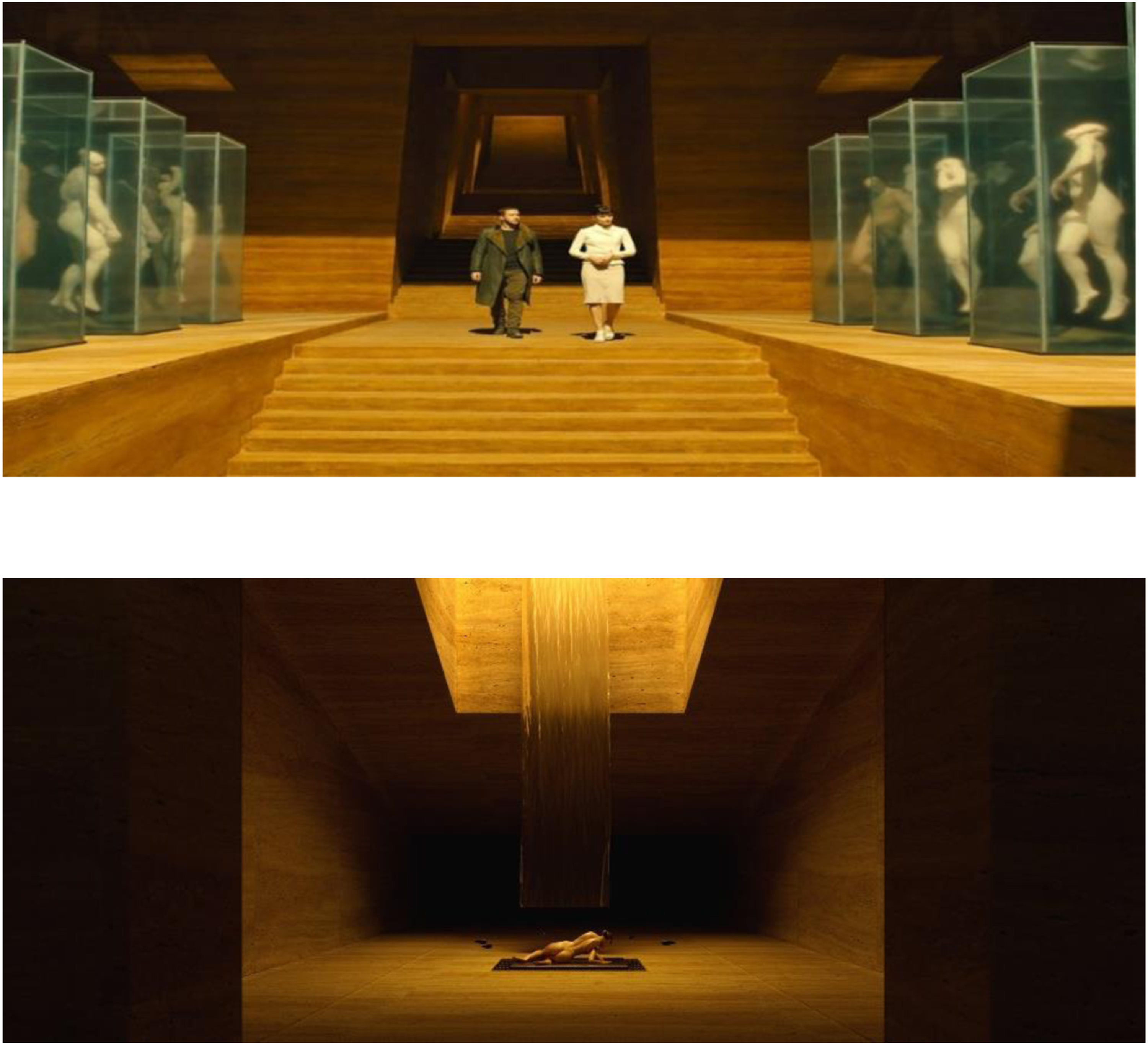
Conceptual Perspectives: Heterotopia and the Utopian Body
Heterotopia, a key concept related to space, was envisioned, coined and introduced by Michel Foucault in a series of lectures to a group of architects in the name of ‘Des Espaces Autre’ back in 1966. Etymologically, heterotopia derives from the Greek heteros (otherness) and topos (place), literally translating to ‘other spaces’. In medicine, more specifically, the term describes a tissue that is morphologically dislocated for no detectable reason yet co-exists within the same type of tissues without being pathological. Foucault’s conception of heterotopia encapsulates these defining features. In Of Other Spaces (1967), the translation of the original French, more substantially lies on Foucault’s canonical definition of heterotopia. Literally meaning a ‘site of otherness’, heterotopia is grounded on utopia yet is distinct from it. Whereas utopia (literally a ‘no place’) is a fantastical, coherent and perfect futuristic territory whereby a society creates seamless socio-political regimes and modes of social ordering (Palladino and Miller, 2015), dystopia is a place that is chaotic and disordered. Against the two notions, heterotopia is a concrete alternative social place that physically exists as a ‘counter-site’ or ‘counter-emplacement’ concurrently representing, contesting, synthesizing and shattering all other normalized spaces (See Foucault, 1967/1986, for a thorough perspective). In formulation of the concept, Foucault (1967) advances six spatial principles, a ‘heterotopology’ that describes the contestation between the mythical and real world. To him, heterotopias: (1) are omnipresent spatial realities found in every culture yet with no absolute universal form, assuming a variety of forms such as ‘crisis’ heterotopias and ‘deviation’ heterotopias; (2) are not ontologically predetermined but are mutable, transforming the everyday experience and challenging the dominant order of things as societies evolve; (3) are heterogeneous and juxtapose several inherently incompatible spaces in a single real place; (4) can be linked to slices of time marking absolute breakage with traditional time (i.e. heterochrony); (5) have a system of opening and closing (i.e. accessibility) and require designated access rituals; and finally (6) are physically estranged yet germane to the outside space and, as such, embody a tension between a ‘heterotopia of illusion’ and a ‘heterotopia of compensation’.
The point of departure in this paper is that although heterotopias may encompass a wide array of characteristics and can be inclusive of several historical and contemporary real and virtual spaces (Chatzidakis et al., 2012), its very nature is diverse, elusive and, arguably, metaphorical. In a plethora of applications and expositions, heterotopia is most productively understood as a tool of analysis that illuminates the multifaceted features of cultural and social spaces and helps invent new ones, making heterotopia ‘a familiar, albeit an ambiguous trope in critical thought on spatiality’ (Knight 2014: 8). Due to its shifting and piecemeal figuration, Foucault’s heterotopia allows for the adoption and adaptation of the most prominent features of heterotopias (extending Foucault’s theorization where appropriate) to contemporary genres, not excluding postcyberpunk films. In a similar vein, the six principles of heterotopia appear to evolve from associative reflections, and, therefore, it is unclear if they depict fixed rules or mere guidelines. By virtue of its potential to create a number of possible worlds, heterotopia affords the present study the full capacity to both contest and engage with the dominant posthuman discourses and consigned AI reconstructed ‘self’.
From a different yet complementary angle, Foucault (1966/2006) put forward the ‘topia’ notion in ‘The Utopian Body’ as the state of being embodied (Casey, 2001; Svenaeus, 2011). By developing a spatial account of the body, Foucault deploys the body as a heterotopia, which is the site of its own permanent contestation and problematization. Foucault’s (1966) focus on the body as the source and product of historically specific regimes of power/knowledge informs the current study. This peculiar account of the body aids in the problematization of how people make sense of the body, particularly because, in Foucauldian terms, bodies are subject to and formed by complex mechanisms of power 3 . Since Foucault analyzes experience as the space enclosed by axes of knowledge, power and subjectivation (Flynn, 2010; Huffer, 2010; O’Leary, 2009), and in complementarity of the aforementioned points of argument, in this study, I pay close attention to the limitations of the hegemonic systems of classification as well as practices of exclusion, erasure and silencing that impact posthuman representation with special focus on emotion AI whereby the experiential body emerges as a site of resistance, and transcendence, in a spatialized manner.
Foucault’s heterotopia, albeit controversial, is potentially useful in the multimodal critical discourse analysis of posthuman representation. Looking from the aperture that Foucault opens, this paper aims to recalibrate posthumanism via four distinct yet connected strands in attempt to unfold a new type of space – a space overlaid with virtual layers and augmented with biodata. For the purpose, I propose a multimodal spatio-cognitive analytical model focusing attention on heterotopic ‘spaces’ and ‘bodies’ in hyperconnected environments. While the introduced model owes a substantial debt to Foucault’s writings on heterotopia and the utopian body, in tilting the focus of enquiry, it is informed by the tenets of Lefebvre (2004) on polyrhythmia, Lawtoo (2015, 2020) on hypermimesis, Pennycook (2018, 2019) on spatial repertoires and semiotic assemblages and Coëgnarts (2017) on cognitive embodiment as insightful interventions. In this paper, I pick up from where these influential scholars leave off in their respective disciplines while making strong links to the extant scholarship. I take on the challenge of contributing to the existing literature, combining the aforementioned perspectives into a coherent embodied analytical model while remaining closely allied to the foundational contributions of heterotopia and the utopian body. This is in attempt to attend to the features ostensibly evolving in the social spaces of abandonment and spatio-temporal trajectories unique to the postcyberpunk spectacle.
Methodology: Toward a Reconceptualization of Posthuman Representation
The proposed model comprises two interlocking categories of analysis: (1) postcyberpunk dystopian cityscape and (2) posthuman emotion AI (See Figure 2 for the Spatio-Cognitive Model of Posthuman Representation). The model is detailed in the sub-sections that follow. Spatio-cognitive model of posthuman representation (SCM of post-Rep).
Postcyberpunk dystopian cityscape
Macro-Level embodied aesthetics
At the macro level, embodied aesthetics highlights the interplay between emotion and cognition in the bodily mediated process of meaning generation in the posthuman/postcyberpunk-dystopian cityscape transactions. To examine the embodied aesthetics that serve the semiotic construal of space, the study conducts a ‘spatial discourse analysis’ (Ravelli, 2019; Ravelli and McMurtrie, 2015) to gain situated knowledge on the complexities and potentialities of dystopian space. More specifically, it draws on Lefebvre’s (2004) rhythmanalysis procedural as integral to discourse and semiosis (Wetherell, 2015) in conjunction with Lawtoo’s (2015, 2020) hypermimesis to unpack tangible spatial resources. Arguably, posthuman identities, linked to body modifications and converging technologies, oscillate between utopian and dystopian spaces, hyper-real simulations and real forms of embodied imitation. A multimodal exploration is likely to help explore the reified binary oppositions (or mutual attunement) in the multiple spaces posthumans inhabit. The cinematic aesthetics of dystopian cityscapes metaphorically reflects its internal rhythm(s) or ‘ensemble of rhythms’ (Edensor, 2010), which, in turn, shape a mobile sense or experience of social spaces. In collegiality, temporality, a ubiquitous and principal characteristic of urban places, is expressed through complex forms of rhythms, socially, spatially and physiologically.
To showcase the temporal socio-spatial profile of the dystopian cityscape, this level of analysis rests on Lefebvre’s (2004) ‘rhythmanalysis’ to disentangle the rhythms that occur in a repetitive manner within and around posthumans, which may ‘collide, synchronise and interweave’ (Jiron, 2010: 131). To Lefebvre (2004), the world comprises sets of rhythms that may coordinate or clash and, in this regard, isorhythmia (equality of in sync rhythms), arrhythmia (pathological discordance of out of sync rhythms), polyrhythmia (superimposition of rhythm assemblages) and eurhythmia (harmony of rhythm ensembles) arise as distinct ways of conceiving spatio-temporal relations 4 . The identification of rhythmic patterns (dissonance, alternance or resonance) is likely to open up new venues to examine the impact of peculiar time–space configurations on posthuman emotion AI representation in fictional spaces dominated by surveillant capitalism. Closely tied to polyrhythmia is the notion of hypermimesis (Lawtoo, 2015, 2020). Just like rhythmanalysis treats the body as the medium through which people configure the rhythms of the lived spaces (Lefebvre, 2004), the esthetic notion of ‘hypermimesis’ takes on fresh valences in relation to issues of simulation, virtuality, hegemony and appropriation 5 . The venerability of hypermimesis as a contested esthetic concept is important for the spatio-temporal agency and potential for change it underlies in posthumans marked by simultaneous self-effacement and self-identification processes.
Through an exhaustive screening of the movie’s full run time, the ensemble of rhythms that permeates the postcyberbunk space (be it isorhythmia, arrhythmia, polyrhythmia or eurhythmia) and is responsible for the social production of postcyberpunk space-time configurations has been identified through captured moments in the filmic heterotopic spaces. Of all these diverse patterns polyrhythmia informs the current study by virtue of its predominance. All moments representative of polyrhythmia, along with hypermimesis, have been coded by three trained coders and an inter-coder reliability of 96.4% was reached using the Online Kappa Calculator (Randolph, 2008).
Micro-Level linguistic landscape
Relatedly, to examine the embodied aesthetics that serve the semiotic construal of space at the micro level, the wide range of authentic and virtual forms of semiosis made prominent in postcyberpunk dystopic space can only be scavenged from a ‘Linguistic Landscape’ standpoint (Landry and Bourhis, 1997). Linguistic Landscape (henceforth LL), a recent sociolinguistic strand of applied linguistics research, initially subsumed the ‘the presence, representation, meanings and interpretation of languages displayed in public places’ (Shohamy and Ben-Rafael, 2015: 1), yet soon gained momentum to incorporate ‘images, photos, sounds (soundscapes), movements, music, smells (smellscapes), graffiti, clothes, food, buildings, history, as well as people who are immersed and absorbed in spaces by interacting with LL in different ways’ (Shohamy, 2015: 153–154) 6 . From a posthumanist perspective, analysis rests on the notion of spatial repertoires as addressed in Pennycook (2018) in extension of LL research. Pennycook focuses on how language is a repertoire of semiotic affordances that are ‘embodied, embedded, extended and enacted’ (p.48), that is, understood spatially and in a distributed way. Understanding spatial repertoires as emergent from the interactions between posthumans, artefacts and space, that is, ‘proximization’ (Cap, 2014), the current research work supports Wee’s (2016) argument that the interplay between ‘affective’ experiences and ‘semiotic’ landscapes, which expands the multimodal repertoires and semiotic terrain (beyond language), is a crucial area of investigation.
Following the recent uptake in the literature, the current study marks a shift of analytical attention from the outdoor to the indoor linguistic landscape. To provide a new angle for semiotic analysis in postcyberpunk films, I attempt to unfold the semio-discursive tropes that abound in and through the indoor/outdoor linguistic landscape of postcyberpunk narratives. For the identification of all linguistic landscape features, the study followed the ‘inductive approach’ (Van Gorp, 2007). That is, no pre-defined semio-discursive features were specified a priori. Only those emergent in the spatial texture of subtle filmic moments, both indoors and outdoors, were identified, grouped and classified under the category that best fits them. All classifications were coded by avid coders, too, and a satisfactory inter-coder reliability of 98.3% using the Online Kappa Calculator was reached.
Posthuman emotion AI
Semiotic assemblages
This level of analysis rests on the key tenets of Pennycook’s (2018) semiotic assemblages, that is, the complex multi-sensorial scapes visible in the posthuman bodily space (outer and inner topographies, boundaries and territories) to better understand the dialectic relationship between the posthuman body and the material and discursive surrounding space(s) that metaphorically parallels Chen’s (2017) ‘polyrhythmic assemblages’. Emotion AI is, arguably, a composite of the conceptual, the discursive and the functional; all three modes are inherent temporal and rhythmical practices of place. Bennett (2010) showcases the ‘assemblage of bodies, of actions and passions, an intermingling of bodies reacting to one another’ as well as a ‘collective assemblage of enunciation, of acts and statements of incorporeal transformations attributed to bodies’ (p. 88). Farnell further believes that modified bodies are over commodified by the corporations and factions that ‘control their production’ (Farnell, 2014: 411). In this understanding, an AI body can either be modified in a way that induces power (and would be deemed ‘autoplastic’ accordingly) or renders the body itself as obsolete (and so would be ‘alloplastic’). The embodied aesthetics therein is fundamentally a digitized generation of futuristic worlds where ‘there are no essential differences or absolute demarcations between bodily existence and computer simulations’ (Hayles, 1999: 3) and so are worthy of scrutiny in this study.
Embodied cognition
Central to this level of analysis, too, is the notion of ‘embodied cognition’ (Zlatev, 2015; Zlatev et al., 2016) as a biological phenomenon grounded in spatio-temporal physical experiences 7 . To fully understand how compositionally complex posthumans cognitively function, analysis is based on image schemas 8 . Given that posthuman enhanced bodies impact cognition in remarkable robust ways, a major question that comes to the fore is ‘How are cognitive processes embodied in posthumans?’ As a more complex sense of posthumanity gets predicated on the development of a caring, sympathetic and affective stance, embodied cognition is best examined from an ‘image schema’ perspective. An image schema is a mental abstraction of basic learnt spatial relationships and derives directly from interactions with the social world (Hampe and Grady, 2005; Lakoff and Johnson, 1999). Some of the most common examples of image schemas (rendered in upper case according to convention) are: CONTAINMENT, SUPPORT and MOVEMENT ALONG PATH. To examine how posthumans recruit image schemas to make sense of the lived space in postcyberpunk cityscapes, it is essential that non-verbal emotion AI modalities are taken into consideration. Through the tri-dialectic ‘space-place-body’ embodiment in BR2049, replicants operate within a dystopian-utopian chronotope whereby multiple processes come together in complex constellations in ‘other places’ facilitating their practices of resistance and transgression. In the context of filmic narrative, image schema analyses go beyond the analysis of linguistic or conceptual metaphors in ‘image-schematic mini-scenes’ (Kimmel, 2009). Complex forms of image schemas are mostly realized in postcyberbunk productions at the plot level. With this in mind, all complex and recurrent conceptualizations that comprise the topological structure of posthumans and allow it to be grouped in an image-schematic profile in the movie run time were identified for subsequent analysis.
Analysis
In full expression of the inherent cosmic disorder and polyglot chaos, BR2049 hosts an intensely uneven patchwork of dystopian, post-utopian and heterotopian polyrhythmic and hypermimetic patterns that are spatially proximate yet institutionally estranged (See Figure 3). These rhythms characterize the post-anthroposcene of the city creating ‘territory-rhythm complexes’ (Brighenti and Karrholm, 2018). That is, several patterns of rhythms intersect and interplay in assemblages, forming a complex of spatial arrangements that, in turn, mark key paradigmatic turns in the filmic narrative, in general, and posthuman emotion AI representation, in specific. The dystopian/post-utopian/heterotopian triad in the cityscape of Los Angeles in BR2049.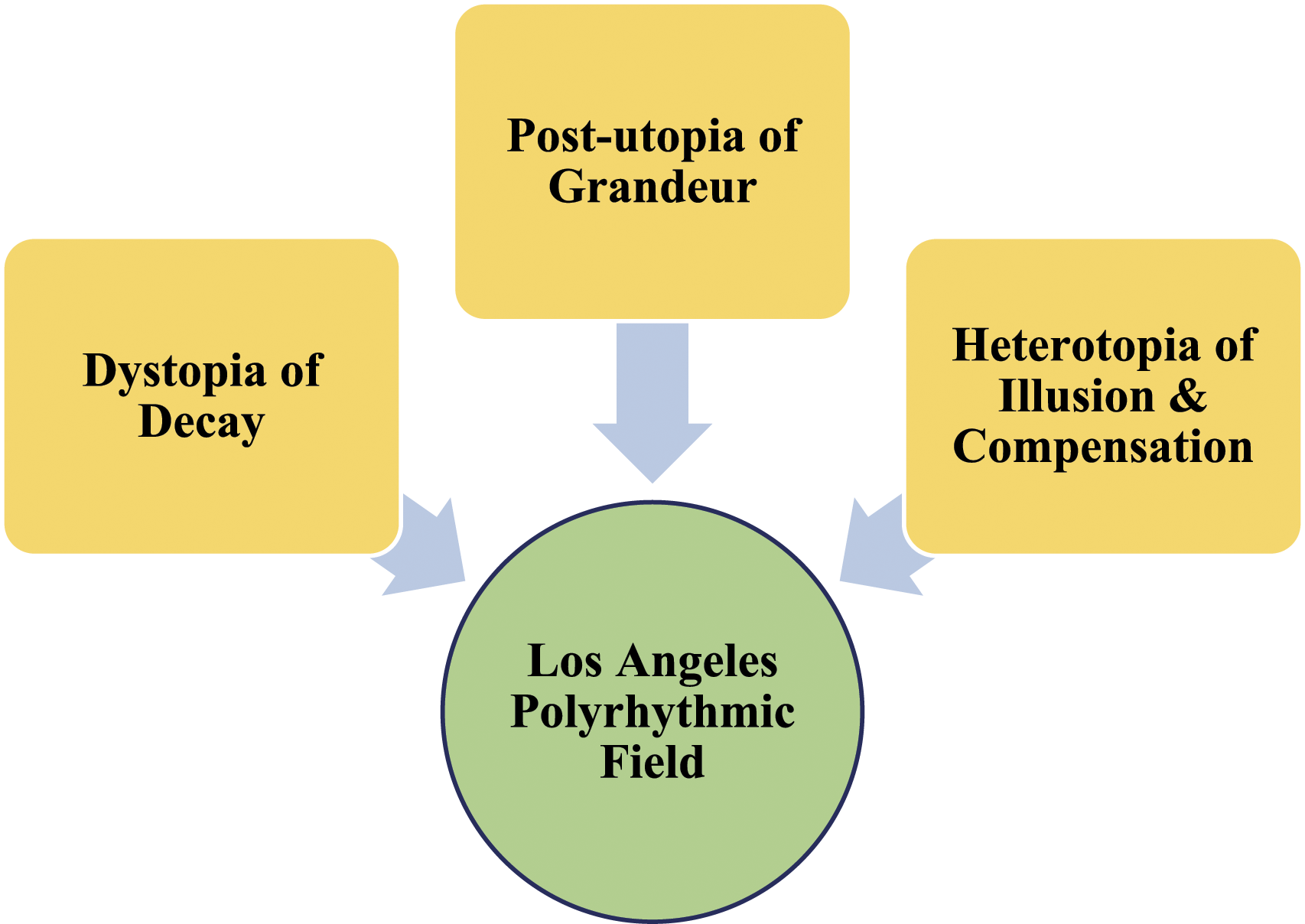
Starting from the opening scene, Villeneuve produces an alarming aestheticized visual register and disturbed vision of humanity, depicting in the process a transformed West ravaged by ecological anxieties. The film’s preoccupation with the visualization of the post-anthropocene is prominently embedded in its cinematography, which frequently favors non-human points of view and extreme long shots. By virtue of the eloquent aerial long-range perspectives and the spectacular expansion of zoom-in and zoom-out possibilities, the urban landscape paradigm serves as a cultural portrait of a dystopian narrative centered on the loss of human control over nature. In this seeming impasse, the gigantic scale of the extreme long shots, especially in the extended long takes of the barren landscapes that visually communicate the film’s anthropogenic esthetic, morphs and syncs up with the shifting position of humanity and utterly dwarfs the human figure in relation to the frame, twice removing them from such inhospitable landscapes. Unable to conceive of a future that moves beyond the existing order, Villeneuve leaves no room for a positive change to the hostile and precarious mode of existence in this ‘dystopia of decay’ (See Figure 4). The once prosperous West has turned into an apocalyptic ‘continuous city’ (Lerup, 2017) in an ever-warming planet (Hern and Johal, 2018); this scenario serves as an allegory of the social and human-induced ecological decay of the present nation and continued decline of contemporary multinational capitalism. Screenshots of the dystopian cityscape in Los Angeles in Blade Runner 2049.
In 2049, LA is best regarded as a ‘postmetropolis’ (Soja, 2000) where socio-economic cleavages are deepened. The ironic dichotomies of ecological collapse/renewable energy and free/slave labor allude to the current global collapse in climactic, financial and socio-political realities. As a total (albeit clichéd) embodiment of unaffected capitalist evil and a radical utopian blueprint of techno-political systems, Wallace Corporation now rules the world. It not only maintains an antagonistic monopoly on technological developments, but constantly seeks to advance android technology while simultaneously pursuing harsh re-bordering strategies to control populations as well. The off-world colonies provide a better life, being a utopia for the elite who are reluctant to risk exposure to (and barely venture into) the lower regions of the city. As Gomel (2018) argues, ‘Utopias are always guarded by fences, walls, oceans or cosmic distances; protected from the pollution of history; kept pure and undefiled’ (p. 6). Indeed, it is this ‘enclosure’ that characterizes Wallace’s corporate complex. Structurally, the corporation is portrayed as a massive, 300-story building. The gigantic, postmodern style of Wallace Corporation (not seen in entirety, nor fully accessible) induces a sense of atrocity, yet the interior exudes an inviting warmth. Whether its uniform color, large and tough high-class architecture, simple decoration or the sense of line and geometry created by light and shadow, the interior structural space aims to highlight the uniqueness and superiority of the elite. Wallace Corporation is best described as a political ‘post-utopia’ (Bell, 2017) that relates to the current geopolitical situation (See Figure 5 and Figure 6). Screenshots of the exterior design of Wallace Corporation as a post-utopia of grandeur in Blade Runner 2049. Screenshots of the headquarters of Wallace Corporation interior design in Blade Runner 2049.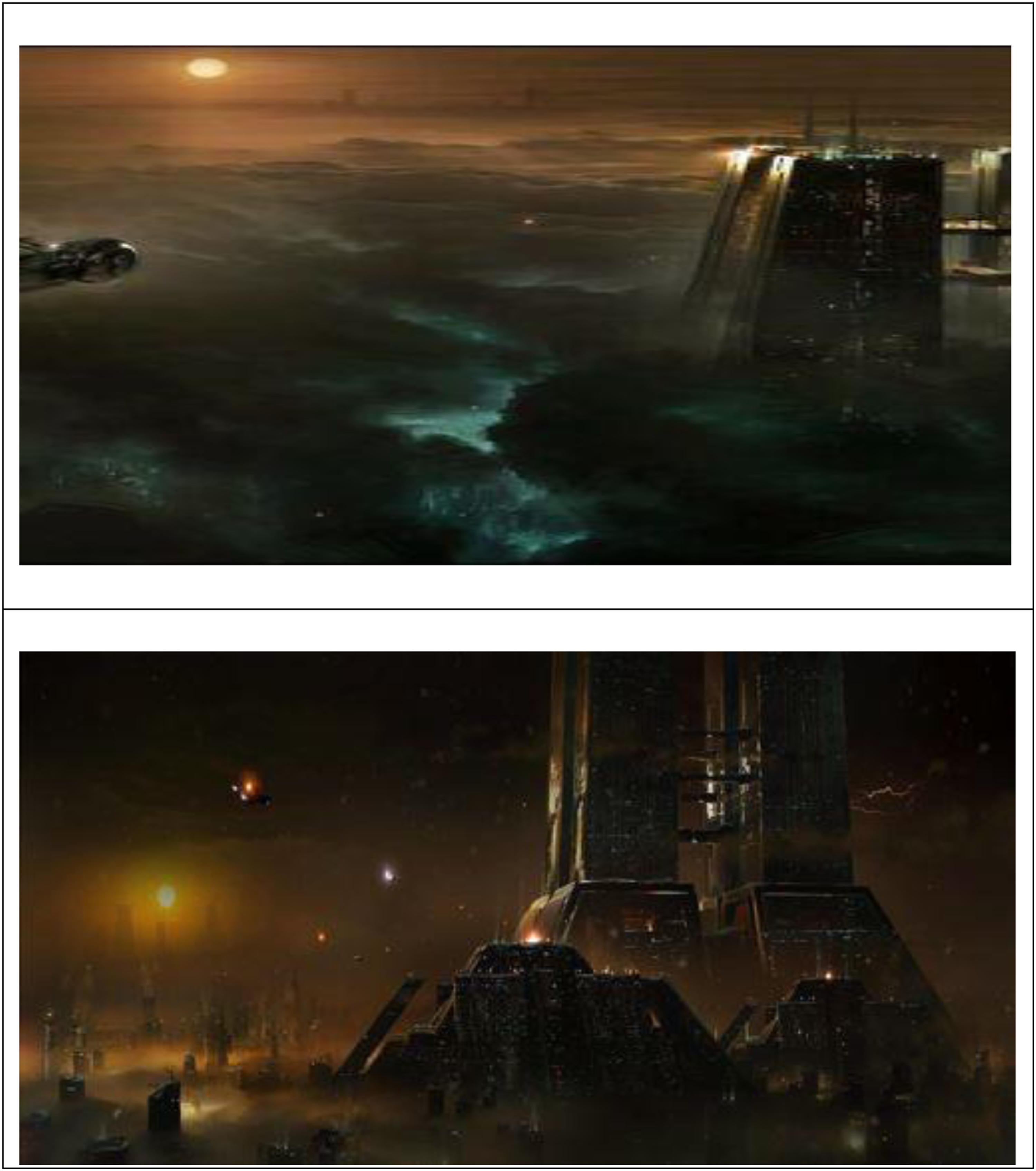
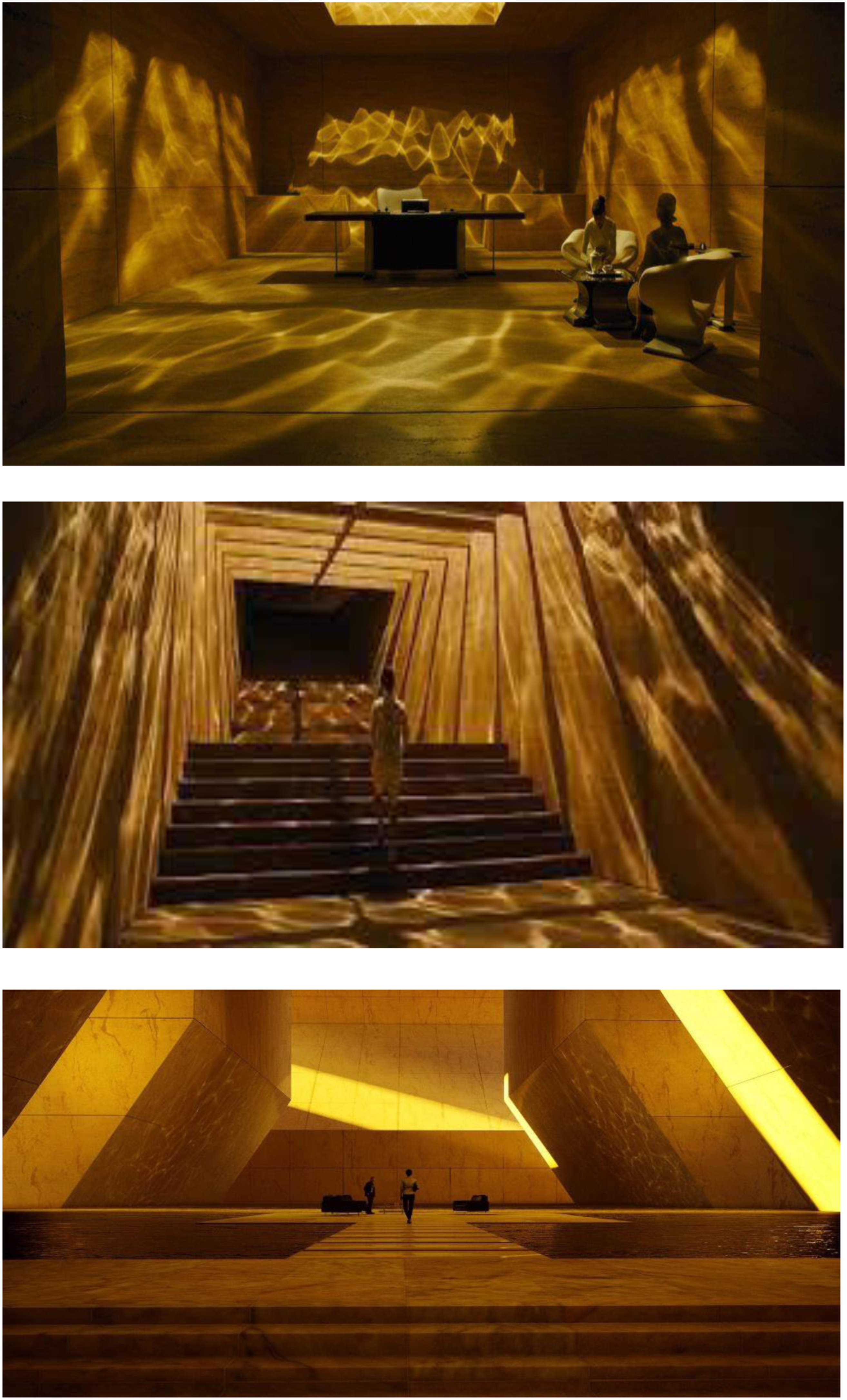
Villeneuve’s visualization of humanity’s ugly future, in dystopic and utopic terms, is tempered by the beauty of the replicants who stand in sharp contrast with the grim milieu of LA. The dystopic scenario induces the need for redemption, a pseudo humanity that restores what has previously been destroyed. Paradoxically, experiences that transcend life in the biological sense acquire utopian significance and, as a consequence, the misé-en-scene acquires an active role in the film and the merit of the narrative goes well beyond its embodied aesthetics. The crux of argument is that Wallace Corporation par excellence, with both its inclusionary and exclusionary practices, brings embedded heterotopias into being in vastly different ways. Like a factory, it is both indoors and outdoors. At first glance, the corporation can be considered a heterotopia of ‘deviance’ where a highly controlled environment prevails and relationships between humans and posthumans are organizationally structured. However, as both a physical and conceptual space, it is an aspirant post-utopia, a fantasy in the messy and imperfect real world representing a safe haven for the protagonists. Just like Foucault’s remarks on the ship as a heterotopia, Wallace Corporation is a microcosm of a placeless place that functions according to its own rules and gives the illusion to replicants that they have life and status and simultaneously simulates a utopia free of humans.
Against the polyrhythmic field of Los Angeles in BR2049, the posthuman body, as the natural substrate on which cultural meaning is imprinted, is best understood through the collage of semio-discursive tropes of estrangement and alienation. These tropes abound in and through the outdoor and indoor linguistic landscape permeating the dystopian cityscape and Wallace Corporation, respectively. Such tropes operate as spatial techniques as well as embodied heterotopias, namely, pictorial metaphor, intentional irony, symbolism and light/color repertoire (See Figure 7). These semiotic resources, despite being included in a condensed and necessarily partial cinematic form, are socially shaped and employed vis-à-vis the socio-political practices interwoven in the film narrative. Semio-discursive features of estrangement and alienation in the heterotopia of illusion and compensation in Blade Runner 2049.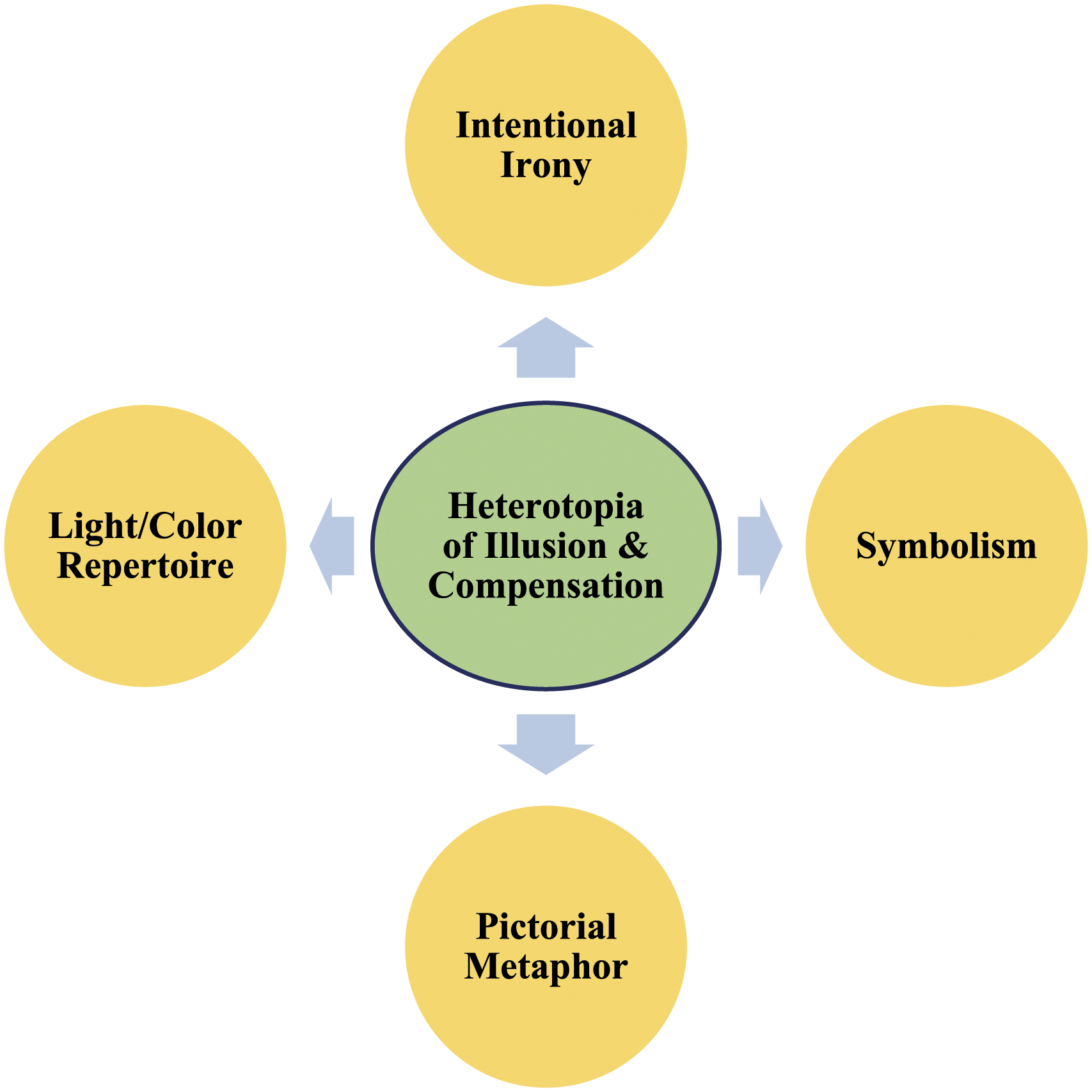
Since the physical appearance of replicants does not immediately identify them as such, Wallace Corporation maintains a Voight-Kampff test check. Ironically, the test is an empathy non-human test for humanity. The test does not measure affects such as fear, remorse and rage despite being the key cursors of humanity; rather, it measures emphatic response through physical manifestations like iris fluctuations, capillary dilation and blush response. The sole implication is that if a replicant does not show emotions, they do not feel as human. The bizarre nature of the test justifies why on one occasion it takes more than a hundred questions to discover that a replicant is a Nexus six model (when a standard test consists of 20 to 30 questions). Ironically again, the questions posed do not test empathy with human beings. Of the questions posed, for instance, some test attitudes toward issues of the human community (e.g. maternity, childhood, and sexuality). Fashioned in this manner, it does not define what a replicant is.
The Voight-Kampff test and other forms of indoor/outdoor surveillance control ubiquitous in the universe of BR2049 (namely, drones and several domestic digital AI creations that perceive mood swings, perform facial recognition and suggest profiled behavioral practices) mark the expansion of a technologically enabled omniscience that converts landscapes into spaces for incorporation. In several scenes, the real humans in the movie (who are only around five with names) are dwarfed by giant holographs and enveloped in simulacra of different types (virtual environments, intelligent holographs, and replicants who so closely reproduce the human in appearance, aspiration and mentality) that they threaten the value of human existence. Other scenes contain no human characters at all; only replicants or digital AIs are visible and this ultimately obviates the need for human presence, including the human image itself. These projections are not completely fabulations; they are symbolic of the techno-capitalist development and imperialist warmongering deeply imbricated in the advent of the post-anthropocene that decenters the human.
Another noteworthy Wallace creation is Joi, a docile homebound holographic companion tailored to K’s specified desires, a projection of an artificial intelligence and a partial embodiment of virtual sentience. She remains immobile, tethered to K’s movement and spatially confined and limited since she is without corporeal substance. Her holographic and volumetric display, yet apparent depth, is a pictorial metaphor and her name is no different. Joi is not a mere male-gaze fantasy, though. Despite being a virtual AI creation, the sheer fact that she is visible floating semi-transparently in the air in all spatial dimensions makes her very being an augmented heterotopic space (See Figure 8) since, in the socio-cultural context of the film, she is a fleeting reality that shapes the way K relates to his own identity. Despite being programmed, she seems to progressively have a certain degree of autonomy when she attends to K’s needs and tells him ‘You’re special’, when she assertively decides to call him by the name ‘Joe’ believing he was not made but born, and eventually when giving him directions to destroy the emanator that controls her out of self-sacrifice. She is depicted as a holographic character who desires liberation, who takes the risk of losing her mortality for the sake of this freedom, and who eventually dies for a meaningful cause, despite her un-embodied AI identity. The fact that Joi longs to connect with the world, to touch her lover K, to feel rain on her skin and eventually self-sacrifice indicates some level of emotional transcendence. Screenshot of Joi, K’s holographic companion in Blade Runner 2049.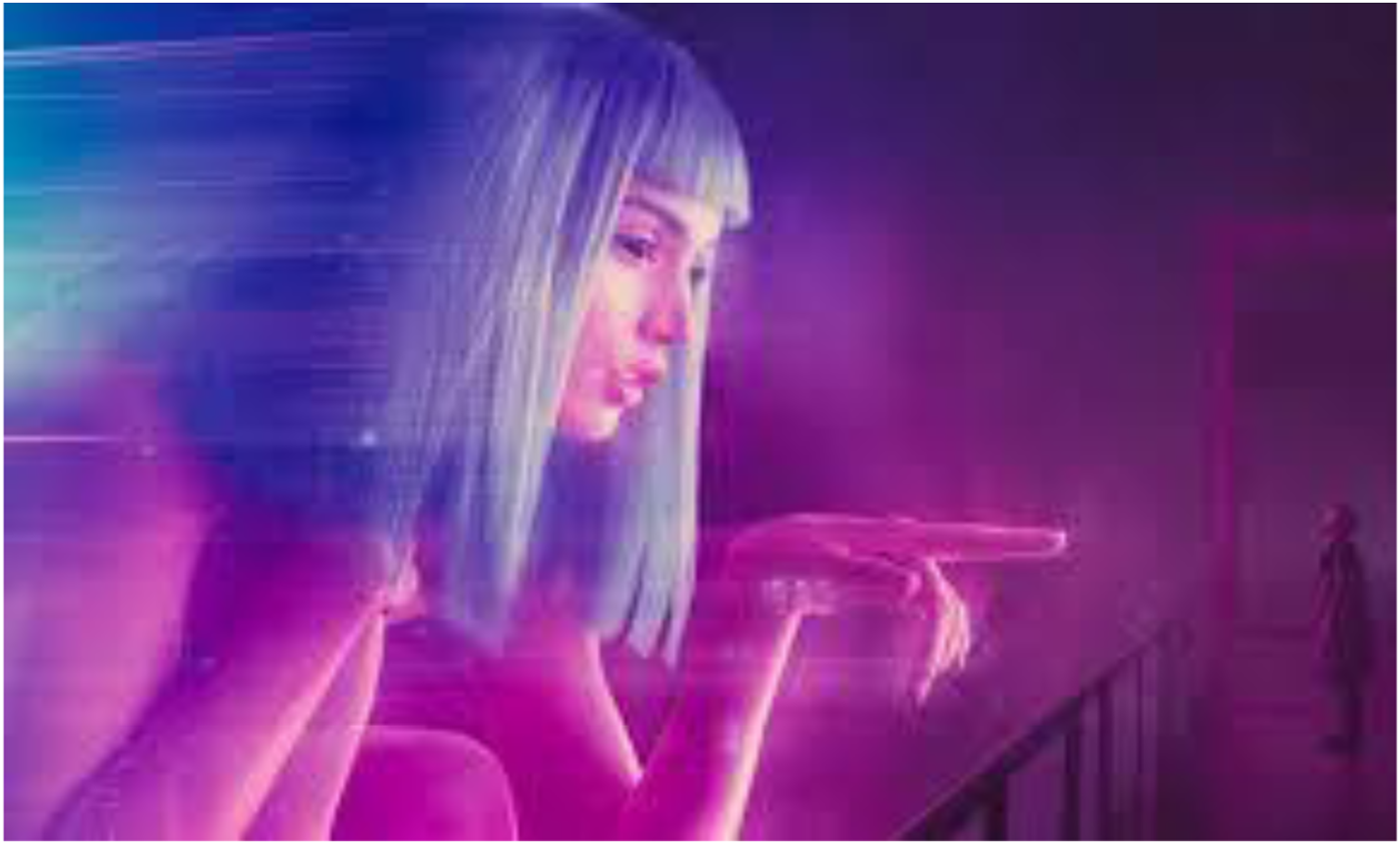
On a different note, what is significant in BR2049 is the fact that (a) the flourishing of virtual space is in opposition to the doomsday of real space; (b) the dark and minimalist elite space and the bleak, radiant underlying space collide; and (c) real space has surreal symptoms, while virtual space is given a sense of realism is significant. Not only does the syntagmatic combination of minimalistic abstractness and primary colors that permeates BR2049 connote artificiality and virtuality, but it advances the filmic narrative therein as well. On the macro level, the closed space color of the elite class is unified, with cool colors – high black, gray, gold and white, creating a highly structured, deep, cold visual perception. The virtual space further hosts light lines or geometric shapes inside the building through the contrast of artificial light. Contrasting to the elite, the open space draws on blackout, neon lights, heavy rain, poor streets, billboards and other visual elements that create the bottom space. On the micro level, certain colors are prominent and gain new meanings in the BR2049 palette. The muted gray-green color palette makes the landscape appear even more desolate; compared to the dynamic fires of the opening of the original, the world of 2049 appears inhospitable. While gray is the main tone of the dystopic lifeless future in 2049, white is mostly preserved for suspended places out of space and time (like a limbo). In total, colors in BR2049 correlate with an agglomerate of heterotopic places.
Posthuman Emotion AI
Similar to LA dystopian cityscape in BR2049, the posthuman body constitutes a patchwork of topian, utopian and heterotopian spaces that are spatially proximate yet estranged (See Figure 9). The replicant body is spatially conceived as an inescapable limited and finite space (i.e. topia). Replicants are spatially confined by their topographies (AI bodily mental features), territories (socio-political divisions in LA), and boundaries (limited life spans, prosthetic memories, etc.). Indeed, the topographies of posthumans qualify as ‘spatial metaphors’ that function allegorically throughout the film. The corporation celebrates the posthuman body as an ‘autoplastic’ work in progress. The realization of replicants as technological utopias is, however, always ‘partial’, ‘compromised’, ‘unstable’ and ‘ephemeral’ utterly dependent on the contextual forces which would otherwise extinguish them. Presented as ‘nexus models’, replicants are highly developed in intelligence, speed, reflexes, rationality and even emotion, yet suffer from mutilation (due to the four-year-old life span), the thing that leads to their fragility and dilemma of realizing self-worth. The topian/utopian/heterotopian triad of the posthuman body in Blade Runner 2049.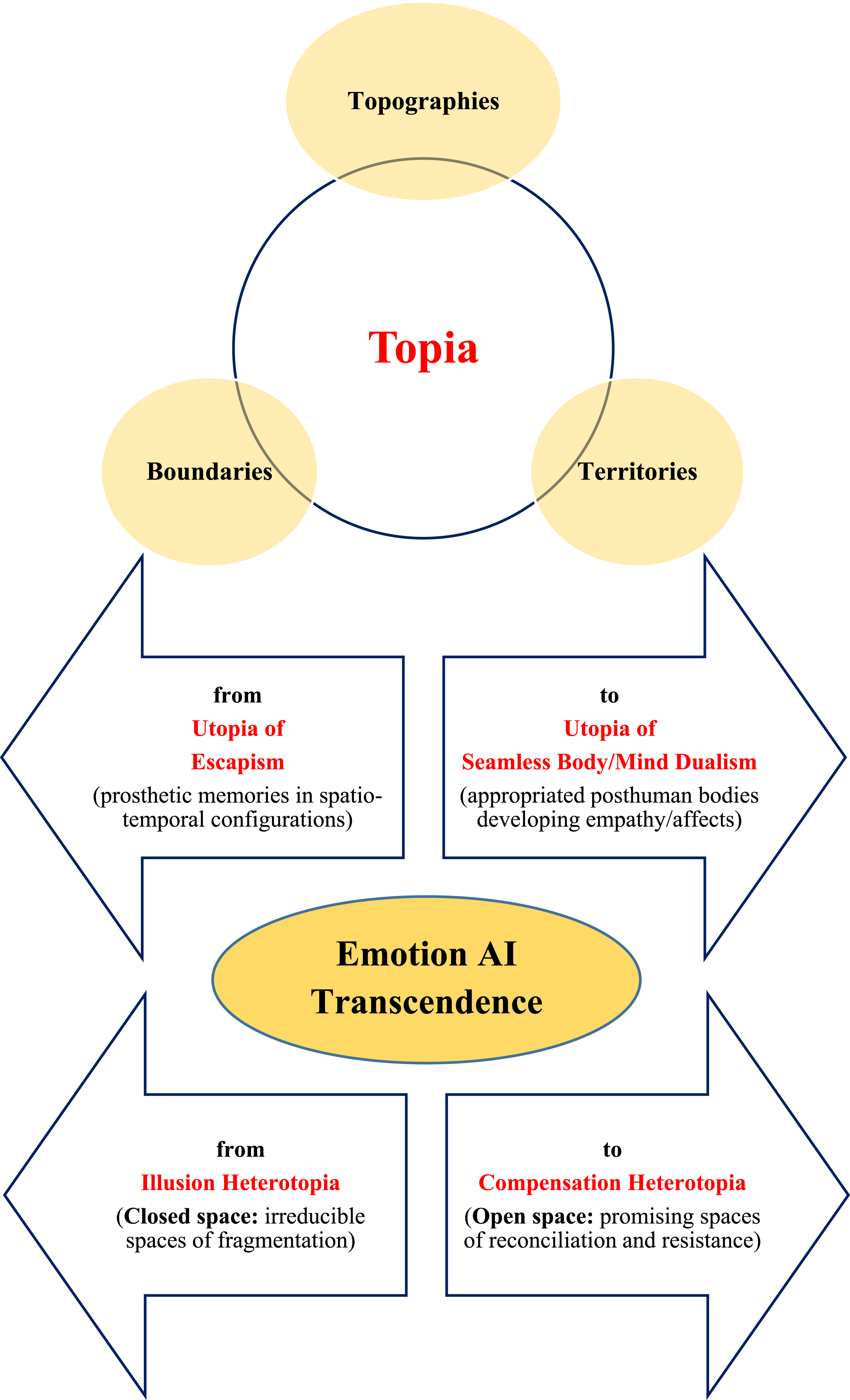
The process of memory-making is an important case in point to consider at this juncture. In BR2049, it is Dr Ana Stelline (the daughter of the Nexus-7 replicant Rachael and Officer Deckard) that works for the Wallace Corporation manufacturing memories to structure personalities with uncanny authenticity using a ‘memory orb’ device (See Figure 10). Confined to a glass ‘prison’ to protect her compromised immune system, and as a response to living in medically-sealed isolation, she not only specializes in creating memories, but also affects, sensations and images of a world she has lost and experiences she can no longer have. When she first appears in the film, she is at work in a forest of green, sunlit trees, which have been produced digitally in her studio. In some cases, her images compensate for a larger loss, not just her personal isolation, but also extinction outside her walls. For instance, the horse memories that haunt K in most of the filmic narrative and the heat of the furnace he looks into as he is chased by the other orphans are Anna Stelline’s memories, not K’s. Since replicants’ prosthetic memories are borrowed from the experience of real people, their identity is, as a consequence, troublesome. In total, these memories, as projections of virtual spatio-temporal configurations, render replicants ‘utopias of escapism’ providing escape routes from the ugly spatio-temporal norm transgressed. Screenshots of Dr Anna Stelline, the memory designer working for Wallace Corporation in Blade Runner 2049.
As the film progresses, however, replicant bodies are depicted in a contestation of power and undergo a significant emotional transcendence marking a paradigmatic shift to ‘utopia of seamless body/mind dualism’. Prosthetic memories, as multilayered dynamic complex of time-space rhythms, as a consequence, become a harbinger of, and vehicle for, cognitive freedom. The height of subjective individualization is when the replicant, having always lived in the certainty of its condition, begins to question its own existence, in the hope of being also human. Operating as repressive but pervasive forms of presence, several heterotopias abound in the reconfigured Nexus-9 replicant body, coalescing to play a subversive, contestatory role. Implanted memories can simultaneously be considered as heterotopias of ‘illusion’ and ‘compensation’ whereby their reality is largely ‘prosthetic’, a fantasy that cannot be deemed real, yet is a reconciliation that unfolds the chaotic postmodernity into regulated and organized colonies. Replicants’ bodies, as a consequence, would be similar to ‘heterochronies’ that constantly accrue time in one space. As posthumans develop and are exposed to increasingly more abstract concepts, they fit the image-schematic profile SOURCE-PATH-GOAL/CONTAINER. K’s search (the driving mechanism for the explicit narrative) connects a multiplicity of spaces and creates an itinerary and spatial journey across the Los Angeles Basin from its artificial farms, megacity, law enforcement agency (LAPD) and corporations (Wallace). Emotion AI, as both an experienced and observed activity in urban space, is inherently rhythmic, influenced by the embodied sense of place. Throughout spatial practices, K traverses the lived spaces, engages in movements and social practices, and generates in the process polyrhythmical fields of interaction. His AI mind cognitively transitions from ‘mimetic schema’ (Zlatev, 2014) to ‘image schema’ and retains a sense of (and for) place; as varied as these practices are, the pace and rhythm in relationships to urban space unfolds.
Discussion
The post-anthroposcenery of LA is a polyrhythmic field and a compound of static rhythmic spatial patterns (represented by the dystopian cityscape) and dynamic spatial rhythms (represented by the post-utopian Wallace Corporation and replicants whose activities add rich complex layers to the rhythmic fields of space). Akin to laboratories, Wallace Corporation can be taken as the site in which new ways of experimenting with ordering society are tried out. As argued by Hetherington (1997), ‘The significance of heterotopias is not that they provide spaces for expression of resistance’, but ‘they act as obligatory points of passage through which an alternate mode of social ordering is performed’ (p. 37). As a replicant state of exception from some or all of the rules of the wider society in which it is embedded, the corporation embodies space-time chunks in which, however briefly, the orthodox socio-political order is suspended, allowing radical new forms of hierarchical social relations to take hold. It is through this ‘laboratorization’ of narrative space that a new social ordering emerges.
Against the polyrhythmic field, the modified bodies of replicants become sites of transformed subjectivity, appropriated power and rebellion. This, in effect, has a ‘synaesthetic effect’ (Pallasmaa, 1996) upon replicants that cannot be reduced to two dimensions. In BR2049, Wallace constantly revolutionizes replicant technology and perversely uses birth as a means to achieve the ultimate ‘miracle’ of endowing such artificial beings with the power to reproduce in the same manner humans do. Anna Stelline’s ontological status is not fully clear (partially due to the ambiguity around the identity of Deckard, whether a human or a replicant). Yet, her mother’s constant dehumanization and the implication that she was housed in an artificial womb is accentuated. Anna Stelline would then be perceived as a marvel that replicants can rally around to free themselves.
In BR2049, reproduction, rather than empathy, is the new border of contention between humans and replicants, and the capacity to reproduce stands as an underlying justification for humans enslavement of the latter. The replicant evolution will then be the ultimate existential threat to biological humans, who are being surpassed and transcended by a new posthuman agent of their own making, who have reclaimed the spiritual values of love, forgiveness, grace, mercy, redemption and liberty that the materialistic humans have gradually denied and rejected. Replicants have come to embrace their status as a liminal entity, one that exists in the interstices between two oppositions occupying a transcendent space of cognitive estrangement where identity is in a state of perpetual becoming. As a ‘trope of postmodern liberalism’ (Farnell, 2014), their body space challenges existing meanings of space and produces contesting enclaves within extraordinary timespaces. With technology seamlessly integrated into social spaces and posthuman bodies, BR2049 is arguably structured as an emotional journey composed of multiple heterotopias, that is, spatial layers, ruptures, and bifurcations expressed through socio-political capitalist projections.
Conclusion
In the current research endeavor, Foucault’s heterotopia, with its polyvalent significations, reinvigorated the work on postcyberpunk films and ‘proved highly capable of registering all manner of subtle (and not so subtle) shifts in the rationalities, technologies, strategies and identities of governance’ (Walters 2012: 3). The heterotopic hybridity pertinent to the postcyberpunk film genre, in general, and the inner and outer topographies of posthuman representation, in specific, proved to be insightful investigative vantage points of multimodal inquiry for the socio-political and technocratic implications they underlie. In tandem, the proposed analytical Spatio-Cognitive Model of Posthuman Representation helped to aptly contextualize and semio-discursively dismantle the emergent quintessential esthetic practices and subjectivities wedded to biopolitics, corporatocracy, hyper-capitalism and neoliberal imaginary.
The paper is not without limitations, though. It is a case study of a film whereby the plot unfolds in paradoxes and ambiguities around the contradiction between humans and replicants, artificial intelligence and super-large enterprises, showcasing the damage of the brutal growth of science and technology to the order of human civilization. Extending the proposed analytical model in tandem with sentiment analysis to existing and future postcyberbunk movies is likely to open new venues for the multidisciplinary study of the surveillance of emotion AI not only in fictional heterotopic spaces but also in the social milieu of prospective humanoid robots developed by robotics companies such as Sophia created by Hanson Robotics.
This article adamantly argues for new philosophical perspectives and praxis in redefinition of the social relationship between human and posthuman in a future not far from real. Posthuman innovations signal metamorphic changes to the representations of lived experience and, therefore, pose a daunting existential challenge in a world where the human race is usurped by its own artificial progeny. The enhanced non-human beings, if endowed with limitless life spans, can be individuals of unlimited vigor, cognitive power and can presumably eventually transcend the fragilities and biological limitations of the present human form. The deployment of unbridled disruptive technologies of techno-capitalism is indeed a fearful feat if taken as legitimate and if not wisely manipulated. It is, therefore, imperative to shift our gaze to the social ramifications, the promise of an empowering integrative posthuman world to expand their existing capabilities, agencies and aspirations.
This is where transhumanism seems very relevant whereby the development of benevolent AI converges with forms of human enhancement or transformation. In transhumanistic terms, humans can transcend their bodily status through technological modification into a superior successor (Fuller, 2017; Huxley, 1968; More, 2009; Nayar, 2013). In extension of Göcke’s (2018) notion of ‘moderate transhumanism’ that is compassion-based, Belk’s (2021) investigation of transhumanism in speculative fiction and Sorgner’s (2021) recent work on the transhumanist repertoire from a dozen intriguing facets, future research endeavors can philosophically examine postcyberbunk filmography, namely the magnum opus Blade Runner 2049, in close relation to hybridized life forms, technologically-assisted human enhancements measures and the accompanying new realms of experiences and values.
Footnotes
Declaration of conflicting interests
The author(s) declared no potential conflicts of interest with respect to the research, authorship, and/or publication of this article.
Funding
The author(s) received no financial support for the research, authorship, and/or publication of this article.
