




Abstract
The city of Rome has been a contested site for unauthorized graffiti since antiquity. Modern times have seen graffiti practices endure in their disruptive form and viral versions of digital street art. This paper applies critical, speculative methods to approximate distinct areas of graffiti research into a common framework of analysis. The idea was to offer insights into graffiti audiencing on digital and street-based spheres of perception while discussing the method’s limitations. After listing convergences and divergences between human-centric and algorithm-centric viewpoints, results revealed an interesting set of details uniquely brought up by computer vision metadata, but which, in turn, exposed limitations in recgonizing graffiti as a politicized practice with deep radical roots.
Keywords
The city of Rome has been a relevant site for graffiti since antiquity. In modern times, graffiti thrives as the utmost expression of freestyle art on walls and in all kinds of public and semi-public spaces. Anarchic drawings depict sexual themes, sticks play with moral tales and stamps reproduce deprecating jokes, social media regurgitation and urban commentary. Despite the ephemerality of these interventions in the urban fabric due to legal and material conditions (MacDowall, 2016), there has been an enduring symbiosis between street action and social media (e.g., MacDowall and De Souza, 2018). The advent of Instagram, for example, has enabled the mirroring of graffiti practices in its unauthorized and disruptive form and commodified versions of street art available online.
This paper aims to approximate distinct areas of graffiti research into a common framework of analysis. Computational and methods can elucidate different forms of perception of graffiti. The former can illustrate the use of graffiti images on automated environments, such as social media. At the same time, the latter situates the practice according to the contested political context of the streets. This research offers insights into interpretations of unauthorized forms of graffiti allowed by computer vision algorithms while contrasting them with human-led, street-based perception deployed as a method. The article starts with a brief overview of graffiti in Rome and current issues in reading unauthorized graffiti, then discusses the efficiency of computer vision for reading and categorizing graffiti.
Graffiti in Rome: An ancient practice?
As an Italian word in its roots, graffiti is a broad practice of public writing, scribbling or spraying that encompasses several historical moments. Notoriously, records from ancient sites have enlightened the knowledge of graffiti pieces found in excavations, especially in Pompeii and across Italy. In Ancient Rome, graffiti messages triggered protests, as in the case of philosophers such as Plutarch (Milnor, 2014: 273). Content-wise, ancient graffiti is similar to contemporaneity. Both contexts are identical concerning the anonymity of the messages and their authors (Benafiel et al., 2010). It also resonates with the gender imbalance in many of today’s graffiti scenes. In Paquius Proculus’ house in Pompeii, archaeologists have only found male names in a universe of rare mentions of women (Benefiel et al., 2015: 105), unlike medieval times, as graffiti mainly consisted of religious sayings (Sa Fran, 2011: 124). Over the 20th century, Italian history has shown that graffiti thrives on political leanings. The famous Fascist saying ‘Mussolini is always right’ was read on the walls of supportive Italian towns during the years of the regime (Townley, 2002: 173).
The fact that ancient graffiti has been ubiquitous in private or semi-private environments suggests a degree of literacy of those who attend these surroundings. From advertisement to politics, from funerary to celebratory, Italo Calvino (2017) reminds us how the walls of Rome have given off public, private, offensive or playful publicly displayed messages. Eventually, graffiti has come down as an integrated fact of ancient Mediterranean life, with rich craft styles, purposeless scribblings and the usual sexual symbolism that makes it timeless (Keegan, 2014: 21). As we shall see next, the city of Rome has, throughout the centuries, remained a fertile ground for graffiti due to the openness of its urban fabric. The city has accommodated old and fresh graffiti forms, inviting rebellious and marketable viewership while not giving up multiple waves of official repression.
Unauthorized graffiti in modern Rome
Like London (Schacter, 2017), Rome has alternated between promoting street art in state-sanctioned places, such as the southeast neighborhoods of Quadraro and Torpignattara. The city government has otherwise neglected graffiti or made anything else illegal. The individual persecution of writers allegedly comes from their ‘assault’ of stations, tantamount to the sudden graffiti breakthrough in the public eye on swathes of sprayed walls in public places – for example, Valle Aurelia in one of the most sprayed stations in the metropolitan rail system. In June 2019, commuters woke up to gallery-like internal walls, including platforms dressed in colorful security signals, graffitied only days after its complete renovation in white paint (Romano, 2019).
State forces have generally failed to tackle graffiti’s ubiquity. Repression has fed innovation, and the maturing of visual repertoires built-in competition among writers (Willis, 2013). The liberating opportunities of graffiti communication clash with misunderstandings behind its abrupt occurrence in the public space (Mitman, 2018). This scenario prompts the rise of prolific graffiti writers, such as the Roman Lorenzo Perris, the so-called GECO. Perris is a 30-year-old whose signature was visible everywhere in the Italian metropolis and abroad. GECO, written in large block letters, is stuck to walls, train stations, flyovers and unexpected corners (Roma Today, 2019, 2022). This ubiquity triggered a lawsuit by Roman authorities (Roma Today, 2022).
GECO, the writer himself, gave an interview (Massy, 2018) to talk about his influences, but not his methods, as he said (translated from Portuguese): “In fact, my style doesn’t differ from city to city. I’m a bomber. I want to spread my name more than having a super-developed aesthetic. The two can and should be complementary, but the first objective of the bomber is quantity. Quality comes later. The city doesn’t influence my style but my method and approach. I think that in Lisbon, I have a more natural approach to graffiti because I feel less of a ban.” (Massy, 2018).
In that sense, writers such as GECO practice the so-called ‘space-claiming’. Mitman (2018) argued in his study of Philadelphia’s graffiti scene that feeling disenfranchised from the urban context is a significant motivation for writers. Indifferent to this marginalization, citizen-organized initiatives, such as Retake Roma, vow to clean Rome of all types of graffiti, yet these organizations remain silent about corporate-sponsored art (Covelli, 2021). This kind of punitive stance against writers aligns with state-level persecution and the media that target independent, disruptive writers, as this profile written about GECO stated: “A hated signature that has become a legend at the same time; a writer sought after by the police as much as by his fans. Some call him ‘the impregnable Diabolik de Noantri,’ and others who, commenting on his photos, write that "GECO is making the history of Roman writing.” (Di Cori, 2020)
Moreover, the same narrative of punishment was channeled by then Mayor of Rome Virginia Raggi, who said on Instagram that his story is no longer ‘tolerable’ (Ibid, 2020). Media reports have also fed periodic digests of graffiti as a law-breaking, crime-inducing practice (e.g., Caccioti, 2021; Il Messaggero, 2018; Larcan, 2021; Nicolini, 2021). Individual issues of public punishment receive lengthy highlights (Corriere, 2016; Il Giorno, 2021; Raimo and Zingarini, 2021), as writers have reported first-hand accounts of racism and xenophobia from angry citizens (Corriere, 2021; Roma Today, 2013). Only a few left-wing publications have voiced support for writers such as GECO (Cegna, 2020). In 2020, the prestigious daily Il Sole 24 Ore asked for new ways of thinking about the ‘regulation’ of street art and calling the mayor’s overreaction an outdated response (Giardini, 2010). Some commentators have pointed to the contradiction of vouching for big names such as Banksy, whose unauthorized graffiti was featured in a large exhibition: ‘In Italy, we treat writers as boss mafioso while paying to see a Banksy in a museum’ (Santangelo, 2020). Elsewhere in the country, celebrated street writers can drive some public charisma in local communities (Caputo, 2020; Urbani, 2021).
After surveying 30 years of graffitied metro carriages, Matthieu Romeo and Lorenzo D’Ambra found that practitioners have remained committed to self-expression, even if that meant constantly running away from the police (D’Ambra and Romeo, 2021). The Roman graffiti scene has also attracted growing numbers of feminist and queer participants (Urloweb and Queenz, 2021). This brief background fleshes out the political context that involves a whole set of actors, regulations and the community around graffiti in Rome. This research considered this moving context to investigate how graffiti’s radical origins are confronted with the advent of computer vision algorithms that can see, define, and categorize graffiti images automatically. The politicized and complex element of unauthorized graffiti probes the power to generate metadata about such contentious images. Furthermore, we aim to discuss the degree to which unauthorized graffiti may lose or not the transmission of political or oppositional stances if only accessed through algorithmic filtering and classification.
Graffiti context, computer vision and framing
One example of the co-existence between human agency and contemporary graffiti’s computerized renderings is GECO’s ‘spreading his name’ statement. Even though his art reverberates through social media, this publicity does not explain his phenomenon. GECO’s testimonial provides evidence of the recent intertwinement of digital and urban practice. In old-school graffiti, writers competed in spelling their territorial choices based on semiotic, discursive, or performative criteria (Brighenti, 2010; Tulke, 2021; Wilson, 2014). Whether GECO or his partners ponder these sorts of repercussions, their practices exist in distinct dimensions for digital viewers and passers-by. Posting, hashtagging or boosting the automated spreading of such images will depend on computer vision to accelerate these images’ prominence on social media. As much as the occasional virality of these images ramps up antagonism, writers are subjected to lawyers, councils and citizens, who ignore the street-based or computerized renderings of their art. Both kinds of readings operate according to real impediments graffiti face in the city. How can graffiti readings be fairer to the political conditions that lead to its existence while generating metadata for social media platforms?
Seen through social networks, graffiti can only refer to the beautiful or curious impression it causes in by-passers (Vanderveen and Van Eijk, 2016). It can spring from solidarity-related postings from users alienated from the dangerous implications for writers (Christensen and Thor, 2017). Whenever vernacular creativity can exist on its own or with new media spaces, there are always limitations and drawbacks to how the public justifies these interventions’ existence (Burgess, 2006, Iveson, 2011). On social media, city controversies around the illicit nature of graffiti can conveniently be ignored by digital viewers, as the material conditions of the production run absent while all it matters is its digital circulation (Bowen, 2013; Baird, 2022).
For example, graffiti’s non-digital context also matters in understanding the binaries between legality and illegality. The debacle around the limits of graffiti acceptance online versus the offline world has split metropolises into ‘moral geographies’. That discussion is not always present on social networks (Mcauliffe, 2012). In the same direction, De Certeau (2011: 22) mentions the ‘logics of operation’ that entails street art. In that case, graffiti’s context lies in the ability to play it with the public, like in a game. De Certeau translates the context of unauthorized practices as a ‘song of resistance’ or a way of counter-using imposed systems of reception. He states, ‘It constitutes the resistance to the historical law of a state of affairs and its dogmatic legitimation’. Social media, in this case, may obfuscate graffiti’s context of resistance, approval or disavowal in tandem with its perceived popularity in the frame favored by computer vision technologies.
This research’s notion of context settles on these temporary, legal/illegal, phenotypical/material conditions in which graffiti appears in the urban fabric. It spans ‘the limits of visibility of these texts’ (Iveson, 2010). The issue of context becomes an essential argument to understand the loss of the field situation at the expense of the current acceleration of capture and interpretation of urban artifacts through metadata (Marres, 2018). Aware of the shortfalls of digital research regarding context, our definition also meets ideas of media framing: the process of selecting and re-hierarchizing the readings of perceived reality (Entman, 1993). Framing is down to the descriptive properties of “clusters” of information available in each posting (Scheufele, 1999). Framing thus evades the view of a collective agency of algorithms, as only big tech companies know how they operate in such a level of detail. Instead, we experimentally apply to frame to scanning graffiti images without further critical inquiry versus whenever human agency exists. We were interested in the degree to which algorithms capture at least part of the local context from a human-centric view.
During preliminary research, there were 21,393 posts classified under the #graffitiroma hashtag on Instagram, which is only one of the many hashtags harboring pictures of unauthorized graffiti in the city. This hashtag served as a gateway to capture because it also gathers other hashtags such as #romagraffiti, #lovegraffiti, #trenitaliafs, #poisonroma. Using hashtags does not mean investing in these text pieces but appropriate them to check how graffiti images appear on social media according to a computer vision scan. These hashtagged images are, in turn, representative of how computer vision can nowadays classify and organize these images for some purpose online. This paper, therefore, contends that it is possible to advance existing methods by bridging computational and non-digital social research methods. It does so by contrasting online graffiti images alongside images extracted from its production sites by the researchers themselves. Although it is not the case of presenting technology as a competing avenue to the streets, we aimed to check salient or absent aspects resulting from both sources as we develop next.
Methods
This research departs from a mixed-method framework for contextual analysis of visual social media posts, as other studies in the literature have also explored (e.g., Ardevol, 2012; Chan et al., 2016; Jacobson, 2015; Patton et al., 2020). The proposal was to enlist graffiti images primarily made for distinct purposes. Even from a limited perspective, the analysis could pinpoint absent or salient elements regarding the presence of graffiti in the urban fabric. The convergence or divergence between computational and non-digital methods would depend on the fresh ways to process these images and which method could better serve to situate graffiti and its political context. In sum, we contrasted computer vision metadata applied in the Instagram-obtained sample against pictures of graffiti pieces directly obtained from the streets of Rome for this research’s purposes by the team.
To the former aim, this study benefits from previous attempts to combine visual analytics with social media data (Schreck and Kei, 2012), such as the description of images, comments and hashtags, which bring up a wealth of information about the picture. In this case, the method analyzes all photos tagged as #graffitiroma, which amounted to over 21,000 posts on Instagram. We have proposed a small purposive sample (n = 2100), circa 10% of the total API-sourced images from #graffitiroma. For a satisfactory sample, it suffices to perceive the essential characteristics of the graffiti that thrives on the network. Moreover, the selection sufficed to gather enough contextual elements such as location, colors, text and various objects depicted. We have chosen Instagram because of its popularity and penetration among graffiti communities in Rome and elsewhere. The platform is also fitting because it mixes commercial street art and unauthorized pieces. It employs methods of computer vision to identify, catalog and generate a metadata list to be extracted from all the images (Statt, 2018).
To analyze this sample, publicly available Google’s Computer Vision technology (Google, 2022) served as a popular tool that provides users with metadata based on prominent elements of the sourced pictures. The option for this computational technique responds to a recent framework for automated visual analysis (Burgess et al., 2021) that generates data based on the description of visual vernacular called critical simulations. This method followed what the authors called critical speculative digital methods. The latter refers to this framework as ‘a form of dynamic “grey box” testing that invites creative, explorative investigation, using advanced computational techniques, guided by critical and qualitative questions’ (Ibid: 2).
Example of computer vision analysis metadata used in this research.
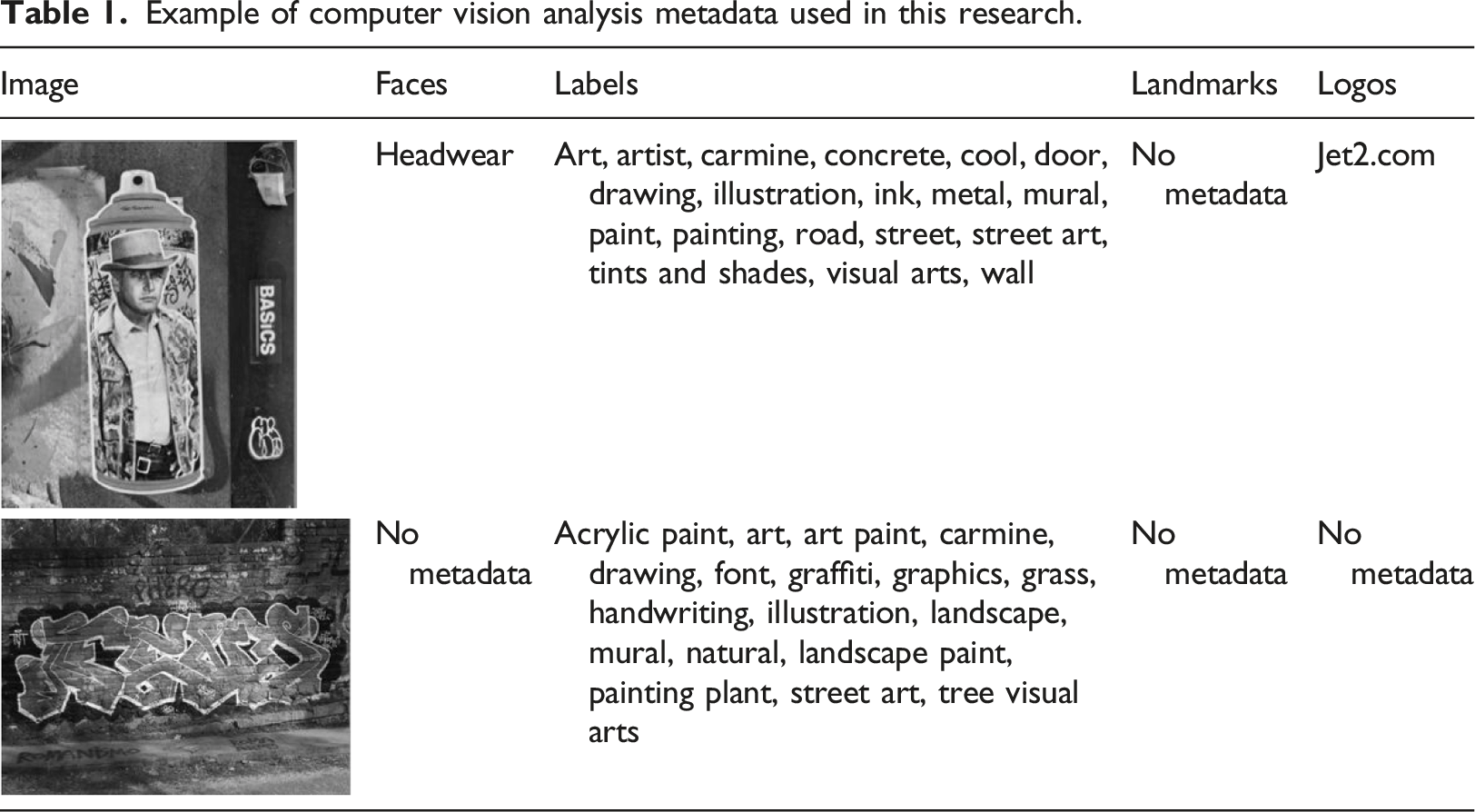
For the non-computational method, the study collected 150 photographs of graffiti in the city of Rome taken by the paper’s authors over 5 years (2017–2022), especially for this research’s purposes. These field visits aimed to capture contextual aspects of graffiti to recreate the encounter between the researcher and graffiti pieces, making contextual elements visible and reactions palpable, as in the anthropological work by Saunders (1985). These images have comprised several topographies of the city, including tourist and suburban neighborhoods and public, semi-public and private spaces. It included a range of unauthorized graffiti techniques, including stickers, handwritten messages, painting and hybrid pieces (eg containing more than one method, such as tagging and spraying). The coding framework also included multimodal features such as colors, nuggets of information and writing styles that could inform values associated with media references, artistic movements and popular types. For example, this framework in Kathmandu allowed for an interpretation that consistently points to violence and gender discrimination (Paudel and Neupane, 2019).
Analytical schemata for graffiti images collected in the city of Rome (Based on Rose, 2016).
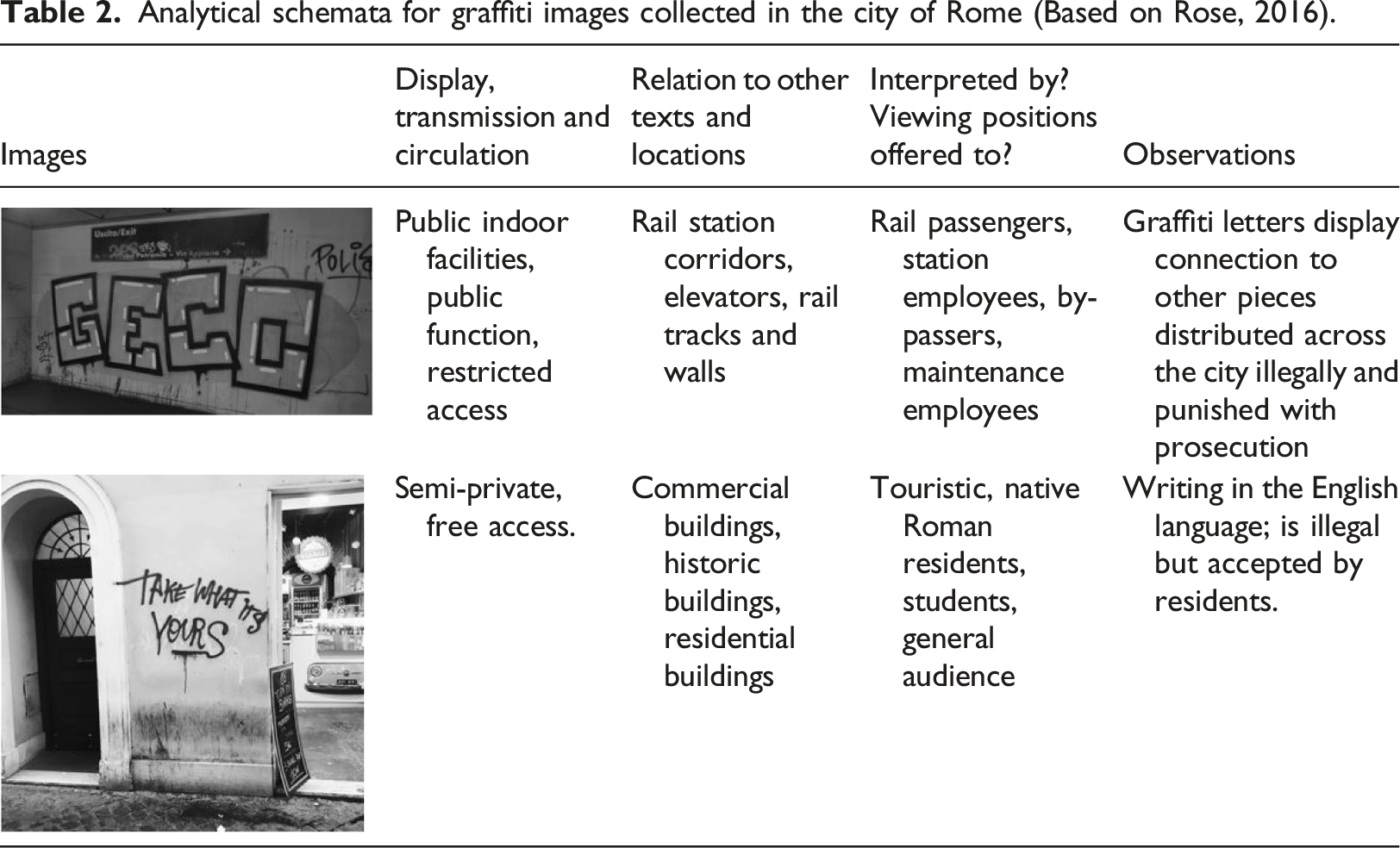
In this codesheet, the responders had to choose from a pre-defined set of choices made of the preliminary analysis (eg public buildings, residential areas) to reduce the subjectivity. Then, each author proceeded with their analysis, in which a blank space collected personal reflections raised by each investigator. This text formed a word cloud that would allow for further reflexivity on the potential meanings of each graffiti concerning its context. We also pondered on what Pinney has argued about the Eurocentric language bias. We have sought to circumvent this bias by taking advantage of the ‘visual culture as presence’, including other potential viewers of the pieces in ordinary conditions (Pinney, 2006: 137), also referring to spatial perceptions that take into account the surroundings of each graffiti piece. As a result, we deliberately enlarged the diversity of locations photographed to center on both touristic and residential sites.
The analysis concludes with a discussion on the articulation between the computational and non-computational methods. We proposed an inventory of saliences by contrasting the top-frequent choices from the codesheet, computer vision metadata and field notes. Our final interpretation consisted of noting what elements point to what Gell (1998) defined as the agency of artworks, as reflective of a ‘specific, socially inculcated sensibility’, or which can ‘initiate casual events in their vicinity’ (Ibid, 19). Pinney’s four types of visual culture (Pinney, 2006) were also valuable in identifying what he called ‘visual culture as language’ and, therefore, ‘critical decoding’ (Ibid, 133). Henceforth, computational and non-computational methods should ease the audience’s critical decoding or the ability to understand viewing positions, whether there are distinct perspectives allowed by computer vision or varying human-led framings of graffiti.
Results and discussion
This research’s first task was to settle the expectations of what one can achieve with computer vision results. Over one hundred metadata words spanned the pre-defined categories of faces, labels, landmarks, logos and safety. Some categories have produced outcomes that serve a broader point regarding computer vision’s inability to read into context as permeated by subjectivity and politicization rather than the face value of these images. For example, having graffiti picturing Betty Boop meant the piece was labeled as ‘obscene’. In the same way, drawings of children’s weapons appeared as ‘violence.’ The attributions to faces and logos have not penetrated urban metaphors, subversive use of symbols and jargon typical of Roman graffiti. Instead, the metadata reader is left with material descriptions, types of paint and colors. Although a few logos were correct, such as that of Trenitalia, Italy’s national rail company and a vehicle for much-unauthorized graffiti, many other associations failed to convey any logic or modes of operation from writers or understand the assemblage of these signs as part of a whole.
To check the amalgamation of these metadata, a word cloud (Figure 1) allowed for further speculation about patterns. For example, the algorithmic indications alluded to color combinations. Even so, these have not always pointed to the correct association (eg white and red are equal to Coca-Cola). Similarly, faces returned a small sample of well-known characters. It was rather about blurred images where writers have used many stickers representing celebrities from the Pope to Pierpaolo Pasolini. Material or non-material pointers can render graffiti images into computerized readings of materials and the rudimentary conditions whereby graffiti lies in the city. In line with these results, we return to De Certeau’s (2011) ‘logics of operation’ to expand on the ‘modalities’ of action. Precisely, we set on seeing the inversions of consuming patterns, as signs return with no context, ‘characterized by its ruses, its fragmentation (the result of the circumstances), its poaching, its clandestine nature’ (De Certeau, 2011: 31). Similarly, we take on Burgess et al. (2021: 7) to speculate through the assemblage of these signs and whether they interact or not with #graffitiroma and the limits of the algorithmic imaginary vis-à-vis the human-centric method discussed earlier. Word cloud of the top 250 repeated descriptive metadata (labels) keywords in images of graffiti in Rome on Instagram (n = 2100).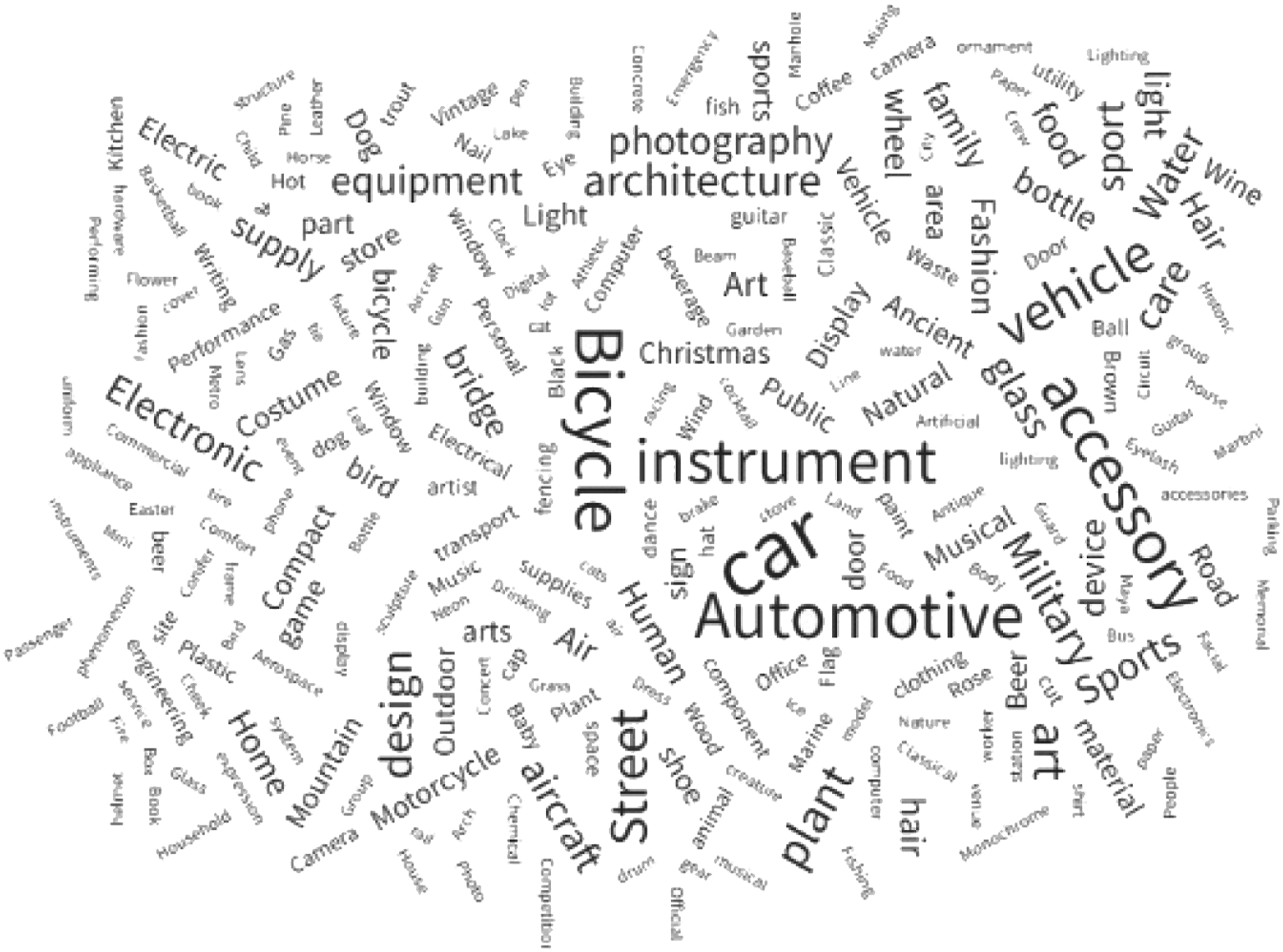
Labels and landmarks
The most revelatory layers retrieved raised the labels and landmarks. The latter correctly indicated several well-known commercial attractions in the Roman landscape. These points’ relationship with unauthorized graffiti becomes more evident as the recurrence of such a pattern inspires reflections on this association with ‘instagrammable’ locations. Recognizable spots may attract likes and comments, but their existence as graffiti spots leaves room to question their engagement with the contentious and illegal part of that practice. Computer vision’s focus was often not on graffiti but on other signs, such as billboards or walls. In the labels, as shown in Figure 1, we cut the extensive list of keywords to the top 250 most frequent tags, indicating the elements found in our dataset.
Words ranged from general references such as art, photography or equipment to more meaningful terms, such as bicycle, vehicle, car or automotive, often signifying the surfaces containing graffiti sketches. Terms such as street, ancient, bridge accessory or plant were references to the surroundings, either against old, bricked walls or surrounded by urban vegetation, street corners, bridges, gas plants or – seemingly – military facilities. Both layers provided context that essentially refers to the environmental and material conditions, as said. As ‘logics of operation’, these renderings make the appropriation of the urban fabric, its pieces and materials available, by writers, as elements visible in the graffiti photographs. However, these readings could apply to any other photo. As we shall see later, this result obfuscates essential conditions for writers regarding the materiality of their production and the reasons they occupy these spaces with their art.
There is an interesting dialog between the political charge of some graffiti pieces juxtaposed to apolitical elements that tie #graffitiroma to keywords such as dog, beer, Christmas, musical and hair whereby the human eye sees references to logos of unions and political parties. The notion of urban dialog corresponds to the frequent juxtaposition of terms (Awad, 2021), some contradictory, others exposing binaries such as relevance/irrelevance, political/apolitical, which sets the metadata at a distinct sphere of criticality. The only exception lies in the well-known geographical locations identified within Rome. For example, sites’ names may emerge from user tagging, as some did, but others may coincide with Instagram’s referencing to businesses. Pictures on the platform are frequently geotagged to name shops or restaurants for commercial and convenience purposes. Whenever such locations came up as computer vision metadata, graffiti pieces or even the writer’s operative intent may or may not coincide with businesses’ names or existence in the scene. As shown in Figure 2, existing business associations hosted graffiti images, leading the perception that graffiti exists in a with vast network of recognizable spots. Main locations identified in Instagram-posted images of graffiti in the city of Rome (n = 2100).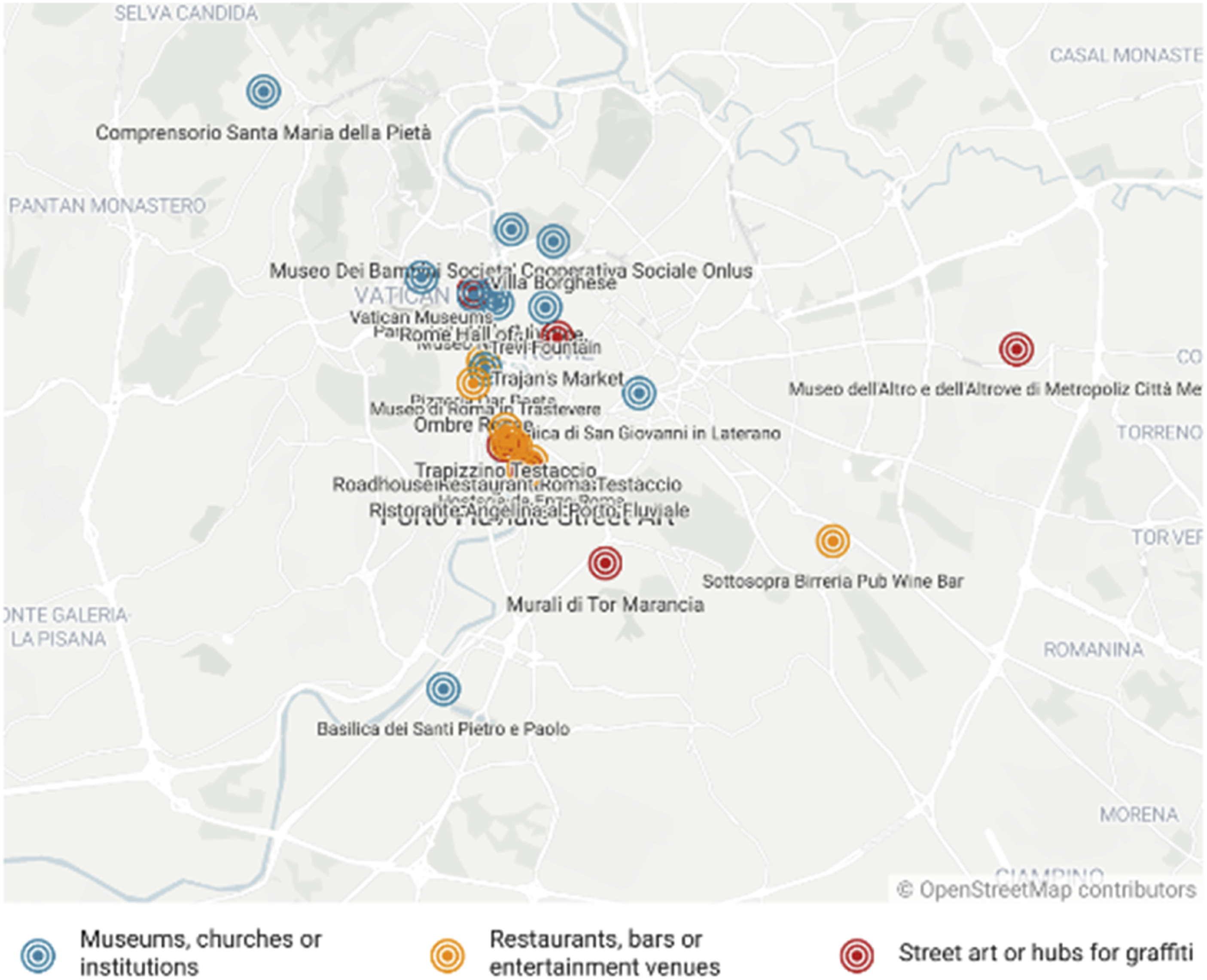
Instagram vernacular should not be taken for granted as distinctive or unique locations or even as correct references. For example, Gibbs et al. (2015) saw an intertwinement between personal and institutional connections when naming locations and events taking place in them. They showed how platform vernaculars could appear according to their context and operation specifics. Here, these linkages may represent the initial opportunity exploited by users (e.g., tourists seeking certain places to have a picture) or random locations that host unauthorized graffiti scenes and not the other way around, graffiti informing the images retrieved here. The above map represents the locations identified on Instagram, which essentially point to this mismatch between convenience and target sharing through #graffitiroma. These postings formed a platform for recognizing such visual vernacular messaging of graffiti, even though most locations verge on the commodification of graffiti because of its advertising purposes or state-sanctioned status.
Therefore, three major area types appear as frequently identified in computer vision: (1) Established cultural institutions or venues: the city’s cultural institutions, churches and museums. (2) Commercial or leisure venues: graffiti is exclusively identified in spots close to restaurants and cultural institutions. (3) Dedicated spaces for graffiti: These tags point to, namely, the Museo dell’ Altro e dell’Altrove, located in the city’s outskirts and informal open-air museums.
The #graffitiroma hashtag yielded these locations based on computer vision, inviting a few conclusions about the relationship between graffiti and the urban landscape. The fact that many images depended on museums and cultural institutions to become recognizable as graffiti hints at the normative function that liaises art venues and graffiti, either authorized or not, in Rome. It is the case of the Comprensorio di Santa Maria Della Pietà, which houses a cultural center on the premises of a former religious school and a park. Over there, unauthorized graffiti co-inhabits a derelict area that spans wild greenery and abandoned facilities. It contains echoes from the Philadelphia Art Museum, which ran the Graffiti Abatement Program in the 1970s for writers who had been found guilty in court (Mitman 2018). Here, the initiative goes without the same agenda to include minoritized writers.
The advent of automatic label assignment and location identification also reveals that several indicators divert the ‘eyes’ of the technology from the graffiti images’ complexity and their political terms. The issue of competing references in the same picture, in which faces compete with labels and locations produce an index of signs, texts, types of paint, objects, weather, etc. We contend that the irrelevance of the legal or illegal status of graffiti pieces on social media, to name one aspect, hinders graffiti from further visibility as embedded in context. For example, in Figure 3, the rainbow flag also appears to gain highlights in the metadata. The algorithm does not seem trained to prioritize the exceptional circumstances involving graffiti written on a train wagon or covering an entire residential housing block. The second problem stems from the positioning of objects and random references that erase the piece’s context or belonging within and outside the scene. The lack of context provokes a relationship between the photographer and the location that, albeit intuitive and enthusiastic, fails to read graffiti as a socially-conscious phenomenon. Graffiti becomes akin to online realities (eg associating oneself with instagrammable spots) more than to the specific neighborhood that attracts writers and their reasons. As a result, while erasing the ‘logics of operation’, one finds a high degree of randomness in graffiti images that circulate online. Next, we approximate this part of the research to the visits made to several graffitied sites in Rome. Image of authorized graffiti tagged #graffitiroma labeled according to the name of a nearby restaurant.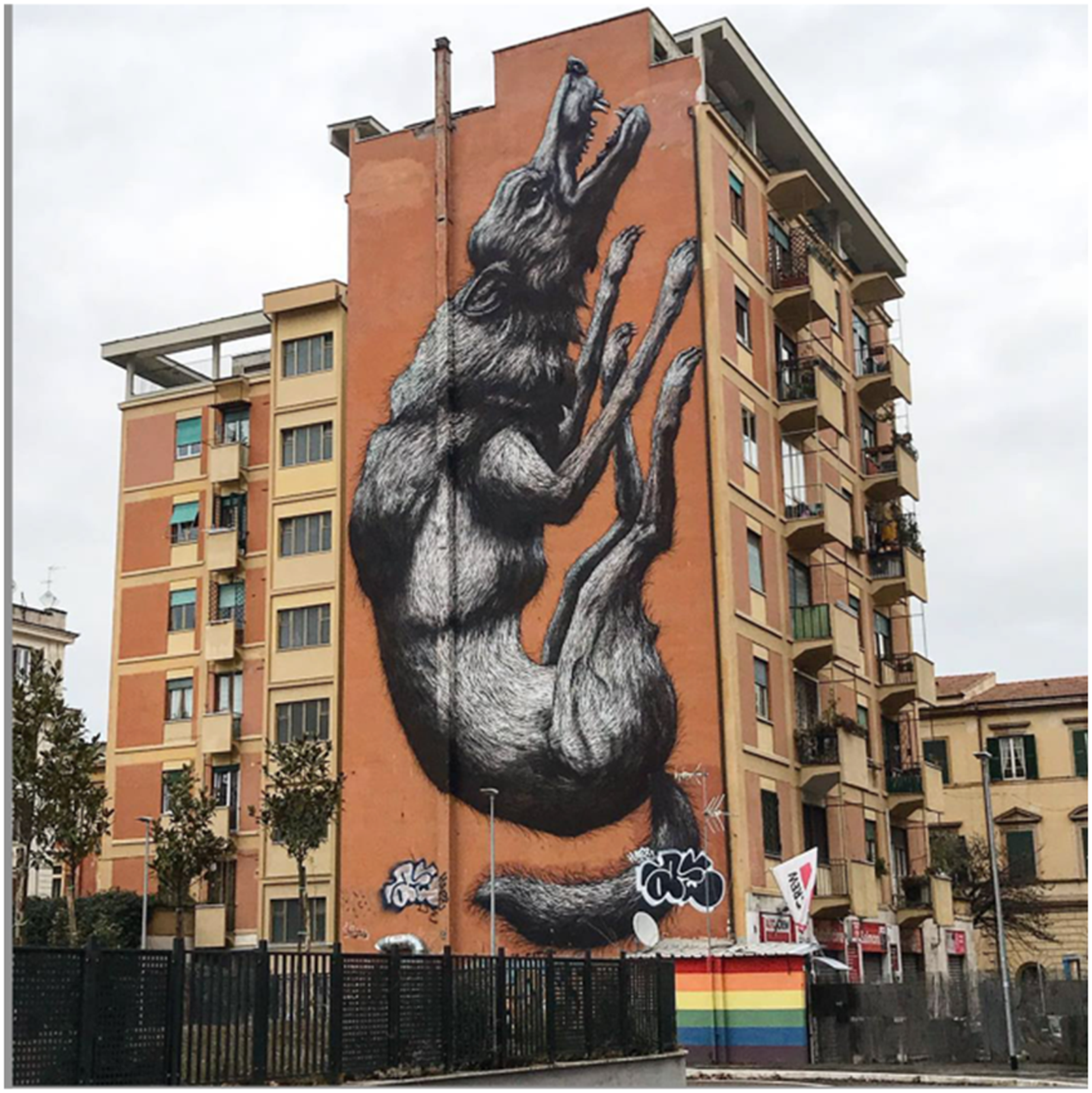
Sites of audiencing in touristic and non-touristic sites of Rome
As explained earlier, this research splits into criteria that distinguish between different forms of audiencing of a visual piece according to a human-led analysis. Figure 4 shows the set of elements raised by each researcher involved in mapping and capturing images of graffiti in Rome. If computer vision has provided the material context that allows graffiti to have such an impact: the colors, objects, famous spots and their names, it could not convey hierarchized perceptions of unauthorized graffiti that assess each piece’s political context and restrictions. In sum, computerized readings of graffiti perceive neither writers’ ‘logics of operation’ nor the assemblage of signs that characterize the inventiveness and wit of Roman practitioners. Combined results from computer and context analysis.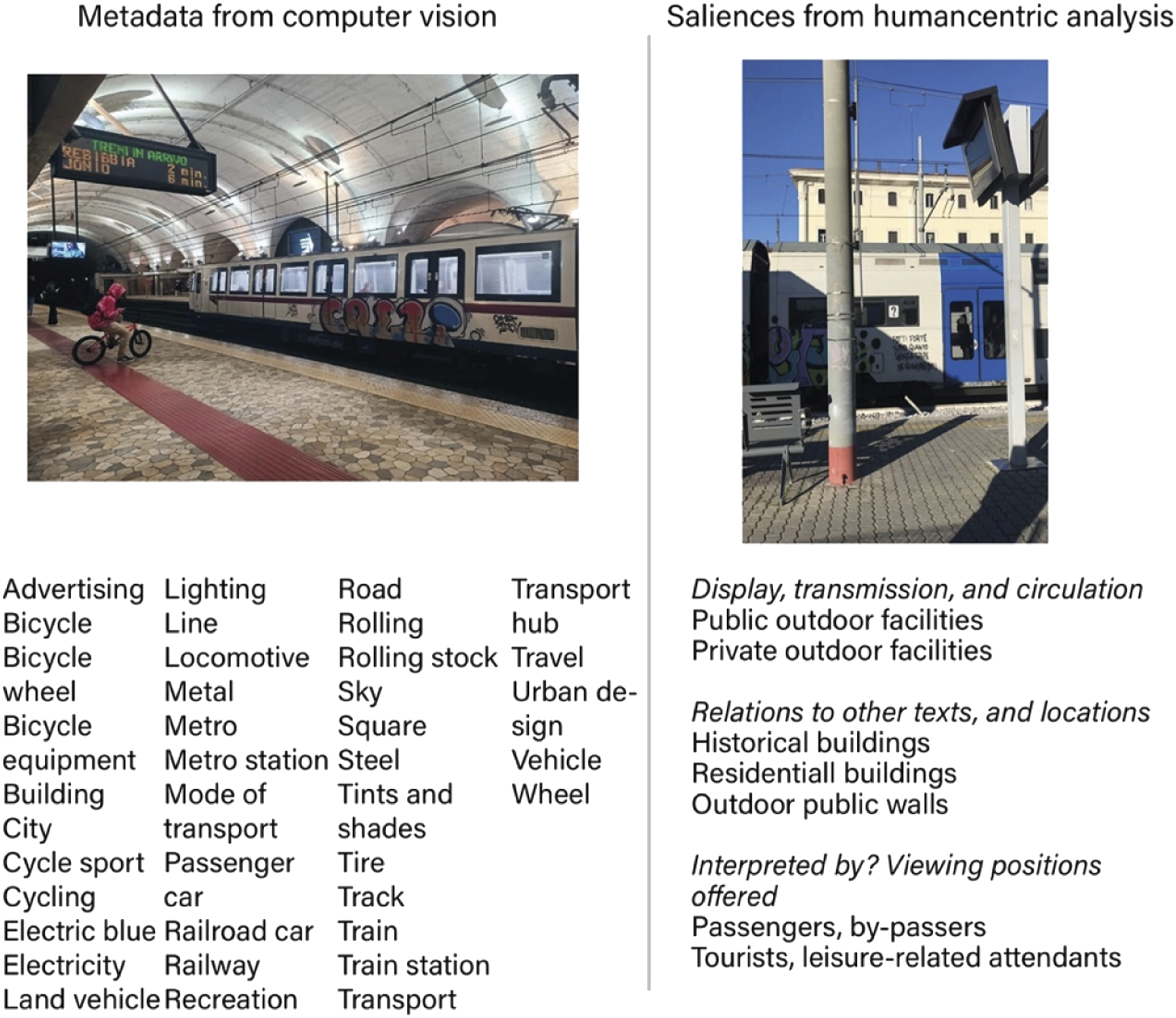
Next, we point to the saliences from the reflexive observations extracted from each visited site in Rome. These contextual readings based on Rose (2016) highlighted the audiencing as the set of complex interpolations of graffiti pieces within distinct environments that, in turn, appear to further social awareness of such interventions.
Display, transmission and circulation
Coders emphasized public outdoor facilities and free access as fundamental features of graffitied walls, rail stations or public building façades. Less graffiti appears in the entrances of these stations, public promenades, waiting rooms and staircases (Figure 5). Contextually speaking, the absence of graffiti from private spaces in general and restricted access spaces, such as in halls or lobbies of buildings, suggests a degree of publicity writers aim for when they put efforts into reaching and illustrating in publicly visible areas. Seemingly, writers seek to guarantee an audience as large as possible that can also politicize their gesture enough, as such is in the controversy generated in train stations. Graffiti visibility according to access and public function of buildings in the city of Rome.
Techniques have also varied according to the context. Stickers were more likely to appear in touristic regions such as Trastevere and traditional handwritten inscriptions in enclosed places, such as train platforms. As shown in Figure 5, semi-private spaces, like malls, galleries, or recently privatized locations, are less popular than those maintained by the government. Accordingly, the writing follows a pattern of being set against public announcements and security boards. Contrariwise, the outdoors of heavily written stations or their squares nearby, such as in Appiano, appear surprisingly non-graffitied. The ‘logic of operation’ follows the public character of these interventions. This is one of the main outtakes of confronting graffiti pieces in person. One can better perceive the legal/illegal relationship between graffiti and the conservation status of targeted spaces, which, for the public, aggravates the potential of what writers have done.
Relation to other texts and locations
As an assembly of signs, the public logic of graffiti in Rome offers the passer-by a sense of novelty, surprise and outrage. The fact that Valle Aurelia station was sprayed days after its opening. The action bore an environmental, political or conservational impact beyond the material dimensions of the writers’ intervention. Of course, in the case of tourist areas, the impact on buildings of historical or political interest consists of assessing the necessary investment to repair them, which is a trigger for public opinion. In the case of outdoor shared walls, a higher percentage of the graffiti identified in touristic areas had flagrant messages for the broader public. In Other, coders’ notes saw the low targeting of residential buildings, even in residential areas such as Monteverde or Pigneto. For that matter, residential and commercial buildings have meant less impact, reducing the critical potential of such assemblages.
On another note, writers seem to base their logic of operation in the communicative potential among themselves. That said, the viewer remains the political actor that witnesses and reacts to such not-so-random messages. Stickers depicting of public figures, another example, meet notes, poems and block letters that signal both conventional techniques of handwriting or massive chunks of paint placed in corridors or where people are standing. Touristic areas, otherwise, differ from this due to the message’s sophistication, including elaborated artistic interventions dressed as outraged graffiti or statements from and to minoritized communities, frequently spotted in the Pigneto region.
Interpreted by? Viewing positions offered to?
As per Figure 6, viewing positions vary to by-passers, passengers, children or whether locals are based in the proximity of graffiti pieces to schools or stations to give access to public parks, kindergartens and ice cream parlors. Wherever the predominant context is commuting stations, spaces for walking, or jogging, graffiti messages become less territorial and content-specific as one gets farther from the tourist-occupied center. The former is characterized by recognizable text, logos and celebrity faces, and the latter brings the viewer block letters or simple writing. Rail stations often attended by migrant communities, such as Valle Aurelia or Ottavia, display languages other than Italian. Bohemian areas such as Trastevere or Pigneto, the destination of choice for younger residents or tourists, set a conflicting, overlapping visual landscape with an overload of pieces assembled on top of each other, often written in English. Hence, stickers in the place connect to comic prints, digital logos, or apps’ logos. In ‘Other’, our notes categorized the public that, while captured in constant flow, either a passenger in peak-time commuting or a mix of by-passers that gathers local and non-local alike of several age groups together, complicate the ‘logic of distribution’ and challenge the criticality of graffiti due to the uncertainty of the terms stricken between viewers and the art. Graffiti visibility according to the kind of public in the city of Rome.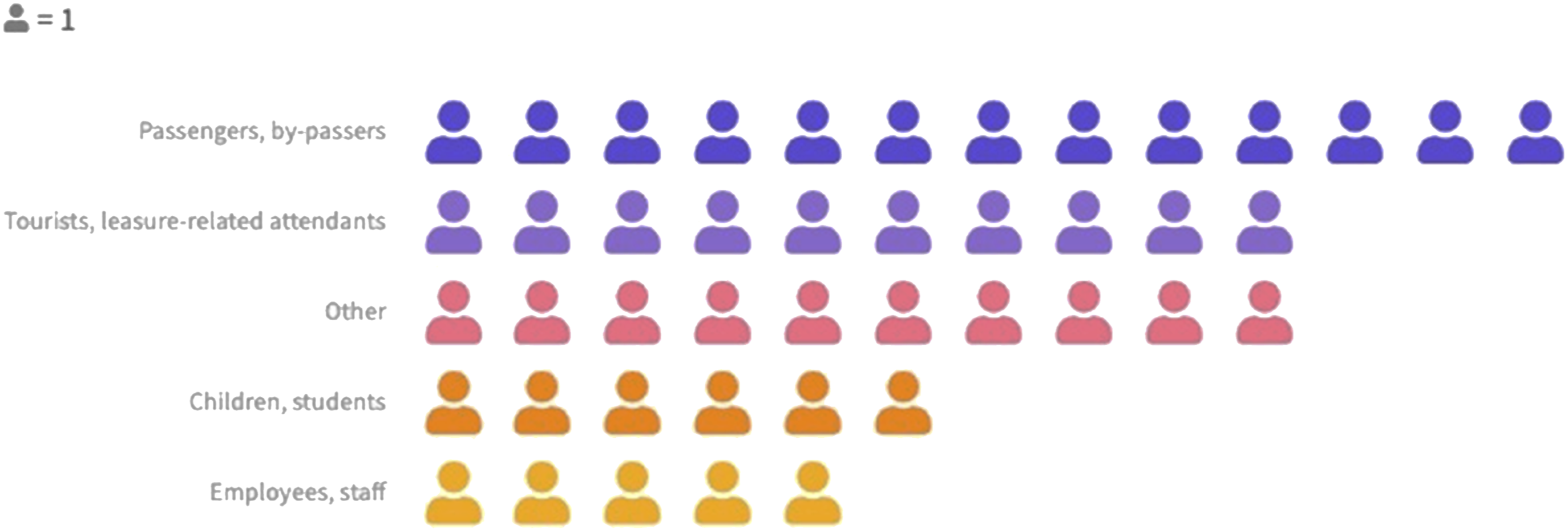
When looking at well-known graffiti pieces, such as the GECO tag, in tourist versus non-tourist locations, one perceives minimal similarity between signaling territories. Whether the tunnel at Valle Aurelia station or lighting poles at Trastevere, the ‘quantity’ strategy seems to pay off in terms of criticality rather than the carefully written messages at suburban walls. A few racist messages found at Quattro Venti station and street graffiti in Monteverde show viewing positions specific to dwellers in these localities, whether due to the technique applied or the political targeting of zones known by its communist affiliations, as the latter.
Other notes
The reflexive nature of the questionnaire yielded distinct insights into the intricate and transitory ways through the quick catch-up with political affairs. Words like migrants reflect graffiti’s outreach to this part of the audience. Also noticeable is its material relatability reproduced in zones and not others, as a stencil and spray figure among areas of large surfaces and stickers predominantly in small corners, lighting poles and small gaps between buildings. Other materials indicated in computer vision analysis seemed far less evident as one walked by the road. The emphasis on materials can reveal that striking visuals may exist regardless of a rigorous description of paints and typos and belong in the viewer’s sensibilities in distinct ways (Figure 7). Word cloud of notes extracted from the visual analysis questionnaire.
For example, in the Tiber River banks, named Lungotevere, the ephemeral nature of graffiti viewing, that is, strollers, cyclists and joggers, seems to exert some pressure on writers for a constant change in their references and location picking, either a play with stones, plants, signs and other still life. De Certeau (2011) mentioned that writers play the game by engaging the viewership with the context. Here, this transitory principle characterizes an unhinged flow of ideas. It is not rare to find references to fascism or anti-fascism, frequently conjugated with names of politicians on each side of the political spectrum. Neighborhoods such as Monteverde attracted both anarchists and right-wingers. Thinkers, such as Antonio Gramsci, appeared together with center-left politician Matteo Renzi, who, in turn, poses alongside a Saudi prince. This volatile assemblage strikes a conversation involving political stance and esthetic value while reclaiming its artistic existence in the city.
Conclusions and limitations
The best way to split this research’s findings is to debate convergence and divergence between computer vision, human-centric analyses and the Roman context. It is worth connecting this paper’s conclusions to what Lorenzo Perris, the GECO, spoke about the quantity versus quality of graffiti in the city. The ‘bomber’s’ intention of multiplying stickers without committing to a specific form of agency. This position flirts with graffiti reproducibility online due to its known and blended ways of spreading as a shared language (Lanry, 2019). However, unauthorized graffiti in Rome has been more politicized than the bulk of Instagram images seem to suggest. On the convergence, the technological appreciation of graffiti seizes upon the materiality the human eye otherwise misses in detail, as the surfaces captured can mirror real-life platforms for graffiti, such as bicycles, trains or walls. However, these objects still need their strategic set-up. Less metadata could hint at elements that communicated the ideological motivations of graffiti and the critical use of paints, stickers and materials. This dissonance demonstrates a fracture between reading graffiti as a phenotypical, context-dependent manifestation and a politicized instance, whereby materials are employed with a purpose.
On the one hand, the lack of translation for the radical roots of Rome’s history of graffiti does not necessarily condemn algorithmic analysis as a less-politicized stance of engagement with the urban landscape, as other artistic, spatial and well-informed uses of such technology to these intents are possible. On the other hand, no matter what style or location, writers’ agency has disappeared in the mid of random pictures or activities with low social impact, which graffiti is not. The computer vision software largely ignored occurrences in public spaces such as parks and rail stations at the expense of overrepresenting it in private spaces, commercial venues, or quickly gentrifying areas opposed to public, free access, ordinary locations. On that account, any radical use of computer vision for detecting or manipulating urban arts should acknowledge the commodifiable nature of its metadata. While rich in material details, logos and color inventories, graffiti in Rome were more likely to appear in a context permeated by businesses or paid-for locations.
As a limitation of this research, field analysis demands further efforts to map various points of access and viewing conditions that see graffiti differently, according to multiple readings and locations in the city. Furthermore, this research’s results connect to what many scholars have argued about erasing graffiti’s destabilizing force, especially against the hegemonic and gentrified assemblage of the visual environment in big cities (Hoppe, 2018; Mitman, 2018). Future research should continue with this research’s attempt to reconcile methods for de-coupling digital advertising and graffiti, especially on social media. Bulky methods for collecting and reading graffiti images could utilize the salience model and the public/private framework explored herein to check graffiti’s political existence in contentious places while avoiding the automated identification of graffiti as a granted solution. Computational methods could be scrutinized to prevent punishing writers as an increasing number of marginalized actors adopt the practice as a legitimate means of expression. More than ready-made postal cards of urban life, unauthorized graffiti in modern Rome resists a political, yet criminalized, form of public dialogue in which physically present by-passers and viewers triumph over automated blindspots of writers’ extensive repertoire. As such, algorithms could not, or perhaps, should not, harvest messages or signs in their entirety or complexity.
Footnotes
Declaration of conflicting interests
The author(s) declared no potential conflicts of interest with respect to the research, authorship, and/or publication of this article.
Funding
The author(s) received no financial support for the research, authorship, and/or publication of this article.
