



Abstract
Using the concepts of data reflectivity and user reflexivity, this paper explores the intricate interplay between human users and algorithms through the lens of domestication. Through the metaphor of yanghao on the Chinese digital platform Xiaohongshu (RED), this paper posits that three failure types relating to data reflectivity result in dissatisfaction with RED’s algorithmic outputs and a perceived loss of control over algorithmic identity. In response, users reflexively feed six specific types of data into the algorithm to shape its understanding of themselves. Ultimately, by strategically curating data and interacting with an algorithm, yanghao demonstrates a successful domestication process, highlighting how data reflectivity and user reflexivity empower users to gain agency within the human–algorithm power dynamic.
Introduction
Algorithms have become deeply embedded in people’s lives, customizing and personalizing many humans’ daily encounters with the world. Individuals often interact with and consume content on their personalized homepage, which is curated via algorithms and tailored to the user’s specific preferences (Kant, 2020; Schrage, 2020). In China, algorithmic social media platforms such as Weibo, Douyin, and Xiaohongshu (RED) learn from past user behaviors, thus further personalizing the content that is delivered. While algorithmic personalization enhances the discovery of relevant content, it simultaneously diminishes users’ control over what appears on their personalized homepage.
This raises the question of how users engage with algorithms when algorithmic output on the personalized homepage (known as the ‘For You’ page on TikTok and ‘Explore’ page on RED, and referred to as such hereafter), that is, that delivered through content curation, routine encounters, and audience recipients, fails to align with their interests or desires, leading to a sense of dissatisfaction.
In addressing this challenge, ordinary Chinese social media users often refer to a particular metaphor: yanghao (养号). This term, which originally meant ‘raising children or pets’ in Chinese, has been adapted to describe the process of ‘raising’ an algorithm by deliberately feeding data back and forth, thus making the algorithm more responsive to users’ personal needs and more in tune with how they want to be perceived.
This paper focuses on RED, one of China’s most popular social media platforms, known for its visually appealing content and strong community engagement (see Figure 1). Launched in 2013, RED is widely recognized as ‘China’s answer to Instagram’, gaining immense popularity as a service for social networking and information exchange among China’s younger generations (United Media Solution, 2023). According to the latest analysis, RED has 300 million monthly active users (QianguaData, 2024). On average, more than three million notes are posted on RED every day, with 300 million daily search queries (Yi, 2023). The platform offers users a range of options for both public interactions (e.g., liking, commenting) and private interactions (e.g., messaging). Users can share content in various formats, including photo-/text-based posts and short videos with sound (see Figure 1). The platform can also be used anonymously. Moreover, the RED algorithm ‘learns about’ users’ interactive behaviors to discern their content preferences and subsequently suggests similar posts. This action is performed irrespective of whether the users choose to follow the content creators (Guo, 2019). Example of the Explore page on RED, an extremely popular social media platform for the exchange of information among young generations in China.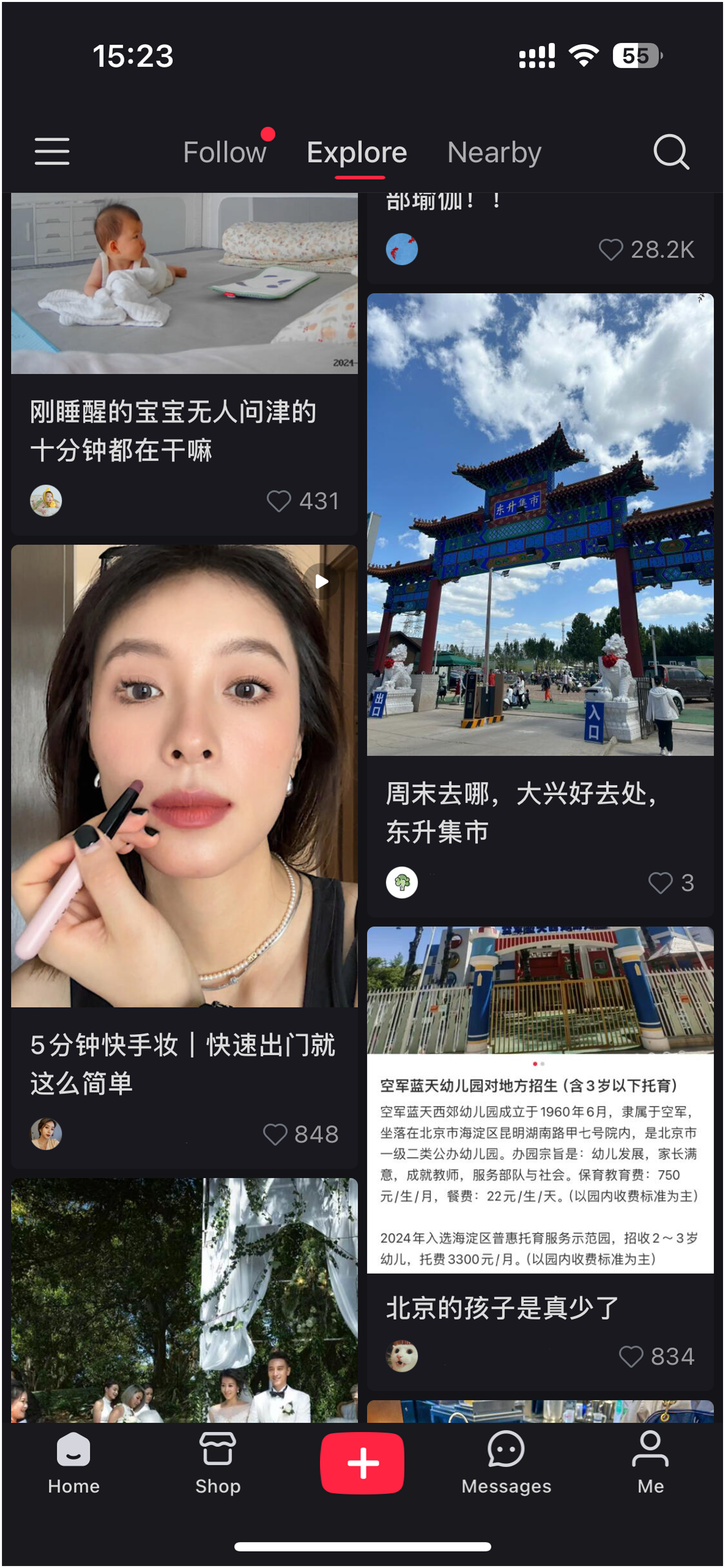
By combining domestication theory with the concepts of data reflectivity and user reflexivity, which have been developed and proposed within the framework of this special issue, we explore the complex process of human–algorithm interaction in the datafied world. Through the metaphor of yanghao on RED (see Figure 2), we demonstrate how users actively engage in data reflectivity and user reflexivity to shape their algorithmic identities and enhance their digital experiences, ultimately aligning their algorithmic identities with their self-concepts (Karizat et al., 2021; Oyserman et al., 2012). Posts on RED that relate to a user’s experience of yanghao. (The posts have been translated from Chinese into English and the English translations have been added in the figures).
Conceptualization and literature review
In this section, we first introduce the concepts of data reflectivity and user reflexivity in response to algorithms. Next, we examine the shaping of algorithmic identity, followed by a discussion of the process of domesticating media technologies.
Conceptualization of data reflectivity and user reflexivity
In our data-driven world, algorithms play a central role in transforming our experiences, relationships, and identities into quantifiable data for analysis and monetization (Beer, 2017; Jaton, 2021). Here, we follow the theme of this special issue and employ two key concepts: data reflectivity and user reflexivity, both of which are crucial for understanding the complex relationship between individuals and algorithmic systems.
Reflectivity pertains to the capacity of phenomena or entities to mirror or represent other phenomena or entities. Here, data reflectivity refers to the capacity of data to capture and represent aspects of the real world, including user behaviors and characteristics (Li et al., 2011; Ploderer et al., 2014). We can unpack data reflectivity on three levels: first, algorithms rely on data as a raw material from which to construct user profiles and tailor content recommendations. Data not only reflect user needs, but also serve as a mirror for how algorithms perceive and represent users. Mathieu and Vengerfeldt (2020) developed a model of the data loop that first presents the fundamentals of data circulation between users and a digital interface, emphasizing the interconnection in the datafied experience. Second, data reflectivity is not a one-way street. Users can also leverage data reflectivity to gain insights into how algorithms perceive them. This can lead to a practice known as user reflexivity, where users strategically curate their data to influence how they are reflected in algorithmic systems. Third, reflectivity relates to the shaping of algorithmic identity. Data become subject to algorithmic coding, potentially reducing the complexity of user experiences, relationships, and identities into simplified and monetizable units. This process contributes to the shaping of algorithmic identities, which are based on algorithms’ interpretations of their data (Cheney-Lippold, 2017).
The term ‘reflexivity’ was first used in social science research, primarily in qualitative research, to refer to the self-awareness and self-assessment of individuals or researchers with respect to their actions, thought processes, and relationships with the subjects of their study (Finlay and Gough, 2008; Stuart, 2018; Subramani, 2019). Reflexivity enables individuals to establish a contemplative connection with the world around them, resulting in a heightened awareness of their personal experiences (D’cruz et al., 2007; Olmos-Vega et al., 2022). Therefore, we employ the concept of user reflexivity in relation to users’ self-awareness and deliberate engagement with algorithmic systems. Moreover, user reflexivity empowers individuals to develop a more nuanced understanding of how they are perceived by algorithms and to potentially shape their algorithmic identities, navigating the complex power dynamics between humans and algorithms.
Shaping of algorithmic identity
The concept of algorithmic identity, introduced by Cheney-Lippold (2011), refers to the formation of identity that is shaped through mathematical algorithms to infer categories about anonymous individual. This definition highlights the role of algorithms in shaping how individuals are perceived and categorized online. However, the logic of algorithmic identity is shaped based on algorithmically inferred attributes about a user (Eslami et al., 2018), rather than a comprehensive understanding of users. Subsequently, it brings the potential for bias and is limited to representing complex human experiences and identities through data points alone (Cheney-Lippold, 2017). Therefore, this can result in a mismatch between how individuals are perceived by algorithms, and how individuals describe themselves and are described by others (Simpson et al., 2022).
Algorithmic identities are shaped by complex power dynamics between humans and algorithms (Bhandari and Bimo, 2022; Markham, 2013). In the context of datafication – the transformation of human experience into data (Kennedy et al., 2015; Mayer-Schönberger and Cukier, 2013) – algorithms are products of structural forces and biases that can reinforce existing identities, create new ones, or amplify certain aspects of our identities, while suppressing others (Noble, 2018). By reducing individuals to data points and categorizing them into simplified groups, algorithms can perpetuate stereotypes and limit the diversity of perspectives, leading to a loss of nuance and complexity in algorithmic identities (French, 2018). Additionally, algorithms may marginalize certain social groups, shaping their algorithmic identities in ways that may not reflect their lived experiences (Simpson and Semaan, 2021). For example, Tik Tok participants have identified the risks of how tailoring an algorithm to one person’s identity could create For You pages that cause and reinforce harm to users, with the algorithm identified as being responsible for unhealthy behaviors and racism (Karizat et al., 2021).
However, users are not passive recipients of algorithmic influence as they incorporate algorithms into their everyday lives through specific practices, actions, skills and tactics (Kant 2020; Klawitter and Hargittai 2018; Siles et al., 2019; Ziewitz, 2017). They can actively engage with algorithms to shape their own algorithmic identities, breaking with the structure–agency linearity (Mathieu and Vengerfeldt, 2020). Karizat et al. (2021) have demonstrated that participants attempt to shape their algorithmic identity by changing their personal engagement with the content recommended to them by the algorithm. This allows the algorithmic output to better reflect their understanding of themselves, thus aligning algorithmic identities with self-concept (i.e., how a person understands and sees themselves) (Oyserman et al., 2012).
To understand how individuals navigate this power dynamic, we turn to the framework of domestication. This approach, rooted in media studies, examines how individuals adapt and shape digital technologies to fit their needs and values. By understanding the metaphor of yanghao, we can gain valuable insights into the evolving relationship between humans and technology.
Development of domestication theory
The term ‘domestication’, which generally refers to the process of taming wild animals, was first applied to humans’ relationship with technology by Silverstone et al. (1989). Over the past four decades, the metaphor has been understood as the process through which individuals encounter, react to, and tame ‘wild’ technologies. Specifically, domestication theory serves as an analytical tool to explore how people adopt technology while maintaining control and agency over its role in their daily routines (Silverstone, 1994; Silverstone et al., 1989). This approach emphasizes how technological products are transformed through interaction. It is believed that technological products must undergo a process of domestication to become suitable for and integrated into daily life (Serensen, 2005; Silverstone et al., 1992).
In recent decades, studies on domestication have increasingly focused on how people domesticate evolving digital platforms such as smartphones (De Reuver et al., 2016), Facebook (Sujon et al., 2018), WeChat (Huang and Miao, 2021), and dating apps (Miao and Chan, 2021). Domestication theory offers a valuable lens through which to examine the complex relationship between individuals and algorithmic platforms. By focusing on how people integrate technology into their daily lives, domestication theory sheds light on the ways in which individuals shape and are shaped by these technologies. For example, Siles et al. (2019) employed domestication theory to explore how Costa Ricans integrated algorithmic systems into their cultural practices, revealing how these technologies both facilitated and constrained social interactions. Similarly, Simpson et al. (2022) used domestication theory to understand how LGBTQ+ users negotiated their identities within algorithmic environments, highlighting the strategies they employed to both resist and conform to algorithmic norms.
By examining how users curate their data and interact with algorithmic systems through yanghao, we can gain valuable insights into the ongoing domestication process of the algorithmic systems used by RED. This process can be further illuminated by understanding how data reflectivity and user reflexivity inform user agency and empower individuals to negotiate their algorithmic identities.
Data collection and research method
Over 2 years, we interviewed 22 users with self-reported experience of yanghao. The participants were recruited from social media platforms such as RED and WeChat, as well as through snowball sampling. To be eligible, participants had to be regular users of RED and have self-reported experience of yanghao. These posts were made by users who self-reported engaging in yanghao, using hashtags such as #Yanghao (#养号), #yanghao succeed (#号被我养成了), #Big Data is my cup of tea (#大数据太对我胃口了), or titles that included the keywords stated above. 14 users were contacted directly through RED messaging and 10 agreed to participate in interviews. At the end of each interview, we utilized a snowball sampling technique by asking the interviewee to refer anyone else suitable for our study (Biernacki and Waldorf, 1981). Six participants were introduced by friends and other participants, while a further six were recruited through a post on WeChat Moments. To ensure a diverse group of respondents, a wide range of ages and occupations were recruited in an effort to generalize the research results. Two interviewees were aged 18–20, eight respondents were aged 21–30, eight respondents were aged 31–40, and four participants were aged 41–50. Five interviewees were students (two undergraduate students, three graduate students), 12 were professionals with various occupations (one editor, one program manager, one bank staff, one accountant, one administrative personnel, one government employee, one salesperson, one deliveryman, two teachers, two engineers), two were stay-at-home parents, and three were self-employed (one content entrepreneur, two designers).
The 22 participants took part in interviews conducted from February 2021 to May 2023. 10 interviews were conducted via WeChat voice call, eight interviews were conducted by telephone, and four participants were interviewed in person. Participation was voluntary, and the participants did not receive compensation for their participation. The interviews ranged from 45–80 min, with an average duration of 56 min. The interview questions centered on the interviewees’ experience of interacting with algorithms, general platform usage, and perceptions of algorithms. We began the interviews with general questions such as ‘Would you like to be interviewed about your interactions with recommendation systems/algorithms?’, ‘How long have you used RED?’, and ‘How often do you use, search, post, and comment on RED?’ By detecting actions taken by individuals to deal with algorithmic recommendations, we encouraged the interviewees to share their story of yanghao. During this process, we further inquired into their deliberate actions in interacting with algorithmic recommendations; their opinions on recommendations that did not align with their preferences; how they felt about recommendations that matched their preferences; and how they evaluated the appropriateness of content recommended by RED’s algorithm.
We used a grounded theory approach and conducted three rounds of analysis (Strauss and Corbin, 1990) that focused on people’s experiences of yanghao, particularly how they actively adapted and attempted to personalize the platform and their interactions with the platform. The first author conducted a preliminary round of open coding of the 22 interview transcripts using Nvivo, a software package for qualitative data analysis. Regular meetings with the research team facilitated discussions on the emerging codes. During the first round of coding, several codes indicated that the participants had integrated RED into their daily routines. After completing this round of open coding, two further rounds of coding were conducted to identify the four major themes of domestication – appropriation, objectification, incorporation, and conversion – as outlined by Silverstone et al. (1992), while also incorporating the concepts of data reflectivity and user reflexivity.
Analysis
The concept of domestication, pioneered by Silverstone et al. (1989, 1992), directs attention to how technologies and people adapt to each other and coexist (or fail to do so) in the same space. Going further, domestication theory shifts the analytical focus toward the process by which technology is adopted and becomes routine. This section applies domestication theory to reveal the metaphor of yanghao by analyzing the four stages of domestication: appropriation, objectification, incorporation, and conversion.
Initiation of Yanghao: motivated by data reflectivity failures
On algorithmic social media platforms, algorithms curate user experiences by controlling post selection, timing, and target audiences. Users evaluate how well the algorithmic outputs align with their interests and self-understanding (Karizat et al., 2021). On RED, yanghao typically begins when users encounter unwanted algorithmic output, described as ‘moments of tension’ (respondent No. 10), indicating a misalignment between algorithmic identity and self-concept (Bhandari and Bimo, 2022; Oyserman et al., 2012). This loss of control over algorithmic identity motivates users to engage in yanghao.
The appropriation stage of domestication theory, where users discover and adopt new technologies, highlights the initial stages of the user–technology relationship. Our interview analysis reveals three primary data reflectivity failures that trigger yanghao.
1. Failure to Reflect User Needs, Values, and Tastes:
The first type of failure occurs when the data generated through data-driven algorithmic personalization fail to reflect the user’s preferences. Many respondents mentioned encountering ‘unwanted, uncomfortable, uninteresting content in poor taste’ (No. 17). Their motivation for yanghao is to calibrate the algorithm and refine its understanding of their algorithmic identity. For example, respondent No. 11 described accidentally engaging with irrelevant content, prompting them to correct the algorithm’s perception: ‘If I accidentally scroll through some content that I am not interested in but look at on a whim, it will make the algorithm recommend something unrelated to my interests, I feel that the algorithm has misunderstood me. [And I’ll] be like, “No, no, no, no. I didn’t actually mean that I was interested in it when I click on and look through the post.” I [then] have to do something to get the algorithm’s recommendations back to normal’.
2. Failure to Reflect User Relationships:
The second type of failure concerns data reflecting users’ relations with others. Users experience ‘context collapse’ (Marwick and Boyd, 2011), where algorithmic sensitivity and responsiveness lead to the blurring of their intended audience boundaries. This results in a loss of control over how they are perceived by themselves and others. As respondent No. 12 said, ‘I have a few lazy days (which means I passively accept whatever the algorithm recommends to me), and then RED recommends me to connect with a relative’s RED account, or it recommends content related to my ex-boyfriend or coworkers, so I need to click “uninterested” hundreds of times’.
3. Failure to Reflect Perceptions of the Outside World:
The third type of failure involves an overabundance of homogenous or low-quality content, lacking ‘nutritional value’ (No. 7). Respondent No. 4 emphasized the importance of adjusting the proportion of homogenized content to avoid becoming trapped in an information cocoon and navigating the chaos of the Explore page. This motivates users to seek diverse content and connect with the broader online world. Parents, acting as ‘coordinated gatekeepers’ (No. 4) for their children’s online experiences, engage in yanghao to curate content and tailor the algorithm for their children. For example, four respondents mentioned the need to help their children ‘tune the algorithm’ to encounter more high-quality content.
These three types of data reflectivity failures suggest that users have not yet integrated the algorithm seamlessly into their routines or identified a clear purpose for its use. In these situations, users actively appropriate the algorithm into their daily lives to find a suitable role for the technology and regain control over their algorithmic identity.
Objectifying and incorporating RED: feeding six types of data under user reflexivity
Having initiated the process of yanghao, users move on to the stages of objectification and incorporation. During these stages, users actively shape their relationship with the algorithm by strategically feeding specific types of data. By engaging user reflexivity, they aim to objectify and incorporate the algorithm into their digital lives, actively correcting data reflectivity failures, and ultimately gaining control over their algorithmic identity.
The second stage of domestication, objectification, comprises the activities involved in ascribing meaning and value to the new technology through shaping and structuring the space (Hynes, 2009), which includes an expression of personal taste and values through the process of ascribing meaning to the object (Serensen, 2005).
According to our research, to objectify the algorithm, users reflexively feed three types of data into the system. First, participants command the algorithm by feeding clear instructional data, treating the algorithm as a conversational partner and explicitly expressing their needs, values, and preferences. Our interviewees said this often involves ‘shouting out’ to the algorithm in post titles or directly addressing it in comments such as ‘Big data, please help recommend my post to…’ or ‘Big data, please don’t recommend content like…’. A number of respondents also expressed their needs directly in the titles of their posts and explicitly requested positive or negative advice from the algorithm, for example, ‘Please recommend some criteria for decision-making from similar groups, and recommend this post to people who can help me; I will seriously consider their advice’ (No. 5). By feeding such data into the loop, the respondents were able to structure their existing virtual social space on RED, in terms of content curation, social encounters, and audience recipients, as a space for efficient information gathering.
Second, to objectify RED, users act as auditors, feeding scrutinizing feedback data into the system to monitor the algorithm. Several of the respondents mentioned that they may report problematic content and advertising or express dissatisfaction with recommendations, contributing to the algorithm’s improvement by serving as whistleblowers or gatekeepers. Respondent No. 9 mentioned that ‘When I see advertisements, plagiarism, or ethically problematic posts, I report them by clicking the “whistle-blowing” button. I have also told my mother how to report them, telling her that the duty to clean the Internet space is up to you and me’. In recent years, ethical issues of injustice, discrimination, and transparency surrounding AI have been subject to increased scrutiny. As a result, there has been a growing call for audits of algorithms.
Third, users intentionally feed ambiguous or contradictory data that disrupt the algorithm’s ability to categorize and predict behavior in a predefined way, thus deliberately confusing the algorithm. This can involve posting diverse content or changing account settings. Many of the interviewees in our study talked about how they confused the algorithms with step-by-step actions. For example, respondent No. 15 said that ‘There are steps! You refresh the Explore page three times, then click “uninterested” on all posts and then turn off the personalized recommendation option. The algorithm will begin to be confused. It does not know what to send to you to keep you here, and then the algorithmic output will be very diverse’. Eight of the interviewees chose to make their accounts private, change their account names and disabling certain RED functions to become untraceable, aiming to sow algorithmic confusion.
The first three types of data relate to how algorithms construct and personalize the online space, while the remaining three focus on seamlessly incorporating the algorithmic platform into a user’s daily routine, determining its suitability for the given role, and optimizing its functional capabilities.
The next stage of domestication, incorporation, focuses more on the time structure, how the technology is integrated into a person’s routine (Hynes, 2009), how well it fits within the daily routine, and the functionality of the technology, such as how the technology is actively used to complete or perform a task (Silverstone et al., 1992).
First, to incorporate RED, users feed negative feedback data to negate algorithm. Twenty of the respondents concluded that users should establish a daily routine of using the ‘not interested’ and ‘dislike’ buttons to ‘let the algorithm optimize itself’ (No. 1). In the words of respondent No. 6, this kind of negative action is often ‘intentional’, such as frequently clicking ‘not interested’ and rarely clicking ‘like’. For example, respondent No. 4 said that ‘Sometimes, when I scrolled past a post I don’t like, I have to go back and click “dislike” on it’. Some of the interviewees talked about how they used RED to help them find job positions after feeding rounds of negative feedback to algorithms and expressing dissatisfaction whenever they were asked to evaluate the algorithm’s recommendations (No. 13). These users had established a daily routine of repeatedly rejecting the algorithm’s recommendations.
Second, users manually calibrate algorithms by feeding sophisticated yet nuanced ‘small’ data related to specific and niche groups. The respondents believed that feeding such precise data made algorithms better able to learn and recognize the specific communication tokens of niche groups, helping to match them with people in the same community. For example, a number of respondents mentioned that they particularly wanted to read certain niche content or join certain marginalized groups, such as those who wanted to meet other individuals who shared their good luck or has recently been blessed online (No. 13, No. 18), those who wanted to meet handsome men (No. 2), and fans of celebrities who wanted to encounter likeminded people through the algorithm (No. 6, No. 8, No. 21).
Third, the interviewees discussed periodically rebooting by discontinuing their use, which involves feeding no data into the system, to disrupt the algorithm’s learning process, establishing a cycle of ‘use–discontinuation–reuse’ (Huang and Miao, 2021). Our participants sometimes opted to log out or create a new account to remain anonymous to the algorithm. This gave them control over the data used to categorize individuals by algorithms, thus manifesting control over the shaping of algorithmic identity. Some users occasionally uninstalled RED. Respondent No. 21 said that ‘I uninstall RED once in a while and then re-register after a while. Through this cycle, the algorithm is trained to win my heart. The content is all interesting’.
By feeding six specific types of data into an algorithm system with user reflexivity, participants aim to correct failures and enhance the accuracy related to data reflectivity, thereby improving their ability to manage how they are profiled and understood by the algorithm. Eventually, the interviewees developed routines around how they used the technology to incorporate RED, expressing their relationships with themselves, with others, and with the outside world, and thus maintaining a balance in the power dynamics of the human–algorithm interaction.
Conversion: make RED a personalized space
The final stage of domestication, conversion, involves transforming the relationship between humans and the outside world, as described by Silverstone et al. (1992: 25). During this phase, the new object or application serves as a mediating factor, conveying various values from the external environment for interpretation within the private sphere. Through this collaborative effort, users and technology jointly construct new perceptions of the world.
Through yanghao, RED has been converted into a personalized, meaningful, and socially connected space. First, RED becomes a personalized space tailored to individual preferences. Users actively shape their feeds through data curation, resulting in a diverse and engaging content landscape. As one participant stated, ‘The videos are terrific and not homogenized at all...they range from astronomy to geography, covering a staggeringly wide range of topics. This suits my taste and aesthetic’ (No. 22).
Second, RED serves as either a social refuge unknown to acquaintances or an exclusive, private, and secluded platform for connection with niche communities, functioning as a medium to express impulsive emotions and build social connections. Some users have adopted RED as their social haven, a peaceful space disconnected from the stresses and demands of daily life where they feel free from the scrutiny of acquaintances. For certain users with specific and unique interests, yanghao helps them discover a greater number of favorable social interactions recommended by algorithms, while also helping them to locate desired content, form regulated communities, and establish a sense of identity and belonging. Şot (2022) reported that many respondents feel connected to a community of likeminded individuals through the content and comments recommended by algorithms, helping to foster intimacy with others. Several respondents like No. 18 expressed satisfaction with yanghao’s success when their homepage displayed niche content understandable only to their specific group: ‘I knew yanghao was successful when I saw that all the information on my homepage was cultural codes and niche symbols only accessible and understandable to me and my small group’. For example, a gay user (No. 20) said that ‘I know yanghao was successful. I love to see content about male–male couples, and now my homepage is full of content written by fans of male–male couples’. Respondent No. 7 said that ‘Sometimes I want to test whether the experiment of yanghao is successful or not. I posted some pictures that only a niche community knows about. There are more than 400 comments under the post I made, indicating that they are all in the same boat’. This resonates with the concept of the algorithmically woven community proposed by Wang et al. (2023), which indicates that algorithms work like a responsive authority to weave a loosely knit, decentralized, and boundless community.
Third, RED has been converted into a window to the world, described as a ‘box of surprises’ by respondents (No.3, No.14), exposing users to diverse cultures, perspectives, and creative expressions. By curating their feeds, users can explore new interests, gain inspiration, and expand their horizons. As a result, RED has been converted into a virtual space that enhances users’ awareness and understanding of the world’ s diversity. For example, Respondent No. 20 stated, ‘It’s like opening a treasure chest every day. I never know what kind of amazing content I’ll find’. Another respondent, No. 5, shared, ‘I’ve learned so much about different cultures and lifestyles through RED. It’s truly a global platform’.
For Silverstone (1994), domestication meant a user’s capacity to appropriate technological artefacts and delivery systems and absorb them into the user’s own culture, thereby creating the user’s own digital space and time, with its own aesthetic and functioning. Based on this, the process of yanghao enables users to domesticate RED, transforming it from a generic platform into a personalized space that aligns with their individual needs, values, and aspirations. This ultimately leads to a better alignment between algorithmic identity and self-concept, enhancing user satisfaction and well-being, and extending beyond stereotyped algorithmic identities to connect with the external world.
Discussion
The process of yanghao is not a one-time event, but rather an ongoing cycle of adaptation and negotiation between users and algorithms. This cyclical nature is driven by data reflectivity and user reflexivity, which work in tandem to shape algorithmic identities.
First, as users engage with the system, they generate data that are fed back into the algorithm, creating a continuous data feedback loop through digital interfaces of data collection and retroaction (Mathieu and Vengerfeldt, 2020). Moreover, the establishment and operation of the data loop are achieved through data reflectivity, making the input and output interconnected and mutually mapping. Thus, the algorithm system is constantly reshaped based on the incoming stream of data collected from users. Therefore, based on data reflectivity, yanghao provides support for the data loop, and the data loop makes the continuous practice of yanghao possible, enabling users to exert their agency and participate in the shaping of their algorithmic identities.
Second, when asked about the end of yanghao, participants emphasized its continuous nature. They believe that yanghao will continue as long as there is a misalignment between their self-concept and their algorithmic identity. Successful yanghao is indicated by the optimization success related to data reflectivity, characterized by positive feedback loops, where users provide positive reinforcement to the algorithm, for instance, by using specific tags or expressing satisfaction. Respondent No. 21 gave some examples: ‘I’ll use tags like #Yanghaosuccess (养号成功), #bigdata I love it (大数据我爱看), give me more recommendations! I know the algorithm will see these posts because the data will catch on and will find their own way to deliver my thoughts to the algorithm’.
Third, user reflexivity plays a crucial role in yanghao. Users are not only aware of the power dynamics between humans and algorithms, but are also engaged in reclaiming agency over the shaping of algorithmic identity. Through this process, users move beyond mere algorithmic awareness to a higher level of user reflexivity.
Here, under our investigation, we delve into the multifaceted concept of user reflexivity in relation to the tug-of-war over the shaping of algorithmic identity between humans and algorithms. (a) Awareness, through which users demonstrate a conscious understanding that their algorithmic identities are not merely reflections of their self-concept, but are also constructed by the subtle influences of algorithmic curation (Seaver, 2019). (b) Agency, whereby users are not passive recipients of algorithmic outputs, but are proactive agents who navigate the algorithmic landscape, actively resisting or challenging algorithmic outcomes that they perceive as unsatisfactory or manipulative (DeVito et al., 2017; Velkova and Kaun, 2021), thus asserting agency over the shaping of algorithmic identity. (c) Adaptive tactics, by which users employ a range of actions to train algorithms in a manner that aligns with their self-concept. They reflexively interact with the algorithm in the data loop, feeding specific data types to position the algorithm as a curated extension of their desired lives. (d) Continuous experimentation, whereby users engage in an ongoing process of learning and adaptation as they encounter new algorithmic systems and as their understanding of these systems evolves. (e) Critical evaluation, which involves users engaging in a reflexive critique of the algorithms they encounter to analyze and question the algorithms’ potential biases, fairness, and broader implications. Ultimately, as rounds of domestication continue, users gain stronger control of their algorithmic identities, providing a sense of security in their daily lives.
Conclusion
Through interviews with 22 users, this study investigated the encounters and everyday engagements with the RED algorithm in China. We applied domestication theory to uncover a metaphor, termed yanghao in Chinese, whereby users, faced with undesirable algorithmic output, spontaneously develop self-organized practices. These practices, underpinned by the concepts of data reflectivity and user reflexivity, are aimed at modulating the algorithm to obtain a better match between their algorithmic identities and self-concept, thus gaining control over the shaping of algorithmic identities.
This research underscores human agency from a user standpoint in the datafied world. By understanding the motivations, strategies, and experiences of yanghao practitioners, we have gained valuable insights into the dynamic interplay between humans and algorithms. Looking ahead, this study advocates for more consideration of how people make sense of algorithms and create meaning from their lived experiences with digital platforms. Future research should explore comparative approaches to better understand the actions and reactions of people from different cultural and geographical backgrounds in response to algorithms.
Footnotes
Acknowledgments
The authors would like to thank anonymous reviewers and Martina Skrubbeltrang Mahnke (Roskilde University, Denmark) for their useful feedback during the manuscript’s revision.
Declaration of conflicting interests
The author(s) declared no potential conflicts of interest with respect to the research, authorship, and/or publication of this article.
Funding
The author(s) disclosed receipt of the following financial support for the research, authorship, and/or publication of this article: This work was supported by Journalism and Marxism Research Center, Renmin University of China; (Project No.MXG202309).
