




Abstract
This article examines how the Dutch public broadcaster NPO has approached streaming through three video-on-demand (VoD) services: NPO Start, NPO Plus, and NLZiet. Rather than a fragmented strategy, NPO’s tiered approach responds to a “wicked” problem: fulfilling its public service remit while facing cord-cutting, budget cuts, intensifying market competition, and the rise of new gatekeepers. Focusing on NLZiet, a collaboration between NPO and two commercial Dutch broadcasters (RTL, SBS), and drawing on interviews, document analysis, and policy review, the paper explores this tiered strategy. It reflects on how distribution has expanded from the relative neutrality of legacy cable to platform intermediaries that exercise gatekeeping and shape media circulation, a shift that undermines PSM control over viewing context. The research identifies a clear tension between the aim of broad, universal access to public content across multiple channels and the ways digital platforms threaten core PSM values through their interfaces, algorithms and underlying infrastructure. The case of NLZiet shows how some of these values can be safeguarded through collaborative arrangements, but it also reveals how NPO doesn’t want to rely on third parties for distribution; long-term viability requires platform sovereignty and stable funding. Finally, NPO’s decision to maintain both NPO Start and NPO Plus highlights how changing viewing habits and austerity complicate efforts to secure the broadcaster’s role in the platform age.
Introduction
As viewership of linear television declines, public service media (PSM) increasingly compete with social media platforms (SMPs) and video-on-demand platforms (VoDs) for audience attention online, content deals, creative talent, and programming rights (Iordache and Raats, 2023). In response to the shifting landscape, the Dutch House of Representatives passed a motion in January 2026 urging public broadcasters to collaborate with global VoD platforms to expand their reach, foster co-productions, and remain relevant. The motion was introduced during the consideration of the budget bill of the Ministry of Education, Culture, and Science for the Year 2026 for the Media Section and at a time when Dutch public broadcasting is facing massive budget cuts and reforms. Niels Baas, managing director of NLZiet—a joint public-commercial VoD platform—in response, stressed that while he generally supports collaboration, PSM need to carefully consider the collaborators and conditions (Baas, 2026). 1 He specifically raised concerns about the “non-neutral” algorithms of international VoD platforms and giving away valuable local content. As such, he framed such collaboration as a possible threat to the sustainability of the local screen industry and PSM’s digital sovereignty. Baas furthermore called for increased government investment in strong, local platform infrastructure like NLZiet.
In adapting to the platform age, many PSM have been cautious about distributing their content on third-party platforms and often prioritize hosting content on their own central VoD platforms. When they do distribute on third-party platforms, they justify their presence by highlighting the need “to be where the audience is” (Iordache and Raats, 2023; Van Es and Poell, 2020) and to engage younger audiences (Johnson and Martin, 2025). This pursuit of universal access conflicts with other public service values, such as independence and diversity.
In the Netherlands, the Dutch Public Broadcaster (NPO) collaborates with two commercial Dutch broadcasters (RTL and SBS—now Talpa) to operate the VoD platform NLZiet. Meanwhile, NPO continues to offer their content on two other VoD services on their platform: NPO Start and NPO Plus. Their approach to online distribution raises questions about efficiency and internal competition. It also highlights the often-overlooked relevance of “universality” in the sense of universal access to content, which Martin and Johnson (2024: 25) more broadly identify as central “battleground for […] public service media in the platform age.” PSM’s push for universal access in the age of streaming and platformization creates tensions with their core values. This is because third-party platforms like international VoDs and SMPs “unbundle” their content and act as gatekeepers, steering user attention through algorithms (Van Es and Poell, 2020: 5) and exercising new forms of “media circulation power” (Hesmondhalgh and Lotz, 2020).
NPO’s tiered strategy highlights how the Dutch public broadcaster struggles with delivering their remit as PSM while confronted with cord-cutters, budget cuts, intensifying market competition, and the rise of these new gatekeepers. However, it likewise raises a central question: Why does the NPO employ a tiered VoD strategy? To explore this issue, the paper is structured around the following questions: • What are the main concerns about how platformization affects the public service values of public broadcasters? • How does the NPO safeguard public service values on NLZiet? • Why does the NPO continue to maintain its own VoD platform, and how do these services compare to each other and NLZiet?
To address these questions, we conduct a document analysis and policy analysis involving materials from both NPO and the Dutch government. Additionally, we incorporate insights from three semi-structured interviews with two representatives from NPO and one from NLZiet.
In this paper, we first discuss the impact of platformization of PSM on public service values by introducing the concept of platform sovereignty and discuss several types of “co-opetition” (Evens, 2014) between public and commercial broadcasters in VoDs in order to situate NLZiet. Subsequently, we trace the emergence and continued existence of NLZiet as a Hulu-inspired response to cord-cutters and highlight a distribution crisis centered on how third-party platforms threaten PSM’s platform sovereignty. This helps explain NPO’s insistence on maintaining its own VoD platform and its collaboration in NLZiet. We then examine the rationale behind offering two NPO services on the same platform: NPO Start (free) and NPO Plus (with subscription fee). Although these services originally served distinct purposes, they have increasingly converged, making it harder to justify their tiered strategy beyond primarily financial efficiency. We conclude by reflecting on the wicked problem of sustaining the relevance of PSM in the platform age. In doing so, we highlight the importance of innovation, as well as the need for and the challenges of developing more future-oriented, collaborative online strategies for PSM.
PSM and platformization
Bonini and Mazzoli (2022: 924) identify six core values that the European Broadcasting Union (EBU) considers central to all PSM: universality, independence, excellence, diversity, accountability, and innovation. They also highlight the numerous challenges PSM face staying relevant while upholding these in the platform age. The platformization of PSM involves integrating digital platforms in two main ways: either through the distribution of content via third-parties or by developing their own VoD platforms. Although SMPs and VoDs differ in terms of content (hosted, often user-generated, content versus professional productions) and business models (advertising versus subscription based), both are computational and data-driven (Lobato and Van Es, 2025). There are thus significant similarities in how VoD and SMP platforms impact public service values. Previous publications have explored the impact of SMPs on public service values (Martin and Johnson, 2024; Nikunen and Hokka, 2020; Van Dijck and Poell, 2014; Van Es and Poell, 2020), PSM upholding public service values on their own VoDs (Bengesser and Sørensen, 2024; Iordache and Raats, 2023), and PSM adapting their platform affordance through developing public service algorithms (Bennett, 2018; Carillon, 2024; Iordache and Raats, 2025; Sørensen and Hutchinson, 2018). As we argue, such challenges can be summarized as a struggle for control over context and platform sovereignty. An underexplored strategy in this struggle is “co-opetition” (Evens, 2014) between broadcasters to create VoD platforms for online content distribution.
Platform sovereignty: The need for independence
As linear viewership declines, PSM increasingly compete online with third-party platforms, including international VoDs such as Prime Video, Netflix and Disney+ and SMPs like YouTube, Instagram, and TikTok. However, PSM are often hesitant to distribute their content through third-party platforms because of concerns over their impact on public service values. For instance, small tweaks to the recommendation system of SMPs can significantly influence the reach of public content (Van Es and Poell, 2020), affecting both universal access and universal appeal (Martin and Johnson, 2024). Consequently, SMPs are frequently used as promotional tools rather than distribution channels (Martin and Johnson, 2024; Van Es and Poell, 2020). However, some notable exceptions have emerged, driven by the ambition to expand reach: In January 2026, the BBC made a content deal with YouTube including the production of original “social first content” and the reuse of old material (Thomas, 2026). This approach aligns with Channel 4’s “platform neutral” distribution strategy, in which native content for social media is created and long-form content distributed via YouTube (Johnson and Martin, 2025: 3). The French public service broadcaster France Télévisions has similarly reached an agreement with YouTube to distribute content, including streaming-first news. Significantly, this partnership “includes a stronger editorial presence on the platform, with content organised by programme and theme, alongside original YouTube-native formats designed to appeal to specific audience segments” (Clover, 2026). These types of deals are not limited to SMPs. Earlier, in 2025, the French public broadcaster signed a distribution agreement with Prime Video, giving its subscribers in France access to live broadcasts of its channels and 20,000 titles from their on-demand catalogue through a dedicated space at no additional costs (K.D. and AFP, 2025).
By distributing on third-party platforms, PSM tend to lose control over the viewing context (e.g., interface layout and recommendations). This is due to the fact that these “platforms curate how cultural content becomes visible, is shared and consumed” (Van Es and Poell, 2020: 2). They are “re-intermediaries” (Vonderau, 2015: 726) that break up and reshuffle previously bundled content through recommendation algorithms (Van Dijck et al., 2018). As Johnson and Martin (2025: 3) note in relation to SMPs, concerns over context collapse include uncertainty about if and what advertisements might accompany content and what recommendations or automatic plays will follow. They also highlight challenges around revenue sharing and access to third-party data. Although not included in the EBU’s list of public service values, (brand) recognizability has emerged as a key concern for PSM in the platform age (Iordache and Raats, 2023; Van Es and Poell, 2020).
Like NLZiet’s director Niels Baas, we relate the challenges PSM face in maintaining independence and control when distributing content on third-party platforms to the concept of sovereignty and more specifically, platform sovereignty (after Bratton, 2016). We therein adapt the concept of “digital sovereignty,” which refers to governments asserting control over the internet and to protect self-determination (Pohle and Thiele, 2020) and extend it to non-state actors (i.e., broadcasters). While the term “digital autonomy” is sometimes preferred when not referring to states (Van Dijck and Meijer, 2025), we use sovereignty to make a stronger claim, emphasizing not only the ability to act independently but also having the authority to determine the conditions under which the action takes place.
Platform sovereignty encompasses the technological dimensions of the platform, including (meta)data, algorithm, protocol, and default (Van Dijck, 2013; 30). This specifically relates to the ability of PSM to govern and make decisions about these dimensions. It also concerns their economic and curational “platform power”; their capacity to “keep control of the customer relationship and [to] have the ability to shape the viewing experience” (Evens and Donders, 2018: 251). Platform sovereignty is therefore likewise linked to what has been termed “media circulation power” (Hesmondhalgh and Lotz, 2020); the power of interfaces to guide audiences towards certain content and experiences.
In line with Van Dijck (2020: 2804), we reject Bratton’s stack metaphor, which treats platforms as bounded entities, adopting her view of platformization as an “evolving dynamic process, propelled by human and nonhuman actors.” Under the concept of platform sovereignty, we recognize that intermediary platforms like Netflix (VoD) and YouTube (SMP) sit within a larger platform ecosystems. They are not isolated entities but always remain interdependent with other components, including digital infrastructure (consumer hardware, cloud services) and industrial and societal sectors (Van Dijck, 2020).
In seeking platform sovereignty through the development of their own VoDs, PSM must contend with audiences whose viewing expectations have been shaped by leading US-based VoD interfaces, particularly Netflix (see Peeters et al., 2024; Iordache et al., 2025: 78). This “Netflix norm” creates additional challenges: PSM often feel pressured to match the technical features and user experience of global VoD platforms. PSM’s need for platform sovereignty is often sidetracked by budget cuts (Van Ammelrooy, 2025) or demands for broadcasters to “forge ambitious strategic [and technological] partnerships at scale” among each other (Ofcom, 2025) or with international VoDs (Baas, 2026).
Collaboration in VoD platforms: Positioning NLZiet
Types and developments in co-opetition in VoD platforms.
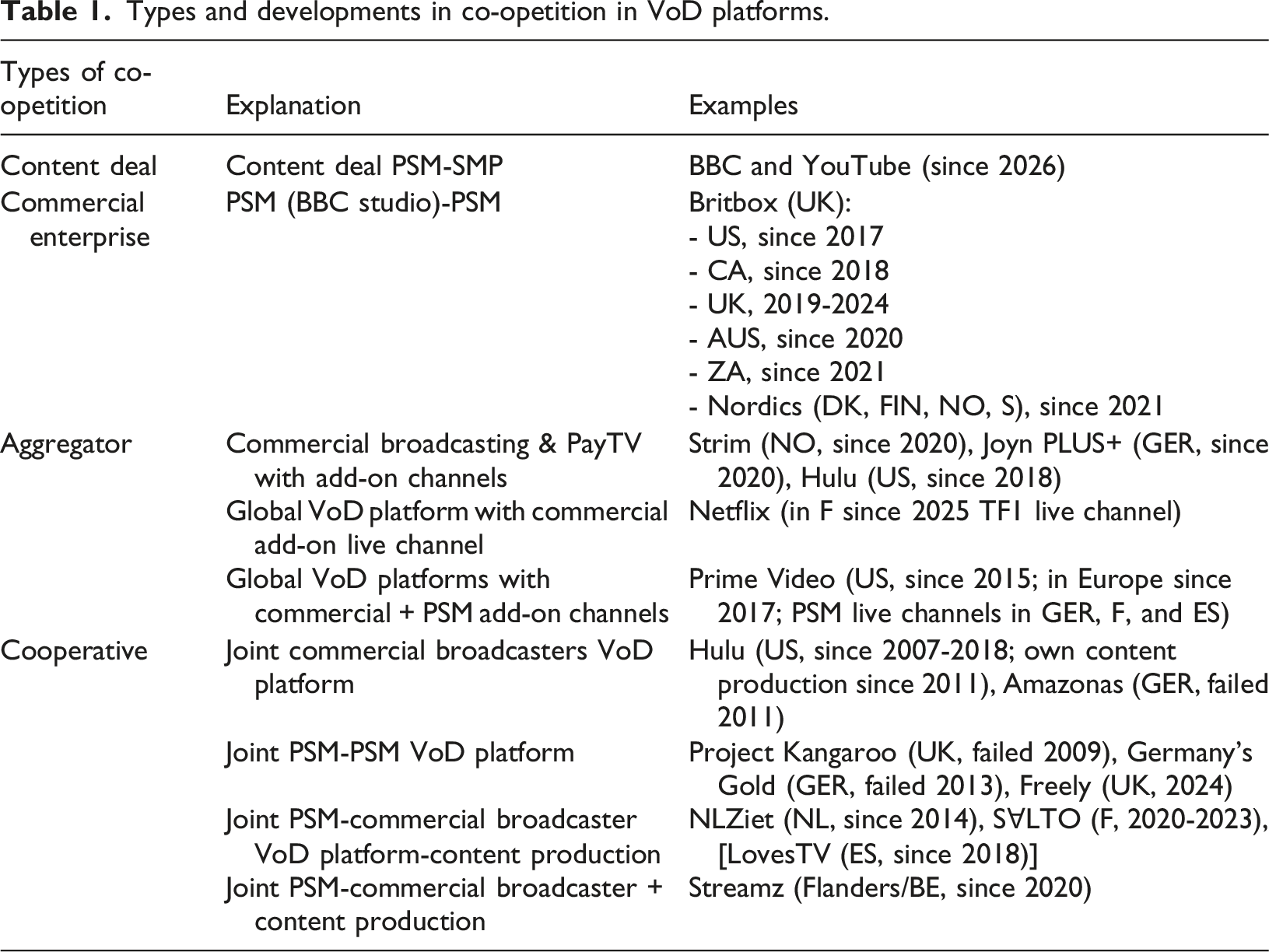
In Table 1 we present a non-exhaustive typology of co-opetition-based collaborations. Because collaboration is an ongoing process of negotiation, broadcasters and their joint VoD platforms may appear more than once under different categories. The case of Hulu, the earliest example of a co-opetition-based VoD platform, and its evolving history illustrate why this overlap is necessary. In March 2007, the commercial US broadcasters, NBC Universal and the News Corporation (Fox), launched the free, advertisement-financed VoD platform (Evens and Donders, 2018: 118ff), offering a bundle of recent episodes of programming from its owners. After Disney/ABC Television Group joined the cooperative in 2009, Hulu also produced original content. It moreover introduced a subscription fee and later started offering live channels via Hulu + Live TV as well as add-on channel subscriptions to HBO, Showtime, and Cinemax (Evens and Donders, 2018: 119). This development into a “virtual MVPD [multichannel video programming distribution]” (Evens and Donders, 2018: 119) platform suggests that Hulu since then falls under the collaboration category of “aggregator.” With Fox leaving Hulu in 2019 and Disney buying out NBC Universal/Comcast in summer 2025, Disney furthermore ended the VoD’s co-opetition model and plans to incorporate Hulu into Disney+ in 2026 (Spangler, 2025).
From the perspective of adaptation strategies (D’Arma et al., 2021: 691), NLZiet, Streamz (Belgium), and BritBox (UK) can be regarded as examples of “mimicry” or “local Netflixes.” However, from a differentiated co-opetition perspective (see table 1), Britbox—which launched as a subscription VoD platform in the US and later expanded to Canada, Australia, South Africa, and the Nordics before ending its UK operation in 2024—clearly differs from nationally focused services such as NLZiet and Streamz. NLZiet, founded 6 years before Streamz, has not pursued original-content production unlike the Flemish SVoD platform. Instead, NLZiet is a co-opetition-based cooperation, established and funded by NPO, RTL, and SBS/Talpa. Recent developments, such as the integration of BBC NL+’s catalogue in fall 2024, indicate that NLZiet is increasingly an aggregator. However, its subscription-based VoD platform did not emerge from a terrestrial pay-TV joint venture (like the Norwegian Strim) or a commercial broadcaster collaboration (like the German Joyn PLUS+).
Unlike Freely (launched 2024 in the UK and owned by EveryoneTV), NLZiet is not a VoD service of a joint PSM company; instead, it includes collaboration between two Dutch commercial broadcasters. This particular composition makes alignment around values less straightforward for NLZiet, though the presence of similarly strong national partners in a small market like the Netherlands does create space to negotiate and safeguard public service values. NLZiet also differs technologically from platforms such as Spain’s LovesTV; a cooperative of Spanish PSM RTVE and commercial media companies Atresmedia and Mediaset España, it is a hybrid broadcast broadband TV (HbbTV) VoD platform, which can be accessed through SmartTVs with digital antenna (Bonet et al., 2021: 140).
In contrast to RTVE, NPO has not signed any content agreements with global VoD platforms such as Prime Video (see Table 1, aggregator; Mucientes, 2026). RTVE’s January 2026 deal follows precedents set by Germany’s PSM—whose more than 30 channels have been part of Prime Video’s German free live TV package since 2020—and the French PSM France TV who, as mentioned, have made their live broadcasts and some 20,000 titles available on Prime Video since 2025 (Clover, 2025; Krieger, 2020).
Overall, NLZiet positions itself as an interesting model of a co-opetition-based cooperative of commercial and PSM parties that have equal say on how their own content is being offered on the platform. However, given that NPO is now urged by the Dutch government to explore collaboration with global VoD providers (Baas, 2026), its future is uncertain. It has prompted the managing director of NLZiet to place greater emphasis on the platform’s continuing relevance as a “local” Dutch online distribution infrastructure. But as will be explained below, even this type of national collaboration, while more practical and sustainable due to its ability to protect several key public service values, still falls short of platform sovereignty.
NPO’s tiered online strategy
The Dutch public broadcasting system is rooted in the country’s history of pillarization. It consists of multiple member-based broadcasting associations—each representing specific target groups, or social or philosophical movements—and two task-based organizations. While the broadcasters are responsible for making programs and content, NPO as the governing body is responsible for coordinating programming and allocating budgets. The broadcasters share facilities and are financed primarily through general taxation. There is also some advertising under strict guidelines, facilitated by Ster (Dutch: Stichting Etherreclame). Due to its low per capita funding compared to other European PSM, NPO is generally seen as less likely to innovate the national VoD market (Bengesser, 2024: 207).
To unearth the raison d’etre for NPO’s tiered VoD strategy, we traced its trajectory through a qualitative document analysis, involving examining and interpreting data to derive meaning, enhance understanding and build empirical knowledge (Bowen, 2009: 27). We analyzed 34 public documents publicly available via NPO including annual reports, evaluations, concession plans, and news items. 2 From the Dutch government portal, we retrieved several letters and decisions from the Ministry of Education, Culture and Science on topics concerning NLZiet and NPO Plus/Start. Finally, we included in our analysis the document “Zicht op Zoveel Meer” (2018, Engl.: View of so much more) by the Council for Culture, a statutory advisory body to the government and parliament in the field of art, culture, and media. They were asked to formulate a response to the question of how to ensure that Dutch cultural content remains accessible and reaches audiences. The analysis of these documents was guided by public service value concerns/claims in relation to the various VoD platforms.
In addition to the document analysis, three semi-structured interviews with representatives from NPO and NLZiet were conducted between June and July 2025. We created a topic guide with questions about the Dutch streaming market in general, the unique proposition of NPO Start, NPO Plus, and NLZiet past, present and future, and the rise of NLZiet. The interviews served to provide explanatory and tacit knowledge, while also enabling the convergence and corroboration of insights from the documents (cf. Bowen, 2009). The questions were a starting point, leading to follow-up questions where relevant. The interviews took an average of 45 min and were recorded and transcribed with Amberscript. These were reviewed, read multiple times, and relevant recurrent themes identified (Corbin and Strauss, 2008). For citation purposes, we have translated portions of the interviews. To help structure our reflection, we take NLZiet as a focal point of our analysis, as it initiated NPO's tiered VoD strategy.
NLZiet: The Dutch answer to cord-cutters
NLZiet was launched in July 2014, as a collaboration between NPO and the commercial broadcasters RTL and SBS (now Talpa). The service was announced in a joint press statement as a 3-in-1 service that enables the Dutch public to access as many Dutch TV offerings online as possible. With a single login, all three services (NPO Plus, RTL XL, and Kijk) could be accessed and searched using a shared search function. NPO Plus was an experimental initiative within NLZiet allowing NPO to examine its viability; to see whether it was feasible to obtain program rights, offer video in a resolution that met television standards, and if there was a demand for the service (NPO, 2015: 106). Charging subscription fees on NPO Plus is presented as necessary to make programming available for longer periods, in higher resolution, and without commercials.
Our interviews revealed that the origins of NLZiet can be traced to a business trip to the East Coast of the United States in the early 2010s by Henk Hagoort, then chairman of the board NPO, and Bert Habets, then CEO of RTL. During the trip they gathered knowledge about Hulu and became convinced that a similar initiative was needed in the Netherlands to address future cord-cutting and the move to online distribution of TV content. NLZiet was established to free television from the TV set and bypass pay-TV cable distribution by building a platform for internet-based television distribution.
While press coverage was quick to suggest NLZiet as the Dutch response to Netflix (Raats and Evens, 2021: 51), NLZiet documents and our interviews challenge this characterization. While NLZiet emphasizes its local Dutch identity in its name, its primary focus is on bundling Dutch broadcasting for a domestic audience rather than on promoting the Dutch-ness of its content. NLZiet was borne from the perceived threat of cord-cutting. As one of the interviewees explained to us: You can imagine from the operation itself it is much easier to make the comparison [to Netflix], because then everyone thinks ‘Oh yes, streaming, I need that too,’ but that isn’t it […] this is offering a package that essentially aggregates three providers […].
Importantly, NLZiet doesn’t offer unique, original content, but instead bundles content. NPO refers to NLZiet as a “full-fledged OTT provider” and presents it as an alternative for viewers who don’t want subscriptions from traditional cable package providers (NPO, 2020).
The 2020 evaluation report on NPO Plus emphasized that NLZiet emerged from the need to make Dutch on-demand content (both commercial and public) easily findable and accessible. This highlights NPO’s concern with promoting universal access to its content. NLZiet was conceived as an open platform, allowing other broadcasters to join over time; a process that is now gradually taking place. It was established as a cooperative to serve the shared interests of its members and generate subscription revenue. Profits are distributed among members according to their share of total viewing time.
The distribution crisis: Universality and independence
The 2020 evaluation report on NPO Plus provides several reasons for offering NPO Plus via NLZiet (and other providers like Ziggo) 3 and as a stand-alone service. First, this strategy enhances universality of access (accessibility) and supports the public service value of universality by making NPO content available across devices and providers. Second, it preserves freedom of choice, allowing audiences to watch only public broadcaster content (unlike NLZiet) without exposure to commercial programming (unlike NPO Start). Third, maintaining its own distribution safeguards NPO’s independence from commercial providers. Fourth, contributing to NLZiet helps stimulate the sector to shift to offering broadcast on demand (NPO, 2020: 20). This is in line with their remit to “serv [e] as champions of the indigenous creative economy” (Doyle et al., 2025: 4).
Enhancing the universal access of Dutch public content is an argument that supports distribution through NLZiet and returns across the documents and in the interviews we held. For instance, the 2018 sector advice “Zicht op zoveel meer,” the Council for Culture (Dutch: Raad voor Cultuur) stated that publicly financed content should be distributed through the most relevant channels: “[a] strategy exclusively aimed at own channels – whether it’s TV networks or on demand platforms – is no longer sustainable” (ibid. 37).
Significantly, in our interview with an NPO representative, distribution on NLZiet is framed as a continuation rather than departure from existing practices to ensure universal access to public content: This is not new for us to have, in addition to our own distribution, distribution through third parties and NLZiet is nothing more than a TV package as you find with KPN and Ziggo, only without cables. Cheaper because it works without set-top boxes and is online. But it is actually a TV provider, a TV package. So just like we put NPO1 in a TV package from Ziggo, we put NPO Plus in the package of NLZiet.
However, as explained to us, the public broadcaster also sees these intermediaries as very different: And the latter [cable companies] used to be rather neutral. Transfer from NPO1 through Ziggo, there is no interference of Ziggo, it just transmits it. […] But with the introduction of digital distribution, with streaming distribution in particular, algorithms for instance play a big role in how you distribute.
In other words, they outlined the difference between what they perceive as the “neutrality” of national intermediaries like the Dutch telecommunication company KPN to commercial foreign platforms that could interfere with public service values. As explored in more depth later in this paper, this concern with digital platforms centers on the loss of control over viewing contexts, which affects discoverability, diversity, and recognizability. It stems from what we call the distribution crisis of the platform age and is tied to the outsourcing of media delivery (Chalaby, 2019). It also extends to an infrastructural level where reliance on cloud services like Amazon Web Services and content delivery networks (CDN) such as Akamai Technologies raise questions of autonomy (Sjøvaag et al., 2024) and independence.
Remaining discoverable and recognizable
Clearly, NPO supports universal access to its programming, but there is concern that distribution through digital platforms potentially threatens other values. The desire of NPO to remain discoverable and recognizable and to support diverse consumption is repeatedly emphasized throughout the analyzed documents and by our interviewees. As explained to us by the NPO representative: […] in addition to making public content, it is also very important that there is an independent context in which the public knows that that content is made without political or commercial interests but is also distributed. […] And there, commercial parties, if you only distribute through commercial parties, can exert control. And we find it important that in that type of distribution, streaming distribution, we remain independent, that the algorithm is in public hands and transparent and developed for instance with you [academic experts] or the social field and is a public property and doesn’t end up in commercial or political hands.
Put differently, the exertion of control by third-party platforms through their interfaces and algorithms (cf. Hesmondhalgh and Lotz, 2020) potentially negatively impacts brand recognizability. This is a central worry for NPO on NLZiet. In fact, clear recognizability of the public broadcaster’s offer is a condition attached to NPO’s commitment efforts to NLZiet (Slob, 2021: 14). In the NLZiet platform, NPO content is kept separate from that of commercial parties. While commercial content is often intermingled, NPO maintains control over its own space within NLZiet. Moreover, since 2025, NLZiet offers three subscription options: Basic, Premium, and Extra. In the cheaper basic subscription, advertisements are shown alongside RTL and Talpa content, but not with NPO content. NPO successfully secured this arrangement on NLZiet. Significantly, this is only possible because of their unique collaboration as cooperative.
As discussed above, the possible negative impact of third-party platforms on core public service values is why NPO is committed to developing its own VoD platform, securing platform sovereignty. While NLZiet offers NPO significant control and influence, one of our NPO interviewees emphasized that only “With NPO Start and our own distribution […] are [we] 100% in charge of our distribution for the future.” The need for PSM to have their own digital platforms is not supported across the political spectrum. The conservative-liberal VVD politician Martens-America stated in an interview, “I don’t understand our ambition to develop our own streaming service. Let’s be honest: we will never come near Netflix” (Beemsterboer, 2024). Here, she uses the Netflix norm to argue against pursuing platform sovereignty. Her perspective willfully overlooks how focusing exclusively on online distribution through a platform such as NLZiet could create an unwanted dependency, since the service’s continuation is not entirely within the hands of NPO (see Hulu’s past struggles and recent fate, Evens and Donders, 2018: 120ff). NPO recognizes that living up to the expectation of Netflix-like user friendliness is unrealistic given limited staff and budget (NPO, 2020: 10), but protecting its own content recognizability and brand remains essential to them. As such, they continue to invest in their own platform.
The birth of two NPO services
After the successful pilot on NLZiet, NPO put in an application with the government to make NPO Plus a stand-alone service. The application was granted and, in the summer of 2017, NPO Start was launched offering both a free and a subscription service. The services target two different types of viewers: VoD enthusiasts (served by NPO Plus) and regular consumers (served by NPO Start). In 2024, the paid service proved successful with 882.000 subscribers (NPO, 2025), which is over double the initially projected number.
Motivation for NPO Plus
NPO Plus has been made a subscription service against payment within the core task of NPO. Several key arguments about NPO Plus’ contribution to the public remit surface across respective policy and strategy documents and in our interviews: • It contributes to universal accessibility, discoverability, and recognizability of public service media content. Having their own public environment enables the Dutch PSM to control the way in which their programming is made visible to viewers (NPO, 2020: 16). Having their own distribution platform also provides valuable insights into viewing practices and helps NPO better respond to the needs of the public (NPO, 2020: 21). The gatekeeper power of platforms consists of their extraction of such data for competitive advantages (cf. Martin and Johnson, 2024: 26). • It responds to changing viewing habits. Most NPO Plus viewing is devoted to so-called timeless programming genres, often watched long after their initial broadcast. By contrast, NPO Start primarily serves as a catch-up service for linear broadcasting. (However, as we discuss below, NPO Start is beginning to adopt an “online first” strategy which initiates decoupling from linear broadcasting.) • It supports pluriformity. Although NPO Plus does not significantly expand the range of content much beyond NPO’s linear offerings, it provides longer access to the full breadth of PSM programming. • It supports innovation. Building NPO Plus has contributed to the adoption of OTT and stimulated sector offerings of BVoD. • It strengthens universal accessibility through cost covering pricing that avoids financial barriers, making content available through multiple channels, and ensuring access across devices. • It is financially efficient. NPO Start and NPO Plus share the same technological infrastructure, with some costs covered by NPO Plus, thereby reducing the amount of public funding allocated for their VoD platform (NPO, 2020: 15). In addition, programs can often be made available on NPO Start for longer periods thanks to the rights agreements negotiated for NPO Plus (NPO, 2020: 16).
In the 2020 evaluation on NPO Plus, NPO suggests that the service has become even more relevant and urgent as the continued growth of the VoD market in the Netherlands has intensified competition for rights acquisition. Moreover, they argue that non-linear viewing is now the norm, also among older viewers (NPO, 2020: 7).
As addressed above, financial efficiency and funding concerns seem to be central in the decision to develop NPO Plus as an add-on to NPO Start. As the 2016–2020 concession plan (NPO, 2015: 103f) reveals, alternative options, such as offering everything through NPO Start for a longer period, were discarded due to this leading to higher costs. Increased costs would result in reduced funds for program production, potentially disrupt the market, and raise copyright expenses. More commercially oriented approaches by providing only a catch-up service and allowing third parties to buy NPO programs were likewise rejected. Reasons for this decision were the risk of only commercially oriented content titles being made widely accessible. NPO likewise feared that it would weaken its bargaining position for rights and prevent guaranteed 7-day availability for all programs.
In the application process for NPO Plus, the government emphasized the necessity to ensure universal access and recognizability of publicly funded content. In his 2016 letter of consent, State Secretary Sander Dekker noted that the Council for Culture’s positive advice is based primarily on NPO Plus adding access to publicly financed content. He attached the conditions that: (1) content should remain available free for at least 1 week after initial broadcast whenever possible; (2) NPO Plus must remain clearly recognizable as a public broadcaster; (3) NPO should explore free access for educational institutions (Dekker, 2016). These conditions reflect the recurring tension between the public service values of universal access and recognizability as well as the differing degrees of concern regarding financing of online content distribution via nationally owned PSM platforms. Significantly, while approving NPO Plus as stand-alone service, Dekker explicitly instructed NPO to continue supporting and investing in NLZiet and to ensure NPO content remains recognizable on there.
Relevant to note is that industry parties objected to the low price point of NPO Plus stating it would lead to market distortion. They wondered why NPO could not simply distribute its content through third-party platforms including NLZiet. Dekker responded that NPO had sufficiently considered alternatives and explained why these would contribute less or insufficiently to their public service mandate (Dekker, 2016: 8). He also objected to the idea that it would distort the market, stating that on-demand and OTT services are not comparable (Dekker, 2016: 9).
Audience habits in transition
While the importance for NPO to develop an own VoD platform is evident in light of wanting control over distribution in the present and future, it is less clear why it operates two services. When NPO Plus launched outside of NLZiet in 2017 on NPO Start, the free service was called Uitzending Gemist (Engl.: Missed Broadcast). As we explain in what follows, budget constraints and uncertainty about the pace of change made NPO long reluctant to fully address the distribution crisis, which demanded greater investment and experimentation.
In a nutshell, the reasoning NPO provides for two services is that they fulfill different needs. NPO Plus offers higher resolution video and an ad-free experience—the latter a key draw, with 39% of Plus subscribers citing the lack of commercials as their reason for subscribing (NPO, 2020: 19). While the catalogues overlap substantially, non-fiction titles generally remain available longer on NPO Start due to rights costs, whereas fiction is typically available for a limited period on NPO Start and mainly offered on NPO Plus. Not surprisingly then, viewing behavior on the services are distinct. NPO Plus subscribers overall tend to watch more content, and more frequently. They also watch more content in advance as well as older content. By contrast, NPO Plus viewers watch relatively more series and engage more often in binge-watching (NPO, 2020: 19). So while NPO Start remains oriented to linear broadcasting, NPO Plus enables the binge experience of VoD platforms.
However, to address changing viewing habits in 2021, NPO requested that NPO Gemist’s role be revised from providing free access to programs that aired on broadcast television for at least 7 days to “program[ming] more independently from broadcast” (NPO, 2021b: 5). In NPO’s 2022–26 concession policy plan, they said they wanted early access to programs scheduled for linear broadcast, curated profiles with selected fragments, web series, and archival material, and exclusive programming. They also wanted to be present on social media platforms to promote the channel’s programming (NPO, 2021: 71). In a letter supporting their application for revision, NPO emphasizes that “in a general sense it’s not so much about increasing reach but shifting with the viewing habits of the audience” (Rijxman, 2021: 3). This also motivated a change in the name of the service “since the name ‘NPO Gemist’ no longer covers the broadening of the profile of the channel – it is after all no longer just the collection of previously broadcast programming” (Rijxman, 2021: 2). NPO Gemist hence became “NPO Start – on demand” (Rijxman, 2021: 2).
Missing in the application is a reflection on the implications of breaking explicit ties to linear broadcasting for NPO Plus. In fact, several parties, including the Dutch media authority, raised concerns about the potential impact on NPO Plus (Rijxman, 2021). NPO responded that it did not believe this would change the popularity of NPO Plus. Asked about the latest changes to NPO’s VoDs, one of our NPO interviewees stated: The biggest change is actually that it was a flat neutral aggregate of linear television. So it was actually a Uitzending Gemist [Engl.: Missed Broadcast]. Watching a catch-up service and what you see these past years is that it has become much more a streaming service a starting point for watching. […] And that is just following the behavior of the audience.
With the release of the second season of the drama series Het Gouden Uur (AVROTROS/NPO, Engl.: The Golden Hour) in September 2025, NPO switched to an “online first”-strategy (Hut, 2025) with linear airing following only in December. This demonstrated that the right content can attract young audiences to its own platform, and has led NPO to migrate its YouTube formats to NPO Start (NPO, 2025). Consequently, while NPO Start and NPO Plus were clearly differentiated in the past, this is less the case now. The current situation reflects both hesitation and uncertainty in responding to changing viewing practices and growing competition, as well as the long held dominance of linear television thinking within the PSM imagination in the platform age.
Discussion and conclusions
PSM face a wicked problem: they are tasked with upholding public service values while contending with budget cuts, shifting audience behaviors, and intensifying competition by third-party platforms. For the Dutch public broadcaster NPO, it has led to the somewhat odd situation of offering three separate VoD services: NLZiet, NPO Plus, and NPO Start. This paper analyzed how NPO pursues universal access to its content, but how distribution on third-party platforms might come at a cost to other public service values. It has clarified the importance of platform sovereignty for PSM, and how innovation needs to be paired with forward-thinking strategies.
Our document analysis and interviews show that NPO promotes access to public service programming across services and devices while concerned for discoverability and recognizability. We refer to this as a distribution crisis. On SMPs, NPO limits distribution, focusing more on promotion and remigrating content to its own platforms; for VoD, it retains its own platform. The case of NPO shows how collaboration and co-opetition can expand accessibility of public broadcasting programming. It enables shared infrastructure costs and can help cover rights-related expenses. In the example of NLZiet, arrangements were negotiated to protect core public service values. Still, NPO seeks to avoid dependence on others by maintaining its own VoD platform to ensure that for the long-term continuity in distribution they aren’t reliant on other parties. But why have two own VoD offerings (NPO Start/NPO Plus)?
The two central motivators for two own VoD offerings are: (1) universal access in line with changed audiences’ watching behaviors, and (2) dealing with the financial burden of costs of content rights. However, as audience habits evolved, NPO’s new “online first strategy” and the migration of YouTube formats to NPO Start have blurred the original distinction between the two services. The current situation reflects broader uncertainty about the direction and demands of the platform age. The question remains: How can public service broadcasting succeed and remain relevant in the face of these challenges? We argue that the key is collaboration, which can take many forms. However, it requires concrete guidelines for pursuing universal access (perhaps inspired by NLZiet) and a clear foundation (e.g., public support and funding) that safeguards platform sovereignty.
Based on our research, we have identified several key strands of thinking that can be pursued. First, rather than competing, content-wise or technologically, with global VoDs, PSM should build their own online proposition based on their unique relationship with both the content and the audience. In other words, debunk and reframe the Netflix norm. Second, these organizations need to break free from the constraints of linear thinking (which admittedly, they are now starting to do but facing massive budget cuts). Third, collaboration and co-opetition can be highly beneficial instead of shifting the financial burden onto the public. The PSM remit of innovation should be considered along the other public service values since there are more opportunities for collaboration on European level (see e.g., German PSM’s “platform strategy of tomorrow,” ARD ZDF Media Stage 2025). NLZiet’s more than 10-year existence reveals that it is possible to define the terms under which vital public service values can be safeguarded even when collaborating with national, commercial broadcasters.
These proposals are easier said than done. Defending public service values in the age of platformization is difficult, particularly with the edge commercial parties have in terms of resources. It requires that governments support public service values by broadening the scope of PSM, giving them sufficient financial support to develop internet distribution in accordance with their remit. The distribution crisis is creating new challenges for PSM while also revealing the limitations of the current model for organizing public service. At the same time, it offers an opportunity to rethink and design value-driven PSM platforms that deliver experiences resilient to replacement or obsolescence by commercial alternatives.
Footnotes
Acknowledgments
Much gratitude to the reviewers for their constructive comments and suggestions. To our respondents, thank you for taking the time to talk to us.

Ethical considerations
We received approval from the Faculty Ethics assessment Committee (FEtC) of the Faculty of Humanities (reference number: 25-105-02) to conduct the interviews.
Funding
The authors received no financial support for the research, authorship, and/or publication of this article.
Declaration of conflicting interests
The authors declared no potential conflicts of interest with respect to the research, authorship, and/or publication of this article.
Disclosure of generative AI use
In the course of preparing the manuscript, the authors used GenAI for editorial assistance. Specifically, the tool supported minor copyediting activities to improve clarity, coherence, and overall readability. No generative AI was involved in the development of the core content of this article; all ideas, analyses, and conclusions are solely those of the authors, who take full responsibility for the work as presented.