



Abstract
Objectives
We conducted a qualitative process evaluation embedded in a cluster randomized controlled trial in rural Guangxi China, which successfully reduced antibiotic use for children upper respiratory tract infections. This study aims to report on the factors that influenced behaviour change among providers and caregivers in the intervention arm, and to explore contextual considerations which may have influenced trial outcomes.
Methods
A total of 35 in-depth interviews were carried out with hospital directors, doctors, and caregivers of children. Participants were recruited from six purposively selected facilities, including two higher performing and two lower performing facilities per trial results. Interviews were conducted in Chinese and translated to English. We also observed guideline training sessions and prescription peer review meetings. Data were analysed using framework analysis.
Results
Intervention-arm doctors described that training sessions improved their knowledge, skills and confidence in appropriate prescribing. This was contrasted by control arm participants who did not receive training and reported less agency in reducing prescribing rates. Prescription peer review meetings were seen as an opportunity for further education, action planning and goal setting, particularly in high performing hospitals, where these meetings were led by senior doctors who were perceived to have relevant clinical experience. Caregiver participants reported that intervention educational materials were helpful but they identified information from doctors was more useful. Providers and caregivers also described contextual health system factors, including hospital competition, short consultation times, and antibiotic availability without prescription, which shaped care preferences.
Conclusions
This qualitative process evaluation identified a range of factors that may have influenced behaviour among providers and caregivers leading to observed changes in reducing inappropriate antibiotic prescribing in China. Future interventions to reduce antibiotic prescribing should consider system level and wider contextual factors to better understand behaviours and patient care preferences.
Introduction
Antimicrobial resistance is a global public health threat. Among its drivers is inappropriate antibiotic use in health care settings, particularly primary care. 1 In China, inappropriate antibiotic use is prevalent in rural settings, where regulation is weak and antimicrobial resistance awareness is poor.2,3 For example, it has been estimated that over 70% of acute upper respiratory tract infections (URTIs) are prescribed antibiotics in outpatient settings,4,5 but these prescriptions are often unnecessary given the viral and self-limiting nature of most UTRIs.
China has taken steps to address inappropriate antibiotic use. Key measures included the introduction of a national essential medicines list and the abolishment of mark-ups on prescribed medicines, including antibiotics, that public hospitals were previously permitted to apply (at 15% or greater)6,7 from 2009. 8 This effectively removed economic incentives for hospitals to overuse medicines. However, these policies have had little demonstrable impact on antibiotic prescribing.6,9
Antibiotic prescribing is a complex process influenced by many factors. 10 These include provider-related factors, such as doctors’ knowledge, skills and behaviour, and patient-related factors, such as demand for antibiotics. Educational interventions to improve doctors’ knowledge were shown to be important but they may not be sufficient to change doctors’ behaviour.11,12 Prescription reviews and regulation were found to be effective in supporting behaviour change, 10 as were multi-faceted interventions targeting both doctors and patients, or their caregivers. 11
Study context
In this paper, we report on a process evaluation, which ran alongside a pragmatic cluster randomized controlled trial involving rural primary care facilities (township hospitals) in Guangxi province in southwest China to reduce inappropriate antibiotic prescribing for children with URTIs. 7 A township hospital is a primary care centre serving around 150,000 residents; it provides mostly outpatient services with 10–20 salaried staff including doctors, nurses and support staff. The township hospital also manages village doctors, who are paramedics who provide basic care but are not licensed to prescribe antibiotics.
Informed by the Theoretical Domains Framework (TDF), 13 which describes factors that influence behaviour, the trial intervention focused on knowledge, skills, beliefs and social influence.14,15 The intervention targeted providers and caregivers (Table 1). Regarding the former, it comprised (i) a contextually adapted clinical guideline based on existing respiratory disease guidelines;16,17 (ii) a 2-h interactive training session held at intervention implementation, covering guideline use, communication skills and strategies for providing concise educational messages during consultations; and (iii) monthly prescription peer review meetings to review doctors’ prescribing behaviours. Review meetings involved retrieving all eligible prescriptions on record from the preceding month and using them as a tool to guide discussion of appropriate antibiotic use. Meetings were initially part of administrative meetings and guided by the trial team. Caregiver education included leaflets and a video loop about the harms of inappropriate antibiotic use screened in the waiting room of the primary care facility. 15
Logic model: targeted educational interventions to encourage appropriate antibiotic prescribing in childhood upper respiratory infection. a

aAdapted from Zou et al. 15
The primary trial outcome was the antibiotic prescription rate, that is, the proportion of prescriptions for URTIs for 2–14-year-old in township hospital outpatients that included one or more antibiotics issued during the final three months of the six-month intervention period. The intervention significantly reduced the absolute antibiotic prescription rate by 29% and was found to be cost-effective. 18 However, the level of change varied considerably by clusters in the intervention group (−74% to −11%) and this variation was greater than in the control group (−25% to 10%). 19
The process evaluation sought to better understand the factors that may have influenced behaviour among providers and caregivers leading to observed changes in antibiotic use in the intervention group. It also explored contextual issues which may have influenced trial outcomes. In doing so, this study may provide useful insights for other low- and middle-income countries that seek to improve antimicrobial stewardship in primary care settings.
Methods
The process evaluation was embedded in the trial and based on guidance by the Medical Research Council in the UK. 20
Sampling strategy
The trial involved 25 township hospitals (clusters) in two rural counties, which were randomized into intervention and control groups. For the process evaluation, we selected equally from the two participating counties and then purposively sampled hospitals according to the level of observed change in antibiotic prescription rates, thus identfifying two ‘higher performing’ hospitals (rate reduction of >50%), two ‘lower performing’ hospitals (lowest rate reduction at <15%) and two control group hospitals (Figure 1).
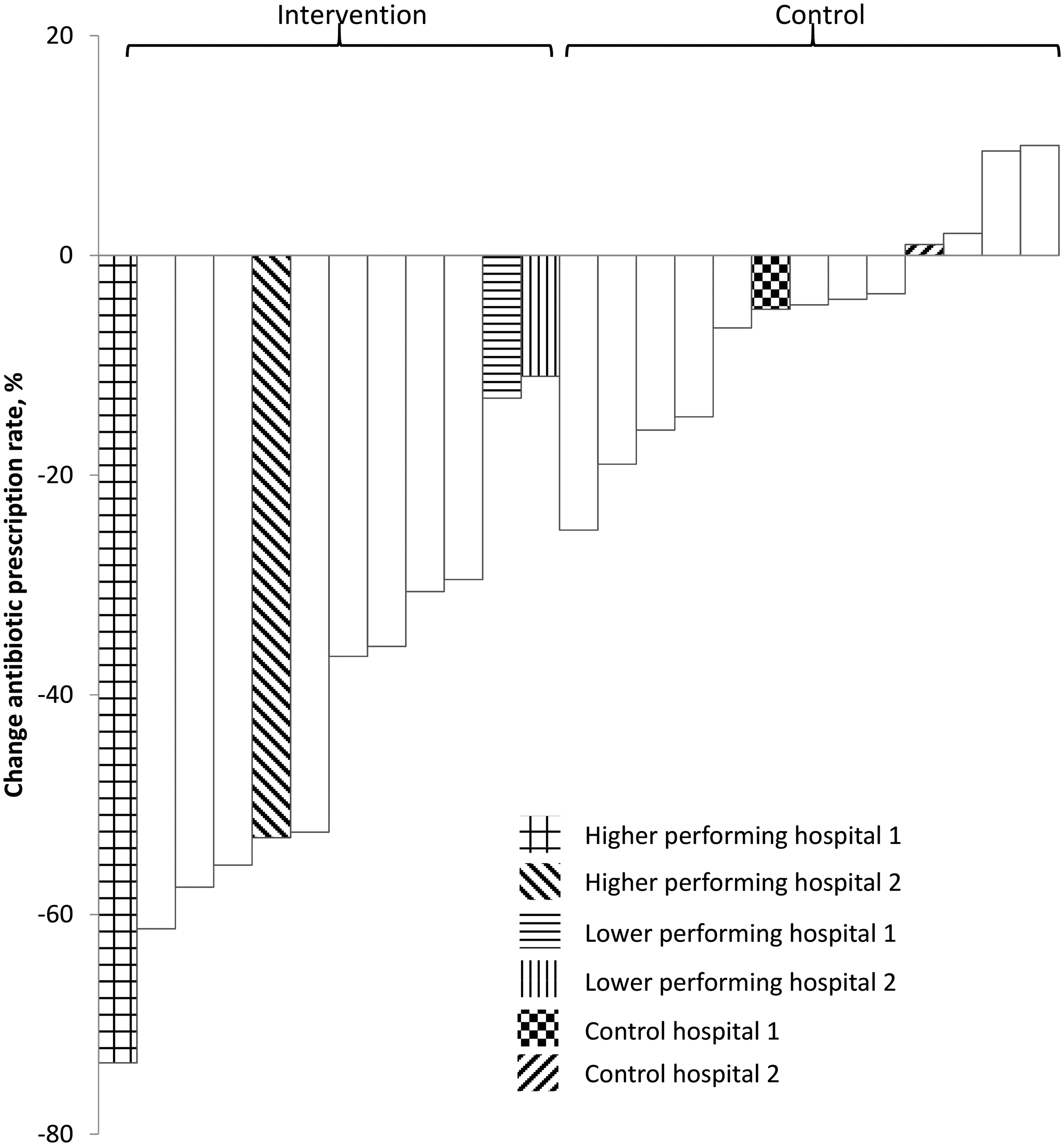
Changes in antibiotic prescription rates of included township hospitals. Each bar represents the absolute difference in antibiotic prescription rates between endpoint and baseline months for an individual township hospital with significant difference of antibiotic prescription rate (p = 0.001) between intervention and control group after adjusting age, gender, payment method of patients, and cluster effect. Note: Adapted from Wei et al. 19
Provider interview participants were also selected purposively according to role, age and gender: township hospital directors (one in each hospital, n = 6) and doctors (three in each hospital, n = 18). Caregiver participants were recruited as part of the trial and purposively selected based on their relationship with the children (parents and grandparents), age and gender (two in each hospital, with one recording omitted in the final analysis due to poor sound quality, n = 11).
Data collection
A total of 35 in-depth, face-to-face interviews were carried out in Chinese language by trained qualitative researchers using semi-structured interview guides tailored to the control and intervention arms. Interview topics focused on the experiences of intervention components by township hospital staff; township hospital doctors’ perspectives on antibiotic prescribing and URTI treatment and associated behaviours; caregivers’ perspectives on antibiotics; and control arm practices (see Online Supplement 1 for topic guides).
Interviews were audio-recorded upon written consent and notes were taken. For caregivers who were unable to read, the research team read out the informed consent document to ensure understanding. Participants were given the option to withdraw from the study at any point without any consequences for them. All interviews were conducted in quiet and private locations in township hospitals. Anonymized audio-recordings were transcribed verbatim.
In addition, we conducted 24 observations of guideline training sessions in all 12 intervention hospitals. All doctors working in these hospitals (n = 127) attended training sessions. Observations entailed research staff attending sessions and taking field notes on training session fidelity to protocol, as well as their general impressions of the training session, including participant reception, participation and any other notes. These observations, along with participant feedback from the sessions, provided contextual information to inform interview data analysis. We carried out similar observations of prescription peer review meetings (or administrative meetings in the control arm) attended by doctors and hospital directors in the selected six hospitals.
Ethical approval
Ethical approval was obtained from the University of Leeds Research Ethics Committee, UK (reference No. MREC15-016), and the Ethics Committee of Guangxi Provincial Centre for Disease Control and Prevention, China (reference No. GXIRB2014-0036). Our trial was registered with ISRCTN14340536.
Data analysis
Interview data were coded using QSR NVivo 10 software. Analysis was guided by the aforementioned Theoretical Domains Framework. 15 We used framework analysis 13 but allowed for inductive discovery of emergent themes. Our approach consisted of familiarization, coding framework agreement, indexing (in Chinese), charting (in Chinese), and interpretation (in English). 21 Findings were translated from Chinese into English, and verified by back-checking transcripts. Three researchers independently coded, indexed and charted transcripts, with any discrepancy discussed until reaching agreement. Emerging themes were discussed among the research team until agreement was reached. All coding interpretations were reviewed by two bilingual qualitative researchers. The principal investigator double-checked translation and coding interpretation.
Results
We report on the key observations following the TDF domains that informed the trial intervention (knowledge, skills, and social influence), with our analysis identifying the additional theme of ‘behavioural regulation’. By this we mean activities related to goal setting, action planning and self-monitoring. 14 We then report on perceived impacts of the wider environmental context within which the intervention was implemented.
Providers’ perspectives: knowledge and skills
Guideline training sessions, delivered as per intervention protocols, were designed to offer the opportunity for participating doctors to gain knowledge on appropriate prescribing and the skills to manage patient requests for antibiotics. The majority of doctors in intervention hospitals reported that participatory guideline training had improved their knowledge about appropriate antibiotic use. A smaller number commented that the training had also strengthened their confidence to not over-prescribe antibiotics and skills in engaging with patients. As one doctor explained,
“the training has a direct impact on our daily performance. We used to prescribe three antibiotics, such as cephalosporin, metronidazole and fluoroquinolone, all together for respiratory infections. Now we know this [is wrong and] cannot continue! I learned to refer to the guideline when seeing patients. We also feel confident to say no to patients when antibiotics are not necessary!” [p007, doctor].
There was a perception that relevant training should be delivered more regularly, with one hospital director commenting,
There should be more training opportunities [on antibiotic prescribing], we just had one training two years ago … it was a big change. Before the training, we prescribed a lot of antibiotics even for just a common cold … it [the training] improved doctors’ capability in diagnosis. [p002, hospital director]
Participants in the control arm did not receive specific training on appropriate prescribing and while it is not possible to directly compare and contrast experiences with intervention-arm participants, there was a suggestion that lack of targeted training might mean that doctors do not feel having control over or agency in reducing antibiotic prescribing:
the director said we had to reduce our APR [antibiotic prescribing rate] to meet with what the Health Bureau requested [20% of all prescriptions]. But our current rate is so high. We do not know how this [antibiotic reduction] is related with ourselves. [p017, doctor]
Providers’ perspectives: behavioural regulation
Similar to training sessions, prescription review meetings were perceived as providing opportunity for increasing knowledge and skills reinforcement, as well as behavioural regulation: “the peer-review was helpful for self-monitoring and reflection. This improved my practice [of reducing antibiotics prescribing] using our own cases” [p013, doctor]. The effectiveness of peer review meetings appeared to be influenced, at least in part, by the quality of the leadership. Thus, in the two higher performing study sites, prescription peer review meetings were led by senior doctors (typically the vice director for clinical service) whereas in the two lower performing hospitals, meeting-leads were hospital directors who were less regarded by their peers in terms of their clinical experience, despite their positions:
“ … not like big hospitals, [our] hospital did not have qualified doctors … The director had almost zero clinical experience … Some experienced senior doctors are not convinced by those junior doctors” [p012, doctor].
Participants working in higher performing hospitals also described that their site had adopted an individualized approach to support and motivate high prescribing doctors. This included asking doctors in the top 10% of APR to justify their prescribing habits and give detailed feedback and action points for behaviour change. As one senior doctor explained,
“I normally talk to those doctors with a high prescribing rate in person to discuss appropriate use of antibiotics and help them set up plans to achieve the target. They seem to be convinced by me” [p002, hospital director].
While the intervention activities offered opportunity to support behaviour change, higher performing sites also engaged in other institutional antibiotic stewardship activities which complemented intervention activities, such as goal setting. For example, the two higher performing hospitals had set the goal to reduce APR by half from its baseline rate in six months, or to 20% of all prescriptions. Lower performing hospitals had no explicitly defined measurable targets for APR reduction. Other measures included explicit incentives or ‘penalties’ to encourage behaviour change. For example, senior doctors who ran the prescription review meetings at higher performing hospitals also reported using deterrents such as making inappropriate prescriptions publicly visible to other doctors. As one doctor explained, “you can see from the outside [of the director’s office] that some inappropriate prescriptions [names blanked] were pasted on the wall. We certainly do not want our [prescriptions] to be put there” [p008, doctor].
Caregiver perspectives: knowledge
As noted, the intervention sought to educate caregivers using leaflets and a video played on a loop in hospital waiting areas. Many caregivers in our study reported that they had found the leaflet to be helpful in improving their knowledge about antibiotics:
“I have read the leaflet carefully and have understood the idea of bacterial infection and viral infection … I think we should reduce the use of antibiotics, it’s no good sometimes … superbug is terrible!” [p024, caregiver].
Patient education was also provided during consultations and most caregivers in our study commented that the knowledge they acquired from their doctors was important to them. One caregiver explained:
We have to listen to what the doctor says. It is directly related with the cure. I accept not taking [antibiotics] if the doctor says no” [p030, caregiver].
Environmental context
There were several contextual factors that impacted intervention effectiveness. For example, in describing reasons for inappropriate prescribing one hospital director explained how they perceived inter-hospital competition as a driver of inappropriate prescribing, noting
“patients cannot see why they[should] still go for township hospitals if they did not have the medications they want [to] get better soon. If we refuse them, they will choose to go to the county hospital. We will suffer financially” [p002, hospital director].
“I felt quite helpless when I failed to persuade a patient not to [take antibiotics], I have tried to explain but he decided to go to the county hospital [i.e., the higher level hospital] to get antibiotics” [p002, hospital director].
In our study context, antibiotics can be obtained from pharmacies without prescription. Some caregivers reported visiting pharmacies or village doctors for antibiotics. This was largely motivated by convenience, as these providers were located closer to patients’ homes. As one caregiver described:
“Sometimes I purchase antibiotics myself [from a pharmacy] if I don't have time to take my child to hospitals or I think the condition worsens” [p032, caregiver].
Discussion
This qualitative process evaluation used provider and caregiver interviews to explore knowledge, skills, social influences and environmental context factors relating to an educational intervention to reduce inappropriate antibiotic prescribing in primary care hospitals in rural China. We identified behavioural regulation as an emergent theme relevant to intervention implementation.
Provider participants reported how intervention activities, including training sessions and prescription peer review meetings, equipped them with knowledge to appropriately prescribe antibiotics and skills to navigate patient requests for antibiotics. This is in line with reports that evidence-based, user-friendly guidelines are important in improving doctors’ knowledge of antibiotic prescribing. 22 However, knowledge on its own is often insufficient to motivate behaviour change. 10 Sun et al. showed that improved knowledge among doctors in rural China did not correspond to improvements in appropriate antibiotic prescribing. 23
Our findings point to the importance of dedicated prescription review meetings in creating an environment to encourage prescribing behaviour change among doctors. The higher performing hospitals in our sample reported prescription review meetings led by respected senior doctors, who also implemented deterrents and engaged in action-planning with high prescribing doctors beyond the scope of the intervention. Behavioural regulation activities such as goal setting, self-monitoring, feedback and action-planning were shown to be effective in encouraging behaviour change in the context of hospital-based antimicrobial stewardship programmes elsewhere. 10 These types of activities were less common in the lower performing hospitals. Our findings point to some underlying organizational factors that might explain the seven-fold variation in APR reduction among intervention hospitals, 19 with factors such as clinical leadership that both supports and holds doctors accountable to behaviour change activities important in explaining the interventions’ longer-term benefits. 24
We also report on caregiver perspectives and how intervention activities provided educational opportunities. Given the existing evidence of poor community knowledge about antibiotics, education on and exposure to antibiotic information is important in supporting caregiver behaviour change. 25 Our findings highlight that educational materials can usefully complement the caregiver–provider relationship, which was found to be a locus of caregiver learning. Similar observations were reported in a recent systematic review of parental attitudes towards antibiotic prescribing in children, which highlighted that caregiver–provider relationships characterized by trust and open communication resulted in greater satisfaction with information given on antibiotics. 26
Our findings also underscore how the behaviours targeted in our intervention are shaped by contextual issues, which are driven largely at the health system level. China does not currently have a primary care referral system, and patients can directly access specialist care. 27 However, because there is no formal appointment system, and patients generally prefer morning consultations, there are long wait times and short consultations. 28 In speaking about the intervention context, providers reported helplessness in trying to convince patients sometime antibiotics are unnecessary, this was impacted by the financial need to retain patients, as well as wanting to avoid arguments with patients experiencing long wait times for short consultations. Given that consultations are the primary site of caregiver education, tension during short consultations could potentially be a barrier to providing adequate antibiotic education to reinforce the pamphlets and video materials. However, among our participants providers did not report that short consultation times affected their ability to offer intervention materials, rather that the intervention helped them to better engage with and educate caregivers and patients during these short interactions.
Equipping doctors to navigate tension will thus be important to ensure appropriate antibiotic use, in particular in the Chinese setting, given the widespread availability of antibiotics over the counter in private pharmacies and village doctors. The intervention was successful in enhancing providers’ confidence to reduce unnecessary antibiotic use; however, our findings from the high performing sites highlight that training was not sufficient in reducing inappropriate use but that antibiotic stewardship must take a systems lens, as well as extend into the community. 29
Strengths and limitations
A strength of this study is the exploration of behavioural factors which impact implementation of a trial intervention from the caregivers’ and providers’ perspectives. To our knowledge, this is one of the first reported qualitative process evaluation studies based on the MRC guideline 20 of a trial to reduce antibiotic prescribing in LMICs. Interventions that achieve higher effect sizes have involved prescription monitoring and specific feedback, 12 but few report how interventions motivated and interacted with behaviour change. 10 Thus, our findings would support the design of similar educational interventions to reduce inappropriate use of antibiotics in other LMICs.
There are limitations to this study. First, the evaluation was conducted by members of the research team who were involved in the implementation of the intervention, which may have introduced bias into the evaluation findings and interpretation of results. Second, the short follow-up period might have affected results as we did not monitor longer-term intervention effects on prescribing behaviours and education when reporting the trial results in 6-months. Third, our findings may be impacted by desirability bias where participants more positively present their experiences. Finally, we explored only six hospitals and purposively selected higher and lower performing hospitals, thus this study did not include perspectives of those in average performing hospitals in the trial.
Conclusion
This qualitative process evaluation reports on factors that may have influenced behaviour among providers and caregivers leading to observed changes in antibiotic use in the context of a trial seeking to reduce inappropriate antibiotic prescribing for children with URTIs in China. Our findings suggest guideline training sessions were useful in equipping providers with knowledge on appropriate antibiotic use, and that prescription review meetings facilitated by senior doctors, who were respected for their clinical experience, may play a positive role in fostering an environment of antimicrobial stewardship. Future interventions to reduce antibiotic prescribing should consider system level and wider contextual factors to better understand behaviours and patient care preferences.
Supplemental Material
HSR896588 Supplemental Figure - Supplemental material for Understanding factors influencing antibiotic prescribing behaviour in rural China: a qualitative process evaluation of a cluster randomized controlled trial
Supplemental material, HSR896588 Supplemental Figure for Understanding factors influencing antibiotic prescribing behaviour in rural China: a qualitative process evaluation of a cluster randomized controlled trial by Xiaolin Wei, Simin Deng, Victoria Haldane, Claire Blacklock, Wei Zhang, Zhitong Zhang, John D Walley, Rebecca King, Joseph P Hicks, Jia Yin, Guanyang Zou, Yunayuan Huang, Mercy Vergis, Jun Zeng, Qiang Sun and Mei Lin: on behalf of the ESO Health Economics Working group in Journal of Health Services Research & Policy
Footnotes
Acknowledgements
We thank colleagues from the Guangxi Centre for Disease Control and Prevention, and colleagues in Rong County and Liujiang County Centres for Disease Control who coordinated the trial implementation. We also thank research assistants and postgraduate students from Guangxi Medical University, Shandong University and Chinese University of Hong Kong who participated in the data collection and interventions.
Declaration of conflicting interests
The author(s) declared the following potential conflicts of interest with respect to the research, authorship, and/or publication of this article: All authors have completed the Unified Competing Interest form at  (available on request from the corresponding author) and they declare that none of them have any conflicts of interest.
Ethical approval
Ethics approval was obtained from Guangxi Institute Review Boards (GXIRB2014-0036) and the University of Leeds Research Ethics Committee (MREC15-016), which agreed that patient consent was unnecessary for record review as we obtained institutional consent in county hospitals to collect anonymous patient data. Prior to randomization, the trial manager sought written informed consent from township hospital directors on behalf of township hospitals, and all participating doctors. We also collected written consents for all participants in the interviews.
Funding
The author(s) disclosed receipt of the following financial support for the research, authorship, and/or publication of this article: The study was funded by DFID (UKAID), conducted as part of the COMDIS-HSD research programme, the Medical Research Council, Global Health Trials developmental grant [MR/M022161/1].
Supplemental material
Supplemental material for this article is available online.
References
Supplementary Material
Please find the following supplemental material available below.
For Open Access articles published under a Creative Commons License, all supplemental material carries the same license as the article it is associated with.
For non-Open Access articles published, all supplemental material carries a non-exclusive license, and permission requests for re-use of supplemental material or any part of supplemental material shall be sent directly to the copyright owner as specified in the copyright notice associated with the article.
