



Abstract
Central Manchester University Hospitals NHS Foundation Trust, like many Trusts, asked itself a number of searching questions in the wake of the reports into appalling standards of care in a number of UK care settings between 2006 and 2009. In order to seek assurance on the quality of care being provided and to be very clear about where improvements were needed, the Board of Directors commissioned a comprehensive peer review into standards of care provided. The resulting exercise involved over 200 staff being trained in review techniques and participating in a comprehensive Trust wide quality improvement programme. The output of this exercise was a detailed plan to improve quality of care, increased recognition of excellence, shared learning across multiple specialties, and increased staff engagement and expertise.
Introduction
A number of reports into the quality of care in the NHS (Darzi 2008; Francis, February 2013, Keogh, July 2013; Berwick, August 2013) all share one key conclusion; to improve the quality of care being delivered, Boards must drive that quality of care by fully understanding clinical outcomes and addressing problems as soon as they arise. But the problem most Boards face and a much discussed problem is how do we know what we don’t know?
Central Manchester University Hospitals NHS Foundation Trust (CMFT) is a large University teaching Trust providing acute inpatient, outpatient and community services across nine hospitals. The Trust is made up of nine clinical divisions and one research division.
The Board of Directors at CMFT has had access for some years to a suite of clinical quality information that draws data from some 700 sources across the organisation, as well as additional information from a number of external sources. These clinical data are so vast that it can be difficult for Boards to see the wood for the trees. Too many times Boards are challenged to understand the real picture of care from numerical data alone. Our chairman once commented, ‘Yes it is an achievement reducing our rate of MRSA bacteraemia to six in a large teaching Trust, but what if they are all on one ward? Then we have a serious problem’.
This challenge and the resulting discussion resulted in one of the biggest staff engagement exercises the Trust had ever undertaken.
There are two key groups who will inform quality information: patients (including their families and carers) and staff (including substantive employees and trainees). The Trust works hard to seek and act upon the views of patients and has made significant changes to practice and service delivery models on the basis of that information. However, one of the key lessons that emerged out of the Mid Staffordshire Inquiry was the failure of that Trust to listen to concerns being raised by staff themselves. Central Manchester were of the view that as staff would be the people charged with delivering improvements to quality, they should be the ones to advise the Board of Directors what those developments should be.
To that end, the Board of Directors commissioned an internal quality review to strengthen clinical quality assurance information. This review has been led by the Medical Director and Chief Nurse.
The Care Quality Commission (CQC) sets out five questions against which they review care going forward:
is care safe? is care effective? are staff caring? is the organisation responsive? is the organisation well led?
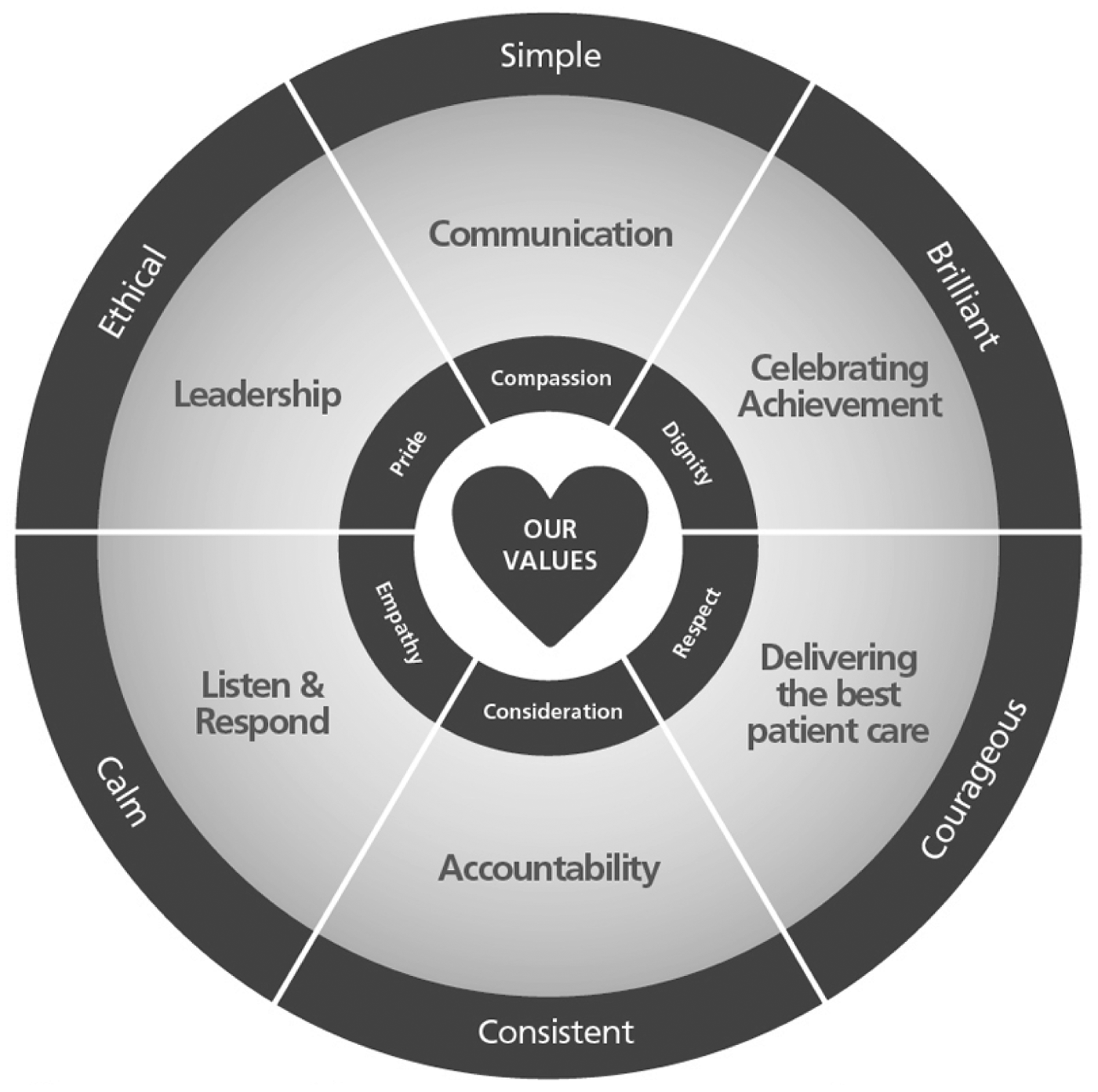
The process for the quality review was aligned with these questions and sought to provide organisational assurance on quality of care. The quality review also utilised the Trust values and behaviours framework which very much formed part of the training and the ethos of the review.
The purpose of quality review was twofold: first to ensure that the organisation could be fully assured of the quality of care being delivered, and second that it could identify and quickly respond where improvement is required. Most importantly, it was decided that the findings and resulting responses would be widely shared.
Terms of reference
These were simple and designed to give an understanding and balanced view of the way the Trust delivers care to patients. Each division was reviewed in its entirety with exceptions of community and outpatient services, which were taken separately. The approach was straight forward and largely based on that used by Keogh:
to understand how care is delivered; to identify areas of good practice and share across the organisation; to determine whether there are any sustained failings in quality of care or treatment; to identify whether these problems are known to the division (organisational business unit) and whether appropriate action is planned and underway; to identify and advise on any additional remedial action required; to identify and escalate and areas of serious concern relating to safety or quality of care.
A project plan was drawn up in August 2013 with the first of the review visits planned for October 2013.
Team selection methodology
Patient governors and staff were invited to take part in the quality reviews. The invitation was issued via the Intranet, meetings and internal bulletins. Approximately 200 members of staff expressed an interest in taking part. The teams were selected from a pool of applicants, ensuring they were allocated to areas other than their own and were representative of all staff groups and all levels of experience. Students, nurses and postgraduate medical trainees were included and it is hoped to expand their numbers and include trainees from other disciplines in future reviews.
Each team has been led by a Clinical Head of Division, a Divisional Director and a Head of Nursing. No team member was involved in a review of their own division. This was an intentional split to provide a mix of expertise and experience as well as an independence from the division being reviewed.
Board members were not invited to take part in the review teams. However, a number of non-executives attended one of the overview training days in order that they could be assured of the process design.
Training
Once the teams were selected, they undertook two training sessions. The first session was a facilitated full day and was designed to provide the following:
a welcome, overview and fundamental principles of the quality review process including values and behaviours; background and context to the review process; principles of the review methodology, including planning, confidentiality requirements, escalation procedures, interview and observation skills.
Importantly, this also gave the teams an opportunity to ask questions about the review. These questions were helpful in the planning and design process.
The second session was a team meeting focussing on the information pack, Key Lines of Enquiry (KLOE) and a planning session for the review visit.
KLOE
Information on each division was collated as a pack prior to the commencement of each review. The Informatics Team designed the pack based on data and reports submitted internally, and on reports generated externally such as staff and patient surveys, General Medical Council (GMC) trainee surveys, Deanery reports and the friends and family test. This summarised and provided an analysis of the large amount of data currently available. The identification of KLOE was part of this process and enabled team members to focus on particular areas of interest.
The pack was presented in the following domains:
patient safety; patient experience; clinical outcomes; governance; regulatory framework.
The KLOE were presented as examples and teams were encouraged to focus on areas they deemed to be of importance during the visit; there was not a mandatory completion required of all questions. All Trust staff were asked if they wished to comment on or add to the KLOE on an open e-mail address.
Process for reviews
The visits were all completed in eight months. The teams used a number of methodologies including interviews, meeting attendance, observation in clinical areas and patient conversations.
The Trust is currently undertaking short progress update visits in the autumn 2014 and will repeat the complete exercise in the autumn of 2015.
Outcome and conclusion
All teams reported that the packs were invaluable and that having the information presented in this way, together in one place, ‘told the story’ of each division in a helpful way. The divisional teams reported similar views. All teams reported that they had been adequately prepared for this by the training.
The added value of staff from all levels and all disciplines being engaged in this process was immense. The experiences of those staff and the insight they provided, the level of challenge they brought to long embedded systems and processes that had been in place for many years, were hugely helpful in drilling down not just to what the problems were, but the root causes of those problems. The Trust has a defined set of values and behaviours; these reviews were undertaken in accordance with them. This was not an inspection or an assessment, but in the true sense of the word, a peer review. Colleagues worked together and shared information on where practice was to be commended. Many team members stated that they were returning to their own place of work with new ideas for the future. Where improvements are needed, a peer feedback process has been facilitated with teams working together to improve quality.
The review has informed work plans for the organisation both locally in specific clinical settings but also a number of Trust-wide projects. For example, a group of newly appointed consultants in the organisation who recently completed a development programme together were interested in utilising their new skills to deliver an improvement project. Working alongside the Trust transformation team they have now come together to work on the development of consistent quality standards for outpatient care. A number of the team were involved in the review of outpatient care as part of the quality review and are using the outcomes of that review to directly inform this improvement work.
The review has informed important safety work streams. An example of this being the need to strengthen patient identification and site checking processes in the non-theatre environment. This has enabled the Trust to very specifically target areas for the development of safety checklists.
Importantly, it has also enabled the Trust to feedback to staff some very positive findings. Our staff were able to discuss openly their views on working in the organisation and, without exception, all divisions were found to have staff that were really proud of their work and comfortable reporting incidents to facilitate learning.
The headline findings for the organisation were:
Celebrating success:
good leadership; excellent patient feedback and use of this information to improve; good governance systems; staff committed, caring and proud; evidence of improvement across all areas; good awareness of patient safety and culture of learning – reduction in harm; good systems for local induction and appraisal for many disciplines.
Improvements required:
staffing, use of agency staff and out of hours cover; excellence in many areas but consistency required; incident/complaints/claims feedback; consistency – mortality review/use of pathways/handovers/infection control; recording of training; patient outliers; communication between community and acute services; Mental Capacity Act/Deprivation of Liberty Safeguards (MCA/DoLS) awareness in some areas; clinical audit cycle completion.
Examples of improvements in progress:
focus on improvements to compliance with clinical pathways; improvements to menu choice for patients; changes to the admissions process for paediatric elective surgical patients; establishment of staff forum in critical care; improved radiology facilities; improvements to IT access and networks in community services; focussed work on discharge pathways; the development of clinical audit performance metrics; changes to staff uniforms; focus on the safety needs of ‘medical outliers’ in the acute hospital; education for staff on the Mental Capacity Act and Deprivation of Liberty Safeguards.
One of the primary planned outputs from this work was always to share our findings with patients and the public. The Trust Board of Directors hold the view that this information should be in the public domain from the outset, sharing success as well as the need for improvements. Each of the reports run to 60–70 pages and it was felt the best way to get the messages across to both the public and staff easily was to prepare summaries of these reports for publication. To that end, a short report detailing what the division does, who was on the team, the findings and most importantly, what the division intends to do in response was published on the Trust internet site. This can be accessed at http://www.cmft.nhs.uk/your-trust/trust-quality-review.
The reviews have not lessened the amount of data that the Board must scrutinise, but they have tested the messages contained therein and provided a level of assurance that the right questions are being asked. The learning from the reviews to date has informed a revised reporting schedule for the Board of Directors, with issues such as staffing and clinical audit cycle completion now featuring as key performance indicators for all areas. Furthermore, the reviews have indicated priorities for deeper scrutiny such as staffing levels, the incidence of Acute Kidney Injury (AKI) and the management of serious clinical incidents. The planned programme of reviews in the coming years will continue to strengthen assurance processes as well as engaging staff and patients with the quality strategy.
A celebration day was held for all teams to come together and share their experiences and it was clear that although this was extremely valuable exercise in assurance, one of the biggest positive impacts was as a staff engagement exercise. At the event the Chief Executive, Medical Director and Chief Nurse were able to engage with many of the staff that took part. Presentations were made on detailed findings and lessons learned in respect of the process itself. At the end of each of these presentations, a senior member of the divisional team fed back to participants their thoughts on action going forward. The afternoon was given over to a facilitated workshop for all the participants to inform what future reviews will look like; this work is already being utilised in the planning of the next round of reviews.
The scale of the challenge, that of truly understanding quality of care in a large university teaching hospital, is immense. There are numerous opportunities to misinterpret or miss completely messages that, by the time they reach the Board, are diluted in a high level measure. This was an exercise in asking our staff, those working at the front line, to talk to their colleagues and patients and observe practice, feeding that straight back to Board members and the public. The Trust asked of staff and patients what is done well, what needs to improve and they responded by telling the organisation exactly how it is.
Footnotes
Funding
This research received no specific grant from any funding agency in the public, commercial, or not-for-profit sectors.
Conflict of interest
None declared.