




Abstract
Over the past decade amidst the development and implementation of new official curriculum texts and associated assessment requirements, there has been considerable international interest in senior physical education. Arnold’s three dimensions of movement have been prominent in curriculum developments and academic debates. In the state of Victoria, Australia, a new official text for the Victorian Certificate of Education Physical Education (VCEPE) was introduced in 2011. This paper re-articulates Arnold’s dimensions of movement as a framework for inquiry, centring on this development. The framework is utilised to critically examine the pedagogical intent inherent in the new VCEPE text and examine the prospective ‘slippage’ that may feature in teachers’ interpretation and implementation of the new text. Specifically, the analysis firstly draws on Arnold’s (1979) three dimensions of movement to explore ways in which different ‘ways of knowing’ in physical education have been represented in the official text, and secondly considers the prospective and potential expression of Arnold’s dimensions in teachers’ interpretation and implementation of the new text. The potential for either conservative or progressive readings of the official text is articulated.
‘Physical Education is being studied but only occasionally experienced’ (Thorburn, 2007: p. 179).
Introduction
Over the past decade, the knowledge (and ‘ways of knowing’ 1 ) that are addressed and recognised in various contexts of senior physical education have attracted considerable attention internationally (MacPhail, 2007; Queensland Studies Association [QSA], 2010; Thorburn, 2007; Victorian Curriculum and Assessment Authority [VCAA], 2010b). The nature of ‘appropriate’ and/or ‘worthwhile knowledge’, the educational status of the subject and ‘academic’ issues related to a subject defined by practical/body work which may be seen by some as essentially ‘non-academic’, have a well-established history of debate in the field (see for example Fitzclarence and Tinning, 1990; Green, 2005; Peters, 1966). Research focussing on curriculum developments in the UK and Australia in particular has provided valuable insights into the ways in which various course developments and associated assessment requirements have sought to extend the integration of ‘theoretical’ and ‘practical’ components of content (see for example Thorburn, 2007; Thorburn and Collins, 2003). That research has also highlighted, however, that for various reasons, changes to course specifications do not necessarily prompt the changes to pedagogy that may have been intended or envisaged by course developers – a scenario perhaps best illustrated by experiences in Scotland (MacPhail, 2007; Thorburn, 2009; Thorburn and Collins, 2003).
The position offered by Thorburn (2008) of ‘merging experiential learning with subject knowledge imperatives in ways which lead to authentic rather than contrived assessments of practical performance and subject knowledge’ (p. 264) is important here, if different knowledges are to be thought of and expressed in the curriculum, pedagogy and assessment, as mutually inclusive and inter-related. Fahlberg and Fahlberg (1994) use the example of a runner to explain that running is both physiological and phenomenological, and that these concepts are inherently linked. Explanations and understandings are partial and arguably inadequate unless we engage with the mutual dependency of the physiological and phenomenological. In this paper we foreground Arnold’s (1979) work, and in particular, his emphasis of the interdependency of different dimensions of movement, as a conceptual reference point in a critical analysis of recently announced changes to the Victorian Certificate of Education – Physical Education (VCEPE) (VCAA, 2010b) study design. 2 As we discuss further below, many of the curriculum developments in senior physical education and much of the associated research have made direct or indirect reference to Arnold’s (1979) conceptualisation of learning ‘in’, ‘through’ and ‘about’ movement. In this paper we seek to re-articulate the Arnoldian dimensions of movement as a framework for inquiry, particularly in relation to curriculum developments, and thereby connect with and extend recent debates in senior physical education. In doing so, we acknowledge the difficulties and lack of clarity of Arnold’s writings and theorisations in physical education by some in the profession, and how these get enacted in practice.
We specifically examine the VCEPE course changes from two perspectives. Firstly, we focus on the pedagogical intent that is embedded in the changes. In so doing we examine the notions of learning ‘in’, ‘through’ and ‘about’ movement (Arnold, 1979) expressed in the new VCEPE, and thus also consider the potential integration of ‘theoretical’ and ‘practical’ knowledges in learning experiences and assessment tasks. This critical engagement with the new VCEPE also draws attention to the significance of course specifications from an equity perspective, in terms of the extent to which the changes can be seen as potentially enabling ‘more and different’ abilities to be recognised in senior physical education (Penney and Hay, 2008). Secondly, our analysis acknowledges and actively engages with the ‘scope for slippage’ (Bowe et al., 1992; Penney and Evans, 1999) that is inherent in the new specifications, and that is recognised as a feature of the interpretation and implementation of official texts. Here our focus turns to the potential pedagogic enactment of the changes, while maintaining Arnold’s dimensions as the central point of reference. We address the respective roles that we foresee curriculum, pedagogy and assessment playing in determining how the three dimensions will be expressed in practice, and consider both pedagogic possibilities and likely constraints amidst implementation of the new course in Victorian schools.
Physical education and ‘ways of knowing’ physical activity and movement
‘In the most extreme case, the nature of physical education is distorted, for example, when attempts are made to justify its value on the same criteria appropriate for an academic subject’ (Wright, 2000: p. 273).
It has been widely acknowledged in the physical education and kinesiology literature that Descartes’ cogito ergo sum – ‘I think, therefore I am’ – the Cartesian dualism, has plausibly diminished the educational status of physical education (Kirk et al., 1996). In line with this thinking, Kretchmar (2005) asserts that the knowledge dualism of ‘knowing that’ is superior to ‘knowing how’, resulting in a tendency for intelligence with only one form of knowing that devalues action, particularly when it is physical. Unfortunately, this binary that privileges theoretical or propositional/declarative knowledge over practical knowledge continues to pervade areas such as physical education teacher education (PETE) preparation programmes, professional learning, and curricula; and arguably, in senior physical education as well. In the state of Victoria, as has happened internationally (Green, 2005), such an approach was used to further ‘academise’ the study of physical education. Senior physical education occurred as part of the Higher School Certificate (HSC) where ‘to give physical education the academic credibility…the subject committee created a programme which virtually excluded all physical activity and which echoed the pedagogy of high status academic subjects’ (Fitzclarence and Tinning, 1990: p. 177). Furthermore, we note that the form of theoretical knowledge that has invariably been privileged in such attempts to make an ‘academic case’ for PE is often a scientised, objective way of knowing, drawn from the biophysical sub-disciplines, 3 which marginalises ‘other’ (Tinning, 2004) and alternate ‘ways of knowing’.
While a call for a broadening of ‘ways of knowing’ movement is not new in physical education, clear articulation of multiple ways of knowing is arguably still lacking both in physical education curriculum texts and pedagogical practices (Tinning, 1998). Fahlberg and Fahlberg (1994) have written that we are in an era of science known as post-positivism. They suggest that multiple epistemologies (knowledges) are acceptable and, if used in an integrated way, correspond to respective aspects of ontologies (realities). In presenting an integrated framework for human movement research, they propose a model where meaning and matter are integrated, not as two separate realities, but one reality that is integrated with different levels. This approach aligns to some extent with Tinning (1998) and Loland (1992), who state that the teaching of physical education must be both mechanistic/analytical and holistic/phenomenological; it is not an either-or situation.
Clarification of the dualism is appropriate, for it provides some legitimacy to the often marginalised study of holism/phenomenology. Bain (1995) has argued that ‘because of its philosophic assumptions, phenomenology has particular relevance to the study of movement’ (p. 241), while Fahlberg and Fahlberg (1994) go one step further and suggest that understanding ‘…meaning in human movement can be facilitated through the study of consciousness via phenomenology and the study of meaning via hermeneutics’ (p. 103). Thorburn (2007) has previously advocated for further exploration of phenomenological approaches and pedagogy as a means to enhance conceptual coherency of senior physical education. In exploring how such phenomenological approaches might be ‘framed’ within physical education, Brown and Payne (2009) provide some historical and contemporary understanding via the presentation of postmodern social science literature related to physical education. In their paper they draw on the work of Sparkes (1992), who opened up perspectives, approaches and ‘ways of knowing’, examining how researchers might represent interpretive, phenomenological and hermeneutical methodologies. Concomitantly, with a focus on theoretical aspects of curriculum development and assessment practices in Scottish senior physical education is the work of Thorburn (2008), whose statement that ‘…the phenomenological route…is not the only route possible, and within an increasingly global and culturally pluralistic world, other writers might like to theorize about other viable philosophical options’ (p. 272) provides additional insights into the philosophy of social science and truth claims about knowledge.
Research beyond physical education/kinesiology can also usefully inform debates and provide new insight into ‘other ways of knowing’. Two significant examples support this view. The work of Belenky et al. (1986) and that of Payne and Riddell (1999), the first from education, the second from environmental education, highlight the importance of epistemological and ontological pluralism as it applies to scholarly inquiry, curriculum development/planning and pedagogical practice. Belenky et al.’s (1986) examination of a diverse group of women’s experiences, identities and intellectual development is arguably seminal to the field and theory of knowledge as it situates and privileges in language/text the often marginalised embodied experiences of the participants. In (re)presenting ways of knowing, being and understanding the environment, Payne interviews Riddell on the meaning of ‘environment’. In discussing how she understands different ways of knowing and sources of this knowledge, Riddell answers:
Let me offer an example. I spent much of my childhood at the ‘Sorrento back beach.’ I knew it as an infant explorer where, with bucket and spade, I waded through, dug up and splashed in every rockpool and sand dune. I knew it as a child, where with the assistance of the ranger, I learnt to name the animals and plants. I knew it as a secondary student, where on a fieldtrip I observed, researched, and drew coastal processes. As a sun-baking, boy-kissing, parent-eluding teenager I found private, sometimes special places on that beach, that I can remember in a way different from others. My point is that you can come to ‘know’ a place by visiting it, living in it, reading about it, researching it, being taught about it, being affected by it and in many other ways. The source can be internal or external, private or public, general or specific, scientific, artistic, geographic, recreational, spiritual, and so on. (Payne and Riddell, 1999: p. 251)
Although these studies present diverse findings, it is their commonality and prospective application to senior physical education that we have pursued. They serve to affirm the importance of experiential and plausibly notions of inter-disciplinary learning. In line with Van Manen’s (1977) suggestion that curriculum concerns are practical concerns, we agree with Payne’s (2005) suggestion that ‘…for curriculum developers and teachers…it is important to “invite” students into different ways of knowing/doing’ (pp. 121–122). Such diversity and ‘ways of knowing’ have arguably been ‘lost’ in much of the academicisation and scientisation of senior physical education. We are optimistic that re-engaging conceptually with the Arnoldian dimensions may challenge physical educators to once again consider alternative ‘ways of knowing’.
Revisiting the Arnoldian dimensions of learning ‘in’, ‘through’ and ‘about’ movement
In two seminal texts, Meaning in Movement Sport and Physical Education (Arnold, 1979) and Education, Movement and the Curriculum (Arnold, 1988), Arnold articulated ‘…the place of movement in the curriculum’ (Arnold, 1988: p. 103). As indicated above, his curriculum design, appropriate for the curriculum planner (read teacher) is premised on the concept of three dimensions of movement. Particularly these concepts of ‘in’, ‘through’ and ‘about’ movement are the framework through which a model for physical education that is underpinned by, and expresses, a holistic understanding of physical education, is articulated. Our desire to revisit Arnold’s work reflects firstly that several international curriculum documents, including senior physical education syllabi or curriculum specifications, are premised on Arnoldian dimensions. Secondly, we contend that given the ways in which Arnold’s work has variously been (re)interpreted and (re)presented over the past 30 years (in curriculum and academic texts), there is a case for further elucidating the dimensions and underpinning conceptualisation/s. Our intention is, therefore, to highlight that re-engaging with the Arnoldian dimensions, primarily as applied to senior physical education, can potentially provide important insights for future developments of curriculum, pedagogy and assessment in physical education, and senior physical education particularly. Below we provide a brief outline of Arnold’s dimensions of education ‘in, through and about’ movement (Arnold, 1979, 1988), prior to elaboration and critique of their application in senior physical education courses, and the re-presentation of Arnoldian dimensions as a framework of analysis for our investigation of the pedagogical intent and possibilities inherent in the new study design for the VCE (Victorian Certificate of Education) Physical Education curriculum.
Arnold's (1985) concepts of ‘in, through and about’
Education, Movement and the Curriculum (Arnold, 1988) and the earlier text Meaning in Movement Sport and Physical Education (Arnold, 1979) are important within the scholarship of physical education. Due to the brevity of our presentation here, we encourage readers to return to the original texts, and particularly to engage with the extended discussion that they offer in relation to the philosophical and ontological perspectives informing conceptualisation of the dimensions. Briefly: Education ‘in’ movement refers to activities of movement/physical activity as worthwhile in and of themselves from the perspective of the moving agent; learning in physical activity thus refers to experiential outcomes, where students directly acquire knowledge, understandings and skills as a result of thoughtful participation in physical activity (e.g. applying tactics and strategies in a game, appraising the physical capacities and requirements of an activity). Education ‘through’ movement is concerned with functionalist views. The activity/movement in physical education is conceived as a way of meeting another aim/goal or objective; a means to an end. Learning through physical activity refers to instrumental outcomes where students indirectly acquire understandings, capacities and attitudes as a result of studying and participating in physical activity (including, for example, increased physical fitness, aesthetic appreciation of a performance, continued participation in a physical activity). Education ‘about’ movement manifests in many versions of physical education primarily concerned with rationalism. From this perspective the importance of movement educationally is that it allows the agent to actualise himself/herself in distinctive, pleasing and bodily related contexts as a process of understanding their own embodied consciousness (Arnold, 1979, 1988; Brown, 2008). Learning about physical activity refers to a rational form of inquiry, where students directly acquire knowledge and understandings as a result of studying and participating in physical activity (e.g. examining the impact of gender stereotypes on participation in physical activity and planning psychological strategies for pre-match preparation).
Arnold (1979) emphasised the importance of the inter-connectedness of these dimensions, saying that: ‘It should be stressed that these three dimensions of movement are not mutually exclusive. On the contrary they overlap and interrelate with one another’ (p. 106). Thus, while Arnold clearly differentiated the dimensions, he retained the emphasis of their inherent inter-dependency. They are, in his words, ‘…conceptually discrete but functionally related. Each dimension is not exclusive of the others, but overlaps and merges into them’ (Arnold, 1979: p. 177). A key question that we pose in relation to recent developments in senior physical education, and specifically pursue in our exploration of the new VCEPE below, is the way in which the dimensions have individually and collectively been represented in senior secondary course requirements (for teaching and learning and assessment). Our interest is, therefore, in the curriculum and pedagogical implications of thinking about learning in, through and about movement with, in each instance, an emphasis of the inherent inter-dependency between the three dimensions. We contend that there are key implications for learning (in terms of scope and focus and the nature of the learning experiences), for official texts (such as senior physical education syllabus documents), and the expressions of those texts in school curricula, teacher pedagogy and assessment, if senior physical education is to adequately and appropriately reflect the conceptualisation of movement and education that is inherent in Arnold’s work. As Arnold (1979: p. 178) argued:
For the curriculum [and we would contend, pedagogical] implications of the concept of movement to be grasped in an adequate way it must be seen not only as a field of study, and as an instrumental value, but as a worthwhile group of physical activities to be engaged in for their own sake.
Engaging with and expressing all of the dimensions and, simultaneously, their inter-relatedness, is the challenge posed.
The articulation and application of Arnold’s dimensions in senior physical education: Are there some notable limitations?
As many readers will be aware, some curriculum developments in senior physical education internationally have made direct reference to Arnold’s (1979) three dimensions of movement in articulating the conceptual thinking that has informed course design and associated specifications for programmes of work and associated assessment. For example, the current Senior Syllabus for Physical Education in Queensland (QSA, 2010) and the document it replaced, Board of Senior Secondary Schools Studies (BSSSS) Senior Physical Education (QSA, 2004), states in its rationale that ‘through the interrelated concepts of learning in, about and through physical activity (Arnold, 1985) students become intelligent performers (Kirk, 1990) and physically educated’ (p.1). In other instances, although not explicitly mentioned, aspects of Arnold’s conceptualisation appear to have informed course development. For example, [Welsh Joint Examinations Committee] the WJEC A and AS specification (WJEC, 2008: p. 6) explains that:
Students will be encouraged to develop and refine knowledge, understanding and skills that make the most of innovative approaches to developing and refining performance in physical activity. As well as experiencing physical activity as thoughtful and reflective participants, students will also learn about physical activity through disciplined enquiry. Integration and synthesis of knowledge are important themes in this specification.
At one level, therefore, Arnold’s dimensions appear to have been influential in senior physical education course development. We suggest, however, that there is a need to review what has become to some extent the ‘familiar language’ of ‘in, through and about’ and to revisit the meanings that were central in Arnold’s conceptualisation and their representation and expression in physical education texts. Some 30 years on from the publication of Arnold’s texts, and with inevitable reliance on secondary interpretations and representations, we question some of the ways in which Arnold’s (1979, 1988) work has been interpreted and ‘translated’ in curriculum and course design, pedagogy and assessment of senior physical education. For example, we might question whether the practical performance assessment tasks arising in senior physical education in Queensland or elsewhere have become, essentially, an alternative form of propositional knowledge representation? Do tasks that purportedly seek to integrate theoretical and practical dimensions of knowledge in senior physical education reaffirm or challenge the dualism of propositional-practical knowledge? (Hay and Penney, 2013; Wright, 2000). As Arnold (1988) articulated:
Practical pursuits in fact are seen as valuable only insofar as they can assist in the development of intellectual understanding. Such a view of knowledge and education is reductionist in nature, for what it amounts to is the denial that practical pursuits, including such physical activities as swimming, dance, and games, as well as others such as pottery, arts and craft, cookery, woodwork, and metalwork have enough about them that makes them worthwhile. (p. 118)
The analysis of practical performance often becomes instrumental in developing physiological, sociological, biomechanical and tactical knowledge in senior physical education settings. We question the extent to which this emphasis retains an alignment with Arnold’s (1979) presentation of education in movement, with the focus on activities of movement/physical activity that are worthwhile in and of themselves from the perspective of the moving agent. From this perspective, moving allows the agent to actualise himself/herself in distinctive, pleasing and bodily related contexts as a process of understanding their own embodied consciousness. These perspectives are subjective and a ‘good-in-themselves’ as well as being ‘good-for-me’ (Brown, 2008).
We are by no means the first to question ways in which learning in, through and about movement are represented in contemporary senior physical education texts and/or practice (see for example Thorburn, 2007, 2009; Thorburn and Collins, 2003), or indeed, in physical education more broadly (Kirk, 2009). We see a renewed need, however, firstly for further critical engagement with both official texts that claim Arnoldian underpinnings, and secondly, the pedagogical texts arising from them as senior physical education in schools. Notions of intelligent and/or reflective performance have, as illustrated above, been foregrounded in course documentation, and embedded in the academic and professional discourses of senior physical education. But do those discourses adequately and appropriately represent Arnold’s conceptualisation/s? Brown (2012) contends that elements of Arnold’s vision have been ‘lost’, or at best have been confused or misinterpreted, from its ‘original’ conception. If we add to this that teachers find it difficult to devise authentic assessment experiences that integrate Arnold’s dimensions of ‘about’ and ‘in’ (Macdonald and Brooker, 1997) in assessment in senior physical education, then clearly a disparity exists between the conceptualisation and how it is enacted through policy and, inevitably, practice. In the sections that follow, we pursue this representation and the issues we have raised in turning attention to a new senior secondary syllabus development in Victoria, Australia – the new VCEPE.
Senior physical education in Victoria
Across Australia, state and territory–based government departments and/or curriculum and assessment authorities (quasi-government agencies) retain authority and an important degree of autonomy for senior secondary education. While the development of a new Australian Curriculum is in process, and is in part a direct response to state/territory differences in curriculum content (Ministerial Council on Education Employment Training and Youth Affairs (MCEETYA), 1999; The States and Territories, 2007), development of K-10 curriculum frameworks is preceding developments focussing on senior secondary years. Further, the Australian Curriculum is being developed in phases, with physical education positioned relatively late in the process. Thus, at the time of writing, senior physical education remains the domain of individual state and territory authorities.
In Victoria, the Victorian Curriculum and Assessment Authority (VCAA) publishes and is responsible for the administration of the VCE study design within all schools. The new VCE Physical Education study design was presented by VCAA in 2010 and accredited for a three-year period, 2011–2014. This will be the 5th iteration of the study design since the introduction of the course in 1992. Prior to this, physical education was taught as part of the Group 1 subjects of the Higher School Certificate (HSC) from 1985–1991. 4 The development of the senior physical education curriculum within Victoria appeared at a time when social, economic, cultural and educational change was occurring. Political and social agendas questioned the status quo of many institutions, amongst them school systems and access to education. For senior physical education there was some benefit. The considerable criticism of entrenched systems such as examinations for matriculation gave rise to school-based assessment in a more diverse range of subjects – home economics, art, music and physical education. The political climate, with its focus on social justice and the development of wider cultural understandings (Blackburn, 1985), presented an opportunity to the writers of the initial VCE Study Design. Fitzclarence and Tinning became authors of the first VCEPE Study Design and, in reflecting on this period of time, wrote:
…we were concerned with the trend in physical education to define the subject in increasingly narrow and fragmented ways with knowledge drawn primarily from the biological/physical sciences. Our response was to place biophysical/physical science understandings alongside knowledge drawn from sociocultural understandings. (1990: p. 181)
There has been a gradual shift of course content within each study design iteration, since this initial conception to a point now where units, areas of study, outcomes of core study and key knowledge are all underpinned by science-oriented knowledge in anatomy, coaching, physical activity epidemiology and exercise physiology.
The VCAA published a study summary that outlined the rationale, structure, units and assessment within the new VCEPE. The rationale was presented thus:
VCE Physical Education examines the biological, physiological, psychological, social and cultural influences on performance and participation in physical activity. It focuses on the interrelationship between motor learning and psychological, biomechanical, physiological and sociological factors that influence physical performances, and participation in physical activity.
The study enables the integration of theoretical knowledge with practical application through participation in physical activities. There are opportunities for students to apply theoretical concepts and reflect critically on factors that affect all levels of performance and participation.
(VCAA, 2010b)
It appears from the above statement that for physical education to ‘count’ (Rink and Mitchell, 2002: p. 209) amongst other VCE subjects, it must conform to the ‘official’ theoretical/academic discourses, in line with what Green (2005) notes as the ‘academicisation’, ‘professionalisation’ and ‘scientisation’ of the subject. In elucidating these concepts ‘in action’, we use Fitzclarence and Tinning’s (1990) analysis of curricula change at senior study level as a poignant reminder that policy and curricula change is never neat nor logical.
Although this reference is over two decades old, it is reflective of the state of senior physical education here in Victoria with the new study design. The rhetoric presented to teachers 5 was that this revised study design ‘…reflects current directions in physical education’ (VCAA, 2010a) and that it is an example of current research and practice elsewhere. We feel, however, that this study design does not achieve this implicit aim. Arguably, it does little in terms of moving beyond narrowly conceived ‘ways of knowing’ (Table 1).
VCEPE Study Design (accreditation period 2011–2014).

1These units are core units in the VCEPE study design.
VCEPE: Victorian Certificate of Education Physical Education; AOS: Area of Study. VCAA (2010b).
The senior curriculum in Victoria is made up of four discrete units that are grouped together as a ‘study’, of which physical education is one of over 90 (See Table 1 for additional details). For students, there are no prerequisites for entry to Units 1, 2 and 3; however, students must undertake Unit 3 prior to undertaking Unit 4. Each unit is the equivalent of 50 hours of study. According to all study designs ‘…units 1 to 4 are designed to a standard equivalent to the final two years of secondary education’ (p. 8). In presentations given by the VCAA that complement the introduction of the study design, the importance of practical activity is highlighted as one rationale amongst several for re-conceptualising the curriculum. It is advocated and re-emphasised within the ‘new’ study design that practical activity should be used appropriately to support learning. Teachers are guided by the comment within the study design that states that ‘…teachers must allocate sufficient time to ensure that the practical component of Physical Education is adequately covered. As a guide, between 10 and 15 hours of class time should be devoted to student practical work across each unit’ (VCAA, 2010b: p. 32). Examples of practical activities, as suggested in the study design ‘Advice to Teachers’, include but are not limited to: use heart rate monitors, or take a pulse manually, to collect heart rate data to analyse in relation to the response of the cardiovascular system at rest and during exercise; participate in a variety of activities to record and report on the acute effects of exercise on the cardiovascular and respiratory systems; play a game of ‘Simon Says’ to investigate factors affecting balance and stability; wear a pedometer for a week to monitor physical activity levels; keep a diary or log of the steps taken; use a valid observational instrument, for example (System for Observing Fitness Instruction Time) SOFIT, to assess the amount of time students engage in moderate to vigorous physical activity during a physical education lesson; visit a tertiary institution to experience use of high technology fitness-testing equipment to analyse fitness components; perform a battery of fitness tests testing a range of health and skill-related fitness components (Table 2). Arnoldian dimensions of movement and the VCEPE: anticipated and potential expression. Notes 1 Here we are using Penney and Chandlers (2000) notion of potential.
2 We are of the philosophical position that practical activity has the ability to produce knowledge, in the sense of the intelligent performer, and is therefore academic; however, the binary may be more easily understood by policy makers and practitioners alike.
3(Physical Activity Learning and Analysis Class) PALACs were first used in VCEPE in the early 1990s. VCEPE: Victorian Certificate of Education Physical Education.
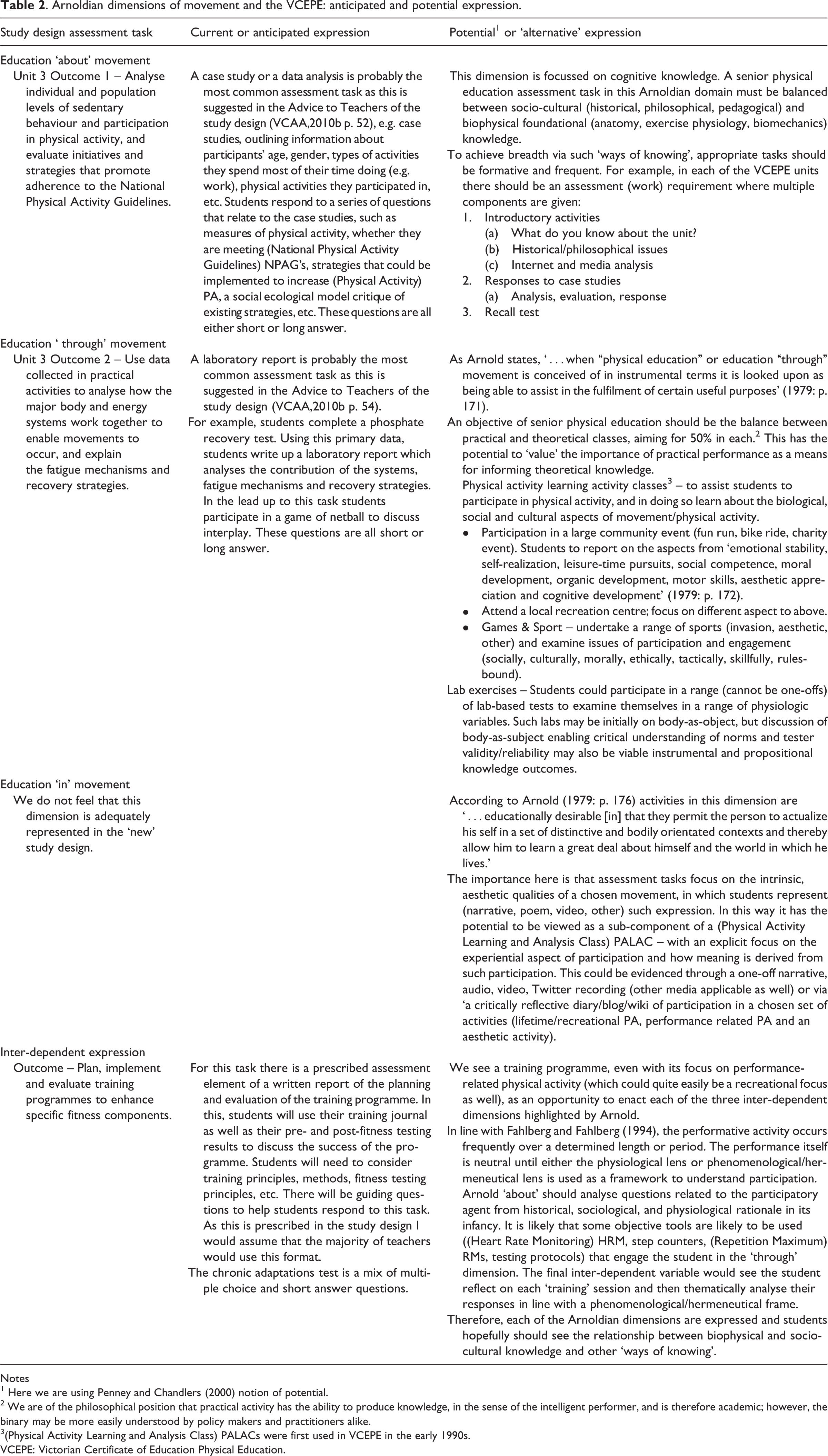
We begin with Arnold’s dimension of education ‘about’ movement. As he reminds us, this dimension is underpinned by ‘rational movement knowledge’ (1979: p. 170) that is propositional and presented in a discursive way. As Arnold emphasises, it should be analytical, critical and evaluative. Whilst the example of the students responding to various case studies is in line with the proposed outcome, in totality this SAC is worth only 10 marks out of 100. We feel that the official text clearly values examinations and all that it entails, as it accounts for half the total marks of a student’s grade. We possess a twofold concern with such practices: (a) the high percentage value of a theoretical ‘test’ in a practically based domain; and (b) its focus and dominance primarily on the biophysical dimensions of movement. As Green (2000) has noted, the process of examinations in senior physical education in countries such as Australia, New Zealand and the United Kingdom is now widespread. As early as 1990, discussion in the literature around ‘examinable physical education’ centred on the nature of appropriate/worthwhile knowledge, the educational status of the subject and ‘academic’ issues related to a subject defined by practical/body work – that which was seen as essentially ‘non-academic’ (Fitzclarence and Tinning, 1990). This ‘new orthodoxy’ (Reid, 1996a, 1996b) has, according to Green’s work, seen teachers accept, conceptually and practically, the importance of the so-called theoretical and intellectual content of physical education (noting the privileging of scientific ways of knowing). In discussing such paradigmatic shifts in senior physical education in Victoria some 20 years ago, Fitzclarence and Tinning (1990) wrote:
To give physical education the academic credibility they desperately wanted, the subject committee created a programme which virtually excluded all physical activity and which echoed the pedagogy of high status academic subjects of the hegemonic curriculum, emphasising in particular propositional knowledge that had an empirical and scientific flavour. (p. 177)
The examinations that are typically used in senior physical education have, as Green (2005) later discussed, arguably ‘scientised’ the curriculum for senior physical education. We acknowledge that examinations are a tool for assessing rational movement knowledge, via Arnold’s ‘about’ movement. Our thoughts on the pedagogical potential for a future senior physical education in Victoria is thus accepting of the biophysical ways of knowing (see Table 2), but also optimistic that socio-cultural knowledge(s) such as history and philosophy, that are also rich content in the study of physical education, may be given appropriate status in coming years.
Arnold (1979) wrote that the dimension of education ‘through’ movement is most related to the term physical education and is routinely manifested via engagement with practical activities, movement and sport. We would expect, therefore, that there are opportunities for students to learn through physical activity via the new study design. This is achieved via student participation in practical activities that generally occur weekly as part of the nominated hours of practical activities and are described in ‘Key Skills’, such as ‘…participate in and evaluate a range of nutritional, physiological or psychological strategies that potentially enhance performance and aid recovery’ (VCAA, 2010b: p. 29). We acknowledge that these activities are designed for instrumental outcomes ‘where students indirectly acquire understandings, capacities and attitudes as a result of studying and participating in physical activity’ (Arnold, 1988: p. 176), and as such reinforce our concern about the practical/theoretical debates raised by Wright (2000). Moreover, our concerns are that practical activity and participation in the study design are yet to receive the status that they seek, vis-a-vis the practical/theoretical debate. This is primarily manifested via time allocation in the study design, which exemplifies to teachers and policy-makers the inherent dualism that exists between theory–practice. We are also concerned that there exists a lack of breadth and depth with regard to appropriate assessment strategies for assessing practical activity, and offer two examples to highlight this point.
The first comes from a current Physical Education Studies (PES) course in Western Australia (WA) (Curriculum Council of Western Australia, 2010). In WA the external examination for PES incorporates a performance assessment or practical examination. While we regard this as a ‘step in the right direction’ we also recognise that the current examination format and arrangements in WA may still mean this component of summative assessment is potentially narrowly focussed on motor skill development and execution, tactical decision-making and performance; such that the assessment can be seen as reductionist.
Our second example directs attention to breadth and frequency of assessment tasks that are both formative and summative, which enables valid assessment of this dimension. Our position reflects the view that the current assessment strategies in Victoria are narrow, due its increasingly scientific focus (e.g. laboratory report) and the knowledges that it is attempting to assess. In this sense there exists a need to assess the ‘about’ dimension in ways that are more holistic, non-dualistic and are accepting of a breadth of ‘ways of knowing’. Potential assessment tasks and pedagogies such as those in Table 2, which are frequent, formative and participatory, provide such breadth. If, for example, both PALACs and lab exercises were two separate assessment tasks in each unit, there is potential for a wealth of tasks across the biophysical–sociocultural continuum whereby different ‘ways of knowing/being/becoming’ for students would be enhanced and students would be presented with a more holistic picture of the study of physical education, developing much more equitable and inclusive assessment practices (Penney and Hay, 2008).
The difficulties in presenting how Arnold’s ‘in’ movement is expressed in the official text of the VCEPE may be partially explained in that this dimension and its underlying concepts is the least well understood by teachers (Brown, 2011). According to Arnold (1979: p. 176) this dimension is ‘…educationally desirable [in] that they permit the person to actualize his self in a set of distinctive and bodily orientated contexts and thereby allow him to learn a great deal about himself and the world in which he lives’ (our emphasis). Whilst the ‘experiential nature’ espoused by Arnold may be enacted implicitly by teachers in multiple assessment tasks across the study design, there is no assurance that such expression of learning ‘in’ movement as it was intended by Arnold is likely to occur. This is supported in part via preliminary research that has identified that teacher content knowledge and knowledge about authentic accounts of students ‘experiential learning’ and subjective/embodied learning is often very restricted, primarily as a result of limited physical education teacher education preparation and professional learning opportunities (Brown, 2011; Thorburn and Collins, 2003).
Finally, the official text presents some opportunities to demonstrate how each of the dimensions are expressed inter-dependently, especially if a broader understanding of Arnold’s ‘in’ movement is considered. We are confident that the rich experiential learning environments planned for in study design, if followed as suggested in Table 2 where movement/physical activity is central to each of the dimensions, provides for scope for a richer, deeper study of ‘about’, ‘through’ and ‘in’ movement. Our argument is that if the study design in VCEPE is to engage the learning holistically, via various ways of ‘knowing’, students need to have an appreciation and understanding of various knowledges. We sense that Fahlberg and Fahlberg’s (1994) framework for analysis in physiological/participatory and phenomenological/hermeneutical can be applied to such an assessment item of a 6–10-week training/recreational plan.
Interpreting and enacting the new VCEPE: potential pedagogies
As our preceding discussion has acknowledged, internationally the development of senior physical education courses is recognised as presenting physical education with some fundamental dilemmas and challenges relating to the nexus between propositional and experiential knowledge. Recent commentaries have reaffirmed that successfully addressing this nexus, in course designs and, furthermore, in enacted curriculum, pedagogy and assessment, remains a challenge (see for example Kirk, 2009; Thorburn, 2008; Thorburn and Collins, 2003). Curriculum developments worldwide reaffirm the complexity of policy processes in education, and specifically the scope for varied and unintended readings of curriculum texts amidst the influence of broader political imperatives and dominant discourses (of for example, standards and performativity), and given the professional knowledge and beliefs that teachers bring to the text (see for example Ennis, 1994; Thorburn and Collins, 2003). Our purpose here, therefore, is to offer preliminary yet informed (drawing on past research, our own professional experiences of similar developments and knowledge of the specific context of senior physical education in Victoria) comment on how the new VCEPE may well be read by physical education teachers in schools in Victoria, with a particular focus on the Arnoldian dimensions of movement. We then move on to consider potential alternative, and arguably progressive, readings of the new official text.
It is anticipated that the explicit statement within the new study design pertaining to the ‘…use of practical activities to underpin theoretical understanding’ (VCAA, 2010b: p. 7) in both the unit’s rationale and aim, as well as material presented from associated workshops, 6 is likely to result in some form of pedagogical change. The renewed vigour and importance of practical activity is plausible as a response to: (a) the study review, conducted in 2008–2009, identifying issues associated with practical work in the study design; (b) empirical research demonstrating lack of student engagement in classroom versus practically based sessions in senior physical education (Thorburn, 2008); and (c) philosophical discussions on the theoretical–practical nexus (Wright, 2000) and its importance to knowledge in physical education (Reid, 1996a, 1996b).
Crucially, the unequivocal statement in the study design ‘Advice for Teachers’ related to developing a course further highlights how we feel the intended policy will be enacted in practice:
In order to meet the requirement of the outcome statements and key skills it is essential that practical activities [emphasis added] are used in conjunction with the teaching of theoretical concepts throughout Units 1 to 4. Practical activities may include laboratory work, data collection, physical activity, sports and games…Teachers must allocate sufficient time to ensure that the practical component of Physical Education is adequately covered (p. 32).
We are cautious about what these changes may mean for student learning and assessment. The assessment structure of the VCEPE in Victoria is propositional and theoretical; it is as an example of ‘…performance-led practically based learning that underpins teaching contexts, assessment that requires language-based oral or written evidence’ (Thorburn, 2007: p. 165). As a result, some students’ understanding of the theoretical concepts may benefit, if teachers can present meaningful practical activities with which students can engage. However, the concern, at least from our perspective, is that they must be able to translate their understanding ‘in’ practical activities to appropriate theoretical language in the school-based assessments tasks and end of year examination. Some preliminary evidence from Scotland seems to support our concern, in that ‘…a majority of students can implicitly achieve a high practical performance standard, although explicitly, when they are asked to verbalise their thoughts through written answers, their work is often poor’ (Thorburn and Collins, 2003: p. 191).
Research internationally has highlighted that there is no assurance that pedagogical and/or assessment practices will express progressive intentions embedded/inherent in curriculum reforms, aside from minor changes that teachers must abide by (Curtner-Smith, 1999; Penney and Evans, 1999; Thorburn et al., 2011). Whether established pedagogical practices associated with teaching VCEPE will change dramatically is, therefore, open to question. Furthermore, given the historical and contemporary content of the units which make up the study design for VCEPE, it is evident that the major content has remained relatively stable for nearly two decades, influenced by those discourses of biophysical ways of knowing (Johns, 2005; Kirk, 1990). This, we feel, is a reflection on the ‘conservative’ nature of the profession, those that make up the profession, and the political and policy contexts in which ‘reforms’ are set, read and must be enacted. While the latter deny teachers time and support to engage deeply and critically with alternatives ways of thinking about knowing, learning, pedagogy and assessment in physical education, we can anticipate that we may well see ‘more of the same’ (Curtner-Smith, 1999; Kirk, 2009) in VCEPE in Victoria. We acknowledge, however, that the scenario may not be, and need not be, ‘status quo’.
In proposing alternative readings and responses, we take up the challenge posed by Thorburn (2007, 2008) to articulate ‘futures’ that we see as being beneficial to senior curriculum and to the profession. These include: (a) (re)privileging the body-subject, socio-cultural-historical understandings and the experiential aspect of learning; and (b) extending debates about representation of experience as an approach to authenticate experience and as an assessment tool. The commentary presented here is acknowledged as somewhat brief. We recognise that the proposals are worthy of both empirical investigation and more extensive debate than this paper allows for.
In the Victorian senior syllabus context, the advice offered some years ago by Fitzclarence and Tinning (1990) remains a pertinent point of reference:
…we were concerned with the trend in physical education to define the subject in increasingly narrow and fragmented ways with knowledge drawn primarily from the biological/physical sciences. Our response was to place biophysical/physical science understandings alongside knowledge drawn from sociocultural understandings. (1990: p. 181)
We can see that Fitzclarence and Tinning (1990) were attempting to broaden those ‘ways of knowing and doing’ amidst and through curriculum innovation. We see this as important as the potential of discourses beyond the biophysical, for example socio-cultural and experiential, are often still marginalised, though they are an important source of content consistent with the understandings and curriculum theorising of Arnold’s ‘about’ and ‘through’ dimensions.
We contend that the logical starting point for thinking about curriculum and pedagogy in senior physical education must be the (moving) body. The ‘primacies of “practice”’ (Archer, 2000) and ‘movement’ (Sheets-Johnstone, 1999) not only address the ontological aspects of ‘being and becoming’ for the individual, but serve to highlight the importance of its epistemological contribution, via language, terminology, meaning and representation of ‘bodily’ experiences as it pertains to the meaning-making of movement. Not the body informed by overweightness/obesity, physical inactivity/sedentary behaviour or diabetes, but one where ‘…it is a pleasurable site for ecstatic, aesthetic, vertiginous, autotelic, sensuous and holistic experiences’ (Mckay et al., 1990: p. 60). These notions are implicit in Arnold’s ‘in’ movement, in that they are part of language often used to describe ‘activities in and of themselves’ (Arnold, 1979: p. 181). Such a stance is also consistent with Thorburn’s (2008) call for ‘phenomenologically oriented experiential learning via auto-biographical writing’ as one method of assessment. We feel that this idea has yet to be adequately discussed within the literature, as hoped for by Thorburn. Nor has it been adequately explored in relation to the role it may have to play in supporting the inter-connected expression of learning in, through and about movement. There exist conceptual challenges within the field relating to the contribution of movement as a unique kind of understanding that possesses a distinctive type of language. Barrow’s (2008) philosophical position relating to education and the body is useful in highlighting this concern:
Movement embodies meaning, that it is itself a distinctive kind of language…But it is surely equally clear that as a means of communication in respect of propositional knowledge or truths and insight encapsulated in our verbal language, bodily language is extremely clumsy and limited – is, in short, a very inferior mode of communication. (p. 278)
We are at the same time reserved, taking a position that is cognisant of the difficulties associated with using language and writing which may reduce any movement experience to an object of analysis (Denison and Markula, 2003). In their book, Moving Writing – Crafting Movement in Sport Research, Denison and Makula (2003) acknowledge this and provide a counterpoint:
…it seems unlikely that we will ever be able to produce truly embodied accounts of people’s movement experiences given the current research climate and emphasis on language and texts, we did [sic] acknowledge that more evocative ways of writing might approximate closer interpretations of people’s movement experiences (p. 18).
We therefore continue the conversations about these matters, reminding readers of the varied and multiple forms of representation presented by Sparkes (2008) and Hopper et al. (2008). This is also in keeping with Brown and Payne’s (2009) call to ‘“raise the stakes” about the importance of meaning, meaning-making through movement experiences, and their ecologies and what it entails for being and becoming educated physically’ (p. 434). We suggest these forms (poetic representations, ethnodrama, fictional representations, narrative inquiry) are also appropriate as tools of assessment of senior physical education as they can ‘authenticate moving-related experiences’. Our modest position is that there is a place for students to be ‘…storytellers, to acquire and nurture their own voices, and to view writing as a process of discovery, understanding and analysis’ (Sparkes, 2008: p. 655).
Issues for future consideration
The Arnoldian dimensions of movement are, in essence, considerate of multiple ways of knowing. We have already noted that Arnold wished his conceptualisation of ‘in’, ‘through’ and ‘about’ to be inclusive of each other. However, he also cautioned against senior syllabuses that attempted to mix the aims and purposes of education (intrinsic and worthwhile), as he saw it, with those of schooling (extrinsic and instrumental). We note that VCEPE study design does not possess an overarching philosophical rationale similar to, for example, the QSA Senior Physical Education document. The ramifications, as we see it, are two-fold and will have a direct bearing upon the prospective expression of Arnold’s dimensions in the new VCEPE. Firstly, conceptual coherency from policy to assessment of student outcomes may be compromised; and secondly, the lack of a philosophy of practical activity within a senior study continues to reinforce the theoretical-practical binary. Until this second point is challenged it is likely that senior physical education in Victoria will remain an essentially propositional/theoretical subject. In further elucidating our thoughts here, the fact that most SAC do not engage with each of the Arnoldian dimensions – in/through/about, with their ‘fullest’ meaning, further reiterates this point. The challenge is for those within the profession to find a ‘modest’ position that engages positively with the positions of Fahlberg and Fahlberg (1994), Fitzclarence and Tinning (1990) and Thorburn (2007, 2008).
Final comments
This paper has presented an exploratory critical commentary on the ‘new’ official text, known as the VCEPE study design, through applying the lens of Arnoldian dimensions of movement. The importance of alternative ‘ways of knowing’ and philosophical/conceptual issues related to theoretical–practical knowledge(s) have been raised with respect to how the study design, as an aspect of policy, was designed and intended. It is argued that, to date, while there are examples of each of the Arnoldian dimensions throughout the study design both exclusively and inter-dependently, in fact the enacted pedagogical practices that result from the intended areas of study, outcomes, key knowledge and key skills become narrowly defined. We offer that major pedagogical change currently seems unlikely to ensue following the introduction of the study design, and have presented discussion centring on potential pedagogies which, if taken up, may broaden and deepen the ways of knowing as they are currently practised in senior physical education in Victoria. We recognise that work within Physical Education Teacher Education and in contexts of professional learning will be key in determining whether or not such potential is advanced in future practice. We also recognise that the analysis and discussion presented here is exploratory, and is grounded in our reading and interpretation of the new VCEPE study design. It is presented as a preliminary comment on this curriculum development, and as a conceptual foundation for empirical work with VCEPE teachers.
Footnotes
Funding
This research received no specific grant from any funding agency in the public, commercial, or not-for-profit sectors.