




Abstract
Over 30 years ago the original teaching games for understanding (TGfU) proposition was published in a special edition of the Bulletin of Physical Education (Bunker and Thorpe, 1982). In that time TGfU has attracted significant attention from a theoretical and pedagogical perspective as an improved approach to games and sport teaching in physical education (PE). It has been particularly championed as a superior alternative to what Kirk (2010) and Metzler (2011) described as a traditional method. Recently, however, one of the TGfU authors suggested that the TGfU premise needs to be revisited in order to explore and rethink its relevance so that pedagogy in PE again becomes a central and practical issue for PE (Almond, 2010), as it has not been as well accepted by PE teachers as it has by academics. In order to review and revisit TGfU and consider its relevance to games and sport teaching in PE this paper outlines two areas of the TGfU proposition: (1) the basis for the conceptualisation of TGfU; (2) advocacy of TGfU as nuanced versions. The empirical-scientific research surrounding TGfU and student learning in PE contexts is reviewed and analysed. This comprehensive review has not been undertaken before. The data-driven research will facilitate a consideration as to how TGfU practically assists the physical educator improve games and sport teaching. The review of the research literature highlighted the inconclusive nature of the TGfU proposition and brought to attention the disparity between researcher as theory generator and teacher practitioner as theory applier. If TGfU is to have improved relevance for teachers of PE more of an emphasis needs to be placed on the normative characteristics of pedagogy that drive this practice within curricula.
Introduction
This paper aims to revisit Bunker and Thorpe’s (1982) teaching of games for understanding (TGfU) approach in physical education (PE). Since its inception as a model, the TGfU approach has been the subject of significant attention from theoretical, research, advocacy and practical perspectives. The review of the literature highlights how the TGfU model has been the catalyst for a global movement involving games teaching that has spawned a diverse array of derivations around the world. Although Bunker and Thorpe intended to challenge the status quo of what has now become known as a ‘traditional’ (Hoffman, 1971; Kirk, 2010; Metzler, 2011) approach to teaching games and sport in PE, a closer look at the literature will show competing discourses vying for dominance in the PE games literature (see for example, Metzler, 2011). For instance, recent research would suggest that curriculum and pedagogical elements associated with Game Sense (den Duyn, 1996, 1997), which is an Australian version of TGfU, are not considered by teachers as unique to a TGfU framework, or of themselves defining of a TGfU approach because they are simply good pedagogical practice for sport related game teaching (Pill, 2011a). This is a theme picked up by Hopper et al. (2009), who noted that TGfU was not initially presented as a new innovation, rather an organisation and application of pedagogy that had not previously been made coherent.
For the purposes of this paper we will be concerned with the critical discussion of two issues: first, we provide a brief historical overview of the conceptual approach commonly known as TGfU in order to highlight how this model has spawned major iterations that may appear to be different, but on closer inspection are defined by subtle rather than distinctive differences, some of which clarify aspects of the original TGfU proposition; and second, in order to verify these claims we adopt a similar methodology to Wallhead and O’Sullivan (2005) in which a total of 76 publications pertaining to the TGfU model were collected and segregated into two categories: theoretical (n = 40) and data-based empirical-scientific studies (n = 36). The review of the non-empirical-scientific literature demonstrated the global dissemination and nuanced interpretations of TGfU since its original description in the themed edition of the Bulletin of Physical Education in 1982. The contradictory nature of the empirical-scientific literature, especially the attempt to capture TGfU as ‘good’ pedagogical practice, is revealed in the empirical-scientific literature summarised later in Table 2. The empirical-scientific data is inconclusive as to whether TGfU enhances games teaching and learning. This is unlike the theoretical literature, which advocates and explains TGfU as an improvement upon traditional (Kirk, 2010; Metzler, 2011) and in many cases still normative ‘technical’ (Kirk, 2010) and ‘linear’ (Chow, et al., 2007) pedagogical practice. The assumptions of the theoretical literature about TGfU pedagogy and comparisons with a traditional PE method (Metzler, 2011) will be explained in the literature review following this introduction. It is anticipated that this paper will generate further discussion and research surrounding games and sport pedagogy and learning in PE, which the results of this research reveal are far from resolved.
Literature review
TGfU: a brief historical overview
A paradigm shift from the drill as the dominant approach to sport-related games teaching began in the 1960s that influenced the later pedagogical elements of TGfU. Wade (1967) proposed a small-sided games framework for the combined purpose of teaching technical and tactical attack and defence skills of football (soccer). The small-sided games framework Wade proposed involved the minimum possible number of players for a competitive small-sided game. Small-sided modified games became a central feature of the TGfU model. Also in the late 1960s, Mosston (1968) described the Spectrum of Teaching Styles. The Spectrum of Teaching Styles instructional strategies guided PE teachers towards the purposeful choice of pedagogical action to meet specific teaching objectives (Mosston, 1981). The guided discovery style explained by Mosston is not unlike the TGfU emphasis on teacher questioning to both prompt examination of a target game concept and focus game understanding.
Mauldon and Redfern (1969) suggested that physical educators should not call a person educated who has simply mastered a skill and presented a new approach for games teaching. Mauldon and Redfern’s new approach (1969) contained three elements: (1) game categories to group games of similar nature so that teaching for conceptual and skill transfer between similar games could occur; (2) game analysis by players so that players were prompted to develop game appreciation and understanding; and (3) structured situations for player experimentation and problem solving. They proposed that all games contained one or more of three elements: (1) sending an object away; (2) gaining possession of an object; and (3) travelling with an object. These elements were used to group games into three categories: (a) net games; b) batting games; and (c) running games. The purpose of the game classification was to assist the process of game analysis for player development of game appreciation, and to assist teaching for skill and knowledge transfer between games. These features are also present as emphasised pedagogical themes in the description of TGfU (Bunker and Thorpe, 1982).
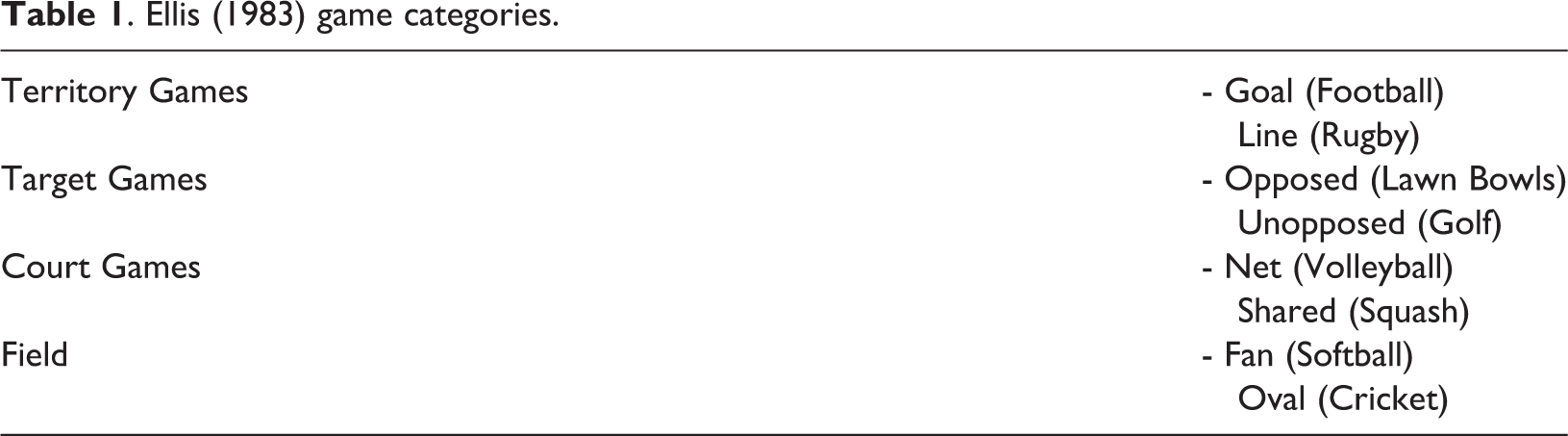
Game classification was later refined to four categories and eight sub-categories by Ellis (1983) (Table 1).
Ellis (1983) game categories.
General overview of literature review.

Despite these developments in games and sport teaching, games teaching in secondary PE continued to be structured as sport-as-techniques in highly structured lessons (Kirk, 2010). The decontextualised nature of learning skills as motor patterns isolated from the movement–information coupling of the game meant that students’ experiences of sport were not authentic (Savelsbergh et al., 2003). Some suggested that a large percentage of students completed the compulsory years of schooling and participation in PE achieving very little success, and knowing very little about games and sport (Bunker and Thorpe 1982, Siedentop 1994).
TGfU: an approach for improved games teaching?
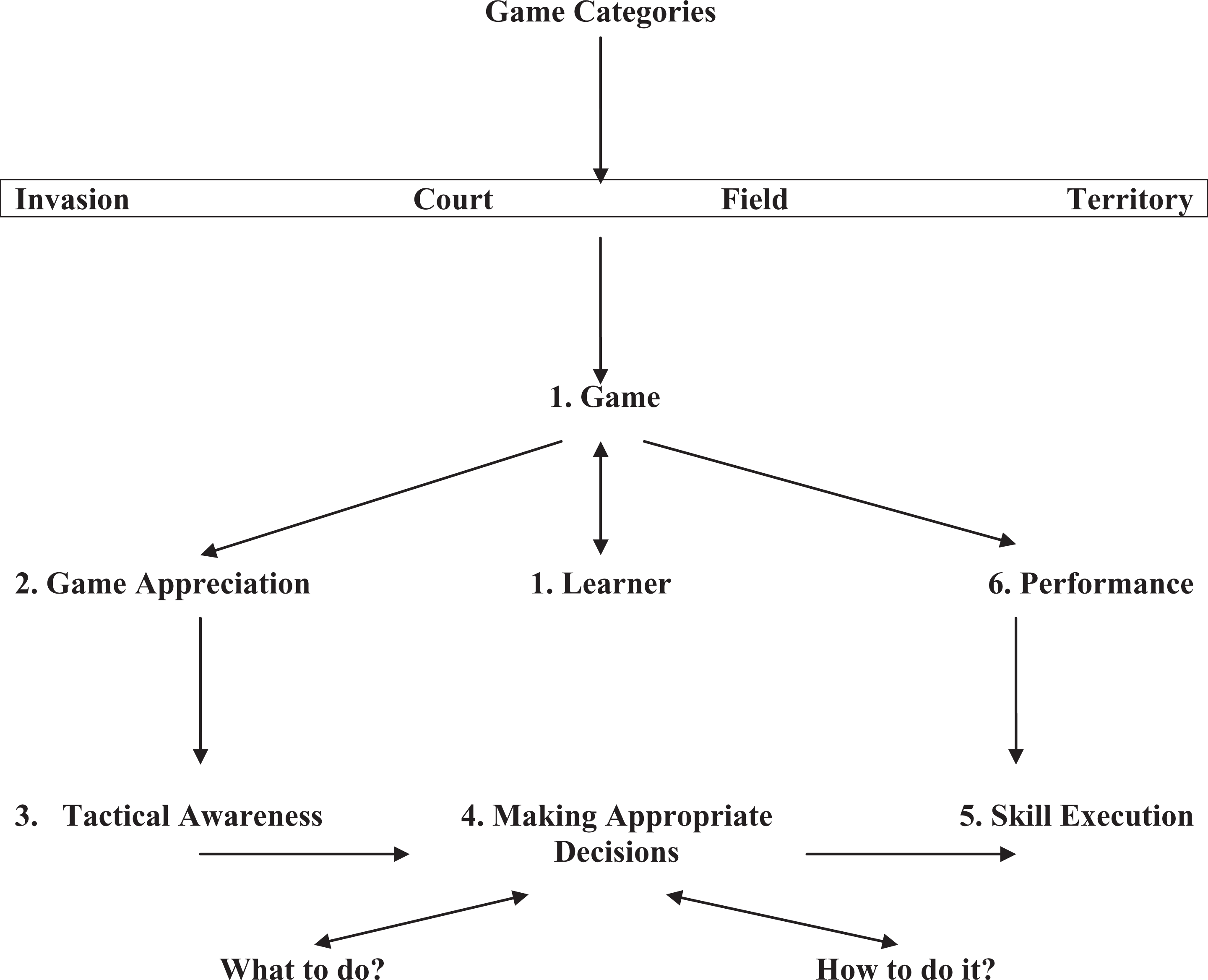
In 1982, TGfU proposed that the games teaching emphasis be placed on understanding the logic of play imposed by the rules of the game, and that appreciation of the tactical structure of play be learnt before highly structured technique teaching was proposed (Bunker and Thorpe, 1982). It emerged as a counter to the perceived shortcomings for student learning inherent in the highly structured sport-as-techniques (Kirk, 2010) traditional PE method (Metzler, 2011) in secondary PE. The model now known as TGfU continued the evolution of the small-sided games approach (Werner et al., 1996) while outlining a sequential cycle of teaching based on the premise that game understanding and decision making was not dependent on the prior development of sport specific movement techniques.
Just as Mauldon and Redfern’s (1969) approach challenged the curriculum and pedagogical practice of PE, TGfU challenged traditional PE method ‘of progression as an additive process by proposing that children could learn to play modified versions of games ahead of mastering the mature skills’ (Kirk, 2010: 85). The six-step TGfU cycle of teaching assumed that students learn best if they understand what to do before they understand how to do it (Griffin et al., 2005: 215). As already indicated, the TGfU model combined features of earlier departures from the PE method. However, it was the clear articulation of guiding pedagogical principles (Bunker and Thorpe, 1982) and theoretical support from the perspective of cognitive educational psychology (Pigott, 1982) that was perhaps significant to the models subsequent academic acceptance.
The distinctiveness of the TGfU model is sometimes suggested as belonging with its guiding pedagogical principles (Thorpe et al., 1984). These are as follows (Thorpe et al., 1986: 164–167):
Sampling: The use of modified games and sport as a way to experience adult versions of games; Exaggeration: Changing game structures, such as rules, equipment and play space, to promote, exaggerate, control or eliminate certain game behaviours to enable teaching through the game; Representation: Small-sided modified games structured to suit the age and/or experience of the players; and Questioning: Prompting student thinking and problem solving by questions so that knowledge of what to do, when to do it and why to do it develops and leads to the question of how to perform movement in the context of play.
However, these pedagogical elements were already advocated as advances in games teaching. What TGfU approach accomplished was the organisation of the pedagogy into a coherent proposition (Thorpe et al., 1986).
Since Bunker and Thorpe’s (1982) original description and explanation of the TGfU approach and further elaboration (Bunker and Thorpe, 1983; Thorpe et al., 1986), it has been advocated as nuanced interpretations. This growth reflected similar concerns to overcome problems of: (1) isolated (from the game) direct teaching of skill drills and defining of skills as techniques; (2) perceptions that student motivation in games teaching is low; and (3) the absence of relevance of PE to the achievement of educational outcomes (López et al., 2009). The next section of the paper briefly summarises the advocacy of TGfU occurring through the major interpretations of TGfU occurring in the PE literature.
Developing TGfU globally: the major iterations
Tactical Games
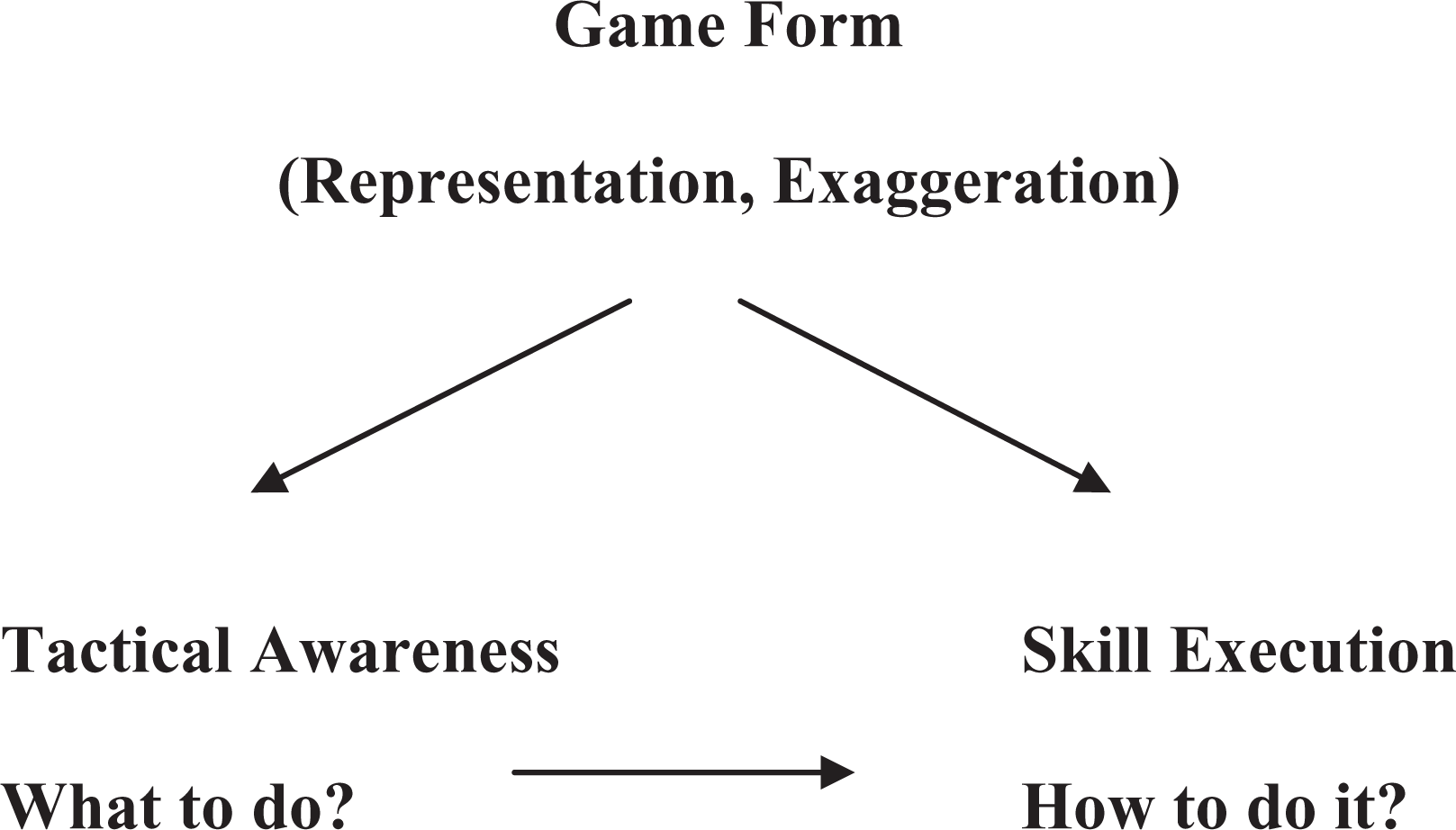
The Tactical Games approach (Griffin et al., 1997; Mitchell et al., 2003, 2006) simplified the six-step teaching and learning cycle of TGfU into a three-step cycle to make it easier for teachers to understand the learning process (Figure 1). The Tactical Games model also introduced a structured progression through levels of sport skill learning to provide a ‘complete package for teaching’ (Mitchell et al., 2006: 5) for middle and secondary school PE that was missing from the TGfU literature. The benefit of such an approach for teachers was that they did not have to be as reliant on developing sport-specific domain knowledge across a broad range of different sports. Questions to guide the development of game understanding and skill practices during lessons were focussed through an overarching tactical problem.
Tactical Games approach.
As Figure 1 illustrates, the Tactical Games approach did not change the tactical-before-technical linear teaching cycle of the original TGfU proposition. However, a substantial addition to the pedagogy of TGfU was the description of an assessment tool that accounted for on-the-ball and off-the-ball game play, known as the Games Performance Assessment Instrument (GPAI). The GPAI enabled codification of tactical decision making, off-the-ball movement to read and respond, and on-the-ball reaction and then recovery to a position for further game involvement (Hopper, 2003). Seven components of game performance were defined in the GPAI to provide flexibility and adaptability of the instrument across TGfU game categories (Mitchell et al., 2006).
Game Sense
The term ‘Game Sense’ was used by Thorpe and West in 1969 as a description of game intelligence and as a games teaching performance measure. However, Game Sense is more commonly recognised as emerging from the field of sport coaching in Australia. In 1993, Charlesworth described Game Sense as the objective of player development at the elite sport level. He described Designer Games (Charlesworth, 1993, 1994) as the structure to achieve the combining of specific technical, tactical and fitness training in a game practice that simulates game conditions to develop player game sense. The idea of Game Sense developed into a sport teaching approach during a series of visits by Rod Thorpe to Australia in the mid 1990s to work with the Australian Sports Commission (Thorpe, 2012). A player-centred model (Schembri, 2005) to develop the tactical and technical foundations of sport through a game-centred training structure was described (den Duyn, 1996, 1997; Thorpe, 1997). Thorpe (2006) has described the Game Sense model as incorporating more than the original TGfU model (Kidman, 2005: 233), and so the Game Sense model may be justifiably seen as a further refinement of TGfU for sport skill teaching.
The central focus of the Game Sense approach is the development of thinking players (den Duyn, 1997). This objective for sport teaching is pursued via the coupling of movement technique to game context as skilled performance; or, as den Duyn (1997) described, Technique + Game Context = Skill (Figure 2). The original Game Sense description did not elaborate the teaching of game appreciation and understanding before a focus on the refinement of skill execution, but discussed the development of technical and tactical game components as being taught together. This was a fine distinction but a departure from the six-step TGfU tactical-before-technical cycle of learning where game appreciation occurs before technique development (Figure 3).

Game Sense (den Duyn, 1997).
The teaching games for understanding (TGfU) approach.
Similar to the TGfU (and Tactical Games) model, small-sided games and the use of questioning to develop tactical game understanding were central to the pedagogy of a Game Sense approach. Also similar to the Tactical Games model, a thematic curriculum for the teaching of sport skill foundations based on the TGfU game categories emerged, elaborated via the Game Sense Cards (Australian Sports Commission, 1999a) and then the Active After Schools Playing for Life kit (Australian Sports Commission, 2005). The Game Sense cards were similar to the Playsport mini-games instructional cards designed by Rod Thorpe (Thorpe, 2006).
Similar to TGfU’s initial articulation, Game Sense did not initially distinguish between small-sided games for fundamental sport skill learning and small-sided game play for more complex tactical and technical skill learning. It was later refined into a three-stage curriculum model aligned to the continuum of achievement evident in Australian Health and PE curriculum frameworks, and the general direction of Côté et al.’s (2003) developmental model of sport participation as Play with Purpose (Pill, 2007).
Play Practice
Game Sense also forms part of the Play Practice approach (Launder, 2001). The Play Practice approach, however, explains Game Sense as one of several elements required for successful game involvement. Similar to Charlesworth’s (1993, 1994) description of Designer Games, Play Practice positions Game Sense as a sport-teaching/coaching objective. Like Designer Games, Play Practices could be seen as activities that sit within a Game Sense approach, alongside skill drills and other instructional strategies, used to teach individual and group situational skills and decision making in ‘time-outs’ between small-sided game play and match simulation via Designer Games.
The Play Practice pedagogy of shaping the play to suit the experience of players, focussing the play on learning sport skills, and enhancing play by directing attention to any elements of play requiring improvement (Launder, 2001) are conceptually similar to the TGfU pedagogy of teaching through the game and directing learning by sampling, exaggerating and representation of game structures. Like TGfU, Tactical Games and Game Sense models, Play Practice pedagogy encouraged teachers to adopt a broad range of instructional strategies to achieve task objectives; however, there is no obvious emphasis on the development of ‘thinking players’ by guided discovery using questioning as a central pedagogical tool as there is in the TGfU, Game Sense and Tactical Games models.
Invasion games competency model
In the invasion games competency model (IGCM) players progress through a sequential series of basic game forms (modified games) growing in complexity as they master the objectives of each game form. A game situation is the starting point for lessons, and the introductory game is designed to relate the tactical and technical elements of the situation to the players. Similar to other versions of TGfU, when using the IGCM teachers are encouraged to monitor the play for tactical problems and intervene to stop the game where appropriate to question players, thereby encouraging players to think about the aim of the game. Once players recognise the need for new skills or skill refinement, practice occurs (Tallir et al., 2004, 2005).
Tactical decision learning model
The tactical decision learning model (T-DLM) focusses on student exploration of the various possibilities of game play and on the construction of adequate movement responses in small-sided invasion games (Grehaigne et al., 2005a). After experiencing the game, teams propose action plans (game plans) which are then tried out in play and progressively refined as players develop more sophisticated understanding of the relationship between the action plan and the game rules (Grehaigne and Godbout, 1995). Once stabilisation of game understanding appears to have taken place, the teacher increases the complexity of the game, and eventually introduces another team sport to initiate generalisation of game understanding across sports (Grehaigne et al., 2005b). Similar to the Tactical Games approach emphasis on data collection, observational assessment and the collection of qualitative and quantitative feedback are central to the T-DLM. This data collection may occur through the tracking of player movement using descriptive drawing and statistical measures such as the Team Sport Assessment Instrument. This instrument contains assessment criteria to account for players' specific behaviours during game play (Grehaigne and Godbout 1997, 1998; Grehaigne et al.2005a).
TGfU is also familiar in Hong Kong, China, Taiwan, Macau, Japan and Korea (Liu, 2010), and in Singapore it is known as the Games Concept Approach (Light and Tan, 2006).
Theoretical framework used to organise the literature review
Adopting a similar methodology to Wallhead and O’Sullivan (2005), initial articles and papers were sourced by a key word search in Google Scholar utilising TGfU, teaching games for understanding, tactical games and game sense and physical education. From the initial searches additional articles, papers and books were sourced through citations and references.
The review of literature revealed four sub-categories of TGfU publication. The first type of publication consisted of theories of sport teaching and learning. The publications discussed the tenets of a model of sport or games teaching and the pedagogical content knowledge (Shulman, 1987). Issues addressed within this type of literature include the cycle of learning (Bunker and Thorpe, 1982; Griffin et al., 1997; Mitchell et al., 2006), pedagogical strategies (Bell, 2003; den Duyn, 1997; Grehaigne et al., 2005a; Griffin et al., 1997; Launder, 2001; Mitchell et al., 2006, Pill, 2007, 2011b; Piltz, 2003), and the application of TGfU to sport skill-teaching pedagogy (Breed and Spittle, 2011; Charlesworth, 1993; den Duyn, 1997; Grehaigne et al., 2005b; Griffin et al., 1997; Hopper, 1998; Launder, 2001; Mitchell et al., 2006; Schembri 2005). This literature also included examples of how to implement teaching games and sport for understanding in school and coaching contexts.
The second category of publication included advocacy for teaching games and sport for understanding for a better practice of sport teaching and coaching. The publications elaborated on the assumptions and assertions of efficacy of the descriptions of the TGfU models being implemented around the world (Chow et al., 2007; Kirk et al., 2000; Launder and Piltz, 2006; Pigott, 1982; Pill, 2010; Piltz, 2002; Renshaw et al., 2010; Thorpe, 1997) and the personal experience of the authors with the model (Butler and McCahan, 2005; Kirk et al., 2000; Light et al., 2005). This type of publication asserted enhanced student learning and games teaching resulting from the adoption of the pedagogical and content tenets of a TGfU-style curriculum based on theories of skill learning or the authors’ experience of games teaching.
The third category of publication included the perspective of the practitioner. It included the data driven studies evaluating the limits, constraints and possibilities of teaching games and sport for understanding on various dimensions of sport learning, the achievement of curriculum outcomes and design and implementation of curriculum. It would not be appropriate to make statements regarding the advantages of models without reviewing the empirical-scientific literature (Chandler and Mitchell, 1990; López et al., 2009). The results of the literature review are contained in Table 2 and discussed in detail later in the paper.
The fourth category of publication dealt with the implementation of teaching games and sport for understanding into the coursework and tertiary education experiences directed at pre-service teacher pedagogical content knowledge (Forrest et al., 2006; Howarth and Walkuski, 2003; Howarth, 2005; Light, 2003; Light and Georgakis, 2005; Pill, 2009; Sweeney et al., 2003). The narrative of this research is that pre-service teachers are attracted to the model but find the pedagogical content knowledge required to implement the theoretical model into practice troublesome, which as a result limits feelings of efficacy with the model. The intention in this paper is not to focus on this area of research as it is a separate line of inquiry to the perspective of the practitioner pursued in this paper.
The historical overview earlier in this paper engaged with the first categories of papers. The discussion to follow will include an analysis of this history of TGfU and substantially engage with the results of the third type of publication, the data driven research. It is always difficult to determine when to stop searching and how many articles to include in a review (Wallhead and O’Sullivan, 2005). Two parameters defined the boundaries of the search and subsequently the analysis and substantive discussion later in this paper: Firstly, the issue of ‘how many’ publications to consider for the review. The peer-reviewed data-based articles were limited to teacher and sport coaches enactment of TGfU pedagogy and students’ experiences of this enactment. Non-empirical articles that did not introduce new questions or directions for TGfU were not included in the review. Secondly, the review did not consider research of pre-service teachers’ experiences of learning to teach using a TGfU approach as it was felt that although related, this is a separate area of inquiry to the one pursued in this paper.
Data driven research
Table 2 summarises the empirical-scientific research as it applies to TGfU and its variations for the teaching of games and sport. It shows a variety of research practices are engaged in the exploration of the assertions for TGfU pedagogy and student learning outcomes. The information contained in Table 2 will be considered in the discussion.
Results and discussion
Proliferation of TGfU
The proliferation of the TGfU and its subsequent iterations suggests that practitioners and researchers across various countries see potential in the approach for enhanced student learning and engagement in games and sport teaching. This suggests its potential as a pedagogical model through which to achieve the game skill development, both tactical and motor development, content standards of curricula. In Australia, the potential of Game Sense as a sport pedagogy is recognised in the Play for Life philosophy and pedagogy of the Australian Sports Commission (Schembri, 2005) and within coach education (Australian Sports Commission, 1999).
While most of theoretical descriptions and pedagogical descriptions of the TGfU interpretations reviewed remained grounded in the demonstration of game play behaviours, central to the ‘reason for being’ of all TGfU versions is positioning game understanding as a valued part of skill learning. Also central is the notion that game skill is best developed in circumstances that most closely represent the situations in which the skills will be used (Thorpe and Bunker, 2010).
Game Sense provided something of a ‘hook for PE teachers to hang on to’ as the vision of the outcome of teaching for understanding, but the nature of ‘understanding’ remains theoretically blurred within TGfU and its subsequent iterations. This omission was initially addressed by theorising TGfU as a form of social constructivism, commonly referred to in the literature as ‘situated learning’ (Dyson et al., 2004; Griffin et al., 2005; Kirk et al., 2000; Kirk and MacPhail, 2002; Penney, 2003). However, constructivism is a collective term for two types of constructivist learning theory – social constructivism and cognitive constructivism. The construction of understanding, as a product of cognition, is in many ways unique to the individual who experiences the world. Cognitive constructivism, with its emphasis on mental models or schemas created and refined by experience (Eggen and Kauchak, 2006), would also seem applicable to the whole notion of ‘understanding’ as defined in TGfU literature. This aspect of ‘understanding’ is highlighted by Wiggins (1998).
According to Wiggins (1998), teaching for understanding is substantially about a shift in the paradigm of instruction from memorising and practising to one of thinking and acting flexibly with deep conceptual and procedural knowledge in new and novel situations. The various TGfU approaches certainly advocate for this type of shift. What none of the nuanced versions of TGfU address substantially, and what is largely absent from the data driven research (Table 2) is what is generally acknowledged as the goal of understanding; that is, deep engagement with knowledge, and the individual intellectual models that are subsequently refined to enable more flexible and adaptive behaviour (Perkins, 1993a, 1993b; Perkins and Blythe, 1994; Wiske, 1998). As Richard and Wallian (2005) noted, ‘Constructivism asks for students to engage in activities that require higher level of thinking and reflective processes. Ultimately, students must demonstrate their understanding by applying the new knowledge in new situations’ (p. 21). While the data-driven TGfU research initially focussed on a ‘tactical vs. technical’ theme, and later a practitioner-referenced methodology (see for example Table 2), what is missing is research focussed on student demonstration of higher level of thinking and the application of new knowledge in new situations.
Research consideration of the nature of TGfU game appreciation and understanding as expressions of cognitive flexibility and creativity is required to substantiate claims made about TGfU for games and sport learning. Further, research into the nature of levels of understanding, recognising that understanding develops by degrees through the acquisition of a sequence of progressively more complex and encompassing concepts (Newton, 2000), may assist a more concrete conceptualisation of TGfU in practice. This is especially so for clarifying the nature of game ‘understanding’ and ‘appreciation’, central to the distinctiveness of TGfU and its nuanced variations.
From the historical account of TGfU’s global development it can be seen that differences between each approach are frequently so subtle that demarcation of these distinctions may not serve any practical pedagogical purpose. What can be suggested from a meta-analysis of the theoretical writing covered in the literature review is that each interpretation of TGfU has added to the original proposition in areas that were conceptually or theoretical absent or under represented. For example, the Tactical Games approach (Mitchell et al., 2006) explains how to differentiate teaching for understanding at different levels of sport development, something missing from the original TGfU proposition (Bunker and Thorpe, 1982). The Tactical Games approach also introduced the GPAI as a tool to assess game sense as both on-the-ball and off-the-ball behaviour, addressing the area of holistic game play assessment.
The Game Sense approach has developed into a differentiated expression of games teaching, from fundamental sport skill development through to situational game play and play practices focussed on specific game outcomes. Game Sense has also provided an attempted explanation of what game understanding means. From a sport pedagogy perspective, the Game Sense proposition is not tactical before technical, but tactical and technical accentuated in a game-centred learning context that should typify sport games pedagogy. The emergence of a dynamic motor skill theory, where games are viewed as complex adaptive systems defined by constraints (Davids et al., 2005; Renshaw et al., 2010) within which game behaviours arise, suggests that representative situations that link information with movement are best for skill learning, which is synonymous with den Duyn’s (1997) explanation of Game Sense as a sport pedagogy (refer to Figure 2). Perhaps, therefore, there is some substance to Almond’s (2010) suggestion that Game Sense is an important dimension of a revised TGfU and Thorpe’s explanation that Game Sense goes further than the original TGfU, and does not hide the philosophy of TGfU behind a simple description of lesson structure (Thorpe, 2006). However, as with other nuanced interpretations of TGfU, the challenge remains to demonstrate the efficacy of Game Sense as sport games pedagogy (Table 2).
Dynamic systems theory constraints-led practice contains similar propositions to Game Sense. It has been identified as non-linear pedagogy to distinguish it from an information-processing model of skill learning and linear ‘progressive part’ pedagogy. The idea of a non-linear pedagogy has been linked to TGfU, providing the theoretical skill acquisition ‘muscle’ missing in TGfU theoretical literature (Chow et al., 2007; Davids et al., 2005; Renshaw et al., 2010). However, as Figure 3 illustrates, TGfU is cyclical in nature; however, it remains linear in that it is represented as a progressive 1-to-6 six-step cycle. Similarly, the Tactical Games approach is represented as a cycle, simplifying the six-step TGfU cycle (Figure 3) to a 1-to-3 three-step cycle (Mitchell et al., 2006) (Figure 1). Bunker and Thorpe (1986) even stressed that the sequential aspects of the TGfU model ‘are critical’ (1986: 10). This is unlike the definition of Game Sense (Figure 2), which links knowing what to do with the ability to put that knowledge into action as skilled performance, and therefore appears more synonymous with the iterative nature of the dynamics of non-linear pedagogy.
The data reviewed in Table 2 illustrate that the concepts of game literacy (Mandigo and Holt, 2004) and game intelligence (McCormick, 2009; Wein 2001) are useful to explain the aims of a TGfU approach and to further define Game Sense. Some of these key characteristic descriptors in Game Sense and game intelligence claim to develop student game performance are as follows:
knowledge and understanding of how to read patterns of play possession of technical and tactical skills ability to set up appropriate, creative, flexible and adaptive responses when necessary understand game rules and its impacts on game play know how to create structural and tactical similarities and differences between games experience positive motivational states in games through developed confidence in coordination and control of movement responses opportunity to reflect on the application of specialised skills in games and suggest strategies for improvement
Whether the TGfU nuances across the iterations described in the earlier historical overview are substantial enough to make a significant difference to the way teachers approach games and sport teaching is debatable, and it may simply be a case of ‘same mountain – different path’ (Mitchell, 2005). What is evidenced, however, is that there emerged competing game–sport for understanding discourses in the literature, each vying for dominance and seeking research validation (Table 2), but essentially promoting the same curriculum substance. This ‘pegging of the ground’ for academic work may be sensible from a research context; however, whether the nuanced boundaries hinder or help the distribution of TGfU pedagogy to PE teachers for enhanced student games and sport learning requires investigation. Almond (2010) alluded to this in his summation that TGfU has not been as readily accepted by teachers as it has by academics.
Teachers may not see TGfU pedagogy as distinctive, and the pedagogy is simply part of the repertoire of necessary pedagogical practice (Pill, 2011a). The review of the theoretical literature also revealed small-sided games, game modifications to shape and focus learning, the use of questions to develop game appreciation and understanding of a target concept, and game categories are not of themselves unique to a TGfU approach. For example, described earlier in the paper was Mosston’s 1960s explanation of the application of instructional strategies to achieve specific learning objectives in his spectrum of teaching approaches (Mosston and Ashworth, 2002). Also noted earlier, games frameworks with similar pedagogical intentions to TGfU had been espoused but did not capture attention and subsequent interest in the way that TGfU did (Findlay, 1982; Mauldon and Redfern. 1969). If there is uniqueness to TGfU it may be one of emphasis and the associated discourse, which reframes games and sport teaching from a behaviourist teacher-centred framework defined by a focus on direct teaching to a constructivist learner-centre framework defined by the foregrounding of cognition in the development of playing competency (Light and Fawns, 2003). However, as Rink (2010: 38) suggested, ‘TGfU doesn’t have a monopoly on constructivism’. TGfU’s reframing of motor skill-to-game teaching (or ‘sport-as-techniques’) (Kirk, 2010) through closed-to-open progressive part pedagogy to game-appreciation-to-motor skill teaching appears to be the pedagogical distinctiveness of the original TGfU proposition.
From a pedagogical perspective, the distinctiveness of TGfU and many of its nuanced interpretations may only substantially lie in this ‘flipped’ classroom. The term ‘flipped’ is used to give effect to the essential difference between a traditional PE method (Metzler, 2011) and TGfU approach. Where the traditional PE method progressed by drill and emphasis on direct teaching to a game, a TGfU approach starts with the game as its organisational and instructional centre (Metzler, 2011). A TGfU lesson progresses from the game to other instructional strategies to further develop aspects of play, and then these enhancements are anticipated in the next engagement with game play. TGfU iterations can then be understood as a shift in praxis from traditional linear motor learning theories to an understanding that reflects complexity and systems theory (Davids et al., 2005, Renshaw et al., 2010).
Proceed with ‘caution’: divergent approaches and contradictory conclusions
Kirk and MacPhail (2002), in discussing TGfU research, make the point that from around the 1980s onwards TGfU ‘began to be scrutinized empirically by researchers’ in the form of comparing TGfU either with a technique or tactical approach (See for example Table 2: Mitchell and Oslin, 1999; Mitchell et al., 1995; Turner and Martinek, 1999). Rink et al. (1996a) noted from their review of six studies (Gabriele and Maxwell, 1995; Griffin et al., 1995; McPherson, 1991, 1992; McPherson and French, 1991; Mitchell et al., 1995; Turner and Martinek, 1992, 1995) done in the area of ‘pedagogical research’ appear to be ‘conflicting’ in parts due to the differences in research design. They argued that part of the reason for the inconclusive support for TGfU over either technique or tactical approaches to teaching was primarily due to the difficulties in comparing different sports chosen for the research, the age of the participants, the length of time, the type of teaching paradigm or model adopted in the research, the variables chosen to measure and how they were measured (Rink et al, 1996a). Studies from Table 2 that have a specific empirical-scientific focus (like Alarcon et al., 2009; Broek et al., 2011; French, et al., 1996; Harrison et al., 2004; Harvey, 2003; Harvey et al., 2009, 2010; Holt et al., 2006; Jones and Farrow, 1999; Martin, 2004; Turner and Martinek, 1999) would appear to reinforce Rink et al.’s (1996a) earlier claims surrounding ‘conflicting’ findings due to research design. It appears little has changed in TGfU research since Rink et al. (1996a) made those claims. For instance, Turner and Martinek (1999) compare TGfU with a technique approach and a control group and found that there was no significant difference between these groups. More telling was the claim by one study (Holt et al., 2006) that unless there was an underlying skill level proficiency then the ‘Play Practice’ approach (Launder, 2001) was not sufficient to improve game performance. The meta-analysis of the data driven research (Table 2) illustrates the contradictory nature of the claims on behalf of a TGfU approach.
One thing that seems to be consistent in each study is the differences surrounding what ‘learning’ is being measured. The range of instruments used in each study, from pre and post skill tests, observations of game play, decision-making capacity (and so on) emphasise that individual performance in game situations is a central feature in their notions of learning that each research is trying to capture.
It is important to note that it is difficult to synthesis all of the studies summarised in Table 2 because of the variation in design. The change in research emphasis over time from ‘tactical vs. technical’ teaching to practitioner referenced research is also telling. The difficulty of synthesis of early TGfU research suggested was noted by Rink et al. (1996a). This research early in the life of TGfU concluded that research investigating the merits of TGfU and other similar approaches to teaching games and sport in PE was prone to ambiguity because the variables analysed were multiple and not standardised, leading to contradictory results that were unreliable. More telling was Rink et al.,’s (1996b) controversial claim that it was possible for students to pick up tactics without direct instruction or teaching within the traditional or skill-based approach, which contradicts the TGfU idea that skills can be acquired through indirect (Hopper and Kruisselbrink, 2001; Mcfadyen and Bailey, 2002; Rink, 2010) teaching methods. Since Rink’s claims, Game Sense (1997), Play Practice (2001) and the Tactical Game Approach (1997) emerged as well articulated variations of the pedagogical intention to teach games or sport for understanding. However, as the data summarised in Table 2 indicate, the challenge of meta-analysis of TGfU research remains due to the methodological variation in TGfU research.
Rink controversially claimed that ‘there does not seem to be any affective advantage to any of the approaches’ when effective teachers are used (Rink et al., 1996b: 493). Also telling is the claim made by Rink (2001) that most of the research surrounding teaching and learning in PE seems to be framed around establishing ‘direct links’ between what a teacher ‘does’ and question begging assumptions about ‘how’ students learn. Hence why Rink (2010: 40 ff) ‘cautions’ us that ‘simplistic and linear models’ cannot capture and explain ‘complex, situational and sometimes chaotic’ nature of movement settings due to the influence of ‘constraints’ on student performance that include all physical, environmental and task characteristics. Certainly the second and third constraints are arguably the most important to PE practitioners due to the direct control they can exercise over these. Much of the initial data driven research (see for example Table 2) uses different study designs in order to determine which task constraints can empower learning, such as comparing tactical and/or technique approaches against control groups. There was some evidence that students from a tactical teaching focus group had enhanced game understanding compared with control and skill focussed groups, but as the data in Table 2 showed the results are not consistent across all studies.
The alleged failure of the traditional and/or the need for the TGfU approach may arguably have more to do with the poor quality of games and sport teaching employed in PE (Alexander and Luckman, 2001; Locke, 1992; Siedentop, 1994) and school PE that is irrelevant or boring for adolescents (Ennis, 1999; McKenzie et al., 1994; Rikard and Banville, 2006; Smith and Parr, 2007; Tinning and Fitzclarence, 1992). Decisions about which approach to adopt are possibly more likely to be philosophical (Green, 1998, 2000, 2002; McMorris, 1998) and not a choice based on empirical-scientific evidence, especially where that is inconclusive and the method narrative confused by competing nuanced interpretations of essentially the same curriculum and pedagogical emphasis.
The data driven TGfU research (Table 2) indicates that teachers struggle with TGfU pedagogical intentions and the pedagogical content knowledge required of a TGfU approach. The limits of teachers conceptual understanding of sport constrains teachers enactment of TGfU and confidence with the approach (Brooker et al., 2000), and for most of the teachers involved in the research, the TGfU variation used was new or unfamiliar to them. A TGfU approach requires ‘considerable pedagogical skill … and teaching with this method is more of a challenge’ (Turner, 2005:73). PE teachers are generally more experienced with a ‘sport-as-techniques’ (Kirk, 2010) approach, and after three decades of TGfU research the ‘TGfU movement’ (Butler and Griffin, 2010: 4) can only claim that ‘teachers value certain aspects of the public theories defined in the textbooks and formal teacher preparation curricula and develop unique interpretations of the models representative of their students’ needs, their personal beliefs about sport and games, and their teaching contexts’ (Butler and Griffin, 2010: 9). The problem as we see it has more to do with the notion that ‘good pedagogical’ practice in PE may seem like the kind of activities that may be the product of empirical-scientific generalisations to which much of this research aspires; however, much of this work is simply unable to capture the constantly changing nuances of ‘real-life’ teaching engagement. We do not deny that practitioners may have something to learn from empirical-scientific or pedagogical research, but the question as we see it is has more to do with determining whether this type of research does, or ever could, present us with a picture of pedagogy in PE which is complete such that there could no longer be any meaningful question outside this picture. The question posed is not asked out of hostility towards empirical-scientific research. Far from it; in fact, it is the nature of pedagogy itself which forces us to ask this question.
If teachers and researchers can take little of pedagogical value from the scientific-empirical research (Table 2) the general advice would seem to suggest a ‘flexible’ approach to teaching in games and sport in PE, which could vary from TGfU and other approaches as long as the approach adopted is conducive to achieving the nominated learning objective, rather than a single overriding approach or style (Capel, 2000). Indeed, Bunker and Thorpe (1982) did not rule in or out a style or instructional strategy in achieving the objective of game competency. The overriding ideal of practice being game centred directs teacher objectives to teach for understanding and student engagement, as the ‘game first’ intention works with student motivation in PE: that is, to play (Bunker and Thorpe, 1982). The historical literature review demonstrated that TGfU instinctively ‘makes sense’ as ‘simply good pedagogy’ (Hopper et al., 2009) to many academics. However, if TGfU is to be ‘pedestaled’ as a preferred pedagogy for ‘performance, participation and enjoyment’ (Light, 2013) then re-articulation of the cycle of learning (Figure 1) to be non-linear, reflective of dynamic constraints-led practice, and a more meaningful representation of what it means to ‘understand’ games and sport is necessary. To this end, PE pedagogues and sport skill acquisition researchers should be working more closely together to find the common ground in ideas and their expression.
From linear to non-linear theories of games teaching in PE
It has been argued elsewhere (Rink, 2010; Stolz and Pill, 2012) that a problem with the traditional approach to teaching games and sport in PE is an overemphasis on the psychomotor domain to the detriment of the cognitive and affective domains of learning. The TGfU approach is an attempt to rebalance the disproportionate emphasis on the psychomotor domain because it focusses on developing thinking players (den Duyn, 1997) who can apply their learning in a variety of situations. For instance, the problem with teaching a volleyball forearm pass in isolation is that it does not automatically equate with the contextual application of the pass to set up an attack or a successful solution to a game problem that arises in complex environments in which movement patterns are executed. In fact, the traditional approach teaches it out of context (Kirk, 2010; O’Connor, 2006; Rovegno, 1995), and herein lies most of the nuanced differences that exist between the traditional and TGfU approaches.
There is much more to playing games and sports than learning a motor skill in isolation (Chow et al., 2007; Davids et al., 2005; Renshaw et al., 2010). The idea that one must learn and master a skill first in simple environments before playing a game in some type of linear fashion is problematic because it decontextualises the skill into something that, for the learner, may have no connection with sporting or game environments, and in essence teaches these movements outside of any real meaning. A TGfU approach is more purposefully directed toward educating the learner within the context in which the technique is performed, whereas the traditional approach is more interested in the performance or execution of technique.
The research findings summarised in Table 2 illustrate that it is problematic to make definitive statements about the efficacy of a TGfU approach because the rhetorical generalisations of the type found in the literature in the earlier historical overview of TGfU can be of little or no use to practitioners. They simply have no relevance to the ‘natural setting’ of each practitioner (Brooker et al., 2000). This point has been made quite strongly by Elliott (1989), who argued that pedagogical and teacher expertise is context specific, and so the generalities of educational research which ignore contextual features thereby have little or no use to practitioners. This was further reinforced by Nuthall (2004), who argued that reducing the teaching–learning process to generalisations leaves little to no relevance to the professional knowledge of the practitioner. For instance, what may work in one class or with one particular student does not mean that it will necessarily equate to it working in other contexts, different curriculum content, different kinds of students and so on.
In the context of games teaching in PE, it is not too hard to see how views of learning may be misconstrued in terms of an acquisition of a skill or based on some behavioural analysis of a movement event. The problem as we see it is that pedagogy is often linked to a basically scientific conception of learning and thereby presumed available to empirical-scientific testing of the effectiveness of models of pedagogical practice. One of the core issues with this is that such research strives to be universal for all practitioners, and in doing so gives rise to abstraction or generalisation that can have little or no application to the reality of what goes on within classroom practice. Hence why a shift from a scientific-technical perception of research in action as ‘technical vs. tactical’ in the 1990s begins to be repositioned to practitioner referenced research in the 2000s, in what Brooker et al., (2000) described as research occurring in the ‘naturalistic setting’ of the PE teaching context.
Some future considerations and concluding comments
According to Carr (1986, 2003), if a child can be encouraged in the right direction to explore their natural innate curiosity and interest with respect to the world then the student will learn irrespective what teaching strategy or method is adopted. This means that the pedagogical emphasis first needs to be on bringing the learner to see the value and significance of what is being offered to them to learn. Questions surrounding direct or indirect teaching strategies, whether to start with teaching technique followed by tactical decision making (or vice versa) later and so on, must always remain subservient to bringing the learner to see the value and significance of what is being offered to them to learn. TGfU’s central emphasis on appreciating the game may be its most relevant proposition for learner engagement, which can be addressed through a ‘naturalistic setting’ (Brooker et al., 2000) and ‘situated learning’ (Kirk and Macdonald, 1998; Kirk and MacPhail, 2002), and peripheral participation within ‘communities of practice’ (Kirk and Kinchin, 2003), which are more authentic and meaningful experiences for students, as well as building on students’ prior knowledge (Dodds et al., 2001) that has the potential to ‘transform’ games and sport in PE.
Competing descriptions of TGfU within the PE literature and its applications are problematic to the physical educator within the school environment because teacher practitioners do not necessarily see or want to see the same boundaries between pedagogical models’ as researchers do as theory generators. Subsequently, if TGfU is to have any relevance for teacher practitioners of PE, more emphasis needs to be placed on the normative characteristics of pedagogy that drives this practice of teaching for understanding within curricula. Future research should continue a practice-referenced approach (Kirk, 2005), but extend past the end of single units of work to include longitudinal data collection aimed at the objective of achieving student ‘understanding’, or perhaps the objective as game sense.
The literature review and discussion leads to four conclusions. First, there is an implied division between researcher as theory generator and teacher practitioner as theory applier. Second, competing descriptions of TGfU in PE literature complicate understanding of the approach and its practical implementation. Third, the application of TGfU and its nuanced versions, such as the Tactical Games approach (Mitchell et al., 2006), are problematic to the teacher practitioner within school contexts because theory guides the means in which to achieve the ends. Unless there is a clear explanation of the nature of the ends themselves there is no theory applier, no organiser to regulate the pedagogical practice. Fourth, perhaps this is where the original description of Game Sense as observable game intelligence leads the TGfU discourse for an answer to the nature of the end purpose, or objective of teaching for understanding – Game Sense (Charlesworth, 1993; den Duyn, 1997; Thorpe and West, 1969).
The argument that the scientific conception of learning that is available to empirical-scientific testing of the effectiveness of various pedagogical methods is problematic and ill conceived, and seems to originate in the notion that since PE activities are overt then they are also measurable (Metzler, 1986), has also been tested in this paper. The shift from empirical-scientific research to practitioner-referenced research is in tune with what Bishop (1992) described as the pedagogue tradition concerned with exploring classroom practicalities, the curriculum and teachers responses to the curriculum as it ‘naturally’ occurs. This is because good educational practice evades conventional empirical-scientific research and cannot capture the complex nature of teacher deliberations in a codified way. For instance, there are some true educational generalisations in pedagogy, such as ‘never face the board when talking to the class’; however, these do not need statistical support to confirm or disprove such a statement. The research paradigm difficulty has more to do with the normative characteristics of education and teaching practice and the incompatible nature of the empirical-scientific approach which attempts to make causal connections and predictions. Consequently, some educational questions are simply irresolvable by empirical-scientific means, may not be normatively resolvable and are a matter for philosophical argument (Carr, 2001).
The empirical-scientific research as it applies to TGfU and its variations for the teaching of games and sport reviewed for this paper indicated that the central tenet of TGfU – teaching for understanding – remains unresolved. Investigating the development and demonstration of performance of understanding as the active use of knowledge (Perkins, 1992) is suggested. The implications and student outcomes of a PE, sport and games curriculum that is thought demanding, taking students beyond what they already know by building up performances of understanding through generative knowledge (Perkins, 1992, 1993a, 1993b), should be a future pedagogical research agenda so that pedagogy in PE again becomes a central practical issue of a sport and games teaching in PE for understanding. This is suggested to bridge the disparity between researcher as theory generator and teacher practitioner as theory applier.
Footnotes
Acknowledgements
We would like to thank the two anonymous reviewers for their helpful comments and suggestions to improve this paper.