



Abstract
This paper describes several practical activities that reveal how complex and nonlinear pedagogies might underpin primary physical education and school sport lessons. These sample activities, involving track and field, tennis and netball components, are designed to incorporate states of stability and instability through the modification of task and environmental constraints that challenge students to learn about movement. These activities challenge students individually and collectively to learn in relation to the cognitive, social, emotional and physical domains. Within these conditions, students are expected to ‘self-organise’ in order to take responsibility for their learning; this approach links with recent calls for a more expansive version of physical education supporting the holistic and lifelong development of physically active individuals. We further suggest that teachers using constraints-led pedagogies require high levels of capacity as they must draw upon their judgement, knowledge and teaching skills to appropriately facilitate and ‘scale’ dynamic learning contexts.
Keywords
Introduction
Education has traditionally been underpinned by the belief that, like a machine, within teaching and learning processes there should be a perfect match between input and output (Biesta and Osberg, 2010). In response, Biesta and Osberg (2010) suggest that education researchers and practitioners alike have drawn upon complexity theory as a means of framing more dynamic practices and processes endemic to teaching and learning. Complexity theory is considered useful for envisioning ‘the non-linear, unpredictable and generative character of educational processes and practices in a positive light’ with a key emphasis on conceiving how ‘meaning, knowledge, understanding, the world and the self’ (Biesta and Osberg, 2010: 2) emerge through educative processes. It has been suggested by Chow and Atencio (2012) that this vision of educational complexity aligns with nonlinear notions, which hallmark a dynamical systems perspective in physical education (PE). There exist some minor differences between these theoretical schema, as dynamical systems theory has been adopted primarily within motor learning research whereas complexity theory has been drawn upon across a range of educational subject areas (Storey and Butler, 2013). In some cases, ‘complexity thinking’ has been deployed as an umbrella concept associated with dynamical systems and other ecological systems theories (Storey and Butler, 2013). Yet Chow and Atencio (2012) put forth that these frameworks can be viewed in a more integrated sense in order to undergird more open-ended, innovative and student-centred pedagogies, reflected in the implementation of rich learning tasks and appropriately challenging environmental boundaries or constraints.
A complex and nonlinear perspective seemingly finds sympathy with recent calls in PE to educate pupils more holistically. This means going beyond simply developing pupils’ physical skills and further educating them in line with a broader understanding of learning, development and identity (Bailey, 2005; Kirk and McPhail, 2002). Bailey (2005: 72), for instance, contends that: ‘whilst the performance of physical skills forms a central and characteristic feature of the subject, like all other areas of the curriculum, it is fundamentally concerned with knowledge, skills and understanding’.
This holistic orientation of PE has purchase within various international contexts where emerging curricular guidelines conceptualise a more broadly defined physically active person. Thorburn et al. (2011), for instance, describe how the new Scottish ‘Curriculum for Excellence’ gives PE greater priority as a subject area that contributes to health and well-being together with lifelong learning agendas. Thorburn et al. (2011: 387) additionally note that curricular guidelines found in countries such as England and New Zealand are designed to link ‘physical education with health and well-being to a greater extent than previously’. Crucially, pupils are now expected to develop in ways that go beyond simply acquiring physical skills, as notions of ‘mental, emotional, social and physical wellbeing’ (Thorburn et al., 2011: 387) are now considered inextricably linked to students’ PE learning experiences. We concomitantly describe how pedagogical strategies aligned with complexity and nonlinear perspectives can arguably support the emergence of diverse and dynamic learning outcomes and behaviours, which are now expected within the curricular re-positioning of PE.
Conceptualising a complex and nonlinear PE pedagogy
Biesta (2010: 6) suggests that ‘self-organisation’ or ‘self-emergence’ is a primary feature occurring within educational systems that can be characterised as ‘open’; within open rather than closed mechanistic systems, each ‘state of a system is not thought to be deterministically caused by a previous state’. Biesta (2010: 6) thus declares that within these pedagogical conditions individuals are viewed as emerging ‘in and through’ learning processes ‘in unique and unpredictable ways’ rather than in predictable linear progression. This view of non-deterministic emergence challenges the traditional paradigm within teaching concerned with the linear transmission and acquisition of knowledge and skills and instead focuses on the creation of behaviours and meanings reflecting ‘unique, individual beings’ (Biesta, 2010: 6). In the context of PE, then, we speculate how characterising teaching and learning as interconnected, emergent and nonlinear might link with recent curricular guidelines that support holistic pupil learning.
Jess et al. (2011: 183) specifically invoke values of complexity within the field of PE, suggesting that ‘uncertainty and diversity can underpin curriculum practices that provide for self-organisation, adaptation and creativity’. The authors remind us that ‘these values are crucial to the physical education of pupils in a postmodern world’ (Jess et al., 2011: 183); that is, contemporary students must be supported in terms of learning about diverse, shifting and even uncertain ‘truths’ surrounding the body, movement and physical activity (Wright, 2004). Jess et al. (2011) subsequently argue that pupil learning in PE can occur in a ‘bottom up’ manner reflecting more situated and authentic learning conditions. Jess et al. (2011: 184) contrast this complex approach with the more traditional behaviourist model of PE that ‘is more likely to be closed and de-contextualised with support from more summative feedback and more superficial evaluation’.
Hopper (2010: 5) describes the complex nature of pupil learning as evolving ‘in a nonlinear form from discovery that results from exploration of the interacting constraints on a learner’. This view of nonlinear learning trajectories, envisioned within a complex teaching and learning framework, relies upon the notion of ‘constraints’ that are categorised into three main elements: the performer; task; environmental (Hopper, 2010; Renshaw et al., 2010). These constraints play a critical role in shaping how students come to explore and search for functional movement solutions in their learning contexts. The emergence of goal-directed behaviour and the acquisition of coordination are viewed here as occurring within a situated context (Chow et al., 2007). Teacher pedagogy in a nonlinear sense thus involves the manipulation of constraints in a facilitative manner in order to encourage variability and exploratory learning, revealing high states of self-organisation in various learning domains (Chow and Atencio, 2012).
Critically, a nonlinear pedagogy approach provides a lesson framework that practitioners can draw upon so that students can be encouraged to explore goal-directed behaviours. These design principles include the need to plan representative learning tasks that are situated in the game contexts; manipulate appropriate constraints; ensure that students establish relevant information-movement couplings and thus the key affordances in the learning activities; and involve movement variability that helps students to transit from one movement behaviour to another (Chow, 2013).
Using complex and nonlinear approaches within primary PE and school sport
Despite the increasing currency afforded to complex and nonlinear pedagogical perspectives in recent PE literature, only a few practical examples reflecting such perspectives are available.
Richard Light has speculated about the use of complex theoretical perspectives to teach activities such as swimming (Light, 2008) and rugby (Light et al., 2012). Furthermore, Hopper (2010) has developed a complex and nonlinear approach to teaching creative dance. Jess et al. (2012) describe an integrated basketball and gymnastics lesson that reflects both complex and nonlinear learning principles. Renshaw and Chappell (2010) have explored the use of a constraints-led approach in the realm of cricket, while Brymer and Renshaw (2010) explicate how outdoor education activities such as hiking, climbing or canoeing could be taught in this constraints-led manner.
In order to extend these initial descriptions and perhaps illustrate potential lesson designing that engenders more holistic learning, we provide detailed activity examples intended for primary PE practitioners. We locate our analysis in the primary PE context for two key reasons. First, this context represents a crucial starting point for enhancing movement competencies underpinned by more holistic notions of pupil development (Jess et al., 2004) and yet both pre-service and in-service teachers of primary PE often lack pedagogical skills and content knowledge when it comes to teaching pupils about movement and games (Morgan and Bourke, 2008). Together, these compelling rationales speak to both the challenges and difficulties of teaching primary PE pupils about movement.
Track and field
Tan et al. (2012) posit that PE lessons can introduce variability in order to encourage learners to more effectively search and explore for functional movement solutions; this approach also helps students deal with unexpected changes in the performance environment (see Table 1).
Complex and nonlinear activities for sprints and hurdles.
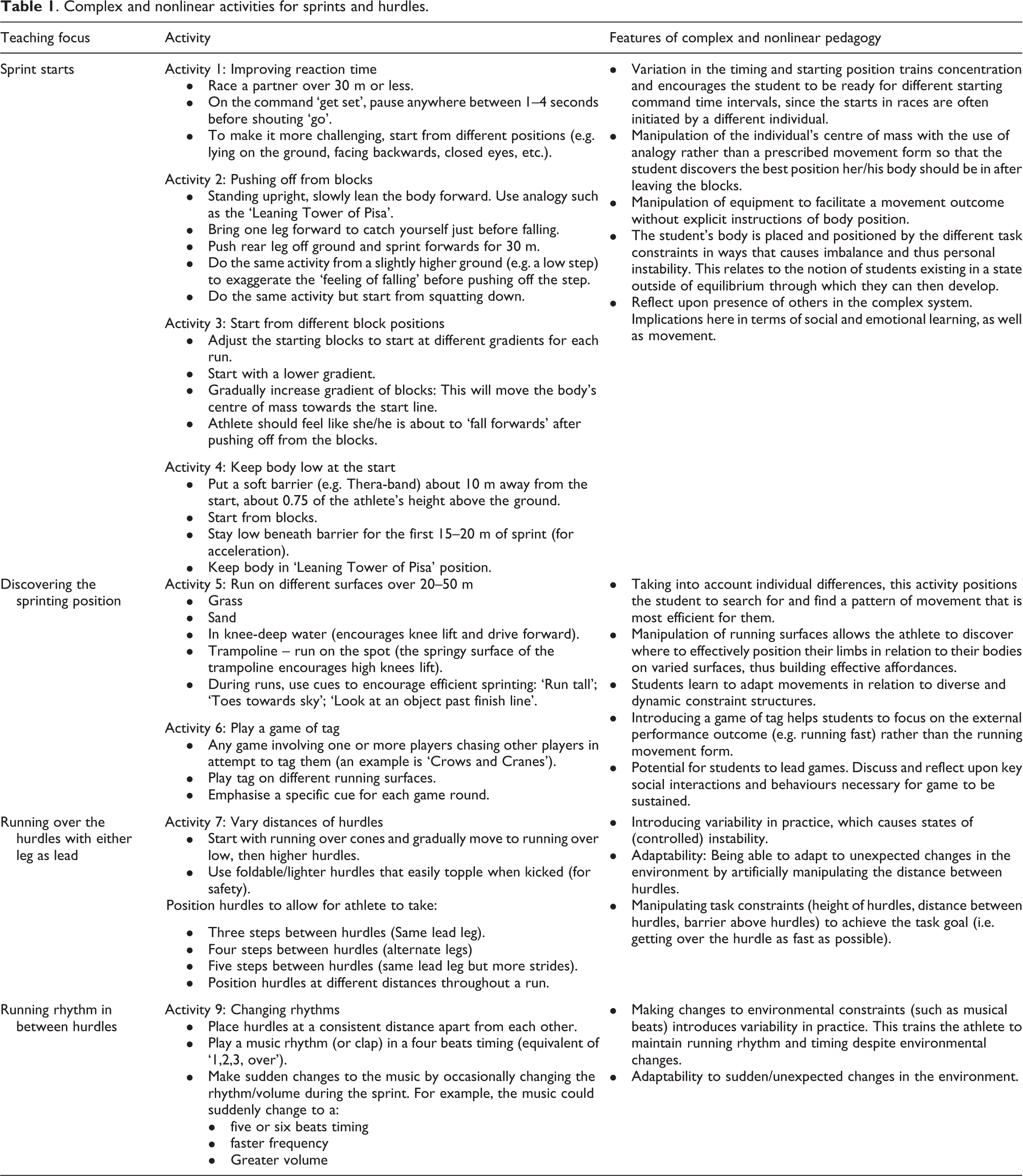
Key features of these activities include variability within practice, whereby learners are presented with a range of possibilities such as variation in start timing and different distances between hurdles, instructions that focus externally such as on the next hurdle and the use of analogies and manipulation of constraints such as adjusting the height of the hurdle and setting barriers above the hurdle to encourage the runner to keep low. Although the teacher plays a facilitative role in structuring the original learning conditions, the student is considered integral to the emergent activity. That is, although the system conditions were partially designed by the teacher through lesson planning, learning is expected to evolve in increasingly student-centred ways that ‘could not have been predicted in advance’ (Morrison, 2006: 3). Indeed, we aver that pupils should be encouraged to reflect upon their own learning needs and, accordingly, make attempts to modify rules, tasks, equipment, spaces and activities as deemed necessary, with teacher support.
The teacher is therefore positioned here as facilitating students’ reflection upon task constraints (e.g. pertaining to hurdle height as an obstacle), individual constraints (e.g. height of the individual, muscular strength), as well as environmental conditions (e.g. competitors, spectator noise, weather, wind direction and speed). According to Biesta (2010: 11), complex systems respond to constraints by transiting ‘to a new form or level of order’; the task of the teacher is therefore to introduce meaningful constraints within lesson conditions so that students are positioned to search for viable and functional movement solutions. Nonlinear learning in hurdling and sprinting is similarly purveyed here as the transitive process occurring when learners search for and find various stable patterns of movement (Chow et al., 2011). This aspect of learning is a key feature of how a complex system (such as a neurobiological system) behaves. Manipulation of control parameters (e.g. variables that can be scaled to guide overall macroscopic changes in behaviours of a system), such as instructions, can encourage learners to transit from one preferred stable movement pattern to a new preferred stable movement pattern (Chow et al., 2011).
Furthermore, while sprinting and hurdling in modified form for primary school children involved in PE or school sport appears to be a closed activity in which participation occurs independent of any external objects (e.g. a ball) or the presence of many negotiable environmental factors (e.g. teammates and opponents as in group games), significant constraints are actually apparent, which add more complexity. Indeed, peers can also be socially and emotionally influential in the sense that they knock over hurdles and they can exhibit certain behaviours during warm ups and performances (e.g. being anxious, confident or even intimidating). In particular, rhythm is a very crucial aspect in hurdling (Barber, 2005). Once the runner hesitates or is distracted by the rhythm of their competitors (especially when opponents hit or trip over hurdles) the rhythm is broken and performance will be impaired (Ewen, 1981). Therefore, adapting to impactful social, emotional and physical changes in the immediate environment is vital to participating in this activity. Indeed, these dynamic aspects endemic to running could be discussed during PE or sport lessons as part of creating a broader learning experience. For instance, what kinds of social relationships underpin various practice and racing environments? Are there certain social rules, etiquettes and ways of interacting that are considered pertinent?
Shifting from a technical performance orientation, Sproule et al. (2011) also remind us that students often negotiate key affective aspects such as perseverance, self-confidence, a personal sense of achievement or satisfaction, as well as feelings of competency and well-being. Within the complex and nonlinear learning model, then, we advocate moving classroom reflection and indeed assessments of ‘ability’ and achievement beyond simply the body’s capacity to move in ‘correct’ ways (Wright and Burrows, 2006).
Larsson and Quennerstedt (2012: 292) declare that the act of moving is not simply an externalised output indicative of fixed parameters or previous inputs existing within a specific context. The social, affective, cognitive and physical processes associated with the running activities are thus not envisioned as being linearly and completely ‘determined by the system and its properties’ (Biesta, 2010: 11) in a mechanistic sense. These activities intend to support the emergence of diverse learning trajectories and outcomes that exceed the sum of initial constituent elements and conditions (Davis and Sumara, 2006).
Tennis and netball
Tennis is a net-barrier game typically involving two players hitting a ball over a net into the opponent’s court; it is a popular activity in primary PE and school sport. Traditionally, tennis has been taught through repetitive drills that train learners to produce stroke patterns that follow a pre-determined movement form (e.g. beginners start with the Eastern forehand stroke) (Crespo, 2009). The traditional teaching approach consists of modelling and instructing optimal movement patterns informed by biomechanical research (Davids et al., 2008). Yet we speculate whether such a linear and reductionist approach can be useful for young learners. According to Crespo (2009: 22), tennis comprises diverse variables such as ‘game situations, tactical intentions, court surfaces, tournament formats, playing conditions, ball types, variety of strokes, type of effects, psychological states, physical conditions…’. As further noted by Storey and Butler (2013), games involving two players reflect a co-dependent complex system, which presents numerous learning opportunities. Alluding to the vital social interaction that constitutes this type of activity, Storey and Butler (2013:137) posit that: ‘when one quits or is injured, the system and all the associated learning (adaptation) potential collapse’. This perspective suggests that actual tennis practice reflects a multi-faceted cooperative learning endeavour that requires a more complex and nonlinear pedagogical approach (see Table 2).
Complex and nonlinear tennis activities.

We posit that the above learning scenarios aim to encourage pupil exploration, decision making and the discovery of individualised stroke patterns through the manipulation of task constraints. In these situations, teachers are expected to provide instructions that are outcome-focused yet open to diverse interpretation. Students are regularly placed in challenging conditions structured by activities emphasising variability, exploration and self-reflection. While teachers play the role of facilitators, a student-centred approach can also include students taking charge of their own learning to adapt and modify various constraints to enhance learning. As long as the task goals are clearly set, the ways to achieving these goals can take on different pathways. For example, the teacher may challenge the students to hit a ball trajectory like the ‘shape of a rainbow’ and students may find a myriad of ways to develop coordination patterns as well as the coupling with the racket to afford such a trajectory. This can occur without explicit and prescriptive instructions about the movement form from the teacher.
The above learning scenarios can be characterised as ‘open’; that is, they are not intended to reflect learning opportunities typically found within a ‘steady state’ of equilibrium, but instead aim to foster diverse and open-ended learning trajectories within conditions deemed as ‘far-from-equilibrium’ (Davis and Sumara, 2006). From a dynamical system perspective, this is akin to leveraging on the features of non-proportionality and multi-stability in nonlinear systems where minute changes to a learners’ intrinsic dynamics can lead to small or large (e.g. non-proportional) changes in macroscopic behaviour. A single cause can thus lead to multiple effects on behaviour (Chow et al., 2011).
Netball, an invasion game, further illustrates the value of a complex and nonlinear learning model. In this discussion, we further demonstrate how basic yet adaptive learning can be developed through activities focusing on social interaction, space, time, movement and skill adaptation. Within activities such as netball, the notion of affordances, which are opportunities for actions, can be established and, in a situated sense, transfer from small-sided game activities to real game settings can be strengthened. As illustrated in Table 3, learning is embedded within the specific game context; the learner is situated within an authentic environment that simulates ‘real life’ physical activity and sport engagements. Indeed, participants should be expected to establish and discuss links to actual netball practice and competition as occurring in broader sport culture.
Complex and nonlinear pedagogical netball activities.

The activities above intend to encourage ‘bottom-up emergent’ (Davis and Sumara, 2006) learning, whereby learners interact with their activity environments to produce rich meanings and behaviours, without a central source providing expert knowledge per se. A key feature within these activities is the emergence of ‘short range relationships’ (Davis and Sumara, 2006) where information exchange takes place in micro-level ways between small groups of students. The netball learning groups are expected to interact to a high degree and adapt in response to changing boundaries and constraints. This perspective resonates with Storey and Butler’s (2013: 137) statement that system participants, as in the netball scenarios, must become highly aware of their co-dependence on others, as ‘changes in one part of the system lead to responses in another’. We also posit that co-dependence inherent to netball can become a useful concept for initiating discussions regarding peer social relationships, as well as behavioural and emotional responses based upon high states of social interactivity. Storey and Butler (2013), for example, raise the possibility that social and cultural values such as competition and teamwork can be addressed within complex game lessons.
Sampling, tactical complexity, representation, and exaggeration
Tan et al. (2012) prioritise four main pedagogical principles (sampling, tactical complexity, representation and exaggeration) in regard to nonlinear games teaching. According to the principle of sampling, games-based learning should involve a variety of opportunities that can illustrate similarities between apparently dissimilar games (Thorpe and Bunker, 1989; Thorpe et al., 1984). In this context, then, it has been argued that games classification (Almond, 1986; Ellis, 1983) can be vital to facilitate the integration of games with common tactical elements and strategies to achieve similar goals (Thorpe and Bunker, 1989; Thorpe et al., 1984). The principle of sampling suggests that these tactical elements and strategies, when understood by students, can be transferred from one game to another within the same games category. From the nonlinear pedagogy perspective, when critical elements of relevant task constraints within two games are similar (e.g. tennis and badminton; netball and basketball), a learner will then be able to leverage on the common task dynamics present in these games for positive transfer between the two games. Specifically, the existing intrinsic dynamics of the learner (e.g. the inherent repertoire of movement solutions that exist within the individual) seeking to transfer between the games can support learning and performance in both games (Chow et al., 2011). For example, netball and basketball, both invasion games, share some tactical elements and strategies despite differences in specific rules and equipment used in both games. Thus, students who experience and understand concepts related to moving to space to support play in netball can transfer these concepts to basketball. Similarly, the modified tennis activity where students explored positioning and playing into space is also attempting to foster positive transfer to badminton or volleyball. Endemic to these group learning scenarios is a high state of social interactivity and students can thus be asked to reflect upon similar social and emotional aspects existing between different activity scenarios.
Tan et al. (2012) have also stressed the importance of designing and matching game forms to the ability level of the student to ensure that tactical problems presented may not be too complex for the learners to understand. This scaffolding aspect is crucial at the beginning and intermediate stages of movement learning within primary PE and sport. This process of supporting the ability level of respective learners can take place both within and across different game categories (Tan et al., 2012). The former strategy refers to planning levels of games complexity, within each category of games, with increasing tactical complexities. The latter aspect refers to planning progressions of games based on the four game categories but teaching less complex games such as target games first, followed by net/barrier or fielding games, then invasion/territorial games (e.g. Thorpe and Bunker, 1989; Werner et al., 1996). From the nonlinear pedagogy perspective, the sequence of teaching less complex games first, both within and across the games categories, is relevant to the idea of accommodating task complexity based on the three learning stages (namely, coordination, control and skill stages) of learners as exemplified by Newell’s (1986) model of motor learning (Tan et al., 2012). Based on students’ ability level and needs, teachers can adjust task complexity by manipulating task constraints (e.g. target areas, changes to space and number of players involved) accordingly. The tennis and netball activities presented earlier show a progression of game forms with increasing tactical complexity, within each game category. Consideration for teaching across categories would mean introducing the less complex modified tennis activities before the more complex invasion netball activities. Such an introduction of less complex activities may also be seen as one approach to incorporate task simplification, where students can be given more opportunities to succeed when key aspects of temporal and spatial demands are reduced in the games.
The principle of representation involves developing modified mini-games that have the same tactical structure of the adult game (Thorpe and Bunker, 1989). From a nonlinear pedagogical perspective, the objective of representation is to allow learners to develop appropriate information-movement couplings in situated learning contexts (modified to small-sided games) so that affordances acquired in practice can be transferrable to the actual adult version of the game. For example, the ‘3 v 3’ possession netball activities, which create several opportunities to develop and establish important perception-action couplings related to passing and receiving, are representative of the full-sized adult game. Similarly, in the modified tennis example provided, ensuring that the learning activities occur in real game contexts enhances the representativeness of the learning activities for the learner. Such situated learning contexts reflect representative learning designing, which is also a key design principle within the nonlinear pedagogy approach (Chow, 2013).
Another aspect of games teaching relates to the approach of exaggerating certain tactical concepts (Thorpe and Bunker, 1989). According to nonlinear pedagogy, task manipulation of rules and equipment can provide such exaggeration without the presentation of explicit instructions on how to solve the tactical problem. Learners will be channelled to explore and search for a limited number of movement solutions bounded by the constraints present in the learning setting in the absence of overly prescriptive instructions (Tan et al., 2012). For example, in net games, a classic example of exaggeration is the use of a wide and short court, where the shape of the court makes it obvious for learners to direct their shots wide, to both left and right sides of the court. In invasion games, exaggeration through task manipulation can also come in the form of game rules. In one of our netball activities, task manipulation by changing the rule from ‘players must make minimally five passes between teammates’ before scoring to ‘each team is allowed a maximum of six passes’ before scoring, provides a change in exaggeration; the rule change requires students to explore and search for functional movement solutions to different tactical problems. Specifically, the former aims to challenge players to learn to move into space to create passing options and encourage quick passing among teammates. The latter not only challenges teammates to move into space to support play but also exaggerates the need for teammates to move forward to invade the opponents’ territory.
Discussion: rethinking primary PE pedagogy
We have outlined several activity scenarios that demonstrate how complex and nonlinear pedagogies might be developed more explicitly during primary PE and school sport lessons. The examples reveal how students can learn about movement while being immersed in learning environments that are constantly challenging and even temporarily causing instability in relation to the cognitive, social, emotional and physical domains. Morrison (2008) indeed reminds us that teachers should initiate learning conditions whereby pupils embark upon ‘edge of chaos’ learning trajectories that oscillate between periods of stability and chaos in order to construct enriching and deeper learning experiences. Storey and Butler (2013) raise a similar point, noting that although PE teachers often design lessons to incorporate initial stability (e.g. dividing up of teams, setting the score at zero, placing equipment), lessons can evolve so that ‘disturbances’ and ‘perturbances’ become critical learning features. That is, both students and teachers alike should be enabled to enact certain modifications or practices that impact upon the flow of activities in ways that challenge the status quo. Simultaneously, they note that unpredictable behaviours and practices that emerge throughout activities require students to consistently adapt and learn from them. Indeed, spontaneous aspects of the lesson can be reflected upon in terms of both social and emotional ramifications. In terms of both the individual and the collective, we wonder: Can the students adapt in positive ways? Or do changing boundaries and unexpected outcomes lead to chaos? What type of feedback mechanism is necessary between teachers and students to ensure lesson viability? Following on, our lesson activities attempt to move beyond their initial grounding in stability so as to promote more challenging learning conditions. With teacher support, students are here expected to be held accountable for their learning across a range of domains.
Following Light (2012), our lessons are underpinned by a ‘whole-person’ perspective, whereby pupils are expected to reflect upon kinaesthetic as well as technical aspects of movement; teachers can draw upon these activities to initiate pupil discussions regarding elements such as flow, power, control, competency, as well as discomfort and instability. Storey and Butler (2013: 40) also demonstrate how complex lessons can be set up to reveal students’ ‘experiences of play, games, and embodied learning using language’. Further, as noted by the authors, pupils engage with complex learning systems replete with influential socio-cultural discourses and emotional aspects. In this regard, then, we suggest that reflecting upon obesity and physical culture issues as well as the emotional domains of learning (e.g. self-confidence, motivation, enjoyment and engagement, fears and marginalisation) are intrinsic aspects of movement lessons.
Games teaching has gained popularity by incorporating student-centred, critical and problem-solving pedagogies (Tan et al., 2012). Light et al. (2012: 372) also note that collaborative and authentic games conditions can engender learning processes aimed at developing individuals who are capable of ‘adapting to, and fitting into, a constantly changing world’. Light (2012) also notes that complexity theory has been incorporated within contexts outside of games teaching, as part of developing more individual and technique-intensive sports (e.g. running and swimming). Yet he challenges the view that swimming is an activity reducible to the objective learner perfecting discrete technical elements; he argues that the swimmer is a ‘whole-person’ integrated within a unique sensual experience that requires high states of adaptation. Larsson and Quennerstedt (2012: 289) similarly refer to ‘intra-action’, whereby learners engage with not only their own body ‘in terms of embodied experiences, bodily functions, or muscular tonus’, but also come to engage with ‘the materiality of other bodies and the material aspects of the event, like, for example, the locality, equipment, a tackle, or touching’. Taking up this perspective, our track and field activities demonstrated how runners interact with their dynamic learning environments, where ‘there is co-evolution between the organism and its environments’ (Morrison, 2006: 3). We suggest that students who are more adaptive and situated within their movement environments can eventually learn to engage with a wider range of physical activities throughout their lifespan and across diverse contexts (Jess et al., 2004).
An adaptive movement learning perspective implies that pupils learn from ‘deviations’ or ‘mistakes’. In this regard, Biesta (2010: 6) posits that nonlinear aspects ‘of physical and social processes’ should be considered ‘as positive and necessary aspects of complex systems, rather than as deviations from the norm or as epiphenomena that need to be explained away’. Pupil exploration is crucial to this perspective of generating seemingly extraneous or secondary movement learning outcomes and patterns. Kapur (2008) argues in this regard that students engaging with novel concepts should be allowed to generate and explore unique methods for solving complex problems, even as this type of open-ended process often reflects failure. He posits that deeper forms of learning can emerge when this process is guided by knowledgeable teachers; in this way, nonlinear aspects often deemed as ‘failure’ can be considered ‘productive’ learning attributes. Concomitantly, we propose that more adaptive movement patterns as well as deep and authentic knowledge about embodiment can evolve through an open and nonlinear learning environment. Furthermore, given that activities such as games can ‘collapse’ at times (Storey and Butler, 2013) in regard to social interactions involving teamwork, cooperation and competition, we suggest that students be given learning space to reflect upon how these occasions might influence their own emotions as well as their future learning.
Conclusion
It has been substantially articulated that primary PE is an important context where children can be meaningfully introduced to concepts of movement, embodiment and lifelong and lifewide physical activity, even as contemporary provision is typically inadequate (Jess et al., 2004; Morgan and Bourke, 2008).Our practical examples aim to support teachers and school sport coaches in shifting away from a more ‘closed’ technical movement perspective undergirded by notions of mature movement acquisition. Jess et al. (2011: 189) indeed declare that teaching towards a ‘gold standard’ of mature movement reflects ‘the allure of ‘certainty’; however, they remind us that this prevailing viewpoint often supports more ‘prescriptive and less exploratory’ pedagogical practices ‘with children’s adaptability and creativity often marginalised, or even ignored’. In this regard, then, teaching for the sake of installing ideal forms of movement is problematic.
By manipulating constraints in the learning context, the teacher supports the learner as she/he searches for movement solutions without being too prescriptive in the instructional approach (Chow et al., 2007). Following on, we suggest that primary PE teachers require sound judgement, relevant knowledge and appropriate pedagogical skills in order to simultaneously facilitate conditions of stability and instability. This does not mean, however, that teachers should not be given scope to experiment at times in order to create innovative lessons. Jess et al. (2012: 35) provide an example of a Scottish male PE teacher, ‘Max’, who ‘struggled and made mistakes’ when trying to teach in more complex and nonlinear ways. Over time, however, he was able to develop lessons that involved high states of student self-organisation – one lesson featured a basketball activity that was directed and refereed by the students themselves. Biesta (2010) also mentions the need for teachers to reduce complexity as necessary, so that students are guided and scaffolded in their learning appropriately without being overwhelmed. Indeed, activities modified and driven by pupils remain highly dependent upon teacher discretion and judgement. Teachers must therefore approach lessons according to local conditions and pupils’ specific abilities and backgrounds. Enhanced teacher capacity is thus required to manipulate or ‘scale’ constraints and infuse variability, allowing students to explore different learning pathways amidst dynamic conditions and constraints.
Taking existing concerns regarding the state of current primary PE provision into contention (Morgan and Bourke, 2008), then, we consequently recommend that substantive (e.g. theoretically underpinned and practitioner-driven) and sustainable (e.g. locally situated and regularly offered) professional learning opportunities for primary PE teachers are necessary (Atencio et al., 2012). High-quality professional development aligned with a theoretically underpinned yet practice-based approach would support teachers intending to use more facilitative and constraints-oriented pedagogies.
Footnotes
Acknowledgement
The authors’ views expressed in this paper do not necessarily represent the views of NIE.
Funding
This paper refers to work from the research project ‘An investigation of nonlinear pedagogy and its application in Singapore schools’ (OER 15/09 CJY) and was funded by the Education Research Funding Programme, National Institute of Education (NIE), Nanyang Technological University, Singapore.