



Abstract
Leisure constraints theory was used as a framework to systematically review factors associated with dropout of organized sport among children and adolescents. Keyword searches for the population, context and construct of interest (i.e. dropout) identified articles from the entire contents of the following databases: Academic Search Complete, ERIC, MEDLINE, PsycINFO and SPORTDiscus. The initial search yielded 557 studies, and 43 met the selection criteria. Most studies focused solely on adolescents, and 89% of participants were male. Most studies were cross-sectional using quantitative approaches. Almost 30 different sports were included in the reviewed studies; however, the most represented sports were soccer, swimming, gymnastics and basketball. Findings from this review indicated that intrapersonal and interpersonal constraints are more frequently associated with dropping out of sport than structural constraints. Although many discrete factors associated with dropout were identified, five major areas emerged: lack of enjoyment, perceptions of competence, social pressures, competing priorities and physical factors (maturation and injuries). Rarely were the interrelationships between factors or the underlying dimensions of factors examined. Future research would benefit from mixed-methods and prospective approaches. These approaches would allow children and youth to explain how their experience of sport shaped their motives to dropout and allow researchers to probe the extent to which affordances and motives for participation aligned with athletes’ reasons for dropping out.
Introduction
Sport, defined as a subset of physical activity that is structured, goal-oriented, competitive and contest-based (McPherson et al., 1989), has demonstrated physical, psychological and social benefits among children and youth (Bailey, 2006; Fox et al., 2010; Krustrup et al., 2010). Early and continued participation in sport is associated with increases in cardiovascular and musculoskeletal fitness (Krustrup et al., 2010; Vandendriessche et al., 2012), enhanced motor coordination (Vandendriessche et al., 2012), higher levels of physical activity (Debate et al., 2009; Sirard et al., 2006; Taliaferro et al., 2010) and less time spent watching television (Sirard et al., 2006), lower body mass indices and percentage body fat (Vandendriessche et al., 2012), and reduced health problems (Vandendriessche et al., 2012). For example, Krustrup and colleagues’ prospective two-year multi-centre study of regular participation in small-sided games of football (soccer) resulted in significant improvements in exercise endurance, coordination and maximal oxygen uptake among children and youth. In addition, these small-sided games were at least as effective in improving health-related fitness parameters as a standard exercise programme among obese children (Krustrup et al., 2010).
Sport also plays a role in the development of psychological and social well-being, as well as the promotion of positive health behaviours among children and youth (Annesi et al., 2007; Gore et al., 2001). Cross-sectional studies show that participation in sport is associated with more positive perceptions of competence (McCarthy et al., 2008); higher self-esteem (Findlay and Coplan, 2008; Marsh and Kleitman, 2003); more positive mood states, emotional control and social adequacy (Griffiths et al., 2010; Marsh and Kleitman, 2003); and enhanced social functioning (Griffiths et al., 2010; Snyder et al., 2010). These results are supported by findings from a quasi-experimental study examining the influence of a developmental sport programme on girls’ psychosocial development (Debate et al., 2009). DeBate and colleagues’ 12-week programme incorporated running and curricula designed to promote positive emotional, social, mental and physical development. This programme produced positive changes in both self-esteem and overall body size satisfaction among 8–15 year old girls.
Sport participation is also associated with reduced psychological and social difficulties, including the experience of anxiety (Smith et al., 2007), shyness (Findlay and Coplan, 2008), depressed mood (Gore et al., 2001) and hyperactivity (Griffiths et al., 2010). In an extensive study (n > 70,000) examining the relationships among sport participation and health risk behaviours of American high school students, Taliaferro et al. (2010) demonstrated that those who participated in sport were more likely to consume fruit and vegetables and to use condoms than non-participants, and they were less likely to smoke. Among female athletes, the likelihood of reporting sexual intercourse-related health risks in the last three months was lower compared to female non-athletes. However, it should also be noted that Taliaferro and colleagues found that male athletes were more likely to engage in vomiting or taking laxatives or pills to lose weight, get into a fight at school, and use alcohol and binge drink. This latter finding is supported by a recent study showing that Canadian adolescents participating in weekly out-of-school sport were more likely to have tried alcohol than adolescents who participated in weekly non-sports activities out-of-school (Guèvremont et al., 2014).
The benefits of sport described in the preceding paragraphs are not synonymous with the reasons that children and youth have for participating in sport. Consistently, children and youth from different cultures (Longhurst and Spink, 1987; Sit, 1998; Yan and McCullagh, 2004), with and without special needs (Sit, 1998) and both males and females (Sirard et al., 2006; Stern et al., 1990) report that intrinsic motivators influence their desire to participate in sport the most. ‘Fun’ is the most commonly reported intrinsic motivator for sport participation among children and youth (Gould et al., 1985; Sirard et al., 2006; Sit, 1998; Stern et al., 1990; Wankel and Kreisel, 1985; Whitehead and Biddle, 2008; Yan and McCullagh, 2004). In a season-long examination of fun among 7–15 year old children playing sport, Wankel and Sefton (1989) found that fun was a positive mood state related to personal achievement and children’s perceptions that their skills were matched against realistic challenges. This is consistent with broader research showing that the challenge and excitement of competing and opportunities to test their skills are important intrinsic motivators, particularly for boys (Gould et al., 1985; Sirard et al., 2006; Wankel and Kreisel, 1985; Yan and McCullagh, 2004). Being with and making new friends (Gould et al., 1985; Sirard et al., 2006; Stern et al., 1990; Wankel and Kreisel, 1985; Whitehead and Biddle, 2008) and being part of a team (Gould et al., 1985; Sirard et al., 2006; Stern et al., 1990; Wankel and Kreisel, 1985) are important motivating factors in and of themselves, but are also part of why children and youth perceive sport to be fun (Whitehead and Biddle, 2008). Children and youth also report that they participate in sport because they want to improve their skills and learn new skills (Gould et al., 1985; Longhurst and Spink, 1987; Stern et al., 1990; Wankel and Kreisel, 1985; Yan and McCullagh, 2004) and because they want opportunities to play/exercise/get into shape (Gould et al., 1985; Longhurst and Spink, 1987; Sirard et al., 2006; Sit, 1998; Stern et al., 1990; Yan and McCullagh, 2004). Extrinsic factors such as achievement status, winning, pleasing coaches or others are generally less important motivations for participation in sport among children and youth (Gould et al., 1985; Wankel and Kreisel, 1985).
Given the popularity of sport and the benefits that may be derived from sport, it is perhaps surprising that more than 35% of children and adolescents drop out of sport annually in North America (Patriksson, 1988). A portion of this dropout may reflect sampling of sports (Cote et al., 2009; Strachan et al., 2009), where children and youth are trying out or transferring between different sports. For example, Butcher et al. (2002) found that 55% of grades 7 and 8 students who had withdrawn from sport (n = 555) competed in another sport in the same or subsequent years. However, some of the dropout from sport may reflect dissatisfaction or negative experiences. Anderson’s (2013) treatise on traditional competitive youth sport reminds us that sport can reproduce and perpetuate patriarchy and masculine hierarchies, foster over-adherence to authority and the acceptance of violence and injury as commonplace; and produce a sense of ‘them and us’, where opposing teams are adversaries and those who do not fit the mould are outsiders or excluded. At an individual level, competition in sport has been shown to produce anxiety and fear of failure as well as to reduce children’s enjoyment of sport and their self-confidence (Choi et al., 2014).
Evidence of low levels of physical activity (Colley et al., 2011), declining participation in physical activity from childhood to adolescence (Riddoch et al., 2004), reduced participation in regular sport among youth (Berger et al., 2008) and the potential for adverse outcomes associated with participation suggest a need to examine the reasons for these discouraging trends. The aim of this review is to examine factors associated with dropout of sport among children and adolescents.
Method
Theoretical framework
Leisure constraints theory (Crawford and Godbey, 1987; Crawford et al., 1991; Jackson et al., 1993) was used as a guiding theoretical framework for this review. This theory had particular utility for framing this review since human behaviour is complex and is influenced by immediate and more distal environments as well as an individual’s personal characteristics, motivations and preferences. Leisure constraints theory allowed us to include reasons for dropout that were perceived or experienced as well as factors that were more proximal or distal to the individual. This theory allowed us to organize, synthesize and make meaning of a broad literature on dropout from sport. Leisure constraints are factors that inhibit or prohibit participation in leisure activities (Jackson, 1997), and three types of constraints are typically examined in leisure constraints research: intrapersonal, interpersonal and structural constraints (Crawford and Godbey, 1987; Ommundsen and Vaglum, 1997). Intrapersonal constraints are internal states and attributes that are important in forming the desire to participate in or have a preference for a particular activity. Intrapersonal constraints include attitudes about the suitability of an activity, anxiety and perceptions of ability. Interpersonal constraints are social factors that affect leisure preferences resulting from interactions with others. Examples include not having anyone to participate with, and having friends or family members who dissuade participation. Structural constraints are external factors that interfere or disrupt the connection between preferences and participation such as insufficient funds to participate, a lack of time or transportation and inadequate facilities. Evidence suggests that successful negotiation of intrapersonal, interpersonal and structural constraints is needed to enable individuals to participate in leisure activities such as sports (Ommundsen and Vaglum, 1997).
Data sources
Keyword searches identified articles from the entire contents of the following databases: Academic Search Complete, ERIC, MEDLINE, PsycINFO and SPORTDiscus, until 31 December 2012. Keywords for the population, context and construct of interest (i.e. dropout) were identified using Medical Subject Headings (MeSH) from the National Library of Medicine controlled vocabulary thesaurus (US National Library of Medicine, 2012). The population keywords were: ‘child/children’, ‘minor’, ‘adolescent/adolescence’, ‘teen/teenager’ and ‘youth’. The context keywords were: ‘sport’, ‘organized sport’ and ‘recreation’; and keywords associated with the construct of interest were: ‘dropout’, ‘attrition’ and ‘disengagement’. English language published journal studies or those that were published ahead of print were considered for this review.
Inclusion/exclusion criteria
A study was included in this review if it met the following criteria: (a) the research was empirical (qualitative or quantitative evidence); (b) the focus was on children and/or youth aged between 5 and 19 years; (c) dropout or intention to drop out was assessed; and (d) the context was sport. Sport was defined as a structured, goal-oriented, competitive and contest-based form of physical activity (McPherson et al., 1989). The initial search yielded 557 potential studies. A total of 514 studies were excluded for the following reasons: 90 were duplicates, 156 were not written in English and 268 did not meet the population criteria and/or the context was not organized sport. Ultimately, 43 studies were included in this review.
Data extraction and synthesis
A data extraction form was used to obtain: (a) general information: study title, authors, journal title and publication date; (b) specific study characteristics: recruitment procedures, participant characteristics (age, sex and sport played), study design, variables examined, validity and reliability of measures and methods of analysis; and (c) the definition of ‘dropout’ used. The proportion of studies exhibiting key characteristics (publication year, world region, participant age and gender, and sports examined) was calculated.
Consistent with leisure constraints theory (Crawford and Godbey, 1987), variables in each study associated with dropout from sport were categorized as an intrapersonal, interpersonal or structural constraint. Variables were considered to have a consistent association with the construct of interest (i.e. dropout) if it was identified in three or more studies.
Assessment of study quality
Study quality was assessed by the first author using a scale adapted from the Strengthening the Reporting of Observational Studies in Epidemiology (STROBE) Initiative statement (Von Elma et al., 2007). Each criterion was score dichotomously: 1 if the element was present in the investigation and 0 if it was absent or inadequately addressed. The seven assessment criteria were: Was a rationale for the research provided? Did the article adequately describe the eligibility of the participants? Were the sources and methods of selection of participants clearly stated? Were the assessment instruments valid and reliable? In the case of qualitative studies, was the data collection approach appropriate for the research in question? Were appropriate analysis techniques applied? Were key findings consistent with study objectives? Was the term ‘dropout’ clearly defined?
Studies were considered to be of high quality if they met six or seven of these criteria and of medium quality if they met three to five of the criteria. Studies would have been excluded from subsequent analysis if they were considered to be of low quality (i.e. scored ≤2 on the aforementioned criteria); however no studies scored two or less. Of the 43 studies included in this review, 24 were rated as high quality and 19 were rated as medium quality (see Table 1). The most common study design limitations were a lack of detail about participant recruitment and selection as well as incomplete operational definitions of dropout. The 48% of studies that defined dropout operationally typically did so by monitoring whether children and adolescents registered for the subsequent season. Overall, study measurement tools used (e.g. questionnaires) were generally valid and reliable and the analyses were appropriate.
Constraint categories identified and elements of quality present in studies included in this review.
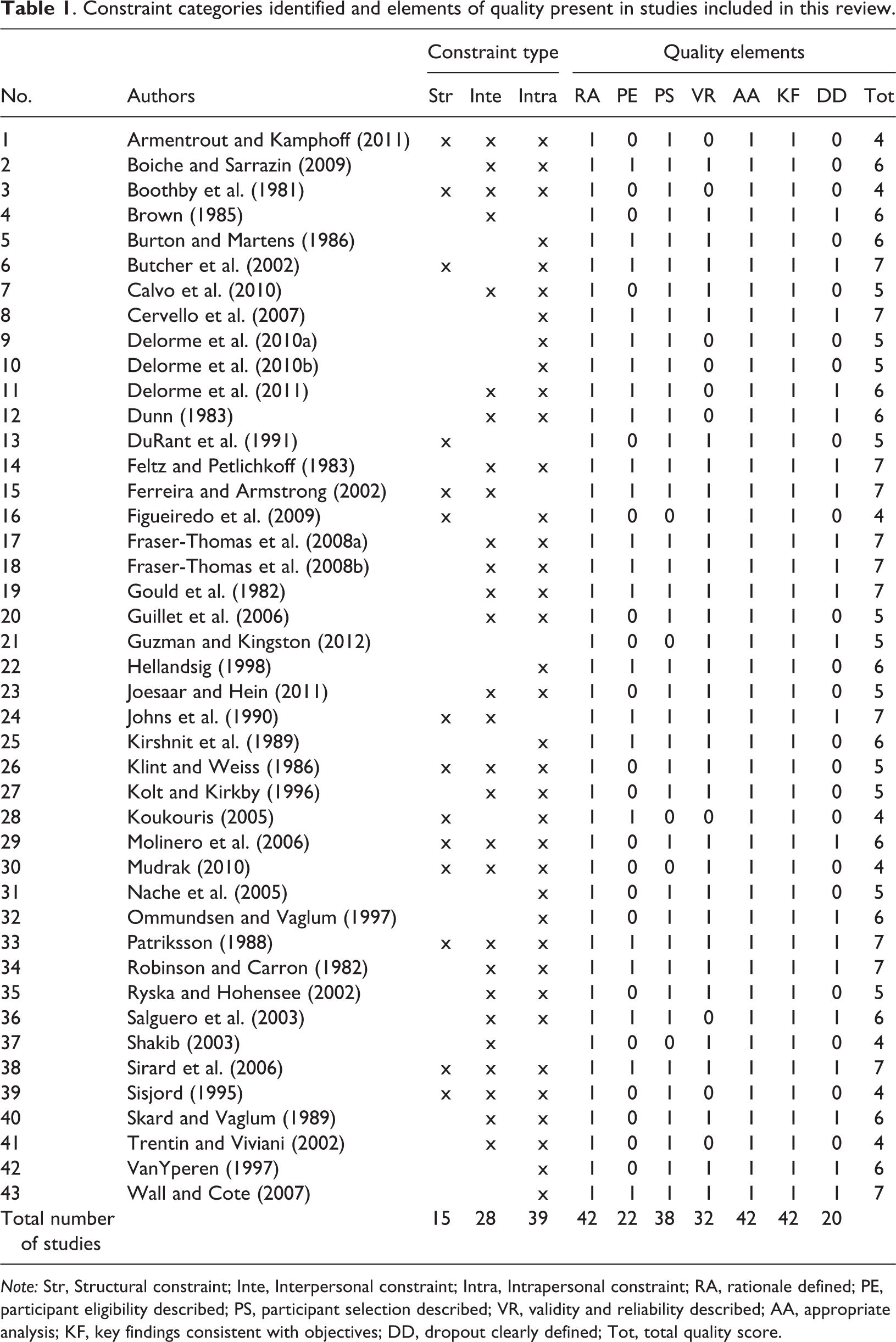
Note: Str, Structural constraint; Inte, Interpersonal constraint; Intra, Intrapersonal constraint; RA, rationale defined; PE, participant eligibility described; PS, participant selection described; VR, validity and reliability described; AA, appropriate analysis; KF, key findings consistent with objectives; DD, dropout clearly defined; Tot, total quality score.
Results
Overview of the studies
Table 2 provides a synthesis of the 43 studies included in this review. Most of the studies were undertaken in Europe (n = 23) and North America (n = 17); and overwhelmingly the participants were male (89%). Studies that included both genders were also biased toward male participation (59% male). Most of the studies focused solely on adolescents (n = 24), with fewer including both adolescents and children (n = 13); and children were the sole participants in only one study. Parents and coaches were the informants (participants) for five of the studies.
Descriptive breakdown of studies related to dropout.

Table 2 also demonstrates that 67% (n = 28) of the studies examined dropout from a single sport. Of those single-sport studies, four sports (soccer, swimming, gymnastics and basketball) dominated the published literature, accounting for 22 of the 28 single sport studies. However, various sports were included in the multi-sport studies, including: judo, karate, tennis, volleyball, baseball, softball, track and field, golf, cheerleading, rowing, kayaking, cross-country running, boxing, alpine skiing, taekwondo, rugby, cycling, table tennis, badminton, soccer, swimming, gymnastics, basketball and ice hockey.
All 43 of the studies were descriptive and for the most part cross-sectional. The majority of the studies used quantitative approaches (65.9%), typically examining correlates of dropout. Some studies administered a questionnaire at the beginning of, or during, a season and examined subsequent dropout (n = 12); and a slightly larger proportion of studies identified children/youth who had withdrawn from a sport and asked them to retrospectively reflect on determinants of dropout (n = 16). Fewer studies used mixed-methods or qualitative approaches. The mixed-methods studies (n = 8) involved some combination of questionnaire, interview and/or physiological or skill test. Most of the questionnaires focused on psychological constructs associated with participation in sport, including 14 studies that examined child and adolescent athletes’ perceptions of sport competence. Although perceptions of competence were often examined, only two studies measured sport skills. Five of the six qualitative studies were semi-structured interviews that gave participants the opportunity to reflect on reasons for dropout. These interviews were conducted after the participant had discontinued their sport; however, the length of time between dropping out and the follow-up interviews was only stipulated in two studies (one and three years after discontinuation).
The leisure constraints model
All three components of the leisure constraints model (Crawford and Godbey, 1987) were represented in the included studies (see Table 1). Intrapersonal and interpersonal constraints were identified in most of the studies (n = 38 and n = 28, respectively) whereas structural constraints were reported less often (n = 15).
Intrapersonal constraints
Five intrapersonal constraints were identified (see Table 3). A lack of enjoyment and low perceptions of physical competence were most frequently identified. A ‘lack of enjoyment’ included constructs such as ‘not having fun’ and ‘being bored’. The children’s/youth’s perception of their lack of physical competence was identified as an important correlate of dropout in 14 studies. Intrinsic pressures (e.g. stress) and perceptions of negative team dynamics (perceptions of coach and teammates) were also identified by participants. Finally, two factors associated with maturation were notable in the findings, specifically: (a) disadvantage associated with chronological age grouping in sport or the ‘relative age effect’; and (b) the individual becoming too old or big to participate.
Factors associated with dropout by constraint type and data source.

*Numbers relate to the list of references cited in Table 1.
Interpersonal constraints
Four interpersonal constraints emerged as factors related to dropout. The most frequently reported interpersonal constraint was ‘pressure’. Unlike the pressures mentioned in the intrapersonal constraints section, these pressures were from others, notably coaches, peers and family members. ‘Having other things to do’ and ‘other social priorities’ were also frequently cited. What those other things/priorities were was rarely elucidated. However, four studies did report that children/adolescents withdrew from one sport to pursue another (see Table 3).
Structural constraints
The most frequently reported structural constraint was ‘time’ (see Table 3). Time was represented variously in these studies, including time for travel, the length of training and competing demands for time (e.g. education and employment). Injuries were the second most frequently reported structural constraint, particularly in the sport of gymnastics. Five of the six studies reporting injuries as a reason for dropout focused on gymnastics. Less frequently reported structural constraints were cost (i.e. travel and registration) and problems related to the organization (i.e. poor facilities and overall structure of club).
Discussion
Leisure constraints theory suggests that successful negotiation of intrapersonal, interpersonal and structural constraints is necessary for participation in leisure pursuits (including sport). Typically, an individual who participates in an activity will assess his or her experiences and then make a decision about future participation. This study examined the constraints encountered by children and youth who had participated in a sport, but had subsequently dropped out. Intrapersonal and interpersonal constraints were more frequently associated with dropout than structural constraints. Although many discrete factors associated with dropout were identified, five major areas emerged: enjoyment, perceptions of competence, social pressures, competing priorities and physical factors.
The two most dominant factors related to dropout were participants’ perceptions of their physical or sport competence and their enjoyment of sport. These intrapersonal factors were associated with dropout in 26 separate studies; and in five of those studies both perceptions of competence and enjoyment were concurrently related to dropout. This finding is consistent with several models that explain children’s choices and motivation in relation to sport such as Harter’s model of competence motivation (Harter, 1978, 1981) and the sport commitment model (Scanlan et al., 1993). Enjoyment, an omnibus term for positive affective responses such as fun and pleasure (Scanlan et al., 1993; Weiss and Williams, 2004), has been previously associated with motivation to participate in sport (McCarthy and Jones, 2007) and the desire and resolve to continue participation (Scanlan et al., 1993; Weiss and Ferrer-Caja, 2002). In the present study, children and youth reported that they had dropped out when their sport was no longer fun. However, very few of the quantitative studies unpacked what contributed to this lack of enjoyment/fun. When the meaning of ‘fun’ was commented on, cited reasons were: not enough playing time or opportunities, dissatisfaction with the coach and too much training time. Several authors discussed the importance of identifying what non-enjoyment represents. Given the prevalence and importance of ‘lack of enjoyment’ as a factor related to dropout and how few studies unpacked the underlying dimensions of this lack of enjoyment, future research of dropout may be well served by using approaches that provide youth with opportunities to explain why their sport was not (or is no longer) enjoyable.
The second most frequently cited factor related to the decision to drop out of sport was perceptions of competence. Feelings associated with a lack of competence were expressed in a variety of ways among studies in this review, including ‘not being good enough’, ‘not as good as I wanted to be’ and ‘lack of skill improvement’. In Boiche and Sarrazin’s (2009) study, adolescent athletes clearly demonstrated that perceptions of competence were significantly higher among 261 current vs. 106 dropout athletes. Their results further demonstrated that adolescents’ perceptions of competence predicted the extent to which they valued sport. The influence of perceptions of competence on dropout also seemed to be mediated by actual competence. Although actual competence was not often measured, Ommundsen and Vaglum’s (1997) study of dropout among 223 adolescent soccer players revealed that the combined effect of low perceptions of competence and lower sport skill measures on dropout was higher than for either of these factors independently. As children tend to gravitate toward areas where they perceive they are competent and away from areas where they feel unsuccessful (Weiss and Williams, 2004) it is unsurprising that dropout from sport is associated with lower perceptions of competence.
Both perceptions of competence and enjoyment were related to dropout in five studies. This is consistent with previous research demonstrating that enjoyment of sport, and children and youth’s perceptions of athletic competence are related (Cairney et al., 2012; McCarthy and Jones, 2007; Ommundsen and Vaglum, 1991). McCarthy and Jones’ findings from focus group interviews with 7- to 12-year-old sport participants suggest that positive perceptions of physical competence are a source of sport enjoyment and, conversely, perceptions of a lack of physical competence are an antecedent of ‘non-enjoyment’. These thoughts are consistent with Harter’s model of competence motivation (Harter, 1978, 1981). Harter’s theory posits that individuals are motivated to be competent in multiple domains such as sport, and that mastery and successes at tasks that are optimally challenging lead to enhanced perceptions of competence and positive affect (enjoyment).
Pressures from family, coaches or friends were identified as interpersonal constraints in this study. Fraser-Thomas et al. (2008a, 2008b) concluded that adolescents feel pressure to satisfy the needs of both family and friends. Adolescents reported pressures to attend parties and other social gatherings of that nature while still meeting the needs of the sport (i.e. training and competition). Dropout was also associated with adolescents’ feelings that parents interfered too often by doing things like videotaping and critiquing performances, offering rewards for performance and by placing them in too many camps. Fraser-Thomas et al. (2008b) reported that adolescents felt pressure to succeed from their parents. Consistent with previous research (Hecimovich, 2004), this pressure was attributed to the parents wanting to give their child opportunities that they did not have. Some degree of sport-related stress or pressure may be healthy and can elicit a positive effect on training and overall performance (Patel et al., 2010). However, the findings of this review indicate that children and adolescents can feel these pressures to such an extent that it contributes to sport attrition.
The negative influence of pressure to conform to gender stereotypes was also evident in this review. This was particularly evident among adolescent females (Guillet et al., 2006; Shakib, 2003). Girls revealed that they felt pressure to be feminine and if they perceived that the sport prevented them from being feminine they were more likely to dropout. These findings are supported by Guillet et al., who found that females who scored high on a femininity scale were more likely to drop out of more ‘masculine’ sports. There were relatively few studies on females in this review, and more research is needed to examine gender-specific constraints influencing dropout from organized sport.
Individuals who participate in organized sport are more likely to have higher levels of physical activity than those who do not (Pfeiffer et al., 2006; Tammelin et al., 2003), and these levels tend to decline from childhood to adolescence (Belanger et al., 2009; Nader et al., 2008). Findings of this review suggest at least part of the reason for this decline in physical activity is that adolescents have priorities other than sport. ‘Having other things to do’, ‘other social priorities’ and ‘pursuit of another sport’ were identified as interpersonal constraints in this review. Although the majority of studies did not explore what these other priorities were, Molinero et al. (2006) suggested that it is often difficult to balance school, work, friends and sport during adolescence. It should be noted that four studies reported that children and adolescents withdrew from one sport to pursue another, a common occurrence in the sampling years (Butcher et al., 2002). These findings also illustrate that additional investigation of children’s versus adolescents’ reasons for dropout are needed. Only one study specifically examined dropout among children although it is highly likely that the interpersonal (e.g. relationships with peers) and structural (e.g. parents being needed to transport younger children) constraints experienced at different stages of development will be dissimilar. Additionally, only 9% of participants in this review were female. This may be attributed to the lower overall levels of female participation in physical activity during adolescence compared to males (Sallis et al., 2000). More studies are needed to examine dropout from sport among females to determine whether there are unique factors associated with dropout for females and to potentially tailor approaches to reduce dropout.
Finally, two physical factors were associated with dropout: injuries and maturation. Injuries were associated with dropout in six studies, and the leading cause of dropout in two of those studies. Twenty-five percent of high school students in the DuRant et al. (1991) study reported that injuries influenced their decision to drop out, and Johns et al. (1990) found that 40% of female competitive gymnasts dropped out because of injuries. Notably, all of the studies that specifically focused on gymnastics (n = 5) identified injuries as a factor associated with dropout. The majority of participants in these studies were at a competitive or elite level. There was little explanation of the type or severity of the injuries; and limited information about how injuries led to dropout. Koukouris (2005), however, reported that elite gymnasts with injuries requiring medical treatment (e.g. surgery) lost interest in their sport because coaches and administrators showed indifference toward them when they were injured. As sport is the leading cause of injury among children and adolescents (Bienfeld et al., 1996; Keats et al., 2012; King et al., 1998) further exploration of the relationship between injuries and disengagement from sport seems warranted. Future research would benefit from examining the interrelationships between different types of injury-related constraints and dropout. For example, a participant’s motivation to rehabilitate an injury properly (intrapersonal constraints) may be influenced by the coach’s attitude toward injured athletes (interpersonal constraint) and whether the club or organization has sound injury management practices and return-to-play guidelines (e.g. Purcell, 2012) in place (structural constraints).
Koukouris also found that physical maturation of gymnasts led to dropout. As one gymnast said, ‘It’s very difficult to be tall in gymnastics and train for the top when you’ve got 15-year-old female gymnasts who are tiny’ (Koukouris, 2005: 46). This phenomenon of ‘growing out’ of a sport was not reflected in the other studies where ‘maturation’ was a factor associated with dropout. Rather, five of the six studies where maturation was a factor suggested dropout was related to the relative age effect (RAE). RAE is the bias or advantage arising from being born early in a relevant selection period (Delorme et al., 2010a, 2010b, 2011). As many sports have a two-year age-group window, a player may be 23 months older than the players whom he or she is competing against. These differences in age are associated with both physical (Malina, 1994) and psychological differences (Bisanz et al., 1995). Of the five RAE studies in this review, three used key demographic information (including date of birth) from sport federation records to examine which child and adolescent athletes did and did not return in subsequent seasons. The results revealed that those born later in the competitive season were less likely to return. Further, Figueiredo et al. (2009) found that youth soccer players who progressed to an elite level in a two-year period were chronologically and skeletally older, were larger in body size and scored higher in all tests than those who stayed at the same level or dropped out in the same time period. The present study supports that RAE contributes to dropout; however, more research is needed among those who drop out to understand the physical, social and psychological aspects of their experience of competing against their chronologically older peers.
Although this review was limited to one organizing framework (i.e. leisure constraints theory), all of the variables identified in the included papers were able to be categorized as an intrapersonal, interpersonal or structural constraint. This appears to reflect the nature of the influences explored in the literature to date, which largely focused on the individual or factors proximal to the individual. Virtually no attention has been given to broader societal contexts such as socioeconomic status, policies governing sporting organizations or the interactions between these broad environmental factors and the individual. Notwithstanding these limitations of the available literature, all three components of the leisure constraints model were associated with dropout from sport among children and adolescents in this review. However, intrapersonal constraints were by far the most prevalent group of factors, having been identified in almost 90% of the studies. Two of these factors, lack of enjoyment and perceptions of physical competence, were identified in more than half of all studies. Rarely were enjoyment or perceptions of competence unpacked in terms of why children and adolescents were no longer enjoying sport or what sources of information were used to form these perceptions. It would be beneficial to explore these constructs in more depth while concomitantly monitoring dropout using longitudinal research designs. Research that has examined the complexity of constructs such as enjoyment may provide considerable insight into child/adolescent attrition from sport. For example, McCarthy and Jones (2007) reported nine separate themes related to the ‘non-enjoyment’ of sport when they examined the general dimension of enjoyment. Themes identified by McCarthy and Jones included over-involved parents, overtraining, injuries and lack of competence. Many of these variables were identified in this review, but their relationship to enjoyment was not explicit. Conversely, studies that reported that a lack of enjoyment was related to dropout, did not often explore what the participants meant by this. It was also unclear why children and adolescents were choosing alternative activities or how the experience of injury or relative physical or psychological immaturity led to dropout. Additionally, it was often not possible to identify whether athletes had dropped out of a sport altogether or moved on to an alternative sport or activity. Where possible, future research would benefit from combining Ommundsen and Vaglum’s (1991, 1997) comprehensive definition of dropout (which asked whether players were still a member of a club, still playing matches and still training, as well as whether they had ceased playing) with a question about whether players had changed to another sport (e.g. Skard and Vaglum, 1989). This combination would provide a more complete picture of players’ organized sport engagement status. Finally, the vast majority of studies included in the review were from countries in North America, Europe and Australia that could be characterized as high income. This limits the generalizability of the findings as well as our understanding of dropout from sport among children and adolescents in many regions of the world and in lower income countries.
Leisure constraints are factors that inhibit or prohibit participation in leisure activities, including sport. Successful negotiation of intrapersonal, interpersonal and structural constraints is needed to enable participation (Godbey et al., 2010). Intrapersonal constraints tend to be most powerful (Crawford et al., 1991) because, ‘…without overcoming them, the desire or preference for a leisure activity will not even come into being or will disappear or diminish if it exists’ (Godbey et al., 2010: 110). The findings of this review indicate that overcoming intrapersonal constraints are not only important for facilitating participation, as suggested by Godbey et al., but this type of constraint is also very important in terms of dropout. Sporting organizations may be able to prevent undue dropout by giving some priority to identifying and intervening with the intrapersonal constraints experienced by both child and adolescent athletes. The interplay between constraints influencing dropout was not often explored, nor was there elucidation about how the athletes’ experience of sport contributed to constraint formation. Future research would benefit from mixed-methods and prospective approaches that explore the multidimensional nature of dropout. These approaches would allow children and adolescents to explain how their experience of sport shaped their motives to drop out, and allow researchers to probe the extent to which affordances and motives for participation aligned with athletes’ reasons for dropping out.
Footnotes
Funding
This research received no specific grant from any funding agency in the public, commercial or not-for-profit sectors.