



Abstract
This paper relates to students’ productive disciplinary engagement (PDE) within the teaching of gymnastics in Tunisia. Students’ engagement is investigated from the pragmatist and social-interactionist perspective of the didactic joint action framework in conjunction with productive disciplinary engagement. Data were collected through ethnographic observations using video recordings and teacher interviews during a 12th grade gymnastics unit conducted by a female teacher in a senior high school. Analyses of students’ actions were carried out during significant episodes when they worked without the direct presence of the teacher. The study draws attention to how breaches of the didactic contract initiated by students promote knowledge content development and how students contribute to the situated didactic process. The analyses of students’ contrasted cases (two high-skilled, two low-skilled students) highlight how students actively participate in shaping their learning. The discussion points out some generic patterns that keep students engaged in a PDE. The paper is concluded with a consideration of the utility of the two theoretical frameworks for understanding student learning in physical education lessons.
Keywords
Introduction
This paper focuses on student learning through interactions from a didactique standpoint (Amade-Escot, 2006). It examines the extent to which students’ participation in PE lessons impacts on the content they learn. Such an examination involves a focus on students’ participation, engagement and learning: How do they participate in classroom activities? What are the quality and the intensity of their engagement? Does their engagement impact on the content knowledge they learn? In this article, we focus on student engagement through two theoretical lenses that permit understanding of how students’ interactions shape the content learned: the joint action studies in didactics (JASD) and the productive disciplinary engagement (PDE) frameworks. The former belongs to the French educational research tradition (Allal, 2011; Amade-Escot, 2006; Caillot, 2007); the latter originated in American science education research with the work of Engle and Conant (2002). The compatibilities and mutual pertinence of these two theoretical frameworks have been discussed through a special issue on PDE by Venturini and Amade-Escot (2014). Furthermore, the two frameworks have already been combined in PE research to study content development in an underprivileged school (Amade-Escot, 2015; Amade-Escot and Venturini, 2009). Recently, students’ PDE was the subject of the doctoral research of the second author of this paper (Bennour, 2014).
Within the theme of this special issue, the purpose of this paper is to investigate the extent to which students learn through peer interactions and how the task transformations they produce impact the content learned. Despite research on teacher effectiveness, which implicitly asserts that content development in PE occurs in a teacher-driven, linear way and that there is a causal relationship between quality of teaching and effective learning (Placek, 1983; Rink, 1994; Silverman, 1985), like Tinning (2015), we believe that teaching and learning interact in complex, uncertain and unpredictable ways. With the purpose of understanding the uncertainty of student learning in PE classrooms, we suggest that a detailed analysis of students’ interactions through both JASD and PDE theoretical lenses enables us to establish how students’ verbal and corporeal actions and interactions create (or do not create) opportunities for learning through the dynamics of the differential didactic contract (Amade-Escot et al., 2015; Verscheure and Amade-Escot, 2007). Importantly, this study does not account for student learning within pedagogical models such as cooperative learning or peer-assisted learning. It is about ordinary 1 PE teaching. It focuses on episodes when students work in small groups without the direct presence of the teacher to examine how much their engagement and interactions lead (or do not lead) to learning. We begin by presenting the two theoretical frameworks used in the study. The following section gives a short overview of the Tunisian context where the data were collected and sketches the methods used to document student learning during a gymnastic unit in a senior high school (12th grade). The next section summarises the findings using four students’ case reports. The discussion calls attention to generic patterns that keep students engaged in PDE. Some remarks on the relevance of combining the two frameworks and how they give a better understanding of student learning in the gym conclude the paper.
Examining students’ productive disciplinary engagement within didactical interactions: an approach combining two theoretical lenses
The purpose of this study is to document how students’ experiences in PE play a role in curricular practice. It focuses on content enactment during ordinary lessons using two theoretical lenses: JASD and PDE. The first of these provides a descriptive framework for studying the enacted curriculum. It takes the teacher, the students and knowledge into account simultaneously, thus combining aspects that are usually separated (Amade-Escot et al., 2015; Ligozat, 2011; Sensevy, 2007). The second complements the first one by giving a view on whether or not the students are really engaged in learning and offers four principles determining particular student behaviours that express PDE (Engle and Conant, 2002; Venturini and Amade-Escot, 2014).
Joint action studies in didactics: outline of the theoretical framework
The epistemological backgrounds of the didactique approach are related to the Vygotskyan social-interactionism perspectives on learning (Allal, 2011) and the assumption that knowledge is constructed within situated social contexts (Amade-Escot, 2006). In the classroom, the teacher’s pedagogical work pertains to the conveyance of a pre-existing culture embedded in curriculum texts which is to be (re)enacted through didactical transactions. Students are expected to take on the assignments proposed by the teacher in order to (re)build such culture (and related knowledge content) in her/his experience, as featured in the theory of didactic transposition (Mercier, 2002; Wallhead and Dyson, 2016). In other words, the teacher and students ‘co-construct diverse forms of knowing while the knowledge itself is transformed through the pedagogical acts of conveyance and appropriation’ (Amade-Escot et al., 2015: 662).
Focusing on the situated and social contexts of the construction of knowing in the classroom, the JASD framework also has links with the pragmatist and social-interactionist theoretical works of Mead, Blumer, and Goffman (Amade-Escot et al., 2015; Ligozat, 2011; Sensevy, 2007, 2009). It accounts for how the content of lessons is brought into play through teacher–student transactions. Seeing the teacher, the students and the particular situatedness of knowledge content as interrelated instances, this descriptive framework considers that, theoretically, teachers’ and students’ practices should be regarded as ‘joint actions’ (Amade-Escot et al., 2015; Ligozat, 2011; Sensevy, 2007, 2009; Wallhead and Dyson, 2016). Classroom contexts are thus seen as contexts of human interactions, where human beings interpret the objects, the situations and the actions of others. The meanings that are given to objects, situations and actions of others may be different for the participants, but common meanings emerge for a given set of people over their joint action within specific institutions (Blumer, 1969; Mead, 1934; Sensevy, 2007). Moreover, participants ‘interpret or “define” each other’s action instead of merely reacting to each other’s action […] based on the meaning which they attach to such action’ (Blumer, 1969: 79). This ‘interpretation’ does not need the direct presence of the other (in Mead’s (1934) sense of ‘generalised other’). Mead’s example of a young girl ‘playing mother’ indicates that she interprets the mother role in absentia. Against the background of social-interactionism, the JASD perspective acknowledges that specific content emerges in the classroom settings as an outcome of the teacher’s and the students’ joint action, even though the students are working without the direct presence of the teacher. In a classroom, when students work without the actual presence of the teacher, the teacher’s expectations (assignments, intents, etc.) operate – more or less depending on the situation – as an implicit part of the background of students’ interactions. Besides, it must be noted that ‘joint actions’ does not mean that participants share the same goals or the same agendas.
Drawing on the idea that students’ knowledge, knowing and know-how and all meanings associated are co-produced and co-constructed in action within situated contexts and transactions, the JASD framework offers a relevant lens to explore how students participate in content development, whether they work in the presence of the teacher or not, or whether learning takes place within a specific pedagogical model or not (see Wallhead and Dyson, 2016). In other words, JASD helps in deciphering how students’ verbal and corporeal actions and interactions contribute to their learning and the extent to which this learning is related to the teacher’s didactic intent. Two major and interrelated notions conceptualise participants’ joint action within the didactic system: the didactic contract and the didactic milieu.
The didactic contract and the didactic milieu
The concept of the didactic contract refers to the set of negotiations, more often than not implicit between teacher and students, that specifically relates to the content at stake and that unfolds during participants’ joint action (Amade-Escot, 2006; Brousseau, 1997; Hennings et al., 2010; Schubauer-Leoni, 1996; Verscheure and Amade-Escot, 2007; Wallhead and Dyson, 2016; Wallhead and O’Sullivan, 2007). Actually, the didactic contract drives all interactions related to content learning, whether students work with or without the presence of the teacher. Negotiations and transactions occur around any piece of content because the meanings that participants give to that content are never totally in harmony. Consequently, (more or less small) misunderstandings, mismatches or un-shared meanings appear all along didactical transactions. They provoke unavoidable breaches of the didactic contract which continuously modify the content taught and learned. One may say that content development in a lesson, which consequently does not always have content growth, goes on through successive breaches of the didactic contract irrespective of whether they are introduced by teachers or students (Amade-Escot, 2006). This evolving and dynamic process begins with the devolution to the students of a learning environment initially designed by the teacher (i.e. the ‘primitive didactic milieu’). It is defined as the set of material, symbolic and semiotic objects that characterise the setting of any learning context. The term ‘primitive’ refers to the idea that the didactic milieu is inherently subject to ongoing modifications as didactical transactions are largely contingency-shaped. Students, in their diversity (gender, attitudes, experiences, abilities, etc.), interpret the primitive didactic milieu as well as the teacher’s actions or intentions throughout the flow of interactions. Thus, according to Brousseau (1997), the actual didactic milieu is all that the students relate to at the immediate learning moment, including the cognitive, emotional elements and the already known notions or skills that students bring to the setting. The intrinsic feature of the didactic milieu lies in its evolution over time through transactions (see ‘mesogenesis’, below).
Understanding the temporal dynamics of didactical practices demands a fine-grained description of participants’ actions and discourses related to the content embedded within the ongoing evolving didactic milieu. Three descriptive and interdependent analytical tools account for these joint action dynamics: mesogenesis, chronogenesis and topogenesis.
A threefold set of genesis
Mesogenesis (i.e. genesis of the milieu) describes the process by which, over time, the teacher (re)-organises the milieu and the milieu is reorganised by students’ actions. Mesogenesis can be characterised by identifying: i) the set of objects that participants indicate to themselves, ii) the meaning that they ascribe to their own actions with these objects [and, we add, the meaning they ascribe to each other’s actions], iii) the control [in terms of the mastery of the content to be learned] they gain from it and that may be re-allocated in further experiences. (Ligozat and Schubauer-Leoni, 2009: 1622)
Chronogenesis (i.e. the genesis of the didactic time) describes the evolution of the knowledge content as it unfolds during the joint action. Chronogenetic actions can be introduced either by the teacher or by students. The chronogenesis is related to the pace of content development which may progress, accelerate or stagnate during didactical transactions.
Topogenesis (i.e. the genesis of positions) documents how teachers and students (collectively or individually) share respective responsibilities all along transactions to produce knowledge content. When the teacher allocates assignments to students, she/he may give them more or fewer responsibilities, and this impacts their learning. But students also have their own agency. They may actively participate in taking on the content at stake, but they might also wait until the end of the class, or engage themselves following their own goals. All these actions have topogenetic consequences related to the content learned. As an example, in group work, a student can assume the responsibility of teaching another student without being assigned to do it by the teacher. This student thus adopts a high topogenetic position in the group that may enhance the learning trajectories of other students.
Using this framework, didactical transactions are described by means of this threefold set of geneses which evolve in concert: ‘every stage of mesogenesis corresponds to a topogenetic state and a chronogenetic state with regard to the content at stake’ (Amade-Escot and Venturini, 2009: 29, our translation).
To summarise, the JASD lens, in focusing in detail on micro-episodes, gives a description of the situated co-construction of meaning, knowledge, know-how and emotion in the classroom. It gives a transactional view of teacher–students as well as the joint action of students–students in terms of how the content is co-constructed in learning environments at a fine-grained unit of analysis. But how do we capture the extent to which students’ participation in the interwoven didactical process leads to learning? Here is the distinctive contribution of the second framework used in this research.
Productive disciplinary engagement: outline of the theoretical framework
Engaging students in deep disciplinary learning is frequently difficult for teachers. ‘The PDE framework was created to provide guiding principles for both designing and understanding [our emphasis] learning environments that seek to foster students’ productive engagement in disciplinary work’ (Engle, 2011: 161). This framework conveys a social-constructivist learning theory within the pedagogical model developed by Brown and Campione (1994) known as the ‘Fostering Communities of Learners Project’. Initially elaborated in science education by Engle and Conant (2002), the PDE framework analyses how students develop in-depth learning (in their study, a more scientific understanding of the crucial distinctions between whales and dolphins) through classroom conversations. Engle and Conant distinguish engagement, disciplinary engagement and productive disciplinary engagement. ‘A group of learners is more engaged to the extent that more of them are participating in an interaction, that participation has greater intensity, and each learner’s participation is responsive to that of others’ (Engle, 2011: 163). Criteria like students’ emotional displays or spontaneous reengagement in the topic over a period of time reinforces evidence of engagement. But this engagement does not necessarily indicate that students’ engagement is disciplinary. By using the term disciplinary, Engle and Conant (2002) meant that there is some contact between what students are doing and the issues, practices and learning outcomes of the subject discipline (its ‘big ideas’). Disciplinary engagement is also related to students’ authentic work. Examples in PE include, when they use more tactical skills in games, when they perform more sophisticated gymnastics skills, or when they propose advanced arguments when coaching peers. But how does one define whether a case of disciplinary engagement is ‘productive’? Engle’s definition is that there is productivity if one can discern ‘significant disciplinary progress from [the] beginning to end of students’ engagement with a particular issue’ (Engle, 2007: 215). Students’ engagement is then productive to the extent that they ‘get somewhere’ in terms of the content (for example: national standards or curricular content). In other words, to be productive, students’ PDE must show evidence of making some sort of valued progress over time (Engle, 2011; Engle and Conant, 2002). Within the perspective of this special issue, we claim that focusing on PDE during didactical transactions allows tracing the moment-by-moment development of PE content from the students’ standpoint.
PDE analytical tools
In their original study, Engle and Conant produced a set of four general principles (problematizing, authority, accountability, resources) that support PDE. For the purpose of descriptive research, these principles collectively function as a set of analytical tools which, for a given case, define PDE or the lack thereof (Amade-Escot and Venturini, 2009; Bennour, 2014; Venturini and Amade-Escot, 2014).
Problematizing content allows one to see if students (individually or collectively) take on specific content problems (as an example, how to coordinate two actions in a gymnastics routine).
Authority indicates whether students develop authority in addressing the problems. Engle (2011) distinguishes four levels of authority: (1) students feel empowered to share what they really think; (2) students are authors of their own ideas or practices; (3) students are recognised as contributors to the ideas or the practice of others; and (4) students are considered as a ‘local authority’ about a topic by their peers or the teacher.
Accountability documents the extent to which students are accountable to others and to disciplinary norms: to one’s peers; to oneself at other times; to local and outside disciplinary authorities (for example: to national gymnastics examinations as a part of the PE grade for the Tunisian Baccalauréat; to the form of practices that are legitimated in acrobatic gymnastics clubs) and to the discipline (i.e. facts, procedures, practice, norms and theories).
Use of resources allows the description of whether students find and use pertinent resources to do all of the above (for example in gymnastics: to add a mat to perform acrobatics skills in a secure working space; to read a schema of a gymnastics skill; to ask a peer to spot; etc.).
To sum up, these four principles focus attention on the particular nature of PDE that occurs and how ‘big ideas’ or other central aspects of the discipline are embodied in students’ practices. Venturini and Amade-Escot (2014) have shown that using them in classroom analysis complements the potential of the JASD lens in giving insight into student participation and thus in describing the extent to which this participation impacts their learning.
Deciphering students’ PDE within didactical transactions in gymnastics: context and method
The research data were collected during an ordinary gymnastics unit in a senior high school in Tunis. Before sketching the methods used, we first present the context of Tunisian PE.
Tunisian context of PE curriculum and teaching
Since the mid-80s, the national Tunisian PE curriculum has been based on multi-sports and grounded in ‘a goal-oriented pedagogy in terms of students’ performance on isolated technical skills and on the (technico-tactical) behaviour in competitive situations’ (Zouabi, 2005: 677). The compulsory weekly time allotment for PE at the senior high school level is two hours for all students, most often in large classes (30 to 40 students on average with large variations between schools). Classes may be either mixed or single-sex depending on the school educational choices (Zouabi, 2005). Related to the infrastructures and pedagogical equipment available, the subject contents of Tunisian PE are track and field, games and acrobatic gymnastics. The national curriculum for senior high school PE specifies that students should be able to perform basis gymnastic skills (i.e. forward and backward rolls, handstand, cartwheel, and so forth) (MJES, 1998). Furthermore, there is a national examination at the end of secondary school. The students should perform a compulsory floor routine as a part of PE assessment for the final high school degree, which is named the Baccalauréat diploma (MJES, 1998). As an overall diploma the Baccalauréat is required to enter university, but the PE grade is not decisive because it counts for only one 20th of the grade average earned in all the other school subjects.
Method
This section is intended to give a brief overview of the method and to indicate the ways the two theoretical frameworks were used. The research is based on a case study. With the purpose of investigating didactical transactions in a ‘real-life context’, the data were collected through ethnographic observations using video recordings and semi-structured interviews with the teacher before and after each lesson (for a presentation of the design of data collection, see Amade-Escot, 2005: 135–140). The interviews seek to grasp the teacher’s perspective regarding the class, the students, the teaching project and the didactic intention for each lesson.
Three consecutive lessons out of a gymnastic unit of 12 were observed in a high school located in an affluent suburb of Tunis. Each lesson lasted approximately one hour and 45 minutes. In this school, PE is delivered to single-sex groups of students. The class (12th grade) was comprised of 22 female students. The gymnastic unit was conducted by Sonia (pseudonym), who is an experienced female teacher (22 years of PE teaching). The overall purpose of the unit was the preparation for the Baccalauréat PE assessment (teacher’s pre-research interview). During this interview, Sonia indicated that the first part of the unit ‘will be dedicated to the learning of the gymnastic basic skills’. Then each student ‘will choose and combine some of these skills in a floor routine that will be assessed at the end of the unit as a part of the Baccalauréat grade’. The observed lessons used in this article were in the middle of the unit, when the teacher set up group work where three to four students worked on isolated basic gymnastics skills and began to combine some of them in a short floor routine. The form of grouping was left to students’ initiative.
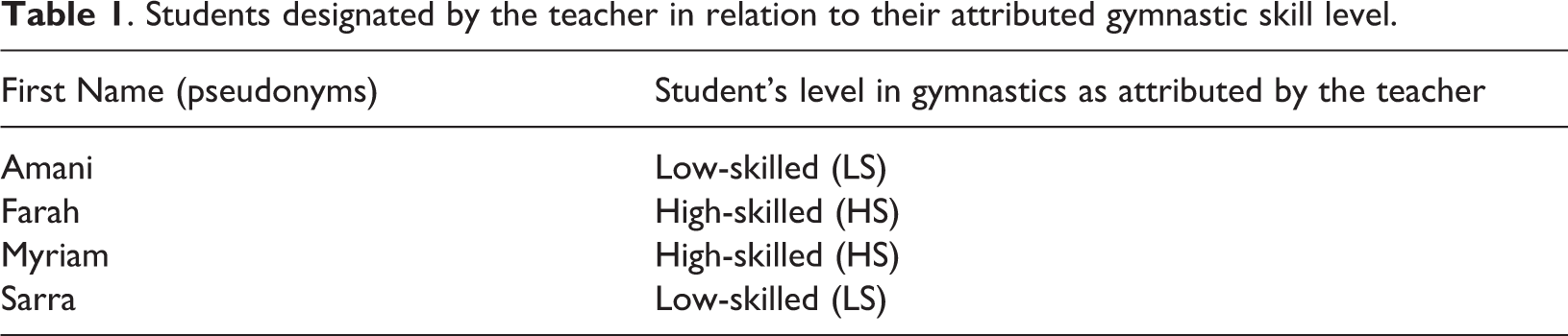
During the pre-research interview, the teacher designated to the researcher four students among the class of 22 having, from her perception, contrasting skill levels in gymnastics: Myriam and Farah (high-skilled (HS) students), Amani and Sarra (low-skilled (LS) students) (pseudonyms) (see Table 1).
Students designated by the teacher in relation to their attributed gymnastic skill level.
The selection of students with differing skill levels is consistent with the overall research purpose of investigating how students learn through peer interactions and how these interactions shape any differential learning. It is also a methodological tenet widely used in didactique research (Amade-Escot, 2005; Leutenegger, 2003).
The data collection during classroom observations encompasses students’ verbal and non-verbal interactions during significant episodes. To examine how students develop agency and are able to generate autonomous learning through interactions and activities in ordinary PE lessons, we focused on episodes where students worked in groups without the direct presence of the teacher. This methodological choice is compatible with the principles of both the JASD and PDE frameworks. Grounded on these premises, the criteria to elicit the episodes were: (a) students work without the direct presence of the teacher; (b) they modify the primitive didactic milieu provided by the teacher in ways that affect the content at stake; (c) students’ actions (verbal and corporeal) during task transformations are clearly describable. Based on these criteria, the second author of this article identified, over the three consecutive lessons, all episodes involving one or more of the four designated students to be analysed. Across the lessons the students may belong to different groups. The analysis of students’ actions during these episodes aims at deciphering in detail how they engage in the didactic process and the extent to which their engagement is productive.
Findings: students’ PDE in gymnastics within didactical transactions
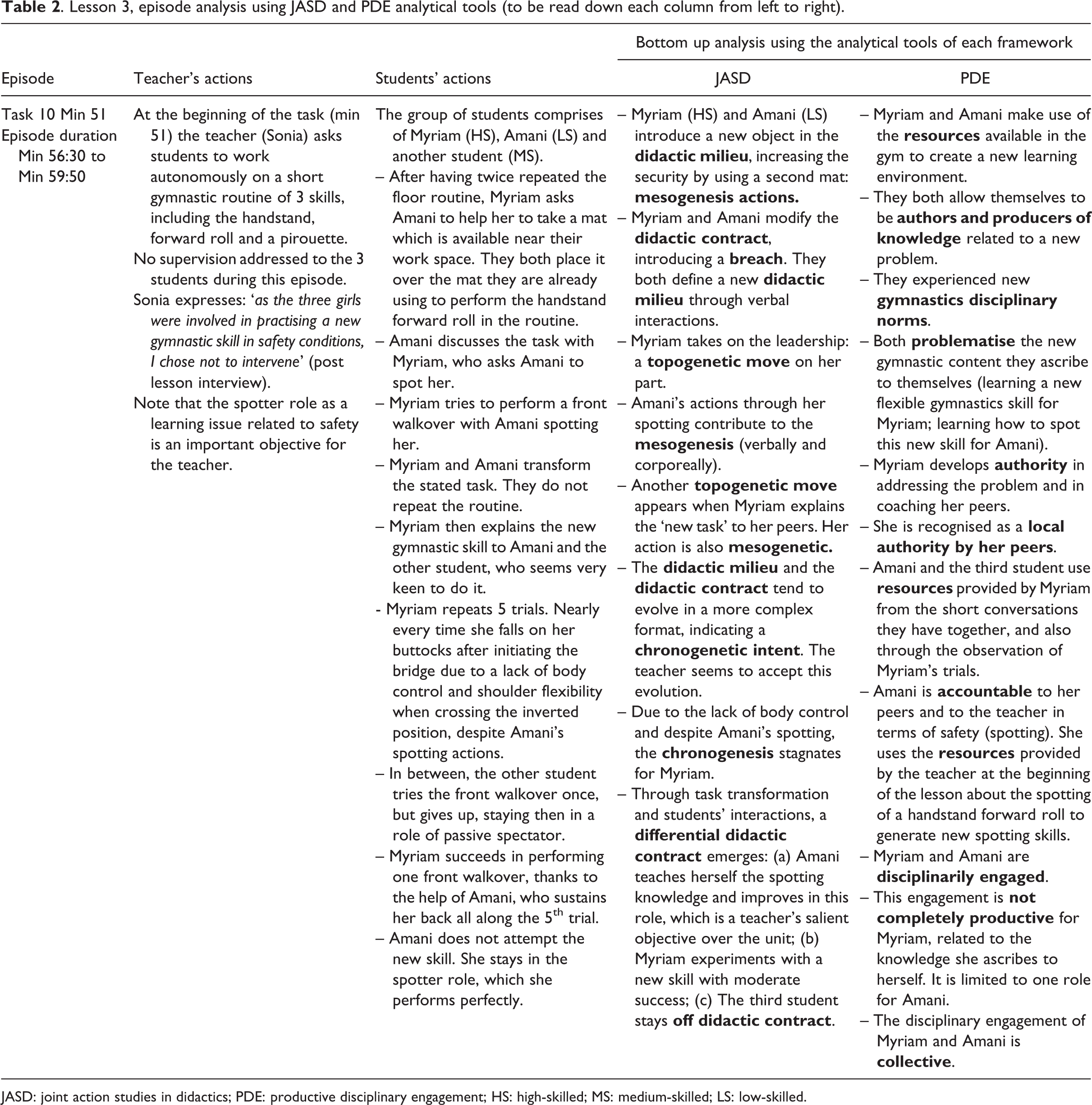
To account for students’ learning in ordinary PE lessons, we first give an outline of the fine-grained analysis of one episode involving two of the observed students: Myriam (HS) and Amani (LS). The description of their actions using the two frameworks (Table 2) highlights how task transformations create opportunities to develop PDE through students’ interactions. Then, we sum up the findings related to the observed students in a condensed matrix (Table 3). A brief comparison of the four students’ cases demonstrates how breaches of the didactic contract contribute to content enactment and how much students actively participate in shaping productive learning. It brings to light generic patterns that keep students engaged in a PDE through didactical transactions.
Lesson 3, episode analysis using JASD and PDE analytical tools (to be read down each column from left to right).
JASD: joint action studies in didactics; PDE: productive disciplinary engagement; HS: high-skilled; MS: medium-skilled; LS: low-skilled.
Condensed matrix display of students’ PDE within the dynamics of the didactic contract over episodes and lessons.
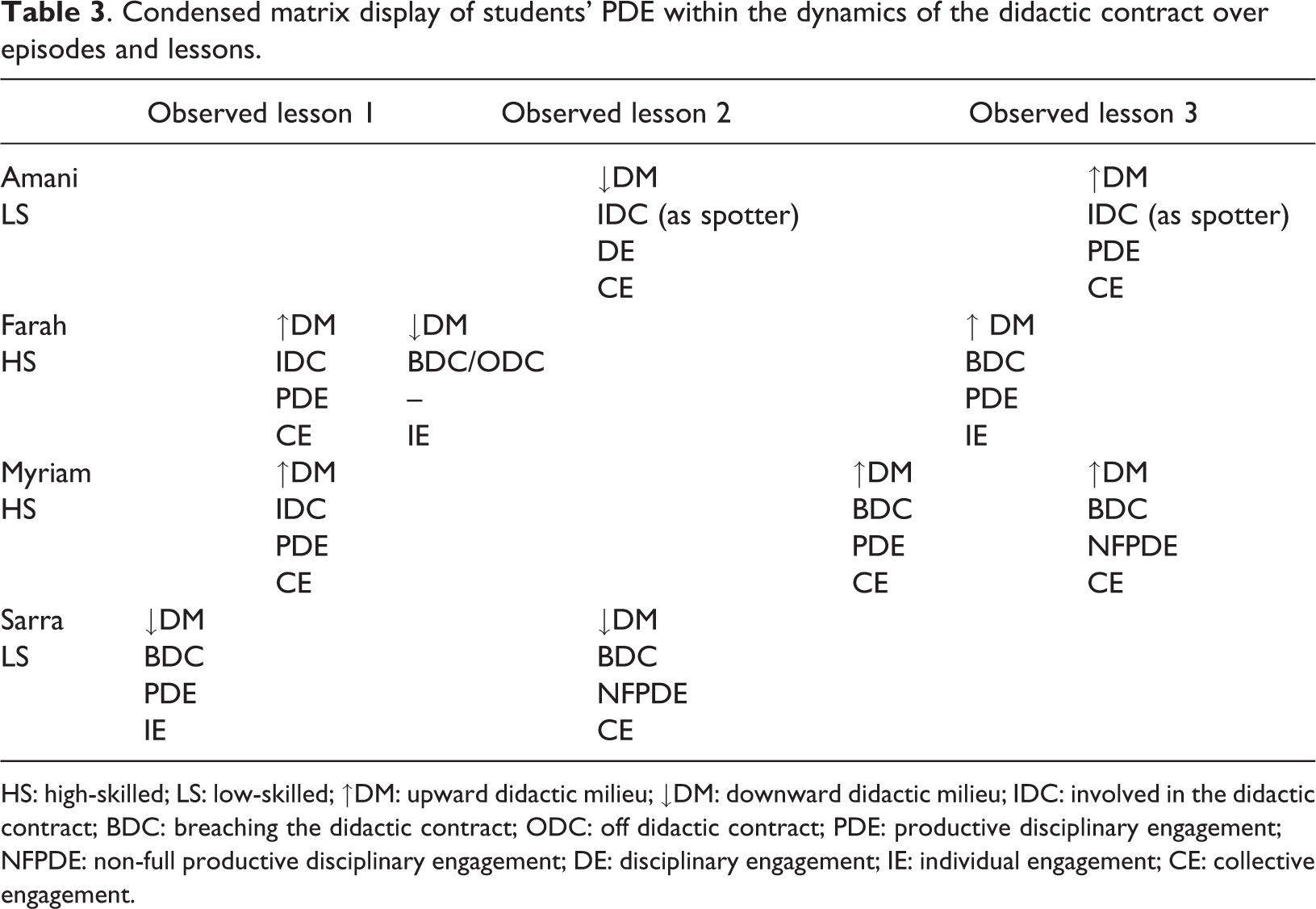
HS: high-skilled; LS: low-skilled; ↑DM: upward didactic milieu; ↓DM: downward didactic milieu; IDC: involved in the didactic contract; BDC: breaching the didactic contract; ODC: off didactic contract; PDE: productive disciplinary engagement; NFPDE: non-full productive disciplinary engagement; DE: disciplinary engagement; IE: individual engagement; CE: collective engagement.
Analysing student learning through the lenses of JASD and PDE frameworks: an illustration
The episode involves Myriam (HS), Amani (LS) and another student. It appears at the very end of the third observed lesson, when Sonia devolves responsibility and asks the class to repeat a short floor routine including the gymnastic handstand forward roll and a pirouette (Task 10, lesson 3, minute 51): ‘you all practised the handstand forward roll… now it’s time to put it in a small routine, with a pirouette for example, and also another gymnastic element if you want. Let’s go!’ This verbal assignment initiates the didactic contract within a loose primitive didactic milieu. Myriam and Amani, after a short discussion and two trials, introduce a breach in the didactic contract with the objective of practising a new gymnastic element, the front walkover, as a flexibility skill in their floor routine (Figure 1).

Front walkover.
The three students no longer practise the stated task. Myriam concentrates her efforts in learning a new gymnastic element, Amani focuses on spotting Myriam and the third student stays at the side of the event. The teacher does not intervene. She says during the post lesson interview: ‘as the three girls were involved in practising a new gymnastic skill in safety conditions, I chose not to intervene’. The episode lasts three minutes and 20 seconds and evolves as described in Table 2.
Episode description
The episode begins when Myriam, who intends to practise a front walkover and so modifies (with the help of Amani) the primitive didactic milieu set up by the teacher. Both students cooperate to add a mat over the one already used in their work place. This mesogenesis action affects the content at stake.
From the JASD framework, Myriam introduces a breach in the didactic contract (BDC). Myriam (HS) enrols Amani (LS) and the third student to experience the new gymnastic skill (the front walkover) within an upward didactic milieu compared to the primitive one set by Sonia. Myriam takes on a topogenetic position, teaching the two other students. The three students verbally interact on what to do, and roles are allotted between them. Amani chooses to take on the role of spotter. In a half-kneeled position (one knee on the mat), she puts her arm under Myriam’s back and supports her with the other arm on her shoulder to help Myriam avoid a hard fall. Doing this, she clearly relies on the content delivered at the beginning of the lesson by the teacher about ‘how to spot a handstand forward roll’ (video transcription of task 3 in this lesson), adapting it to the new situation. Her spotting appears quite effective and no accidents occur. Amani’s spotting actions contribute by refining the mesogenesis in a direction that helps Myriam in her learning. The teacher was at this time supervising another group of students. As already discussed, she does not intervene and lets this group of three students work autonomously. Myriam then takes a topogenetic lead. She explains the new gymnastic skill to Amani and the third student and tries to demonstrate a front walkover (mesogenetic actions). Following Myriam, the third student tries to perform the new skill. Myriam gives her some verbal cues like ‘push on your shoulders’ (related topogenetic and mesogenetic action). After an unsuccessful trial, the third student gives up and stays off didactic contract (ODC) until the end of the episode. Amani, for her part, engages thoroughly in a spotter role over the episode while Myriam performs several trials which are not completely successful. Myriam and Amani’s actions and interactions thus lead to some chronogenetic effects in terms of content development for each of these students: for Myriam, the chronogenesis concerns the practice of the front walkover; for Amani, the chronogenesis is related to the spotting. A differential didactic contract emerges from these interactions.
From the PDE framework, Myriam and Amani take on new gymnastic problems. By changing the learning environment and using the resources at hand (i.e. the mat, the skills and the knowledge acquired in the previous tasks and lessons), they allowed themselves to be authors and producers of knowledge. They also collectively found resources to develop their own learning purposes (collective engagement). Through their actions they develop authority, engaging themselves in the issues and practices of a new gymnastic skill. One can say that Myriam and Amani are accountable to some disciplinary norms (for Myriam, when and how to begin the bridge move from the handstand inverted position; for Amani, when and how to spot a gymnast performing such a skill). These disciplinary norms are related to the personal goal or agenda each of these students has. Nevertheless, it must be noted that during the first lessons of the unit the teacher put a big focus on spotting safely that may explain Amani’s behaviour in this episode and the one observed in lesson 2 (see Table 3). This low-skilled student is being accountable for her peers’ safety, but also to the discipline in terms of the spotting procedures which belong to a specific role in gymnastic practice. This is why we consider that, while these two students are disciplinarily engaged contrary to the third one, who gives up, the productivity of their respective engagement is nuanced. In this episode, it may be considered as moderate for Myriam because of her approximate trials of a new and complex skill, and as important, but in the very specific content of spotting, for Amani.
Students’ PDE over interactions
The analysis of the episodes initiated by the four observed students during the three lessons (summarised in Table 3) emphasises that students’ actions and interactions without the direct presence of the teacher may create some opportunities in terms of the content learned. It also demonstrates also that content development occurs without the teacher’s knowledge or consent. During task transformations, students often engage themselves in the situated learning process in ways that allow them to progress in the disciplinary content even though the outcome of this learning is not always the one initially intended by the teacher.
Scrutinising students’ actions and interactions through the consecutive episodes when they modify the didactic milieu initially stated by the teacher illustrates when and how PDE occurs. The comparison of Amani, Farah, Myriam and Sarra’s case reports shows that the content they learn during autonomous group work is quite different over the three lessons. Each student interprets the primitive didactic milieu set by the teacher in different ways. In this study, high-skilled students (Farah and Myriam) modify the tasks stated by Sonia more often than lower-skilled students (Amani and Sarra). The modifications introduced by high-skilled students tend to make the didactic milieu more complex. Nevertheless, regardless of whether the modifications of the primitive didactic milieu are upward (↑DM) or downward (↓DM) (see Table 3) they inflect the micro-dynamics of the learning situation. Most students’ mesogenetic actions introduce breaches into the didactic contract. This should not be interpreted as a dysfunction because new opportunities for learning may appear, as illustrated by Myriam and Amani in the previous section. Actually, each student occupies a unique niche within the didactic contract. However, they may sometimes behave ‘off didactic contract’ (ODC), like the third student does during the episode already presented, or like Farah does when she stops working (Table 3, lesson 2) after having experienced a few trials of a backward roll where she stays in kneeling position after rolling. Being ‘off didactic contract’ means students are no longer disciplinarily engaged. By contrast, students’ mesogenetic actions which modify the primitive didactic milieu have to maintain to a certain extent some disciplinary ‘links’ with the theme or the subject initially intended by the teacher, or with other disciplinary norms. For instance, Farah’s individual engagement (IE) (Table 3, lesson 3) when breaking off the didactic contract led her to experiment with a more complex pirouette of two rotations than that of the basic gymnastics pirouette assigned by Sonia to the class. In other words, breaches of the didactic contract should not be considered as off task participation, but as situated conditions in which the student teaches herself and/or peers through interactions, as did Amani and Myriam in the episode described in the above section.
Students’ interactions and cooperative work may also lead to PDE, particularly when individuals get thoroughly involved in the didactic contract (ICD). For example, later in lesson 1, Farah and Myriam (HS) move the springboard to increase the distance between the feet push-off and the landing mat in a vertical jump task. Cooperating in this upwardly didactic milieu (↑DM), the collective engagement of these students leads them to produce higher vertical jumps and progressively tucked-up jumps. Their mesogenetic action thus results in a chronogenetic move. Remotely placed, Sonia supports the disciplinary engagement of the two students by giving them positive feedback and monitoring cues about the upper-body position when landing that help them to perform progressively more sophisticated jumps with perfect vertical receptions on the mat. In this episode, both students’ PDE is all the more significant since it is supported by the teacher; however, this is not always the case.
Indeed, the findings of this study demonstrate that students’ interactions without the direct presence of the teacher open up learning opportunities beyond the ones embedded in the primitive didactic milieu. They acknowledge that learning between and among students has no lesser value than learning directly supervised by a teacher. To some extent, Amani, Farah, Myriam and Sarra, in different ways, achieve some physical, personal and social learning during group work.
Nevertheless, the consequences of students’ disciplinary engagement do not always lead to productive learning in the content. For example, the analysis of Myriam’s verbal and corporeal actions at the end of lesson 3, as reported above in the previous section, indicates that she does not reach a full productive engagement (Table 3, lesson 3, NFPDE) because the breach of the didactic contract she initiated was too great for her. Likewise, low-skilled students (Amani and Sarra) in lesson 2 do not reach PDE even though they both provide ‘authentic’ gymnastic work in doing a handstand in this episode. At the beginning of this episode, Amani is disciplinarily engaged but does not exhibit significant progress in reaching the inverted position, whereas Sarra, acting in the same downward didactic milieu, is able after a few trials to swing her free leg up to the inverted position and to control the come-back to the lunge position (Table 3, lesson 2, NFPDE). For her part, after a few trials, Amani gives up in doing the handstand. However, she stays disciplinarily engaged in spotting Sarra, thus getting involved in the didactic contract (IDC) when it concerns the content related to the spotting knowledge and know-how, which incidentally is related to some social learning in terms of care. Through the observed episodes, Sarra’s PDE appears more consistent than Amani’s. For instance, the analysis demonstrates that Sarra individually feels authorised to downturn the primitive didactic milieu to best achieve her own goal (Table 3, lesson 1, IE). Moreover, in lesson 2, she also seeks to find resources in asking a higher skilled student about ‘how far apart the hands should be placed on the ground [when performing a handstand]’ (Table 3, lesson 2, CE). One may say that she becomes able to identify and create actions that make her accountable to some gymnastics norms related to this skill, even though the didactic milieu she moves down does not suffice to succeed in the handstand she endeavours to perform. This statement highlights the inherent uncertainty of learning.
Discussion: student learning, differential didactic contract and PDE
This case study enables comprehension into how student learning is modelled through various forms of modifications of the primitive didactic milieu and breaches of the didactic contract and, by consequence, how the micro-dynamics of situations affect the content actually learned by each student during group work. It also shows that didactical transactions are contingent. In such a situated process, each student’s learning evolves subject to her/his engagement related to some disciplinary norms as indicators of PDE. The study supports the idea that in PE settings students co-construct diverse forms of knowledge, as pointed out by previous works (Amade-Escot, 2000, 2006; Amade-Escot et al., 2015; Hennings et al., 2010; Verscheure and Amade-Escot, 2007; Wallhead and Dyson, 2016; Wallhead and O’Sullivan, 2007). This brings us to discuss first, the differential feature of the didactic contract within the JASD perspective, and second, generic patterns that contribute to the facilitation of students’ PDE through didactical transactions.
The findings of this case study bring to light the fundamental feature of the didactic contract which ‘is not implicitly negotiated with all classroom students but with some groups of students who have diverse standings in the classroom. These standings are related to diverse hierarchies of excellence and are partially attributable to students’ social backgrounds’ (Schubauer-Leoni, 1996: 160, our translation). Actually, the concept of the didactic contract accounts for didactical transactions which are not only implicit but also differential in their fulfilment. We are reminded here that according to Brousseau (1997), the didactic contract should be understood not as a formal contract but as a concept that accounts for the implicit attempt to find a common meaning of what is at stake in the setting. Theoretically, it marks continuation, in actions and interactions, of the didactic transposition that is the inevitable chain of transformation, elaboration and reconstruction of the knowledge content through classroom practices (Ligozat, 2011). Using the JASD framework to analyse students’ interactions in group work shows that the implicit attempt to find a common meaning between participants goes through various paths. Students interpret or define the content to be learned based on the meaning which they attach to the situation. In light of the above, the real content is thus not the primary content embedded in the primitive didactic milieu provided by the teacher, but that which results from the incredible number of interactions and implicit negotiations during classroom events. That is why the relevance of the concept of the didactic contract lies in its differential feature, which provides pragmatic insight into what is at stake for each participant during classroom interactions.
The extent to which these interactions produce valuable learning was the focus of this study. It led us to use the PDE framework (Engle, 2011; Engle and Conant, 2002; Venturini and Amade-Escot, 2014), which provides useful analytical tools to analyse students’ activities from a socio-constructivist standpoint. We argue that examining in detail the various forms of students’ PDE in relation to the differential dynamics of the didactic contract uncovers some generic patterns or sets of conditions that may scaffold student learning: Open learning environments help students to develop their own goals in relation to some disciplinary norms. This process goes through modifications of the primitive didactic milieu that may introduce breaches into the didactic contract. However, open learning environments are not sufficient. Relevant students’ mesogenetic initiatives need appropriate resources at hand such as material (mat, springboard, etc.), specific artefacts (schema, video feedback, etc.) and semiotic and social inputs as they arise from students’ verbal and corporeal interactions or the teacher’s monitoring. Giving students authority over and accountability to disciplinary norms also requires they share some topogenetic and mesogenetic actions (such as teaching each other or intervening in the initial didactic milieu). Condition 3 leads to increasing student-driven topogenesis (and thus, the associated mesogenesis and chronogenesis), which is powerful in sustaining individual and collective engagement that impacts content development, in particular when students work without the direct presence of the teacher (Bennour, 2014). In this pattern, the group of learners plays a key role because individuals construct meaning through exchanges (Barker et al., 2015; Rovegno and Dolly, 2006) and because collective engagement increases PDE (even though it may be reached through individual engagement). Simultaneously to condition 5, as every student has her/his own agency, the productivity of her/his learning is unique and requires specific teacher support and monitoring.
Of course, it should be noted that not all of these generic conditions are fulfilled at every stage of the interwoven teaching and learning processes, as the findings show. Moreover, teachers are not always sensitive enough to the opportunities and the relevance created in the setting when a student introduces a breach in the didactic contract or modifies the learning environment. Classroom practices, therefore, are extremely uncertain.
Conclusion
The purpose of this article was to focus on ordinary PE when students work in groups without the direct presence of the teacher, in order to examine how much their engagement and interactions lead to disciplinary learning. The findings suggest that students’ task transformations do not always result in poor outcomes as implicitly acknowledged by PE research on teacher effectiveness (Placek, 1983; Rink, 1994; Silverman, 1985). On the contrary, the detailed analysis of micro-episodes of classroom life suggests that students’ verbal and corporeal actions create opportunities for learning through the dynamics of the differential didactic contract (Amade-Escot et al., 2015; Schubauer-Leoni, 1996). The analysis calls attention to how breaches of the didactic contract initiated by students participate in the content enactment and thus to how students contribute to the situated didactic process (Amade-Escot, 2000; Wallhead and O’Sullivan, 2007). Drawing on Dyson’s (2006) standpoint of a lack of research about student perspectives and activities in the gym related to curricular practice, this study acknowledges the idea shared by many learning theorists of the centrality of student interactions to enhancing learning (Lafont, 2012). It also points out that learning occurs within the unavoidable tension between active agents and the immediate contexts (defined as material, social and cultural) that are more or less monitored by the teacher.
Grounded in the French didactique research tradition, this study combines two theoretical lenses. Each one has its specific background and primarily socio-interactionist for JASD, primarily socio-constructivist for PDE. Nevertheless, the two frameworks, as discussed by Venturini and Amade-Escot (2014), are complementary because their backgrounds are epistemologically compatible. We argue that using JASD and PDE frameworks enhances the understanding of PE practices (Amade-Escot, 2015) since it focuses on the co-construction of content in which students play an important role. The idea of a mutual adjustment between participants related to knowledge at stake is at the core of the two frameworks. Both deal with teaching, learning and knowledge content considered as a whole (Venturini and Amade-Escot, 2014). The JASD lens, in focusing on participants’ joint action, allows the importance of the teacher’s didactical intent and expectations to be seen as an implicit part of the background of students’ acquaintance with the knowledge content and the construction of meanings during their interactions with others. The PDE framework complements this analysis by giving insight into the various forms of students’ social engagement related to disciplinary norms. Highlighting how individuals co-produce the conditions in which specific content learning occurs in PE remains a fascinating subject for further investigations.
Footnotes
Funding
The author(s) received no financial support for the research, authorship, and/or publication of this article.