




Abstract
In this paper, we critically examine the potential of assessment components in physical education teacher education (PETE) to either reinforce or challenge PETE students’ conceptions of what a physical education (PE) teacher needs to know to teach this school subject. To understand the mechanisms that may contribute to the difficulty of challenging these taken-for-granted beliefs (doxa) within PETE, we draw on the theories and concepts of Pierre Bourdieu. Two different kinds of empirical material are analysed: one consists of 62 essays, written by PETE students before starting their degree programme, dealing with their conceptions of PE teachers’ competencies, while the second consists of course booklets and assessment components used within one PETE programme. The study shows that implicit prerequisites and conditions in assessment components are very similar to the conceptions of competencies in PETE students’ statements. The study also shows that taken-for-granted beliefs may be challenged, but at the same time, we argue, the use of socially critical perspectives in PE practice may also (in the name of the doxa) stigmatise those who are not physically active in their leisure time as well as those who do not look fit and sporty, and thus does not challenge the way power and social superiority or inferiority appear in PE.
Introduction
Research has shown that physical education (PE) is a school subject where the power of tradition is strong. Various educational reforms and new curricula do not seem to have had a significant impact; rather, content, forms of assessment and grading stay the same (Annerstedt and Larsson, 2010; Ekberg, 2016; Kirk, 2010; Redelius et al., 2009). Despite new curricula in Sweden, for example, PE teachers’ practices remain unchanged, and PE teachers still seem to have problems reaching out to all their pupils (Ekberg, 2016; Fagrell et al., 2012), especially those who do not participate in sport in their leisure time (Säfvenbom et al., 2015; Schenker, 2016).
One of the government’s instruments for regulating teaching in schools is teacher education, which includes physical education teacher education (PETE). In contrast to countries such as Norway and the US (The Standing Committee on Education and Research, 2003; NASPE, 2008a, 2008b), PETE in Sweden is not treated and regulated differently than other teacher education school subject programmes.
The latest reforms of Swedish teacher education, including PETE, and Official Reports of the Swedish Government (SOU) place higher academic demands on the education programmes (SOU, 1999, 2008). One of the learning outcomes stated in the Education Act in the Swedish Statute Book (SFS) introduced in 2011 (SFS, 2010) is to develop students’ ability to adopt socially critical approaches and perspectives so that they can handle complex situations. Future PE 1 teachers should, for instance, be provided with opportunities to identify and analyse the different beliefs, norms and values that pervade PE (SFS, 2010). But will the Swedish teacher education reform in 2011 actually lead to the development of PETE students’ ability to adopt socially critical approaches? Are PETE students able to question values pervading PE that may lead to the exclusion of some pupils?
Despite the academisation of PETE during the last three decades (Larsson, 2009; Mordal-Moen, 2011; Mordal-Moen and Green, 2014a, 2014b; Tinning, 2006), in Sweden as well as internationally, previous research indicates that PETE is permeated by beliefs and values based on assumptions about what a competent PE teacher should know (Kirk et al., 2006; Larsson, 2009; Mordal-Moen, 2011). Research has also shown that PETE does not challenge students’ conceptions about the subject to any great extent. However, we know little about why this is the case. The overall purpose of this paper is to examine some of the mechanisms that may contribute to these difficulties by analysing current PETE students’ conceptions of what a PE teacher needs to know, and what assumptions about PE teacher competencies are expressed through assessment components in the newly reformed Swedish PETE. The assessment components are used as summative assessment of learning outcomes (Spiller, 2015) at the end of a course or part of it.
Assessment can have different purposes but, in higher education, it is often used as a determinant of what students are supposed to learn (Gibbs, 2006; Spiller, 2015). According to Hay and Penney (2013), assessment is a powerful message system that tells us something about which knowledge, skills, educational practices and outcomes are seen as important. Assessments are also important in order to prioritise those competencies which are seen as necessary and important for the students (Boud, 2007; Rust, 2000), and they affect both the curriculum and pedagogical practices (Lingard, 2010). At the same time, methods and practices used for assessing in higher education have been criticised for being based on traditional practices and assumptions, for not being consistent with academic values, and for not developing critical thinking (Boud, 1990; Spiller, 2015). To enable newly educated PE teachers to identify and analyse different beliefs, norms and values pervading PE, high academic demands are placed on the design of the assessment components. In this study, we see assessment components as tools to examine learning outcomes, but also as tools that may reinforce or challenge existing conceptions. In that sense, the assessments could be a driving force that may affect the prevailing traditions.
On the one hand, the assessment components (as well as the education structure, content, etc.) might be a part of PETE and its culture. On the other hand, the general academisation process and the higher demands on students’ abilities to identify and analyse norms and values in the school subject may influence the PETE programmes and the assessment components.
The ‘rules’ of PETE
Teacher education is generally an arena for both reproduction and change, and there are struggles about, for example, what characterises a ‘good’ teacher, ‘good’ education and what skills future teachers need (Backman and Larsson, 2016; Backman and Pearson, 2016; Larsson, 2009; Mordal-Moen and Green, 2014a, 2014b). Both in PETE and in PE, there have been debates about the importance of theory and practice and about whether physical science is more important than social science (Backman and Larsson, 2016; Backman and Pearson, 2016; Kirk et al., 2006; Larsson, 2009; Standal et al., 2014). Both PETE students and PETE educators tend to value, to a greater extent, practice (technical teaching skills and physical skills in sporting activities) over theoretical subjects and academic writing (Dowling, 2011; Maivorsdotter et al., 2014; Mordal-Moen, 2011; Mordal-Moen and Green, 2014a; Velija et al., 2008).
It is seldom questioned that sporting activities are seen as providing a favourable environment for the passing on of values involving a common interest in sport. PETE students and PETE educators participate in sport and persuade others to do the same, which means that the positive value of sport is taken for granted (Larsson, 2009). The description of a good PE teacher still is today, as it has been historically, to be good at many different sports and have in-depth knowledge of human biology (Larsson, 2009; Mordal-Moen and Green, 2014b). These taken-for-granted beliefs are reflected in the content and the structure of PETE programmes, the types of students who enrol, and the learning outcomes at the end of the programmes (Dowling, 2006; Dowling and Kårhus, 2011; Larsson, 2009; Mordal-Moen, 2011; Rossi et al., 2008). Neither the political and societal changes, for example academisation of professional programmes (Dowling, 2006; Kirk, 2010; Tinning, 2006) and increased focus on lifelong health and globalisation (Commission on Social Determinants of Health, 2008), nor the shift in the PETE or PE curriculum appear, however, to be able to challenge the rules of the game (Larsson, 2009; Mordal-Moen, 2011; Mordal-Moen and Green, 2014a). Instead, certain beliefs, norms and values continue to be reproduced in PETE regardless of the criticisms offered (Dowling, 2006, 2011; Larsson, 2009; Mordal-Moen, 2011).
Valued PETE knowledge
Reflecting on their future profession, experiences in sport gained in childhood and during school are valued more highly by PETE students than their teacher education (Brown, 2005; Evans et al., 1996; Larsson, 2009; Mordal-Moen and Green, 2014a). These students place a high value on being a competent athlete rather than being a competent teacher. According to some PETE research, the focus in PETE is on content knowledge in the form of tactics, rules and individual skills in different physical activities like dance, swimming, games and different outdoor activities, as opposed to aspects related to how to teach (Capel et al., 2011; Hayes et al., 2008; Larsson, 2009).
A number of studies indicate that it seems to be difficult, throughout teacher education, to challenge PETE students’ relatively conservative views of PE teachers’ competencies (Larsson, 2009; Mordal-Moen and Green, 2014a, 2014b; Velija et al., 2008). Although PETE has been discussed from many different perspectives, for example subject knowledge and teaching practices (see Herold and Waring, 2010; Sloan, 2007), several studies highlight the importance of teacher educators supporting PETE students in developing critical approaches, so that they better understand the consequences of their teaching practices (Camacho and Fernández-Balboa, 2006; Garrett and Wrench, 2011; Sicilia-Camacho and Fernández-Balboa, 2009). At the same time, sociologist PETE and PE scholars have pointed out that even if issues such as equality and gender are part of the PETE content, this knowledge is not valued by the students (Brown, 2005; Dowling, 2006; Larsson, 2009). PETE programmes seem to have difficulties in getting students to move beyond their ‘everyday understanding’ and, for example, to detect and challenge how power and social superiority/inferiority appear in the subject (Brown and Evans, 2004; Camacho and Fernández-Balboa, 2006; Dowling, 2006; Dowling and Kårhus, 2011; Larsson, 2009; Muros Ruiz and Fernández-Balboa, 2005; Schenker, 2016).
Researchers have demonstrated that the traditions of different subject areas contribute to reproduction in PETE (Larsson, 2009; Mordal-Moen and Green, 2014a; Schenker, 2011; Tinning, 2006). There seems to be a strong link between physical science and learning outcomes related to physical ability and a dominance of predetermined biomechanical views of body movement (Larsson, 2009). Research also points to a lack of learning outcomes related to critical perspectives, such as social justice and equality, and learning outcomes within science are complicated to formulate if they are to be related to a societal context (Backman and Larsson, 2016). Traditional assessment in PETE has been criticised for not challenging students’ conceptions or the actual practice in schools (Hay and Penney, 2013; Lorente-Catalán and Kirk, 2016). According to Lorente-Catalán and Kirk (2016), assessment methods have to be improved. The shift from an emphasis on practical skills to an emphasis on academic knowledge has, however, been something which many representatives within PETE have regarded with mistrust, and they are critical of the fact that academic writing is more valued than practical abilities, such as teaching or physical skills (Johnson, 2013; Larsson, 2009).
Theoretical framework
To understand the potential of assessments in PETE to reinforce or challenge PETE students’ conceptions of what a PE teacher needs to know, we draw on the theories and concepts of Pierre Bourdieu. Analyses from such a perspective make it possible to understand reproduction and change within an education programme in relation to those who are involved in it. The concepts which we find relevant and useful for this study are, above all, habitus, doxa and social field.
Bourdieu defines the concept of habitus as a system of embodied dispositions. This means that an individual’s experiences are inscribed in the body and function as an internal compass, a ‘feel for the game’ (Bourdieu, 1990: 66) which, without consciously thinking, allows a person to navigate in different social contexts. A social field is characterised by having its own logic and defining its own rules. These are rules that everyone in the field has to abide by and that are also often self-evident and taken for granted (Bourdieu, 1977). Bourdieu uses the word doxa to describe what is underlying taken-for-granted assumptions that everyone in the field is aware of and never questions. Doxa thus represents the collective beliefs, norms and attitudes about the ideal or ‘right’ practice (Bourdieu, 1977).
Bourdieu’s concepts make possible a study of hierarchies and polarities within the social field of PETE. In the social and cultural construction of PE teachers’ competencies and assessments, power relationships are incorporated as habitus, which becomes something obvious and seldom questioned. The benefit of using Bourdieu’s concept of social field is to explain how, within a specific social context such as PETE, there is a shared commitment to the logic and rules of the game (Bourdieu, 1990, 2005). The rules within a field or, as in this case an education programme, are the result of historical struggles and have shaped prevailing beliefs, or the doxa. If the doxa of a field is not questioned and challenged, it continues both to guide and limit what is possible and not possible (Bourdieu, 1977, 1990).
PETE can be seen as an encounter between students with conceptions about their future profession and explicit and implicit structures of a teacher education programme (see Larsson, 2009). The structures within PETE are based on assumptions, values and norms which lead to practices that constitute what is deemed relevant and valuable knowledge (Bourdieu and Passeron, 1990). Participants in PE and PETE are individuals, but at the same time they find themselves in a context which involves a number of socially constructed rules and conceptions about what is possible and right, as well as what is inconceivable and impossible (Hunter, 2004). Leaning on Bourdieu’s concepts and theories, our understanding of competencies and assessment components is that they are culturally constructed and based on the doxa of the field. Although PETE is not, strictly speaking, a social field in accordance with Bourdieu’s definition, the taken-for-granted assumptions of what constitutes a ‘competent’ teacher of PE still represent a form of doxa. What is considered to be the ‘right’ practice or the ‘competent’ teacher and valued forms of knowledge are also reflected in what is assessed.
Method
To be able to examine some of the mechanisms that may contribute to the potential lack of challenging the doxa within PETE we are guided by two research questions. The first question concerns what conceptions about PE teachers’ competencies future PETE students have before they start their degree. The second question concerns what is assessed in PETE and what conceptions and taken-for-granted assumptions about PE teacher competencies are expressed by the assessment components.
The empirical data collected to answer the first question consist of 62 essays written by recently enrolled student teachers in two different PETE programmes at two different universities in Sweden. The essays, written in Swedish, varied in length – from approximately 100 to 900 words. The excerpts used in this paper were later translated into English. In the essays the students were asked to express their thoughts and reflections about their upcoming PETE programme, the school subject PE, and the role of a PE teacher. The essays are seen to represent a view of the students’ conceptions about the profession, where some thoughts are made explicit and some are implicit (see Larsson, 2009).
The empirical data to answer the second research question consist of all the course booklets and summative assessments within the subject content courses of one PETE programme. The course booklets contain detailed information and descriptions of the assessment components. In total, 14 booklets and 58 different assessment components were analysed.
The research conforms to relevant conventions regarding ethics (Hermerén, 2011; Wager and Kleinert, 2011). The study is conformed to the ethical requirements and data are anonymised. The participants were informed about the aim of the study and they all provided their consent to participate. We have taken into account the issue around confidentiality, which means that all data are processed and stored to prevent unauthorised access to the material. The impact of this research could not in any way be said to cause environmental damage, stigmatisation of particular social groups, political or financial retaliation, etc.
All the empirical data were examined in relation to the research questions and subsequently interpreted with the help of Bourdieu’s theoretical framework (Patton, 1990). We have, for example, used Bourdieu’s concepts to understand and explain what is taken for granted in order to uncover and unpack underlying (hidden) assumptions.
In the essays, the PETE students express themselves about the teaching content in PE and about preferred teaching methods. From these descriptions, implicit prerequisites and conditions explored as philosophical teaching principles were analysed (see Table 1). Each teaching method may be understood and interpreted from its content and how it is taught (Schenker, 2011). The analysis of the implicit prerequisites and conditions also concerns how the normal, meaning the not ‘deviating’, pupil in school PE is described, or rather, which pupils, if any, ‘deviate’ or are described as different. For instance, when a PETE student expresses that he or she expects to ‘get a pedagogical toolbox to be able to teach pupils that do not already like sports’ we interpret the notion of the ‘deviant’ pupil as one who does not like sports and who is in need of a pedagogical intervention to change her or his preferences and to be normalised.
Example of the analytical model used when reading students’ essays.
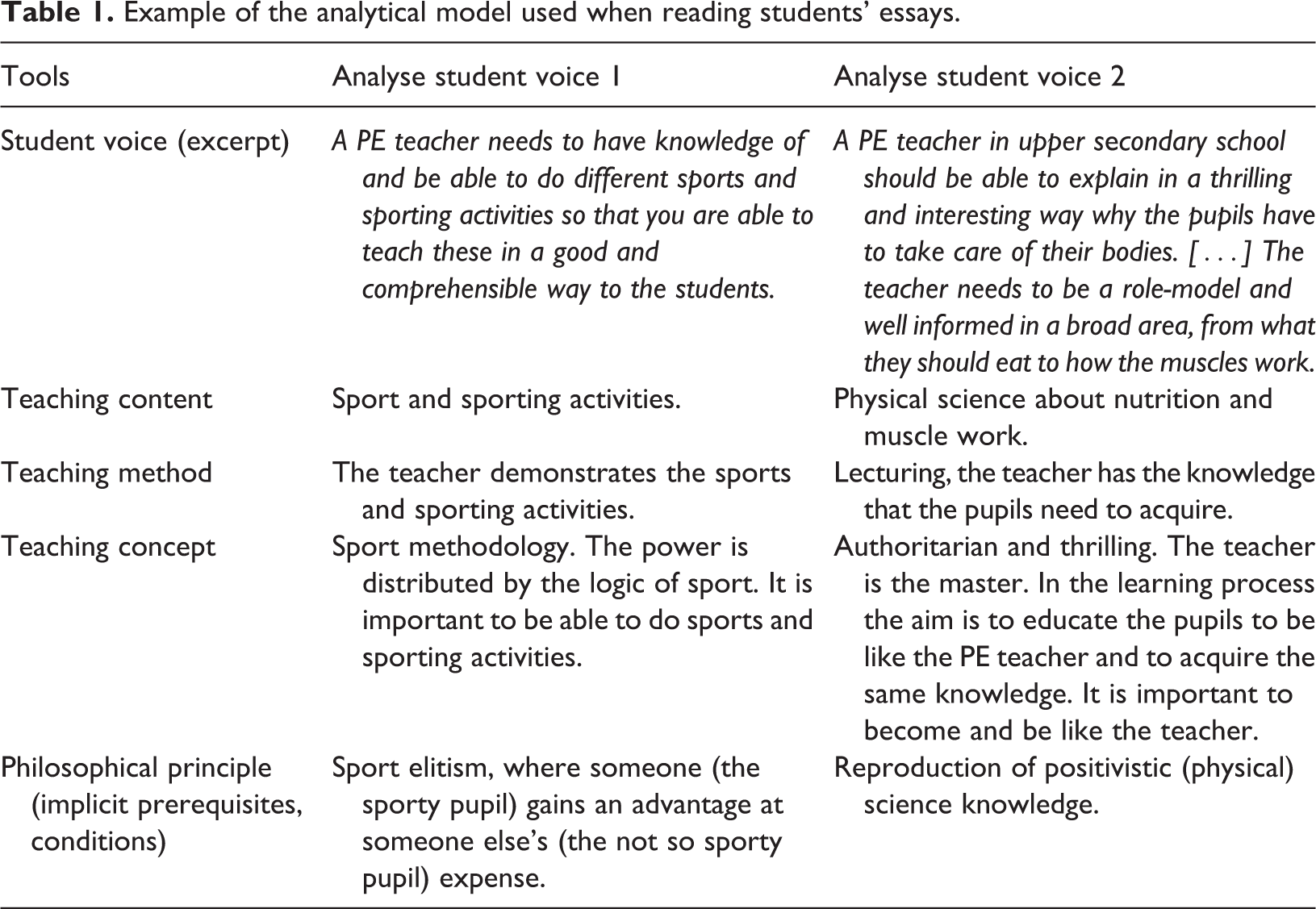
By identifying the notion of who needs to be changed, it is possible to analyse the principles of how power is distributed, and thereby the doxa. In that way, patterns in the students’ views on competencies needed for a PE teacher have been identified. Step one was to identify PE content and PE teaching methods. Step two was to analyse the PE teaching concept, and step three concerned the PE philosophical principle, meaning the implicit prerequisites and conditions in the PE context. In Table 1 we provide two examples of the analysis.
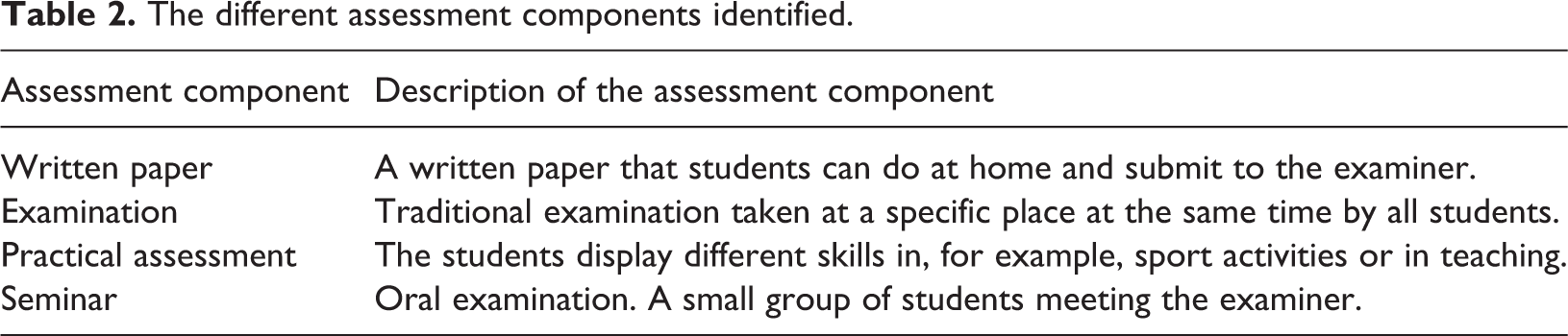
The analysis of the assessment components used in one PETE programme was conducted in two stages. The first stage was to categorise the assessment components and subject areas (the categories are inspired by Backman and Larsson, 2016) and to identify the patterns of meaning and the scheme of underlying principles for classification of how competencies are constructed (see Tables 2 and 3). The patterns and themes identified spread over four different types of assessment components and four different subject areas, as shown in the tables above.
The different assessment components identified.
The number of assessment components throughout the PETE (physical education teacher education) programme.
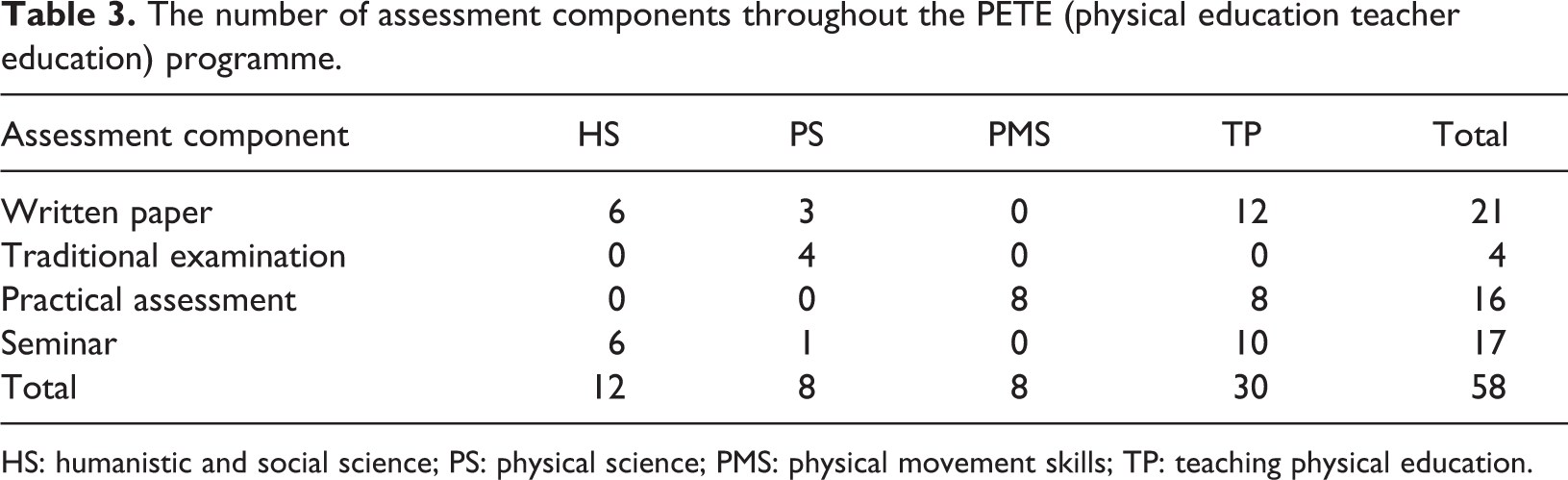
HS: humanistic and social science; PS: physical science; PMS: physical movement skills; TP: teaching physical education.
The second stage involved picking up both explicit and implicit expressions which communicated collective conceptions and the taken-for-granted assumptions in relation to PE teachers’ competencies. Recurring patterns and themes were first identified before these patterns or themes were deconstructed and explored in more detail by, for example, looking at verbs, tasks, tools, etc. We provide an example of this above (Table 4).
Example of the analytical model in the second stage.
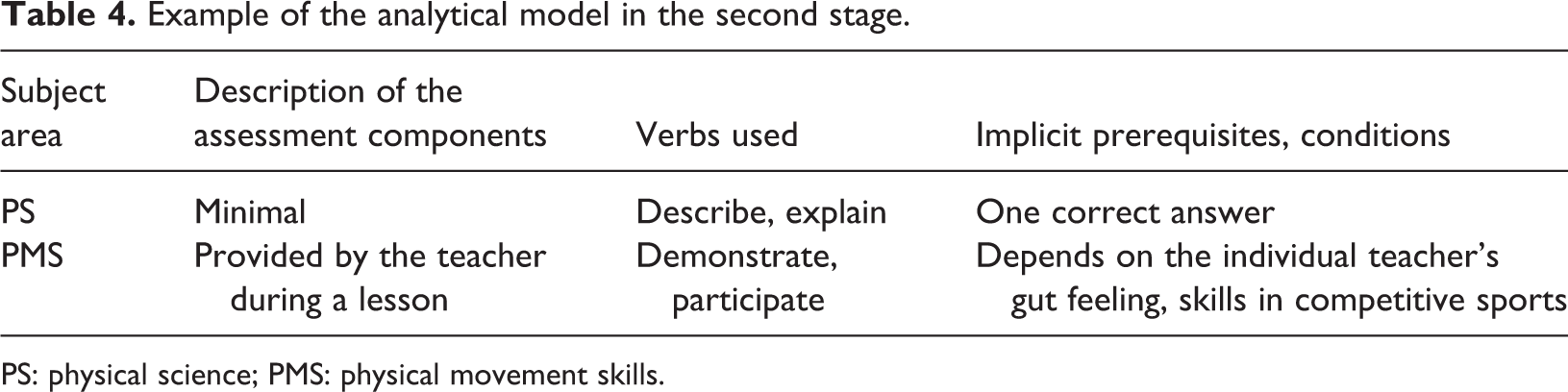
PS: physical science; PMS: physical movement skills.
In this analysis the implicit prerequisites and conditions about PE teachers’ competencies are central. We are interested in whether, and if so, how, these conceptions, expressed in the essays and in the assessment components challenge the doxa of PETE. If they harmonise, it means that the assessment components may not have the potential to challenge PETE students’ views. However, if they are not consistent at all, it is not self-evident, either, that assessment components will challenge students’ views. The most beneficial scenario is when they are not consistent and when the aggregated assessment components have the potential to challenge the taken-for-granted assumptions of what constitutes a ‘competent’ teacher of PE. We argue that the assessments’ implicit prerequisites and conditions have to be understood by their dynamic interrelations in PETE.
Findings
In the following section we present the findings of the study. The first part deals with PETE students’ conceptions of PE and the second part deals with PETE assessment components. The excerpts in part one are mainly selected to illustrate PETE students’ common views of PE, while the excerpts in part two are mainly selected to illustrate assumptions about PE teachers’ competencies expressed in the assessment components.
PETE students’ understandings of PE
Two overriding themes were identified in the essays about the content of PE and what competencies PE teachers need. The first concerns perspectives on health and sport, and the second one is about the pedagogical skills that a PE teacher needs – especially in relation to some pupils.
Health and sport – areas of science and sport performances
Two particular content areas are expressed as pivotal by the PETE students. The first content base focuses on knowledge about, and the importance of taking personal responsibility for, the maintenance of good health. The second pivotal content area is related to sport activities. These two areas are often addressed in relation to each other. For example, one student proposed that: My future pupils should learn about the importance of human movement, to be physically active several times per week. They should learn about health. What is good for their health and how they can improve their own health.
The PETE students describe sport as important – not only as a way of achieving better health, but also to try different types of sport, since sport plays a crucial role in our society. Providing the pupils with different sporting activities gives them opportunities to try many different sports so that they can find one that they will continue doing later in life. Swimming and orienteering are mentioned frequently and are not only seen as activities to try out, but also as providing knowledge needed for adulthood. Content such as outdoor education, risk and safety management and CPR are also mentioned, but only by a few students. When it comes to expectations of the knowledge and competencies that the PETE students themselves need to develop throughout their degree, there are great similarities with what they mentioned above about what is important in PE, in other words: […] a PE teacher needs to know a little bit about a lot of things. This gives the teacher more credibility and provides opportunities for more variety. You should for instance know the different shots in badminton or volleyball. (Student voice) […] nutrition, anatomy, physiology, be able to talk about being healthy and how to exercise properly. How to do good warm-ups and stretching which is super-important when exercising. (Student voice) Throughout my whole PE teacher degree, I expect to try and learn about a whole range of different sports that I have not come across that much before since I have mostly played soccer. Because I think that sport is great fun and I like all sports. (Student voice)
Pedagogical skills are needed
In addition to specific content knowledge, the themes also include other competence areas. Beyond subject knowledge, they highlight, for instance, pedagogical skills: It is not enough to know how to kick the ball and to run fast, you also at the same time need to be a pedagogue. (Student voice) I expect to acquire good knowledge so that I can fulfil my teaching tasks in the best possible way. Teaching = to be direct and clear so that the information reaches the students, great patience. How I, in a good way, can engage with and teach the pupils so that their experiences of sport in PE will teach them how to acquire the knowledge needed to have a healthy lifestyle and to participate in those things which are important in our society, that is different sports.
What is assessed in PETE?
The analysis of course booklets in one of the PETE programmes demonstrates how the PETE students’ competencies are assessed several times and in different ways throughout the degree. Each semester consists of several course modules with different content and assessment components that can be linked to different subject areas. The assessment components demonstrate that different subject areas’ traditions can be reflected in the specific assessment tasks and also related to the PE traditions. The patterns of meaning that constitute the subject area and the subject area’s traditions seem to function as a scheme both for what type of assessment component is available and as a scheme of classification for what assessment tasks to use and for what kind of student responses to expect.
Different subject areas’ traditions
The subject area of physical science is the only one which has traditional examinations. The descriptions of the examinations are often minimal. For example, the guidance provided to the students in a physical science examination is: ‘To pass the examination you need 60% and to pass with distinction 80%’.
The questions in the examination have only one correct answer. There is no recognition of other perspectives or other ways of understanding the body. In the following examples the examination tasks focus on the body as an object: Describe the four stages of motor development (Examination in ‘Motor skills’, 1.5 credits). Which parts of the skeleton are muscles (e.g. biceps) attached to, origin and insertion? (Examination in ‘Physical science’, 7.5 credits)
Assessment components in the subject area of humanistic and social science differ from physical science. The types of assessment components are written papers and seminars. They are both characterised by descriptions that are often extensive and contain a lot of questions besides the main question to be answered. They also require specific references to literature that the students are expected to use. The questions are often complex, such as: Use the prescribed literature to critically examine two different movement cultures important for learning, body awareness, identity and health, and their importance for the teaching of physical education and health. The selected cultures should be described (briefly), compared, analysed and discussed from different perspectives. The relationship between the observed cultures, the school’s teaching of physical education and health, and the future professional role as a teacher should also be treated. The written paper should include 1200-1500 words and also be presented at the seminar. (Written paper in ‘Movement cultures II’, 7.5 credits)
Similar to physical science, subject traditions seem to dictate the choice of verbs used in the assessment tasks. The assessment components in humanistic and social science almost exclusively call on verbs such as ‘reflect’, ‘critically review’ and ‘discuss’. These verbs suggest that knowledge is socially constructed, not absolute and contingent on perspective.
The assessment components in the subject area of physical movement skills are often practical assessments. The descriptions are often minimal and seem to depend on the individual PETE educator’s assumptions or gut feelings of what competencies a teacher of physical education needs. As an example, from the course ‘Body, movement and health’, the only guidance given to the PETE students is: Specific descriptions for the different assessments are provided by the teacher. (Course booklet in ‘Body, movement and health’, 15 credits).
Some assessment components in physical movement skills have a strong connection to skills in specific activities related to cultural heritage, such as skating ‘forward, backward, and at least two ways to stop’ (Practical assessment in Outdoor education in ‘Body, movement and health’, 15 credits).
The physical movement skills assessment components are more often aligned to the physical science, with limited links to the humanistic and social science. This is demonstrated in this example from a swimming assessment where PETE students are required to: ‘Conduct a biomechanical analysis of a PETE student’s crawl technique’ (Practical assessment in Swimming in ‘Body, movement and health’, 15 credits).
The subject tradition in the physical movement skills assessment components is also reflected in the verbs used in the descriptions of these assessments. For example, ‘participate’ only occurs when assessing physical ability. Other common verbs used are ‘conduct’ and ‘demonstrate’.
In teaching PE both written papers and practical assessments are used. The descriptions are often very detailed as in this assessment component in ‘Physical education, health and learning’: The paper should result in components that can be used to assess and grade students in PE. Examples of such components are quantitative observation schedules, tests, exercise logbooks and materials for qualitative interviews. (Written paper in ‘Physical education, health and learning’, 7.5 credits)
The socially critical perspective is somewhat existent in teaching PE assessment components and also in the use of verbs such as ‘reflect’ and ‘discuss’. Even more common are verbs that reflect that teaching PE is about effective organising such as ‘plan’, ‘organise’, ‘observe’, ‘evaluate’, ‘lead’ and ‘implement’.
Discussion
This study, similar to previous studies (e.g. Capel et al., 2011; Larsson, 2009; Mordal-Moen and Green, 2014a, 2014b; Standal et al., 2014; Tinning, 2012), demonstrates how those who enter PETE seem to be strongly influenced by their previous experience and knowledge of sport and have developed a sporting habitus. The PETE students’ expectations and beliefs highlight how they, throughout their degree, want to pursue their passion and taste for sport further (Capel et al., 2011; Larsson, 2009; Maivorsdotter et al., 2014) and that their future teaching practices should lead to their pupils (even the uninterested ones) developing the same passion for sport.
This study also shows that implicit prerequisites and conditions in assessment components are very similar to the conceptions of competencies in the PETE students’ statements. Apart from the assessment components in the humanistic and social science, they highlight similar beliefs, norms and attitudes about what competencies PE teachers need (see Larsson, 2009; Velija et al., 2008). The results also show how the different disciplines have their own traditions regarding the ‘correct’ knowledge in the specific subject – and that knowledge is not necessarily linked to the more critical learning outcomes of teacher education. Contrary to previous studies (see, for example, Backman and Larsson, 2016), this study shows that socially critical perspectives exist in Swedish PETE today, but it is difficult to examine if they may develop the PETE students’ ability to adopt socially critical approaches and perspectives as part of their future PE teaching practice.
The mechanisms behind the assessment components indicate that the traditions of each subject area are linked to different social fields which, with their underlying principles of classification (Bourdieu, 1990), affect the types of assessment that are (im)possible and also what PE teacher competencies are taken for granted. Even if most of the assessment components include references to research and place high demands on the PETE students’ scientific knowledge, it is questionable whether, for example, merely having an examination with a repetition of facts, such as about muscles, may potentially challenge PETE students’ conceptions of what competencies and skills a PE teacher needs (see Hay and Penney, 2013; Lorente-Catalán and Kirk, 2016). The circumstance that physical movement skills are assessed in a way that seems to depend on the individual PETE educators, that physical science is assessed through written examinations and that several assessment components within humanistic and social science concern critically reflecting on societal issues does not, per se, challenge PETE students’ understanding of PE practice. If the knowledge within physical science is indisputable as pedagogical content and if physical movement skills are assessed separately with the support of gut feeling (see Larsson, 2009; Svennberg et al., 2014), the socially critical issues may easily be seen as not valid knowledge in the field of PE (see Figure 1).
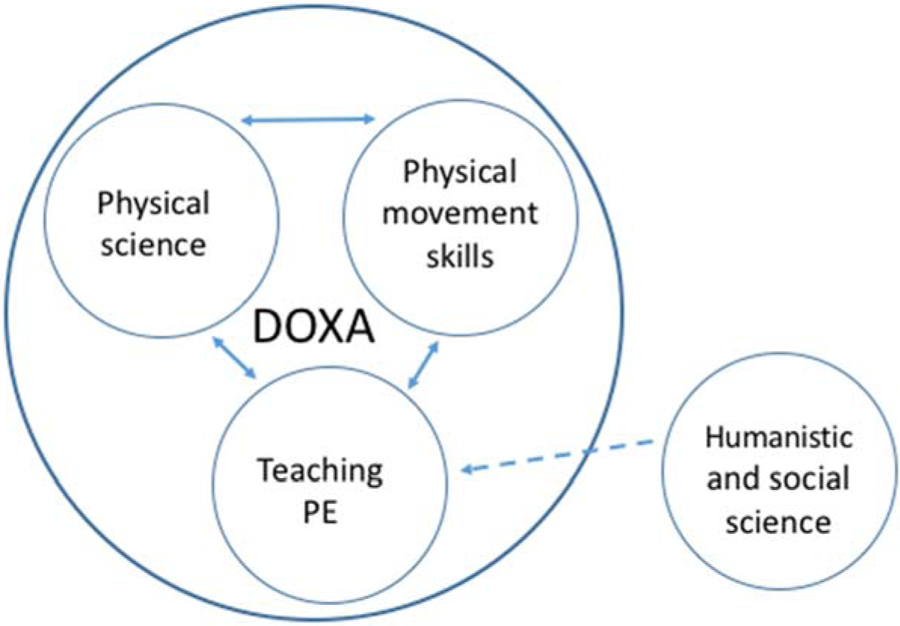
Assessments in PETE in relation to doxa.
Similar to findings in previous studies (Kirk et al., 2006; Larsson, 2009; Maivorsdotter et al., 2014), the assessment components in physical science, physical movement skills and teaching PE interplay and express an underlying doxa (see Bourdieu, 1977) of PETE. Humanistic and social science has the potential to challenge doxa in, for example, teaching PE assessment components. Several of these assessment components reoccur throughout the PETE programme, which may contribute to the challenging of the doxa if we consider the number and quantitative content.
However, there is a tendency that certain parts of these assessment components instead reproduce the doxa, by the dynamic interrelations between their implicit prerequisites and conditions in PETE. PETE students plan and organise PE practice, which is a normative process where normative assumptions and socially critical perspectives may interplay. A socially critical perspective may, for instance, lead to an awareness of disability, gender and equality issues. However, in a PE context, pupils with disabilities and of different genders are all individuals. Categorising them as homogeneous groups in need of one certain pedagogical approach may lead to stigmatising (groups of) pupils with presumed needs. Even if PETE students are provided with opportunities to analyse different norms and values pervading PE, it is not clear how the humanistic and social science perspectives could be used to assist in PE teaching without showing prejudice to ‘groups’ of pupils.
As a matter of fact, the use of socially critical perspectives in PE practice may (in the name of the doxa) stigmatise the ‘others’ in PE, those who are not physically active in their leisure time and those who do not look fit and sporty, and thus not challenge how power and social superiority or inferiority appear in the subject (see Brown and Evans, 2004; Camacho and Fernández-Balboa, 2006; Dowling, 2006). If socially critical approaches only end up being a perspective or a method for identifying certain groups (that are at risk and not yet passionate) and if the mode of learning is based on knowledge transfer, with the teacher as role model, there is a concern that some pupils might be stigmatised. This also means that the potential that assessing has to strengthen PETE and PE according to the reforms is very much uncertain (Annerstedt and Larsson, 2010). Like Lorente-Catalán and Kirk (2016), we argue that assessments need to be developed in order to challenge PETE students’ views of important PE teacher competencies, for example assessments concerning how to handle issues related to the power and social hierarchies that constitute the school subject in practice (e.g. Brown and Evans, 2004; Camacho and Fernández-Balboa, 2006; Dowling and Kårhus, 2011).
Conclusions
In the introduction we asked if the Swedish teacher education reform in 2011 might actually lead to educating PE teachers that have the abilities to question the logic of the practice that pervades PE. In this study we have shown that reforming one PETE programme per se does not necessarily challenge the doxa of PETE. The findings indicate that the PETE assessment components do not, due to their form and content, have the potential to reinforce a change in PE practice, to be more inclusive and to challenge how power and social superiority/inferiority materialise in the subject.
The content and the construction of assessment components do not clearly show how the PETE students in practical teaching situations are supposed to critically reflect and, in a more conscious way, act so as not to increase the social inequity that already exists in society. When everyone accepts ‘the rules of the game’, they cannot reflect on, challenge, argue in favour of, or fight against, the logic of the dominant practice or the types of knowledge that are deemed to be important and have their legitimate place in a PETE programme. Doxa might not be set in stone, but there seems to be a need to thoroughly reconstruct PETE if future PE teachers are going to develop socially critical approaches that truly challenge the prevailing assumptions about what competencies a PE teacher should have.
Based on the findings in this study, we suggest that there is a need for future research concerning PETE students’ learning in relation to the assessment components’ potential to reinforce or challenge students’ conceptions of what a PE teacher needs to know. It would be interesting to find and scrutinise assessment components including socially critical perspectives in PE practice that have a clear potential to challenge the doxa of PETE.
Footnotes
Acknowledgements
We would like to thank the two anonymous reviewers and the editor for their helpful comments and suggestions to improve this paper. We would also like to thank Karin Redelius for providing valuable feedback in earlier drafts on this article.
Declaration of Conflicting Interests
None declared.
Funding
The authors received no financial support for the research, authorship, and/or publication of this article.