




Abstract
In the context of implementing a physical activity policy as part of a national school reform in Denmark, the purpose of this study was to explore lower secondary teachers’ interpretations and perceptions of the physical activity policy with a focus on movement integration. In total, 14 teachers from four different schools were selected to take part in this qualitative study, which involved semi-structured interviews, focus group interviews, go-along observations and informal interviews. A thematic analysis framework was employed to identify and describe patterns of meaning within data. The findings showed substantial diversity among teachers’ interpretations and perceptions of movement integration, and consequently a lack of definitional clarity regarding movement integration and a possible misalignment between policy and practice. Teachers’ perceptions and interpretations of movement integration were influenced by other and more prioritised policies and discourses regarding academic achievement, as well as by intrapersonal, interpersonal and institutional factors. The findings also suggested a lack of support and collaboration within the school and provided insights into the strengths and weaknesses associated with the autonomy afforded in the Danish school reform.
Introduction
In August 2014, the Danish government passed a new reform for Danish public schools targeting primary and lower secondary education. According to the Danish Ministry of Education, the main reason underlying this reform was a need to improve the academic standard in public schools (Danish Ministry of Education, 2014). One of the major components of the reform related to physical activity (PA). Specifically, the reform included a policy which specified that PA should be a mandatory part of the longer and more varied school day, corresponding to an average of 45 minutes per day. According to the Danish Ministry of Education (2014), the underlying rationale of the policy was that “motivation levels and the learning process at large benefits from more physical exercise and activities that help improve the health of children and youth” (Danish Ministry of Education, 2014: 9). Accordingly, the Danish Ministry of Education (2014) provided examples of how the PA requirement could be met by introducing short periods of PA such as: a morning run; ball games or similar; other longer lasting and regularly scheduled activities in cooperation with local sports clubs; or by using PA as a pedagogical tool in working within various subjects. Besides these examples, the policy provides no other rules or guidelines on how to implement PA during the school day. The policy, however, states that “It is the duty of the headmaster [principal] to ensure that, within the overall teaching time, pupils participate in physical exercise and activity each day to an extent corresponding to an average of 45 minutes per day” (p. 9) (Danish Ministry of Education, 2014). While the overall educational reforms and policies are determined at the national level, responsibility for the implementation of the policies is retained by the municipalities and the individual schools. As a result, the individual school has a pivotal role in the enforcement and implementation of the mandatory PA, which affords a considerable degree of autonomy and flexibility at the school level.
A few reports have been published about the implementation of the new PA policy in Danish schools. Available research indicates that as a result of the policy teachers have become responsible for integrating PA into various subjects across the curriculum (Jacobsen et al., 2017). At the same time, existing evidence suggests that a considerable number of teachers, particularly lower secondary teachers, find it challenging to incorporate PA into the different subjects (Jacobsen et al., 2017). Despite some progress from 2015 to 2017, less than 20% of primary and lower secondary school teachers in Denmark use PA during lessons every day (Jacobsen et al., 2015, 2017). While Danish primary school teachers are generally positive towards the PA element of the school reform and believe that PA has a positive impact on student learning, lower secondary teachers are more sceptical about the policy (Jacobsen et al., 2017). Given that in Denmark primary and lower secondary school teachers are specialists (i.e. they typically teach two to four subjects in grades 1–3, 4–6 or 7–9), most teachers (besides teachers with physical education (PE) as one of their subjects) have very limited preservice training as well as experiences with respect to PE and PA.
Movement integration (MI)
A novel aspect of the Danish school reform is MI, which is defined as infusing PA into general education classroom time (Webster et al., 2015) and is recommended as an approach to school-based PA promotion (Institute of Medicine, 2013). Various terminologies are used to describe MI and relevant categories. Recent literature distinguishes between: academic-infused and non-academic strategies (Webster et al., 2017); task-relevant and task-irrelevant PA (Chandler and Tricot, 2015); and deliberate and incidental PA (Russ et al., 2017).
Numerous MI programmes have been successfully implemented worldwide and found to improve children’s PA (Goh et al., 2016), on-task behaviour (Mahar et al., 2006) and academic achievement (Mullender-Wijnsma et al., 2015). However, given that teacher buy-in is critical for MI to be used in schools, it is important to examine their perceptions of MI (McMullen et al., 2016). Indeed, several studies have explored teachers’ perceptions of, and ability to implement, MI (e.g. Goh et al., 2017; Martin and Murtagh, 2017; Stylianou et al., 2016). Despite the perceived benefits of MI, classroom teachers often perceive barriers to this approach, including lack of time due to competing pressures (e.g. academic testing and accountability) (Goh et al., 2017). Other commonly identified barriers include lack of perceived MI competence (Bartholomew and Jowers, 2011), lack of support (McMullen et al., 2016), and lack of awareness of policy requirements related to PA (Webster et al., 2017). However, available studies are predominantly limited to specific MI programmes, thus providing limited insights into this area of research with respect to broader school reforms.
Theoretical framework
The meaning of policy is often taken for granted and seen as an attempt to solve a problem through the production of a policy text that is straightforwardly adopted into practice (Braun et al., 2011). In contrast, for the purposes of this paper, we conceptualise policy as a process and a complex, dynamic, relational and on-going struggle over meaning (Penney and Evans, 2005). This acknowledges that teachers interpret, translate and potentially produce their own versions of the PA policy. As such, they decontextualise and recontextualise meaning, content and values (Bernstein, 1990; Penney and Evans, 2005). Beyond embracing policy as process, it is also critical to acknowledge how a policy cycle evolves in different contexts: the context of influence; the context of policy text production; and the context of practice (Bowe et al., 1992). In this study, we are focusing on how teachers interpret and translate the PA policy into the context of practice.
Various discourses, local factors (e.g. school facilities) and external factors (e.g. collective agreement and rules about working hours) influence the policy processes and teachers’ interpretations of the policy into the context of practice. Bronfenbrenner (1979) proposed a socio-ecological perspective that identifies and acknowledges multiple levels of factors that influence human behaviour. Further, McLeroy et al. (1988) suggested a socio-ecological model (SEM) in the health promotion field with five interrelated levels of factors. The intrapersonal factors include an individual’s personal knowledge, values and experiences. The interpersonal level includes influences from colleagues, students and other social networks. The institutional level has to do with structural factors, support, priorities and facilities within the organisation. The community level refers to the interaction and relationship with related groups and organisations. Finally, the policy level involves local and national policies. SEM is frequently used as a framework in research exploring factors that influence the implementation of practices (e.g. Dinkel et al., 2017; Langille and Rodgers, 2010; McMullen et al., 2016). Similarly, this study adopts SEM to explore the different levels of factors that influence teachers’ interpretations and perceptions of the PA policy and MI.
This study focuses on MI in lower secondary schools (i.e. grades 7–9, students 12–16 years), as we have limited knowledge about lower secondary teachers’ interpretations of MI internationally, and the interrelation between teachers’ interpretations and perceptions of the PA policy and MI in the Danish context. Its purpose is to add to relevant research by exploring lower secondary teachers’ perceptions and interpretations of the national school reform, with a focus on how movement is integrated within academic lessons in the Danish school setting.
To our knowledge this is the first study to investigate lower secondary school teachers’ perceptions and interpretations of MI in relation to a national school reform. Thus, it can provide valuable insights into the role of teachers in implementing national reforms involving PA and affording a considerable level of local/school autonomy in terms of implementation and accountability.
Methods
A qualitative approach was chosen for this study as it allows teachers to share their stories and voices, and thus contribute to a complex and in-depth understanding of teachers’ interpretations and perceptions of the policy and MI (Creswell, 2013).
Participants and settings
The school recruitment process involved sending invitations to more than 50 Danish schools located in the middle and eastern part of Jutland. The intention was to select schools according to principles of maximum variation (Creswell, 2013), including different school sizes, locations and socio-economic backgrounds of students as well as a variety in engagement levels with PA prior to the reform (e.g. exceeding or not exceeding government recommendations for PE and/or PA during the school day). However, only four state schools accepted the invitation to participate in the study and all four schools were selected. The schools were located in four different Danish municipalities. Three of the four schools were located in smaller towns and the fourth in a middle size town. All four of them had predominantly middle class, native Danish-speaking residents. The four schools represented typical Danish schools in organisation, size and environment, although one of the schools was a small village school. More information about the schools is available in Table 1.
Characteristics of participating schools and teachers.
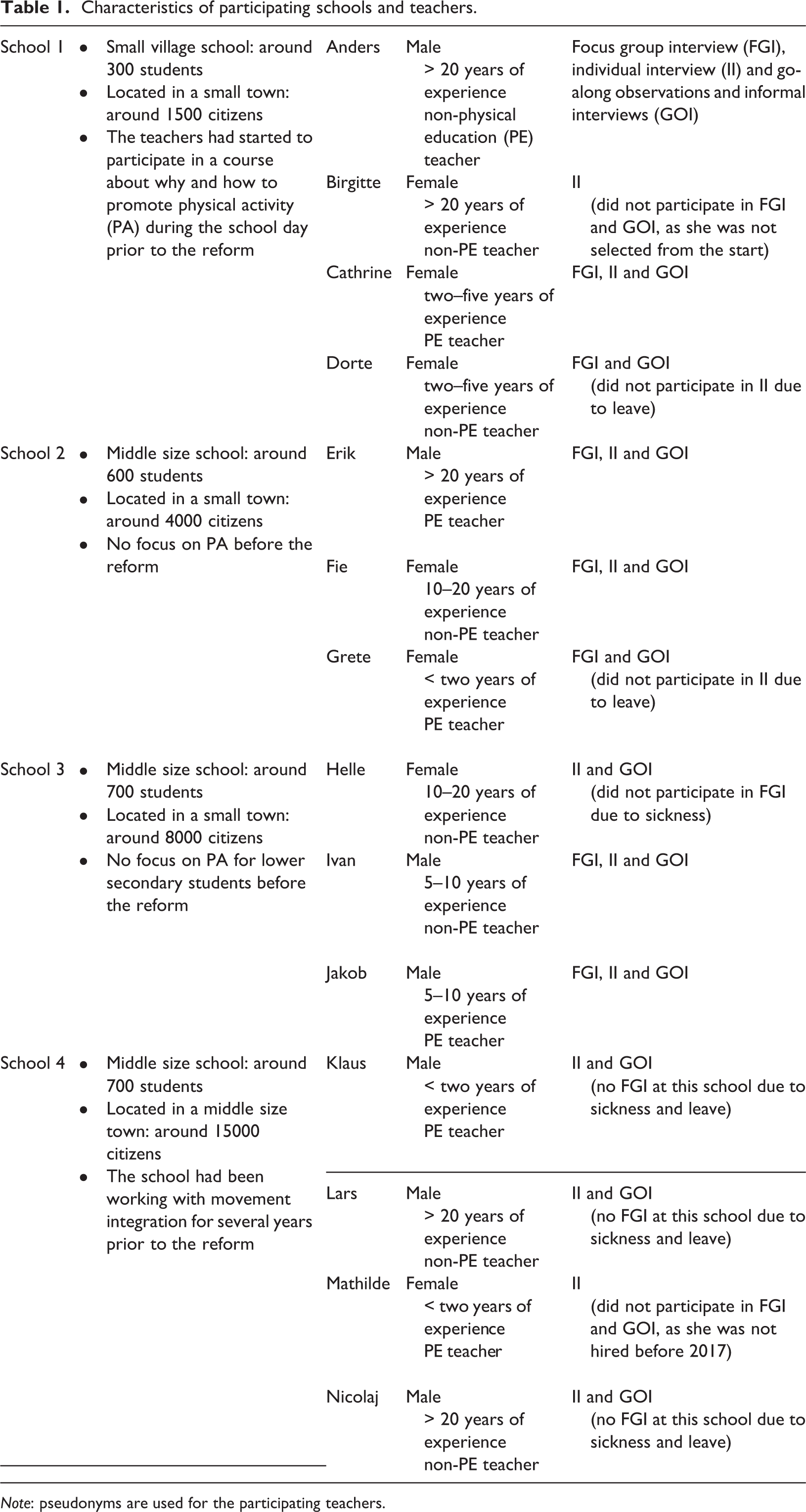
Note: pseudonyms are used for the participating teachers.
Even though the four schools did not meet the principles of maximum variation as initially designed, the study still aimed to recruit a diverse sample of teachers from participating schools. Within each school, the principal was asked to suggest three to four participants among the lower secondary teachers on the basis of the following criteria: (a) represented both sexes; (b) taught different subjects (at least one PE teacher and at least one non-PE teacher); and (c) had a range of teaching experience. As such, the participants were selected purposively (Creswell, 2013). The assumption underlying this selection strategy was that a diverse sample on the basis of the above criteria would afford opportunities for potentially various interpretations of the PA policy and diverse ways of implementing the policy in the context of practice to be shared. Similar research has indicated differences between: males and females (Egan et al., 2018); PE teachers and non-PE teachers; and newly graduated teachers and experienced teachers (Benes et al., 2016). Further information about the participating teachers is available in Table 1.
Data collection
Focus group interviews (FGI)
The FGI were conducted in order to gain insight into our participants’ perceptions as well as their social interactions while discussing the topic under investigation (Halkier, 2008). These interactions involved teachers commenting on other teachers’ experiences and perceptions and asking each other questions. The FGI guide was developed based on a literature review of teachers’ perceptions of implementing MI (Jørgensen and Troelsen, 2017). The guide addressed the following issues: teachers’ knowledge about and perceptions of the PA policy; teachers’ interpretations of MI; teachers’ intentions when using MI; preferred times, places and activities for MI during lessons; and perceived challenges and facilitators. The guide included predominantly semi-structured open-ended questions intended to give teachers optimal opportunities to freely express their views, beliefs and values, and allow probing questions (Kvale and Brinkmann, 2009). Three focus groups of approximately 90 minutes were conducted on school grounds at the participants’ convenience in October 2015. Due to illness and leave among the teachers selected at School 4, it was not possible to conduct an FGI. Accordingly, data collection at school 4 included an individual interview (II) instead of an FGI (cf. Table 1).
Go-along observations and informal interviews (GOI)
The combination of GOI (Kusenbach, 2003) in “natural” settings gave insight into how teachers carried out their daily routines and their interactions with students and colleagues. The observations and interviews focused on observing the implementation of MI during lessons and informally interviewing (without recording) the teachers in relation to observations to gain a more comprehensive understanding. The method also included observations of teachers between lessons, at the coffee station or copy machine and during formal and informal meetings. Data from GOI were collected in November 2015, lasted approximately 14 hours at each of the four schools and were recorded through field notes.
Individual Interviews (II)
The II were conducted in order to gain a deeper understanding of how the individual teachers interpreted and implemented the PA policy. A semi-structured format with open-ended questions was used to facilitate individual teachers’ responses of relevance to the study and follow-up questions (Kvale and Brinkmann, 2009). The interview guide was informed by previously collected data from the focus groups as well as SEM. Teachers were asked about their values, interests and experiences concerning MI, PA and sport, along with their perceptions of the policy and associated challenges (e.g. “In which situations do you find MI meaningful?”). In alignment with SEM, teachers were prompted to respond to questions that focused on intersecting issues relating to: the national policy; the local school (e.g. structure, facilities, colleagues and students); and their individual background. In total, twelve interviews of approximately one hour were conducted during school time on a day and at a time convenient to the teachers in January 2017.
Data analysis
Data analysis was an ongoing task during the study and was conducted using NVivo software. It began with the verbatim transcriptions of the audio-recorded FGI and the field notes from the GOI and continued with the transcripts of the II. Data were analysed using a six-phase thematic analysis because of its flexibility as a method for identifying, analysing and describing themes or patterns of meaning within data (Braun and Clarke, 2006). The first phase involved becoming familiar with all aspects of the data. During the second phase, a long list of initial codes was generated in an inductive and data driven process. The third phase involved sorting the different codes into potential themes and collating all the relevant coded data extracts within the identified themes. In this phase, SEM was applied to identify the potential influences of the different levels of factors concerning teachers’ interpretations and perceptions of the PA policy and MI. In the fourth phase, themes were reviewed and refined, and the themes from the FGI and the GOI were used to test the themes and codes from the II. Within the fifth phase, themes were defined, refined and named, as well as negotiated with co-authors and critical friends (Creswell, 2013). Finally, in the sixth phase, selected extracts were analysed in relation to the research question in order to provide sufficient evidence of the themes within the data.
Several strategies were used to support the trustworthiness of the findings (Creswell, 2013). The data from the FGI as well as from the GOI were used to triangulate the findings from the II. Further, peer debriefing was used, which involved discussing the study protocol and analysing the data and negotiating themes with the co-authors and critical friends.
Findings
In analysing the data collected for this study, three themes were developed: diversity in teachers’ interpretations and uses of MI; influences from students, colleagues and principals; and dichotomies in teachers’ perceptions of the PA policy and MI. Different levels of factors within SEM were evident in the data. Intrapersonal, interpersonal and institutional factors seemed to particularly influence the teachers’ interpretations and perceptions of the policy and MI. However, the analysis also showed an interrelatedness between the different levels of factors.
The three themes and relevant subthemes are presented below, supported by quotes translated into English. All quotes used originate from II unless otherwise specified . Where relevant, more context (e.g. teaching experience) is provided.
Diversity in teachers’ interpretations and uses of MI
The first theme provides insight into how teachers in the study interpreted and used MI. Three different ways of interpreting MI were evident in the data: MI as academic movement activities; MI as breaks; and MI as an incidental part of the lesson. Further, we found that teachers’ interpretations and MI approaches were informed by high-stake policies about enhancing academic achievement along with intrapersonal factors such as teachers’ values and competences and their knowledge about the policy, and structural factors such as lack of preparation time.
MI as academic movement activities
Even though the PA policy in Denmark provides flexibility in fulfilling the requirement of providing 45 minutes of PA each day for every student, most of the participating teachers described MI as academic movement activities. However, there was substantial variety of opinions among teachers about the importance, content or purpose within academic movement activities. Most of the examples that teachers provided involved activities that combined the subject and task-irrelevant PA. For instance, students participated in relays and ran around finding, collecting or remembering words and cards. Lars gave an example of this: They [the students] get a sheet of tasks, and then they can run from one side to the other and answer the questions.
Even though some teachers in the study reported finding academic movement activities meaningful, this was not a common way of implementing PA during classroom time. Some teachers reported that they experienced challenges when trying to incorporate MI as academic movement activities and shared examples of how high-stake policies play into these processes. Mathilde highlighted: I haven’t got the time for it [MI]. I have so much to do during my lessons. It [MI] can become stressful because of all the [academic] demands. […] If I estimate the time spent on academic movement activities and compare with the benefits, then it would often be better to let the students sit at their tables. It takes a long time to prepare [academic movement activities] […] I would really like more time to prepare this.
MI as breaks
MI as breaks was a common way of implementing MI for most of the teachers in this study. Teachers used breaks as a non-academic approach within lessons if students lost focus or became restless. For example, Erik (FGI) discussed: I think it’s fine that they [the students] get a break [during the lessons]. I tell them to take a walk outside. To get some fresh air and some physical activity. I often use PA as a break. The students get a feeling of a change during the lesson and something different is happening, which gives you new energy and oxygen to the brain. And then you’re ready to move on.
A common way that teachers implemented breaks was by asking students to take a walk outside. In this way, students could decide if and how much they moved during the break. As Fie shared, on these occasions: They [students] actually control it themselves, but they like to get out and get some air. I never prepare those brain breaks and that These breaks are the most common, because it is the easiest [way to use MI]. It’s not because it’s the best, it’s just because it’s easy.
MI as an incidental part of the lesson
Some of the teachers in the study expressed a broader understanding of MI than others. They talked about MI as an implicit or incidental part of the lesson. This involved activities that the teacher did not prepare to promote PA or to promote learning or other benefits through PA. Birgitte talked about MI this way: It [MI] is situations when students move around, when they must be in groups and put the tables together and so on and so on. For me, MI is about changes [in teaching practices]. You can call it transitions during lessons. In physics they [the students] are moving anyway, because they are not sitting. They stand up, walk around, picking up equipment and doing experiments and so on. According to the policy, this is also MI. That’s when you don’t sit down. It can be defined this way anyway, but it is not activities with high pulse of course. We wanted to see some historical findings and we went there by bike. We didn’t take the bike because we thought about MI, but because we had to go there. But it’s MI.
Influences from students, colleagues and principals
The second theme relates to how students, colleagues and principals seemed to influence teachers’ interpretations and uses of MI. Within this theme, the following central subthemes were constructed: Students’ response to MI; and Lack of collaboration and leadership.
Students’ responses to MI
According to participating teachers, an interpersonal factor in the form of students’ responses to MI influenced their approach to MI and how much MI was incorporated into the classroom. Some teachers reported that not all students had positive attitudes towards MI, and that some students would prefer to continue what they were doing at their desks. For example, Birgitte said: Some students find it [MI] annoying because suddenly they have to stop in the middle of something […] And some of them tell me that they find it uncomfortable to participate […] they are afraid to look silly. In seventh [grade] they are often happy to get out of the classroom, but especially in ninth grade they are not always crazy about leaving their chair. Those ninth-graders, they don’t bother to participate. You could say that this should be a reason to make them participate, but that’s not a battle I bother to take. It’s hard to find something new and catchy. I think they [the students] have the feeling: ‘We have done this before’, ‘we have done relays’, ‘we have collected cards’, ‘can’t we just…?’, I hear a lot of: ‘can’t we just?’ ‘Can’t we just have a ten minutes break and then continue what we are doing?’
Lack of collaboration and leadership
The diversity among teachers’ interpretations of MI revealed that the interpretation of, and responsibility for, MI were delegated to the individual teacher. Possibilities for collaboration and discussions with other teachers and the principal seemed absent due to institutional or organisational factors. The lack of collaboration was evident in all four schools and seemed to contribute to the diversity in teachers’ interpretations and perceptions of MI. As Mathilde put it: We discuss neither purposes nor content [related to MI] with each other. No one knows if there is any MI at all […] It’s just something that the principal expects to happen […] It hasn’t even been discussed at any meeting. The principal does not interfere in what we are doing regarding MI. I would really like if it [MI] was something that the teachers were fighting for. […] if we were on the same side. We don’t discuss the purpose and I don’t need a common purpose. We have so many things to think of, and this [MI] is not something we prioritise. I’m sorry to say. We don’t discuss purposes with each other. I actually think that most of us only use MI because we are told to.
Dichotomies in teachers’ perceptions of the PA policy and MI
The final theme demonstrates how teachers’ perceptions of the PA policy are dichotomous. It also highlights the influence of intrapersonal factors, such as knowledge, values and competences, on teachers’ perceptions of the policy. In the analysis, the following three dichotomies were evident in teachers’ perceptions about the PA policy and implementation of MI: No change or major change; Important part of my job or not my job; and Easy or difficult.
No change or major change
Most of the teachers in the study expressed that the PA policy had not impacted their teaching practices. Some of these teachers talked about MI as something they had always done, and they did not reflect on the purpose of the PA policy. For example, Ivan said: I don’t think it has caused a major change to my practice. MI has always been a part of my lessons. Somehow, unconsciously. I almost never let my students sit down and listen for a whole lesson. At the beginning [of the reform] I thought that it [MI] should relate to the subject. But I don’t think like that anymore. […] It [MI] is almost anything when they [the students] are not sitting.
However, a few of the teachers in this study reported that the PA policy had significantly impacted their teaching practices. Anders described his experience as follows: It certainly has been a major change. I’ve been a teacher for many years and I don’t recall anyone telling me to do something different […] Suddenly we had a new reform, telling us to do certain things. And every teacher in Denmark should do it [MI]. It took quite a lot of time for me to get used to it. It really did.
Important part of my job or not my job
Most teachers expressed that PA should be a part of all children’s everyday lives and therefore viewed the PA policy in a positive light. For example, Klaus, who was a newly graduated PE teacher, said: I think it’s fantastic that PA has become a part of the school day. It simply forces the students to get out of the classroom once in a while. Sometimes I think there’s a conflict between what I would like to do if I had the time for it, versus what we must do in the subjects […] We must constantly test and measure [students’ academic achievement] in the subjects […] So MI is the first thing to be cut out.
There were also a few teachers in the study who held a negative perception of the PA policy. Anders, a non-PE teacher with more than 20 years of teaching experience, discussed: I think it’s a bad idea […] But I have no problem implementing MI. As long as it’s dictated from above, I’ll do it. I don’t care about how much students move around as long as they are good at the subjects I teach. […] I think that the school day should be shorter, so the kids would have sufficient energy for participating in activities in the sport clubs. I don’t think PA is something for the school to take care of. I think it’s absurd that you remove possibilities for PA in other places in society, and then we have to do MI in our academic lessons. It’s not a reasonable demand to make teachers who don’t know anything about movement incorporate MI. I would prefer that the PE teachers took care of the daily PA.
Easy or difficult
Most teachers in the study did not find MI difficult. In spite of some of the teachers reporting a lack of ideas and inspiration, the majority of teachers believed that they already had the competences needed for MI. When asked about whether she felt prepared for MI, Fie replied: It’s not something that a teacher can’t do. You know that’s the way we are – teachers. We’re used to being creative and finding solutions. I think the integrated part [academic movement activities] is difficult in some subjects. I think that it’s very challenging and hard to see how to do it.
Discussion
In the context of a national school reform in Denmark, the purpose of this study was to explore lower secondary teachers’ perceptions and interpretations of a PA policy, with a focus on how movement is integrated within academic lessons. The findings of this study demonstrate substantial diversity among teachers’ interpretations and perceptions of the policy and MI. Consistent with related studies (e.g. Kirk and Macdonald, 2001; Leow et al., 2014), it was evident in the data collected for this study that teachers recontextualised the PA policy in their own way and devaluated the PA policy priorities in the light of high-stake policy about enhancing academic attainment. The study also documented how the different levels of factors within SEM appeared to be interrelated in influencing teachers’ interpretations and perceptions of MI, and in turn their implementation of the policy. The inherent flexibility within the Danish PA policy text seemed to facilitate heterogeneity of purposes, content and commitment at the level of implementing MI into the context of practice.
The teachers in our study reported employing different MI approaches, which were influenced by their perceptions of the policy and factors from different levels of SEM. MI as breaks was a common approach shared by participating teachers. Breaks were interpreted as a non-academic strategy and, similarly to previous studies, seemed to be chosen by teachers as a convenient, simple and short form of MI (McMullen et al., 2014). Consistent with related studies, some teachers in this study found MI to be an “add-on” to their current demands (Cothran et al., 2010; McMullen et al., 2016), and a few teachers even found MI to be antagonist to academic instruction or learning benefits (Webster et al., 2017).
Similar to the findings of previous studies, intrapersonal factors, including a lack of knowledge about the benefits of MI (Benes et al., 2016) and a lack of awareness of the PA policy content (Allison et al., 2016; Webster et al., 2017), as well as interpersonal factors such as students’ negative responses to MI (Webster et al., 2017), influenced teachers’ interpretations and perceptions of MI. Lack of time due to academic pressures and an already overcrowded schedule was also perceived as a barrier to MI in this study, and is consistent with previous findings in this area (e.g. Cothran et al., 2010; McMullen et al., 2016; Parks et al., 2007). This demonstrates that unless teachers perceive MI as supportive to academic requirements, they may resist incorporating movement in their teaching practices. Teachers’ reflections about MI purposes and content could probably benefit from knowledge about the possible relation between PA and learning.
Teachers’ understanding and use of MI as an incidental part of lessons seemed to be a way of legitimising existing teaching practices. As such, some of the teachers in the study complied with what Ball (2003) termed “cynical compliance”, where the teacher submits to the use of MI without subscribing to the values and purposes that fostered the policy (Leow et al., 2014). This kind of cynical compliance exposes a gap between the values and intentions within the policy and teachers’ interpretations and deficient preparation and implementation of MI, thus indicating a misalignment between the PA policy text and the context of practice. However, it is also an example of how teachers recontextualised the PA policy and struggled to find meaning in the context of practice (Maguire et al., 2015).
According to Webster et al. (2017), some teachers prefer to incorporate MI into naturally occurring transitions, because they see this as integrative rather than additive to classroom routines and practices. However, the teachers in this study who interpreted MI as an incidental part of the lesson did not try to promote PA or reflect on any purposes regarding MI. Instead they tried to avoid changes in their practices. In the future, it could be useful to consider if both deliberate and incidental strategies of MI (Russ et al., 2017) could benefit from discussions about MI purposes and content, in an attempt to achieve better alignment between the PA policy and practice.
Some teachers did not regard MI as their core mission, and consistent with other research (Cale et al., 2016), a few teachers did not consider the promotion of PA as their responsibility at all. Instead, they displaced the responsibility onto the students and their families as well as onto the government. This is concerning, if the components of PA policy are to be realised in practice and teachers are tasked with this responsibility.
Principals play a key role in allocating time for collaborative planning, the discursive articulation of policies, and what is prioritised in the curriculum (Leow et al., 2014). However, it appears that the principals at the four participating schools did not want to compromise teachers’ autonomy. A lack of direction from the principal, along with the lack of a written local policy and collaborative school culture may remove the pressure to implement the PA policy and allow teachers to make their own decisions about the implementation of MI. Nevertheless, as documented by Langille and Rodgers (2010), there could be a conflict between the autonomy and flexibility provided by the policy and the principals, and the directions and specificity wanted from teachers. The diversity among teachers’ interpretations of the policy and MI suggests a lack of definitional clarity and discussions about the PA policy and a lack of clarity regarding the scope of MI. Even though the policy must be flexible in order to reflect the different school contexts and teachers’ values and competence levels, there is a risk that the policy will be diluted, and that teachers’ interpretations of MI will become too inclusive, giving the impression that every kind of movement is synonymous with an MI approach. According to Russ et al. (2017), incidental MI includes all kinds of movement that are associated with increased heart rate, reduced sedentariness and increased PA. However, in the case of the Danish PA policy, reduced sedentariness or increased PA in itself is not mentioned as part of the policy purposes. A possible misalignment between policy text and practice could therefore also be a matter of lack of clear language regarding the intentions of the policy, the means of achieving them and the lack of specific accountability measures (Carlson et al., 2013; Stylianou et al., 2019).
Even though the principals in this study might have tried to encourage a decentralised individual approach to the use of MI, participating teachers did not have a sense of ownership of, and commitment to, the implementation of the policy. Possibilities for collaboration, shared decision-making and common commitment seemed absent due to other priorities communicated within the school. Yet, collaboration and support from colleagues and principals can have a major impact on implementation of MI (Langille and Rodgers, 2010; Webster et al., 2018), and research suggests that teachers want to feel connected to each other at their school and engage in collaborative planning (Egan et al., 2018). In a study by Dinkel et al. (2017), collaboration was identified as an underutilised resource by teachers for the promotion of MI, and this issue might also be the case at the four schools in our study.
The findings of this study accentuate the importance of acknowledging the possible diversity among teachers’ interpretations and perceptions of MI. They also provide additional insight into the complexity of how the levels of factors within SEM are interrelated in influencing teachers’ interpretations and perceptions of PA policies and MI. Future research regarding the implementation of PA policies should acknowledge the diversity in, as well as the interdependence between, teachers’ interpretations and perceptions of policies. A limitation of this study relates to the lack of consideration of principals’ and students’ perspectives. Future research should consider collecting data from different stakeholders to provide a richer understanding of policy interpretation and implementation as well as relevant influencing factors.
Conclusion and recommendations
This study provides insights into how a PA policy that is part of a national school reform is interpreted and transformed by individual teachers. The study confirms that policy implementation is not simply a matter of teachers adhering to a fixed PA policy text and putting PA into the context of practice. Rather, it was clear that the policy text was recontextualised as a result of individual interpretations. Teachers are different and operate in various contexts. Accordingly, they interpret and perceive PA policies in unique ways influenced by various discourses, by other high-stake policies, and by intrapersonal, interpersonal and institutional factors.
Given the level of flexibility inherent in the policy, more attention on school-level implementation seems to be necessary. In order to help teachers to make sense of the policy in the context of practice, we suggest that principals provide leadership in initiating discussions about values, purposes and priorities related to the PA policy. To facilitate policy implementation, we suggest that principals work on establishing a supportive and collaborative school culture and allocating necessary resources in the form of materials, training time, preparation time, and collaboration time. We also suggest that principals acknowledge that teachers are different. If governments and principals wish to foster meaningful connections and avoid misalignment between the PA policy text and school priorities and practices, their approaches need to acknowledge teachers’ histories, values and identities. At the same time, it is expedient to have all teachers within a school discuss the rationale behind the PA policy and expected outcomes, to promote a coherent articulation between the context of policy text production and the context of practice.
Footnotes
Declaration of Conflicting Interests
The authors declared no potential conflicts of interest with respect to the research, authorship, and/or publication of this article.
Funding
The authors received no financial support for the research, authorship, and/or publication of this article.