



Abstract
There is international consensus that creativity is a fundamental outcome of schooling. Opportunities exist to enhance the creativity of schoolchildren, particularly in movement-based subjects such as physical education (PE). In this pilot study, we investigated the effect of a six-week dance-based PE intervention on children’s creativity in a primary school context. Forty second grade students participated in a controlled trial. One class (n = 20) was assigned to the intervention and participated in dance-based PE lessons (10 girls, 10 boys; age 7–8 years). The other class (n = 20) was assigned to the control condition and continued regular PE with no dance (10 girls, 10 boys; age 7–8 years). Pre–post assessment of creativity was obtained through an adapted version of Guilford’s (1967) Alternative Uses task. Data were analysed using linear mixed models, with adjustment made for children’s perceived dance ability and for baseline differences in creativity between groups. The overall effect of the intervention was small (d = 0.36, 95%CI = –0.21 to 0.92), but not statistically significant (p = 0.21). Post-hoc analysis revealed a large difference in the effect of the intervention between children with above and below-average baseline creativity (d = 1.26, 95%CI = 0.14 to 2.39, p = 0.03). Children with above-average creativity at baseline benefitted more (d = 0.99, 95%CI = 0.01 to 1.96, p = 0.047). This pilot study provides further support for the place of dance and creativity within the PE curriculum. However, particular attention should be given to students’ starting points.
Introduction
Although the development of numeracy and literacy remains a primary concern for educational policymakers (Global Education Monitoring Report, 2016), there has also been an increased emphasis in recent years on the development of creativity as a cross-disciplinary outcome of schooling (Kim and Pierce, 2013; Tienken, 2016). This is largely in response to research published by Kim (2011) which showed that, even though assessments of intelligence in the United States have shown a steady increase over the past 30 years – according to what is known as ‘the Flynn effect’ (Flynn, 2007) – creative thinking scores in schoolchildren have remained largely stagnant over time, and have even decreased in some younger age groups (e.g. kindergarten).
Creativity is a complex construct though, and perceptions about its meaning and malleability have evolved over the years (Craft et al., 2001; Harris, 2016). Historically, there has been much debate about whether creativity is a fixed trait or a natural endowment (Feldman et al., 1994; Gardner, 1993), or whether it is a latent ability within all individuals that is awaiting activation and therefore always potentially amenable to change (Craft et al., 2001). Today, there is much more consensus that creative potential is something that can be nurtured, developed, and improved (Beghetto and Kaufman, 2016; Kaufman and Beghetto, 2009), and that creativity can be understood as both an individual trait and as an outcome of tasks that are accomplished by individuals or groups (Doron, 2017). It is this latter, task-related, notion of creativity that is particularly suited to improvement through schooling (Richards, 2010; Tienken, 2016).
There is substantial research evidence that creative thinking and behaviours can be enhanced through intervention (Hernández-Torrano and Ibrayeva, 2020; Scott et al., 2004a, 2004b). Whilst arts-based education has naturally been the subject matter most closely associated with creativity promotion and cultivation (Burton et al., 1999, 2000; Fürst et al., 2012; Winner et al., 2013, 2014) – and arts-based intervention studies in schools have been shown to positively impact young children’s creativity (Celume et al., 2019; Ebert et al., 2015; Hainselin et al., 2018; Lee et al., 2015; van de Kamp et al., 2015; Yeh and Li, 2008) – numerous studies now show that such creative thinking and behaviours can be enhanced across the curriculum in many (if not all) subjects by exposing learners to activities that require problem-solving, exhibiting flexibility, improvising or adapting to new stimuli, and responding to unexpected situations (Beghetto and Kaufman, 2016; Bereczki and Kárpáti, 2018; Davies et al., 2013; Silvia et al., 2014; Tan, 2001).
Research focus: Dance-based physical education and creativity
School-based physical education (PE) has been recognised for some time now as an important pedagogical setting within which to assess and develop creativity (Phillip, 1969; Stinson, 1975; Torrance, 1965; Wyrick, 1968). As a consequence, enhancing creativity has historically been proffered as one of the many benefits of PE – for example, in the context of higher-level PE delivery for the gifted and talented (Bailey and Morley, 2006; Bunker and Thorpe, 1982; Griffin and Butler, 2005; Hastie, 2010; Memmert, 2015; Morley and Bailey, 1988; Mosston, 1966, 1981; Moston and Ashworth, 1986, 1994, 2002), but also in the context of early years education where movement exploration and play are conceived of as the natural modalities for creative expression (Grammatikopoulos et al., 2012; Konstantinidou et al., 2011, 2014; Pagona and Costas, 2008; Trevlas et al., 2003; Zachopoulou et al., 2006).
In England (National Curriculum for Physical Education UK [NCPEUK], 2013), as elsewhere in Europe (Gibbs et al., 2016; Larsson and Karlefors, 2015; MacLean, 2016; Mattsson and Lundvall, 2015; see also European Commission’s Education, Audiovisual and Culture Executive Agency [EACEA] Eurydice Report, 2013), dance has been identified as an area within the PE curriculum where schoolchildren can be introduced to the creative process (Chen, 2001; Chen and Cone, 2003; Kim, 2002; Lai Keun and Hunt, 2006; Macdonald, 1991; Rovegno, 2000; Sowden et al., 2015). This is because dance, and creative dance in particular, encompasses the performance, composition, and appreciation of human movement, with a particular focus on producing aesthetic value (Pickard and Maude, 2014). Such dance-based PE can give schoolchildren the opportunity to engage in activities that promote embodied cognition (Giacosa et al., 2016; Sevdalis and Keller, 2011), which has been shown to be associated with executive functions (particularly cognitive control, flexibility, and improvisation skills) known to subtend creativity (Diamond, 2013; Radel et al., 2015; Sharma and Babu, 2017).
Experimental research on dance-based activities and creativity is still in its infancy though. Our review of the literature revealed fewer than 10 empirical studies which had sufficiently robust research designs to be considered for systematic reviewing or meta-analyses (Moher et al., 2015). A limited number of these experimental studies have been published in journals associated specifically with PE (e.g. Bournelli, 1998; Cleland, 1993; Cleland and Gallahue, 1993; Lai Keun and Hunt, 2006). In such a limited context, research evidence on the creativity-enhancing effects of dance-based interventions has been positive, but it remains equivocal. A major reason for this is because different studies have shown that dance-based interventions can have a positive effect on different components of creativity – for example, on fluency in Caf et al. (1997) and Campion and Levita (2014), flexibility in Bollimbala et al. (2019), fluency and flexibility in van de Kamp et al. (2015), originality in Jay (1991), Sowden et al. (2015) and Richard et al. (2018), originality and elaboration in Reber and Sherrill (1981), and originality and abstractness in Minton (2003) – but no consistent effect on creativity overall. In short, the creativity-enhancing effects of dance-based PE are partially supported. However, further PE-based research is needed as, according to physical educators, PE includes a wide range of activities that allow creative outcomes to emerge, such as team games, practising sports skills, fundamental movement activities and motor improvisation, as well as dancing (Konstantinidou et al., 2011).
In view of this limited research, the aim of this study was to explore the effect of a dance-based PE intervention on task-related creativity in primary school-aged children. The study is significant because it adds further empirical evidence to an emerging field of inquiry, and because it also estimates and presents the effect of children’s baseline creativity prior to initiating the intervention (rather than simply controlling for it). Such extended analyses are of particular significance given the longstanding recognition within PE of the importance of student ‘starting-points’, and also given the natural variability in students’ preferences for different activities across the PE curriculum.
Method
Setting
The study took place in a single state co-educational primary school in England. The school was located in the West Midlands region, and in a constituency ranked nationally among the 30% most socioeconomically deprived (according to the Government’s official national index of multiple deprivation, Smith et al., 2015). The most recent Office for Standards in Education (Ofsted) UK report for the school states that the proportions of students (i) from minority ethnic backgrounds and/or disadvantaged backgrounds, (ii) who speak English as a second language, and (iii) with special educational needs and/or disabilities are above the national average. Despite such an ‘at-risk’ demographic profile, the report also stated that academic attainment at the school was approximately in line with national averages. Therefore, scope for an intervention to affect child-level factors was supported by baseline academic standards.
Participants
PE was compulsory for all students in the school and was taught for 1 hour per week on a class-by-class basis in their intact class groups. Personal communication with the PE specialist in the school indicated that lessons were predominantly sports based, and were designed to be in line with subject content which is specified in the NCPEUK (2013) for Key Stages 1 and 2. The study was designed as a two-armed, or parallel-groups, controlled trial. Forty second grade students were involved in the study. The school had two second grade classes that provided the two intact study groups for this quasi-experimental design: a dance-based PE group (n = 20; 10 girls, 10 boys; age 7–8 years) that received the intervention; and a control group (n = 20; 10 girls, 10 boys; age 7–8 years) that participated in sports-based lessons (with no dance) delivered by the PE specialist employed by the school in line with NCPEUK (2013). The intervention was assigned to the class group that undertook their PE lesson on a Friday. This was required to ensure the availability of instructors and supervisors to deliver the intervention. Parents provided written informed consent and children provided assent to participate in the study. The study was granted approval by a faculty-level ethics, health and safety committee that was convened at the University of Birmingham (UK). Five students were excluded on the basis of having English as a second language (ESL), severe learning difficulties, or a physical disability. These exclusions were applied by the school and not by the researchers as a matter of the study design.
Dance-based PE programme and delivery
Four site visits were undertaken prior to the intervention to liaise with the PE specialist at the school on the appropriateness and feasibility of the research design, to facilitate instructor site familiarisation, and to conduct pre-intervention testing. The intervention lasted 6 weeks and was delivered as weekly dance-based PE lessons of ∼50 minutes in duration. Each session consisted of a 5-minute warm up, 40 minutes of planned dance-based activities, and a 5-minute cool-down. The six lessons were individually themed to develop or enhance: (1) spatial awareness (Lesson Theme [LT]: pathways); (2) movement vocabulary (LT: travelling); (3) linking movements (LT: sequencing); (4) choreographing movement sequences (LT: composing [instructor-led]); (5) choreographing original movement sequences (LT: improvising [instructor-facilitated]); and (6) combining learning from (1)–(6) to perform an original movement sequence to the group (LT: appreciating [instructor-facilitated]).
Tasks for each lesson were finalised and agreed with the first author during a meeting held the day prior to each lesson. Each task was defined according to the following criteria: (i) description; (ii) duration; (iii) aim; (iv) presentation; (v) teaching points for instruction; and (vi) use of demonstrations, verbal cues, and questioning to encourage student learning. As an example of a lesson which combined at first limited (instructor-led) and then divergent (child-level) responses, in the opening spatial awareness dance lesson, the instructors used background music and verbal descriptive imagery cueing to set the scene for a jungle environment. Instructors began the lesson by asking children to think about and verbally articulate the movements of known jungle animals which the instructor would then demonstrate through movement (e.g. ‘wriggling like a snake’, ‘swinging like a monkey’, ‘marching like an elephant’, ‘prancing like a gazelle’). Children were initially prompted to mimic or reproduce the instructor’s movements. To practice the embodiment of a snake, for example, at a level close to the ground and to the sound of at once quiet and then all of a sudden pointed musical characterisation, children were encouraged to first ‘stretch’ and ‘elongate’ their bodies, to ‘wriggle’ or ‘slither’ smoothly, and then to ‘tighten up’ and to ‘flee quickly’ or ‘strike sharply’. Mimicking the embodiment of an elephant, in comparison, children’s responses were cued to overtly percussive sounds (e.g. ‘drumming’) and were invited to imagine the elephant’s slow, heavily articulated, movement pathways (e.g. ‘swooshing’ trunk, ‘swaying’ tail, ‘stomping’ feet).
As the lessons progressed, the instructors’ input was gradually withdrawn, giving children increased opportunities to act autonomously to more fully promote the cultivation of creativity. Sequential, open-ended, instructional design was incorporated into lessons to generate further divergent and even original movement responses (Chen and Cone, 2003). For example, after mimicking the embodiment of different animals and focusing on dance movement quality, towards the very end of the spatial awareness dance lesson, instructors transitioned to use of verbal cueing and questioning to elicit greater movement expression. Children were asked to imagine that they were moving through a densely populated jungle. After choosing the animal that they wanted to embody, the children were thereafter prompted to move divergently in relation to one another and to think about how the animal they were embodying could move in this context – e.g. ‘slippery’ snakes down low on the ground could ‘slither’ quickly out of the way of oncoming herds of elephants ‘stomping’ across the Savanna.
Instructor training and treatment fidelity
Sessions were delivered by a team of three instructors, the roles for whom – Session Lead (×1) and Session Support (×2) – were rotated each week. We reasoned that this would minimise the effect of individual instructor behaviour (in general) and teaching style (in particular), neither of which were the focus of the study. The instructors were final year students of a PE and coaching sciences degree programme from the University of Birmingham (UK). The instructors completed a Dance Education module the year before delivering the intervention. The module included (i) theoretical discussion and assessment of Laban principles and the conceptual framework for teaching dance (Pickard and Maude, 2014); (ii) weekly opportunities for practical application and peer-teaching; (iii) theoretical and practical considerations on how to teach learners with diverse needs and abilities; and (iv) evidence-based approaches to assessment-for-learning as a tool to inform teaching and to support student learning. Completion of this module (combined with extensive experience working with young children in a range of educational and coaching settings) assured the authors and the principal of the study school that the instructors could successfully deliver the intervention. Each intervention lesson was supervised by the first author as a matter of treatment fidelity. This was also a requirement of the ethical approval that was granted to conduct the study. The first author and instructors met the day before and immediately after each lesson. These treatment fidelity and quality meetings were effective for planning, for noting challenges, and for suggesting changes for the next lesson.
Outcome measure
Data were collected 1 week prior to the first lesson of the intervention and 1 week after the final lesson to ascertain changes that had occurred as a result of participation. The pre- and post-intervention assessment of creativity was conducted using an adapted version of Guilford’s (1967) Alternative Uses task, which is a widely used, validated, and reliable measure of creativity (Kleibeuker et al., 2017). With Guilford’s approach, creativity is operationalised as an individual’s ability to generate multiple and novel uses for a familiar object within a limited amount of time. Creativity, it is reasoned, requires both the ability to recognise a familiar object and also the ability to elaborate upon and thereafter overcome prepotent response tendencies that result in familiar uses of that object (Guilford, 1967; see also Benedek et al., 2014; Groborz and Necka, 2003; Zabelina and Robinson, 2010).
Theoretically speaking, the Alternative Uses task is considered a ‘domain-general’ assessment of creativity (Hong and Milgram, 2010; Qian et al., 2019; Runco, 1987; Sternberg, 2009). Such an assessment was deemed particularly appropriate for the purposes of the present study as we were interested in whether the tasks we designed for and delivered to the children during dance-based PE could affect creativity in a more general, or transferable, way. Use of such a domain-general assessment task was critical, we believed, as there is often an expectation in PE that intervention effects can translate across the curriculum (see for example Hardman and Marshall, 2005; Jacobs et al., 2013; Macdonald, 2013). Practically speaking, the task is particularly suitable for pedagogical research because it is both task-oriented and norm-referenced (i.e. it communicates to assessors how participants perform in relation to a specific activity relative to their reference group), and because it provides a total creativity score based on a multidimensional model which includes four creativity-relevant outcomes: (i) fluency, (ii) flexibility, (iii) originality, and (iv) elaboration (described below) (Guilford, 1967; see also Dietrich, 2004). In principle at least, this is beneficial for practitioners because it can allow for the monitoring and targeting of specific creativity subcomponents. Furthermore, where shortfalls exist, interventions can be tailored directly to address students’ needs in one or more subcomponent area. Our interpretation of the relationship between the six lesson themes for the intervention and this multidimensional model of creativity is illustrated in Figure 1.
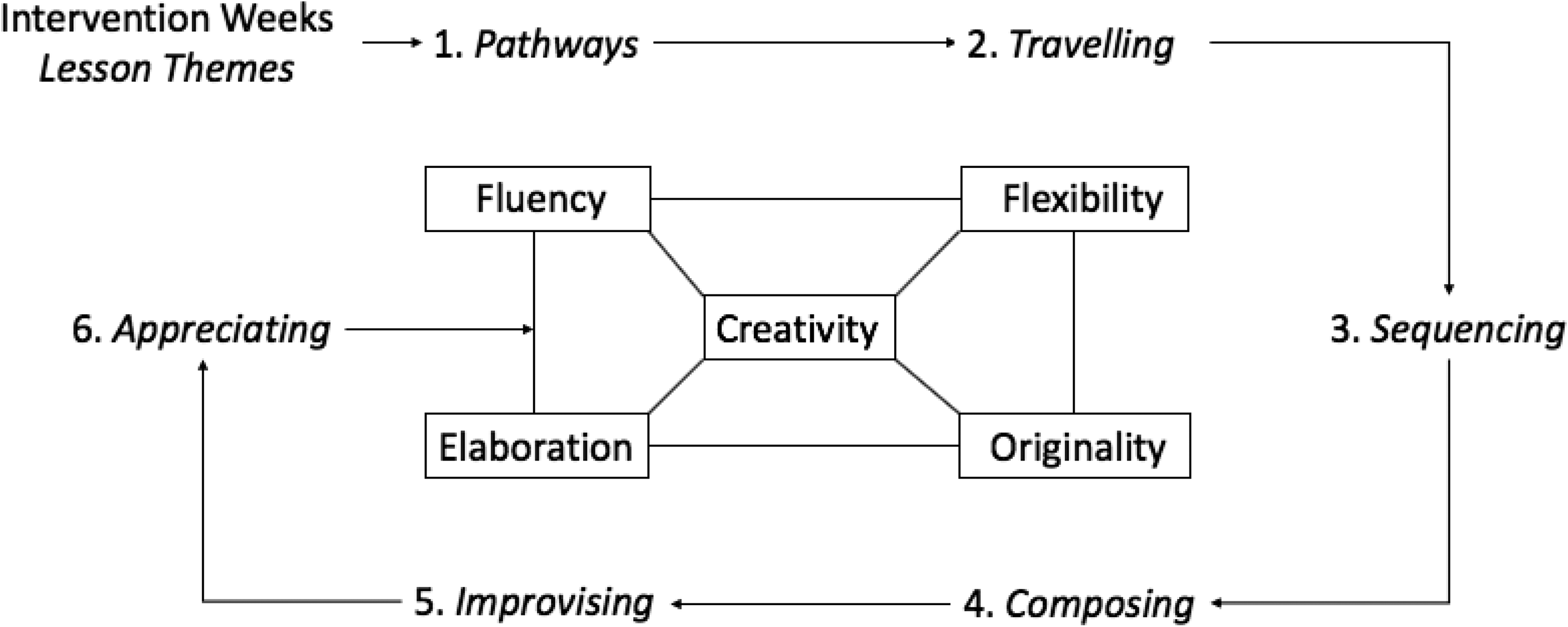
Conceptual framework illustrating a simple linear relationship between the six intervention lesson themes and pupils' post-intervention performance on the Alternative Uses creativity task.
We used a nonverbal version of the Alternative Uses task (cf. Ball and Torrance, 1984). This involved substituting a drawing activity for the more commonly used written or verbal approach (Torrance, 1966). Adapting the task was justified theoretically, because it recognises the growing critical literature on the overly cognitive and linguistic bias of creativity testing protocols (Leutner et al., 2017). Adapting the task was also justified practically, in recognition of the age and educational level of our participants. We reasoned that a drawing task would enable them to express creativity in a way that was more appropriate to their educational level and expected literacy (Gajda, 2016). Critically, such a nonverbal approach has been widely used and found to be reliable and valid in other studies using experimental protocols to assess creativity (see for example Kim, 2006).
To administer the task, students were given a single sheet of paper with five blank circles printed on it. They were instructed to draw any circular-based object, expression, or event they could think of using the circle (e.g. a smiley face, a basketball, a flower with petals, a wheel for a car). The duration of the task was set at 2 minutes. Students were reassured that this was not a test, though they were separated and spaced-out across the room so as to avoid copying. Once the time elapsed, outcome sheets were coded by instructors in collaboration with the child to write the name of the object or event directly underneath each circle. This process of articulating the responses was facilitated by both the instructors and classroom teachers where necessary.
Once coded, the instructors collected the outcome sheets and scored them based on the four creativity-relevant task outcomes identified above: (i) fluency (i.e. total number of uses), (ii) flexibility (i.e. total number of distinct uses), (iii) originality (i.e. uses, norm-referenced against the group), and (iv) elaboration (i.e. range of alternative uses) of responses. Each drawing was scored on a scale of zero to five and combined to produce a total score (with an upper limit of 20). For example, a participant who drew five different smiley faces would receive a five for fluency, a five for flexibility, and a one for elaboration. Originality scores for a given sheet were scored based on whether the drawings were original in respect of the group as a whole. For example, a student with a single drawing that no other students produced received a one for originality. A student with five different drawings that no other students produced would receive a five for originality. A student who drew five different smiley faces would have received a total score of 12 in this instance, if no other students drew a smiley face. The instructors marked score sheets independently of one another and cross-referenced their scores afterwards to ensure accuracy. The larger part of this cross-referencing involved deriving students’ scores for originality.
Confounders
A very brief demographic inventory was also used to code the child’s gender and age, and to assess the possible confounding effects of students’ perceptions about dance and perceived dance ability prior to the initiation of the intervention. Gender was coded by the instructors. Class teachers provided data about the students’ ages. Students were thereafter asked two single item questions: ‘How does dance make you feel?’ (to which they responded on a five-point Likert scale with the following anchors, 1 = ‘I really don’t like dance’ and 5 = ‘I really love dance’) and ‘How good do you think you are at dance?’ (to which they responded on a five-point Likert scale with the following anchors, 1 = ‘Very bad’ and 5 = ‘Very good’).
Statistical analysis
Prior to the statistical analysis, data for the outcome variable were standardised to a percentage of the total score with a resulting range of 0 to 100. Such an approach has been suggested in meta-research resources to be much more easily interpretable and representative of the full range of a psychological construct (Hopkins, 2018). Once standardised, data were thereafter analysed in the Statistical Analysis System (SAS, Version 9.4 – SAS Institute Inc., Cary, NC, USA). In the preliminary stages of data analysis, we observed that there were substantial baseline differences in creativity between the intervention and control group. We also observed that the standard deviations for the pre–post changes in creativity between the groups were substantially different. In order to account for these two types of unequal variances in the statistical model, we used the linear mixed model procedure to analyse the data. The linear mixed model can function in a manner akin to a repeated measures analysis of covariance (ANCOVA), and it can produce the same output. However, the linear mixed model procedure has the added benefit of allowing the user to model different error terms and different effects of covariates for the comparison groups (which is not possible in ANCOVA) (Tabachnick and Fidell, 2014). In this study, this means that we could both allow for unequal variances in the changes in creativity and that we could also allow for a different slope representing the different effects of baseline creativity between the two groups. This is a highly informative statistical modelling procedure that has, to the best of our knowledge, not been a feature of much published research on interventions in PE (not to mention dance-based PE).
The final statistical model compared mean changes (post- minus pre-test) in creativity between the control and intervention group with the change score as the dependent variable and with an adjustment for baseline differences between the two groups. The intervention effect was derived from the difference in the adjusted mean changes in creativity between the control and intervention group. To explore the moderating effect of children’s different starting points vis-à-vis the intervention, baseline creativity was analysed as a numeric linear predictor interacted with the group effect to specify a different slope in the control and intervention group. The effect baseline values was analysed as the difference in the change in creativity between participants who differed by two standard deviations (SD) (Hopkins et al., 2009). This represented a difference in the effect of the intervention between students with below (mean –1SD) and above (mean +1SD) average creativity at baseline (Hopkins et al., 2009). In our preliminary analyses, we also observed that there were baseline differences in perceived dance ability between the control and intervention group. Therefore, we included perceived dance ability in the model as a potential confounder and held it constant at its mean.
Given the ongoing debates about and criticisms of the sole use of statistical significance testing and resulting p values when making inferences (Amrhein et al., 2019), the magnitudes of the effects in this study were also evaluated by means of standardisation – that is, by dividing the intervention effect by the between-participants SD at baseline. Becker’s (1988) formula was used to adjust for small-sample size, and the resulting standardised effects (d) were evaluated using the following adaptation of Cohen’s (1992) scale: d < 0.20, trivial; d = 0.20–0.59, small; d = 0.60–1.19, moderate; d = 1.20–1.99, large; d ≥ 2.00, very large (Hopkins et al., 2009). An alpha level of p < 0.05 was set and uncertainty in the estimate is expressed in the results as a 95% confidence interval (95%CI).
Results
Descriptive statistics
Table 1 presents participant characteristics for the intervention and control groups at baseline. There was a moderate-sized statistically significant difference between the intervention and control groups’ creativity at baseline (d = 0.63, 95%CI = 0.02 to 1.25, p = 0.04). This justified the inclusion of an adjustment for baseline differences between groups in the main analysis, and it also justified our secondary aim of estimating the moderating effects of baseline creativity levels on the overall intervention outcome (i.e. the effect of the intervention for children at different baseline levels of creativity). There was also a moderate-sized difference in perceived dance ability between children in the intervention and control groups at baseline. This, too, justified the inclusion of this variable in the statistical model as a potential confounder (d = 0.70, 95%CI = –0.01 to 1.41, p = 0.05). The proportions of boys and girls in the intervention and control groups were evenly matched. Means (M) and SDs (±) for age in both groups were also matched (M = 7.4 ±0.5). There was also practically no difference between the two groups in respect of pre-intervention perceptions about dance (d = 0.10, 95%CI = –0.45 to 0.65, p = 0.72).
Baseline participant characteristics of the intervention and control group.

n: number; SD: standard deviation.
Main analysis
Table 2 shows the baseline-adjusted pre–post mean changes in creativity for both the intervention and control group. It also shows the differences in these changes in a standardised format which is conventional when representing the overall magnitude of an intervention as an effect size. The overall effect of the intervention was small but not statistically significant (d = 0.36, 95%CI = –0.21 to 0.92, p = 0.21). This result means that the overall effect of the intervention was unclear – or, at best, possibly beneficial given the width of the confidence interval. It also means that there was probably some variation in the response to the intervention that was being affected by different child-level factors.
Pre–post changes in creativity for intervention and control group, with intervention effects and associated uncertainties.
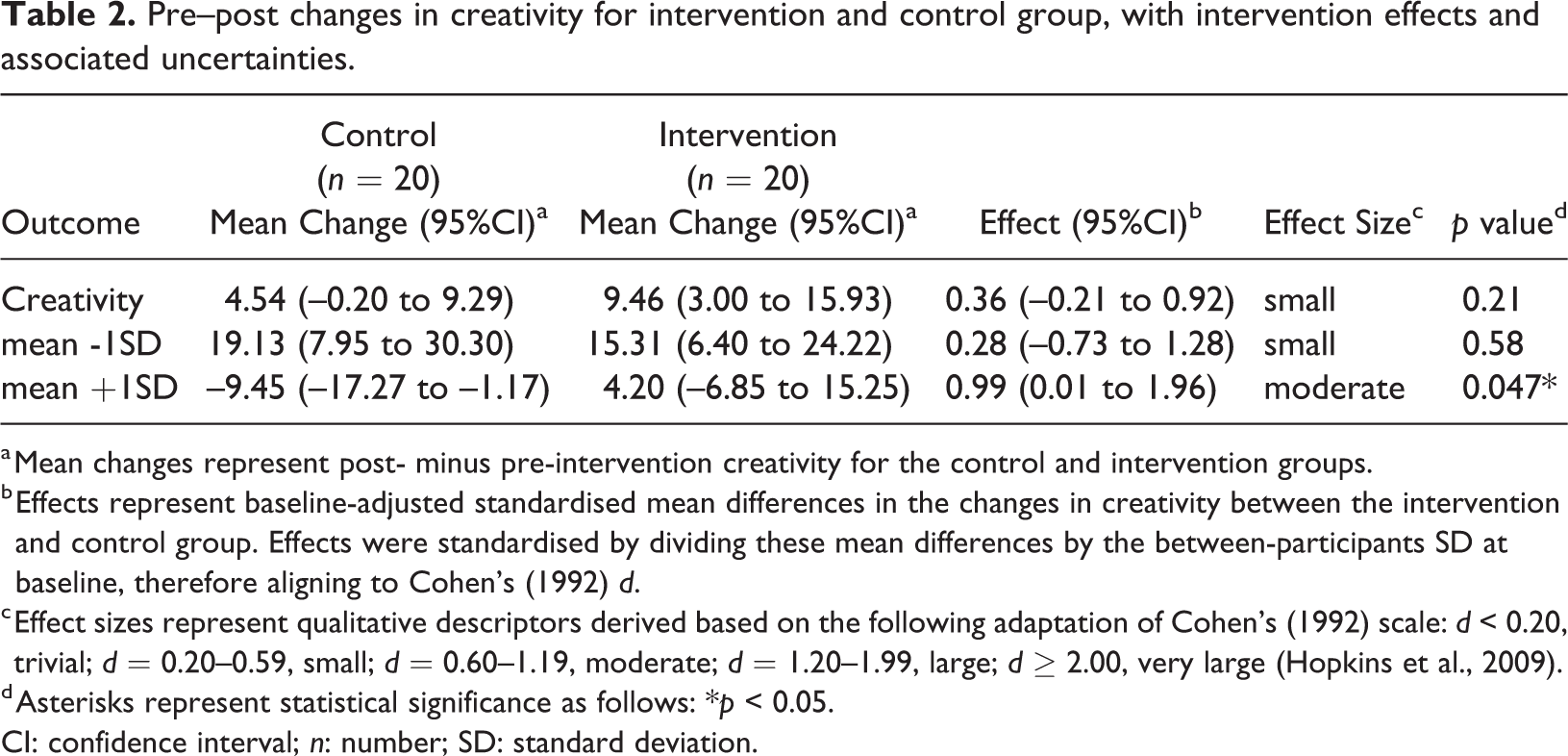
a Mean changes represent post- minus pre-intervention creativity for the control and intervention groups.
b Effects represent baseline-adjusted standardised mean differences in the changes in creativity between the intervention and control group. Effects were standardised by dividing these mean differences by the between-participants SD at baseline, therefore aligning to Cohen’s (1992) d.
c Effect sizes represent qualitative descriptors derived based on the following adaptation of Cohen’s (1992) scale: d < 0.20, trivial; d = 0.20–0.59, small; d = 0.60–1.19, moderate; d = 1.20–1.99, large; d ≥ 2.00, very large (Hopkins et al., 2009).
d Asterisks represent statistical significance as follows: *p < 0.05.
CI: confidence interval; n: number; SD: standard deviation.
Post-hoc analysis revealed that the effect of the intervention varied substantially between students with different levels of baseline creativity. More specifically, there was a large statistically significant difference in the effect of the intervention between students with above (mean +1SD) and below (mean –1SD) average baseline creativity (d = 1.26, 95%CI = 0.14 to 2.39, p = 0.03). Or, to put it a little bit differently, there was a moderate-sized and statistically significant intervention effect for children with above-average creativity at baseline (d = 0.99, 95%CI = 0.01 to 1.96, p = 0.047) and a small but not statistically significant intervention effect for children with below-average creativity at baseline (d = 0.28, 95%CI = –0.73 to 1.28, p = 0.58). In the case of the latter effect (i.e. children at mean –1SD), the width of the confidence interval must lead us to the conclusion that the effect for children with below-average creativity at baseline was unclear. These latter two effects (i.e. for children at mean ±1SD) are also shown in Table 2.
Discussion
This pilot study explored the effect of a dance-based PE intervention on task-related creativity in a primary school setting. Results showed that there was a possible small intervention effect overall, and that there was, in fact, a large difference in the effect of the intervention based on children’s baseline creativity level. Children with above-average creativity levels at baseline exhibited a moderate-sized increase in creativity over the study period when compared with control. The point estimate for the effect of the intervention for children with below-average creativity at baseline was small, but statistically unclear. This study and these data therefore speak to the practical viability and possible benefits of implementing a dance-based PE intervention. They also clearly speak to the reality of heterogeneity in response. Such heterogeneity in creativity-related interventions has been demonstrated in a series of recent, highly relevant, meta-analyses (Koch et al., 2014, 2019; Ma, 2009). It is also something that will be well known to real-life practitioners within PE, and it suggests that careful consideration of student starting points and ability levels is required before embarking on a dance-based scheme of work.
Of particular value in this study is the approach that we have taken to estimate the effects of the intervention. Previous research on dance-based interventions has focused exclusively on group-level effects, which, we would argue, overlooks the role of individual differences (see for example Rousselet et al., 2017). Such individual differences are known to exist and have been empirically observed in older studies in PE (see for example Buck et al., 1991). Today, they are likely to be accentuated given the fact that student diversity has become very much the norm in mainstream schooling (Makopoulou and Thomas, 2016). That is to say more practically that the conventional approach to evaluating the effect of an intervention is focused too much on the effect for an ‘average’ child. Within this approach, there is a tendency to simply ‘control for baseline differences’ by holding baseline values constant at their mean. We suspect that the approach taken to estimate differences in the response to an intervention based on differences in baseline values will be of great use to the wider research community (see for example Rousselet et al., 2017). Such an approach would be particularly useful where randomisation of participants is not possible, for example (i.e. where baseline differences are highly likely). It also seems critical (to us at least) if researchers are to continue to embrace within-class heterogeneity in PE (Ward et al., 2019; Wilkinson et al., 2016).
As for the reason for the difference in the response, Piaget’s stages of cognitive development give some explanation for the observed heterogeneity in effect of the intervention (Piaget and Inhelder, 1971). The students involved in this study were either 7 or 8 years old. It is plausible, therefore, that the group with above-average creativity at baseline had already made a transition from the preoperational stage (4–7 years, able to represent events and objects not yet present but unable to engage in transformational imagery) to the operational stage (8–11 years, able to engage in transformational imagery, and able to reproduce this imagery as learning in new contexts) of cognitive development. These children were therefore possibly at a development threshold when imagery ability was transitioning from being solely perceptual to incorporating both perceptual and higher-order conceptual activities. In other words, these positive responders to the intervention were possibly at a stage of cognitive development where domain-specific activities (i.e. dance-based PE) were more readily and reliably translating into domain-general creativity (i.e. the Alternative Uses task) (see also Hoyek et al., 2009; Muir and Munroe-Chandler, 2017; Munroe-Chandler et al., 2007).
Research on the cognitive process underlying alternative uses tasks supports such a view. Research by Gilhooly et al. (2007), for example, seems to imply that, for children at the preoperational stage of cognitive development, there is an overreliance on a cognitive process known as ‘retrieval’. This means that responses to tasks are being retrieved from a long-term memory store of ‘pre-uses’. Such responses are largely automatic, already implicitly known to the child, and therefore unlikely to be mediated by recent secondary experience. These types of responses are also limited in supply and therefore get exhausted quickly. In the context of the alternative uses task applied to this study, we expect that responses from children at the preoperational stage of cognitive development would be limited in respect of both flexibility (total number of uses) and elaboration (range of alternative uses). In contrast, children at later stages of cognitive development are known to exhibit higher-order responses to tasks, such as ‘proper-use’, ‘disassembly’, and ‘broad-use production’. This class of response requires that the child understands the components of a target object or task. Such responses are associated with creativity because they are more executively demanding and because they require divergent thinking, which results in both originality and the elaboration of possible uses.
Limitations and future research directions
There are three main limitations of our pilot study design that should inform future research.
Firstly, randomisation was not an option, as it was simply too disruptive to timetabling within the school. We would argue that the quasi-experimental design was a reasonable compromise to make in these circumstances, as the use of intact class groups contributes towards ecological validity and to the immediate practitioner relevance of the research findings. Whilst randomisation should be prioritised in future studies, it is worth noting that calls for improved ecological validity of experimental studies on creativity has been a recurring theme and criticism of the available literature (Kasof, 1997; Kurtzberg and Amabile, 2001; Zabelina and Ganis, 2018).
Secondly, the use of a single school is another possible limitation. Ideally, experimental studies of this kind would be conducted across multiple schools using a hierarchical or multi-level design. Use of multiple schools would provide a larger sample size and therefore more statistical power with which to assess moderating (e.g. ethnicity, socioeconomic status, school or class-level characteristics) and mediating (e.g. motor skills, executive function, fluid intelligence) factors. Use of a multi-level design would also ensure that unit of analysis violations and inflated Type 1 error rates are avoided and minimised, respectively (see esp. Li et al., 2017). Where students are nested within different class groups across schools, such a design would also provide a random effect to estimate the effect of instructor quality. This is important, as instructor quality is a known determinant of student learning outcomes in education (Harris and Sass, 2011). But it is also important for a more specific reason, with recent research on sports and gameplay scenarios showing that the level at which a task is set (Memmert, 2007), and the extent to which instructors utilise ‘attention broadening’ and ‘attention narrowing’ cues (Memmert and Furley, 2007; see also Memmert, 2015), can predict creative performance. Thinking back on the animal-themed lesson described in the methods section above – and the movement problem of negotiating a densely populated jungle, in particular – we acknowledge that prompting children to think more about how an animal could (as opposed to would) move in this context may have further expanded their creative potential.
Finally, the period of implementation for the study represents a limitation. Whilst a 6-week period of delivery is in line with recent dance movement therapy studies (Lakeset al., 2019a, 2019b; Stamou et al., 2019), a post-intervention follow-up period of, for example, 1 week and 1 month would have allowed for more robust assessment of shorter- (acute) and longer-term (chronic) effects. In other words, despite the strengths of this study, there is still limited evidence in the literature of the ‘washout period’ following this (and other) dance-based PE interventions.
These limitations notwithstanding, we should not rule out the value of smaller scale studies like this one building up over time and across different contexts to form a more comprehensive meta-analysis in the future. This latter approach seems the more likely route for future research in this area, frankly, given the average (M = 57 ±49) and median (n = 40) sample sizes reported in recent meta-analyses of dance movement therapy interventions (Koch et al., 2014, 2019).
Conclusion
The results of this study suggest that a targeted dance-based PE intervention shows some promise for enhancing task-related creativity in primary school-aged children. The overall group-level effect was small, and, in line with the outcomes of dance movement therapy interventions more generally, there was a high degree of variability in the response to the intervention. There were clearly some positive responders to the intervention, though – we found this for children with above-average creativity levels to begin with. With this finding, our research clearly builds upon previous studies, which had partially supported the creativity-enhancing benefits of dance-based PE, but which had neglected to explore the effects of students’ starting points and individual responses. The results of this study reaffirm the importance of considering children’s starting points vis-à-vis dance-based PE. In fact, it is little wonder to us that early attempts to situate dance within the PE curriculum were couched in the context of the gifted and talented.
As for the impact of this research, we expect that the findings of this study can be of value to practitioners. Because of their many years’ teaching experience and having seen the positive effects of exposing students to a wide range of activities, many practitioners remain advocates for dance-based PE. We recognise, however, that dance-based schemes of work still remain vulnerable to omission from the PE curriculum (Mattsson and Lundvall, 2015). This is especially the case where there is a preference among students for playing games or competing in sports, and where there is a teacher who is likely to acquiesce. It is also more likely in schools where PE is viewed primarily as a conduit for competitive sport and as an environment within which to develop athletic performance. Our study could therefore be interpreted as having provided further evidence of the value of retaining dance-based PE in the curriculum, and of its importance to inclusive PE more generally.
Finally, we also expect that the findings of this study could be of benefit to individual schools. It is noteworthy that this intervention was designed and delivered in full by an external research team, and there is some evidence to suggest that schools in England (and elsewhere) are now using their pupil premium grant fund to buy in support from external PE service providers (Ní Chróinín and O’Brien, 2019; Sperka and Enright, 2019; Sperka et al., 2018). The evidence for the creativity-enhancing benefits of dance-based PE provided in this study could benefit schools when choosing such external service providers. In other words, if a school was to consider whether or not to choose an external service provider to deliver dance-based schemes of work, then this study could provide supportive evidence to school governing boards and to parents’ associations who have a vested interest in making that decision.
Footnotes
Declaration of conflicting interests
The author(s) declared no potential conflicts of interest with respect to the research, authorship, and/or publication of this article
Funding
The author(s) received no financial support for the research, authorship, and/or publication of this article.
