




Abstract
Over the past three decades, a body of research has highlighted the benefits and challenges of what might collectively be referred to as critical pedagogical approaches to Health and Physical Education Teacher Education (HPETE). This research shows that praxis facilitated through critical pedagogies can challenge dominant accountability regimes in HPETE, by animating the discourse of democracy and interrogating and denaturalizing the conditions of oppression. The aim of this study was to explore the (im)possibilities of praxis when the lead author attempted to transition to online teaching. Theoretically, we are guided by the work of bell hooks, and specifically her ‘engaged pedagogy’. Participatory action research framed this study. Participants included the lead author (a teacher educator), a critical friend, and two additional teacher educators. Data collected included: (a) lead researcher observations; (b) collaborative group meetings between the lead author and the two other teacher educators; (c) meetings between the lead author and the critical friend; (d) teacher educator focus group; and (e) artefacts. Findings are discussed under two themes. First, building relationships as a foundation to cultivating a learning community; this theme relates to the challenges and facilitators to getting to know our ‘faceless students’ and building an interactive relationship with them in an online environment. The second theme constructed from the data was commitment to a process of self-actualization that promotes teachers’ and students’ wellbeing; under this theme we describe and interrogate how mutual participation, vulnerability and risk taking were cultivated in challenging university and pedagogical contexts.
Introduction
Our starting point in this article is not the massive migration from in-class face-to-face education to online education that was necessitated owing to COVID-19. Rather, the starting point for this paper was our increasing unease about threats to critical pedagogical work in Initial Teacher Education (ITE) (Cochran-Smith et al., 2018; Enright et al., 2018), and our commitment to continue resisting dominant accountability regimes that undermine rather than serve the critical democratic project in Health and Physical Education Teacher Education (HPETE). Although we are based in Australia where advocacy for critical pedagogy has grown in HPETE (Enright et al., 2018), as teacher educators, we have faced challenges in advocating for equity and democracy as necessary moral constituents in our pedagogies (Enright et al., 2018; Luguetti and McLachlan, 2021). That being said, the unique challenges posed by having to transition one HPETE unit online did shape our study; it necessitated our engagement with new research questions and new literature, and included serious consideration of how we might construct and reconstruct critical pedagogies online (Boyd, 2016; Caruthers and Friend, 2014; Schneider and Smith, 2014). Ultimately, therefore, the focus of this paper evolved to become an exploration of the (im)possibilities of praxis when the lead author (a teacher educator) attempted to transition to online teaching. We should highlight from the outset that we consider ourselves activist HPETE educators committed to the pursuit of democracy, equity, and social justice. Critical pedagogy underpins our activism and praxis; it is an essential characteristic of our pedagogy and activism. For us, critical pedagogy is an umbrella term for pedagogies underpinned by critical theory and orientated to action (Enright et al., 2018; Luguetti and McLachlan, 2021). As described by Freire (1987), it brings together activism and praxis. 1
In the HPETE literature there are many examples of what has been broadly described as critical pedagogical work (e.g. Enright et al., 2017; Gerdin et al., 2019; Hill et al., 2018; Luguetti and Oliver, 2019; Philpot, 2016, 2019; Schenker et al., 2019). This work is quite diverse in terms of its focus, and the authors recruit different histories, theories, and practices, depending on their social and cultural contexts and geographies, as well as their own personal commitments (Schenker et al., 2019). For example, some of this work has been undertaken by feminist scholars who have focused their praxis and scholarship on learning to listen and respond to young people in order to better challenge potentially harmful and exclusionary practices in HPETE (Enright et al., 2017; Luguetti and Oliver, 2019; Oliver et al., 2015). These scholars have worked with students to challenge and change power relations, revealing how complicated and messy power dynamics are in any ITE experience. Others have suggested that critical pedagogy is both challenging to understand and enact in HPETE and can be reduced to critical thinking with no emphasis on social transformation (Philpot, 2016).
At the heart of critical pedagogy is a commitment to equity, democracy, and social justice, and to listening and pedagogically responding to the needs and interests of diverse populations in localized contexts (Enright et al., 2018; Schenker et al., 2019). Thus, critical and feminist scholars, through their pedagogical work, have challenged and/or resisted both limiting discourses and various forms of discrimination in HPETE (e.g. neoliberalism, sexism, racism, homophobia) by interrogating and denaturalizing the conditions of oppression (Enright et al, 2018; Gerdin et al., 2019; Philpot, 2015). This pedagogical work has involved the co-production and application of knowledge as teacher educators and student teachers together learn to name and then resist the imposition of oppressive, disempowering, and commonly accepted practices (Enright et al., 2017; hooks, 1994; Luguetti and Oliver, 2019; Philpot, 2019). Indeed, activist scholars in HPETE have long advocated that the medium is the message, and if we expect Health and Physical Education teachers to have the confidence, knowledge, and skills to promote sustained democratic practices and critical pedagogies in schools, they need to experience some of these pedagogies (Enright et al., 2017; Philpot, 2015).
That being said, new accountability regimes have emerged within and beyond our universities that are making it increasingly difficult to undertake the critical pedagogical work with student teachers that others have advocated for. Dominant teacher education accountability regimes in Australia, and in other countries, increasingly only focus on narrow, measurable indicators such as performance standards, students’ evaluations, and benchmarks (Cochran-Smith et al., 2018; Enright et al., 2018). While there are no easy causal narratives that can explain the emergence of these ‘new’ accountability regimes in teacher education (Taubman, 2010), the language and logic of the reforms suggest a lack of trust in teacher educators and teacher education, a perception of poor teacher quality, and a privileging of market ideologies. This accountability turn has had a serious impact on the ‘repertoires for manoeuvre’ (Priestley et al., 2012: 205) available to teacher educators.
Discussions of the effects of this new dominant accountability regime have begun to emerge in the HPETE literature. Enright and colleagues (2018), for example, bemoan the harnessing or narrowing of HPETE, and describe the uphill battle that HPETE faces in advocating for equity and democracy as necessary moral constituents of teacher education, given that teacher education more broadly is increasingly shaped by agendas, stakeholders and accountability regimes that restrict rather than open up what is possible. There is, therefore, much more work required to better understand how teacher educators in HPETE can continue to resist and even challenge these limiting accountability regimes.
Also worthy of note, given the context for this study in this paper, is that there is a lack of research in online or digitally supported HPETE (Calderón et al., 2020; O’Brien et al., 2020). A few studies focused on, for example, incorporating Twitter and other social media sites into HPETE (Calderón et al., 2016), investigating the use of cameras and video clips and student teachers’ learning (Barker et al., 2016), and exploring a student-centred approach by using digital technology and the impact on student teachers’ intrinsic motivation, learning climate and academic achievement (Calderon et al., 2020). Very recently, O’Brien et al. (2020) investigated the proposed measures of change required for online teaching during the COVID-19 pandemic. Their findings revealed significant tensions between the experiential nature of physical education (PE) as a subject and the institutional and external constraints and biases towards online and blended approaches to HPETE as a significant challenge for teacher educators. Therefore, while there is certainly some work emerging, and we would envisage a proliferation of post COVID-19 publications, to date there has been a dearth of research that has sought to provide insight into the complexities of taking HPETE online, and no study that has looked at how critical pedagogies and teacher educator praxis transition from face-to-face to online teaching.
Although the body of research on critical pedagogy and HPETE has grown over the past three decades (Enright et al., 2017; Gerdin et al., 2019; Hill et al., 2018; Luguetti and Oliver, 2019; Philpot, 2016, 2019; Schenker et al., 2019), much less attention has been paid to the enactment of those pedagogies in online spaces. Thus, in this paper, we are particularly interested in exploring the (im)possibilities of praxis when the lead author (a teacher educator) attempted to transition to online teaching. We will explore whether what transpired during her efforts to engage in praxis constituted ‘engaged pedagogy’ and what conditions enabled or undermined this. Theoretically, we have taken our steer from bell hooks (1994, 2003, 2009), and specifically her work on ‘engaged pedagogy’.
Rethinking teaching in higher education through an engaged pedagogy
As a Black activist feminist scholar, bell hooks’s pedagogy in higher education emerged from the interplay of anticolonial, critical, and feminist pedagogies, committed to the Black liberation struggle (hooks, 1994, 2009). hooks (2009) sees her pedagogy connected to struggles for social justice. Inspired by Brazilian educator Paulo Freire and his progressive view of education as the practice of freedom, she developed what she called an ‘engaged pedagogy’, defined as a progressive, holistic education that emphasizes wellbeing in the classroom (hooks, 1994). Indeed, hooks does not use the term critical pedagogy. She defines her engaged pedagogy as one which espouses a combination of ‘anticolonial, critical, and feminist pedagogies…for interrogating biases in curricula that reinscribe systems of domination…while simultaneously providing new ways to teach diverse groups of students’ (hooks, 1994: 10).
Her work is informed by her experience as a Black young woman whose early education in all-Black, segregated schools was seen as a political act towards liberation (hooks, 2003). In addition, her criticality towards higher education emerged from her experiences as a Black student in predominantly White institutions where most of her professors ‘were not the slightest bit interested in enlightenment. More than anything they seemed enthralled by the exercise of power and authority within their mini-kingdom, the classroom’ (hooks 1994: 17). hooks critiques the contemporary university as ‘imperialist White supremacist capitalist patriarchy’ (hooks 1994: 17), silencing minorities and offering a banking system of education. The banking system is based on the assumption that education is a process of depositing knowledge which students patiently receive, memorize, and repeat (Freire, 1987).
For hooks (1994), engaged pedagogy employs a holistic model of learning where teacher educators also grow and are empowered by the process. She suggested ways to rethink higher education as a practice of freedom by raising critical consciousness through dialogue where students and teacher educators understand, critique and negotiate/transform oppressions (e.g. White supremacy, heterosexism, genderism, classism, and racism) both within classrooms as well as throughout the university system more broadly (hooks, 1994). In addition, in an engaged pedagogy the classroom should become a community where teacher educators and students together work in partnership (hooks, 1994, 2003). Finally, engaged pedagogy cares for the souls of students and teachers. It makes the classroom a place where wholeness is welcomed, and students and teachers can be honest, even radically open.
hooks offers a radical critique to dominant accountability regimes in teacher education by suggesting a pedagogy where there is a sense of struggle, where teacher educators and students work together to overcome the alienation that has become the norm in the contemporary university (Dean, 2007). Scholars argued that the dominant accountability regimes in teacher education require radical approaches to teaching and learning, which emphasize critical thinking about our own roles in perpetuating systems of oppression. For hooks (1994), the notions of praxis are recurring in her work. She advocates praxis in a similar way to Freire (1987), that is, combining dialogue, action, and reflection upon the world in order to change it. Her notion of engaged pedagogy is one which requires teachers and students to develop and engage in praxis. For us, there were clear synergies and tensions between the philosophies and characteristics associated with hooks’s ‘engaged pedagogy’, what we were hoping to achieve through the unit 2 , and the data that were gathered. Thus, it became a useful theoretical tool to help us interrogate our data and the process and pedagogies associated with those data.
Methodology
The larger study from which this paper draws was a participatory action research (PAR) project. PAR supports the belief that knowledge is rooted in social relations, and is more powerful when produced collaboratively through action (Fine, 2007; Freire, 1987). In this study, the lead author invited students and teacher educators as co-participants to co-create a health unit. The co-creation of the unit was part of the course work, and included a spiral cycle of planning–acting–observing–reflecting (Carr and Kemmis, 1986; Freire, 1987). PAR was chosen for this project as it involves dialogue, critical reflection, and action in and about people’s situations (Freire, 1987).
Context and participants
This research project took place in a university in Melbourne, Australia. The university was considered a non-selective one in Australia. The university was the first Australian university to use a ‘block’ model of learning, where the students study one unit (subject) at a time every four weeks. Each unit typically has three three-hour face-to-face teaching sessions per week, scheduled over three days. The ‘block’ model focuses on interactive learning and group work with small size classes (max 35 students). The lead author (Carla) arrived in Australia in 2018 and started to design a unit called Adolescent Health. This unit was for second year students in their HPETE programme 3 , and was required to create opportunities for students to investigate the impact of physical, cognitive, psychological, and social perspectives on adolescent health and wellbeing.
In 2010–2018, this unit was 12 weeks of content and focused on drug education and mental health. Informed by the previous 12-week content and format, Carla re-designed the unit in October to December 2018 to be taught in a block mode. Based on the student-centred principles of block mode and the connection with practice-integrated learning, Carla decided to incorporate an activist approach embedded in a critical pedagogy called Student-Centered Inquiry as Curriculum (Oliver and Oesterreich, 2013) in this unit. The approach includes Building the Foundation followed by a four-phase cyclical process of Planning, Responding to Students, Listening to Respond, and Analyzing Responses as the basis of all pedagogical decisions. The Building the Foundation Phase is designed with the intent of identifying what facilitated and hindered the young people’s engagement in health and physical activity (Oliver and Oesterreich, 2013). Given what we learned during Building the Foundation Phase, we then co-created and implemented an Activist Phase (Figure 1). It is important to highlight that critical pedagogical readings formed part of the course content. As well as reading and discussing the literature on student-centred approaches (e.g. Oliver and Oesterreich, 2013), Carla and her students also engaged with authors such as Paulo Freire, bell hooks, and Gloria Ladson-Billings.

Student-centered Inquiry as Curriculum Approach, Oliver KL and Oesterreich HA (2013) Journal of Curriculum Studies, 45(3), 394–417. Reprinted with permission.
In a face-to-face format, the unit had a partnership with a secondary school. In session 3, we used to interview a group of 60 grade 9 students regarding their feelings during PE, physical activity and health barriers they face to be healthy, changes they want in PE and sport, and what they want to learn about health (Building the Foundation). Given what we learned in this phase, we co-created the unit (Activist Phase). In a face-to-face format, the students studied the topics that emerged from the analyses of the young people’s voices and we planned a second field trip in session 11 to respond to them. We prepared a Health Expo with interactive information stands to cater for 150 young people.
Participants included Carla (lead author), a critical friend (second author) and two teacher educators (third and fourth authors). Carla was a teacher educator with eight years of experience using activist teaching approaches in a variety of settings. English was her additional language. Carla has taught in two private universities in Brazil for 10 years. In the last two years, Carla has worked in an Australian university, where this study took place. For Carla, interactions are fundamental pieces of her existence. The social physical distancing due to COVID-19 was a barrier to Carla’s way of being in the world. In addition, Carla considered online interactions as a non-genuine interaction or meaningless. For her, interactions, to exist as a human, must be face-to-face.
The second author (Eimear) acted as a critical friend. She was also a teacher educator and had worked in a different Australian university for seven years. Eimear had engaged with activist approaches for many years and was a sounding board for Carla as she worked to quickly transition her unit online, and then came to reflect and write about this experience. Eimear was an outsider to the group in many ways, a fresh pair of eyes who helped Carla to reflect on, explore, and clarify the values and beliefs she brought to her praxis and her research (Carr and Kemmis, 1986). Eimear and Carla engaged in a kind of intellectual sparring and Eimear often challenged Carla to see her pedagogies through another lens. Together, and over time, Carla and Eimear explored the tension between ‘critical’ and ‘friend’ as Eimear often, for example, posed provocative questions and provided alternative data analysis and interpretive options (Costa and Kallick, 1993). Their evolving professional friendship came to be characterized by mutual respect (Baskerville and Goldblatt, 2009) as they worked together sensitively and over time on this study.
The two teacher educators were PhD students in sociology. Jack had two years of experience teaching units in the university. Jeff had three years of experience teaching units in the university. Jeff taught this unit in the previous year in a face-to-face format. All participants signed an informed consent form and ethical approval for this study was received from the Ethics Committee (protocol number HRE20-020).
Rethinking the activist approach in the Adolescent Health unit: a remote way of teaching
While originally the unit was not intended to be taught remotely, restrictions that came into effect as a result of COVID-19 in early 2020 meant that Carla had one week to redesign the unit as she was suddenly required to teach her two classes online. Carla invited the two teacher educators assigned to the unit to rethink its design with her. Staff were advised to schedule regular and structured online classes using Zoom at the same time they would usually facilitate on-campus classes. Although examples were shared, it was left to the unit coordinators to decide how the unit would be transitioned online. 4
As stipulated by the teaching and learning policy at the university, the lead author redesigned the unit by teaching significant parts of the unit via Zoom (synchronous). The dynamic of the unit can be described as follows: (a) introduction via Zoom (15 min) where the three teacher educators explained the learning aspirations for the session as well as the summary of all students’ productions from the previous session; (b) interactive workshop via Zoom (1 h) – taught to student teachers (sessions 5 to 9); (c) online activities (1 h 20 min) – where the students engaged with online tasks by posting and commenting on their productions in a shared space (discussion boards); (d) summary/reflections via Zoom (20 min) – where the teacher educators opened a space for questions and comments regarding students’ production and assessments. Table 1 describes the differences between the face-to-face sessions and the online teaching.
Comparison of face-to-face and remote delivery, and alignment with the activist approach.

The cycle of PAR occurred according to the following design: every Monday Carla met Jack and Jeff to reflect on the week of teaching and plan for the upcoming week. During the week, Carla, Jack, and Jeff taught the sessions (three sessions a week) and observed the enactment of pedagogical decisions they had previously agreed on, many of which were informed by student feedback. From week 1, this student feedback was produced in each session during planned dialogue with students where they were explicitly asked to reflect on and offer possible actions to enhance the unit. In this way, students contributed to the co-creation of the unit. On Fridays, Carla discussed critical incidents (e.g. challenges the teacher educators faced and events that happened in the online classes) with her critical friend Eimear. This served as a debriefing session for Carla and allowed reflective planning for the upcoming sessions.
Data collection sources
Data collection spanned 11 sessions and included: Lead researcher observations collected as field notes. Carla wrote field notes/observations after each class (total of 12 pages). These data were used to inform the meetings with her critical friend and teacher educators. Collaborative group meetings between the lead author and the two teacher educators. Carla organized weekly 60-min meetings with Jack and Jeff to reflect on the week of teaching and plan for the upcoming week (five meetings in total). The meetings created an environment for participants to engage in conversations about their experiences. All collaborative group meetings were audio-recorded and transcribed (total of 29 pages). Meetings between the lead author and the critical friend. Eimear served as a peer debriefer and assisted with progressive data analysis, was contacted weekly for advice on how to progress through the project, and helped with the preparation of this manuscript. All meetings were audio-recorded and transcribed (total of 35 pages). Teacher educators’ focus group. Jack and Jeff participated in a focus group at the end of the unit that was co-facilitated by Carla. Instead of planning the weekly teaching as they did in the collaborative meetings, they decided to do a focus group to identify the challenges and pleasures of redesigning and teaching this unit online. Examples of the questions included: (a) Tell me about what brought you pleasure or joy in delivering this unit? (b) Tell me a story about a challenge that you had in delivering this unit? How did you negotiate that challenge? (c) Tell me about something that went well in this unit? (d) Tell me a story about something that helped in your learning? Why was it helpful? How did it impact your decision making? (e) Share an example about a challenge that you had with a student. The focus group was digitally recorded for verbatim transcription (a total of 15 pages). Artefacts produced in the classes. All artefacts generated over the course of the unit (e.g. lesson plans, summaries of data collected from the young people’s interviews in session 3, peer feedback, assessments, and other student productions) were collected (total of 56 pages).
Data analysis
Data analysis involved inductive and iterative analysis using thematic analysis methods (Braun and Clarke, 2019). Through deep and prolonged data immersion, thoughtfulness, and reflection, themes were produced. As described by Braun and Clarke (2019), themes do not passively emerge from the data; they are creative and interpretive stories about the data, produced at the ‘intersection of the researcher’s theoretical assumptions, their analytic resources and skill, and the data themselves’ (Braun and Clarke 2019: 594). bell hooks’s conceptualization of ‘engaged pedagogy’ emerged as our analytical frame. Initially, it was not the intention to use hooks’s engaged pedagogy, but it appeared as a generative theoretical tool after the inductive and iterative analysis. This framework had the potential to help further interrogate the data as there were clear synergies and tensions between the findings and how hooks constructed some of the key characteristics of her ‘engaged pedagogy’.
The analytical process was framed by the research questions: (a) Did what transpired during the lead author’s online praxis constitute engaged pedagogy?; (b) What conditions enabled or undermined this? The data were organized chronologically and filed by session date, and the analysis proceeded through several steps. First, the first and second authors (Carla and Eimear) read all data sets and engaged in the process of coding where statements and ideas were developed as data were read and re-read (five 1 h meetings). Carla and Eimear separately identified codes (e.g. sharing responsibility, building relationships, wellbeing, relationality, community, listening and responding, collaboration, and trust/mistrust). Through this analysis, statements and ideas were developed as data were read and re-read. Second, Carla and Eimear engaged in a process of constructing the themes, considering the conceptualization of engaged pedagogy. Thus, the themes were grouped into two main themes: building relationships in an online space as a foundation to cultivating a learning community; and commitment to a process of self-actualization that requires mutual participation and promotes teachers’ and students’ wellbeing. The fourth process of analysis involved the third and fourth authors. They engaged in a process of double-checking the interpretations. They discussed the codes Carla and Eimear had identified in relation to the research questions and challenged some of the interpretations of the coded data, the construction of themes, and the narrative associated with the analysis. In this phase, multiple revisions were made to the analysis and paper until all authors felt that the analysis was reflective of their experience of the unit.
In this paper, different trustworthiness criteria were adopted: triangulation of the data sources, presence of the critical friend, and member checking. Triangulation of the data sources (observations, collaborative meetings, and artefacts) involved the application and combination of different methods to develop a better understanding of the phenomena. The presence of the critical friend encouraged researcher reflexivity and challenged data interpretation. Member checking occurred when the third and fourth authors checked the themes produced in the thematic analysis. It was a reflective process, generating insights and checking contradictions (Braun and Clarke, 2019).
Findings and discussion
Guided by the work of bell hooks’s ‘engaged pedagogy’, we constructed two main themes from our data: building relationships in an online space as a foundation to cultivating a learning community; and commitment to a process of self-actualization that requires mutual participation and promotes teachers’ and students’ wellbeing.
‘Teaching students without faces’: building relationships in an online space as a foundation to cultivating a learning community
In the engaged pedagogical classroom, hooks says that it is essential that teacher educators and students take time to get to know one another and build relationships (hooks, 2009). The teachers in this study (Carla, Jack, and Jeff) experienced conditions that enabled and undermined their efforts to build relationships. While we all agreed that building relationships is the foundation to building a learning community, we had limited previous experience of getting to know our students in the absence of face-to-face interaction. COVID-19-related impacts required us to use the tools at our disposal, that is, Zoom breakout rooms and other collaborative technological tools (e.g. shared documents, discussion boards, and the annotate tool on Zoom) in addition to our own more progressive and dialogic pedagogies.
From the beginning of the online classes, Carla, Jack, and Jeff explored the potential of these technologies and pedagogies to build relationships with students in the online space (Figure 2). They brainstormed and facilitated many activities that sought to help them get to know each other: I said that I wanted to build relationships with them. I asked them to annotate where their grandparents were from and I realized that they were using stamps anonymously. So, I was struggling to build relationships […] I asked them to choose a virtual background and I realized that most of them didn’t know or couldn’t do it due to an issue with Macs. Jack, Jeff, and I explained our backgrounds and we asked a few students to do the same. (Carla’s field note – Session 1)
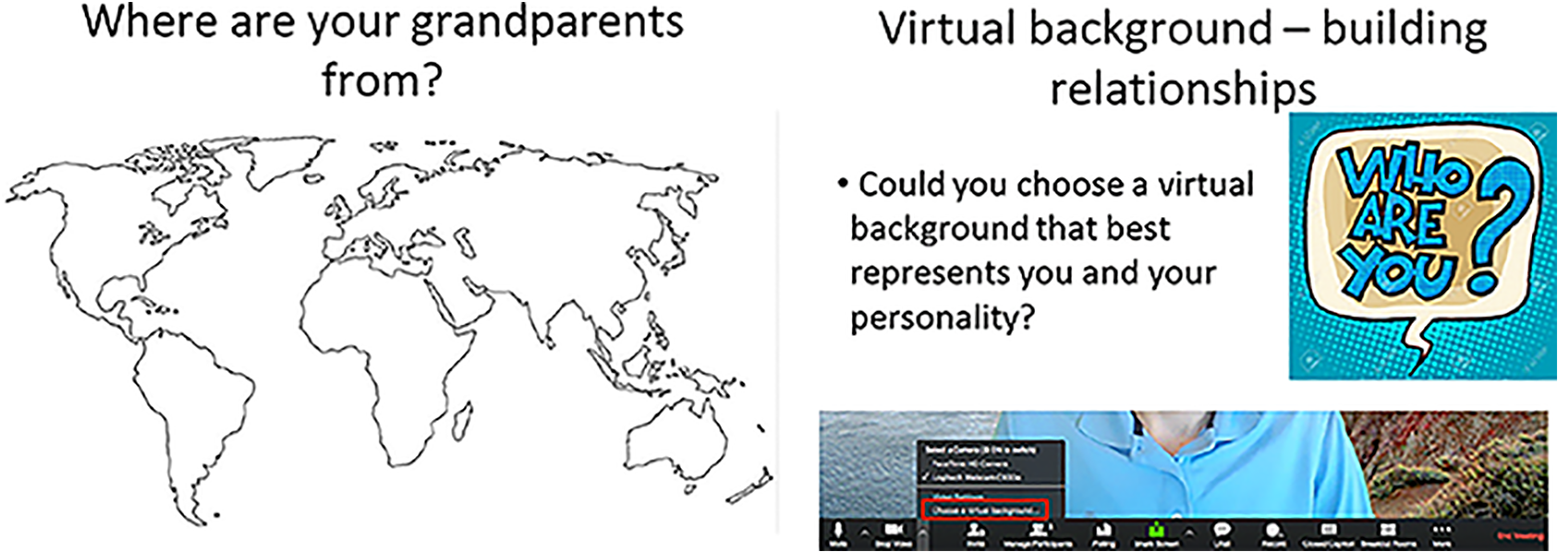
Strategies to build relationships in session 1.
The challenges to building an interactive relationship emerged partly from the teacher educators’ unfamiliarity with the technology. We were teaching and learning via Zoom for the first time and we were unsure how strategies that we had previously used to build relationships would be translated in an online space. Indeed, many of our strategies proved ineffective. For example, the virtual background activity proved unsuccessful because half of the students could not complete the task. However, we then engaged the students in debriefing around these strategies, exposing the risks we had taken and asking the students to participate with us in pedagogical decision-making, and ultimately in working with us to overcome the challenges to creating a learning community (hooks, 2003). One of the main challenges was undoubtedly the development of an interactive relationship that went beyond a surface level with our sometimes ‘faceless students’: Carla: My biggest struggle is the lack of connection. So, I think it is a metaphor of teaching students without faces […] What can we do differently? Jeff: I think we can find out how we can maybe centre some of the tasks more in the breakout room where they feel more comfortable to discuss […] Another thing I don’t think it will help necessarily, but it could be fun…I noticed that you could put like a profile picture on your thing. So maybe even if it’s not their face interactively, maybe at least we can get a sense of what they look like or might not help. Carla: Yeah. But at least it’s putting a face in their voices. Yeah. Another strategy I was thinking to use is…if we stay with them in small groups, they might turn on the video if they understand the importance of doing that. (Collective meeting – week 1)
The challenge of building an interactive relationship also emerged from the mistrust of students (and academics) that was being communicated by the university. From the beginning of session 1, the university suggested many different policies and procedures to control students’ behaviour in online spaces. Initially, the teacher educators were asked to share a slide about ‘behaviours in a virtual classroom’ with all students. Although Carla started the session by showing the slide, she did not speak to the slide or talk about those rules because she ‘realized it would be incoherent with this unit’ (field note – session 1). After the first week, the university policy focus on controlling everybody’s behaviours in online classrooms intensified with the release of a new ‘virtual classroom etiquette’ policy (Figure 3).
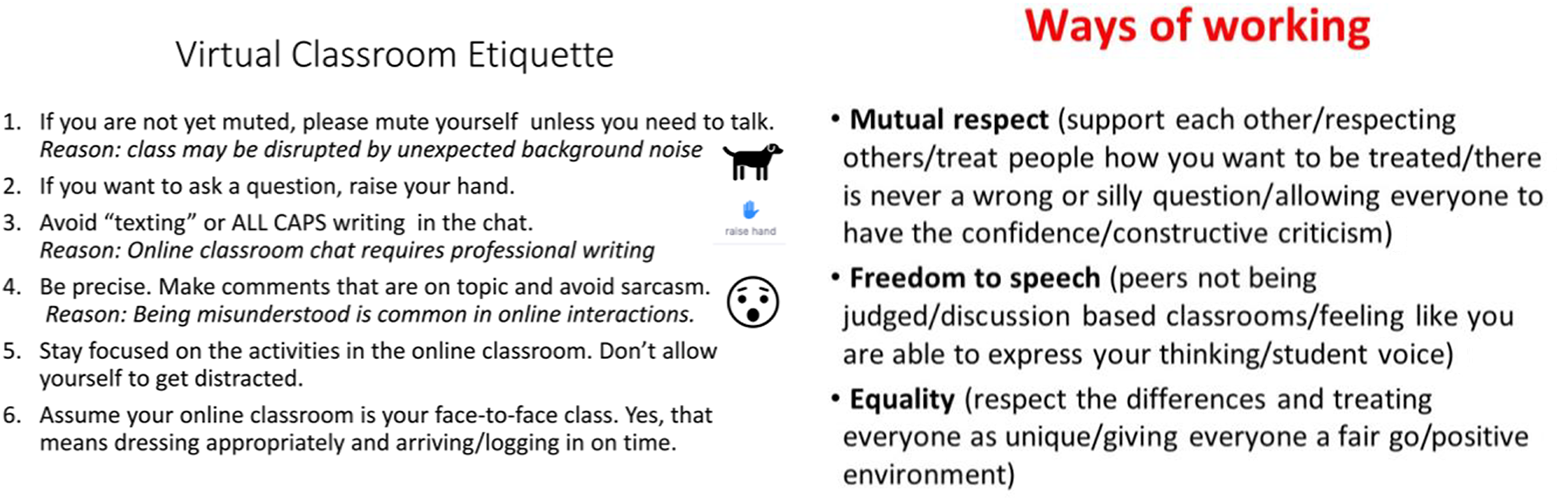
Comparison of the virtual classroom etiquette suggested by the university and the ways of working co-created by students in session 3.
Rather than not engage with this policy, Carla chose to make this something that was a focus of discussion among the teaching team and the students. We (Carla, Jack, and Jeff) co-created ways of working with students in sessions 2 and 3 that would enable us to engage with the policy critically while also serving our own aim to make the class a supportive environment for the kind of pedagogies we wanted to facilitate. We discussed with students what a safe environment meant and how we could collectively create that kind of space. By comparing the co-created ways of working with the ‘virtual classroom etiquette’ we identified how the university procedures were constraining the interactive relationship. Students were now not allowed to send private chats between each other. Carla knew that one of the main challenges in an online space was lack of communication. As each of these policy directives was shared with students, perceptions of mistrust increased, and the possibilities for Carla and the students to co-create a safe space and engage in collaborative pedagogical decision-making were constrained. It was made clear that not complying with these ‘rules’ could result in students being removed from the virtual classroom or further disciplinary actions as per current policy and guidelines. The university policy clearly sought to control everybody’s behaviours in online classrooms, an approach that was antithetical to the kind of environment and relationships Carla hoped to cultivate.
In contrast to the mistrust evidenced through university policy, we sought to create a trusting space where teachers and students together could listen to and respond to students’ voices and share pedagogical responsibilities. For example, we negotiated one of the assessments (see Table 1 for more information). In assessment 1, students engaged with individual and group online tasks (e.g. watch two videos and identify three keywords that describe how young people use social media, the risks, and opportunities), posting and commenting on their productions in a shared space (discussion boards). In analysing students’ voices, we realized that the productions in the breakout rooms should be valued as much as the productions on discussion boards. Therefore, we included students’ participation in the breakout rooms in the assessment 1. The breakout room provided a safe space to generate a collaborative discussion, which is essential in cultivating a learning community. One of the students commented, for example: I like the breakout rooms as our voices are more heard in the smaller groups compared to the big group discussions. I also like how we can access everyone’s work to get a different perspective. (Student’s anonymous comment – session 3)

Display of multiple voices (annotate tool on Zoom).
After brainstorming ideas on how to co-create a safe environment in the classroom, we asked students to write possible ‘ways of working’ using the annotate tool. It provided a space to display multiple voices at the same time. Although we acknowledge that an engaged pedagogy ‘does not assume that all voices should be heard all of the time’ (hooks, 2009: 21–22), the display of multiple voices created a safe anonymous space where students recognized and responded to their peers’ voices. In addition, students implemented other collaborative technological tools such as Straw poll, Kahoot! and Padlet 5 in their group presentations. We realized that the collaborative technological tools were central to the process of building relationships and students’ learning in an online space.
Instead of writing peer feedback regarding their presentations individually, we decided to facilitate dialogic feedback in the breakout rooms. In assessments 2 (group presentation) and 4 (Health Expo), we asked students to write peer feedback. Assessment 2 peer feedback focused on the visual appeal, comprehension, engagement, and content of the group presentations. Assessment 4 peer feedback focused on the quality of the lesson plan and all material produced in the Health Expo (e.g. banners, posters, and handout materials). This approach to feedback was essential in building and sustaining relationships online. Dialogical feedback emphasizes the importance of engaging students in dialogue around learning (Steen-Utheim and Wittek, 2017); it consists of interactive exchanges in which interpretations are shared, meanings negotiated, and expectations clarified. Students were sent to breakout rooms and used a OneDrive 6 document to record positive things and spaces for growth regarding all group presentations. The students were encouraged to write constructive feedback on positive aspects they observed, but also critique some aspects based on the assessment criteria, suggesting spaces for growth. Afterwards they shared their perceptions with the whole class. In addition, we implemented discussion boards in every class where students shared their production (individual or group) and were encouraged to reply to their peers’ comments.
We knew that building relationships was important for cultivating a learning community in the online classroom. We got to know these faceless students by spending more time in breakout rooms and incorporating collaborative technological tools, as well as by implementing dialogical approaches to feedback. As suggested by hooks (2009), in an engaged pedagogy, teacher educators no longer assume the sole leadership role in the classroom; the classroom functions more like a cooperative where everyone contributes to making sure all resources are being used. We learned to use shared collaborative tools to improve communication, and both the students and teachers involved in this study were very much learning together and drawing on each other’s skills and knowledge to do this (hooks, 2003, 2009). We also had to be constantly vigilant to the messages students were receiving through various university policies and engage with these policies in ways that helped the students appreciate that we were not the university.
‘The puppet asked how the students were doing in the lockdown’: commitment to a process of self-actualization that requires mutual participation and promotes teachers’ and students’ wellbeing
Progressive, holistic education, ‘engaged pedagogy’ is more demanding than conventional critical or feminist pedagogy. For, unlike these two teaching practices, it emphasizes well-being. That means that teachers must be actively committed to a process of self-actualization that promotes their own well-being if they are to teach in a manner that empowers students (hooks, 1994: 15).
The teacher educators in this unit (Carla, Jack, and Jeff) created spaces of empowerment by naming, critiquing, and negotiating the social injustices their students were facing. For example, the students’ mistrust and lack of voice were evidenced through the university policy. For hooks (1994), engaged pedagogy does not seek simply to create spaces to empower students, but employs a holistic model of learning where teacher educators also grow and are empowered by the process. Although hooks did not clearly define how she understood the term self-actualization, it is commonly interpreted as an individual psychological way of achieving the full human potential. 7 Key to her application of this concept is the idea that an individual’s wellbeing is essential for an effective engaged pedagogy. In that sense, it is important to recognize that if teacher educators are wounded and damaged individuals, they might not be able to fully create generative conditions for social change. It is rare in the HPETE scholarship, or indeed in the education scholarship more broadly, for anyone to talk about teachers or teacher educators having a responsibility to be self-actualized (hooks, 1994). But that is something that did concern us in our study. We created spaces for caring for the wellbeing of Carla, Jack, and Jeff, as well as the wellbeing of students. Carla and the students mutually participated in sharing their emotional responses to the difficulties (and the unexpected joys) associated with the changes COVID-19 had brought to their lives and their experience of this unit. This meant being vulnerable and taking risks. Carla, for example, was open about the loneliness of her personal life in lockdown in Australia without her partner and about the (im)possibilities of her praxis in an online space. For Carla, her poetry was also a space where she could describe her feelings and care for her own soul (hooks, 1994) (Table 2).
Carla’s poems.
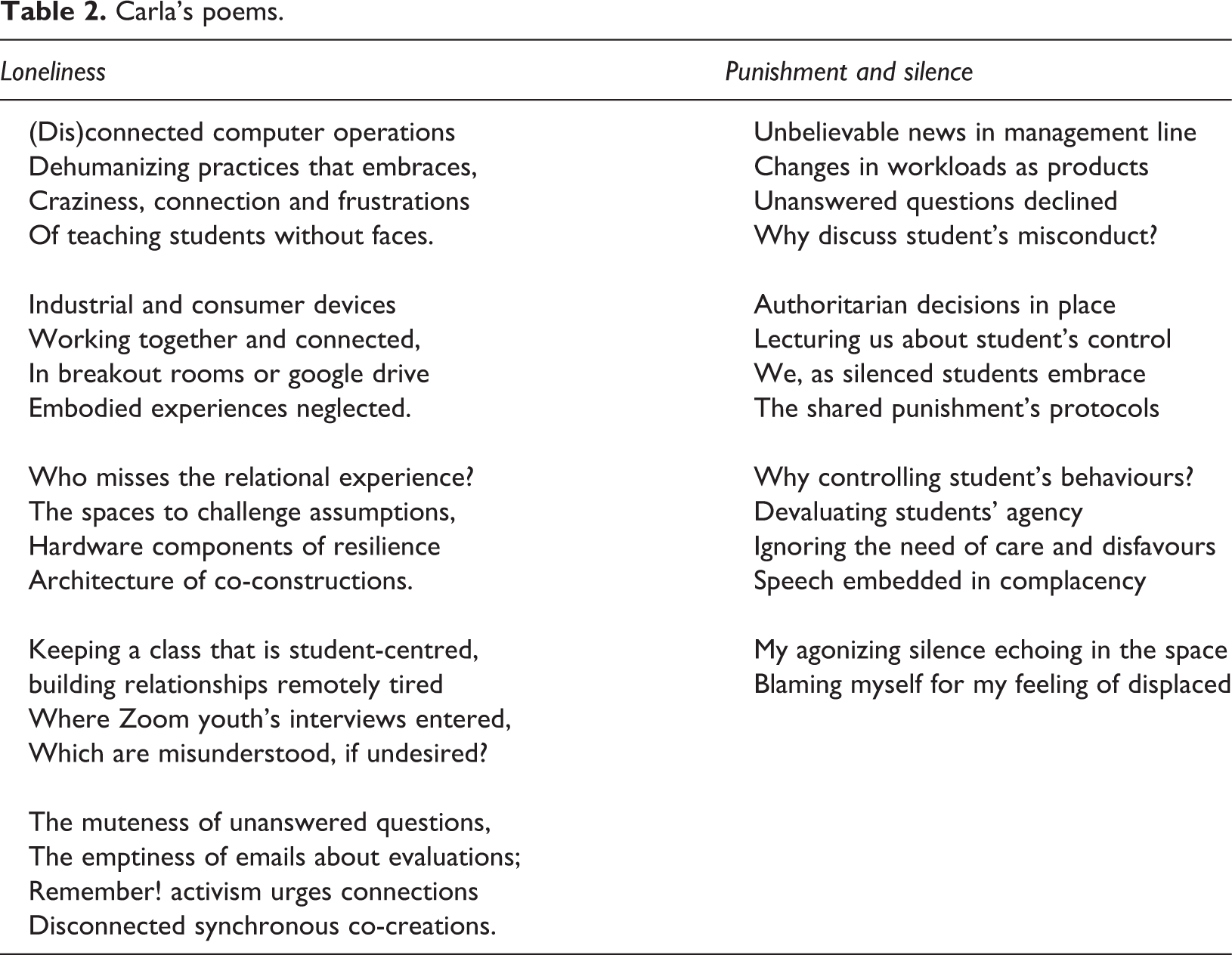
Carla’s poems described her feelings of loneliness due to the lack of relational experience in the online classroom and her struggle with the dominant university accountability discourse and policies that were very risk averse and clearly sought to tightly control students’ (and teachers’) behaviours in online spaces. Carla had seven years of experience with critical pedagogies. She knew the importance of collaboration and relationship building. Although she was brainstorming different ideas with Jack and Jeff and trying different strategies, she realized that the online space had limitations that were affecting everybody’s wellbeing, including her own, and made it more difficult to develop the kind of relationships that usually underpinned her praxis. In addition, Carla was emotionally struggling with the lack of support at the college level. Carla’s second poem, written after a college meeting, highlighted her feelings. Carla could not understand why ‘students’ potential misconduct’ was the major concern and focus in the first meeting after all staff began teaching remotely. Collegiality was an essential element in negotiating the constraints at the institutional level and in the classroom. Carla learned to remain attentive to and take care of her own individual wellbeing, if she was going to be in a position to facilitate an engaged pedagogy (hooks, 1994).
Many students also described struggles with their wellbeing. For example, students shared their experiences of losing their jobs, having family members sick, and individual circumstances that made it difficult to engage with the unit in the way they wanted. One student, Sarah, who was ‘stuck in France’ shared the following: Hi Carla, I am contacting you as I had enrolled in the class planning to be back in Australia as of yesterday. Unfortunately, I am currently stuck in France due to flights cancelling, and the reason I was in France, to begin with, was because I was working here under a dance contract which has been suspended due to the COVID-19. I am able to still study as I have access to Wi-Fi and will be able to work it around the time difference, I just wanted to know if this is possible and if it will affect any of the assessments. Kind regards, Sarah. (Sarah’s email)
Sharing humour and joy emerged as a key characteristic of the kind of caring environment that we co-created over the course of the unit: Session 6 started with Jeff and a puppet. He started saying ‘good morning’ with a puppet in his hands and a funny voice. I saw a few cameras on and then a lot of cameras on. The students were laughing, I was laughing. I was not expecting it, but I loved it. The puppet asked how the students were doing in the lockdown and in the unit. Although the students did not answer the puppet’s questions, they put the camera on, and many laughed! (Carla’s field note – session 6)
Ultimately, and consistent with a key characteristic of engaged pedagogy, we strived to create a place where wholeness was welcomed (hooks, 1994, 2009), and the students and teachers could be honest and share their emotions and feelings. We named our fears and established a relationship based on mutual recognition that nurtured the growth of both parties (students and teachers), creating an atmosphere of trust and commitment that is always present when genuine learning happens (hooks, 1994). We actively promoted and pursued wellbeing for all and employed a holistic model of learning where teachers and students had opportunities to grow and potentially be empowered by the process (hooks, 1994, 2009). This is a kind of empowerment that can only happen when teacher educators take the risk of being vulnerable while encouraging students to take risks (hooks, 2009).
Conclusion
The aim of this study was to explore the lessons learned when one teacher educator attempted to transition her praxis online. Guided by bell hooks’s engaged pedagogy (1994, 2003, 2009), we were particularly interested in understanding whether what transpired during this teacher educator’s praxis constituted engaged pedagogy and what conditions enabled or undermined this. This study strengthens the body of knowledge on critical pedagogy in HPETE (Enright et al., 2017; Gerdin et al., 2019; Hill et al., 2018; Luguetti and Oliver, 2019; Philpot, 2016, 2019; Schenker et al., 2019) and online HPETE (Calderón et al., 2020; O’Brien et al., 2020) by focusing on discussions of praxis. Our findings suggest that praxis is possible in online HPETE, as is the evolution of engaged pedagogy. The teacher educators were able to transition from solely critical thinking and advocacy for change to micro-actions with HPETE students. For example, they reflected and applied strategies to overcome the lack of connection, mistrust, and struggles with everybody’s wellbeing in their classroom online space. Our study emphasized an engaged pedagogy where action is an essential element. As described by Freire, it is a pedagogy that combines action and reflection. It is not a pedagogy that sacrifices action (called verbalism) or sacrifices reflection (called activism): ‘action for actions sake – negates the true praxis and makes dialogue impossible’ (Freire, 1987: 87).
The enactment of an engaged pedagogy in an online space required many elements of engaging in praxis in face-to-face pedagogical settings, for example, building relationships. The collaborative digital tools enabled the enactment of the engaged pedagogy in an online environment by fostering collective dialogue and supporting micro-actions. Digital technologies and some of the specific support and affordances of digital tools facilitated our online engaged pedagogy. However, these same tools also simultaneously hindered our pedagogy. Though, it was not just technology or the online context that enabled or constrained our engaged pedagogy. The rapid proliferation of university policy related to online teaching and learning, and specifically, the procedures to control students’ behaviour in online spaces undermined our pedagogy. We had to be constantly vigilant to the messages students were receiving through various university communications and engage with these policies in ways that helped the students and teacher educators to critically analyse those power relations and find ways to collectively overcome these emerging and proliferating institutional barriers.
We learned that the enactment of engaged pedagogy in an online space, just as in face-to-face contexts, requires commitment to a process of self-actualization. By creating a place where wholeness was welcomed (hooks, 1994, 2009), and the students and teacher educators could be honest and share their emotions, feelings, and vulnerability, we enabled an engaged pedagogy. For example, Carla and some of her students shared their emotional responses to the difficulties associated with the changes COVID-19 had brought to their lives and their experience of this unit. Carla was open about the loneliness of her personal life in lockdown in Australia and some of the students shared their experiences of losing their jobs, having family members sick, and individual circumstances that made it difficult to engage with the unit in the way they wanted. Given the uncertainty, fear, and anxiety some students and staff were feeling owing to COVID-19, this emphasis on wholeness possibly became the linchpin of pedagogical efforts. Carla took the risk of being vulnerable and sharing her emotions and feelings while encouraging students to also take the risks to be vulnerable (hooks, 2009). This openness served to disrupt the dualistic separation of public and private and welcome the discussion about wellbeing, encouraging the teacher educators and students to appreciate their shared commitment to learning, and the connections between this learning and their life experiences.
As we observed in a HPETE context, it is much more difficult to build the kinds of relationships required to facilitate an engaged pedagogy and to respect the emotions, the reciprocity, and the vulnerability required of praxis without face-to-face interaction. But, as our analysis reveals, the broader university context also continues to play a key role in undermining or supporting engaged pedagogies. These findings make us fearful of the impact of the massive migration from in-class face-to-face education to online education in HPETE programmes that has been necessitated owing to the COVID-19 pandemic. They raise serious questions about the ability of HPETE educators and student teachers to engage affectively in relationships built on care, wellbeing, and relatedness, in a context that is unpredictable and unknown (Carrillo and Flores, 2020; Murray et al., 2020; O’Brien et al., 2020). Student teachers’ and HPETE educators’ relationships are challenged by physical distance in online spaces, often leading to feelings of isolation (Murray et al. 2020). This was certainly a barrier Carla, Jeff, and Jack worked hard to overcome.
There is, however, much more to learn about HPETE student learning, resistance, and transformation when they experience these pedagogies remotely. Future studies should continue to explore the (im)possibilities of praxis in HPETE online, focusing on student teacher learning, resistance, and transformation through this process (Boyd, 2016; Turpin, 2007). Indeed, a forthcoming publication from these authors will focus on students’ perspectives on the study described in this paper. While the COVID-19 pandemic will hopefully resolve, online teaching will stay, and thus, scholars in our field should continue exploring the (im)possibilities of translating HPETE and HPE pedagogies online.
Footnotes
Declaration of conflicting interests
The author(s) declared no potential conflicts of interest with respect to the research, authorship, and/or publication of this article.
Funding
The author(s) received no financial support for the research, authorship, and/or publication of this article.
