



Abstract
Examinable physical education (i.e. physical education as a certificate subject in a high-stakes environment) has distinctive forms of practical and theoretical knowledge, and the concept of ‘integration’ has been identified as a means to bridge such forms of knowledge. This paper explores how teachers interpret, translate, and enact curriculum policy, particularly the notion of ‘integrated learning experiences’, and how students respond to ‘integrated learning experiences’ in the Irish examinable physical education curriculum. Figurational sociology was used to locate the teachers and students in a web of interdependent relationships and conceptualise them as ‘policy actors’. Through analysing a year-long data set of teacher and student qualitative data, this paper sheds light on how teachers and students ‘do’ policy work which we explicitly argue is influenced by the independencies within their figurations in the multi-layered policy enactment context. This paper contributes to our understanding of the policy enactment process and how teachers and students engage (or not) with the enactment of curriculum policy.
Keywords
Introduction
Goodson (1983) outlines two major subject traditions, the academic tradition (aligned with theoretical knowledge) and the utilitarian tradition (aligned with practical knowledge). While the distinction in knowledge (theoretical and practical) is evident here, we are interested in subjects which consist of the two forms of knowledge (theoretical and practical) and, more specifically, how these forms of knowledge are taught together in the learning experience. The integration of these two forms of knowledge into the learning experience can be labelled as ‘integrated learning experiences’. Shoemaker's (1989: 5) definition of an ‘integrated course’ captures how we position an ‘integrated learning experience’ in this paper: An integrated course [learning experience] is one that is organized in such a way that it cuts across subject-matter lines, bringing together various aspects of the particular subject in an interaction with other areas of study in order to achieve the stated objectives and outcomes of the programme. It views learning and teaching in a holistic way and reflects on issues in the real world making courses [learning experiences] meaningful within their particular as well as wider contexts.
We use Leaving Certificate Physical Education (LCPE) as a curriculum case study to explore the notion of ‘integrated learning experiences’, acknowledging that the LCPE curriculum development process resulted in a ‘curriculum made up of unintended consequences’ (Scanlon et al., 2019). We draw on the policy enactment literature (Ball et al., 2011; Braun et al., 2011) to understand how ‘unintended consequences’ played out in practice whilst also acknowledging the influence of policy slippage (Penney and Evans, 2005). This paper contributes to our understanding of the policy enactment process and how teachers and students engage (or not) with the enactment of curriculum policy. Two research questions guided this study:
How did the teachers interpret, translate, and enact ‘integrated learning experiences’? How did the students interpret, translate, and enact their teachers’ interpretation, translation, and enactment of ‘integrated learning experiences’?
The paper begins by discussing what integrated learning experiences are and how they are constructed in school subjects. It then delves into the underpinning theoretical framework, figurational sociology, and the location of teachers and students as policy actors within their figurations.
Integrated learning experiences: The integration of theoretical and practical knowledge in examinable physical education
Examinable physical education (i.e. physical education as a certificate subject in a high-stakes environment) has distinctive forms of practical and theoretical knowledge. The concept of ‘integration’, that is, the integration of theory and practice to move beyond the theory–practice duality (Brown and Penney, 2018), has been central to examinable physical education curriculum development over the last number of decades (Jones and Penney, 2019). Yet, Brown and Penney (2018: 42) comment ‘curriculum developers internationally have been openly grappling for ways to give structure and pedagogical direction to the notion of integration’. Despite the centrality of integration in curriculum development, the concept, its meaning, its relationship with theory and practice, and its enactment in examinable physical education have been conceptualised as somewhat problematic (Stolz and Thorburn, 2020; Thorburn, 2007). Jones and Penney's (2019) research, which explored teachers’ pedagogic meanings of integrated theory and practice, highlights the variations and differences in teachers’ understanding (and enactment) of integration. Underpinned by Arnold's (1979) conceptualisation of learning in, through and about movement, and reflecting their empirical data, Jones and Penney (2019) articulated three categories of ‘integrated pedagogic practice’: (i) Opportunistic; (ii) Structured; and (iii) Investigative/guided (please see Table 1 for further detail on these categories). In this latter category, students are cast as active agents (investigators) and teachers as guided discovery agents. One challenge of teaching integrated learning experiences is the preparation for the written examination: Thorburn and Collins (2003: 199–200) found: teachers commented the ‘missing link’ was ‘that they can’t write it down’ in a way that would be acceptable in an examination question … [the teachers] become increasingly concerned by the lack of development in their students’ written AP [Analysis of Performance] answers. The most frequent solution to this ‘missing link’ was for teachers to assume greater control over the teaching environment.
Categories of ‘integrated pedagogic practice’ (Jones and Penney, 2019).

Other reported challenges in enacting integrated learning experiences included time and accountability pressures (Jones and Penney, 2019) and curriculum policy design (Whittle et al., 2017). To gain a deeper understanding of the curriculum case study that is the focus of this paper, we briefly outline the LCPE specification.
Leaving Certificate Physical Education
LCPE is an optional examinable subject which occurs in the final two years of post-primary schooling in Ireland whereby the students are typically aged 16 to 18 years old. Irish post-primary students complete their Leaving Certificate examinations, and the results of these examinations culminate in a ‘points’ total which is used to gain entry to further/higher education. While LCPE was introduced in schools in September 2018 for the first time, LCPE was first formally announced in 1998 (please see Scanlon et al. (2020b) for a detailed account of the development of LCPE). LCPE was a curriculum policy advocated by influential people in the curriculum development space who made up a Development Group (i.e. curriculum policymakers). Scanlon et al.’s (2020b) research highlights how the Development Group took advantage of a ‘window of opportunity’ in finalising the curriculum policy specification. Scanlon et al.'s (2019) research explains how the social processes (i.e. professionalisation and academicisation of physical education) and political processes influenced this curriculum policy development process. While we do not have the space to detail this development, we encourage readers to read Scanlon et al.'s (2019, 2020b) research on this curriculum development process and the teachers’ involvement in such processes. The LCPE specification was designed to provide students with ‘integrated learning experiences’ (National Council for Curriculum and Assessment (NCCA), 2017) and the concept of integration was emphasised in the deliberations between the curriculum makers to overcome the theory–practice divide, particularly in the construction of the assessment components (Scanlon et al., 2019). The LCPE programme components are presented in Figure 1. The LCPE specification constitutes 128 learning outcomes that physical education teachers are expected to teach over the course of two years. With regard to ‘integration’, the LCPE specification states: The emphasis is on providing learners with integrated learning experiences where there is a balance between developing personal performance in selected physical activities and deepening their understanding of the theoretical perspectives that impact on performance and participation in physical activity. These perspectives include learning in the humanities/social sciences and life sciences … . Learners experience physical education as a concurrent process of learning in, through and about physical activity (NCCA, 2017: 7–8; our emphasis)
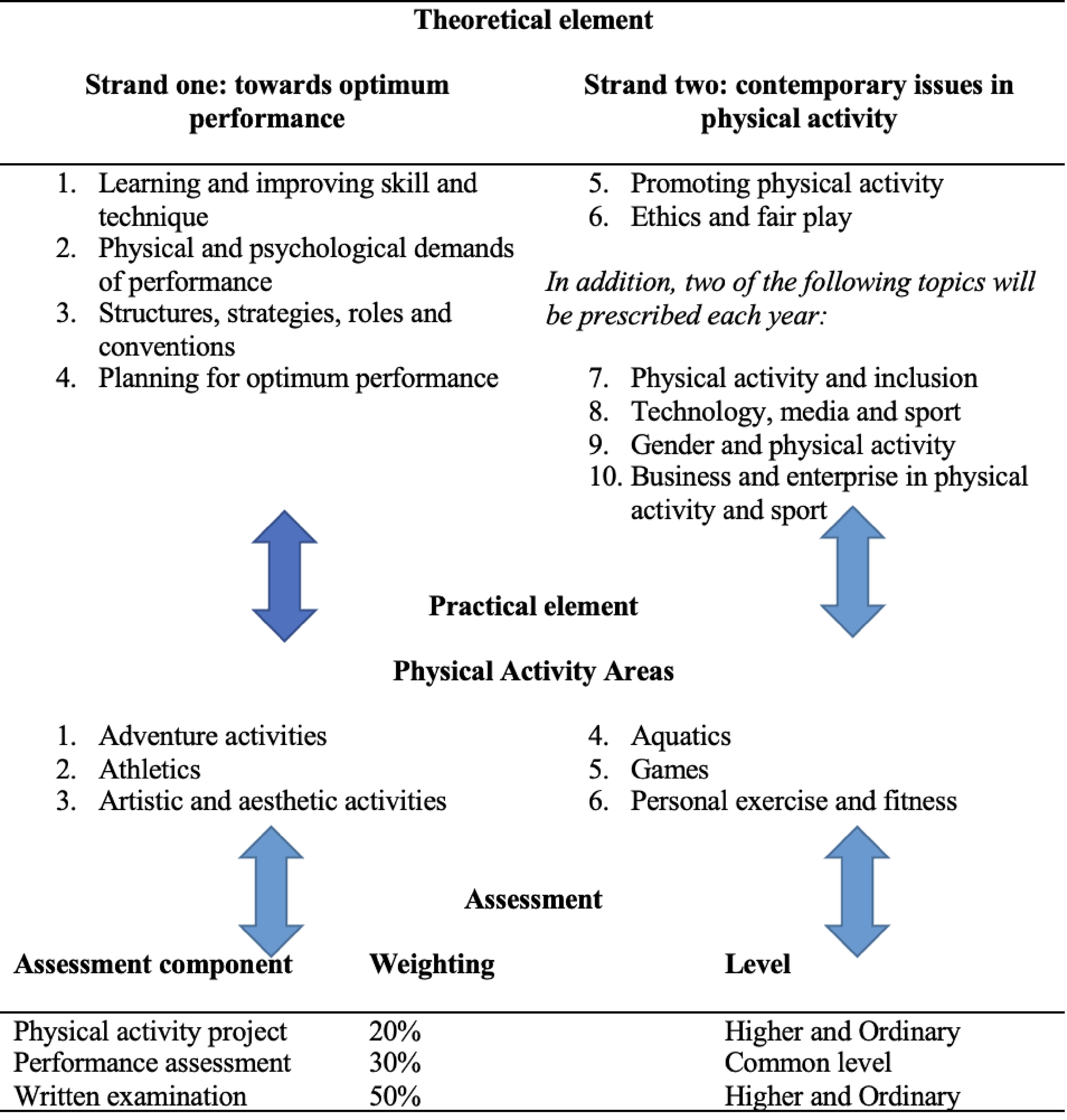
Leaving Certificate Physical Education (LCPE) outline (adapted from the specification; NCCA, 2017).
The formal curriculum policy, that is, the official written text, may also encourage a theory–practice divide despite emphasising the importance of integration in the above extract. For example, the LCPE specification states that: ‘In strand 1, students learn about different theoretical perspectives that impact on optimal performances and how to apply this understanding to a range of different activities’ (NCCA, 2017: 11). This may encourage learning ‘about’ theory and then ‘applying’ in practice rather than learning about theory in practice; we explore these constraints and possibilities later in the paper. Having introduced the reader to integrated learning experiences and the LCPE curriculum case study context, we now present the underpinning theoretical frameworks of this paper.
Figurational sociology
Figurational sociology, and particularly the concept of a figuration, is used in this paper to locate the teachers and students in their network of interdependent relationships (i.e. their figurations). Elias (1978) contends that people can only be understood in the plural or, in other words, in their web of interdependent relationships. Elias termed these ‘figurations’: ‘people are more-or-less dependent on each other first by nature and then through social learning, through education, socialization and socially generated reciprocal needs, they exist, one might say, only in pluralities, only in figurations’ (Elias, 1978: 271). By locating the teachers and students within their figurations in this paper, we gain a deeper understanding of how they enact policy and shed light on the enabling and constraining interdependent relationships which influence such enactment. It is important to acknowledge that each teacher/student is a part of their own figuration in which they have multiple interdependent relationships with, for example, their colleagues/peers, their teacher/students, parents, and so on; this highlights the complexity of the situation and the multiple interacting and interdependent web of networks. It is argued that people develop ‘socially constructed “habitus” or “second nature”’ (van Krieken, 1998: 6) through their figuration and influenced by the multiple interacting, interdependent relationships within. It is also important to note a figuration involves social processes, past and present, recognised and unrecognised (Green, 2002). With regard to this paper, this emphasises the complexity of the policy enactment process which is influenced by teachers’ and students’ habitus and numerous social processes. Elias contends characteristics of human relations or social life should be considered in terms of processes rather than something static. For instance, power should not be viewed as something a person possesses, but rather power is a structural characteristic of human relationships which places people in powerful positions (Elias, 1978).
Figurational sociology has been used to understand many different aspects of education (Lybeck, 2019). Scanlon et al. (2019, 2020b) used figurational concepts to explore the process of curriculum development in understanding how curriculum makers’ intentional actions resulted in unintended outcomes. Scanlon et al. (2020a) also used figurational sociology to gain a deeper understanding of curriculum enactment and offered an alternative figurational viewpoint of teacher agency in such enactment. More recently, Scanlon et al. (2022) used figurational sociology in exploring the teachers’ professional development experience in a rhizomatic analysis. The use of figurational sociology across these four mentioned studies allowed the authors to locate the participants in a complex web of interdependent relationships. As such, the authors were able to explore such influential interdependent relationships on the participants’ habits, actions, and processes. In this paper, we conceptualise curriculum as policy and policy as a social and political process (Penney, 2013), and engage with the language of policy ‘enactment’ ‘to “make” policy into a process’ (Ball et al., 2012: 2). We now move on to discuss Ball and colleagues’ work on policy enactment.
Teachers and students as ‘policy actors’ who ‘do’ policy enactment
We use figurational sociology as a lens in interrogating Ball and colleagues’ work on policy enactment and specifically, in analysing teachers and students as ‘policy actors’ who ‘do’ policy enactment. As such, we locate teachers and students in their respective, yet interconnected and interdependent, figurations in a complex multi-layered policy enactment context (Braun et al., 2011). While we do not have the space to detail the multi-layered policy enactment context, we focus here on teachers and students as ‘policy actors’ who ‘do’ policy work (Ball et al., 2011). Ball et al. (2011: 625) encourage us to view teachers as policy actors who occupy different policy positions ‘in making meaning of and constructing responses to policy through the processes of interpretation and translation’. Table 2 outlines Ball et al.'s (2011) eight types of policy actors. Similar to others (Alfrey et al., 2017; Wilkinson and Penney, 2020), the purpose here in outlining these types of policy actors is to use Ball et al.'s (2011) theoretical framework to understand the different roles teachers take within the policy enactment process in interpreting, translating, and enacting curriculum policy into pedagogical practices. It is important to note that ‘the actor positions should not be regarded as fixed, mutually exclusive or exhaustive’ (Wilkinson and Penney, 2020: 4). This process from curriculum text to enactment is a contested and negotiated process between, and alongside, the teacher and their (life and professional) biography, other teachers, students, school management, professional development agencies, curriculum and assessment agencies, and social and political processes. From a figurational viewpoint, the concept of habitus is influential here. Throughout this process, the original intentions of the curriculum continue to be (re)interpreted and (re)developed through a complex decoding manner (Braun et al., 2011; Lambert and Penney, 2020). This decoding process allows the teachers to work in a creative manner with ‘themselves, their colleagues and their students in order to do policy and to do it well’ (Ball et al., 2012: 138).
Policy actors and ‘policy work’ (adapted from Ball et al., 2011).

While there seems to be a growing literature base in adopting Ball et al.'s (2011) teachers as policy actors framework, there is very little research conducted on students as policy actors. Löfgren et al. (2018) and Wilkinson and Penney's (2020) recent research highlights the importance of viewing students as policy actors in the processes of translating and enacting policy in school. Wilkinson and Penney (2020: 11) conclude in their research, ‘Although students are not formally responsible for the enactment of policy in schools, this research has shown the various ways in which they are, nonetheless, active in enactment’. Students are somewhat constrained in the enactment process by the teachers’ interpretation, translation, and enactment of policy (Löfgren et al., 2018). From the perspective of figurational sociology, the concept of ‘power’ can shed light on this influential interdependent relationship and its respective actions. This paper draws on Ball et al.'s (2011) policy actors framework to understand the roles students adopt in their response to integrated learning experiences and Elias’s (1978) concept of power to explore how power balances between teacher and student influence such responses to (and further enactment of) integrated learning experiences. This paper takes the stance of Löfgren et al. (2018: 681) that, ‘teachers and pupils are not merely the subjects of policy, but actors of policy as well’.
Given the process-orientated underpinning of figurational sociology, figurational sociology offers an exploratory and analytical lens to understand the relational, processual nature of teachers’ and students’ policy enactment. Figurational sociology allows for a critical analysis of policy enactment in this context as the use of a figuration will encourage us to view (and understand) teachers’ and students’ actions in a web of interdependent relationships. Through this figurational lens, we will be able to explore the power imbalances which enable and constrain such policy enactment actions. Merging this with Ball and colleagues’ work, figurational sociology will allow us to understand how teachers and students as policy actors operate in these roles and who influences the construction and amalgamation of these policy actor roles. The intent here is to view Ball and colleagues’ work through a figurational lens to further understand such work and ‘push’ the theoretical boundaries of Ball and colleagues’ framework. If we position teachers as policy actors (in their figurations within the complex multi-layered policy enactment context), and pedagogy as policy work (Penney, 2013), we can view teachers’ pedagogical practice as policy action (Brown and Penney, 2018) or policy work. This perspective allows us to focus on the ‘how’, that is, ‘how’ examinable physical education, and more specifically integrated learning experiences, are taught and learned. With the notion of integrated learning experiences in mind, and an understanding of curriculum policy and appreciation of teachers and students as policy actors doing policy work in the complex multi-layered policy enactment context (Ball et al., 2011), we revisit our aims before delving into the methods of the paper. We aim to explore and understand: (i) how the teachers engaged in a process of interpretation, translation, and enactment of ‘integrated learning experiences’; and (ii) how students underwent a similar process in response to their teachers’ interpretation, translation, and enactment of ‘integrated learning experiences’.
Methods
Participants and data collection
A case study design, which entails a detailed and intensive analysis of a single case (Bryman, 2012), was used for this study to ensure deep data gathering and exploration into the teachers’ and students’ figurations and perceptions of integrated learning experiences. Two teachers, Claire and Jack (pseudonyms), were purposively sampled (Bryman, 2012) as these teachers were part of the first 64 schools to teach LCPE in phase one of its introduction. The 64 schools were chosen from a pool of schools that applied to teach the first phase of LCPE. It was recommended that one teacher from each school was to teach LCPE. The teachers were purposively sampled due to their inclusion in professional development clusters which were organised by the Professional Development Services for Teachers (PDST). The two teachers resided in two different professional development clusters which were geographically convenient to the researcher. It is important to note that Claire and Jack also teach another school subject alongside LCPE. The two teachers then chose and asked six students from their LCPE class to be involved in the study. These six students were chosen from class sizes between 18 and 20 students. Given only 64 teachers were involved in phase one of the enactment of LCPE, limited information is provided on the participants to protect their identity from being traced.
The two teachers were interviewed in a semi-structured manner weekly (when possible), face-to-face at their respective schools, at the authors’ institute or by phone for the whole first year of teaching LCPE. This resulted in Claire being interviewed 19 times and Jack being interviewed 18 times. The teachers were asked questions on their planning, their pedagogical approaches, the forms of assessment used, the role of digital technologies, and a number of reflective questions (e.g. what have you learned this week that you can adapt to your teaching next week?). The interviews lasted between 15 and 45 minutes. The students were interviewed in focus groups over a year and one term at their respective schools which resulted in four focus group interviews for the two groups of students (eight focus groups in total). While it was envisioned that the six students would participate in all focus groups, due to absentees, in three focus group interviews, only five students were available. The same students, when available, participated in all focus groups. The students were asked questions on what they had enjoyed about LCPE (content, assessment, pedagogy), what they had found challenging in LCPE (content, assessment, pedagogy), and comparison questions to other Leaving Certificate subjects. The focus groups lasted between 25 and 45 minutes. Students were included in this research for two reasons: (i) as discussed previously, there is very little research on students as policy actors (Löfgren et al., 2018; Wilkinson and Penney, 2020) and we argue that students are central policy actors in the policy enactment process – as such, we are adding to the policy enactment literature from a student perspective which is needed; and (ii) the students have a strong interdependent relationship with the teacher as they interact on a daily/weekly basis; therefore, it would have been unwise to ignore the perspective of this group of people (students) given the strong interdependent relationship in the teacher's figuration (and vice versa). Please see Figure 2 for the pattern of interviews conducted over the time period.

Data collection time period.
Data analysis
An amalgamated inductive and deductive approach was drawn on for the data analysis (Charmaz, 2014). This involved identifying figurational concepts (i.e. figuration, power, and habitus), the concept of integration, and policy actors theoretical framework as sensitising concepts but not drawing on such concepts until the last step of data analysis. The data analysis occurred in three phases: initial, focused, and theoretical (Charmaz, 2014). The first phase (initial) is an inductive data analysis and as we progressed, deductive elements were introduced (focused), and the final phase of data analysis can be considered deductive (theoretical). We stress that these phases did not occur in isolation (Thornberg and Charmaz, 2012). Given the large data set from multiple sources (teachers and students), we approached these steps in a non-linear approach, revisiting steps when needed. The data analysis was done in a dual approach, that is, Charmaz's approach to coding (explained below), and through a ‘live coding’ technique: both conducted by Author 1. Live coding (Parameswaran et al., 2020) is a relatively new form of qualitative data analysis that codes data without transcribing. The interview/focus group recordings were listened to, and codes were noted whilst listening ‘live’. This process was done alongside the initial phase of Charmaz's coding. Live coding can add context and meaning to the words and highlights the power of voice in the analysis process. In other words, ‘hearing the voice of the participant brings aspects of emotion, intent, and context that offers life that is otherwise lost on paper’ (Parameswaran et al., 2020: 641). This adds another dimension to qualitative data analysis which transcribing cannot as it added to how words are/were communicated. This approach was particularly useful for focus groups which can be difficult to translate into text (Parameswaran et al., 2020).
The first step in Charmaz's (2014) approach to coding was initial coding which involves line-by-line coding, and incident-to-incident coding. This dual approach captures and extracts the implicit and explicit messages in the data set (Mordal-Moen and Green, 2014). An important point to note in this phase was using the participants’ words as codes (as much as possible) to reduce author interpretation. The second step of coding was focused coding which involved a more selective and conceptual process (Weed, 2009). Throughout this step, initial codes were (re-)organised, compared, combined, and abandoned. As Mordal-Moen and Green (2014) put it, the most ‘fruitful’ codes were chosen. The construction of categories and sub-categories was a result of this process. The final step of coding was theoretical coding. In this phase, the sensitising concepts were drawn on to make sense of the constructed categories and sub-categories. Sensitising concepts included: (i) figuration; (ii) power; (iii) habitus; (iv) policy actors framework; and (v) the concept of integration. These sensitising concepts were not drawn on in the first two phases of data analysis (aligning with the inductive nature of the grounded theory approach). In this phase (theoretical phase), the intent was to explore and negotiate the processes and relationships between the theoretical concepts and the constructed categories. The constructed categories were read and re-read in relation to each sensitising concept and a mapping exercise was conducted whereby each sensitising concept was mapped onto segments of data which were best explained through that concept. Memo writing (Charmaz, 2014) proved useful in this theoretical negotiation phase. Throughout the first two phases of data analysis, ideas and theoretical connections were thought of and immediately formally noted through memo writing. This allowed the researcher to enter the theoretical coding ‘with an open but informed mind’ (Wheeler, 2013: 85). This acknowledges how the researcher and the data are ‘always theoretically informed’ (Garratt, 2013) and Charmaz's (2014) version of grounded theory supports this.
Findings and discussion
A ‘one-way street’: Teaching and understanding theory and doing it in practice
While acknowledging and emphasising the importance of blending theory and practice, Claire and Jack appeared to follow a ‘one-way street’ approach to integrated learning experiences. That is, the teachers teach the theoretical knowledge in the classroom before applying or reinforcing such knowledge through practical experience. This was as opposed to a ‘two-way street’ where the students are introduced to the practical knowledge first before the teaching of theoretical knowledge, or alternatively, a ‘spaghetti junction’ where the theoretical knowledge and practical knowledge overlap and are taught in the same (integrated) learning experience. For example, Claire's ‘one-way street’ approach is evident in how she taught ‘feedback’: In the theory class, we were studying different types of feedback, but then I wanted to implement them into the practical class and let the students live through the different types of feedback, and experience different types of feedback while playing a game … [so] we're implementing the theory we learned in [the] class[room] … [on reflection] I think they learned because I think I'm probably getting better at linking the theory to practical as well … I find if we’ve done some of the theory as background work, it's easier in the practical because they’re just implementing and living it [theory] through the practice. (Claire, Interview 3)
Interestingly, Claire associated improved student learning with her ability to teach integrated learning experiences. In this case, Claire interpreted integrated learning as theory(classroom)-to-practical(sports hall). In saying that, both Claire and Jack consistently alluded to how the practical experience reinforces the theoretical learning. Jack provides a teaching example of this: I had some posters up that some of the classes had made. They were around the room, and they just walked around, like a poster walk as like a starter just to recap each of the different lessons. I talked to them about the three [types of interval sessions] that we were going to be doing. So, we did maybe an 8-minute starting session. Then, at the end of that session, brought them in, had a discussion about how they felt, the characteristics, the advantages. So, they [learned about it] … theoretically, [and then] they got to experience practically. So, there's a lot of questioning in there on my behalf and I'm linking back to the theory they've done in [the previous classroom] lessons … .That learning is definitely being consolidated and it's definitely sinking in a bit more when they're experiencing it … we were looking at them from a theoretical perspective and then we directly applied them practically to the practical elements … So a lot of it was teacher-led and questioning them or probing them to make those connections to the theory and the practical. (Jack, Interview 2)
In this teaching example, we can see how Jack interpreted integrated learning experiences and translated them into a stop, start, stop, start pedagogical approach. Jack's interpretation of integrated learning experiences (‘stop, start, stop, start pedagogical approach’) influenced the students’ interpretation of how integrated learning experiences play out, as one student comments: [In practical class, we] will do the theory, then [our teacher] is like ‘go off and do this’ and then we would do it and analyse it, and then go back into the group again [to discuss the theoretical content]. (Deborah, Focus group 2).
The two examples of Jack and Claire's teaching highlight how they both interpreted, translated, and enacted integrated learning experiences, that is, teaching about theoretical knowledge in a classroom before applying such knowledge through physical experiences in a practical setting. Given this is the first time physical education is examinable in Ireland, and the first time the teachers engaged in teaching formally integrated learning experiences, the policy work the teachers did operated through a ‘coping’ role (Ball et al., 2011). The teachers were coping with the extra demands of having a large examinable theoretical aspect to the subject and the manner in which it should be delivered. When questioned on their reasons for being in a classroom for the teaching of the theoretical elements, the teachers defended the traditions of a Leaving Certificate subject (although not necessarily agreeing with it). Referring to the policy positions outlined by Ball et al. (2011), although Jack and Claire uphold a ‘receivers’ position, they also display elements of an ‘entrepreneurs’ policy position. The teachers did display elements of being entrepreneurs in doing policy work (Ball et al., 2011) as in many cases they did advocate for integrated learning experiences and how more time should be spent in a practical setting, but teacher, student, and contextual elements constrained the fruition of this advocacy.
Given this data set was collected weekly over one year, the teachers’ interpretation, translation, and enactment of integrated learning experiences changed, adapted, and modified to the context provided in that specific teaching moment (although informed by their past teaching biographies and orientated for their future teaching practices). For example, when Jack moved from topic 2 (physical and psychological demands of performance) to topic 1 (learning and improving skill and technique), the nature of the topic and the learning outcomes encouraged him to interpret integrated learning experiences in a different manner, that is, embedding the theory into the practical rather than teaching it before or alongside it: Topic 2 … [was] quite heavy theoretically and so we moved to topic 1 so we are looking at skill … where I can incorporate more theory in practical stuff within the lesson so, you know, embed it in the lesson as opposed to having structure[d] theory lessons followed by some practical … the planning was more around trying to embed the practical within the lesson. (Jack, Interview 7)
Interestingly, Jack's students had an influence in this decision to ‘embed practical within the lesson’ as: ‘They enjoy it more, I think they find it easier to relate to the learning … if they can personally experience it themselves’ (Jack, Interview 7). The student data supports this as across both sets of students, in all focus groups, there was a consistent message of ‘understanding by doing’, rather than ‘understanding then doing’: ‘Like everything we do in the theory class, it [practical experience] kind of helps us to understand it better’ (Aidan, Focus group 3). The following conversation (Focus group 4) speaks to this message (‘understanding by doing’), and highlights where and how students would like to learn through integrated learning experiences in a practical setting: Adam: I think we do a lot of classroom work, I thought it [LCPE] would be way more practical. It [LCPE] is very classroom based. So there would be a lot more learning [if we were] doing the actual thing.
Nelly: I think your understanding of it [content knowledge] will kind of expand then [by doing the practical after the theory class]. You are transferring what you have learned from class to like actually doing it.
Adam: I think it [LCPE] is pretty good so far overall – I am really enjoying it [LCPE]. The only thing is [I wish there were] more practical [classes].
Aaron: Other than that, it is perfect.
Nelly: Yeah it seems people learn in like different ways. I think a lot of people would learn easier if you are actually doing it rather than taking it [down] and hearing what [our teacher] is saying … I think the whole kind of school system needs to [change] [All: yeah] … It is kind of focusing on the one type of mind like people that are like intellectually smart like book[smart] [All: yeah] … I think [LC]PE is the chance for more of the sporty kids to come in and like show what they are able to do.
We can see how Jack began to challenge his receiver position with elements of an entrepreneur position (Ball et al., 2011) when he began to translate integrated learning experiences differently, that is, embedding the theory into the practical rather than teaching it before or alongside it. It was the strong interdependent relationship with his students in Jack's figuration (Elias, 1978), which encouraged this reflection, interrogation, and resulting challenge of his policy position and associated practices. The students emphasised and advocated for their want and need for more practical experiences to understand the theoretical knowledge, an ‘understanding by doing’ approach. In terms of policy positions, the students occupied two positions as they displayed characteristics of an entrepreneur, that is, advocacy for understanding by doing, and a critics position, that is, critiquing their teachers’ pedagogical approaches (and interpretation and enactment of integrated learning experiences) and engaging in a level of counter-discourse in opposing the schooling system, one ‘way of knowing’, and the privileging of ‘academic’ knowledge and practices.
The students had an active role in policy enactment (Wilkinson and Penney, 2020) as their policy positions influenced their teacher's interpretation, translation, and enactment of integrated learning experiences. From Jack's processual teaching example, we can see a strong interdependent relationship between students as policy actors and teachers as policy actors. While it may have been assumed the teacher as a policy actor was in a powerful position in policy enactment in the classroom, the power imbalances (Maher, 2010) shifted in the figuration and moved towards the students as policy actors given their advocacy and critiquing of how they wanted to learn. This, therefore, places the students in a powerful position in influencing their teacher's enactment of integrated learning experiences.
This category emphasises the usefulness of utilising figurational sociology in explaining how teachers and students ‘do’ policy enactment. The figurational insights highlight the interdependent relationships which operate within the teachers’ and students’ figurations, and how such interdependent relationships (and associated unbalanced power ratios) influence the policy positions teachers and students uptake (Ball et al., 2011). As seen in this category, the strong interdependent relationship between teachers and students enabled and constrained the policy enactment process and the policy actor roles which teachers and students held (or not) in such enactment processes. For example, Jack was constrained in his enactment of integrated learning experiences as the students advocated for another means of learning, which, through Jack's interrogation of practices, enabled another ‘way of knowing’, which benefited student learning. This interrogation of practices and Jack's ability to reflect and change (influenced and directed by his strong interdependent relationship with his students) demonstrates Jack's positive student–teacher relationship. This has been acknowledged in the literature as a key factor in influencing student academic performance (Whittle et al., 2018) and a characteristic of the ‘perfect’ physical education teacher (Whittle et al., 2015).
2. Contextual elements enabling and constraining the potential of integrated learning experiences [My take home message this week is] I suppose planning for when I am trying to incorporate different strategies that I wouldn’t normally use and I am trying to develop those strategies, [I] just need to make sure it is planned into the lesson, otherwise I will just go back to default; I will go back to what I am used to doing. (Jack, Interview 13)
When discussing their teaching plans for integrated learning experiences, Claire and Jack consistently alluded to their supportive relationships with other LCPE teachers and the PDST, that is, the professional development providers who deliver professional development related to LCPE in this case. They commented how these relationships enabled creative thinking around the potential of integrated learning experiences. The PDST organised and facilitated regionally based professional learning communities (PLCs), which included approximately seven to nine LCPE teachers. While Claire and Jack were in two different PLCs, their engagement and interaction with other teachers (and the PDST resources) in sharing, developing, and critiquing teaching approaches for integrated learning experiences assisted in developing their own pedagogical toolkit. Jack reflects on these new strategies (or pedagogical approaches) and the importance of careful planning for integrated learning experiences:
Teaching space proved to be a barrier and constrained the potential of integrated learning experiences, as Claire recalls: The best thing for the whole subject, in my idea, from the get-go, was that the easiest way to teach it is through practical and to teach the theory through practice and I would have liked if I had access to the hall for my theory classes but I don’t. (Claire, Interview 2)
Different (and a combination of) teacher, student, curriculum, and contextual elements enabled and constrained the potential of integrated learning experiences. Supportive interdependent relationships within Jack and Claire's figurations (Elias, 1978) enabled a level of creative thinking for integrated learning experiences. Jack's comment regarding the importance of planning so that he ‘will not go back to what he is used to doing’ reflects the power of habits (Camic, 1986) and the need for a conscious effort in counteracting habitual practices. While habitus can be very difficult to change given how deeply ingrained habits are in one's personality structure (inclusive of teaching biographies) or habitus (Elias, 1978), Jack's recognition in this comment may enable the process of change. For now, though, throughout the processual data set, the teachers reverted back to their teaching biographies and Leaving Certificate ‘teaching’, that is, rote teaching and learning, once the learning outcomes mounted and formal assessment 1 pressure rose. Not only did their teaching biography and teaching context constrain the potential of integrated learning experiences, so did the contextual and infrastructural elements. Given the organisation of school subject timetables, LCPE was designated classroom time and practical space–time (in the sports hall or outside). The teachers and students began to label and conceptualise these spaces as theoretical spaces (classroom) and practical spaces (sports hall/outside). On behalf of both the teacher and students, there appeared to be an overwhelming association of theoretical knowledge with the classroom and practical knowledge with the sports hall. This begs the questions, ‘Do integrated learning experiences need to occupy a physical experiences space?’ and ‘Can integrated learning experiences be achieved without physical movement?’. While answers to these questions may be contested, it can be agreed that integrated learning experiences require creative thinking to enable their possibilities and potentialities.
The LCPE specification provided the teachers with challenges and opportunities, and a level of freedom to teach the content in their own way, given the nature of a learning outcomes-designed curriculum. While this enabled the potential of producing original and creative integrated learning experiences, the teachers viewed aspects of the curriculum as constraining elements, which hinder such production. The number of learning outcomes (128) and the lack of prior student knowledge put pressure on the teachers to enact meaningful, relevant and worthwhile pedagogical approaches to teaching the content. The students also felt the pressure of covering the vast number of learning outcomes but did not blame their teacher's teaching but the curriculum itself: ‘There's so much theory … I am drowning in theory … I feel like there are so many [learning outcomes] that we are not getting through them properly, and it's not [our teacher's] fault, there's just many [learning outcomes]’ (Emer, Focus group 4).
Given the number of learning outcomes that the teachers are expected to teach, depending on the strand, topic, and learning outcome, the teachers began to separate theoretical knowledge for the classroom and practical knowledge for the sports hall, with a greater amount of class time spent in the former space. Jack discusses the ratio of theory lessons (classroom) and practical lessons (sports hall): You have to do two or three theory lessons before you can introduce practical lessons. That's the ratio. You have to get the theory before the practical. It's very difficult to mix them. (Jack, Interview 5)
While overall, Claire and Jack found value in teaching integrated learning experiences (‘I suppose I've learned that the teaching is more enjoyable if the practical and the theory can be blended together’ (Claire, Interview 8)), throughout the year, the teachers questioned the role and necessity of practical knowledge. This question seemed to be raised when the pressure of covering the learning outcomes mounted. From Claire's comment below, the tension in where and how to teach theoretical and practical knowledge is evident: I felt so under pressure this week with psychology, I was kind of thinking to myself ‘God did I need to go to the Astro [turf, i.e. outdoor sports pitch] to get them [students] to do all of those different runs. If I told them the example would they know the same?’ … I felt under pressure with physiology as I had lots to do so I was kind of going in my head ‘God was that a waste of a class, did they understand the lactic acid system?’ … . But I think it did reinforce the learning … it reinforced everything and linked everything as well. I suppose it's good to apply it practically. (Claire, Interview 14)
While the teachers questioned the role and necessity of practical knowledge, the students consistently commented how they learned better through practical experiences: [I would understand the content better by] maybe linking it to the practical more instead of doing all the theory – just making it more practical like so we get what's going on. (Aidan, Focus group 3)
Both the students and the teachers felt the pressure of covering a large number of learning outcomes (128). Given the need to cover all the learning outcomes, in some cases, the teachers began to treat the learning outcomes as a ‘tick-the-box’ exercise rather than teaching them in a meaningful, relevant, and worthwhile manner. While the students recognised this, they did not blame their teacher. They indirectly critiqued a non-face-to-face interdependent relationship (Green, 2002) in their figuration, the NCCA, that is, the curriculum makers. This is a perfect example of how an influential non-face-to-face relationship, that is, the curriculum makers, and the unintended consequences that they produced (Scanlon et al., 2019), influenced the teaching and learning occurring in the school policy enactment context. The unintended consequence of having so many learning outcomes in the curriculum specification encouraged the separation of theoretical and practical knowledge (and in some cases, replacing practical classes with extra theoretical classes) in order to relieve the curriculum pressure and cover all the learning outcomes. This was unintentionally encouraged, despite the emphasis on integrated learning experiences in the specification and the teachers’ and students’ advocacy for such approaches. We are not pinpointing the learning outcomes issue as the only factor for this resulting practice as it is a combination, an amalgamation, and a negotiation between multiple elements in the policy enactment process and the interaction between the interdependent relationships within, alongside, and between the teachers’ and students’ interdependent figurations. The trend of replacing practical classes with theoretical classes for formal assessment preparation is reported in the literature (Stidder, 2000) and signs of this were alluded to by the teachers in this study but encouragingly the students emphasised how they learned better through practical experiences. The students commented how the practical experience makes it ‘easier to understand’ the theoretical knowledge but also prepares them for the written examination. This finding contests this common concern (translating practical knowledge and understanding into written answers) in the research (Thorburn and Collins, 2003). The students again are upholding an entrepreneur policy position in advocating how they want to learn. This category highlights the multiple, interdependent (face-to-face and/or non-face-to-face, recognised and/or unrecognised, past and/or present) relationships which constitute one's figuration. For example, the professional development providers were a supportive face-to-face interdependent relationship in the teachers’ figuration and the curriculum makers were a non-face-to-face interdependent relationship in the students’ figuration. The processual nature of this category emphasises the constraining nature of habitus (Elias, 1978), particularly in a high-stakes, accountable context.
3. Integrated learning experiences through assessment: Possibilities and potentialities? I think because there's a written exam and we don't know what's on it … As a teacher I'd probably see pressure to give them information or to give them something kind of concrete rather than just discuss it in a practical even though we would be doing it through practical, I think, which will really aid their understanding. So, I think I would have been very unhappy with their full knowledge if we didn't have practical tomorrow. But I think the practical tomorrow will really help reinforce everything we've done this week. (Claire, Interview 16)
When discussing assessment and how this can or cannot promote, encourage, or discourage integrated learning experiences, there seemed to be a contrast between the teacher and student voices. While the teachers acknowledged the importance of the practical experience in reinforcing the theoretical knowledge, they discussed the pressure of teaching an examination subject in a high-stakes environment and how that can limit original and creative integrated learning experiences. The following comment from Claire highlights this conflict:
Throughout the year, the teachers did use project-based learning approaches, which were based on the Physical Activity Project (PAP), to prepare students for the PAP but also to blend theoretical and practical knowledge. In this manner, the teachers interpreted and translated integrated learning experiences into mini-assessment projects which the students reported enjoying and seeing the ‘links’ between theory and practice. Interestingly, the teachers were concerned about the students’ learning for the written examination if they focused too much on practical experiences. Again, this highlights the separation of knowledge – (theoretical) learning for the examinations and learning in practical experiences. Despite the teachers’ concern, the students commented how learning through the PAP consolidated the learning and the experience of applying the theoretical knowledge to a practical setting in the PAP prepared them for the written examination. As one student recalls: Health related fitness and sport related fitness, you would be like ‘oh I have to learn them’ [theoretically] but then in our PAP we had to link them in [practically] so then [if it comes up in the written exam] you think back to your PAP and be like okay that is it … and you just write that down. (Emer, Focus group 4)
Alongside this, the students reported how they enjoyed project-based learning and the PAP which enhanced their learning of the subject and allowed them to have more ownership in the design of the project and learning experience: ‘I enjoyed doing the project, you are writing up your own thing and putting in your videos and you are like creating this project around your kind of personality’ (Adam, Focus group 4).
Interestingly, once formal assessment deadlines approached, and formal assessment was being discussed with the teachers and students, there appeared to be a conflict between the policy positions that the teachers upheld and between the teachers’ policy positions and the students’ policy positions. Influenced by the teachers’ experiences with a Leaving Certificate subject and the associated pressures and expectations from the broader policy context (the Leaving Certificate examination system) (Thorburn and Collins, 2003), the teachers enacted policy from a ‘receiver’ position. The doing of policy work revolved around coping, defending decisions and pedagogical approaches, and depending on support, professional development, and other LCPE teachers (Ball et al., 2011). In saying this, while this was the predominant policy position, there was a conflict between this position and holding an ‘entrepreneur’ position. The school context shaped the receiver position which reflected the realities of enactment but there were elements of the teachers’ practices and visions for enactment which represented possibilities and potentialities. For example, in Claire's comment, we can see the realities of enactment given the context in which the enactment occurred (i.e. ‘the pressure to give them information’) but in the same comment, the conflict is noticeable as Claire advocates in her entrepreneur position (Ball et al., 2011) for the practical experience in providing ‘full knowledge’ (theoretical and practical knowledge). Using project-based learning and being creative in assigning such learning (e.g. attending sports games to view practical activities and reflect on such activities with theoretical knowledge or the use of digital technologies in recording and analysing movement), the teachers challenged elements of their receiver position with elements of entrepreneur position due to the interaction with their students in their figuration. This highlights how different positions can coexist depending on the positioning of the teacher in their figurations and their interaction with influential interdependent relationships. It is also worth noting that many of these challenges reflect issues of course design and assessment which are translated and interpreted for enactment (which causes further challenges and issues, as noted above).
Following Jones and Penney's (2019) conceptualisations of integration, this project-based learning approach and the PAP represent investigative/guided arrangements for integrated theory and practice. The students act as the active agents in this approach and the teacher adopts a facilitator role. The teachers seemed to adopt a facilitator role given the student-centred nature of these assessments (which was outlined in the LCPE specification). The students in this study seemed to appreciate this level of control which they believed enhanced their learning, understanding, and preparing for the written examination. These findings highlight the possibilities and potentialities of integrated learning experiences becoming embodied learning experiences and enhance the potential of deep learning for the written examinations (as well as the other formal assessments). One concept which does not explicitly appear in the LCPE specification but is evident in Adam's final comment (i.e. ‘you are like creating this project around your kind of personality’) is ‘personalisation’ (Brown and Penney, 2018). Through project-based assessment (formal and informal), the students’ interpretation of integrated learning experiences highlighted the importance of personalisation in developing their own authentic, personalised learning experiences aligned with their teachers’ expectations, and therefore, exploring and making meanings of movement (Brown and Penney, 2018). In this construction process, the students hold a ‘translators’ policy position (Ball et al., 2011) as they produced artefacts representing integrated learning experiences. Elements of their teachers’ policy position (receivers and entrepreneurs) facilitate their students’ policy position (translators) which again highlights how policy positions change, amalgamate, and dominate depending on the context and the influential interactions between a strong interdependent relationship in their respective figuration.
Considerations and conclusion
Viewing the interrelationship between each of the three categories and informed by the combination of the theoretical frameworks (Ball et al., 2011; Elias, 1978), the findings of this paper emphasise the complexity of teaching and learning situations: demonstrated through the teaching of ‘integrated learning experiences’. There are multiple, interconnected, and interdependent elements and relationships which enable and constrain policy enactment. The use of figurational sociology enabled us to locate the teachers and students in their interconnected web of interdependent relationships and their figurations. By viewing the teachers and students in their figurations, we gained a deeper understanding of their actions which were influenced, directed, enabled, and/or constrained by their interdependent relationships. This also shed light on the changing nature of the teachers’ and students’ policy actor positions. For example, as noted under category one, Jack challenged his receiver position with elements of an entrepreneur position due to the interaction with his strong interdependent relationship with his students (and their critics position). Throughout the findings, we can also see how non-face-to-face interdependent relationships influenced the teachers’ and students’ enactment of the curriculum, for example, the NCCA. Figurational sociology highlights the complexity of the curriculum enactment process which operates within and alongside a figuration consisting of influential interdependent relationships (face-to-face, non-face-to-face, recognised and/or unrecognised, past and/or present).
The use of figurational sociology also shed light on the unbalanced power ratios which exist in a figuration and how teachers and students are put in powerful positions throughout the teaching and learning process. As previously alluded to, habitus is constructed through figuration(s) (Elias, 1978). The teachers’ and students’ habitus seemed to constrain the potential of integrated learning experiences, in that the teachers’ teaching biographies (habitus) and the students’ learning biographies (habitus) operate in a traditional teaching and learning space (particularly in the Leaving Certificate context) given their respective education. This space (and their aligned habitus) was evident as the formal assessment pressures mounted and the teachers reverted to traditional rote teaching and learning and the students supported this decision. Overall, figurational sociology provides an alternative framework to interrogate and ‘push the boundaries’ of the dominant theories used to analyse the complexity of policy enactment processes and to understand the teachers’ and students’ actions as policy actors within that process as they enact integrated learning experiences.
This paper sought to understand how teachers interpreted, translated, and enacted integrated learning experiences, and their students’ response to such enactment (and indeed, their own interpretation and translation). The key takeaway message for the reader is: through the use of figurational sociology, we have demonstrated how the teacher's interpretation is not solely their interpretation but an interpretation that has been contested and massaged for them through multiple interdependent relationships in their figuration (Elias, 1978) through the policy enactment process (Ball et al., 2011). It is then translated and enacted through their own habitus, and influenced by the school context (Braun et al., 2011) and the multiple interdependent relationships within and alongside their figuration. We also argue that students have an active role in this process and further influence and direct the possibilities and potentialities of integrated learning experiences, depending on their enabling or constraining interdependent relationships within their figurations. We believe the findings and discussion of this paper can inform initial teacher education as pre-service teachers (PSTs) should be taught about the complexity of the enactment of curriculum policy and their role within that multi-layered process. We need to prepare PSTs as policy actors. PSTs should also be allowed space and time to engage with complex pedagogies such as integrated learning experiences which could build their pedagogical repertoire for teaching different types of knowledge in the same experience. This paper has shed light on how teachers and students ‘do’ policy work, which we argue is influenced by the multiple interdependent relationships within and alongside their figurations in the multi-layered policy enactment context.
Footnotes
Declaration of conflicting interests
The authors declared no potential conflicts of interest with respect to the research, authorship, and/or publication of this article.
Funding
The authors received no financial support for the research, authorship, and/or publication of this article.
