



Abstract
Despite the impossibility of face-to-face teaching during the covid-19 pandemic lockdown, many physical education teachers used remote activity pedagogical monitoring (PM) to keep students engaged in physical activity (PA). The aim of this study was to explore students’ experiences of remote PM practices during lockdown to engage in PA. A sequential explanatory mixed methods design was used, with a qualitative investigation (students’ experience of PM) informed by a quantitative investigation (relationship between PA and PM as a function of diligence). First, 644 French students (16.32 ± 1.01 years) participated in a longitudinal survey to collect retrospective data about their reported PA levels during a typical week before lockdown and four weeks after. A second step consisted of identifying clusters, based on how PA emerged in participants and diligence in PM. Five clusters were identified from which eight paragons accepted to be interviewed. Interviews were conducted with paragons from each cluster to understand their different lived experiences during PM. Results showed a significant decrease in PA during lockdown, with PM serving to limit the drop-out from PA. Positive experiences in PA engagement were associated with: (a) family and video support, (b) variety in the PA program, (c) requests for work, (d) provision of feedback, and (e) use of personalised training. Results are encouraging in terms of developing hybrid pedagogical practice which includes face-to-face activity and use of PM. Further research is needed to ensure these pedagogical principles lead to positive experiences of PA engagement at a distance.
Introduction
The global Coronavirus 2019 (covid-19) pandemic led many governments across the world to confine the population to slow the spread of infection. This public health strategy has raised questions over unintended collateral damage to population health and wellbeing, particularly in terms of impacting the capacity to maintain physical activity (PA) levels. Some research has reported an overall decrease in students’ PA levels during lockdown (Rodríguez-Larrad et al., 2021; Stockwell et al., 2021) and has supported the need for recommendations to promote pedagogical advances which mitigate effects of inactivity and sedentary behaviours (Bull et al., 2020; Sallis et al., 2006). These methodological advances may require a change in PA programs during lockdowns, adapting to the particularities of the pandemic context.
For most young people, physical education (PE) has been recognised as the main opportunity to maintain engagement with PA during lockdown (Coulter et al., 2021), since PE is a mandatory part of school curricula across the world. PE is traditionally offered in a ‘hands-on’ or ‘face-to-face’ format (Varea and González-Calvo, 2021), but lockdown forced pedagogical innovations, opening the way to hybrid teaching innovations, including remote activity pedagogical monitoring (PM; Howley, 2022). PM is an emerging form of teaching, moving towards virtual learning platforms where the educator is not physically present in front of the student (Webster et al., 2021). Calderón and McPhail (2021) have suggested how several paradigms, such as face-to-face teaching and PM could co-exist to create a holistic and comprehensive strategy to promote quality PA experiences (UNESCO, 2015). Initial studies of implementing this approach have shown how teachers’ conceptions have changed (Centeio et al., 2021), leading them closer towards PM, oriented towards health topics to promote PA (Potdevin et al., 2020).
Designed appropriately, PM could have the potential to complement face-to-face teaching, taking into consideration the diverse learning and PA needs of students (D’Agostino et al., 2021). However, during the pandemic (2019–2021) PE teachers were required to immediately conceive and deliver robust virtual educational activities, following the sudden entry into lockdown without adequate preparation time. Studies have already focused on the uses of PM, showing (a) how social inequalities reflect inequalities in the numerical domain could be an issue (Howley, 2022), (b) innovations in implementation and organisation of home PA and exercises, (c) specific design adaptations to limit the amount of sedentary time (Sheldrick et al., 2022), (d) the effects of PM on the quantity and intensity of PA levels to avoid decrements over time (Wilke et al., 2021) and (e) the ineffectiveness of PM used by teachers in their hybrid pedagogical practice (Mercier et al., 2021). Gobbi et al. (2020) have already shown a significant effect on evolution of PM and feedback processes used by PE teachers on adolescents’ PA levels, regardless of country. These studies have revealed that students experienced the first wave of covid-19 quite differently, suggesting that a diverse sample of students is needed to record and evaluate wider experiences of PA engagement.
Studies which have explored student experiences of lockdown are scarce, particularly those with adolescents and their relationship with the PM used by PE teachers. Interestingly, a few studies have analysed effects of PM in physical rehabilitation settings, provided by virtual assistants (Oh et al., 2021). Results have suggested that online coaching can have immediate positive effects on PA levels, but persistence in engaging in PA beyond the interventions was questioned. These results seemed to reinforce the need for the construction of a substantive, positive relationship, even at a distance, between teachers and students. Several other studies have investigated PE teachers’ key pedagogical principles for remote learning to improve students’ engagement in PA during lockdown, such as providing online feedback, choices of sports for participation and social support from parents/caregivers at home (Derigny et al., 2022; Gobbi et al., 2020; Istenič, 2021a; Rivera-Vargas et al., 2021).
Following the phenomenological enaction approach (Poizat et al., 2022; Theureau, 2003, 2015; Vors et al., 2019), the present study investigated the processes of students’ engagement in PA at a distance through their intentions, perceptions and knowledge mobilised. From the students’ point of view, López-Fernández et al. (2021) showed that quality of interactions between students and PE teachers was perceived to deteriorate during lockdown. In contrast, Sandvik et al. (2021) showed that, for some, this period was an opportunity to explore new ways of developing PA in a small area of the home environment, using flexibility and autonomy of practice. These contradictory findings stress the need to explore the quality of distance learning practices, especially PM, offered by PE teachers, from the students’ perspective. While effects of PM interventions have been recorded and assessed, they seem to be short-lived and need to be further explored to provide PE teachers with information for the development of high quality, online educational resources. This issue provides a clear need for further research to inform educational policy and PE teachers on the effects of education at a distance on PA levels, particularly during periods that inhibit face-to-face interactions and require virtual teaching.
Implementing a mixed methods approach, which combined a quantitative (relationship between PA and PM as a function of diligence) and a qualitative analysis (students’ experience of PM), this study addressed the following research question: How did students experience remote PM practices to engage in PA during lockdown? We hypothesised that, similar to PE experiences in a face-to-face format, there are effective teaching principles and methods, which can be highlighted from the participating students’ lived experience.
Methods
Procedure
We conducted a mixed methods investigation including a longitudinal follow-up of participants (Figure 1). Mixed methods have been defined as a ‘third methodological paradigm’ (Vors and Bourcier, 2022), which include a quantitative method to analyse numeric data and a qualitative method to analyse verbalised insights (Creswell and Plano Clark, 2017; Greene, 2007). This integrated methodology goes beyond the divisions between the quantitative and qualitative data analysis to retain benefits of different types of evidence, increasing the strength of studies and diminishing the weaknesses of studies from a single perspective (Johnson and Onwuegbuzie, 2004). This methodological approach was initially used by Camerino et al. (2019) in a PE teaching context, and then more recently by Adé et al. (2022), Girard et al. (2022) and Vors and Bourcier (2022). Overall, mixed methods research has five key aims (Greene et al. 1989): (a) triangulation of results from different methods, (b) investigating complementarity of findings between different methods, (c) developing use of findings from one method to help inform implementation of another method, (d) stimulating innovations that seek new perspectives of frameworks and (e) seeking to expand the breadth and range of an inquiry by using different methods for different components of the study.

Flowchart of participant recruitment.
First, we used a quantitative method to record participants’ PA levels and to profile the reported effects of PM on the evolution of participants’ PA levels during the covid-19 lockdown. Second, based on the quantitative data, we used a qualitative method (enactive interviews) to gain a deeper understanding of participants’ patterns of remote engagement in PA, using PM guided by teachers. This study was authorised by Ethics Committee of the University of Lille under the number 2020-418-S82 and the National Committee for Informatics and Freedoms under the number 2020-037. Participants were informed that they could terminate their participation in the study at any time. They provided informed consent following the requirements of the World Medical Association Declaration of Helsinki (2013).
Participants
A sample of French high school students (n = 808; mean age: 16.32 ± 1.01, range: 14–20 years) participated voluntarily in the quantitative measurements between March 30 and April 12 2020 (a covid-19 lockdown occurred from 16 March to 11 May 2020 in France). Qualitative data collection was undertaken between January and March 2021, less than a year after the quantitative data collection phase.
For the quantitative phase, the 32 schools selected were part of a teachers’ network who participate regularly in PA research studies with their students. When recruiting participants, no particular attention was given to the students’ past experiences with PM. Socioeconomic stratification was carried out (low socioeconomic status: 52.3%; high socioeconomic status: 47.7%, non-statistically significant differences) to limit bias related to digital access of participants (Howley, 2022). Participants were excluded when the surveys were not fully completed (n = 79) and where data were incoherent (n = 42, e.g. reported activity participation being more than seven days a week or more than 10,000 minutes per week). Outliers were statistically excluded using the Grubb Test (n = 43). A total of 644 participants were included in this first stage.
For the qualitative phase, 32 paragons (representative participants of each cluster) were identified to engage in enactive interviews to construct the experiential process behind choices made to engage in PA during lockdown. Paragons who did not respond (n = 23) or provided incoherent enactive interviews (n = 1) were excluded from the data treatment. As a result, eight paragons interviewed were included in this study.
Data production
Physical activity
We used the International Physical Activity Questionnaire-Short Version (IPAQ-SV; Sember et al., 2020) to collect retrospective data about PA levels reported by participants during a normal week before lockdown and PA levels two to four weeks after the start of lockdown. Following the French national policies and WHO classification of PA profiles (Bull et al., 2020; Genin et al., 2021), we classified participants into three initial profiles of PA levels undertaken before lockdown: ‘inactive’ (<600 Mets.min.week−1), ‘minimally active’ (600–3000 Mets.min.week−1) and ‘HEPA active’ (Health Enhancing Physical Activity; > 3000 Mets.min.weeks−1).
PM and diligence
Information on the availability or not of PM during lockdown was requested of all participants (question: ‘Did you receive distance learning from your PE teacher?’; answer: ‘yes/no’). To standardise participants’ understanding, PM in PE was defined as: any direct or indirect link with the PE teacher (mail, live teaching, pedagogical resources in the digital working environment) that led to the completion of work in a PE setting. A binary question (‘yes/no’) on the understanding of this definition was administered to all participants. In cases of a positive response to exposure to PM, a diligence assessment was carried out by using a Likert scale (question: ‘Have you completed the proposed distance learning activities?’; answer: ‘one to five’, corresponding respectively to PM ‘never executed’ to PM ‘always executed’).
Pedagogical practices
To collect data on key pedagogical practices, enactive interviews were conducted by video conference and took about 40 minutes to complete (approximately 10 minutes for the presentation of the research and the confidentiality to establish a relationship of trust with the student and 30 minutes for the self-confrontation interview). In contrast to other types of interviews, they provided access to the lived experience of the participants by confronting them with their own activity data (Theureau, 2003, 2015). In our study, the enactive interviews allowed participants to be confronted with their own self-reported changes in PA quantity and quality of PM data. Recent qualitative studies have demonstrated the fruitfulness of this method for studying learners’ dynamic experiences in PE lessons (e.g. Gesbert et al., 2017) and for studying the dynamics of PE lessons (e.g. Jourand et al., 2018; Vors et al., 2015). The interview was directive to provoke the re-emergence of elements of past experience when the participant was confronted with their own evolution of PA participation and PM. Before each interview, the interviewer explained the expectation that the participant should ‘re-live’ and describe their own experience of PA during lockdown. Whenever they wished, the participant could comment on their own lived experience progressively, which in our study concerned their perceptions, intentions and knowledge in action. The starting question was: ‘What happened here?’ (presenting the evolution of self-reported PA) then ‘What was your feeling at this moment about the PM from your teacher?’ and ‘What were your intentions in PA?’ According to the participant's response, the questioning went deeper, starting from the participant's initial comments, as suggested for phenomenological research (Starks and Brown Trinidad, 2007).
Quantitative data analysis
The statistical analysis of the data was undertaken using the free R software (version 4.10) with different modules used (car, FactoMineR, ggpubr, lsmeans, outliers, psych, quantreg, rcompanion, rstatix and tidyverse). All data from quantitative variables and residual statistics were tested for normality, homoscedasticity and interdependence of the residuals (Shapiro-Wilk; Jarque Bera; Bptest; Durbin-Watson test). Non-normality of the distribution of the data from these quantitative variables led us to use non-parametric statistical analyses and to present descriptive statistics with median and interquartile range values. Statistical level of confidence was set at p < .05.
To record the differentiated evolution of PA levels according to PM between the periods before and during lockdown, a series of paired Wilcoxon signed rank tests and non-paired Wilcoxon rank sum tests were conducted. We followed the recommendations of Cohen (1988) to set the value of Cohen's d as a small effect when d > 0.2, medium when d > 0.5 and large when d > 0.8. To highlight effects of profile or PM on the evolution of PA, we conducted two Kruskal–Wallis tests with pairwise Wilcoxon tests (Holm method) as post hoc tests. Adjusted eta squared (
Following PA evolution and diligence, we performed a Principal Component Analysis (PCA) on participants who were exposed to PM, to identify clusters and representative paragons (Vors and Bourcier, 2022). Paragons corresponded to participants in the middle of each cluster, in the centre of the scatter plot. Exploratory cluster analysis was performed to verify, by graphical analysis, individuals who could be grouped into homogeneous clusters, representing similar characteristics (Broc et al., 2016). The paragons were identified using a statistical method from the FactoMiner package (‘desc.ind’) and then confirmed graphically via the FactoShiny package. Data reduction was considered robust when two dimensions accumulated an explanation greater than 50% of the variance (Pressac and Mell, 2017).
Qualitative data analysis
The qualitative data were analysed using the phenomenological method, which involves inductive and deductive approaches by identifying the description of phenomena that can be grouped into discrete categories (Vors et al., 2019). Taken together, they describe the structure of the participant's experience (Starks and Brown Trinidad, 2007). Respecting this theoretical and methodological framework, this phenomenological analysis of the data was undertaken in three steps (Theureau, 2003, 2015). First, the enactive interviews were transcribed verbatim and linked to the evolution of each PA intensity level as a function of attention to PM. Second, three components of experience were identified from the verbatim data (Saury et al., 2013; Theureau, 2003): (a) the intentions of the participant inform about the history of past and future interactions (what concerns emerged in the action?), (b) the perceptions that inform about the dynamics of the actor's situation (what sensations, feelings and emotions are significant in the situation?), and (c) the knowledge in acting that informs about the dynamics of learning/development (what are the rules or the past experiences mobilised in action?). Third, the components of each participant's experiences were grouped and reduced to similar sequences to keep only the typical component of the experience recurrent for all (Starks and Brown Trinidad, 2007). Two researchers (TD and TG) conducted the enactive interviews. They were both mentored and guided by a specialist researcher in this type of interviewing (OV). These three authors analysed the interviews together to classify the verbal material into the relevant categories related to the participants’ experiences.
Results
Evolution of PA levels supported by PM during the first wave of the covid-19 pandemic lockdown
After eliminating outliers (n = 164), 644 participants (418 females and 226 males, agemean: 16.32 ± 1.01 years old) were included in this study. Results of paired Wilcoxon signed rank testing showed that participants reported a significant loss of PA (−231 Mets.min. week−1, p < .05, d = 0.42). However, participants with a ‘HEPA active’ profile lost more PA (−1654 Mets.min.week−1, p < .05, d = 0.87, large) than ‘minimally active’ (−91 Mets.min.week−1, p < .05, d = 0.17) and ‘inactive’ (−0 Mets.min.week−1, p < .05, d = 0.4) participants. Results of the Kruskal–Wallis test showed a profile effect on the evolution of PA levels during the lockdown period (p < .05;
Among the 644 participants selected for the study, 506 received PM and 138 did not. The results of the non-paired Wilcoxon rank sum tests showed that there was no significant difference in PA levels between the students who received PM and those who did not (−179 vs −309 Mets.min.week−1, p = .71, d = 0.03). This lack of statistical significance was found in participants defined as ‘HEPA active’ (−1630 vs −2062 Mets.min.week−1, p = .56, d = 0.11), ‘minimally active’ (−90 vs. −124 Mets.min.week−1, p = .57, d = 0.07) and ‘inactive’ (0 vs + 24 Mets.min.week−1, p = .47, d = 0.63). Results of the Kruskal–Wallis test showed no effect of PM on the evolution of PA (Table 1).
Characteristics of participants and evolution of PA during the first wave of the covid-19 pandemic according to PM.
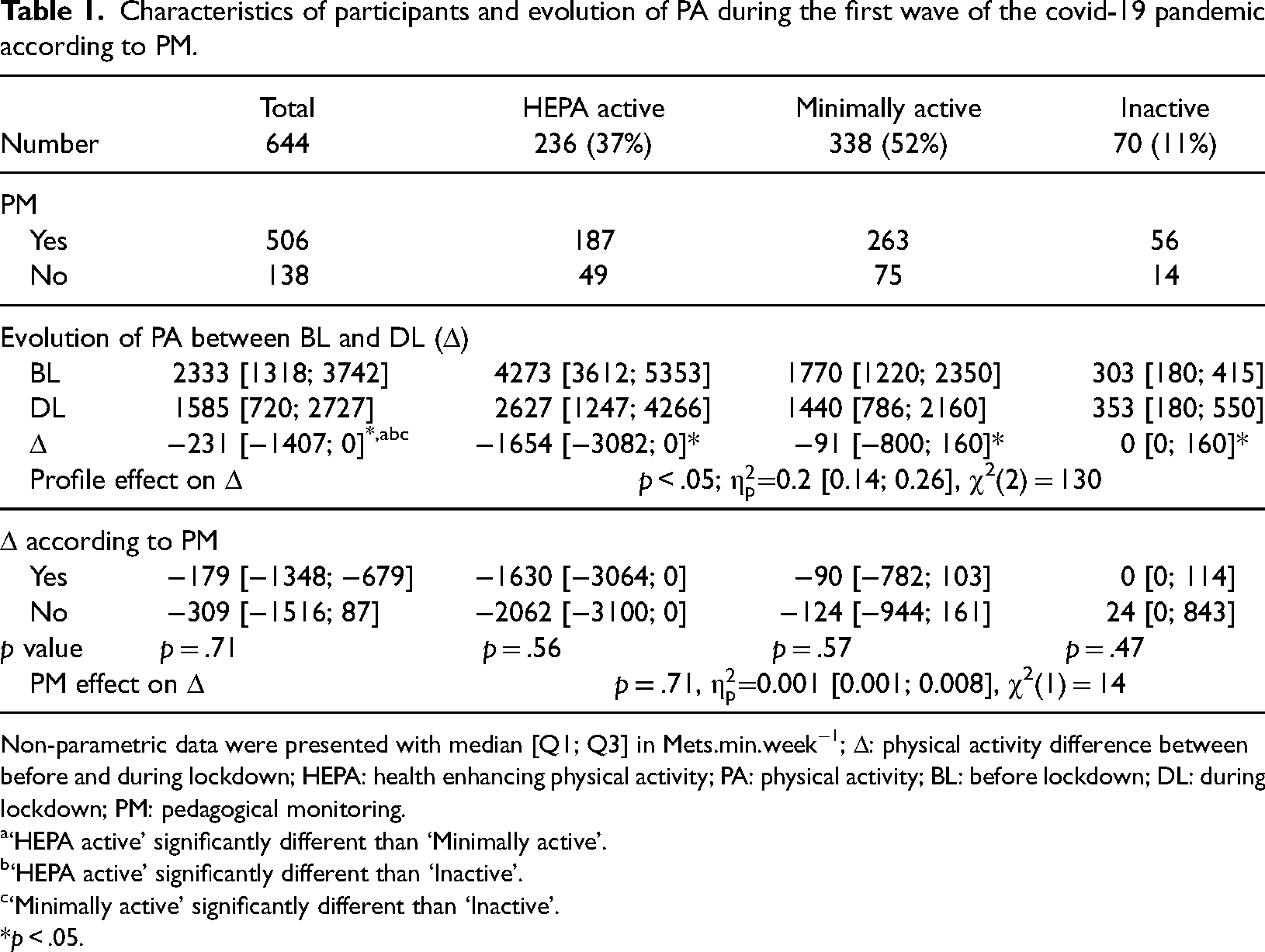
Non-parametric data were presented with median [Q1; Q3] in Mets.min.week−1; Δ: physical activity difference between before and during lockdown; HEPA: health enhancing physical activity; PA: physical activity; BL: before lockdown; DL: during lockdown; PM: pedagogical monitoring.
‘HEPA active’ significantly different than ‘Minimally active’.
‘HEPA active’ significantly different than ‘Inactive’.
‘Minimally active’ significantly different than ‘Inactive’.
*p < .05.
Concerning the relationship with the diligence of undertaking PA during lockdown (Figure 2), Kendall–Theil's non-parametric regression model showed a significant correlation between self-reported diligence and the amount of PA reported (p < .05). Students who did not report receiving substantial PM support reported a lower median PA level than those who strictly followed the PM provided during the lockdown. On a Likert scale of one to five, each point of diligence represents a gain of 351 Mets.min.week−1 (
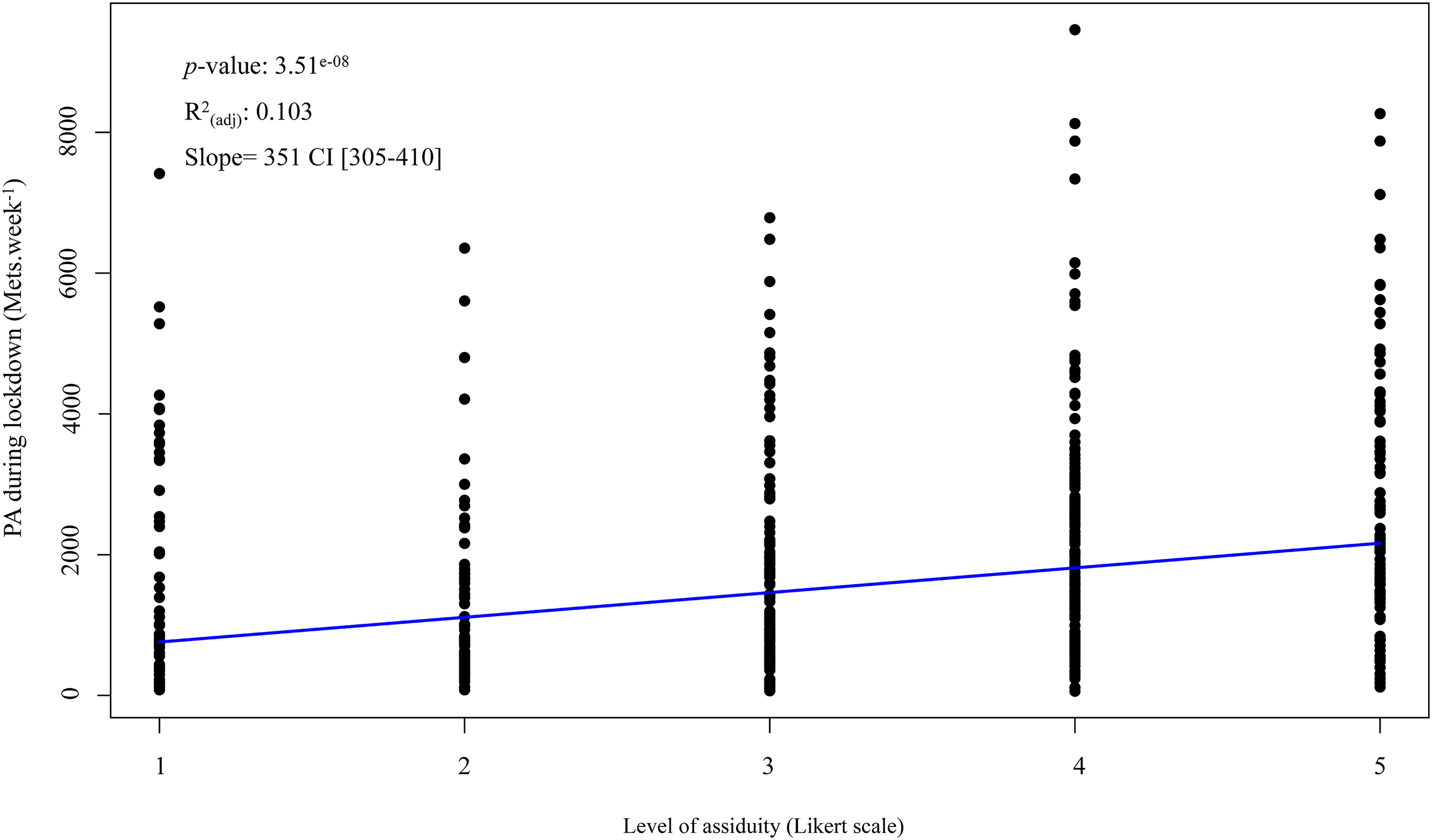
Relationship between diligence and PA during confinement.

Factor map from PCA analysis.
Cluster analysis of data on young people who received PM during lockdown
The cluster analysis by PCA of the 506 participants who reported having received PM revealed five meaningful clusters (Figure 3). Dimensions one and two explained 86% of the variance. Dimension one was correlated with PA levels reported before lockdown (R2 = 0.89; p < .05) and the evolution of PA (R2=−0.83; p < .05). Dimension two was correlated with the level of diligence (R2 = 0.93; p < .05). The quantitative and qualitative characteristics of clusters are presented in Table 2. Quantitative characteristics corresponded to the number of participants in each cluster, initial amount of PA, delta of PA between the periods before and during the lockdown, and level of diligence. Qualitative characteristics corresponded to the major intention behind PA, perceptions and knowledge verbalised by participants during enactive interviews. The characteristics of engagement in PA for each cluster corresponded to the initial level, that is, the level at which PA was undertaken before the lockdown.
Clusters’ quantitative and qualitative characteristics according to PM during lockdown.

For clarity, we standardised the wording of the content of each category succinctly, with a word or group of words emblematic of the participant allowing for a qualitative description of the specificity of the significant experience. Δ: physical activity difference between before and during lockdown; HEPA: health enhancing physical activity; N: number; PA: physical activity; PE: physical education; PM: physical education monitoring.
Data are in median [IQR] Mets.min.week−1.
Data are presented as categorisation of verbatims.
Cluster one (paragons interviewed: two) corresponded to the majority of participants who were ‘inactive with low diligence’. The qualitative analysis showed that the paragons in cluster one lacked motivation to engage in PA (intentions: ‘there was no follow-up and he [the teacher] just sent us some exercises without explanation’). At the beginning of the lockdown, they followed the PM support where they were required to return a form to the PE teacher on the digital working environment (perception: ‘I wasn't too motivated’). Afterwards, they remained less active because there was no follow-up and they had to search for information on the internet (knowledge in acting: ‘during the lockdown, we were supposed to do exercises at home but as it was not on video, I think nobody did it. Especially without necessarily knowing what to do. You had to watch everything on the internet’).
Cluster two (paragons interviewed: two) corresponded to initially ‘inactive and diligent’ students. The qualitative analysis showed that the paragons in this second cluster were physically engaged because the PE teacher offered different circuit choices that students could construct themselves (intentions: ‘she [the teacher] put different circuits every week on the school website. We had to choose and build circuits that we liked the most. What I liked was that the teacher gave feedback on my own circuits by correcting them, which helped me’). The PE teacher asked for student reflections and followed that up with advice to make progress at a distance (perception: ‘I felt that I was really followed by the teacher. Plus, I could see that I was losing weight. I really enjoy doing the exercises I choose, it's motivating’). The homework assigned by the PE teacher was in line with the students’ personal concerns to be physically active daily to maintain their health and wellbeing (knowledge in acting: ‘the teacher put comments on our sheet with for example “you did a bit too much upper body on this circuit”. I already had some knowledge of weight training’).
Cluster three (paragons interviewed: one) corresponded to ‘minimally active and low diligence’. The qualitative data showed that the paragon in cluster three did not appreciate the PM proposed by the teacher (intentions: ‘the PE lessons that the teacher sent me were really things that you don't normally do, like I remember he sent a circus training video or something like that’). There was no choice and no feedback requested by the PE teacher (perception: ‘I don't like the circus, don't find the video sent by the teacher motivating’). The participant in this cluster tended not to follow the PE proposals and was more involved in family PA where they may have undertaken a little jogging and resistance training activity (knowledge in acting: ‘my father knew a lot of the moves to do. Without him, I would have done a little bit but not as much’).
Cluster four (paragons interviewed: two) corresponded to the description of participants who were ‘minimally active and diligent’. The qualitative analysis showed that the paragons of cluster four undertook a regular level of PA, based on the teacher's proposals (intentions: ‘there was a circuit that the teacher sent us that I liked because it was really cool, but it was really difficult every time, but I liked it because it was quite short’). They systematically carried out the teacher's activity prescriptions, based on a program of short and intense exercises, but they adapted the PM according to their desires (perception: ‘I was really motivated. I didn't miss any’). Then, they undertook activity autonomously by repeating some of the teacher's exercises. They regretted that they did not complete a follow-up requested by the teacher (knowledge in acting: ‘there was no feedback. We had to manage on our own’).
Cluster five (paragons interviewed: one) corresponded to the sub-sample of ‘HEPA active and diligent’ students. The qualitative data revealed that the paragon of cluster five reported an increasingly intense level of PA throughout the duration of the lockdown period. The participant started by doing the exercises proposed by the teacher (intentions: ‘our teacher would send us an e-mail every week and then we would send her videos’). What really motivated them was winning a competition with points earned according to the quality of the PA videos sent to the teacher, as well as the teacher's feedback on their activity (perception: ‘it was in the form of challenges and afterwards she made a classification with points that we earned’; knowledge in acting: ‘she could correct me without being there’). The participant also increased the volume of activity through engaging with family challenges and exercise undertaken with siblings and parents (perception: ‘either my brother or my sister would do them with me’).
Discussion
The covid-19 pandemic lockdown provided an interesting opportunity to analyse the effects of the use of online teaching methods, emphasising PM proposed by PE teachers in the French school system. The aim of this study was to gain insights on key pedagogical characteristics into using remote pedagogical support, from the students’ perspective. The two main outcomes revealed by the data were: (a) the use of PM at a distance tended to limit the loss of PA levels in students due to the lockdown rules and (b) the preferential forms of PM that engaged students in PA remotely. These findings opened ways to develop hybrid PE teaching methods for future educational program designs.
The originality of this study lay in the use of a mixed method research design which revealed associations between students’ use of PM (diligence in using it) and PA (changes across time) during the lockdown period. The explanatory sequential design was implemented in two distinct interactive phases (Creswell and Plano Clark, 2017). The first phase allowed us to investigate the association between PM on PA levels of participants (implementing quantitative methods). To complement these findings, the second phase deepened understanding of the students’ experiences (implementing qualitative methods).
The challenge of teaching exclusively at a distance
Our findings revealed a decrease in students’ PA levels during lockdown, confirming data reported in previous international studies (e.g. López-Valenciano et al., 2021; Wilke et al., 2021). Our results highlighted the need for quality distance education programs to support remote participants’ experiences, emphasising that having PM available was not sufficient to limit the decrease in student PA levels (p = .71,
Students’ positive and negative experiences with distance learning in PE
In the lockdown context, the pedagogical approaches implemented by the PE teachers were sudden adaptations, based on personal initiatives and were not substantiated through professional preparation and training. For Jeong and So (2020: 5), ‘the sudden shift to online classes left teachers unprepared and struggling with unfamiliar teaching methods,’ which resulted in the implementation of some trial-and-error strategies. Analysis of the qualitative data identified key pedagogical variables that mitigated a drop in PA levels, at most resulting in the maintenance of existing levels. Online PE classes could help students to be better engaged in PA during lockdowns (slope coefficient: + 351 Mets.min.week−1, p < .05), by using video support more effectively, and a variety of different forms of PA and exercise experiences (e.g. CrossFit training, weight training and intermittent running with high and low intensities). The participant interviews highlighted requests to PE teachers to provide advice on activities, to receive feedback from teachers, and for opportunities for students to be able to choose and adapt exercises, and even to create personalised training programs (e.g. ‘circuit’, ‘training video’, ‘exercise classifications with points’ but ‘no feedback’). These essential factors for supporting student motivation have already been identified as important in the literature, but under conditions of a non-lockdown lifestyle (Potdevin et al., 2018). These findings support the need for continuous feedback from teachers to students to facilitate the quality of their experiences, which was essential for maintaining PA levels at a distance during the covid-19 pandemic (Centeio et al., 2021; Istenič, 2021b; Sandvik et al., 2021).
On the other hand, factors perceived to inhibit PA engagement included the non-compulsory aspect of the remote activities, the imposition of exercises that did not match students’ needs, the lack of variety in exercises, the absence of feedback and difficulties in technological access and use, with too many files and/or internet links. These factors seemed to mainly affect experiences of participants in clusters one and two, who reported a relative stability of PA levels during lockdown (median delta of PA: 0 Mets.min.week−1), albeit from low initial PA levels (median of initial level of PA: 1016 and 1869 Mets.min.week−1). The experiences of paragons in these clusters were personalised in comments describing PM as having ‘no follow-up’, ‘some exercises without explanation’, ‘watch everything on the internet’, and ‘choose and build circuits’. The results showed some convergence with teachers’ views since similar difficulties in engaging in PA remotely have been reported by Jeong and So (2020). For example, Jeong and So (2020) pointed out three difficulties faced by PE teachers during lockdowns: (a) the monotony of teaching courses under the limited environmental constraints faced by pupils remotely and the limited educational content that did not adequately convey the value of PE; (b) the trial-and-error methods applied nationwide, resulting from a lack of expertise in conducting remote PE courses; and (c) the limited assessment guidelines offered by educational authorities.
There are as many profiles as typical PM experiences
Cluster analysis highlighted a variety of profiles of students in their relationship between PM and PA level (five clusters). Identification of profiles of adolescents in the context of lockdown in our study confirmed findings of previous studies by Derigny et al. (2022) and Genin et al. (2021), which differentiated adolescents in terms of PA evolution in lockdown (‘HEPA active’, ‘minimally active’, and ‘inactive’). Thus, understanding the evolution of PA during a lockdown context is a complex process, as there are a multitude of PA trajectories that participants can follow, aligned with a multitude of PM experiences. Although some studies have already investigated the overall effect of PM on the evolution of PA (Gobbi et al., 2020), our results were innovative since no research has analysed PM by differentiating between students in terms of PA profiles or levels of diligence. It is worth noting that a cluster pooling around ‘HEPA active and low diligence’ has yet to be identified using statistical analysis. All ‘HEPA active’ adolescents seemed to be diligent in using PM during lockdown. This finding strongly suggests that all active students were attracted to using PM and made use of teaching sessions as an opportunity to undertake PA during the day. This idea corroborates findings of Derigny et al. (2022) showing that, under normal living conditions outside of a lockdown lifestyle, most active adolescents seized more opportunities to engage in PA.
Strengths and limitations
The use of a longitudinal follow-up with French pupils and the number of participants (n = 644) with sufficient statistical power (β>0.8) were the main strengths of this study. The use of a mixed methods approach made it possible to overcome the divide between quantitative and qualitative approaches, leading to a better understanding of the patterns emerging from the statistical analysis. However, the use of a questionnaire to gather data appeared to be a weakness as participants tend to overestimate their moderate and vigorous PA (Charles et al., 2021), although the IPAQ had an adequate degree of reliability (rw = 0.74; Sember et al., 2020). In addition, the IPAQ has normally been used with a seven-day recall period, whereas in this study, the recall period was longer, drawing on memories from before the covid-19 lockdown. Three other limitations are acknowledged: (a) the limited number of enactive interviews conducted while pre-existing studies conduct on average five interviews per cluster (Vors and Bourcier, 2022), (b) the infeasibility of collecting data after 12 April 2020, as this was a school holiday period, and (c) the lack of information on the nature of educational monitoring, which other studies have also alluded to (Goodyear et al., 2021).
Conclusion: Towards hybrid teaching?
With the aim of quality PE teaching (UNESCO, 2015), the results of this study raise questions about the possibilities of using hybrid teaching methods that could reinforce face-to-face teaching and encourage students to engage in more regular PA. Initial studies have investigated this possibility (e.g. Calderón and MacPhail, 2021; Carmi and Tamir, 2022), but they did not employ mixed methods, based on participants’ verbalisations of their practices and motivations to propose pedagogical guidelines. Other studies have focused on teachers’ practices in remote teaching contexts (D’Agostino et al., 2021). To our knowledge, none have addressed the students’ point of view. To promote a hybrid teaching approach, the qualitative data highlighted the importance of understanding how environmental factors and PM could influence PA engagement. The interviews showed that family support and group involvement favoured engagement in PA (‘my father knew a lot of the moves to do’, ‘either my brother or my sister would do them with me’), in accordance with previous findings (e.g. Prochaska et al., 2002) where quantitative data showed that parents and peers served as the most important behavioural role models for children and adolescents. In a lockdown context, Wilke et al. (2021) have already shown the infeasibility of teaching alone at a distance. Collaborative research with family or with other teachers seems to be an important avenue for future pedagogical methods and could be included more in the professional formation of PE teachers. These professional advances lead to innovative hybrid teaching methods which are essential for the development of pedagogical expertise (Centeio et al., 2021; Yoon et al., 2018).
To conclude, our findings lead us to concur with the recommendations of Varea and González-Calvo (2021) on the need to offer initial and in-service training to teachers on hybrid teaching methodologies that include proposals for good pedagogical practice using PM. Based on the relationship between students’ perceptions of their educational experiences and their PA levels, our results support some specific recommendations on distance learning modalities, including (a) investigated pedagogical experiences associated with family and video support to limit the drop-out from PA., (b) providing a variety of PA experiences in a hybrid program and (c) further considering student requests for increasing activity, provision of supportive feedback and implementation of personalised training programs.
These recommendations seemed to enhance levels of student motivation (‘it was really cool’, ‘I liked it’, ‘I was really motivated’, ‘I didn’t miss any’), encouraging PE teachers who work simultaneously at a distance and using face-to-face (hybrid method) conditions to stimulate student motivation so that they may find meaning in their PA experiences. Thus, our results are congruent with the possibility of supporting student activity using an integration of face-to-face and remote engagement methods (Calderón and MacPhail, 2021). As empirical and theoretical evidence has been accumulated on how online and face-to-face teaching could co-exist for the purpose of holistic and amplified learning (Calderón and MacPhail, 2021), perspectives on the evolution towards hybrid teaching approaches need to be further explored. Thus, we encourage replication studies to verify these modalities of PM in another context. Since the covid-19 situation was novel for teachers and little research has, so far, focused on this topic, the merit of these proposed hybrid methods should be verified by further investigations.
Footnotes
Acknowledgements
We would like to thank all the pupils who participated in this study, as well as Syndicat National des Enseignants d’Éducation Physique and the PE teachers who made it possible to distribute the questionnaire used in this study. We also thank the Master's students for their participation in the realisation of the study.
Declaration of conflicting interests
The author(s) declared no potential conflicts of interest with respect to the research, authorship and/or publication of this article.
Funding
The author(s) received no financial support for the research, authorship and/or publication of this article.
