



Abstract
In this introductory article, a brief history and introduction to contribution analysis is provided to lay the stage for the articles that follow. At the heart of contribution analysis is the aim to be able to make credible causal claims about the contribution an intervention is making to observed results. The key role that theories of change play is noted, and what a useful theory of change ought to contain is discussed. The article then makes a link between the philosophical discussions on causality and contribution analysis through a discussion of contributory causes. It is argued that such causes, which on their own are neither necessary nor sufficient, represent the kind of contribution role that many interventions play: where there are a number of other influencing events and conditions at work in addition to the intervention of interest. Contribution analysis is an approach to confirming that an intervention is a contributory cause.
Introduction
This Special Issue focuses on contribution analysis (CA), a theory-based approach to evaluation aimed at making credible causal claims about interventions and their results. Theory-based approaches in evaluation have been discussed for many years (see Weiss, 1997a; Stame, 2004; Rogers, 2007; White, 2009; Funnell and Rogers, 2011) and much has been written. Blamey and Mackenzie (2007) make the useful distinction in theory-based approaches between realist evaluations (Pawson and Tilley, 1997) and those approaches that develop an explicit theory of change. The latter include Chen’s (1990) theory-driven evaluation, Weiss’s (1995, 2000) theory-based evaluation and Mayne’s (2001, 2008, 2011) contribution analysis.
One result of the widespread interest in theory-based approaches is that there is no agreement on the terms used and even some of the concepts. Nevertheless, there is consistency on the value of theory-based approaches. They may be best thought of as a logic of enquiry for explaining interventions that can complement and be used in combination with other designs and data collection techniques. Coryn et al. (2010) review practice with theory-based evaluation approaches over the past decade, and White and Phillips (2012) review a number of ‘small n’ approaches to evaluation.
Most theory-based approaches rely on developing a theory of change, a logical model for an intervention showing a results chain of how outputs are expected to lead to a sequence outcomes, 1 identifying successive levels of desired effects. They seek to show how the intervention is expected to work or make a difference. The theory of change is usually developed based on initial policy intentions, informed then by a range of stakeholder views and information sources, including prior evaluations and research. The theory of change is then verified to the extent that it matches what is observed to have happened.
CA lies within these theory-of-change approaches. I introduced the approach in 2001 (Mayne, 2001) and amplified it more recently (Mayne, 2011), and as noted in the 2011 publication, published applications of CA were few, despite many references to the approach. Interest in CA was evident at the 2010 EES Conference on Prague where a workshop on CA was given and several papers presented (Lemire, 2010; Toulemonde, 2010; Wimbush and Mulherin, 2010). Subsequently, the possibility of this Special Issue was raised.
I first discussed CA in the context of results monitoring systems (Mayne, 2001). The question I was considering was what could be said about causality of an intervention when only monitoring data were available. CA, it seemed to me, offered a reasonable way to make evidence-based causal claims rather than being unable to say anything about causality – or worse, leaving readers to make their own assumptions.
As I became more familiar with the range of theory-based approaches in evaluation – such as those by Connell and Kubisch (1998), Davidson (2006), Gysen et al. (2006), Patton (2008b), Pawson et al. (2004), Reynolds (1998) and Weiss (1995, 1997b) – it was clear than many shared common features with CA. What was distinctive about CA was that it offered a more systematic way to arrive at credible causal claims, and improve often weak evaluation practice when dealing with causality. From an evaluation perspective, the issue was what could be done to make credible causal claims in the absence of experimental approaches. Many evaluations seemed either to be silent on causality or, perhaps worse, made causal claims based solely on the views of interviewees.
Contribution analysis: A quick overview
CA is based on the existence of, or more usually, the development of a postulated theory of change for the intervention being examined. The analysis examines and tests this theory against logic and the evidence available from results observed and the various assumptions behind the theory of change, and examines other influencing factors. The analysis either confirms – verifies – the postulated theory of change or suggests revisions in the theory where the reality appears otherwise. The overall aim is to reduce uncertainty about the contribution an intervention is making to observed results through an increased understanding of why results did or did not occur and the roles played by the intervention and other influencing factors.
One aspect of CA that has been noted is that it suggests a structured approach to the analysis (White and Phillips, 2012). Six key steps are set out as shown in Table 1 (Mayne, 2001). These steps can also be part of an iterative approach to building the logic and evidence for claiming that the intervention made a contribution.
Key Steps in Contribution Analysis.
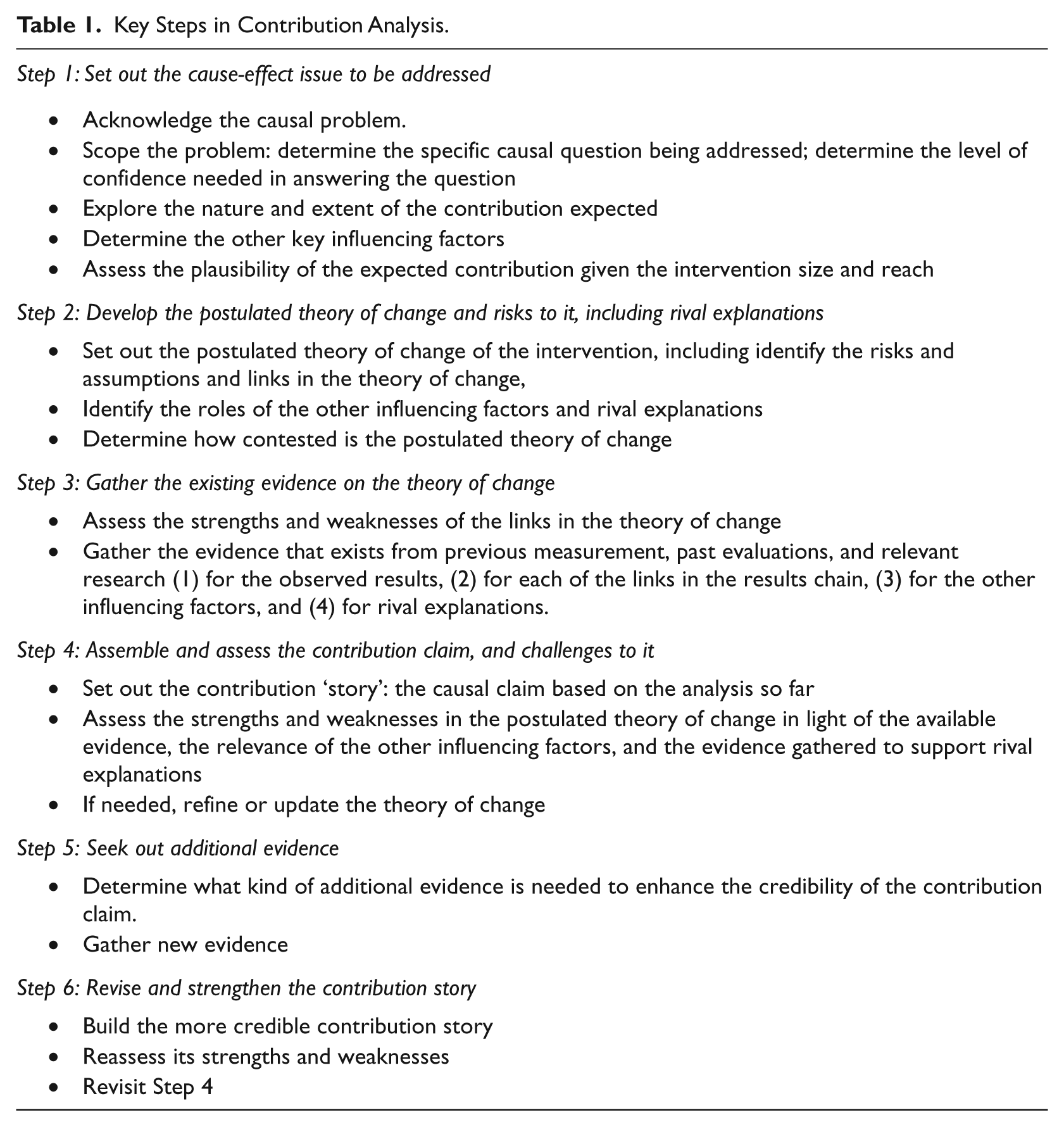
While Table 1 sets out a number of specific steps, as the articles in this Special Issue illustrate, those who have made use of CA have usually modified these steps to best suit the circumstances they face and the specific analytic methods they have used. CA is still a relatively new approach in evaluation. In my view, it is good practice that a variety of approaches are being developed and explored.
CA, then, argues that if one can verify or confirm a theory of change with empirical evidence, and account for major external influencing factors, then it is reasonable to conclude that the intervention in question has made a difference. The theory of change provides the basis for the argument that the intervention is making a difference, identifies weaknesses in the argument and hence where evidence for strengthening such claims is most needed. Causality is inferred from the following logic and evidence:
The intervention is based on a reasoned theory of change: the chain of results, and the assumptions behind why the intervention is expected to work are plausible, sound, informed by existing research and literature and supported by key stakeholders. 2
The activities of the intervention were implemented as outlined in the theory of change.
The theory of change is verified by evidence: the chain of expected results occurred, and the assumptions held.
External factors – context and rival explanations – influencing the intervention are assessed and are either shown not to have made a significant contribution or, if they did, their relative contribution is recognized.
In the end, a conclusion is reached – a contribution claim about whether the intervention made a difference as expected. To summarize: Contribution claim = a verified theory of change + other key influencing factors accounted for.
What does a contribution claim look like? The result of a CA is rarely definitive proof. Causality in relation to socio-economic interventions is usually of the probabilistic form: that the intervention is most likely to have made a difference. CA provides an argument with evidence from which it is reasonable to conclude with confidence that the intervention has made a contribution and why. It builds a compelling case – a warrant – about the contribution being made: The aim is to get what Hendricks (1996) call ‘plausible association’: whether a reasonable person would agree from the evidence and argument that the program has made an important contribution to the observed result. (Mayne, 2011: 62)
While the focus has often been on using CA to make causal claims, as implied in my earlier articles, and as the articles in this Special Issue amply point out, CA also has other uses. Wimbush et al. in this issue discuss using CA approaches as a participatory tool in planning for results and evaluation systems to enhance learning and understanding about intervention being planned and reviewed. Leeuw in this issue discusses using CA approaches to be able to assess the likelihood that a proposed policy initiative will work.
The Special Issue is evidence of both a growing CA practice and a continuing discussion and debate about making use of CA and related theory-based approaches.
Contribution rather than attribution
There has been discussion and possible confusion between the terms attribution and contribution. Many authors make a useful distinction between these terms (Patton, 2008a; Stern et al., 2012). In much of the literature, attribution is used to both identify with finding the cause of an effect and with estimating quantitatively how much of the effect is due to the intervention. The term contribution is used here in the following way: in light of the multiple factors influencing a result, has the intervention made a noticeable contribution to an observed result and in what way? The authors in this Special Issue adhere to this usage. 3
Useful theories of change
Critical to CA is the development of a well thought-out and credible theory of change. In my view, a good theory of change goes well beyond a results chain or logical framework. I would argue that a complete theory of change is embedded in the context of the intervention, and is developed incorporating the perspectives of key stakeholders, beneficiaries and the existing relevant research. Theories of change should include:
a results (causal) chain showing the basic logic of the intervention;
the underlying assumptions behind the links in the results chain;
an elaboration of the risks to each of these links;
identification of unintended effects; and
identification of other key explanatory factors (rival explanations).
Figure 1 illustrates the various components of a theory of change. 4 The theory of change is displayed deliberately as a quasi-linear process, but allows for feedback loops as needed. A ‘sort of’ linear theory of change facilitates both arriving at causal claims and communicating the performance story of the intervention. The assumption boxes can be used to reduce the number of explicit links that might otherwise be needed in a theory of change. Other explanatory factors (rival explanations) may be different for different links or may apply to the overall causal logic of the intervention. The vertical ‘activities and outputs’ box allows for an implementation theory to be shown (i.e. the activities and outputs that are going to be delivered, perhaps over time, to implement the intervention).
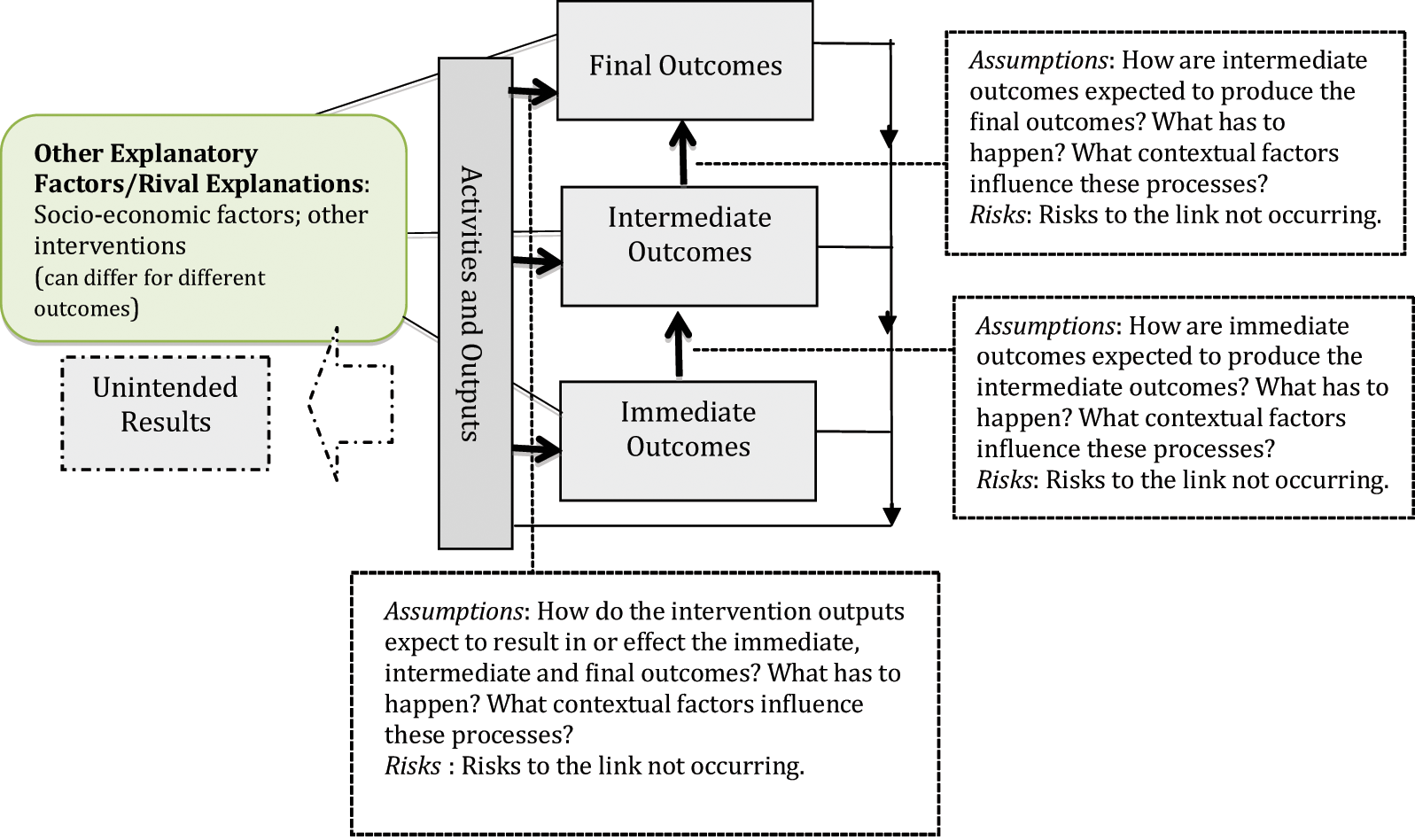
Displaying a theory of change.
Theories of change as causal packages
The logic used for making causal contribution claims outlined above was not related directly to the literature on causality. There is a large and active literature on the issue of causation, and over centuries now, a number of different perspectives have been developed to explain and understand causation, of which counterfactual approaches are only one. A recent study on impact evaluation that I participated in commissioned by DFID (Stern et al., 2012) provides a discussion of these different bases for causal inference. I would like to discuss how CA relates to the causality literature, many ideas of which arose during the work on the DFID-funded project. This has the potential to suggest ways that we can further deepen and systematize CA within evaluation practice.
Causality involves relationships between events or conditions, and is often discussed in terms of necessary and sufficient conditions. When we say that X ‘caused’ Y, we can mean that X is:
Necessary but not sufficient. A person must be infected with HIV before they can develop AIDS. HIV is therefore a necessary cause of AIDS; however, since every person with HIV does not contract AIDS, it is not sufficient.
Sufficient but not necessary Decapitation is sufficient to cause death; however, people can die in many other ways.
Both necessary and sufficient A gene mutation associated with Tay-Sachs is a both necessary and sufficient cause for the development of the disease, since everyone with the mutation will eventually develop Tay-Sachs and no-one without the mutation will ever have it.
Neither necessary nor sufficient – a contributory cause Smoking heavily is a contributory cause of lung cancer – it is not a necessary cause since there are other sources of lung cancer, nor is it a sufficient cause since not all smokers suffer from lung cancer.
I would suggest that in ordinary discussions, ‘X causes Y’ is most often taken to mean sufficiency. We mean either that in this case the event X resulted in Y, or that generally the phenomena X results in Y, recognizing in either case that there may be other events that also could produce Y. Necessity seems a less common use of the term ‘cause’ as it quite demanding, requiring that whenever there is the event Y then there is X. Causes that are both necessary and sufficient are even more rare. On the other hand, contributory causes that are neither necessary nor sufficient on their own are quite common.
It is clear that many interventions do not act alone and that the desired outcomes will be the result of a combination of causal factors, including other related interventions, and events and conditions external to the intervention. Indeed, many interventions are designed to be part of such a ‘causal package’, and even if not so designed, their evaluation needs to take these other factors into account. Cartwright and Hardie (2012) call these supporting factors, other events and conditions that need to happen in order for the intervention to work, to make a difference.
In these instances, the key causal question becomes: was the causal package consisting of the intervention plus supporting factors sufficient to produce the intended outcome? It is recognized that there could be other ways that the desired outcome is brought about and hence the particular causal package in question may not be necessary to achieve the desired outcome. In addition, we would want to know if the intervention was a necessary part of the specific causal package. Perhaps the desired outcome could be realized through the supporting factors without the intervention. I’ll refer to the causal package with these two characteristics – sufficiency of the package and necessity of the intervention as part of the package – as the intervention causal package.
If these conditions hold, then the intervention is a contributory cause and as such has ‘made a difference’, as I would define it. That is, the intervention was a necessary element of the causal package that produced the observed result. Box 1 sets out an example of a causal package related to an intervention aiming to improve education outcomes for girls. It is clear in this example that there are other ways of improving educational outcomes of girls, such as through offering extracurricular help to girls.
Causal packages and making a difference
Consider an intervention aimed at improving the education outcomes for girls in a developing country, through raising the knowledge, skills and awareness of teachers in schools.
Other supporting factors here might be:
the willingness of teachers to support the education of girls;
the support of parents for their daughters to attend schools and study at home;
the ability of girls to get to the schools;
the adequacy of the schools to accommodate girls.
The causal package here is the training provided to teachers plus the supporting factors. An evaluation would want to know if this causal package worked, i.e. in this case were education outcomes for girls improved as a result of the causal package, and since it is an evaluation of the intervention, was the intervention a needed part of the causal package?
What is of particular interest is that, as I have described them, theories of change are in fact postulated causal packages, and more. They identify the supporting factors as assumptions and identify the risks (the confounding factors) and, as well, set out the relationships between supporting factors and the intervention. The assumptions are the supporting factors needed for the theory of change to work. Overall, a theory of change is a model of how the intervention is expected to act as a contributing cause.
A theory of change can be constructed for the example in Box 1. Its outline would be something like: teachers with more training and skills in educating girls would provide teaching that is more attuned to girls’ needs and is of more interest to them, resulting in girls being more actively engaged in studying and wanting an education. This will lead to better education outcomes for the girls concerned. Among the assumptions here would be (1) that teachers want to help girls get a better education and hence work to acquire new skills, (2) parents support their daughters more active engagement in school, (3) girls are able to attend schools, and (4) are comfortable there.
In the philosophy literature, contributory causes are called INUS causes: an
The discussion of contributory causes has here so far been in deterministic terms (i.e. a cause is either sufficient or it is not). However, as noted earlier, the discussion needs to reflect the probabilistic nature of causality in socio-economic phenomena. Mahoney (2008: 421) argues that ‘a treatment is a cause when its presence raises the probability of an outcome occurring in any given case’. He introduces the useful ideas of probabilistically necessary causes – ‘factors that usually or almost always have to be present for the outcome to occur’ – and probabilistically sufficient causes – ‘a cause that much of the time on its own will produce the effect’ (pp. 425–6). For many interventions being evaluated, these are more realistic interpretations of the necessary and sufficient conditions discussed earlier.
In term of an intervention’s causal package, I will use the terms likely necessary to describe the supporting factors, and likely sufficient to describe the sufficiency of the intervention causal package, meaning that in this case, the causal package most likely produced the observed result. 5 To show that the intervention is a contributory cause is to show that the intervention’s causal package is likely sufficient, and that the intervention is itself a necessary element of the sufficient package.
Indeed, in terms of causal packages, this is exactly what CA is able to do; i.e. confirming:
that the expected result occurred;
that the supporting factors – the assumptions for each link in the theory of change – have occurred and together provide a reasonable explanation for the results that occur;
that any other identified supporting factor that is present has been included in the causal package, thereby potentially revising the theory of change; and
that any plausible rival explanations 6 – external causal factors – have been accounted for.
Given that the assumptions may be likely necessary conditions, in a specific case not all may have occurred. In this case an assessment is needed of whether the collection of supporting factors (assumptions) actually occurring provides a reasonable explanation for the observed result. This, plus the assessment of rival explanations, allows for the causal inference to be made as to whether the intervention causal package (for a link in a causal chain) was sufficient. If it was and all the other links in the causal chain are also confirmed, then the theory of change itself has been confirmed.
Data and evidence for the analysis comes from drawing on logic, critical thinking, and prior research and asking relevant stakeholders whether they believe there were other causal factors beyond the package at work. If other causal factors were believed to be at work, one would need to seek out supporting evidence. Note that the links in a theory of change should comprise relatively proximate cause and effects, making judgement and the use of logic and critical thinking easier.
Consider the intervention described in Box 1 about enhancing the skills of teachers so as to improve education outcomes for girls. Assume the additional training of teachers occurred and subsequently, an increase in education outcomes for girls was observed. Did the intervention make a difference? Was the additional training a contributory cause? To answer, the steps and assumptions in the theory of change would be examined to see if they occurred as expected. Did teachers acquire and apply new skills? Were girls more engaged? Did parents support their daughters getting educated? Further, were any other factors at play outside the postulated theory of change, in particular were there any plausible rival explanations for the enhanced education outcomes, and if so what were they? Possible rival explanations might include greater investment generally in education, increasing teacher/student ratios or the arrival of the internet, providing possibilities for self learning. If the theory of change is confirmed and no significant rival explanations found, then one could conclude with confidence that the intervention did indeed make a difference. 7
I am arguing that the idea of contributory cause is a useful and relevant concept for many interventions. It offers a practical approach to confirming that an intervention contributed to an observed result and indeed made a difference. As such, it also offers one basis for future methodological development of CA as a form of theory-based evaluation, building on the concepts of causal packages.
Articles in the Special Issue
The articles in this Special Issue provide a broad overview and discussion of the current state of CA. The first few articles provide specific cases of applied CA. Delahais and Toulemonde describe their five years of experience of CA in their evaluation practice. Using several examples, they discuss how they operationalized key aspects of CA and particularly the contribution story. They discuss the real challenges faced in carrying out a CA and the resources required. The authors also argue for the need for better ways of presenting contribution stories and for standards for assuring the quality of CA.
Lemire et al. begin the discussion of applied CA, describing how they have operationalized the steps involved in the analysis, focusing in particular on how to account for other influencing factors and rival explanations. They propose a tool to do this – the ‘Relevant Explanation Finder’.
Wimbush et al. provide examples of the use of CA and CA concepts from Canada and Scotland. They have used CA as a participatory process, which strengthens both conceptual and practical understanding of planning/managing for outcomes and the related implementation and change theories, thus helping to build collaborative capacity within and across participating partner organizations.
After an insightful discussion of the debate in development evaluation about the use of experimental designs versus theory-based approaches, Vaessen and Raimondo discuss an evaluation of a UNESCO programme that is not amenable to experimentation. They discuss CA in relation to impact evaluation pointing to both strengths and weaknesses, describe the formative evaluation they conducted using a theory of change, and discuss their planned use of CA for the summative evaluation. They also discuss the idea of contributory causes in CA as outlined in this introductory article.
Leeuw, in discussing theory-based and CA approaches, describes the application of several tools that are likely to be new to most evaluators, addressing three problematic situations: (1) building theories of change using software; (2) forecasting impacts by testing theories of change with look-alike interventions and examining past implementation failures; and (3) developing ‘historical’ counterfactuals. Leeuw argues that CA can be strengthened through the identification of the mechanisms at work that visualization software can foster, through the examination of implementation failures in look-alike mechanisms, and through testing contribution stories using historical counterfactuals and hypothetical question research.
The remaining two articles discuss various aspects of the concepts behind CA. Patton, after outlining and discussing cases of how CA is used in evaluations, argues that it depends crucially on critical thinking. CA requires careful and rational thinking about the factors and conditions behind the links between interventions and their impacts. He presents a forceful argument that ‘rigorous thinking supersedes rigorous methodology’ and discusses quality standards for rigorous thinking.
Sridharan and Nakaima end the Special Issue. They discuss a number of questions and challenges to those using theory-based and CA approaches that can help in the further development of theory-driven evaluation and CA approaches. Questions such as: ‘What is a “good-enough” programme theory? How does one build understanding and expectations about programme impact? What does causality mean for complex interventions? How does learning occur? How does the application of theory-driven evaluation approaches help generate an “ecology of evidence”? How can evaluation methods be integrated directly with CA?’ are discussed within the context of an ongoing dance/physical activity programme for health promotion and the questions set the stage for future work on CA.
Final comments
My intent with this Special Issue is to widen the interest in and share the experiences with using CA as a way of making causal claims about interventions in a credible and rigorous manner. The articles provide a wealth of ideas to further explore CA and many references that readers can follow up. After a healthy gestation period, I do think that CA is coming of age.
Footnotes
Funding
This research received no specific grant from any funding agency in the public, commercial or not-for-profit sectors.
Notes
John Mayne is an independent advisor on public sector performance. He has been working with a number of government, NGO and international organizations in various jurisdictions, on results management, evaluation and accountability issues. He has authored numerous articles and reports, including several on contribution analysis, and co-edited five books in the areas of programme evaluation, public administration and performance monitoring. In 1989 and in 1995, he was awarded the Canadian Evaluation Society Award for Contribution to Evaluation in Canada. In 2006, he was made a Canadian Evaluation Society Fellow.