



Abstract
This article draws on neo-institutional theoretical ideas to empirically examine the institutionalization of evaluation in the national government of Finland. The results indicate ambiguity in the basic institutionalization of Finnish evaluation, and imprecision in the agency of the actors that carry out or commission evaluations or utilize the evaluation results. Some Finnish institutional practices of evaluation enhance formal rationality such as efficiency and effectiveness, some support legitimation, and others do both in combination. The strength of coupling of evaluation to decision-making varies greatly. For future research, the article suggests studies on the institutionalization of evaluation in other countries. For evaluation practice, the results highlight the position of evaluation along the rationality-legitimation axis, and the variable linkages of evaluation to decision-making.
Keywords
Evaluation is a practical art but one that utilizes a wide variety of scientific approaches and that often contributes substantially to the development of these approaches. Given that there is such a variety of approaches to evaluation, this article considers only one of these. The article takes its conceptual framework from global neo-institutional research (Lowndes and Roberts, 2013; Peters, 2011). On the theoretical grounds discussed below, the article poses four research questions and empirically seeks answers to these questions through a country case study on the institutionalization of evaluation in Finland. The four questions are:
(1) What are the processes and outcomes that characterize the basic institutionalization of evaluation in Finland?
(2) From where do evaluation actors derive their capacity to act – their ‘agency’?
(3) Observing the global proliferation of evaluation, which processes of institutionalization contribute to its shaping and persistence?
(4) Observing that evaluation may not only evolve gradually, how do active change agents exert influence its shaping?
Academic research on evaluation and evaluation practice can progress without reflecting on the key notions of evaluation, simply taking them for granted. Guba and Lincoln (1989), for their part, advise us to abandon efforts to define evaluation on the basis that context-free definitions are vacuous. However, academic research commonly requires either universal or contextual definitions of evaluation, and evaluation clients also make analogous requests (see, for instance, Stufflebeam and Shinkfield, 2007). This article observes these common requirements.
The following section elaborates the conceptual approach, discusses the motivation for the four research questions, and links these questions to each other. The next section explicates the research methodology. Each of the subsequent four sections seeks to answer one of the research questions posed. The last section discusses the contributions and implications of the study.
The research approach
Within neo-institutional research (Lowndes and Roberts, 2013; Peters, 2011), this article represents what is commonly called sociological neo-institutionalism. This is a variant launched by John W. Meyer and Brian Rowan (1977) during the incubation years of neo-institutionalism, and later substantially elaborated by Meyer and his colleagues (Kruecken and Drori, 2009). This article formulates its four research questions by way of four complementary perspectives drawn from Meyerian neo-institutionalism. The four perspectives, respectively, focus on:
the examination of the roots and processes of basic institutionalization;
‘agency’ as the capacity of the institutional actors to act;
broader processes and outcomes of the ‘going concern’ of institutionalization;
intense agent-driven institutional change.
The basic institutionalization of evaluation
The neo-institutionalism that this article draws upon sees basic institutionalization to be formed by habitually taken-for-granted patterns of interaction between the relevant actors, which also catalyzes the social knowledge that these actors share (Meyer and Rowan, 1977: 341). During the early years of neo-institutionalism, Zucker (1977: 726) noted that this ‘social knowledge, once institutionalized, exists as a fact, as part of objective reality’. Following this neo-institutionalist perspective, ‘facts’ include institutional vocabularies, terminologies, conceptual systems, classifications, categorizations, boundaries within and between institutions, and the identities of institutions and institutional actors.
Institutional routines and habitual patterns pose particular methodological challenges, and suggest caution in using institutional insiders as informants. Schneiberg and Clemens (2006: 214) suggest that we examine ‘breaches’, ‘deviant events, or conflicts that reveal … undiscussed boundaries of taken-for-granted understanding’. The intricacies of institutional taken-for-granted routines led this investigation to dive below the surface of evaluation. This is why it examines ambiguity, hybrid forms, equivocal language, ‘leaky’ classifications, categorizations and boundaries, and the incomplete identities of evaluators, evaluation practices, and institutions of evaluation. Emphasizing these characteristics is a consequence of methodological choice, not a criticism of evaluation.
The capacity to act in evaluation: Evaluation agency
This article moves on from basic institutionalization of evaluation to examine the ‘evaluation agency’ of actors in the contingent circumstances in which these actors may either succeed or fail. Meyer and Jepperson (2000: 117) analytically distinguish three types of agency. ‘Agency for itself’ (or for ‘themselves’) vests in individuals and collectivities such as professions, specialist organizations and national states acting on their own behalf. ‘Agency for others’ is carried out, for instance, by professions, organizations and states on behalf of others whether they are individuals, families, groups, organizations or other states. ‘Agency for standards and principles’, as its name suggests, acts on behalf of a principle, for example, human rights, transparency, good governance, social responsibility, and science-driven rationalization (Drori and Meyer, 2006; Drori et al., 2009).
This article looks for:
‘agency for itself’ in the self-evaluation of actors and in evaluations conducted by evaluators on their own initiative;
‘agency for others’ in evaluations commissioned by other actors and carried out by evaluation professionals, organizations and institutions consistent with their mandate;
‘agency for standards and principles’ in the approaches, practices and principles of evaluation itself.
Diffusion, rationality, legitimation and institutional coupling in evaluation
The neo-institutional framework adopted directs attention to the diffusion of models and scripts for new or revised institutional elements, the modification of these models and scripts in use, and the sedimentation of the new elements atop those that have been institutionalized earlier (Strang and Macy, 2001). The article considers evaluation in these terms.
Accounts of institutional actors trying to control their contingent circumstances by means of institutional elements that enhance formal rationality such as efficiency, performance or effectiveness convey only a partial truth (Meyer and Rowan, 1977). This is because the actors may also introduce and maintain institutional elements that enhance institutional legitimation.
Neo-institutionalism agrees with certain other research orientations that institutional elements may be introduced to enhance rationality, often fulfill their purpose, and support institutional legitimation in this way. However, since Meyer and Rowan (1977), neo-institutionalism also considers the possibility that legitimation is enhanced by institutional elements that are introduced with the promise of rationality independent of what is actually achieved. It is useful to note that the decoupling (or loose coupling) between institutional elements that actually enhance rationality and those that enhance legitimation may usefully protect core institutional elements from institutional outsiders. In actual practice, research on evaluation has recognized the complex relationships between rationality and legitimation years before the emergence of neo-institutional research (Eaton, 1962; Weiss 1970; but see also Dirsmith et al., 2000).
Intense agent-driven institutional change in evaluation
Lowndes and Roberts (2013: 111–43) distinguish two dimensions of institutional change: its tempo; and the strength of the agency of the actors that initiate change. Combining these two dimensions, they distinguish four types of change. Three of these types have been covered in the previous sections, but the fourth type is relevant here: intense agent-driven institutional change (Lowndes and Roberts, 2013: 122–5). For examining the institutionalization of evaluation, an early neo-institutional view is relevant:
[W]hen emergent culture is the focus, then the problem of establishing facticity becomes the central problem. It is here that the moral character of social facts becomes the central concern. (Zucker, 1977: 726)
In the neo-institutional understanding to which this article subscribes, actors that successfully carry agency for change induce the re-evaluation of what count as the most acceptable social facts with regard to the institutionalization of evaluation. This re-evaluation substitutes a new preferred institutionalization for prior institutionalization that now becomes obsolete (see, for instance, Meyer and Hammerschmid, 2006).
Methodology
This article follows common criteria of qualitative research: the cogent formulation of theoretically informed research questions, the clear explication of the data collection and analysis, the ‘saturation’ of the available data in the analysis, and the credibility and trustworthiness of the results (Silverman, 2011: 27–56). Empirically, the article examines the institutionalization of evaluation within Finland’s national government of twelve ministries and numerous agencies and offices (Salminen et al., 2012).
Had Finland a Westminster-style government with a more unitary political executive, it would be sufficient for the article to draw upon such sources as White Papers elaborating government policies and programs. However, Finland’s legalist hierarchy of norms, derived from a written constitution, justifies reliance on the contents of the national legislation database Finlex. The analysis first uses this database to examine the basic institutionalization of evaluation, looking for instances of the Finnish word arviointi for ‘evaluation’, and searching for ambiguity in the use of this word.
The necessary material to examine institutional agency for evaluation in Finland includes both official documents and research studies. Analogous material and Finlex support the examination of diffusion, rationality versus legitimation and the coupling or decoupling of institutional aspects that concern evaluation, such as the link between evaluation and decision-making. The study of intense agent-driven institutional change in evaluation requires, in principle, the observance of methodological conventions of historical research (Jordanova, 2006), although this article type allows only for examples of historical change.
Besides documents, the research material includes five expert interviews to check facts and tease out interesting ‘breaches’ in the institutionalization of evaluation. Interview questions were not shown to the interviewees but only used as prompts in each interview situation (Gubrium et al., 2012; see Table SD1 in Supplementary Data on http://evi.sagepub.com/supplemental). All interviewees had experience of evaluation-related research and evaluation practice, each held or was studying for a doctorate, and the survey included both male and female respondents. The average age of the interviewees was fifty-five. To encourage the interviewees to speak freely, the interviews were conducted under assurances of anonymity.
Basic institutionalization of evaluation in Finland
Table 1 provides an overview of the evaluation vocabulary in Finnish legislation. In the Finnish legislative database Finlex, as in the Finnish language in general, the word arviointi may signify not only ‘evaluation’ but also, for instance, ‘assessment’, ‘inspection’, ‘valuation’, ‘ascertainment’, or mere ‘checking’ of legal compliance. Nominally, arviointi is present in quite a number of acts and statutes (see Table 1), but polysemy (words and expressions carrying different meanings) means that most instances have little to do with evaluation as understood within the global evaluation community. The common Finnish expression tuloksellisuuden arviointi, despite its literal translation as ‘performance evaluation’, refers to performance measurement ascribing quantitative values to performance indicators. Moreover, the majority of the current 315 acts or statutes that use the expression vaikuttavuuden arviointi (‘effectiveness evaluation’; see Table 1) are simply upgrades of technical ‘inspection’, or environmental or other ‘impact assessment’. Some varieties of assessment are closer than second cousins to evaluation, but in order to use different terms we must understand their different meanings and concepts before using them analytically.
Evaluation vocabulary in Finnish legislation, 2014.
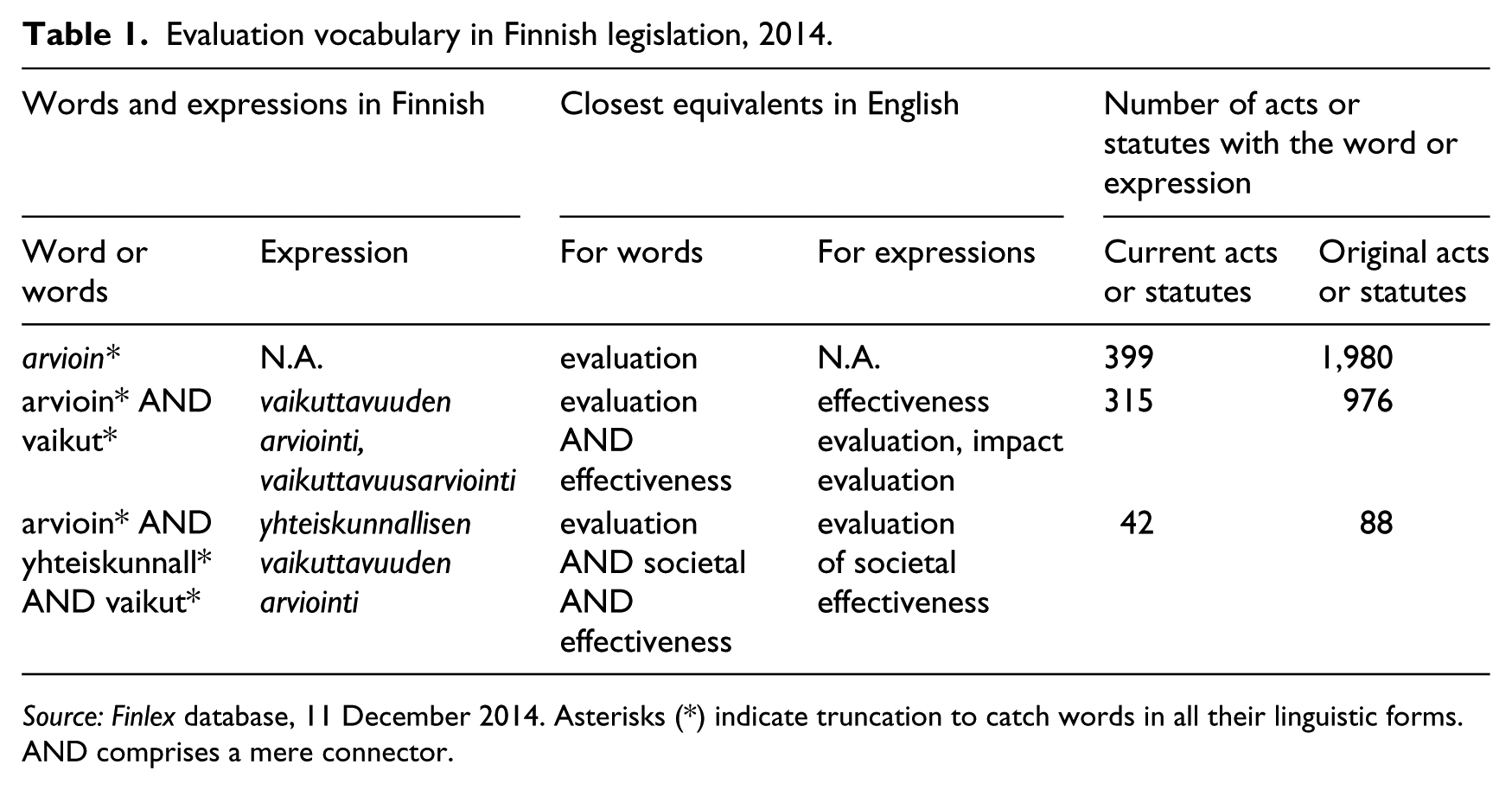
Source: Finlex database, 11 December 2014. Asterisks (*) indicate truncation to catch words in all their linguistic forms. AND comprises a mere connector.
The core of the current Finnish legislative vocabulary of effectiveness evaluation is summed up in the notion yhteiskunnallisen vaikuttavuuden arviointi. Its official Finnish translation into English, the ‘evaluation of societal effectiveness’, is no less ambiguous than the Finnish original. No Finnish legal text specifies the meaning of this notion, but from the characteristic usage of the notion we can infer that it comprises a catch-all notion referring to the accomplishment of any politically preferred or other substantial and widespread effects in society. The notion was found in 42 current acts or statutes (Table 1) but some of the 42 do not deal with ‘societal effectiveness’ in the proper sense and several other instances of utilization regulate various types of impact assessment without undisputed elements of evaluation. Eliminations left three domains to examine more closely. One includes the universities, removed from the government budget and the civil service in 2010, but with a statutory obligation to pursue ‘societal effectiveness’. The second is the standing orders of the State Council, comprised of the ministers and the twelve ministries together, also prescribing the evaluation of societal effectiveness, as do the standing orders for each ministry. The third domain, established in legislation in the early 2000s (BA, 2013; BS, 2013), instituted the evaluation of societal effectiveness in the annual budget preparation, the medium-range planning in each ministry for its sector of administration, the annual reporting of the agencies and offices, the annual reporting of the ministries on their sectors, and the annual government report to Parliament on the closure of government accounts.
During this research process colleagues continued asking why not use other sources than Finlex to investigate the uses of the Finnish word for ‘evaluation’, arviointi. Besides Finland’s entrenched legalist traditions, the results of an earlier study (Ahonen and Virtanen, 2005) justified the choices of data source. By the middle of the first decade of the 2000s, arviointi had come to be very broadly interpreted in Finland. Many earlier types of study, research or monitoring were renamed arviointi but without introducing changes in substance. Had this article exploited other documents than legal texts, this would have excessively complicated the analysis. However, future research should utilize such tools as big data methods to examine the hundreds of Finland’s annual evaluation reports.
Agency for evaluation in Finland
Agency of the evaluation actors for themselves
The ambiguities in the basic institutionalization of evaluation in Finland need not discourage us from examining agency for evaluation. There is no overarching evaluation institution in the country. The State Audit Office has the independence, but lacks the statutory mandate to re-badge its performance auditing – often undertaken in parallel with evaluation – as evaluation proper (Table 2, item 1.2). Despite efforts, there has been no effective coordination of evaluation within Finland’s national government (Table 2, item 2.0.2; PMO, 2011; MF, 2012).
Aspects of the institutionalization of evaluation in the national government of Finland.

Explanation: Subordinate bodies of functions are indicated by a dash below the name of their main body.
Table 2 implies that typically evaluators within Finland’s national government are employees of agencies and offices subordinated to the ministries rather than officials in the ministries themselves. Many other evaluators work for global and domestic consulting companies and other organizations that win evaluation contracts from government organizations.
Evaluation agency on behalf of others
The constitutional obligation of Finland’s government to respond to parliamentary requests for comprehensive ex post reporting on the results of legislative reforms establishes an important type of evaluation agency in the country (Table 2, item 1). Further types of evaluation agency are written into legislation on individual policy fields; in result contracts between ministries and their subordinate agencies and offices; and business contracts between outsourced providers of evaluation services and government organizations.
Interviewees reported that no profession proper has evolved in Finland that could be said to have agency for evaluation. Since 1992, those who have sought to acquire Finland’s Certified Degree of Auditors of Public Administration and the Public Finances (JHTT) have had to pass evaluation assignments as part of their examination. However, most of those who have acquired this degree (JHTTs) take on few evaluation roles. Since its establishment in 1999, the Finnish Evaluation Society (FES), with approximately 200 members, has made valuable contributions. However, it has not forged a unitary body of evaluators, and many evaluators have never joined the society.
At the time of this study, only a few companies – micro or small – indicated exclusive specialization in evaluation in Finland, although many larger companies offered evaluation expertise alongside other services. This reflects a small evaluation market, although the Finnish market has not been too small to attract some foreign companies in taking over Finnish-owned evaluation operations.
Evaluation agency representing general principles and standards
Neither the members of Finland’s evaluation community nor the government have produced their own evaluation standards and principles. One of the interviewees argued that market competition provides better quality assurance than formal standards and principles. Furthermore, a competitive evaluation market can be identified between the approximately 100 organizations commissioning evaluations in Finland’s national government; and the providers of evaluation services.
Finland’s evaluators frequently apply international standards and principles (e.g. AEA, 2013), and some government organizations have explicitly harmonized their evaluation guidelines with these standards and principles. One early example is the evaluation of Finland’s development cooperation (Table 2, item 3) which has for several decades subscribed to international – and since the 1990s also to EU – evaluation standards and principles (MFA, 2013).
A set of softer and more academic standards is also applied by Finland’s scholars and practitioners of evaluation, derived from all three types of evaluation roots distinguished by Alkin (2012): methods, valuing and utilization. Evaluation deriving from the ‘methods’ roots evolved from early quasi-experiments on speed limits (Salusjärvi and Kontiala, 1975) in line with the evaluation classic of Campbell and Ross (1968). Evaluative studies of school achievement also sprang up early on (Renko, 1971). Certain non-experimental and experimental economic analyses have been re-named evaluations (Ilmakunnas et al., 2008), and evidence-based evaluation within health care applies entrenched conventions of randomized control trials (Hakama et al., 2012). Some of Finland’s education scholars have stressed Alkin’s ‘valuing’ roots of evaluation (Keskitalo et al., 2012), and Alkin’s ‘utilization’ roots (Patton, 2008) have also featured (Berg and Hukkinen, 2011). Harder-to-classify evaluation types – found in Finland no less than elsewhere – include ‘fourth-generation evaluation’ (García-Rosell and Mäkinen, 2013; Guba and Lincoln, 1989), evaluation that implements critical scientific realism (Holma and Kontinen, 2010; Pawson and Tilley, 1997), and studies in evaluation ethics (Laitinen, 2008; Schwandt, 2002).
Numerous doctoral dissertations have been written in Finland on evaluation since the earliest study (Sintonen, 1981), but evaluation is not among the country’s academic disciplines awarding master’s and doctoral degrees, nor is it the main theme in any of the thematic master’s programs. Interviewees vented their frustration over common academic reluctance to assign full intellectual value to research that involved evaluation. However, the vigorous global publication activity by Finland’s evaluation scholars questions the claims of deficiency.
Diffusion, performance, legitimation and coupling
Having considered both the basic institutionalization of evaluation and agency for evaluation in Finland, let us have a look at the ‘going concern’ of Finnish evaluation in its practical institutionalization. As the conceptual framework implies, the examination has to provide indications of the diffusion, modification and sedimentation of global institutional elements of evaluation in the Finnish case (Table 2, last column). The analysis also considers the enhancement of rationality and the enhancement of legitimation by means of evaluation, and at the tight or loose coupling between evaluation and decision-making. Alongside evaluation proper, the analysis includes practices close enough to evaluation to merit inclusion.
High politics, the elevated authority of institutions and the political importance of issues crowd out rationality and accentuate legitimation in evaluation (Table 2, items 1 and 1.1). In one case, the relative shortness of the electoral cycle – four years at the maximum – appears to crowd out rationality (item 2.0.1), in another the proximity to high politics exerts an analogous impact (items 2.0.2 and 2.0.3), and in a third case, limited operationalization restricts rationality (item 4). Within higher education policy, legitimation is emphasized (item 8.1.3). A spillover from the excellent results in evaluating the efficiency and effectiveness of compulsory education in Finland is that they also provide this country’s system of compulsory education with general legitimation (item 8.1.1). Finland’s foremost impact assessment practice builds on institutionalized statutory procedures enacted in the name of rationality enhancement, but does not necessarily ensure actual rationality, rather guaranteeing formal compliance (item 13). However, rationality and legitimation commonly coexist as aspects of evaluation.
The coupling of evaluation with decision-making is generally loose rather than tight in Finland’s national government. However, tight and loose coupling commonly co-exist (items 1, 1.3, 3, 7.0.1, 9, 10, 12 and 13). The coupling is looser in high politics (items 1, 2.0.1 and 2.0.2), if operationalization is limited (items 4 and 7.0.2), or if constitutional or other statutory separation between legislative and executive powers exerts an influence (items 1.2, 1.3, and 7.0.2).
Insofar as organizations or functions have a staff status (with preparatory or other assisting tasks) as opposed to a direct line status (with direct responsibilities under the command of organizational leadership), this weakens the coupling of their evaluation results with the decision-making of the government ministries (items 4.1, 7.1, 8.1.3, 8.2, 9, 11.1, 12, 12.1, 12.2 and 13.1). In one case, the publication of output other than summary evaluation results is prohibited; this is to prevent tight coupling to decision-making on individual schools (item 8.1.1). Vested interests of the corporatist variety may also influence the coupling of evaluation to decision-making (12.2). There have nonetheless been more recent government efforts to tighten the coupling of evaluation to government decision-making (items 2.0.3. and 2.0.4), including the introduction of a new assessment practice (item 2.0.3).
Intense agent-driven institutional change
Intense agent-driven institutionalization within Finnish evaluation has happened in some sectors and circumstances. Since the 1960s development co-operation led to the first institutionalization of evaluation proper in the country in order to legitimate allocations of the government resources (Table 2, item 3). Quasi-experimental studies on speed limits and studies on teacher efficiency (Renko, 1971; Salusjärvi and Kontiala, 1975) referred to earlier also fall into the ‘intense’ category.
In 1987–91, evaluation was largely overshadowed in Finland by New Public Management emphases on operational performance, and in 1991–94, by the exigencies of preventing the general collapse of the economy (on this, see the chapter on Finland in Pollitt, 2013). Finland’s accession to the EU in 1995 catalyzed the ex ante evaluation of the structural funds programs and projects (Table 2, item 11). Later, ex ante evaluation expanded into legal policy-making and legal preparation (items 4 and 4.1; Tala, 2010). Finland harmonized the evaluation of its development co-operation and its research and technological development policies with their EU counterparts by 1995 (items 3, 8.2 and 11.2; MFA, 2013). Evaluations required by the ‘open method of coordination’ of EU policies, evolved since 1997, have been also implemented in Finland (Ahonen and Virtanen, 2008). Since 2015, Finland implements systematic national ex ante assessments of the Finnish impact of European Commission legal and policy initiatives (Uusikylä et al., 2015; Appendix, item 2.0.3.; see also items 2.0.4–2.0.5).
An important threshold year for evaluation in Finland was 1995, marking the multiplication in types and targets of evaluation in ways that suggest partial substitution of what can be called ‘post-NPM’ for previous NPM procedures (see Pollitt and Bouckaert, 2011). Evaluation expanded, for instance, to cover national public administration reforms (Pollitt et al., 1997), public services, individual government organizations, and policies, programs and projects. However, as indicated previously, the word arviointi (‘evaluation’) became a buzzword connected with many pursuits, many of which had little to do with evaluation as understood within the global evaluation community.
In the future, focused studies should examine further cases of intense agent-driven change in Finnish evaluation. This concerns, for instance, the 2003–4 reform that introduced statutory procedures covered by the ambiguous notion of ‘societal effectiveness’ (BA, 2014; BS, 2014; MF, 2003). This evaluation reform evolved not only as an extension of government accounting, but also as a novel dimension of budgetary accountability, and a new content element in the annual government accounting. This reform substituted an effectiveness orientation for the traditional compliance orientation, and further supplemented the efficiency orientation of NPM with post-NPM characteristics.
Conclusions and implications
This article has sought answers to four research questions derived from a variant of neo-institutional theory (best summarized in Kruecken and Drori, 2009) in its examination of the institutionalization of evaluation in the national government of Finland. The article has contributed with a country case study on the institutionalization of evaluation grounded on a systematic theoretical framework. The empirical results indicate ambiguity in the basic institutionalization of evaluation in Finland and in the agency of the actors carrying out, commissioning or using evaluations. However, evaluation principles, standards, approaches and methods give coherence. With tighter or looser coupling to decision-making, some of the Finnish institutional practices of evaluation enhance formal rationality such as efficiency and effectiveness, some support legitimation, and the other practices contribute to both ends. There have also been instances of intense agency-driven institutional change in Finnish evaluation.
A referee usefully asked if evaluation in Finland’s national government is institutionalized at all. One interviewee proposed that evaluation is institutionalized up to strong routinization, although this routinization is characteristically confined only to ‘particular knowledge practices’ (erityiset tietokäytännöt). In general, the neo-institutionalism that this article applies fully agrees with views that global pressures towards institutional isomorphism– that also affects evaluation – may not lead to homogeneity because of the wide variety of contexts in which these forms find their applications (see Beckert, 2010; Pollitt, 2013).
At its beginning, this article promised to open up one and only one perspective from among the others to examine the institutionalization of evaluation. However, this limitation by no means rules out examination of the institutionalization of evaluation in other countries than Finland in analogous theoretical and methodological terms as in this article.
The implications of this article for practice are stronger and more general than its immediate implications for future research. The analysis of the basic instutionalization of evaluation suggests that the evaluation practitioner should try to live with ambiguity with respect to notions of evaluation and the agency of the evaluator, the characteristics of evaluation commissioners and the multiple possible uses of the evaluation results. A clear-headed evaluator should find good use for the rationality versus legitimation division in evaluation and the various possible degrees of coupling between evaluation and decision-making. Last but not least, would not many a researcher on evaluation and many an evaluation practitioner prefer to turn into an agent of intense change for the very best of evaluation?
Footnotes
Funding
This research received no specific grant from any funding agency in the public, commercial or not-for-profit sectors.
References
Supplementary Material
Please find the following supplemental material available below.
For Open Access articles published under a Creative Commons License, all supplemental material carries the same license as the article it is associated with.
For non-Open Access articles published, all supplemental material carries a non-exclusive license, and permission requests for re-use of supplemental material or any part of supplemental material shall be sent directly to the copyright owner as specified in the copyright notice associated with the article.
