



Abstract
In the social sciences, there is an emerging interest in process tracing as a method for improving rigour and transparency in within-case inferences. Recently, the method has been proposed as a possible enhancement of theory-based approaches to evaluation, but applications of the method remain rare. In an attempt to fill this gap, process tracing was used to evaluate the Universal Exposition held in Milano in 2015 (EXPO2015). Mega-events of this kind are perfect candidates for ‘testing’ the method; although their effects have been widely discussed in the relevant literature, claims about the causal contribution of mega-events are not straightforward, and a number of ambiguities complicate any clear assessment of their consequences. Two in-depth case studies of projects related to EXPO2015 – the East External Highway and Refettorio Ambrosiano – demonstrate the advantages and feasibility of process tracing and of the application of Bayesian logic to evidence search, collection and assessment. In particular, case study results show that Bayesian scrutiny may reveal unexpected weakness in apparently obvious inferences and increase reliability in assessing less straightforward causal attributions.
Introduction
The Universal Exposition held in Milano in 2015 (EXPO Milano 2015) was an important commercial event, involving 137 countries attracting more than 20 million visitors and helping the creation of about 10 thousand firms (Dell’Acqua, 2016). Its theme, ‘Feeding the planet’, provided a platform for discussion of socially relevant issues such as food security, biodiversity, hunger, and food waste. It was also a major popular event, where less-engaged visitors could taste crocodile burgers, bugs, and Guinness-record sandwiches or pizzas. Landmark events of this kind undoubtedly have many important consequences, both planned and unintended. The present study explores the causality of mega-events, using process tracing (PT) to investigate causal effects in two case studies related to EXPO Milano 2015.
The opportunity to host mega-events like world fairs, football championships, or the Olympics is highly prized by policy-makers. They are popularly considered as a kind of development policy that promises to create critical junctures and boost radical change in political, economic and urban agendas. The effects of such events have been widely reported in the relevant literature; investigations of their economic impact, for instance, have highlighted the creation of new jobs and firms (Stevens and Bevan, 1999), increased trade and tourism flows (Kang and Perdue, 1994), and radical changes in the business environment (Spilling 1996). Additionally, planners have studied the potential of mega-events to stimulate urban renewal and development (Bramwell, 1997) and have critically analysed how they are planned (Gursoy and Kendall, 2006). Finally, sociologists and political scientists have studied the importance of mega-events for renewing the image of host cities or countries and their symbolic value in showcasing new governments or consolidating national identity (Burbank et al., 2001; Tomlinson and Young, 2006).
However, the jury is still out on the benefits of mega-events (Flyvbjerg et al., 2003; Hall, 2006). Theories explaining why mega-events have certain effects are often poorly developed or remain implicit, impeding any tracing of clear causal chains and increasing the risk of spurious causal attributions. Further, several ambiguities complicate such evaluations. Because the event label is ubiquitous, almost all projects during the event will be framed as part of it, making overestimation of effects more likely. On the other hand, such major events produce many unintended effects that may not be captured by assessments based on official programmes or declared goals. In combination with the typical methodological difficulties in evaluating unique events, mega-events certainly present hard challenges for evaluators.
For all these reasons, EXPO Milano 2015 is an interesting context for application of PT. In general, PT promises to increase rigour in dealing with single cases and within-case inferences, and the case of EXPO Milano 2015 is used to ‘test’ the method here. Specifically, the study investigates whether and how PT can deepen understanding of how mega-events produce effects, thereby revealing spurious causal attributions and identifying genuine consequences. Although there is emerging interest in PT in political science (Collier, 2011), policy analysis (Kay and Baker, 2015) and evaluation (Befani and Stedman-Bryce, 2016; Schmitt and Beach, 2015), more comprehensive application remains rare. The present study is an attempt to bridge this gap.
The article is organized as follows. After a brief introduction to the method, the third section presents two hypotheses concerning how and why mega-events may influence decision and/or implementation, mapping related evidence. The next two sections analyse two possible consequences of EXPO Milano 2015 by considering two case studies: the construction of the East External Highway (A58), and the opening of Refettorio Ambrosiano (see Supplementary Data Table 1 for a list of interviewees involved in these case studies). The final section assesses the advantages of using PT in the present context.
A brief introduction to process tracing
Process tracing is a qualitative method for drawing within-case inferences in single cases (Beach and Pedersen, 2013; Bennett and Checkel, 2015). Although there is no standard way of conducting a PT-based study, the method’s prescriptions can be condensed into two basic recommendations, concerning theory building and theory testing. In relation to the former, PT takes its name from its intended use in unpacking causal processes, articulating the intermediate steps linking causes and outcomes. In this respect, PT resembles theory-based approaches to evaluation (Astbury and Leeuw, 2010; Blamey and MacKenzie, 2007; Pawson and Tilley, 1997), responding to the broader methodological call in political science and policy analysis to open the black box of causality (Brady and Collier, 2010). In relation to theory testing, PT offers a Bayesian approach to data collection, evidence assessment, and theory updating, equipping analysts with novel tools for dealing with small-n or unique interventions.
As a first step toward evidence collection and assessment, PT begins by examining prior confidence in a hypothesis (H) in terms of any preliminary supporting evidence for H (e.g. results of previous studies), and by critically discussing expectations. This second point relates to how the impact of the evidence on confidence in H should be evaluated. The probative value of a piece of evidence depends on two characteristics: certainty and uniqueness. Certainty expresses the probability of observing the evidence conditional to H being true. High certainty means that the evidence should be there if H is true; low certainty means that the evidence is inessential. Uniqueness expresses the probability of finding the evidence conditional to H being false. High uniqueness indicates that the evidence is specific to H and unexplained by alternative hypotheses; low uniqueness means that there are many alternative explanations for finding that piece of evidence.
In a typical example from PT textbooks, being in town on the day of a murder has high certainty and low uniqueness. Such evidence (so called hoop tests) has limited confirmatory power if found and a strong disconfirmatory effect if not found. Conversely, being caught with a smoking gun close to the crime scene is an example of evidence with high uniqueness but low certainty. Such evidence (the so-called smoking-gun test) greatly increases confidence in H, but not finding it has only limited disconfirmatory value – that is, given low certainty, H could be confirmed even in the absence of such evidence.
Combining priors, uniqueness, and certainty provides analysts with a powerful and transparent tool for guiding the process of evidence search, and for assessing the probative value of the collected evidence. This reasoning is formalized in the Bayes theorem, a formula to measure the probability of H in light of new evidence. This reasoning is used informally throughout the present paper; for a formal treatment, see Humphreys and Jacobs (2015) or Befani and Stedman-Bryce (2016).
Theorizing mega-events
Some interventions are clearly associated with mega-events, including any projects that are necessary for the event to take place (e.g. site infrastructures) or that can be considered direct outputs of staging the event (e.g. increased tourism flows). However, direct outputs are only a tiny part of what happens around a mega-event, and most cases will not fit unambiguously into this category. Overall, in order to establish that the mega-event caused a certain innovation, evidence must be found that the event changed the decision or implementation setting, by accelerating existing processes or creating unprecedented opportunities for brand new projects.
Causal contributions of the kind described above can take several forms. The two hypotheses developed here make explicit how staging a mega-event might support the implementation of a new project. While these are by no means the only possible contribution claims, they serve to illuminate typical ambiguities in the assessment of mega-events. H1 clarifies when planned interventions (i.e. those included in the event programme) can be considered genuine consequences of a mega-event; H2 relates to innovations staged during the mega-event period but not programmed before the event, examining when these can be included among the event’s consequences.
Both hypotheses are presented in the form of ‘entities . . . that engage in activities’ as proposed by Machamer et al. (2000: 3) for thinking about mechanisms and subsequently by Beach and Pedersen (2013) for formulating PT hypotheses. Following PT guidelines (Gerring, 2007), both hypotheses are presented in diagrammatic form. The two diagrams also map supporting pieces of evidence, which were mapped and discussed in terms of their certainty and uniqueness values before conducting the case studies. For clarity, these values will be discussed along with the evidence in the two empirical sections below.
Fast track decision-making (H1)
The bidding process may serve as a catalyst for interventions that policy-makers already had in mind, which may have been languishing in the municipal or national agenda and end up forming part of the bid proposal despite having no functional connection with the event. In addition, as candidacy documents generally overpromise in order to increase the appeal of the bid, the interesting question concerns when projects that are non-essential to the event can be considered among its consequences. Interesting candidates here include several long awaited renovation or infrastructural works in Milan that were eventually completed in preparation for EXPO 2015. In what circumstances can we assert that the mega-event made a difference to the decision and/or implementation of similar projects?
Typically, the implementation of a mega-event is characterized by heightened time and media pressures, international visibility, and external deadlines. In this respect, implementing a programmed intervention may put greater pressure on policy-makers, leading to additional resource provision (e.g. budget additions beyond routine or special procedures). Such fast-track policy-making can take several forms, including special funds, dedicated decision structures, and temporary norms. Some have pushed this argument even further, lamenting the secrecy, lack of transparency, and evasion of ordinary procedures that typify mega-events planning (Pillay et al., 2009). On that basis, the key features of our first hypothesis explaining the mega-event factor are ‘being in the spotlight’, greater pressure, and special procedures. Figure 1 below presents H1 and maps possible evidence.
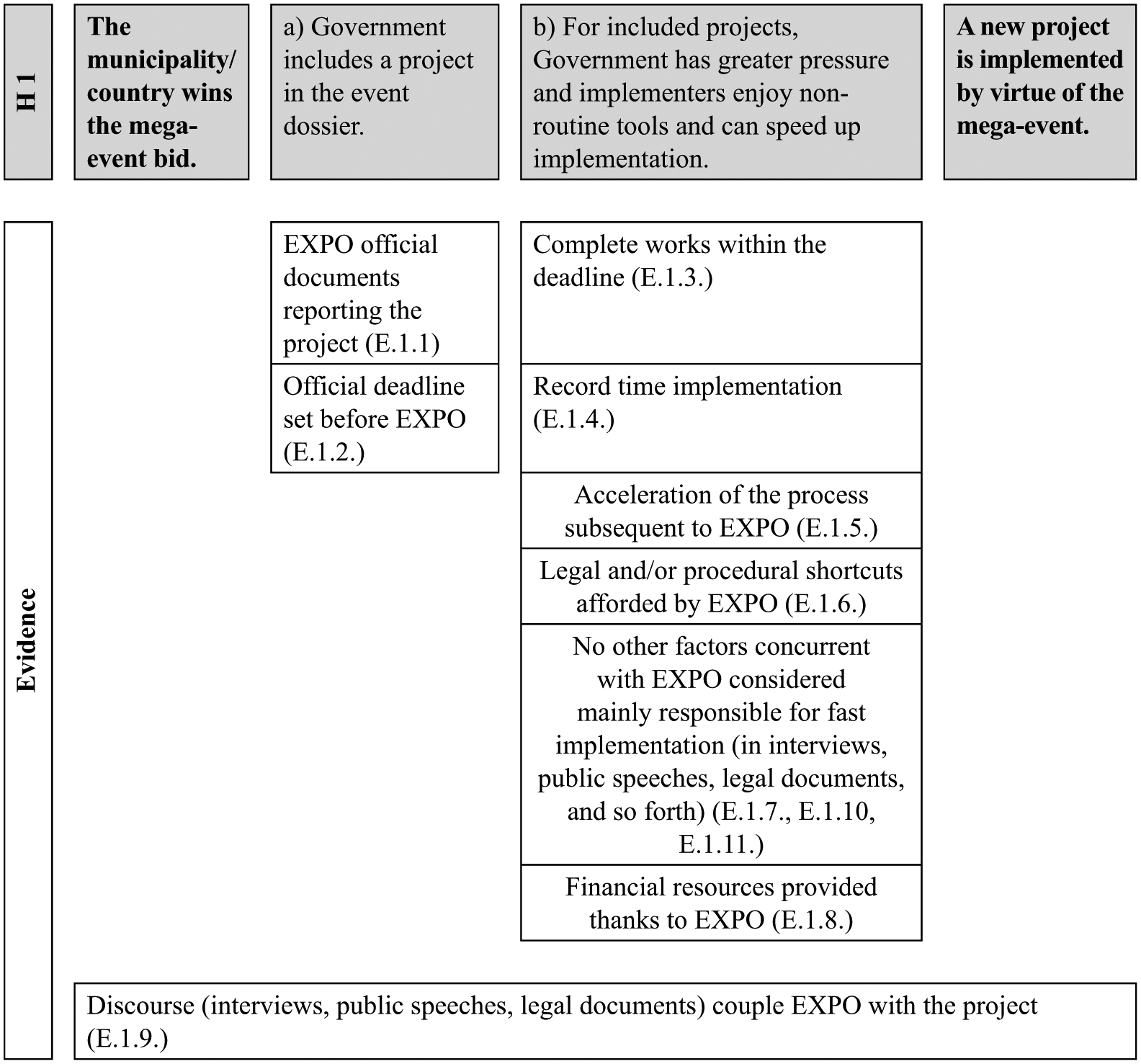
Fast-track decision-making: Hypothesis and evidence.
EXPO 2015 provides several examples congruent with H1. The higher pressure on implementing actors was particularly evident in completing the event site, where workers were employed 24/7 for three shifts in a row. Special procedures marked the event from its very beginning and, even before winning the bid, the Prime Minister’s Decree of 30 August 2007 declared EXPO 2015 a ‘Grande Evento’ (i.e. an exceptional or major event), signifying that ordinary administrative procedures were to be suspended. This special status was justified in the decree by virtue of the event’s ‘organizational complexity’ and the expected ‘participation of high officials from the country and abroad’, so lending official recognition to the causal relevance of the event’s international visibility. As further evidence of external pressure, the Bureau International des Expositions (BIE) – the intergovernmental organization in charge of overseeing World Expos – visited periodically and was in close communication with local implementers.
While this preliminary evidence does not mean that all projects officially included in the event actually enjoyed fast-track decision-making, it lends some weight to the plausibility of H1 – in other words, its prior confidence can be characterized as high. The case of the East External Highway (A58) will be analysed to test H1 and to illuminate the process of evidence assessment and subsequent updating of priors. The A58 project was selected as a case study because not strictly necessary for the event’s staging, it was included in the official EXPO infrastructural dossier; it is a typical infrastructural legacy of mega-events; and works ended on time for the exposition. To this extent, the A58 represents a suitable case for testing H1.
Boosting entrepreneurship (H2)
During the course of the mega-event, many (if not most) innovations are likely to bear the mega-event label or to be promoted as part of the mega-event. Among the cultural events staged during EXPO 2015, for instance, the EXPO label was almost ubiquitous. However, it remains uncertain whether and why EXPO made a difference in deciding on or implementing those events. A second hypothesis of interest here relates to how mega-events create opportunities for policy entrepreneurs (PEs). While H1 seeks to discern when projects included in the official bid may (or may not) be considered a legacy of the event, H2 examines those interventions not included in advance, which are not necessarily coordinated by the event organizers but may nonetheless be considered among its consequences.
PEs are agents of change who propose innovative ideas and work to get them on the agenda and to win approval for them (Kingdon, 1984; Mintrom and Norman, 2009; Mintrom and Vergari, 1996). A primary characteristic of PEs is their particular acumen for reading contexts and exploiting exogenous or endogenous shocks. In Kingdon’s formulation, PEs wait (like surfers) for changes that may open windows of opportunity. EXPO 2015 may have been one such window.
PEs perform two major roles (Mintrom and Norman, 2009; Mintrom and Vergari, 1996). First, they frame policy problems and solutions in order to gain visibility and consensus. As mega-events have special visibility, they may offer a perfect opportunity for promoting certain projects or policies. Potential PE strategies (and evidence supporting H2) may include use of the event label, the framing of problems and solutions in a way that is congruent with the event, and even the slight modification of projects to fit the event.
The second role played by PEs is to assemble and maintain coalitions of actors supporting a particular solution. Some authors take the view that mega-events attract new actors and investments, so increasing opportunities to forge novel coalitions among local, national and transnational interests (Hall, 2006). In this way, mega-events may expand entrepreneurs’ capacity to reach out to new networks, increase their relational skills, and secure additional resources. Figure 2 below is a diagrammatic representation of H2, mapping possible evidence.
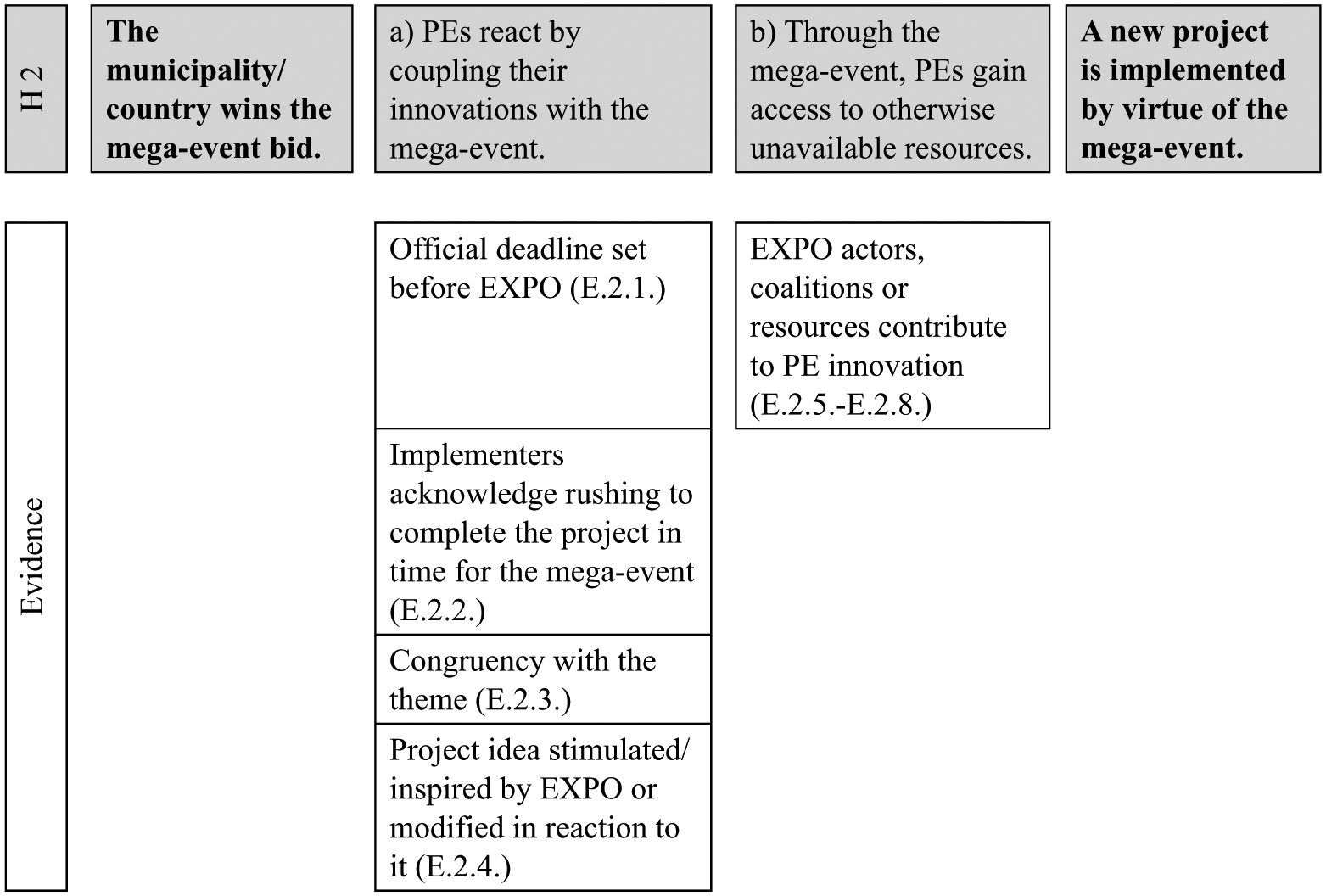
Boosting entrepreneurship: hypothesis and evidence diagram.
H2 is tested by reference to the case of Refettorio Ambrosiano, an innovative soup kitchen for poor people. Although not included in the official EXPO documents, this project was perfectly congruent with the event theme. In this respect, it is a good candidate for testing H2.
The fastest highway ever built
The East External Highway (A58) is a major route of about 32 km in length that encircles the eastern territory outside Milan (see Figure 3). Comprising three lanes in both directions and including several tunnels and bridges, the works also comprised 38 km of local roads and several other interventions designed to enhance access to the new infrastructure or to reduce its impact on local traffic and the local environment. Total costs for the project amounted to about 1.6 billion euros.
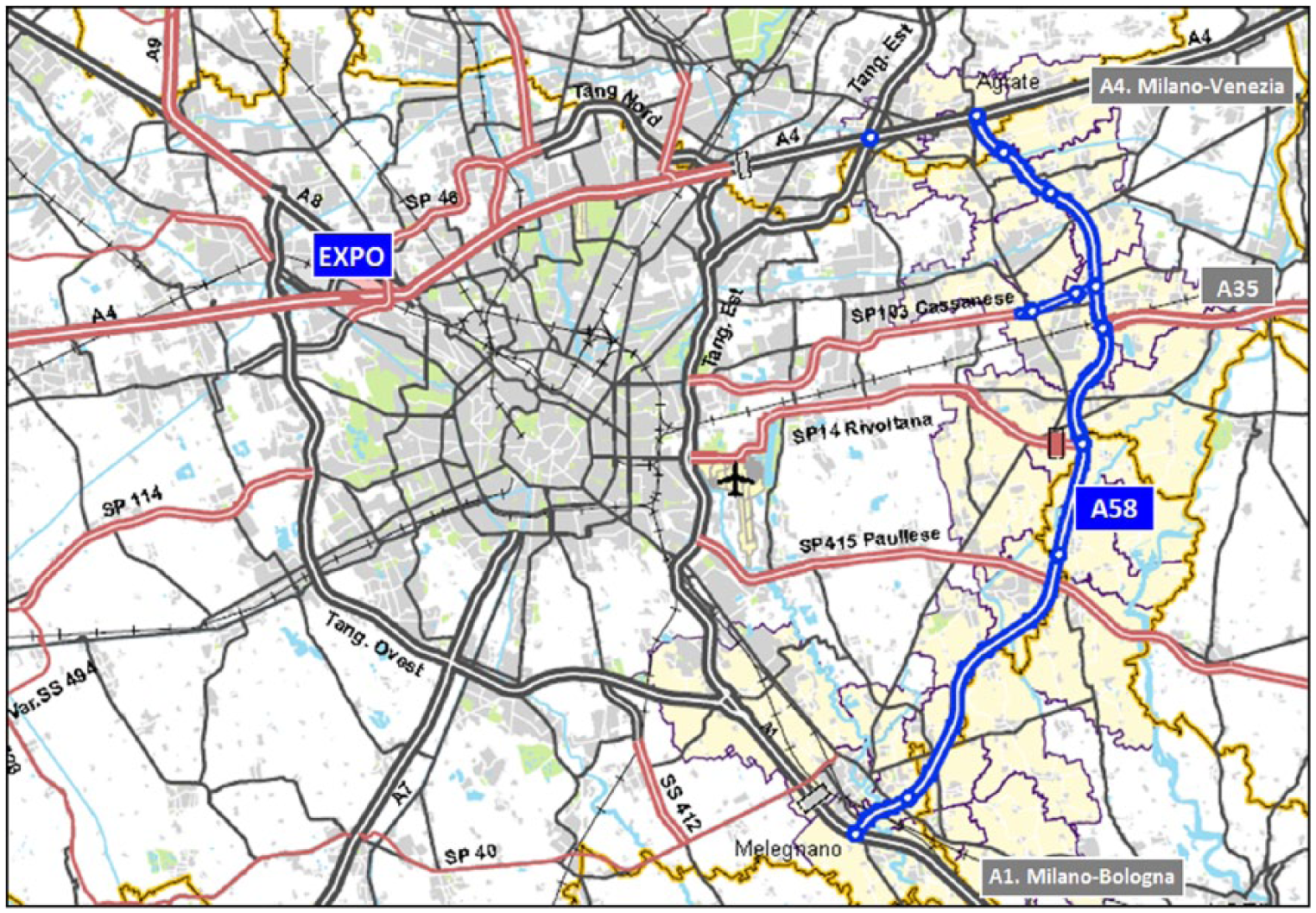
The East External Highway (A58) and the EXPO site.
The A58 has strategic appeal in terms of mobility in northern Italy. At its north and south edges, it connects two major highways: the A4 (Milano-Venezia) and the A1 (Milano-Bologna); it is also of fundamental importance for full functioning of the A35, which connects Brescia to Milan. In fact, the A35 does not reach Milan directly but leads into the A58, through which it connects northward to route SP103 and southward to route SP14, both of which proceed to the city (see Figure 3).
The A58 was included in the group of infrastructure projects to enhance EXPO’s accessibility and opened on 16 May 2015, just 15 days after the event began. The significance of such preliminary evidence and the other clues collected during the empirical work (mapped in Figure 1 above) will now be discussed.
With respect to part a) in H1, the fact that EXPO official documents report the project in the event infrastructural programme (E.1.1.) is high in both certainty and uniqueness. In fact, the evidence should be there if the government includes the project among EXPO infrastructures, and there are no alternative explanations for such inclusion. Setting the official project deadline before EXPO (E.1.2.) has high uniqueness, as this indicates the importance of the project for staging the event, although other official works may have different deadlines. The A58 complies with both requirements and permits strong confirmation of step a). This is important, as pressures to complete works and the special implementation context mostly relate to official EXPO projects.
Turning to part b), actual completion of the works within the deadline (E.1.3.) lacks certainty. EXPO infrastructure projects were divided into three groups in descending order of importance: ‘essential’, ‘connected’, and ‘necessary’. (The first two were included in the EXPO infrastructural dossier.) Interestingly, while some of the ‘essential’ projects were not completed (notably, the metro line M4), many of the ‘connected’ or ‘necessary’ infrastructures were. This is no surprise, however, as one should not expect the ‘EXPO effect’ to overcome the virtually infinite number of implementation difficulties that typically arise in big infrastructural projects. On the other hand, as delays are quite common during such works, and completion within the deadline (E.1.3.) is rare (i.e. it has some degree of uniqueness), it would be worth inquiring if this was due to H1.
Completing the works on time but within the average duration is not particularly significant. Instead, an implementation time shorter than average (E.1.4.) constitutes more unique evidence, pointing more clearly to some atypical factor such as EXPO. Interestingly, works for the A58 were incredibly fast, beginning on 11 June 2012 and ending less than three years later – an undoubted record time for such projects. A 2014 report from the Italian Department of Economic Development and Cohesion estimated that infrastructural projects costing more than 100 million euros were completed in about 7.2 years on average (DPS, 2014) – more than twice the time taken for the A58. Notice also that although in some regions of Italy, works are of shorter than average duration, this is not the case in Lombardy, which is in line with national data (DPS, 2014).
As an additional clue, we can consider the pace of the whole process – in particular, whether decision-making and/or implementation of the A58 was accelerated once EXPO entered the municipal agenda (E.1.5.), which would provide significant support for H1. In particular, the evidence has some degree of uniqueness, as one should find alternative factors, independent of EXPO but concurrent with it, that explain this acceleration. A brief history of the A58 may help to illuminate this point.
The first proposal for the A58 dates back to 2001, when the Province of Milano proposed to build a new East Highway, external to the one in Milano, which was over-congested. In 2002, together with financial and industrial partners, the Province established the company TEM Ltd, specifically to design the new infrastructure. The draft preliminary project was presented in 2003, approved locally, and took until 2006 to pass through all the requisite administrative procedures. In 2008, Milano won the EXPO bid, and the A58 was included among the ‘connected infrastructures’ for the event. In the same year, completion of the executive project and infrastructure contracts were put out to tender. The contractor presented the executive project in 2010. The year 2011 was spent mainly on administrative procedures and some variations to the project, which were ready at the end of the same year. In total, the whole design and tender phase took about nine years (from 2002 to 2011). Interestingly, this was longer than the country average, which is estimated at about 7.3 years (DPS, 2014); so, although the works themselves were completed quickly, the tender and project phase took longer than average. In this respect, it would seem that inclusion in the EXPO infrastructures may have accelerated implementation.
However, the same brief history would also tell that the A58 enjoyed no special status because of EXPO (E.1.6.). The administrative process was routine, and in terms of legal procedures at least, the implementation process was afforded no shortcuts whatsoever. This test was classified as a smoking gun (high uniqueness, low certainty) because we can imagine that (even within the boundaries of ordinary procedures) the process may have been accelerated in several other ways.
Indeed, looking at the government deliberation granting final approval to the A58 (CIPE, 2011), some passages stress the importance of completing the works quickly. However, this demand had nothing to do with EXPO but with the parallel works for the A35. As mentioned above, the A35 can reach Milano only via the central stretch of the A58, without which the 62 km of the A35 would have ended in the fields. It should also be noted that as works for the A35 began in 2009 (three years before work began on the East External Highway), there was a real danger that the infrastructure would be finished but not working, impacting the A58 works (Corriere della Sera, 2013). Interviews with the company confirmed that there were pressures to complete the works quickly, but only for the central stretch to join the A35. Finding no concurrent factors contributing to fast implementation was considered a hoop test for H1, which however fails in light of the evidence. In fact, complementarity with the A35 (E.1.7.) explains part of the pressures to accelerate works in a way unrelated to the staging of the mega-event.
Although EXPO provided no legal shortcuts, the process may nonetheless have gained from financial resources associated with the mega-event (E.1.8.). This would be a smoking-gun test for H1, as EXPO funds were limited and only a few infrastructure projects considered essential to staging the event received direct aid from those funds. Unfortunately, this proves to be another failed smoking gun.
The A58 was to be the first Italian highway built using only private money. Project financing provisions required the contractor to provide engineering and construction of the highway in exchange of a 50-year right to collect tolls. However, in 2013, the Italian government passed decree 69/2013. Among several provisions for the country economy, article 18 established a 2 billion fund for infrastructure projects, and 330 million euros was granted to the A58. This government financial contribution was unexpected, and it would seem reasonable to suspect that EXPO was among the reasons for granting the funds. As preliminary evidence, however, although the decree actually included several financial provisions dedicated specifically to EXPO-related interventions (article 46), the Universal Exposition was never mentioned in relation to the A58. In the same way, interviewees excluded the importance of EXPO in those negotiations. Given the need to increase capital in order to secure a financial plan that appealed to investors, the contractor turned to the government for help. Interviewees also confirmed that the contractor lobbied the government directly, with no intercession by either the region or the municipality, both of whom were involved in organizing the mega-event and could possibly have exploited this in negotiations.
When asked about the reasons for the record implementation time, the interviewees, never mentioned EXPO, and when directly asked about the effect of the mega-event, all denied its influence on the A58. The highway opening ceremony provided further clues contrary to H1. This was a major occasion for media attention, and mention of EXPO would certainly be expected. However, an analysis of recordings of the highway opening (Tangenziale Esterna, 2015) revealed that the regional governor, the Italian Ministry of Infrastructure, and the contractor’s CEO made no mention of EXPO. Interestingly, the Special Commissioner for EXPO was not even present. Equally, on the following day, the main Italian newspapers reported the opening of the highway and praised the successful completion but did not mention EXPO as a factor (Corriere della Sera, 2015a, 2015b; Repubblica, 2015). Combining these clues makes for a strong hoop test of H1 (E.1.9.). However, it is one that the hypothesis fails to pass.
In addressing why implementation of the A58 had been so successful, informants agreed that, beyond complementarity with the A35, two factors mainly accounted for this rapidity: the incentives provided by project financing (E.1.10.) and the successful management of local conflict (E.1.11.) – both unrelated to EXPO. In the case of the former, the contractor was eager to complete the works in order to exploit the tolls; in this respect, the pressure was not external to the company (i.e. it was not EXPO-related). With regard to the latter factor, all informants confirmed the capability of the regional government in negotiating with the municipalities. The regional government decided to establish a round table discussion involving the regional, provincial, and municipal governments, their technical staff, the regional and national highway authorities, and the contractor. Interestingly, the first meeting at the beginning of 2007 ended with all municipalities declaring their opposition to the highway. In one year of intense negotiations, the regional government managed to secure unanimous agreement on the infrastructure, with locals relinquishing or modifying some of their most expensive requests (such as extensions of the metro line as formerly promised). For their part, local governments gained their fair share of compensatory works; the 32 km highway came with 38 km of new provincial and local roads, and 30 km of cycling lanes. Additionally, there were several innovative projects to reduce the infrastructure’s environmental impact and improvements to 15 km of existing local roads. The round table continued to operate after the executive project had been approved, helping to resolve further conflicts arising during the works. 1
Testing H1
The literature and preliminary interviews determined prior confidence in H1 as high. As well as a similar mechanism identified in the literature on mega-events, when asked why the EXPO dossier included several projects not directly required by the event, interviewees recalled an impression that EXPO projects were to enjoy a sort of priority lane. Further supporting H1, this kind of new infrastructure is typical of interventions included in mega-event planning and is a common legacy of such events. Although infrastructure for direct access would be more likely to fit H1, prior confidence was still high. Using Bayesian reasoning informally, high prior confidence means that relevant negative evidence is needed to diminish confidence in H1. Table 1 summarizes the collected evidence, reporting certainty and uniqueness values, whether the test was passed or failed, and how that affected confidence in H1.
Assessing the evidence for H1.
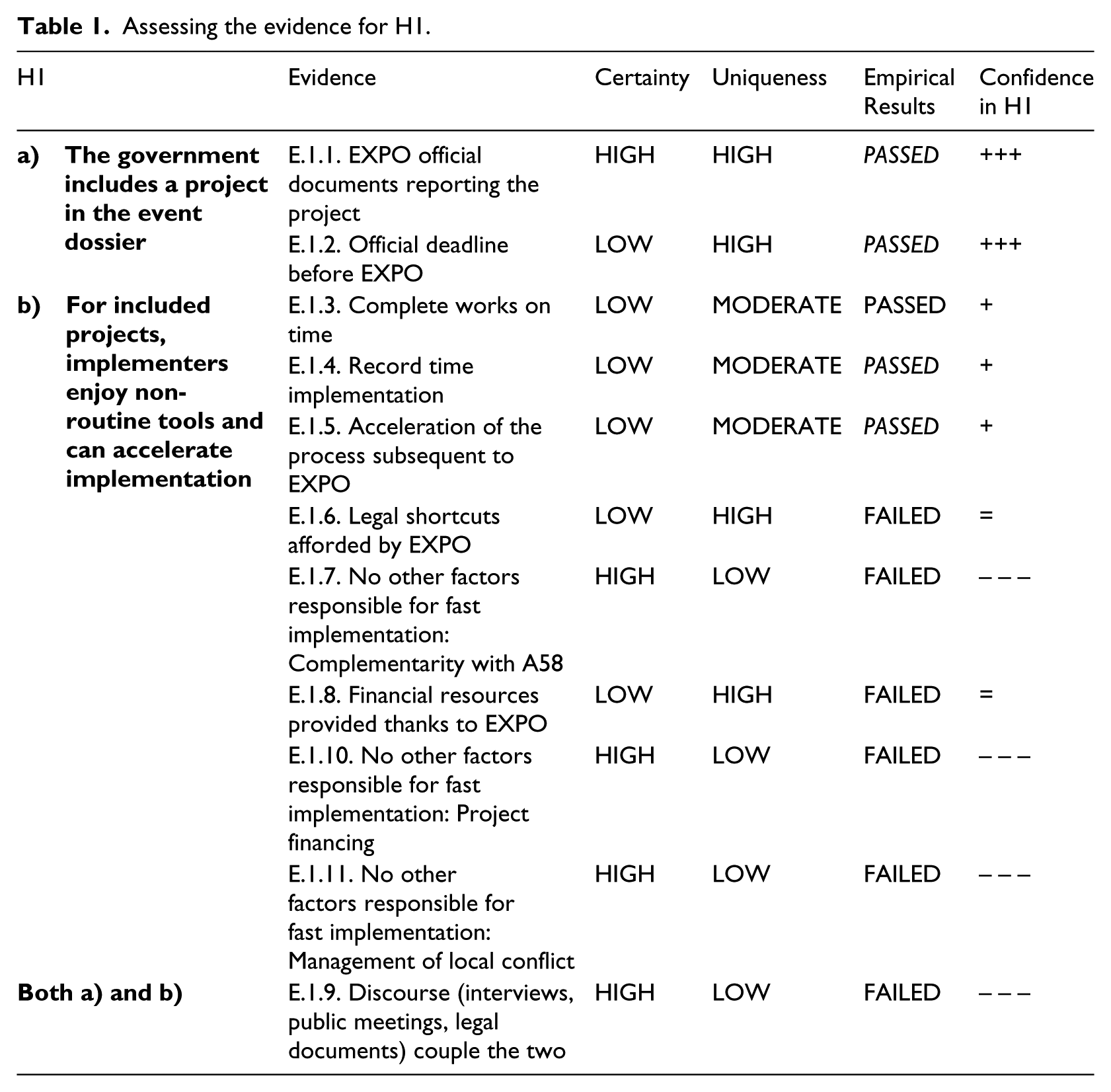
Based on the informal discussion in the previous section as summarized in Table 1, we see that H1 failed 6 of 11 tests. While part a) is clearly confirmed by passing two tests with high uniqueness, part b) presents a mixed evidentiary picture. Part b) is fundamental for H1, as inclusion among the official projects is certainly a precondition but does not in any way ensure a privileged implementation context.
In relation to part b), tests E.1.3.–E.1.5. were successfully passed. These relate to completion of the works and to timing and pace. The three tests exhibit some uniqueness, indicating that something special happened in the decision-making and implementation phases of the A58 project, but no unequivocal EXPO effect can be identified. In this respect, while E.1.6. and E.1.8. – two smoking guns relating to special procedures and funds – are not unduly problematic, the failures in all tests regarding concurrent factors (E.1.7., E.1.10., E.1.11.) are strongly disconfirmatory. In fact, these hoop tests can explain the results for E.1.3.–E.1.5. in terms of complementarity with the A35, the structure of project financing, and the ability to mitigate local conflicts. All of these factors are unrelated to EXPO and clearly disconfirm part b) in H1. Finally, further disconfirmation comes from E.1.9. The fact that legal documents, newspapers, public declarations, and all interviewed actors denied any connection between the implementation of the highway and EXPO is particularly significant for one of the official EXPO infrastructures. In conclusion, by compounding the strength and results of the evidence collected, one can say that decision-making and implementation in the case of the East External Highway – although certainly special – are highly unlikely to be EXPO-related.
Not bread alone
Imagine you are having dinner in Milano. Tables, chairs, and dishes are the best of Italian design; the walls display some beautiful works of contemporary art; and a three-starred Michelin chef is cooking for you. However, you are not in the most exclusive restaurant in town – in fact, you are not even in a restaurant but in a soup kitchen for the poor. The chef is preparing the finest dinner you have ever had, but he is using leftovers and non-vendible food sourced from restaurants, supermarkets, and other donors. Refettorio Ambrosiano is such a place. Combining solidarity, art, and the fight against food waste, it is a place where the poorest can not only feed their material needs but restore their spirit: not a soup kitchen but a refectory.
Only six months before the EXPO, Refettorio Ambrosiano was an abandoned parochial theatre in Greco, a low-income neighbourhood next to Milan’s Central Station. To mark the Universal Exposition, the theatre was completely renovated. Politecnico di Milano donated the renewal project; the best Italian designers created 13 tables for the guests; renowned artists offered their works as decor. The kitchen, chairs, dishes, and all materials used for renovation were donated by sponsors and then assembled by Caritas. During the Universal Exposition, Refettorio Ambrosiano hosted 65 of the world’s most renowned chefs, cooking 150 meals each day by making ingenious use of the edible waste generated by EXPO 2015.
Refettorio Ambrosiano was not included in the official EXPO programme or in the interventions planned for the event; indeed it was totally unplanned until a few months before the exposition started. Nonetheless, the Refettorio was scheduled to open in time for the exposition; it had a functional connection with the event, and its focus on limiting food waste was possibly one of the best incarnations of the event theme. So, was it a consequence of EXPO 2015, or not?
Reasoning about the probative value of the evidence, matching the EXPO deadline can be seen as having high certainty (E.2.1.); PEs looking to sell their project as part of the event certainly cannot set a different deadline. In the case of Refettorio Ambrosiano, it opened on 4 June 2015 – one month after the mega-event started.
Interestingly, the renovation was incredibly fast, completed in less than six months. This is explained in part by the fact that the works were completed by Caritas, a private organization that is therefore exempt from the complex rules governing public works. However, commenting on the renovation of the abandoned theatre, interviewees confirmed that they were rushing to comply with the EXPO deadline (E.2.2.). This offers a highly unique indication that PEs wanted to couple their innovation with the mega-event. (It is hard to think of alternative explanations or to view this as cheap talk on the part of the interviewees.) In this respect, it can be understood as a smoking gun in favour of H2.
Congruency to the topic (E.2.3.) has high certainty. Indeed, PEs willing to exploit the saliency of the mega-event would need to promote their innovation by matching the event theme, and the ideas of fight against food waste and chefs’ social responsibility were congruent with EXPO. In addition, during EXPO, invited chefs reused about 10 tons of leftovers, expiring food, and overripe vegetables and fruits, coming from the exposition. Each night, food was collected and packed at the event site, and each morning, it arrived at Refettorio Ambrosiano, where chefs explored the day’s ingredients and wondered how to cook them. For the first five months of its life, the Refettorio was to work in perfect symbiosis with the event; no surprise, then, that the media typically associated the Refettorio with EXPO. A web search of two major Italian newspapers (Repubblica and Corriere della Sera) for the EXPO period returned 58 articles for Refettorio Ambrosiano, of which 45 associated the Refettorio with EXPO.
The idea’s emergence provides an even stronger clue that PEs reacted to the mega-event in crafting their project (E.2.4.). Certainly, Refettorio Ambrosiano was not on the agenda before the mega-event; the idea was presented publicly for the first time in April 2014, just a year before the EXPO. Its promoter was Massimo Bottura, a three-starred Michelin chef, who was going to open the first day of Identità Expo, a sort of temporary restaurant within the event site, where the best international chefs would prepare original menus. However, Bottura was not satisfied with such ‘elite’ involvement and started thinking about a further contribution to the event: a place within the EXPO site where chefs could reuse the event’s leftovers.
In December 2013, at a restaurant vernissage in Milan, Bottura met Davide Rampello, who was then curating the so-called Pavilion Zero – the introductory EXPO pavilion dedicated to the history of humanity, nature, and food. Rampello committed to the idea, but immediately suggested one important change; the Refettorio had to be outside the EXPO site. In his work on the Zero Pavilion, Rampello had in fact realized that it was important to work on something that would last longer than the six-month display. The Refettorio had to be a permanent legacy.
The brief reconstruction made here clearly points to EXPO. The idea was born in response to the event in a double respect; inspired by the event theme, it was modified to contrast with EXPO’s temporary nature. Both Bottura and Rampello were involved in EXPO, and they were stimulated by their reflections on its theme. In light of how the idea was born, we have a positive smoking gun.
The project had another distinctive element. It was not to be an ordinary soup kitchen but a refectory. This meant providing a place where guests could find not only a meal but also relief. It had to be beautiful, quiet, and restorative. In practical terms, this meant allocating more resources than to a typical soup kitchen. An examination of how those resources were raised generates some relevant smoking gun tests for part b) in H2. In fact, although not certain proof of an EXPO effect on implementation, finding that EXPO actors or resources made the project possible is a highly unique clue. This can be said of four elements: the involvement of artists and designers (E.2.5.), the set-up of place and activities (E.2.6.), the involvement of starred chefs (E.2.7.), and the fund-raising and donations (E.2.8.).
First, the idea of a beautiful dining place had a direct model in Milan – the famous Refectory in Santa Maria delle Grazie, where Leonardo da Vinci had painted the Last Supper. The idea came from Rampello and was realized by means of his personal network. In fact, he had been president of the Triennale – the major Italian institution for design – and had easy access to Politecnico di Milano and to contemporary artists and designers. We can say that EXPO had no significant effect in this regard (E.2.5.).
Second, providing a quiet place aligned perfectly with the aspirations of Caritas, the future owner and manager of the Refettorio, as helping the poor and providing meals to the disadvantaged is among their typical activities. However, Caritas did not want another soup kitchen, as several religious institutions already provided meals for the municipality. Instead, they wanted to experiment with a different model. Refettorio would host a limited number of guests, admitted for three months as part of a special programme of recovery. They found the little parochial theatre and reached a leasing agreement with the local church. In respect of H2, this is again a failed smoking gun, as the labour, organization of activities, and set up of the space were totally within Caritas’ own network and resources (E.2.6.).
The third special feature of Refettorio Ambrosiano was certainly the exceptional quality of the meals. This is certainly a consequence of Bottura’s personal network, as he managed to bring 65 chefs to the Refettorio. Interestingly, some of those chefs came to Milan on EXPO days for the specific purpose of cooking there. However, one might reasonably speculate whether this would have been possible without the parallel presence of EXPO. In fact, most of those chefs were also participating in EXPO through Identità Expo or other culinary events. A pre-post comparison during and after EXPO revealed that their presence at the Refettorio understandably diminished when the mega-event ended. Chefs would have not come if not invited by Bottura, but the appeal of EXPO undoubtedly helped (E.2.7.).
In this regard, the company sponsoring Identità Expo offered to provide the chefs’ logistics for Refettorio. More generally, the mega-event had a strong effect in attracting donors (E.2.8.). Almost all the companies sponsoring Refettorio Ambrosiano were in fact involved in EXPO as either official partners, exhibitors, or contributors to pavilions. These included the companies providing the website (also running the EXPO website), the copper for the big hood in the Refettorio kitchen (contracted for a pavilion covered in about 1000 m2 of copper), and the lighting (with a presence in several pavilions).
Interviewed on the future of Refettorio Ambrosiano after EXPO, Luciano Gualzetti, director of Caritas, portrayed the mega-event ‘as a way to catalyse many donors and public figures that could support the project’ (31 July 2015; youtu.be/WzHBopVadns). As further confirmation after the event, Massimo Bottura created Food for Soul, an NGO to keep the attention on fighting food waste. Unsurprisingly, the NGO’s projects include a new Refectory in Rio for the 2016 Olympics. Commenting on the Rio project, the staff of Food for Soul confirmed the importance of the mega-event for the start-up.
Testing H2
In terms of the prior likelihood of H2, a mega-event is a critical juncture for a city or country and certainly offers a special context for PEs as a showcase for new projects and the potential to reach a greater public. However, this is no more than a window of visibility for innovations that would have been realized anyway. In the present context, the mega-event should stimulate PEs and provide otherwise unavailable resources. Here, congruency with the event theme certainly indicates an effect, but as mentioned above, most projects staged in the event period will display some elements of congruency. Overall, H2 is demanding, and a cautious estimate would set the prior low.
In Table 2 below, we have summarized the evidence collected, reporting probative values, empirical results, and the evidentiary impact on confidence in H2.
Assessing the evidence for H2.
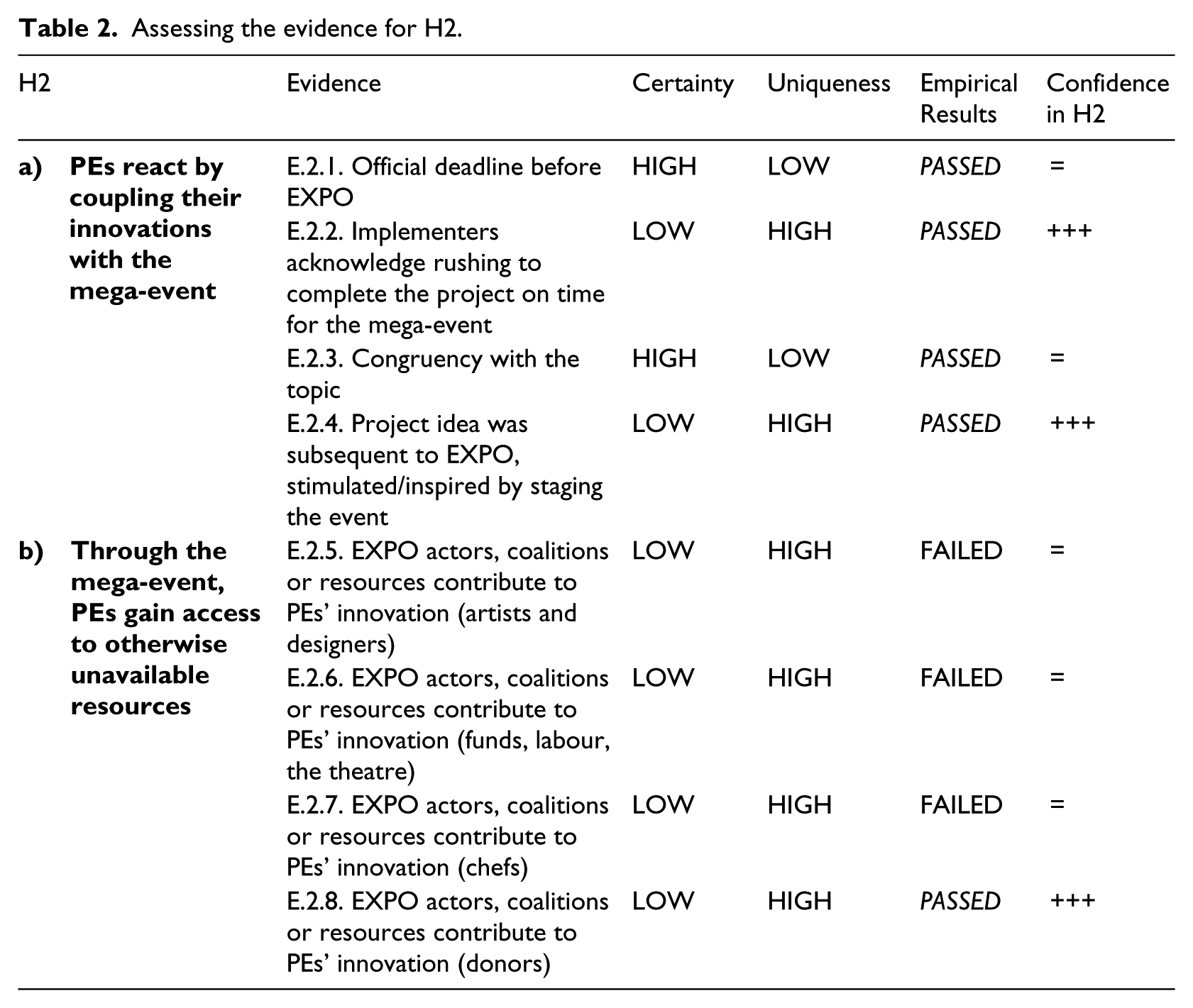
Looking at the evidence, we can see that H2 passed five tests out of eight. Concerning part a), Table 2 shows that four tests were passed: two hoop tests (E.2.1. and E.2.3.) and two smoking guns (E.2.2. and E.2.4.). However, passing the hoop tests is not particularly significant. As all entrepreneurs will try to ‘use’ the mega-event, if only in a symbolic way, projects with parallel deadlines and congruency with the event theme will abound. In fact, those tests have a high likelihood of false positive, and passing them does not provide great corroboration for a). Instead, the more solid evidence is that implementers were rushing to complete the works (E.2.2.). This means that they spent more resources, so increasing the likelihood that they sought to couple their innovation with EXPO. Most importantly, by reconstructing how the project came out, it is clear that the idea was stimulated profoundly by the opportunity of staging the event. This evidence (E.2.4.) is a passed smoking gun, significantly increasing confidence in part a).
As to part b), failing E.2.5.–E.2.7. has no dramatic negative impact. In fact, one should not expect the mega-event to provide all needed resources but instead to increase the ordinary pool in the hands of implementers (i.e. the evidence has low certainty). In this respect, passing E.2.8. increases confidence in b) by showing that EXPO significantly changed the implementation settings for innovators.
Given the strength of the evidentiary material collected, it is reasonable to conclude that both parts of H2 are corroborated by the empirical material, so that we can increase our confidence in the hypothesis.
Conclusions
In relation to theory building, we can agree that PT guidelines push researchers to deepen their causal understanding. Translating the general idea of mega-events as favourable contexts, the two different hypotheses helped to illuminate the possible causal roles of mega-events. It should also be noted that the two hypotheses presented here do not exhaust the causal mechanisms linking mega-events and implementation. In this respect, the benefits of searching for more explicit causal claims cannot be underestimated, as this may expose a diverse array of causal paths.
Proceeding from H1 and H2 in diagrammatic form, it was possible to articulate the implications of the hypotheses and so refine the search for evidence. It is worth noting, for instance, that evidence that has high certainty for H1 (such as inclusion among official projects) is not so for H2. Conversely, congruency with the event theme has low certainty for H1, but this is high for H2. These examples indicate an improved ability to appreciate ‘what is evidence of what’ and its significance for different parts of the hypotheses. This is also a relevant addition to the transparency of the process.
The two cases included several elements of ambiguity that invited contrasting conclusions. For instance, the A58 was among the official EXPO projects, was completed on time for the event, and was built in record time. The Refettorio was congruent with the EXPO theme but was unplanned and apparently within the ordinary capacity of its promoters. The informal Bayesian reasoning used here is certainly a powerful tool for assessing the weight of evidence and serves to guide judgment of contrasting evidentiary material of this kind.
A further issue concerns whether the same conclusions would have been reached without using the PT method. In the case of the A58, where there was mixed evidence but no clear criterion for discerning probative values, one would have had less confidence in discarding H1. Additionally, knowing that the positive hoop tests had no significant confirmatory power clearly invited deepening of the search for evidence. In the case of Refettorio Ambrosiano, however, one would have probably reached the same conclusion but for the wrong reasons. It seems likely that one would have been satisfied with the strength of the functional connection with EXPO, ultimately equating this with a causal consequence.
In conclusion, PT is certainly a valuable addition to the qualitative researcher’s toolbox, helping to increase the rigour of investigation of unique events. In particular, informal Bayesian reasoning provides clear, rigorous, and transparent criteria for determining the significance of the evidence and a powerful tool for weighting contrasting evidence, assessing its probative value, and appreciating its impact.
Footnotes
Funding
This research received no specific grant from any funding agency in the public, commercial, or not-for-profit sectors.